 Daniela Cristiano1†
 Maria Francesca Peruzy2*†
 Silvia Castellano1
 Andrea Mancusi1
 Yolande Thérèse Rose Proroga1
 Elisabetta Delibato3Roberta Mazzocca2
 Rosa Luisa Ambrosio2
 Nicoletta Murru2,4
- 1Department of Food Microbiology, Istituto Zooprofilattico Sperimentale del Mezzogiorno, Naples, Italy
- 2Department of Veterinary Medicine and Animal Production, University of Naples Federico II, Naples, Italy
- 3Department of Food Safety, Nutrition and Veterinary Public Health, Istituto Superiore di Sanità, Rome, Italy
- 4Task Force on Microbiome Studies, University of Naples Federico II, Naples, Italy
Introduction: Conventional methods for Salmonella detection in food samples are time-consuming, often requiring up to 5 days for pathogen identification. To prevent the distribution of contaminated foods on the market, rapid methods for early Salmonella detection are urgently needed, especially within the food industry, where timely responses are critical to public health and supply chain management. The aim of the present study was to evaluate a rapid strategy based on Real-Time PCR for detecting Salmonella in various food matrices.
Methods: Several approaches were tested to rapidly detect Salmonella in experimentally contaminated leafy greens, minced meat, mozzarella cheese, and mussel samples. The protocols included two DNA extraction methods (boiling and Chelex 100), two enrichment broths (BPW and BPW supplemented with RAPID’Salmonella Capsules), and two incubation temperatures (37 °C and 42 °C).
Results: Using preheated BPW at 41.5 °C overnight, Salmonella was detectable within 4 h when DNA was extracted via the Chelex 100 method.
Discussion: The application of this rapid, automated, and low-cost analytical strategy could enable both food business operators and competent authorities to significantly enhance the control of food products. This method may represent an innovative tool for improving the assessment of epidemic outbreaks, ensuring not only food safety but also rapid diagnosis during emergencies.
1 Introduction
Each year, foodborne pathogens are responsible for over half of all food-related illnesses worldwide. Among these pathogens, Salmonella stands out as a major contributor, causing hundreds of thousands of deaths annually (Yang et al., 2018; Kim et al., 2021). In the European Union (EU), Salmonellosis is the second most frequently reported zoonosis and the major cause of foodborne outbreaks. In 2023, a total of 77,486 cases of human salmonellosis were reported in EU with a notification rate of 18.0 per 100,000 population (EFSA, 2024). In Italy, salmonellosis is the most reported foodborne infection, with over 3,500 cases reported annually (Leati et al., 2021). Salmonella infection in humans usually manifests as self-limiting gastroenteritis with nausea, abdominal cramps, vomiting, and diarrhea. Still, in some cases, it can be life-threatening, especially in young children (<5 years), the elderly, and immunocompromised adults (Liu et al., 2022).
The genus Salmonella consists of two species: Salmonella enterica and Salmonella bongori. Salmonella enterica (S.) can be further divided, into six subspecies and according to its surface antigens (O and H) into over 2,600 serotypes of which 99% are associated with animal and human infections (Ferrari et al., 2019). In 2023, the most commonly reported Salmonella serovars in human infections were S. enteritidis, S. typhimurium and monophasic S. typhimurium, 1,4,[5],12:i:-. Salmonella serovars live in the gastrointestinal tract of a wide range of domestic and wild animals. They can reach humans following direct contact with infected animals or via the consumption of contaminated foods. The pathogen can survive in all kinds of foods, e.g., meat, meat products, fish, fishery products, fruit, vegetables, spices, and herbs (Peruzy et al., 2022). The main sources of human infection are eggs and egg products, followed by pig meat and products thereof and bakery products (EFSA, 2022). However, a wide range of foods such as dairy products and vegetables has been implicated in salmonellosis. Several factors occurring from production to consumption, such as poor hygiene during slaughtering or harvesting, processing, transportation, and manipulation, may contribute to the survival of Salmonella in such foodstuffs (Ehuwa et al., 2021).
At the European level (EU), an integrated approach has been implemented for the control of Salmonella from farm to fork, with control programs conforming to European legislation (Wang et al., 2021). According to the Reg. (EC) 2073/2005 and any subsequent amendment, an absence of Salmonella is required in different food categories such as minced meat and meat preparation, dairy products, ready-to-eat vegetables and mussels. Pathogen isolation is generally performed through analytical reference methods which are reliable and sensitive but long and time-consuming. The ISO method (ISO 6579-1:2017/Amd 1:2020) for pathogen detection involves the use of different agar media after a pre-enrichment, in buffered peptone water and selective enrichment phases which allow the pathogen’s growth but prolong the detection time (Wang et al., 2021). Therefore, the whole process, considering also the biochemical and serological confirmation, takes up to at least 5 days to confirm the presence of the pathogen (Wang et al., 2021). The timing of analyses is incompatible with the need for early detection of Salmonella in food, to both intervene rapidly and prevent the distribution of contaminated food and in the event of epidemic outbreaks (Heymans et al., 2018). Molecular-based approaches have become increasingly important in microbial identification and diagnostics due to their high reliability, accuracy, and specificity (Awang et al., 2021). Among these, PCR-based methods have been extensively applied for the detection of Salmonella in pre-enriched food samples (Machado et al., 2019; Öz et al., 2020; Liu et al., 2022). However, these assays often remain time-consuming or technically demanding. For instance, Zhai et al. (2019) developed a real-time NASBA assay with high specificity and sensitivity for viable Salmonella cells, but requiring a 12-h pre-enrichment step. Conversely, Liu et al. (2022) proposed a CRISPR/Cas12a-based RPA assay suitable for on-site detection, yet its implementation involves complex optimization procedures and specialized reagents. Furthermore, many of these molecular assays have been optimized for a single food matrix, limiting their broader applicability. The present study aimed to develop a rapid and versatile qualitative Real-Time PCR method for Salmonella detection across different food matrices, with a total analysis time of approximately 7 h.
2 Materials and methods
2.1 Food samples for the detection of Salmonella in experimentally contaminated foods
Leafy greens (LG), minced meat (MM), water buffalo mozzarella cheese (WBMC), and mussels (M) samples were purchased in different supermarkets in the Campania Region (South Italy). All samples of around 200–300 g were transported at 4 °C to the laboratory within 1 h. Samples were analyzed before Salmonella strain’s inoculum with the ISO 6579-1:2017/Amd 1:2020 to evaluate the absence of the pathogen.
2.2 Salmonella strains
Salmonella Typhimurium, collected from the Salmonella Collection of the Salmonella Typing Center of the Campania Region (Department of Food Microbiology, Istituto Zooprofilattico Sperimentale del Mezzogiorno, Portici, NA, Italy), was used to contaminate food samples. Strains were cultured twice in nutrient agar (NA; CM0003, Oxoid, Basingstoke, UK) and incubated at 37 °C for 24 h. Colonies were then transferred in Buffered Peptone Water (BPW; CM0509, Oxoid, Basingstoke, UK). Contamination levels were determined by counting on Plate Count Agar (PCA; CM0325, Oxoid). Food samples were contaminated by dipping at low (1–10 CFU/25 g – LC) and high (10–102 CFU/25 g – HC) levels.
2.3 Detection of Salmonella in experimentally contaminated samples by using different extraction methods
2.3.1 Experimental contamination of the food matrix
Twenty-five grams of leafy green were placed in a sterile stomacher bag and homogenized for 3 min at 230 rpm using a peristaltic homogenizer (BagMixer®400 P, Interscience, Saint Nom, France) after the addition of 225 mL of sterile BPW. Each homogenate was inoculated with 1 mL of dilutions with the low and high levels as indicated in Section 2.2. Seeded samples were incubated at 37 °C for 20 h. During this phase, 2 mL of pre-enrichment media at different incubation times (0, 2, 4, 5, 6, 7, 8 and 20 h) were collected and subjected to DNA extraction.
2.3.2 DNA extraction
DNA was extracted from each homogenate at time zero (T-0) and after 2 (T-2), 4 (T-4), 5 (T-5), 6 (T-6), 7 (T-7), 8 (T-8), and 20 (T-20) hours of incubation. DNA from leafy green homogenate was extracted by using the boiling (section 2.3.2.1) and Chelex 100 (section 2.3.2.1) methods.
2.3.2.1 Boiling method
One mL of each homogenate was transferred into a 2 mL tube. The cell suspension was centrifuged for 10 min at 14,000 g. The supernatant was discarded carefully and the pellet was resuspended in 100 ul of DNase-RNase free distilled water by vortexing. The solution was incubated for 10 min at 100 °C and centrifuged for 5 min at 14,000 g at 4 °C. An aliquot of 5 μL of the supernatant was used as the template DNA in the real time PCR.
2.3.2.2 Chelex 100 method
One or 10 mL of each homogenate were transferred into a 2 mL tube or 15 mL tube, and centrifuged for 10 min at 10,000 × g at 4 °C. The supernatant was discarded, and the pellet was re-suspended in 300 μL of 6% Chelex 100 by vortexing and incubated at 56 °C for 20 min and further 8 min at 100 °C. The suspension was immediately chilled on ice for 1 min, and centrifuged for 5 min at 10,000 g at 4 °C. An aliquot of 5 μL of the supernatant was used as the template DNA in the real time PCR.
2.3.3 Real-time PCR (qPCR)
To evaluate the presence of Salmonella, the iQ-Check Real-Time PCR Kit (Bio-Rad, Hercules, CA, United States) was used following the manufacturer’s recommendations. The assay is based on the amplification and detection of a specific Salmonella spp. DNA target using fluorescent probes. Each reaction was prepared by combining 5 μL of extracted DNA with 45 μL of PCR master mix, for a total reaction volume of 50 μL. Amplifications were carried out with a total run time of approximately 1 h 10 min.
Fluorescence data were analyzed using the Bio-Rad CFX Manager software, and results were interpreted following the manufacturer’s criteria, taking into account the amplification curve profile and the internal control response. Samples were considered positive when the specific amplification curve was observed with a Ct value ≤ 45 and a valid internal control signal. Late Ct values approaching the assay cut-off were interpreted as indicative of a very low concentration of target DNA. This interpretation is consistent with the analytical sensitivity and detection limits established in the AFNOR-certified and ISO 16140-2 validation study of the method.
2.4 Detection of Salmonella in experimentally contaminated samples by using different broths and incubation temperatures
2.4.1 Experimental contamination of the food matrix
Twenty-five grams of leafy green, minced meat, and water buffalo mozzarella cheese samples were placed in sterile stomacher bags and homogenized for 3 min at 230 rpm using a peristaltic homogenizer (BagMixer®400 P, Interscience, Saint Nom, France) after the addition of 225 mL of BPW. For half of the samples, a RAPID’S Salmonella Capsule (3564710, Bio-Rad, Hercules, California, United States) was added to the BPW (BPWC). Each homogenate was inoculated with 1 mL of low- and high-level dilutions as described in Section 2.1. Homogenates containing the RAPID’S Salmonella Capsule were incubated at 42 °C, whereas those without the capsule were incubated at 37 °C, both for 20 h. During incubation, aliquots of pre-enrichment media were collected at various time points and subjected to DNA extraction (see Section 2.4.2).
2.4.2 DNA extraction and real-time PCR
DNA was extracted from 20 mL of each homogenate at time zero (T-0) and after 2 (T-2), 4 (T-4), 5 (T-5), 6 (T-6), 7 (T-7), 8 (T-8), and 20 (T-20) hours of incubation by using the Chelex 100 (section 2.3.2.2) method. Real-time PCR was performed by using the “iQ-Check Real-Time PCR Kit” (section 2.3.3).
2.5 Detection of Salmonella in experimentally contaminated samples by using pre-heated BPW
2.5.1 Experimental contamination of the food matrix
Twenty-five grams of leafy green, minced meat, water buffalo mozzarella cheese, and mussels samples were placed in a sterile stomacher bag and homogenized for 3 min at 230 rpm using a peristaltic homogenizer (BagMixer®400 P, Interscience, Saint Nom, France) after the addition of 225 mL of sterile overnight-preheated Buffered Peptone Water (BPW; CM0509, Oxoid, Basingstoke, UK). Before use, BPW was heated overnight at 41.5 °C.
Each homogenate was inoculated with 1 mL of dilutions with the low and high levels as indicated in Section 2.1. Seeded samples were incubated at 37 °C for 20 h.
2.5.2 DNA extraction and real-time PCR
DNA was extracted from 1 of each homogenate after 4 (T-4), 5 (T-5), 6 (T-6), and 20 (T-20) hours of incubation by using the Chelex 100 (section 2.3.2.2) method. Real-time PCR was performed by using the “iQ-Check Real-Time PCR Kit” (section 2.3.3).
2.6 Statistical analysis
All quantitative PCR (qPCR) data were statistically analyzed to assess the influence of the inoculum level, extraction method, and incubation time on Salmonella detection efficiency. Cycle threshold (Ct) values were considered continuous variables indicative of the amount of amplifiable target DNA.
Prior to inferential testing, the data were examined for normality (Shapiro–Wilk test) and homogeneity of variance (Levene’s test). When these assumptions were met, two-way analysis of variance (ANOVA) was used to evaluate the main effects of inoculum level (low vs. high) and extraction method (Boiling vs. Chelex-100), including their interaction. For non-normally distributed data, equivalent non-parametric Kruskal–Wallis tests were applied.
Pairwise comparisons between extraction methods within each inoculum level were performed using paired Student’s t-tests, based on Ct values measured at identical incubation times. In a separate analysis, the effect of sample volume (1 mL vs. 10 mL of homogenate) extracted using the Chelex-100 method was similarly evaluated by paired t-tests to determine whether increasing the extraction volume improved detection sensitivity.
The relationship between incubation time and Ct decrease was modeled using simple linear regression (Ct = β₀ + β₁·time), and regression slopes were compared between treatments to estimate the rate of DNA detection improvement over time. Descriptive statistics (mean ± SD) were computed for each condition, and data visualization was performed through ggplot2 in R software (v.4.3.0; R Foundation for Statistical Computing, Vienna, Austria). Statistical significance was set at p < 0.05.
3 Results
3.1 Early detection of Salmonella in spiked leafy greens using alternative DNA extraction methods
In the first trial, both the boiling and chelex-100 protocols were employed to extract bacterial DNA from 1 mL of homogenized leafy green samples. Both methods proved effective for the early detection of Salmonella in vegetables, with positive results obtained from the 5th hour of incubation at the lowest contamination level (0–10 CFU/25 g) and from the 4th hour at the highest level (10–102 CFU/25 g), respectively (Table 1).
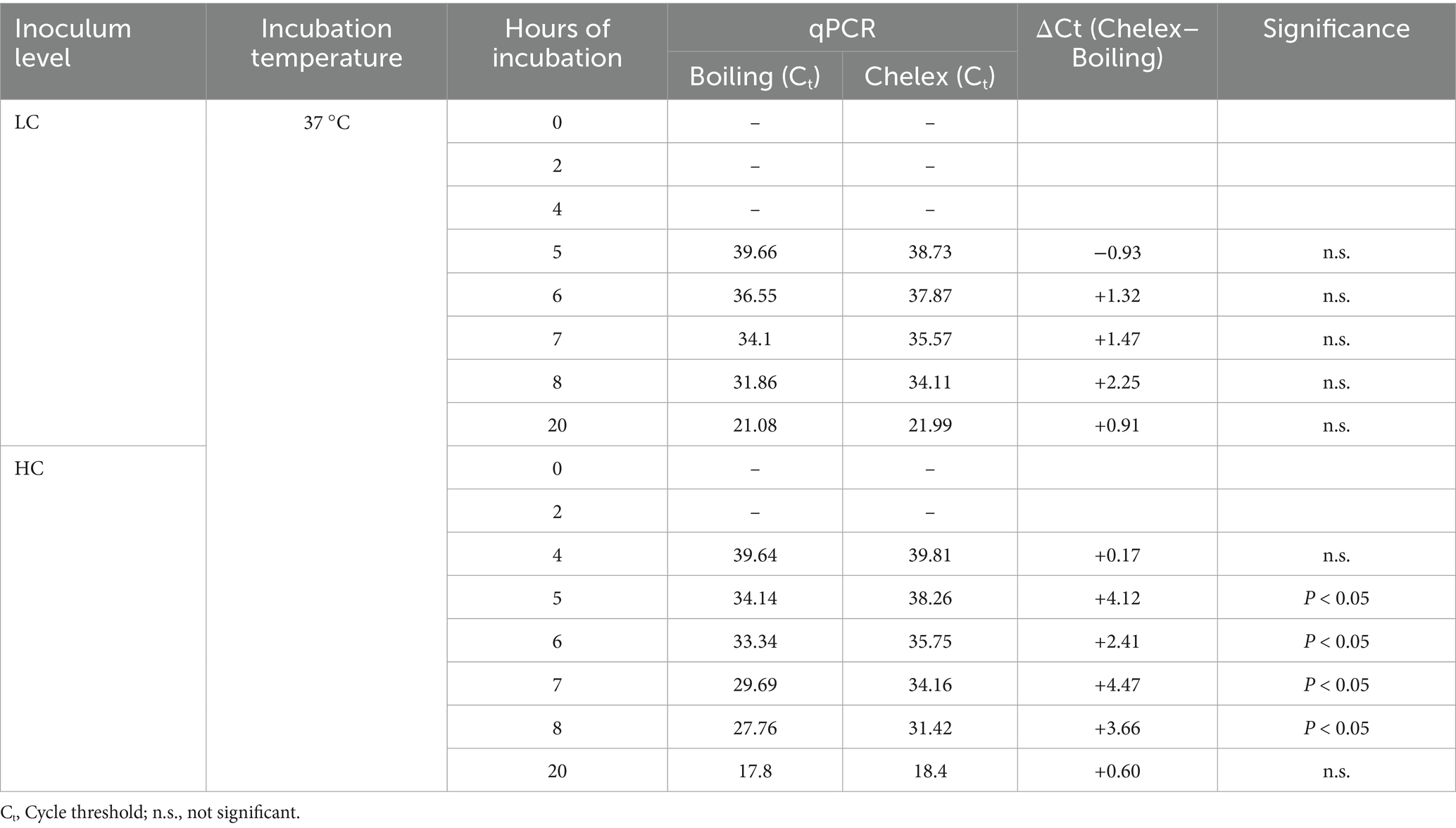
Table 1. Detection of Salmonella by using the Boiling and Chelex 100 method from 1 mL of homogenate of leafy greens artificially contaminated with two bacterial levels (LC, low = 1–10 CFU/25 g; HC, high = 10–102 CFU/25 g) and incubated for 20 h.
Cycle threshold (Ct) values decreased progressively with incubation time across all samples, indicating a time-dependent increase in Salmonella DNA detectability. Samples inoculated at high contamination levels (HC) exhibited consistently lower Ct values compared to low contamination (LC) samples, confirming faster detection at higher bacterial loads.
Between extraction methods, the boiling protocol yielded slightly lower mean Ct values than the chelex-100 method in both LC and HC samples (mean ΔCt = +0.6 and +1.9, respectively). This difference was statistically significant only at the high contamination level (t = 3.32, p = 0.02). Linear regression analysis showed a comparable overall decrease of approximately 2 Ct units per hour for all treatments, with Boiling displaying marginally steeper slopes, suggesting a faster DNA detection rate.
Leafy greens were again used as the food matrix in a subsequent trial, where DNA extraction was performed from 10 mL of the incubated homogenate instead of 1 mL. However, the detection time remained unchanged, with Salmonella being identified at 4 h for the highest inoculation level and 5 h for the lowest (Table 2). Comparison of extraction volumes revealed that using 10 mL of homogenate yielded slightly lower mean Ct values than 1 mL (ΔCt ≈ 0.4), but the difference was not statistically significant for either contamination level (LC: t = 1.06, p = 0.35; HC: t = 0.96, p = 0.38). Linear regression analysis showed parallel trends for both extraction volumes (slope ≈ − 2 Ct h−1), indicating that increasing the extracted volume did not appreciably enhance the detection rate of Salmonella under the tested conditions.
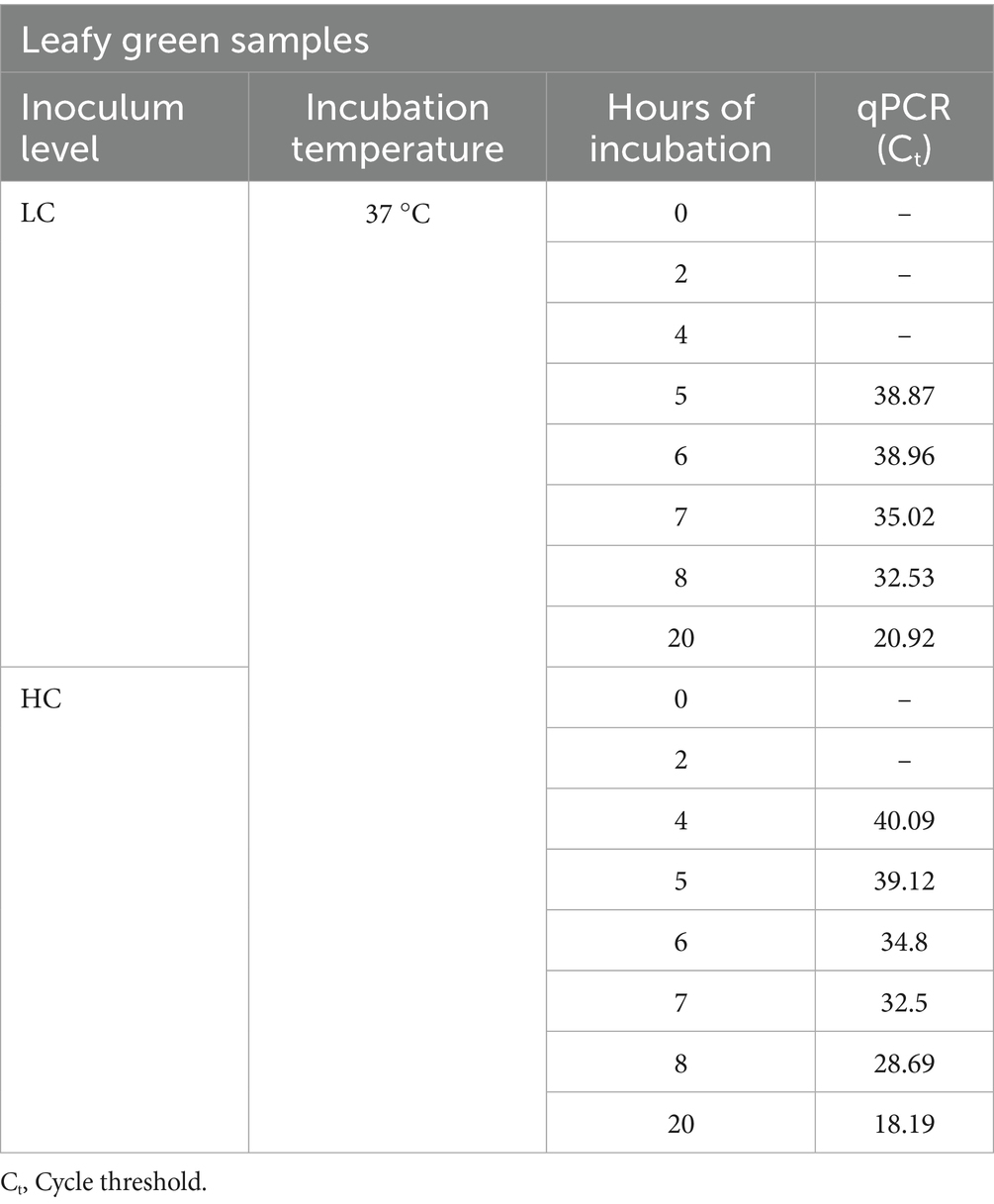
Table 2. Detection of Salmonella by using the Chelex 100 method from 10 mL of homogenate of leafy greens artificially contaminated with two bacterial levels (LC, low = 1–10 CFU/25 g; HC, high = 10–102 CFU/25 g) and incubated for 20 h.
3.2 Influence of broth composition and incubation temperature on the detection of Salmonella in spiked food samples
An additional strategy employed in the present study involved modifying the enrichment broth formulations and varying the incubation temperature. RAPID’S Salmonella capsules, which are selective supplements, were added to half of the samples prepared in BPW. In this trial, DNA extraction was performed using 20 mL of each incubated homogenate and the Chelex-100 method. The results obtained from homogenates incubated with the capsule are not shown, as the detection of positive samples was inconsistent and exhibited no clear temporal trend.
3.2.1 Detection in minced meat
In minced meat, Salmonella was detected from the 8th hour of incubation onwards in samples seeded at the lowest contamination level. In samples with the highest contamination level, detection occurred from the 6th hour onwards (Table 3).
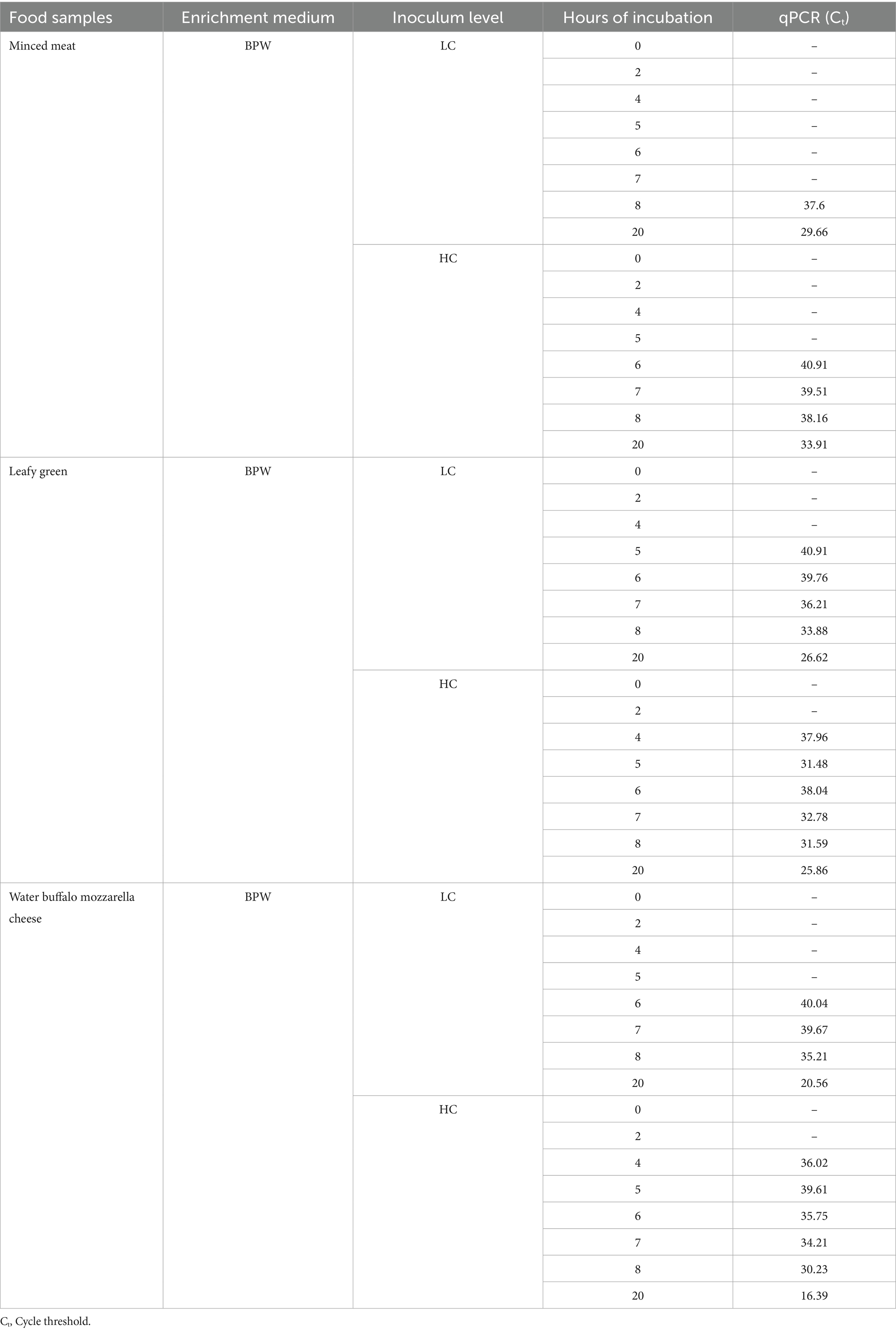
Table 3. Detection of Salmonella by using Chelex100 extraction method from 20 mL of homogenate of minced meat, leafy greens and water buffalo mozzarella cheese artificially contaminated with two bacterial levels (LC, low = 1–10 CFU/25 g; HC, high = 10–102 CFU/25 g) and incubated in Buffered Peptone Water (BPW) 20 h at 37 °C.
3.2.2 Detection in leafy greens
In leafy green samples, Salmonella was detected from the 5th hour of incubation onwards in samples seeded at the lowest contamination level, whereas in samples with the highest contamination level, detection occurred from the 4th hour onwards (Table 3).
3.2.3 Detection in water buffalo mozzarella cheese
In water buffalo mozzarella cheese, Salmonella was detected from the 6th hour of incubation onwards in samples seeded at the lowest contamination level, whereas in samples with the highest contamination level, detection occurred from the 4th hour onwards (Table 3).
3.3 Enhanced detection of Salmonella in spiked food samples using pre-heated buffered peptone water
In the final trial, BPW was preheated to 41.5 °C prior to sample inoculation. Salmonella was detected from the 4th hour of incubation in minced meat, mozzarella, and mussel samples, regardless of the bacterial load. In leafy green samples, detection failed only in the case of low-level contamination (Table 4).
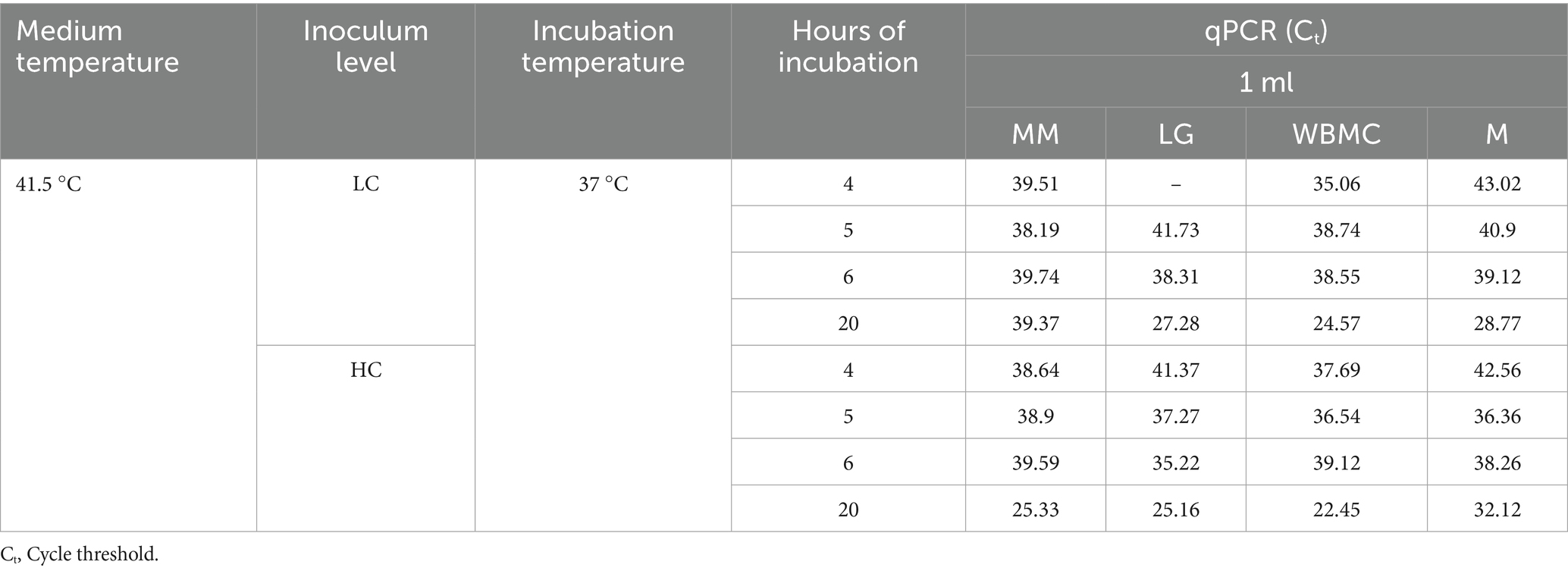
Table 4. Detection of Salmonella from 1 mL of minced meat (MM), leafy greens (LG), water buffalo mozzarella cheese (WBMC) and mussels (M) homogenates artificially contaminated with two bacterial levels (LC, low = 1–10 CFU/25 g; HC, high = 10–102 CFU/25 g CFU/g) and incubated in preheated buffered peptone water (41.5 °C) by using Chelex100 extraction method.
4 Discussion
Over the past few years, various cultural and molecular methods have been employed for the detection of Salmonella in food. Although these approaches are reliable, they are often lengthy and time-consuming (Machado et al., 2019; Liu et al., 2022). Conventional microbiological techniques typically require up to 4 days to confirm negative results and 6–7 days to identify positive isolates (Zhai et al., 2019). Compared with traditional plating methods, PCR offers greater speed and specificity, enabling the detection of sub-dominant bacterial populations directly in food samples or after enrichment (Cremonesi et al., 2014). However, the inclusion of an enrichment step has been shown to improve detection sensitivity by diluting inhibitory substances and enhancing Salmonella growth, which is why enrichment-based approaches remain the most widely used in routine testing (Dmitric et al., 2018). In the present study, several trials were conducted to evaluate these aspects.
4.1 Effectiveness of different DNA extraction protocols for the identification of Salmonella in artificially contaminated matrices
PCR-based methods require efficient DNA extraction protocols for accurate pathogen detection. Efficient extraction is particularly crucial in complex matrices, as inhibitory substances may compromise amplification (Kasturi and Drgon, 2017). In this study, two non-solvent, cost-effective, and rapid DNA extraction methods—boiling and Chelex-100—were evaluated. Commercial DNA extraction kits were not considered due to their high cost and operational complexity. Instead, the focus was placed on the boiling and Chelex-100 methods as practical alternatives for routine use in diagnostic applications (Pacheco et al., 2023).
In the first trial, both methods were effective for the early detection of Salmonella in vegetables, starting from the 5th hour of incubation at the lowest contamination level (1–10 CFU/25 g) and from the 4th hour at the highest level (10–102 CFU/25 g). This demonstrates that both extraction protocols are sufficiently sensitive to allow early pathogen recovery even in minimally contaminated matrices.
In an attempt to reduce the detection time, DNA extraction was performed using 10 mL of incubated homogenate instead of 1 mL. However, the detection time remained unchanged, with Salmonella being detected at 4 h for the highest inoculation level and 5 h for the lowest. This suggests that, at least for this matrix, increasing the extraction volume does not significantly enhance the sensitivity or accelerate detection. The comparison between DNA extraction volumes revealed that increasing the aliquot of homogenate from 1 mL to 10 mL did not significantly improve Salmonella detection efficiency when using the Chelex-100 extraction protocol. Although Ct values obtained from 10 mL samples were, on average, slightly lower than those from 1 mL samples (ΔCt ≈ 0.4), this difference was not statistically significant for either contamination level. This suggests that the extraction efficiency of the Chelex-100 method is not strongly dependent on the sample volume, at least within the tested range.
The absence of a clear improvement may be attributed to the limited recovery capacity of the resin and the saturation of chelating sites when processing larger sample volumes. Additionally, since both low and high contamination levels exhibited comparable time-to-detection trends, the total amount of target DNA present in 1 mL of enriched homogenate was apparently sufficient for reliable amplification.
These results support the use of smaller extraction volumes for routine qPCR detection, offering practical advantages in terms of reagent savings, reduced processing time, and simpler workflow without compromising analytical sensitivity. However, further testing on different food matrices or at lower contamination levels could clarify whether larger extraction volumes may confer benefits under more challenging detection conditions.
Although both the boiling and Chelex-100 methods yielded comparable results in this study, previous reports—such as that by Mohammadi et al. (2017)—have demonstrated that the Chelex-100 method produces higher-quality DNA. This resin exhibits a high affinity for polyvalent metal ions. During the extraction process, Chelex-100 promotes cell lysis through heat treatment, releasing DNA while simultaneously preventing its degradation by chelating metal ions that could otherwise catalyze nucleic acid hydrolysis (Yang et al., 2024). Although DNA quality was not directly assessed in our experiments, the superior performance reported in the literature led us to select the Chelex-100 method for subsequent analyses to ensure greater reliability and consistency.
4.2 Impact of broth formulations and incubation temperatures on Salmonella detection in experimentally contaminated samples
An alternative approach to reducing detection time involved modifying the enrichment broth formulations and incubation temperatures. Specifically, RAPID’S Salmonella capsules, used as selective supplements, were added to half of the samples prepared in BPW. Following the manufacturer’s recommendations for Salmonella recovery, homogenates containing the capsule were incubated at 42 °C. The results from these samples are not presented, as the detection of positive cases was sporadic and showed no consistent temporal pattern.
Overall, modifying incubation temperature and incorporating selective supplements influenced Salmonella detection. Although S. typhimurium has been reported to be thermotolerant at 45 °C (Pesingi et al., 2017), and elevated temperatures have been associated with a reduction in background flora (Daquigan et al., 2016), incubation at 42 °C did not improve detection efficiency in the present trials (Data not shown). Conversely, the standard incubation temperature of 37 °C, as recommended by ISO 6579-1:2017/Amd 1:2020, resulted in faster and more reliable pathogen recovery across these matrices. The diverse and complexity of food matrices pose great challenges for rapid and ultra-sensitive detection of Salmonella in food samples (Vinayaka et al., 2019).
In minced meat samples enriched in BPW, Salmonella was detected as early as 8 h post-incubation at the lowest contamination level, consistent with Josefsen et al. (2007) and Krämer et al. (2011), who reported a minimum incubation time of approximately 8 h for reliable PCR detection in meat products. At the highest contamination level, detection occurred earlier, at 6 h. In contrast, earlier detection was achieved in both leafy greens and water buffalo mozzarella cheese across contamination levels. For leafy green samples, increasing the homogenate volume used for DNA extraction to 20 mL enabled detection of Salmonella at the lowest contamination level from 6 h of incubation; however, recovery was not improved compared to smaller volumes (1 mL or 10 mL) and was slightly delayed (6 h versus 5 h). These findings suggest that matrix effects and bacterial distribution exert a greater influence on detection efficiency than absolute bacterial load in these food types.
4.3 Rapid detection of Salmonella in inoculated food samples using pre-heated BPW
In the present study, BPW was preheated to 41.5 °C. The use of preheated broth had a notable impact on Salmonella growth, enabling its detection after only a few hours of incubation. Salmonella was consistently detected in minced meat, mozzarella, and mussels starting from the 4th hour, regardless of bacterial load used (1 mL). In leafy greens, detection failed only when 1 mL of homogenate was used for low-level contamination at the 4-h mark.
The entire Salmonella detection process in the present study was completed in under 7 h, involving minimal handling and requiring no more than 4 h of culture enrichment. Notably, Salmonella was detectable even at low concentrations, which is critical given that ingestion of a single colony-forming unit (CFU) can potentially lead to infection (Wang et al., 2021).
Many recently proposed methods include short enrichment phases (depending on the food matrix) but involve complex sample preparation procedures that ultimately prolong the overall detection time (Wang et al., 2018; Du et al., 2021; Liu et al., 2022). In contrast, the protocol developed in the present study ensures a streamlined and time-efficient approach, combining simplified sample handling with rapid diagnostic output. qPCR was used as a qualitative method for Salmonella detection, offering enhanced sensitivity, speed, and safety compared to traditional endpoint PCR, which typically requires post-amplification steps, thereby providing a more practical and reliable tool for routine analysis (Machado et al., 2019; Sahu et al., 2019; Vinayaka et al., 2019; Peruzy et al., 2020). By integrating minimal enrichment time with qPCR and straightforward processing, the present study provides a practical and robust solution for the rapid detection of Salmonella in diverse food matrices.
5 Conclusion
In conclusion, this study combined multiple pre-detection strategies—including the use of different pre-enrichment broths, DNA extraction methods and enrichment volumes—with a molecular detection kit to establish a rapid and robust analytical workflow.
By preheating BPW at 41.5 °C overnight and extracting DNA using the Chelex 100 method, Salmonella was detectable as early as 4 h post-incubation. This approach enables pathogen detection in less than 7 h.
To our knowledge, this is the first study demonstrating the effectiveness of a single rapid protocol across a broad range of experimentally contaminated food matrices, including meat, cheese, vegetables, and mussels.
The key advantages of this method are its automation potential and suitability for high-throughput testing. The results presented here may support the implementation of a rapid, automated, and cost-effective strategy for routine Salmonella monitoring across various food supply chains. Furthermore, this approach could serve as a valuable tool for timely outbreak investigations, enhancing both food safety and emergency diagnostic response.
Data availability statement
The raw data supporting the conclusions of this article will be made available by the authors, without undue reservation.
Author contributions
DC: Formal analysis, Resources, Validation, Writing – original draft. MP: Data curation, Investigation, Validation, Visualization, Writing – original draft. SC: Methodology, Writing – original draft. AM: Validation, Writing – original draft. YP: Conceptualization, Project administration, Writing – review & editing. ED: Conceptualization, Writing – review & editing. RM: Investigation, Writing – original draft. RA: Writing – original draft, Investigation. NM: Conceptualization, Funding acquisition, Project administration, Writing – review & editing.
Funding
The author(s) declare that financial support was received for the research and/or publication of this article. This study was supported by the Italian Health Ministry-Grant IZS-ME 02/16 RC.
Conflict of interest
The authors declare that the research was conducted in the absence of any commercial or financial relationships that could be construed as a potential conflict of interest.
Generative AI statement
The authors declare that no Gen AI was used in the creation of this manuscript.
Any alternative text (alt text) provided alongside figures in this article has been generated by Frontiers with the support of artificial intelligence and reasonable efforts have been made to ensure accuracy, including review by the authors wherever possible. If you identify any issues, please contact us.
Publisher’s note
All claims expressed in this article are solely those of the authors and do not necessarily represent those of their affiliated organizations, or those of the publisher, the editors and the reviewers. Any product that may be evaluated in this article, or claim that may be made by its manufacturer, is not guaranteed or endorsed by the publisher.
References
Awang, M. S., Bustami, Y., Hamzah, H. H., Zambry, N. S., Najib, M. A., Khalid, M. F., et al. (2021). Advancement in Salmonella detection methods: from conventional to electrochemical-based sensing detection. Biosensors 11:346. doi: 10.3390/bios11090346
Cremonesi, P., Pisani, L. F., Lecchi, C., Ceciliani, F., Martino, P., Bonastre, A. S., et al. (2014). Development of 23 individual TaqMan® real-time PCR assays for identifying common foodborne pathogens using a single set of amplification conditions. Food Microbiol. 43, 35–40. doi: 10.1016/j.fm.2014.04.007
Daquigan, N., Grim, C. J., White, J. R., Hanes, D. E., and Jarvis, K. G. (2016). Early recovery of salmonella from food using a 6-hour non-selective pre-enrichment and reformulation of tetrathionate broth. Front. Microbiol. 7:2103. doi: 10.3389/fmicb.2016.02103
Dmitric, M., Vidanovic, D., Matovic, K., Sekler, M., Saric, L., Arsic, M., et al. (2018). In-house validation of real-time PCR methods for detecting the INV a and TTR genes of Salmonella spp. in food. J. Food Process. Preserv. 42. doi: 10.1111/jfpp.13455
Du, M., Li, J., Liu, Q., Wang, Y., Chen, E., Kang, F., et al. (2021). Rapid detection of trace Salmonella in milk using an effective pretreatment combined with droplet digital polymerase chain reaction. Microbiol. Res. 251:126838. doi: 10.1016/j.micres.2021.126838
EFSA (2022). The European Union one health 2022 zoonoses report. EFSA J. 21:e8442. doi: 10.2903/j.efsa.2023.8442
EFSA (2024). The European Union one health 2023 zoonoses report. EFSA J. 22:e9106. doi: 10.2903/j.efsa.2024.9106
Ehuwa, O., Jaiswal, A. K., and Jaiswal, S. (2021). Salmonella, food safety and food handling practices. Foods 10:907. doi: 10.3390/foods10050907
Ferrari, R. G., Rosario, D. K. A., Cunha-Neto, A., Mano, S. B., Figueiredo, E. E. S., and Conte-Juniora, C. A. (2019). Worldwide epidemiology of Salmonella serovars in animal-based foods: a meta-analysis. Appl. Environ. Microbiol. 85, 1–21. doi: 10.1128/AEM.00591-19
Heymans, R., Vila, A., van Heerwaarden, C. A. M., Jansen, C. C. C., Castelijn, G. A. A., van der Voort, M., et al. (2018). Rapid detection and differentiation of Salmonella species, Salmonella typhimurium and Salmonella Enteritidis by multiplex quantitative PCR. PLoS One 13:e0206316. doi: 10.1371/journal.pone.0206316
Josefsen, M. H., Krause, M., Hansen, F., and Hoorfar, J. (2007). Optimization of a 12-hour TaqMan PCR-based method for detection of Salmonella bacteria in meat. Applied and Environmental Microbiology, 73, 3040–3048.
Kasturi, K. N., and Drgon, T. (2017). Real-time PCR method for detection of Salmonella spp. in environmental samples. Appl. Environ. Microbiol. 83:e00644-17. doi: 10.1128/AEM.00644-17
Kim, M.-J., Kim, H.-J., and Kim, H.-Y. (2021). Direct triplex loop-mediated isothermal amplification assay for the point-of-care molecular detection of Salmonella genus, subspecies I, and serovar typhimurium. Food Control 120:107504. doi: 10.1016/j.foodcont.2020.107504
Krämer, N., Löfström, C., Vigre, H., Hoorfar, J., Bunge, C., and Malorny, B. (2011). A novel strategy to obtain quantitative data for modelling: combined enrichment and real-time PCR for enumeration of salmonellae from pig carcasses. International Journal of Food Microbiology, 145:S86–S95.
Leati, M., Busani, L., Zaccherini, A., Ruocco, L., Amato, S. D., Villa, L., et al. (2021). The challenging task to select Salmonella target serovars in poultry: the Italian point of view. Epidemiol. Infect. 149:e160. doi: 10.1017/S0950268821001230
Liu, L., Zhao, G., Li, X., Xu, Z., Lei, H., and Shen, X. (2022). Development of rapid and easy detection of Salmonella in food matrics using RPA-CRISPR/Cas12a method. LWT 162:113443. doi: 10.1016/j.lwt.2022.113443
Machado, I., Garrido, V., Hernandez, L. I., Botero, J., Bastida, N., San-Roman, B., et al. (2019). Rapid and specific detection of Salmonella infections using chemically modified nucleic acid probes. Anal. Chim. Acta 1054, 157–166. doi: 10.1016/j.aca.2018.12.027
Mohammadi, S., Esfahani, B. N., Moghim, S., Mirhendi, H., Zaniani, F. R., Safaei, H. G., et al. (2017). Optimal DNA isolation method for detection of nontuberculous mycobacteria by polymerase chain reaction. Advanced Biomedical Research, 6:133.
Öz, Y. Y., Sönmez, Ö. İ., Karaman, S., Öz, E., Unal, C. B., and Karataş, A. Y. (2020). Rapid and sensitive detection of Salmonella spp. in raw minced meat samples using droplet digital PCR. Eur. Food Res. Technol. 246, 1895–1907. doi: 10.1007/s00217-020-03531-x
Pacheco, J. I. M., dos Anjos, K. B. A., Silva, I. V., Okar, R. G., Rodrigues, S. M. B. D., Francabandiera, A. I., et al. (2023). Comparison of two affordable DNA extraction methods for molecular detection of Salmonella isolates from broiler farm’s boot swabs. Res. Soc. Dev. 12:e28312139618. doi: 10.33448/rsd-v12i1.39618
Peruzy, M. F., Proroga, Y. T. R., Capuano, F., Corrado, F., Santonicola, S., De Medici, D., et al. (2020). Detection and quantification of campylobacter in foods: new analytic approaches to detect and quantify campylobacter spp. in food samples. Ital J Food Saf 9, 88–92. doi: 10.4081/ijfs.2020.8591
Peruzy, M. F., Proroga, Y. T. R., Capuano, F., Mancusi, A., Montone, A. M. I., Cristiano, D., et al. (2022). Occurrence and distribution of Salmonella serovars in carcasses and foods in southern Italy: eleven-year monitoring (2011–2021). Front. Microbiol. 13, 1–10. doi: 10.3389/fmicb.2022.1005035
Pesingi, P. K., Kumawat, M., Behera, P., Dixit, S. K., Agarwal, R. K., Goswami, T. K., et al. (2017). Protein-L-isoaspartyl methyltransferase (PIMT) is required for survival of Salmonella typhimurium at 42°C and contributes to the virulence in poultry. Front. Microbiol. 8:361. doi: 10.3389/fmicb.2017.00361
Sahu, B., Singh, S. D., Behera, B. K., Panda, S. K., Das, A., and Parida, P. K. (2019). Rapid detection of Salmonella contamination in seafoods using multiplex PCR. Braz. J. Microbiol. 50, 807–816. doi: 10.1007/s42770-019-00072-8
Vinayaka, A. C., Ngo, T. A., Kant, K., Engelsmann, P., Dave, V. P., Shahbazi, M. A., et al. (2019). Rapid detection of Salmonella enterica in food samples by a novel approach with combination of sample concentration and direct PCR. Biosens. Bioelectron. 129, 224–230. doi: 10.1016/j.bios.2018.09.078
Wang, J., Li, Y., Chen, J., Hua, D., Deng, H., Li, Y., et al. (2018). Rapid detection of food-borne Salmonella contamination using IMBs-qPCR method based on pagC gene. Braz. J. Microbiol. 49, 320–328. doi: 10.1016/j.bjm.2017.09.001
Wang, M., Zhang, Y., Tian, F., Liu, X., Du, S., Ren, G., et al. (2021). Overview of rapid detection methods for Salmonella in foods: progress and challenges. Foods 10:2402. doi: 10.3390/foods101
Yang, Q., Domesle, K. J., and Ge, B. (2018). Loop-mediated isothermal amplification for Salmonella detection in food and feed: current applications and future directions. Foodborne Pathog. Dis. 15, 309–331. doi: 10.1089/fpd.2018.2445
Yang, H., Zhou, Q., Hu, J., Bao, Z., and Wang, M. (2024). A chelex-100-based rapid DNA extraction method and its application in the detection of shrimp pathogens. Electron. J. Biotechnol. 70, 29–37. doi: 10.1016/j.ejbt.2024.04.004
Keywords: Salmonella , real-time PCR, minimum pre-enrichment time, leafy greens, minced meat, mozzarella cheese, mussel
Citation: Cristiano D, Peruzy MF, Castellano S, Mancusi A, Proroga YTR, Delibato E, Mazzocca R, Ambrosio RL and Murru N (2025) Toward same-day detection of Salmonella: a rapid and cost-effective analytical method. Front. Microbiol. 16:1710697. doi: 10.3389/fmicb.2025.1710697
Edited by:
Konstantinos Papadimitriou, Agricultural University of Athens, GreeceReviewed by:
Taseen S. Desin, University of Central Florida, United StatesSanja Duvnjak, Croatian Veterinary Institute, Croatia
Copyright © 2025 Cristiano, Peruzy, Castellano, Mancusi, Proroga, Delibato, Mazzocca, Ambrosio and Murru. This is an open-access article distributed under the terms of the Creative Commons Attribution License (CC BY). The use, distribution or reproduction in other forums is permitted, provided the original author(s) and the copyright owner(s) are credited and that the original publication in this journal is cited, in accordance with accepted academic practice. No use, distribution or reproduction is permitted which does not comply with these terms.
*Correspondence: Maria Francesca Peruzy, bWFyaWFmcmFuY2VzY2EucGVydXp5QHVuaW5hLml0
†These authors have contributed equally to this work