Abstract
Introduction:
Dizziness is one of the most common and recurring complaints in adults presenting at the clinic. However, its prevalence in the population of the Kingdom of Saudi Arabia remains unclear. We aimed to examine the prevalence and correlates of dizziness in a large sample of the Saudi population.
Methods:
In this is cross-sectional study, we used an electronic survey, which was completed by 1.478 respondents, with a response rate of 84% across five regions of Saudi Arabia. The online survey was launched on the Qualtrics website and distributed via social media channels to obtain heterogeneous responses. The study included adults aged ≥18 years who resided in Saudi Arabia during data collection. We used t-test and chi-square test for descriptive analysis and multiple logistic regression model to assess prevalence and predictors of dizziness.
Results:
More than half of the participants were aged between 26 years and 45 years (58.66%). Of the participants, 42.97% reported having dizziness at the time of taking the survey. Women were less likely than men to report dizziness (OR = 0.65; CI, 0.49, 0.87; p = 0.003). A description of the type of dizziness by age revealed that vertigo slightly decreased with age. Unclear vision with movement or blurry vision was common in young adults, whereas imbalance was common in older adults. A multiple regression model adjusted for demographic characteristics revealed a statistically significant association between dizziness and age group. Participants in the age group of 46–55 years were 1.83 times more likely to report dizziness compared to those aged >65 years (odds ratio = 1.83; confidence interval, 0.62, 5.41; p = 0.0009).
Discussion:
Dizziness is a common complaint in Saudi Arabia. Future studies should elucidate the risk factors for and mechanisms of dizziness to help prevent falls and reduced quality of life.
1. Introduction
Dizziness is one of the most common and recurring complaints in adults presenting at the clinic (1–3). It is a non-specific term and could refer to vertigo, presyncope, disequilibrium, or light-headedness (4). Cardiovascular, vestibular, psychological, and neurological conditions may cause dizziness (5). Otologic peripheral and cardiovascular factors are the most common causes of dizziness (6). Dizziness may be severe and may affect the quality of life, potentially resulting in falls and economic burden and loss (2, 7).
The prevalence of dizziness (6) has been reported in the range of 17 to 30% (8). Studies in older adults (3, 9, 10) have reported lifetime prevalence of dizziness is in the range from 16.9 to 23.2% (11, 12). A recent study has reported the prevalence of dizziness in the range of 15.8–23.0% (2, 13). In contrast, previous estimates were in the range of 10.9 to 59.2% (14, 15).
The prevalence of dizziness increases with age and may be more common in women than in men (1–3, 16). The age-related increase may be associated with changes to the balance system and emergence of multiple sensory deficits and the accumulation of comorbidities, which are more frequent in older than in younger adults. The 2017 General Authority for Statistics in Saudi Arabia report showed that the prevalence of chronic diseases increases dramatically with age owing to a 70.7% increase in the prevalence in the elderly aged ≥65 years (17). Changes to hormone levels may account for higher dizziness prevalence rates among women than among men (18).
Vertigo is the most frequent category of dizziness across age groups (6, 19), although its prevalence may increase with age (8, 20). Murdin and Schilder (8) reported that the prevalence of vertigo ranges from 3 to 10%. Unclear vision with head movement is a common symptom in vestibular neuritis, Manière’s disease, ototoxic medication, and uncompensated peripheral vestibular disorders (8, 21–23). Disequilibrium is more common in older than in younger adults (18, 19).
Otological peripheral factors are associated with dizziness, rather than with cardiovascular diseases (6). In Saudi Arabia, Shami et al. (24) reported that the main diagnostic category for patients with dizziness is a peripheral vestibular disorder; meanwhile, other studies reported central mediated problems as a common category (25).
Dizziness increases the risk of falling, low quality of life, depression, and anxiety, and incurs an economic burden (2, 7, 26). Approximately 49.9% of Saudis aged >60 years experienced a fall during a 12-month period, and 74% of them had a post-fall injury (27). Early vestibular rehabilitation may improve the quality of life and postural control, and decrease the rate of dizziness, and dizziness-related anxiety (28). However, such referrals for patients presenting with dizziness are rare in Saudi Arabia (29). Physical therapists have a role in treating individuals with dizziness and imbalance; however, this role is rarely recognized (29). The body of evidence on dizziness in the Saudi Arabian population is increasing but remains small. The prevalence of dizziness in this population remains unclear; assessing the scale of the problem is required to elucidate its causes and to develop solutions. These estimates may also be used for comparisons with those from other countries. This study aimed to estimate the prevalence of dizziness in Saudi Arabia.
2. Methods
This cross-sectional study was performed using a convenience sampling technique to collect responses from the participants. Our target population comprised adults aged ≥18 years residing in Saudi Arabia during data collection. For data collection, we used an online survey that was launched on the Qualtrics software (Qualtrics, Provo, UT, United States. https://www.qualtrics.com) and distributed via social media channels to obtain heterogeneous responses. The questionnaire was adapted from a previous study with few modifications to include questions on the Saudi Arabian population, such as the geographical location and languages spoken (18). The online survey was available in both Arabic and English version. Two experts determined content validity. Moreover, we conducted a pilot study on 10 participants to validate the modified survey version.
The survey consisted of two major sections. The first section included questions on dizziness. The second included questions on demographic characteristics. No identifying information, such as names or e-mail addresses, was collected from the respondents. Only the authors could access the data. Participation was voluntary, and we obtained consent from all participants by requesting them to click on “agree” if they were willing to participate after reading the informed consent form. Moreover, they were provided with the option to refuse participation. We added a statement in the survey introduction section to encourage participants to assist older adults dwelling at the same residency in completing the survey. The Local Research Ethics Committee (LREC) at the University of Tabuk has approved the research proposal (UT-171-34-2021) as it satisfied the requirements of ethical approval criteria according to the rules and regulations of the National Committee of Bioethics (NCBE).
2.1. Study variables
Our primary outcome was a report of dizziness, as reported by the participant. The participants were asked about current experiences of dizziness. Moreover, we collected data on demographic characteristics, such as age, sex, marital status, body mass index (BMI), employment status, residence region, and prescribed medications. All eligible respondents were included in the analysis.
2.2. Statistical analysis
The participants’ characteristics were compared using the chi-square test, Fisher’s exact test, and t-test, as suitable. To examine age-and sex-based prevalence of dizziness, we performed sex-and age-stratified analyses. The prevalence of dizziness was assessed in a sample of Saudi residents. We performed binary logistic regression to assess the significant predictors and correlates of dizziness. We determined and addressed the assumptions of linear relationship between the logic of the outcome and each predictor variables, besides multicollinearity. All statistical tests were two-sided, and the findings were considered statistically significant at p-values of <0.05. All analyses were conducted using SAS statistical software version 9.4 (SAS Institute Inc. Cary, NC).
3. Results
The study included 1.478 respondents, with a response rate of 84%. Slightly more than half of the participants were aged between 26 years and 45 years (58.66%). The respondents were predominantly women (63.4%), married (59.69%), overweight or obese (58.18%), and employed (51.4%) (Table 1). Of the participants, 42.97% reported having dizziness at the time of taking the survey. A higher proportion of women (76.23%) reported dizziness compared with that by men (23.77%), across all age groups (Table 2). More than half of the individuals aged >65 years were men (55.56%). BMI increased with age among all age groups (Table 2). A description of the type of dizziness by age revealed that vertigo slightly decreased with the age. Unclear vision with movement or blurry vision was common in young adults, whereas imbalance was common in older adults as shown in Figure 1.
Table 1
| Total (N = 1.478) | |
|---|---|
| Participants characteristics | |
| N (%)1 | |
| Age (y) | |
| 18–25 | 303 (20.5) |
| 26–35 | 488 (33.02) |
| 36–45 | 379 (25.64) |
| 46–55 | 204 (13.8) |
| 56–64 | 79 (5.35) |
| >65 | 25 (1.69) |
| Sex | |
| Male | 541 (36.6) |
| Female | 937 (63.4) |
| Marital status | |
| Married | 985 (66.64) |
| Signal | 430 (29.09) |
| Divorced | 44 (2.98) |
| Widowed | 19 (1.29) |
| Body Mass Index (BMI) | |
| Obese | 379 (25.64) |
| Overweight | 481 (32.54) |
| Underweight | 75 (5.07) |
| Normal | 543 (36.74) |
| Employment Status * | |
| Employed | 755 (51.4) |
| Unemployed | 397 (27.03) |
| Student | 212 (14.43) |
| Retired | 105 (7.15) |
| The region of residency | |
| Central region | 254 (17.19) |
| Western region | 521 (35.25) |
| Eastern region | 280 (18.94) |
| Northern region | 208 (14.07) |
| Southern region | 215 (14.55) |
| Current medications | |
| Yes | 429 (29.03) |
| No | 1.049 (70.97) |
| 1 N (%) sample size and percentages |
Demographic characteristics of the participants.
Missing.
Table 2
| Total (N = 1.273) | |||||||
|---|---|---|---|---|---|---|---|
| Age range (y) | 18–25 N (%) | 26–35 N (%) | 36–45 N (%) | 46–55 N (%) | 56–64 N (%) | >65 N (%) | p-value1 |
| Sex | <0.0001 | ||||||
| Male | 15 (9.87) | 42 (23.46) | 38 (32.48) | 18 (30.51) | 12 (38.71) | 5 (55.56) | |
| Female | 137 (90.13) | 137 (76.54) | 79 (67.52) | 41 (69.49) | 19 (61.29) | 4 (44.44) | |
| Marital status | <0.0001 | ||||||
| Married | 28 (18.42) | 120 (67.04) | 98 (83.76) | 53 (89.83) | ----- | ----- | ----- |
| Signal | 121 (80.26) | 47 (26.26) | 15 (12.82) | 2 (3.39) | ----- | ----- | |
| Divorced | 2 (3.39) | 11 (3.42) | 4 (6.15) | 2 (3.39) | ----- | 1 (1.32) | |
| Widowed | ----- | 1 (0.56) | ----- | 2 (3.39) | 3 (9.68) | 1 (0.56) | |
| Body mass index | <0.0001 | ||||||
| Obese | 15 (9.87) | 35 (19.55) | 39 (33.33) | 28 (47.46) | 17 (54.84) | 5 (55.56) | |
| Overweight | 24 (15.79) | 69 (38.55) | 52 (44.44) | 20 (33.9) | 12 (38.71) | 3 (33.33) | |
| Underweight | 30 (19.74) | 6 (3.35) | 2 (1.71) | ----- | ----- | ----- | |
| Normal | 83 (54.61) | 69 (38.55) | 24 (20.51) | 11 (18.64) | 2 (6.45) | 1 (11.11) | |
| Employment status * | <0.0001 | ||||||
| Employed | 15 (9.93) | 90 (51.430) | 71 (62.04) | 37 (62.78) | 7 (22.58) | ----- | |
| Unemployed | 36 (23.84) | 78 (44.57) | 42 (36.21) | 17 (28.81) | 7 (22.58) | 4 (4.44) | |
| Student | 100 (66.23) | 7 (4.00) | ----- | ----- | ----- | ----- | |
| Retired | ----- | ----- | 3 (2.59) | 5 (8.47) | 17 (54.84) | 5 (55.56) | |
| Region of residency | <0.0001 | ||||||
| Central region | 11 (7.24) | 30 (16.76) | 28 (23.93) | 12 (20.34) | 4 (12.9) | 1 (11.11) | |
| Western region | 38 (25.00) | 45 (25.14) | 41 (35.04) | 31 (52.54) | 21 (67.74) | 4 (44.44) | |
| Eastern region | 24 (15.79) | 48 (26.82) | 27 (23.08) | 10 (8.55) | 6 (19.35) | 3 (33.33) | |
| Northern region | 15 (9.87) | 19 (10.61) | 10 (8.55) | 6 (10.17) | ----- | ----- | |
| Southern region | 64 (42.11) | 37 (20.67) | 11 (9.4) | ----- | ----- | 1 (11.11) | |
| Current medications | <0.0001 | ||||||
| Yes | 28 (18.42) | 49 (27.37) | 47 (40.17) | 35 (59.32) | 24 (77.42) | 9 (100.00) | |
| No | 124 (81.58) | 130 (72.63) | 70 (59.83) | 24 (40.68) | 7 (22.58) | ----- | |
Prevalence of dizziness across age groups (univariate analysis).
Missing.
1p-value of Chi-square test, and fisher exact test when appropriate.
2cell is zero observation.
Figure 1
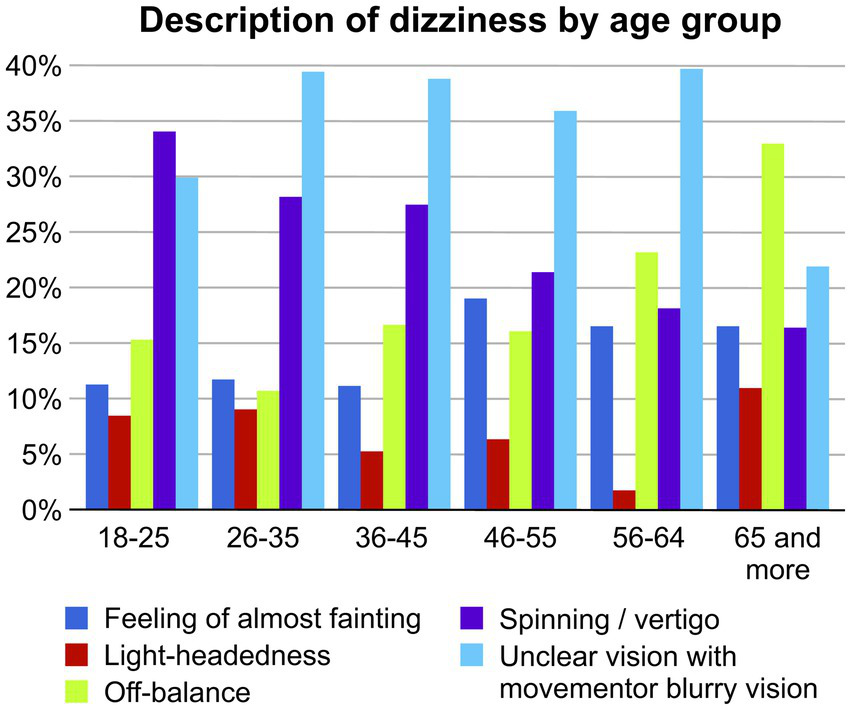
Description of dizziness by age group.
A multiple regression model adjusted for demographic characteristics revealed a statistically significant association between dizziness and age group. The age group of 46–55 years was the only significant predictor for dizziness, while gender was a protective factor. Participants in this age group were 1.83 times more likely to report dizziness, compared to those aged >65 years (odds ratio, OR = 1.83; confidence interval, [CI], 0.62, 5.41; p = 0.0009). Women were less likely than men to report dizziness (OR = 0.65; CI, 0.49, 0.87; p = 0.003) (Table 3).
Table 3
| Participants characteristics | Odds ratio | Confidence interval | p-value |
|---|---|---|---|
| Age (y) | |||
| 18–25 | 0.87 | (0.27, 2.78) | 0.23 |
| 26–35 | 1.1 | (0.37, 3.29) | 0.82 |
| 36–45 | 1.41 | (0.12, 1.17) | 0.2 |
| 46–55 | 1.83 | (0.62, 5.41) | 0.009 |
| 56–64 | 0.89 | (0.23, 2.14) | 0.38 |
| >65 | Reference | Reference | Reference |
| Sex | |||
| Male | Reference | Reference | Reference |
| Female | 0.65 | (0.49, 0.87) | 0.003 |
| Marital status | |||
| Married | 4.73 | (0.55, 40.41) | 0.09 |
| Signal | 3.62 | (0.4, 2.26) | 0.52 |
| Divorced | 3.59 | (0.35, 35.9) | 0.58 |
| Widowed | Reference | Reference | Reference |
| Body mass index | |||
| Obese | 0.65 | (0.25, 1.17) | 0.1 |
| Overweight | 0.78 | (0.3, 2.0) | 0.52 |
| Underweight | Reference | Reference | Reference |
| Normal | 1.13 | (0.45, 2.28) | 0.09 |
| Employment status * | |||
| Employed | 0.38 | (0.11, 1.13) | 0.29 |
| Unemployed | Reference | Reference | Reference |
| Student | 1.29 | (0.8, 2.01) | 0.39 |
| Retired | 1.77 | (0.91, 3.43) | 0.26 |
| Current medications | |||
| Yes | 0.71 | (0.45, 1.09) | 0.12 |
| No | Reference | Reference | Reference |
Predictors of dizziness in the Saudi population.
Missing.
4. Discussion
We aimed to investigate the prevalence of dizziness in the Saudi Arabian population. Some of our findings were consistent and some were inconsistent with those of previous studies. Dizziness is a common clinical complaint, affecting approximately 20 to 30% of the general population (2, 30). In the present survey, 42.97% of the participants reported dizziness; this rate was higher than those previously reported (2, 30). However, this finding was consistent with that of a study from São Paulo on dizziness in the general population (18). The prevalence of dizziness varied notably between studies (6). This variation may be accounted for by the non-specificity of the term, which encompasses a range of sensations (31). In addition, data collection methods and sites may have affected those findings. Research challenges in this context include describing and standardizing this symptom (32). Moreover, the high prevalence of dizziness in Saudi Arabia could be explained by underutilizing physical therapy services due to limited referrals from physicians and a lack of awareness about the physical therapy role in vestibular rehabilitation (29).
The age range from 46 years to 55 years was a significant predictor for dizziness in this study; this finding is consistent with that of Bittar et al. (18). A clinical study conducted in Saudi Arabia revealed that the mean age of individuals presenting with dizziness is 45.1 years (24). Some studies reported that the prevalence of dizziness increases with the age (33, 34) while others did not (14, 35). Herein, only 1.69% of the participants aged >65 years responded to the survey; older adults may refrain from participating in digital surveys because of the lack of motivation or experience with electronic devices.
Dizziness is more prevalent among women than among men (2, 33). Herein, prevalence of dizziness was more among men than among women; this finding is inconsistent with that of previous studies. However, some studies failed to report an association between dizziness and sex in older adults (35, 36). Herein, men tended to be older and have higher BMI than women. Approximately 70% of individuals who were overweight have reported some degree of dizziness (37). In addition, smoking is a risk factor for dizziness (38). The prevalence of cigarette smoking in Saudi Arabia is higher in men than that in women (32.5% vs. 3.9%) (39). Overall, the distribution of risk factors for dizziness may account for the differences in prevalence among groups.
The highest prevalence of vertigo was observed in participants aged 18–25 years and decreased with increasing age; this finding is consistent with those of some previous studies (18, 19) and inconsistent with those of others (8, 20). Vertigo has been reported in 20.8% of adolescents aged 12–19 years, suggesting this population may be affected by peripheral dizziness (1). In Saudi Arabia, peripheral vestibular disorders are considered the primary diagnostic criterion for patients with dizziness (24). In this study, unclear vision with movement was common in young adults. Uni-or bilateral vestibular hypofunction may cause unclear vision with movement; its rates are likely underestimated and may increase from 2.4% in middle-aged and younger adults to 32.1% in those aged ≥79 years (40). Meanwhile, imbalance was relatively common in adults aged ≥65 years. This finding was consistent with those of several studies (18, 19, 41).
The study had several limitations. First, the present findings were not cross-referenced with clinical data. Second, we randomly selected participants from different regions of Saudi Arabia; however, there was no account for the region-based population weight in our study. Third, the study sample included those who used social media, introducing selection bias; consequently, these findings are unlikely to generalize to the entire Saudi population. Fourth, specific comorbidities, such as heart disease, were not interrogated in this study despite their association with dizziness; consequently, the present findings may be affected by confounding.
5. Conclusion
Dizziness is a common complaint in Saudi Arabia. Men are more likely than women to report dizziness. Vertigo slightly decreased with age. Unclear vision with movement was common in young adults, whereas imbalance was common in older adults. Future studies should examine dizziness mechanisms and risk factors. Dizziness may lead to poor outcomes, including falls; dizziness screening and prevention should be introduced at the clinic and policy levels to prevent poor outcomes.
Publisher’s note
All claims expressed in this article are solely those of the authors and do not necessarily represent those of their affiliated organizations, or those of the publisher, the editors and the reviewers. Any product that may be evaluated in this article, or claim that may be made by its manufacturer, is not guaranteed or endorsed by the publisher.
Statements
Data availability statement
The raw data supporting the conclusions of this article will be made available by the authors, without undue reservation.
Ethics statement
The Local Research Ethics Committee (LREC) at the University of Tabuk (UT-171-34-2021) reviewed and approved the research proposal in accordance with the rules and regulations of the National Committee of Bioethics (NCBE). The patients/participants provided their written informed consent to participate in this study.
Author contributions
AA proposed the study, developed the survey, collected the data, and wrote the manuscript. MA contributed to the study proposal, developed the survey, collected the data, and wrote the manuscript. AbA was a coauthor and served in research proposal, working on the survey, data collection, and writing manuscript. MR contributed to data collection, statistical analysis, and manuscript writing. DA contributed to study proposal, developed the survey, collected the data, and wrote the manuscript. AH collected the data, wrote, reviewed, and edited the manuscript. All authors contributed to the article and approved the submitted version.
Acknowledgments
The authors would like to thank all participants for their cooperation and participation. In addition, we would like to thank Editage for their assistance with English language editing of this manuscript.
Conflict of interest
The authors declare that the research was conducted in the absence of any commercial or financial relationships that could be construed as a potential conflict of interest.
References
1.
Langhagen T Albers L Heinen F Straube A Filippopulos F Landgraf MN et al . Period prevalence of dizziness and vertigo in adolescents. PLoS One. (2015) 10:e0136512. doi: 10.1371/journal.pone.0136512
2.
Yardley L Owen N Nazareth I Luxon L . Prevalence and presentation of dizziness in a general practice community sample of working age people. Br J Gen Pract. (1998) 48:1131–5.
3.
Jönsson R Sixt E Landahl S Rosenhall U . Prevalence of dizziness and vertigo in an urban elderly population. J Vestib Res. (2004) 14:47–52. doi: 10.3233/ves-2004-14105
4.
Drachman DA Hart CW . An approach to the dizzy patient. Neurology. (1972) 22:323–34. doi: 10.1212/WNL.22.4.323
5.
Chau AT Menant JC Hübner PP Lord SR Migliaccio AA . Prevalence of vestibular disorder in older people who experience dizziness. Front Neurol. (2015) 6:268. doi: 10.3389/fneur.2015.00268
6.
Bösner S Schwarm S Grevenrath P Schmidt L Hörner K Beidatsch D et al . Prevalence, aetiologies and prognosis of the symptom dizziness in primary care -a systematic review. BMC Fam Pract. (2018) 19:33. doi: 10.1186/s12875-017-0695-0
7.
Siracuse JJ Odell DD Gondek SP Odom SR Kasper EM Hauser CJ et al . Health care and socioeconomic impact of falls in the elderly. Am J Surg. (2012) 203:335–8. doi: 10.1016/j.amjsurg.2011.09.018
8.
Murdin L Schilder AG . Epidemiology of balance symptoms and disorders in the community: a systematic review. Otol Neurotol. (2015) 36:387–92. doi: 10.1097/MAO.0000000000000691
9.
Chang NC Dai CY Lin WY Yang HL Wang HM Chien CY et al . Prevalence of persistent tinnitus and dizziness in an elderly population in southern Taiwan. J Int Adv Otol. (2019) 15:99–105. doi: 10.5152/iao.2019.6257
10.
De Moraes SA Soares WJ Ferriolli E Perracini MR . Prevalence and correlates of dizziness in community-dwelling older people: a cross sectional population based study. BMC Geriatr. (2013) 13:4. doi: 10.1186/1471-2318-13-4
11.
Kroenke K Price RK . Symptoms in the community. Prevalence, classification, and psychiatric comorbidity. Arch Intern Med. (1993) 153:2474–80. doi: 10.1001/archinte.1993.00410210102011
12.
Neuhauser HK Von Brevern M Radtke A Lezius F Feldmann M Ziese T et al . Epidemiology of vestibular vertigo: a neurotologic survey of the general population. Neurology. (2005) 65:898–904. doi: 10.1212/01.wnl.0000175987.59991.3d
13.
Wiltink J Tschan R Michal M Subic-Wrana C Eckhardt-Henn A Dieterich M et al . Dizziness: anxiety, health care utilization and health behavior–results from a representative German community survey. J Psychosom Res. (2009) 66:417–24. doi: 10.1016/j.jpsychores.2008.09.012
14.
Bisdorff A Bosser G Gueguen R Perrin P . The epidemiology of vertigo, dizziness, and unsteadiness and its links to co-morbidities. Front Neurol. (2013) 4:29. doi: 10.3389/fneur.2013.00029
15.
Radtke A Lempert T von Brevern M Feldmann M Lezius F Neuhauser H . Prevalence and complications of orthostatic dizziness in the general population. Clin Auton Res. (2011) 21:161–8. doi: 10.1007/s10286-010-0114-2
16.
Kammerlind AS Ernsth Bravell M Fransson EI . Prevalence of and factors related to mild and substantial dizziness in community-dwelling older adults: a cross-sectional study. BMC Geriatr. (2016) 16:159. doi: 10.1186/s12877-016-0335-x
17.
The General Authority for Statistics in Saudi Arabia . GASTAT releases results of household health survey. (2018). Available: https://www.stats.gov.sa/sites/default/files/household_health_survey_2017_0.pdf
18.
Bittar RS Oiticica J Bottino MA Ganança FF Dimitrov R . Population epidemiological study on the prevalence of dizziness in the city of São Paulo. Braz J Otorhinolaryngol. (2013) 79:688–98. doi: 10.5935/1808-8694.20130127
19.
Wojtczak R Narożny W Kuczkowski J Siebert J . Epidemiology of dizziness in northern Poland–the first polish neurootologic survey of the general population. Ann Agric Environ Med. (2017) 24:502–6. doi: 10.5604/12321966.1228401
20.
Lai YT Wang TC Chuang LJ Chen MH Wang PC . Epidemiology of vertigo: a national survey. Otolaryngol Head Neck Surg. (2011) 145:110–6. doi: 10.1177/0194599811400007
21.
Zingler VC Weintz E Jahn K Huppert D Cnyrim C Brandt T et al . Causative factors, epidemiology, and follow-up of bilateral vestibulopathy. Ann N Y Acad Sci. (2009) 1164:505–8. doi: 10.1111/j.1749-6632.2009.03765.x
22.
Lee SU Park SH Kim HJ Koo JW Kim JS . Normal caloric responses during acute phase of vestibular neuritis. J Clin Neurol. (2016) 12:301–7. doi: 10.3988/jcn.2016.12.3.301
23.
Lucieer F Vonk P Guinand N Stokroos R Kingma H van de Berg R . Bilateral vestibular hypofunction: insights in etiologies, clinical subtypes, and diagnostics. Front Neurol. (2016) 7:26. doi: 10.3389/fneur.2016.00026
24.
Shami I Al SA . Causes of vertigo in Saudi patients seen at tertiary teaching hospital. J Taibah Univ Med Sci. (2011) 6:26–32. doi: 10.1016/S1658-3612(11)70153-6
25.
Al Saif A Al SS . The clinical and demographic features of dizziness related to general health among the Saudi population. J Phys Ther Sci. (2015) 27:3195–8. doi: 10.1589/jpts.27.3195
26.
Johansson M Andersson G . Prevalence of dizziness in relation to psychological factors and general health in older adults. Audiol Med. (2006) 4:144–50. doi: 10.1080/16513860600997483
27.
Almegbel FY Alotaibi IM Alhusain FA Masuadi EM Al Sulami SL Aloushan AF et al . Period prevalence, risk factors and consequent injuries of falling among the Saudi elderly living in Riyadh. BMJ Open. (2018) 8:e019063. doi: 10.1136/bmjopen-2017-019063
28.
Whitney SL Alghadir AH Anwer S . Recent evidence about the effectiveness of vestibular rehabilitation. Curr Treat Options Neurol. (2016) 18:13. doi: 10.1007/s11940-016-0395-4
29.
Alyahya D Kashoo FZ . Perception, knowledge, and attitude of medical doctors in Saudi Arabia about the role of physiotherapists in vestibular rehabilitation: a cross-sectional survey. Peer J. (2022) 10:e13035. doi: 10.7717/peerj.13035
30.
Neuhauser HK Radtke A Von Brevern M Lezius F Feldmann M Lempert T . Burden of dizziness and vertigo in the community. Arch Intern Med. (2008) 168:2118–24. doi: 10.1001/archinte.168.19.2118
31.
Sloane PD Coeytaux RR Beck RS Dallara J . Dizziness: state of the science. Ann Intern Med. (2001) 134:823–32. doi: 10.7326/0003-4819-134-9_Part_2-200105011-00005
32.
Grill E Müller M Brandt T Jahn K . Vertigo and dizziness: challenges for epidemiological research. OA Epidemiol. (2013) 1:1–6. doi: 10.13172/2053-079X-1-2-757
33.
Chang J Hwang SY Park SK Kim JH Kim HJ Chae SW et al . Prevalence of dizziness and associated factors in South Korea: a cross-sectional survey from 2010 to 2012. J Epidemiol. (2018) 28:176–84. doi: 10.2188/jea.JE20160113
34.
Calhoun AH Ford S Pruitt AP Fisher KG . The point prevalence of dizziness or vertigo in migraine -and factors that influence presentation. Headache. (2011) 51:1388–92. doi: 10.1111/j.1526-4610.2011.01970.x
35.
Stevens KN Lang IA Guralnik JM Melzer D . Epidemiology of balance and dizziness in a national population: findings from the English longitudinal study of ageing. Age Ageing. (2008) 37:300–5. doi: 10.1093/ageing/afn019
36.
Colledge NR Wilson JA Macintyre CC Mac Lennan WJ . The prevalence and characteristics of dizziness in an elderly community. Age Ageing. (1994) 23:117–20. doi: 10.1093/ageing/23.2.117
37.
Corna S Aspesi V Cau N Scarpina F Gattini Valdés N Brugliera L et al . Dizziness and falls in obese inpatients undergoing metabolic rehabilitation. PLoS One. (2017) 12:e0169322. doi: 10.1371/journal.pone.0169322
38.
Formeister EJ Sharon JD . The association between smoking and dizziness in U.S. adults: a population-based survey study. Hear Balance Commun. (2021) 19:36–41. doi: 10.1080/21695717.2020.1807254
39.
Algabbani AM Almubark R Althumiri N Alqahtani A BinDhim N . The prevalence of cigarette smoking in Saudi Arabia in 2018. FDRSJ. (2018) 1:1. doi: 10.32868/rsj.v1i1.22
40.
Grill E Heuberger M Strobl R Saglam M Holle R Linkohr B et al . Prevalence, determinants, and consequences of vestibular hypofunction. Results from the KORA-FF4 survey. Front Neurol. (2018) 9:1076. doi: 10.3389/fneur.2018.01076
41.
Hall CD Herdman SJ Whitney SL Anson ER Carender WJ Hoppes CW et al . Vestibular rehabilitation for peripheral vestibular hypofunction: an updated clinical practice guideline from the academy of neurologic physical therapy of the American Physical Therapy Association. J Neurol Phys Ther. (2022) 46:118–77. doi: 10.1097/NPT.0000000000000382
Summary
Keywords
prevalence, dizziness, vertigo, disequilibrium, oscillopsia, epidemiology
Citation
Alharbi AA, Alshammari ME, Albalwi AA, Ramadan MM, Alsharif DS and Hafiz AE (2023) Dizziness in Saudi Arabia: An epidemiologic study. Front. Neurol. 14:1040231. doi: 10.3389/fneur.2023.1040231
Received
09 September 2022
Accepted
15 March 2023
Published
06 April 2023
Volume
14 - 2023
Edited by
Giancarlo Logroscino, University of Bari Aldo Moro, Italy
Reviewed by
Vladimir Parfenov, I.M. Sechenov First Moscow State Medical University, Russia; Hubertus Axer, Jena University Hospital, Germany
Updates
Copyright
© 2023 Alharbi, Alshammari, Albalwi, Ramadan, Alsharif and Hafiz.
This is an open-access article distributed under the terms of the Creative Commons Attribution License (CC BY). The use, distribution or reproduction in other forums is permitted, provided the original author(s) and the copyright owner(s) are credited and that the original publication in this journal is cited, in accordance with accepted academic practice. No use, distribution or reproduction is permitted which does not comply with these terms.
*Correspondence: Majed M. Ramadan, ramadhanma@ngha.med.sa
This article was submitted to Neuroepidemiology, a section of the journal Frontiers in Neurology
Disclaimer
All claims expressed in this article are solely those of the authors and do not necessarily represent those of their affiliated organizations, or those of the publisher, the editors and the reviewers. Any product that may be evaluated in this article or claim that may be made by its manufacturer is not guaranteed or endorsed by the publisher.