 Natsuya Yuzue
 Takashi Sekiyama
- International Political Economy Research Group, Department of Advanced Integrated Studies in Human Survivability, Graduate School of Advanced Integrated Studies in Human Survivability (GSAIS), Kyoto University, Kyoto, Japan
With the expansion of the global economy and the development of technology, the concept of economic security has attracted attention, as highlighted at the G7 Hiroshima summit in 2023. Although this is important for policies, it has not yet been clearly defined. This definition cannot be neglected when evaluating policies that ensure that private economic activities are not excessively restricted. Therefore, this study aims to define economic security concerning value, threats and means. This study used literature reviews to analyze eight Japanese and four English studies. Economic security can be defined as the protection of essential values, such as national survival, sovereign independence, and economic prosperity, from threats, including the disruption of critical commodity supplies, the outflow of advanced technologies, and overreliance on other countries This can be achieved through diversifying supply sources and supply chains, diplomatic efforts to maintain a free and open international economic system, stockpiling essential resources, reducing excessive foreign dependence, developing indispensable goods domestically, and preventing the loss of critical advanced technologies. This study also argues that regulatory measures must be necessary and reasonable to eliminate threats to the values that need protection, because restrictions imposed for economic security purposes limit the freedom of business activity. The definition of economic security and the reflections on economic security policy presented in this paper contribute to the broader discussion in international political economy.
1 Introduction
Economic security is now positioned as one of the most important international issues: the leaders’ communiqué of the G7 summit held in Hiroshima in May 2023 included economic security as a separate item, stating that “ensuring economic resilience and economic security globally remains our best protection against the weaponization of economic vulnerabilities” (MOFA, 2023).
The Trump administration’s 2017 National Security Strategy in the United States stated that “economic security is national security” (The White House, 2017). The current U.S. National Security Strategy, published in 2022, places the economy at the core of security (The White House, 2022). Similarly, the EU, European Parliament, and European Council issued a joint statement on the European Economic and Security Strategy on June 20, 2023 (EU, 2023). Japan enacted the Economic Security Promotion Law in May 2022, one year before the G7 Summit. The law provides for (1) the establishment of a critical goods supply network, (2) the security of key infrastructure, (3) support for the development of advanced critical technologies, and (4) a patent non-disclosure system, with the aim of comprehensively and effectively promoting economic measures related to ensuring security (Ministry of Justice, Japan, 2022). Japan has also positioned its economic security policy as one of the pillars of its National Security Strategy, which was revised in December 2022 (Cabinet Secretariat, 2022).
In this article, economic security is summarized as follows.
Economic security is the protection of the survival of a nation and its people, its sovereign independence, and its economic prosperity from threats such as disruptions in the supply of critical commodities, the outflow of critical advanced technologies, and dependence on other countries.
This requires diplomatic efforts to maintain a free and open international economic system.
Neither of these official documents clearly states what “economic security” is. Security refers to the protection of assets against threats (Wolfers, 1952). However, official documents tend to avoid defining economic security. Even when defined, the value, threat, or means are often ambiguous (see Table 1).
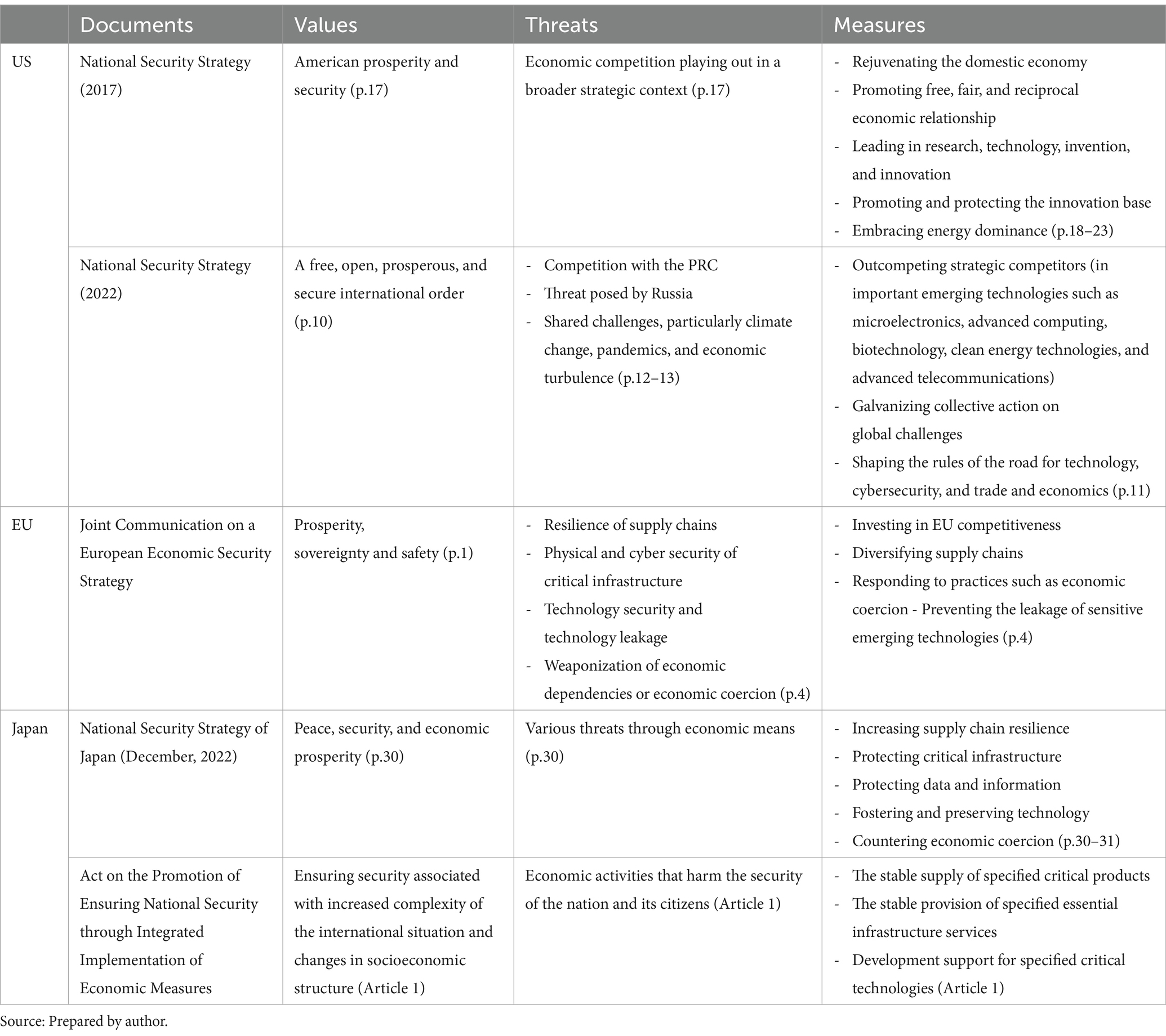
Table 1. Definition of economic security in official documents of the US, EU, and Japan.
This finding raises several questions. What is economic security? What are considered threats to economic security? What, who, and how should these individuals be protected from such threats? Although its definition remains ambiguous, the free economic activities of the private sector have been restricted to security. It is impossible to discuss the rationale for such economic security policies when their definitions are unclear. The economic activities of the private sector may be excessively restricted regarding security (Table 1).
Although countries have only recently begun to publish official documents on economic security, debates on this concept have been ongoing for more than half a century. Economic security has often been used as a concept related to individual economic difficulties, such as income and employment in the context of domestic social welfare. Such arguments date back to pre-war times (Adams, 1936). German economists also discussed the security dimension of economic policy as early as 1900 (Arato et al., 2020). Since then, national economic security has been intermittently in the policy spotlight after major economic shocks (Von Gensau and Pelkmans, 1982), such as the oil crisis of the 1970s (Pelkmans, 1982), food security in 2007–2008 (Dawe, 2010), the great financial crisis of 2008–2009 (Whalen, 2011), and the COVID-19 pandemic (Falkendal et al., 2021). A review of these debates provides a better understanding of economic security.
Therefore, this study aims to define economic security from the perspective of threats, objects and means by reviewing related literature. The review in this paper includes English and Japanese literature. In Japan, economic security has been the subject of active debate on three occasions: at the end of the 1970s, at the end of the 1990s, and in the present day. Interestingly, more relevant literature on national economic security was found in Japanese literature than in English literature, as discussed in Section 2. This can be understood as a result of the fact that Japan has been actively discussing the security aspects of its economic policy under the concept of “comprehensive security” since the 1970s. Section 2 briefly reports the results of the literature review and Section 3 discusses the definition of economic security. Finally, Section 4 presents a brief conclusion.
2 Methodology
For the English-language literature, a title search using the keyword “economic security” was conducted in the article database JSTOR in February 2024. The search yielded 275 academic papers, 75 book chapters, and 147 reports. For Japanese-language literature, we searched CiNii Research, a Japanese literature search service, using the keyword “economic security” during the same month. Consequently, 50 books and 662 articles have been published in Japanese. This study reviews eight Japanese and four English language articles from these references for their contribution to the discussion on the definition of economic security, as determined by their titles and abstracts.
The selection of these papers was made on the basis that the quality is sufficient to reflect the novel situations of the policies and to be analyzed from an academic perspective. It should be noted that there is a risk that these articles may not include some concepts that other articles may have mentioned. It is therefore important to be aware of the limitations and update the concepts when there is a recognition of a crucial influence on the study of economic security.
Some previous studies have also attempted to define economic security while mentioning it as a concept in the study of security (Buzan et al., 1998). However, our definition is primarily focused on economic aspects, because by defining economic security as the safety of people’s economic life, we are able to conceptualize policies in a neutral manner from a military evaluation perspective. In contrast, defining economic security within the context of security can render it a dependent variable of military strategy. Consequently, policy may be subject to change due to variations in the conceptualization of military security. From a policy-making perspective, military strategy is not the sole priority in politics. By defining economic security as the safety of economic life, it becomes feasible to analyze it fairly and impartially from an economic perspective. In this aspect, this paper has made a contribution to enrich the concepts of political economic research and to understand the relation to the policy science by incorporating the elements necessary to ensure the safety of economic life within the definition.
Table 2 summarizes the definitions of economic security discussed in the English and Japanese literature reviewed in this paper regarding the values to be protected, threats to those values, and measures to eliminate or reduce these threats.
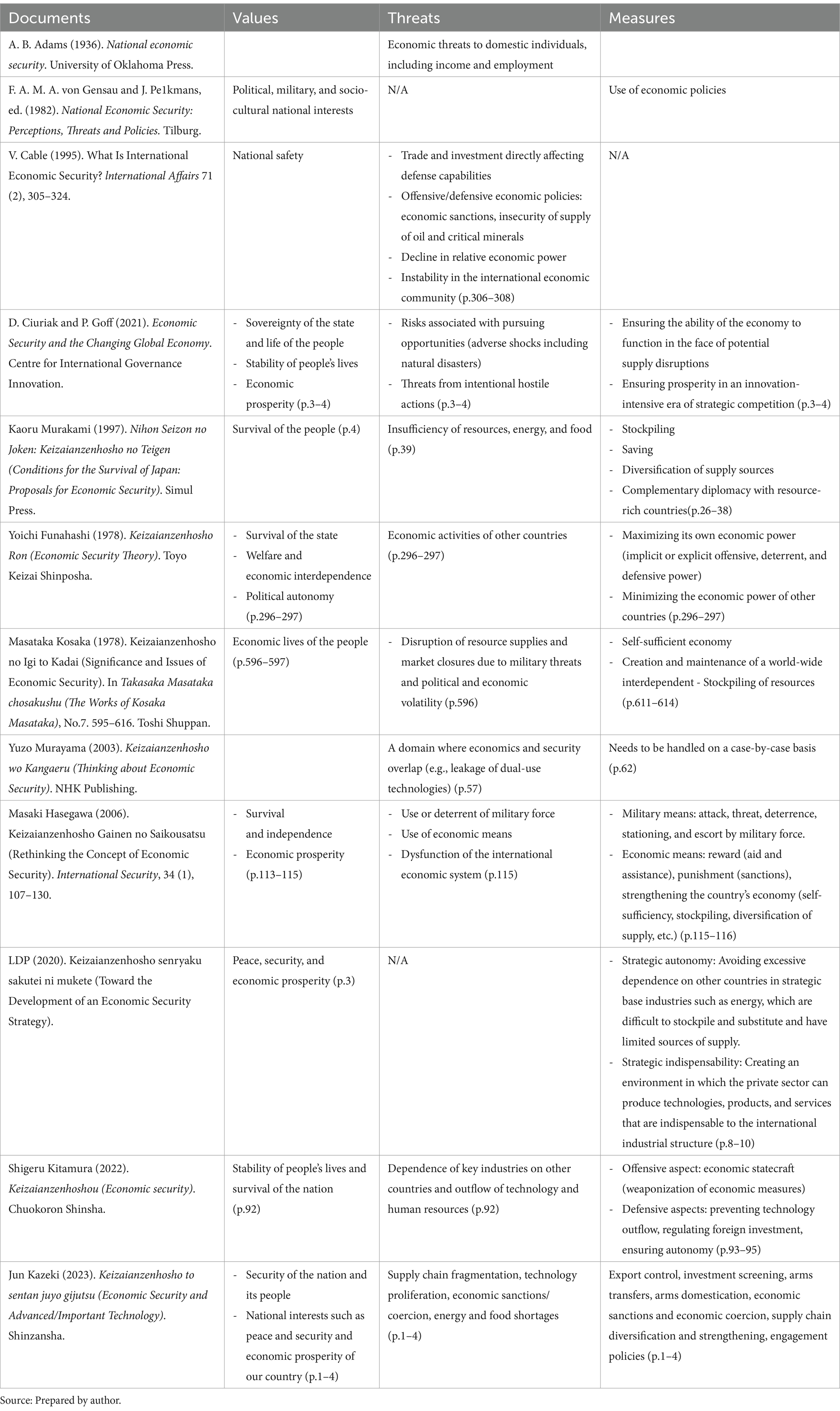
Table 2. Definition of economic security in English and Japanese literature.
3 Values, threats, means
3.1 Values to be protected
Although there is little English-language literature that clearly defines the values to be protected, a report published in 2021 by the Centre for International Governance Innovation, a Canadian think tank, emphasizes the sovereignty of the state and the lives of its people in the context of the economic dimension of national security (Ciuriak and Goff, 2021).
In addition, almost all Japanese literature from the 1970s to the present has considered the survival of the nation or its people as a value to be protected through economic security. Along with survival, “political autonomy” (Funahashi, 1978) or “independence of sovereignty” (Hasegawa, 2006; LDP, 2020) have also been emphasized. Conversely, along with such political survival and independence, “people’s economic life” (Kosaka, 1978) and “economic prosperity” (Kazeki, 2023) are also unanimously pointed out in many works of literature.
In summary, the previous arguments seem to indicate that the values to be protected in economic security are “survival of the nation and its people,” “independence of sovereignty,” and “economic prosperity.”
3.2 Threats
Although few studies have clearly defined threats, shortages of resources, energy, food, and other goods essential to people’s lives have often been identified as threats to economic security in both the English and Japanese literature from the 1970s to the present (Murakami, 1997; Cable, 1995; Hasegawa, 2006; Kazeki, 2023). Recent discussions on supply chain disruptions can be understood in a similar context.
Such shortages and supply disruptions of critical commodities are caused by natural disasters, international instability, or pandemics. Supply shortages can also be caused by trade restrictions based on the political intentions of the supplier countries. The latter case, namely economic sanctions or coercion by other countries, has traditionally been recognized as a threat in most English-language studies on economic security (Cable, 1995; Ciuriak and Goff, 2021). In this context, economic security and so-called economic status are almost synonymous. Japanese literature has also begun to emphasize the threat of deliberate economic sanctions and coercion by hostile countries, particularly in recent years (Hasegawa, 2006; Kazeki, 2023).
Some literature also view a decline in relative economic power as a threat to the “survival of the nation and its people,” “independence of sovereignty,” and “economic prosperity” because it undermines relative military superiority (Cable, 1995; Ciuriak and Goff, 2021).
In addition, key advanced technologies, such as semiconductors, have recently become more important than ever in discussions on economic security. The threat of outflow or dependence on other countries for key advanced technologies did not receive much attention during the 1970s. However, in recent years, advanced technology has become one of the most important issues in the economic security agenda. Particular emphasis has been placed on the issue of dual-use technologies in which the boundary between civilian and military technologies is blurred (Murayama, 2003; Ciuriak and Goff, 2021; Kitamura, 2022). As technological innovations in the civilian field have become remarkable, the number of cases in which civilian technology has been transformed into military technology has increased. Consequently, dual-use technologies have become increasingly important in recent years.
3.3 Means
Economic security aims at eliminating or deterring the threats discussed above as much as possible. To deal with disruptions in the supply of critical goods, one of the requirements is to ensure the ability of the economy to function in the face of the risks of such supply disruptions (Ciuriak and Goff, 2021). In this regard, a logical solution is to be self-sufficient in everything to eliminate the fear that critical goods will not be adequately supplied from abroad (Kosaka, 1978). Indeed, the two World Wars of the 20th century were struggles between powers for self-sufficient spheres of existence.
However, the isolation of economic security was inconsistent with the original political goal. Self-sufficiency for the “survival of the nation and its people” and “independence of sovereignty” would not allow the country to enjoy the benefits of comparative advantage. This would lead to a situation incompatible with the other goal of economic security, “economic prosperity.” Moreover, the concentration of supply sources within a country ironically increases the risk of supply disruptions due to unexpected events such as natural disasters.
Therefore, conventional discussions of economic security have suggested that self-sufficiency has become “almost impossible” (Kosaka, 1978) in the modern industrial age. Thus, since the 1970s, there has been consensus that the risks of resource shortages and supply disruptions should be reduced by diversifying sources of supply (Murayama, 2003; Kazeki, 2023).
In this context, some have emphasized the importance of maintaining a free and open international economic system as a prerequisite for diversifying sources of supply (Kosaka, 1978; Kitamura, 2022). Simultaneously, many argue for the necessity of “stockpiling,” asserting that a degree of self-help preparedness against temporary supply disruptions is necessary (Murakami, 1997; Kosaka, 1978; Hasegawa, 2006; LDP, 2020).
Conversely, a country that depends on other countries for critical goods with limited suppliers would not be able to ensure the “survival of the nation and its people,” “independence of sovereignty,” and “economic prosperity” if subjected to economic sanctions or economic coercion by the supplier country. This is the risk of “weaponized interdependence” (Farrell and Newman, 2019). Supplier countries for hard-to-substitute strategic commodities are at a central node in the web of economic interdependence linking many consuming countries. Such supplier countries have asymmetric power that allows them to unilaterally cut off certain consuming countries or trading partners from their supply chains. The supplier country controls a choke point at the central node of the supply chain network.
A consuming country should not be overly dependent on other nations for critical commodities that are difficult to stockpile or substitute, to prevent the risk of a choke point of critical resources being seized by a hostile nation (LDP, 2020). Such strategic autonomy is a defensive measure against the economic status of potential adversaries. In other words, it is necessary for a consumer country to create an environment in which domestic firms can produce products and services that are indispensable to its industrial structure.
Simultaneously, improving strategic indispensability is necessary to counter or deter hostile actions by an adversary with offensive capabilities (LDP, 2020). The development and maintenance of critically advanced technologies are crucial for ensuring strategic indispensability. This is especially true for countries that lack critical natural resources, as critical technologies are the only economic deterrent to sanctions by their adversaries. A report by Canada’s Centre for International Governance Innovation also cites securing prosperity in an innovation-intensive era of strategic competition as an economic security measure, along with preparing for disruptions in the supply of critical commodities (Ciuriak and Goff, 2021).
However, strategic indispensability is undermined if advanced technologies are leaked to other countries. In addition, as mentioned above, the boundary between civilian and military technologies has disappeared as a dual-use technology. If advanced civilian technology leaks into a hostile country, it may be diverted for military use, thereby increasing the military threat to the countries that originally developed the technology. Therefore, especially in recent discussions, several proposals have been made to prevent technology leakage through export control and investment screening (LDP, 2020; Kitamura, 2022; Kazeki, 2023).
If a country does not have the capacity to implement measures stated above, it can be said that its economic security is weak. In this case, the counrty needs to start by building necessary capacity and institutions. First of all, it is necessary to develop the systems and infrastructure to protect the survival of the state and its people, the political and legal systems to protect sovereignty and independence, and the industrial, distribution and financial systems for economic prosperity. In doing so, it is possible to design appropriate systems while taking into account the criteria listed in the definition, such as diversification of resource supply and protection of key technologies. However, even in such a process, it is thought that small states are likely to be influenced by medium-sized states and major powers. In particular, if the policies of medium-sized states and major powers change in areas where capacity is lacking, it is thought that it will be difficult to protect national interests, and that it will be easy to fall into a serious situation in terms of economic security. Thus, the challenges of economic security for small states are distinct from those of medium-sized states and major powers in that the former are more susceptible to the influence of medium-sized states and major powers, and that the process of establishing new national and economic systems is likely to be included.
4 Conclusion
Based on the most common denominator in the English and Japanese literature, the values, threats, and measures of economic security can be summarized as follows:
Economic security is the protection of the survival of a nation and its people, its sovereign independence, and its economic prosperity from threats such as disruptions in the supply of critical commodities, the outflow of critical advanced technologies, and dependence on other countries.
This requires diplomatic effort to maintain a free and open international economic system. Additionally, a certain level of stockpiling is necessary as a precaution against temporary supply disruptions. Moreover, as a defensive measure against economic sanctions by potential adversaries, it is essential to ensure strategic autonomy without excessive dependence on other countries for critical commodities that are difficult to stockpile or replace and for which sources of supply are limited. It is also necessary to ensure strategic indispensability to counterattack or deter hostile countries by promoting products and services that are indispensable to the international industrial structure of the country. To ensure strategic autonomy and indispensability, promoting and preventing the outflow of advanced key technologies are important measures for economic security.
However, it is important to recognize that restricting private economic transactions for economic security also restricts economic freedom. Therefore, regulatory measures should be limited to what is indispensable and reasonable for eliminating or deterring threats to national survival, sovereign independence, and economic prosperity. However, there is skepticism about whether such restrictions are truly limited to what is necessary and reasonable in the context of economic security. To ensure that private economic activities are not restricted in the name of security, it is important to clearly define economic security, including its values, threats, and means. It would be gratifying if this study could contribute to the definition of economic security.
Author contributions
NY: Writing – original draft, Writing – review & editing. TS: Writing – original draft, Writing – review & editing.
Funding
The author(s) declare that no financial support was received for the research, authorship, and/or publication of this article.
Conflict of interest
The authors declare that the research was conducted in the absence of any commercial or financial relationships that could be construed as a potential conflict of interest.
Generative AI statement
The authors declare that no Generative AI was used in the creation of this manuscript.
Publisher’s note
All claims expressed in this article are solely those of the authors and do not necessarily represent those of their affiliated organizations, or those of the publisher, the editors and the reviewers. Any product that may be evaluated in this article, or claim that may be made by its manufacturer, is not guaranteed or endorsed by the publisher.
References
Arato, J., Claussen, K., and Heath, J. B. (2020). The perils of pandemic exceptionalism. Amer. J. Int. Law 114, 627–636. doi: 10.1017/ajil.2020.67
Buzan, B. G., Wæver, O., and de Wilde, J. H. (1998). Security: A new framework for analysis. Boulder: Lynne Rienner.
Cabinet Secretariat. (2022). National Security Strategy of Japan (December, 2022). Available online at: https://www.cas.go.jp/jp/siryou/221216anzenhoshou/nss-e.pdf (Accessed March 1, 2024).
Cable, V. (1995). What is international economic security? lnt. Affairs 71, 305–324. doi: 10.2307/2623436
Ciuriak, D., and Goff, P. (2021). Economic security and the changing global economy. Waterloo: Centre for International Governance Innovation.
EU. (2023). Joint communication on a European economic security strategy. Available online at: https://eur-lex.europa.eu/legal-content/EN/TXT/PDF/?uri=CELEX:52023JC0020 (Accessed March 1, 2024).
Falkendal, T., Otto, C., Schewe, J., Jägermeyr, J., Konar, M., Kummu, M., et al. (2021). Grain export restrictions during COVID-19 risk food insecurity in many low- and middle-income countries. Nature Food 2, 11–14. doi: 10.1038/s43016-020-00211-7
Farrell, H., and Newman, A. L. (2019). Weaponized interdependence: how global economic networks shape state coercion. Int. Secur. 44, 42–79. doi: 10.1162/isec_a_00351
Funahashi, Y. (1978). Keizaianzenhosho Ron (economic security theory). Tokyo: Toyo Keizai Shinposha.
Hasegawa, M. (2006). Keizaianzenhosho gainen no saikousatsu (rethinking the concept of economic security). Int. Secur. 34, 107–130. doi: 10.57292/kokusaianzenhosho.34.1_107
Kazeki, J. (2023). Keizaianzenhosho to sentan juyo gijutsu (Economic Security and Advanced/Important Technology). Tokyo: Shinzansha.
Kosaka, M. (1978). Keizaianzenhosho no igi to kadai (significance and issues of economic security). In Kosaka (2000). Kosaka Masataka chosakushu dai 7 kan (The Works of Kosaka Masataka vol.7). Tokyo: Toshi Shuppan, 595–616.
LDP (2020). Keizaianzenhosho senryaku sakutei ni mukete (Toward the development of an economic security strategy). Available online at: https://storage2.jimin.jp/pdf/news/policy/201021_1.pdf (Accessed March 1, 2024).
Ministry of Justice, Japan. (2022). Act on the promotion of ensuring National Security through integrated implementation of economic measures. Available online at: https://www.japaneselawtranslation.go.jp/en/laws/view/4523/en (Accessed March 1, 2024).
MOFA. (2023). G7 Leaders’ statement on economic resilience and economic security. Available online at: https://www.mofa.go.jp/mofaj/files/100506767.pdf (Accessed March 1, 2024).
Murakami, K. (1997). Nihon seizon no joken: Keizaianzenhosho no teigen (conditions for the survival of Japan: Proposals for economic security). Tokyo: Simul Press.
Murayama, Y. (2003). Keizaianzenhosho wo kangaeru (thinking about economic security). Tokyo: NHK Publishing.
Pelkmans, J. (1982). The many faces of National Economic Security. In F. A. M. A. Geusauvon and J. Pelkmans National Economic Security: Perceptions, threats, and policies. Tilburg, the Netherlands: John F. Kennedy Institute. John F. Kennedy Institute.
The White House. (2017). National Security Strategy of the United States of America (December 2017). Available online at: https://trumpwhitehouse.archives.gov/wp-content/uploads/2017/12/NSS-Final-12-18-2017-0905.pdf (Accessed March 1, 2024).
The White House. (2022). National Security Strategy of the United States of America (October, 2022). Available online at: https://www.whitehouse.gov/wp-content/uploads/2022/10/Biden-Harris-Administrations-National-Security-Strategy-10.2022.pdf (Accessed March 1, 2024).
Von Gensau, F. A. M. A., and Pelkmans, J. (1982). National Economic Security: Perceptions, Threats and Policies. Tilburg, the Netherlands: John F. Kennedy Institute.
Whalen, C. J. (2011). Financial instability and economic security after the great recession. Cheltenham, UK: Edward Elgar Publishing.
Keywords: economic security, values, threats, means, critical commodities, advanced technologies
Citation: Yuzue N and Sekiyama T (2025) Defining economic security through literature review. Front. Polit. Sci. 7:1501986. doi: 10.3389/fpos.2025.1501986
Edited by:
Leposava Ognjanoska, International Balkan University, North MacedoniaReviewed by:
Neel Vanvari, Institute for Indo-Pacific Affairs, New ZealandCopyright © 2025 Yuzue and Sekiyama. This is an open-access article distributed under the terms of the Creative Commons Attribution License (CC BY). The use, distribution or reproduction in other forums is permitted, provided the original author(s) and the copyright owner(s) are credited and that the original publication in this journal is cited, in accordance with accepted academic practice. No use, distribution or reproduction is permitted which does not comply with these terms.
*Correspondence: Natsuya Yuzue, eXV6dWUubmF0c3V5YS44NHZAc3Qua3lvdG8tdS5hYy5qcA==