 Siti Hajar
 Ramlan
 Kholilul Kholik
- 1Universitas Muhammadiyah Sumatera Utara, Medan, Indonesia
- 2Universitas Pembangunan Panca Budi, Medan, Indonesia
Geosites as geopark assets not only have ecological and geological value, but also socio-cultural and sustainable economic value for local communities. The purpose of this study is to analyze the importance of adaptive policies in geosite governance by considering environmental dynamics, community involvement, and global challenges including climate change and sustainable tourism. The research method used a mixed methods approach with a sequential explanatory design. Quantitative data were obtained through a survey of stakeholders involved in geosite management, then analyzed using Partial Least Squares-Structural Equation Modeling (PLS-SEM) to examine factors influencing the effectiveness of adaptive policies. Furthermore, qualitative analysis was carried out to strengthen the quantitative results and provide contextual understanding. The results show that adaptive policies have a significant role in increasing the effectiveness of geosite governance in realizing sustainable tourism through existing local values. Then, the main contributing factors are cross-sector collaboration, recognition of local wisdom, and policy flexibility in responding to changing socio-economic and environmental conditions. Thus, adaptive policies are seen as an important foundation in realizing the sustainability of the Toba Caldera Geopark and supporting the achievement of the Sustainable Development Goals (SDGs).
1 Introduction
Indonesia’s national development agenda is stated in Asta Cita, which emphasizes the importance of sustainable development that balances environmental, economic and social aspects. In line with Asta Cita 2, namely strengthening a productive, independent and competitive economic system and in it emphasizing the development of tourism as a leading sector based on local wisdom, culture and environmental sustainability, then in the development of adaptive geosites in the Toba Caldera Geopark Area of Samosir Regency in line with the spirit of Asta Cita can make tourism a local economic motor that is also an instrument for preserving nature and culture (Pariwisata, 2025; Utara, 2025). In addition, Asta Cita also emphasizes the development of superior and character-based human resources, which is directly related to community participation in geosite management. One of the UNESCO Global Geopark areas in Indonesia is the Toba Caldera Geopark and has 16 Geosites located in seven districts in the Lake Toba area, and 5 geosites are in Samosir Regency (Utara, 2025), as shown below:
Figure 1 shows that the 5 geosites in Samosir Regency consist of: (1) Pusuk Buhit; (2) Tele – Euphrata; (3) Hutatinggi; (4) Batak Museum Simanindo; (5) Ambarita – Tuk Tuk – Tomok. Thus, El Hamidy and Errami (2025), Sartori Peruzzo et al. (2025), and Sibarani et al. (2025) geosites are not only geological formations but also include cultural and historical sites that strengthen the identity of the Toba Caldera Geopark as a world geological and cultural heritage, and the management of the Toba Caldera Geopark geosite in Samosir Regency is an integral part of the development agenda in realizing sustainable tourism in Indonesia. The Toba Caldera Geopark as one of the UNESCO global Geoparks (UGGp) faces complex challenges in maintaining a balance between conservation, education and economic development of local communities (Sibarani et al., 2025; Utara, 2025). The Toba Caldera Geopark Geosite is a highly developed tourist destination in Samosir Regency because it is not only an important asset for the region but also because it has very high geological, ecological and cultural (Hajar et al., 2025; Hajar, 2020; Sibarani et al., 2025).

Figure 1. Map of the Toba Caldera Geopark geosite area.
The governance geosite located in the Toba Caldera Geopark in Samosir Regency still faces limitations, particularly in the aspects of inter-institutional coordination, community participation, and the integration of local wisdom. This area also faces challenges in realizing sustainable tourism, including environmental changes and conflicts of interest that have led to low levels of local community participation and readiness to face the 2025 UNESCO revalidation (Pariwisata, 2025). However, the achievement of sustainable tourism in Samosir Regency is also evidenced by the achievement of PAD realization in the tourism sector, which experienced a significant increase, especially in 2024 which saw an extra increase with an achievement of Rp 52,969,977,722, thus showing extraordinary growth compared to the previous year, namely 2023 which showed the realization of PAD of Rp 13,617,270,000 which experienced a decrease in the previous year, namely Rp 16,470,710,000 in 2022 (Samosir, 2024).
The explanation shows that the performance of the tourism sector is experiencing rapid recovery and growth, where 2024 can be interpreted as a result of strengthening sustainable tourism policies, adaptive geosite management and multi-level collaboration between local governments, national and international institutions such as UNESCO in the development of the Toba Caldera Geopark Area. Thus, the increase in PAD in the tourism sector is also an indicator of the success of adaptive governance and policies in Samosir Regency. The increase in PAD in the tourism sector is also supported by the growth rate of tourist visits in Samosir Regency, namely an increase in tourist visits in 2024, namely 1,761,427 people (domestic tourists) and 15,705 people (foreign tourists) where in 2023 the number of tourist visits was around 997,722 people (domestic tourists) and 10,950 people (foreign tourists).
According to data from Samosir and dan (2025), since 2021, the growth of tourist visits to Samosir Regency has increased significantly, especially in the 5 Samosir geosite areas. Research results from Fauzi and Misni (2016), Hajar et al. (2022), Zwiers (2018) also confirm an increase in the number of tourists, but the level of local community participation in decision-making regarding geosite management remains low, this is due to community dissatisfaction with the geosite management, which has led to conflict within the community. Furthermore, geosite governance is also influenced by the Toba Caldera Geopark, which has received a yellow card from UNESCO, hampering tourism development at the geosite. Therefore, these issues are interrelated and require an integrated approach to achieve effective governance at the geosite in Samosir Regency (Pariwisata, 2025). Thus, an adaptive geosite management policy that involves all levels of society is crucial. This involvement of all parties aims to maintain sustainable tourism, oriented toward developing local values inherent in all geosites in Samosir Regency, including culture, nature, and other resources.
The effort to involve the entire community in the governance of the Toba Caldera Geopark geosite in Samosir Regency is also one of the steps taken by the local government together with the Toba Caldera Geopark Agency, to obtain a green card from UNESCO for the Toba Caldera Geopark again (Kementerian Pariwisata Republik Indonesia, 2025). This approach is also an important step in formulating adaptive policies for tourism development in Samosir Regency, without eliminating the local values that exist in the Toba Caldera Geopark geosite so that it can continue to be preserved and become a priority tourist attraction in sustainable tourism. The approach in question is adaptive governance, because of its dynamic, collaborative, and responsive nature to change and provides solutions to problems faced so that it is relevant in this research (Cleaver and Whaley, 2018; Steelman, 2022). Moreover, the governance of geosites in Samosir Regency, requires education for the community to be able to continue to maintain and preserve it so that it can support sustainable tourism in Samosir Regency.
According to Hossain et al. (2025), Nandini et al. (2024), and Sharma-Wallace et al. (2018), Adaptive governance is a governance approach that emphasizes multi-stakeholder collaboration, flexibility and adaptive capacity in facing socio-ecological uncertainty. So, Hartman (2021), Lindsay et al. (2014), and Mergel et al. (2021) that adaptive governance, as a very relevant approach in the latest paradigm in public administration, namely New Public Governance (NPG), where the government is not the only actor but there are other parties that must cooperate with each other, namely the community, indigenous communities, the private sector and international institutions (UNESCO), so that it emphasizes cross-sector collaboration. So, this is what causes the relevance of adaptive governance in this study, because it can emphasize collaboration between stakeholders to accommodate environmental changes, policies and the needs of local communities and minimize the occurrence of conflict in the governance of the Toba Caldera Geopark geosite in Samosir Regency.
The shift in public administration in the era of governance society has provided a transformation for the concept of sustainable tourism through adaptive governance (Andersson et al., 2022; Madan and Ashok, 2023), which has shifted the paradigm of government management from a traditional hierarchical bureaucratic model to a more collaborative, responsive, and network-based governance pattern. This shift not only affects the implementation of sustainable tourism but also has an impact on the legitimacy of its policies. Because in public administration, policy legitimacy does not only come from legal or bureaucratic authority, but also from community acceptance. This is related to the placement of cultural values, norms, and community participation as the basis for formulating and implementing policies. Therefore, in accordance with what was explained (Huang et al., 2025; Lestari et al., 2022), the local government and the management body of the Lake Toba Geopark must be able to adjust the governance of geosites in the Toba Caldera Geopark Area to international standards (conservation, education, sustainability), so that multi-level governance occurs between local, national, and global. Thus, this study not only shows advanced geosite governance in the domestic space but can refer to the development of public administration through adaptive policies in the era of globalization, thereby creating multi-level collaboration in geosite governance in Samosir Regency.
Multi-level collaboration in geosite governance in the Toba Caldera Geopark Area in Samosir Regency is a concrete example of public administration practices involving local, national, and global actors. This is consistent with (Ansell and Gash, 2008; Folke et al., 2005; Gash, 2022), who explain the importance of cross-sector and cross-actor collaboration in achieving complex public goals, thereby strengthening the sustainability and legitimacy of governance and realizing good governance in the partnership-based tourism sector (Álvarez, 2020). Therefore, this research is based on the theories of adaptive governance and collaborative governance, as well as policy legitimacy, which are expected to realize social legitimacy, cross-level collaboration, and the desire for locally-wisdom-based tourism within a global public administration framework.
2 Conceptual framework
The focus of this research is directed at the relationship between adaptive policies, geosite governance and sustainable tourism in the Toba Caldera Geopark Area, especially Samosir Regency. This research is also based on the framework of public administration development, which started from a rigid and centralized bureaucracy, then shifted to an emphasis on efficiency, effectiveness and a market approach through the New Public Management (NPM) paradigm (Arbolino et al., 2021; Blackstone et al., 2017), then there was a transformation in the development of public administration in the digitalization era, emphasizing multi-actor collaboration, community participation and networks (network governance) through the New Public Governance (NPG) paradigm (Lindsay et al., 2014; Maurer, 2017; Mergel et al., 2021). Referring to this development, the focus of this research uses an adaptive governance approach that strengthens institutional capacity to be responsive, flexible, and able to face environmental, social, cultural, economic and ecological uncertainties. Thus, adaptive governance becomes the main conceptual framework in the Toba Caldera Geopark Area in facing global dynamics (UNESCO legitimacy), national (super priority destination) and local (Toba Batak wisdom) (Hajar, 2020).
In the public administration paradigm of New Public Governance (NPG), according to Batory and Svensson (2020) and Herizal et al. (2020) the government is no longer viewed as a single actor but as an enabler that facilitates interaction and cooperation between actors, ranging from local communities, indigenous communities, business actors, academics and even media institutions. This transformation of public administration makes decision-making more open, participatory and inclusive so that it is in accordance with the needs of society and global dynamics. Hence, herein lies the importance of an adaptive governance approach in the management of the Toba Caldera geosite in Samosir Regency. Adaptive policy in public policy literature is understood as an approach that emphasizes flexibility, continuous learning, multi-actor participation, and the ability to respond to changes in the external and internal environment. According to Naswar et al. (2024) and Sadat and Lawelai (2025), adaptive policy assumes that uncertainty is inevitable in the development process, so policy strategies must be designed to adapt to changing conditions and community needs. Adaptive policy in the Toba Caldera Geopark area means that geosite governance does not only rely on formal regulations from the central and regional governments, but is also open to input from local communities, traditional leaders, tourism actors, and tourists. Thus, the resulting policy is more responsive to real challenges, such as environmental degradation, land use conflicts of interest, climate change, and the dynamics of the global tourism market. Meanwhile, geosite governance refers to a series of mechanisms, rules, practices, and interactions that regulate the use and preservation of geosite areas as tourism assets and geological heritage. This governance is multidimensional, encompassing economic, social, cultural, environmental, and institutional aspects.
The Toba Caldera Geopark area has 16 Geosites located in seven regencies in the Lake Toba area, and 5 of these geosites are located in Samosir Regency, where the geosites are not only geological formations but also cultural and historical sites that strengthen the identity of the Toba Caldera Geopark, (Sibarani et al., 2025) as a world geological and cultural heritage. Therefore, adaptive policies are a crucial factor in geosite governance, as well as how these policies can realize sustainable tourism in accordance with the direction of national development, SDGs goals, and the Asta Cita agenda of the Indonesian government. Therefore, Hajar et al. (2025) and Rosenbloom (2016) emphasized that adaptive policies are formulated as the main axis that connects the dimensions of geosite governance with the achievement of sustainable tourism goals. The Toba Caldera Geosite is not just a natural tourist attraction, but also a living space for local communities, steeped in traditional Batak wisdom. Therefore, effective governance must balance geological preservation, local economic empowerment, and cultural identity strengthening. Top-down governance often fails to address on-the-ground needs, necessitating an adaptive approach that enables cross-sector and cross-actor collaboration (Morris et al., 2016; Nandini et al., 2024). Therefore, sound and adaptive geosite governance can achieve sustainable tourism in the Toba Caldera Geopark in Samosir Regency, through the implementation of good governance principles in the management of the geopark’s natural, cultural, and tourism resources.
According to Farsari (2023), Nunkoo (2017), Subair et al. (2025) sustainable tourism is defined as tourism activities that meet the needs of current tourists without compromising the ability of future generations to meet their own needs, this concept is based on three main pillars: economic, environmental, and socio-cultural. In the development of the Toba Caldera Geopark area, the concept of sustainable tourism means ensuring that tourism development does not damage the natural beauty, does not displace local communities from their living space, and continues to contribute to regional economic growth. Thus, Challies et al. (2017) and Sadat and Lawelai (2025) this is where adaptive policies are important in geosite governance, because adaptive policies provide a foundation for flexibility in geosite governance. For example, in the face of a surge in tourist visits that has the potential to damage the ecosystem, adaptive policies allow local governments to change management strategies, such as limiting the number of visitors, implementing quota-based electronic tickets, or diverting tourists to alternative destinations.
Adaptive policies are a prerequisite for achieving sustainable tourism, as the tourism sector is highly vulnerable to change, including climate change, market trends, and global policies. Adaptive policies facilitate the integration of sustainability principles, as decision-making is not bogged down in rigid bureaucratic procedures but rather responsive to dynamics (Lundén and Varnajot, 2024; Pahl-Wostl, 2019). Therefore, adaptive policies serve as a key instrument for bridging short-term needs (tourism economic growth) with long-term goals (environmental and cultural sustainability)(Epifani and Valente, 2023; Nurjaya, 2022). Furthermore, adaptive policies also facilitate the integration of local wisdom into governance. For example, the practice of marsiadapari (a Batak community service) can be institutionalized as a participatory mechanism for maintaining the cleanliness of geosites. Local wisdom serves as social legitimacy and serves as social capital that supports community participation. Thus, adaptive policies not only respond to changes in the external environment but also internalize local socio-cultural values into governance. In constantly changing environmental, social, and economic conditions, only adaptive policies can ensure the achievement of sustainable tourism (Dolnicar et al., 2023; Mandić et al., 2025). This framework also emphasizes the importance of cross-actor collaboration, integration of local wisdom values, and the capacity of local bureaucracies and communities in managing sustainable tourism based on technology, education, and innovation that is long-term oriented and in line with Asta Cita and SDGs.
3 Research method
This research employed a mixed methods approach, a combination of quantitative and qualitative methods within a single research sequence, with the goal of gaining a more comprehensive understanding of the phenomenon under study (Creswell, 2018; Hatipoglu et al., 2016). An explanatory sequential design was chosen because it combines the strengths of quantitative analysis in examining relationships between variables with the depth of qualitative analysis to explain findings more contextually. The initial stage was a case-based exploratory study aimed at identifying the characteristics of the phenomenon and formulating relevant variables related to geosite governance, local wisdom, and adaptive policies within the concept of sustainable tourism. Furthermore, the quantitative stage, using SEM-PLS, was chosen as the primary analysis technique for quantitative data for several reasons: its ability to analyze complex relationships between latent variables, including mediating or moderating variables that emerge in policy and governance studies. It also does not require data to be normally distributed, making it more flexible for limited sample sizes such as this study.
PLS-SEM was chosen because it is relevant for exploratory research, capable of analyzing highly complex structural models, and can still be used with relatively small sample sizes (Hair et al., 2019). However, in line with the principle of external validity, this study does not claim to generalize the results to the broader population of 79,437,000 people. The sample size was 79 respondents, representing only approximately 0.10% of the population, at a 95% confidence level. According to Ringle et al. (2024) this sampling model is considered valid as exploratory research, not statistically generalizable. According to Thangiah et al. (2020), this exploratory stage is not intended to conduct statistical generalizations but rather to formulate an initial research model tailored to the complex, contextual nature of the phenomenon, involving multi-level interactions between actors in policy governance. Therefore, it can be concluded that the use of SEM-PLS can simultaneously measure construct validity and reliability, thereby increasing the accuracy of the adaptive policy model testing results. Therefore, SEM-PLS aligns with the objective of this study, which is to analyze the importance of adaptive policies in geosite governance.
The next stage is qualitative analysis, which is used to interpret the quantitative results in more depth, explore the rationale behind the empirical findings, and synergize them with a public administration perspective in the context of adapting geosite management policies. This allows for a comprehensive understanding of the dynamics of adaptive governance and the implementation of local wisdom in sustainable tourism. The research design is carried out in two stages, as described below (Figure 2).

Figure 2. Research implementation stages.
The integration of quantitative and qualitative results is carried out by comparing the results of the SEM-PLS test with the findings of qualitative data through document review, which were collected and analyzed separately and then compared at the interpretation stage. For example, if the quantitative analysis shows that adaptive policies have a significant effect on tourism sustainability, then the qualitative analysis can explain the social factors that make adaptive policies more effective, and the existence of regional regulations that support public participation (Sidney, 2020; Singh, 2018). This integration allows the research to produce a holistic understanding, where numerical data provides empirical evidence, while qualitative narratives enrich contextual explanations. The purpose of this integration is to verify the findings, enrich the understanding of the causal mechanisms discovered by SEM-PLS, and explain inconsistencies between statistical models and field reality (contradictions). Thus, the explanatory sequential mixed method design is the most appropriate approach to assess the urgency of adaptive policies in the governance of the Toba Caldera Geopark geosite.
4 Result and discussion
The Toba Caldera Geopark is an area recognized by UNESCO as part of the UNESCO Global Geopark (UGGp) since 2020, and is an area resulting from a supervolcanic eruption around 74,000 years ago that formed Lake Toba, and in the middle of it is Samosir Island (Pariwisata, 2025; Utara, 2025). Administratively, the Toba Caldera Geopark covers seven regencies in North Sumatra, one of which is Samosir Regency which occupies a strategic position because it is in the heart of the lake and also contains many important geosites. Samosir Regency is known as the center of Batak Toba culture as well as an area that has spectacular natural landscapes in the form of lakes, hills, caldera cliffs, and unique geological formations (Jayaraju et al., 2023; Zafeiropoulos, 2024) this is what makes Samosir a “core area” in the development of the Toba Caldera Geopark (Sibarani et al., 2025). The geopark area in Samosir has a large tourist attraction, both for domestic and foreign tourists, some of the potential that is developing, including (1) Nature-based ecotourism such as trekking, panoramic tours, and geological observations; (2) Batak cultural tourism with dance attractions, traditional gondang music, traditional ceremonies, and typical culinary; (3) Spiritual and historical tourism through traditional sites such as Batu Hobon or the Tomb of King Sidabutar; and (4) Educational tourism through the introduction of the geological processes of the supervolcano, the ecosystem of Lake Toba, and the values of local wisdom.
The Toba Caldera Geopark in Samosir Regency is the core of global geological and cultural heritage, possessing strategic value for Indonesian tourism development (Fauzi and Misni, 2016). Its potential to improve community well-being and strengthen the national tourism brand is enormous, but its success depends heavily on adaptive, participatory, and local wisdom-based governance (Hajar and Arma, 2024; Sitepu et al., 2021). By strengthening adaptive policies, enhancing community capacity, and integrating sustainability principles, this geopark will become not only a tourist destination but also a living laboratory for education, research, and world heritage preservation.
4.1 Adaptive policy as a strengthening of the governance of the Toba Caldera Geopark geosite in realizing sustainable tourism in Samosir regency
Sustainable tourism in today’s era cannot be separated from the need for governance that is responsive to environmental, social, and economic changes. This is increasingly important for areas with geopark status, as tourism sustainability concerns not only economic aspects but also the preservation of geodiversity, biodiversity, and local culture (Fathani et al., 2023; Ibrahim et al., 2021; Rosado-González et al., 2023). The Toba Caldera Geopark, recognized by UNESCO as part of the UNESCO Global Geopark Network, faces complex challenges in maintaining a balance between nature conservation, tourism utilization, and the well-being of local communities (Hajar et al., 2025; Pariwisata, 2025). In Samosir Regency, one of the core areas of the Toba Caldera Geopark, geosite governance is key to determining the direction of tourism development. The geosites scattered throughout the region not only possess geological value but are also closely linked to the history, cultural identity of the Toba Batak people, and the economic potential of the community. However, static or rigid governance often fails to address the dynamics arising from development pressures, increasing tourist flows, and global climate change. Therefore, a more adaptive approach to policy and governance is needed.
Adaptive policies are seen as a crucial tool for geosite management to remain relevant and resilient amidst change. According to El Hamidy and Errami (2025), Sartori Peruzzo et al. (2025), and Zhuang et al. (2024), the fundamental principle of adaptive policies is the ability to make continuous adjustments based on experience, learning, and changes in the external context. With this approach, geosite governance is expected to not only preserve geological and cultural heritage but also increase local community participation, strengthen the role of local wisdom, and maintain tourism competitiveness (Halim et al., 2024; Qiu et al., 2025; Wang, 2024). Based on the results of a survey conducted with 79 respondents, the following conclusions can be drawn:
Based on Figure 3, the respondents consisted of 79 people with a relatively balanced distribution between men (51.9%) and women (48.1%). This indicates that participation in the study was fairly gender-representative, so the perspectives obtained were not biased towards one group. In terms of age, the majority of respondents were between 20–30 years (40.5%) and 31–40 years (29.1%). This condition indicates that most respondents are still in the productive age group, which is generally more adaptive to change and actively involved in social and economic activities. Meanwhile, the age groups 41–50 years (13.9%) and 50 years and above (16.5%) still contributed, although smaller in number, but important because they bring a more mature perspective of experience. Judging by occupational background, respondents mostly came from the local community (43%), followed by MSMEs (20.3%), local tourists (12.7%), foreign tourists (3.8%), and tourism managers and awareness groups (6.3%). This composition demonstrates that the research involved key actors directly connected to the local social and economic context. According to Ramlan et al. (2023) and Yenni (2022), the dominant involvement of local communities reflects their role as the primary stakeholders experiencing the impacts and benefits of the activities. Overall, the characteristics of the respondents reflect a fairly balanced diversity in terms of gender, age, and profession. This strengthens the validity of the research because the data obtained represents various relevant groups, ensuring scientifically sound conclusions (Table 1).

Figure 3. Respondent demographics.

Table 1. PLS algorithm analysis results.
The results of the convergent validity test indicate that all indicators in each construct have outer loading values above 0.70, thus meeting the indicator validity criteria (Hair et al., 2019). The Adaptive Governance construct is represented by five indicators (AG1–AG5) with loadings between 0.740–0.836. This indicates that all indicators have a fairly strong contribution in explaining the concept of adaptive governance. The Local Wisdom construct (KL1–KL5) has an outer loading of 0.801–0.866 with an AVE value of 0.708, meaning it is able to explain more than 70% of the indicator variance. Sustainable Tourism also shows high reliability with two main indicators (PB1 and PB2) having outer loadings above 0.930 and an AVE of 0.872, indicating very strong indicator consistency. Meanwhile, Geosite Governance has three indicators (TKG1–TKG3) with loadings of 0.814–0.881, a Cronbach’s Alpha of 0.818, and an AVE of 0.733, which means it meets construct validity standards. In terms of reliability, all constructs have a Cronbach’s Alpha > 0.70, Composite Reliability > 0.70, and AVE > 0.50. This proves that the research model has excellent internal consistency and adequate convergent validity (Gutiérrez Navas et al., 2024; Hair et al., 2019). Thus, all constructs in this study can be declared reliable and valid for further analysis in testing the structural model (Figure 4).
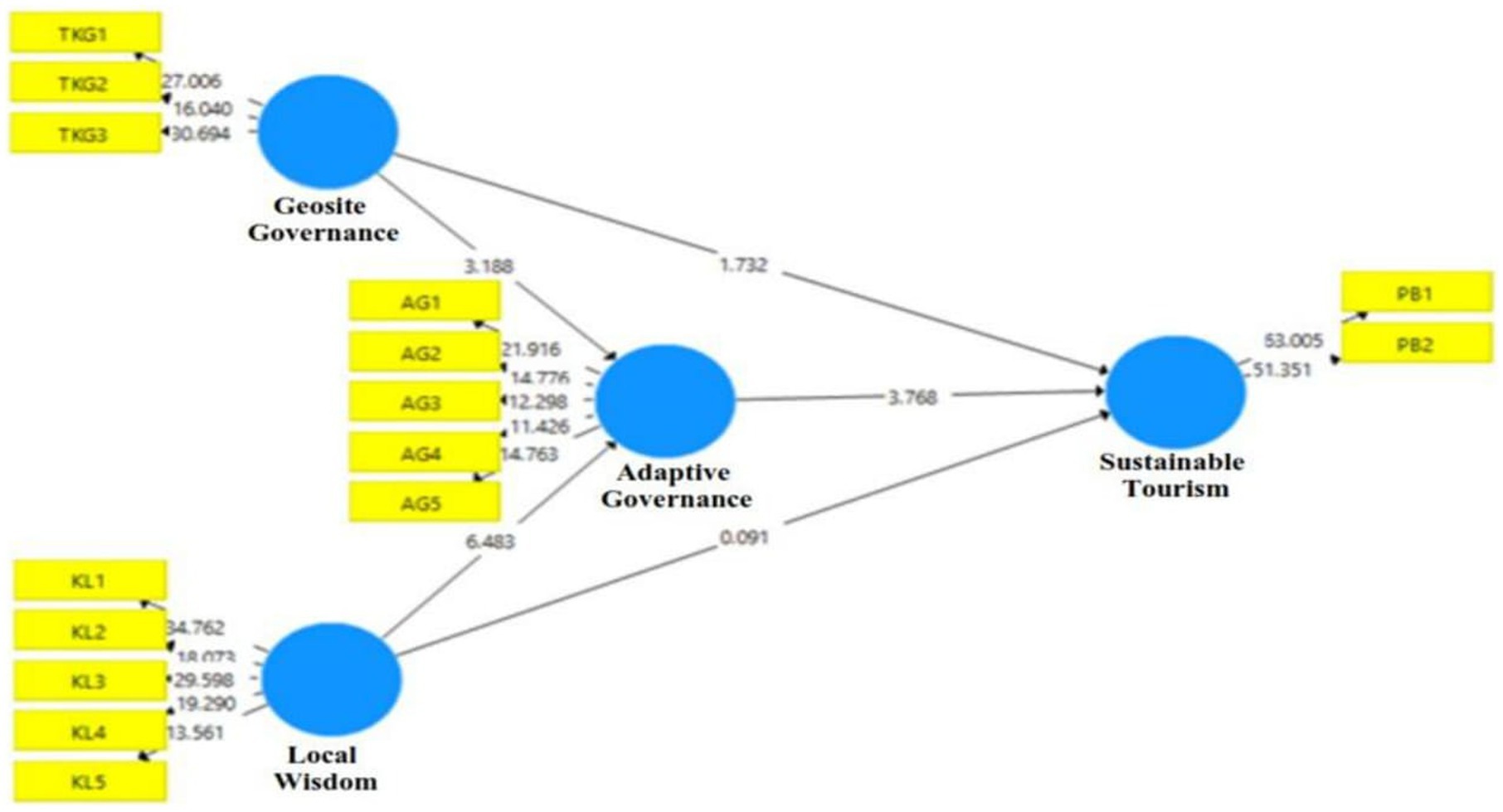
Figure 4. Model structure (p-value).
The results of the structural model test indicate that adaptive governance has a positive and significant influence on sustainable tourism with a path coefficient of 0.546. This confirms that the more adaptive the governance implemented, the greater the opportunity for achieving sustainable tourism practices, in line with adaptive governance theory which emphasizes the importance of flexibility in responding to social and ecological environmental dynamics. Conversely, local wisdom was not proven to have a direct influence on sustainable tourism (coefficient −0.012), indicating that the role of cultural values and traditional practices does not necessarily encourage tourism sustainability if not integrated into a formal management framework. However, the influence of local wisdom was seen to be significant on geosite governance with a coefficient of 0.550, indicating that the integration of local norms, traditions, and values plays an important role in strengthening the management mechanism of geological sites.
Furthermore, adaptive governance also contributes to geosite governance with a coefficient value of 0.321, although its influence is relatively lower than local wisdom. In turn, geosite governance contributes positively to sustainable tourism with a coefficient of 0.243, confirming its position as a mediating variable that bridges the influence of adaptive governance and local wisdom on tourism sustainability. Overall, this model shows that 52.2% of the variation in sustainable tourism can be explained by the combination of adaptive governance, local wisdom, and geosite governance, indicating a moderate level of explanatory power. Thus, this finding strengthens the theoretical argument that geosite governance is a key instrument in channeling local values and adaptive policies towards achieving sustainable tourism (Table 2).

Table 2. Path coefficient.
The path analysis results show that adaptive governance has a positive and significant effect on sustainable tourism (β = 0.546; p < 0.001). This is in line with the theory of adaptive governance (Folke et al., 2005; Rosenbloom, 2016; Sharma-Wallace et al., 2018), which emphasizes the importance of flexibility, multi-stakeholder collaboration, and adaptability in facing the dynamics of the socio-ecological environment. This means that the more adaptive the governance implemented, the stronger its contribution to achieving sustainable tourism practices. Furthermore, local wisdom has a positive and significant effect on adaptive governance (β = 0.550; p < 0.001). These findings confirm the theory of social-ecological systems (Yeremeyev et al., 2021; Zwiers, 2018), which places local knowledge as an important foundation in adaptive natural resource management. In other words, the cultural values, traditions, and practices of local communities can strengthen a more responsive and inclusive adaptive governance system. However, local wisdom did not directly influence sustainable tourism (β = −0.012; p = 0.928). This indicates that local wisdom does not automatically promote sustainable tourism if it is not institutionalized through formal governance. This finding confirms that the role of local wisdom is more effective when mediated by governance mechanism.
Furthermore, geosite governance had a significant positive effect on adaptive governance (β = 0.321; p = 0.002). These results indicate a reciprocal interaction, where both formal rule-based geological site management and community participation strengthen adaptive flexibility in tourism governance. The effect of geosite governance on sustainable tourism was found to be positive but not significant (β = 0.243; p = 0.084). This indicates that although strengthening geosite governance has the potential to promote tourism sustainability, its direct effect is still limited, possibly due to limitations in policy implementation or other external factors such as infrastructure and regulatory support. The mediation effect test showed that local wisdom has an indirect effect on sustainable tourism through adaptive governance (β = 0.301; p = 0.001). This means that although local wisdom does not have a direct impact, it becomes significant when articulated in adaptive governance. Adaptive governance has an indirect effect on sustainable tourism through geosite governance (β = 0.175; p = 0.015). This finding supports the view of governance theory (Hajar et al., 20242024) which states that adaptive governance practices will be more effective if operationalized through specific management units or institutions (in this case geosites).
The research results show that local wisdom does not directly influence sustainable tourism. This is understandable because local wisdom functions more as social capital and a cultural symbol that requires governance for concrete implementation. Without institutional support, cultural values merely become identities without a structural impact on sustainability. Kholik and Yusri (2025) and Mahrinasari et al. (2024) emphasized that local wisdom only contributes significantly when institutionalized in tourism management plans. Geosite governance was also found to have no direct influence on sustainable tourism. This condition occurs because geosite management is often hampered by limited regulations, inter-agency coordination, and low community participation. In other words, geosites can only have a real impact if managed adaptively. El Hamidy and Errami (2025) and Sartori Peruzzo et al. (2025) prove that geosite management requires institutional flexibility to be able to face environmental dynamics and disaster risks. The integration of local wisdom in adaptive policies is a dominant factor because the Samosir community has traditions, customs, and cultural practices relevant to environmental sustainability.
Conversely, adaptive governance has been shown to have a positive and significant impact on sustainable tourism. Adaptive governance provides room for policy flexibility, cross-stakeholder collaboration, and the ability to adapt to change (Challies et al., 2017; Gritsenko and Wood, 2022). Thus, tourist destinations are more resilient and able to maintain long-term sustainability. Nandini et al. (2024) and Sadat and Lawelai (2025) also emphasize that adaptive governance is key to strengthening the competitiveness of sustainable tourism. Local wisdom has been found to have a positive influence on adaptive governance. Cultural values such as deliberation, mutual cooperation, and community participation have been shown to be the social foundations that foster adaptive governance. In other words, local culture is not only a symbol of identity but also a social instrument for collective decision-making (Glass et al., 2025; Li et al., 2023). This finding aligns with Wardani (2023) who showed that local wisdom strengthens tourism competitiveness through participatory collaboration. Geosite governance has also been shown to have a positive influence on adaptive governance. A geosite management system that prioritizes conservation, zoning, and local community involvement can serve as an initial framework for creating more adaptive governance. This aligns with Sartori Peruzzo et al. (2025) and Sibarani et al. (2025), which asserts that adaptation-based geosite management can increase the effectiveness of risk management while supporting sustainable tourism. From a public administration perspective, adaptive policies must accommodate these values throughout the process of policy formulation, implementation, and evaluation. This reflects a paradigm shift from government to governance, where local actors become equal partners with the government.
This paradigm shift in public administration emphasizes that partnerships between government, communities, academics, and the private sector can foster multi-level collaboration, resulting in policies based on cross-sector dialogue and understanding. Benaddi et al. (2021) and Hashim (2024) explains that in modern public administration, this collaboration is a form of networked governance that encompasses the values of trust, communication, and shared responsibility to strengthen policy legitimacy while simultaneously enhancing community social capacity. Based on this explanation, it can be concluded that the success of the Toba Caldera geosite governance no longer depends on a single authority but rather on the synergy between actors within an interconnected system. Multi-level coordination is one effort to achieve goals in geosite governance in the Toba Caldera Geopark Area of Samosir Regency. This is what is called governance alignment in public administration, namely the harmonization of policies across levels without sacrificing local autonomy (Andersson et al., 2022; Tuthaes et al., 2024). Thus, multi-level collaboration in geosite governance is a new form of public administration development that can integrate domestic policies with Indonesia’s Asta Cita II and the Sustainable Development Goals (SDGs).
Referring to the public administration paradigm in the New Public Governance (NPG) era, it combines the principles of collaboration, networking, and adaptability (Héritier and Eckert, 2008; Lindsay et al., 2014). NPG positions the public, government, the private sector, and the global community as equal partners in creating good tourism governance (Hajar, 2025; Jamal and Camargo, 2018). NPG reflects a shift toward democratic, responsive, and sustainability-oriented governance. Thus, the management of the Toba Caldera Geosite is not merely a technical matter of tourism, but rather a manifestation of adaptive public administration that combines local values, national interests, and global commitments within a sustainable governance framework. Therefore, based on this collaborative framework, flexible geosite governance can be produced, and cultural values can be transformed into concrete strategies for realizing sustainable tourism.
4.2 The importance of adaptive policies in the governance of the Toba Caldera Geopark geosite in Samosir regency
The dynamics of public administration changes in the modern era have impacted the governance of the Toba Caldera geosite, caused by changes in tourist visits, pressures of cultural commercialization, and the dynamics of inter-institutional relations that demand a rapid, flexible, and evidence-based policy response. Therefore, adaptive policies are considered incapable of addressing the problems faced in the governance of the Toba Caldera Geopark geosite in realizing sustainable tourism in Samosir Regency, which involves many actors. However, on the other hand, the understanding of adaptive policies that create performance in policy implementation due to regulatory changes that are too rapid or inconsistent, and are not supported by strong institutions and clear coordination mechanisms, so that accountability cannot be maintained, resulting in the emergence of undirected policy changes.
According to Outeda (2024) and Zwang (2019), adaptive policy as legitimacy, referring to the perspective of public administration, is a fundamental aspect that ensures that the policies taken have a legal basis, authority, and recognition at both the national and international levels. Global legitimacy for the UNESCO Global Geopark status for the Toba Caldera requires geosite governance to be carried out in accordance with the principles of good governance (Pariwisata, 2025; Utara, 2025). Therefore, this is the role of public administration to ensure that national regulations are in line with international standards, so that adaptive policies can maintain a global reputation and meet the expectations of the international community (Fadhlinsyah et al., 2023; Zhiyuan et al., 2020). Thus, adaptive policies must also be able to accommodate local values in the process of policy formulation, implementation, and evaluation. This is in accordance with modern public administration that emphasizes local values and prioritizes community participation (Mergel et al., 2021; Morris et al., 2016; Velasco, 2020). The integration of local wisdom in adaptive policies is a dominant factor because the Samosir community has traditions, customs, and cultural practices relevant to environmental sustainability.
The governance of the Toba Caldera Geopark in Samosir Regency is strategically positioned because it has received international recognition from UNESCO as part of the UNESCO Global Geopark Network, and in September 2025 it has re-obtained its Green Card (Utara, 2025). This status is not only a symbolic achievement, but also a major mandate to maintain a balance between conservation, education, and sustainable development (Pariwisata, 2025). In this context, adaptive policies are seen as important because they enable geosite governance to remain responsive to ever-changing social, cultural, economic, and environmental dynamics (Hajar et al., 2025; Sibarani et al., 2025). Therefore, there are aspects of internal strength that are important capital in realizing sustainable tourism in the Toba Caldera Geopark Area, especially the geosite (Utara, 2025), namely First, UNESCO recognition through the Green Card increases international legitimacy and opens up opportunities for global cooperation. Second, the rich local wisdom of the Toba Batak people, with values such as marsiadapari (mutual cooperation) and habonaron do bona (truth as the basis), serves as a social foundation for building participatory governance. Third, the beauty of the geology, ecology, and culture are major attractions for tourists. Fourth, the application of adaptive governance principles has begun to encourage multi-actor involvement in management. However, without targeted adaptive policies, these strengths risk stagnation and under-management.
This internal strength aspect is also influenced by weaknesses that pose challenges in formulating adaptive policies (Farsari, 2023; Yusria et al., 2025), namely: (1) coordination between institutions is still partial, resulting in frequent program duplication; (2) community participation is not yet fully equitable, with local communities more often involved in the implementation stage than in the planning stage; (3) limited local human resource capacity in digital literacy, waste management, and foreign languages limits global competitiveness. Inadequate supporting infrastructure (roads, sanitation, waste management) also has the potential to reduce the quality of the tourist experience. Thus, adaptive policies are important to address these weaknesses through increasing community capacity, integrating inter-institutional roles, and developing environmentally friendly infrastructure (Junus et al., 2024; Yang and Ning, 2025).
Furthermore, external challenges resulting from the surge in tourism pose pressure on the environment, such as pollution, waste, and the risk of damage to the geosite. Cultural commercialization can erode the spiritual and social significance of the Toba Batak people (Manurung et al., 2020; Nugroho et al., 2021; Sitompul et al., 2020). Global uncertainties such as pandemics, climate change, and economic crises also have the potential to reduce tourist numbers. Furthermore, conflicts of interest between actors (government, investors, local communities) can weaken governance (Subair et al., 2025; Van Bets et al., 2017). Therefore, in facing these challenges, adaptive policies serve as dynamic mitigation mechanisms, for example by developing adaptive governance-based regulations, strengthening participatory monitoring, and developing crisis protocols to respond to global uncertainty. Thus, the important factors that make adaptive policies highly relevant in the governance of the Toba Caldera Geopark geosite in Samosir Regency can be described as follows:
The Figure 5 that the local wisdom of the Toba Batak people is considered highly relevant and dominant in supporting geosite governance. Values such as mutual cooperation (marsiadapari), habonaron do bona (truth as the basis), and customary practices in natural resource management are important instruments to ensure that tourism development aligns with local cultural identity (Siallagan et al., 2024; Octavianna et al., 2020). The research results confirm that the success of geosite management is largely determined by social legitimacy and local community support. This finding aligns with research (Ballesteros et al., 2022; Briggs et al., 2022; Zwang, 2019) which emphasizes that sustainable geopark management cannot be separated from the role of local communities as knowledge holders and the importance of global legitimacy in expanding access to international networks. However, this research provides a new emphasis that in the context of the Toba Caldera, local wisdom is more dominant than global legitimacy, in contrast to the case of geoparks in China or Europe which place more emphasis on UNESCO international standards (Pariwisata, 2025).
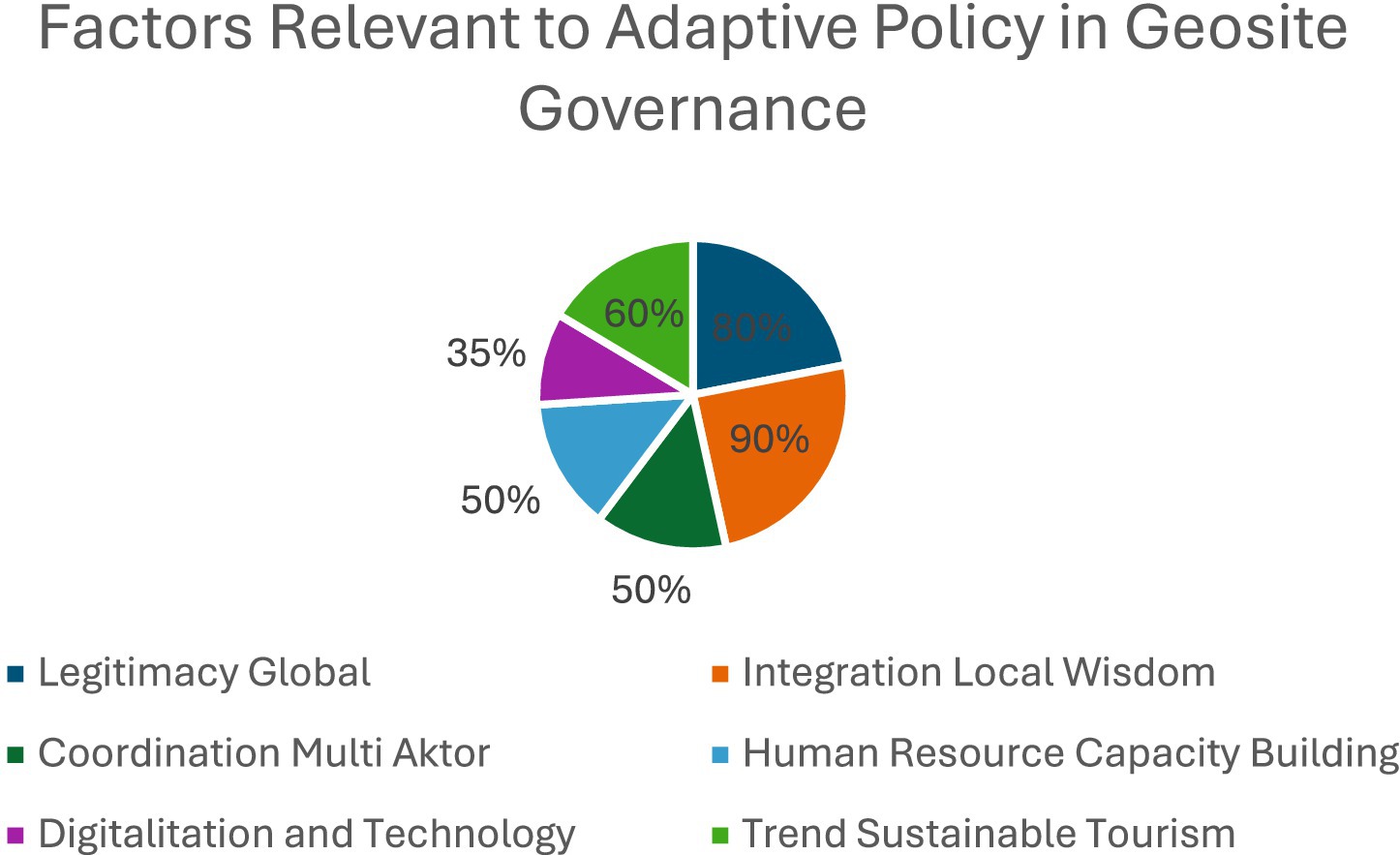
Figure 5. Level of relevance of adaptive policies in geosite governance.
The achievement of green card status for the Toba Caldera Geopark from the UNESCO Global Geopark Network is a strong driving force in the implementation of adaptive policies. Global recognition demands the implementation of international standards in conservation, education, and sustainable development. Research finds that global legitimacy not only enhances the tourism image but also strengthens Samosir’s position in attracting international investment and collaboration. Global developments toward sustainable tourism are relevant for adaptation to local contexts, such as research results from Amin et al. (2025), Baltaci (2025), Dangi and Petrick (2021) that tourists are now paying greater attention to environmental aspects, culture, and authentic experiences. This aligns with the natural and cultural richness of the Toba Caldera, which has ecological and sociocultural appeal. Adaptive policies are needed to manage this trend without sacrificing environmental authenticity and sustainability (Astuti et al., 2025; Folke et al., 2005).
The results of the study indicate that inter-institutional coordination (local governments, authority bodies, tourism awareness groups, business actors, and indigenous communities) remains a challenge (Muza, 2024; Wan and Bramwell, 2015). Adaptive policies are seen as relevant to unite the interests of various actors and prevent overlapping policies, and reflect a moderate but crucial urgency: without adaptive coordination, geosite management policies have the potential to be fragmented. These results reinforce studies conducted by (Sh Babakhanova and Pulatov, 2019; Pak et al., 2020) on adaptive governance in ecotourism areas, which highlight the need for cross-sector collaboration as an absolute requirement for successful management. However, this study found that in the context of Samosir Regency, coordination remains weak due to institutional limitations and the dominance of a top-down approach. This indicates an implementation gap between the ideals of the adaptive governance model and the reality on the ground.
Furthermore, the results of this study also support studies (Adams et al., 2017; Jia and Chaozhi, 2020; Masya and Alatas, 2024), which emphasize that sustainable tourism trends present significant opportunities for geopark destinations in Indonesia. However, this study provides an additional contribution, stating that this global trend can only be effectively internalized if combined with local values and adaptive governance mechanisms. From a policy perspective, the results of this study confirm the findings (Hartman, 2021; Hasselman, 2017; Sharma-Wallace et al., 2018) regarding the importance of adaptive governance in addressing the dynamics of uncertainty, both environmental and social. However, this study emphasizes that adaptive governance is not only a responsive instrument to global change but also a strategy for strengthening social legitimacy through the integration of local wisdom, due to this emphasis as the most relevant factor in adaptive policies for geosite governance (El Hamidy and Errami, 2025; Koupatsiaris and Drinia, 2024; Zafeiropoulos, 2024). A balance between global legitimacy and social legitimacy is a prerequisite for maintaining sustainable tourism in the Geopark Area. However, adaptive policies themselves face obstacles related to the digitalization gap, indicating that technological innovation has not yet fully become a primary factor, but rather only a supporting factor within the local community environment. Thus, adaptive policies in the governance of the Toba Caldera Geopark geosite can be viewed as a public administration process that combines aspects of regulation, collaboration, capacity, innovation, and sustainability. This positions public administration not merely as a bureaucratic mechanism, but as a driving force that ensures sustainable tourism can be realized through inclusive and adaptive geosite management.
Geosite governance in the Toba Caldera Geopark Area demands adaptive policies, enabling geosite management to adapt to the dynamics of the social and economic environment, as well as to constantly changing global challenges. The adaptive policies identified in this study stem from collaborative interactions between the local government, the Toba Caldera Geopark Agency, local communities, academics, business actors, and other stakeholders working in synergy with sustainable tourism (Chand et al., 2025; Junus et al., 2024; Lin and Simmons, 2017). However, these interactions create governance mechanisms that are not static but continually evolve and adapt to local needs. Thus, the adaptive policies identified in this study are characterized by heterogeneity, institutional learning, and governance resilience (Lundén and Varnajot, 2024; Nitivattananon and Srinonil, 2019). Therefore, from a public administration perspective, these characteristics reflect the importance of dynamic and participatory governance processes that transcend top-down regulation.
Based on the results of the study, it shows that there is an increase in community capacity in maintaining the sustainability of geological resources and optimizing the values of sustainable tourism, as carried out by the geosite managers in the Tele Area (Geosite Aek Sipitudai). One of the efforts made by the local government and also the Toba Caldera Management Agency is to facilitate cross-sector synergy by providing a dialogue space with various parties to be directly involved in formulating adaptive policies to realize sustainable tourism in the Toba Caldera Area of Samosir Regency. Thus, the results of this study are in line with the concept of adaptive governance as an approach that emphasizes policy flexibility (Hasselman, 2017; Rosenbloom, 2016), the ability to adapt to changes in the social environment and learning (Álvarez, 2020; Sh Babakhanova and Pulatov, 2019) and this is what is included in the transformation of public administration, namely the shift from a hierarchical bureaucratic system to a collaborative network system that is adaptive, participatory and oriented towards the social values of the community.
This shift in public administration, in this study, is seen as the implementation of a tourism system that produces interactions between actors in an adaptive policy network and supports sustainable tourism by upholding local values that serve as normative and cultural foundations, to form geosite governance that is not only prioritized by technocratic factors but directly focuses on sustainability factors (Briggs et al., 2022; Sartori Peruzzo et al., 2025). Local values are the main indicators in geosite governance, and are integrated into the NPG framework that can strengthen trust, solidarity and social cohesion in building collaborative governance. This is also clarified by Brendehaug et al. (2017) and Syafrizal (2021) opinion that local social and cultural values must be integrated into institutional structures to create long-term legitimacy and sustainability. Therefore, this shows that geosite governance is the practice of NPG through integrated local values through adaptive and collaborative mechanisms across actors and levels of government.
The transformation of public administration has opened up significant space for adaptive policies, but this adaptation process must be managed through responsive and collaborative governance to avoid policy inconsistencies and uncertainty in its implementation. Therefore, (Sungkawati, 2024; Thi et al., 2024) in sustainable tourism, adaptive governance is crucial, which can bring about a paradigm shift from economic and exploitative tourism development to a model that prioritizes geosite and ecosystem conservation, integrates local wisdom as social and cultural capital, involves local communities in decision-making, and encourages service innovation and the digitalization of geosite management to respond to VUCA (volatility, uncertainty, complexity, and ambiguity). Thus, adaptive governance provides a governance framework that is responsive, inclusive, and adaptive to environmental, social, economic, and cultural dynamics (Liu et al., 2024; Ricaurte-Quijano, 2013; Subair et al., 2025). This transformation makes tourism development oriented not only toward short-term economic growth, but also toward long-term sustainability based on geosite conservation and local community involvement.
5 Conclusion
Adaptive policies have become an important foundation for strengthening geosite governance in developing sustainable tourism amidst the ever-changing social, economic, and ecological dynamics of the Toba Caldera Geopark Area, particularly in Samosir Regency. Adaptive policies not only serve as a technocratic response but also represent a new framework that aligns with the shifting paradigm of public administration toward the era of governance society. Currently, local governments are no longer the sole determining actors, but rather, several actors collaborate in developing sustainable tourism through geosite governance to produce adaptive policies.
The shift in the public administration paradigm from traditional to governance has opened up space for a more deliberative, inclusive, and adaptive governance process. In the governance era, collaboration between various actors is crucial for developing a framework, implementing local values and knowledge that interact dynamically. This is where adaptive policies are crucial as a concrete manifestation of cooperative and collaborative work patterns between all interests to transform information that can support regional development in all sectors. This study shows that adaptive policies play a strategic role in the governance of the Toba Caldera Geopark geosite, namely: (1) As a strengthening of institutional capacity, by increasing the government’s ability to read changes, anticipate risks, and improve strategies; (2) Adaptive policies become a means of integrating interests, where local values are included in policy formulation; (3) Adaptive policies create space for innovation and encourage cross-sector collaboration in supporting sustainable tourism through geosite governance.
The importance of adaptive policies is increasingly evident, synergizing with the demands of sustainable tourism in Samosir Regency, which has 5 of the 16 geosites included in the Toba Caldera Geopark Area. An adaptive approach is able to balance the two sides of the risks that must be faced in geosite governance: development pressures and natural and environmental damage. Therefore, this is seen from the perspective of the public administration paradigm, indicating that adaptive policies in geosite governance reflect the core values of the governance society era: collaboration, sustainable development, and responsiveness.
The implementation of adaptive policies in Samosir Regency demonstrates that good geosite governance requires not only strong regulations, but also the government’s ability to listen, negotiate, and absorb new knowledge. Thus, adaptive policies are not only a strategic choice, but a fundamental necessity to ensure sustainable tourism can develop without sacrificing the ecological integrity and cultural value of the Toba Caldera Geopark area. This not only supports the achievement of the SDGs and Indonesia’s Asta Cita (Goals), but also strengthens Samosir’s position as a leading global tourism destination based on geological heritage and local wisdom. Research findings on adaptive policies in the geosite governance of the Toba Caldera Geopark theory provide several important contributions, both at the managerial and developmental levels. In terms of managerial impact, the research findings suggest that the Samosir Regency government needs to develop a more responsive, collaborative, and data-driven work pattern.
From a conceptual perspective, this research enriches the discourse on sustainable tourism governance by positioning adaptive policies as a core component of ecological geosite governance. Theoretically, the adaptive approach emphasizes the shift in public administration paradigm from a hierarchical model to a networked, collaborative, and learning-based governance model. These findings provide a novel contribution to the literature on geopark management, demonstrating that the success of conservation and tourism is determined not only by formal regulations but also by the ability of institutions to experiment, absorb feedback, and adapt policies to local socio-ecological conditions. At the conceptual level, this research also reinforces the notion that geosite governance is a dynamic process, not a static structure.
This research also opens new opportunities for future research. First, longitudinal studies are needed to monitor how adaptive policies affect ecological carrying capacity and community well-being in the long term. Long-term research will provide a more comprehensive picture of the effectiveness of adaptive policies in maintaining a balance between conservation and the economy. Second, further research can develop an integrative model that combines the perspectives of adaptive governance, smart tourism, and the creative economy to create a more holistic approach to geosite management. Third, comparative studies with other geoparks, both national and international, are needed to examine differences in policy adaptation patterns across various socio-cultural contexts. This will enrich our understanding of how local characteristics influence governance dynamics in geopark areas. The recommendations include: (1) strengthening regulatory legitimacy; (2) integrating local wisdom into public policy formulation; (3) optimizing multi-actor coordination; (4) increasing human resource capacity; (5) digital transformation in governance; and (6) balancing sustainable tourism principles.
Data availability statement
The original contributions presented in the study are included in the article/supplementary material, further inquiries can be directed to the corresponding author/s.
Ethics statement
The studies involving humans were approved by Toba Caldera Management Agency. The studies were conducted in accordance with the local legislation and institutional requirements. The participants provided their written informed consent to participate in this study.
Author contributions
SH: Conceptualization, Data curation, Formal analysis, Funding acquisition, Investigation, Methodology, Project administration, Resources, Software, Supervision, Validation, Visualization, Writing – original draft, Writing – review & editing. Ramlan: Data curation, Methodology, Resources, Supervision, Conceptualization, Formal analysis, Funding acquisition, Investigation, Project administration, Software, Validation, Visualization, Writing – original draft, Writing – review & editing. KK: Data curation, Methodology, Resources, Supervision, Validation, Conceptualization, Formal analysis, Funding acquisition, Investigation, Project administration, Software, Visualization, Writing – original draft, Writing – review & editing.
Funding
The author(s) declare that no financial support was received for the research and/or publication of this article.
Acknowledgments
We would like to thank the Ministry of Higher Education, Science, and Technology of the Republic of Indonesia, and the Muhammadiyah University of North Sumatra through the Institute for Research and Community Service, for facilitating the implementation of this research and for publishing the results as research outputs. We also thank the Samosir Regency Tourism and Culture Office for providing data and information related to the topic of this article.
Conflict of interest
The authors declare that the research was conducted in the absence of any commercial or financial relationships that could be construed as a potential conflict of interest.
Generative AI statement
The authors declare that no Gen AI was used in the creation of this manuscript.
Any alternative text (alt text) provided alongside figures in this article has been generated by Frontiers with the support of artificial intelligence and reasonable efforts have been made to ensure accuracy, including review by the authors wherever possible. If you identify any issues, please contact us.
Publisher’s note
All claims expressed in this article are solely those of the authors and do not necessarily represent those of their affiliated organizations, or those of the publisher, the editors and the reviewers. Any product that may be evaluated in this article, or claim that may be made by its manufacturer, is not guaranteed or endorsed by the publisher.
References
Adams, V. M., Álvarez-Romero, J. G., Capon, S. J., Crowley, G. M., Dale, A. P., Kennard, M. J., et al. (2017). Making time for space: the critical role of spatial planning in adapting natural resource management to climate change. Environ. Sci. Pol. 74, 57–67. doi: 10.1016/j.envsci.2017.05.003
Álvarez, R. F. (2020). Geoparks and education: UNESCO global geopark Villuercas-Ibores-Jara as a case study in Spain. Geosciences 10. doi: 10.3390/geosciences10010027
Amin, S. B., Khandaker, M. K., Samia, B. I., Khan, F., and Taghizadeh-Hesary, F. (2025). Fostering sustainable tourism through digital innovation and green tourism initiatives in Bangladesh. Sustain. Futures 10:100841. doi: 10.1016/j.sftr.2025.100841
Andersson, C., Hallin, A., and Ivory, C. (2022). Unpacking the digitalisation of public services: configuring work during automation in local government. Gov. Inf. Q. 39:101662. doi: 10.1016/j.giq.2021.101662
Ansell, C., and Gash, A. (2008). Collaborative governance in theory and practice. J. Public Adm. Res. Theory 18, 543–571. doi: 10.1093/jopart/mum032
Arbolino, R., Boffardi, R., De Simone, L., and Ioppolo, G. (2021). Multi-objective optimization technique: A novel approach in tourism sustainability planning. J. Environ. Manag. 285:112016. doi: 10.1016/j.jenvman.2021.112016,
Astuti, S. J. W., Suindyah Dwiningwarni, S., and Atmojo, S. (2025). Modeling environmental interactions and collaborative interventions for childhood stunting: a case from Indonesia. Dialogues in Health 6:100206. doi: 10.1016/j.dialog.2025.100206,
Ballesteros, D., Caldevilla, P., Vila, R., Barros, X. C., Rodríguez-Rodríguez, L., García-Ávila, M., et al. (2022). A GIS-supported multidisciplinary database for the management of UNESCO global geoparks: the Courel Mountains Geopark (Spain). Geoheritage 14. doi: 10.1007/s12371-022-00654-3
Baltaci, M. (2025). Sustainable future of the oceans: strengthening tourism and global cooperation under SDG 14 sustainable future of the oceans: strengthening tourism and global cooperation under SDG 14. Cattle Pract. 33. doi: 10.59671/MNNoJ
Batory, A., and Svensson, S. (2020). Regulating collaboration: the legal framework of collaborative governance in ten European countries regulating collaboration: the legal framework of collaborative governance in ten European countries. Int. J. Public Adm. 43, 780–789. doi: 10.1080/01900692.2019.1658771
Benaddi, H., Laaz, N., Kettani, E.El, and Hannad, Y. (2021). Ontology model for public services in Morocco based on 5W1H approach: psom-egovma. Procedia Comput. Sci., 198, 429–434. doi: 10.1016/j.procs.2021.12.265
Blackstone, E. A., Hakim, S., and Meehan, B. (2017). A regional, market oriented governance for disaster management: A new planning approach. Eval. Program Plann. 64, 57–68. doi: 10.1016/j.evalprogplan.2017.05.014,
Brendehaug, E., Aall, C., and Dodds, R. (2017). Environmental policy integration as a strategy for sustainable tourism planning: issues in implementation. J. Sustain. Tour. 25, 1257–1274. doi: 10.1080/09669582.2016.1259319
Briggs, A., Newsome, D., and Dowling, R. (2022). A proposed governance model for the adoption of geoparks in Australia. Int. J. Geoheritage Parks 10, 160–172. doi: 10.1016/j.ijgeop.2021.12.001
Challies, E., Newig, J., Kochskämper, E., and Jager, N. W. (2017). Governance change and governance learning in Europe: stakeholder participation in environmental policy implementation. Polic. Soc. 36, 288–303. doi: 10.1080/14494035.2017.1320854
Chand, D., Mohan, A., and Walia, A. (2025). Government funding and its influence on product innovation in micro, small, and medium enterprises (MSMEs): a comprehensive review. J. Inf. Syst. Eng. Manag. 10, 213–237. doi: 10.52783/jisem.v10i11s.1516
Cleaver, F., and Whaley, L. (2018). Understanding process, power, and meaning in adaptive governance: a critical institutional reading. Ecol. Soc. 23. doi: 10.5751/ES-10212-230249
Creswell, J. W. (2018). “Research design (qualitative, quantitative, and mixed methods approaches)” in Research design third edition (Sage Publications).
Dangi, T. B., and Petrick, J. F. (2021). Augmenting the role of tourism governance in addressing destination justice, ethics, and equity for sustainable community-based tourism. Tourism Hospital. 2, 15–42. doi: 10.3390/tourhosp2010002
Dolnicar, S., Gray, A., Grün, B., Li, H., and Portmann, M. (2023). Automatically monitoring environmental performance in tourism – the example of plate waste at all-you-can-eat buffets. Ann. Tourism Res. Empirical Insights 4:100100. doi: 10.1016/j.annale.2023.100100
El Hamidy, M., and Errami, E. (2025). The geosites of Safi province (Marrakech-Safi region, Morocco): inventory and assessment for geoconservation, geotourism, geoeducation, geoparks, and local sustainable development. Int. J. Geoheritage Parks 13, 68–91. doi: 10.1016/j.ijgeop.2025.01.001
Epifani, F., and Valente, D. (2023). Sustainable governance of tourism-based social – ecological landscapes. Sustainability 15, 1–17. doi: 10.3390/su1522115967
Fadhlinsyah,, Hajar, S., and Bida, O. (2023). Spatial policy on environmental management in Gayo Lues regency. Int. J. Health, Econ. Soc. Sci. 5, 192–203. doi: 10.56338/ijhess.v5i3.3777
Farsari, I. (2023). Exploring the nexus between sustainable tourism governance, resilience and complexity research. Tour. Recreat. Res. 48, 352–367. doi: 10.1080/02508281.2021.1922828
Fathani, A. T., Azmi, N. A., Purnomo, E. P., Tham, S. A., and Ahmad, R. (2023). A systematic review of tourism governance: sustainable tourism governance model post COVID-19. Jurnal Borneo Administrator 19, 35–50. doi: 10.24258/jba.v19i1.1125
Fauzi, N. S. M., and Misni, A. (2016). Geoheritage conservation: indicators affecting the condition and sustainability of geopark – a conceptual review. Procedia. Soc. Behav. Sci. 222, 676–684. doi: 10.1016/j.sbspro.2016.05.224
Folke, C., Hahn, T., Olsson, P., and Norberg, J. (2005). Adaptive governance of social-ecological systems. Annu. Rev. Environ. Resour. 30, 441–473. doi: 10.1146/annurev.energy.30.050504.144511
Gash, A. (2022). “Collaborative governance” in Handbook on theories of governance (Second, 649. eds. C. A. and J. Torfing (Edward Elgar Publishing, Inc.).
Glass, J. H., Waylen, K., Reed, M. S., Peskett, L., and Stevens, B. (2025). Natural capital approaches to decision-making for collaborative landscape governance. Environ Sci Policy 171:104133. doi: 10.1016/j.envsci.2025.104133,
Gritsenko, D., and Wood, M. (2022). Algorithmic governance: a modes of governance approach. Regul. Gov. 16, 45–62. doi: 10.1111/rego.12367
Gutiérrez Navas, E. B., Sarmiento Suarez, J. E., Ramírez Montañez, J., and Rincón Quintero, Y. A. (2024). Determining factors for the digitization of micro, small, and medium-sized enterprises (MSMEs) in Ibero-America. J. Innov. Knowl. 10. doi: 10.1016/j.jik.2024.100631
Hair, J. F., Hult, G. T. M., and Ringle, C. M. (2019). A primer on partial least squares structural equation modeling (PLS-SEM) : SAGE Publications, Inc. Printed.
Hajar, S. (2020). Perencanaan pembangunan pariwisata kawasan danau toba disertasi. 1st Edn: Universitas Brawijaya.
Hajar, S. A. N. A. (2025). Good Tourism Governance: Tinjauan Komparatif Pada Kawasan Pariwisata Danau Toba dan Kawasan Pariwisata Labuan Bajo : UMSU PRESS.
Hajar, S., and Arma, N. A. (2024). Tourism governance based-on penta-helix model in Samosir Island, Indonesia. Int. J. Relig. 5, 1914–1927. doi: 10.61707/rjw9gt07
Hajar, S., Faustyna, F., and Kholik, K. (2022). Muslim-friendly tourism towards good tourism governance. Otoritas 12, 142–161. doi: 10.26618/ojip.v12i2.8052
Hajar, Siti, Ramlan,, and Kholik, K. (2025). Kebijakan Tata Kelola Geosite Geopark Kaldera Toba Berbasis Kearifan Lokal Melalui Pendekatan Adaptive Governance untuk Pariwisata Berkelanjutan di Samosir.
Hajar, S., and Yuliani, F. (2024). “Perencanaan Pariwisata (Teori dan Praktek dalam Perspektif Administrasi Publik)” in ed. N. A. Arma. 1st ed (UMSU PRESS).
Halim, J. M., Lubis, D. P., Hasibuan, A. P. R., Syardhi, R. D., Ningsih, R. W., and Alda, T. (2024). Interactive mixed reality museum for Ulos Batak cultural heritage preservation and global recognition. Int. J. Architect. Urbanism 8, 371–376. doi: 10.32734/ijau.v8i3.18103
Hartman, S. (2021). Adaptive tourism areas in times of change. Ann. Tour. Res. 87:102987. doi: 10.1016/j.annals.2020.102987,
Hashim, H. (2024). E-government impact on developing smart cities initiative in Saudi Arabia: opportunities & challenges. Alex. Eng. J. 96, 124–131. doi: 10.1016/j.aej.2024.04.008,
Hasselman, L. (2017). Adaptive management; adaptive co-management; adaptive governance: what’s the difference? Aust. J. Environ. Manag. 24, 31–46. doi: 10.1080/14486563.2016.1251857
Hatipoglu, B., Alvarez, M. D., and Ertuna, B. (2016). Barriers to stakeholder involvement in the planning of sustainable tourism: the case of the Thrace region in Turkey. J. Clean. Prod. 111, 306–317. doi: 10.1016/j.jclepro.2014.11.059
Héritier, A., and Eckert, S. (2008). New modes of governance in the shadow of hierarchy: self-regulation by industry in Europe. J. Public Policy 28, 113–138. doi: 10.1017/S0143814X08000809
Herizal, H., Mukhrijal, M., and Wance, M. (2020). Pendekatan Akuntabilitas Pelayanan Publik Dalam Mengikuti Perubahan Paradigma Baru Administrasi Publik. J. Gov. Soc. Policy 1, 24–34. doi: 10.24815/gaspol.v1i1.17327
Hossain, M. A., Islam, M. R., Yesmin, T., and Hasan, M. H. (2025). Development and application of the GATSI in measuring tourism sustainability in cox’s bazar, Bangladesh. Geomatica 77:100041. doi: 10.1016/j.geomat.2024.100041
Huang, X., Zhan, W., Qi, T., Guo, Y., Bai, R., and Hong, T. (2025). Research on regional collaborative governance between central and local governments under the background of green innovation. Systems 13. doi: 10.3390/systems13030153
Ibrahim, M. S. N., Abdul-Halim, S., Ishak, M. Y., and Hassan, S. (2021). The local community awareness on Langkawi UNESCO global Geopark status: case of Kampung Padang Puteh, Langkawi, Malaysia. Int. J. Geoheritage Parks 9, 233–241. doi: 10.1016/j.ijgeop.2021.02.009
Jamal, T., and Camargo, B. A. (2018). Tourism governance and policy: whither justice? Tour. Manag. Perspect. 25, 205–208. doi: 10.1016/j.tmp.2017.11.009,
Jayaraju, N., Sreenivasulu, G., Madakka, M., and Manjulatha, M. (2023). “Coasts, estuaries and lakes: Implications for sustainable development” in Coasts, estuaries and lakes: implications for sustainable development. doi: 10.1007/978-3-031-21644-2
Jia, X., and Chaozhi, Z. (2020). Halal tourism: is it the same trend in non-Islamic destinations with Islamic destinations? Asia Pac. J. Tourism Res. 25, 189–204. doi: 10.1080/10941665.2019.1687535
Junus, D., Harun, N. I., and Napir, S. (2024). Adopting sustainable environmental policy based on quadruple helix model in Gorontalo city, Indonesia. Otoritas: Jurnal Ilmu Pemerintahan 14, 573–588. doi: 10.26618/ojip.v14i3.12764
Kementerian Pariwisata Republik Indonesia. (2025). Siaran Pers: Menteri Pariwisata Sebut Pariwisata Jadi Salah Satu Pilar Strategis Penggerak Ekonomi. Pariwisata. Available online at: https://kemenpar.go.id/berita/siaran-pers-menteri-pariwisata-sebut-pariwisata-jadi-salah-satu-pilar-strategis-penggerak-ekonomi
Kholik, K., and Yusri, M. (2025). Challenges of human resource management towards optimizing public service performance in realizing sustainable development at the population and civil registration service of Medan City. Int. J. Health, Econ. Soc. Sci. 7, 449–454. doi: 10.56338/ijhess.v7i1.7057
Koupatsiaris, A. A., and Drinia, H. (2024). Expanding geoethics: interrelations with geoenvironmental education and sense of place. Sustainability 16. doi: 10.3390/su16051819
Lestari, D., Rochaida, E., Suharto, R. B., Mixila, S., and Sutapa, I. N. (2022). In the era of digitization, government’s role in alleviating stunting. Webology 19, 4925–4941. doi: 10.14704/web/v19i1/web19330
Li, X., Chen, W., and Alrasheedi, M. (2023). Challenges of the collaborative innovation system in public higher education in the era of industry 4.0 using an integrated framework. J. Innov. Knowl. 8. doi: 10.1016/j.jik.2023.100430
Lin, D., and Simmons, D. (2017). Structured inter-network collaboration: public participation in tourism planning in southern China. Tour. Manag. 63, 315–328. doi: 10.1016/j.tourman.2017.06.024
Lindsay, C., Osborne, S. P., and Bond, S. (2014). The “new public governance” and employability services in an era of crisis: challenges for third sector organizations in Scotland. Public Adm. 92, 192–207. doi: 10.1111/padm.12051
Liu, S., Wu, Y., Jiang, G., and Dong, J. (2024). System dynamics modeling of collaborative governance in smart cities: a case study of Dongguan, China. Sci. Rep. 14, 1–20. doi: 10.1038/s41598-024-82363-1
Lundén, A., and Varnajot, A. (2024). Protected areas and tourism in the new normal: an analysis of temporal and scalar tensions of sustainable tourism governance in the finnish arctic. Tourist Behav. New Norm. 2, 241–259. doi: 10.1007/978-3-031-45866-8_13
Madan, R., and Ashok, M. (2023). AI adoption and diffusion in public administration: a systematic literature review and future research agenda. Gov. Inf. Q. 40:101774. doi: 10.1016/j.giq.2022.101774
Mahrinasari, M. S., Bangsawan, S., and Sabri, M. F. (2024). Local wisdom and government’s role in strengthening the sustainable competitive advantage of creative industries. Heliyon 10:e31133. doi: 10.1016/j.heliyon.2024.e31133,
Mandić, A., Petrić, L., and Pivčević, S. (2025). Harmonizing sustainability and resilience in post-crisis cultural tourism: stakeholder insights from the split metropolitan area living lab. Tour. Manag. Perspect. 55. doi: 10.1016/j.tmp.2024.101331
Manurung, R., Ismail, R., Sibarani, R., and Munthe, H. (2020). The position of Toba Batak ethnic women on land obtained from families in North Sumatra Province. Int. J. Sci. Technol. Res. 9, 174–178. doi: 10.5220/0011563500003460
Masya, H., and Alatas, S. (2024). Social intervention as a communication strategy in reducing stunting in Sidoarjo East Java. Communicology 12, 104–124. doi: 10.21009/COMM.032.07
Maurer, S. M. (2017). The new self-governance: a theoretical framework. Bus. Polit. 19, 41–67. doi: 10.1017/bap.2016.4
Mergel, I., Ganapati, S., and Whitford, A. B. (2021). Agile: a new way of governing. Public Adm. Rev. 81, 161–165. doi: 10.1111/puar.13202
Morris, J.C, and Stevens-Miller, K. (2016). Advancing collaboration theory: models, typologies, and evidence. In K. Morris, C John, and Stevens-Miller (Ed.), Routledge research in public administration and public policy Routledge Taylor & Francis 3, 1295–1306. doi: 10.1016/j.bpj.2015.06.056
Muza, O. (2024). Innovative governance for transformative energy policy in sub-Saharan Africa after COVID-19: green pathways in Egypt, Nigeria, and South Africa. Heliyon 10:e29706. doi: 10.1016/j.heliyon.2024.e29706,
Nandini, D., Eddy, A. A. N., Gorda, S., Subanda, N., Oka, A. A. N., and Gorda, S. (2024). Adaptive governance in the transformation process of Kintamani tourism attraction management by Bangli District government. J. Human. Soc. Stud. 8, 978–984. doi: 10.33751/jhss.v8i3.10328
Naswar, I. A., Mukhlis, M. M., Achmad,, and Khalid, R. M. (2024). Exploring SDGs regulatory frameworks and regional regulation for climate change mitigation and adaptive resilience in coastal communities. Jurnal IUS Kajian Hukum Dan Keadilan 12, 572–587. doi: 10.29303/ius.v12i3.1543
Nitivattananon, V., and Srinonil, S. (2019). Enhancing coastal areas governance for sustainable tourism in the context of urbanization and climate change in eastern Thailand. Adv. Clim. Chang. Res. 10, 47–58. doi: 10.1016/j.accre.2019.03.003,
Nugroho, C., Nurhayati, I. K., Nasionalita, K., and Malau, R. M. U. (2021). Weaving and cultural identity of Batak Toba women. J. Asian Afr. Stud. 56, 1165–1177. doi: 10.1177/0021909620958032,
Nunkoo, R. (2017). Governance and sustainable tourism: what is the role of trust, power and social capital? J. Destin. Mark. Manag. 6, 277–285. doi: 10.1016/j.jdmm.2017.10.003
Nurjaya, I. N. (2022). Legal policy of sustainable tourism development: toward community-based tourism in Indonesia. J. Tourism Econ. Policy 2, 123–132. doi: 10.38142/jtep.v2i3.404
Octavianna, Y., Sibarani, R., Situmorang, H., and Hasibuan, S. N. (2020). Traditional praying performance Martonggotonggo and dancing performance Marpaniaran for the women’s health at the Toba Batak traditional wedding ceremony. Enferm. Clin. 30, 357–360. doi: 10.1016/j.enfcli.2019.11.003
Outeda, P. C. C. (2024). The EU’S AI act: a framework for collaborative governance. Internet of Things 27:101291. doi: 10.1016/j.iot.2024.101291
Pahl-Wostl, C. (2019). The role of governance modes and meta-governance in the transformation towards sustainable water governance. Environ Sci Policy 91, 6–16. doi: 10.1016/j.envsci.2018.10.008,
Pak, K., Polikoff, M. S., Desimone, L. M., and Saldívar García, E. (2020). The adaptive challenges of curriculum implementation: insights for educational leaders driving standards-based reform. AERA Open 6, 1–15. doi: 10.1177/2332858420932828
Pariwisata, K. 2025 Fakta-fakta Geopark Toba Caldera Kementerian Pariwisata Republik Indonesia. Available online at: https://kemenpar.go.id/berita/fakta-fakta-geopark-toba-caldera
Qiu, N., Xing, Z., Han, X., and Du, M. (2025). Chrono-urbanism in action: collaborative governance for heritage preservation and livability in Beijing’s hutongs. Cities 160:105841. doi: 10.1016/j.cities.2025.105841
Ramlan,, Hajar, S., and Saputra, A. (2023). “Opportunities and challenges for developing a Tourism Village based on local wisdom in the era of society 5.0” in Proceedings of the 5th open society conference (OSC 2023), advances in economics business and management research, OSC, 89–95. doi: 10.2991/978-94-6463-290-3_8
Ricaurte-Quijano, C. (2013). Self-organisation in tourism planning: Complex dynamics of planning, policy-making, and tourism governance in. Santa Elena, Ecuador: In The University of Brighton.
Ringle, C. M., Sarstedt, M., and Hair, J. F. (2024). Advanced issues in partial least squares structural equation modeling (PLS-SEM). 2nd Edn. Thousand Oaks, CA: Sage Publications.
Rosado-González, E. M., Lourenço, J. M. M., Palacio-Prieto, J. L., and Sá, A. A. (2023). Collaborative mapping on sustainable development goals in Latin America UNESCO global geoparks: a methodological discussion. Int. J. Geoheritage Parks 11, 203–220. doi: 10.1016/j.ijgeop.2023.02.002
Rosenbloom, H. D. (2016). ADAPTIVE practice strategies for dealing: practice strategies for dealing with constant change in public administration and policy. CRC Press, Taylor & Francis Group
Sadat, A., and Lawelai, H. N. (2025). Optimizing sustainable tourism governance and its impact on employment opportunities through a dynamic governance approach. J. Inf. Syst. Eng. Manag. 10, 965–979. doi: 10.52783/jisem.v10i27s.4756
Samosir, P. K. 2024 Industri Kerajinan Kain Tenun Samosir Motif Ulos. Kabupaten Samosir. Avaialble online at: https://samosirkab.go.id/industri-kerajinan-kain-tenun-samosir-motif-ulos/
Samosir, D. K, and dan, P.. (2025). Kunjungan Wisatawan 2024 Meningkat 56 Persen ke Samosir, Tapi Lama Tinggal Tetap Hanya 1,5 Hari. Green Berita. Available online at: greenberita.com/2025/02/kunjungan-wisatawan-2024-meningkat-56.html
Sartori Peruzzo, R., Valdati, J., and McHenry, M. (2025). Land tenure and future development affect integrity and geodiversity in Brazilian indigenous Geocultural sites. Geomorphology 481:109770. doi: 10.1016/j.geomorph.2025.109770,
Sh Babakhanova, B., and Pulatov, K. (2019). Green chemistry and sustainable development: Tashkent Institute of Chemical Technology Acts Responsibly. Sustainability (Switzerland) 11, 1–14. doi: 10.1016/j.regsciurbeco.2008.06.005
Sharma-Wallace, L., Velarde, S. J., and Wreford, A. (2018). Adaptive governance good practice: show me the evidence! J. Environ. Manag. 222, 174–184. doi: 10.1016/j.jenvman.2018.05.067,
Siallagan, D. N., Handayani, R., and Sibarani, S. (2024). Optimizing natural resources: dye plant conservation for the Harungguan Muara Ulos weaving industry. Int. J. Inf. Technol. Bus. 7, 09–16. doi: 10.24246/ijiteb.712024.09-16
Sibarani, R., Kimura, T., and Simanjuntak, P. (2025). The schematic structure of folk discourses of Toba caldera Geosites as the collective memory for tourist destinations at Lake Toba area. Cogent Arts Humanit. 12. doi: 10.1080/23311983.2025.2451491
Sidney, F. F. G. J. M. M. S. (2020). “Handbook of public policy analysis (theory, politics, and methods)” in Handbook of public policy analysis (CRC Press).
Sitepu, A. O., Santiago, F., and Purwanto, R. 2021. The effectiveness of licensing on tourism business activity in the area of the Toba Lake. In Proceedings of the 2nd international conference on business law and local wisdom in tourism (ICBLT 2021), 605(Icblt), 6–11. https://www.atlantis-press.com/proceedings/icblt-21/125965316
Sitompul, R., Alesyanti,, and Ridwan, M. (2020). Domestic violence as initiated by Batak culture in East Medan, Indonesia. J. Hum. Behav. Soc. Environ. 30, 835–842. doi: 10.1080/10911359.2020.1750526
Steelman, T. (2022). Adaptive governance. In J. Torfing and C. A. Torfing (Ed.), Handbook on theories of governance (Second, 649). Edward Elgar Publishing, Inc.
Subair, N., Prianto, A. L., and Amri, A. R. (2025). The dynamics of no one left behind: contestation of pentahelix actors in sustainable tourism governance in the coastal area of Tanjung Bunga, Indonesia. Grassroots J. Nat. Resour. 8, 1–36. doi: 10.33002/nr2581.6853.080101
Syafrizal, (2021). Local wisdom and social dilemma has allergy upon worn value, proudly with currently values (viewed from social anthropology perspective for orang Ocu). Randwick Int. Soc. Sci. J. 2, 302–315. doi: 10.47175/rissj.v2i3.252
Thangiah, M., Petronas, U. T., Basri, S., and Petronas, U. T. (2020). Analyzing the conceptual model for exploratory testing framework using analyzing the conceptual model for exploratory testing framework using PLS-SEM Thangiah Murugan, Shuib Basri, and Dhanapal Durai Domnic
Thi, H. N., Thi, T. N., Trong, T. V., Duc, T. N., and Nghi, T. N. (2024). Sustainable tourism governance: a study of the impact of culture. J. Gov. Regul. 13, 474–485. doi: 10.22495/jgrv13i2siart22
Tuthaes, C. L., Toda, H., and Lake, P. (2024). Hexa helix’s collaboration in creative economy development based on local wisdom: case study of Ikat weaving MSMEs in Kupang City. J. Bina Praja 16, 171–185. doi: 10.21787/jbp.16.2024.171-185
Utara, P. P. S. 2025 Geopark Kaldera Toba Kembali Raih Green Card GM BP Kaldera Toba: Kerja Keras Semua Pihak. Pemerintah Provinsi Sumatera Utara. Avaialble online at: https://sumutprov.go.id/artikel/artikel/geopark-kaldera-toba-kembali-raih-green-card-gm-bp-kaldera-toba-kerja-keras-semua-pihak
Van Bets, L. K. J., Lamers, M. A. J., and van Tatenhove, J. P. M. (2017). Collective self-governance in a marine community: expedition cruise tourism at Svalbard. J. Sustain. Tour. 25, 1583–1599. doi: 10.1080/09669582.2017.1291653
Velasco, M. (2020). “Global encyclopedia of public administration, public policy, and governance” in Global encyclopedia of public administration, public policy, and governance. doi: 10.1007/978-3-319-31816-5
Wan, Y. K. P., and Bramwell, B. (2015). Political economy and the emergence of a hybrid mode of governance of tourism planning. Tour. Manag. 50, 316–327. doi: 10.1016/j.tourman.2015.03.010,
Wang, T. (2024). Sustainable development of rural revitalization in Zibo Pujia Village: a perspective on culture-tourism integration. Acad. J. Human. Soc. Sci. 7, 101–107. doi: 10.25236/ajhss.2024.070416
Wardani, V. (2023). Local wisdom of the Aceh Community in Peoples Stories in Pidie and Pidie Jaya districts. Jurnal Ilmu Sosial Dan Ilmu Politik Malikussaleh 4, 286–295. doi: 10.29103/jspm.v4i2.11337
Yang, L., and Ning, W. (2025). Mechanisms and effects of the sustainable integration of digital-driven rural cultural tourism from the perspective of symbiosis. Sustain. Futures 10:100867. doi: 10.1016/j.sftr.2025.100867,
Yenni, E. (2022). Strategi Komunikasi Kepala Desa Dalam Mengembangkan Wisata Sawah di Desa Pematang Johar communication Strategy Village head in Develoving Rice field tourism in the Pematang Johar Village. Jurnal Sinar Manajemen 9, 489–495. doi: 10.56338/jsm.v9i3.3016
Yeremeyev, I., Dychko, A., Remez, N., Kraychuk, S., and Ostapchuk, N. (2021). Problems of sustainable development of ecosystems. Earth Environ. Sci. 628:012014. doi: 10.1088/1755-1315/628/1/012014,
Yusria, M., Kholikv, K., Hajarc, S., and Warjio, (2025). Healthy and waste-free area: integrated waste management, regional resilience through sustainable development in deli Serdang regency, Indonesia. J. Posthumanism 5, 980–1000. doi: 10.63332/joph.v5i3.832
Zafeiropoulos, G. N. (2024). The importance of Geoenvironmental education in understanding geological heritage and promoting Geoethical awareness: Development and implementation of an innovative assessment method, with a case study of the Southeast Aegean Islands : National and Kapodistrian University of Athens.
Zhiyuan, Wu, Bi, Weixi, Yuan, Hao, Lu, Andrew, Zhao, Sinuo, Zhou, Longfei, et al. 2020. Evaluation of smart infrastructure systems and novel UV-oriented solution for integration, resilience, inclusiveness, and sustainability. IEEE 5th international conference on Universal Village. doi: 10.1109/UV50937.2020.9426194
Zhuang, A., Stoffelen, A., Meijles, E., and Groote, P. (2024). The complex governance of protected areas: insights from geoheritage and geopark management in China. Environ. Policy Gov. 34, 679–690. doi: 10.1002/eet.2118,
Zwang, A. (2019). Web communication of french geoparks in education: the expression of their legitimacy. UNESCO Global Geoparks 644015, 199–213. doi: 10.1002/9781119681489.ch11,
Keywords: adaptive policy, geosite management, sustainable tourism, Toba Caldera Geopark, local wisdom, public administration
Citation: Hajar S, Ramlan and Kholik K (2025) Why is adaptive policy important in geosite governance as an effort to realize sustainable tourism in the Toba Caldera Geopark area of Samosir regency? Front. Polit. Sci. 7:1713478. doi: 10.3389/fpos.2025.1713478
Edited by:
Stacey M. Mitchell, Georgia State University, United StatesReviewed by:
Andi Luhur Prianto, Muhammadiyah University of Makassar, IndonesiaAqil Teguh Fathani, Jakarta Veterans National Development University, Indonesia
Martha Cecilia Méndez Prada, Corporación Universitaria del Caribe, Colombia
Copyright © 2025 Hajar, Ramlan and Kholik. This is an open-access article distributed under the terms of the Creative Commons Attribution License (CC BY). The use, distribution or reproduction in other forums is permitted, provided the original author(s) and the copyright owner(s) are credited and that the original publication in this journal is cited, in accordance with accepted academic practice. No use, distribution or reproduction is permitted which does not comply with these terms.
*Correspondence: Siti Hajar, c2l0aWhhamFyQHVtc3UuYWMuaWQ=