Abstract
Introduction:
Gender disparities in medical and biomedical research productivity remain a critical issue globally, yet data from Arab countries, including Bahrain, are limited. This study examines gender differences in medical and biomedical research productivity in Bahrain over a two-decade period (2005–2024), focusing on publication rates, authorship patterns, journal quality, and collaboration trends.
Methods:
A bibliometric analysis was conducted using the Scopus database, covering 5,445 publications from Bahraini institutions in the medical and biomedical fields. Data were filtered to include only articles and reviews. Books, conference papers, and retracted works were excluded. The variables included authorship positions (first, last, corresponding), journal quartiles, SCImago Journal Rank (SJR), and collaboration types (institutional, national, regional, international). Gender was determined based on the authors' names and institutional and professional profiles. Descriptive statistics, Student's t-tests, and chi-square tests were used to compare sex differences (p < 0.05).
Results:
The number of medical and biomedical publications in Bahrain increased fivefold from 2005 to 2024, comprising 80.1% of the articles and 12.8% of the reviews. Arabian Gulf University led institutional output (30.2% of total publications). Local journals accounted for 54.0% of the publications, with limited international visibility. Males from Bahrain dominated authorship (59.3% first, 68.3% last, 65.6% corresponding), whereas females comprised 36.0% of Bahraini authors on average. Male first authors from Bahrain were more prevalent in Q1 journals (58.3% vs. 41.7%) and international collaborations (40.7%). The female corresponding authors included more female Bahraini coauthors (mean 78.19% vs. 15.99% for males).
Conclusion:
Gender disparities in Bahrain's medical and biomedical research output underscore the need for targeted interventions to support female researchers, particularly in securing senior authorship and publishing in high-impact journals. Enhancing international collaboration and equitable resource allocation could further strengthen Bahrain's research landscape.
1 Introduction
Academic publications have become highly valued by universities, as they are among the criteria considered in world university rankings, and universities take pride in having the names of their faculty members listed on global data platforms such as the World Ranking of the Top 2% Scientists (Stanford University Elsevier, 2025). Moreover, research productivity is a significant contributing factor to academic recruitment, the promotion of current academic staff, the maintenance of current jobs, and recognition among scientists (Lerchenmuller et al., 2018). Thus, measuring research productivity has become paramount as academic medicine has become increasingly competitive. There are several publication-based metrics of scholarly productivity, including the number of published research papers, authorship order, publication sources, and article citations (Ranjan et al., 2016).
Although women are increasingly represented in some academic disciplines (Ortega et al., 2024), female researchers remain underrepresented in the production of scientific literature (Macaluso et al., 2016; Giannos et al., 2023; Gutiérrez Torres et al., 2025), particularly in lower-middle-income and low-income countries (Totis et al., 2025). A study revealed that Chilean female education researchers published, on average, 20.8% fewer articles than their male counterparts did. There were no gender differences in research leadership, such as first authorship, but male researchers had more international research collaborations, whereas women researchers engaged more in national collaboration (Hiller et al., 2020). However, women's authorship in high-impact orthopedic journals has increased, and the gender gap has narrowed (Grant et al., 2024).
There has been more focus on gender disparities in scientific publications. Gender differences were reported in terms of productivity, collaboration efforts, and citations (Mayer and Rathmann, 2018). Women tend to publish fewer articles than their male counterparts do, often in less prominent journals, and may opt for less prestigious outlets, such as book chapters. This pattern could disadvantage women in advancing academically, as peer-reviewed journal publications are vital for career advancement, obtaining tenure, securing research funding, and gaining recognition within the scientific community, and attaining leadership roles (Mayer and Rathmann, 2018; Gutiérrez Torres et al., 2025). Moreover, women's articles receive fewer citations than their male peers do, which suggests a lower influence on their publications (Lerchenmuller et al., 2018). Several individual factors influence this gender gap, including career age, rank, marital status, motivation, personality, talent, and specialization. In addition, several organizational factors are involved, including department size and setup, research group size, university prestige, research focus, funding, collaboration, and coauthorship.
The persistent trend of men publishing more scientific papers than women throughout their careers has been referred to as the “productivity puzzle” (Huang et al., 2020). The “productivity puzzle,” which captures the enduring pattern of men publishing more than women throughout their careers, captures the heart of this gender gap. There are several possible reasons for this discrepancy, including variations in family obligations and job interruptions, issues with resource allocation, peer review procedures, teamwork, role expectations, academic standing, specialty, and workplace culture (Huang et al., 2020). However, when research productivity is examined after controlling for having children, gender remains a major predictor of research productivity (Stack, 2004). This gender gap remains evident even after accounting for career length and is observed across most countries and disciplines. Various individual and organizational factors have been proposed to elucidate this phenomenon, including marital status and the presence of children (Stack, 2004) career interruptions, and the disproportionate family responsibilities shouldered by women (Lerchenmuller et al., 2018; Mayer and Rathmann, 2018), differences in academic rank and specialization (Mairesse and Pezzoni, 2015), personality and motivational traits (Huang et al., 2020; Mayer and Rathmann, 2018), unequal access to funding, larger research groups, and prestigious collaboration networks (Macaluso et al., 2016; Lerchenmuller et al., 2018), as well as systemic biases in the recognition of women's contributions—historically termed the “Matilda effect” (Rossiter, 1993). While the relative impact of each factor varies by country, discipline, and institutional context, their cumulative effect consistently disadvantages female researchers in terms of publication metrics and career advancement.
A review of health research in the Eastern Mediterranean region revealed that research and development (R&D) funding is low in Bahrain and the other Gulf States, except for Qatar (Ismail et al., 2013). The biomedical research output of Bahrain and other Arab countries lagged behind that of Turkey, Iran, and Israel (Benamer and Bakoush, 2009). However, a review conducted in Saudi Arabia revealed a 14.1% increase in health research publications from 2008 to 2017 (Ul Haq et al., 2020), and biomedical research in Qatar increased almost 24 times from 2000 to 2012 (Zeeneldin and Taha, 2014). Recent mapping of Middle East research from 2003 to 2023 revealed that 20.9% of Bahraini publications are in the health sciences, 49.6% in the physical sciences, 20.6% in the social sciences, and 8.9% in the life sciences. Bahrain was reported to have 56.8% international research collaboration, the lowest percentage among Gulf Cooperation Council (GCC) countries after Kuwait (Dardas et al., 2023). Between 2007 and 2016, Bahrain published 608 medical articles and contributed 0.9% to the Arab world's medical research output (El Rassi et al., 2018).
Research on gender differences in medical and biomedical research productivity in Arab countries is scarce. A 10-year study examining the research productivity of medical faculty at the American University of Beirut reported that women researchers had a lower mean number of publications (20.8) compared to men (30.2), and they were underrepresented in senior research authorship (Rachid et al., 2021). Similar findings were reported from two reviews of Qatar and GCC countries that examined mental health research productivity by gender, where men had more research output and had more senior authorship positions (Albahari and Bashir, 2020b,a). Studies on gender disparities in research have not yet been conducted in Bahrain, and this study, examining medical and biomedical research, would hopefully identify gaps and suggest ways to narrow them.
Bahrain has 19 universities and higher education institutions, of which only four include medical and biomedical studies. They are Arabian Gulf University (AGU), the Royal College of Surgeons Ireland-Medical University of Bahrain (RCSI-MUB), the University of Bahrain (UOB), and Ahlia University. Bahrain has public health institutions (PHIs) that comprise the Ministry of Health (MOH), which includes primary healthcare centers, the Public Health Directorate, government hospitals (Salmaniya Medical Complex (SMC), Psychiatric Hospital, Jidhafs Maternity Hospital, and Geriatric Hospital), and the Royal Medical Services (RMS). The latter includes the Military Hospital (BDF), the Mohammed bin Khalifa bin Salman Al Khalifa Cardiac Center (MKCC), and King Hamad University Hospital (KHUH), which houses the Bahrain Oncology Center (BOC). Government hospitals (GHs) became autonomous in 2020, and before that, they were part of the MOH. The MKCC was established in 1992, and the BOC was established in 2019. In addition to the public sector, Bahrain has several private hospitals and clinics.
The study's objectives were to determine the gender gap in the rates of medical and biomedical publications in Bahrain from 2005 to 2024, describe the trend of publication rates by gender, compare the authorship patterns among men and women (first, last, and corresponding authors, and the five other coauthors), compute the proportions of medical and biomedical publications by gender of first, last and corresponding authors, determine the differences in the quality of journals by gender, determine the number of citations of articles by gender, compute the trend of the average proportion of female authors, compute the average percentage of Bahraini institutions involved out of the total institutions, and identify the leading Bahraini organizations contributing to the country's medical and biomedical research output.
2 Materials and methods
The Scopus database was utilized for a bibliometric analysis of medical and biomedical publications affiliated with Bahrain, covering the 20-year period from January 1, 2005, to December 31, 2024. This timeframe was chosen to provide a balanced, symmetrical, and easily interpretable long-term perspective, which is a common approach in bibliometric studies examining research productivity and gender equity. Extending the analysis to earlier years would have included periods with very low publication output (fewer than 10–15 papers annually before 2005), resulting in statistically unstable gender proportions and potentially misleading trends.
The data retrieval process was designed to ensure comprehensive coverage while maintaining relevance. An initial broad search in Scopus for Bahrain-affiliated publications within the specified medical and biomedical subject areas (including Biochemistry, Genetics and Molecular Biology; Dentistry; Health Professions; Immunology and Microbiology; Medicine; Multidisciplinary; Neuroscience; Nursing; Pharmacology, Toxicology and Pharmaceutics; and Veterinary) yielded 6,128 records. After restricting the results to preferred document types—such as articles, editorials, letters, notes, reviews, and short surveys—while excluding books, book chapters, conference papers, corrections, errata, retracted articles, and items in press, the dataset was reduced to 5,766 records.
To capture additional relevant publications, targeted searches were conducted for major academic institutions (AGU, RCSI-MUB, UOB) and health institutions (MOH, KHUH, and BDF) in Bahrain. These searches identified 4,991 records. The country-level and institutional datasets were then merged, producing a combined total of 10,757 records.
Duplicates within the merged dataset were identified and removed using Excel's duplicate removal function based on matching DOIs, titles, and links, eliminating 4,861 records and leaving 5,896 unique papers. This step revealed that the institutional searches added only 130 unique records not captured in the initial country-based search. Finally, manual screening of all records was performed to confirm strict relevance to the medical and biomedical fields, leading to the exclusion of 451 papers. The resulting final dataset comprised 5,445 publications, which formed the basis of the analysis (Figure 1).
Figure 1

Retrieved documents from Bahraini organizations for the period between 2005 and 2024. MOH, Ministry of Health; RCSI-MUB, Royal College of Surgeons Ireland-Medical University of Bahrain; UOB, University of Bahrain.
In addition to the variables extracted from Scopus, we included the following variables in the Master file: authors from Bahrain (name, sex and affiliation of the first author, last author, corresponding author, and the first five coauthors), journal quartile and SCImago Journal Rank (SJR), total number of authors, number of authors from Bahrain (male, female, and total), the percentage of authors from Bahrain, percentage of females among authors from Bahrain from total authors from Bahrain, total number of institutions, number of institutions from Bahrain, percentage of institutions from Bahrain, and type of collaboration (none, institutional, regional, and international). Major institutions were added, including AGU, RCSI-MUB, UOB, MOH, SMC, Psychiatric Hospital, BDF, KHUH, and GH. The rest were grouped into research centers and other institutions, which included private hospitals and clinics, and other organizations.
The sex of Arab authors, who were the majority, was known from their first names. In the rare cases of the neutral names of Arab authors and the uncertainty of the sex of non-Arab authors, full names were searched on the websites of their affiliated institutions, Scopus Profiles, Google Scholar, and LinkedIn. The first Bahraini affiliation documented in the article was used for authors with multiple affiliations. The computation of the number of authors and institutions was restricted to those 15 and below. The types of collaboration, i.e., single author (none), institutional (authors from the same institution), national (authors from different institutions within the same country), regional (authors from Arab countries), and international (collaborations with authors from other countries), were identified. The threshold of 15 authors was chosen as a pragmatic and widely adopted cut-off in large-scale bibliometric studies because it excludes the small proportion of highly multi-authored consortium papers (typically large epidemiological registries, genome-wide association studies, or international clinical trials) that disproportionately inflate the mean number of authors and institutions while contributing minimal additional information on individual-level authorship patterns. In our dataset, 463 publications (8.5% of the total) had >15 authors; these were excluded solely from the calculation of the average number of authors and institutions per paper to prevent distortion of descriptive statistics, as is standard practice (Huang et al., 2020; Lariviere and Costas, 2016).
A separate sensitivity analysis was conducted on these 463 excluded papers in the computation of the number of authors: they were published predominantly in Q1/Q2 international journals (78.4%), had higher citation rates, and showed a slightly larger gender gap in senior positions (last author 71.9% male vs. 68.3% in the main sample; corresponding author 69.2% male vs. 65.6%. Among the publications with more than 15 authors, there were only three first authors (2 male, 1 female), three last authors (2 male, 1 female), and three corresponding male authors from Bahrain, while the rest were coauthors. However, because these papers represent only 8.5% of the total dataset and the direction of the gap remains unchanged, their exclusion does not alter any of the study's conclusions regarding overall gender disparities.
The percentages of Bahraini authors, female Bahraini authors, and Bahraini institutions were computed. If the partnership was international, any regional collaboration within it was disregarded. We assigned the journal quartile and SJR where applicable, using the official SJR database for the relevant publication year. If the journal had more than one specialty, the quartile related to the document specialty was used, and if more than one specialty applied, the highest quartile was selected. The data were entered and analyzed via SPSS. Means and standard deviations of continuous variables were compared between sexes via Student's independent t-test. Categorical variables were compared by sex via the chi-square test. Furthermore, we observed that several key variables-specifically citation counts, the number of authors/institutions, and annual proportions of female authorship-exhibited strongly right-skewed distributions. This was evidenced by standard deviations significantly exceeding the means and a notable departure from normality, as assessed through visual inspection of histograms and Shapiro-Wilk tests. Consequently, we supplemented the parametric analyses with non-parametric methods where appropriate. The Kruskal-Wallis test was utilized to compare the distribution of the annual proportion of Bahraini female authors among all Bahraini authors over the 20-year study period, given the marked skewness, heteroscedasticity, and ordinal-like characteristics of this variable over time. The choice of the Kruskal-Wallis test over repeated-measures ANOVA was based on the non-normal distribution and unequal variances across years. The results of the Kruskal-Wallis test are presented, along with the median and interquartile range (IQR) to provide a more comprehensive description of central tendency and dispersion in the context of skewness. A p < 0.05 was considered statistically significant.
3 Results
3.1 Overall description
3.1.1 Temporal trends and document types
The dataset comprises 5,445 scientific publications from Bahrain, spanning the period from 2005 to 2024. Figure 2 shows the temporal distribution of publications during that period. There was a marked increase in publication output over time, with a fivefold increase in publications between 2005 and 2024 and notable spikes in 2020 and 2021. The document types were as follows: article (4,363, 80.1%), review (694, 12.8%), letter (135, 2.5%), editorial (125, 2.3%), note (78, 1.4%), and short survey (50, 0.9%).
Figure 2

Distribution of publications by year.
3.1.2 Quantitative descriptive characteristics of the publications
Table 1 presents the descriptive statistics for key quantitative variables related to the characteristics of scientific output. There were 19,535 authors, of whom 9,791 were from Bahrain, over the total period. There were 463 manuscripts with more than 15 authors, including 3 from Bahrain. The mean number of authors was 5.1 ± 3.2, and that of authors from Bahrain was 2.3 ± 1.9.
Table 1
| Variable | Mean | SD | Minimum | Maximum |
|---|---|---|---|---|
| Total number of authors (n = 19,535)* | 5.1 | 3.2 | 1.0 | 15.0 |
| Number of authors from Bahrain (n = 9,791)$ | 2.3 | 1.9 | 1.0 | 15.0 |
| Proportion of authors from Bahrain (%)*$ | 60.3 | 38.6 | 3.1 | 100.0 |
| Number of institutions involved (n = 11,196)** | 3.0 | 2.5 | 1.0 | 15.0 |
| Number of Bahraini institutions (n = 4,891) | 1.2 | 0.5 | 1.0 | 6.0 |
| Proportion of Bahraini institutions (%)** | 61.8 | 35.8 | 6.7 | 100.0 |
Descriptive statistics of publication characteristics of documents (n = 5,445).
*The number of authors above 15 (463) was excluded. $The number of authors from Bahrain above 15 (3) was excluded. **The number of institutions above 15 (390) was excluded.
3.1.3 Journal features
There were 1,856 journals, with English dominating the publication language, accounting for 99.9% of all publications (n = 5,440), with minimal representation of other languages, including Arabic, French, German, and Turkish (collectively <0.1%). In 183 (3.4%) documents, the journals had neither an assigned quartile nor an SJR. Of the 5,262 documents that were indexed, the average SJR was 1.0 ± 1.9, with publications ranging from low-impact journals (SJR = 0.1) to high-impact journals (SJR = 24.2). Publications were distributed across all journal quartiles, with a notable concentration in Q1 (31.7%) and Q3 (24.2%) journals. Q2 journals accounted for 22.1%, and Q4 journals accounted for 3.3%. The average overall number of citations per document was 39.5 ± 374.4, ranging from 0 to 13,221.
Almost two-thirds of the journals were local or regional journals. The three local journals (Bahrain Medical Bulletin, Journal of the Bahrain Medical Society, and the Arab Gulf Journal of Scientific Research) accounted for 54.0% of all the journals in which manuscripts were published during the period. The five regional journals (Saudi Medical Journal, Eastern Mediterranean Health Journal, Oman Medical Journal, Annals of Saudi Medicine, and Sultan Qaboos University Medical Journal) accounted for 9.0% (Table 2).
Table 2
| Rank | Journal | Frequency | % |
|---|---|---|---|
| 1 | Bahrain Medical Bulletin | 808 | 43.5 |
| 2 | Journal of the Bahrain Medical Society | 148 | 8.0 |
| 3 | Saudi Medical Journal | 66 | 3.6 |
| 4 | The Lancet | 58 | 3.1 |
| 5 | PLoS ONE | 50 | 2.7 |
| 6 | Arab Gulf Journal of Scientific Research | 46 | 2.5 |
| 7 | Cochrane Database of Systematic Reviews | 46 | 2.5 |
| 8 | BMJ Case Reports | 42 | 2.3 |
| 9 | Nutrients | 41 | 2.2 |
| 10 | Scientific Reports | 37 | 2.0 |
| 11 | Eastern Mediterranean Health Journal | 36 | 1.9 |
| 12 | International Journal of Surgery Case Reports | 28 | 1.5 |
| 13 | International Journal of Molecular Sciences | 26 | 1.4 |
| 14 | British Journal of General Practice | 26 | 1.4 |
| 15 | Frontiers in Endocrinology | 25 | 1.35 |
| 16 | Angiology | 25 | 1.4 |
| 17 | Oman Medical Journal | 24 | 1.3 |
| 18 | Diabetes Research and Clinical Practice | 23 | 1.2 |
| 19 | Journal of Infection and Public Health | 21 | 1.1 |
| 20 | Annals of Saudi Medicine | 21 | 1.1 |
| 21 | World Journal of Clinical Pediatrics | 21 | 1.1 |
| 22 | Sultan Qaboos University Medical Journal | 20 | 1.1 |
| 23 | BMJ Open | 20 | 1.1 |
| 24 | Radiology Case Reports | 20 | 1.1 |
| 25 | Others | 178 | 9.6 |
| Total | 1,856 | 100.0 |
Journals with the highest proportion of publications.
3.1.4 Institutional affiliations, author demographics, and collaboration patterns
A substantial proportion of publications (41.4%, n = 2,254) involved institutions exclusively from Bahrain. Collaboration between Bahraini and international institutions accounted for 40.7%, whereas collaboration with regional institutions reached 17.9%. The exclusive Bahraini involvement was institutional (23.8%), followed by local collaboration with other Bahraini institutions (10.2%) and the participation of 7.5% of single authors.
Academic institutions contributed 55.6% of the publications, followed by PHIs (28.7%), RMS (20.9%), research institutes (2.8%), and other private clinics, centers, and hospitals (6.1%) (Figure 3). Over half (54.2%) of the publications of academic institutions and 30.2% of the total publications had an AGU author. AGU was the leading institution across all authorship positions, accounting for approximately 24.8% to 28.8% of the authors in each category (Table 3). It was followed by SMC (17.2%−19.6%), KHUH (9.6%−11.2%), RCSI-MUB (10.0%−11.1%), and BDF (10.3%−10.9%).
Figure 3

Publications by Bahraini institutions.
Table 3
| Institution | First author | Last author | Corresponding author |
|---|---|---|---|
| Arabian Gulf University | 792 25.3 | 693 27.4 | 884 29.3 |
| Salmaniya Medical Complex, Psychiatric Hospital, and Governmental Hospitals | 670 21.4 | 531 21.0 | 574 19.0 |
| Military Hospital and Mohammed bin Khalifa bin Salman Al Khalifa Cardiac Center | 382 12.2 | 301 11.9 | 350 11.6 |
| Royal College of Surgeons Ireland-Medical University of Bahrain | 336 10.7 | 252 10.0 | 335 11.1 |
| King Hamad University Hospital and Bahrain Oncology Center | 312 10.0 | 289 11.4 | 298 9.9 |
| University of Bahrain | 208 6.7 | 142 5.6 | 186 6.2 |
| Primary healthcare, Public Health, and other Ministry of Health departments | 200 6.4 | 147 5.8 | 179 5.9 |
| Other | 230 7.3 | 174 6.9 | 209 6.9 |
| Total | 3,130 100.0 | 2,529 100.0 | 3,015 100.0 |
Top 5 institutional affiliations by author position in all publications with Bahraini authors.
Publications that had 15 authors or fewer (4,982) typically involved an average of 5.1 authors, with authors from Bahrain representing approximately 81% of all authors per publication. Three thousand one hundred thirty publications (57.5%) involved the first author from Bahrain, 2,529 (46.4%) involved the last author, and 3,015 (55.4%) involved the corresponding author. Bahraini authors constituted 87 to 97.8% of the first authors who published in local journals, the last authors constituted 70.0 to 75.5%, and the corresponding authors constituted 84.8 to 90.8% (Supplementary Table 1). The predominant type of collaboration was institutional collaboration, representing 40.7% of all publications (n = 2,214), followed by regional collaboration (23.7%, n = 1,292) and institutional collaboration (17.9%, n = 974). Local collaboration accounted for 10.2% (n = 555), whereas 7.5% of the publications (n = 406) were single-authored and involved no collaboration.
3.2 Gender gap
3.2.1 Authorship
Of the 9,791 authors from Bahrain, determining the gender of less than 1% was challenging. However, gender could be inferred from multiple publications of the same author and affiliation.
Compared with females, male authors from Bahrain (4.0–4.6) in all authorship positions had a greater number of coauthors (3.7–3.9). The overall mean proportion (36.0 ± 40.5) of female authors among all those from Bahrain was lower than that of male authors (Table 4). The mean number of male first authors from Bahrain was 3.1 ± 2.2, and that of females was 3.1 ± 2.1. In contrast, the mean number of last authors was 3.4 ± 2.2 for males and 3.5 ± 1.9 for females. The mean numbers of male and female corresponding authors from Bahrain were similar, at 3.1 ± 2.2 and 3.1 ± 2.0, respectively. The female first authors tended to include female coauthors (average mean 71.2% ± 28.8), whereas the male first authors included an average of 19.4% ± 25.5%. For the corresponding authors, the values were 73.1% ± 28.3% and 20.7% ± 26.0%, respectively, and for the last author, the values were 67.8% ± 27.7% and 23.4% ± 26.3%, respectively (data not presented).
Table 4
| Year | Number of documents | Mean ±SD | Median (IQR) | p-value |
|---|---|---|---|---|
| 2005 | 125 | 26.1 ± 37.5 | 0.0 (0.0–50.0) | <0.001 |
| 2006 | 148 | 30.0 ± 37.7 | 0.0 (0.0–50.0) | |
| 2007 | 120 | 32.1 ± 37.7 | 20.0 (0.0–50.0) | |
| 2008 | 112 | 29.1 ± 37.9 | 0.0 (0.0–50.0) | |
| 2009 | 146 | 29.4 ± 39.9 | 0.0 (0.0–54.2) | |
| 2010 | 108 | 25.7 ± 34.1 | 0.0 (0.0–50.0) | |
| 2011 | 131 | 33.6 ± 38.7 | 16.7 (0.0–60.0) | |
| 2012 | 135 | 30.6 ± 38.1 | 0.0 (0.0–50.0) | |
| 2013 | 193 | 34.0 ± 40.0 | 0.0 (0.0–66.7) | |
| 2014 | 222 | 34.2 ± 40.0 | 11.3 (0.0–66.7) | |
| 2015 | 203 | 33.7 ± 40.0 | 0.0 (0.0–60.0) | |
| 2016 | 268 | 35.5 ± 39.7 | 25.0 (0.0–66.7) | |
| 2017 | 231 | 35.1 ± 40.0 | 25.0 (0.0–66.7) | |
| 2018 | 281 | 40.9 ± 41.0 | 33.3 (0.0–100.0) | |
| 2019 | 309 | 34.6 ± 40.0 | 25.0 (0.0–66.7) | |
| 2020 | 426 | 37.0 ± 39.9 | 25.0 (0.0–66.7) | |
| 2021 | 545 | 37.2 ± 40.2 | 25.0 (0.0–66.7) | |
| 2022 | 546 | 40.1 ± 42.5 | 25.0 (0.0–100.0) | |
| 2023 | 560 | 37.3 ± 41.8 | 20.0 (0.0–83.0) | |
| 2024 | 632 | 40.5 ± 42.6 | 33.3 (0.0–100.0) | |
| Total | 5,441 | 36.0 ± 40.5 | 20.0 (0.0–66.7) |
Changes in the proportion of Bahraini female authorship from total Bahrainis across the study period.
Four documents were excluded (one in 2024, two in 2023, and one in 2021) because the number of authors exceeded 15. IQR, Interquartile range. The Kruskal–Wallis test was used. Statistically significant p-values are formatted in bold.
The gender gap was statistically significant throughout the years. The lowest percentage (25.7% ± 34.1%) was recorded in 2010, and the highest percentage (40.9% ± 41.0%) was recorded in 2018 (Table 4). Across all authorship positions, male authors consistently outnumbered female authors (Figure 4). For the first authors, males comprised 59.3% (n = 1,857) of the sample, whereas females accounted for 40.7% (n = 1,273) of the sample. This gender disparity was more pronounced for last authors (males: 68.3%, n = 1,726; females: 31.7%, n = 802) and corresponding authors (males: 65.6%, n = 1,980; females: 34.4%, n = 1,038). The proportions of male first to fifth coauthors from Bahrain were slightly greater than those of female coauthors (Figure 4). The sex ratios of the first author, last author, and corresponding author from Bahrain were 1.5, 2.2, and 1.9, respectively.
Figure 4
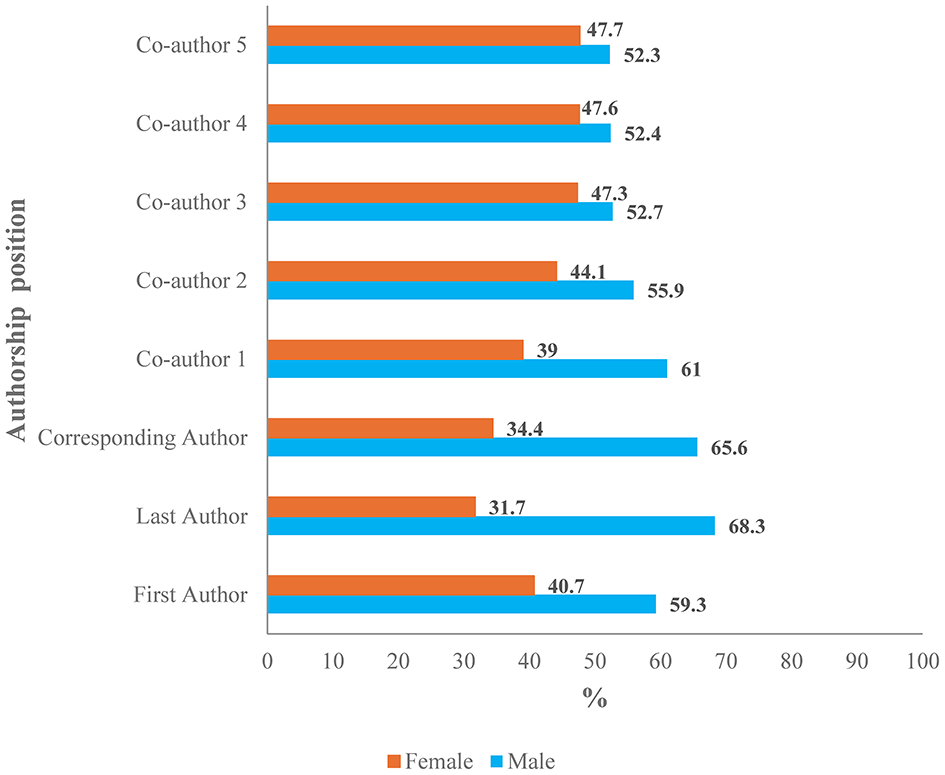
Gender distribution by author position.
As anticipated in bibliometric datasets, the distribution of several variables-including the annual proportion of female Bahraini authors, the total number of authors, and citation counts-exhibited a pronounced right skew, with standard deviations significantly exceeding the means. Mean ± standard deviation values are presented throughout the manuscript to enable comparison with prior studies in the field; however, readers are advised to interpret these descriptive statistics with caution. The observed gender differences in authorship patterns remained consistent and statistically significant when non-parametric methods were employed, as detailed in Table 4.
3.2.2 Journal features: journal quartile, top leading journals
Male first authors had higher counts (353 vs. 252) and a higher percentage (58.3% vs. 41.7%) in Q1 journals, suggesting greater representation in top-tier publications. Similarly, males outnumbered females in the last and corresponding authors (Table 5). Male and female first and corresponding authors from Bahrain had equal mean journal SJR (0.5 and 0.6), whereas males had a slightly higher mean journal SJR than females did for last authors (0.6 ± 0.6 vs. 0.4 ± 0.4). The citations of journals in which a Bahraini male was the last author outnumbered those of females (8.5 +16.6 vs. 5.5 +14.2), and the corresponding author (8.5 +20.2 vs. 5.3 +11.6) was similar to the first author (7.4 ±19.5 vs. 7.7 ±50.6.
Table 5
| Journal | First author | Last author | Corresponding author | |||||||||
|---|---|---|---|---|---|---|---|---|---|---|---|---|
| Male | Female | Male | Female | Male | Female | |||||||
| n | % | n | % | n | % | n | % | n | % | n | % | |
| Q1 (n = 1,669) | 353 | 19.6 | 252 | 20.4 | 349 | 20.7 | 128 | 16.7 | 385 | 20.0 | 202 | 20.2 |
| Q2 (n = 1,202) | 362 | 20.1 | 186 | 15.1 | 363 | 21.6 | 120 | 15.6 | 437 | 22.7 | 130 | 13.0 |
| Q3 (n = 1,271) | 526 | 29.2 | 377 | 30.5 | 466 | 27.7 | 227 | 29.6 | 547 | 28.5 | 290 | 28.9 |
| Q4 (n = 1,120) | 558 | 31.0 | 420 | 34.0 | 505 | 30.0 | 293 | 38.2 | 552 | 28.7 | 380 | 37.9 |
| Total | 1,799 | 100.0 | 1,235 | 100.0 | 1,683 | 100.0 | 768 | 100.0 | 1,921 | 100.0 | 1,002 | 100.0 |
| p -value | 0.005 | <0.001 | <0.001 | |||||||||
Distribution of journal quartiles according to the gender of Bahraini first, last, and corresponding authors.
Chi-square test was used. Statistically significant p-values are formatted in bold.
There were gender differences among authors from Bahrain in the journals most frequently chosen for publication, as indicated by the first, last, and corresponding authors (Supplementary Table 2). This finding was particularly pronounced in the local journal Bahrain Medical Bulletin, where 30.9% of the females were first authors, 30.7% were last authors, and 34.7% were corresponding authors, whereas 21.4%, 21.3%, and 18.9% were males, respectively (p < 0.001).
3.2.3 Document type
There were statistically significant differences by document type and gender across authorships (Table 6). Slightly greater proportions of females from Bahrain than males were first authors (83.3%), last authors (87.9%), and corresponding authors (81.3%) in the original articles (78.7%, 85.3%, and 81.3%, respectively). The proportions of males were greater than those of females for almost all the other types, except for notes and short surveys (Table 6).
Table 6
| Document | First author | Last author | Corresponding author | |||||||||
|---|---|---|---|---|---|---|---|---|---|---|---|---|
| Male | Female | Male | Female | Male | Female | |||||||
| n | % | n | % | n | % | n | % | n | % | n | % | |
| Article (n = 4,365) | 1,463 | 78.7 | 1,060 | 83.3 | 1,461 | 85.3 | 705 | 87.9 | 1,611 | 81.3 | 876 | 84.4 |
| Editorial (n = 125) | 75 | 4.0 | 22 | 1.7 | 38 | 2.2 | 4 | 0.5 | 75 | 3.8 | 16 | 1.5 |
| Letter (n = 135) | 61 | 3.3 | 27 | 2.1 | 29 | 1.7 | 19 | 2.4 | 52 | 2.6 | 18 | 1.7 |
| Note (n = 78) | 40 | 2.2 | 25 | 2.0 | 14 | 0.8 | 10 | 1.2 | 38 | 1.9 | 21 | 2.0 |
| Review (n = 694) | 198 | 10.7 | 120 | 9.4 | 157 | 9.2 | 62 | 7.7 | 185 | 9.3 | 90 | 8.7 |
| Short survey (n = 50) | 21 | 1.1 | 19 | 1.5 | 14 | 0.8 | 2 | 0.2 | 20 | 1.0 | 17 | 1.6 |
| Total | 1,858 | 100 | 1,273 | 100 | 1,713 | 100 | 802 | 100 | 1,981 | 100 | 1,038 | 100 |
| p- value | 0.001 | 0.006 | 0.004 | |||||||||
Distribution of document types according to the gender of first, last, and corresponding authors from Bahrain.
Chi-square test was used. Statistically significant p-values are formatted in bold.
3.2.4 Collaboration
Among the total institutions, a greater percentage of female authors were from Bahraini institutions (84.5%−90.2%), whereas males represented a lower percentage (79.4%−80.3%) across all authorship positions (not presented). Males collaborated with more institutions (mean 1.9 ± 2.1) than females did (mean 1.7 ± 1.8) across all authorship positions (data not presented). Compared with female first authors, male first authors collaborated with more institutions (mean, 1.8 vs. 1.5) and Bahraini institutions (mean, 1.9 vs. 1.7). A greater percentage of male first authors than female first authors had regional and international collaborations (31.7% vs. 26.2%). In contrast, female first authors had higher counts of institutional collaborations (707 vs. 561). Last and corresponding authors from Bahrain had higher percentages of regional (15.0% vs. 8.5%) and international collaboration (15.4% vs. 6.6%) (Table 7).
Table 7
| Collaboration type | None | Institutional | Local | Regional | International | Total | ||||||
|---|---|---|---|---|---|---|---|---|---|---|---|---|
| First author | ||||||||||||
| n | % | n | % | n | % | n | % | n | % | n | % | |
| Female | 163 | 12.8 | 561 | 44.0 | 216 | 17.0 | 123 | 9.7 | 211 | 16.6 | 1,274 | 100 |
| Male | 241 | 13.0 | 707 | 38.1 | 320 | 17.2 | 207 | 11.1 | 382 | 20.6 | 1,857 | 100 |
| p- value | 0.005 | |||||||||||
| Last author | ||||||||||||
| n | % | n | % | n | % | n | % | n | % | n | % | |
| Female | 0 | 0.0 | 472 | 58.9 | 194 | 24.2 | 68 | 8.5 | 68 | 8.5 | 802 | 100 |
| Male | 0 | 0.0 | 793 | 46.4 | 344 | 20.1 | 257 | 15.0 | 315 | 18.4 | 1,709 | 100 |
| p- value | <0.001 | |||||||||||
| Corresponding author | ||||||||||||
| n | % | n | % | n | % | n | % | n | % | n | % | |
| Female | 160 | 15.4 | 484 | 46.6 | 169 | 16.3 | 68 | 6.6 | 157 | 15.1 | 1,038 | 100 |
| Male | 227 | 11.5 | 732 | 37.0 | 356 | 18.0 | 304 | 15.4 | 361 | 18.2 | 1,980 | 100 |
| p- value | <0.001 | |||||||||||
Collaboration type distribution by sex of author from Bahrain.
Chi-square test was used. Statistically significant p-values are formatted in bold.
4 Discussion
Our study of the gender disparity in research productivity in Bahrain is highly important. This is the first study to examine the country's medical and biomedical research output, compare research productivity by gender, and analyze trends over a 20-year period. This study helps address the unique challenges faced by female scholars in Bahrain and the Arab region, reporting on the magnitude of the gender gap over the years. This study aims to contribute to ongoing efforts to promote gender equity in academia, ultimately benefiting the academic community and enhancing research output in the region.
Our study confirms the continuous increase in the research output of biomedical publications in Bahrain (Abu-Dawas et al., 2015; Bredan et al., 2011; Al-Farsi et al., 2021) with a notable increase during the COVID-19 pandemic, similar to what has been reported (Else, 2020; Sloane and Zimmerman, 2021). This reveals a persistent gender disparity in the productivity of medical and biomedical research in Bahrain over the past two decades, with male authors consistently outnumbering females across key authorship positions. This pattern aligns with the global “productivity puzzle,” where males tend to publish more throughout their careers (Huang et al., 2020). The proportions of female authors as first authors, corresponding authors, and last authors were lower than those of male authors, which is consistent with findings from an Oxford study on the diversity of biomedical research in these authorship categories (Shah et al., 2021; Giannos et al., 2023). This finding is also consistent with those from other Arab countries (Albahari and Bashir, 2020b,a; Rachid et al., 2021). In Bahrain, the mean proportion of female Bahraini authors was 36.0%, fluctuating over the years but showing no significant closure of the gap, with the lowest proportion in 2010 and a modest peak in 2018. A recent review of female authorship in toxicology journals reported a relatively close percentage (32%) of first authors (Love et al., 2024), and progress in narrowing the gap has been reported in medical education journals (Madden et al., 2021). These disparities extend to journal quality and collaboration types, where male first authors are more frequently represented in high-impact Q1 journals, are part of larger research teams, and are engaged in more international collaborations. The low percentage (3.4%) of journals in our dataset that were not indexed in the SJR database is unlikely to have underestimated our gender pattern. Such trends may reflect underlying factors, such as family obligations, resource allocation biases, and workplace cultures, that disproportionately affect female researchers, as noted in the broader literature on gender inequities in academia (Ismail et al., 2013; Lerchenmuller et al., 2018; Mairesse and Pezzoni, 2015). The female authors were mainly original articles across senior authorship positions (83.3%−87.9%). An Indian study on authorship in oncology research reported that original articles were predominant (30.9%) among female authors (Noronha et al., 2024).
Gender disparities in medical authorship have been observed in various low- and middle-income countries, extending beyond the Arab region. A recent cross-sectional analysis of 6,088 articles from 54 Colombian medical journals (2018–2022) revealed that women comprised approximately 46% of first authors and 41% of last authors in original research articles, with even lower representation in surgical specialties such as orthopedics (10%) and neurosurgery (27%), along with geographic variations (Gutiérrez Torres et al., 2025). These findings are consistent with our research in Bahrain, underscoring the necessity for region-specific interventions to promote equitable authorship opportunities for female researchers in academic medicine. Beyond the statistically significant gender disparity observed in publication counts and senior authorship in our study, a more nuanced interpretation necessitates integrating our quantitative findings with established structural and cultural barriers to female academic advancement. The underrepresentation of female authors in Q1 journals likely reflects challenges in securing highly competitive research funding, a prerequisite for large-scale, high-impact projects. Although institutional policies are designed to ensure equitable access to grants, constraints on time and resources—particularly those arising from greater family and caregiving responsibilities—may impact female researchers' propensity to apply for complex funding and their capacity to lead resource-intensive projects. The observed collaboration patterns further evidence this. The reduced frequency of international collaboration among female researchers can be attributed to lower attendance at global conferences and fewer opportunities for international networking, often resulting from challenges related to work-life balance. Conversely, the higher rates of institutional and national collaboration among women may reflect a pragmatic response to these limitations, prioritizing locally accessible and manageable research partnerships. Additionally, the finding that female corresponding authors include a significantly higher proportion of female coauthors suggests the formation of gender-congruent supportive networks. In contexts where cultural norms may influence cross-gender professional interactions, these networks serve as vital support systems, fostering a collaborative environment perceived as more comfortable and practical. Ultimately, while this study clearly delineates the quantitative gaps, a comprehensive understanding of their origins—including the influence of workplace culture, resource allocation biases, and specific career interruptions—will require subsequent qualitative studies.
Despite the observed gaps, encouraging signs emerge from the data, including a fivefold increase in overall medical and biomedical publications from 2005 to 2024, primarily driven by institutions such as AGU, which led in authorship across various fields. This recent advancement in gender parity is in line with what has been reported in plastic surgery research (Jeong et al., 2025). The corresponding female authors demonstrated a stronger inclination toward including female Bahraini coauthors. They focused more on local collaborations, potentially indicating efforts to foster inclusive networks within Bahrain's academic and health sectors. This finding is similar to what has been reported in the literature (Jeong et al., 2025). However, the concentration of publications in local and regional journals, combined with a low international collaboration rate compared with other GCC countries (Ranjan et al., 2016) highlights Bahrain's challenges in achieving global research visibility. Low international collaboration may limit Bahraini scholars' ability to achieve global standing (Gutiérrez Torres et al., 2025). It also affects networking and the quality of publications and can delay the promotion of academic faculty, as publishing in Q1 journals has become an advantage for promotion.
To address these disparities, targeted interventions such as workshops on research methodology, English editing services, mentorship programs, equitable funding distribution, and policies promoting work–life balance could empower female researchers, ultimately enhancing Bahrain's medical and biomedical output and contributing to regional gender equity in science. Future studies should explore qualitative factors, including barriers specific to Bahraini women, to inform more nuanced strategies. Finally, although this is a case study of Bahrain, we encourage other Arab countries to replicate this study and compare their findings with ours to gain a broader understanding of the gender gap among Arab medical and biomedical researchers and propose solutions to narrow it.
4.1 Strengths and limitations
This study presents a comprehensive analysis of gender disparities in medical and biomedical research productivity in Bahrain over 20 years (2005–2024), using a robust bibliometric approach based on the Scopus database. The inclusion of a wide range of variables, such as authorship positions, journal quartiles, SJR, and collaboration types, strengthens the depth and granularity of the findings. The study's focus on Bahrain-specific institutions, including those in the academic and health sectors, uniquely contributes to the limited literature on gender differences in research productivity in the Arab region. By identifying key institutions, such as AGU, as leaders in publication output and analyzing trends over time, this study provides actionable insights for policymakers and academic leaders seeking to promote gender equity. Additionally, the rigorous methodology, including the use of statistical tests and the exclusion of duplicate entries, enhances the reliability and validity of the results.
Despite its strengths, the study has several limitations. First, reliance on the Scopus database may have excluded publications not indexed in that database. Although Scopus provides the most comprehensive and standardized coverage of Bahraini medical and biomedical publications, including the three leading local journals that account for the majority of national output, a small proportion of articles published in non-indexed local periodicals or conference proceedings may have been missed. This could marginally underestimate the total publication volume, although it is unlikely to substantially alter the observed gender patterns given the dominance of Scopus-indexed journals in the dataset. Second, in limited instances, determining the names of Arab authors who are gender-neutral or culturally ambiguous, as well as those of non-Arab authors, may have introduced slight inaccuracies through searches of their institutions' websites and other online sources. External verification was required for fewer than 1% of author occurrences and was conducted using multiple corroborating sources. We acknowledge that a minimal degree of residual gender misclassification cannot be completely ruled out for authors with limited or contradictory online profiles. However, given the low proportion and the conservative verification protocol applied, any such error is unlikely to affect the overall patterns or statistical conclusions reported. Third, excluding the number of authors and institutions above 15 from the calculation of the average number of authors and institutions might have slightly underestimated the numbers. Fourth, the author's first affiliation may have impacted the representation of some institutions. Fifth, the study did not account for qualitative factors such as career interruptions, family responsibilities, or institutional barriers, which could provide a deeper context for the observed gender disparities.
5 Conclusions
This study highlights a significant gender disparity in the productivity of medical and biomedical research output in Bahrain from 2005 to 2024, with male authors from Bahrain consistently outnumbering females across first, last, and corresponding authorship positions. Despite a fivefold increase in publication output over the study period, the gender gap persists, with females constituting only 36.0% of Bahraini authors on average and lower representation in high-impact Q1 journals and international collaborations. AGU emerged as the leading institution, contributing significantly to Bahrain's medical and biomedical research output, yet female researchers face challenges in achieving equitable representation, particularly in senior authorship roles. However, female corresponding authors showed a notable tendency to include more female Bahraini coauthors, suggesting efforts toward fostering inclusive local research networks. These findings underscore the need for targeted interventions, such as mentorship, equitable funding, and policies that address work–life balance, to close the gender gap and enhance Bahrain's research ecosystem. Future research should explore qualitative barriers and extend the analysis to other Arab countries to contextualize these disparities within the broader region.
Statements
Data availability statement
The original contributions presented in the study are included in the article/Supplementary material, further inquiries can be directed to the corresponding author.
Author contributions
RRH: Conceptualization, Writing – original draft, Writing – review & editing, Supervision, Visualization, Project administration, Validation, Formal analysis, Methodology. EK: Writing – original draft, Methodology, Validation, Formal analysis, Writing – review & editing. HJ: Formal analysis, Methodology, Visualization, Writing – original draft, Validation, Writing – review & editing.
Funding
The author(s) declared that financial support was received for this work and/or its publication. Publication fees for this article were supported by the Arabian Gulf University.
Conflict of interest
The author(s) declared that this work was conducted in the absence of any commercial or financial relationships that could be construed as a potential conflict of interest.
Generative AI statement
The author(s) declared that generative AI was not used in the creation of this manuscript.
Any alternative text (alt text) provided alongside figures in this article has been generated by Frontiers with the support of artificial intelligence and reasonable efforts have been made to ensure accuracy, including review by the authors wherever possible. If you identify any issues, please contact us.
Publisher’s note
All claims expressed in this article are solely those of the authors and do not necessarily represent those of their affiliated organizations, or those of the publisher, the editors and the reviewers. Any product that may be evaluated in this article, or claim that may be made by its manufacturer, is not guaranteed or endorsed by the publisher.
Supplementary material
The Supplementary Material for this article can be found online at: https://www.frontiersin.org/articles/10.3389/frma.2026.1714436/full#supplementary-material
References
1
Abu-Dawas R. B. Mallick M. A. Hamadah R. E. Kharraz R. H. Chamseddin R. A. Khan T. A. et al . (2015). Comparative analysis of quantity and quality of biomedical publications in Gulf Cooperation Council countries from 2011-2013. Saudi Med. J.36, 1103–1109. doi: 10.15537/smj.2015.9.12369
2
Albahari D. Bashir M. (2020a). Gender gap in mental health research productivity: results from Qatar. Asian J. Psychiatr.54:102347. doi: 10.1016/j.ajp.2020.102347
3
Albahari D. Bashir M. (2020b). Women's productivity in mental health research in the Gulf Cooperation Council (GCC). Asian J. Psychiatr.54:102311. doi: 10.1016/j.ajp.2020.102311
4
Al-Farsi Y. M. Albali N. H. Alsaqabi M. K. Sayed M. Al-Mawali A. H. Al-Adawi S. et al . (2021). Period-prevalence and publication rate of health research productivity in seven Arabian Gulf countries: bibliometric analysis from 1996 to 2018. Oman Med. J.36:e316. doi: 10.5001/omj.2021.100
5
Benamer H. T. Bakoush O. (2009). Arab nations lagging behind other Middle Eastern countries in biomedical research: a comparative study. BMC Med. Res. Methodol.9:26. doi: 10.1186/1471-2288-9-26
6
Bredan A. Benamer H. Bakoush O. (2011). Visibility of Arab countries in the world biomedical literature. Libyan J. Med.6:6325. doi: 10.3402/ljm.v6i0.6325
7
Dardas L. A. Malkawi A. M. A. Sweis S. Sweis N. Al-Khayat A. Sawair F. A. (2023). Mapping two decades of research productivity in the Middle Eastern and Arab countries: a comprehensive bibliometric analysis. Publications11:48. doi: 10.3390/publications11040048
8
El Rassi R. Meho L. I. Nahlawi A. Salameh J. S. Bazarbachi A. Akl E. A. et al . (2018). Medical research productivity in the Arab countries: 2007-2016 bibliometric analysis. J. Glob. Health8:020411. doi: 10.7189/jogh.08.020411
9
Else H. (2020). How a torrent of COVID science changed research publishing - in seven charts. Nature588:553. doi: 10.1038/d41586-020-03564-y
10
Giannos P. Katsikas Triantafyllidis K. Paraskevaidi M. Kyrgiou M. Kechagias K. S. (2023). Female dynamics in authorship of scientific publications in the public library of science: a 10-year bibliometric analysis of biomedical research. Eur. J. Investig. Health Psychol. Educ.13, 228–237. doi: 10.3390/ejihpe13020018
11
Grant C. Stauffer T. P. Seyler T. M. Wu C. J. Hinton Z. W. (2024). Gender trends in authorship in 6 major orthopaedic journals. J. Bone Joint Surg. Am.106, 625–630. doi: 10.2106/JBJS.23.00995
12
Gutiérrez Torres M. A. Ruiz S. Morales K. Rincon L. Serpa F. Gómez C. et al . (2025). Disparities of women's authorship in Colombia: a cross-sectional analysis. PLOS Glob. Public Health5:e0003972. doi: 10.1371/journal.pgph.0003972
13
Hiller K. P. Boulos A. Tran M. M. Cruz A. I. Jr. (2020). What are the rates and trends of women authors in three high-impact orthopaedic journals from 2006-2017?Clin. Orthop. Relat. Res.478, 1553–1560. doi: 10.1097/CORR.0000000000001043
14
Huang J. Gates A. J. Sinatra R. Barabasi A. L. (2020). Historical comparison of gender inequality in scientific careers across countries and disciplines. Proc. Natl. Acad. Sci. U. S. A.117, 4609–4616. doi: 10.1073/pnas.1914221117
15
Ismail S. A. McDonald A. Dubois E. Aljohani F. G. Coutts A. P. Majeed A. et al . (2013). Assessing the state of health research in the Eastern Mediterranean Region. J. R. Soc. Med.106, 224–233. doi: 10.1258/jrsm.2012.120240
16
Jeong T. Kass N. M. Liu H. Y. Dixon A. Buckner N. Arellano J. A. et al . (2025). The impact of women-led academic collaborations in plastic surgery. Ann. Plast. Surg.94, S417–S420. doi: 10.1097/SAP.0000000000004277
17
Lariviere V. Costas R. (2016). How many is too many? On the relationship between research productivity and impact. PLoS ONE11:e0162709. doi: 10.1371/journal.pone.0162709
18
Lerchenmuller C. Lerchenmueller M. J. Sorenson O. (2018). Long-term analysis of sex differences in prestigious authorships in cardiovascular research supported by the National Institutes of Health. Circulation137, 880–882. doi: 10.1161/CIRCULATIONAHA.117.032325
19
Love J. S. Loo G. T. Murphy L. Temple C. Spyres M. B. Manini A. F. et al . (2024). A decade in review: trends in female authorship in peer-reviewed toxicology journals. J. Med. Toxicol.20, 22–30. doi: 10.1007/s13181-023-00975-x
20
Macaluso B. Lariviere V. Sugimoto T. Sugimoto C. R. (2016). Is science built on the shoulders of women? A study of gender differences in contributorship. Acad. Med.91, 1136–1142. doi: 10.1097/ACM.0000000000001261
21
Madden C. O'Malley R. O'Connor P. O'Dowd E. Byrne D. Lydon S. (2021). Gender in authorship and editorship in medical education journals: a bibliometric review. Med. Educ.55, 678–688. doi: 10.1111/medu.14427
22
Mairesse J. Pezzoni M. (2015). Does gender affect scientific productivity?Rev. Econ.1, 65–113. doi: 10.3917/reco.661.0065
23
Mayer S. J. Rathmann J. M. K. (2018). How does research productivity relate to gender? Analyzing gender differences for multiple publication dimensions. Scientometrics117, 1663–1693. doi: 10.1007/s11192-018-2933-1
24
Noronha V. Kolkur M. Haridass C. Bhagyavant P. Das R. Chittari S. S. et al . (2024). Representation of female authors in oncology: the Indian perspective. Ecancermedicalscience18:1755. doi: 10.3332/ecancer.2024.1755
25
Ortega L. Guzmán-Valenzuela C. Montero M. Palacios D. Ortiz Ruiz F. (2024). Looking beyond representation: gender inequities in research attrition, output, leadership, and collaboration in Chilean education researchers' career trajectories. J. Divers. High. Educ.18(Suppl. 1), S709–S723. doi: 10.1037/dhe0000617
26
Rachid E. Noureddine T. Tamim H. Makki M. Naalbandian S. Al-Haddad C. et al . (2021). Gender disparity in research productivity across departments in the faculty of medicine: a bibliometric analysis. Scientometrics126, 4715–4731. doi: 10.1007/s11192-021-03953-8
27
Ranjan A. Kumar R. Sinha A. Nanda S. Dave K. A. Collette M. D. et al . (2016). Competing for impact and prestige: deciphering the “alphabet soup” of academic publications and faculty productivity metrics. Int. J. Acad. Med.2, 187–202. doi: 10.4103/2455-5568.196875
28
Rossiter M. W. (1993). The Matthew Matilda effect in science. Soc. Stud. Sci.23, 325–341. doi: 10.1177/030631293023002004
29
Shah S. G. S. Dam R. Milano M. J. Edmunds L. D. Henderson L. R. Hartley C. R. et al . (2021). Gender parity in scientific authorship in a National Institute for Health Research Biomedical Research Centre: a bibliometric analysis. BMJ Open11:e037935. doi: 10.1136/bmjopen-2020-037935
30
Sloane P. D. Zimmerman S. (2021). The impact of the COVID-19 pandemic on scientific publishing. J. Am. Med. Dir. Assoc.22, 484–488. doi: 10.1016/j.jamda.2021.01.073
31
Stack S. (2004). Gender, children and research productivity. Res. High. Educ.45, 891–920. doi: 10.1007/s11162-004-5953-z
32
Stanford University and Elsevier (2025). Top 2% Scientists. Available online at: https://top2percentscientists.com/about-us/ (accessed February 9, 2025).
33
Totis F. Colella F. E. Safa A. Stefini R. Cannizzaro D. (2025). Female authorship in global research: a bibliometric study of high- and low-income country collaborations. Neurosurg. Focus58:E14. doi: 10.3171/2024.12.FOCUS24815
34
Ul Haq I. Ur Rehman S. Al-Kadri H. M. Farooq R. K. (2020). Research productivity in the health sciences in Saudi Arabia: 2008-2017. Ann. Saudi Med.40, 147–154. doi: 10.5144/0256-4947.2020.147
35
Zeeneldin A. A. Taha F. M. (2014). Qatar biomedical and cancer publications in PubMed between 2000 and 2012. Qatar Med. J.2014, 31–37. doi: 10.5339/qmj.2014.5
Summary
Keywords
biomedical, disparity, gender, medical, research output, research productivity, Scopus
Citation
Hamadeh RR, Khedr E and Jahrami H (2026) Medical and biomedical research productivity in Bahrain: an analysis of gender differences and patterns over two decades. Front. Res. Metr. Anal. 11:1714436. doi: 10.3389/frma.2026.1714436
Received
27 September 2025
Revised
10 January 2026
Accepted
13 January 2026
Published
04 February 2026
Volume
11 - 2026
Edited by
Carmen Corona Sobrino, University of Valencia, Spain
Reviewed by
Jane G. Payumo, Michigan State University, United States
María Alejandra Gutiérrez-Torres, Boston College, United States
Updates
Copyright
© 2026 Hamadeh, Khedr and Jahrami.
This is an open-access article distributed under the terms of the Creative Commons Attribution License (CC BY). The use, distribution or reproduction in other forums is permitted, provided the original author(s) and the copyright owner(s) are credited and that the original publication in this journal is cited, in accordance with accepted academic practice. No use, distribution or reproduction is permitted which does not comply with these terms.
*Correspondence: Randah R. Hamadeh, randah@agu.edu.bh
Disclaimer
All claims expressed in this article are solely those of the authors and do not necessarily represent those of their affiliated organizations, or those of the publisher, the editors and the reviewers. Any product that may be evaluated in this article or claim that may be made by its manufacturer is not guaranteed or endorsed by the publisher.