Explore article hub
 Andy Reisinger
- Institute for Climate, Energy and Disaster Solutions (ICEDS), Australian National University, Canberra, ACT, Australia
A Viewpoint on the Frontiers in Science Lead Article
The methane imperative
Key points
- Deep reductions in future methane (CH4) emissions alongside carbon dioxide (CO2) are non-negotiable if we wish to limit global warming to well below 2°C, let alone 1.5°C, but action on CH4 cannot substitute inaction on CO2: reaching at least net zero CO2 emissions globally remains a prerequisite for limiting warming at any level.
- Net zero greenhouse gas emission targets applied to the sum of all gases remain a relevant tool to manage climate risks even though global CH4 emissions do not have to be reduced to zero and net zero greenhouse gas emissions cannot be a universal prescription for all emitters.
- Only 13% of global CH4 emissions are covered by targeted climate policies (whose effectiveness is unclear) compared with 53% of global total emissions. Stronger and more consistent policies are needed to motivate and regulate CH4 emission reductions, requiring governments to engage with a broader range of stakeholders and to deploy a wider set of policy tools than for CO2 and energy-centric climate policy.
Introduction
One of the enduring challenges for climate policy is to make sense of competing narratives about the leading causes of climate change and appropriate solutions. One of those is the relative importance of carbon dioxide (CO2) versus methane (CH4) to limit global warming in a manner consistent with the goals of the Paris Agreement.
Physical climate science makes it indisputably clear that CO2 emissions from fossil fuels and land use change are the dominant drivers of human-caused climate change. At the same time, we have long known that CO2 is not the only climate forcer—a multi-gas approach to emissions reduction would be more cost-effective and enable greater flexibility in limiting climate change than a narrow focus on CO2 only.
The most recent assessment by the Intergovernmental Panel on Climate Change (IPCC) has brought this dual narrative into sharp relief: global net CO2 emissions since 1850 have caused ~0.8°C of warming (relative to the period 1850–1900), followed closely by ~0.5°C due to CH4 emissions. The combined warming of 1.3°C has been partly offset by the cooling effect of sulfate aerosols alongside warming and cooling contributions from other short-lived climate forcers: the net warming from all human activities thus closely matches the total observed warming of 1.1°C during the 2010–2019 period (1). Greenhouse gas emissions have continued to rise, and 2024 has a reasonable chance of being the first calendar year to exceed warming of 1.5°C.
In their lead article, Shindell et al. (2) powerfully detail why climate policy must take CH4 far more seriously than it has so far and how it could do so in a way that aligns, rather than competes, with the drive for global net zero CO2 emissions.
Surging methane concentrations
CH4 concentrations have risen nearly three-fold since the Industrial Revolution, driven almost entirely by increasing human-caused emissions from agriculture, fossil fuel extraction and use, and waste. However, concentrations have shot up even more rapidly over the past few years than we can explain based on existing emissions data.
The most likely reasons for the unexplained acceleration in CH4 concentrations are an underestimation of rising fossil fuel emissions combined with surging natural emissions from wetlands triggered by recent climate trends. Wetlands are the dominant natural source of CH4, but emissions are affected by human land use and climate change. Uncertainties for this attribution remain large, however, and changes in atmospheric chemistry that influence how long CH4 lasts in the atmosphere may also have played a role. The conclusion for policy is rather more simple: we need to reduce CH4 emissions even more than anticipated to achieve global climate goals.
How important are CH4 reductions versus CO2?
Policymakers seeking to tackle CH4 are inevitably confronted with the question of just how much effort is warranted in mitigating CH4 versus CO2. Again, competing narratives vie for political dominance.
On the one hand, the long lifetime of CO2 means the effect of its emissions on climate is cumulative. Therefore, according to physics, if we wish to halt warming at any level, global net CO2 emissions must eventually reach zero regardless of how difficult this might be. No such simple physics-based requirement exists for CH4 since its contribution to global warming depends mainly on its rate of emissions in the preceding two to three decades. Even a very gradual decline in global CH4 emissions could thus cap their contribution to global warming at the current level. Physics alone, therefore, cannot tell us how far we should reduce CH4 emissions even if we decide on a specific global temperature limit.
On the other hand, the short lifetime of CH4 is often cited as a key reason to prioritize emission reductions since this would almost immediately benefit the climate. A tonne of CH4 avoided today has the same benefit to the climate over the next 20 years as avoiding more than 80 tonnes of CO2. The urgency of action on climate change dictates that we exploit every opportunity to reduce and avoid CH4 emissions wherever possible—not instead of but alongside the global race to net zero CO2.
It can be challenging for policymakers to appreciate that both narratives are correct. Action on CH4 is no substitute for inaction on CO2, but if we genuinely wish to limit warming to well below 2°C then action on CH4 becomes as non-negotiable as action on CO2.
Figure 1 seeks to illustrate this dynamic. Even though the warming from historical CO2 emissions is an important part of global equity discussions, we can only limit future climate change by addressing future emissions and increasing future removals. Under current policies (Figure 1A), the biggest future contribution to global warming would come from future CO2 emissions, whose warming effect builds up over time. Future CH4 emissions would contribute appreciable warming on top of this, but even if we could avoid all future CH4 emissions, global warming would still exceed 2°C under current policies. Mitigating future CO2 emissions, both through reducing and avoiding emissions at their source and removing CO2 from the atmosphere to reach global net zero CO2 emissions, is therefore utterly essential to limit warming to any level that might be regarded as “well below” 2°C.
Figure 1
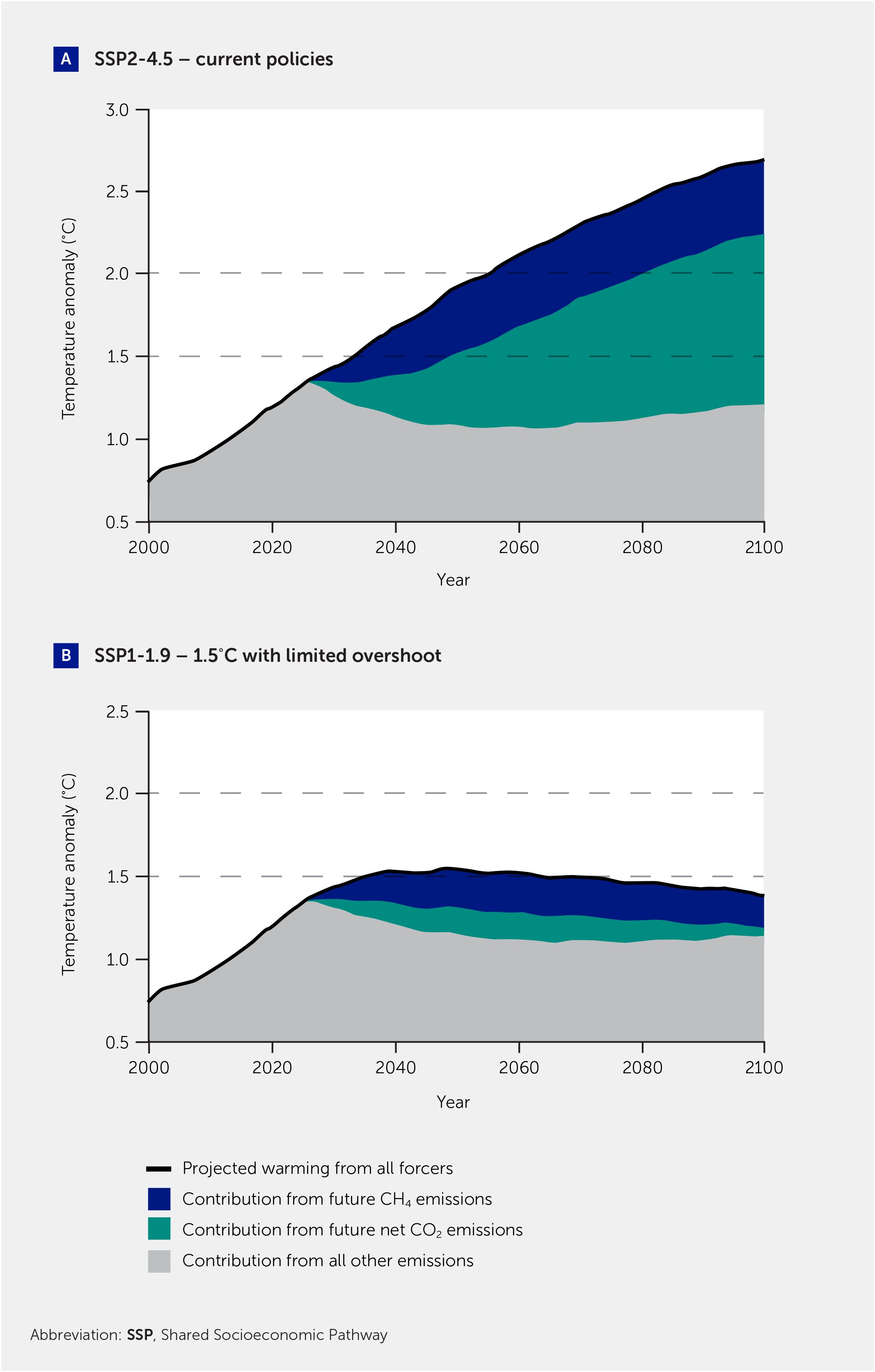
Figure 1 Contribution of future carbon dioxide (CO2) and methane (CH4) emissions to global warming under two different scenarios: Shared Socioeconomic Pathway (SSP) 2-4.5 (A) and SSP1-1.9 (B). SSP2-4.5 approximates emissions and future warming under current policies, whereas SSP1-1.9 assumes stringent and immediate global action having started in 2020 and reaching net zero CO2 emissions around 2050 alongside deep and sustained reductions in CH4 emissions. Solid black lines show the projected warming from human activities in both scenarios as well as natural forcers (solar and volcanic). Gray-shaded areas indicate the warming from all past human activities up to 2024 and from future human activities, except CO2 and CH4 emissions, as well as natural forcings. The green-shaded areas show the contribution to global warming from future global net CO2 emissions from 2025 onwards under both scenarios, while the blue-shaded area shows the same for CH4. For SSP2-4.5, warming due to future CO2 emissions is the dominant cause of warming after about 2050. For SSP1-1.9, warming due to future CH4 emissions is greater than that from future CO2 emissions. Temperature responses were modeled using the FaIR simple climate model (3), calibrated to reproduce the temperature response to emissions as assessed in the Intergovernmental Panel on Climate Change (IPCC) Sixth Assessment Report (1, 4). The raw data used to generate this figure can be found in Supplementary Data Sheet 1.
The most ambitious reference scenario considered by the IPCC envisages the world reaching net zero CO2 emissions by about 2050 and sustaining net negative CO2 emissions for at least the remainder of the 21st century. In that (increasingly counterfactual) successful scenario, future CH4 emissions become the dominant contributor to future warming even if we achieve deep and sustained reductions (Figure 1B). How much we reduce future CH4 emissions in addition to CO2 thus becomes an increasingly critical lever the closer we wish to limit global warming to 1.5°C.
Shindell et al. (2) provided a range of perspectives and metrics that may help policymakers hold both narratives in their minds and appreciate the interdependencies between CO2 and CH4. One key interaction to consider is that even though greater action on CH4 does not remove the need for net zero CO2 emissions, how quickly we need to reach net zero CO2 depends on how much we reduce CH4 at the same time. The most recent estimate of the remaining global carbon budget to limit warming to 1.5°C is 200 Gt CO2, starting on 1 January 2024 (5). This calculation assumes that global CH4 emissions concurrently drop by more than 50% by 2050, which is consistent with the most ambitious mitigation pathways assessed by the IPCC (6). If, instead, CH4 emissions were to decline by only 25% by 2050, the remaining carbon budget for 1.5°C would lie below zero.
Another key interaction plays out in the use of land, where choices and trade-offs exist between using a finite land resource either for extensive livestock agriculture generating CH4 emissions or for carbon sequestration through afforestation or the production of biomass for bioenergy. Therefore, even though CH4 and CO2 behave differently in the atmosphere, choices around mitigation strategies and goals for both are linked to choices about how to manage and respond to the global demand for emissions- and land-intensive food.
To net zero or not to net zero to achieve climate targets?
Shindell et al. (2), alongside other researchers (7), have recommended that separate targets should be indicated for long-lived greenhouse gases and short-lived climate forcers (including CH4), rather than a single net zero emissions target covering the sum of all greenhouse gases aggregated using Global Warming Potentials. This is based on the insight that limiting warming to 1.5°C requires only net zero emissions of long-lived gases, chiefly CO2, alongside deep and sustained reductions—but not zero emissions—of short-lived gases (6).
However, this insight is derived from scenarios that assume immediate and deep global emission reductions from 2020 onwards—a world that could have been. Actual current emission trajectories firmly set the world on a path to exceed global warming of 1.5°C within the next 10 years, rising further thereafter. The only way to “keep 1.5°C alive” is therefore to plan for eventually bringing the temperature back down again rather than merely stabilize it at whatever level well above 1.5°C we might find ourselves. This would require global net negative emissions of long-lived gases beyond 2050 and/or even deeper long-term reductions of CH4 emissions than most global scenarios currently envisage. Neither option will be easy, but either or both will be necessary unless policymakers formally give up on “pursuing efforts” to limit warming to 1.5°C (8). Net zero targets covering the sum of greenhouse gas emissions are one way of driving such deeper long-term reductions and are thus an important tool to manage climate risk. They cannot, however, be a universal prescription.
The many connections between CH4 and CO2 that Shindell et al. (2) discuss also make clear that if individual countries or sectors do adopt separate emission targets for long- and short-lived gases, such targets cannot be set in isolation from each other to achieve an overall climate goal. How we slice the global emissions pie to serve a highly uneven world depends on value judgments about equity and pathways for sustainable development, not physics. Separate targets for short- and long-lived gases provide greater transparency in emissions and actual climate outcomes but also imply dual political fronts for lobbying and renegotiation. Separate targets also reduce flexibility for accommodating underachievement in individual sectors and therefore increase the risk of failure. Whether combined or separate targets lead to a more durable and ambitious climate response overall will thus depend on country- and sector-specific circumstances as well as uncertainty about future technologies to achieve individual targets decades into the future.
How can we make more progress on methane?
Shindell et al. (2) show clearly that reducing CH4 emissions is possible at relatively low (or, in some cases, no) costs, especially in activities related to coal, oil, and gas extraction and use and landfill waste. An enduring conundrum is why governments and industry have not taken more action so far. Most countries have set economy-wide national emission targets, and reducing CH4 emissions more strongly should help achieve existing commitments at lower overall costs.
Shindell et al. (2) demonstrate that under rising oil and gas prices, the profit margins for oil production have outpaced the profit margins for CH4 abatement measures. While this may explain why overall CH4 emissions have not gone down, it does not explain why the CH4 abatement that would be cost-effective is not being undertaken. One reason may be that companies have finite financial and human capital and therefore prioritize their attention, which can leave non-core business activities such as CH4 abatement untapped even if such abatement would be profitable.
The large gap between the potential and currently realized extent of CH4 mitigation makes it clear that stronger and more consistent policies are needed to motivate and regulate companies to reduce CH4 emissions. Strikingly, only about 13% of global CH4 emissions are covered by targeted policies, and a significant share of those policies focus on monitoring rather than reduction and rely on information and voluntary action rather than mandatory pricing or regulation (9). By comparison, more than 53% of global total emissions are covered by climate laws (10). This suggests that governments can suffer from similar capacity and commitment limitations to companies, where the smaller share of CH4 emissions within national totals results in disproportionately reduced policy attention, despite the relative effectiveness of such policies.
Limiting efforts to address a second-order problem also makes unfortunate sense from a political economy perspective. The pursuit of more stringent policies to address CH4 would require governments to engage with additional stakeholders and employ policy tools outside a CO2- and energy-centric approach to climate policy, which increases political risk and sectoral lobbying. This applies even more to governments that must contend with CH4 emissions from agriculture—the one sector that would require the most complex and atypical interventions to achieve sustainable emission reductions and which the analysis by Shindell et al. left substantially underexplored.
However, this widening of political fronts for climate action can also be a promise rather than a barrier. People concerned about climate change consistently tend to underestimate the degree to which others hold similar views and take action, which in turn limits their willingness to act (e.g., 11). If global CH4 emissions continue to receive only lukewarm policy attention, this not only makes the global response to climate change less effective, but it could also reduce the willingness of CO2 emitters to continue their difficult journey all the way to net zero CO2 emissions. Taking parallel and stringent action on CH4 may therefore be imperative not only from a climate and economic perspective but also to maintain and strengthen the support from existing stakeholders to achieve our collective climate goals.
Supplementary material
The Supplementary Material for this article can be found online at: https://www.frontiersin.org/articles/10.3389/fsci.2024.1451011/full#supplementary-material
Statements
Author contributions
AR: Conceptualization, Visualization, Writing – original draft, Writing – review & editing.
Data availability statement
The original contributions presented in the study are included in the article/Supplementary Material. Further inquiries can be directed to the corresponding author.
Funding
The author(s) declare that no financial support was received for the research, authorship, and/or publication of this article.
Conflict of interest
The author declares that the research was conducted in the absence of financial relationships that could be construed as a potential conflict of interest.
The author currently serves as a Commissioner for He Pou A Rangi, New Zealand’s Climate Change Commission, but has authored this article independent of this role, and its content is not endorsed by the Commission.
Publisher’s note
All claims expressed in this article are solely those of the authors and do not necessarily represent those of their affiliated organizations, or those of the publisher, the editors and the reviewers. Any product that may be evaluated in this article, or claim that may be made by its manufacturer, is not guaranteed or endorsed by the publisher.
References
1. Masson-Delmotte V, Zhai AP, Connors SL, Péan C, Berger S, Caud N, et al, editors. Climate Change 2021: the Physical Science Basis. Contribution of Working Group I to the Sixth Assessment Report of the Intergovernmental Panel on Climate Change.. Cambridge: Cambridge University Press (2021). doi: 10.1017/9781009157896
2. Shindell D, Sadavarte P, Aben I, Bredariol T, Dreyfus G, Höglund-Isaksson L, et al. The methane imperative. Front Sci (2024) 2:1349770. doi: 10.3389/fsci.2024.1349770
3. Leach NJ, Jenkins S, Nicholls Z, Smith CJ, Lynch J, Cain M, et al. FaIRv2.0.0: a generalized impulse response model for climate uncertainty and future scenario exploration. Geosci Model Dev (2021) 14:3007–36. doi: 10.5194/gmd-14-3007-2021
5. Forster PM, Smith C, Walsh T, Lamb WF, Lamboll R, Hall B, et al. Indicators of Global Climate Change 2023: annual update of key indicators of the state of the climate system and human influence. Earth Syst Sci Data (2024) 16:2625–58. doi: 10.5194/essd-16-2625-2024
6. Shukla PR, Skea J, Slade R, Al Khourdajie R, van Diemen D, McCollum M, et al, editors. Climate Change 2022: Mitigation of Climate Change. Contribution of Working Group III to the Sixth Assessment Report of the Intergovernmental Panel on Climate Change.. Cambridge: Cambridge University Press (2022). doi: 10.1017/9781009157926
7. Allen MR, Peters GP, Shine KP, Azar C, Balcombe P, Boucher O, et al. Indicate separate contributions of long-lived and short-lived greenhouse gases in emission targets. npj Clim Atmos Sci (2022) 5:5. doi: 10.1038/s41612-021-00226-2
8. Reisinger A, Geden O. Temporary overshoot: Origins, prospects, and a long path ahead. One Earth (2023) 6(12):1631–37. doi: 10.1016/j.oneear.2023.11.008
9. Olczak M, Piebalgs A, Balcombe P. A global review of methane policies reveals that only 13% of emissions are covered with unclear effectiveness. One Earth (2023) 6(5):519–35. doi: 10.1016/j.oneear.2023.04.009
10. Dubash NK, Mitchell C, Boasson EL, Borbor-Cordova MJ, Fifita S, Haites E, et al. National and sub-national policies and institutions. In: Shukla PR, Skea J, Slade R, Al Khourdajie R, van Diemen D, McCollum M, et al, editors. Climate Change 2022: Mitigation of Climate Change. Contribution of Working Group III to the Sixth Assessment Report of the Intergovernmental Panel on Climate Change.. Cambridge: Cambridge University Press, Cambridge (2022) 1355–450. doi: 10.1017/9781009157926.015
Keywords: methane emissions, carbon dioxide emissions, net zero, Paris Agreement, climate change
Citation: Reisinger A. Why addressing methane emissions is a non-negotiable part of effective climate policy. Front Sci (2024) 2:1451011. doi: 10.3389/fsci.2024.1451011
Received: 18 June 2024; Accepted: 18 July 2024;
Published: 30 July 2024.
Edited and Reviewed by:
Euan Nisbet, Royal Holloway University of London, United KingdomCopyright © 2024 Reisinger. This is an open-access article distributed under the terms of the Creative Commons Attribution License (CC BY). The use, distribution or reproduction in other forums is permitted, provided the original author(s) and the copyright owner(s) are credited and that the original publication in this journal is cited, in accordance with accepted academic practice. No use, distribution or reproduction is permitted which does not comply with these terms.
*Correspondence: Andy Reisinger, YW5keS5yZWlzaW5nZXJAYW51LmVkdS5hdQ==