 Huan Zhang*
 Bo Xu
Bo Xu- School of Economics, Nanjing Audit University, Nanjing, China
This article explores the impact of eco-industrial park construction from the perspective of industrial chain resilience. Eco-Industrial Parks (EIP) help reduce environmental pollution and make the industrial sector more environmentally friendly, representing the direction of sustainable industrial development. Based on panel data from 285 cities from 2006 to 2023, this article uses the difference in differences method to explore the impact of the construction of national eco-industrial demonstration parks on industrial chain resilience. Research has found that in pilot cities, EIP has made a positive contribution of 1.56 to 2.75% in improving industrial chain resilience. Considering the exclusion of provincial capitals and other policy factors, the impact of EIP is robust. Compared to the eastern region, the role of EIP in enhancing the industrial chain is more pronounced in the central and western regions. Meanwhile, in regions with higher levels of regional integration, there is a stronger positive impact. The industrial structure upgrading caused by green technology innovation and the crowding out effect of high pollution manufacturing industry helps to explain these mechanisms. Further estimates indicate that considering the spatial correlation of various factors, EIP has a significant positive spatial spillover effect on the industrial chain.
Introduction
In the context of deepening economic globalization and increasing global economic uncertainty, regional economies are facing more complex and severe risks. As a pillar of economic development, strengthening the resilience of the industrial chain is particularly important. Although China’s industrial development has achieved great success, internal problems within the industry are very prominent. The overall innovation capability of the industry is insufficient, the added value of products is too low, the dependence on energy resources is too strong, environmental pollution is serious, and regional development is unbalanced and insufficient. These problems have led to a lack of industrial development momentum and have almost become a “pollution shelter” for developed countries. Meanwhile, these issues have also led to a low industrial resilience index in China. When facing risks and shocks, the industry has a weak ability to resist risks, is prone to damage or slow recovery, resulting in significant losses to the national economy. Now, in the context of trade frictions and global economic uncertainty, studying the influencing factors and improvement mechanisms of industrial chain resilience has strong practical value. Besides China, more and more countries are constructing eco-industrial parks to achieve a win-win situation between industrial economic growth and environmental protection. The impact of eco-industrial parks on the resilience of the industrial chain has also received widespread attention from the academic community. According to previous research, the mechanism of action can be divided into three stages: entry threshold, regulatory system, and circular economy. Eco-industrial parks have introduced a large number of preferential and subsidy policies to attract capital and talent, thereby promoting technological innovation and industrial upgrading. Eco-industrial park is a new type of industrial park with the goal of green, low-carbon, and circular development. It mainly concentrates high-tech and low pollution enterprises, which can reduce the negative impact of industrial concentration on the environment. At the same time, there are strict assessment standards within the park, which requires enterprises to consider environmental protection issues while developing the economy and continuously improve their green technology innovation capabilities. In addition, the eco-industrial park has constructed a new circular economy system based on the principles of industrial ecology, so its internal industrial system can operate in a manner similar to natural ecosystems. The remaining energy and materials in the production process of eco-industrial parks can be transferred to other processes for use, forming a collaborative chain network that effectively transfers and uses energy and materials within or between enterprises, thereby improving the resource and energy utilization efficiency of policy production processes.
The construction of eco-industrial parks in Western countries began in the late 20th century, while the construction of eco-industrial parks in China started relatively late. The construction of the Guigang National Eco-Industry (Sugar) Demonstration Park in Guangxi in 2001 marked the initial exploration of the development of eco-industrial parks in China. In 2003, the release of the “Regulations on the Application, Naming, and Management of National Eco-Industrial Park Demonstration Zones” and the “Guidelines for the Planning of Eco-Industrial Demonstration Zones” marked the beginning of standardization work in China’s eco-industrial parks. In 2007, the “Management Measures for National eco-industrial Parks” were released, marking a relatively stable stage of development for China’s eco-industrial parks. The demonstration zone must be applied for by the construction enterprise to the provincial environmental protection department, and after review, the application will be submitted to the Ministry of Environmental Protection of China. Approved by the Ministry of Environmental Protection, demonstration zone construction enterprises can organize planning. After the completion of the pilot construction period, the construction enterprise can apply for the naming of the demonstration zone to the provincial environmental protection department and report to the Ministry of Environmental Protection of China. The Ministry of Environmental Protection reviews the submitted materials and submits them to the General Administration for approval. Applicants who meet the criteria will be approved as demonstration zones and awarded a unified logo specification. Demonstration zone construction enterprises shall report the construction, development and existing problems of the demonstration zone to the Ministry of Environmental Protection on a quarterly basis, and submit an annual summary at the end of the year. In 2008, China’s first national level eco-industrial park project was officially constructed. As of now, a total of 55 national level eco-industrial park projects have been completed. Eco-industrial parks with regional characteristics refer to eco-industrial parks transformed from existing economic and technological development zones and high-tech development zones. These eco-industrial parks themselves have good infrastructure and high green innovation capabilities. The focus of future construction is to introduce the concepts of eco-industry and circular economy into these parks, adopting lifecycle and ecological design methods to minimize the generation of waste from resource consumption. Finished products should be easy to disassemble and recycle, so as to optimize product structure, improve product chain, enhance resource efficiency and reduce environmental emissions, find new growth points for the park, and promote sustainable development of the park. They are located at important nodes of the Chinese economic belt, mainly responsible for responding to national policies and supporting regional development.
Manufacturing industry is the pillar of China’s economic development, with its output accounting for over 30% of the national economy and playing a pivotal role in economic growth. Since the reform and opening up, China has implemented the policy of development zones, promoted rapid regional economic development, utilized industrial agglomeration effects, and achieved the “miracle of economic growth.” As of now, there are 387 national level development zones and 2,299 provincial-level development zones in China. In order to transform the economic growth mode and achieve high-quality economic development, since 2001, the State Environmental Protection Administration has implemented the National Ecological Industry Demonstration Park Policy on the basis of traditional industrial parks, aiming to construct environmentally friendly and resource-saving industrial parks (Song et al., 2024; Zhang et al., 2024). The construction of ecological industrial parks plays an important role in promoting the coordinated development of regional resources, environment, and economy, promoting sustainable development at the regional and industrial levels, transforming the economic development mode, adjusting the industrial structure, achieving regional energy conservation and emission reduction, and reducing environmental pollution. There are still significant shortcomings in the existing research on ecological industrial parks and industrial chain resilience. Firstly, most studies focus on the single dimensional impact of ecological industrial parks on the environment or economic benefits, lacking a systematic exploration of the correlation mechanism between them and industrial chain resilience; Secondly, existing research mostly adopts qualitative analysis or case study methods, lacking quantitative empirical testing based on large sample data, making it difficult to accurately reveal the specific impact and path of ecological industrial park policies on industrial chain resilience; Thirdly, existing research on measuring the resilience of industrial chains mostly remains at the level of a single indicator, without constructing a comprehensive evaluation system that fully reflects the industrial chain, resulting in insufficient scientific and comprehensive research conclusions.
Against the backdrop of accelerating global industrial chain restructuring, China is confronted with the dual pressures of “low-end lock-in” and “green transformation.” In 2023, the added value of China’s manufacturing industry accounted for 26.8% of GDP, while the proportion of high-tech manufacturing industry was only 15.5%. The problems of high energy consumption and low added value in traditional industries remain prominent. This study confirms that eco-industrial parks enhance industrial chain resilience through green technology innovation and the crowding-out effect of high-pollution enterprises, which can provide a path to solve the “pollution haven” dilemma. Therefore, the contribution of this article is mainly reflected in the following aspects. Firstly, we incorporate the eco-industrial park policy into the “coordinated development analytical framework” for the first time, which is not a mere theoretical conception. The practical background is that the 14th Five-Year Plan for Industrial Green Development explicitly proposes to “promote the coordinated development of eco-industrial parks and the enhancement of industrial chain resilience.” This study responds to policy demands and fills the research gap in the correlation mechanism between “environmental policies and industrial chain resilience.” Secondly, we adopt a combination of the Difference-in-Differences (DID) method and the Spatial Durbin Model (SDM), which is not a mere listing of methods. Considering the reality of unbalanced regional development in China, the sample of 285 cities covers the eastern, central, and western regions, and the Spatial Durbin Model can capture the technology diffusion and factor flow effects of eco-industrial parks. Thirdly, we have constructed a multi-dimensional evaluation system for industrial chain resilience, which includes three dimensions: shock resistance, adaptive recovery capacity, and endogenous growth capacity. Each dimension is supported by practical and corresponding indicators. The differences in these indicators directly reflect the resource circulation capacity of the industrial chain, providing a quantifiable and practical basis for evaluating industrial chain resilience.
Literature review and theoretical analysis
Relevant literature
Existing literature explores the role of industrial park oriented economic zones and economic and technological development zones in promoting economic growth. Gibbs and Deutz (2005) found that special economic zones significantly increased foreign investment in pilot cities, resulting in agglomeration economies and economic growth effects. The research results also indicate that economic and technological development zones have significantly improved the productivity of enterprises (Wu et al., 2023). As a representative of sustainable industrial parks, the research theme of eco-industrial parks focuses on evaluating environmental benefits from the perspective of environmental science and governance (Wang et al., 2024). Eco-industrial park is a symbol of a city’s comprehensive promotion of green and low-carbon transformation, with a demonstrative effect. Among the various elements related to corporate social responsibility, good environmental performance is considered the most important by businesses and stakeholders (Shao et al., 2024). According to Porter’s hypothesis, appropriate environmental regulations can drive corporate innovation and increase productivity, thereby offsetting environmental costs and cultivating new competitive advantages (Herman and Xiang, 2019). Eco-industrial parks enjoy targeted support and encouragement policies, including the construction of special fund subsidies, land and credit policies, etc. The government encourages the construction of technology innovation platforms that are conducive to the development of circular economy, to assist enterprises in technological innovation and industrial green transformation in specific directions. Especially for small and micro enterprises, these supportive policies can effectively help them overcome financing constraints and fill talent gaps (Huang et al., 2019).
With academic research believing that industrial structure is the key factor affecting the resilience of regional economy, research results on the resilience of more detailed regional economic structure related to industries have gradually emerged. Some scholars focus on specific industries, and through the evaluation of regional industrial security, Internet security and the maturity of strategic emerging industrial systems, they have explained the lack of resilience of industrial systems at different scales (Romero and Ruiz, 2013). Scholars have also focused on industrial clusters, relying on the decomposition of resilience processes to clarify the important roles of hierarchical governance, internal system innovation, and market diversification in enhancing the resilience of industrial clusters (Van Leeuwen et al., 2003). Relatively speaking, there is insufficient research on the resilience of the industrial chain. Although some scholars have explored the implementation path of industrial chain security from a theoretical perspective based on specific economic phenomena, there is a lack of quantitative analysis on the evolution law and impact mechanism of industrial chain resilience. Through literature review, it can be found that although research on resilience is common, there is relatively little research on industrial chain resilience. Eco-industrial parks, as a green location oriented policy, play an important role in the industrial development of industrial structure upgrading, technological innovation, and manufacturing enterprise performance (Genc et al., 2019). Therefore, this article will conduct research on industrial chain resilience based on economic resilience and regional resilience, construct a theoretical framework for industrial resilience research, and provide new ideas and perspectives for measuring and exploring the improvement of industrial chain resilience.
Theoretical mechanisms and research hypotheses
Eco-industrial parks have a standardized and regulated evaluation system that takes into account both the environmental and economic benefits of enterprises. Moreover, specialized functional departments are assigned to collect and compile data related to the evaluation indicators. According to the Management Measures for National eco-industrial Parks, the assessment criteria are as follows: ① Economic development indicators, including economic development level, economic development potential, etc.; ② Eco-industry characteristic indicators, including the existence of mature eco-industry chains, degree of reuse, flexible characteristics, infrastructure construction, etc.; ③ Ecological environment protection indicators, including environmental protection level, environmental performance, ecological construction, potential for ecological environment improvement, etc.; ④ Green management indicators, including policy and regulatory systems and management awareness. It can be seen that while considering economic development, the country has very strict requirements for development zones to become eco-industrial demonstration zones. Parks that fail to meet the evaluation criteria will not be upgraded to eco-industrial parks, while parks that successfully transform into eco-industrial parks will gain more advantages, especially in terms of national policy support. Eco-industrial park enterprises can not only enjoy the original preferential policies, but also obtain special funds established by local finance. Local finance provides targeted financial subsidies for national eco-industrial park projects, with a focus on increasing subsidies, subsidized loans, or tax exemptions for policy research and key projects of national eco-industrial park projects.
Eco-industrial Park is the third generation industrial park in China, following Economic and Technological Development Zone and High tech Development Zone. The biggest difference from the previous two parks is that the eco-industrial park is designed based on the principles of circular economy theory and industrial ecology, with the goal of improving the economic efficiency of enterprises while minimizing their impact on the environment (Hu et al., 2021). Guided by the theory of eco-industries, the focus is on the construction of ecological chains and networks in industrial parks (Pan et al., 2016). At the same time, it can maximize the utilization of resources, minimize pollutant emissions from industrial sources, and achieve regional clean production (Schlüter et al., 2023).
Green technology innovation effect
According to the growth pole theory, innovation emerges first in regions with favorable conditions. The preferential subsidies and priority development policies enjoyed by new economic parks have to some extent strengthened the agglomeration of innovative factors and absorbed human and material capital from surrounding areas. With the sharp decline in costs and the expansion of labor demand, urban innovation needs to achieve higher returns by expanding production scale. The one-way flow of innovative elements to the central city may generate a siphon effect, thereby widening the innovation development gap between the new economic park and surrounding areas. This situation means that neighboring regions will have to give up on enhancing their own innovation level in order to promote the development momentum of innovation in the central city. In addition, the siphon effect of pilot cities will lead to continuous loss of human and material capital in cities adjacent to the pilot cities of the new economic park. This, in turn, will lead to a weakening of innovation factors, thereby hindering the achievement of its sustainable development goals.
The treatment and utilization of solid waste and waste energy in eco-industrial parks is a breakthrough for achieving a win-win situation for local industries. As the cradle of innovation, enterprises play an important role in this process. The eco-industrial park has built a good platform for enterprise technological innovation. Firstly, the enterprise cluster within the eco-industrial park concentrates innovative resources and promotes extensive communication among enterprises. In addition, eco-industrial parks can accelerate the exchange and application of technology, and this coupling effect has a significant impact on urban technological innovation capabilities. The tax incentives and subsidies provided by new economic parks to enterprises play a driving role in their innovation motivation and level (Ma et al., 2025). These tax incentives and subsidies can directly promote the innovation capability of enterprises and drive high-quality talents to enter the pilot cities of new economic parks. Through this talent aggregation, human capital can interact with production factors inside and outside the park, generate knowledge spillovers, accelerate innovation diffusion speed, improve the overall innovation capability of the city, and provide technical support for sustainable urban development. Based on this, this article proposes the first hypothesis.
Hypothesis 1: National eco-industrial parks will enhance the resilience of the industrial chain through green technology innovation.
The crowding out effect of heavily polluting enterprises
Government subsidies and tax incentives for eco-industrial parks will attract enterprises or production factors to enter the park, and the spatial flow of factors caused by this phenomenon will constrain the economy and environment of surrounding areas. At the same time, the government is focusing on increasing policy research and key project implementation for eco-industrial parks. Due to the scarcity of eco-industrial parks and strict application procedures, the incentive measures provided are very attractive. Therefore, more capital inflows and enterprises are attracted to the park, which in turn promotes economic growth and technological progress of the park and the city, thereby enhancing the overall development of the region. It is worth noting that most of the enterprises and elements benefiting from the eco-industrial park project are environmentally friendly or green high-tech enterprises. Most of the enterprises attracted to eco-industrial parks often have high technological levels and low pollution emissions, and the existence of these enterprises may lead to heavy polluting enterprises being squeezed out of the market. In addition, due to the development goals and obligations of the eco-industrial park, heavy polluting enterprises operating in the eco-industrial park are required to fulfill the emission reduction targets stipulated by the policies of the eco-industrial park.
To achieve the goal of industrial symbiosis, the eco-industrial park affects the sustainability of the city through measures such as setting emission reduction targets for park enterprises. Firstly, the eco-industrial park promotes mutually beneficial integration between different enterprises within the city and various industries between cities. Through these efforts, eco-industrial parks can effectively address environmental pollution while promoting harmony with the environment through the regeneration of industrial waste. In this regard, the waste generated in the upstream production process is converted into raw materials for downstream production, thereby achieving the reuse of factors and improving the overall quality of urban industrial chain resilience (Susur et al., 2019). Therefore, due to the restrictions on pollution emissions from enterprises in the eco-industrial park, heavy polluting enterprises that do not meet the clean production standards of the eco-industrial park will be forced to relocate to surrounding areas. These regions are more susceptible to the impact of pollutant emissions caused by inter regional migration of heavily polluting enterprises, hindering the achievement of sustainable development goals. Therefore, the second hypothesis is proposed.
Hypothesis 2: National eco-industrial parks will affect the resilience of the industrial chain through the crowding out effect of high polluting manufacturing industries.
Figure 1 illustrates the influencing mechanism of this study.
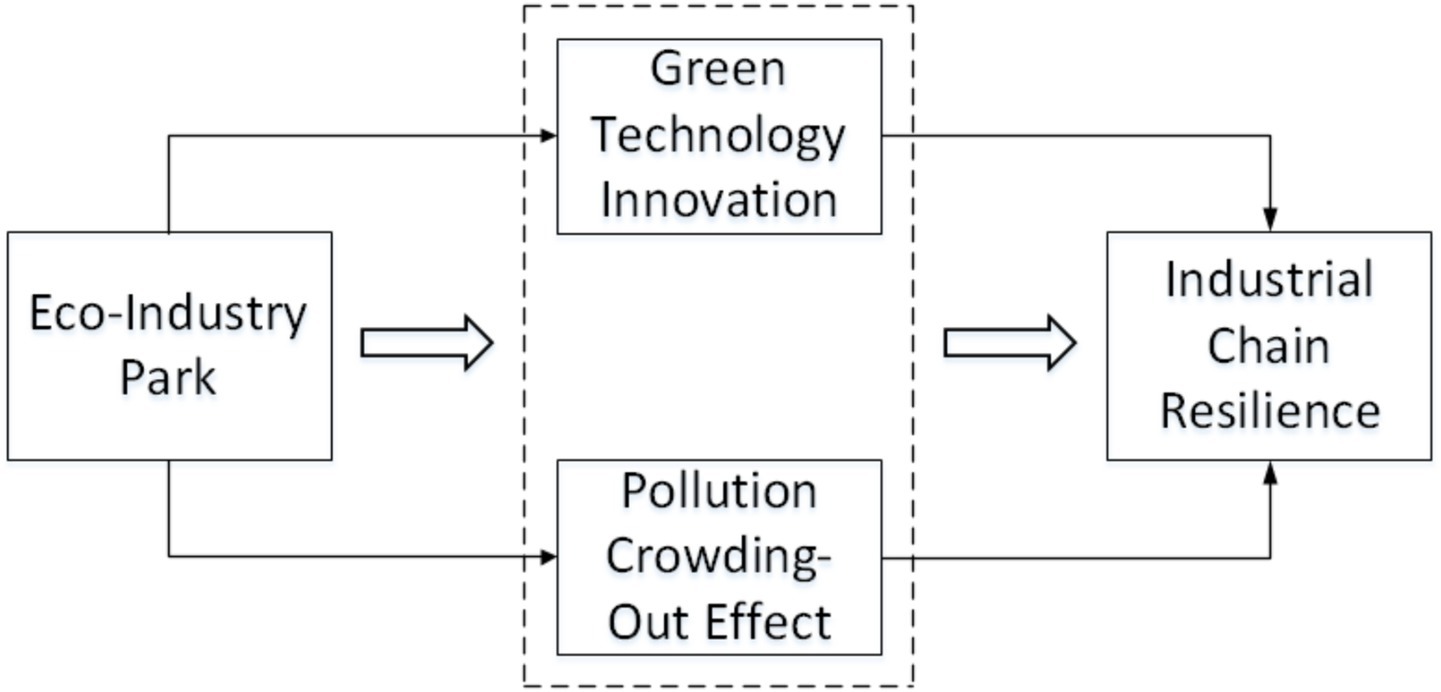
Figure 1. Theoretical framework.
Research design and data explanation
Research methods
The existing research on the impact of eco-industrial parks on the industrial chain has revealed the path to achieving industrial chain security from a theoretical perspective, but further exploration is needed on the impact on the resilience of the industrial chain. Therefore, this article adopts the methods of double difference and spatial econometrics to quantitatively analyze the evolution law and impact mechanism of industrial chain resilience, and explore the technological innovation effect and crowding out effect of eco-industrial parks on industrial chain resilience from different levels.
Evaluation model
Entropy weight method
The first step is to dimensionless the data. Considering the inconsistency in the scale between indicators, it is necessary to dimensionless the data to eliminate the dimensional influence between indicators, so that the range of values for each indicator is [0, 1]. Two processing methods, positive and negative, are used to process the data.
For positive indicators, that is, indicators with larger values are better, the Equation (1) for dimensionless processing of indicators is:
For negative indicators, that is, indicators with smaller values are better, the Equation (2) for dimensionless processing of indicators is:
The second step is to determine the weights of the indicators. Calculate the proportion pij of the i-th indicator value under the j-th indicator in Equation (3):
We calculate the entropy value ej of the j-th indicator in Equation (4):
Next, we calculate the coefficient of difference gj for the j-th indicator in Equation (5):
Then, calculate the weight wj of the j-th indicator in Equation (6):
Finally, calculate the comprehensive score Hi for each evaluation object in Equation (7).
where, wj in the above equation is the indicator weight determined by the entropy weight method, and aij is the standardized value of each indicator.
Difference-in-differences model
This article first uses the difference-in-differences (DID) method to evaluate the impact of the construction of eco-industrial parks on the resilience of the industrial chain. This method compares the changes between the experimental group and the control group at different time points or treatment conditions to eliminate fixed effects and time effects of individuals or groups, thereby more accurately evaluating the impact of policies. We will use the interaction term between policy implementation dummy variables and time dummy variables as the core explanatory variable DID, and construct a difference in differences model. The specific benchmark regression model is as follows in Equations (8, 9).
where, a0 represents the direct impact effect of eco-industrial parks on the resilience of the industrial chain. If the coefficient is positive, it indicates that the construction of eco-industrial parks has a positive effect on improving the resilience of the industrial chain. Otherwise, it indicates the existence of inhibitory effects. Xit is a series of control variables that control for the impact of other factors on the resilience of the industrial chain. γi, λt, ξit are individual fixed effects, time fixed effects, and random interference terms, respectively. The subscripts t and i represent the time and individual of the observed variable.
Spatial Durbin model
Neglecting the spatial spillover effects between independent and dependent variables can inevitably lead to bias in estimation results (Wang et al., 2021). The selection of spatial econometric models is mainly represented by the Spatial Autoregression Model (SAR), Spatial Error Model (SEM), Spatial Autocorrelation Model (SAC), and Spatial Durbin Model (SDM). Considering the unbiased estimation characteristics of SDM, this model can effectively reflect the dynamic characteristics of global value chain integration and low-carbon transformation in time and space. Therefore, this article adopts the spatial Durbin model in Equation (10).
where, Yit is the dependent variable, DIDit is the explanatory variable, and W is the spatial weight matrix set in this article. If city i is a pilot city for eco-industrial park construction at time t, then DIDit = 1, otherwise DIDit = 0. X represents the control variables, mainly including regional investment level, infrastructure construction, urban innovation atmosphere, and technology service level. α represents a constant, while ρ、δ and β represent the coefficients of their respective variables. μi and ηt represent individual and temporal effects, while εit it is a random perturbation term.
Variable selection and interpretation
Dependent variable
Due to insufficient research on resilience at the industry chain level, in order to better understand the meaning of industry chain resilience, this article will use three abilities to represent industry chain resilience: resilience to shocks, adaptability to recovery, and endogenous growth. Obtain resilience evaluation values for different urban industrial chains using entropy weight method.
a) Ability to withstand impact. This is mainly expressed from three aspects: employment in the manufacturing industry (Eilering and Vermeulen, 2004), macro policy support (Fang et al., 2007), and financial development level (Mathews et al., 2018). Adequate employment in the manufacturing industry is the foundation for its sustained and steady development, as well as an important reflection of its ability to withstand shocks. Macro policy support is expressed as the ratio of fiscal expenditure to regional GDP. The government’s fiscal expenditure provides financial support when the industrial chain is impacted, effectively enhancing the industry chain’s ability to withstand shocks. The level of financial development is expressed as the ratio of the deposit balance of financial institutions to the regional GDP. The high-level development of finance can play a role in guiding funds and provide financial support for industries to resist shocks.
b) Adaptability and recovery ability. That is, the ability of the industrial chain to respond and adjust after facing shocks, expressed by industrial diversification (Tudor et al., 2007), the proportion of total retail sales of consumer goods in society (Peng et al., 2024), and fiscal self-sufficiency rate (Li et al., 2015). Industrial diversification (Indiv) is measured using the Herfindahl Hirschman Index (HHI), which is the reciprocal of industrial concentration. The larger the HHI index, the higher the market concentration. Therefore, its reciprocal can reflect industrial diversification, that is, the smaller the HHI index, the richer the industrial diversification. In the formula, , where Indiv represents the industrial diversification index; HHI stands for industrial concentration; φi represents the proportion of the output value of industry i to the regional GDP. A complete and comprehensive industrial system can provide us with sufficient adjustment space when the industrial chain is impacted by external uncertainties, effectively enhancing the adaptability and recovery ability of the industrial chain. The proportion of total retail sales of consumer goods in society can fully reflect the final consumption level of a region and is the basic driving force for driving regional economic growth and recovery. The fiscal self-sufficiency rate, expressed as a percentage of local fiscal revenue and expenditure, to some extent reflects the health and sustainability of regional finance. A higher fiscal self-sufficiency rate can adapt and recover on its own after being impacted.
c) Endogenous growth capacity. Mainly refers to the ability of an industry to achieve sustained growth under the influence of internal factors such as technological innovation, knowledge accumulation, etc. This article uses the comprehensive utilization rate of industrial waste (Ren et al., 2025), regional innovation and entrepreneurship index (Huang et al., 2025), and level of scientific and educational investment (Belaud et al., 2019) to represent it. The comprehensive utilization rate of industrial waste refers to the level of recycling of industrial waste resources. Recycling waste between upstream and downstream industries can facilitate smooth collaboration in the industrial chain, improve the overall quality of the industrial chain, and promote endogenous growth of the industrial chain. A higher regional innovation and entrepreneurship index can form an organic system with a wide range of subjects and collaborative elements, supporting continuous innovation of regional industries and increasing economic benefits. The level of investment in science and education is expressed as the ratio of science and education expenditure to general budget expenditure. Education, science and technology talents are the fundamental and strategic support for the comprehensive construction of a modern country. Increasing investment in science and education can inject new vitality into the resilience of the industrial chain.
Explanatory variables
Eco-industrial park (EIP)
At present, eco-industrial parks are divided into two types: those that have undergone planning review and obtained official approval, and those that have already submitted applications and are currently undergoing review. The main research objective of this article is the former, which means that the park has passed the planning and review, and has obtained an official name. These eco-industrial parks were first constructed in 2008 and together formed the experimental group for this empirical study. However, some cities have multiple eco-industrial parks. When determining the explanatory variables, for cities with only one eco-industrial park, the construction time, i.e., the year before the eco-industrial park was built, is set to 0, and the year after its completion is set to 1. If there are multiple eco-industrial parks, only the year of the earliest construction of the eco-industrial park is considered, that is, set to 0 before the year of the earliest completion of the eco-industrial park, and set to 1 thereafter.
Control variables
In order to minimize the impact of other factors on the resilience of the industrial chain, the following control variables are selected in this article.
a) The regional investment level (INV) is expressed as the ratio of real estate investment to regional GDP. This article is based on panel data from 285 cities from 2006 to 2023, which is a period of rapid development in China’s real estate investment. Real estate is also known as the pillar industry of the national economy, therefore, selecting the ratio of regional real estate investment to regional GDP can fully reflect the investment level of the region.
b) Infrastructure Construction (ROAD), expressed in terms of per capita road area. The construction of road traffic facilities is a key project in infrastructure construction, and the per capita road area can reflect the level of infrastructure construction in a region. The comprehensive infrastructure construction provides a material foundation for the construction of eco-industrial parks and facilitates the transformation of industrial parks into eco-industrial parks.
c) The urban innovation atmosphere (BOOK) is represented by the logarithm of the public book inventory. The technological innovation effect is a key intermediary effect in the construction of eco-industrial parks and the upgrading of industrial chains. The technological innovation effect generated by green innovation in cities can effectively enhance the resilience of the industrial chain in the region. The collection of urban public books can reflect the overall innovation atmosphere of the city, promote the improvement of regional innovation level, and thus play a role in enhancing the resilience of the urban industrial chain through intermediary effects.
d) The level of technology services (TECH) is expressed as the ratio of the number of people engaged in scientific exploration to the total number of employed people. The ratio of the number of people engaged in scientific and technological survey to the total employment can indicate the proportion of a city’s scientific and technological industry, reflecting the level of urban scientific and technological services. A higher level of technological services facilitates technological innovation in a region, promotes the combination of technological progress and environmental friendliness, and thereby enhances the resilience of the industrial chain.
Mediating variable
a) Green Technology Innovation (GPAT). Green patents cover technological innovation achievements in energy conservation and emission reduction, resource recycling, pollution prevention and control, and the number of authorized patents can intuitively reflect a city’s activity and innovation strength in green technology research and application (Castiglione and Alfieri, 2019). This article collects the number of green patent authorizations at the urban level, and to avoid outliers, adopts the method of adding 1 to the logarithm to represent the level of urban green technology innovation, in order to test the mechanism of eco-industrial park construction and industrial chain resilience improvement. As a quantitative representation of the level of urban green technology innovation, the larger the value, the stronger the comprehensive innovation ability of the city in green technology research and development, achievement transformation, and application promotion. It has more solid technical support and innovation driving ability in promoting the green development of eco-industrial parks and enhancing the risk resilience of the industrial chain.
b) Industrial structure upgrading (ENT). This article follows the approach of Lambert and Boons (2002) and uses the ratio of the added value of the city’s secondary and tertiary industries to represent it. The design of this indicator follows the general law of industrial evolution. When the regional economy transitions from the middle stage of industrialization to the service economy, the proportion of the secondary industry represented by manufacturing and energy industries will gradually give way to the tertiary industry centered on modern service industries and digital economy. The change in the ratio of the two can dynamically present the speed and direction of this structural adjustment. With the popularization of ecological concepts and the application of green technology innovation, the industrial structure continues to be optimized and upgraded, and the proportion of resource-saving and environmentally friendly tertiary industries is gradually increasing. The proportion of high-energy consuming secondary industries is constantly decreasing. Using the ratio of the secondary and tertiary industries as a moderating variable can reflect the current progress of industrial structure upgrading in pilot cities.
Data sources
This article aims to study the impact and mechanism of eco-industrial park construction on the resilience of the industrial chain from the perspective of economic benefits. Panel data from 285 cities across the country from 2006 to 2023 were selected for empirical analysis. Among them, the selection of explanatory variables, namely cities, was mainly based on the “National eco-industrial Park Demonstration List” and “National eco-industrial Park Demonstration List” published by the Ministry of Environment in 2017. Considering the construction requirements and principles clearly stipulated by the Ministry of Environment, Guigang Sugar Industry, which was built in 2001, and Lubei Industrial Park, which was built in 2003, were excluded. Finally, only 48 prefecture level cities with EIPs built after 2008 were selected as explanatory variables for the study. The data mainly comes from the China Urban Statistical Yearbook, China Energy Statistical Yearbook, and China Environmental Yearbook. Table 1 shows the data characteristics.
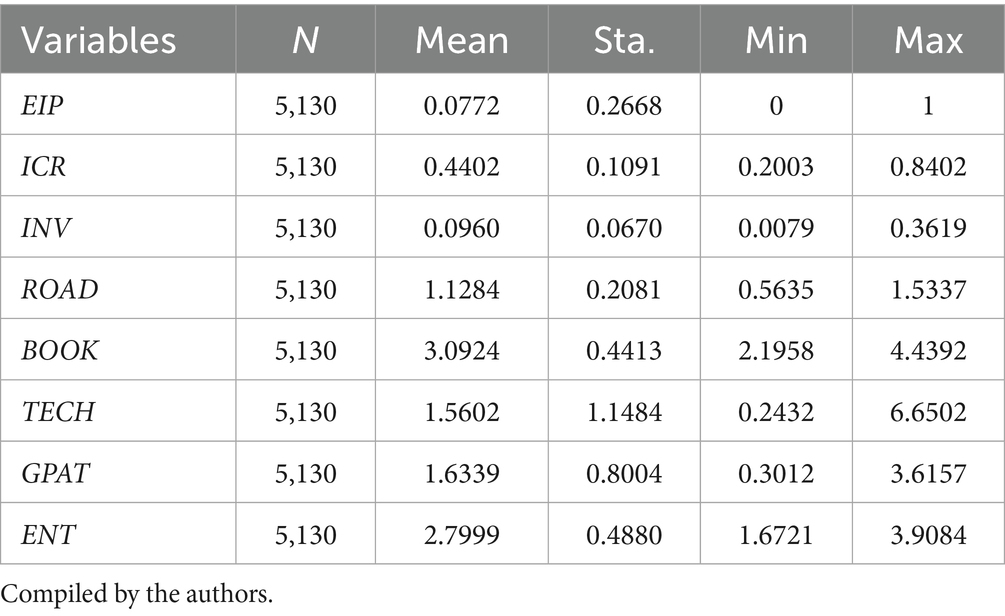
Table 1. Descriptive statistics.
Empirical analysis
Benchmark regression analysis
As shown in Table 2, the results of the benchmark regression are presented. In column (1), without controlling for all samples, the results indicate that the construction of eco-industrial parks has a significant positive impact on the resilience of the industrial chain. After adding control variables, column (2) still shows a significant positive baseline regression result, but the coefficient of influence decreases, indicating that the impact of eco-industrial park construction on the improvement of industrial chain resilience has been weakened after controlling for variables such as regional investment level, infrastructure construction, urban innovation atmosphere, and technology service level. Adding time fixed effects in column (3) and individual fixed effects in column (4), the results show that they are significant at the 1% significance level, but the coefficients have increased. This indicates that after controlling for variables that change over time but do not change with individuals and those that change with individuals but do not change over time, the impact of eco-industrial park construction on the resilience of the industrial chain increases. Column (5) will include both time fixed effects and individual fixed effects, and the results show that although the influence coefficient decreases, it is still significant at the 1% level. Overall, the construction of eco-industrial parks has a significant impact on enhancing the resilience of the industrial chain.
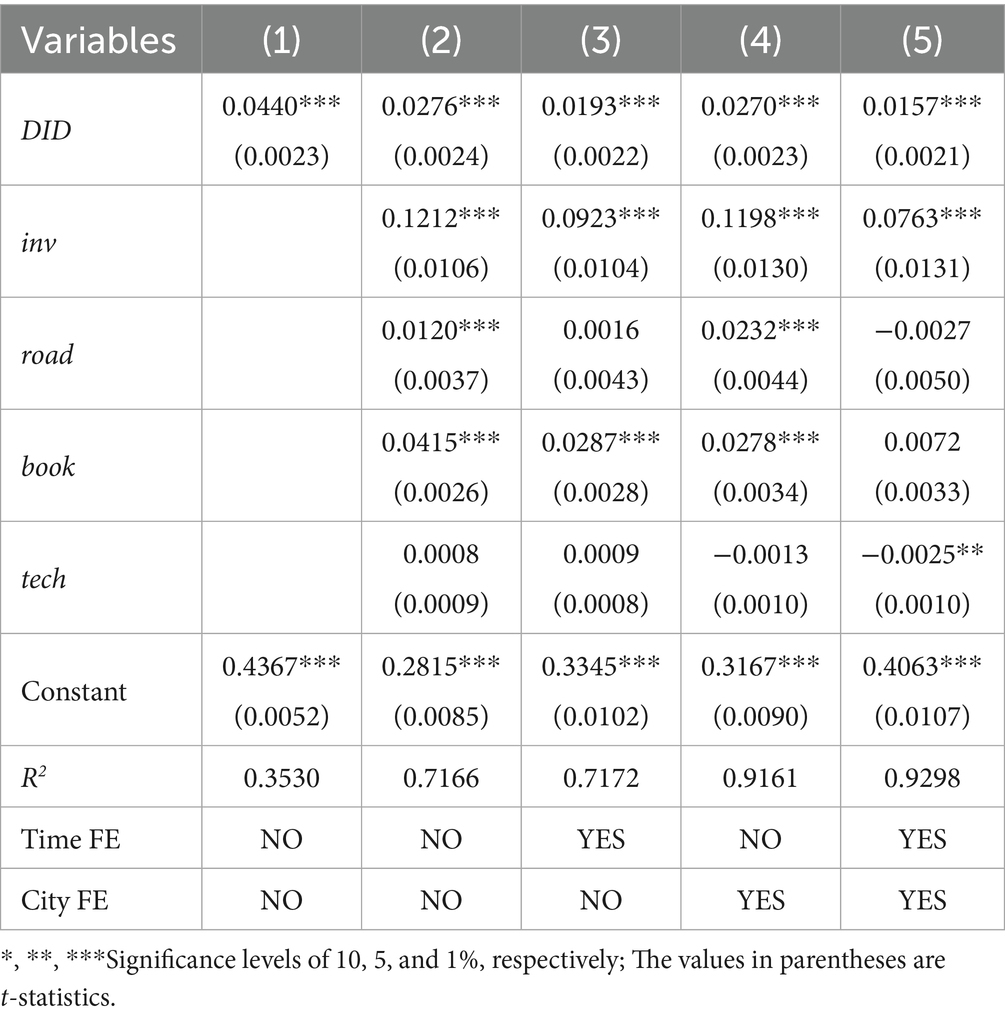
Table 2. Benchmark regression.
Regarding the coefficient of the core explanatory variable DID (0.0157, significant at the 1% level) in Column (5) of the benchmark regression: According to the mean value of industrial chain resilience (ICR) (0.4402) in Table 1 of the original manuscript, this coefficient indicates that after controlling for time-fixed effects, individual-fixed effects, and variables such as regional investment level, the construction of national Eco-Industrial Parks (EIPs) can relatively increase the industrial chain resilience of pilot cities by 3.57% (0.0157/0.4402). From a practical perspective, this improvement is specifically reflected in the stronger ability of pilot cities to respond to external risks. For instance, when the industrial chain faces fluctuations in raw material prices or supply chain disruptions, EIPs can reduce the duration of production interruptions through the circular economy system (e.g., reuse of industrial waste, collaborative supply among enterprises). This result is highly consistent with the practical function of EIPs in improving resource utilization efficiency, as described in the mechanism section of the original manuscript that “the internal industrial system of EIPs can achieve effective transfer and utilization of energy and materials.”
Regarding the coefficient of the control variable “regional investment level (INV)” (0.0763, significant at the 1% level): The paper defines this variable as “the proportion of real estate investment in regional GDP.” Considering the real-world context of the coordinated development of real estate and industry in China from 2006 to 2023, this coefficient indicates that reasonable real estate investment can indirectly support the improvement of industrial chain resilience by improving industrial supporting infrastructure (e.g., logistics and warehousing facilities, production auxiliary facilities around EIPs). However, it is necessary to note the point mentioned in the original manuscript that “excessive reliance on real estate should be avoided to prevent crowding out industrial R&D investment.” This supplement not only echoes the setting logic of control variables in the original manuscript but also provides a practical boundary explanation for the interpretation of results.
Robustness test
To ensure the robustness of the experimental results, this article will use the following two methods for robustness testing:
a) Exclude provincial capital cities. Due to the higher administrative level of provincial capital cities compared to other cities, they tend to have more resources such as funding, technology, and talent. In the process of studying the improvement of industrial chain resilience, the impact of eco-industrial park construction will be weakened. Even if the scale and quantity of eco-industrial park construction are small, due to the allocation of more other resources, the resilience of the industrial chain may be improved. Therefore, after excluding provincial capital cities, the sample will be regressed again to verify the robustness of the experimental results.
b) Exclude interference from other policies. The government’s policy support can play a guiding role in the allocation of social resources. This article considers that implementing other policy measures during the construction of eco-industrial parks by the government may have a certain impact on the resilience of the industrial chain. For example, the industrial policies formulated by the country to guide the direction of industrial development and optimize and upgrade the industrial structure will have an impact on the resilience of the industrial chain to a certain extent. Therefore, exclude other policy interference and re-examine the robustness of the results.
As shown in Table 3, the results of the robustness test are presented, where column (1) represents the test results after excluding provincial capital cities, and column (2) represents the test results after excluding other policy interference. From columns (1) and (2), it can be seen that the core explanatory variable DID is positively significant at the 1% level. After excluding the interference of provincial capital cities and other policies, the key coefficient of the impact of eco-industrial park construction on the resilience of the industrial chain is positive and has passed the significance test, indicating the robustness of the test results.
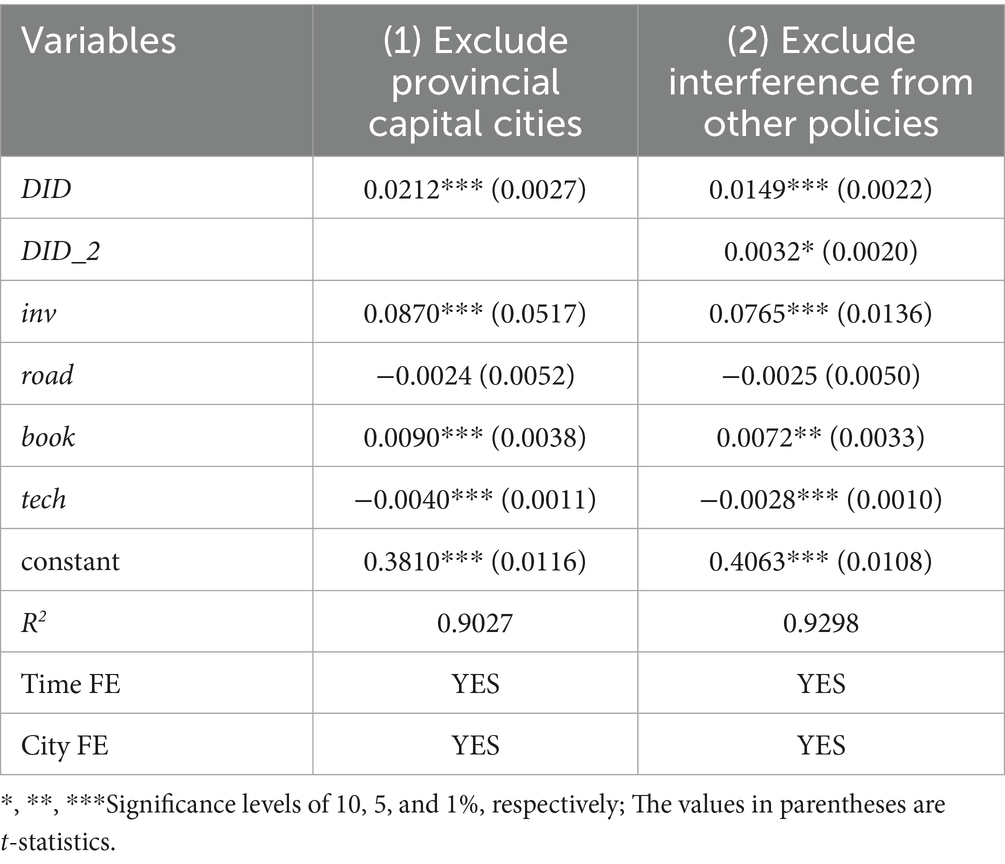
Table 3. Robustness test.
Heterogeneity test
There exists differences between the eastern and mid-western regions of China in terms of development foundation, resource endowment, and policy environment. Regions with high and low levels of regional integration have different levels of industrial synergy and factor flow efficiency, which will affect the construction path of ecological industrial demonstration zones and the resilience level of industrial chains. Heterogeneity test can accurately identify the problems and advantages of different regions, reveal the mechanism of regional characteristics on the resilience of the industrial chain, and provide a basis for formulating differentiated policies, promoting regional coordinated development, and enhancing the resilience of the industrial chain.
a) Spatial geographic location. Due to the different spatial and geographical locations of each city, there are certain differences in the endowment of factor resources, the support of relevant preferential policies, as well as the inflow of funds, technology, and talents. The ability of cities in different regions to build eco-industrial parks also varies. The data in this article comes from 285 different cities across the country from 2006 to 2023, covering various regions of the country. Therefore, in order to examine whether the impact of eco-industrial park construction on the resilience of the industrial chain has spatial heterogeneity, this paper divides the urban sample into eastern cities and mid-western cities according to spatial geographic layout. Columns (1) and (2) in Table 3 are the regression results of eastern cities and central and western cities, respectively.
b) Level of regional integration. The “Outline of the Development Plan for Regional Integration in the Yangtze River Delta” released by the State Council in 2019 promotes the process of regional integration. The development of regional integration in the Yangtze River Delta has proven that it has a significant promoting effect on the optimization and upgrading of regional economic structure, technological innovation, and resource and environmental friendliness. Cities with different levels of regional integration are influenced by other cities within the region. To investigate whether the impact of eco-industrial parks on the resilience of the industrial chain exhibits heterogeneity in regional integration levels, this study divides the cities under investigation into high and low levels of regional integration, in order to test the heterogeneity of the model. The specific inspection results are shown in Table 4.
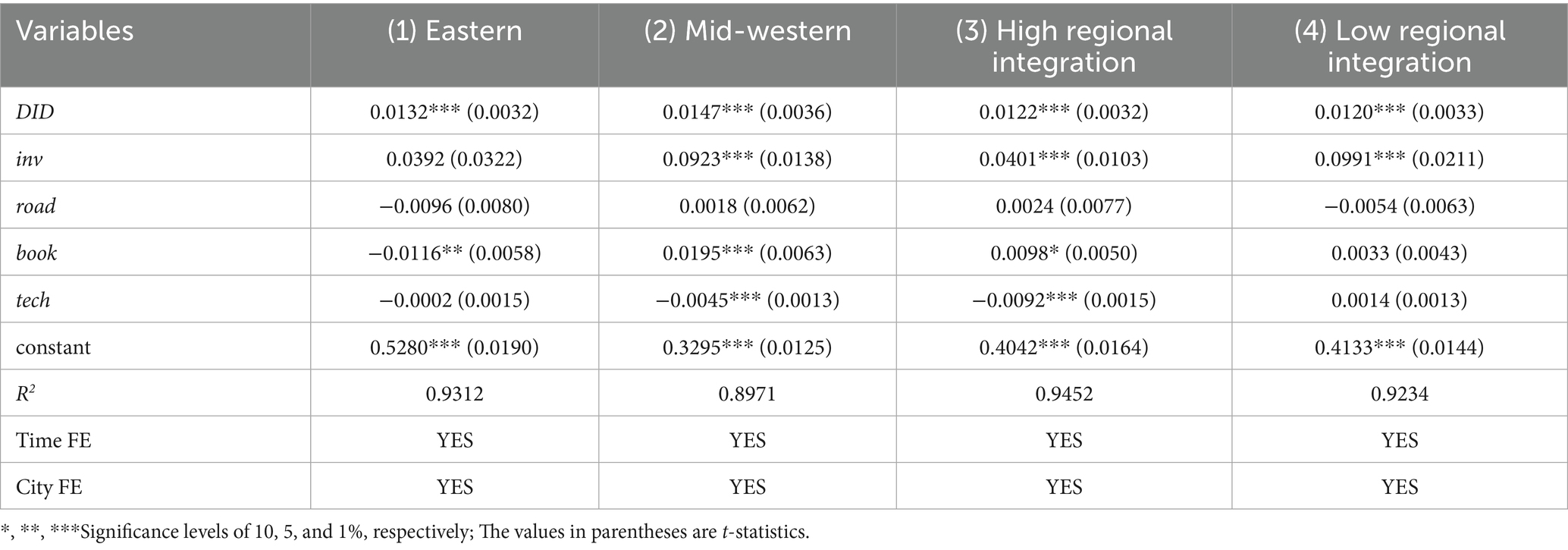
Table 4. Heterogeneity test.
Against the backdrop of accelerating global industrial chain restructuring, tightening environmental constraints, and regional coordinated development becoming a national strategy, the eastern region of China has optimized its industrial structure and improved its industrial chain, while the mid-western regions rely on traditional industries and have prominent industrial chain gaps. There are significant differences in the integration process between different cities and regions, and the problem of obstructed factor flow restricts the risk resistance of the industrial chain. Thus, studying the regional heterogeneity impact of ecological industrial parks on the resilience of the industrial chain is of great significance. According to the heterogeneity test results, it can be seen that the construction of eco-industrial parks in eastern and mid-western cities has a significant impact on the resilience of the industrial chain, and the impact of the construction of eco-industrial parks on the resilience of the industrial chain is more pronounced in mid-western cities. This may be due to the large proportion of traditional industries in the mid-western regions, which have problems such as low industrial levels and incomplete industrial chains. The construction of eco-industrial parks can guide the green transformation of traditional industries, form a complete industrial chain for comprehensive resource utilization through the development of circular economy, and enhance the resilience of the industrial chain. Columns (3) and (4) show the regression results of high regional integration cities and low regional integration cities. The results showed that with the addition of control variables, time fixed effects, and individual fixed effects, the regression coefficients were significantly positive, indicating that the construction of eco-industrial parks, especially in highly integrated cities, can significantly enhance the resilience of the industrial chain. The possible reason is that regions with high levels of regional integration often break down administrative barriers and promote the free flow of talent, technology, capital, logistics, and other factors across regions. Eco-industrial parks can attract environmental technology research and development talents on a larger scale, connect with green financial resources, accelerate the transformation of low-carbon technologies, and enhance the adaptability of the industrial chain in green transformation. Based on the above heterogeneity analysis results, whether from the perspective of regional development differences or regional integration degree differences, the construction of ecological industrial parks has a significant positive impact on the resilience of the industrial chain, and the impact mechanism and effect size in different contexts have been reasonably explained. This result not only verifies the effectiveness of ecological industrial park construction in enhancing the resilience of the industrial chain, but also, through multidimensional heterogeneity testing, eliminates the randomness of results caused by regional differences, effectively proving the robustness of the core conclusion proposed in this paper that “ecological industrial park construction can significantly enhance the resilience of the urban industrial chain.”
Mechanism analysis
The previous test results have shown that the construction of eco-industrial parks can enhance the resilience of the industrial chain. To further analyze the impact of eco-industrial park construction on industrial chain resilience, the following will explore the mechanism by which eco-industrial park construction enhances industrial chain resilience.
Table 5 shows the mechanism test results of the improvement of industrial chain resilience by the construction of eco-industrial parks. Columns (1) and (2) report the test results of the technological innovation effect. The results of column (1) indicate the impact of eco-industrial park construction on the mechanism variable of green technology innovation. It can be concluded from the results that at the 1% statistical level, the construction of eco-industrial parks significantly promotes green technology innovation. Based on this, column (2) tests the effect of technological innovation, and the results show that, while controlling for the impact of eco-industrial park construction on industrial chain resilience, green technology innovation significantly enhances industrial chain resilience. This indicates that green technology innovation plays a mediating role between the construction of eco-industrial parks and the improvement of industrial chain resilience. This result also validates hypothesis 1.
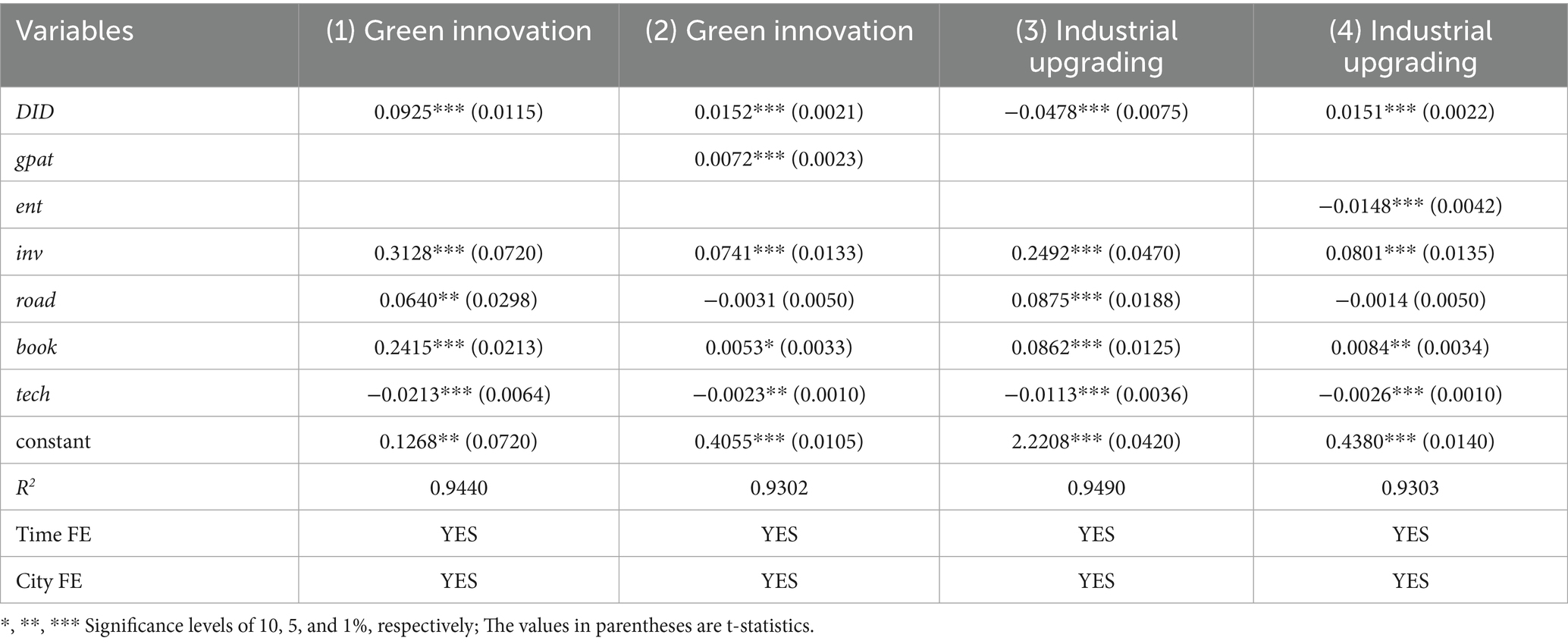
Table 5. Mechanism test.
Columns (3) and (4) show the results of the crowding out effect test for heavily polluting enterprises. The results of column (3) indicate the impact of eco-industrial park construction on heavily polluting industries. It can be concluded from the results that, at the 1% statistical level, the construction of eco-industrial parks significantly reduces the number of heavily polluting enterprises. This is because under government policy support, emerging industrial parks are mostly resource-saving and environmentally friendly eco-industrial parks, which largely forces heavily polluting enterprises to relocate. On this basis, column (4) tests the crowding out effect of heavily polluting enterprises, and the results show that under the control of the impact of eco-industrial park construction on industrial chain resilience, the reduction in the number of heavily polluting enterprises promotes the improvement of industrial chain resilience at the 1% statistical level. This indicates that the crowding out effect of heavily polluting enterprises has a significant impact on the upgrading of industrial structure and the improvement of industrial chain resilience. This conclusion also confirms hypothesis 2.
Spatial correlation test
Existing research has shown a spatial correlation between the construction of eco-industrial parks and the improvement of industrial chain resilience. Therefore, we conducted spatial autocorrelation tests to ensure the accuracy of our research. This article uses economic variables Moran’s I index and Geary’s I index to test the spatial correlation between the construction of eco-industrial parks and the improvement of industrial chain resilience in 285 cities in China from 2006 to 2023. The value of Moran’s I is between [−1, 1]. A value greater than 0 indicates a positive spatial correlation, a value equal to 0 indicates no spatial correlation, and a negative value indicates a negative spatial correlation. The results of the spatial correlation test in this article are shown in Table 6. The Moran’s index and Geary’s I values for the construction of eco-industrial parks and the improvement of industrial chain resilience from 2006 to 2023 are both greater than 0, and the overall fluctuation amplitude is small, indicating a significant spatial correlation between the construction of eco-industrial parks and the improvement of industrial chain resilience, and also demonstrating the rationality of the spatial econometric model selection.
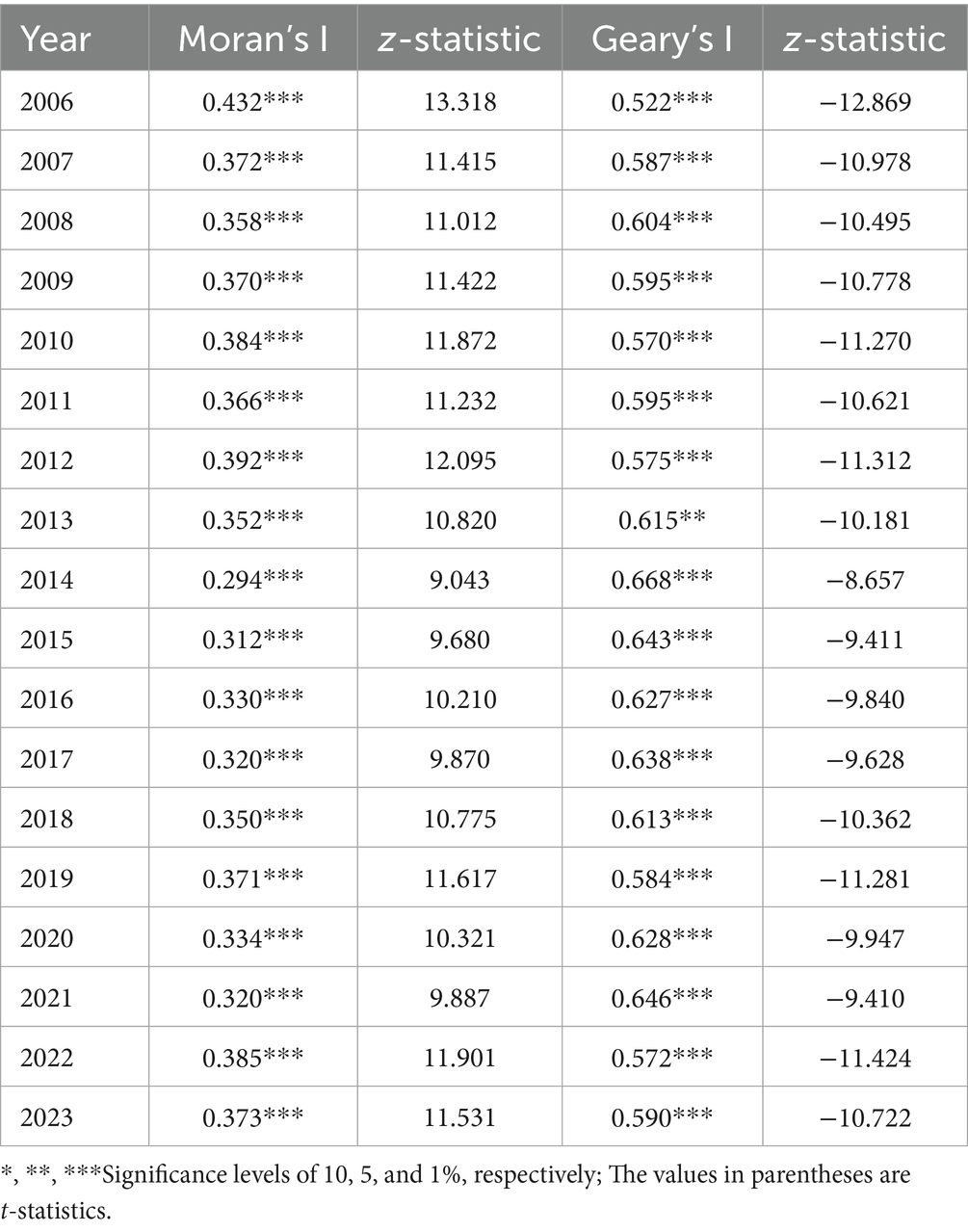
Table 6. Spatial autocorrelation test.
To explore the spatial distribution characteristics of industrial chain resilience in specific regions, this article further drew a local Moran index map of industrial chain resilience in various cities in 2023. According to Figure 2, most provinces in China are distributed in the first and third quadrants, and the resilience of the industrial chain is positively correlated. The high industry chain resilience cluster cities in the first quadrant are mainly first tier cities and eastern regions, while the low industry chain resilience cluster cities in the third quadrant are mainly distributed in the central and western regions, reflecting the strong spatial correlation and regional heterogeneity of industry chain resilience.
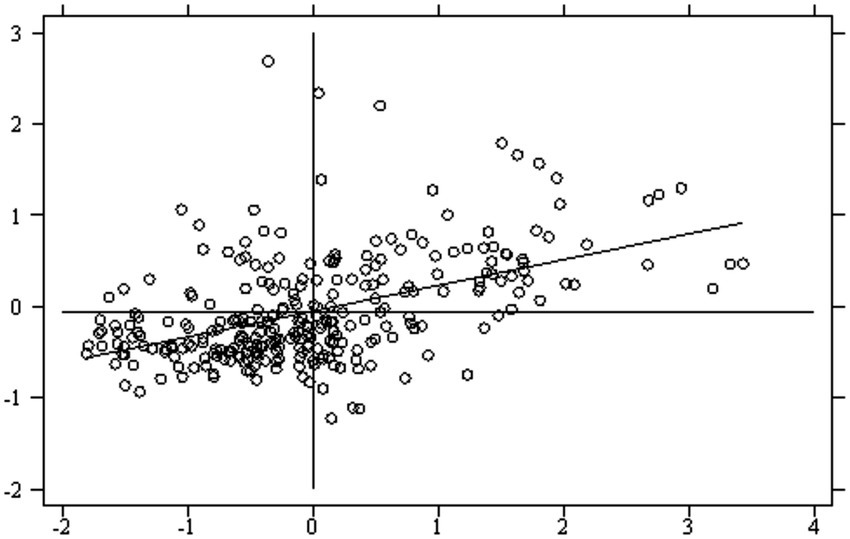
Figure 2. Moran scatter plot of China’s industrial chain resilience in 2023.
Spatial effect analysis
Based on the results of LR test and Wald test, this paper chooses the spatial Durbin model (Farooque et al., 2022). According to the test results of the SDM model in column (3) of Table 7, the coefficient of the improvement of industrial chain resilience by the construction of eco-industrial parks is 0.0127, which is significant at the 1% level, indicating that the construction of eco-industrial parks can enhance industrial chain resilience. The coefficient of the spatial lag term W × DID for the construction of eco-industrial parks is 0.0129, and it passes the test at a significance level of 1%, indicating that the construction of eco-industrial parks has a significant spatial transmission effect, that is, the construction of eco-industrial parks in surrounding cities will produce spatial spillover effects, which will have an impact on the resilience of the city’s industrial chain. This impact may stem from technology diffusion, factor flow, or industrial synergy between regions. The green production technology developed by enterprises in the eco-industrial park of surrounding cities can be disseminated to the city through talent flow or technical cooperation, driving the overall upgrading of the industrial chain.
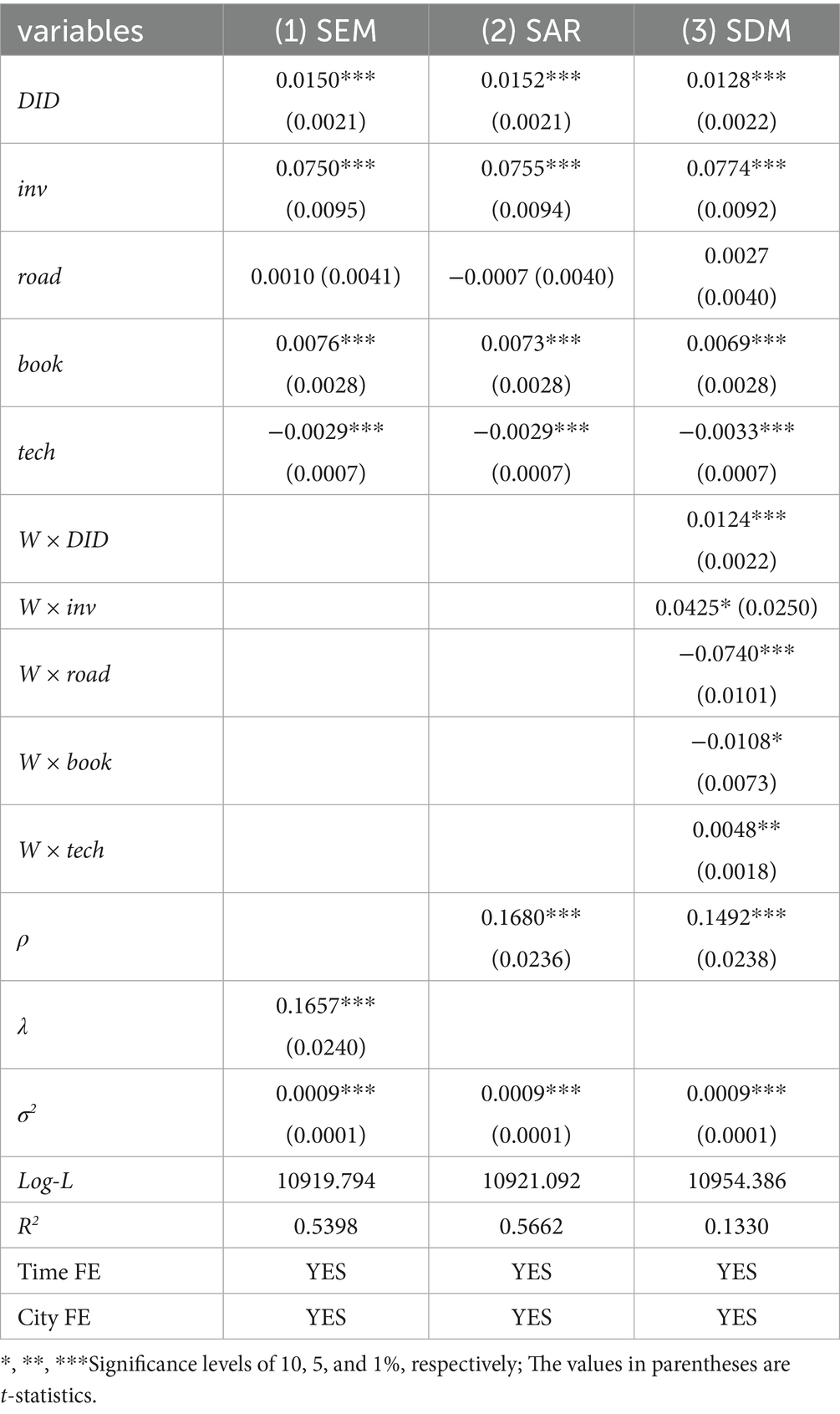
Table 7. Spatial effect test.
This conclusion is consistent with the results of the spatial autocorrelation test mentioned earlier. The spatial autocorrelation test, using indicators such as Moran’s I index, confirms the significant clustering characteristics of eco-industrial park construction and industrial chain resilience in spatial distribution, that is, regions with similar levels exhibit clustering distribution in space. The significance of the spatial lag term in the SDM model further confirms from the spatial dimension that the construction of eco-industrial parks not only enhances the resilience of the industrial chain locally, but also radiates and drives surrounding areas through spatial correlation, forming a synergistic effect (Han et al., 2022). These quantitative results provide solid empirical evidence for a deeper understanding of the impact mechanism of eco-industrial park construction on the resilience of the industrial chain, and also provide scientific quantitative references for the formulation of policies to promote the construction of eco-industrial parks and enhance the resilience of the industrial chain through regional collaboration.
Research conclusion and policy implications
As a new type of industrial park, the eco-industrial park aims to be constructed based on the concept of circular economy, principles of industrial ecology, and clean production standards. The resilience of an industry chain represents its ability to withstand shocks, recover, and generate endogenous growth. Previous studies have revealed the positive ecological benefits of the construction of eco-industrial parks on the development of the industrial chain. This article further explores the impact mechanism of eco-industrial park construction on the resilience improvement of the industrial chain from the perspective of economic benefits. Based on panel data from 285 cities across the country from 2006 to 2023, the spatial Durbin model is used for empirical research, and the impact of eco-industrial park construction on the resilience improvement of the industrial chain is examined by geographical location and regional integration level. The final research results indicate that: (1) there is a significant spatial correlation between the construction of eco-industrial parks and the improvement of industrial chain resilience, and the spatial Durbin model selected in this paper is reasonable. (2) The construction of eco-industrial parks can significantly promote the improvement of industrial chain resilience, and the migration of heavily polluting enterprises has spillover effects. (3) The construction of eco-industrial parks has regional heterogeneity in enhancing the resilience of the industrial chain. The role of eco-industrial park construction in cities in the central and western regions is more significant than that in the eastern regions. Cities in areas with high regional integration have a more pronounced effect on enhancing the resilience of the industrial chain than those in areas with low regional integration. (4) Green technology innovation and industrial structure upgrading, as intermediary effects, can enhance the resilience of the industrial chain in the construction of eco-industrial parks.
Based on the above research conclusions, this article proposes the following policy implications:
Firstly, we attach great importance to green technology innovation. Considering the intermediary role of green technology innovation, the government should pay more attention to promoting green technology research and management practices both inside and outside eco-industrial parks. The government can encourage enterprises to invest in green innovation projects through fiscal incentives, tax incentives, and research and development support. These measures will promote the improvement of urban green technology innovation level, thereby enabling the economic benefits of new economic and technological development zones to be better realized. At the same time, the public sector needs to create a better environment for talent introduction and investment, and the economic impact of eco-industrial parks will be achieved through higher levels of human capital and stronger corporate attractiveness. Form a virtuous cycle of “technological innovation industrial upgrading resilience enhancement.”
Secondly, accelerate the upgrading of industrial structure. The upgrading of industrial structure, as an intermediary mechanism, has played an important role in the construction of eco-industrial parks and the improvement of industrial chain resilience. Regional governments should start with the mechanism impact of eco-industrial park construction on enhancing the resilience of the industrial chain, accelerate the promotion of industrial upgrading, vigorously develop green technology innovation, promote the combination of ecological construction and industrial upgrading, while achieving ecological and economic benefits, and creating a solid industrial foundation for enhancing the resilience of the industrial chain. Through the integration model of “ecology + industry,” emerging industries such as ecotourism and carbon trading are embedded into the industrial chain, promoting the combination of ecological construction and industrial upgrading, while achieving ecological and economic benefits, and creating a solid industrial foundation for enhancing the resilience of the industrial chain.
Thirdly, fully leverage the industrial upgrading effect brought about by the relocation of heavily polluting enterprises. Cities in regions with high levels of regional integration can achieve smooth communication of resources, technology, and talent, generating resource agglomeration effects and providing convenience for the construction of urban eco-industrial parks in the region. Regional cooperation should be strengthened to achieve resource sharing and factor flow. The relocation of polluting enterprises promotes the upgrading of industries towards low pollution and high value-added links, reducing dependence on a single resource or market. After heavy polluting enterprises relocate, core cities release factors such as land and environmental capacity, and shift towards research and development design, high-end manufacturing, and other aspects. Through the reconfiguration of regional resources, technological spillovers, and optimization of industrial division of labor, systematic changes can be achieved, and the upgrading effect of industries can be leveraged to jointly promote the improvement of industrial chain resilience.
Fourth, promote the successful experience of eco-industrial park construction and strengthen cooperation between regions. Cities should strengthen cooperation and share successful experiences in the construction of eco-industrial parks. Cities in different regions should adapt to local conditions and fully tap into their own advantages. Eastern cities should fully utilize their geographical advantages, integrate advantageous resources such as capital, technology, and talent, and play a pioneering role in the construction of eco-industrial parks, setting an example for the promotion of national eco-industrial park construction. The cities in the central region are geographically close to those in the eastern region. We should make good use of this advantage, actively introduce advanced technologies from developed eastern regions, and seek technical support. The western region can promote the construction of regional eco-industrial parks through greater preferential policies, develop new renewable energy, inject new impetus into regional industrial transformation and upgrading, continuously expand the scale of eco-industries, and narrow the gap with the central and eastern regions.
Data availability statement
Publicly available datasets were analyzed in this study. This data can be found at https://www.stats.gov.cn/sj/ndsj/ China Urban Statistical Yearbook China Energy Statistical Yearbook China Environmental Yearbook.
Author contributions
HZ: Conceptualization, Data curation, Methodology, Supervision, Writing – original draft, Writing – review & editing. BX: Formal analysis, Investigation, Software, Validation, Visualization, Writing – review & editing.
Funding
The author(s) declare that no financial support was received for the research and/or publication of this article.
Conflict of interest
The authors declare that the research was conducted in the absence of any commercial or financial relationships that could be construed as a potential conflict of interest.
Generative AI statement
The authors declare that no Gen AI was used in the creation of this manuscript.
Any alternative text (alt text) provided alongside figures in this article has been generated by Frontiers with the support of artificial intelligence and reasonable efforts have been made to ensure accuracy, including review by the authors wherever possible. If you identify any issues, please contact us.
Publisher’s note
All claims expressed in this article are solely those of the authors and do not necessarily represent those of their affiliated organizations, or those of the publisher, the editors and the reviewers. Any product that may be evaluated in this article, or claim that may be made by its manufacturer, is not guaranteed or endorsed by the publisher.
References
Belaud, J. P., Adoue, C., Vialle, C., Chorro, A., and Sablayrolles, C. (2019). A circular economy and industrial ecology toolbox for developing an eco-industrial park: perspectives from French policy. Clean Techn. Environ. Policy 21, 967–985. doi: 10.1007/s10098-019-01677-1
Castiglione, C., and Alfieri, A. (2019). Supply chain and eco-industrial park concurrent design. IFAC-PapersOnLine 52, 1313–1318. doi: 10.1016/j.ifacol.2019.11.380
Eilering, J. A., and Vermeulen, W. J. (2004). Eco-industrial parks: toward industrial symbiosis and utility sharing in practice. Prog. Ind. Ecol. Int. J. 1, 245–270. doi: 10.1504/PIE.2004.004681
Fang, Y., Côté, R. P., and Qin, R. (2007). Industrial sustainability in China: practice and prospects for eco-industrial development. J. Environ. Manag. 83, 315–328. doi: 10.1016/j.jenvman.2006.03.007
Farooque, M., Zhang, A., Liu, Y., and Hartley, J. L. (2022). Circular supply chain management: performance outcomes and the role of eco-industrial parks in China. Transp. Res. Part E Logist. Transp. Rev. 157:102596. doi: 10.1016/j.tre.2021.102596
Genc, O., van Capelleveen, G., Erdis, E., Yildiz, O., and Yazan, D. M. (2019). A socio-ecological approach to improve industrial zones towards eco-industrial parks. J. Environ. Manag. 250:109507. doi: 10.1016/j.jenvman.2019.109507
Gibbs, D., and Deutz, P. (2005). Implementing industrial ecology? Planning for eco-industrial parks in the USA. Geoforum 36, 452–464. doi: 10.1016/j.geoforum.2004.07.009
Han, F., Sun, M., Jia, X., Klemeš, J. J., Shi, F., and Yang, D. (2022). Agent-based model for simulation of the sustainability revolution in eco-industrial parks. Environ. Sci. Pollut. Res. 29, 23117–23128. doi: 10.1007/s11356-021-17503-5
Herman, K. S., and Xiang, J. (2019). Induced innovation in clean energy technologies from foreign environmental policy stringency? Technol. Forecast. Soc. Change 147, 198–207. doi: 10.1016/j.techfore.2019.07.006
Hu, W., Tian, J., and Chen, L. (2021). An industrial structure adjustment model to facilitate high-quality development of an eco-industrial park. Sci. Total Environ. 766:142502. doi: 10.1016/j.scitotenv.2020.142502
Huang, B., Yong, G., Zhao, J., Domenech, T., Liu, Z., Chiu, S. F., et al. (2019). Review of the development of China's eco-industrial park standard system. Resour. Conserv. Recycl. 140, 137–144. doi: 10.1016/j.resconrec.2018.09.013
Huang, J., Zheng, B., and Du, M. (2025). How digital economy mitigates urban carbon emissions: the green facilitative power of industrial coagglomeration. Appl. Econ. 57, 1–19. doi: 10.1080/00036846.2025.2486785
Lambert, A. J. D., and Boons, F. A. (2002). Eco-industrial parks: stimulating sustainable development in mixed industrial parks. Technovation 22, 471–484. doi: 10.1016/S0166-4972(01)00040-2
Li, J., Pan, S. Y., Kim, H., Linn, J. H., and Chiang, P. C. (2015). Building green supply chains in eco-industrial parks towards a green economy: barriers and strategies. J. Environ. Manag. 162, 158–170. doi: 10.1016/j.jenvman.2015.07.030
Ma, Q., Wang, F., He, L., Chai, X., and Yu, C. (2025). The impact of eco-industrial parks on urban haze pollution: evidence from China. Environ. Dev. Econ. 30, 202–219. doi: 10.1017/S1355770X24000391
Mathews, J. A., Tan, H., and Hu, M. C. (2018). Moving to a circular economy in China: transforming industrial parks into eco-industrial parks. Calif. Manag. Rev. 60, 157–181. doi: 10.1177/0008125617752692
Pan, M., Sikorski, J., Akroyd, J., Mosbach, S., Lau, R., and Kraft, M. (2016). Design technologies for eco-industrial parks: from unit operations to processes, plants and industrial networks. Appl. Energy 175, 305–323. doi: 10.1016/j.apenergy.2016.05.019
Peng, S., Wu, K., Tang, C., Meng, B., Wang, Z., Li, H., et al. (2024). Multi-layer perspective of household-driven carbon emissions reveals new industrial chain hotspots in China. J. Clean. Prod. 467:142979. doi: 10.1016/j.jclepro.2024.142979
Ren, Y., Mo, Y., and You, W. (2025). Economic complexity, CO2 emissions, and the mediating roles of energy structure and energy efficiency: a spatial panel analysis. Appl. Econ. 57, 1–15. doi: 10.1080/00036846.2024.2302930
Romero, E., and Ruiz, M. C. (2013). Framework for applying a complex adaptive system approach to model the operation of eco-industrial parks. J. Ind. Ecol. 17, 731–741. doi: 10.1111/jiec.12032
Schlüter, L., Mortensen, L., Gjerding, A. N., and Kørnøv, L. (2023). Can we replicate eco-industrial parks? Recommendations based on a process model of EIP evolution. J. Clean. Prod. 429:139499. doi: 10.1016/j.jclepro.2023.139499
Shao, Y., Liu, J., Hua, X., Kularathne, C., and Shi, L. (2024). Applicability of the international framework for eco-industrial park in China—survey and analysis based on 17 case parks in Jiangxi Province. Sustainability 16:4635. doi: 10.3390/su16114635
Song, Y., Bai, W., and Zhang, Y. (2024). Resilience assessment of trade network in copper industry chain and the risk resistance capacity of core countries: based on complex network. Resour. Policy 92:105034. doi: 10.1016/j.resourpol.2024.105034
Susur, E., Hidalgo, A., and Chiaroni, D. (2019). A strategic niche management perspective on transitions to eco-industrial park development: a systematic review of case studies. Resour. Conserv. Recycl. 140, 338–359. doi: 10.1016/j.resconrec.2018.06.002
Tudor, T., Adam, E., and Bates, M. (2007). Drivers and limitations for the successful development and functioning of EIPs (eco-industrial parks): a literature review. Ecol. Econ. 61, 199–207. doi: 10.1016/j.ecolecon.2006.10.010
Van Leeuwen, M. G., Vermeulen, W. J., and Glasbergen, P. (2003). Planning eco-industrial parks: an analysis of Dutch planning methods. Bus. Strateg. Environ. 12, 147–162. doi: 10.1002/bse.355
Wang, Y., Wan, F., Peng, S., Zheng, X., Han, W., Yan, D., et al. (2024). Resilience level assessment of regional water resources system based on multi-link. Ecol. Indic. 160:111943. doi: 10.1016/j.ecolind.2024.111943
Wang, T., Zhang, M., Springer, C. H., and Yang, C. (2021). How to promote industrial park recycling transformation in China: an analytic framework based on critical material flow. Environ. Impact Assess. Rev. 87:106550. doi: 10.1016/j.eiar.2020.106550
Wu, J., Nie, X., Wang, H., and Li, W. (2023). Eco-industrial parks and green technological progress: evidence from Chinese cities. Technol. Forecast. Soc. Change 189:122360. doi: 10.1016/j.techfore.2023.122360
Zhang, K., Jin, Y., Li, D., Wang, S., and Liu, W. (2024). Spatiotemporal variation and evolutionary analysis of the coupling coordination between urban social-economic development and ecological environments in the Yangtze River Delta cities. Sustain. Cities Soc. 111:105561. doi: 10.1016/j.scs.2024.105561
Keywords: eco-industrial park, industrial chain resilience, green technology innovation, crowding out effect, industrial upgrading
Citation: Zhang H and Xu B (2025) Eco-industrial parks construction and industrial chain resilience. Front. Sustain. Cities. 7:1663273. doi: 10.3389/frsc.2025.1663273
Edited by:
Wayne Gearey, The University of Texas at Dallas, United StatesReviewed by:
Barbara Goličnik Marušić, Urban Planning Institute of the Republic of Slovenia, SloveniaMengyao Guo, Yunnan University, China
Copyright © 2025 Zhang and Xu. This is an open-access article distributed under the terms of the Creative Commons Attribution License (CC BY). The use, distribution or reproduction in other forums is permitted, provided the original author(s) and the copyright owner(s) are credited and that the original publication in this journal is cited, in accordance with accepted academic practice. No use, distribution or reproduction is permitted which does not comply with these terms.
*Correspondence: Huan Zhang, MjcwMzM2QG5hdS5lZHUuY24=