 Alexa J. Shaw
 Anat V. Lubetzky
- 1Ossining High School, Ossining, NY, United States
- 2Physical Therapy Department, Steinhardt School of Culture Education and Human Development, New York University, New York City, NY, United States
Anxiety and stress are prominent issues for the adolescent population. Physical activity is known to reduce symptoms of anxiety and stress; however, many adolescents lack the time or motivation to exercise regularly, particularly during stressful exam weeks. Virtual Reality (VR) has the potential to make exercise more enjoyable and more engaging than exercise alone. We aimed to investigate the immediate effect of a 10-min dodgeball exercise session, with and without a VR headset, on self-reported stress, anxiety and cognitive performance in adolescents during times known to induce stress in high school, such as exam weeks. Participants were randomly assigned to a VR group (n = 16) where participants were immersed in a virtual dodgeball environment (exergame), or a dodgeball group (n = 14) which played a simple game of one-on-one dodgeball. Executive function was measured using the Trail Making Test (TMT) Parts A and B. Anxiety was self-reported on the Pediatric Anxiety Short Form 8a (PASF). Stress was self-reported on the Psychological Stress Experiences-Short Form 8a (PSES). Both groups significantly improved their TMT A and B performance and reduced stress and anxiety scores with effect size ranging from 0.59 to 1.2 (main effect of time p < 0.001 for all outcomes). There were no significant differences between groups and no time by group interaction for any outcome. A short bout of exercise, with or without VR, during stressful high school exam weeks was shown to be effective for immediate reduction of stress and anxiety and enhancement of cognitive function in a small sample of high school students. High schools looking to apply interventions to help their students manage anxiety and stress should consider encouraging them to take a “time-out” to exercise and play. The cost-effectiveness of exergames inside the school settings and implications for academic success should be investigated in future research.
Introduction
Adolescents frequently experience anxiety and stress particularly in relation to academic stressors. Students commonly report high level of academic-related stress (Pascoe et al., 2020) that can influence their mental and physical health (Barmola and Srivastava, 2010). Approximately 10–40% of all students suffer from varying levels of test anxiety (Gregor, 2005). The known relationship between test anxiety and the well-being of adolescents points to a need for school-based interventions that are cost-effective (Steinmayr et al., 2016). Two non-pharmaceutical interventions that have been shown to be effective for the reduction of stress and anxiety are exercise (Plante et al., 2006; Staiano and Calvert, 2011) and virtual reality (VR) (Gorini et al., 2010; Tarrant et al., 2018; Zeng et al., 2018).
Numerous studies have shown exercise to be a viable intervention to manage symptoms of anxiety and stress (Plante et al., 2006; Staiano and Calvert, 2011) with most research focusing on aerobic interventions or mind-body programs, such as yoga or Tai-Chi. For example, adolescents who met twice a week for 25–30 min of aerobic exercise self-reported significantly less stress following 10 weeks of training (Norris et al., 1992). Those who underwent high intensity exercise reported significantly less stress than those participating in moderate intensity exercise, flexibility training, or the control group. It has also been found that both high and low intensity exercise lead to a decrease in anxiety in pre-adolescents (Philippot et al., 2019). The mechanism of stress reduction via exercise is typically considered to be related to hormonal responses and changes in neurotransmitters such as serotonin and dopamine, known to affect mood (Esch and Stefano, 2010).
Adolescents may not have the time or motivation to exercise regularly, particularly during exam weeks when they may be concerned that spending time exercising will interfere with their grades. However, a “time-out” hypothesis suggests that stress and anxiety are reduced after exercise because it affords the individual a break from daily stressors (Breus and O’Connor, 1998) and that if an individual is using exercise as a “time out” from stressors, a short exercise session may prove just as effective as a long one (Jackson, 2013). In college aged women who reported that studying was their biggest stressor, exercising while taking a “time out” from the stressors had the greatest calming effect (Breus and O’Connor, 1998). Participants self-reported anxiety and stress before and after four 40-min conditions (quiet rest, study, exercise, and studying while exercising) over four days. The “exercise only” condition had the greatest calming effect, whereas participants who were not given a break from their stressors the “studying while exercising” condition did not have nearly the same calming effect (Breus and O’Connor, 1998). Acute aerobic exercise was shown to be effective for reducing self-reported stress from anxiety-inducing laboratory stimuli in adults, (Crocker and Grozelle, 1991; Salmon, 2001), likewise immediately after a 20 min exercise session, state anxiety was significantly reduced in adult males (Bahrke and Morgan, 1978). Exercise of different lengths is also known to have a positive influence on mood (Plante et al., 2003). A study investigating the effects of a 10 and 15 min exercise session on mood in male graduate students found that both bouts of exercise had an improvement on mood (Nabetani and Tokunaga, 2001). Despite the known benefits of regular exercise across the life span (Hillman et al., 2008), there is limited research investigating the effects of exercise, particularly acute exercise, on anxiety and stress in adolescents in high school. Whether an acute short bout of exercise can help with stress and anxiety reduction among adolescents during exam weeks is currently unknown.
Virtual Reality (VR) has been defined as “an artificial environment which is experienced through sensory stimuli (such as sights and sounds) provided by a computer” (Merriam-Webster, n.d.). Across the life span, data suggest that people are more likely to maintain good exercise habits if it is paired with VR, possibly because it is more engaging (Nigg, 2003; Plante et al., 2003). This may be particularly applicable during teen years when video games are highly popular (National Poll on Children’s Health, n.d.). VR has the potential to make exercise exciting, prompting adolescents to exercise more and by that potentially reduce stress and anxiety and perhaps enhance academic performance (Corrigan and Hinkeldey, 1987). The case for involving VR in a program designed to reduce stress and anxiety is compelling. Nature-based VR scenes and guided meditation within immersive VR environments have been shown to reduce anxiety in people with generalized anxiety disorder (Gorini et al., 2010; Tarrant et al., 2018). In addition, exercise paired with VR, i.e., exergame, has been shown to be effective at reducing symptoms of anxiety (Zeng et al., 2018). VR exergames tend to result in higher or the same intensity as standard exercise, however, the VR exergames show higher rates of enjoyment (Slater and Wilbur, 1997; Zeng et al., 2017). Exergames have also been shown to improve youths’ health status and provide social and academic benefits in the long-term (Staiano and Calvert, 2011) but it is unknown whether they have an effect on immediate cognitive performance. Immediate improvement in cognitive performance could potentially enhance test scores and further encourage adolescents to participate in an exercise program.
This pilot study aimed to investigate the immediate effect of a 10-min exercise session, with and without a VR environment, on stress, anxiety and cognitive performance in adolescents without previous known diagnosis of anxiety and stress during times known to induce stress in high school (exam weeks) within the school settings. We hypothesized that both groups will show gains with greater benefits in the VR group. If combining a short bout of exercise with VR is equally or more effective for stress and anxiety reduction in adolescents during exams, as we hypothesized, these should be considered by schools as well due to the known engagement and motivation factor as VR may be more appealing to tech-interested adolescents. If a short bout of exercise, with no extra equipment that has no cost can help in reduction of stress and anxiety that will have important and immediate implications for school-based interventions.
Methods
The study was approved by the Institutional Review Board at Ossining High School. Thirty healthy students were recruited from Ossining High School, a public high school in Westchester County, New York. Students were recruited and tested right before finals week in June 2019, Preliminary Scholastic Assessment Test and National Merit Scholarship Qualifying Test (PSAT/NMSQT®) week in October 2019, and midterms week in January 2020. Individuals were informed about the study via visits to science classes, text, and email. Those who indicated interest in participating were required to submit a written consent/assent form signed by both the guardian and the participant. Attached to the assent form was a demographics survey that all participants completed prior to their in-person study session including information regarding age, grade level, ethnicity/race, and average exercise times per week. This was a pilot randomized controlled study within the school settings. Participants were randomly assigned to the VR group (n = 16) or the Dodgeball group (n = 14) via paper slips pulled out of a hat once the participant arrived at the session.
Testing Procedure
All tests and questionnaires were completed directly before and immediately after the exercise session. To examine executive functioning, cognitive flexibility and attention, participants completed the Trail Making Tests Part A and B (Corrigan and Hinkeldey, 1987; Gaudino et al., 1995; Lezak et al., 2004). The TMT A and B asks participants to draw lines to connect circles in either numerical (TMT A) or alphabetical (TMT B) sequential order. The TMT is commonly used to assess executive function in adolescents, (Nyongesa et al., 2019), and has been shown to have excellent internal consistency before and after a 10-week exergame intervention in African American adolescents (Staiano and Calvert, 2011). These tests were administered in a pen/paper format and participants were instructed to draw the lines as quickly and accurately as possible. Anxiety was self-reported on the Pediatric Anxiety Short Form 8a (PASF) (Bevans et al., 2013). The questions asked about anxiety experienced within the past seven days on a Likert scale from 1 (Never) to 5 (Almost Always). The lowest possible score was an eight while the highest score was a 40 (lower is better). Stress was self-reported on the Psychological Stress Experiences-Short Form 8a (PSES) (Quinn et al., 2014). The questions asked participants to rank their stress levels in the past seven days on a Likert scale from 1 (Never) to 5 (Always). The lowest possible score was an eight while the highest was a 40 (lower is better). Both the PASF and the PSES have been developed and validated by the PROMIS® (Patient-Reported Outcomes Measurement Information System) pediatric assessment for children aged 8–17. Note that self-reported anxiety and stress are greatly influenced by a person’s current levels of stress and anxiety (Pfaltz et al., 2010; Rose and Devine, 2014). Participants’ heart rate (HR) was recorded for 60 s before and immediately after the exercise using a Garmin fitness watch (Garmin Ltd. United States).
VR Group
Participants wore the Oculus Rift (Facebook, CA, United States) Head Mounted Display (model HM-A). The Lenovo™ Legion Y520 with a NVIDIA®GeForce® 1060 graphics card was used to run a virtual ‘park’ scene, previously developed for balance assessment (Lubetzky et al., 2018; Lubetzky et al., 2019). This scene presents a virtual park scene consisted of a green field surrounded by grey buildings of various shapes (Figure 1). In the center, is a little box from which virtual balls are projected directly towards the participants. Participants were asked to keep both feet on the floor and move their upper body to avoid being hit by the balls (Figure 2). Each VR scene lasted 2 min and the scene was repeated 5 times. Between the trials, participants were given 30-s breaks to minimize the risk of cybersickness (Stanney and Kennedy, 1997). Any who wished to discontinue participation were allowed to do so, however no cybersickness was reported and all participants completed the study.
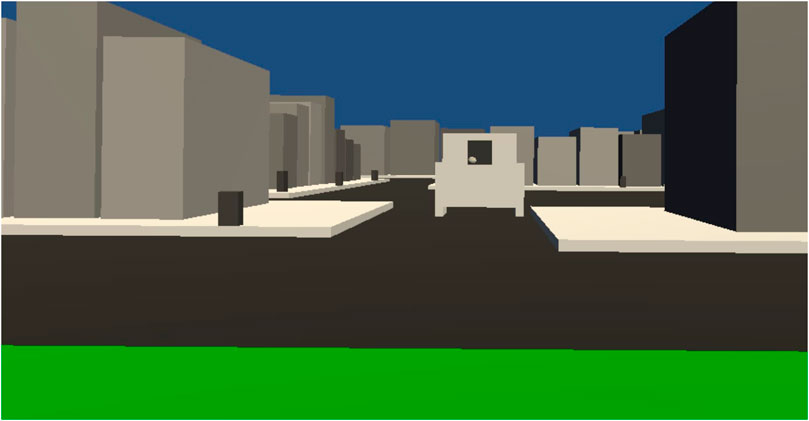
FIGURE 1. A screenshot of the virtual park scene with a ball projected from the center of the screen.
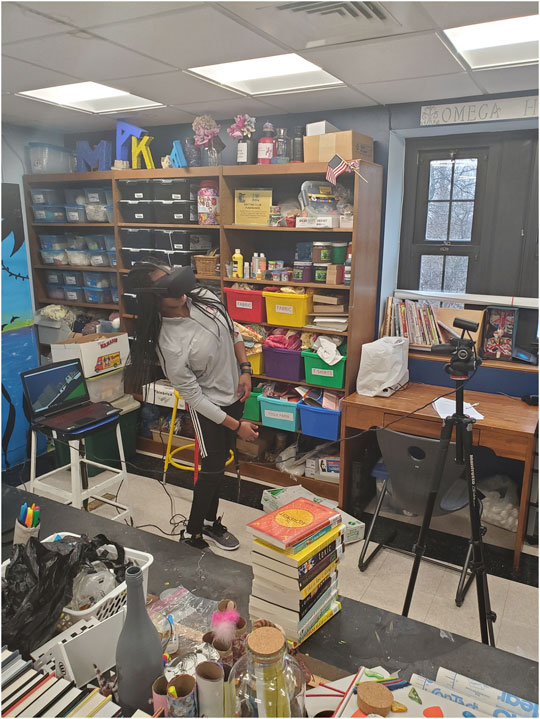
FIGURE 2. Experimental setup: a participant wearing the Oculus Rift headset and avoiding a ball within the virtual park scene at the school library.
Dodgeball Group
Participants in the dodgeball group played a simple game of catch with the researcher (Figure 3). The participant and the researcher were stationed approximately six feet apart and the ball was tossed for 2-min time intervals repeated five times with a 30 s rest period after each interval, similar to the VR group. The ball was thrown at an angle each time to mirror the motion participants experienced in the VR environment. All participants in the dodgeball were given the opportunity to play with the VR headset following the completion of the study procedures and all chose to do so. No data were collected at that time.
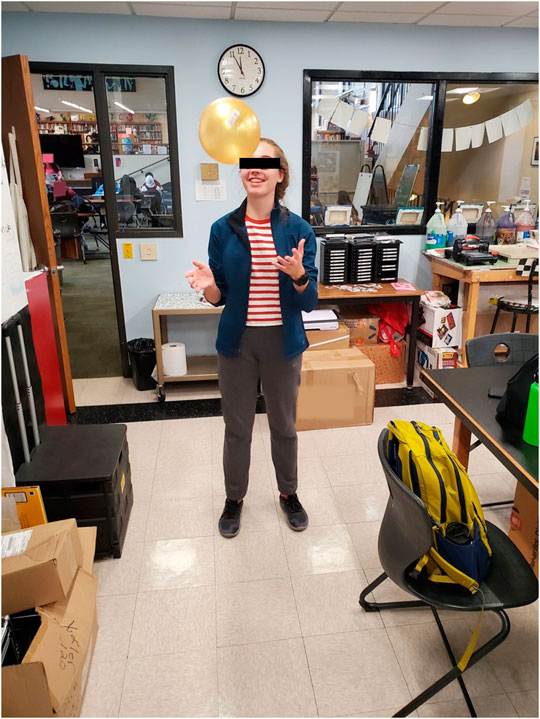
FIGURE 3. Experimental setup: a participant attempting to catch a ball during a “one‐on‐one” dodgeball game at the school library.
Data Analysis
Descriptive statistics were calculated for all demographic measures per group. To confirm that randomization was successful, we used Fisher’s exact test to compare the proportions of females, a T-test to compare the age distribution, and Mann Whitney U test to compare weekly hours of exercise. The distribution of all dependent variables but TMT B approximated normality. To compare the immediate effect of dodgeball vs. VR on cognitive function, anxiety and, stress we ran a mixed model repeated measures Analysis of Variance (ANOVA) with one within factor (time, two levels) and one between factor (group, two levels) for TMT A, PASF and PSES questionnaires and heart rate (HR). The sphericity assumption was met on all analyses hence no corrections were applied. For TMT B, because the results of the non-parametric comparisons were comparable to the mixed model ANOVA, we report the latter. Mean estimates with 95% confidence intervals (CIs) were calculated per outcome as well as Cohen’s d effect size (ES), classified as small (0.2–0.5), moderate (0.5–0.8) or large (>0.8). Data were analyzed using IBM SPSS statistics (version 25.0).
Results
The groups were comparable on all demographic variables (Table 1) as well as on all outcome measures at baseline (Table 2). Common physical activities reported included: dance, soccer, gymnastics, running, tae-kwan-do, swimming, volleyball, and tennis. Nine participants did not regularly perform any type of physical activity (five in the dodgeball group and four in the VR group). For pre and post estimates of all outcome measures per group and their respective 95% CIs, see Table 2.
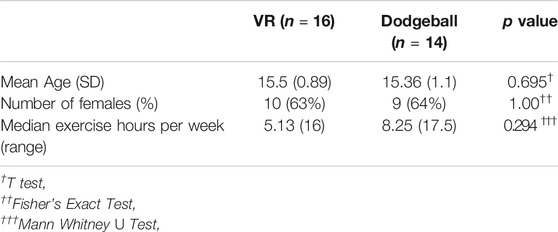
TABLE 1. Sample demographics.

TABLE 2. Outcome measures (mean, 95% CI) Pre and Post Per group.
TMT A: A significant main effect of time (F1,28 = 29.6, p < 0.001) was observed for TMT A with no main effect of group and no time by group interaction (Figure 4A). ES for the dodgeball group was 1.2 and for the VR group was 0.69.
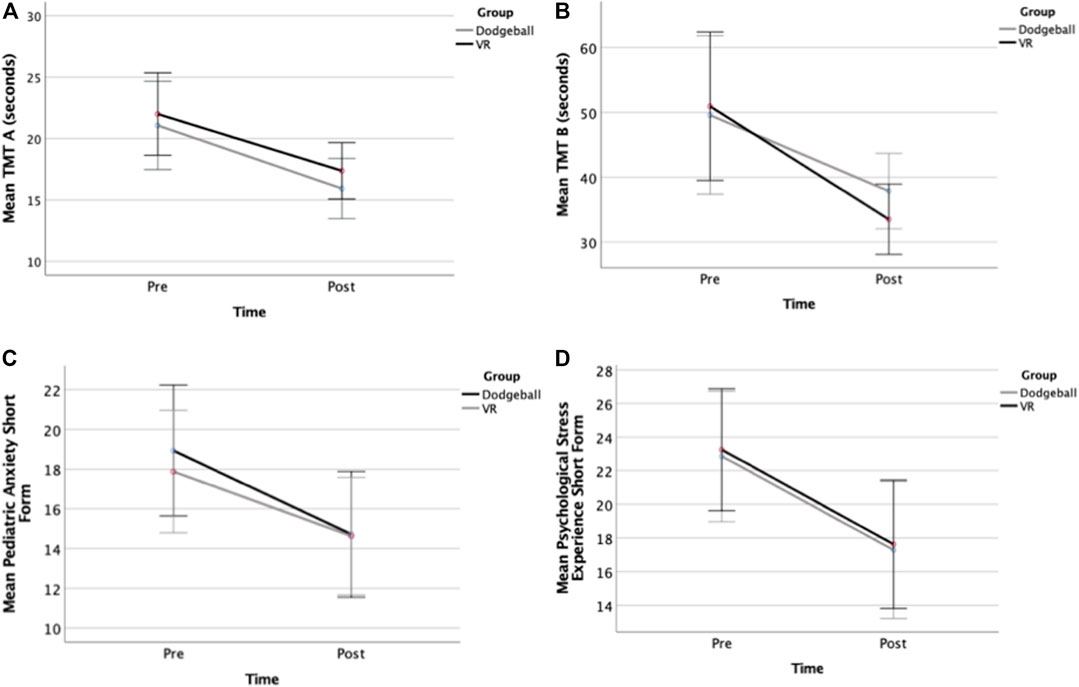
FIGURE 4. A comparison of study outcome measures between the VR group (black line) and the dodgeball group (grey line) pre and post the session: (A) Trail Making Test (TMT) A; (B) TMT B; (C) Pediatric Anxiety Short Form Raw Scores; and (D) Psychological Stress Experience Short Form Raw Scores.
TMT B: A significant main effect of time (F1,28 = 18.94, p < 0.001) was observed for TMT B with no main effect of group and no time by group interaction (Figure 4B). ES for the dodgeball group was 0.79 and for the VR group was 0.89.
Anxiety (PASF): A significant main effect of time (F1,28 = 24.2, p < 0.001) was observed for PASF with no main effect of group and no time by group interaction (Figure 4C). ES for the dodgeball group was 0.67 and for the VR group was 0.59.
Stress (PSES): A significant main effect of time (F1,28 = 19.72, p < 0.001) was observed for PSEF with no main effect of group and no time by group interaction (Figure 4D). The Effect size for the dodgeball group was 0.75 and for the VR group was 0.79.
Heart Rate (HR): A significant main effect of time was observed for HR (F1,28 = 22.87, p < 0.001) with no main effect of group but a significant time by group interaction (F1,28 = 9.01, p = 0.006). The average HR post exercise was 104.71 for the dodgeball group and 94.43 for the VR group (Table 2).
Discussion
In this school-based small pilot randomized controlled study, adolescents on exam weeks were randomized into exercising within a VR simulation of a dodgeball exercise (exergame) or performing a similar dodgeball game without the VR environment. We investigated immediate changes in self-reported anxiety and stress as well as performance on written cognitive tests. While we hypothesized that exercise in VR would lead to greater gains, we found that both groups increased their scores on the cognitive tests (moderate to large ES) and reduced their anxiety and stress scores (moderate ES) after 10 min of exercise with no significant difference between groups. The increase in HR was minimal and slightly larger in the dodgeball group than in the VR group.
Previous studies have looked at the acute effects of exercise in adults, but little is known regarding acute effects in youth. The immediate decrease in anxiety and stress could be attributed to the physiological impact of exercise (Plante et al., 2006; Staiano and Calvert, 2011). It is possible, however, that the decrease in anxiety and stress should be attributed to the enjoyment of play or being in the VR environment, as suggested by the “time-out” hypothesis (Breus and O’Connor, 1998). Because the length the session was short and the increase in HR was minimal, it is likely that playing, rather than taxing that cardiovascular system, mediated the changes. The changes in both groups were similar, with moderate ES, suggesting that dynamic playing, even if short, should be encouraged in adolescents. While the exergame did not lead to larger improvements, the inclusion of the VR headset was the main reason that students volunteered for the study during a stressful exam week and all participants wanted to play with the headset even if they were randomized to the dodgeball group. In agreement with previous literature, (Nigg, 2003; Plante et al., 2003), this suggests that high school students are more likely to join an exergame program than more traditional ones. Novelty bias is possible with respect to using VR at the school settings and could have been a factor in encouraging students to volunteer for the study. While over 20% of the sample was familiar with the Head Mounted Display setup all participants were excited to play with VR. It is reasonable to assume that the excitement effect will wear off over time but any participation in exercise should be encouraged and in fact the novelty principle should be embraced by schools to encourage exercise in the long term (i.e., by getting new games, new technology etc.). It is unlikely that novelty bias influenced the results because both groups improved to a similar extent. In addition, this study was conducted in two different rooms: the school library crafts room and the meditation room. At any given time, the VR setup only required about 6 feet of space. While the dodgeball setup was also feasible in the small space, there was the concern of hitting equipment in the room which did not exist with the VR setup.
The decrease in time required to complete the TMT A for the VR group demonstrated that a short playing session was also effective at improving participants’ executive functioning with moderate to large ES. This result is consistent with Basso et al. that found an improvement in TMT performance, among other Neuropsychological tests, following a single session of acute exercise but not after video watching in healthy adults (Basso et al., 2015). This significant time by group interaction suggests that the immediate improvement in TMT performance following acute exercise cannot be explained by learning effects. While this appears to be a favorable outcome for students hoping to focus during a written exam, it is possible that the observed change reflects a learning effect, i.e., that participants improved on the TMT because they had seen it and practiced it before. A learning effect was indeed observed before for the TMT A, but not for a computerized version of the TMT B which is considered more difficult (Wagner et al., 2011; Oliveira et al., 2014). Whether the cognitive improvement observed in our study will remain in the longer term and translate into the academic domain should be investigated in future research.
Several limitations of this pilot study should be acknowledged. First, the sample was small, and we ran multiple statistical tests. However, the fact that the findings were consistent across all metrics, i.e., both groups improved on all outcomes, with no difference between groups, reduces the risk of an inflated type I error. In addition, because there was no trend for a between-group difference and the performance of the groups was almost identical, it is unlikely that a larger sample would change the null between-group finding. Although there was a social component to the dodgeball exercise session that was not present in the VR exercise session, it is unlikely that this influenced the results as both groups showed significant decreases across all metrics except HR. Despite the small between-group difference in HR, neither group came close to what is considered target HR for a moderate intensity exercise (CDC, 2020). The study was designed to investigate immediate effects of a short bout of exercise. This may have important implications if exercising is done immediately prior to an exam but cannot be extrapolated to assume any lingering effects with repeated exposure of play or a longer exercise session. Even though the PASF and PSES report anxiety and stress over 7 days, we decided to use them in the study because they were specifically designed for adolescents and children ages 8–17 and are short and easy to complete. Self-reported questionnaires are greatly influenced by a person’s current stress and anxiety and the fact that the scores changed following the exercise shows that the participants’ perception of their levels of stress and anxiety changed as well. The Hawthorne bias, i.e., people behave differently because they know they are being watched is possible in any research study, particularly when both intervention groups improve in a similar manner. Note that students were not told that their anxiety and stress would be decreased following the exercise session, they were only told that we were investigating the effects exercise had on anxiety and stress. To refute a possible Hawthorne bias, future studies should include a non-intervention control group. Indeed, since the study did not include a seated VR control group, it is unclear if playing a video game without exercising would have led to similar outcomes. Previous research has found that videogames are good for stress relief, especially in relation to academic stressors in schools. Russoniello et al., 2008). However, the known health benefits of movement and exercise (Warburton and Bredin, 2017) suggest that a dynamic game should be preferred and encouraged in adolescents. This research only investigated one VR scene; it may be beneficial to investigate how participants respond to diverse VR exercises, esp. because one participant’s anxiety increased because they were afraid of the ball. Finally, the participants were recruited from the school and we did not screen for history of anxiety disorders. Future research should investigate the long-term effects in a larger sample of students, transfer to academic success and whether longer, more intense exercise programs lead to greater improvements. Future studies should also investigate whether exercise and play interventions in the school can help students with diagnosed anxiety disorders.
Our study found that playing with an actual ball was just as effective at reducing anxiety and stress in adolescents as playing with a virtual one. This study used the high-end Oculus Rift HMD with a setup that has been shown to induce minimal to no cybersickness (Lubetzky et al., 2018). Even though the cost of high-end HMDs is decreasing, the cost of balls will remain substantially lower. Additional concerns to the schools, if schools were to take this approach to help students during times of stress, may include disinfecting and storing of the headsets. It is also unclear whether the immersion and 3-dimensional experience has been a factor in increasing motivation to participate and decreasing stress and anxiety. Immersion describes the involvement of a user in a virtual environment during which his or her awareness of time and the real world often becomes disconnected, thus providing a sense of “being” in the task environment instead (Slater and Wilbur, 1997). While a couple of studies showed an increase in engagement with the level of immersion, a recent review determined that this relationship is inconclusive (Rose et al., 2018) and exercising with non-immersive VR can encourage participation as well (Rose et al., 2018). The use of the VR system to exercise has the potential to make exercise more appealing to tech interested adolescents. While we did not directly measure enjoyment, most participants volunteered for the study because it involved VR. In addition, all participants in the dodgeball group chose to play with the VR headset following the completion of the study procedures. Future studies could therefore investigate exergame with non-immersive affordable technology such as computer screens or mobile phones.
Conclusion
A short bout of exercise during stressful high school exam weeks, such as finals, midterms or PSAT prep weeks, was shown to be effective for immediate reduction of stress and anxiety and enhancement of cognitive function in a small sample of high school students. Despite the novelty of VR and the passion of youth towards technology changes in performance were similar between groups. Our study is one of very few that chose to focus on adolescents rather than adults. The timing of the study allowed us to investigate anxiety and stress specifically related to tests in healthy adolescents rather than generalized anxiety issues. The short nature of the acute exercise as well as little equipment and space required greatly enhance the likelihood that this program can be implemented in schools. While the benefits of regular exercise are well known, adolescents typically do not think of 10-min movement as potentially beneficial to their stress or cognitive function during exam weeks. While the cost-effectiveness of VR headsets in the school settings needs to be investigated in future research, this study provides further support that adolescents should be encouraged to take a short “time out” to exercise and have fun in order to promote good physical and psychological health, including during school time.
Data Availability Statement
The datasets presented in this study can be found in online repositories. The names of the repository/repositories and accession number(s) can be found below: http://dx.doi.org/10.17632/9ng3zprk4k.1.
Ethics Statement
The studies involving human participants were reviewed and approved by The Institutional Review Board at Ossining High School. Written informed consent to participate in this study was provided by the participants’ legal guardian/next of kin. Written informed consent was obtained from the minor(s)’ legal guardian/next of kin for the publication of any potentially identifiable images or data included in this article.
Author Contributions
AS and AL substantial contributions to the conception or design of the work or interpretation of data for the work. AS recruitment of participants and data acquisition. AS and AL statistical analysis of the data. AS drafting the work. AS and AL revising the work, critically for important intellectual content, final approval of the submitted, version, and agreement to be accountable for all aspects of the work.
Funding
AL was funded by grants from the National Institutes of Health National Rehabilitation Research Resource to Enhance Clinical Trials (REACT) pilot award and an Emerging Research Grant from Hearing Health Foundation. The sponsors had no role in the study design, collection, analysis and interpretation of data; in the writing of the manuscript; or in the decision to submit the manuscript for publication. The content is solely the responsibility of the authors and does not necessarily represent the official views of the National Institutes of Health.
Conflict of Interest
The authors declare that the research was conducted in the absence of any commercial or financial relationships that could be construed as a potential conflict of interest.
Acknowledgments
The authors thank Ossining High School as well as the science research teachers Angelo Piccirillo and Valerie Holmes for all their guidance on the project. We thank Zhu Wang, PhD candidate, NYU Courant Future Reality Lab and Tandon School of Engineering, for the development of the application, and for technical support.
Supplementary Material
The Supplementary Material for this article can be found online at: https://www.frontiersin.org/articles/10.3389/frvir.2020.598506/full#supplementary-material.
References
Bahrke, M. S., and Morgan, W. P. (1978). Anxiety reduction following exercise and meditation. Cognit. Ther. Res. 2 (4), 323–333. doi:10.1007/BF01172650
Barmola, K., and Srivastava, S. (2010). “Effect of examination stress on adolescents’ health.” in Book on healthcare management. (New Delhi, India: New Century Publication). Available at: https://www.researchgate.net/publication/333774673_Effect_of_Examination_Stress_on_Adolescents%27_Health.
Bevans, K. B., Gardner, W., Pajer, K., Riley, A. W., and Forrest, C. B. (2013). Qualitative development of the PROMIS® pediatric self-report banks. J. Pediat. Psychol. 38 (2), 173–191.
Basso, J. C., Shang, A., Elman, M., Karmouta, R., and Suzuki, W. A. (2015). Acute exercise improves prefrontal cortex but not hippocampal function in healthy adults. J. Int. Neuropsychol. Soc. 21 (10), 791–801. doi:10.1017/S135561771500106X
Breus, M. J., and O’Connor, P. J. (1998). Exercise-induced anxiolysis: a test of the “time out” hypothesis in high anxious females. Med. Sci. Sports Exerc., 30 (7), 1107–1112. doi:10.1097/00005768-199807000-00013
CDC (2020). Target heart rate and estimated maximum heart rate | physical activity. Available at: https://www.cdc.gov/physicalactivity/basics/measuring/heartrate.htm.
Corrigan, J. D., and Hinkeldey, N. S. (1987). Relationships between parts A and B of the Trail Making Test. J. Clin. Psychol. 43(4), 402–409. doi:10.1002/1097-4679(198707)43:4<402::aid-jclp2270430411>3.0.co;2-e
Crocker, P. R., and Grozelle, C. (1991). Reducing induced state anxiety: effects of acute aerobic exercise and autogenic relaxation. J. Sports Med. Phys. Fit. 31 (2), 277–282.
Esch, T., and Stefano, G. B. (2010). Endogenous reward mechanisms and their importance in stress reduction, exercise and the brain. Arch. Med. Sci. 6 (3), 447–455. doi:10.5114/aoms.2010.14269
Gaudino, E. A., Geisler, M. W., and Squires, N. K. (1995). Construct validity in the trail making test: what makes Part B harder? J. Clin. Exp. Neuropsychol. 17 (4), 529–535. doi:10.1080/01688639508405143
Gorini, A., Pallavincini, F., Algeri, D., Repetto, C., Gaggioli, A., and Riva, G. (2010). Virtual reality in the treatment of generalized anxiety disorders. Stud. Health Technol. Inform. 154, 39–43. doi:10.3233/978-1-60750-561-7-39
Gregor, A. (2005). Examination anxiety: live with it, control it or make it work for you? Sch. Psychol. Int. 26 (5), 617–635. doi:10.1177/0143034305060802
Hillman, C. H., Erickson, K. I., and Kramer, A. F. (2008). Be smart, exercise your heart: exercise effects on brain and cognition. Nat. Rev. Neurosci. 9 (1), 58–65. doi:10.1038/nrn2298
Jackson, E. M. (2013). Stress relief: the role of exercise in stress management. ACSM’s Health Fit. J. 17 (3), 14–19. doi:10.1249/FIT.0b013e31828cb1c9
Lezak, M. D., Howieson, D. B., and Loring, D. W. (2004). Neuropsychological assessment. Oxford, United Kingdom: Oxford University Press.
Lubetzky, A. V., Hujsak, B. D., Fu, G., and Perlin, K. (2019). An Oculus Rift assessment of dynamic balance by Head mobility in a virtual park scene: a pilot study. Mot. Contr. 23 (1), 127–142. doi:10.1123/mc.2018-0001
Lubetzky, A. V., Hujsak, B. D., Kelly, J. L., Fu, G., and Perlin, K. (2018). Control mechanisms of static and dynamic balance in adults with and without vestibular dysfunction in Oculus virtual environments. Pharm. Manag. PMR 10 (11), 1223–1236.e2. doi:10.1016/j.pmrj.2018.07.001
Merriam-Webster (n.d). Virtual reality. Merriam-Webster.com dictionary. Available at: https://www.merriam-webster.com/dictionary/virtual%20reality (Accessed June 10, 2020).
Nabetani, T., and Tokunaga, M. (2001). The effect of short-term (10- and 15-min) running at self-selected intensity on mood alteration. J. Physiol. Anthropol. Appl. Hum. Sci. 20 (4), 231–239. doi:10.2114/jpa.20.233
National Poll on Children’s Health (2020). Game on: Teens and video games. National Poll on Children’s Health. Available at: https://mottpoll.org/reports/game-teens-and-video-games (Accessed June 5, 2020).
Nigg, C. R. (2003). Technology’s influence on physical activity and exercise science: the present and the future. Psychol. Sport Exerc. 4 (1), 57–65. doi:10.1016/S1469-0292(02)00017-1
Norris, R., Carroll, D., and Cochrane, R. (1992). The effects of physical activity and exercise training on psychological stress and well-being in an adolescent population. J. Psychosom. Res. 36 (1), 55–65. doi:10.1016/0022-3999(92)90114-H
Nyongesa, M. K., Ssewanyana, D., Mutua, A. M., Chongwo, E., Scerif, G., Newton, C. R. J. C., et al. (2019). Assessing executive function in adolescence: a scoping review of existing measures and their psychometric robustness. Front. Psychol. 10, 311. doi:10.3389/fpsyg.2019.00311
Oliveira, R. S. de, Trezza, B. M., Busse, A. L., and Jacob-Filho, W. (2014). Learning effect of computerized cognitive tests in older adults. Einstein(Sao Paulo) 12 (2), 149–153. doi:10.1590/s1679-45082014ao2954
Pascoe, M. C., Hetrick, S. E., and Parker, A. G. (2020). The impact of stress on students in secondary school and higher education. Int. J. Adolesc. Youth 25 (1), 104–112. doi:10.1080/02673843.2019.1596823
Pfaltz, M. C., Michael, T., Grossman, P., Margraf, J., and Wilhelm, F. H. (2010). Instability of physical anxiety symptoms in daily life of patients with panic disorder and patients with posttraumatic stress disorder. J. Anxiety Disord. 24 (7), 792–798. doi:10.1016/j.janxdis.2010.06.001
Philippot, A., Meerschaut, A., Danneaux, L., Smal, G., Bleyenheuft, Y., and De Volder, A. G. (2019). Impact of physical exercise on symptoms of depression and anxiety in pre-adolescents: a pilot randomized trial. Front. Psychol. 10, 1820. doi:10.3389/fpsyg.2019.01820
Plante, T. G., Aldridge, A., Bogden, R., and Hanelin, C. (2003). Might virtual reality promote the mood benefits of exercise? Comput. Hum. Behav. 19 (4), 495–509. doi:10.1016/S0747-5632(02)00074-2
Plante, T. G., Aldridge, A., Su, D., Bogdan, R., Belo, M., and Kahn, K. (2003). Does virtual reality enhance the management of stress when paired with exercise? An exploratory study. Int. J. Stress Manag. 10 (3), 203–216. doi:10.1037/1072-5245.10.3.203
Plante, T. G., Cage, C., Clements, S., and Stover, A. (2006). Psychological benefits of exercise paired with virtual reality: outdoor exercise energizes whereas indoor virtual exercise relaxes. Int. J. Stress Manag. 13 (1), 108–117. doi:10.1037/1072-5245.13.1.108
Quinn, H., Thissen, D., Liu, Y., Magnus, B., Lai, J. S., Amtmann, D., et al. (2014). Using item response theory to enrich and expand the PROMIS® pediatric self‐report banks. Health Qual. Life Outcomes 12, 160.
Rose, M., and Devine, J. (2014). Assessment of patient-reported symptoms of anxiety. Dialogues Clin. Neurosci. 16(2), 197–211. doi:10.31887/DCNS.2014.16.2/mrose
Rose, T., Nam, C. S., and Chen, K. B. (2018). Immersion of virtual reality for rehabilitation—review. Appl. Ergon. 69, 153–161. doi:10.1016/j.apergo.2018.01.009
Russoniello, C. V., O’Brien, K., and Parks, J. M. (2008). The effectiveness of casual video games in improving mood and decreasing stress. J. Cyber. Ther. Rehabil. 2 (1), 53–66.
Salmon, P. (2001). Effects of physical exercise on anxiety, depression, and sensitivity to stress: a unifying theory. Clin. Psychol. Rev. 21 (1), 33–61. doi:10.1016/s0272-7358(99)00032-x
Slater, M., and Wilbur, S. (1997). A framework for immersive virtual environments five: speculations on the role of presence in virtual environments. Presence Teleoperators Virtual Environ. 6 (6), 603–616. doi:10.1162/pres.1997.6.6.603
Staiano, A. E., and Calvert, S. L. (2011). Exergames for physical education courses: physical, social, and cognitive benefits. Child Dev Perspect 5 (2), 93–98. doi:10.1111/j.1750-8606.2011.00162.x
Stanney, K. M., and Kennedy, R. S. (1997). The psychometrics of cybersickness. Commun. ACM 40 (8), 66–69.
Steinmayr, R., Crede, J., McElvany, N., and Wirthwein, L. (2016). Subjective well-being, test anxiety, academic achievement: testing for reciprocal effects. Front. Psychol. 6, 1994. doi:10.3389/fpsyg.2015.01994
Tarrant, J., Viczko, J., and Cope, H. (2018). Virtual reality for anxiety reduction demonstrated by quantitative EEG: a pilot study. Front. Psychol. 9, 1280. doi:10.3389/fpsyg.2018.01280
Wagner, S., Helmreich, I., Dahmen, N., Lieb, K., and Tadic, A. (2011). Reliability of three alternate forms of the trail making tests A and B. Arch. Clin. Neuropsychol. 26 (4), 314–321. doi:10.1093/arclin/acr024
Warburton, D. E. R., and Bredin, S. S. D. (2017). Health benefits of physical activity: a systematic review of current systematic reviews. Curr. Opin. Cardiol. 32 (5), 541–556. doi:10.1097/HCO.0000000000000437
Zeng, N., Pope, Z., and Gao, Z. (2017). Acute effect of virtual reality exercise bike games on college students’ physiological and psychological outcomes. Cyberpsychol. Behav. Soc. Netw. 20 (7), 453–457. doi:10.1089/cyber.2017.0042
Keywords: virtual reality, exercise, head mounted display (HMD), high school, stress, anxiety
Citation: Shaw AJ and Lubetzky AV (2021) A Short Bout of Exercise With and Without an Immersive Virtual Reality Game Can Reduce Stress and Anxiety in Adolescents: A Pilot Randomized Controlled Trial. Front. Virtual Real. 01:598506. doi: 10.3389/frvir.2020.598506
Received: 24 August 2020; Accepted: 17 December 2020;
Published: 26 February 2021.
Edited by:
Valentino Megale, Softcare Studios, ItalyReviewed by:
Christof Lutteroth, University of Bath, United KingdomSoledad Quero, University of Jaume I, Spain
Copyright © 2021 Shaw and Lubetzky. This is an open-access article distributed under the terms of the Creative Commons Attribution License (CC BY). The use, distribution or reproduction in other forums is permitted, provided the original author(s) and the copyright owner(s) are credited and that the original publication in this journal is cited, in accordance with accepted academic practice. No use, distribution or reproduction is permitted which does not comply with these terms.
*Correspondence: Anat V. Lubetzky, YW5hdEBueXUuZWR1