 Katarina Pavic
  Dorine Vergilino-Perez
  Thierry Gricourt
 Laurence Chaby
- 1Université de Paris, Vision Action Cognition, Paris, France
- 2Sorbonne Université, CNRS, Institut des Systèmes Intelligents et de Robotique, ISIR, Paris, France
- 3SocialDream, Research and Development Department, Bourg-de-Péage, France
- 4Université de Paris, UFR de Psychologie, Boulogne-Billancourt, France
In recent years, an increased demand for improving mental health and well-being led to developing procedures capable of enhancing positive experiences. One highly attractive candidate for evoking positive experiences is Virtual Reality (VR), as VR enables users to experience various situations in controlled and safe environments. This overview first investigates how positive emotions, well-being and VR are interconnected. Then, an overview about how and why to induce positive emotions in adult users is provided. Methodological and ethical considerations about VR technology, measurements of VR’s efficacy and user characteristics are reviewed. It emerges that VR is efficient in inducing positive emotions across the adult lifespan and in various settings. Levels of immersion, interactivity, Virtual environment contents, sensory modalities involved and users’ characteristics emerged as key determinants for successfully inducing positive emotions with VR. The main applications of positive VR experiences consist in using VR for relaxation, stress and pain management, motivation for physical activities, and gives promising results for apathy treatment in elderly users. Although VR is efficient in eliciting positive emotions and experiences, the underlying operating mechanisms remain unclear and are yet to be further investigated. Finally, the need for a user-centered approach when designing positive VR experiences, clear guidelines for the use of VR, and a better documentation of its potential adverse effects are addressed.
1 Introduction
1.1 From Positive Emotions to Well-Being
Taking a stroll in nature, sharing pleasant moments with relatives or friends, traveling and discovering new places. While all these experiences may seem trivial, they are beneficial for our well-being, thanks to the positive emotions that can emanate from them. A large body of literature showed that positive emotions are the founding stone of human fulfillment and well-being (Fredrickson and Joiner, 2002; Fredrickson, 2004; Fredrickson, 2006; Garland et al., 2010). In addition, positive emotions are closely associated with quality of life (Kuppens et al., 2008), life success (Lyubomirsky et al., 2005), better health and longevity (Diener and Chan, 2011) and cognitive functioning (Dolan, 2002; Blair et al., 2007). Therefore, there are clear benefits in promoting positive experiences and emotions among healthy, vulnerable and/or isolated adults. Despite the high benefits of positive emotions emanating from the above-mentioned experiences, not everyone has regular access to nature walks, social interactions or travel. Moreover, access has become even more restricted due to the current COVID-19 crisis, leading to heightened mental health issues (Ganesan et al., 2021), increased loneliness and isolation (Killgore et al., 2020). A critical concern that needs to be addressed is how people can have access to positive experiences for enhancing well-being and mental health. One innovative answer for bringing nature, people and places together may be virtual reality (VR). VR has the advantage of enabling users to safely experience various real-life or imaginary situations, while allowing tight control over the stimuli used (Baños et al., 2017; Freeman et al., 2017). VR is therefore a suitable candidate for promoting positive experiences.
Historically, research has focused on understanding negative emotions and pathology, while positive emotions, well-being and the links between them have been understudied (Alexander et al., 2020). In recent years, considerable efforts have been made to delimit and describe the diversity of positive emotions, revealing that positive emotions are more than the mere concepts of “joy” and “happiness” (see Desmet, 2012; Alexander et al., 2020). In this context, the broaden-and-build theory provides a framework for understanding the links between positive emotions, cognition and well-being (Fredrickson, 2004; Fredrickson, 2006). According to this theory, positive emotions broaden one’s mind, unlike negative emotions that lead to narrowing one’s mind (Garland et al., 2010; Cohen et al., 2016). This has been supported by studies reporting attentional capture and broadening following positive emotion induction (Fredrickson and Branigan, 2005; Gupta, 2019). In return, the mind broadening resulting from positive emotions helps build long-lasting resources, such as social connections, opportunities and knowledge, resulting in well-being (Fredrickson, 2004; Fredrickson, 2006; Garland et al., 2010). Enhancing positive emotion and accumulating long-lasting resources may be of great interest in vulnerable and/or isolated populations such as elderly people (Ong, 2010). Additionally, it has been argued that positive emotions are linked to better health outcomes and longevity (Diener and Chan, 2011). Therefore, gaining a better understanding of positive emotions appears as crucial as understanding and relieving negative ones.
Growing interest in positive emotions and their potential links to individuals’ well-being began with the development of positive psychology, a scientific field that investigates well-being at the individual, organizational and societal levels (Seligman and Csikszentmihalyi, 2000). This has led to a paradigm shift where well-being is no longer seen as the absence of health issues, but also as the presence of positive emotions, resources, and strengths (Seligman and Csikszentmihalyi, 2000; Bos et al., 2016). Defining the notion of well-being is not straightforward, since in the existing literature, the terms “well-being,” “happiness” and “life satisfaction” are often used interchangeably (Suardi et al., 2016). However, two main approaches can be identified in the literature: 1) subjective and 2) psychological well-being. Subjective well-being, or “hedonia,” consists in life satisfaction, with a focus on positive, pleasant experiences and quality of life (Diener et al., 1999). Psychological well-being, also called “eudaimonia,” focuses on long-term fulfillment, encompassing the idea of constant improvement towards fulfilling life-goals and optimal functioning (Ryff, 1989; Lent, 2004). As these two major approaches have overlapping goals and are not fully exclusive, integrative theories of well-being have developed (e.g., see Henderson and Knight, 2012) in parallel to critics suggesting they are two sides of the same coin (e.g., see Kashdan et al., 2008).
1.2 Fostering Positive Emotions Through Technology
Recently, technologies have become believable candidates for enhancing individuals’ health and well-being, leading to the emergence of “positive technologies”. Derived from positive psychology, the positive technologies framework investigates the use of technology to improve users’ well-being, quality of life and experiences (Botella et al., 2012; Riva et al., 2012; Baños et al., 2017). It has been suggested that positive technologies can enhance subjective (“hedonia”), psychological (“eudaimonia”) or social well-being (Botella et al., 2012; Riva et al., 2012; Baños et al., 2017). VR belongs to the technologies cited within the framework of positive technologies, especially as a “hedonic” technology enabling positive and pleasant experiences in the present (Botella et al., 2012; Riva et al., 2012). What makes VR a suitable candidate for fostering positive experiences are its immersive power and the sense of presence that VR experiences generate. Historically, sense of presence has been defined as the feeling of “being physically there” (i.e., spatial presence, Slater, 1999; Steuer, 1992) to which can be added the feeling of “being with others” (i.e., social presence, Biocca et al., 2001).
Recent research has established that VR is arousing (Felnhofer et al., 2015; Marín-Morales et al., 2018) and is an effective tool for inducing emotions in laboratory settings (Bernardo et al., 2021). More precisely, VR has proven effective in inducing various positive emotions, such as joy, relaxation (e.g., see Anderson et al., 2017; Serrano et al., 2016) and more complex emotions such as awe (i.e., feeling of wonder when confronted with vast and transcending stimuli, Chirico et al., 2017; Chirico et al., 2018) and the sublime (i.e., feeling of “amazement tinged with fear” in response to vast or powerful stimuli, Chirico et al., 2021). However, significant divergences can be observed about recruited users and the material used for inducing positive emotions with VR. As these methodological choices can greatly influence the emotions induced, they will be further examined in the present article.
1.3 Aim of the Overview
There are already reviews about VR, emotion induction, well-being and their links to mental health. A recent systematic review confirmed that VR technology is efficient for inducing both positive and negative emotions in lab-settings (Bernardo et al., 2021). Other reviews highlighted VR’s potential for improving mental health (Freeman et al., 2017; Jerdan et al., 2018), and elder’s quality of life and emotions (D’Cunha et al., 2019; Kim et al., 2019). However, the aim of these reviews was not about understanding key aspects that need to be considered when inducing positive emotions with VR across the adult-life span. Additionally, VR interventions for mental health mostly relied on exposing participants to negative stimuli, for example in the context of exposure therapies, craving induction, or better understanding paranoia among else (Freeman et al., 2017; Jerdan et al., 2018).
Thus, the goal of the present article is to provide an overview and reflect on key determinants for inducing efficiently and safely positive emotions with VR technology. We specifically aim to survey the methodology used for inducing positive emotions, as well as address theoretical and ethical considerations that need to be taken into account. The following topics will be covered in the subsequent sections:
• How and why to induce positive emotions in healthy adult users;
• Can positive emotion induction through VR be beneficial for elderly users;
• What are the potential underlying cognitive mechanisms involved during positive emotion induction with VR.
1.4 Scope and Limitations
There are several definitions of VR in the literature, focusing rather on its immersive (e.g., Slater and Wilbur, 1997) or interactive (e.g., Steuer, 1992) proprieties. For present purposes, VR will be defined as “inducing targeted behavior in an organism by using artificial sensory stimulation, while the organism has little or no awareness of the interference” (LaValle, 2016). While this is a broad definition, it has the advantage of including varying levels of immersion (LaValle, 2016), ranging from low immersive and more affordable devices such as screens, to highly immersive Cave Automated Virtual Environments, whereby users enter a room with graphical projections onto surrounding walls (Cruz-Neira et al., 1993), and Head-Mounted Displays (HMDs). We decided to include a broad range of devices in order to investigate the degree of immersion and/or interactivity needed for an optimal emotion induction through VR, therefore not limiting the present survey to highly immersive devices such as CAVEs and HMDs. However, as VR technology has been in constant development the last few years it is more than possible that methodological, theoretical and ethical aspects discussed in this paper are prone to change in the future (Elor and Kurniawan, 2020).
Inducing positive emotions through VR implies using it as a Mood Induction Procedure (MIP). MIPs are well-established experimental procedures for inducing temporary emotional states, considered similar to the ones experienced in everyday life (Martin, 1990; Baños et al., 2012). MIPs relies traditionally on presenting arousing pictures (Lang et al., 1997), film sequences (Gross and Levenson, 1995), music (Västfjäll, 2001) or sentences (Velten, 1968). However, a caveat about MIPs must be addressed, as “emotion” and “mood” are often used interchangeably, making it unclear what is truly induced via these procedures. For the sake of clarity and to ensure consistency throughout this overview, “emotions” will be defined as states elicited by precise events or stimuli, and of short duration (Scherer, 2005). Following Sander et al. (2005), emotions will be considered to consist of the following five components: subjective feeling, stimulus evaluation, motivation, motor expression and physiological responses. In contrast, “mood” consists of broader and more diffuse states, and does not necessarily need a contextual stimulus (Ekkekakis, 2012).
We believe that this work will be of interest to researchers in affective cognitive sciences, psychologists, and healthcare providers wondering which material and content to use, and why it is relevant to induce positive emotions in adults users. For a broad picture of this overview, we have presented a Sankey Diagram (Figure 1) based on studies included in this overview. The Sankey Diagram allows a quantitative visualization and understanding of the links between recruited populations, employed VR devices, VE contents, affective measures and study aims. The details about each study included in the diagram can be found in Supplementary Material.
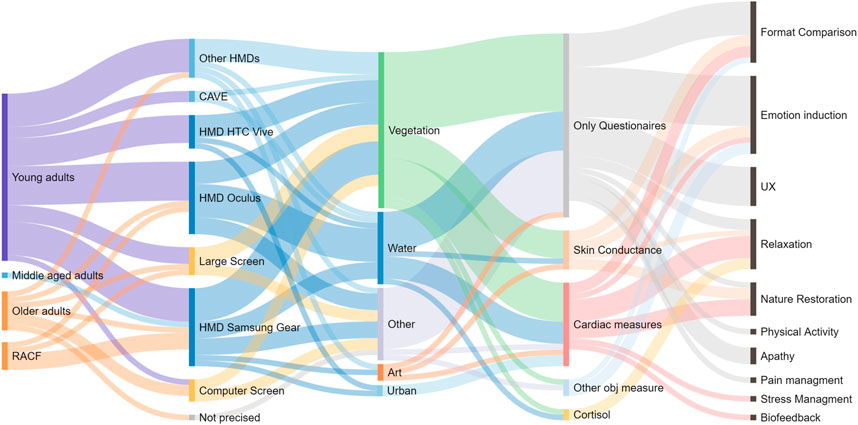
FIGURE 1. Sankey diagram illustrating links in the literature between recruited populations, VR devices, VE contents, emotional measures and study aims in the field of fostering positive emotions through VR. For instance, the majority of the studies recruited young adults in their study, and the majority of studies that recruited participants in RACFs used a Samsung Gear HMD. Stroke breadths indicate the number of experiments for a given category going from left to right. Abbreviations: RACF, Residential Aged Care Facility; HMD, Head-Mounted Display, obj, objective; UX, User Experience (in this case acceptability and/or feasibility studies).
2 Fostering Positive Emotions Among Healthy Young Users
2.1 How to Induce Positive Emotions Through VR?
Pivotal studies in the field of positive emotion induction through VR have been conducted on healthy young adults, usually students, to confirm whether it is possible to induce positive emotions with VR (Riva et al., 2007; Baños et al., 2008) and whether the technology employed is acceptable and useful (Baños et al., 2014). Since then, a large body of literature explored which methodological aspects can greatly influence users’ experience (see Supplementary Table S1). It appears that the level of immersion, interactivity, VE contents, and sensory modalities involved are key determinants for fostering positive emotions. As there are discrepancies in the affective measures used to assess VR’s efficacy for inducing positive emotions, they will also be covered in the present section.
Ensuring that VR technology is adequately tolerated by healthy young users is the prerequisite before aiming to induce positive emotion. Cybersickness corresponds to adverse effects during and after VR exposure, and is characterized mainly by symptoms such as eye strain, headaches, sweating, disorientation, and nausea (LaViola, 2000). It is usually assessed by the Simulator Sickness Questionnaire (SSQ) (Kennedy et al., 1993). Intriguingly, only three studies inducing positive emotions with HMDs have explicitly assessed cybersickness symptoms (Bittner et al., 2018; Liszio and Masuch, 2019; Seabrook et al., 2020). However, the results of these studies corroborate good tolerance of HMDs in the context of positive emotion induction (Bittner et al., 2018; Liszio and Masuch, 2019; Seabrook et al., 2020).
The first aspect that needs to be taken into account when inducing positive emotions with VR is the level of immersion. There is a heterogeneity of devices included under the umbrella term VR in the literature, and with varying levels of immersion that can lead to low or more intense emotional states (Visch et al., 2010; Diemer et al., 2015). Surprisingly, a limited number of studies have compared immersion levels needed for positive emotion induction. One study compared the effectiveness of inducing positive emotions using an HMD, a tablet, or reading neutral text (control condition) (Bittner et al., 2018). Although VR was most effective in improving positive emotions and mild depressive symptoms, the superiority of the HMD over a less immersive tablet was slight (Bittner et al., 2018). A second study showed a superiority of HMD compared to a screen for inducing awe (Chirico et al., 2017), however, as awe is a complex emotion, it is difficult to conclude if this is true for basic positive emotions.
The second aspect that needs to be considered is the level of interactivity and user engagement within the VEs. Interactive VR experiences under a HMD appear to enhance positive emotions (Yeo et al., 2020), and reduce stress (subjective and physiological) (Liszio and Masuch, 2019) better than non-interactive VR experiences. Authors suggest that these results can be explained by the ability of interactive experiences to capture and hold users’ attention over time (Yeo et al., 2020). Nevertheless, a consensus about what falls under the term of “interactive” is required, as it sometimes means accomplishing a task in the VE (Liszio and Masuch, 2019), or navigating freely in the VE (Yeo et al., 2020).
Third, contents of the VEs have to be considered, as they can greatly influence induced emotions (Gross and Levenson, 1995). Most of the studies involved natural settings featuring either vegetation or water (see Figure 1). This is in line with well known and documented benefits of natural environments on emotions (for a review see McMahan and Estes, 2015). Several studies confirmed that exposure to virtual nature increases positive emotions and/or perceived restoration (Riva et al., 2007; Browning et al., 2020; Mattila et al., 2020; Seabrook et al., 2020; Yeo et al., 2020) while also significantly reducing negative ones (Villani and Riva, 2012; Anderson et al., 2017; Yeo et al., 2020). Additionally, virtual nature has a positive impact on physiological arousal, further confirming its relaxing and restorative properties (Annerstedt et al., 2013; Anderson et al., 2017; Browning et al., 2020). Similar benefits of real and virtual nature have been observed when using highly-immersive HMDs (Chirico and Gaggioli, 2019; Browning et al., 2020). There are however discrepancies on the best way to deliver virtual nature experiences, as it has been reported similar benefits of computer-generated and 360°natural videos (Brivio et al., 2021), or greater efficacy of computer-generated VEs (Yeo et al., 2020) in inducing positive emotions.
Fewer studies have investigated the effect of other types of VE contents such as art (Valtchanov et al., 2010; Chirico et al., 2021), crowded urban environments (Yu et al., 2018), or personalized VE contents (Evans et al., 2020). Art and urban-based contents have usually been compared to virtual nature’s efficacy for inducing positive emotions. It emerged a superiority of natural VE contents for inducing the sublime (Chirico et al., 2021), as well as heightened positive emotions and resource restoration compared to virtual art (Valtchanov et al., 2010). Furthermore, compared to crowded urban environments, natural environments again induced greater positive emotions and vigor in young adults (Yu et al., 2018). However, studies comparing urban and natural environments in VR did not manage to show physiological changes or differences between natural and urban environments. Finally, personalized 360° videos also appeared as efficient for inducing positive emotions (Evans et al., 2020), although their efficacy has not been compared to other VE contents.
The fourth key determinant that needs to be considered is the sensory modality involved in positive VR experiences. Only one study investigated the influence stereoscopy, i.e., the presentation of a different image to each eye in order to give an impression of depth, revealing that it does not impact the valence or intensity of induced emotions (Baños et al., 2008). Furthermore, it is preferable to include auditory stimuli, rather than relying solely on visual stimuli (Annerstedt et al., 2013; Kern et al., 2020). Auditory stimuli mostly consisted in music and/or ambient environmental sounds (e.g., birds chirping, waves, etc.), and on fewer occasions on positive narratives (e.g., Riva et al., 2007; Seabrook et al., 2020). The added value of olfactory and tactile stimulation have been explored in one study, concluding that auditory and visual information were sufficient in VR for relaxing participants (Serrano et al., 2016).
Finally, VR’s efficacy for inducing targeted emotions has mainly been investigated with questionnaires, the most widely used ones being the Positive and Negative Affect Schedule (Watson et al., 1988) and Visual Analogical Scales (VAS, see Baños et al., 2012). More recently, physiological measures have started to be collected in addition to questionnaires, confirming VR’s capacity for arousal (Felnhofer et al., 2015). Commonly collected physiological measures are skin conductance, and cardiac measures such as Heart Rate (HR) or Heart Rate Variability (HRV) (see Figure 1). In a limited number of studies, electromyography (Chirico et al., 2017), cortisol (Annerstedt et al., 2013; Liszio et al., 2018) or electroencephalography (Marín-Morales et al., 2018) have been used to explore VR’s potential for inducing emotions.
2.2 Why Induce Positive Emotions in Healthy Users?
Positive emotions coupled with VR can have great benefits on healthy users’ physical activity. For instance, when combined with stationary cycling, a virtual park inducing joy efficiently motivated users (Miragall et al., 2021). However, authors pointed out that inducing joy was not sufficient to increase user’s motivation without an appropriate body posture (e.g., leaning forward posture while pedaling) (Miragall et al., 2021). It emerges that coupling VR, positive emotion induction and exercise can have great benefits on users’ motivation, although VR and positive emotions by themselves are not sufficient for that goals. It should be noted that the present studies used large screens, possibly because using HMDs for exercise may be challenging and increase cybersickness symptoms.
There is also compelling evidence that VR experiences are efficient for relaxation when combined with VE contents showing natural settings. On numerous occasions, virtual nature (both vegetation and water features) has proven to be efficient for inducing relaxed states in healthy young adults (Riva et al., 2007; Annerstedt et al., 2013; Anderson et al., 2017; Browning et al., 2020; Mattila et al., 2020) and supporting mindfulness practice (Seabrook et al., 2020). Furthermore, it has been verified that the novelty and attractiveness of VR did not distract participants from accessing a relaxed yet focused state needed for biofeedback (Rockstroh et al., 2019) or hypnosis (Thompson et al., 2010). A recent study revealed that VR relaxation applications are overall positively perceived by users (Fagernäs et al., 2021), further confirming their usefulness.
One last application of positive emotions induced through VR among healthy young adults is stress and pain management. Inducing positive emotions with VR appears efficient at recovering from acute stress, with subjective outcomes such as improved self-report emotions, and objective outcomes such as an increased HRV (Villani and Riva, 2012; Annerstedt et al., 2013; Liszio and Masuch, 2019). Additionally, playing a game in an aquatic environment under an HMD has proven efficient in reducing experimentally induced pain (Gordon et al., 2011). However, VR was efficient in reducing only high intensity pain, and both HMDs and CAVE were efficient for accomplishing it (Gordon et al., 2011).
It should be noted that the vast majority of the above-mentioned studies used natural contents. This demonstrates the virtues of nature, while again confirming the need for investigating the potential benefits of social contents, notably for physical activity and motivation. For instance, it could be relevant to compare exercising in natural virtual environments and exercising with a virtual coach in order to better understand the influence of the contents on positive VR applications. Additionally, as the previously cited studies about positive emotion induction through VR and their applications were conducted on healthy young adults, their generalization to more vulnerable users needs to be addressed separately.
3 Towards Successful Aging With VR
Although the majority of VR studies on positive emotion induction have been conducted on young adults, a growing number of studies have investigated the use of VR for elderly users (see Supplementary Table S2). Fostering positive experiences can be particularly beneficial to elderly adults, given the previously discussed benefits of positive emotions on health and quality of life (Kuppens et al., 2008; Diener and Chan, 2011). Moreover, it is generally admitted that positive emotions and happiness follow a U-shaped pattern throughout the life-span, with an improvement from early to advanced adulthood (although see Steptoe et al., 2015). However, advancing in age is often described as a developmental process characterized by social, physical and cognitive losses (Baltes and Baltes, 1990; Baltes and Carstensen, 2003). In contrast, the concept of “successful aging” has emerged, consisting in aging with well-functioning physical and cognitive abilities, and minimized risks of developing diseases and disabilities (Rowe and Kahn, 1987; Rowe and Kahn, 2015). Thus, exploring positive VR experiences for elderly users has a twofold advantage, as it may enable a better understanding of why some people are considered to age successfully while also potentially alleviating age-related health issues and decline.
Providing elderly users with VR experiences requires ensuring that the VR devices and high levels of immersion are adapted to them. Elderly users seem to prefer devices with lower levels of immersion, such as smartphones, to highly-immersive HMDs, while the opposite holds for younger adults (Liu et al., 2020). On a similar note, hospitalized patients who were not interested in testing an HMD were older than those who were interested (Mosadeghi et al., 2016). This does not mean that older adults do not appreciate HMDs, as they usually find highly immersive VR experiences enjoyable, and have a rather positive attitude towards HMDs once they have tested them (Huygelier et al., 2019). Furthermore, high levels of acceptance and satisfaction have been reported towards HMDs and CAVE for VR, which can be safely used with elderly users considered “in good health” (Benoit et al., 2015; Huygelier et al., 2019; Chan et al., 2020) or having cognitive and/or physical impairments (Roberts et al., 2019; Appel et al., 2020; Brimelow et al., 2020). The duration of immersion under an HMD may last up to 20 minutes, with little to no adverse side effects (Appel et al., 2020).
In line with these results, several studies confirm VR’s efficacy for inducing positive emotions (such as joy and relaxation) in healthy middle-aged (Yu et al., 2020), elderly users (Etchemendy et al., 2011; Baños et al., 2012; Liu et al., 2020; Yu et al., 2020), or among more vulnerable and/or dependent users (e.g., residents of Residential Aged Care Facilities, RACF) (Moyle et al., 2018; Roberts et al., 2019; Appel et al., 2020; Brimelow et al., 2020). As for younger users, most of the studies relied on natural-based VE contents (Baños et al., 2012; Moyle et al., 2018; Huygelier et al., 2019; Appel et al., 2020; Brimelow et al., 2020), mainly because of their well-known benefits and safety of use (Appel et al., 2020). Additionally, it has been showed that nature contents lead to lower feelings of tiredness and depression in middle-aged and older adults (Yu et al., 2020). Several studies used other VE contents such as interactive applications (Etchemendy et al., 2011; Baker et al., 2020) or personalized contents (Benoit et al., 2015), mainly in order to investigate elderly users’ acceptability and satisfaction of these contents (see Supplementary Material).
Positive emotions induced through VR have proven to be useful in improving cognitive and physical outcomes in people with mild cognitive impairment (Kim et al., 2019) and people living with dementia (D’Cunha et al., 2019). A growing demand for using VR to reduce apathy in RACFs has also sprung up in recent years. Although current evidence is limited to exploratory and preliminary research, VR has potential for reducing apathy in addition to improving overall emotions (Brimelow et al., 2020). This observation is further supported by residents’ families and by staff members (Moyle et al., 2018). However, one limitation is the lack of control groups in order to understand to what extent VR by itself is efficient in reducing apathy compared to traditional treatments. A research project aims at answering this limitation by including an active and passive control group for comparison with the VR group (Saredakis et al., 2020).
As a side note, despite high levels of satisfaction and an efficient induction of positive emotions, it has been reported on several occasions that VR also induces negative emotions in elderly users (Appel et al., 2020; Brimelow et al., 2020; Chan et al., 2020; Liu et al., 2020), especially feelings of anxiety or fear (Moyle et al., 2018). These mixed feelings about VR experiences can be explained by characteristics of the users and of the devices. It is plausible that VR experiences, especially those involving HMDs, are less appropriate for users with cognitive deficits, who may experience VR as confusing or even intrusive (Roberts et al., 2019; Baker et al., 2020). Elderly users have reported the following drawbacks of VR experiences: physical discomfort and blurred vision due to inadequate devices, issues for executing required movements in VE, worries about using the equipment without assistance, and personal preference for less immersive experiences (Roberts et al., 2019; Baker et al., 2020; Liu et al., 2020).
4 Discussion
4.1 Strengths and Weaknesses of Positive Emotion Induction Through VR
In recent years increased interest in using technology to enhance health and well-being has sprung up (Kitson et al., 2018). The present review aimed specifically at investigating VR’s potential for eliciting and fostering positive emotional states. This investigation was conducted on studies that recruited adult users, most of them conducted on young healthy users. It emerged that VR is a safe and potent technology for inducing positive emotions in young and elderly users. The results of the present overview support the claim that the positive emotions induced through VR provide effective leverage for physical activity (Miragall et al., 2021), alleviating induced stress (Annerstedt et al., 2013; Liszio and Masuch, 2019) or pain (Gordon et al., 2011) in healthy young adults, as well as a promising tool for reducing apathy in elderly users (Moyle et al., 2018; Brimelow et al., 2020).
High levels of acceptability, satisfaction and perceived usefulness of positive VR experiences have been reported by young adults, and elderly users. However, a limited number of studies assessed explicitly VR tolerance and cybersickness symptoms when inducing positive emotions. As variable levels of cybersickness symptoms have been reported in the literature, with usually women (Stanney et al., 2020), and elderly users (Arns and Cerney, 2005; Huygelier et al., 2019) being more prone to it, generalizing explicit measures of cybersickness symptoms appears relevant, especially when aiming to induce positive emotions. Employing objective measures in addition to self-reported measures of cybersickness could also be relevant for a better detection of cybersickness symptoms (see Chang et al., 2020).
There are no clear answers about the levels of immersion and interactivity required for inducing positive emotions. Although highly immersive HMDs and CAVE are particularly efficient for inducing positive emotions (Chirico et al., 2017; Chirico et al., 2018; Browning et al., 2020), alleviating negative emotions (Bittner et al., 2018) and sensations (Gordon et al., 2011), their superiority to screens remains to be validated. Moreover, interactivity appears beneficial for inducing positive emotions (Villani and Riva, 2012; Liszio and Masuch, 2019) and preventing users’ boredom (Yeo et al., 2020), yet the majority of the studies relied on non-interactive VR experiences. Additionally, low immersive devices and non-interactive VR experiences appeared efficient at conveying positive emotions, especially in elderly users. Further studies are needed to disentangle the optimal levels of immersion and interactivity required based on users’ characteristics for fostering positive emotions.
Regarding VE contents employed for inducing positive emotions, it emerged that VEs of nature, i.e., vegetation and aquatic contents are widespread. This is mainly due to nature’s health benefits (Twohig-Bennett and Jones, 2018), positive emotion improvement (McMahan and Estes, 2015) and ability to restore resources (Kaplan and Kaplan, 1989; Ulrich et al., 1991). However, several points need to be addressed about natural VE contents. Firstly, a neutral VE has not been systematically used for comparison, therefore making it difficult to fully state natural VE superiority for conveying positive emotions over other types of VE. Furthermore, a new research field consisting in using natural VE for promoting climate change awareness has started developing (Fauville et al., 2020). Natural VE are therefore employed for encouraging conservation behavior (Hsu et al., 2018; Nelson et al., 2020; Hofman et al., 2021), learning about ocean acidification (Markowitz et al., 2018) or visualizing a forest under climate changes (Huang et al., 2021). These natural VE do not necessarily aim at inducing positive emotions, but rather raising awareness which can lead to negative emotion induction (Hsu et al., 2018; Nelson et al., 2020). This means that natural VE are not intrinsically positive (or negative), but rather that their emotional valence relies heavily on the context and the meaning users are willing to give them.
Social contents may also present advantages for fostering positive emotions, yet they have been understudied. This is intriguing given that their use in VR could help to enhance social well-being, as argued within the positive technologies’ framework (Botella et al., 2012; Riva et al., 2012; Baños et al., 2017). A research asking participants to record their personalized 360° video revealed that more than half of the participants’ videos included family members, friends or loved ones, and that the majority of videos involved the presence of at least one person (Evans et al., 2020). Moreover, it emerged from studies investigating elderly users’ preferences that they are particularly willing in using VR for social purposes and interactions (Roberts et al., 2019; Baker et al., 2020). This is in line with researches showing that social contents (i.e., with people present in the pictures/videos) induce greater subjective feelings of positive emotions (Colden et al., 2008), and different physiological responses to non-social contents (Britton et al., 2006). This may for instance explain why studies comparing “natural” and “urban” (therefore social) VE contents (Yu et al., 2018; Yu et al., 2020) failed to reveal clear physiological differences between the two types of content. Developing a database of various VE contents for emotion induction thus appears necessary, and there have been attempts for developing one (e.g., see Li et al., 2017).
VR’s efficacy has mostly been investigated with questionnaires reporting “subjective” feelings, although in recent years they started being coupled to more “objective” measures, mainly skin conductance and various cardiac measures. As a matter of fact, it has been argued by various authors that combining questionnaires with “objective” measures helps better understand to what extent VR interventions are effective, and ensuring that participants do not simply experience social desirability-bias (Appel et al., 2020; D’Cunha et al., 2019; Felnhofer et al., 2015; Riva et al., 2007; Bernardo et al., 2021). However, a consensus about the relevant measures and the best way to collect them is needed since considerable heterogeneity was observed regarding the selected measures, the moment and duration of their collection.
More recently, there has been a growing interest in providing VR experiences, especially positive ones, to older users. When proposing positive VR experiences to elderly users, one should have the following considerations in mind. Depending on users’ characteristics and preferences, lower immersive devices may be more suitable, especially when setting up VR interventions for users with cognitive and/or physical impairments, and the benefits of interactivity has yet to be investigated among elderly users. Nevertheless, it has been argued on several occasions that elderly users can find highly immersive CAVEs and HMDs enjoyable and draw benefits from them (Benoit et al., 2015; Huygelier et al., 2019; Appel et al., 2020). Constructors of positive VR experiences under HMDs could consider that their use may be compromised when users rely on hearing and/or visual aid devices (Roberts et al., 2019; Liu et al., 2020); should consider adapting the movements and inputs to be controller-free (Pimentel et al., 2021) and simplify the equipment and interfaces for novice and less autonomous users (Roberts et al., 2019). Lastly, further studies are necessary on middle-aged users, as so far only one study recruited these users (Yu et al., 2020), therefore it is not possible to conclude on VR’s efficacy in these users.
Finally, several limitations must be addressed regarding studies that attempt to induce positive emotions through VR. Studies’ sample sizes can range from 5 to over a thousand participants per study and experimental condition (see Supplementary Material). Smaller sample sizes have been observed in studies recruiting elderly users in RACFs and impairments, which implies lower statistical power (Akobeng, 2016). Additionally, effect sizes have not been consistently reported in presently selected studies, making it complex to fully conclude on VR’s capacity for inducing positive emotions. However, a considerable number of studies with young adults reported medium to large effect sizes (see Supplementary Material) suggesting that VR is at least to some extent efficient for inducing emotions in younger users. More robust studies reporting effect sizes of positive VR interventions are needed to support its efficacy in middle-aged and elderly users. One should have also in mind the possibility of p-hacking, which consists in a set of questionable practices forcing results to be significant even in under-powered studies (Nelson et al., 2018; Botella and Suero, 2020). Lastly, a potential publication bias should be addressed, as the majority of the studies reported significant positive outcomes, while null or negative effects are a minority or non-existing so far in the literature. These statistical and publishing biases can be overcome by carefully reporting sample size measurements (Nelson et al., 2018), significant and non-significant results (Lakens and Etz, 2017), and studies pre-registration and/or replication (Nosek and Lakens, 2014).
4.2 Potential Cognitive Mechanisms Involved
While there is no clear explanation of why VR is so efficient in inducing positive emotions nor what its short and long term benefits are (Kenwright, 2018; Bernardo et al., 2021), findings allow us to speculate on the possible operating mechanisms. The Figure 2 provides a visual illustration of the cognitive mechanisms covered in the present section, which investigates the links behind VR technology, positive emotions and users’ characteristics.
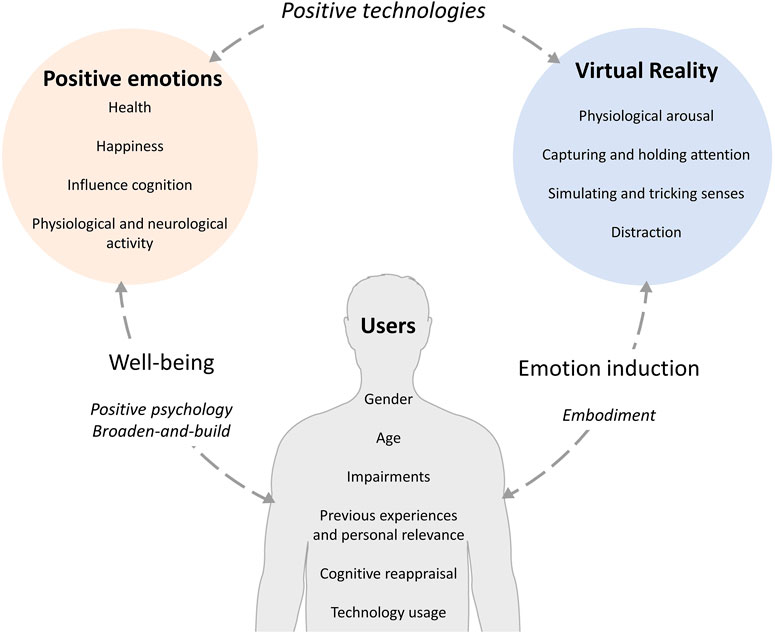
FIGURE 2. A schematic illustration of potential cognitive mechanisms linking positive emotions, VR and users. Concepts written on the arrows describe the link between two instances, and the theoretical models explaining the existing link are written below in italics.
It has been argued that highly immersive VR is arousing (Visch et al., 2010; Chirico et al., 2017), able to capture and hold users’ attention (Cho et al., 2002; Li et al., 2020; Seabrook et al., 2020), trick their senses (Gallace et al., 2012; Serino et al., 2016; Droit-Volet et al., 2020), as well as distract from negative affects and sensations (Malloy and Milling, 2010; Sharar et al., 2016). However, a neurological perspective on VR’s benefits and adverse effects is highly needed. Recently, it has been suggested that VR and the brain may share similarities, i.e. embodied simulations (Riva et al., 2018). For the brain, embodied simulations imply the existence of a “body matrix,” involved in coding visual, tactile and proprioceptive information which allows an individual to maintain a mental model of the body and the space around it (Moseley et al., 2012; Riva et al., 2018). Through the integration of several sensory stimuli, the body matrix is able to provide predictions about future actions (Riva et al., 2018). As VR shares the same characteristics of integrating several sensory inputs and predicting future user actions for optimal VR experiences, it has been suggested that VR can be considered as an “embodied technology” (Riva et al., 2018; Yu et al., 2020). Currently, VR is highly efficient at simulating the external world and body, but simulating internal simulations is more complex (although see Riva et al., 2019). When combined, these features may at least partially explain what makes VR suitable for positive emotion induction.
The operating mechanisms behind positive emotions and their influence are better documented, and interestingly, they have complementary benefits to VR. As already discussed, positive emotions present health benefits (Diener and Chan, 2011), can lead to happiness (Diener et al., 1999) and influence cognition and stimuli processing (Phillips et al., 2002; Fredrickson, 2004; Rowe et al., 2007; Holland and Kensinger, 2010). Although there are discrepancies in the literature concerning the physiological markers of positive emotions (Fredrickson, 2003; Kreibig, 2010), they have undoubtedly effects on the cardiac, vascular and electrodermal systems (Shiota et al., 2011). The recent development of a neuroscience of well-being suggests the implication of a broad neural system, involving several neurotransmitters and brain regions traditionally known to be involved in emotion processing (for a review see Alexander et al., 2020).
Beyond complementary added values of VR and emotions for fostering well-being, a user-centered approach is highly needed to elicit optimal user experiences. Fostering positive emotions by means of technology implies taking into account users’ age (Liu et al., 2020), gender (Siess and Wölfel, 2019), and physical and cognitive impairments (Roberts et al., 2019; Baker et al., 2020) as all these characteristics may potentially influence users’ VR experience (Kenwright, 2018). Personal relevance is another key aspect that may play a major role when opting for preferred VE contents, but has been understudied. Finally, cognitive reappraisal may come into play, as depending on users’ goals and regulation strategies employed they will drawn different benefits from emotional experiences (McRae et al., 2012; Brockman et al., 2017). It has also been argued in this overview that VE contents are not intrinsically “positive” or “negative,” as their emotional valence depends greatly on the meaning users are willing to give them.
4.3 Ethical Considerations and Limitations
Several ethical considerations need to be discussed about positive VR and fostering well-being. Firstly, the devices and material used as VR should be reported clearly, as several devices, with variable levels of immersion, are grouped under the umbrella term of VR. VR material has been reported in the majority of the studies investigated for the present overview (see Figure 1). Nevertheless, authors should consistently report the VR material used in their studies.
Although the studies discussed in the present review aimed specifically at inducing positive emotions in users, mixed feelings and negative emotions among elderly users (D’Cunha et al., 2019; Liu et al., 2020; Moyle et al., 2018) and barriers for using HMDs outside lab-settings (Pimentel et al., 2021) have been reported. This raises several concerns, starting with the need to involve elderly users in every feature design, from the early stages of development of a technology to its application (Castilla et al., 2013). Before setting up positive VR experiences for elderly users, some design guidelines that should be considered are simplifying the technology to be accessible to novice users (Kenwright, 2018; Pimentel et al., 2021), limiting the number of choices for a given action in the VE (Castilla et al., 2013), enabling different levels of complexity in order to match users’ skills (Castilla et al., 2020), and slow down speech narratives to avoid the double-tasks resulting from such situations (Castilla et al., 2020).
A thorough reflection about which users can benefit from VR interventions, and those for whom it may be detrimental is necessary (Kellmeyer, 2018; Kellmeyer et al., 2019). As literature about VR and emotion induction is nascent, it is normal to start investigating its effects on healthy users before proposing it to more fragile ones. It appears necessary to investigate the benefits, as well as the negative side-effects that may arouse from using VR. For instance, there is to our knowledge no literature about addiction to VR experiences, yet it needs to be investigated, especially when setting positive VR interventions. In line with this observation, it is intriguing that no clear guidelines about the VR exposure duration required and necessary for inducing positive emotions has been reported. For instance, the exposure duration in the cited studies ranges from 90 s (Marín-Morales et al., 2018) to 20 min (Baños et al., 2012; Appel et al., 2020; Miragall et al., 2021) without breaks, and over 45 min with breaks (Anderson et al., 2017). As exposure duration requires to be long enough to elicit positive emotions, but not too lengthy to cause tiredness, confusion or boredom, its thresholds need to be further investigated.
Positive emotions are not valued and expressed in the same way in different cultures (Joshanloo and Weijers, 2014). Research into positive emotions and well-being should take cultural differences into account, which is still rarely the case (Alexander et al., 2020). For instance, the majority of the cited studies has been on conducted on so-called Western, Educated, Industrialized, Rich and Democratic (WEIRD) populations (Henrich et al., 2010a,b). While it does bring some insights on users’ opinions and reactions to positive VR interventions, it remains not generalizable to all potential users because of this bias.
Finally, fostering positive emotions should not in any case become an injunction towards constant well-being and the repression of negative emotions. Several limitations have been raised about the broaden-and-build based literature, which supports the idea that positive emotions, cognition and well-being are tightly linked (Fredrickson, 2004; Fredrickson and Branigan, 2005; Fredrickson, 2006). Firstly, the dichotomy between positive and negative emotions have been criticized (Held, 2018). Thus, positive emotions do not always lead to well-being, and can even become detrimental (Gruber et al., 2008; Ford and Mauss, 2014). In addition, negative emotions can also motivate the construction of useful resources (Moss and Wilson, 2015; Pérez- Álvarez, 2016). Methodological weaknesses of the broaden-and-build literature has also been reviewed, pointing mainly at the experimental methodologies employed for supporting the theory (Nickerson, 2007; Pérez- Álvarez, 2016). For instance, the supposed broadening of attention following positive emotions is not consistently found, as the links between emotions and cognition appear to be more flexible than originally conceptualized (e.g., see Huntsinger, 2012; Taylor et al., 2017). Going further, it has been suggested that rather than purchasing constantly positive experiences and happiness, perhaps it is more relevant to pursue a valuable and meaningful life with its ups and downs (Pérez-Álvarez, 2016).
5 Conclusion
In conclusion, the studies presented in this overview reveal the great potential and future that positive VR has for fostering positive emotions in young and adult users. These positive emotions may in return motivate users towards achieving their goals, or help relaxing and managing negative affects and pain. Key aspects that need to be reflected on before setting up positive VR interventions are users’ characteristics and needs, levels of immersion, interactivity, VE contents, sensory modalities involved, and exposure duration required for optimal positive emotion induction. In any cases, fostering well-being through VR should be driven by users’ characteristics and needs in the first place rather than by technological progresses, about which there is still a lot of gray area on their long-term benefits and side-effects. Overall, fostering positive emotions through VR should remain a proposition, and should not in any case become an injunction towards constant well-being and happiness.
Author Contributions
KP, DV-P, TG, and LC contributed to the conception and planning of the review. KP identified articles relevant to the topic and wrote the first draft of the manuscript. All authors contributed to manuscript revision, read and approved the submitted version.
Funding
This work was supported by the French Research and Technology Association (ANRT, Association Nationale de la Recherche et de la Technologie) exclusively for a doctorate scholarship and program between Université de Paris, Sorbonne Université and SocialDream from 2020 to 2023 (Grant Number 2019/0715). The funder had no role in study design, data collection and analysis, decision to publish, or preparation of the manuscript.
Conflict of Interest
Authors KP and TG were employed at SocialDream
The remaining authors declare that the research was conducted in the absence of any commercial or financial relationships that could be construed as a potential conflict of interest.
Publisher’s Note
All claims expressed in this article are solely those of the authors and do not necessarily represent those of their affiliated organizations, or those of the publisher, the editors and the reviewers. Any product that may be evaluated in this article, or claim that may be made by its manufacturer, is not guaranteed or endorsed by the publisher.
Supplementary Material
The Supplementary Material for this article can be found online at: https://www.frontiersin.org/articles/10.3389/frvir.2022.788820/full#supplementary-material
References
Akobeng, A. K. (2016). Understanding Type I and Type Ii Errors, Statistical Power and Sample Size. Acta Paediatr. 105, 605–609. doi:10.1111/apa.13384
Alexander, R., Aragón, O. R., Bookwala, J., Cherbuin, N., Gatt, J. M., Kahrilas, I. J., et al. (2020). “The Neuroscience of Positive Emotions and Affect: Implications for Cultivating Happiness and Wellbeing,” in Neuroscience and Biobehavioral Reviews.
Anderson, A. P., Mayer, M. D., Fellows, A. M., Cowan, D. R., Hegel, M. T., and Buckey, J. C. (2017). Relaxation with Immersive Natural Scenes Presented Using Virtual Reality. Aerospace Med. Hum. Perform. 88, 520–526. doi:10.3357/amhp.4747.2017
Annerstedt, M., Jönsson, P., Wallergård, M., Johansson, G., Karlson, B., Grahn, P., et al. (2013). Inducing Physiological Stress Recovery with Sounds of Nature in a Virtual Reality forest - Results from a Pilot Study. Physiol. Behav. 118, 240–250. doi:10.1016/j.physbeh.2013.05.023
Appel, L., Appel, E., Bogler, O., Wiseman, M., Cohen, L., Ein, N., et al. (2020). Older Adults with Cognitive And/or Physical Impairments Can Benefit from Immersive Virtual Reality Experiences: a Feasibility Study. Front. Med. 6, 329. doi:10.3389/fmed.2019.00329
Arns, L. L., and Cerney, M. M. (2005). “The Relationship between Age and Incidence of Cybersickness Among Immersive Environment Users,” in IEEE Proceedings. VR 2005. Virtual Reality, 2005, Bonn, Germany, 12-16 March 2005 (IEEE), 267–268.
Baker, S., Waycott, J., Robertson, E., Carrasco, R., Neves, B. B., Hampson, R., et al. (2020). Evaluating the Use of Interactive Virtual Reality Technology with Older Adults Living in Residential Aged Care. Inf. Process. Manage. 57, 102105. doi:10.1016/j.ipm.2019.102105
Baltes, M. M., and Carstensen, L. L. (2003). “The Process of Successful Aging: Selection, Optimization, and Compensation,” in Understanding Human Development (Dordrecht, The Netherlands: Springer), 81–104. doi:10.1007/978-1-4615-0357-6_5
Baltes, P. B., and Baltes, M. M. (1990). "Psychological Perspectives on Successful Aging: The Model of Selective Optimization with Compensation, in Successful Aging: Perspectives From the Behavioral Sciences. Editors P. B. Baltes, and M. M. Baltes (Cambridge: Cambridge University Press), 1–34. doi:10.1017/cbo9780511665684.003
Baños, R. M., Carrillo, A., Etchemendy, E., and Botella, C. (2017). Positive Technologies for Understanding and Promoting Positive Emotions. Span J. Psychol. 20, E50. doi:10.1017/sjp.2017.42
Baños, R. M., Botella, C., Rubió, I., Quero, S., García-Palacios, A., and Alcañiz, M. (2008). Presence and Emotions in Virtual Environments: The Influence of Stereoscopy. CyberPsychology Behav. 11, 1–8. doi:10.1089/cpb.2007.9936
Baños, R. M., Etchemendy, E., Castilla, D., García-Palacios, A., Quero, S., and Botella, C. (2012). Positive Mood Induction Procedures for Virtual Environments Designed for Elderly People. Interacting Comput. 24, 131–138. doi:10.1016/j.intcom.2012.04.002
Baños, R. M., Etchemendy, E., Farfallini, L., García-Palacios, A., Quero, S., and Botella, C. (2014). Earth of Well-Being System: A Pilot Study of an Information and Communication Technology-Based Positive Psychology Intervention. J. Positive Psychol. 9, 482–488. doi:10.1080/17439760.2014.927906
Benoit, M., Guerchouche, R., Petit, P. D., Chapoulie, E., Manera, V., Chaurasia, G., et al. (2015). Is it Possible to Use Highly Realistic Virtual Reality in the Elderly? a Feasibility Study with Image-Based Rendering. Neuropsychiatr. Dis. Treat. 11, 557–563. doi:10.2147/NDT.S73179
Biocca, F., Harms, C., and Gregg, J. (2001). “The Networked Minds Measure of Social Presence: Pilot Test of the Factor Structure and Concurrent Validity,” in 4th Annual International Workshop on Presence (Philadelphia, PA), 1–9.
Bittner, L., Mostajeran, F., Steinicke, F., Gallinat, J., and Kühn, S. (2018). Evaluation of Flowvr: A Virtual Reality Game for Improvement of Depressive Mood. Biorxiv, 451245. doi:10.1101/451245
Blair, K. S., Smith, B. W., Mitchell, D. G. V., Morton, J., Vythilingam, M., Pessoa, L., et al. (2007). Modulation of Emotion by Cognition and Cognition by Emotion. Neuroimage 35, 430–440. doi:10.1016/j.neuroimage.2006.11.048
Bos, E. H., Snippe, E., de Jonge, P., and Jeronimus, B. F. (2016). Preserving Subjective Wellbeing in the Face of Psychopathology: Buffering Effects of Personal Strengths and Resources. PloS one 11, e0150867. doi:10.1371/journal.pone.0150867
Botella, C., Riva, G., Gaggioli, A., Wiederhold, B. K., Alcaniz, M., and Baños, R. M. (2012). The Present and Future of Positive Technologies. Cyberpsychology, Behav. Soc. Networking 15, 78–84. doi:10.1089/cyber.2011.0140
Botella, J., and Suero, M. (2020). Commentary: The Extent and Consequences of P-Hacking in Science. Front. Psychol. 11, 581910. doi:10.3389/fpsyg.2020.581910
Brimelow, R. E., Dawe, B., and Dissanayaka, N. (2020). Preliminary Research: Virtual Reality in Residential Aged Care to Reduce Apathy and Improve Mood. Cyberpsychology, Behav. Soc. Networking 23, 165–170. doi:10.1089/cyber.2019.0286
Britton, J. C., Taylor, S. F., Berridge, K. C., Mikels, J. A., and Liberzon, I. (2006). Differential Subjective and Psychophysiological Responses to Socially and Nonsocially Generated Emotional Stimuli. Emotion 6, 150–155. doi:10.1037/1528-3542.6.1.150
Brivio, E., Serino, S., Negro Cousa, E., Zini, A., Riva, G., and De Leo, G. (2021). Virtual Reality and 360° Panorama Technology: a media Comparison to Study Changes in Sense of Presence, Anxiety, and Positive Emotions. Virtual Reality 25, 303–311. doi:10.1007/s10055-020-00453-7
Brockman, R., Ciarrochi, J., Parker, P., and Kashdan, T. (2017). Emotion Regulation Strategies in Daily Life: Mindfulness, Cognitive Reappraisal and Emotion Suppression. Cogn. Behav. Ther. 46, 91–113. doi:10.1080/16506073.2016.1218926
Browning, M. H. E. M., Mimnaugh, K. J., van Riper, C. J., Laurent, H. K., and LaValle, S. M. (2020). Can Simulated Nature Support Mental Health? Comparing Short, Single-Doses of 360-degree Nature Videos in Virtual Reality with the Outdoors. Front. Psychol. 10, 2667. doi:10.3389/fpsyg.2019.02667
Castilla, D., Garcia-Palacios, A., Bretón-López, J., Miralles, I., Baños, R. M., Etchemendy, E., et al. (2013). Process of Design and Usability Evaluation of a Telepsychology Web and Virtual Reality System for the Elderly: Butler. Int. J. Human-Computer Stud. 71, 350–362. doi:10.1016/j.ijhcs.2012.10.017
Castilla, D., Suso-Ribera, C., Zaragoza, I., Garcia-Palacios, A., and Botella, C. (2020). Designing Icts for Users with Mild Cognitive Impairment: a Usability Study. Ijerph 17, 5153. doi:10.3390/ijerph17145153
Chan, J. Y. C., Chan, T. K., Wong, M. P. F., Cheung, R. S. M., Yiu, K. K. L., and Tsoi, K. K. F. (2020). Effects of Virtual Reality on Moods in Community Older Adults. A Multicenter Randomized Controlled Trial. Int. J. Geriatr. Psychiatry 35, 926–933. doi:10.1002/gps.5314
Chang, E., Kim, H. T., and Yoo, B. (2020). Virtual Reality Sickness: a Review of Causes and Measurements. Int. J. Human-Computer Interaction 36, 1658–1682. doi:10.1080/10447318.2020.1778351
Chirico, A., Cipresso, P., Yaden, D. B., Biassoni, F., Riva, G., and Gaggioli, A. (2017). Effectiveness of Immersive Videos in Inducing Awe: an Experimental Study. Sci. Rep. 7, 1218–1311. doi:10.1038/s41598-017-01242-0
Chirico, A., Clewis, R. R., Yaden, D. B., and Gaggioli, A. (2021). Nature versus Art as Elicitors of the Sublime: A Virtual Reality Study. PloS one 16, e0233628. doi:10.1371/journal.pone.0233628
Chirico, A., Ferrise, F., Cordella, L., and Gaggioli, A. (2018). Designing Awe in Virtual Reality: An Experimental Study. Front. Psychol. 8, 2351. doi:10.3389/fpsyg.2017.02351
Chirico, A., and Gaggioli, A. (2019). When Virtual Feels Real: Comparing Emotional Responses and Presence in Virtual and Natural Environments. Cyberpsychology, Behav. Soc. Networking 22, 220–226. doi:10.1089/cyber.2018.0393
Cho, B.-H., Ku, J., Jang, D. P., Kim, S., Lee, Y. H., Kim, I. Y., et al. (2002). The Effect of Virtual Reality Cognitive Training for Attention Enhancement. CyberPsychology Behav. 5, 129–137. doi:10.1089/109493102753770516
Cohen, A. O., Dellarco, D. V., Breiner, K., Helion, C., Heller, A. S., Rahdar, A., et al. (2016). The Impact of Emotional States on Cognitive Control Circuitry and Function. J. Cogn. Neurosci. 28, 446–459. doi:10.1162/jocn_a_00906
Colden, A., Bruder, M., and Manstead, A. S. R. (2008). Human Content in Affect-Inducing Stimuli: A Secondary Analysis of the International Affective Picture System. Motiv. Emot. 32, 260–269. doi:10.1007/s11031-008-9107-z
Cruz-Neira, C., Sandin, D. J., and DeFanti, T. A. (1993). “Surround-screen Projection-Based Virtual Reality: the Design and Implementation of the Cave,” in Proceedings of the 20th Annual Conference on Computer Graphics and Interactive Techniques, 135–142.
D'Cunha, N. M., Nguyen, D., Naumovski, N., McKune, A. J., Kellett, J., Georgousopoulou, E. N., et al. (2019). A Mini-Review of Virtual Reality-Based Interventions to Promote Well-Being for People Living with Dementia and Mild Cognitive Impairment. Gerontology 65, 430–440. doi:10.1159/000500040
Desmet, P. M. (2012). Faces of Product Pleasure: 25 Positive Emotions in Human-Product Interactions. Int. J. Des. 6 (2), 1–29.
Diemer, J., Alpers, G. W., Peperkorn, H. M., Shiban, Y., and Mã¼hlberger, A. (2015). The Impact of Perception and Presence on Emotional Reactions: a Review of Research in Virtual Reality. Front. Psychol. 6, 26. doi:10.3389/fpsyg.2015.00026
Diener, E., and Chan, M. Y. (2011). Happy People Live Longer: Subjective Well-Being Contributes to Health and Longevity. Appl. Psychol. Health Well-Being 3, 1–43. doi:10.1111/j.1758-0854.2010.01045.x
Diener, E., Suh, E. M., Lucas, R. E., and Smith, H. L. (1999). Subjective Well-Being: Three Decades of Progress. Psychol. Bull. 125, 276–302. doi:10.1037/0033-2909.125.2.276
Diniz Bernardo, P., Bains, A., Westwood, S., and Mograbi, D. C. (2021). Mood Induction Using Virtual Reality: a Systematic Review of Recent Findings. J. Technol. Behav. Sci. 6, 3–24. doi:10.1007/s41347-020-00152-9
Dolan, R. J. (2002). Emotion, Cognition, and Behavior. science 298, 1191–1194. doi:10.1126/science.1076358
Droit-Volet, S., El-Azhari, A., Haddar, S., Drago, R., and Gil, S. (2020). Similar Time Distortions under the Effect of Emotion for Durations of Several Minutes and a Few Seconds. Acta Psychologica 210, 103170. doi:10.1016/j.actpsy.2020.103170
Ekkekakis, P. (2012). “Affect, Mood, and Emotion,” in Measurement in Sport and Exercise Psychology, 321. doi:10.5040/9781492596332.ch-028
Elor, A., and Kurniawan, S. (2020). The Ultimate Display for Physical Rehabilitation: A Bridging Review on Immersive Virtual Reality. Front. Virtual Reality 1, 25. doi:10.3389/frvir.2020.585993
Etchemendy, E., Baños, R. M., Botella, C., Castilla, D., Alcañiz, M., Rasal, P., et al. (2011). An E-Health Platform for the Elderly Population: The butler System. Comput. Educ. 56, 275–279. doi:10.1016/j.compedu.2010.07.022
Evans, C. P., Chiarovano, E., and MacDougall, H. G. (2020). The Potential Benefits of Personalized 360 Video Experiences on Affect: a Proof-Of-Concept Study. Cyberpsychology, Behav. Soc. Networking 23, 134–138. doi:10.1089/cyber.2019.0241
Fagernäs, S., Hamilton, W., Espinoza, N., Miloff, A., Carlbring, P., and Lindner, P. (2021). What Do Users Think about Virtual Reality Relaxation Applications? a Mixed Methods Study of Online User Reviews Using Natural Language Processing. Internet Interventions 24, 100370. doi:10.1016/j.invent.2021.100370
Fauville, G., Queiroz, A. C. M., and Bailenson, J. N. (2020). Virtual Reality as a Promising Tool to Promote Climate Change Awareness. Techn. Health, 91–108. doi:10.1016/b978-0-12-816958-2.00005-8
Felnhofer, A., Kothgassner, O. D., Schmidt, M., Heinzle, A.-K., Beutl, L., Hlavacs, H., et al. (2015). Is Virtual Reality Emotionally Arousing? Investigating Five Emotion Inducing Virtual Park Scenarios. Int. J. human-computer Stud. 82, 48–56. doi:10.1016/j.ijhcs.2015.05.004
Ford, B. Q., and Mauss, I. B. (2014). “The Paradoxical Effects of Pursuing Positive Emotion,” in Positive Emotion: Integrating the Light Sides and Dark Sides, 363–381. doi:10.1093/acprof:oso/9780199926725.003.0020
Fredrickson, B. L., and Branigan, C. (2005). Positive Emotions Broaden the Scope of Attention and Thought‐action Repertoires. Cogn. Emot. 19, 313–332. doi:10.1080/02699930441000238
Fredrickson, B. L., and Joiner, T. (2002). Positive Emotions Trigger Upward Spirals toward Emotional Well-Being. Psychol. Sci. 13, 172–175. doi:10.1111/1467-9280.00431
Fredrickson, B. L. (2004). The Broaden-And-Build Theory of Positive Emotions. Phil. Trans. R. Soc. Lond. B 359, 1367–1377. doi:10.1098/rstb.2004.1512
Fredrickson, B. L. (2006). Unpacking Positive Emotions: Investigating the Seeds of Human Flourishing. J. Positive Psychol. 1, 57–59. doi:10.1080/17439760500510981
Fredrickson, B. (2003). The Value of Positive Emotions. Amer. Scientist 91, 330–335. doi:10.1511/2003.4.330
Freeman, D., Reeve, S., Robinson, A., Ehlers, A., Clark, D., Spanlang, B., et al. (2017). Virtual Reality in the Assessment, Understanding, and Treatment of Mental Health Disorders. Psychol. Med. 47, 2393–2400. doi:10.1017/s003329171700040x
Gallace, A., Ngo, M. K., Sulaitis, J., and Spence, C. (2012). “Multisensory Presence in Virtual Reality,” in Multiple Sensorial media Advances and Applications: New Developments in MulSeMedia Editors G. Ghinea, F. Andres, and S. Gulliver (Hershey, PA: IGI Global), 1–38. doi:10.4018/978-1-60960-821-7.ch001
Ganesan, B., Al-Jumaily, A., Fong, K. N. K., Prasad, P., Meena, S. K., and Tong, R. K. (2021). Impact of Coronavirus Disease 2019 (Covid-19) Outbreak Quarantine, Isolation, and Lockdown Policies on Mental Health and Suicide. Front. Psychiatry 12, 565190. doi:10.3389/fpsyt.2021.565190
Garland, E. L., Fredrickson, B., Kring, A. M., Johnson, D. P., Meyer, P. S., and Penn, D. L. (2010). Upward Spirals of Positive Emotions Counter Downward Spirals of Negativity: Insights from the Broaden-And-Build Theory and Affective Neuroscience on the Treatment of Emotion Dysfunctions and Deficits in Psychopathology. Clin. Psychol. Rev. 30, 849–864. doi:10.1016/j.cpr.2010.03.002
Gordon, N. S., Merchant, J., Zanbaka, C., Hodges, L. F., and Goolkasian, P. (2011). Interactive Gaming Reduces Experimental Pain with or without a Head Mounted Display. Comput. Hum. Behav. 27, 2123–2128. doi:10.1016/j.chb.2011.06.006
Gross, J. J., and Levenson, R. W. (1995). Emotion Elicitation Using Films. Cogn. Emot. 9, 87–108. doi:10.1080/02699939508408966
Gruber, J., Johnson, S. L., Oveis, C., and Keltner, D. (2008). Risk for Mania and Positive Emotional Responding: Too Much of a Good Thing? Emotion 8, 23–33. doi:10.1037/1528-3542.8.1.23
Gupta, R. (2019). Positive Emotions Have a Unique Capacity to Capture Attention. Prog. Brain Res. 247, 23–46. doi:10.1016/bs.pbr.2019.02.001
Held, B. S. (2018). Positive Psychology's A Priori Problem. J. Humanistic Psychol. 58, 313–342. doi:10.1177/0022167817739409
Henderson, L., and Knight, T. (2012). Integrating the Hedonic and Eudaimonic Perspectives to More Comprehensively Understand Wellbeing and Pathways to Wellbeing. Intnl. J. Wellbeing 2, 196–221. doi:10.5502/ijw.v2i3.3
Henrich, J., Heine, S. J., and Norenzayan, A. (2010a). Most People Are Not Weird. Nature 466, 29. doi:10.1038/466029a
Henrich, J., Heine, S. J., and Norenzayan, A. (2010b). The Weirdest People in the World? Behav. Brain Sci. 33, 61–83. doi:10.1017/s0140525x0999152x
Hofman, K., Walters, G., and Hughes, K. (2021). The Effectiveness of Virtual vs Real-Life marine Tourism Experiences in Encouraging Conservation Behaviour. J. Sustain. Tourism, 1–25. doi:10.1080/09669582.2021.1884690
Holland, A. C., and Kensinger, E. A. (2010). Emotion and Autobiographical Memory. Phys. Life Rev. 7, 88–131. doi:10.1016/j.plrev.2010.01.006
Hsu, W.-C., Tseng, C.-M., and Kang, S.-C. (2018). Using Exaggerated Feedback in a Virtual Reality Environment to Enhance Behavior Intention of Water-Conservation. J. Educ. Techn. Soc. 21, 187–203.
Huang, J., Lucash, M. S., Scheller, R. M., and Klippel, A. (2021). Walking through the Forests of the Future: Using Data-Driven Virtual Reality to Visualize Forests under Climate Change. Int. J. Geographical Inf. Sci. 35, 1155–1178. doi:10.1080/13658816.2020.1830997
Huntsinger, J. R. (2012). Does Positive Affect Broaden and Negative Affect Narrow Attentional Scope? a New Answer to an Old Question. J. Exp. Psychol. Gen. 141, 595–600. doi:10.1037/a0027709
Huygelier, H., Schraepen, B., Van Ee, R., Vanden Abeele, V., and Gillebert, C. R. (2019). Acceptance of Immersive Head-Mounted Virtual Reality in Older Adults. Sci. Rep. 9, 4519–4612. doi:10.1038/s41598-019-41200-6
Jerdan, S. W., Grindle, M., van Woerden, H. C., and Kamel Boulos, M. N. (2018). Head-mounted Virtual Reality and Mental Health: Critical Review of Current Research. JMIR serious games 6, e14. doi:10.2196/games.9226
Joshanloo, M., and Weijers, D. (2014). Aversion to Happiness across Cultures: A Review of where and Why People Are Averse to Happiness. J. Happiness Stud. 15, 717–735. doi:10.1007/s10902-013-9489-9
Kaplan, R., and Kaplan, S. (1989). The Experience of Nature: A Psychological Perspective. Cambridge, UK: Cambridge University Press.
Kashdan, T. B., Biswas-Diener, R., and King, L. A. (2008). Reconsidering Happiness: The Costs of Distinguishing between Hedonics and Eudaimonia. J. Positive Psychol. 3, 219–233. doi:10.1080/17439760802303044
Kellmeyer, P., Biller-Andorno, N., and Meynen, G. (2019). Ethical Tensions of Virtual Reality Treatment in Vulnerable Patients. Nat. Med. 25, 1185–1188. doi:10.1038/s41591-019-0543-y
Kellmeyer, P. (2018). Neurophilosophical and Ethical Aspects of Virtual Reality Therapy in Neurology and Psychiatry. Camb Q. Healthc. Ethics 27, 610–627. doi:10.1017/s0963180118000129
Kennedy, R. S., Lane, N. E., Berbaum, K. S., and Lilienthal, M. G. (1993). Simulator Sickness Questionnaire: An Enhanced Method for Quantifying Simulator Sickness. Int. J. aviation Psychol. 3, 203–220. doi:10.1207/s15327108ijap0303_3
Kenwright, B. (2018). Virtual Reality: Ethical Challenges and Dangers [opinion]. IEEE Technol. Soc. Mag. 37, 20–25. doi:10.1109/mts.2018.2876104
Kern, A. C., Ellermeier, W., and Jost, L. (2020). “The Influence of Mood Induction by Music or a Soundscape on Presence and Emotions in a Virtual Reality Park Scenario,” in Proceedings of the 15th International Conference on Audio Mostly, 233–236. doi:10.1145/3411109.3411129
Killgore, W. D. S., Cloonan, S. A., Taylor, E. C., and Dailey, N. S. (2020). Loneliness: A Signature Mental Health Concern in the Era of Covid-19. Psychiatry Res. 290, 113117. doi:10.1016/j.psychres.2020.113117
Kim, O., Pang, Y., and Kim, J. H. (2019). The Effectiveness of Virtual Reality for People with Mild Cognitive Impairment or Dementia: a Meta-Analysis. BMC psychiatry 19, 219–310. doi:10.1186/s12888-019-2180-x
Kitson, A., Prpa, M., and Riecke, B. E. (2018). Immersive Interactive Technologies for Positive Change: a Scoping Review and Design Considerations. Front. Psychol. 9, 1354. doi:10.3389/fpsyg.2018.01354
Kreibig, S. D. (2010). Autonomic Nervous System Activity in Emotion: A Review. Biol. Psychol. 84, 394–421. doi:10.1016/j.biopsycho.2010.03.010
Kuppens, P., Realo, A., and Diener, E. (2008). The Role of Positive and Negative Emotions in Life Satisfaction Judgment across Nations. J. Personal. Soc. Psychol. 95, 66–75. doi:10.1037/0022-3514.95.1.66
Lakens, D., and Etz, A. J. (2017). Too True to Be Bad. Soc. Psychol. Personal. Sci. 8, 875–881. doi:10.1177/1948550617693058
Lang, P. J., Bradley, M. M., and Cuthbert, B. N. (1997). International Affective Picture System (Iaps): Technical Manual and Affective Ratings. NIMH Cent. Study Emot. Attention 1, 39–58.
LaViola, J. J. (2000). A Discussion of Cybersickness in Virtual Environments. SIGCHI Bull. 32, 47–56. doi:10.1145/333329.333344
Lent, R. W. (2004). Toward a Unifying Theoretical and Practical Perspective on Well-Being and Psychosocial Adjustment. J. Couns. Psychol. 51, 482–509. doi:10.1037/0022-0167.51.4.482
Li, B. J., Bailenson, J. N., Pines, A., Greenleaf, W. J., and Williams, L. M. (2017). A Public Database of Immersive Vr Videos with Corresponding Ratings of Arousal, Valence, and Correlations between Head Movements and Self Report Measures. Front. Psychol. 8, 2116. doi:10.3389/fpsyg.2017.02116
Li, G., Anguera, J. A., Javed, S. V., Khan, M. A., Wang, G., and Gazzaley, A. (2020). Enhanced Attention Using Head-Mounted Virtual Reality. J. Cogn. Neurosci. 32, 1438–1454. doi:10.1162/jocn_a_01560
Liszio, S., Graf, L., and Masuch, M. (2018). The Relaxing Effect of Virtual Nature: Immersive Technology Provides Relief in Acute Stress Situations. Annu. Rev. Cyberther. Telemed. 16, 87–93.
Liszio, S., and Masuch, M. (2019). Interactive Immersive Virtual Environments Cause Relaxation and Enhance Resistance to Acute Stress. Annu. Rev. Cyberther Telemed. 17, 65–71.
Liu, Q., Wang, Y., Yao, M. Z., Tang, Q., and Yang, Y. (2020). The Effects of Viewing an Uplifting 360-degree Video on Emotional Well-Being Among Elderly Adults and College Students under Immersive Virtual Reality and Smartphone Conditions. Cyberpsychology, Behav. Soc. Networking 23, 157–164. doi:10.1089/cyber.2019.0273
Lyubomirsky, S., King, L., and Diener, E. (2005). The Benefits of Frequent Positive Affect: Does Happiness lead to success? Psychol. Bull. 131, 803–855. doi:10.1037/0033-2909.131.6.803
Malloy, K. M., and Milling, L. S. (2010). The Effectiveness of Virtual Reality Distraction for Pain Reduction: a Systematic Review. Clin. Psychol. Rev. 30, 1011–1018. doi:10.1016/j.cpr.2010.07.001
Marín-Morales, J., Higuera-Trujillo, J. L., Greco, A., Guixeres, J., Llinares, C., Scilingo, E. P., et al. (2018). Affective Computing in Virtual Reality: Emotion Recognition from Brain and Heartbeat Dynamics Using Wearable Sensors. Sci. Rep. 8, 13657–13715. doi:10.1038/s41598-018-32063-4
Markowitz, D. M., Laha, R., Perone, B. P., Pea, R. D., and Bailenson, J. N. (2018). Immersive Virtual Reality Field Trips Facilitate Learning about Climate Change. Front. Psychol. 9, 2364. doi:10.3389/fpsyg.2018.02364
Martin, M. (1990). On the Induction of Mood. Clin. Psychol. Rev. 10, 669–697. doi:10.1016/0272-7358(90)90075-l
Mattila, O., Korhonen, A., Pöyry, E., Hauru, K., Holopainen, J., and Parvinen, P. (2020). Restoration in a Virtual Reality forest Environment. Comput. Hum. Behav. 107, 106295. doi:10.1016/j.chb.2020.106295
McMahan, E. A., and Estes, D. (2015). The Effect of Contact with Natural Environments on Positive and Negative Affect: A Meta-Analysis. J. Positive Psychol. 10, 507–519. doi:10.1080/17439760.2014.994224
McRae, K., Ciesielski, B., and Gross, J. J. (2012). Unpacking Cognitive Reappraisal: Goals, Tactics, and Outcomes. Emotion 12, 250–255. doi:10.1037/a0026351
Miragall, M., Vara, M. D., Cebolla, A., Etchemendy, E., and Baños, R. M. (2021). Leaning Forward to Increase Approach Motivation! the Role of joy, Exercise, and Posture in Achieving Goals. Curr. Psychol. 40, 2390–2399. doi:10.1007/s12144-019-00175-3
Mosadeghi, S., Reid, M. W., Martinez, B., Rosen, B. T., and Spiegel, B. M. (2016). Feasibility of an Immersive Virtual Reality Intervention for Hospitalized Patients: an Observational Cohort Study. JMIR Ment. Health 3, e28. doi:10.2196/mental.5801
Moseley, G. L., Gallace, A., and Spence, C. (2012). Bodily Illusions in Health and Disease: Physiological and Clinical Perspectives and the Concept of a Cortical 'body Matrix'. Neurosci. Biobehavioral Rev. 36, 34–46. doi:10.1016/j.neubiorev.2011.03.013
Moss, S. A., and Wilson, S. G. (2015). The Positive Emotions that Facilitate the Fulfillment of Needs May Not Be Positive Emotions at All: The Role of Ambivalence. Explore 11, 40–50. doi:10.1016/j.explore.2014.10.006
Moyle, W., Jones, C., Dwan, T., and Petrovich, T. (2018). Effectiveness of a Virtual Reality forest on People with Dementia: A Mixed Methods Pilot Study. The Gerontologist 58, 478–487. doi:10.1093/geront/gnw270
Nelson, K. M., Anggraini, E., and Schlüter, A. (2020). Virtual Reality as a Tool for Environmental Conservation and Fundraising. Plos one 15, e0223631. doi:10.1371/journal.pone.0223631
Nelson, L. D., Simmons, J., and Simonsohn, U. (2018). Psychology's Renaissance. Annu. Rev. Psychol. 69, 511–534. doi:10.1146/annurev-psych-122216-011836
Nickerson, C. (2007). Theory/Analysis Mismatch: Comment on Fredrickson and Joiner's (2002) Test of the Broaden-And-Build Theory of Positive Emotions. J. Happiness Stud. 8, 537–561. doi:10.1007/s10902-006-9030-5
Nosek, B. A., and Lakens, D. (2014). Registered Reports. Soc. Psychol. 45, 137–141. doi:10.1027/1864-9335/a000192
Ong, A. D. (2010). Pathways Linking Positive Emotion and Health in Later Life. Curr. Dir. Psychol. Sci. 19, 358–362. doi:10.1177/0963721410388805
Pérez-Álvarez, M. (2016). The Science of Happiness: As Felicitous as it Is Fallacious. J. Theor. Philos. Psychol. 36, 1–19. doi:10.1037/teo0000030
Phillips, L. H., Bull, R., Adams, E., and Fraser, L. (2002). Positive Mood and Executive Function: Evidence from Stroop and Fluency Tasks. Emotion 2, 12–22. doi:10.1037/1528-3542.2.1.12
Pimentel, D., Foxman, M., Davis, D. Z., and Markowitz, D. M. (2021). Virtually Real, but Not Quite There: Social and Economic Barriers to Meeting Virtual Reality’s True Potential for Mental Health. Front. Virtual Reality 2, 2. doi:10.3389/frvir.2021.627059
Riva, G., Baños, R. M., Botella, C., Wiederhold, B. K., and Gaggioli, A. (2012). Positive Technology: Using Interactive Technologies to Promote Positive Functioning. Cyberpsychology, Behav. Soc. Networking 15, 69–77. doi:10.1089/cyber.2011.0139
Riva, G., Mantovani, F., Capideville, C. S., Preziosa, A., Morganti, F., Villani, D., et al. (2007). Affective Interactions Using Virtual Reality: the Link between Presence and Emotions. CyberPsychology Behav. 10, 45–56. doi:10.1089/cpb.2006.9993
Riva, G., Wiederhold, B. K., Chirico, A., Di Lernia, D., Mantovani, F., and Gaggioli, A. (2018). Brain and Virtual Reality: what Do They Have in Common and How to Exploit Their Potential. Annu. Rev. CyberTherapy Telemed. 16, 3–7.
Riva, G., Wiederhold, B. K., and Mantovani, F. (2019). Neuroscience of Virtual Reality: from Virtual Exposure to Embodied Medicine. Cyberpsychology, Behav. Soc. Networking 22, 82–96. doi:10.1089/cyber.2017.29099.gri
Roberts, A. R., De Schutter, B., Franks, K., and Radina, M. E. (2019). Older Adults' Experiences with Audiovisual Virtual Reality: Perceived Usefulness and Other Factors Influencing Technology Acceptance. Clin. gerontologist 42, 27–33. doi:10.1080/07317115.2018.1442380
Rockstroh, C., Blum, J., and Göritz, A. S. (2019). Virtual Reality in the Application of Heart Rate Variability Biofeedback. Int. J. Human-Computer Stud. 130, 209–220. doi:10.1016/j.ijhcs.2019.06.011
Rowe, G., Hirsh, J. B., and Anderson, A. K. (2007). Positive Affect Increases the Breadth of Attentional Selection. Proc. Natl. Acad. Sci. 104, 383–388. doi:10.1073/pnas.0605198104
Rowe, J. W., and Kahn, R. L. (1987). Human Aging: Usual and Successful. Science 237, 143–149. doi:10.1126/science.3299702
Rowe, J. W., and Kahn, R. L. (2015). Successful Aging 2.0: Conceptual Expansions for the 21st century. Geronb 70, 593–596. doi:10.1093/geronb/gbv025
Ryff, C. D. (1989). Happiness Is Everything, or Is it? Explorations on the Meaning of Psychological Well-Being. J. Personal. Soc. Psychol. 57, 1069–1081. doi:10.1037/0022-3514.57.6.1069
Sander, D., Grandjean, D., and Scherer, K. R. (2005). A Systems Approach to Appraisal Mechanisms in Emotion. Neural networks 18, 317–352. doi:10.1016/j.neunet.2005.03.001
Saredakis, D., Keage, H. A., Corlis, M., and Loetscher, T. (2020). Using Virtual Reality to Improve Apathy in Residential Aged Care: Mixed Methods Study. J. Med. Internet Res. 22, e17632. doi:10.2196/17632
Scherer, K. R. (2005). What Are Emotions? and How Can They Be Measured? Soc. Sci. Inf. 44, 695–729. doi:10.1177/0539018405058216
Seabrook, E., Kelly, R., Foley, F., Theiler, S., Thomas, N., Wadley, G., et al. (2020). Understanding How Virtual Reality Can Support Mindfulness Practice: Mixed Methods Study. J. Med. Internet Res. 22, e16106. doi:10.2196/16106
Seligman, M. E. P., and Csikszentmihalyi, M. (2000). Positive Psychology: An Introduction. Am. Psychol. 55, 5–14. doi:10.1037/0003-066x.55.1.5
Serino, S., Pedroli, E., Keizer, A., Triberti, S., Dakanalis, A., Pallavicini, F., et al. (2016). Virtual Reality Body Swapping: a Tool for Modifying the Allocentric Memory of the Body. Cyberpsychology, Behav. Soc. Networking 19, 127–133. doi:10.1089/cyber.2015.0229
Serrano, B., Baños, R. M., and Botella, C. (2016). Virtual Reality and Stimulation of Touch and Smell for Inducing Relaxation: A Randomized Controlled Trial. Comput. Hum. Behav. 55, 1–8. doi:10.1016/j.chb.2015.08.007
Sharar, S. R., Alamdari, A., Hoffer, C., Hoffman, H. G., Jensen, M. P., and Patterson, D. R. (2016). Circumplex Model of Affect: a Measure of Pleasure and Arousal during Virtual Reality Distraction Analgesia. Games Health J. 5, 197–202. doi:10.1089/g4h.2015.0046
Shiota, M. N., Neufeld, S. L., Yeung, W. H., Moser, S. E., and Perea, E. F. (2011). Feeling Good: Autonomic Nervous System Responding in Five Positive Emotions. Emotion 11, 1368–1378. doi:10.1037/a0024278
Siess, A., and Wölfel, M. (2019). User Color Temperature Preferences in Immersive Virtual Realities. Comput. Graphics 81, 20–31. doi:10.1016/j.cag.2019.03.018
Slater, M. (1999). Measuring Presence: A Response to the Witmer and Singer Presence Questionnaire. Presence 8, 560–565. doi:10.1162/105474699566477
Slater, M., and Wilbur, S. (1997). A Framework for Immersive Virtual Environments (Five): Speculations on the Role of Presence in Virtual Environments. Presence: Teleoperators & Virtual Environments 6, 603–616. doi:10.1162/pres.1997.6.6.603
Stanney, K., Fidopiastis, C., and Foster, L. (2020). Virtual Reality Is Sexist: but it Does Not Have to Be. Front. Robot. AI 7, 4. doi:10.3389/frobt.2020.00004
Steptoe, A., Deaton, A., and Stone, A. A. (2015). Subjective Wellbeing, Health, and Ageing. The Lancet 385, 640–648. doi:10.1016/s0140-6736(13)61489-0
Steuer, J. (1992). Defining Virtual Reality: Dimensions Determining Telepresence. J. Commun. 42, 73–93. doi:10.1111/j.1460-2466.1992.tb00812.x
Suardi, A., Sotgiu, I., Costa, T., Cauda, F., and Rusconi, M. (2016). The Neural Correlates of Happiness: A Review of Pet and Fmri Studies Using Autobiographical Recall Methods. Cogn. Affect Behav. Neurosci. 16, 383–392. doi:10.3758/s13415-016-0414-7
Taylor, A., Bendall, R., and Thompson, C. (2017). Positive Emotion Expands Visual Attention … or Maybe Not J. Exp. Psychol. 8 (4), 521–535.
Thompson, T., Steffert, T., Steed, A., and Gruzelier, J. (2010). A Randomized Controlled Trial of the Effects of Hypnosis with 3-d Virtual Reality Animation on Tiredness, Mood, and Salivary Cortisol. Int. J. Clin. Exp. Hypnosis 59, 122–142. doi:10.1080/00207144.2011.522917
Twohig-Bennett, C., and Jones, A. (2018). The Health Benefits of the Great Outdoors: A Systematic Review and Meta-Analysis of Greenspace Exposure and Health Outcomes. Environ. Res. 166, 628–637. doi:10.1016/j.envres.2018.06.030
Ulrich, R. S., Simons, R. F., Losito, B. D., Fiorito, E., Miles, M. A., and Zelson, M. (1991). Stress Recovery during Exposure to Natural and Urban Environments. J. Environ. Psychol. 11, 201–230. doi:10.1016/s0272-4944(05)80184-7
Valtchanov, D., Barton, K. R., and Ellard, C. (2010). Restorative Effects of Virtual Nature Settings. Cyberpsychology, Behav. Soc. Networking 13, 503–512. doi:10.1089/cyber.2009.0308
Västfjäll, D. (2001). Emotion Induction through Music: A Review of the Musical Mood Induction Procedure. Musicae Scientiae 5, 173–211. doi:10.1177/10298649020050s107
Velten, E. (1968). A Laboratory Task for Induction of Mood States. Behav. Res. Ther. 6, 473–482. doi:10.1016/0005-7967(68)90028-4
Villani, D., and Riva, G. (2012). Does Interactive media Enhance the Management of Stress? Suggestions from a Controlled Study. Cyberpsychology, Behav. Soc. Networking 15, 24–30. doi:10.1089/cyber.2011.0141
Visch, V. T., Tan, E. S., and Molenaar, D. (2010). The Emotional and Cognitive Effect of Immersion in Film Viewing. Cogn. Emot. 24, 1439–1445. doi:10.1080/02699930903498186
Watson, D., Clark, L. A., and Tellegen, A. (1988). Development and Validation of Brief Measures of Positive and Negative Affect: the Panas Scales. J. Personal. Soc. Psychol. 54, 1063–1070. doi:10.1037/0022-3514.54.6.1063
Yeo, N. L., White, M. P., Alcock, I., Garside, R., Dean, S. G., Smalley, A. J., et al. (2020). What Is the Best Way of Delivering Virtual Nature for Improving Mood? an Experimental Comparison of High Definition TV, 360° Video, and Computer Generated Virtual Reality. J. Environ. Psychol. 72, 101500. doi:10.1016/j.jenvp.2020.101500
Yu, C.-P., Lee, H.-Y., Lu, W.-H., Huang, Y.-C., and Browning, M. H. E. M. (2020). Restorative Effects of Virtual Natural Settings on Middle-Aged and Elderly Adults. Urban For. Urban Green. 56, 126863. doi:10.1016/j.ufug.2020.126863
Keywords: virtual reality, well-being, aging, mood induction, emotion, physiological measure, positive technologies
Citation: Pavic K, Vergilino-Perez D, Gricourt T and Chaby L (2022) Because I’m Happy—An Overview on Fostering Positive Emotions Through Virtual Reality. Front. Virtual Real. 3:788820. doi: 10.3389/frvir.2022.788820
Received: 03 October 2021; Accepted: 09 February 2022;
Published: 01 March 2022.
Edited by:
Florian Pecune, University of Glasgow, United KingdomCopyright © 2022 Pavic , Vergilino-Perez , Gricourt and Chaby. This is an open-access article distributed under the terms of the Creative Commons Attribution License (CC BY). The use, distribution or reproduction in other forums is permitted, provided the original author(s) and the copyright owner(s) are credited and that the original publication in this journal is cited, in accordance with accepted academic practice. No use, distribution or reproduction is permitted which does not comply with these terms.
*Correspondence: Katarina Pavic , a2F0YXJpbmEucGF2aWNAdS1wYXJpcy5mcg==