 Yuke Pi
 Xueni Pan
 Mel Slater
 Justyna Świdrak
- 1SEEVR Lab, Department of Computing, Goldsmiths, University of London, London, United Kingdom
- 2Event Lab, Department of Clinical Psychology and Psychobiology, Institute of Neurosciences of the University of Barcelona, University of Barcelona, Barcelona, Spain
- 3Institut d’Investigacions Biomèdiques August Pi i Sunyer (IDIBAPS), Barcelona, Spain
- 4Institute of Psychology Polish Academy of Sciences, Warsaw, Poland
This study explores the impact of embodied experiences in Virtual Reality (VR) on individuals’ attitudes and behavior towards climate change. A total of 41 participants were divided into two groups: an embodied group that interacted with a virtual environment through full-body avatars, and a non-embodied group that observed the scenarios from an invisible observer’s point of view. The VR experience simulated the progressive consequences of climate change across three generations within a family, aiming to make the abstract and relatively distant concept of climate change a tangible and personal issue. The final scene presented an optimistic scenario of a future where humans had successfully combated climate change through collective action. The evidence suggests that there is an effect of the scenario on the carbon footprint response, even 6 weeks after the VR exposure, irrespective of condition. Additionally, increases were found in participants’ perceived influence on climate action and engagement in pro-environmental behaviors, with the embodied group showing a more pronounced response in the short term. These findings suggest that immersive VR experiences that incorporate virtual embodiment can be an effective tool in enhancing awareness and motivating pro-environmental behavior by providing a powerful and personal perspective on the impacts of climate change.
1 Introduction
In the future metaverse, there will be many activities we can join - from entertainment to education. Some activities will be run by people connected in real-time (e.g., a drama teacher), and others will be run by entirely virtual humans (non-player characters, NPCs) in an automatic scenario (e.g., an immersive movie). Here we demonstrate a type of scenario that people can enter that could result in positive behavioral change. Our example is like an immersive movie except it includes embodiment as a person who experiences the effects of climate change first-hand - the past as a child, the present, a horrific future as an older person, and a possible positive alternate future if both individual and collective action to prevent climate change is taken now (Lee et al., 2024).
In the face of the escalating climate crisis, events such as wildfires, massive flooding, and extreme weather patterns have become more frequent and extreme (Ridder et al., 2022), and there is an increasing urgency to educate and engage the global populace as well as policymakers. While evidence that climate change is induced by human activity is unequivocal, there remains a challenge: translating this complex and abstract proposition into a tangible, personal reality for individuals, who often feel powerless (Kenis and Mathijs, 2012). Importantly, even though often seen as a task for large, international organisations and governments, shifting individual actions to a more sustainable future could profoundly impact global warming (Unsworth and McNeill, 2017; Whitmarsh et al., 2021). Therefore, empowering citizens to take climate action is one key to combating the climate crisis.
The many ways in which citizens can engage can be grouped into two broad categories: through personal environmental behaviours that directly influence greenhouse gas emissions, and collective climate action, such as support for green policies and direct political participation (Lubell et al., 2007). The first type includes lifestyle choices, such as selecting a renewable energy provider, changing diet to be more plant-based, choosing public transport or cycling instead of a motor vehicle, and more sustainable shopping (buying fewer new clothes, buying second-hand). These types of behavior can be measured as individual carbon footprints (Wright et al., 2014), defined as “a measure of the total amount of CO2 and CH4 emissions of a defined population, system or activity, considering all relevant sources, sinks and storage within the spatial and temporal boundary of the population, system or activity of interest” (Wright et al., 2014). Collective action takes various forms of exerting pressure on authorities and organizations to implement climate policies and may include participating in neighbourhood-based climate protection initiatives, engaging with climate activist groups, signing petitions, voting, or discussing climate policies with friends and neighbors.
One of the barriers to undertaking these actions is the fact that the probability that a single member of the public can influence the climate is virtually zero (Lubell et al., 2007) and thus, empowerment of citizens on a mass scale is of utmost importance (Ojala, 2023). Evidence suggests that a feeling of personal responsibility and efficacy to reduce climate change may translate into climate action (Bergquist et al., 2019; Bouman et al., 2020). Perceived personal influence refers to the belief that individual participation in global warming activism will increase the probability of supporting the collective good, and is one of the strongest predictors of such collective actions as protest behaviour and voting behaviour (Lubell et al., 2007).
Existing field interventions aimed at increasing climate engagement among individuals demonstrate small effects (Bergquist et al., 2019) and thus, new approaches are urgently needed. There is growing evidence suggesting that Virtual Reality (VR) experiences can profoundly influence environmental attitudes and behavior (Markowitz et al., 2018; Hofman et al., 2022). For example, VR-mediated natural experiences have been shown to increase connectedness to nature (Soliman et al., 2017; Spangenberger et al., 2022) and promote pro-environmental behavior as effectively as real-life (Deringer and Hanley, 2021). There is also evidence that VR can increase climate change engagement, awareness, intentions, and behavior (Queiroz et al., 2018). While VR’s impact on environmental attitudes has been studied, its impact on political engagement in climate action and the unique effect of embodied, first-person experience of climate change remains unexplored. With a wide field-of-view head-tracked and stereo head-mounted display, it is possible to substitute a person’s real body with a life-sized virtual body, which moves with their movements, and which can be reflected in a virtual mirror. This typically gives rise to the illusion of ownership over the virtual body, where the participant feels that the virtual body is their own (Slater et al., 2010; Kilteni et al., 2012). Prior research has demonstrated that this kind of experience can lead to profound psychological changes in participants through implicit learning (Slater, 2017), including changes in attitudes and behavior related to age (Hershfield et al., 2011; Banakou et al., 2013; Cowie et al., 2018) and race (Maister et al., 2015; Bedder et al., 2019; Banakou et al., 2020).
We conducted an experimental study with 41 people, where we simulated various levels of climate deterioration in VR. Half of the group had an embodied experience of the climate change consequences, and the other half observed the same scenario, but from an invisible observer’s perspective (control condition). The goal was to examine the influence of a first-person simulation of anthropogenic climate change consequences. Our VR experience includes a unique application of virtual embodiment: through the eyes of a child, and later an adult, witnessing the escalating climate change, and later still how the situation may improve if action is taken now, or in the control condition as a passive observer. We expected that an embodied (vs non-embodied) experience of time travel could increase people’s individual and collective climate action by transforming the issue of climate change from the background to the foreground and making it personal. This is an exploratory rather than a confirmatory study. However, our expectations were that after the VR scenario, participants would increase their perceived influence on the climate crisis and engagement in both individual and collective climate action as compared to before their VR scenario. We did not predict one way or the other whether this effect would still be detectable after 6 weeks. However, we did expect that participants in the embodied condition would report a larger change as compared to the observer condition.
2 Methods
2.1 Experimental design
The experimental design was between groups with one binary factor: Observed (n = 20) and Embodied (n = 21) as described above. The 41 participants (21 female) were recruited from the campus of Goldsmiths, London University and arbitrarily assigned to the two groups. The Observed and Embodied groups were similar in gender, age, and prior VR experience (Table 1).

Table 1. Demographics.
2.2 Materials
The VR experience was developed with the Unity 3D engine and the head-mounted display (HMD) used was the Oculus Quest Pro. This has resolution of 1,800 × 1,920 per eye, and weighs 722 g. It has 6 degrees of freedom head-tracking, and hand tracking was through the use of two controllers, also tracked with 6 degrees of freedom.
2.3 Ethics
Ethics approval was obtained from the Department of Computing Ethics Committee at Goldsmiths. Each participant received an Amazon voucher valued at £15 as compensation for their time.
2.4 Scenarios
The scenario spanned three generations of a parent and child witnessing the impact of climate change from within their own home. In the Embodied condition, participants saw their virtual body when looking down at themselves and its reflection in a mirror. The movements of their head and upper body were mapped to their virtual body through real-time tracking from the HMD and controllers. The participant, embodied as a child in the past, interacted with a parent that was in the same virtual room, while the TV portrayed information about climate change. The outside scene seen through the windows was a green pasture with animals grazing.
In the second phase, the participant was embodied as a teenager, with the same parent, now older, and in the same, now dilapidated, room. The program on the TV described the causes and consequences of climate change, and how it is being fought. The scene outside had deteriorated with fires in the distance.
In the third phase, the future, the participant was a parent and interacted with a child who pleaded for the future. The TV no longer worked, and the outside scene was deserted.
A final scene set 50 years in the future portrayed a more optimistic scenario, including from that future standpoint a large screen TV showing a program about history, portraying events where worldwide mass collective action had forced politicians to take climate change seriously, instigating fundamental changes that led to the positively changed scenario.
In the Observed condition, the participant observed the all same scenes but from an invisible third-person perspective. They did not have any virtual body, and they saw the two virtual characters (always parent and child) sitting on the sofa watching TV (Figure 1).
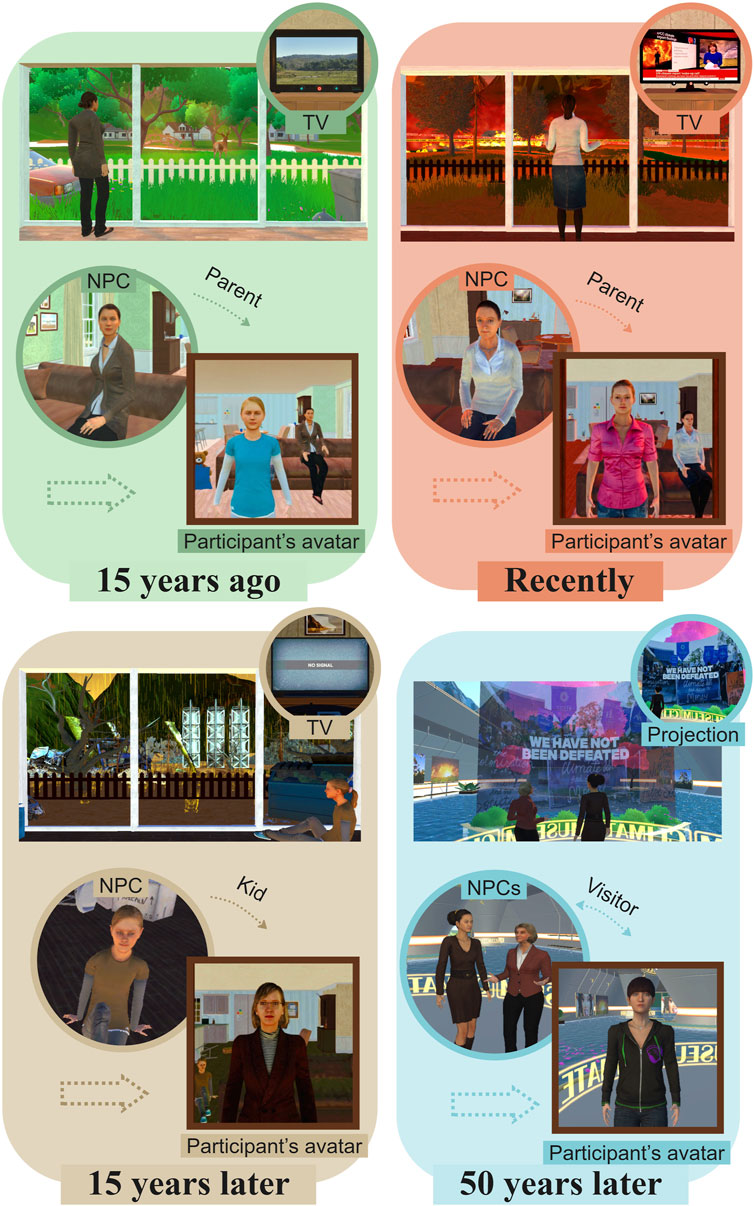
Figure 1. Evolution of the scenarios from 15 years earlier to 50 years later for the Embodied condition. Each panel shows the participant’s avatar and the virtual character with which they interact (NPC, Non-player character) which for the first three scenarios is either the parent (15 years ago and recently) or the child (15 years later). In the 50 years later scene the participant is addressed by two NPCs one of which participated in demonstrations 50 years earlier, which are shown on a documentary on a large futuristic screen.
The environment and changes were designed based on current news. In fact, the TV programs in the first two scenes were from the BBC and other TV stations reporting on wildfires and other climate change-related events from the last 3 years1. They illustrated that we can see now and sometimes personally experience very frequent heatwaves, wildfires, flooding, etc. (El Garroussi et al., 2024; Tasker and Wentworth, 2024). It is argued by scientists overwhelmingly that these are caused by human activity resulting in climate change (Lee et al., 2024). The VR scenarios provided an experience, like being in an immersive movie, but being able to move around as they wished.
To ensure that the scenario would not result in feelings of helplessness, we added the last empowering scene set 50 years in the future in virtual museum. This depicted the idea that through collective action, such as participating in massive protests (actual footage from real protests that happened recently2), climate change could be combated. Additionally, in that scene there was a virtual human who explained to the participant how positive change had been achieved. She mentioned that thanks to the collaboration of the citizens and global massive protests the world leaders and organizations had to take real action. This scene was based on the top 2 recommendations of the United Nations Environment Program: “Spreading the word” and “Keeping up the political pressure” (United Nations, 2024).
2.5 Procedure
Participants were first given an information sheet and asked to read and sign a consent form. Then they completed pre-study questionnaires. Participants were reminded they could withdraw at any point without giving reasons. They were instructed on how to use the HMD. Participants were asked to choose a virtual body to represent themselves (their avatar) aligned with the gender with which they identified. The gender of all other virtual characters in the scenario then aligned with that of the chosen avatar. The experimenter showed the participants in the embodied group how to calibrate their virtual bodies and perform several simple avatar interactions such as switching the TV on and off and grabbing small objects After starting the VR scene, those in the Embodied group were asked to warm up for 30 s in the beginning of each scene (embodiment phase). They started by standing in front of a mirror, looking at the reflection of their virtual body in a mirror and moving their bodies according to audio instructions. After 30 s, there was a voice guide in VR asking the participant to explore the room now. Their bodies changed in each scenario–from a child in the first scenario, to a younger person in the second, and to an older person (a parent with a young child) in the third. There was no special embodiment in the final future scene. In contrast, the non-embodied group did not have any body nor interactions with the virtual characters. In both conditions, participants were encouraged to explore the scene and had no particular task other than to observe what was happening. Both groups experienced the four phases mentioned above, each phase lasting about 150 s and automatically transitioning to the next one. The amount of time was fixed for each participant, since their actions would not influence what would occur in the environment. After the experiment, they removed the HMD and answered a post-VR questionnaire. Finally, the participants were thanked for their participation and were asked to complete follow-up questionnaires after two and 6 weeks. A video of the scenario is available at https://youtu.be/q53ikT_pjh0. The phrases spoken by the virtual characters are displayed in Supplementary Table S1.
2.6 Measurements
2.6.1 Primary outcome measures
We measured real-world change with respect to personal environmental behaviours after the VR experience with a carbon footprint calculator (CF) from the World Wildlife Fund United Kingdom website (WWF)3. The WWF CF is one of the most widely used CFs, and it has been specifically designed for populations in the United Kingdom, where our study was conducted. The WWF CF has gone through regular updates to ensure its accuracy (Harris, West, and Owen, 2021). A 2023 Report that included 1.1 million responses provides the largest database in this area to date4. The WWF CF is divided into four modules: food, travel, home, and stuff. The carbon footprint is a simple way of showing how people’s lifestyle leads to carbon emissions. The individual emissions are built up from the estimated personal consumption of, e.g., electricity and travel, as well as the energy that’s required to produce food and all the other items they buy. It converts all the different greenhouse gases into an equivalent impact from carbon dioxide, the most common human-caused greenhouse gas. The footprint value is an annual figure in “tonnes of carbon dioxide equivalent–or tCO2e” (Harris et al., 2021). In order to observe whether there is any impact from our VR scenario on participant’s daily real-life behavior, this was done three times: before the experiment (carbon 1), 2 weeks after the experiment to measure any potential immediate effect (carbon 2), and again 6 weeks later to measure any lasting effect (carbon 3) (Figure 2).
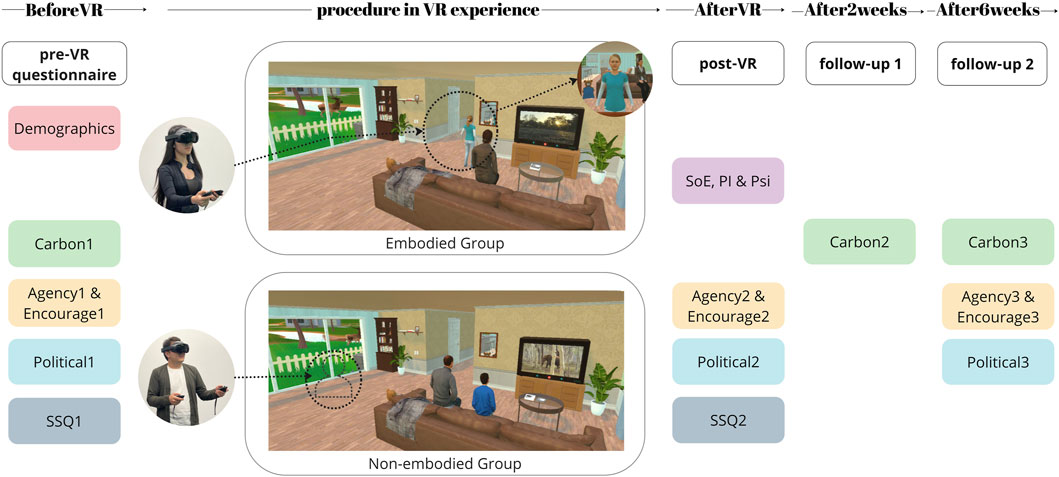
Figure 2. Experimental Procedure. Participants attended three different sessions that included four assessment points when data were collected, which we labelled as (1) Before VR, (2) AfterVR, (3) After 2 Weeks, and (4) After 6 Weeks.
We used selected subscales from the survey of Lubell et al. (2007) to measure a change in the perceived influence on climate change and climate action engagement. This was carried out three times - before the VR exposure, immediately after the exposure, and 6 weeks later. In particular, we measured personal influence (agency) (“I believe my actions have an influence on global warming and climate change.”), and perceived reciprocity (encourage) (“My actions to reduce the effects of global warming and climate change in my community can encourage others to reduce the effects of global warming through their own actions”) on a Likert scale from 1 – strongly disagree to 7 – strongly agree. We also included the six-item Political Participation (political) scale to measure collective climate action, where participants respond Yes/No if they carried out any of the six listed items (such as “contacting a public official about an environmental issue,” “signing an environmental/climate petition or appeal,” or “attending an environmental/climate demonstration or rally”) in the past year (pre-VR questionnaire). In the post-VR questionnaires, we reformulated the instruction. Immediately after the VR exposure, we asked whether participants planned to do them (intention) in the next 12 months (AfterVR) and in the second follow-up, whether they did any of them (actual action) in the last 6 weeks since the VR session (After 6 Weeks) (Figure 2).
2.6.2 Virtual reality experience
Embodiment. The experimental paradigm hinges on establishing a strong sense of body ownership within the Embodied group. After the experiment, participants completed questionnaires assessing the illusion that the virtual body they embodied felt like their own, using a 7-point Likert scale (1 = strongly disagree, 7 = strongly agree). The scale included three items, body ownership: “I felt that the virtual body I saw when looking down at myself was my own body, even though it did not look like me” (medown); “I felt as if it were my body when I looked toward the body reflected in the mirror, even though it did not look like me” (memirror); and agency was measured by “I felt that the movements of the virtual body were caused by my own movements” (mymovements).
Additionally, the paradigm requires a high level of presence in all embodied and non-embodied conditions. Presence encompasses the illusion of being in the virtual environment (Place Illusion, PI) and the perceived reality of the events (Plausibility Illusion, Psi) (Slater, 2009; Slater et al., 2022). Thus, the place illusion (PI) scale included two items: “I felt as if I were in the room that I saw when looking around” (there), and “I felt as if the room I was in was located in the environment that I saw outside the window” (outsidethere). The plausibility illusion (Psi) scale used “I felt as if the events that happened were really happening around me and to me” and “I felt as if the events I saw in the environment outside the window were really happening” (outsidereal). Both were rated on a Likert scale from 1 – strongly disagree to 7 – strongly agree.
The Simulator Sickness Questionnaire (SSQ) questionnaire was administered before and after the VR experience to check whether the participants experienced this during the experiment (Kennedy et al., 1993).
2.6.3 Qualitative data and control measures
To better understand the potential influence of the VR experience on participants, immediately after the exposure, we asked about their impressions during the scenarios, and what effect it had on them, if any. We asked them to comment on their experience of being in the scenario, the passing of time, the sense of realism, and its impact on their thoughts and feelings (about 200 words). We conducted a theme-based content analysis of the answers (Neale and Nichols, 2001). After reading participants’ written responses after their VR experiences, we categorized the data into initial themes, including “Perception of Time,” “Realism and Immersion,” “Emotional Impact,” and “Cognitive and Environmental Awareness,” among others. We quantified the frequency of each theme to determine how prevalent certain types of responses were among participants. We also discuss typical quotes from participants that best illustrated each theme in an effort to vividly convey participants’ experiences and emotional responses.
2.7 Statistical model
We carried out a Bayesian analysis of the response variables,
where
• Period 1 refers to prior to the VR exposure.
• Period 2 refers to immediately after the VR exposure in the case of agency, encouragement and political, and 2 weeks after the VR exposure in the case of carbon footprint.
• Period 3 refers to 6 weeks after the VR exposure.
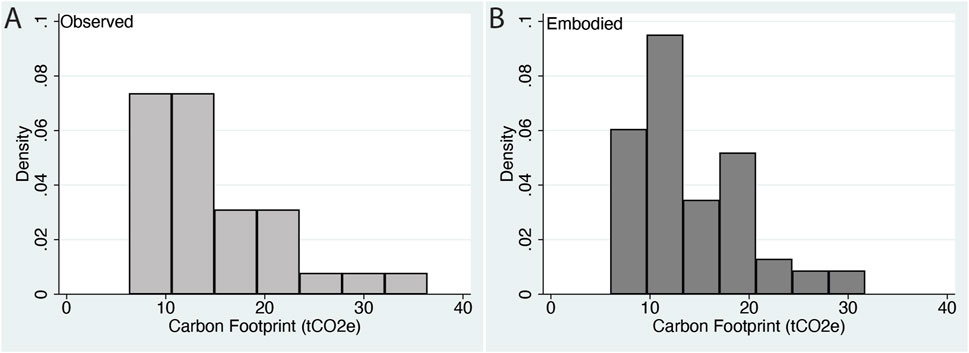
Figure 3. Carbon footprint by condition in period 1 (prior to the VR exposure) (A) For the Observed group (B) For the Embodied group.
The variable
Hence the parameters of the model are:
Putting all this together, the likelihood for the model is:
where
This model is very similar to a classical ANOVA model, except in Bayesian terms, and without the restriction to a normal distribution for the likelihood. As is the case in ANOVA, in order for this model to be estimable (‘identifiable’) we need further constraints on the parameters. A standard one is to set the first values of each parameter to 0:
We use weakly informative prior distributions for the parameters (Lemoine, 2019). These are proper probability distributions but with large variance:
Hence, the prior 95% equal tail credible intervals are [−20, 20]. These are intervals such that the parameters are within the given ranges with 95% probability prior to incorporating the observed data.
The prior distribution for
For personal influence (agency) and perceived reciprocity (engagement), we used an ordered logistic regression model. In this the coefficients for independent variables represent the log odds of being in a higher category of the outcome variable as opposed to all lower categories, given a one-unit increase in the independent variable, holding all other variables constant. Hence a positive coefficient for an independent variable means that higher values of this variable are associated with higher odds of the outcome variable being in a higher category. On the other hand, a negative coefficient indicates that higher values of the independent variable are associated with lower odds of the outcome variable being in a higher category. The magnitude of the coefficient shows the strength of the association between the independent variable and the odds of being in a higher category.
The linear predictors are the same as in Equation 1 and the same prior distributions are used as in Equation 2. Of course, the parameters are different for each of the two response variables, we use the same notation for convenience.
The collective action variable (political) is a count of the number of “yes” items on the 6 questions. For this we used a binomial logistic regression with the binomial parameter (number of ‘trials’) as 6. This is not strictly correct since the binomial model assumes independence between the outcomes, but we use it here as a heuristic first approximation. The linear predictor is the same Equation 1. The prior distributions for the parameters are shown in Equation 2.
Note that one overall model encompasses all of the response variables. This avoids the problem of ‘multiple comparisons’ in null hypothesis testing, where more than one test diminishes the validity of the significance levels, requiring special methods have to be used such as Bonferroni corrections.
We use the Stan probabilistic programming language (https://mc-stan.org) with the R interface rstan (https://mc-stan.org/users/interfaces/rstan). Bayesian solutions use Monte Carlo methods to find posterior distributions. We ran 4 Monte Carlo chains (different processes) each with 8,000 iterations. The results of the 4 chains mixed without problem and the solutions converged.
3 Results
We present the results first descriptively, and then formally using the statistical model defined in the previous section.
3.1 Presence and body ownership
Overall, the illusion of presence was very high both with respect to being in the room, and with respect to the outside scene. There appear to be no differences between the Observed and Embodied groups. The lowest median is 5.5 and all interquartile ranges (IQR) are above 5 (Figure 4A).
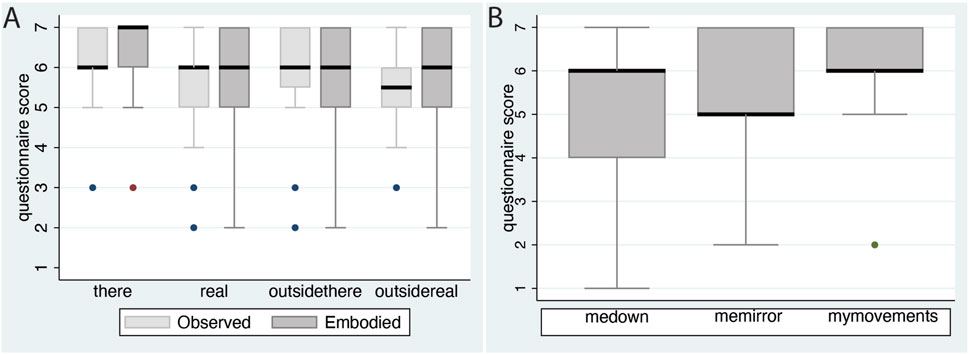
Figure 4. Presence and body ownership. (A) Boxplots of presence by condition. (B) Body ownership for the Embodied condition. Each variable was measured on a Likert 1–7 scale where 1 = “strongly disagree” and 7 = “strongly agree.” The horizontal thick lines are the medians, the boxes the interquartile ranges (IQR), and the whiskers range from max (min value, 25th percentile – 1.5*IQR) to min (max value, 75th percentile +1.5*IQR). Values outside of this range are shown individually.
In the Embodied group, the scores for body ownership and agency were high with the lowest median as 5 and all interquartile ranges above the mid-point of the scale. The mymovements variable, a score on how well the movements of the virtual body followed the movements of the real body, in other words a test of the body tracking, had a median of 6 out of 7, with the whole IQR being at least 6 (Figure 4B). Additionally, simulator sickness was low (M = 2.88, SD = 3.01) and not different between the conditions, and the post-simulator sickness was not different from the baseline.
In this work we are not making inferences about presence or body ownership for the population, rather we needed to check that for this particular sample the responses are high, in other words that the experimental setup worked from this point of view.
3.2 Carbon footprint
Figure 5 shows a reduction in carbon footprint over the 3 time periods. Prior to the VR exposure the Observed and Embodied conditions have approximately the mean same scores, but after 2 weeks there is a reduction in both with a greater reduction in the Embodied condition. After 6 weeks there is a further reduction and still a difference between the conditions, though less pronounced.
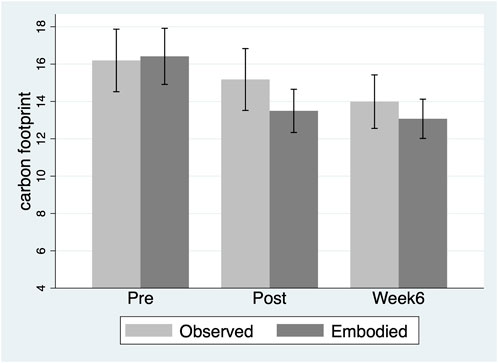
Figure 5. Box plots showing the means and standard errors for carbon footprint over three time periods and by condition (Observed, Embodied). Pre refers to prior to the VR exposure, Post refers to 2 weeks after the exposures and Week 6 refers to 6 weeks after the VR exposure.
3.3 Agency, encouragement and political
Figure 6 shows the results for agency, encouragement and political. In the case of agency there appears to be an increase after 2 weeks, but then a decline at 6 weeks, at least for the Embodied group. There is a similar pattern for encouragement, though with a more pronounced decrease after 6 weeks. In the case of political there is again an increase after 2 weeks but a marked decline after 6 weeks, with no clear difference between Observed and Embodied at any time period.
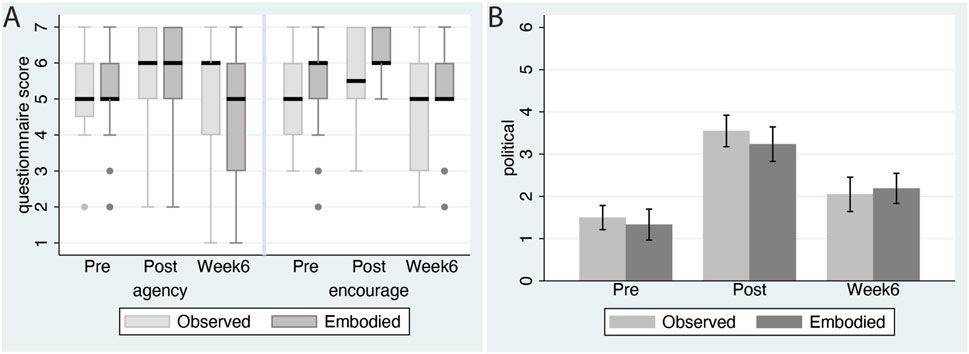
Figure 6. Agency, encouragement and political by condition. (A) Box plots for agency and encouragements. (B) Bar chart showing the means and standard errors for political. Pre refers to prior to the VR exposure, Post refers to immediately after the VR exposure, and Week 6 refers to 6 weeks after the exposure.
3.4 Statistical analysis
In this section we report the results of the statistical model which will allow us to see whether the informal observations in the previous section are supported. Table 2 shows the summaries of the posterior distributions. Note that all effects are relative to the ‘Pre’ condition (period 1). Note that all the credible intervals are substantially narrower than the prior intervals of −20 to 20, indicating the effect of the observed data.
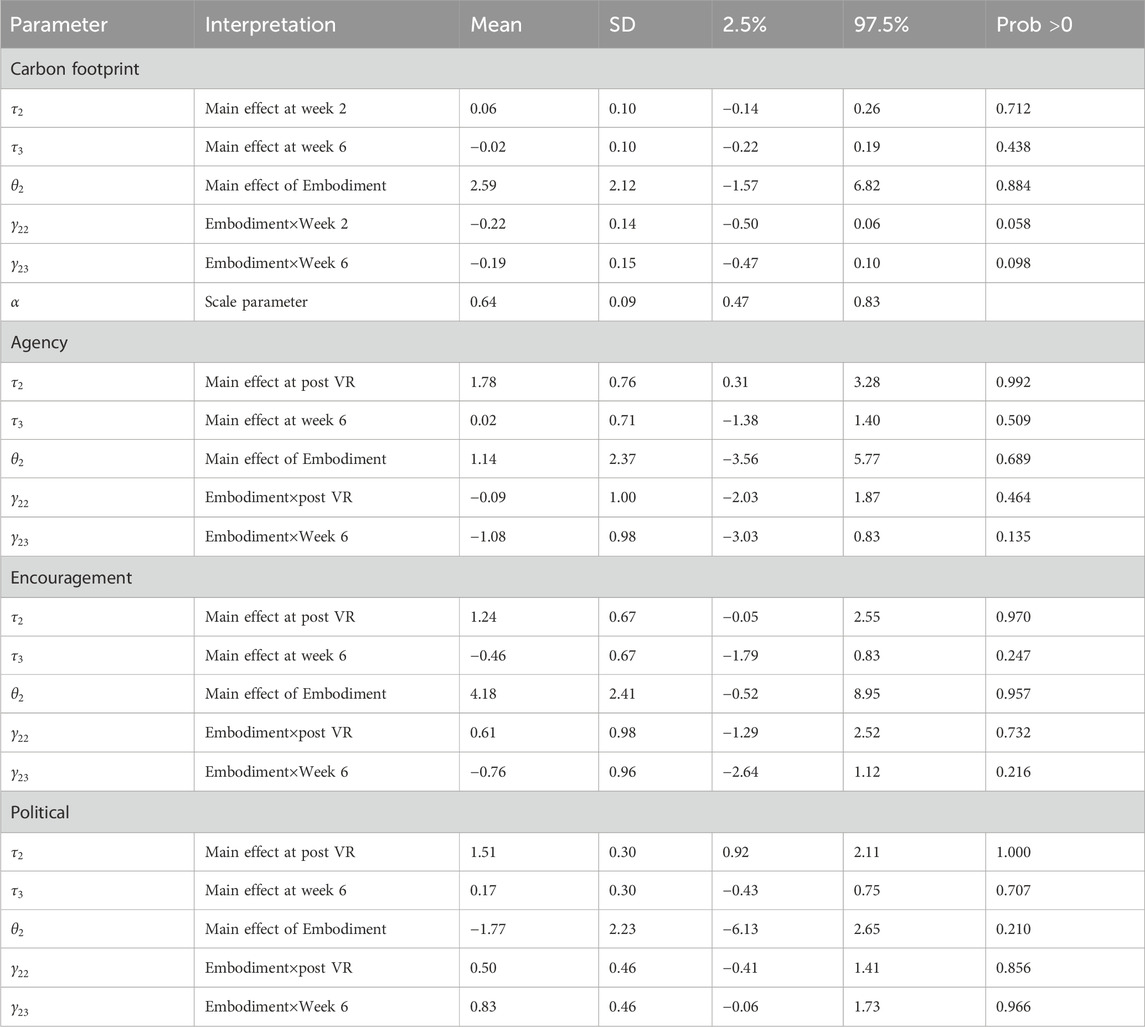
Table 2. Summaries of the posterior distributions of the parameters showing the means, standard deviations and the 95% credible intervals. Prob >0 is the probability that the parameter >0.
The interaction effects for carbon footprint indicate a decrease in the Embodied condition at week 2 (prob = 1 – 0.058 = 0.942) and at week 6 (prob = 1 – 0.098 = 0.902). This supports what can be seen in Figure 5.
For agency there is an increase immediately after the VR shown by the main effect (prob = 0.992), no effect at week 6, and the interaction indicates that there is a decline at week 6 in the Embodied condition. This can be seen in Figure 6A. For encouragement there is an increase immediately after the VR (main effect prob = 0.970) and a main effect of Embodiment irrespective of the period (prob = 0.957). This may be due to the change from Pre to Post in Figure 6A, and there is some evidence of a decline in the Embodiment condition in week 6 (prob = 1 – 0.216 = 0.784) though this probability is considered low.
For political there is a clear increase immediately after the VR (prob = 1.000) and in the Embodiment condition there is an increase after the VR (prob = 0.856) and week 6 (prob = 0.966). This can be seen in Figure 6B, which shows that although there is a decline with respect to period 2, there is still a clear increase in week 6, compared to the “pre” condition.
Overall, we can conclude that there was a decrease in carbon footprint irrespective of condition, with good probability support. For agency and encouragement there is an initial increase immediately after the VR irrespective of condition. For political there is an increase immediately after the VR irrespective of condition, and also in the Embodiment conditions at week 6.
3.5 Analysis of participant essays
We found several key themes through analyzing the participants’ word responses after the VR experience:
3.5.1 Emotional impact
Many participants showed strong emotional reactions during the VR experience. The virtual environment, especially the visualization of climate change, made them concerned about the environmental issues. One participant mentioned, “Seeing the forest fire outside the window while being inside the house gave me a sense of urgency and made me feel like we should be escaping.”
3.5.2 Realism
Most of the participants rated the scenario’s realism highly. This suggests that the virtual environment was convincing enough to engage participants effectively. One participant shared, “The sense of realism in the VR environment made it even more immersive. I feel a genuine connection to the people in the scenario and their struggles.”
3.5.3 Sense of time
Participants noticed a clear transition of time (past, present and future) through different stages of climate change during the VR experience. One participant said,” I could feel the passage of time. Different scenarios, my reflection in the mirror, and the disasters outside the window all made me realize that different things are happening over time, both on a personal level and on a larger scale.” Additionally, observing how their avatars grow up and age triggered a source of additional reflection: “During the middle-age phase, I was extremely curious about my virtual body. Being in my twenties, I’d never experienced an older body, so I observed myself in the mirror for a long time.”
3.5.4 Awareness
Participants showed a high level of awareness of their actions and surroundings, indicating that they were actively engaged with the content. One participant said, “I suddenly feel that VR really has the potential to change things. The world turning terrible makes me feel helpless and consider reducing my consumption. In the last scenario, I took a deep breath and thought, ‘There’s still a chance to see the snow-capped mountains.”
3.5.5 Environmental concern
Some participants expressed a higher environmental concern after the experience. One participant said, “My thoughts on environmental protection are still quite limited, but I’ve started to concern the issue. Perhaps, I’ll pay more attention to it in my daily life.”
3.5.6 Connection with personal experience
Some of participants found the connections which related the VR scenarios to their personal experiences, such as the California wildfires and heatwaves in London. These connections deepened their emotional responses to the VR experience. One participant commented, “It was made clear to me that with each scene change, there were things that could happen and called to mind the fires California has been experiencing recently.”
3.5.7 Embodiment and interactivity
Participants in the embodied condition felt more immersed, but some reported technical issues with the avatar movements, which broke their immersion. Besides, the ability to interact with objects enhanced engagement for many participants, though some noted that bugs in the interactions occasionally disrupted the sense of realism. One said, “Most objects in the environment were interactive and felt very realistic. That is, until I threw the teddy bear onto the couch, after which my attention shifted from the environment to some small bugs.” This can be considered as a loss of Plausibility.
In any event, we observed that there was a change regardless of the previous attitudes and their baseline levels of concern. Those who had not cared about climate change before reported that the scenario made them think and pay more attention, as one participant commented, “Experiencing the scenes personally made me realize the importance of environmental protection for the first time.” While those who reported previous awareness of the problem, declared they would take more significant action, as one said, “It was impactful, and though I already take the climate emergency seriously, this made it seem even more urgent.”
4 Discussion
It has been shown multiple times that VR can change people’s attitudes and behaviors, as discussed in the examples about age and racial bias above. Here we have demonstrated that this is true also for such complex phenomena as climate change-related attitudes and actions. In particular, we found that the VR experience led to a reduction in individual carbon footprint in both conditions. Importantly, perceived influence on climate change increased immediately post-VR exposure and was maintained after 6 weeks, with no differences between conditions, suggesting that merely witnessing a potentially catastrophic future and a hope-giving final message is enough to empower people.
Importantly, participants felt that their actions may encourage others to become involved in climate action. Here, immediately after the exposure, we observed a strong effect of embodiment, which was not present 6 weeks later. The baseline beliefs related to climate change and the role of anthropogenic activity in it could have influenced participant’s reactions to the scenario. Although we did not explicitly ask participants about their attitudes before the VR experience, in the open question many of them compared their pre- and post-exposure opinions. This shift in perceived influence on their own and other’s behavior seemed to translate into action, as there was an overall increase for political action immediately (which measured the willingness to take action) and 6 weeks later (which measured the actual action taken compared to pre-VR baseline). Overall, these results suggest that both conditions empowered participants, consequently leading to their active involvement in climate change-related activities, both individually and collectively. Moreover, several participants mentioned how the virtual experience reminded them of real-world events, such as the California wildfires or the heatwaves in London. These personal connections appeared to enhance the emotional impact of the VR scenario, making it feel more immediate and relevant. This suggests that incorporating real-world references or relatable scenarios can further engage participants and deepen the emotional resonance of the VR experience.
Overall, the scenarios generated high levels of presence and body ownership. Additionally, participants appreciated the ability to interact with objects (a TV, mug, teddy bear) in the virtual environment, but they reported that errors or delays in object interactions also decreased immersion. These findings emphasize the importance of smooth embodiment and interactivity to maintain the plausibility of the virtual experience.
Metaverse(s) may become an important source of entertainment and education, where participants will experience reconstructions of past events and simulations of the future in which they can actively engage. The aim of the study was to investigate the influence of such a climate change simulation on attitudes and behavior. It would be interesting to study whether the same effects would be observed in a social metaverse, where several people could jointly share such educational experiences. We speculate that participating in such simulation with others, especially those familiar or close to the participant, could have potentially much stronger impact, in particular with personalized rather than generic avatars ageing along the timeline. Participants may find the experience much more personal and effective, since personal responsibility to reduce climate change is associated with various climate actions (Bouman et al., 2020).
The experience was not an explicit tutorial. Instead of lecturing to people about climate change, we aimed at offering a first-person experience of the effects of climate change now and in the future, and the purpose was to see if this would result in a change in attitudes and behavior. The information of how to behave more pro-environmentally is easily accessible and rather well-known, while the real challenge is to change actual habits, values, and emotions (Graves and Roelich, 2021).
Climate change is a complex, multifaceted process, which cannot be mitigated without engaged and proactive citizens, political leaders, and organizations. Both individual and collective action are necessary to reduce global greenhouse gas emissions, which needs to happen urgently. Yet, there is a large gap between the proportion of the population expressing concern about climate change and those actually engaged in any form of climate change activism, due to both individual and social-contextual barriers. Latkin et al. (2023) found a clear need to make the anticipated impacts of climate change continuously salient in people’s lives, as only one in five respondents reported that the topic of climate change was “extremely important” or “very important,” while almost one-third said that climate change was not a topic that they frequently think about. Virtual reality – and the future metaverse – is an excellent tool to change this, since it makes climate change a tangible and personal experience. This has been demonstrated for explicit climate change education (Queiroz et al., 2018; Brown et al., 2021; Levy and Liu, 2022; Cho and Park, 2023). A novel aspect of our study was the demonstration of how climate change affects a person throughout their lifespan – first a child, then as a young person and then as a middle-aged adult. It is believed that “legacy thinking” may be a useful strategy to engage people in climate change mitigation (Frumkin et al., 2012) and such deliberation can enhance the capacity to consider future generations’ perspectives and motivate people to ensure their wellbeing (Kulha et al., 2021). We argue that our future-directed scenario may have strengthened this type of concern.
Climate change may trigger anxiety, especially in young people. However, participants were free to leave at any moment without giving reasons, though none did so. Importantly, the final scene in our study was intentionally optimistic and presented real-life examples of massive protests as if they had happened in the relatively distant past around the world to balance the negative experience of previous scenes (50 years ago from the perspective of the scenario but in reality, now). However, these types of environments caused by climate change in first three scenes may possibly act as negative triggers for some participants. We do not know what role the final scene played in the overall effects, but there is evidence that constructive hope drives climate advocacy (Nabi et al., 2018) and pro-environmental behavioral change, unlike hope based on denial (Ojala, 2023). Further studies are necessary to confirm which element of embodied time travel increases the engagement in climate action in the most effective way.
Participants had one exposure in our multi-generational scenario spread over several decades – from being a child or teenager interacting with a parent, through to being the parent interacting with a child, and finally far into the future interacting with an older person who had participated in climate change demonstrations. However, a single exposure may not be enough to lead to a lasting change. It is possible that the experience itself of a catastrophic future was particularly disturbing, as some people experienced the simulated climate change consequences personally. Nonetheless, there were certain short-term differences, especially for the perceived influence on others, which suggests that immediately after the exposure participants were more impacted by the embodied experience, but in the long-term they had a similar impact on real-life behavior as the non-embodied for some of the responses. It might be thought that the changes in scenario and changes in age through the experience might have acted as a distractor. However, experiencing themselves at different ages was a critical part of the experimental design. They were taken through different time periods, and their bodies had to reflect this. Additionally, the experience was hard to ignore, since it was surrounding the participant and was also reflected in the mirror so that they could see what was happening behind them.
There were two main shortcomings of the study. First, we could only measure declarative behavioral change, as no objective (external) measurements were available. We tried to mitigate this limitation by using a carbon footprint calculator, which quantifies human behavior, and by collecting post-exposure data twice. Future studies should consider exploring other measures of behavioral change, less sensitive to bias and social desirability effects. Another shortcoming was the sample, as we recruited students on the campus. Thus, the obtained results should be replicated on a larger and more heterogeneous sample. Nevertheless, we have demonstrated that the simulation of climate change scenarios can be a useful tool for increasing climate action, albeit further studies are needed to understand its effectiveness.
Data availability statement
The raw data supporting the conclusions of this article will be made available by the authors, without undue reservation.
Author contributions
YP: Data curation, Investigation, Project administration, Software, Visualization, Writing–original draft, Writing–review and editing. XP: Supervision, Writing–review and editing, Funding acquisition, Data curation. MS: Conceptualization, Data curation, Formal Analysis, Funding acquisition, Methodology, Supervision, Writing–review and editing. JŚ: Resources, Supervision, Writing–review and editing, Methodology.
Funding
The author(s) declare that financial support was received for the research, authorship, and/or publication of this article. This work received support from the Economic and Social Research Council (ES/W003120/1) to YP and XP, and the Arts and Humanities Research Council (AH/T011416/1) to XP. MS is partially supported by the European Union-funded Horizon Europe project “environMENTAL” (101057429) and co-funding by United Kingdom Research and Innovation under the United Kingdom Government’s Horizon Europe funding guarantee (10041392 and 10038599) and the Ministry of Science and Technology of China (MOST) National Key Project of “Inter-governmental International Scientific and Technological Innovation Cooperation” (2023YFE0199700). Views and opinions expressed are however those of the author(s) only and do not necessarily reflect those of the European Union, the European Health and Digital Executive Agency (HADEA) or UKRI. Neither the European Union nor HADEA nor UKRI can be held responsible for them.
Acknowledgments
ChatGPT 4o from OpenAI was used to improve the English writing in the first draft version.
Conflict of interest
MS is a founder member of the spin-off company Virtual Bodyworks which specializes in using Virtual Reality in the context of DEI, therefore unrelated to the topic of this paper.
The authors declare that the research was conducted in the absence of any commercial or financial relationships that could be construed as a potential conflict of interest.
The author(s) declared that they were an editorial board member of Frontiers, at the time of submission. This had no impact on the peer review process and the final decision.
Publisher’s note
All claims expressed in this article are solely those of the authors and do not necessarily represent those of their affiliated organizations, or those of the publisher, the editors and the reviewers. Any product that may be evaluated in this article, or claim that may be made by its manufacturer, is not guaranteed or endorsed by the publisher.
Supplementary material
The Supplementary Material for this article can be found online at: https://www.frontiersin.org/articles/10.3389/frvir.2024.1499835/full#supplementary-material
Footnotes
1Videos in Scene1: Wild Life Nature Documentary: https://www.youtube.com/watch?v=7jUW96CiEKA; Videos in Scene2: Climate change BBC record: https://www.youtube.com/watch?v=vdJmyhqElTc.
2Videos in Scene 4: https://www.youtube.com/watch?v=H9bc0sbqIGA, https://www.youtube.com/watch?v=AzI6Yti5aAM, https://www.youtube.com/watch?v=IQk8iXKvl_A.
3https://footprint.wwf.org.uk/questionnaire
4https://www.wwf.org.uk/our-reports/footprint-calculator-report-2023
References
Banakou, D., Beacco, A., Neyret, S., Blasco-Olivera, M., Seinfeld, S., and Slater, M. (2020). Virtual body ownership and its consequences for implicit racial bias are dependent on social context. R. Soc. Open Sci. 7, 201848. doi:10.1098/rsos.201848
Banakou, D., Groten, R., and Slater, M. (2013). Illusory ownership of a virtual child body causes overestimation of object sizes and implicit attitude changes. PNAS 110, 12846–12851. doi:10.1073/pnas.1306779110
Bedder, R. L., Bush, D., Banakou, D., Peck, T., Slater, M., and Burgess, N. (2019). A mechanistic account of bodily resonance and implicit bias. Cognition 184, 1–10. doi:10.1016/j.cognition.2018.11.010
Bergquist, M., Nilsson, A., and Schultz, P. W. (2019). Experiencing a severe weather event increases concern about climate change. Front. Psychol. 10, 220. doi:10.3389/fpsyg.2019.00220
Bouman, T., Verschoor, M., Albers, C. J., Böhm, G., Fisher, S. D., Poortinga, W., et al. (2020). When worry about climate change leads to climate action: how values, worry and personal responsibility relate to various climate actions. Glob. Environ. change 62, 102061. doi:10.1016/j.gloenvcha.2020.102061
Brown, B., Pérez, G., Ribay, K., Boda, P. A., and Wilsey, M. (2021). Teaching culturally relevant science in virtual reality:“When a problem comes, you can solve it with science”. J. Sci. Teach. Educ. 32, 7–38. doi:10.1080/1046560X.2020.1778248
Cho, Y., and Park, K. S. (2023). Designing immersive virtual reality simulation for environmental science education. Electronics 12, 315. doi:10.3390/electronics12020315
Cowie, D., Mckenna, A., Bremner, A. J., and Aspell, J. E. (2018). The development of bodily self-consciousness: changing responses to the Full Body Illusion in childhood. Dev. Sci. 21, e12557. doi:10.1111/desc.12557
Deringer, S. A., and Hanley, A. (2021). Virtual reality of nature can be as effective as actual nature in promoting ecological behavior. Ecopsychology 13, 219–226. doi:10.1089/eco.2020.0044
El Garroussi, S., Di Giuseppe, F., Barnard, C., and Wetterhall, F. (2024). Europe faces up to tenfold increase in extreme fires in a warming climate. npj Clim. Atmos. Sci. 7, 30. doi:10.1038/s41612-024-00575-8
Frumkin, H., Fried, L., and Moody, R. (2012). Aging, climate change, and legacy thinking. Am. J. public health 102, 1434–1438. doi:10.2105/AJPH.2012.300663
Graves, C., and Roelich, K. (2021). Psychological barriers to pro-environmental behaviour change: a review of meat consumption behaviours. Sustainability 13, 11582. doi:10.3390/su132111582
Harris, V., West, C., and Owen, A. (2021). WWF-UK carbon footprint calculator. Available at: https://www.wwf.org.uk/sites/default/files/2022-05/WWFFootprintCalculator-MethodologyDocument-2021.pdf.
Hershfield, H. E., Goldstein, D. G., Sharpe, W. F., Fox, J., Yeykelis, L., Carstensen, L. L., et al. (2011). Increasing saving behavior through age-progressed renderings of the future self. J. Mark. Res. 48, S23–S37. doi:10.1509/jmkr.48.spl.s23
Hofman, K., Walters, G., and Hughes, K. (2022). The effectiveness of virtual vs real-life marine tourism experiences in encouraging conservation behaviour. J. Sustain. Tour. 30, 742–766. doi:10.1080/09669582.2021.1884690
Kenis, A., and Mathijs, E. (2012). Beyond individual behaviour change: the role of power, knowledge and strategy in tackling climate change. Environ. Educ. Res. 18, 45–65. doi:10.1080/13504622.2011.576315
Kennedy, R. S., Lane, N. E., Berbaum, K. S., and Lilienthal, M. G. (1993). Simulator sickness questionnaire: an enhanced method for quantifying simulator sickness. Int. J. Aviat. Psychol. 3, 203–220. doi:10.1207/s15327108ijap0303_3
Kilteni, K., Groten, R., and Slater, M. (2012). The sense of embodiment in virtual reality. Presence Teleoperators Virtual Environ. 21, 373–387. doi:10.1162/PRES_a_00124
Kulha, K., Leino, M., Setälä, M., Jäske, M., and Himmelroos, S. (2021). For the sake of the future: can democratic deliberation help thinking and caring about future generations? Sustainability 13, 5487. doi:10.3390/su13105487
Latkin, C., Dayton, L., Bonneau, H., Bhaktaram, A., Ross, J., Pugel, J., et al. (2023). Perceived barriers to climate change activism behaviors in the United States among individuals highly concerned about climate change. J. Prev. 44, 389–407. doi:10.1007/s10935-022-00704-0
Lee, H., Calvin, K., Dasgupta, D., Krinner, G., Mukherji, A., Thorne, P., et al. (2024). CLIMATE CHANGE 2023 synthesis report summary for policymakers. Available at: https://ntrs.nasa.gov/citations/20230009518.
Lemoine, N. P. (2019). Moving beyond noninformative priors: why and how to choose weakly informative priors in Bayesian analyses. Oikos 128, 912–928. doi:10.1111/oik.05985
Levy, J., and Liu, D. (2022). “Extended Reality (XR) environments for flood risk management with 3D GIS and open source 3D graphics cross-platform game engines: advances in immersive sea level rise planning technologies for student learning and community engagement,” in International conference on intelligent technologies (Springer), 271–285. doi:10.1007/978-981-99-1912-3_25
Lubell, M., Zahran, S., and Vedlitz, A. (2007). Collective action and citizen responses to global warming. Polit. Behav. 29, 391–413. doi:10.1007/s11109-006-9025-2
Maister, L., Slater, M., Sanchez-Vives, M. V., and Tsakiris, M. (2015). Changing bodies changes minds: owning another body affects social cognition. Trends Cognitive Sci. 19, 6–12. doi:10.1016/j.tics.2014.11.001
Markowitz, D. M., Laha, R., Perone, B. P., Pea, R. D., and Bailenson, J. N. (2018). Immersive virtual reality field trips facilitate learning about climate change. Front. Psychol. 9, 2364. doi:10.3389/fpsyg.2018.02364
Nabi, R. L., Gustafson, A., and Jensen, R. (2018). Framing climate change: exploring the role of emotion in generating advocacy behavior. Sci. Commun. 40, 442–468. doi:10.1177/1075547018776019
Neale, H., and Nichols, S. (2001). Theme-based content analysis: a flexible method for virtual environment evaluation. Int. J. human-computer Stud. 55, 167–189. doi:10.1006/ijhc.2001.0475
Ojala, M. (2023). Hope and climate-change engagement from a psychological perspective. Curr. Opin. Psychol. 49, 101514. doi:10.1016/j.copsyc.2022.101514
Queiroz, A. C. M., Kamarainen, A. M., Preston, N. D., and Da Silva Leme, M. I. (2018). “Immersive virtual environments and climate change engagement,” in Proceedings of the immersive learning research network. doi:10.3217/978-3-85125-609-3-27
Ridder, N., Ukkola, A., Pitman, A., and Perkins-Kirkpatrick, S. (2022). Increased occurrence of high impact compound events under climate change. Npj Clim. Atmos. Sci. 5, 3. doi:10.1038/s41612-021-00224-4
Slater, M. (2009). Place Illusion and Plausibility can lead to realistic behaviour in immersive virtual environments. Philos. Trans. R. Soc. Lond 364, 3549–3557. doi:10.1098/rstb.2009.0138
Slater, M. (2017). “Implicit learning through embodiment in immersive virtual reality,” in Virtual, augmented, and mixed realities in education. Editors D. Liu, C. Dede, R. Huang, and J. Richards (Singapore: Springer).
Slater, M., Banakou, D., Beacco, A., Gallego, J., Macia-Varela, F., and Oliva, R. (2022). A separate reality: an update on place illusion and plausibility in virtual reality. Front. Virtual Real 3. doi:10.3389/frvir.2022.914392
Slater, M., Spanlang, B., Sanchez-Vives, M. V., and Blanke, O. (2010). First person experience of body transfer in virtual reality. PLOS ONE 5, e10564. doi:10.1371/journal.pone.0010564
Soliman, M., Peetz, J., and Davydenko, M. (2017). The impact of immersive technology on nature relatedness and pro-environmental behavior. J. Media Psychol. 29, 8–17. doi:10.1027/1864-1105/a000213
Spangenberger, P., Geiger, S. M., and Freytag, S.-C. (2022). Becoming nature: effects of embodying a tree in immersive virtual reality on nature relatedness. Sci. Rep. 12, 1311. doi:10.1038/s41598-022-05184-0
Tasker, S., and Wentworth, J. (2024). Wildfire risks to UK landscapes. Available at: http://nflg.co.uk/files/POST-PN-0717.pdf.
Unsworth, K. L., and Mcneill, I. M. (2017). Increasing pro-environmental behaviors by increasing self-concordance: testing an intervention. J. Appl. Psychol. 102, 88–103. doi:10.1037/apl0000155
Whitmarsh, L., Poortinga, W., and Capstick, S. (2021). Behaviour change to address climate change. Curr. Opin. Psychol. 42, 76–81. doi:10.1016/j.copsyc.2021.04.002
Keywords: climate change, virtual reality, embodiment, environmental attitudes, time travel
Citation: Pi Y, Pan X, Slater M and Świdrak J (2025) Embodied time travel in VR: from witnessing climate change to action for prevention. Front. Virtual Real. 5:1499835. doi: 10.3389/frvir.2024.1499835
Received: 21 September 2024; Accepted: 05 December 2024;
Published: 07 January 2025.
Edited by:
Maria Limniou, University of Liverpool, United KingdomReviewed by:
Valeria Orso, University of Padua, ItalyMartin Dobricki, University of Teacher Education Bern, Switzerland
Copyright © 2025 Pi, Pan, Slater and Świdrak. This is an open-access article distributed under the terms of the Creative Commons Attribution License (CC BY). The use, distribution or reproduction in other forums is permitted, provided the original author(s) and the copyright owner(s) are credited and that the original publication in this journal is cited, in accordance with accepted academic practice. No use, distribution or reproduction is permitted which does not comply with these terms.
*Correspondence: Mel Slater, bWVsc2xhdGVyQHViLmVkdQ==; Justyna Świdrak, c3dpZHJha0ByZWNlcmNhLmNsaW5pYy5jYXQ=