PK
pawel kiper
Healthcare Innovation Technology Lab, San Camillo Hospital (IRCCS)
Venezia, Italy
5,982
Total downloads
33k
Total views and downloads
Submit your idea
You will be redirected to our submission process.
This is the second volume of the Research Topic titled 'New approaches for central nervous system rehabilitation'. You can find the first volume here.
Motor rehabilitation is a complex and growing field within neurorehabilitation. It is specifically directed to apply restorative techniques to stimulate neural plasticity in the motor domain of the central nervous system (CNS). Here we can distinguish a wide range of approaches developed for CNS motor recovery in acute, subacute, or chronic stage of injury.
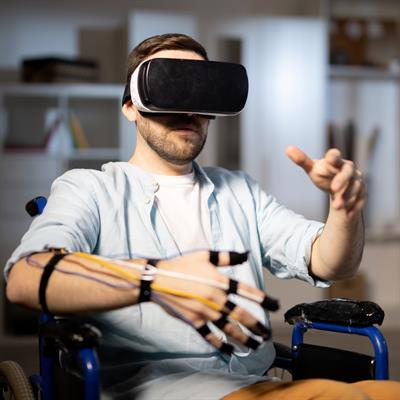
Because the plateau of neuroplasticity can be observed after about 12 weeks from stroke onset it is important to capitalize on this high level of brain reorganization by providing well-timed and well-designed treatments. Considering that neuroplasticity is maintained for the whole human life and can be stimulated through specific learning or exposure to enriched environments far beyond an early phase of elevated post-injury plasticity, we can hypothesize that applying specific treatments can also be beneficial for people in the chronic phase after CNS injury. These approaches comprise priming or augmentation techniques, including innovative technologies like virtual reality or end-effector robots, exoskeletons, or non-invasive brain stimulation. Many of them have been confirmed as effective, but so far in clinical practice, we can still experience a lack of specific indications i.e., which therapy for how long time and for which patient’s impairment can successfully be applied.
Thus, the goal of this Research Topic is to explore new neurorehabilitative ideas and approaches, or modifications of already existing techniques for motor rehabilitation that can be applied to patients with CNS injury (stroke, TBI). The scope of the Research Topic will include new neurorehabilitative ideas, approaches, or modifications of already existing techniques, identification of research or clinical gaps including predictive research for treatments and recovery.
All kinds of articles that Frontiers accepts will be considered, including but not limited to original research articles and systematic reviews. Reviews oriented to show research gaps in the context of neurological patients’ treatment also will be considered.
This Research Topic accepts the following article types, unless otherwise specified in the Research Topic description:
Articles that are accepted for publication by our external editors following rigorous peer review incur a publishing fee charged to Authors, institutions, or funders.
Keywords: neurorehabilitation, robotics, virtual reality, exoskeletons, priming techniques, augmented techniques, new treatment modality, new approaches for neurorehabilitation, neurology, sensory-motor integration, recovery prediction.
Important note: All contributions to this Research Topic must be within the scope of the section and journal to which they are submitted, as defined in their mission statements. Frontiers reserves the right to guide an out-of-scope manuscript to a more suitable section or journal at any stage of peer review.
Healthcare Innovation Technology Lab, San Camillo Hospital (IRCCS)
Venezia, Italy
University of Rzeszow
Rzeszów, Poland
Faculty of Health Sciences, Jan Długosz University
Częstochowa, Poland
Department of Physiotherapy, University of Seville
Seville, Spain
Manuscripts can be submitted to this Research Topic via the main journal or any other participating journal.
Submit your idea
You will be redirected to our submission process.