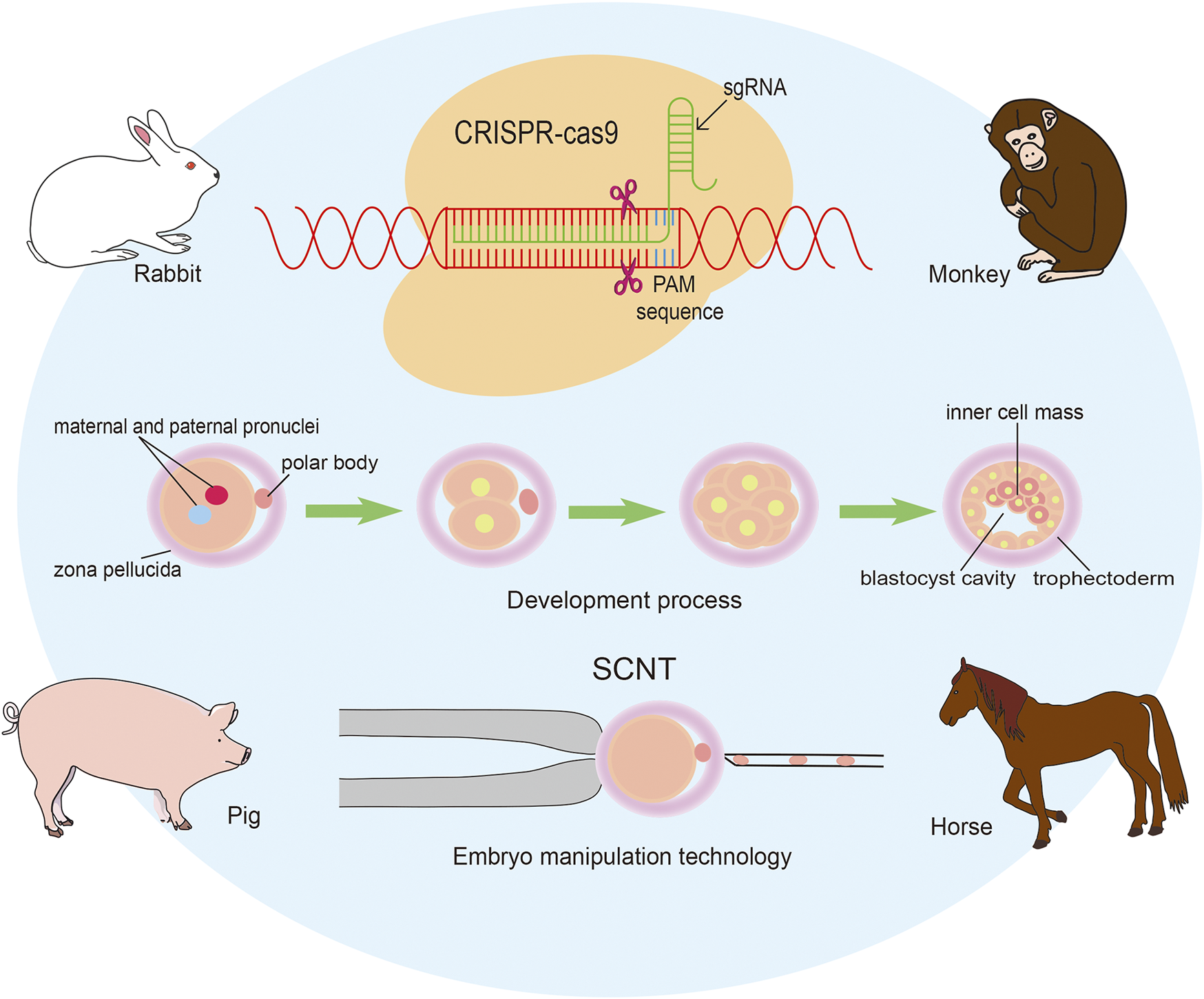
We have a great pleasure to organize the Research Topic "Applying large Animals for Developmental Study and Disease Modeling". It is well known that large animals show similarities in many physical and pathological characteristics with human beings and have numerous advantages in developmental and medical research. In recent years, an important breakthrough has been achieved in gene editing technique, including ZFN, TALEN, CRISPR/Cas9, and so on. Especially for the coming out of CRISPR/Cas9 mediated gene modification strategies, various types of human diseases have been recapitulated in large animal models. It has to be mentioned that the progress in establishing embryonic stem cells and inducible pluripotent stem cells is also critical for the application in diseases modeling and therapies. In our Research Topic more than ten papers have been collected, and most of them focus on pig, monkey, rabbit and horse (Figure1).
The pig, as one of the most common livestock, exhibits several advantages in biomedical research. These are: comparable human and pig body sizes, similar anatomical and physiological characteristics, genomic composition and ordinary diets (1). It makes the pig a promising alternative animal model alternative for humans. Rapid growth rate, early sexual maturity, short generation intervals, high number of offspring per litter, and standardized breeding techniques, also make easier the application of pigs in the study on human diseases.In recent decades, the advances in technologies contribute to the development of genetically engineered pig models of human diseases. The come out of somatic cell nuclear transfer (SCNT) and reliable genome editing techniques make possible for the generation of porcine models of human diseases. The efficacy of porcine SCNT has been largely improved and several kinds of small molecular inhibitors have been applied to enhance the developmental competence of SCNT embryos (1,2). CRISPR/Cas9-mediated gene editing strategies are widely used in the establishment of porcine models of human diseases. Various genomic genetically engineered pigs have been generated, including chimeric gene knock in, point mutations, large genome fragment deletions, multifunctional live cell sensors etc.
Nonhuman primates (NHP) emerge increasingly as the excellent models for translational research, due to even closer proximity to human beings in terms of physiology, biochemistry, immunology, pathology and genetic evolution. For example, NHP models are widely used in studies on Severe Acute Respiratory Syndrome Coronavirus 2 (SARS-CoV-2). In fact, NHP models of HIV, ZIKV or Ebola virus infection show to mirror closely the pathogenesis in human patients. SCNT monkeys have been successfully produced using fetal fibroblasts as donor cells in recent years (7). Furthermore, BMAL1 gene-edited monkeys via the CRISPR/Cas9 technique were generated with both intracytoplasmic sperm injection and SCNT method (8,9). Cynomolgus monkey blastoids resembling blastocysts in morphology and transcriptomics using naive ESC develop to embryonic disk with the structures of yolk sac, amnion cavity, chorionic cavity and primitive streak via prolonged in vitro culture (10), making it possible to investigate primate embryonic development without the same ethical concerns touching humans. There are various NHP models of human diseases have been established in recent years, including bilaterally delivering synthetic Aβ oligomers into the cerebral parenchyma of cynomolgus monkeys to drive early pathological progression of Alzheimer's disease (11).However, in the near future, researchers might face monkey shortage crisis (12). In the Research Topic, Weizheng Liang et al. summarizes the recent progress in using genomic editing technology in the establishment of NHP models and discusses the factors limiting the wide application of NHP models of human diseases (13).
Rabbit is another commonly used experimental model for investigating equivalents of human diseases. With the emergence of microinjecting, SCNT and genomic editing technology, a large number of rabbit models of human diseases were established. The pronuclear microinjection is still the most common method in the construction of transgenic rabbit models. Novel genomic editing technologies, such as CRISPR/Cas9, remarkably promote the precision in rabbit genome manipulation (14). In the previous studies, CRISPR/Cas9 technique was applied to introduce mutation of αA-Crystallin or GJA8 gene to induce congenital cataracts in Rabbits (15,16). Recently, SpRY-ABEmax mediated base substitution has been used to generate YIPF5 (p.W218R) mutation to construct rabbit primary microcephaly model, which precisely recapitulate the typical symptoms of human primary microcephaly (17). With recent technological innovations in genomic editing techniques, rabbit models will certainly play a much more important role in the study on human diseases. In our Research Topic, a carrageenan-induced abdominal aortic adventitial inflammatory model in hypercholesterolemic rabbits is described (18). It determines the role of MMP-12 secreted from adventitial macrophages in the pathogenesis of this diseases (18).
Horses are commonly used as animal models for studying several human diseases, including neurodegenerative diseases, mental and behavioral disorders, neuropsychiatric disorders and spontaneous sepsis. Using SCNT and genomic editing technology to construct horse models of human diseases seems to be less attractive than porcine and rabbit models. However, the rapid development in horse models have been achieved in recent years. A recent report has announced that a total of 12 SCNT foals were born (19), and gene-edited horse embryos have been generated by CRISPR/Cas9 technology (20). In our Research Topic, Neil Marr et al. utilized immunolabelling for CD146 to determine horse tendon cell population, providing the intrinsic evidences for the relationships between local interfascicular matrix vascular and basement membrane constituents (21).
Modeling" delivers a whole plethora of excellent examples of the fascinating progress made recently in this field of biomedical research.
The authors declare that the research was conducted in the absence of any commercial or financial relationships that could be construed as a potential conflict of interest.
LY and YH drafted the manuscript, YH revised the draft, FY, JK and SW made substantial

