Network-based Mathematical Modeling in Cell and Developmental Biology

Cover image for Research Topic "Network-based Mathematical Modeling in Cell and Developmental Biology"
59kviews
Editorial12 August 2024
Editorial: Network-based mathematical modeling in cell and developmental biology

The Research Topic on Network-based Mathematical Modeling in Cell and Developmental Biology raised various subjects of interest for mathematical modelers that also provide insight for future studies by bench scientists. In essence, three themes emerged and will be discussed below. First, the crucial and essential topic of reproducibility of published models was addressed. Secondly, novel mathematical and computational approaches enabled a deeper understanding of biological systems. A third theme arose through the significant efforts aimed at creating whole cell models and downstream applications.

Enhancing reproducibility through rigor and transparency is a long-term goal of NIH (Collins & Tabak, 2014) and other agencies such as NSF. Wet-lab experiments can be difficult to reproduce because of variations in the conditions. Are models, essentially computational experiments, easily reproducible? Guided by FAIR principles (Findable, Accessible, Interoperable, and Reusable), Pedro Mendes examined a highly cited mathematical model that described segment polarity in Drosophilia published by Von Dassov et al. in 2000. The unavailability of the original software forced the author to recode the model, which was a labor-intensive process that required de novo model implementation. The major take-home message from the report is that publication of mathematical models in a widely used standard format is essential, as only this will ensure the model is reproducible in the future.

Several novel mathematical approaches were taken by investigators to better understand cellular reaction networks. Marrone and colleagues described the use of nullclines, curves on a plane that are solutions to the differential equations, for analysis of systems with more than two variables. The authors followed Zhang et al. (2011) in considering pseudo-nullclines (an analog of nullclines for a system that can be decomposed into 2 modules) and used them to reproduce the dynamics of several well-known systems such as the embryonic cell cycle and MAPK cascade. Glazer and colleagues developed a new Monte Carlo Boolean Modeler (MC-Boomer) method to generate large (hundreds of thousands) collections of Boolean models whose simulations agree with observed data. A pipeline for analyzing these models and discovering novel regulatory interactions was developed and applied to a well-known model of the Drosophila segment polarity network (Albert & Othmer, 2003). Analysis of the models generated by MC-Boomer can be used to identify alternate hypotheses for the gene regulatory mechanism that could be then experimentally validated. Eidi and colleagues used stochastic modeling to investigate the spatial arrangement of cell types during stem cell division, governed by two Turing signaling patterns. Their model predicts the pattern of the differentiated cells and identifies the signaling patterns that influenced the formation of the cellular structure.

Biological networks are usually described as graphs with nodes representing biological entities (e.g., genes, proteins, functional complexes) and connecting edges representing influences on their behavior. Thus, graph-theoretical methods are under constant development, as illustrated by the two manuscripts in this issue. Nam and Gunawardena introduced the linear framework - a graph-theoretic approach to analyzing biomolecular systems described by continuous time Markov processes, such as post-translational modification and gene regulation. The nodes represented individual molecular states and edges represented the probabilities of transitions between molecular states. This report described the application of linear frameworks before the steady state was reached. Specifically, the authors showed that the properties of the First Passage Time (FPT) were functions of the edge labels. The FPT defined a timescale of single-molecule kinetics, such as the enzyme’s completion time, and the approach described by the authors can be used for the analysis of real-time single-molecule data. Lecca et al. represented a biological network as a system of springs, in which the nodes constituted the masses and the edges were springs that connected these masses. Further, they defined latent geometry through the embedding of the spring network model into the metric space (Euclidean, hyperbolic, and spherical). Geometric properties of the embedded network (such as nodes clustering according to their radial coordinates) can be used for the analysis of the original biological network. The authors analyzed the transcriptome network of chronic myeloid leukemia and identified a set of candidate driver genes for network dynamics.

The third theme that emerged under the Research Topic addressed mathematical modeling beyond biochemical signaling networks. Georgouli and colleagues provided a review of existing multi-scale models of whole cells, starting from genome-scale models of metabolism developed in the nineties to the first whole-cell model incorporating the activity of nearly all molecules in M. genitalium to the recent efforts to develop the whole-cell model of E. coli. Gilbert and colleagues continued the theme of whole cell modeling by building a computational model of chromosome replication in a synthetic minimal bacterial cell. The authors used Langevin simulations to analyze chromosome organization. The authors noted that the polymer model of the chromosome can be used to prepare molecular dynamics models of entire Syn3A cells, validating cell states predicted by the whole-cell models. Hansen and colleagues discussed a topic closely related to whole-cell modeling – digital twins, multi-scale computational models of tissue and organs that work as a substitute for real human organ systems and can predict physiological events from genomic and molecular data. The authors presented opportunities and challenges for building digital twins, including parameter uncertainty, the use of artificial intelligence (AI) and machine learning (ML) methods to speed up model building, simulation and validation, and assessing the quality of predictions.

In summary, the Research Topic, Network-based Mathematical Modeling in Cell and Developmental Biology, gathered many state-of-the-art studies that will guide future directions. The melding of dry and wet laboratory studies is anticipated to advance our understanding of Systems Biology in new and exciting ways.

2,425 views

Cell level functions underlie tissue and organ physiology. Gene expression patterns offer extensive views of the pathways and processes within and between cells. Single cell transcriptomics provides detailed information on gene expression within cells, cell types, subtypes and their relative proportions in organs. Functional pathways can be scalably connected to physiological functions at the cell and organ levels. Integrating experimentally obtained gene expression patterns with prior knowledge of pathway interactions enables identification of networks underlying whole cell functions such as growth, contractility, and secretion. These pathways can be computationally modeled using differential equations to simulate cell and organ physiological dynamics regulated by gene expression changes. Such computational systems can be thought of as parts of digital twins of organs. Digital twins, at the core, need computational models that represent in detail and simulate how dynamics of pathways and networks give rise to whole cell level physiological functions. Integration of transcriptomic responses and numerical simulations could simulate and predict whole cell functional outputs from transcriptomic data. We developed a computational pipeline that integrates gene expression timelines and systems of coupled differential equations to generate cell-type selective dynamical models. We tested our integrative algorithm on the eicosanoid biosynthesis network in macrophages. Converting transcriptomic changes to a dynamical model allowed us to predict dynamics of prostaglandins and thromboxane synthesis and secretion by macrophages that matched published lipidomics data obtained in the same experiments. Integration of cell-level system biology simulations with genomic and clinical data using a knowledge graph framework will allow us to create explicit predictive models that mechanistically link genomic determinants to organ function. Such integration requires a multi-domain ontological framework to connect genomic determinants to gene expression and cell pathways and functions to organ level phenotypes in healthy and diseased states. These integrated scalable models of tissues and organs as accurate digital twins predict health and disease states for precision medicine.

4,384 views

17 citations

Whole-cell modeling is “the ultimate goal” of computational systems biology and “a grand challenge for 21st century” (1). These complex, highly detailed models account for the activity of every molecule in a cell and serve as comprehensive knowledgebases for the modeled system. Their scope and utility far surpass those of other systems models. In fact, whole-cell models (WCMs) are an amalgam of several types of “system” models. The models are simulated using a hybrid modeling method where the appropriate mathematical methods for each biological process are used to simulate their behavior. Given the complexity of the models, the process of developing and curating these models is labor-intensive and to date only a handful of these models have been developed. While whole-cell models provide valuable and novel biological insights, and to date have identified some novel biological phenomena, their most important contribution has been to highlight the discrepancy between available data and observations that are used for the parametrization and validation of complex biological models. Another realization has been that current whole-cell modeling simulators are slow and to run models that mimic more complex (e.g., multi-cellular) biosystems, those need to be executed in an accelerated fashion on high-performance computing platforms. In this manuscript, we review the progress of whole-cell modeling to date and discuss some of the ways that they can be improved.

11,223 views

25 citations

The linear framework II: using graph theory to analyse the transient regime of Markov processes
The linear framework uses finite, directed graphs with labelled edges to model biomolecular systems. Graph vertices represent chemical species or molecular states, edges represent reactions or transitions and edge labels represent rates that also describe how the system is interacting with its environment. The present paper is a sequel to a recent review of the framework that focussed on how graph-theoretic methods give insight into steady states as rational algebraic functions of the edge labels. Here, we focus on the transient regime for systems that correspond to continuous-time Markov processes. In this case, the graph specifies the infinitesimal generator of the process. We show how the moments of the first-passage time distribution, and related quantities, such as splitting probabilities and conditional first-passage times, can also be expressed as rational algebraic functions of the labels. This capability is timely, as new experimental methods are finally giving access to the transient dynamic regime and revealing the computations and information processing that occur before a steady state is reached. We illustrate the concepts, methods and formulas through examples and show how the results may be used to illuminate previous findings in the literature.

4,018 views

12 citations

Dynamics of chromosome organization in a minimal bacterial cell
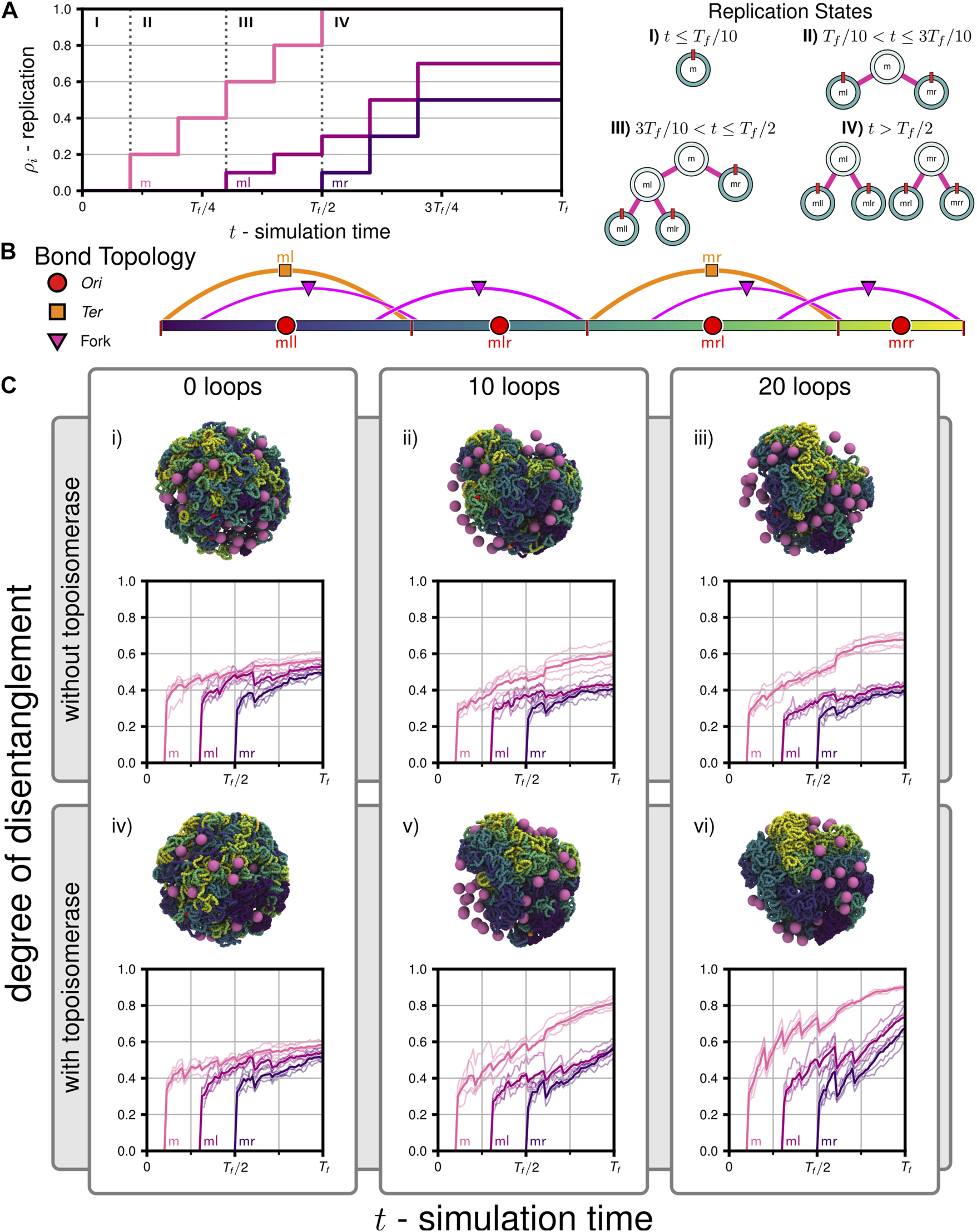
Computational models of cells cannot be considered complete unless they include the most fundamental process of life, the replication and inheritance of genetic material. By creating a computational framework to model systems of replicating bacterial chromosomes as polymers at 10 bp resolution with Brownian dynamics, we investigate changes in chromosome organization during replication and extend the applicability of an existing whole-cell model (WCM) for a genetically minimal bacterium, JCVI-syn3A, to the entire cell-cycle. To achieve cell-scale chromosome structures that are realistic, we model the chromosome as a self-avoiding homopolymer with bending and torsional stiffnesses that capture the essential mechanical properties of dsDNA in Syn3A. In addition, the conformations of the circular DNA must avoid overlapping with ribosomes identitied in cryo-electron tomograms. While Syn3A lacks the complex regulatory systems known to orchestrate chromosome segregation in other bacteria, its minimized genome retains essential loop-extruding structural maintenance of chromosomes (SMC) protein complexes (SMC-scpAB) and topoisomerases. Through implementing the effects of these proteins in our simulations of replicating chromosomes, we find that they alone are sufficient for simultaneous chromosome segregation across all generations within nested theta structures. This supports previous studies suggesting loop-extrusion serves as a near-universal mechanism for chromosome organization within bacterial and eukaryotic cells. Furthermore, we analyze ribosome diffusion under the influence of the chromosome and calculate in silico chromosome contact maps that capture inter-daughter interactions. Finally, we present a methodology to map the polymer model of the chromosome to a Martini coarse-grained representation to prepare molecular dynamics models of entire Syn3A cells, which serves as an ultimate means of validation for cell states predicted by the WCM.

11,349 views

23 citations