Abstract
Co-benefits conceptually apply broadly to the realms of sustainability and resilience and are increasingly relevant in decision-making processes as there is an increase in complex and compound events. Therefore, infrastructure design, planning, governance, and disaster preparedness for compound events are critical for building resilient systems. Decisions are often based on direct benefits of a proposed project or intervention, which are the more salient to decision makers and may be the function of available financing and experience with event types. The ideal community resilience actions for a community may be heavily influenced by the identification (and inclusion) of co-benefits in assessments of community resilience alternatives. Fung and Helgeson reviewed the literature on co-benefits with a specific focus on the definition of co-benefits, areas where co-benefits are used the most (considering the literature related to climate change), and co-benefit measurement and assessment methodologies in the context of resilience planning. The current study further explores these areas by focusing on the development of the literature on co-benefits published since 2017. The specific review questions explored are: (1) What is the major focus of the literature on co-benefits? and (2) What are methods and tools for measurement and assessment of co-benefits? The literature review reveals two primary focus areas: co-benefits of resilience and sustainability planning, and co-benefits of climate mitigation and adaptation actions. The latter are further categorized as falling as either health co-benefits or environmental and social co-benefits of climate actions. Within the two broad focus areas, our study reviews research objectives, analysis region, co-benefit categories, direct benefits, and evaluation methods and assessment frameworks. Moreover, we provide a synthesis of analysis tools and assessment methods including monetization methods, multi-criteria (i.e., multi-objective) analysis methods, scoring methods and matrices, and systematic reviews. The review reveals several gaps and opportunities for both future research and applications. One opportunity is to develop more generic evaluation methods for co-benefits with a focus on scoring methods and matrices, which provide a good balance of quantitative and qualitative evaluation, in the development of more generic analysis and assessment methods and tools.
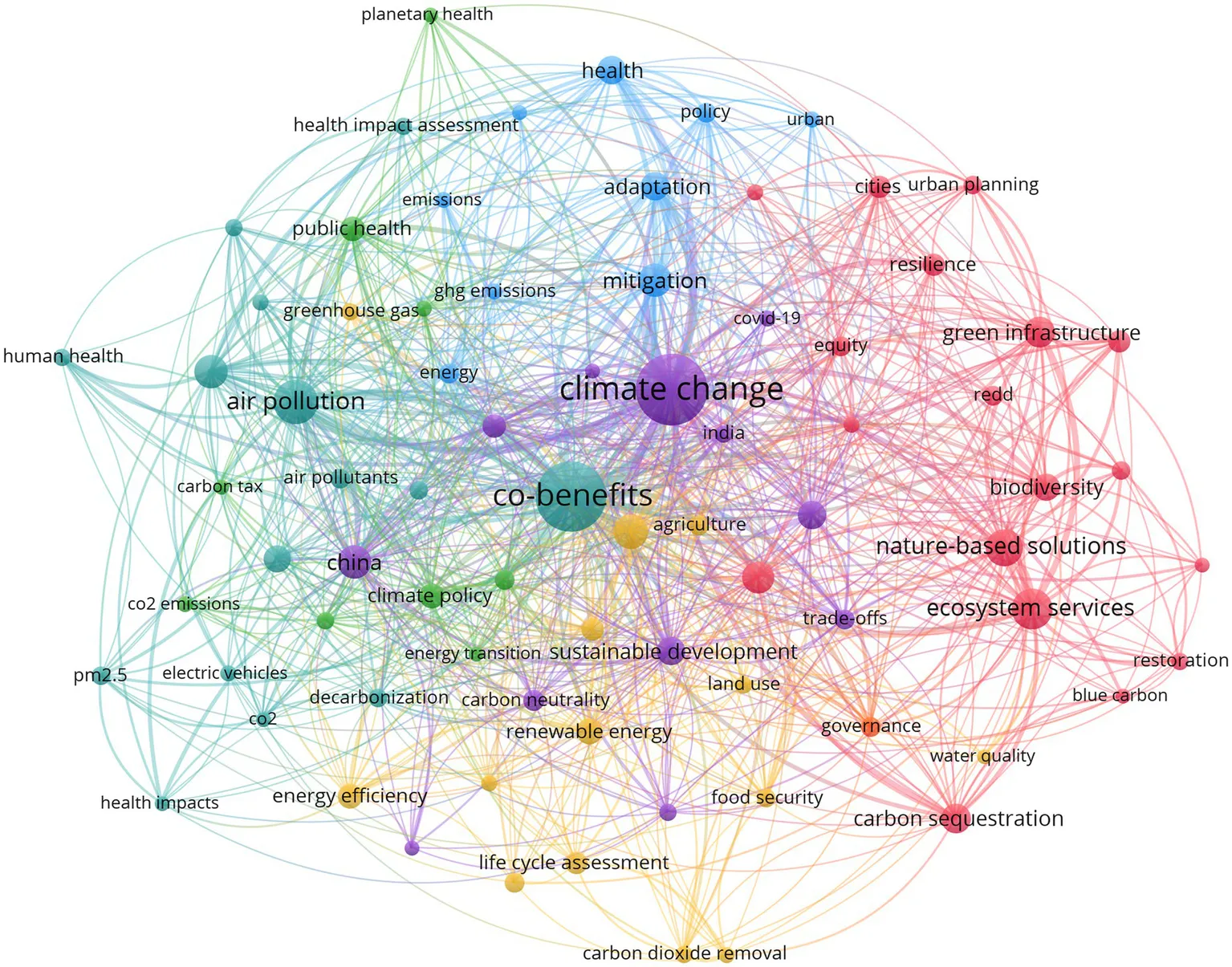
Co-occurrence of keywords, identified in the corpus analyzed focused on co-benefits since 2017. There are six clusters of keywords identified. The first cluster, shown in red, contains 18 keywords with a focus (higher frequency of keywords) of climate mitigation, eco-system services, nature-based solutions, green infrastructure, and resilience. The second cluster, shown in green, has 15 keywords, with the most influential keywords being air pollution and air quality co-benefits. The third cluster, shown in darker blue, has 14 keywords with the most influential keywords being sustainability and renewable energy. The fourth cluster shown, in orange, contains 12 keywords with the most influential keywords being climate change, health co-benefits, and sustainable development goals. Clusters 6 and 7, shown in purple and lighter blue, respectively, each have nine keywords, with the most influential ones being climate policy, adaptation, and mitigation.
1 Introduction
Climate change is increasing the chances of multiple climate hazards occurring simultaneously or consecutively across the United States and its territories. Such interactions between multiple hazards across space or time, known as compound events, exacerbate the societal and ecosystem impacts of individual hazards and hinder the ability of communities, particularly frontline communities, to respond and cope. Therefore, infrastructure design, planning, governance, and disaster preparedness for compound events are critical for building resilient systems. Decisions are often based on direct benefits of a proposed project or intervention, which are the more salient to decision makers and may be the function of available financing and experience with event types. Building a business case can help determine the ideal community resilience actions for a community and may be heavily influenced by the identification (and inclusion) of co-benefits in assessments of community resilience alternatives.
The resilience dividend is a concept that has gained traction over the last decade as there has been an increase in the study and application of community resilience planning. The resilience dividend, defined as “the net co-benefit (or co-cost) of investing in enhanced resilience, in the absence of a disruptive incident” (Fung and Helgeson, 2017) is critical in the socioeconomic evaluation of community resilience alternatives. Creation of a business case for investment in community resilience planning strategies is often necessary to gain support for capital expenses associated with such efforts (Fung et al., 2021). Furthermore, the concept of co-benefits has been broadly adopted and extended to consider additional formulations, such as the resilience windfall (Helgeson and O’Fallon, 2021). Co-benefits conceptually apply broadly to the realms of sustainability and resilience and are increasingly relevant in decision-making processes as there is an increase in complex and compound events. Fung and Helgeson (2017) note that the definitions of co-benefits fall into three broad categories: objective-based, intent-based, and externality-based. We follow the broad definition of co-benefits introduced by the IPCC (2014): “effects that a policy or measure aimed at one objective might have on other objectives, irrespective of the net effect on overall social welfare.”
There have been many definitions of co-benefits employed and the current paper builds upon the review and definition of co-benefits provided in Fung and Helgeson (2017). The current study focuses on the development of the literature on co-benefits, specifically reviewing documents that have been published since 2017 and related to environmental sustainability and climate and extreme weather event resilience. This is important, as societal losses from extreme weather and climate events have been increasing since at least the 1960s and continue to do so (Smith, 2021). In the period 1980–2023 there were 376 events that each cost $1 billion or more for a total loss of $2.707 T, with 66 of those (or 17.5% of the events) occurring in the last three years (2021–2023) accounting for $438B in losses (or 16% of the total) (NOAA, 2024). The causes of these increases in losses are likely due to multiple factors, including climate change impacts that are amplified by increased development and encroachment into areas more vulnerable to natural hazards, as well as local (and in some cases global) increases in the rate of hazard events (Cutter et al., 2008; Mohleji and Pielke, 2014).
The scientific background of this study is grounded in the increasing integration of resilience planning and sustainability assessment within environmental and resource management fields. Co-benefits—defined as secondary or ancillary benefits that arise from interventions primarily aimed at other objectives—have gained prominence as climate-related shocks, such as floods and droughts, become more frequent and complex. In the context of water resource management, numerous studies (e.g., Lama and Chirico, 2020; Pirone et al., 2024; Errico et al., 2019) demonstrate how infrastructural and ecological interventions, such as vegetated channels, reservoir configuration, or green infrastructure, yield multiple hydrological, ecological, and societal outcomes. However, the valuation and comparison of such benefits—along with their trade-offs—remain challenging without robust, adaptable assessment tools.
This complexity underscores the importance of sensitivity analysis in both scientific and practical applications of co-benefit evaluation. In water systems, small variations in vegetation density, channel geometry, or reservoir outlet configuration can lead to disproportionate changes in flow resistance, peak discharge, and downstream flood risk—as demonstrated in the hydrodynamic studies cited above. Similarly, in resilience planning, the relative contribution of different co-benefits (e.g., air quality, economic revitalization, public health) may shift dramatically depending on the scale of intervention, stakeholder priorities, or assumptions built into modeling tools. Therefore, any assessment framework used in monitoring or managing natural resources—particularly those aimed at resilience and climate adaptation—must include methods to test the sensitivity of outcomes to input assumptions. Doing so enables more transparent, robust decision-making and enhances the credibility of proposed interventions in multi-objective contexts.
This paper is organized as follows. Research methods and materials are explained in Section 2. The associated bibliographic analysis results are presented in Section 3; information about content analysis of literature is presented in Section 4; and Subsection 4.3 is dedicated to co-benefits assessment framework and tools. Section 5 discusses and summarizes the important findings of this paper and major gaps in the literature. Finally, Section 6 discusses future research needs.
2 Materials and methods
In this study, we performed a bibliographic and content analysis of literature focused on the co-benefits of resilience planning. This study builds on the NIST Technical Note 1959 “Defining the Resilience Dividend: Accounting for Co-benefits of Resilience Planning,” which defines a resilience dividend as “the net co-benefit (or co-cost) of investing in enhanced resilience, in the absence of a disruptive incident” (Fung and Helgeson, 2017). Fung and Helgeson (2017) reviewed the literature on co-benefits with a specific focus on the definition of co-benefits, areas where co-benefits are used the most (considering the literature related to climate change), and co-benefit measurement and assessment methodologies in the context of resilience planning. The current study further explores these areas by focusing on the development of the literature on co-benefits published since 2017.
The specific review questions we address are:
(1) What is the major focus of the literature?; and
(2) What are methods and tools for measurement and assessment of co-benefits?
The literature reviewed for this paper was drawn from both the Web of Science and Google Scholar. The Web of Science was selected because it covers all important and influential sources related to the topic of interest (Birkle et al., 2020). In addition, the article export format provided by Web of Science allows better bibliographic analysis using VOSviewer (Van Eck and Waltman, 2010). VOSviewer is a tool for constructing and visualizing bibliometric networks and text mining (Van Eck and Waltman, 2011). This software can be used to develop maps based on the input documents to show the focus of the literature and highly influential countries, journals, and authors.
The systematic review protocol included terms related to co-benefits and other alternative and/or related terms that are used in this research area. The specific terms searched on the Web of Science included “co-benefit[s],” “resilience dividend[s],” “ancillary benefit[s],” “co-benefits assessment tool[s],” “co-benefits gap[s],” “co-benefits definition,” “co-benefits analysis,” and “co-impacts.” The focus of this study is on documents published since 2017, with the search date selected to include studies published between Jan 1st, 2017 and April 23rd, 2024. Using the search terms, 3,073 papers were collected from the Web of Science (WOS). Their full record, including title, author names, abstracts, keywords, and cited references, were exported to be used for bibliographic analysis in VOSviewer.
For the full content analysis and discussion, paper of relevance to the research questions were selected from WOS and Google Scholar. Collectively, 38 studies that were published after 2017 have been selected and reviewed in detail. The content of the final set of documents is analyzed in detail, and information that is of importance regarding the focus of the current study is extracted and presented in the form of tables. The tables provide information about the main objective of these papers, the region of study, suggested definition for co-benefit, assessment methods or tools for co-benefits, and primary and secondary objectives. Figure 1 provides an illustrative summary of the study framework.
Figure 1
3 Bibliometric analysis
To illustrate the evolution of the literature over time, the number of publications per year from 20101 to the present, is displayed in Figure 2. The results are based on documents found on WOS using the search terms mentioned in Section 2, using studies published between Jan 1st, 2010 and April 23rd, 2024 (Figure 2). The number of papers published each year demonstrates an upward trend that emphasizes the importance of co-benefit topics across sectoral foci.
Figure 2
Bibliographic analysis was performed using VOSviewer. Two types of maps were created: (1) a co-occurrence map, which shows the foci of the selected literature based on the frequency of keywords, and (2) a map of highly influential countries that have published papers.
The co-occurrence map of keywords is based on studies published since 2017, found via the search terms discussed in Section 2 with a minimum occurrence of 15. Using this threshold, 78 of 7,761 keywords meet the requirement. A larger node size is consistent with a keyword with a higher frequency. The items or nodes are connected through links which shows the connection or relation between two items. Since the current map is based on co-occurrence of the keywords, a link represents whether two keywords have co-occurred in studies. Additionally, there can only be one link between any pair of items. Each link has a strength, denoted by a positive numerical value with greater values showing a more robust connection between a pair of keywords. For the co-occurrence map, a link with higher strength value means the number of publications in which two terms occur together is higher.
There are six clusters of keywords identified. The first cluster, shown in red, contains 18 keywords with a focus (higher frequency of keywords) of climate mitigation, eco-system services, nature-based solutions, green infrastructure, and resilience. The second cluster, shown in green, has 15 keywords, with the most influential keywords being air pollution and air quality co-benefits. The third cluster, shown in darker blue, has 14 keywords with the most influential keywords being sustainability and renewable energy. The fourth cluster, shown in orange, contains 12 keywords with the most influential keywords being climate change, health co-benefits, and sustainable development goals. Clusters 6 and 7, shown in purple and lighter blue, respectively, each have 9 keywords, with the most influential ones being climate policy, and adaptation and mitigation, respectively.
Based on foci demonstrated by the co-occurrence map, and in line with the study of Fung and Helgeson (2017), the co-benefits literature is categorized into two main groups: (1) co-benefits of resilience planning and sustainability and (2) co-benefits associated with climate change mitigation and adaptation actions. The second group is further categorized into two subgroups of health co-benefits of climate change actions, and environmental and social co-benefits of climate change actions. Detailed content analysis of the selected studies under these categories are presented in the next section.
Figure 3 demonstrates the most influential countries performing research concerning co-benefits since 2017. The map presented in Figure 3 is obtained from bibliographic coupling analysis which is defined as two documents that both cite the same document (Van Eck and Waltman, 2011). The minimum number of studies for a country to be considered in this analysis is set at 20. The bigger nodes represent countries with a higher number of studies. The US and China have the highest number of publications in this area followed by European countries (e.g., England, Germany, and Netherlands), Asian countries (e.g., Japan, India), and Australia.
Figure 3
4 Content analysis: overview of the literature
The studies included in the detailed review cover the general breadth of literature with an effort made to prioritize studies that provide an evaluation framework or an assessment method for co-benefits. These frameworks and assessment methods are discussed in detail in subsection 4.3. Tables 1, 2 summarize essential information for each study with respect to co-benefits of resilience planning and sustainability (Table 1) and co-benefits of climate actions (Table 2). The tables facilitate comparison between studies with respect to several factors, including the study’s region of analysis, the main objective, the category of co-benefits, the evaluation framework or assessment tool, direct benefits, and co-benefits.
Table 1
| Reference | Region | Study’s main objective | Category of co-benefits | Evaluation framework or assessment tool | Direct benefit | Co-benefits |
|---|---|---|---|---|---|---|
| Meerow and Newell (2017) | Detroit, USA | Introducing a spatial planning approach to identify tradeoffs and synergies associated with ecosystem services provided by green infrastructure, and to identify priority areas where green infrastructure can be strategically placed to leverage co-benefits | Environmental: Co-benefits associated with the use of green infrastructure | Introduced a Green Infrastructure Spatial Planning (GISP) model that leverages GIS-based multi-criteria evaluation of six benefit criteria including stormwater management, social vulnerability, access to green space, air quality, urban heat island, and landscape connectivity and expert stakeholder-driven weighting. The purpose of the suggested method is strategic placing of green infrastructure to maximize the co-benefits of planned green infrastructure. | Ecosystem services provided by green infrastructure, enhancing urban sustainability and resilience | Stormwater management, social vulnerability, green space, air quality, urban heat island amelioration, landscape connectivity |
| Helgeson and O’Rear (2018) | Maryland, USA | Highlighting the impacts of considering resilience benefits in economic analyses of residential sustainability investments | Environmental and Economic: Co-benefits associated with using a rooftop solar photovoltaic (PV) system | Life cycle costing (LLC) analysis | Solar-plus-storage from an installed rooftop solar PV system | Co-benefits that arise from sustainability planning (avoided damages and losses from avoided grid outages) |
| Keefe (2018) | USA | Analyzing the perception of social, economic, and environmental co-benefits as reported by communities through the HUD NDRC competition BCAs. | Social, Economic, Environmental and Natural Hazard: social, economic, and environmental co-benefits of resilience planning by communities in the HUD NDRC competition | Presented a methodology to analyze the NRDC BCAs. They created a table referred to as “The BCA crosswalk” to summarize the results from the NDRC BCAs. They developed codes-short phrases-to consolidate and represent the various types of co-benefits reported by applicants and the codes were used in the BCA crosswalk. | The World bank, triple dividend concept was used. Avoiding losses when disasters strike. | Unlocking development potential by stimulating economic activity thanks to reduced disaster related investment risks; and, social, environmental, and economic co-benefits associated with investments. |
| Alves et al. (2018) | Marbella (Spain), Ayutthaya and Sukhumvit (Thailand), | Presenting a multi-criteria approach for selection of green and grey infrastructure to reduce flood risk and increase co-benefits | Environmental: Co-benefits associated with the use of green and gray infrastructure | Proposed a method for selection of flood mitigation measures in urban areas based on a multi-criteria analysis that considers flood risk reduction, cost minimization and enhancement of co-benefits. The method comprises of several steps including screening (e.g., elimination of not applicable measures according to flood type), scoring (e.g., measuring performance assessment to enhance co-benefits), weighting (e.g., local preferences regarding co-benefits), and ranking (e.g., final scores calculation and ranking). | Flood risk reduction | Water quality, environmental (e.g., air quality, ground water recharge), liveability (e.g., urban heat reduction), economic (e.g., energy savings), socio-cultural (e.g., recreational uses) |
| Alves et al. (2019) | Sint Maarten, Netherlands | Presenting a method to include the monetary analysis of co-benefits associated with green, blue and gray into a cost-benefits analysis of flood risk mitigation measures | Environmental: Co-benefits associated with green, blue and gray infrastructure used for reducing flood risk | The multi criteria method for measures selection proposed by Alves et al. (2018) is used to identify locally relevant benefits and the applicable measures to achieve these benefits. The green, blue, and grey measures are ranked based on the decision makers’ analysis. Using the ranking, various combinations of measures are further analyzed, and a final set of measures and their associated benefits are selected which will be economically evaluated. The economic valuation is based on the relation between impacts on the environment and the consequent human welfare and usually estimated based on local data (e.g., instance energy and water prices). | Flood risk reduction | Co-benefits associated with green-blue infrastructure such as green roofs: energy savings, reduction of carbon dioxide (CO2) pervious pavements: heat stress reduction, energy saving, reduction of air pollutants, reducing surface temperatures up to 4°C. |
| Mirhosseini et al. (2019) | USA | Proposing a framework for describing the synergies and discords that occur between several ‘resilience’ and ‘sustainability’ building certification programs (BCP) | Environmental: Co-benefits and tradeoffs with regards to resilience & sustainability certification programs for climate change | Developed a matrix showing the relationships between multiple green building rating systems and resilience rating systems that is used to incorporate the interpretations of resilience cited in their paper. This comparison includes the rating system origin, application, and range of implementation as it considers resilience scholarship. The table aims to identify the problems, objectives, and co-benefits of various green building rating criteria and resilience criteria | Hazard mitigation, disaster resilience, vulnerability reduction, generally increase resilience and sustainability | Co-benefits associated with different certification programs, for example co-benefits of working toward increased energy conservation and energy efficiency |
| Paunga and Lassa (2020) | 222 countries and territories worldwide | Developing a global scale baseline of investment in disaster risk reduction worldwide | Environmental and Natural Hazard: Co-benefits of planning for natural hazard risk reduction (natural disasters are considered generally) | Presented an assessment framework for disaster risk reduction that included aggregation of investment in indicators of financial investment (foreign investment, development assistant, GDP, insurance penetration), social investment (access to education, health and water, and sanitation), early warning system investment (internet access, mobile phone access, public awareness, disaster monitoring, risk assessment), enabling environment (easiness of doing business, government effectiveness, the rule of law, corruption control, DRR budget allocation commitment) | Disaster risk reduction using measures of saving lives and avoiding losses | Unlocking development potentials by stimulating economic activity by reducing disaster-related investment risks. The third dividend relates to the co-benefits of DRR investment. These co-benefits include economic, social, and environmental co-benefits such as improved social cohesion, better environmental quality, reduced vulnerability to poverty. |
| Kurth et al. (2020) | USA (Coastal areas) | Exploring the challenge of quantifying the resilience benefits of coastal projects and developing an assessment method suited to existing projects and discussing ways forward to meet the challenges. | Environmental and Natural Hazard: Co-benefits of resilience planning for hazards associated with coastal zones (i.e., energetic storms and inundation by rising sea levels) | Developed a scoring system to evaluate the resilience co-benefits. They first categorized the engineering strategies that were implemented by each project and summarized them to 27 feature types. Then the feature type was evaluated for its contribution to 12 resilience indicators and 10 USACE business line indicators. Feature types received a binary 0–1 score for each indicator. | Environmental, economic, and social benefits that are generated by USACE projects. | Co-benefit associated with increasing interest in the USACE and other organizations in resilience (derived from EWN projects.) |
| Fung et al. (2021) | Cedar Rapids, USA | Developing a CGE model to quantify the net co-benefits of investing in increased resilience | Social, Economic, Environmental: Co-benefits associated with investing in increased resilience against natural hazards such as flood | Developed a CGE model to quantify the co-benefits at a high level, and to show how co-benefits are distributed throughout an economy. To calculate the co-benefits, the avoided losses is first quantified under a simulated flooding event for the 2007 time period. Then the economic co-benefits considering exogenous positive shocks, in the absence of a natural disaster for both time periods (pre-and post-resilience) are quantified. | Increased resilience to flood | Avoided losses from the investments in increased resilience (avoided employment and income loss) in an event of natural disaster, economic co-benefits due to neighbourhood revitalization in the absence of a natural disaster |
| Helgeson and O’Fallon (2021) | Port Orford, and Portland Oregon, Alaska, American Samoa | Reviewing the use of co-benefits and the resilience dividend and introducing the concept of a resilience windfall | Environmental, Natural Hazard: Co-benefits associated with disaster resilience and sustainable planning | Through introducing the concept of resilience dividend and windfall, a framework is provided to evaluate the resilience planning alternatives that can assign value to the options. Multiple narrative examples are then used to explore the proposed framework which vary by locations, hazard types, and resilience intervention types to demonstrate the power of narrative exposition to communicate the importance of co-benefits. | Benefits associated with resilience and sustainability activities such as limiting GHG emissions or imposing caps on emissions | Co-benefits of resilience and sustainability measures related to human health or improvements to air quality |
| Cohen et al. (2021) | Multiple locations worldwide (Rwanda, Morocco, Japan, Marshall Islands, Chile, Lebanon) | Exploring the relationships between climate change mitigation action and co-impacts and the Sustainable Development Goals (SDGs) and illustrating it using a selection of examples from countries’ Nationally Determined Contributions (NDCs). | Environmental: Co-benefits and tradeoffs of climate change mitigation actions. | Provided examples of co-benefits and adverse side effects and examples of SDG indicators that could be used to track progress, linked to different mitigation actions. Different types of co-impacts were considered including co-impacts in climate resilience and energy security. Investment and growth, employment, (biodiversity ecosystem services, soil), water pollution, air pollution, energy access, poverty alleviation, food and water security, health, Noise, congestion and other considerations that contribute to quality of life | Benefits of GHG mitigation actions in different sectors such as energy, industry, buildings, and waste | Co-benefits/adaptation benefits has been mentioned for different mitigation actions. For example, for solar street lighting, co-benefits include Reduced reliance on grid-based power generation and infrastructure and imported energy. This has been linked to SDG 1, SDG 7, and SDG 11 |
| Mehryar and Surminski (2022) | Lowestoft, England | Investigating how a combination of modelling and measurement methods can help decision-makers with their flood resilience strategies | Environmental and Natural Hazard: Co-benefits of resilience planning for flooding | Provided a Flood Resilience Measurement for Communities (FRMC) founded on a holistic and integrated conceptualization of community resilience capacity as comprising of human, social, natural, physical, and financial capitals, and 44 indicators of resilience used for measuring these five capitals’ capacities. | Benefits of resilience planning for flooding, for example benefits associated with using flood protection measures | Co-benefits associated with resilience planning for flooding (co-benefits are not specifically mentioned) |
| Chabba et al. (2022) | Lima, Peru | Evaluating economic viability of Eco-DRR afforestation effort project through a BCA and include probabilistically estimated DRR benefits and place-based economic and non-market co-benefits representing stakeholder values. | Environmental and Natural Hazard: Co-benefits of Eco-DRR | A comprehensive assessment approach was designed using equity-weighted risk-based social BCA probabilistically assessed potential DRR benefits, integrated place-and context-based ecosystem co-benefits’ values that influence social and ecological wellbeing, incorporated equity consequences for marginalized stakeholders by accounting for income differences, and addressed uncertainty in analysis through a stochastic BCA model using Monte Carlo simulations, and a sustainability analysis to monitor the Eco-DRR measure’s contribution to broader urban resilience and sustainability goals that subjectively reviewed project performance, and benchmarked project impacts against IUCN’s Global Standard and SDG 11 frameworks. | Benefits of afforestation conserve, restore, manage ecosystems which decreasing vulnerability against multiple risks by reducing exposure to hazards and increasing adaptive capacity | Avoided losses, property rights gains in the form of increased rent value |
| Yokomatsu et al. (2023) | Tanzania and Zambia | Introducing a dynamic macroeconomic model aimed at evaluating DRR policies under various hazards | Environmental and Natural Hazard: Co-benefits of DRR investment for natural hazard mitigation | Presented a model called DYNAMMICs to quantify the DRR benefits considering three resilience dividends, using RBC model as the basis for DYNAMMICs framework which simulates changes in investment, savings, consumption, and other variables due to external shocks, including disasters through a stochastic evaluation using Monte Carlo simulation. | Avoiding losses and damages from disasters (saving lives, reducing damages to infrastructure, reducing losses to economic flows) | Unlocking economic potential (household and agricultural productivity, land value from protective infrastructure), development co-benefits such as eco-system services, transportation uses, agricultural productivity gains |
| Rözer et al. (2023) | Vietnam, Nepal, Indonesia, Afghanistan, and the United Kingdom | Investigates knowledge gaps and challenges in integrating multiple resilience dividends into the planning, implementation, and evaluation of DRR interventions at the community level | Social, Economic, Environmental: Co-benefits of DRR investments | They suggested an analytical framework that incorporated the decision-making cycle by Brent (1998) and Mechler (2016) with the TDR concept to explore how various resilience dividends are integrated into different stages of a project and impact the outcomes of community-level DRR investment. | Reduced costal erosion, reduced flood damage, reduced damages to fishing boats and residential homes and businesses | Creation of new jobs through the restoration of hotels and other services, less out mitigation, increase agricultural yields, improved food and water security, more sustainable use of local resources |
| Sharifi et al. (2024) | Multiple locations worldwide | Providing a systematic review to addresses the scarcity of research exploring the connections between smart cities and SDGs | Social, Economic, Environmental: Co-benefits and trade-offs of SDGs | They performed a systematic literature review PRISMA method for literature search and selection using SCOPUS focusing on the connections between smart cities and SDGs. They used a deductive approach and emphasized different aspects like sectoral and geographic focus, methodological approaches, and linkages to SDGs. They further conducted co-occurrence analysis to accompany the review through mapping knowledge structures of the reviewed studies. | Major SDG benefits in categories including no poverty, good health, climate action, clean water and sanitation, affordable and clean energy | Accelerating economic growth, improving efficiency, strengthening innovation, and raising citizen awareness |
Summaries of studies selected for detailed content analysis with regards to co-benefits of resilience planning and sustainability.
Table 2
| Reference | Region | Study’s main objective | Category of co-benefits | Tool or assessment method for co-benefits | Direct benefit | Co-benefits |
|---|---|---|---|---|---|---|
| Chang et al. (2017) | Multiple locations worldwide | Reviewing studies quantifying the health co-benefits of climate change mitigation related to air quality, transportation, and diet | Environmental, social and economic: Health co-benefits of air quality improvements in both PM2.5 and ozone for achieving the 2°C climate mitigation | Reviewed the techniques used by other studies to quantify co-benefits. Multiple studies monetized the estimated health co-benefits to estimate the extent to which these benefits could offset the costs of implementing the policy. | Paris agreement: Reduce fossil fuel use to limit the temperature increase to 2°C and 1·5°C. | Health co-benefits achieved by mitigation policies and technologies that influence health by modifying health-related exposures such as non-GHG air pollutants, physical activity, and diet |
| Peng et al. (2017) | China | Examining near-term air quality and CO2 co-benefits of various current sector-based policies in China. | Environmental, social and economic: Climate and health co-benefits of air quality improvements | Calculated the mortality changes resulting from changes in air pollution levels for each scenario relative to their base mitigation scenario. | Reducing air pollutants: specifically reducing the PM2.5 | Health co-benefits based on mortality (due to ischemic heart disease, stroke, chronic obstructive pulmonary disease and lung cancer) changes resulting from changes in air pollution levels |
| Markandya et al. (2018) | USA, India, China, Europe, and the rest of the world | Analyzing how the health co-benefits would compensate the mitigation cost of achieving the targets of the Paris climate agreement. | Environmental, social and economic: Health co-benefits of air quality improvements in both PM2.5 and ozone for achieving the 2°C climate mitigation | Calculated the premature deaths and morbidity associated with concentrations of particulate matter and ozone in the atmosphere and monetized the health impacts using VSL. | Paris agreement: Reduce fossil fuel use to limit the temperature increase to 2°C and 1·5°C. | Health benefits of reducing air pollutants [fine particulate matter (PM2.5); and ozone (O3)]. |
| Li et al. (2018) | China | Quantification of co-benefits using the example of energy-related co-benefits of CO2 mitigation | Environmental, social and economic: Improved health due to having improved air quality as a result of reducing GHG emissions | Calculated the co-benefits associated with avoided death based on the international value of statistical life (VSL). | GHG emission reduction | National health co-benefits (reduced mortality) from improved air quality due to reducing GHG emissions |
| Xie et al. (2018) | China, India, Japan, Rest of Asia | Quantifying the health and economic co-benefits of air quality improvements in both PM2.5 and ozone for achieving the 2°C climate mitigation goal in Asia. | Environmental, social and economic: Health (morbidity, mortality and expenditures and economic (Work time loss) co-benefits of air quality improvements in both PM2.5 and ozone for achieving the 2°C climate mitigation) | Combined the CMAQ model, a health assessment model, and the Asia-Pacific Integrated AIM/CGE model to evaluate the long-term health and economic impacts caused by ambient PM2.5 and ozone pollution under different climate mitigation and SSP2scenarios in Asian countries. | Reducing fossil fuel consumption and greenhouse gas emissions | Air quality improvement and decrease of premature deaths caused by exposure in PM2.5 |
| Vandyck et al. (2018) | Global | Assessing the global and regional mortality, morbidity, and agricultural air quality co-benefits in the context of the Paris Agreement while accounting for future uncertainty in air pollution control measures | Environmental, social and economic: Health co-benefits of air quality improvements in both PM2.5 and ozone for achieving the 2°C climate mitigation | Calculated the co-benefits of avoided premature mortality (monetized by using the VSLs), lost workdays, and crop yields. A hybrid approach that combines market and nonmarket benefits was used for the economic valuation of co-benefits. The market co-benefits for labor markets through a reduction of lost workdays due to illness (PM2.5) and for agriculture markets via improved crop yields (O3) were used as input in the global economy-wide CGE model JRC-GEM-E3 to assess the broader economic impacts. | Paris agreement: Reduce fossil fuel use to limit the temperature increase to 2°C and 1·5°C. | Health benefits of reducing air pollutants include reducing morbidity and mortality, and improvement in agriculture |
| Gao et al. (2018) | Global | Synthesizing the current evidence of public health co-benefits of GHG emissions reduction in different economic sectors to improve understanding of the mitigation measures involved, potential mechanisms, and relevant uncertainties | Social: Public health co-benefits of greenhouse gas emissions reduction | No Specific method is provided. | GHG emission reductions | Health co-benefits associated with GHG emissions reductions in different sectors including energy generation, transportation, agriculture and food, households, and industrial and economic processes. |
| Li et al. (2019) | China | Analyzing the air pollution co-benefits of low-carbon pathways toward the well below 2°C (WBD2) target in China. | Environmental, social, and economic: Improved air quality because of reducing GHG emissions and consequently decrease of premature deaths caused by exposure in PM2.5 | No method explicitly mentioned for the calculation of co-benefits; however, multiple models are used to calculate energy consumption reduction, air pollution emission reduction, air quality improvement, and the number of premature deaths because of implementing constraints to reduce GHG emissions. | GHG emission reduction | Air quality improvement and decrease in premature deaths caused by exposure to PM2.5 |
| Barron et al. (2019) | Australia | Proposing interventions that provide strategic green space enhancement at the neighborhood and block scale | Social and Environmental: Co-benefits associated with enhancing green spaces that improves both climate resilience and human health | Provided intervention typology and illustrative diagrams that presented various green space configurations and served as a guidance system for urban greening to optimize human health and climate resilience co-benefits. The interventions achieve spatially explicit functions while enhancing quality of life and experience. Each of the eight interventions reflect: a primary health benefit and/or a climate resilience response identified from the literature review, and a physical vegetation configuration in relation to other structural elements and spatial conditions. | Urban green spaces with primary objective of helping cities transition to more resilient, healthier, and sustainable futures | Positive effects of urban green space for human health |
| Fernandez-Guzman et al. (2023) | South America | Evaluating the existing evidence on the health benefits of climate mitigation strategies in South American countries | Social and Environmental: health co-benefits of climate change mitigation strategies | They conducted a systematic review of studies related to climate mitigation and health for countries in South America, using PRISMA for extension for Scoping Reviews guidelines. The focus of studies were climate mitigation strategies, defined as interventions aimed at reducing GHG emissions or increasing GHG removal and sequestration, and health co-benefits, referring to improved public health indicators resulting from climate change mitigation actions. The authors considered studies, including trials, quasi-experimental, comparative, observational, and modeling studies, and case reports. | Benefits associated with climate change mitigation actions including GHG emission reduction | Reduce morbidity and improve quality of life, reduce mortality, increase life expectancy, and decrease disability-adjusted life years (DALYs), and improve well-being (physical, mental, and social) |
| Kennedy et al. (2024) | Cortes Island, British Columbia, Canada | Promoting community health and climate justice co-benefits using case study of a rural remote island | Social and Environmental: health and climate justice co-benefits | They conducted a five-phase project including (1) environmental scan, (2) community scoping interviews, (3) community engagement and planning forum, (4) scoping review on justice-informed community engagement, (5) survey development. | Climate change mitigation actions benefits | Health and climate justice co-benefits |
| Sethi (2018) | Multiple locations worldwide | Providing an understanding of theoretical literature on generating and estimating co-benefits in this inter-disciplinary area by reviewing available assessment tools, and in the process, identify the grey zones or research gaps. | Environmental and Natural Hazard: Co-benefits of climate, local environment and development are considered under different sectors such as Transport, local environment, GHG emissions, Energy, residential/commercial service sector, Waste, energy, urban planning, public health, air pollution, economy | An exhaustive review of 44 urban-co-benefit assessment tools 27 in mitigation and 17 in adaptation is performed. Gaps are mentioned. | Climate change mitigation actions (e.g., GHG emission reduction) | Climate co-benefits in urban areas |
| Deng et al. (2018) | Multiple locations worldwide | Providing a systematic review to assess the state of knowledge on the co-benefits of GHG mitigation by exploring typology of co-benefits, mitigation sectors, geographic scales, and the types of research methods used. | Environmental, social, and economic, natural, and resilience: co-benefits associated with GHG mitigation and including economic impacts, ecosystem impacts, health impacts, air pollutants, resource efficiency, conflict and disaster resilience, distribution impact, energy security, technological spillover/innovation, and food security | Performed a systematic review of papers which included bibliometric analysis, and network analysis. They further hand-code the papers resulting from the systematic review and develop and implement a typology of co-benefits research. | GHG emission reductions | co-benefits associated with economic impacts, ecosystem impacts, health impacts, air pollutants, resource efficiency, conflict and disaster resilience, distribution impact, energy security, technological spillover/innovation, and food security |
| Ershad Sarabi et al. (2019) | Multiple locations worldwide | Performing a systematic review of the literature focusing on the NBS. | Environmental: Co-benefits associated with NBS | Performed a systematic review of publication focused on NBS as a theoretical concept, NBS adoption, management, planning and implementation using the Scopus search engine. | Societal challenges arising from climate change and urbanization | Social, environmental and economic |
| Dovie (2019) | No specific location was mentioned | Analyzing the state of the PaCA’s Article 7 and links with co-benefits to enable adaptation to independently contribute to and match mitigation efforts, arguing that greater levels of mitigation alone could not reduce additional adaptation cost. | Environmental: Co-benefits of climate change mitigation and adaptation actions. | No Specific method is provided. | Climate mitigation and adaptation | Co-benefits related to objectives of development, sustainability, and equity |
| Karlsson et al. (2020) | Multiple locations worldwide | Presenting a review of articles focused ‘co-benefits’ of climate policy with the purpose of accommodating policymakers in identifying research gaps by structuring, describing, analyze and synthesizing the rapidly expanding knowledge on climate policy co-benefits. | Environmental, social, and economic: co-benefits associated with climate policies that include improving air quality, diet and physical activity, soil and water quality, economic and organizational performance, and energy security | Provided a systematic review using Scopus database. They narrowed down the resulted documents by exclusion of documents by a rating of each article independently by all authors and a full read-through, followed by some additional rejections. Information was gathered from the final list of papers that included parameters such as category of co-benefit, quantification and monetization of co-benefits, policy aspects, and research gaps. | Reducing climate change costs | Improved air quality, improved diet and physical activity, improved soil and water quality, improved biodiversity, improved economic and organizational performance, improved energy security |
| Sharifi (2021) | Multiple locations worldwide | Exploring two types of interactions between adaptation and mitigation measures, namely co-benefits and synergies through analyzing evidence reported in the literature | Environmental and Natural Hazard: Co-benefits with regards to adaptation/mitigation plans in urban design and land use planning, transportation, building, waste, energy, green and blue infrastructure, water, urban governance, and behavioral issues | Database of studies including 56 papers that were relevant to urban climate change mitigation and adaptation interactions were collected and different information was extracted from these papers including primary objective (mitigation/adaptation/both), major contribution to mitigation, Major links to risks, or adaptive capacities improved (e.g., flooding, wildfire, extreme heat). Then co-benefits and synergies with regards to each category of sectors, e.g., transportation were discussed. | Climate change mitigation and adaptation actions | Co-benefits and synergies between urban climate change mitigation and adaptation measures |
| Choi et al. (2021) | Multiple locations worldwide | Providing a systematic review of papers, focusing on their climate benefits, relevant co-benefits and trade-offs, and the green infrastructure types that provide such climate benefits and co-benefits. | Environmental: Co-benefits associated with green infrastructure used for climate change adaptation such as | Presented a systematic review of 144 documents collected from Web of Science, Scopus, and Google Scholar. They focused on extracting information with regards to the climate change adaptation and mitigation benefits, the type of green infrastructure, and qualitative or quantitative information on co-benefits related to the climate benefits, trade-offs, or disservices. | Climate change adaptation | Water scarcity management, flood management, heat stress reduction, ecosystem resilience, renewable energy, energy use reduction, carbon storage, coastal flood protection. |
| Boyd et al. (2022) | South Africa (Durban, Cape Town), UK (London, Manchester), India (Surat, Indore), Canada (Montreal, and Vancouver) | Taking adaptation programs and planning as a starting point and identifies whether potential co-benefits and trade-offs with mitigation are considered. | Environmental and Natural Hazard: Co-benefits of adaptation plans for climate impacts as identified in each city’s adaptation plan. Following hazards are considered: flash floods, sea level rise, extreme heat, water scarcity, storm surge | Performed a detailed review of the adaptation plan for each city. Their view process included exploring city-level adaptation measures and their corresponding mitigation co-benefits or tradeoffs in four categories of policy strategies, hard infrastructure strategies, ecosystem-based strategies. Furthermore, they performed interviews to identify factors contributing to a city’s approach to co-benefits and associated obstacles in implementing them. | Climate change adaptation actions | Mitigation co-benefits of climate change adaptation |
| Jones and Doberstein (2022) | Canada | Performing a scoping review of the hazards literature to clarify scholars’ usage of the term ‘co-benefits’ in the field of hazard mitigation and adaptation. | Environmental and Natural Hazard: co-benefits in climate-affected hazard adaptation | Created a scorecard tool that considered six themes in papers for scoring co-benefits including: climate change mitigation, multi-hazard protection, human health, economy, society and culture and environmental health | Climate-affected hazard adaptation | Co-benefits associated with climate-affected hazard adaptation measures in categories of climate change mitigation, multi-hazard protection, human health, economy, society and culture and environmental health |
| Roggero et al. (2023) | Moscow, Paris, and Montreal | Addressing the disparity between the theoretical concept of co-benefits and their practical influence on local climate mitigation efforts in urban areas. | Environmental, social: air quality co-benefits from mitigation | They employed a case study approach to study climate action in three cities where there has been progress in climate mitigation and documented history of poor air quality. They included written sources, including official documents, policy assessments, journalistic sources, and research contributions, were used to reconstruct mitigation efforts from 1990 to the present. The analysis involved systematically reviewing documents. | GHG emission reduction | Improved air quality, energy savings, energy security |
| Lee and Liu (2023) | Guandu plain in Taipei city, Taiwan | Proposing alternative land use practices and evaluating their co-benefits in alleviating flood risks, using an energy synthesis approach | Environmental, Natural Hazard, and Economics: Co-benefits associated with NBS to alleviate flood risk | The methodology comprised three steps: identifying co-benefits through an expert workshop, proposing alternative land use practices, and evaluating co-benefits using energy synthesis. | Reducing flood risk | Education: environmental, food and farming, reducing habitat loss and fragmentation, tourism, and recreation groundwater recharge microclimate regulation, improving air quality improving public health |
Summaries of studies selected for detailed content analysis with regards to co-benefits associated with climate change actions.
4.1 Co-benefits of resilience planning and sustainability
In this section, we provide an overview of studies focused on co-benefits of resilience planning and sustainability. This category is comprised of studies that explore resilience measures to select nature-based solutions (NBS) or green, blue, and gray interventions, monetize co-benefits associated with such measures, analyze synergies and disconnects between resilience and sustainability, and link resilience measures and indicators to Sustainable Development Goals (SDGs), the concept of resilience dividends, and disaster risk reduction. Most studies in this area implemented case studies to explore the impacts of considering co-benefits in economic analyses of resilience and sustainability investments. The methods to assess co-benefits include monetization methods, multi-criteria (i.e., multi-objective) analysis methods, and scoring methods and matrices. More detailed information on tools to assess and evaluate co-benefits is provided in subsections 4.3.1, 4.3.2, 4.3.3, and 4.3.4.
Studies have shown that quantifying the co-benefits associated with resilience and sustainability investments significantly enhances the economic viability and business cases associated with investments (Fung et al., 2021; Helgeson and O’Rear, 2018). In this context, the co-benefit is considered as the result of avoided losses in the presence and absence of disaster events, and co-benefits considering exogenous positive shocks pre-and post-resilience enhancing investments (Fung et al., 2021). Additionally, the concept of resilience windfalls has been introduced as “an unexpected or sudden gain or advantage of resilience planning” and can also be thought of as “the discrepancy between expected and actual avoided losses.” The resilience dividends and windfalls provide a framework to expand the evaluation of resilience planning alternatives beyond simply avoided losses and may help justify resilience planning for a given community through the value of resilience planning for additional objectives. Informing a robust discussion around co-benefits and associated categories of resilience dividends and windfalls can help motivate increased learning and cooperation and effectively advance projects that address both resilience and sustainability (Helgeson and O’Fallon, 2021).
Exploring the synergies and discord across resilience planning and sustainability programs and the link that maps these two objectives to each other has been the focus of some of the reviewed studies. Understanding how synergies and differences in sustainability and resilience are encoded and implemented within a holistic framework, together with early design performance assessment, is an essential component in the operationalization of sustainability and resilience (Mirhosseini et al., 2019). Accounting for trade-offs like privacy, cybersecurity, infrastructure costs, and social biases in planning and implementation of SDGs in addition to co-benefits is crucial for ensuring effective contribution to sustainable and resilient urban development (Sharifi et al., 2024).
In assessment of co-benefits, it has been emphasized that the impacts of Disaster Risk Reduction (DRR) investments change in a non-monotonic ways, which requires a constant long-term evaluation through dynamic simulation and consideration of multiple resilience dividends (e.g., additional economic, social, and ecological benefits) can enhance the attractiveness of DRR efforts (Rözer et al., 2023; Yokomatsu et al., 2023). In addition to co-benefit assessment, the importance of co-impact assessment has been emphasized. Co-impact assessment aims to identify co-benefits and adverse side effects. In the case of climate change actions, they are usually associated with co-impacts in different sectors, and identifying them is a prerequisite to developing optimum policy packages. Co-impact assessment can lay out the knowledge base to gain support for mitigation actions, explore synergistic opportunities, and contribute to other objectives, such as increasing the efficiency and cost-effectiveness of climate actions (Cohen et al., 2021).
Green infrastructure has gained popularity for numerous purposes (e.g., stormwater management) since it provides multiple ecosystem services while improving urban sustainability and resilience. Therefore, various studies have developed frameworks to optimize the application of green infrastructure through the consideration of multiple objectives and accounting for their co-benefits (Alves et al., 2018, 2019; Meerow and Newell, 2017).
4.2 Co-benefits of resilience planning and sustainability
The co-benefits related to climate change (i.e., mitigation) and adaptation actions for the studies reviewed here are mainly categorized into two groups: health-related co-benefits and other co-benefits that cover a variety of environmental benefits such as air quality, soil and water quality, biodiversity, and economic and social co-benefits.
4.2.1 Health co-benefits of climate change mitigation and adaptation actions
Studies regarding health co-benefits of climate change mitigation actions have predominantly focused on quantifying such co-benefits through monetizing the reduction in mortality and morbidity due to improved air quality. The studies included have been primarily performed in East Asia and targeted emissions from sectors including transportation, industry, residential, and power (Li et al., 2019; Peng et al., 2017). There is consensus among the studies that the health and air quality co-benefits counterbalance the mitigation cost (Li et al., 2018; Markandya et al., 2018; Xie et al., 2018). Similarly, on a global scale and in the context of the Paris Climate Agreement, studies have shown that the health co-benefits would compensate for the mitigation cost of achieving the targets of the Paris Climate Agreement considering different scenarios where multiple countries contribute to emissions abatement based on equity criteria (Markandya et al., 2018). They found that while the value of co-benefits varies regionally, it exceeds the greenhouse gas (GHG) mitigation costs for most of the scenarios globally (Vandyck et al., 2018).
In addition to the studies that focus on monetizing health co-benefits, others have been selected for review in this section, including review studies and methodologies regarding incorporating health co-benefits into projects. Some studies provide systematic reviews of existing literature on the quantification of health co-benefits of mitigation actions. Quantitative estimates of health co-benefits of mitigation policies in the areas of air quality, transportation, and diet showed that health co-benefits of mitigation policies are a considerable part of their costs, and they often occur earlier compared to the direct benefits of reducing GHG emissions (Chang et al., 2017). Furthermore, the importance of quantifying the health co-benefits due to GHG mitigation is emphasized, as this information can assist policymakers in decision-making with regard to mitigation policies that affect the population on international, national, or regional levels (Gao et al., 2018). Review studies with regards to health and climate justice co-benefits have emphasized the importance of equitable data approaches to integrate community knowledge and qualitative data into climate planning, to enable collaboration across sectors. The complex interconnectedness of climate change and community health necessitates such cooperation (Kennedy et al., 2024).
4.2.2 Environmental and social co-benefits of climate change mitigation and adaptation actions
Most papers selected for this section are comprised of studies that have provided systematic reviews. The focus of these reviews covers a variety of topics, including reviews of available co-benefit assessment tools, reviews of the literature on NBS, reviews of documents with regards to co-benefits of climate policy and SDGs, and reviews of the literature on co-benefits of green infrastructure.
The systematic reviews about the co-benefits of climate mitigation actions in urban planning have been performed on a global scale, considering multiple cities as case studies. Measures such as green building programs, as well as distributed and decentralized energy systems that have a greater potential for providing co-benefits are discussed (Sharifi, 2021). Furthermore, these studies have shown that different cities worldwide differ in their capability to identify co-benefits or tradeoffs with mitigation in their adaptation plans. However, cities that aimed to account for co-benefits and tradeoffs in their adaptation plans were somewhat capable of planning for synergies. Additionally, co-benefits of adaptation measures were more readily identifiable compared to their tradeoffs, and cities more frequently employed specific types of co-benefits such as ecosystem-based strategies and building design measures. It is also discussed that the implementation of decision-making tools such as multi-criteria assessments can accommodate identifying co-benefits and trade-offs (Boyd et al., 2022).
In the area of green infrastructure, systematic reviews of studies have shown most of the literature focuses on environmental benefits such as water and air quality improvement and heat stress reduction. At the same time, about 30% of the papers investigated the trade-offs between the benefits and disservices of green infrastructure (Choi et al., 2021). A review of the literature focusing on NBS has illustrated their human and ecological co-benefits in addition to ecosystem conservation and restoration. For NBS, the most frequently observed enabler was reported to be developing partnerships between stakeholders followed by effective monitoring, knowledge sharing, financial instruments, plans and legislations, education, and training, combining with gray infrastructures, open innovation and experimentation, and appropriate planning and design (Ershad Sarabi et al., 2019).
The literature review focused on co-benefits of climate policy indicated that most papers are concentrated on co-benefits of improved air quality; however, when the study is performed on a larger geographic scale, the focus could also cover diet, physical activity, soil and water quality, biodiversity, economic performance, and energy security. The analysis results further suggested that the economic value of the air quality co-benefits can be equal to or exceed mitigation costs; however, only a small portion of the studies have monetized the co-benefits. Such knowledge can benefit decision-making for policymakers whose concern with mitigation costs can lead to suboptimal climate policies (Karlsson et al., 2020). The diversity of geographical areas can also affect the importance of co-benefits. Roggero et al. (2023) investigated the discrepancy between theoretical concept and practical influence of co-benefits on urban climate mitigation efforts considering three case studies of air quality co-benefits in Moscow, Paris, and Montreal. Their assessment showed the controversial role of air quality co-benefits across case studies from a key element of mitigation to a potential source of controversy. The authors highlighted the essential role of air quality co-benefits in decision-making regarding local climate policies despite this controversy.
The systematic review of literature related to co-benefits of GHG mitigation has identified the most frequently studied co-benefits to be the ecosystem impacts and economic activity co-benefits, while energy security co-benefits are the least studied. Furthermore, the most and least studied sectors were energy, industry, building, waste, agriculture, forestry, and other land use (AFOLU), and buildings, respectively. With respect to scale, most studies were conducted on a national level, followed by international and regional level analysis. Geographically, the concentration of most of the studies was in Europe, with Oceania, Africa, and South America having the lowest number of papers. Based on the methodology, most papers used social science analysis methods such as qualitative case studies, literature reviews, surveys, and interviews. Among the studies that used science and engineering methods, integrated assessment models, optimization models, simulation models, and life cycle assessments were most frequently used (Deng et al., 2018) (Table 2).
4.3 Analysis tools and methods
The proposed frameworks and tools of reviewed studies in the previous section are categorized into monetization methods, multi-criteria (i.e., multi-objective) analysis methods, scoring methods and matrices, and systematic reviews. Selection of methods and associated tools relates both to the co-benefit topic(s) under analysis and the interested party as well as the technical expertise of those conducting the analysis. Thus, understanding the breadth of these tools is important to user selection of which to engage with in valuation and evaluation of co-benefits. This is particularly important when non-market valuation is involved (Helgeson and Gore, 2024).
4.3.1 Monetization methods
The literature review reveals a wide range of monetization methods that vary in complexity and are typically case-study specific. Alves et al. (2018) presented an approach to incorporate monetized co-benefits of green-blue infrastructure into a cost–benefit analysis of flood risk mitigation measures. The multi-criteria method for measures selection proposed by Alves et al. (2018) was employed to identify locally relevant benefits and the applicable measures to achieve those benefits. The authors considered various interventions of green, blue, and grey measures and ranked them based on the decision makers’ analysis. Using the ranking, various combinations of measures were further analyzed, and a final set of measures and their associated benefits was selected and economically evaluated. The economic valuation was based on the relationships among impacts on the environment and the consequent human welfare, usually estimated based on local data. For example, to monetize the value of green roofs, the annual benefits were calculated, including direct benefits, such as: improving air quality, carbon sequestration, increased roof longevity, and indirect benefits, such as: air quality due to energy savings (energy price) and carbon reduced due to energy savings (CO2 value). Paunga and Lassa (2020) presented an assessment framework for DRR investment in 222 countries that included aggregation of investment across indicators: (1) financial investment (foreign investment, development assistance, gross domestic product (GDP), insurance penetration), (2) social investment (access to education, health and water, and sanitation), (3) early warning system investment (internet access, mobile phone access, public awareness, disaster monitoring, risk assessment), and (4) enabling environment (easiness of doing business, government effectiveness, the rule of law, corruption control, DRR budget allocation commitment).
Yokomatsu et al. (2023) presented a Dynamic Model of Multi-hazard Mitigation CoBenefits (DYNAMMICs) to quantify the DRR benefits considering three resilience dividends, including (1) avoiding direct impact (1st dividend); (2) enhancing economic potential (2nd dividend); and (3) generating sustainable development co-benefits (3rd dividend). The authors implemented a class of macroeconomic models called Real Business Cycle (RBC) models as the basis for the DYNAMMICs framework. This model simulates changes in investment, savings, consumption, and other variables due to external shocks, including disasters, through a stochastic evaluation using Monte Carlo simulation. The model compares the mean growth paths of an economy with and without DRR investment and computes the Total Growth Effect (TGE) of DRR investment. The TGE is comprised of three dividends of ex post damage mitigation effect, ex ante risk reduction effect, and co-benefit production expansion effect. Rözer et al. (2023) suggested an analytical framework that incorporated the decision-making cycle by Brent (1998) and Mechler (2016) with the triple dividend of resilience (TDR) concept advocated by the World Bank to explore how various resilience dividends are integrated into different stages of a project and impact the outcomes of community-level DRR investment. The Triple Dividend of Resilience helps stakeholders in the decision-making process through assessment of an interventions’ benefits using methods such as Benefit Cost Analysis (BCA). When the decision is made, TDR guides the monitoring and evaluation against the predefined targets. The evaluation process could involve empirical quantification of resilience dividends to provide crucial information for both monitoring the DRR success and informing future DRR efforts.
Helgeson and O’Rear (2018) developed an economic framework for evaluating investment in sustainability based on a case study of solar-plus-storage from an installed rooftop solar photovoltaic (PV) system. They employed life cycle costing (LCC) analysis that accounts for all costs related to the development, owning, operating, maintenance, repair, and end of life (including disposal) for a project. In their framework, they accounted for avoided damages and losses due to increased resilience by calculating the resilience-related values for cost per unserved electricity (CUE) in dollars per kilowatt hour ($/kWh) using the Interruption Cost Estimate (ICE) Calculator (Sullivan et al., 2015). The ICE Calculator is a “tool designed for electric reliability planners at utilities, government organizations or other entities that are interested in estimating interruption costs” (ibid.), which provides estimates of aggregated direct and indirect costs reported as the CUE. Additionally, the authors quantified the whole-building environmental impacts (e.g., land use, global climate change potential, human health) of alternative building designs using life cycle assessment (LCA) inventory data in conjunction with input–output (I-O) data in a hybrid life-cycle impact assessment (LCIA) framework. Fung et al. (2021) developed a computable general equilibrium (CGE) model to quantify economic co-benefits of investing in increased flood resilience at a high level, and to show how co-benefits are distributed throughout an economy, in the case of Cedar Rapids, Iowa. To calculate the co-benefits, the avoided losses (in terms of output, employment, and household income) are first quantified under a simulated flooding event for the 2007 time period (before resilience investments). Subsequently, the economic co-benefits are calculated based on positive exogenous shocks that occur in the absence of a natural disaster for both pre-and post-resilience time periods.
In the area of health co-benefits, Peng et al. (2017) calculated health co-benefits by evaluating mortality reductions due to changes in air pollution levels from different scenarios relative to the base case. Mortality is associated with four diseases (ischemic heart disease, stroke, chronic obstructive pulmonary disease, and lung cancer) as a result of long-term exposure to PM2.5. Markandya et al. (2018) used the Global Change Assessment Model (GCAM) to explore emission pathways and abatement costs of scenarios across temperatures and climate change methods. The scenarios were used in an air quality model (TM5-FASST) and the concentrations of particulate matter and ozone in the atmosphere, and in turn the associated premature deaths, were calculated. Finally, value of statistical life (VSL) is employed to monetize the health impacts which are compared with the mitigation cost obtained from GCAM. Li et al. (2018) developed a method to evaluate co-benefits and cost. The approach included the regional emissions air quality climate and health (REACH) framework that combined an energy–economic model, the China Regional Energy Model (C-REM, “global general equilibrium model that resolves China’s economy and energy system at the provincial level”), with an atmospheric Nature Climate Change Articles chemistry model, GEOS-Chem. They employed C-REM to simulate energy and CO2 emissions and air pollutants by 2030 considering three scenarios that aim to reduce CO2 intensity by 3, 4%, or 5% per year between 2015 and 2030. Then the health co-benefits are monetized (change in mortality due to change in PM2.5) using three concentration–response functions and two health valuation methods.
Xie et al. (2018) integrated the Community Multiscale Air Quality (CMAQ) model, a health assessment model, and the Asia-Pacific Integrated Assessment/Computable General Equilibrium (AIM/CGE) model to assess the long-term health and economic effects due to ambient PM2.5 and ozone pollution considering multiple climate mitigation and SSP2scenarios. The health impacts were considered as mortality and morbidity and monetized as additional medical expenditures and VSL. Then they were converted into per capita work time loss (change in the labor participation rate) in the AIM/CGE model to determine macroeconomic impacts. Finally, the net benefit of climate mitigation was calculated using cost–benefit analyses. Vandyck et al. (2018) incorporated extensive datasets and models on emissions, climate, the energy system, the dispersion and impacts of ambient air pollutants, and the economy in order to quantify the impact of actual climate change mitigation policies suggested in the runup to the 21st Conference of the Parties in Paris. To quantify the co-benefits, a framework was used that accounts for market and nonmarket benefits. Labor market benefits were considered as the reduction of lost workdays due to illness, and agricultural market benefits were captured by improved crop yields. These are used as input in the global economy-wide computable general equilibrium (CGE) model JRC-GEM-E3 (Joint Research Centre general equilibrium model). This model “describes consumer and producer behavior; represents government policies such as taxes, subsidies, transfers, and emission caps; captures endogenously the international trade flows based on (changes in) relative prices; and includes macro feedback mechanisms via forward and backward supply chain linkages and via labor market, wages, and employment effects.” The JRC-GEM-E3 model is also designed to evaluate the cost of climate change mitigation policies. The health co-benefits regarding avoided premature deaths are monetized using the VSLs (not entered in JRC-GEM-E3 model).
Li et al. (2019) presented a model that combined the China TIMES model developed by the. Energy Technology System Analysis Program (ETSAP) of the International Energy Agency (IEA) (typically used for estimating carbon mitigation strategies and future energy systems in China) and the Greenhouse Gas and Air Pollution Interactions and Synergies model (GAINS) models (developed by the Air Quality and Greenhouse Gases (AIR) program at the International Institute for Applied Systems Analysis, IIASA). The GAINS model is a comprehensive assessment model that considers the interplay of different policies addressing both air quality enhancement and greenhouse gas emission reduction to evaluate the co-benefits of air quality improvement. The health impacts were accounted for as premature deaths from PM2.5 based on the number of people in different exposure classes and GBD-2013 integrated exposure-response functions. The GBD-2013 (Global Burden of Disease Study 2013), conducted by the Institute for Health Metrics and Evaluation (IHME) at the University of Washington, provides a comprehensive evaluation of mortality, morbidity, and disability linked to diverse diseases, injuries, and risk factors worldwide, at both regional and national levels. The GAINS model quantifies the air pollutant emissions and PM2.5 concentrations as well as the health impacts to evaluate the potential co-benefits under situations with and without air pollutant control technologies. After the mitigation targets are applied to the China TIMES model, the model computes scenario-dependent and cost-optimal profiles.
4.3.2 Multicriteria analysis methods
Multi-criteria analysis methods represent a class of methods used to evaluate the performance of alternatives (typically through optimization) with respect to multiple, potentially criteria (the objectives in an optimization problem). Meerow and Newell (2017) developed a Green Infrastructure Spatial Planning (GISP) model using a GIS-based multi-criteria evaluation (MCE) of six benefit criteria including stormwater management, social vulnerability, access to green space, air quality, urban heat island effect, and landscape connectivity and expert stakeholder-driven weighting with the objective of strategic placing of green infrastructure to maximize the co-benefits of planned green infrastructure.
Alves et al. (2018) proposed a multi-criteria decision analysis (MCDA) method for selection of flood mitigation measures in urban areas based on a multi-criteria analysis that considers flood risk reduction, cost minimization and enhancement of co-benefits. The authors discussed the innovative aspects of their proposed method comparing to previously available approaches that included accounting for grey measures in addition to green measures, involving various flood types in the analysis, and involving a wider range of co-benefits, and building the capability in the model to define preferences among these benefits. The method comprises several steps including screening (i.e., elimination of unapplicable measures according to flood type and local physical constraints), scoring (i.e., measuring performance assessment to enhance co-benefits and reduce flooding risk, measuring cost assessment considering total cost reduction), weighting (i.e., local preferences regarding co-benefits: first selection of weights, local preferences regarding final goal: second selection of weights), and ranking (i.e., final scores calculation and ranking development). The methodology proposed by Mehryar and Surminski (2022) was a combination of mental modeling, using Fuzzy Cognitive Mapping (FCM) and a resilience measurement method, using Flood Resilience Measurement for Communities (FRMC) with the objective of supporting a decision-making process regarding resilience measures. The authors first explored stakeholders’ biases on flood resilience interventions, and then led them through a systems thinking exercise using FCM and FRMC to elicit mental models representing important aspects of flood resilience and their interrelations. These were then aggregated, representing the collective perceptions and knowledge of stakeholders, and used to identify the most beneficial resilience actions in terms of direct and indirect impacts on flood resilience. The model was then used to identify the level of agreement among stakeholders about aspects of flood resilience that required enhancement.
4.3.3 Scoring methods and matrices
Scoring methods and matrices represent less quantitative, often heuristic-based, alternatives to the highly complex monetization and multicriteria analysis methods. Presented a methodology to analyze National Disaster Resilience Competition (NRDC) BCA to examine a community’s understanding of economic and environmental co-benefits, as reported in their BCAs and assessment methodologies used to quantify these co-benefits. The author created a table referred to as “The BCA crosswalk” to summarize the results from the NDRC BCAs. They developed codes (consisting of short phrases) to consolidate and represent the various types of co-benefits reported by applicants. The codes were used in the BCA crosswalk to represent high-level categories of co-benefits used in practice. Forty co-benefits were reported across three categories of co-benefits of community development (e.g., Housing supply, Traffic & reduced vehicle use), economic revitalization (e.g., renewable energy, workforce benefits), and environment (e.g., climate regulation, water filtration) in the BCA competition applications. Furthermore, the BCA crosswalk assigned a score for quantitative calculations of co-benefits (“1” if a monetary value was assigned and “0” if only qualitative descriptions were provided). The results of the analysis were provided in a series of visuals capturing the frequency and quantification of resilience co-benefits, showcasing the number of NDRC BCAs reporting co-benefits within each category and the percentage with monetary valuation, and the frequency and quantification levels across three co-benefit categories.
Mirhosseini et al. (2019) developed a matrix that weights the resilience and sustainability of certification systems (e.g., ENERGY STAR, PHIUS, FORTIFIED) and rating systems (e.g., RELi, Envision, LEED, BREEAM). The matrix delineates the extent to which external impacts including natural (e.g., earthquakes, storms, and hurricanes), environmental (e.g., climate change, extreme weather), social (society, health), and economic (economic risks) impacts have been addressed in the certification and rating systems based on a four-level scale. Furthermore, the matrix employs Woods’ (2015) four basic concepts of resilience: (1) resilience as rebound, (2) resilience as robustness, (3) resilience as graceful extensibility, and (4) resilience as sustained adaptability to determine whether such concepts are considered in the mentioned programs.
Kurth et al. (2020) developed a scoring system to evaluate resilience co-benefits. Eighty-nine Engineering with Nature (EWN) coastal projects were reviewed, and their engineering strategies were determined and summarized as a list of 27 feature types (e.g., seawall with habitat growth opportunities). The contribution of each engineering feature type was evaluated with respect to resilience and US Army Corps of Engineers (USACE) business lines (i.e., flood risk management, navigation, ecosystem restoration). In evaluation of contribution of each feature to resilience, a rubric was used which breaks down resilience into four stages of the disaster lifecycle as outlined by the National Academy of Sciences (NAS) (National Research Council, 2012), plan/prepare, absorb, recover, and adapt. Under these four categories, 12 indicators were identified: (1) prepare (e.g., shoreline and/or sediment stabilization), (2) absorb (e.g., wave attenuation and/or dissipation), (3) recover (e.g., promotes self-recovery after hazard event), and (4) adapt (e.g., adaptability to changing community needs). Furthermore, an additional set of indicators were developed to measure the impact of EWN projects on specific USACE civil works programs to represent various civil works objectives, aiming to understand which types of USACE projects contribute most significantly to resilience. Ten indicators were defined under four other categories: (1) navigation, (2) management, (3) flood management and coastal storm risk reduction, and (4) environmental restoration. Feature types were evaluated using a binary scoring system (0–1) for each indicator. A score of 1 is assigned based on whether the EDF report attributes a specific benefit to a feature. Finally, the scores were aggregated for resilience and USACE business lines.
Jones and Doberstein (2022) developed a scorecard tool related to co-benefits of climate-affected hazard adaptation. They started by performing a scoping literature review to extract examples of co-benefits from collected papers to identify common themes of co-benefits and define criteria for the scorecard. The common themes included climate change mitigation, multi-hazard protection, human health, economy, society and culture and environmental health. The scorecard contained three tables, in which the first table enabled decision makers to evaluate individual projects based on 18 defined co-benefits, grouped into six themes. The impact scores in the first table were based on the following categories: sacrifices (−2), hinders (−1), maintains (0), improves (1), expands (2), not applicable (0), and, not considered (−1). The second table assigned theme weights of 1 to 3 based on their importance in a specific context. The impact scores from the first table are multiplied by the theme weight in the second table to yield a project score. The third table could be used to compare the final score of the projects.
4.3.4 Systematic reviews
Finally, a more qualitative approach in the literature is to systematically review and analyze categories of co-benefits in existing studies. The review by Chang et al. (2017) provided a framework within which to discuss (for every category considered, including air quality, transportation and diet), the study approaches, policy scenarios at local, national, or international level, policy baselines, temporal scales, sources of GHG emissions, modeling considerations, concentration-response function considerations, and relevance and inclusion of co-harms. They summarized different methods employed by studies for valuation of health co-benefits that included VSL, value of life years lost with mortality analysis by age segmentation, benefits transfer approach, cost of illness, and willingness to pay. Fernandez-Guzman et al. (2023) conducted a systematic review of studies related to climate mitigation and health for countries in South America, using the Preferred Reporting Items for Systematic and Meta-Analysis extension for Scoping Reviews (PRISMA-ScR) method. The reviewed studies focused on climate mitigation strategies, which are defined as efforts to decrease GHG emissions (e.g., biofuel production) or increasing GHG removal and sequestration (e.g., coastal blue carbon, forestation,) and health co-benefits (i.e., public health indicators resulting from climate change mitigation actions). The review included different studies of trials, quasi-experimental, comparative, observational, and modeling studies, and case-study reports.
To better inform climate mitigation and adaptation planning processes at the region of study, Kennedy et al. (2024) conducted a five-phase project. The five phases included: (1) environmental scan, collecting and analyzing available datasets related to the island’s environmental conditions to identify gaps for further research; (2) community scoping interviews, to complement the data gathered in first phase; (3) community engagement and planning forum, through forming a focus group to investigate climate change mitigation and adaptation strategies; (4) scoping review on justice-informed community engagement, including a systematic review of peer-reviewed and gray literature to identify best practices and recommendations for promoting justice in community engagement efforts for climate planning; and (5) survey development, synthesizing the findings of previous steps to develop a survey to obtain further insights from community members about climate change planning efforts.
Sethi (2018) evaluated and classified 44 co-benefit assessment tools into three groups: (1) informative or database tools, which provide information on specific urban, environment or development indicators that is helpful for government and policy makers; (2) evaluation tools, which allow users to evaluate the current situation, identify problems, and assess the most appropriate policy from set of options; and, (3) simulation tools, which could be used to model real-life situations and provide alternatives and future scenarios, impact assessment, and forecasts that can accommodate decision making. Sharifi (2021) provided a bibliographic analysis that included bibliographic coupling, co-citation analysis, and co-occurrence analysis, to explore the interactions between the existing knowledge about adaptation and mitigation. The author collected a database of studies including 56 papers that were relevant to urban climate change mitigation and adaptation interactions and different information was extracted from these papers including primary objective (mitigation/adaptation/both), major contribution to mitigation, major links to risks, or adaptive capacities improved (e.g., flooding, wildfire, extreme heat). Co-benefits and synergies with regards to each category of sectors, e.g., transportation were then discussed.
Choi et al. (2021) presented a systematic review of 144 documents collected from Web of Science, Scopus, and Google Scholar. They focused on extracting information with regards to the climate change adaptation and mitigation benefits, the type of green infrastructure, and qualitative or quantitative information on co-benefits related to the climate benefits, trade-offs, or disservices. Ershad Sarabi et al. (2019) performed a systematic review of publications focused on NBS as a theoretical concept, NBS adoption, management, planning, and implementation using the Scopus search engine. The analysis of the final set of papers was aimed at identifying the conceptualized NBS, objectives of NBS, key stakeholders in developing NBS, and the barriers and enablers for implementation and uptake of NBS. Karlsson et al. (2020) conducted a systematic review using the Scopus database. They refined the search results by independently evaluating each document using a rating system, followed by a full read-through. Afterward, they further narrowed down the selection by rejecting some additional documents. Information was gathered from the final list of papers that included parameters such as category of co-benefit, quantification and monetization of co-benefits, policy aspects, and research gaps. Deng et al. (2018) conducted a systematic review that included a bibliometric analysis of the corpus of papers to provide information on main research subjects, lead authors and highly cited publications. They further used network analysis to visualize the results. Additionally, the authors performed a mapping analysis to group the papers based on co-benefits, sectors, areas of geographic focus, and methods.
An alternative to reviewing categories of co-benefits and method in the scientific literature is to review a community’s policy documents. Boyd et al. (2022) performed a detailed review of the adaptation plan for each city considered in their study. Their review process included exploring city-level adaptation measures and their corresponding mitigation co-benefits or tradeoffs in four categories of policy strategies, hard infrastructure strategies, and ecosystem-based strategies. Furthermore, they performed interviews to identify factors contributing to a city’s approach to co-benefits and associated obstacles in implementing them. Roggero et al. (2023) employed a case study approach to study climate action in three cities where there has been progress in climate mitigation and documented history of poor air quality. They included written sources, including official documents, policy assessments, journalistic sources, and research contributions, to analyze mitigation efforts from 1990 to the present. The analysis of documents showed how local governments embodied the biophysical linkages between GHG emissions and air pollution reduction into their strategies and policies.
5 Discussion and limitations
While this review provides a taxonomy of co-benefits analysis tools—monetization methods, multi-criteria analysis, scoring methods and matrices, and systematic reviews—it is also important to support potential users in selecting the most appropriate approach for their specific problem or context. Different decision environments, resource constraints, stakeholder priorities, and data availability shape which tools are practical and defensible in use. One of the most critical factors in tool selection is decision context. For example, municipal planners evaluating infrastructure investments under grant or regulatory scrutiny may require monetized outputs to support benefit–cost analysis (BCA). In such cases, tools like life cycle costing (LCC), computable general equilibrium (CGE) models, or statistical valuation of health/environmental benefits may be appropriate—particularly when high-quality local data is available. Conversely, community-based organizations working on urban greening or disaster preparedness in low-capacity environments may prefer scoring frameworks or multi-criteria methods that are more participatory and transparent, allowing for integration of community values even with limited data. See Table 3 for a summary of co-benefit analyses indicating user type, decision context, recommended method type(s), potential key advantages, and associated limitations.
Table 3
| User type | Decision context | Recommended method type(s) | Key advantages | Limitations |
|---|---|---|---|---|
| Municipal planner/public agency | Infrastructure planning, grant applications, cost–benefit compliance | Monetization Methods (e.g., LCC, CGE, BCA) | Generates defensible, dollar-based outputs for funding or policy decisions | Requires high-quality data, technical expertise, time-intensive |
| Community-based organization (CBO) | Prioritizing local projects, stakeholder engagement | Scoring Methods, Multi-Criteria Analysis (MCA) | Flexible, participatory, low technical barrier | Less precise, may lack perceived rigor for external funding |
| Regional planning authority | Cross-sectoral investment or land use strategy | MCA, Systematic Reviews | Supports multi-objective trade-off analysis, adaptable across sectors | May require expert facilitation and consensus-building process |
| NGO/advocacy group | Policy framing, community resilience campaigns | Scoring Matrices, Narrative-Based Tools | Captures social and equity co-benefits, supports storytelling | Limited comparability or generalizability |
| Technical consultant/evaluator | Tool comparison, method design, model validation | Systematic Reviews, Hybrid Methods | Synthesizes methods across cases, builds institutional knowledge | Often retrospective, resource-heavy |
| Academic/researcher | Theory development, method refinement, longitudinal study | All (esp. MCA, Monetization, Systematic Reviews) | Deep analysis, model refinement, cross-case insights | May lack immediate applicability or stakeholder relevance |
Summary of co-benefit analyses indicating user type, decision context, recommended method type(s), potential key advantages, and associated limitations.
Scoring methods and matrices also offer value in early-stage or comparative assessments, especially when a diversity of objectives or stakeholder values must be considered. These methods tend to require less technical input while enabling structured prioritization. For example, a regional agency conducting a resilience planning charrette could use a scoring matrix to align proposed interventions with resilience dividends and social equity metrics. These approaches are well-suited for screening-level analysis, public engagement, or grant application processes where full monetization is not required.
Multi-criteria analysis (MCA) methods serve as a bridge between qualitative and quantitative approaches. They are particularly useful in multi-sector planning environments where decisions must account for conflicting objectives—e.g., balancing flood risk reduction with green space equity or economic redevelopment. MCA can support structured decision-making across disciplines and help reveal trade-offs, even in the absence of monetized data. Finally, systematic reviews and tool inventories are most relevant to researchers, technical consultants, or regional planning bodies tasked with developing new policy frameworks or comparing alternative evaluation methods. These approaches are useful for meta-analysis, tool benchmarking, or integrating cross-sectoral co-benefit considerations into strategic planning documents.
While the preceding review of the current literature highlights a broad spectrum of analysis methods and tools available for measuring co-benefits, it also demonstrates some limitations to a cohesive framework across different topic areas. The specific strengths and weaknesses of the categories that were identified (i.e., environmental vs. economic, environmental vs. health, etc.) remain largely unclear and as such point towards the need for additional data collection and analysis.
These studies all commonly point out the need for further research, particularly more cross-disciplinary collaboration and integration.
5.1 Co-benefits of resilience planning and sustainability
The literature demonstrates potential to align resilience and sustainability planning through co-benefits. Several studies emphasize the importance of quantifying co-benefits in supporting fiscally sound investment decisions (Alves et al., 2019; Fung et al., 2021; Helgeson and O’Rear, 2018; Keefe, 2018). Socio-economic valuation plays a crucial role in creating cost-effective and sustainable options, including resilience investments (Helgeson and O’Rear, 2018). Moreover, investing in increased resilience yields benefits even in the absence of disasters, contributing to economic co-benefits including increased household income and regional output (Fung et al., 2021). Considering co-benefits also helps to identify efficient adaptation strategies, such as the green-blue-grey strategy for hazard-resilient infrastructure (Alves et al., 2019). Finally, consensus building among technical experts and the public sector is essential for quantifying resilience co-benefits in a benefit–cost analysis (Keefe, 2018).
In terms of implementation, potential synergies between sustainability and resilience strategies across different scales emphasize the need for cross-disciplinary approaches (Mirhosseini et al., 2019). Frameworks incorporating sustainability, resilience, adaptation, and vulnerability metrics are necessary at various levels, from the single asset (e.g., building) scale to the broader community (Mirhosseini et al., 2019). Moreover, a systematic framework accounting for synergies and tradeoffs between sustainability and resilience is crucial for effective operationalization (Cohen et al., 2021).
Finally, the framework of Disaster Risk Reduction (DRR) has the potential to not only saves lives, but also to promote development potential, as well as socio-economic and environmental co-benefits (Paunga and Lassa, 2020). The quality of both institutions and governance influences the amount of investment in DRR (Paunga and Lassa, 2020). Disaster risk reduction solutions on a city scale are necessary to address increasing socio-natural risks (i.e., risks that stem both from natural and human-made causes), while supporting optimal environmental and equity outcomes (Chabba et al., 2022). However, DRR tends to be aimed at and structurally adopted across the Global South. There may be applicability to this construct in the Global North as a means to further tie together resilience and sustainability planning with relevant co-benefits.
Recent research by Yokomatsu et al. (2023) highlights critical policy insights for DRR-associated investments. They argue that DRR strategies must consider all potential hazards, as focusing on a single threat could inadvertently increase vulnerability to others. Although DRR investments entail short-term costs, evaluating their long-term benefits can facilitate more informed stakeholder discussions and decision-making. Yokomatsu et al. (2023) also emphasize that optimal DRR strategies should combine complementary options rather than rely on singular interventions. This approach ensures efficient resource use and effective risk reduction.
However, challenges remain in integrating multiple resilience dividends into DRR planning, particularly in developing countries where institutional silos often obstruct comprehensive policy alignment. While DRR efforts are increasingly aligned with Climate Change Adaptation (CCA) and development policies, the predominance of techno-scientific approaches tends to prioritize hard infrastructure solutions, often neglecting social and environmental resilience dimensions. Innovative interventions like Ecosystem-based Adaptation face hurdles due to their complexity and the uncertainty surrounding their acceptance and potential co-costs. Despite these concerns, the long-term benefits of interventions with multiple resilience dividends are well-recognized. To address skepticism and bridge knowledge gaps, pilot projects demonstrating successful outcomes are essential. Furthermore, integrated decision-making frameworks that span the entire project life cycle are crucial for aligning DRR interventions with high-level policy targets (Rözer et al., 2023).
In the context of sustainable development, smart city solutions are seen as instrumental in advancing the Sustainable Development Goals (SDGs), particularly those related to sustainable cities (SDG 11), responsible consumption and production (SDG 12), affordable and clean energy (SDG 7), clean water and sanitation (SDG 6), and quality education (SDG 4). However, Sharifi et al. (2024) call for further research to explore the broader implications of smart cities for achieving the SDGs. This includes examining potential synergies, conflicts, and trade-offs beyond cost and energy efficiency. Empirical studies are needed to complement existing conceptual and theoretical research, providing a more comprehensive understanding of how smart city solutions can contribute to sustainable development.
In conclusion, while significant progress has been made in DRR, CCA, and sustainable development, there are still notable gaps and challenges that need to be addressed. Future research should focus on developing integrated frameworks, conducting pilot projects, and exploring the multifaceted impacts of innovative solutions like smart cities. By doing so, policymakers and stakeholders can make more informed decisions that enhance resilience and sustainability across various domains.
5.2 Health co-benefits of climate change mitigation and adaptation actions
Most of the literature on health co-benefits emphasizes how co-benefits of climate mitigation and adaptation efforts can help offset policy costs (Chang et al., 2017; Markandya et al., 2018; Peng et al., 2017; Xie et al., 2018). Of particular interest to this review, various modeling limitations and areas needing further research are identified within these studies (Chang et al., 2017; Markandya et al., 2018; Peng et al., 2017; Xie et al., 2018).
The shape of relative risk functions is crucial in assessing health benefits of air pollution reduction (Peng et al., 2017). The GCAM model explores emission pathways and abatement costs but does not consider damages beyond health damage due to limitations (Markandya et al., 2018). Labor productivity and indoor air pollution are important factors in quantifying health and economic co-benefits of air quality improvement (Xie et al., 2018). Finally, achieving Nationally Determined Contributions (NDCs) in the Paris Agreement requires systematic reviews of health co-benefits at larger scales and with greater consistency (Chang et al., 2017).
Moreover, various uncertainties exist in evaluating air quality improvement co-benefits, including low-carbon targets, application rates of control strategies, and differences in methodologies and risk functions (Li et al., 2019). Challenges and uncertainties in health co-benefits assessment of GHG emissions reduction include developing credible scenarios, heterogeneous health impacts among different population groups, and various economic valuations of health outcomes (Gao et al., 2018).
Multi-model assessments can help evaluate combined uncertainties in the modeling chain (Vandyck et al., 2018). Improved exposure measurement, additional health endpoints, and revised estimates of disease burden can enhance understanding of air pollution’s health impacts (Vandyck et al., 2018). Future research should focus on developing a coherent approach to incorporating multiple sources of uncertainty, thereby providing a more comprehensive and reliable assessment of the health co-benefits of climate change mitigation and adaptation actions. This can enable policymakers to make more informed decisions that maximize health benefits while addressing climate change.
5.3 Environmental and social co-benefits of climate change mitigation and adaptation actions
Beyond health considerations, most studies on environmental and social co-benefits of climate mitigation and adaptation are synthesis and meta-analysis papers that identify shortcomings and research needs, especially related to quantifying such co-benefits.
Notably, the role of air quality co-benefits is one that is increasingly recognized, but not thoroughly encompassed within analysis, research, and policy at present. Despite the limited integration into policies, air quality co-benefits do influence climate mitigation efforts in various ways and are notably difficult to measure. Decision-makers need to prioritize flexibility in enabling conditions for climate action, allowing local governments to prioritize co-benefits based on their specific context and identified goals and values. Transnational municipal networks can facilitate knowledge sharing in this regard. Secondly, the Roggero et al. (2023) highlight the need for a nuanced understanding of co-benefits and their interactions with climate action, especially regarding air quality. While air quality co-benefits do influence local climate action, their role varies significantly across different contexts, highlighting the need for tailored approaches and further research to understand and leverage their potential effectively (Roggero et al., 2023).
A few studies focus on the specific set of mitigation and adaptation actions that communities can take. Sethi (2018) discusses conceptual, methodological, empirical, and policy-governance gaps in assessing urban co-benefits, including insufficient scientific understanding, data limitations, and limited understanding of cities’ roles in climate action. Sharifi (2021) highlights considerable knowledge on the co-benefits of adaptation and mitigation in urban areas but emphasizes the need for more information on their synergies and the importance of sectoral collaborations and integrated urban management approaches.
Other studies explore challenges with incorporating co-benefits into planning and policy. Boyd et al. (2022) identify obstacles in considering co-benefits in urban climate adaptation plans, including limited technical capacity and siloed approaches to climate planning in cities. Karlsson et al. (2020) outline areas for further research on climate policy co-benefits, such as quantification based on empirical data, exploration of co-benefits in policy and decision-making, and assessment of integrated policies addressing multiple Sustainable Development Goals (SDGs).
Finally, Choi et al. (2021) and Ershad Sarabi et al. (2019) highlight gaps at the intersection of climate, sustainability, and the environmental co-benefits. Choi et al. (2021) indicate areas for further research on climate benefits and co-benefits of Green Infrastructure (GI), including investigating indirect contributions to climate mitigation and exploring socio-cultural values of GI features. Ershad Sarabi et al. (2019) argue for more research on barriers and enablers of Nature-Based Solutions (NBS), as well as interactions among specific barriers and enablers.
6 Conclusions and future work
This paper provides an overview of the current state of practice in evaluating and measuring co-benefits, with a particular focus on resilience co-benefits related to environmental sustainability and climate and extreme weather event resilience. There is the caveat that bibliometric analyses may reveal academic research interests, which may be differentiated from topics considered in decision-making for policy and management. The topic of co-benefits is, by definition, highly related to real-world project options, and the majority of papers reviewed leverage case studies.
The study builds on Fung and Helgeson (2017) in providing advances in quantification since 2017, as well as in cross-domain applications. The literature review reveals two primary focus areas: co-benefits of resilience and sustainability planning, and co-benefits of climate mitigation and adaptation actions. The latter are further categorized as falling as either health co-benefits or environmental and social co-benefits of climate actions. Within the two broad focus areas, our study reviews research objectives, analysis region, co-benefit categories, direct benefits, and evaluation methods and assessment frameworks. Moreover, we provide a synthesis of analysis tools and assessment methods including monetization methods, multi-criteria (i.e., multi-objective) analysis methods, scoring methods and matrices, and systematic reviews.
Co-benefits are generally articulated as such because they are part of policy or behavioral changes that address multiple objectives, this can make for optimistic business cases. Relatively few papers note co-costs or co-disbenefits. Fung and Helgeson (2017) discuss co-costs in their analysis. Wenger (2015) and Helgeson and O’Fallon (2021) note the importance of co-costs. A “negative co-benefit” refers to a situation where mitigating one negative environmental impact inadvertently creates another negative impact, while a “negative externality” simply means a cost imposed on a third party by an economic activity, without the involved parties having to pay for that cost; essentially, a negative co-benefit is a specific type of negative externality where the unintended negative consequence arises from trying to address another negative issue. Our current analysis did not exclude co-costs specifically, but also did not focus on this category explicitly.
Future work could build on this foundation by offering a practical decision-support guide that maps real-world use cases to tool types based on criteria such as scale, sector, data availability, time constraints, and stakeholder involvement. Such a guide would greatly enhance the accessibility and uptake of co-benefits analysis frameworks in diverse planning and decision-making contexts.
Monitoring and evaluating the effectiveness of co-benefit measurement over time is essential to improving the accuracy, credibility, and utility of resilience planning. As interventions unfold and conditions evolve, assessing whether the chosen measurement tools and methods continue to capture meaningful and relevant co-benefits—such as health improvements, ecosystem gains, or economic outcomes—is critical. Over the mid-and long-term, this ongoing evaluation helps identify where methods may need refinement, ensures consistency in tracking progress, and supports more informed decision-making. In this way, effective measurement itself becomes a key component of adaptive management, enabling learning, accountability, and optimization of co-benefit outcomes across time.
The present review reveals several other gaps and opportunities for both future research and applications. Since the primary goal of this study was to identify and categorize analysis tools and methods, we identify two key opportunities for future research. One opportunity is to develop more generic evaluation methods for co-benefits. While analysis tools and assessment methods range in complexity and scope, a common theme is that such tools tend to take the approach of being case-study specific. This is likely in part due to the complexity and case-specific aspects of co-benefits. However, there is an opportunity to explore areas of overlap in these methods, so that application of these methods can be more consistent to both allow comparison across case studies and to enhance replicability. Considering this observation and the preceding review, one recommendation is to focus on scoring methods and matrices, which provide a good balance of quantitative and qualitative evaluation, in the development of more generic analysis and assessment methods and tools.
The second opportunity similarly arises from the observation that analysis tools and assessment methods vary in complexity and scope. We note that there is a lack, and therefore a need, for validation of assessment methods for co-benefits. While assessment methods for resilience, in general, exist, especially metrics (e.g., Gu et al., 2023), the studies we review rarely validate the analysis tools and assessment methods they use, aside from stakeholder engagement. There is an opportunity to systematically evaluate these methods through monitoring and evaluation; we recommend this for future research.
Statements
Author contributions
JH: Conceptualization, Methodology, Supervision, Writing – original draft, Writing – review & editing. AA: Data curation, Formal analysis, Investigation, Methodology, Writing – original draft, Writing – review & editing. JF: Validation, Writing – review & editing.
Funding
The author(s) declare that no financial support was received for the research and/or publication of this article.
Conflict of interest
The authors declare that the research was conducted in the absence of any commercial or financial relationships that could be construed as a potential conflict of interest.
Generative AI statement
The author(s) declare that no Gen AI was used in the creation of this manuscript.
Correction note
A correction has been made to this article. Details can be found at: 10.3389/fclim.2025.1652559.
Publisher’s note
All claims expressed in this article are solely those of the authors and do not necessarily represent those of their affiliated organizations, or those of the publisher, the editors and the reviewers. Any product that may be evaluated in this article, or claim that may be made by its manufacturer, is not guaranteed or endorsed by the publisher.
Footnotes
1.^The reference time to show the number of publications has been selected as 2010 (as opposed to 2017 which is the beginning of the time span considered in this paper for further content analysis) to better illustrate the significant increasing trend.
References
1
AlvesA.GersoniusB.KapelanZ.VojinovicZ.SanchezA. (2019). Assessing the co-benefits of green-blue-grey infrastructure for sustainable urban flood risk management. J. Environ. Manag.239, 244–254. doi: 10.1016/j.jenvman.2019.03.036
2
AlvesA.GersoniusB.SanchezA.VojinovicZ.KapelanZ. (2018). Multi-criteria approach for selection of green and grey infrastructure to reduce flood risk and increase CO-benefits. Water Resour. Manag.32, 2505–2522. doi: 10.1007/s11269-018-1943-3
3
BarronS.NitoslawskiS.WolfK. L.WooA.DesautelsE.SheppardS. R. (2019). Greening blocks: a conceptual typology of practical design interventions to integrate health and climate resilience co-benefits. Int. J. Environ. Res. Public Health16:4241. doi: 10.3390/ijerph16214241
4
BirkleC.PendleburyD. A.SchnellJ.AdamsJ. (2020). Web of science as a data source for research on scientific and scholarly activity. Quant. Sci. Stud.1, 363–376. doi: 10.1162/qss_a_00018
5
BoydD.PathakM.van DiemenR.SkeaJ. (2022). Mitigation co-benefits of climate change adaptation: a case-study analysis of eight cities. Sustain. Cities Soc.77:103563. doi: 10.1016/j.scs.2021.103563
6
BrentR. J. (1998). Cost-benefit analysis for developing countries. New York, NY: Edward Elgar Publishing Ltd.
7
ChabbaM.BhatM. G.SarmientoJ. P. (2022). Risk-based benefit-cost analysis of ecosystem-based disaster risk reduction with considerations of co-benefits, equity, and sustainability. Ecol. Econ.198:107462. doi: 10.1016/j.ecolecon.2022.107462
8
ChangK. M.HessJ. J.BalbusJ. M.BuonocoreJ. J.ClevelandD. A.GrabowM. L.et al. (2017). Ancillary health effects of climate mitigation scenarios as drivers of policy uptake: a review of air quality, transportation and diet co-benefits modeling studies. Environ Res Lett12:113001. doi: 10.1088/1748-9326/aa8f7b
9
ChoiC.BerryP.SmithA. (2021). The climate benefits, co-benefits, and trade-offs of green infrastructure: a systematic literature review. J. Environ. Manag.291:112583. doi: 10.1016/j.jenvman.2021.112583
10
CohenB.CowieA.BabikerM.LeipA.SmithP. (2021). Co-benefits and trade-offs of climate change mitigation actions and the sustainable development goals. Sustain Product Consump26, 805–813. doi: 10.1016/j.spc.2020.12.034
11
CutterS. L.BarnesL.BerryM.BurtonC.EvansE.TateE.et al. (2008). A place-based model for understanding community resilience to natural disasters. Glob. Environ. Chang.18, 598–606. doi: 10.1016/j.gloenvcha.2008.07.013
12
DengH.-M.LiangQ.-M.LiuL.-J.AnadonL. D. (2018). Co-benefits of greenhouse gas mitigation: a review and classification by type, mitigation sector, and geography. Environ. Res. Lett.12:123001. doi: 10.1088/1748-9326/aa98d2
13
DovieD. B. K. (2019). Case for equity between Paris climate agreement’s co-benefits and adaptation. Sci. Total Environ.656, 732–739. doi: 10.1016/j.scitotenv.2018.11.333
14
ErricoA.LamaG. F. C.FrancalanciS.ChiricoG. B.SolariL.PretiF. (2019). Validation of global flow resistance models in two experimental drainage channels covered by Phragmites australis (common reed). In Proceedings of the 38th IAHR world congress-water connecting the world. 1313–1321.
15
Ershad SarabiS.HanQ.RommeA. G. L.de VriesB.WendlingL. (2019). Key enablers of and barriers to the uptake and implementation of nature-based solutions in urban settings: a review. Resources8:121. doi: 10.3390/resources8030121
16
Fernandez-GuzmanD.LavarelloR.Yglesias-GonzálezM.HartingerS. M.Rojas-RuedaD. (2023). A scoping review of the health co-benefits of climate mitigation strategies in South America. Lancet Reg. Health Am.26:100602. doi: 10.1016/j.lana.2023.100602
17
FungJ.HelgesonJ. (2017) in Defining the resilience dividend: Accounting for co-benefits of resilience planning. eds. FungJ.HelgesonJ..
18
FungJ. F.HelgesonJ. F.WebbD. H.O’FallonC. M.CutlerH. (2021). Does resilience yield dividends? Co-benefits of investing in increased resilience in Cedar Rapids. Econ. Syst. Res.33, 336–362. doi: 10.1080/09535314.2020.1798359
19
GaoJ.KovatsS.VardoulakisS.WilkinsonP.WoodwardA.LiJ.et al. (2018). Public health co-benefits of greenhouse gas emissions reduction: a systematic review. Sci. Total Environ.627, 388–402. doi: 10.1016/j.scitotenv.2018.01.193
20
GuD.DillardM.GerstM.LoerzelJ. (2023). Validating commonly used indicators for community resilience measurement. Nat. Hazards Rev.24:04023008. doi: 10.1061/NHREFO.NHENG-1642
21
HelgesonJ. F.GoreC. (2024). “Beyond the Bottom Line: Nonmarket Stated and Revealed Preference” in Methods for Community Resilience and Adaptation Planning (Gaithersburg, MD: National Institute of Standards and Technology). NIST Special Publications (SP) NIST SP 1322
22
HelgesonJ.O’FallonC. (2021). Resilience dividends and resilience windfalls: narratives that tie disaster resilience co-benefits to long-term sustainability. Sustain. For.13:4554. doi: 10.3390/su13084554
23
HelgesonJ.O’RearE. (2018). Improving the economic viability of Investment in Building Sustainability through the valuation of resilience-based co-benefits. Gaithersburg, Maryland: US Department of Commerce, National Institute of Standards and Technology.
24
IPCC. (2014). “Annex II: Glossary,” in Climate Change 2014: Synthesis Report. in Contribution of Working Groups I, II and III to the Fifth Assessment Report of the Intergovernmental Panel on Climate Change. eds. MachK. J.PlantonS.von StechowC. (Geneva, Switzerland: IPCC), 117–130.
25
JonesD. M.DobersteinB. (2022). Encouraging co-benefits in climate-affected hazard adaptation: developing and testing a scorecard for project design and evaluation. Int. J. Dis. Risk Reduct.74:102915. doi: 10.1016/j.ijdrr.2022.102915
26
KarlssonM.AlfredssonE.WestlingN. (2020). Climate policy co-benefits: a review. Clim. Pol.20, 292–316. doi: 10.1080/14693062.2020.1724070
27
KeefeK. E. (2018). Beyond one bad day: Exploring social, economic, and environmental co-benefits of resilience in the National Disaster Resilience Competition. Cambridge, Massuchusetts: Massachusetts Institute of Technology.
28
KennedyA. M.TsakonasK.Berman-HatchF.ConradiS.ThaysenM.GillespieM. A.et al. (2024). Promoting community health and climate justice co-benefits: insights from a rural and remote island climate planning process. Front. Public Health12:1309186. doi: 10.3389/fpubh.2024.1309186
29
KurthM. H.AliR.BridgesT. S.SuedelB. C.LinkovI. (2020). Evaluating resilience co-benefits of engineering with nature® projects. Front. Ecol. Evol.8:149. doi: 10.3389/fevo.2020.00149
30
LamaG. F. C.ChiricoG. B. (2020). Effects of reed beds management on the hydrodynamic behaviour of vegetated open channels. In Proceedings of the 2020 IEEE international workshop on metrology for agriculture and forestry (metro Agri for), Trento, Italy, 4–6 November 2020; 149–154.
31
LeeY.-C.LiuY.-F. (2023). Co-benefits of preserving urban farmland as climate change adaptation strategy: an emergy approach. Ecol. Indic.154:110722. doi: 10.1016/j.ecolind.2023.110722
32
LiN.ChenW.RafajP.KiesewetterG.SchöppW.WangH.et al. (2019). Air quality improvement co-benefits of low-carbon pathways toward well below the 2 C climate target in China. Environ. Sci. Technol.53, 5576–5584. doi: 10.1021/acs.est.8b06948
33
LiM.ZhangD.LiC.-T.MulvaneyK. M.SelinN. E.KarplusV. J. (2018). Air quality co-benefits of carbon pricing in China. Nat. Clim. Chang.8, 398–403. doi: 10.1038/s41558-018-0139-4
34
MarkandyaA.SampedroJ.SmithS. J.Van DingenenR.Pizarro-IrizarC.ArtoI.et al. (2018). Health co-benefits from air pollution and mitigation costs of the Paris agreement: a modelling study. Lancet Planet. Health2, e126–e133. doi: 10.1016/S2542-5196(18)30029-9
35
MechlerR. (2016). Reviewing estimates of the economic efficiency of disaster risk management: opportunities and limitations of using risk-based cost–benefit analysis. Nat. Hazards81, 2121–2147. doi: 10.1007/s11069-016-2170-y
36
MeerowS.NewellJ. P. (2017). Spatial planning for multifunctional green infrastructure: growing resilience in Detroit. Landsc. Urban Plan.159, 62–75. doi: 10.1016/j.landurbplan.2016.10.005
37
MehryarS.SurminskiS. (2022). Investigating flood resilience perceptions and supporting collective decision-making through fuzzy cognitive mapping. Sci. Total Environ.837:155854. doi: 10.1016/j.scitotenv.2022.155854
38
MirhosseiniH.CarmodyK.IuloL. D.. (2019). “A framework for the co-benefits and trade-offs of resilience & sustainability certification programs.” ARCC Conference Repository.
39
MohlejiS.PielkeR. (2014). Reconciliation of trends in global and regional economic losses from weather events: 1980–2008. Nat. Hazards Rev.15:04014009. doi: 10.1061/(ASCE)NH.1527-6996.0000141
40
National Research Council. (2012). “Disaster resilience: A national imperative.” Washington, DC: The National Academies Press.
41
NOAA (2024). U.S. Billion-Dollar Weather and Climate Disasters: National Centers for environmental information (NCEI).
42
PaungaF.LassaJ. A. (2020). Setting an agenda for entrepreneurial governments: a global baseline assessment of disaster risk reduction investment. Int. J. Dis. Manag.3, 36–52. doi: 10.24815/ijdm.v3i1.17533
43
PengW.YangJ.WagnerF.MauzerallD. L. (2017). Substantial air quality and climate co-benefits achievable now with sectoral mitigation strategies in China. Sci. Total Environ.598, 1076–1084. doi: 10.1016/j.scitotenv.2017.03.287
44
PironeD.CimorelliL.PianeseD. (2024). The effect of flood-mitigation reservoir configuration on peak-discharge reduction during preliminary design. J. Hydrol.52:101676. doi: 10.1016/j.ejrh.2024.101676
45
RoggeroM.GotgelfA.EisenackK. (2023). Co-benefits as a rationale and co-benefits as a factor for urban climate action: linking air quality and emission reductions in Moscow, Paris, and Montreal. Clim. Chang.176:179. doi: 10.1007/s10584-023-03662-6
46
RözerV.SurminskiS.LaurienF.McQuistanC.MechlerR. (2023). Multiple resilience dividends at the community level: a comparative study of disaster risk reduction interventions in different countries. Clim. Risk Manag.40:100518. doi: 10.1016/j.crm.2023.100518
47
SethiM. (2018). “Co-benefits assessment tools and research gaps” in Mainstreaming climate co-benefits in Indian cities. eds. SethiM.de OliveiraJ. P.. (New York, NY: Springer), 47–73.
48
SharifiA. (2021). Co-benefits and synergies between urban climate change mitigation and adaptation measures: a literature review. Sci. Total Environ.750:141642. doi: 10.1016/j.scitotenv.2020.141642
49
SharifiA.AllamZ.BibriS. E.Khavarian-GarmsirA. R. (2024). Smart cities and sustainable development goals (SDGs): a systematic literature review of co-benefits and trade-offs. Cities146:104659. doi: 10.1016/j.cities.2023.104659
50
SmithA. (2021). US billion-dollar weather and climate disasters in historical context and new hazard and socioeconomic risk mapping. Silver Spring, Maryland: AMS Washington Forum.
51
SullivanM.SchellenbergJ.BlundellM. (2015). Updated value of service reliability estimates for electric utility customers in the United States.
52
Van EckN.WaltmanL. (2010). Software survey: VOSviewer, a computer program for bibliometric mapping. Scientometrics84, 523–538. doi: 10.1007/s11192-009-0146-3
53
Van EckN. J.WaltmanL. (2011). “VOSviewer manual” in Manual for VOSviewer version, vol. 1. CitNetExplorer and VOSviewer.
54
VandyckT.KeramidasK.KitousA.SpadaroJ. V.Van DingenenR.HollandM.et al. (2018). Air quality co-benefits for human health and agriculture counterbalance costs to meet Paris agreement pledges. Nat. Commun.9, 1–11. doi: 10.1038/s41467-018-06885-9
55
WengerC. (2015). Better use and management of levees: reducing flood risk in a changing climate. Environ. Rev.23, 240–255. doi: 10.1139/er-2014-0060
56
WoodsD. D. (2015). Four concepts for resilience and the implications for the future of resilience engineering. Reliabil. Eng. Syst. Safety141, 5–9. doi: 10.1016/j.ress.2015.03.018
57
XieY.DaiH.XuX.FujimoriS.HasegawaT.YiK.et al. (2018). Co-benefits of climate mitigation on air quality and human health in Asian countries. Environ. Int.119, 309–318. doi: 10.1016/j.envint.2018.07.008
58
YokomatsuM.MochizukiJ.JosephJ.BurekP.KahilT. (2023). Macroeconomic co-benefits of DRR investment: assessment using the dynamic model of multi-hazard mitigation CoBenefits (DYNAMMICs) model. Dis. Prev. Manag.32, 139–162. doi: 10.1108/DPM-07-2022-0154
Summary
Keywords
adaptation, co-benefit, resilience dividend, community resilience, co-benefits analysis
Citation
Helgeson JF, Al Kajbaf A and Fung JF (2025) Co-benefits of resilience planning: a review of analysis tools and methods. Front. Clim. 7:1539858. doi: 10.3389/fclim.2025.1539858
Received
06 December 2024
Accepted
12 May 2025
Published
16 June 2025
Corrected
14 July 2025
Volume
7 - 2025
Edited by
Xixi Wang, Old Dominion University, United States
Reviewed by
Elliott Thomas Campbell, Maryland Department of Natural Resources, United States
Giuseppe Francesco Cesare Lama, University of Naples Federico II, Italy
Lochan Singh, Indian Institute of Science (IISc), India
Updates
Copyright
© 2025 Helgeson, Al Kajbaf and Fung.
This is an open-access article distributed under the terms of the Creative Commons Attribution License (CC BY). The use, distribution or reproduction in other forums is permitted, provided the original author(s) and the copyright owner(s) are credited and that the original publication in this journal is cited, in accordance with accepted academic practice. No use, distribution or reproduction is permitted which does not comply with these terms.
*Correspondence: Jennifer F. Helgeson, jennifer.helgeson@nist.gov
†ORCID: Jennifer F. Helgeson, orcid.org/0000-0002-3692-7874
Azin Al Kajbaf, orcid.org/0000-0001-8778-9371
Juan F. Fung, orcid.org/0000-0002-0820-787X
Disclaimer
All claims expressed in this article are solely those of the authors and do not necessarily represent those of their affiliated organizations, or those of the publisher, the editors and the reviewers. Any product that may be evaluated in this article or claim that may be made by its manufacturer is not guaranteed or endorsed by the publisher.