Abstract
As a remedy against stress and anxiety, cannabidiol (CBD) products are of increasing interest in veterinary medicine. Limited data is available describing the actual effectiveness of CBD in horses. The aim of this study (part 2 of 2) was to analyze stress parameters via behavioral observation, heart rate monitoring and assessment of blood and saliva cortisol levels in healthy horses treated repeatedly with a CBD containing paste. Twelve horses were randomly assigned to a treatment or a control group. Two pastes were orally administered in a double-blinded study design, one paste containing CBD and one paste without active ingredient. Both pastes were administered twice daily over 15 days (dose: 3 mg CBD/kg). Behavioral observations were conducted daily using a sedation score and a rating of facial expressions, based on the previously described facial sedation scale for horses (FaceSed) and the Horse Grimace Scale. Blood and saliva samples were obtained regularly to determine cortisol levels throughout the study. Cortisol levels were analyzed by means of liquid chromatography/tandem mass spectrometry (LC/MS/MS). Behavioral observations and cortisol levels were compared between groups. Prior to paste administration, a novel object test was performed and the horses’ reaction to loading on a trailer was recorded. Both tests were repeated after 13 days of paste application. Movement patterns such as different gaits during the novel object test were evaluated and an ethogram was designed to assess exhibited behavioral traits. Cardiac beat-to-beat (R-R) intervals were recorded throughout and evaluated using heart rate (HR) and heart rate variability (HRV) parameters. Blood and saliva samples for cortisol analysis were taken before and after the tests. Daily behavioral observations and cortisol levels did not differ between the treatment and the control group. Similarly, analysis of movement patterns, HR, HRV and cortisol levels during the novel object test and trailer test did not identify significant differences between the groups. Regularly administered oral CBD (3 mg/kg BID over 15 days) had no statistically significant effect on behavioral observations, cortisol levels, HR and HRV in horses. Further research is required to establish adequate doses and indications for the use of CBD in horses.
1 Introduction
Supplements containing cannabis compounds have been promoted as remedies for the treatment of numerous conditions such as anxiety or osteoarthritis in human and animal patients (1–5). Their popularity has increased in recent years but few scientific studies have investigated the actual effectiveness in animals and specifically horses (6–8). The predominant cannabis compounds include the phytocannabinoids cannabidiol (CBD) and Δ9-tetrahydrocannabinol (THC), which is known for its psychoactive properties (9–11). CBD is currently under investigation for its proposed relaxing and anxiolytic effects in humans, rodents and dogs (3, 12–23). CBD interacts directly with the serotonin1A (5-HT1A) receptor (1, 24–27) and indirectly with the cannabinoid type 1 (CB1) receptor from the endocannabinoid (eCB) system by inhibiting the deactivation of endogenous cannabinoids (28–30). 5-HT1A receptors and the eCB system regulate stress responses and can exhibit an anxiolytic effect when activated (27, 31–33). The CB1 receptor and its significance as a therapeutic target are currently under investigation (34, 35).
The pharmacological activity of the acidic forms of CBD and THC, cannabidiolic acid (CBDA) and Δ9-tetrahydrocannabinolic acid (THCA), has been scarcely reported so far (9). CBDA and THCA have been shown to interact with the eCB system with their functionality still under study (36–38). In addition to phytocannabinoids, cannabis plants contain terpenoid and flavonoid contents which are described to exhibit multiple effects, including anti-inflammation or sedation (39).
In the European Union (EU), companies declare their cannabis products for horses as “nutritional supplements” as opposed to medicinal products and are therefore not under regulation by the European Medicines Agency (EMA). To date, there is no authorized cannabis veterinary medicinal product in the EU or North America available (40). The Fédération Equestre Internationale (FEI) has banned all cannabis products due to the exhibition of potentially psychotropic effects (41). Since 2022, CBD is classified as a controlled medication (41).
In horses, options for the assessment of stress-responses include behavioral observations such as sedation scores or facial expression scales (42–46) as well as the analysis of physiological parameters like cortisol levels (47–51), heart rate and heart rate variability (48, 52–54). A common and frequently documented test to evaluate stress or fear in animals is the novel object test (6, 54–57). One report has assessed the effect of CBD in horses using a novel object test with evaluation of reactivity and heart rate after daily feeding of CBD pellets (dose: ~0.2 mg CBD/kg SID) for 6 weeks (6). When compared to a control group, reactivity scores were lower, but no significant difference in heart rate was identified (6).
Transportation and loading on trailers cause stress responses in horses which are reflected in increased heart rates and cortisol levels (58–60). Different training methods or even sedatives can be applied to effectively reduce these stress responses (58–61). No report has documented a potential effect of CBD on equine stress levels during loading on a trailer so far.
The aim of this study was to validate equine behavior and stress reactions including the response to a novel object test and a trailer test via heart rate and cortisol level monitoring in healthy horses following repeated oral administration of CBD containing paste (3 mg CBD/kg BID) for 15 days. The authors hypothesized that regular CBD administrations would have a calming effect in horses.
2 Materials and methods
2.1 Animals and study products
Twelve horses (seven mares and five stallions, Haflinger x Warmblood cross) were enrolled in the study. Horses were randomly assigned to a treatment or a control group (n = 6 + 6). Horses’ age was 3–16 years (median: 11 years) with an average body weight of 488 ± 55 kg in the treatment group. In the control group, the age was 10–26 years (median: 10.5 years) and the body weight 443 ± 56 kg. This study was designed as a prospective, randomized clinical trial. Study products were two pastes for oral administration, one containing 55% full spectrum CBD plant extract, medium-chain triglyceride (MCT) coconut oil, naturally occurring phytocannabinoids, terpenes, flavonoids and beeswax with a THC content of <0.2% (TAMACAN XL 55%®, Herosan healthcare GmbH, Austria). The second paste lacked an active ingredient and contained MCT coconut oil and beeswax [see part 1/2 for further detail (62)]. Pastes were labeled as “A” or “B” to conceal the formulation. The study was approved by the competent authority for licensing and notification procedures for animal experiments (LAVG) in Brandenburg, Germany (AZ: 2347-12-2021). Animals included had to pass a general physical examination by a licensed veterinarian and had a blood sample analysis including assessment of a complete blood count (CBC), kidney and liver biomarkers prior to study start. Exclusion criteria included irregularities during examination of the circulatory, respiratory and gastrointestinal systems, and signs of pain or inflammation such as fever and high white blood cell counts.
2.2 Multiple dose study
The multiple dose study started following a wash-out period of 25 days after the dose escalation study (62) to ensure a complete elimination of all cannabinoids following previous CBD applications. The day before study start, horses were physically examined, and a jugular vein catheter was aseptically placed. The jugular vein thrombophlebitis of one mare from the previous study part had resolved by this time (62). Serum and urine samples were tested for residual cannabinoid contents from the previous study part. Throughout the study, physical examination was repeated daily in every horse. Pastes (dose: 3 mg CBD/kg) were administered before feeding every 12 h (6:30 a.m. and 6:30 p.m.) for 15 days. Equine behavioral observations were video recorded daily between 7:30 am and 8:30 am using two acoustic stimuli (clicker and crackling of a plastic bag) and one visual stimulus (waving of a pink cloth). Video length was between 30 s and 60 s. Photographs of the horses’ faces were further taken once daily between 8:30 and 9:30 a.m. for assessment of facial expressions. Analysis of facial expressions was performed on one photo per horse and day. Videos and photographs were taken with an Apple iPhone SE® (Apple Inc., CA, United States). Analysis of facial expressions was based on the facial sedation scale for horses (FaceSed) (43) and the Horse Grimace Scale (45). Facial parameters analyzed included orbital opening, position of ears, tension of chewing muscles represented by their visible presence, relaxation of lips and dilation of nostrils (62). Figure 1 shows a timeline of the study.
Figure 1

Timeline of multiple dose study. Pastes (3 mg CBD/kg and control) were administered twice daily (n = 6 + 6 horses) from days 1 to 15.
Blood and saliva samples obtained for assessment of cannabinoid levels (63) were additionally analyzed for cortisol levels. Samples were taken on the day before start of paste administrations (day 0), days 1–4, 8, 15–19, 23, and 30 (Figure 1). To avoid any influence of the circadian rhythm, only samples taken between 8:00 a.m. and 9:00 a.m. were chosen for cortisol analysis. Per each horse, 10 mL of blood was collected into serum separating tubes, stored at room temperature for 30–60 min and centrifuged at 3,000 × g for 10 min. From each tube, 5 mL of serum was then transferred into a fresh tube to be frozen and stored at −20°C. Samples were analyzed per each individual horse. To further analyze cortisol levels, saliva samples were taken with synthetic swabs (Salivette®, SARSTED AG & Co. KG, Nümbrecht, Germany). Swabs were removed from the tube using Gross-Maier Dressing Forceps and inserted into the horse’s mouth for approximately 30 s. Two to three swabs were used for each sample. Salivettes® were centrifuged at 1,000 × g for 10 min. Saliva was subsequently transferred into new tubes, frozen and stored at −20°C.
2.3 Novel object test and trailer test
To obtain baseline behavioral values, a novel object test and horses’ reactions to loading on a trailer were video recorded 3 days before the start of paste administration. Blood and saliva samples were taken for measurement of cortisol levels immediately prior to the novel object test. A Polar® H10 heart rate sensor (Polar® Electro Oy, Kempele, Finland) was attached to an electrode belt which spanned around the horse’s chest. Each horse’s coat was trimmed and moisturized with water over the heart base between the 4th and 5th intercostal space to enhance signal transmission. The heart rate sensor was connected to a mobile device via Bluetooth to record cardiac beat-to-beat (R-R) intervals using the Polar® Equine App (Version 1.2.1, Polar® Electro, Kempele, Finland). For the novel object test, an inflatable pool raft (approximately 170 × 80 × 10 cm, yellow pineapple) served as the unknown object. The pool raft was chosen for its bright and large exterior, and to minimize the possible risk of injury for the animals. The test began with horses being led into a round pen (Ø 15 m). The person leading the horse left the round pen and the object was lowered from the ceiling in the center of the round pen (Figure 2). After 10 min, the horse was taken out of the round pen and the object was raised to the ceiling again.
Figure 2
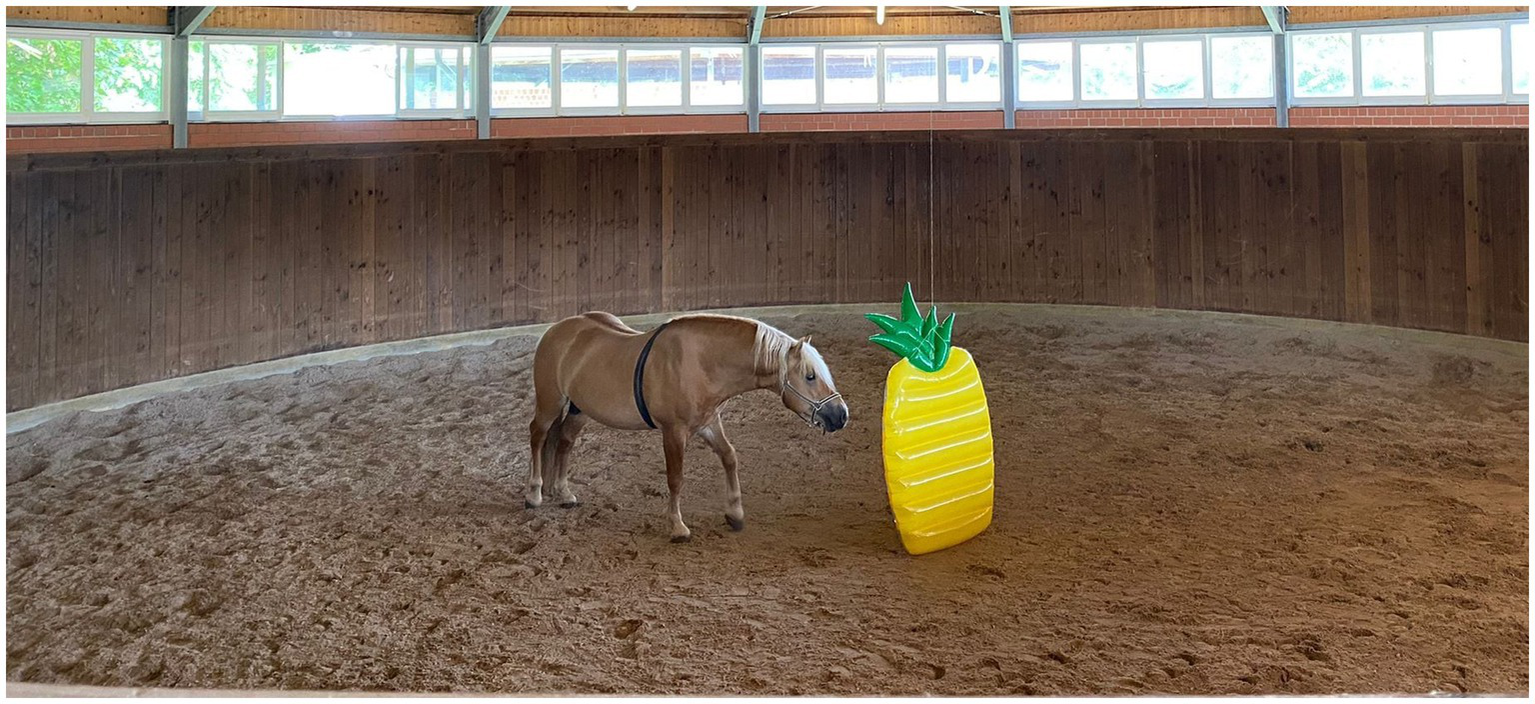
Novel object test. A pool raft (yellow pineapple) was chosen as the unknown object. The horse is wearing an electrode belt with a heart rate sensor around its chest.
Each horse was subsequently led into a riding hall, where a trailer was parked. Horses were guided directly toward the trailer and up the ramp. If a horse was not willing to walk up the ramp, it was led back in a circle for another attempt (maximum five attempts). A second person was then asked to stand behind the horse and support its guidance toward the trailer. Loading was not enforced by any additional measures. After the tests, blood and saliva samples were obtained for later assessment of cortisol levels.
Both tests were repeated after 13 days of paste administration (Figure 1), as CBD concentrations in serum were expected to have reached a steady state by this time (63). A new pool raft with similar dimensions but differing outer appearance (green turtle) was chosen for the second novel object test. The remainder of the protocol including the setup for loading on a trailer remained the same. All tests were recorded using a video camera (GoPro HERO10®, San Mateo, United States).
2.3.1 Assessment of novel object test
All video recordings were randomized and blinded. Evaluation was performed by one observer who was experienced in equine behavior studies and not aware of the horses’ group assignments. For each recording, the time periods spent in different movement patterns were assessed. Movement patterns included sniffing the ground, standing still, moving in each gait (walk, trot, canter) and rolling. During locomotion in each gait, the number of changes in direction were additionally documented. The horses’ reactions to the novel object itself were recorded by taking a note of the time it took a horse to first fixate the object visually, first approach the object and first touch the object.
2.3.2 Assessment of trailer test
Randomized and blinded video recordings were assessed by an observer experienced in equine behavior studies, who was not involved in the previous study parts. Each horse’s compliance with entering the trailer was scored on a scale from 0 to 7 for each attempt (Table 1). The attempt with the highest score was selected for statistical analysis.
Table 1
| Score | |
|---|---|
| 0 | Horse stops in front of the ramp |
| 1 | One front leg is on the ramp |
| 2 | Both front legs are on the ramp (with support) |
| 3 | Both front legs are on the ramp (no support) |
| 4 | Both front legs are in the trailer (with support) |
| 5 | Both front legs are in the trailer (no support) |
| 6 | Horse is in the trailer (with support) |
| 7 | Horse is in the trailer (no support) |
Behavioral scoring for trailer test.
“Support” refers to a second person standing behind the horse to guide it on the trailer.
2.3.3 Ethogram
An adjusted ethogram was developed to evaluate the behavioral traits shown throughout the novel object- and the trailer tests (Table 2). Randomized and blinded video analysis was performed by three observers who were not involved in the previous study parts but specifically trained for equine behavioral assessment. The number of behavioral traits displayed per horse was evaluated. Results of all three assessments were pooled to median values for further analysis.
Table 2
| Behavioral trait | Description |
|---|---|
| Bucking† | Fast dynamic movement in which the horse lowers its head, rounds its back and jumps in the air, sometimes leaving the ground with all four legs while kicking with the hindquarters |
| Cocking hindleg† | Horse standing firmly on three legs while one hindleg touches the ground with only the tip of the hoof |
| Defecating† | The horse relieving itself from fecal matter |
| Digging/scratching†§ | Standing firmly on three legs while purposefully scratching the ground with the tip of one front hoof |
| Ear movement§ | (Independent) flickering of one or both ears |
| Flehmen response† | Stretching the neck and the head upwards while curling the nose and exposing the teeth |
| Freezing§ | Freezing of the horse with tense posture and forward gaze |
| Head tossing†§ | Abrupt, powerful, short movement of the head and neck sideways or upwards; usually combined with tilting of the head |
| Licking/chewing† | Movement of the jaw that results in opening and closing of the mouth including movement of the tongue |
| Looking around or behind§ | Turning the head and neck toward the back without leg movements |
| Neighing†§ | The sound of a characteristic noise of a horse with different volumes and voice pitches |
| Remaining near exit† | The horse seeks close proximity to the exit of the round pen and remains there |
| Rolling† | Laying on the ground and demonstration a rolling motion, sometimes tilting over to the other side |
| Sniffing† | Horse lowers the head and sniffs the ground |
| Sniffing the ramp§ | Horse lowers the head and sniffs the ramp |
| Snorting†§ | Accelerated exhale through the nostrils accompanied by a characteristic flapping sound of the nostrils |
| Stomping† | Lifting of one leg and placing it back down forcefully |
| Tail swishing†§ | Short, intense, omnidirectional movement of the tail |
| Treading on the spot§ | Lifting and lowering the hooves without forward, backward or sideways movements |
| Urinating† | The horse relieving itself from urine in a characteristic stand |
| Walking backwards§ | Stepping backwards |
| Walking sideways§ | Stepping sideways |
Ethogram developed for evaluation of the †novel object test and §trailer test.
2.3.4 Assessment of heart rate and heart rate variability
Each cardiac beat-to-beat (R-R) recording was divided into sections of 5 min as previously described (54). Automatic beat correction was applied to remove artifacts (threshold: very low, 0.3 s). Heart rate (HR) and heart rate variability (HRV) including the following parameters: mean HR in beats per minute (bpm), root mean square of successive beat-to-beat differences (RMSSD in milliseconds, ms) and standard deviation of normal-to-normal R-R intervals (SDNN, ms) were evaluated using the software Kubios® HRV Standard (ver. 3.5, Kubios® Oy, Kuopio, Finland).
2.4 Assessment of cortisol levels
Cortisol levels in serum and saliva samples were determined by means of high-performance liquid chromatography/tandem mass spectrometry (LC/MS/MS). Information on the sample preparation/extraction, instrumental conditions, validation, analysis and method validation are summarized in the Supplementary material.
2.5 Statistical analysis
Data were recorded in Microsoft Excel® (Version 2304) and statistical analysis was performed with SPSS® Statistics 27 (IBM®, NY, United States). Data were visually inspected and tested with a Shapiro–Wilk test for normal distribution. Behavioral observations (sedation score, facial expression scale) and cortisol concentrations were analyzed using an analysis of variance (ANOVA) with a Greenhouse–Geisser correction and a general linear model for repeated measures to test for differences between the treatment and the control group over time. Cortisol levels in serum and saliva were further tested for correlation using Spearman’s rank correlation coefficient.
For the novel object test and the trailer test, the differences between movement patterns, reactions to the unknown objects, scores for loading on a trailer, ethogram behavioral traits and cortisol levels during the first test (baseline) and after 13 days of paste administration were calculated for each horse. Differences between the treatment and control group were compared using a t-test (for normally distributed data) or a Mann–Whitney-U-Test (for not normally distributed data). For the ethogram, intraclass correlation coefficients determined the level of agreement between the observers for each observed behavioral trait. HR, RMSSD and SDNN parameters obtained during the second test were analyzed using an ANOVA to test for differences between the treatment and the control group. Residuals were visually inspected for normal distribution. The level of significance was p < 0.05.
3 Results
3.1 Animals
Daily physical examinations of all horses did not identify any side effects such as gastrointestinal intolerances associated with paste application. On the day before study start, no residual cannabinoid contents were detected in serum or urine. Regular blood analyses did not identify significant irregularities in CBC, kidney and liver biomarkers (63). CBD concentrations in serum reached a steady state after 2 days of CBD paste administration with a mean maximum serum concentration (Cmax) of 38.4 ± 8.9 ng/mL (63).
3.2 Behavioral observations
Mean values for sedation scores ranged from 34.0 ± 5.0 (day 3) to 51.7 ± 1.5 (day 19) in the treatment group, and 39.0 ± 1.5 (day 15) to 56.0 ± 2.0 (day 19) in the control group. For the facial expression scale, values ranged from 9.7 ± 2.0 (day 3) to 12.6 ± 2.3 (day 9) in the treatment group, and 10.3 ± 0.8 (day 0) to 13.8 ± 1.1 (day 1) in the control group (Figure 3). On 12 out of 18 days, values for sedation scores were higher in the control group than in the treatment group. Comparison using an ANOVA with a Greenhouse–Geisser correction showed no significant differences between groups for the sedation score [F(3.0, 11.9) = 2.3, p = 0.127] and the facial expression scale [F(1.0, 1.0) = 1.5, p = 0.435]. Due to technical difficulties, videos and photographs of day 13 and 14 were not assessable for scoring.
Figure 3

Mean ± standard deviations (SD) of behavioral observations obtained during the multiple dose study with daily administration of cannabidiol (CBD) and placebo pastes to a treatment and control group (n = 6 + 6 horses). The treatment group received CBD containing paste from days 1 to 15 (3 mg CBD/kg BID p.o.). (A) Summed up sedation scores after acoustic and visual stimulations (clicker, plastic bag, pink cloth). (B) Daily facial expression scores. Higher scale points relate to a higher level of relaxation/sedation.
3.3 Morning cortisol levels
Throughout the course of the multiple dose study, cortisol levels in serum were on average 54.7 ± 18.6 ng/mL in the treatment group and 62.2 ± 19.2 ng/mL in the control group. For saliva, mean cortisol levels were on average 0.40 ± 0.30 ng/mL in the treatment group and 0.63 ± 0.45 ng/mL in the control group (Figure 4). Differences between groups were tested using an ANOVA with a Greenhouse–Geisser correction and were non-significant for cortisol levels in serum [F(4.1, 37.0) = 1.7, p = 0.171] and in saliva [F(1.6, 3.2) = 1.0, p = 0.442] over all days. Correlation between serum and saliva cortisol levels was rs = 0.53 (p < 0.001).
Figure 4
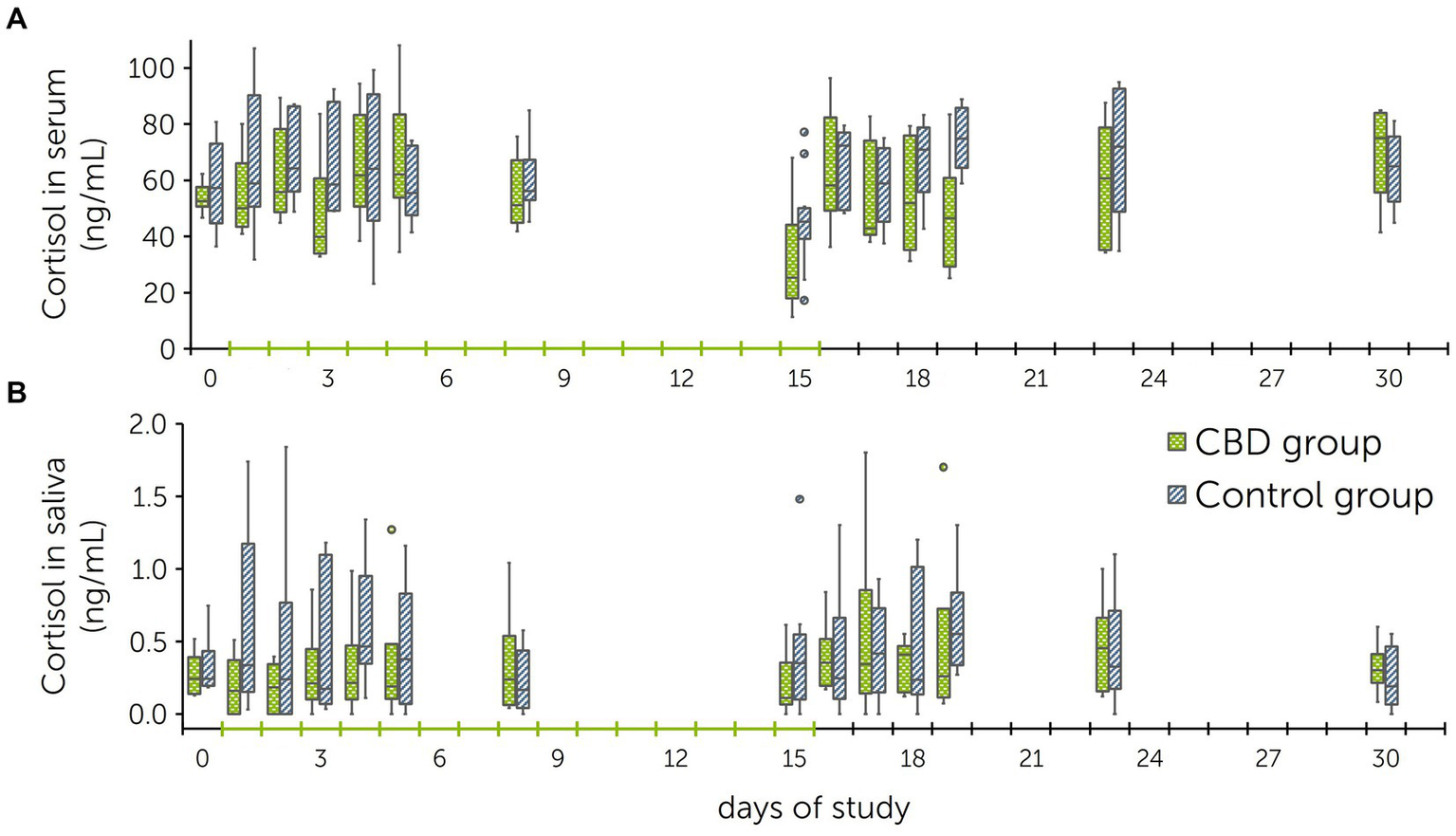
Boxplots of cortisol levels in serum (A) and saliva (B) obtained during the multiple dose study with daily administration of cannabidiol (CBD) and placebo pastes to a treatment and control group (n = 6 + 6 horses). The treatment group received CBD containing paste from days 1 to 15 (3 mg CBD/kg BID p.o.).
3.4 Novel object test and trailer test
3.4.1 Novel object test
The initial reactions to lowering of the pool raft was trotting or galloping alongside the outer parameter of the round pen in all horses. Movements then reduced to walking, standing or sniffing the ground with a subsequent continuation of trotting or galloping in a number of cases. Movement patterns for each individual horse are depicted in Figure 5. The difference between each movement pattern shown during the novel object test before trial start (baseline) and after 13 days of paste administration was calculated for each horse. Comparison of the differences between treatment and control group proved to be non-significant for all movement patterns (sniffing: p = 0.699; walking: p = 0.818; trotting: p = 0.818; galloping: p = 0.394; rolling: p = 0.699).
Figure 5

Movement patterns during novel object test in direct comparison per individual horse (1–12) between baseline (left bars) and after 13 days of paste administration (right bars) to a treatment and control group (n = 6 + 6 horses). The treatment group received a cannabidiol (CBD) containing paste twice daily from days 1 to 15 (3 mg CBD/kg).
During both tests, horses changed direction several times. Differences in the number of changes of direction between before and after treatment ranged from 0 to 4 for each horse in the treatment group and from 1 to 8 for each horse in the control group. There was no significant difference found when compared between groups (p = 0.485).
In both novel object tests, all horses first fixated the pool raft visually 1.1–1.4 min after the start with non-significant difference between groups (p = 0.485). During the first novel object test (baseline), all horses approached the novel object after approximately 3 min (treatment group: 3.0 ± 1.3 min, control group: 3.0 ± 1.5 min). During the second novel object test, horses in the treatment group first approached the novel object after 4.4 ± 3.4 min and horses in the control group after 1.5 ± 0.5 min. Differences were non-significant (p = 0.065). During the baseline novel object test, four horses in each group touched the object. Two horses in the treatment group and four horses in the control group touched the pool raft during the second novel object test. Modes of touching included careful reaching with head and neck, tentative touching, or nibbling. Statistically significant difference was not identified between groups (p = 0.485).
3.4.1.1 Novel object test: ethogram
Ten out of fifteen behavioral traits were rated with ICC values of > 0.90. The ICC value for “remaining near exit” was 0.80. “Cocking hindleg” and “stomping” were rated with ICC values between 0.50–0.75, and “licking/chewing” and “snorting” were rated with ICC values < 0.50.
In both groups, the most frequently exhibited trait was “sniffing” (treatment group: median at baseline = 12 times, median after paste administration = 16.5 times; control group: median at baseline = 9.5 times, median after paste administration = 10.5 times). Other behavioral traits (Table 2) were exhibited a median of 0–4 times. Individual stallions showed behavioral traits such as “tail swishing” and “head tossing” up to 18 and 29 times, respectively.
The difference between each behavioral trait exhibited during the baseline test and after paste administration was calculated per horse. Comparison of the differences between groups showed no significant effect [p values ranging from 0.132 (“head tossing”) to > 0.999 (“bucking”)].
3.4.2 Trailer test
During the baseline test, three horses in the treatment group entered the trailer completely (scores 6 and 7, Table 1), one horse placed both front legs in the trailer (score 4), one horse went as far as putting both front legs on the ramp of the trailer (score 2) and one horse stopped in front of the ramp (score 0). In the control group, two horses entered the trailer (scores 6 and 7), two horses put both front legs in the trailer (scores 4 and 5) and two horses stopped before the ramp (score 0).
After 13 days of paste administration, the scores of six horses (three in each group) did not change (treatment group: scores 7, 7, 0; control group: scores 6, 0, 0). One horse in the treatment group was rated with a higher score (score 2 to 3). Two horses in the treatment group and three horses in the control group scored lower in the second test (treatment group: score 6 to 3, score 4 to 3; control group: score 7 to 6, score 5 to 3, score 4 to 3).
For each horse, the differences between scores determined during baseline and after paste administration were calculated with no significant effect when compared between groups (p = 0.589).
3.4.2.1 Trailer test: ethogram
Observer agreement using the ICC was rated > 0.90 for six out of twelve behavioral traits. ICC values for “tail swishing,” “looking around or behind,” and “treading on the spot” were between 0.75 and 0.90. “Ear movement,” “freezing” and “snorting” were rated with ICC values of < 0.50.
In both groups, the behavioral trait most frequently observed was “ear movement” during the baseline test (treatment group: median of 5 times; control group: median of 3 times) and after paste administration (both groups: median of 3 times). “Ear movement,” “head tossing” and “looking around or behind” was mainly observed in stallions (between 10 and 13 times each). No horse exhibited “digging/scratching.” Differences were calculated between the baseline test and after paste administration for each individual horse. Differences were compared between groups using the Mann–Whitney-U-Test with resulting p values ranging from 0.180 (“looking around or behind”) to > 0.999 (“digging/scratching,” “neighing,” “walking sideways”).
3.4.3 Heart rate and heart rate variability
Due to technical difficulties, recordings of R-R intervals during the novel object test and the trailer test before study start (baseline) were not available for analysis. It was decided to compare HR and HRV data obtained during the second tests between treatment and control group. The mean values assessed during the novel object test for HR were: 48.6 ± 1.5 bpm, for RMSSD: 93.4 ± 22.1 ms and for SDNN: 87.9 ± 26.3 ms in the treatment group. In the control group, mean values for HR were: 44.9 ± 5.3 bpm, for RMSSD: 113.8 ± 36.5 ms and for SDNN: 113.5 ± 58.9 ms.
During the trailer test, the mean HR was 47.2 ± 3.7 bpm, mean RMSSD was 121.1 ± 21.3 ms and mean SDNN was 118.6 ± 37.6 ms in the treatment group. In the control group, mean values were HR: 46.3 ± 10.7 bpm, RMSSD: 124.2 ± 45.0 ms and SDNN: 132.4 ± 61.0 ms. Analysis using a one-way ANOVA with a Greenhouse–Geisser correction found no statistically significant differences between treatment and control group over both trials for HR: F(1.5, 12.2) = 1.2, p = 0.312, RMSSD: F (5, 40) = 1.6, p = 0.183 and SDNN: F (6, 36) = 1.6, p = 0.178.
3.4.4 Cortisol levels
Serum and saliva samples for cortisol analysis were obtained prior to each novel object test and after each trailer test. Before the first novel object test (baseline), cortisol levels of horses in the treatment group were 44.68 ± 11.08 ng/mL in serum and 0.17 ± 0.09 ng/mL in saliva. After the baseline tests, cortisol levels increased to 68.87 ± 24.95 ng/mL in serum and 0.46 ± 0.38 ng/mL in saliva. Before the second novel object test, serum cortisol levels were 45.22 ± 12.61 ng/mL and saliva cortisol levels 0.15 ± 0.05 ng/mL. After the second trailer test, cortisol levels increased to 47.23 ± 18.27 ng/mL (serum) and 0.35 ± 0.15 ng/mL (saliva) (Figure 6).
Figure 6

Cortisol levels in serum (A) and saliva (B) before the novel object test (NOT) and trailer test, and immediately after both tests. Tests were performed twice: prior to start of paste administrations (baseline) and following 13 days of paste administrations to a treatment and control group (n = 6 + 6 horses). Pool rafts were used as novel objects [pineapple for the baseline test (NOT 1), turtle for the second test (NOT 2)]. The treatment group received a cannabidiol (CBD) containing paste twice daily from days 1 to 15 (3 mg CBD/kg).
Prior to the baseline novel object test, cortisol levels in the control group were 46.28 ± 16.10 ng/mL in serum and 0.26 ± 0.19 ng/mL in saliva. After loading on a trailer, cortisol levels reached 60.87 ± 18.67 ng/mL in serum and 0.20 ± 0.09 ng/mL in saliva. Before the second novel object test, serum cortisol levels were 59.40 ± 25.12 ng/mL and saliva cortisol levels were 0.78 ± 0.48 ng/mL. After the second trailer test, cortisol levels were 61.42 ± 30.30 ng/mL (serum) and 0.50 ± 0.51 ng/mL (saliva) (Figure 6).
Differences between cortisol levels measured in serum and saliva before and after the tests were calculated for each horse. Comparison of test results from the second tests found a significant difference between groups for cortisol levels in saliva (p = 0.016), but not in serum (p > 0.999). Within the treatment group, comparison between baseline tests and tests following CBD paste administration showed no significant differences (serum: p = 0.505; saliva: p > 0.999).
4 Discussion
Regular oral administration of a CBD containing paste at a dose of 3 mg/kg was well-tolerated by all horses in this study. Multiple oral CBD administrations did not have a significant effect on behavioral observations and cortisol monitoring. Parameters investigated in a novel object test and during loading on a trailer did not differ significantly from the control group.
Case reports have described CBD as an effective agent for the treatment of mechanical allodynia, chronic crib-biting and wind-sucking at an oral dose of 0.5 mg CBD/kg BID in horses (64, 65). These reports did not test CBD levels in serum, but previous studies reported maximum CBD concentrations of less than 20 ng/mL in serum following administration of up to 3 mg CBD/kg p.o. (8, 66–71). Two studies found Cmax levels of 51 ng/mL CBD in serum following oral administration of 2 mg CBD/kg SID for 7 days (67, 70), and Cmax levels of 55.7 ng/mL CBD in serum following a single oral dose of 10 mg CBD/kg (72). The Cmax levels of 38.4 ± 8.9 ng/mL in serum reported during the current study (63) are therefore in line with previous reports, and comparatively high (70). In dogs, similar CBD dose levels lead to much higher concentration maxima in serum: one study has shown that the median Cmax of CBD was 102.3 ng/mL after single oral administration of 2 mg CBD/kg (4). The absorption and retention of CBD in horses seems to be more akin to humans than dogs (70). Single oral intake of 400 mg CBD resulted in a subjective reduction in anxiety in humans with generalized social anxiety disorder (15). However, as no therapeutic serum concentrations for anxiety in humans are available so far, further studies are required to translate administered CBD dose levels to therapeutic serum concentrations.
The facial expression scale used in this study was based on the facial sedation scale for horses (FaceSed) and the Horse Grimace Scale (HGS) (43, 45). Two studies have reported an effective assessment of facial expressions using the HGS to indicate pain levels (73, 74). In the current study, daily behavioral observations of sedation levels using a sedation score and a facial expression scale did not differ significantly between treatment and control group. This assessment is in line with previous studies that found no significant effect on sedation levels following regular CBD pellet feedings (~0.29 mg CBD/kg over 56 days) in horses (7) and oral administration of CBD treats (4.5 mg CBD/kg BID over 21 days) in dogs (18). Reports on US veterinarians and pet owners’ perceptions of CBD and hemp use in dogs state that sedation/tiredness were the most commonly observed side effects (75–77). In humans, sedation was reported as a side effect following daily oral intake of 600 mg CBD over 6 weeks (78). As doses were higher in these reports, the question remains whether increased dose levels and therefore increased serum concentrations would lead to a similar effect in horses.
Cortisol is a steroid hormone which is subject to a circadian rhythm. Cortisol levels assessed in previous publications were reported to be highest between 8 am and 12 pm (serum: 25–70 ng/mL; saliva: 0.55–0.70 ng/mL) (50, 79) and are comparable to levels reached in the current study. Depending on the time of day and stress exposure, saliva levels can reach up to 3 ng/mL in horses but usually stay below 1 ng/mL (49, 50, 80). Saliva sampling is a noninvasive, pain-free additional technique to gain more information about cortisol levels (49, 81). Salivary and serum cortisol levels have been reported to have different degrees of correlation (rs = 0.32–0.80) (50, 81). In this study, a moderate correlation was seen between serum and salivary cortisol levels (rs = 0.53) (82). Minor disruptions leading to stress responses can result in deviations from the normal circadian cortisol rhythm and may elevate cortisol levels in blood (50, 79). In this study, no significant effect of CBD on morning cortisol levels was identified.
Novel object tests have been used in a variety of species and can be performed with different unknown objects (54–57) or even unknown horses (Novel horse test) (83). Novel object tests are designed as fear tests and are used to document the intensity of an animal’s fearfulness when confronted with the unknown object. As no standard protocol exists, neither regarding the kind of object nor the duration of exposure, scoring of reactions and assessment of additional parameters (such as heart rate) tend to vary. In this study, two novel object tests were performed with similarly sized yet differently colored and shaped objects (pool rafts: yellow pineapple and green turtle) to make the test results comparable and exclude a habituation effect. One report tested habituation to a frightening stimulus (white nylon bag) in 2-year-old colts. It was concluded that the horses were habituated to the stimulus after four training sessions which were all conducted within 1 day (84). As the novel object tests performed in this study were only performed twice and were 16 days apart, habituation was considered to be an unlikely limiting factor. The effect of CBD in horses has been tested in another study using a novel object test following daily oral administration of CBD pellets (~0.2 mg CBD/kg) (6). A significantly lower degree of reactivity compared to a control group was documented (6). A fear response test performed in dogs following oral CBD treatment (1.4 mg CBD/kg) showed no significant effect (85). In agreement with this report, the current study found no significant difference between treatment and control group regarding movement patterns. Reaction times to the novel object differed between groups: during the first novel object test, horses in both groups took about 3 min to first approach the novel object. During the second test, horses in the treatment group took more time to first approach the object (4.4 ± 3.4 min) than horses in the control group (1.5 ± 0.5 min). These differences could suggest that CBD does either not exhibit a fear-reducing effect in the studied dose level, or that CBD has a relaxing effect and reduces the horse’s interest in the novel object. Statistical analysis showed that the differences between groups are bordering on significance (p = 0.065), which might be biased by the small sample size. Future tests should include larger sample sizes and potentially nervous horses when determining CBD’s effect as a fear-reducing or anxiolytic agent.
Loading on a trailer is considered a stressful event for horses (58–60). Different training methods are described to reduce horses’ discomfort and anxiety (58–60). In addition to training, sedatives like acepromazine may be used to reduce stress responses (61). Oral CBD (total of 400 mg, single administration) has been reported to subjectively decrease anxiety in humans with generalized social anxiety disorder (15). The effect of CBD on horses’ reactions to loading on a trailer has not been reported yet, but results of this study suggest that it does not increase horses’ willingness to enter a trailer at the tested dose level.
Behavioral traits displayed by horses during the novel object- and the trailer test were assessed using a customized ethogram. Behavioral observations may be performed using a software (53) or handwritten lists prepared by one to four independent observers (73, 74, 86). To reduce subjectivity, three observers rated behavioral traits in this study. Most behavioral traits displayed a good (0.75–0.90) to excellent agreement (> 0.90) (87). Behavioral traits with poor agreement (< 0.50) included “ear movement,” “freezing,” “licking/chewing” and “snorting.” Poor scores might be related to an insufficient description of the respective traits, or to the more difficult detection of smaller movements such as “ear movement” or “licking/chewing” especially in combination with other movements when watching a video recording. A wide variety of behavioral traits were assessed including noises (“neighing”) and whole body movements (“walking backwards”), as well as behaviors indicative of stress such as “bucking” or “head tossing” (88). No significant differences in displayed behavioral traits were identified between treatment and control group.
Studies investigating heart rate (HR) and heart rate variability (HRV: RMSSD and SDNN) have shown that a decrease in HR and increase in RMSSD and SDNN suggest an autonomic shift toward a parasympathetic dominance and are therefore indicative of the horse’s stress levels (48, 54, 89–92). Measurement of HR and HRV is an established tool to evaluate stress responses due to pain or anxiety-inducing events (90, 93–96). Additionally, assessments of HR and HRV have been performed during novel object tests (54–56, 97), and loading on a trailer and subsequent transport (98, 99) in horses. The effect of CBD on HR and HRV has been documented in horses, dogs, humans and rodents with varying results. In horses, HR assessed during a novel object test found no significant effect between a treatment group fed 100 mg pelleted CBD (~0.2 mg CBD/kg) and a control group (6). A stress test performed in dogs similarly found no significant differences in HR and HRV values between a treatment (single oral administration of 4 mg CBD/kg) and a placebo group (100). A second report in dogs equally identified no significant changes in RMSSD and SDNN following a fear response test when treated orally with 1.4 mg CBD/kg (85). In contrast, single intraperitoneal CBD administration in rodents (10 mg CBD/kg) significantly reduced the increase of HR and blood pressure in a stress inducing and fear conditioning setting, suggesting an anxiolytic effect (14, 16). In this study, HR values were higher and RMSSD and SDNN were lower in the treatment than in the control group, indicating a less pronounced parasympathetic state in the treatment group. However, as these differences were statistically non-significant, their relevance is debatable.
Measurement of cortisol concentrations is an established parameter for stress evaluation in horses (49, 51, 81, 92, 99). When comparing the cortisol levels before and after the novel object- and trailer tests, cortisol levels in serum increased to varying degrees (Figure 6). Within the treatment group, the increase was less pronounced after the second round of tests. Statistical analysis showed that this reduction was non-significant. In the control group, salivary cortisol levels had decreased after both test rounds. The difference between treatment and control group was therefore found to be significant (p = 0.016). The effect of CBD on cortisol levels has been investigated in humans, dogs and horses with varying results (17, 66, 100–102). After a stress test, dogs that received oral CBD (4 mg CBD/kg) showed significantly lower serum cortisol concentrations than a control group (100). In horses, one study compared cortisol levels between horses that were administered CBD oil and horses receiving olive oil after transportation with no significant findings (66). Studies performed in humans are difficult to compare due to their differing designs and intentions, but have similarly not found a significant effect of CBD on cortisol levels (101, 102).
As all cannabinoids are listed as prohibited substances by the FEI, and CBD is defined as a controlled medication (41), future studies are required to determine what effects oral dosing of CBD exactly exerts in horses, and what dose levels and intervals are needed to achieve these effects. No consistently significant effects on equine behavior were observed in this study.
A small sample size is the main limitation of this study. Further limitations include the missing recordings of R-R intervals during the novel object test and the trailer test before study start (baseline). Consequently, comparison of HR and HRV was carried out between groups following paste administration. Subjects were healthy horses that did not show behavioral problems. Further trials with larger sample sizes are needed to validate the potential effectiveness of CBD in anxious or nervous horses. Future studies may also include more detailed assessments of HRV parameters including the parasympathetic tone activity (PTA) index. Oral dosing using different formulations such as micellar formulation should also be considered (72). Clinical studies as have been performed with dogs (4) are of interest to further assess the potential use of CBD in equine medicine.
5 Conclusion
This study did not detect consistently significant effects of regularly administered oral CBD (3 mg/kg BID over 15 days) on behavioral observations or morning cortisol levels in healthy horses. Horses’ reactions to a novel object and loading on a trailer were tested with no significant differences identified between treatment and control group. Parameters assessed included movement patterns, reaction to the novel object, heart rate and heart rate variability, and cortisol levels in serum and saliva. No adverse reactions were observed following multiple administrations of a CBD containing paste. Further research is required to determine adequate indications for the use of CBD products in horses.
Statements
Data availability statement
The raw data supporting the conclusions of this article will be made available by the authors, without undue reservation.
Ethics statement
The animal study was approved by the competent authority for licensing and notification procedures for animal experiments (LAVG) in Brandenburg, Germany (AZ: 2347-12-2021). The study was conducted in accordance with the local legislation and institutional requirements.
Author contributions
FE: Conceptualization, Data curation, Formal analysis, Investigation, Methodology, Project administration, Software, Validation, Visualization, Writing – original draft. AE: Conceptualization, Data curation, Formal Analysis, Funding acquisition, Investigation, Methodology, Project administration, Resources, Supervision, Validation, Writing – review & editing. MM: Formal analysis, Investigation, Methodology, Project administration, Software, Validation, Writing – review & editing. KCJ: Formal analysis, Methodology, Software, Validation, Writing – review & editing. SW: Formal analysis, Methodology, Software, Validation, Writing – review & editing. NB: Conceptualization, Data curation, Methodology, Project administration, Writing – review & editing. JB: Data curation, Formal analysis, Investigation, Methodology, Project administration, Writing – review & editing. MP: Data curation, Formal analysis, Investigation, Methodology, Writing – review & editing. MT: Methodology, Supervision, Writing – review & editing. WB: Conceptualization, Methodology, Project administration, Supervision, Writing – review & editing. CL: Conceptualization, Funding acquisition, Methodology, Project administration, Resources, Supervision, Writing – review & editing. MW: Conceptualization, Investigation, Methodology, Project administration, Resources, Supervision, Writing – review & editing.
Funding
The author(s) declare financial support was received for the research, authorship, and/or publication of this article. The study was funded by the Freie Universität Berlin, the German Equestrian Federation (FN) and Herosan healthcare GmbH. Herosan healthcare GmbH was not involved in the study design, collection, analysis, interpretation of data, the writing of this article or the decision to submit it for publication. We acknowledge support by the Open Access Publication Fund of the Freie Universität Berlin.
Acknowledgments
The authors would like to sincerely thank Hannah Petersen and Dr. Ina Schenk for their extensive contributions to this study, and Franziska Berger, Lena Haas, Katharina Jessat, Anja Kühnel, Dr. Jenny Ries, Clara Schubert, and Elisa Zimmermann for their support with horse handling. We also thank the whole team at the Equine Center Bad Saarow, especially Prof. Dr. Johannes Handler, for providing the horses and their support during the practical part of the study. The authors further acknowledge the support of Conny Pint and Daniela Wimmer, and sincerely thank Philine Bank for initiating the project.
Conflict of interest
The authors declare that the research was conducted in the absence of any commercial or financial relationships that could be construed as a potential conflict of interest.
Publisher’s note
All claims expressed in this article are solely those of the authors and do not necessarily represent those of their affiliated organizations, or those of the publisher, the editors and the reviewers. Any product that may be evaluated in this article, or claim that may be made by its manufacturer, is not guaranteed or endorsed by the publisher.
Supplementary material
The Supplementary material for this article can be found online at: https://www.frontiersin.org/articles/10.3389/fvets.2023.1305873/full#supplementary-material
References
1.
FogaçaMVCamposACCoelhoLDDumanRSGuimarãesFS. The anxiolytic effects of cannabidiol in chronically stressed mice are mediated by the endocannabinoid system: role of neurogenesis and dendritic remodeling. Neuropharmacology. (2018) 135:22–33. doi: 10.1016/j.neuropharm.2018.03.001
2.
HensonJDVitettaLQuezadaMHallS. Enhancing endocannabinoid control of stress with Cannabidiol. J Clin Med. (2021) 10:10. doi: 10.3390/jcm10245852
3.
MoltkeJHindochaC. Reasons for cannabidiol use: a cross-sectional study of CBD users, focusing on self-perceived stress, anxiety, and sleep problems. J Cannabis Res. (2021) 3:5. doi: 10.1186/s42238-021-00061-5
4.
GambleL-JBoeschJMFryeCWSchwarkWSMannSWolfeLet al. Pharmacokinetics, safety, and clinical efficacy of Cannabidiol treatment in osteoarthritic dogs. Front Vet Sci. (2018) 5:165. doi: 10.3389/fvets.2018.00165
5.
Della RoccaGDi SalvoA. Hemp in veterinary medicine: from feed to drug. Front Vet Sci. (2020) 7:387. doi: 10.3389/fvets.2020.00387
6.
DraegerALThomasEPJonesKADavisAJPorrCS. The effects of pelleted cannabidiol supplementation on heart rate and reaction scores in horses. J Vet Behav. (2021) 46:97–100. doi: 10.1016/j.jveb.2021.09.003
7.
St BlancMPChapmanAMKeowenMLGarzaFLiuC-CGrayLet al. Effects of a supplement containing Cannabidiol (CBD) on sedation and Ataxia scores and health. J Equine Vet. (2022) 117:104085. doi: 10.1016/j.jevs.2022.104085
8.
RyanDMcKemieDSKassPHPuschnerBKnychHK. Pharmacokinetics and effects on arachidonic acid metabolism of low doses of cannabidiol following oral administration to horses. Drug Test Anal. (2021) 13:1305–17. doi: 10.1002/dta.3028
9.
MechoulamRHanušLOPertweeRHowlettAC. Early phytocannabinoid chemistry to endocannabinoids and beyond. Nat Rev Neurosci. (2014) 15:757–64. doi: 10.1038/nrn3811
10.
GolombekPMüllerMBarthlottISprollCLachenmeierDW. Conversion of Cannabidiol (CBD) into psychotropic cannabinoids including tetrahydrocannabinol (THC): a controversy in the scientific literature. Toxics. (2020) 8:8. doi: 10.3390/toxics8020041
11.
Casajuana KöguelCLópez-PelayoHBalcells-OliveroMMColomJGualA. Constituyentes psicoactivos del cannabis y sus implicaciones clínicas: una revisión sistemática. Adicciones. (2018) 30:140–51. doi: 10.20882/adicciones.858
12.
GranjeiroEMGomesFVGuimarãesFSCorrêaFMResstelLB. Effects of intracisternal administration of cannabidiol on the cardiovascular and behavioral responses to acute restraint stress. Pharmacol Biochem Behav. (2011) 99:743–8. doi: 10.1016/j.pbb.2011.06.027
13.
GomesFVResstelLBGuimarãesFS. The anxiolytic-like effects of cannabidiol injected into the bed nucleus of the stria terminalis are mediated by 5-HT1A receptors. Psychopharmacology. (2011) 213:465–73. doi: 10.1007/s00213-010-2036-z
14.
ResstelLBTavaresRFLisboaSFJocaSRCorrêaFMGuimarãesFS. 5-HT1A receptors are involved in the cannabidiol-induced attenuation of behavioural and cardiovascular responses to acute restraint stress in rats. Br J Pharmacol. (2009) 156:181–8. doi: 10.1111/j.1476-5381.2008.00046.x
15.
CrippaJADerenussonGNFerrariTBWichert-AnaLDuranFLMartin-SantosRet al. Neural basis of anxiolytic effects of cannabidiol (CBD) in generalized social anxiety disorder: a preliminary report. J Psychopharmacol (Oxford, England). (2011) 25:121–30. doi: 10.1177/0269881110379283
16.
ResstelLBJocaSRMoreiraFACorrêaFMGuimarãesFS. Effects of cannabidiol and diazepam on behavioral and cardiovascular responses induced by contextual conditioned fear in rats. Behav Brain Res. (2006) 172:294–8. doi: 10.1016/j.bbr.2006.05.016
17.
CorsettiSBorrusoSMalandruccoLSpallucciVMaraglianoLPerinoRet al. Cannabis sativa L. may reduce aggressive behaviour towards humans in shelter dogs. Sci Rep. (2021) 11:2773. doi: 10.1038/s41598-021-82439-2
18.
MorrisEMKitts-MorganSESpanglerDMGebertJVanzantESMcLeodKRet al. Feeding Cannabidiol (CBD)-containing treats did not affect canine daily voluntary activity. Front Vet Sci. (2021) 8:645667. doi: 10.3389/fvets.2021.645667
19.
ShallcrossJHámorPBechardARRomanoMKnackstedtLSchwendtM. The divergent effects of CDPPB and Cannabidiol on fear extinction and anxiety in a predator scent stress model of PTSD in rats. Front Behav Neurosci. (2019) 13:91. doi: 10.3389/fnbeh.2019.00091
20.
Fusar-PoliPCrippaJABhattacharyyaSBorgwardtSJAllenPMartin-SantosRet al. Distinct effects of Δ9-tetrahydrocannabinol and cannabidiol on neural activation during emotional processing. Arch Gen Psychiatry. (2009) 66:95–105. doi: 10.1001/archgenpsychiatry.2008.519
21.
WilliamsNNEwellTRAbbottsKSHarmsKJWoelfelKADooleyGPet al. Comparison of five Oral Cannabidiol preparations in adult humans: pharmacokinetics, body composition, and heart rate variability. Pharmaceuticals (Basel). (2021) 14. doi: 10.3390/ph14010035
22.
ZiebaJSinclairDSebreeTBonn-MillerMGuttermanDSiegelSet al. Cannabidiol (CBD) reduces anxiety-related behavior in mice via an FMRP-independent mechanism. Pharmacol Biochem Behav. (2019) 181:93–100. doi: 10.1016/j.pbb.2019.05.002
23.
De GregorioDMcLaughlinRJPosaLOchoa-SanchezREnnsJLopez-CanulMet al. Cannabidiol modulates serotonergic transmission and reverses both allodynia and anxiety-like behavior in a model of neuropathic pain. Pain. (2019) 160:136–50. doi: 10.1097/j.pain.0000000000001386
24.
FogaçaMVCamposACGuimarãesFS. Cannabidiol and 5-HT1A receptors In: Neuropathology of drug addictions and substance misuse: Elsevier (2016). 749–59.
25.
IzzoAABorrelliFCapassoRDi MarzoVMechoulamR. Non-psychotropic plant cannabinoids: new therapeutic opportunities from an ancient herb. Trends Pharmacol Sci. (2009) 30:515–27. doi: 10.1016/j.tips.2009.07.006
26.
CamposACMoreiraFAGomesFVDel BelEAGuimarãesFS. Multiple mechanisms involved in the large-spectrum therapeutic potential of cannabidiol in psychiatric disorders. Philos Trans R Soc Lond Ser B Biol Sci. (2012) 367:3364–78. doi: 10.1098/rstb.2011.0389
27.
BlessingEMSteenkampMMManzanaresJMarmarCR. Cannabidiol as a potential treatment for anxiety disorders. Neurotherapeutics. (2015) 12:825–36. doi: 10.1007/s13311-015-0387-1
28.
LewekeFMPiomelliDPahlischFMuhlDGerthCWHoyerCet al. Cannabidiol enhances anandamide signaling and alleviates psychotic symptoms of schizophrenia. Transl Psychiatry. (2012) 2:e94. doi: 10.1038/tp.2012.15
29.
WatanabeKKayanoYMatsunagaTYamamotoIYoshimuraH. Inhibition of anandamide amidase activity in mouse brain microsomes by cannabinoids. Biol Pharm Bull. (1996) 19:1109–11. doi: 10.1248/bpb.19.1109
30.
Di MarzoVBisognoTDePL. Anandamide: some like it hot. Trends Pharmacol Sci. (2001) 22:346–9. doi: 10.1016/S0165-6147(00)01712-0
31.
RiebeCJPamplonaFAKamprathKWotjakCT. Fear relief-toward a new conceptual frame work and what endocannabinoids gotta do with it. Neuroscience. (2012) 204:159–85. doi: 10.1016/j.neuroscience.2011.11.057
32.
McLaughlinRJHillMNGorzalkaBB. A critical role for prefrontocortical endocannabinoid signaling in the regulation of stress and emotional behavior. Neurosci Biobehav Rev. (2014) 42:116–31. doi: 10.1016/j.neubiorev.2014.02.006
33.
RussoEBBurnettAHallBParkerKK. Agonistic properties of cannabidiol at 5-HT1a receptors. Neurochem Res. (2005) 30:1037–43. doi: 10.1007/s11064-005-6978-1
34.
KupczykPRykalaMSerekPPawlakASlowikowskiBHolyszMet al. The cannabinoid receptors system in horses: tissue distribution and cellular identification in skin. J Vet Intern Med. (2022) 36:1508–24. doi: 10.1111/jvim.16467
35.
GaliazzoGTagliaviaCGiancolaFRinnovatiRSadeghinezhadJBombardiCet al. Localisation of cannabinoid and cannabinoid-related receptors in the horse ileum. J Equine Vet. (2021) 104:103688. doi: 10.1016/j.jevs.2021.103688
36.
McPartlandJMMac DonaldCYoungMGrantPSFurkertDPGlassM. Affinity and efficacy studies of Tetrahydrocannabinolic acid a at cannabinoid receptor types one and two. Cannabis Cannabinoid Res. (2017) 2:87–95. doi: 10.1089/can.2016.0032
37.
BologniniDRockEMClunyNLCascioMGLimebeerCLDuncanMet al. Cannabidiolic acid prevents vomiting in Suncus murinus and nausea-induced behaviour in rats by enhancing 5-HT1A receptor activation. Br J Pharmacol. (2013) 168:1456–70. doi: 10.1111/bph.12043
38.
de PetrocellisLLigrestiAMorielloASAllaràMBisognoTPetrosinoSet al. Effects of cannabinoids and cannabinoid-enriched Cannabis extracts on TRP channels and endocannabinoid metabolic enzymes. Br J Pharmacol. (2011) 163:1479–94. doi: 10.1111/j.1476-5381.2010.01166.x
39.
McPartlandJMRussoEB. Cannabis and Cannabis extracts. J Cannabis Therapeutics. (2001) 1:103–32. doi: 10.1300/J175v01n03_08
40.
BriyneNDeHDSandlerIStilesESzymanskiDMoodySet al. Cannabis, Cannabidiol oils and tetrahydrocannabinol-what do veterinarians need to know?Animals (Basel). (2021) 11. doi: 10.3390/ani11030892
41.
Fédération Equestre Internationale. FEI clean sport - prohibited substances database (2022). Available at:https://inside.fei.org/content/anti-doping-rules.
42.
PollerCHopsterKRohnKKästnerSB. Nociceptive thermal threshold testing in horses - effect of neuroleptic sedation and neuroleptanalgesia at different stimulation sites. BMC Vet Res. (2013) 9:135. doi: 10.1186/1746-6148-9-135
43.
DeOARGozalo-MarcillaMRingerSKSchauvliegeSFonsecaMWEsteves TrindadePHet al. Development and validation of the facial scale (face Sed) to evaluate sedation in horses. PLoS One. (2021) 16:e0251909. doi: 10.1371/journal.pone.0251909
44.
SchauvliegeSCuypersCMichielsenAGasthuysFGozalo-MarcillaM. How to score sedation and adjust the administration rate of sedatives in horses: a literature review and introduction of the Ghent sedation algorithm. Vet Anaesth Analg. (2019) 46:4–13. doi: 10.1016/j.vaa.2018.08.005
45.
Dalla CostaEMineroMLebeltDStuckeDCanaliELeachMC. Development of the horse grimace scale (HGS) as a pain assessment tool in horses undergoing routine castration. PLoS One. (2014) 9:e92281. doi: 10.1371/journal.pone.0092281
46.
DeOARGozalo-MarcillaMRingerSKSchauvliegeSFonsecaMWTrindadePHet al. Development, validation, and reliability of a sedation scale in horses (Equi Sed). Front Vet Sci. (2021) 8:611729. doi: 10.3389/fvets.2021.611729
47.
KönigVBorstelUVisserEKHallC. Indicators of stress in equitation. Appl Anim Behav Sci. (2017) 190:43–56. doi: 10.1016/j.applanim.2017.02.018
48.
von LewinskiMBiauSErberRIlleNAurichJFaureJ-Met al. Cortisol release, heart rate and heart rate variability in the horse and its rider: different responses to training and performance. Vet J. (2013) 197:229–32. doi: 10.1016/j.tvjl.2012.12.025
49.
PeetersMClossonCBeckersJ-FVandenheedeM. Rider and horse salivary cortisol levels during competition and impact on performance. J Equine Vet. (2013) 33:155–60. doi: 10.1016/j.jevs.2012.05.073
50.
BohákZSzabóFBeckersJ-FMelo de SousaNKutasiONagyKet al. Monitoring the circadian rhythm of serum and salivary cortisol concentrations in the horse. Domest Anim Endocrinol. (2013) 45:38–42. doi: 10.1016/j.domaniend.2013.04.001
51.
Becker-BirckMSchmidtALasarzikJAurichJMöstlEAurichC. Cortisol release and heart rate variability in sport horses participating in equestrian competitions. J Vet Behav. (2013) 8:87–94. doi: 10.1016/j.jveb.2012.05.002
52.
König von BorstelUEuentSGrafPKönigSGaulyM. Equine behaviour and heart rate in temperament tests with or without rider or handler. Physiol Behav. (2011) 104:454–63. doi: 10.1016/j.physbeh.2011.05.010
53.
VisserEKvan ReenenCGRundgrenMZetterqvistMMorganKBlokhuisHJ. Responses of horses in behavioural tests correlate with temperament assessed by riders. Equine Vet J. (2003) 35:176–83. doi: 10.2746/042516403776114108
54.
VisserEKvan ReenenaCGvan der WerfJTNSchilderMBHKnaapJHBarneveldAet al. Heart rate and heart rate variability during a novel object test and a handling test in young horses. Physiol Behav. (2002) 76:289–96. doi: 10.1016/S0031-9384(02)00698-4
55.
ChristensenJWKeelingLJNielsenBL. Responses of horses to novel visual, olfactory and auditory stimuli. Appl Anim Behav Sci. (2005) 93:53–65. doi: 10.1016/j.applanim.2005.06.017
56.
MunstersCCVisserKEvan den BroekJvan Sloet Oldruitenborgh-OosterbaanMM. The influence of challenging objects and horse-rider matching on heart rate, heart rate variability and behavioural score in riding horses. Vet J. (2012) 192:75–80. doi: 10.1016/j.tvjl.2011.04.011
57.
ForkmanBBoissyAMeunier-SalaünM-CCanaliEJonesRB. A critical review of fear tests used on cattle, pigs, sheep, poultry and horses. Physiol Behav. (2007) 92:340–74. doi: 10.1016/j.physbeh.2007.03.016
58.
TateoAPadalinoBBoccaccioMMaggiolinoACentoducatiP. Transport stress in horses: effects of two different distances. J Vet Behav. (2012) 7:33–42. doi: 10.1016/j.jveb.2011.04.007
59.
DaiFDalla CostaABonfantiLCaucciCDi MartinoGLucarelliRet al. Positive reinforcement-based training for self-loading of meat horses reduces loading time and stress-related behavior. Front Vet Sci. (2019) 6:350. doi: 10.3389/fvets.2019.00350
60.
ShanahanS. Trailer loading stress in horses: behavioral and physiological effects of nonaversive training (TTEAM). J Appl Anim Welf Sci. (2003) 6:263–74. doi: 10.1207/s15327604jaws0604_1
61.
Santos GodoiTLVillas-BoasJDAlmeidaNATrigoPIDeAFQDeMMA. Pharmacopuncture versus Acepromazine in stress responses of horses during road transport. J Equine Vet. (2014) 34:294–301. doi: 10.1016/j.jevs.2013.06.008
62.
EichlerFEhrleAJensenKCBaudischNPetersenHBäumerWet al. Behavioral observations, heart rate and heart rate variability in horses following oral administration of a cannabidiol containing paste in three escalating doses (part 1/2). Front Vet Sci. (2023) 10:1305868. doi: 10.3389/fvets.2023.1305868
63.
EichlerFPoźniakBMachnikMSchenkIWingenderABaudischNet al. Pharmacokinetic modelling of orally administered cannabidiol and implications for medication control in horses. Front Vet Sci. (2023) 10:1234551. doi: 10.3389/fvets.2023.1234551
64.
EllisKLContinoEK. Treatment using cannabidiol in a horse with mechanical allodynia. Equine Vet Educ. (2021) 33:33. doi: 10.1111/eve.13168
65.
CunhaRZFelisardoLLSalamancaGMarchioniGGNetoOIChiocchettiR. The use of cannabidiol as a novel treatment for oral stereotypic behaviour (crib-biting) in a horse. Vet Anim Sci. (2023) 19:100289. doi: 10.1016/j.vas.2023.100289
66.
TurnerPLGuayKAJonesTCohenLElwongerFvan GeemRet al. 113 Cannabidiol supplementation and physiological response in transported horses. J Anim Sci. (2022) 100:33. doi: 10.1093/jas/skac028.063
67.
WilliamsMRHolbrookTCMaxwellLCroftCHIentileMMCliburnK. Pharmacokinetic evaluation of a Cannabidiol supplement in horses. J Equine Vet. (2022) 110:103842. doi: 10.1016/j.jevs.2021.103842
68.
YocomAFO'FallonESGustafsonDLContinoEK. Pharmacokinetics, safety, and synovial fluid concentrations of single- and multiple-dose Oral administration of 1 and 3 mg/kg Cannabidiol in horses. J Equine Vet. (2022) 113:103933. doi: 10.1016/j.jevs.2022.103933
69.
DraegerALHoffmanLKGodwinPRDavisAJPorrSA. Pharmacokinetics of a single feeding of pelleted cannabidiol in horses. Steeplechase: Murray State University (2020).
70.
SchwarkWSWakshlagJJ. A one health perspective on comparative cannabidiol and cannabidiolic acid pharmacokinetics and biotransformation in humans and domestic animals. Am J Vet Res. (2023) 84:1–9. doi: 10.2460/ajvr.23.02.0031
71.
TurnerSEKnychHKAdamsAA. Pharmacokinetics of cannabidiol in a randomized crossover trial in senior horses. Am J Vet Res. (2022) 83:83. doi: 10.2460/ajvr.22.02.0028
72.
Sánchez de MedinaASerrano-RodríguezJMDíez de CastroEGarcía-ValverdeMTSaituaABeceroMet al. Pharmacokinetics and oral bioavailability of cannabidiol in horses after intravenous and oral administration with oil and micellar formulations. Equine Vet J. (2023) 55:1094–103. doi: 10.1111/evj.13923
73.
Dalla CostaEBracciDDaiFLebeltDMineroM. Do different emotional states affect the horse grimace scale score? A pilot study. J Equine Vet. (2017) 54:114–7. doi: 10.1016/j.jevs.2017.03.221
74.
Dalla CostaEStuckeDDaiFMineroMLeachMCLebeltD. Using the horse grimace scale (HGS) to assess pain associated with acute laminitis in horses (Equus caballus). Animals (Basel). (2016) 6:6. doi: 10.3390/ani6080047
75.
KoganLRHellyerPWSilcoxSSchoenfeld-TacherR. Canadian dog owners’ use and perceptions of cannabis products. Can Vet J. (2019) 60:749–55. PMID:
76.
KoganLSchoenfeld-TacherRHellyerPRishniwM. US Veterinarians' knowledge, experience, and perception regarding the use of Cannabidiol for canine medical conditions. Front Vet Sci. (2018) 5:338. doi: 10.3389/fvets.2018.00338
77.
KoganLRHellyerPWRobinsonNG. Consumers' perceptions of hemp products for animals. J Am Holistic Vet Med Assoc JAHVMA. (2016):42.
78.
BoggsDLSurtiTGuptaAGuptaSNiciuMPittmanBet al. The effects of cannabidiol (CBD) on cognition and symptoms in outpatients with chronic schizophrenia a randomized placebo controlled trial. Psychopharmacology. (2018) 235:1923–32. doi: 10.1007/s00213-018-4885-9
79.
IrvineCHAlexanderSL. Factors affecting the circadian rhythm in plasma cortisol concentrations in the horse. Domest Anim Endocrinol. (1994) 11:227–38. doi: 10.1016/0739-7240(94)90030-2
80.
AurichJWulfMIlleNErberRVonLMPalmeRet al. Effects of season, age, sex, and housing on salivary cortisol concentrations in horses. Domest Anim Endocrinol. (2015) 52:11–6. doi: 10.1016/j.domaniend.2015.01.003
81.
PeetersMSulonJBeckersJ-FLedouxDVandenheedeM. Comparison between blood serum and salivary cortisol concentrations in horses using an adrenocorticotropic hormone challenge. Equine Vet J. (2011) 43:487–93. doi: 10.1111/j.2042-3306.2010.00294.x
82.
SchoberPBoerCSchwarteLA. Correlation coefficients: appropriate use and interpretation. Anesth Analg. (2018) 126:1763–8. doi: 10.1213/ANE.0000000000002864
83.
RoelfsemaE. Endocrinological and behavioural adaptations to experimentally induced physical stress in horses. Utrecht University: Thesis. (2008):234.
84.
ChristensenJWRundgrenMOlssonK. Training methods for horses: habituation to a frightening stimulus. Equine Vet J. (2006) 38:439–43. doi: 10.2746/042516406778400574
85.
MorrisEMKitts-MorganSESpanglerDMMcLeodKRCostaJHHarmonDL. The impact of feeding Cannabidiol (CBD) containing treats on canine response to a noise-induced fear response test. Front Vet Sci. (2020) 7:569565. doi: 10.3389/fvets.2020.569565
86.
TerryRLMcDonnellSMvan EpsAWSomaLRLiuYUbohCEet al. Pharmacokinetic profile and behavioral effects of gabapentin in the horse. J Vet Pharmacol Ther. (2010) 33:485–94. doi: 10.1111/j.1365-2885.2010.01161.x
87.
PerinettiG. Sta tips part IV: selection, interpretation and reporting of the intraclass correlation coefficient. sejodr. (2018) 5:3–5. doi: 10.5937/sejodr5-17434
88.
KaiserLHeleskiCRSiegfordJSmithKA. Stress-related behaviors among horses used in a therapeutic riding program. J Am Vet Med Assoc. (2006) 228:39–45. doi: 10.2460/javma.228.1.39
89.
LenoirATrachselDSYounesMBarreyERobertC. Agreement between electrocardiogram and heart rate meter is low for the measurement of heart rate variability during exercise in Young endurance horses. Front Vet Sci. (2017) 4:170. doi: 10.3389/fvets.2017.00170
90.
ReidKRogersCWGronqvistGGeeEKBolwellCF. Anxiety and pain in horses measured by heart rate variability and behavior. J Vet Behav. (2017) 22:1–6. doi: 10.1016/j.jveb.2017.09.002
91.
BorellE vonLangbeinJDesprésGHansenSLeterrierCMarchantJet al. Heart rate variability as a measure of autonomic regulation of cardiac activity for assessing stress and welfare in farm animals -- a review. Physiol Behav. (2007) 92:293–316. doi: 10.1016/j.physbeh.2007.01.007
92.
Hernández-AvalosIMota-RojasDMendoza-FloresJECasas-AlvaradoAFlores-PadillaKMiranda-CortesAEet al. Nociceptive pain and anxiety in equines: physiological and behavioral alterations. Vet World. (2021) 14:2984–95. doi: 10.14202/vetworld.2021.2984-2995
93.
GehlenHFaustM-DGrzeskowiakRMTrachselDS. Association between disease severity, heart rate variability (HRV) and serum cortisol concentrations in horses with acute abdominal pain. Animals (Basel). (2020) 10. doi: 10.3390/ani10091563
94.
GehlenHLoschelderJMerleRWaltherM. Evaluation of stress response under a standard euthanasia protocol in horses using analysis of heart rate variability. Animals (Basel). (2020) 10:10. doi: 10.3390/ani10030485
95.
RietmannTRStuartABernasconiPStauffacherMAuerJAWeishauptMA. Assessment of mental stress in warmblood horses: heart rate variability in comparison to heart rate and selected behavioural parameters. Appl Anim Behav Sci. (2004) 88:121–36. doi: 10.1016/j.applanim.2004.02.016
96.
RietmannTRStauffacherMBernasconiPAuerJAWeishauptMA. The association between heart rate, heart rate variability, endocrine and behavioural pain measures in horses suffering from laminitis. J Vet Med A Physiol Pathol Clin Med. (2004) 51:218–25. doi: 10.1111/j.1439-0442.2004.00627.x
97.
LeeKEKimJGLeeHKimBS. Behavioral and cardiac responses in mature horses exposed to a novel object. J Anim Sci Technol. (2021) 63:651–61. doi: 10.5187/jast.2021.e51
98.
WaranNKRobertsonVCuddefordDKokoszkoAMarlinDJ. Effects of transporting horses facing either forwards or backwards on their behaviour and heart rate. Vet Rec. (1996) 139:7–11. doi: 10.1136/vr.139.1.7
99.
SchmidtABiauSMöstlEBecker-BirckMMorillonBAurichJet al. Changes in cortisol release and heart rate variability in sport horses during long-distance road transport. Domest Anim Endocrinol. (2010) 38:179–89. doi: 10.1016/j.domaniend.2009.10.002
100.
HuntABFlintHELoganDWKingT. A single dose of cannabidiol (CBD) positively influences measures of stress in dogs during separation and car travel. Front. Vet. Sci. (2023) 10:1112604. doi: 10.3389/fvets.2023.1112604
101.
Appiah-KusiEPetrosNWilsonRColizziMBossongMGValmaggiaLet al. Effects of short-term cannabidiol treatment on response to social stress in subjects at clinical high risk of developing psychosis. Psychopharmacology. (2020) 237:1121–30. doi: 10.1007/s00213-019-05442-6
102.
Mongeau-PérusseVRizkallahEMorissetteFBrissetteSBruneauJDubreucqSet al. Cannabidiol effect on anxiety symptoms and stress response in individuals with cocaine use disorder: exploratory results from a randomized controlled trial. J Addict Med. (2022) 16:521–6. doi: 10.1097/ADM.0000000000000959
Summary
Keywords
behavior, CBD, equine, FaceSed, heart rate variability, Horse Grimace Scale, novel object test, sedation score
Citation
Eichler F, Ehrle A, Machnik M, Jensen KC, Wagner S, Baudisch N, Bolk J, Pötzsch M, Thevis M, Bäumer W, Lischer C and Wiegard M (2024) Behavioral observations, heart rate and cortisol monitoring in horses following multiple oral administrations of a cannabidiol containing paste (part 2/2). Front. Vet. Sci. 10:1305873. doi: 10.3389/fvets.2023.1305873
Received
02 October 2023
Accepted
10 November 2023
Published
03 January 2024
Volume
10 - 2023
Edited by
Robin Temmerman, European College of Veterinary Pharmacology and Toxicology (ECVPT), Belgium
Reviewed by
Ismael Hernández Avalos, National Autonomous University of Mexico, Mexico; Marilena Bazzano, University of Camerino, Italy
Updates
Copyright
© 2024 Eichler, Ehrle, Machnik, Jensen, Wagner, Baudisch, Bolk, Pötzsch, Thevis, Bäumer, Lischer and Wiegard.
This is an open-access article distributed under the terms of the Creative Commons Attribution License (CC BY). The use, distribution or reproduction in other forums is permitted, provided the original author(s) and the copyright owner(s) are credited and that the original publication in this journal is cited, in accordance with accepted academic practice. No use, distribution or reproduction is permitted which does not comply with these terms.
*Correspondence: Fabienne Eichler, f.eichler@fu-berlin.de
Disclaimer
All claims expressed in this article are solely those of the authors and do not necessarily represent those of their affiliated organizations, or those of the publisher, the editors and the reviewers. Any product that may be evaluated in this article or claim that may be made by its manufacturer is not guaranteed or endorsed by the publisher.