 Michela Negro
 George Younes2
 Eric Burns
 Matthew Baring
- 1Department of Physics and Astronomy, Louisiana State University, Baton Rouge, LA, United States
- 2NASA Goddard Space Flight Center, Greenbelt, MD, United States
- 3Department of Astronomy, College Park, University of Maryland, College Park, MD, United States
- 4Center for Research and Exploration in Space Science and Technology, NASA Goddard Space Flight Center, Greenbelt, MD, United States
- 5Department of Physics and Astronomy–MS 108, Rice University, Houston, TX, United States
Time-domain and multimessenger astronomy (TDAMM) involves the study of transient and time-variable phenomena across various wavelengths and messengers. The Astro2020 Decadal Survey has identified TDAMM as the top priority for NASA in this decade, emphasizing its crucial role in advancing our understanding of the universe and driving new discoveries in astrophysics. The TDAMM community has come together to provide further guidance to funding agencies, aiming to define a clear path toward optimizing scientific returns in this research domain. This encompasses not only astronomy but also fundamental physics, offering insights into properties of gravity, the formation of heavy elements, the equation of state of dense matter, and quantum effects associated with extreme magnetic fields. Magnetars, neutron stars with the strongest magnetic fields in the universe, play a critical role in this context. We aim to underscore the significance of magnetars in TDAMM, highlighting the necessity of ensuring observational continuity, addressing current limitations, and outlining essential requirements to expand our knowledge in this field.
1 Introduction
Over the last 2 decades, magnetars have been the subject of numerous comprehensive review articles. The work by Mereghetti (2008) delved into observational evidence distinguishing a unique class of isolated neutron stars (NSs)—powered by magnetic energy— termed magnetars, which encompass anomalous X-ray pulsars (AXP) and soft gamma repeaters (SGRs) (Mereghetti et al., 2015). Subsequently, in 2015, Mereghetti, along with Pons and Melatos, offered a second review focusing on persistent emission properties, exploring models explaining extreme magnetic field origins, evolutionary pathways, and interconnections with other neutron star classifications (Mereghetti et al., 2015). Additionally, in the same year, Turolla et al. (2015) provided a detailed overview of magnetar origins and evolution, emphasizing the critical role of theoretical modeling in understanding fundamental physics, constrained by both persistent and transient emission observations. Furthermore, the review by Kaspi and Beloborodov (2017) (Kaspi and Beloborodov, 2017) and 4 years later by Esposito, Rea, and Israel (2021) (Esposito et al., 2021) updated the discourse on the magnetar population within our Galaxy. These reviews focused on high-energy (X-rays and above) persistent emission characteristics, temporal behavior, and transient activities, collectively enriching our understanding of these enigmatic celestial objects. Recently, Dell’Orso and Stella provided a review focused on newly born millisecond magnetars (Dall’Osso and Stella, 2022).
A clear trend emerging from each of these reviews is that, despite representing only a small fraction of the observed neutron star population, magnetars have been attracting the interest of many scientists from many different areas of astronomy and astrophysics, demonstrated by the relative increase in the number of publications mentioning “magnetars” over the past decades (Figure 1). The sheer number of reviews is the result of continued fundamental discoveries pertaining to the field of magnetars, which shape the understanding of the NS population at large and beyond. The most significant among them is the unification of AXP and SGR under the same name (Duncan, 1998) and progresses with the phenomenology of starquakes (Cheng et al., 1996), the observation of the extremely bright events called giant flares (when a magnetar outshines the Sun for a fraction of a second in hard X-rays) ( Hurley et al., 1999; 2005), identification of a population of extragalactic magnetar flares masquerading as short gamma-ray bursts, the observation of new mysterious bright and intermittent galactic long-period radio pulsating sources, and finally the association between magnetars and fast-radio bursts (Mereghetti et al., 2020). Such observational evidence has been catalyzing studies and has increased the interest of a wider and deeper community. Several models predict gravitational wave emission from magnetars at birth and during giant flares, and many theoretical studies suggest that high-energy neutrinos are produced during those events. Furthermore, there are discussions on magnetars being the source of other types of isolated neutron stars, such as central compact objects (CCOs) and X-ray dim isolated neutron stars (XDINs), and transient event ultra-luminous X-ray sources (ULXs), super-luminous supernovae (SLNS), and fast X-ray transients (FXT).
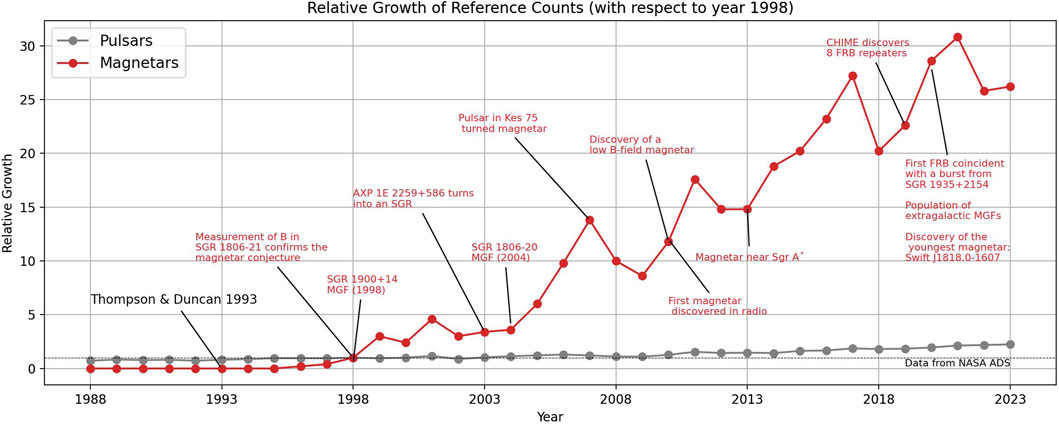
Figure 1. Relative increase in peer-reviewed articles mentioning “magnetars” compared to articles mentioning “pulsars” normalized to 1998. In red annotations, we highlight some major events and observations related to magnetars.
This paper explores the significant role of magnetars in time-domain and multimessenger (TDAMM) astronomy, focusing on their transient activity. The core aspect of this scope highlights the critical role of the high-energy space-based missions that have enabled inference built upon compelling evidence in the past several decades. This study aims to highlight the main characteristics of these missions, while also acknowledging their limitations, thereby proposing viable avenues for enhancing our ability to study these captivating celestial entities. Section 2 provides a brief introduction on the magnetar population, and Section 3 focuses on the fast-transient activity, discussing short bursts, storms, and flares. Section 4 delves into the multimessenger prospects for magnetars, discussing the expectations for the observation of gravitational waves and neutrinos.
2 Magnetars
The question of the conditions necessary to create and power a magnetar underpins the broad interest in these enigmatic celestial objects. To grasp the significance of this question, it is essential to first define a magnetar. Neutron stars are the compact remnants forged in the explosion of massive stars during a supernova event. With a mass typically ranging between about 1.2 and 2 times that of the Sun, the neutron-degenerate matter in NS is squeezed into a sphere that is approximately 10–20 km (6–12 miles) in diameter, reaching supra-nuclear densities in their interior and representing the densest form of matter known in the universe—about fourteen orders of magnitude denser than osmium, the densest element found on Earth. NSs are highly magnetized, which requires a dynamo-like amplification of an original magnetic field from stellar mergers (Schneider et al., 2019), fall-back dynamos (Barrère et al., 2022), or other mechanisms, like inverse cascading of helical and fractionally helical magnetic fields (Brandenburg, 2020). Differential rotation and rotation–convection coupling in the collapsing core of massive stars can also initiate this dynamo effect (Duncan and Thompson, 1992), which continues in the convective inner structure of the newly formed rapidly rotating NS, and produce strong magnetic fields (Thompson and Duncan, 1993). Magnetars are ultra-magnetized NSs, with recorded (dipolar) magnetic fields of the order of
Studying the population of magnetars in our Galaxy, both alone and in comparison to the bigger population of isolated NSs, can shed light on their progenitors (Beniamini et al., 2019), and hence the conditions necessary for their formation. The main characteristics of the Galactic magnetar population are illustrated in Figure 2, in comparison to the wider pulsar population (Manchester et al., 2005, ATNF Catalog). Approximately thirty known high-energy emitting magnetars are found in our Galaxy, with the majority located within 1° from the Galactic plane, one in the Large Magellanic Cloud (Cline et al., 1982) and one in the Small Magellanic Cloud (Lamb et al., 2002). They are characterized by a high spin-down rate and slow rotation period, which together with their location in the plane, suggest that active magnetars are typically young, from approximately a hundred years [the youngest known is about 240 years old, discovered in 2020 (Esposito et al., 2020)] to a few tens of thousands of years, as shown in the top-left panel in Figure 2, in comparison with the much older population of pulsars. Except for PSR J1622-4950, which was discovered in radio in 2010 (Levin et al., 2010), all the other known “standard” young magnetars were discovered in the X-ray band, most of them through a first bright transient event. Through the observation and statistical study of the bursting activity of SGR 1806-20 Cheng et al. (1996) found evidence of the hypothesized solid crust on the magnetar surface (see for a similar association with FRBs, Totani and Tsuzuki, 2023). In fact, they found similarities between the magnetar burst energy and waiting time distributions and those for quakes on Earth caused by tectonic movements (Perna and Pons, 2011; Dehman et al., 2020). The discovery of fast radio bursts (FRBs) from galactic magnetars (Bochenek et al., 2020; CHIME/FRB Collaboration et al., 2020) in coincidence with their bursting (Mereghetti et al., 2020; Li et al., 2021) and possibly glitching activity ( Younes et al., 2023; Ge et al., 2024) provide crucial information on the physical mechanisms that power these phenomena and the crustal and magnetospheric conditions that can produce FRBs. More recently, radio transient surveys have discovered a population of long-period galactic radio pulsars which are likely older magnetars (Caleb et al., 2022; Hurley-Walker et al., 2022; 2023; Beniamini et al., 2023; Rea et al., 2024). None of these have a high-energy counterpart yet, but given their highly variable nature in the radio and likely magnetar nature along with a possible connection to long-period FRBs (Beniamini et al., 2020), it is plausible that future X-ray and gamma-ray transients could be associated with high-energy monitors with sufficient angular resolution.
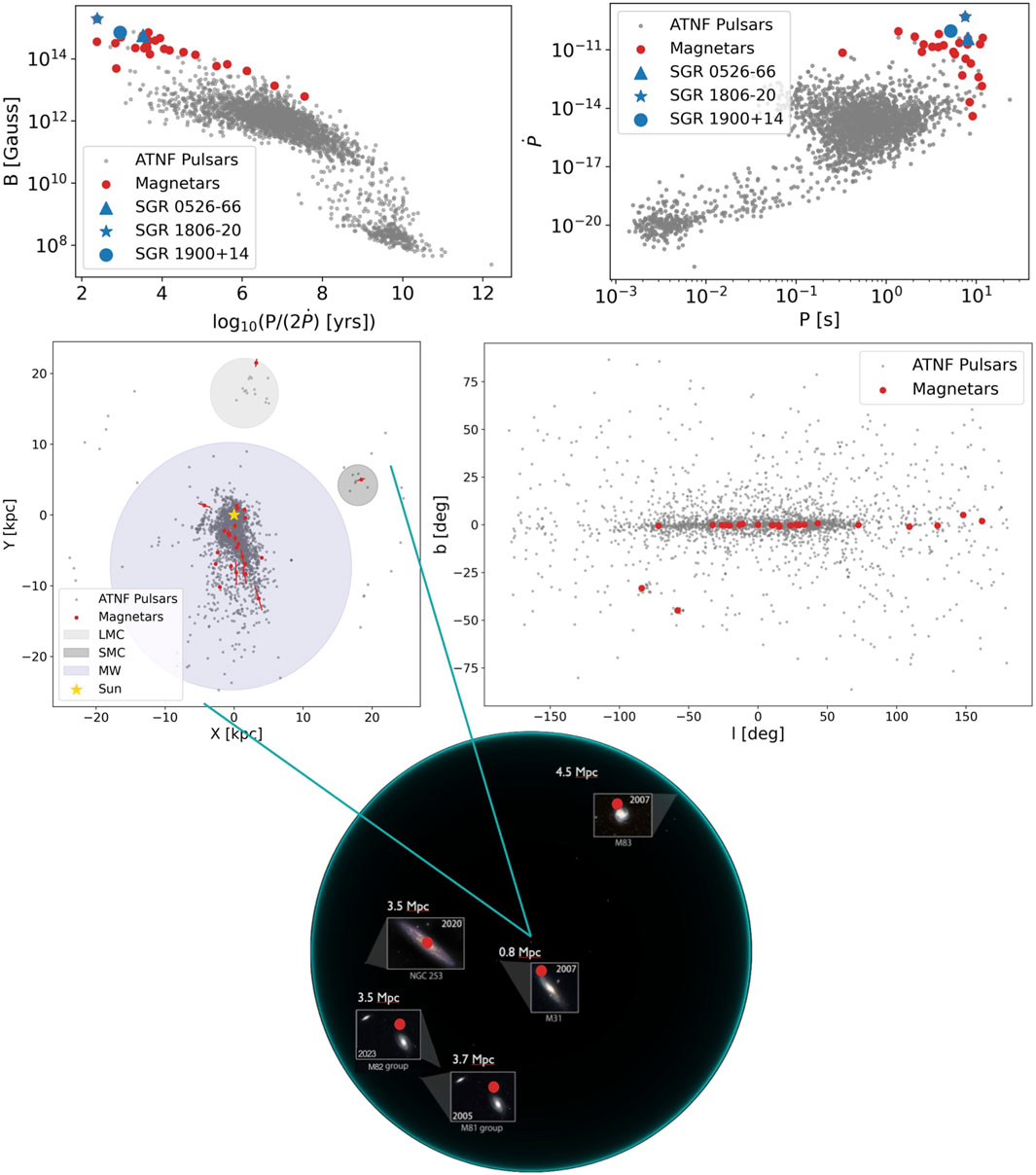
Figure 2. Population of galactic high-energy magnetars in red [data from the McGill catalog (Olausen and Kaspi, 2014)], compared to the pulsar population provided by the Australia Telescope National Facility (ATNF) catalog (Manchester et al., 2005) shown in gray. Top left: shows the magnetic field strength as a function of the estimated age; top right: the spin-down rate as a function of the period. Middle: top-Galactic view (left) and Mollweide sky-projection (right) showing the distribution in the Milky Way. Bottom: population of known extragalactic magnetar candidates (Credit: adapted from NASA Goddard press release).
Several magnetars have been discovered in neighboring galaxies: NGC 253 (Sculptor galaxy), M31 (Andromeda galaxy), the M81-M82 group, and M83. Confirmation of pulsating emissions matching typical magnetar rotation periods would validate their identity. Extragalactic magnetars can be observed only during the brightest flares, but an unequivocal association requires the detection of the pulsating emission, typically too fast-fading to be caught in time by sensitive instruments. However, the detection of the brighter short initial spike allows inferring the volumetric intrinsic rates of such phenomena associated with magnetars, providing important clues on their formation channels (Burns et al., 2021). The current population of extragalactic magnetar candidates includes only a handful of objects from nearby galaxies, limiting our constraints on the volumetric intrinsic rates. Such limitation needs more sensitive all-sky soft gamma-ray monitors with the ability to trigger more efficiently on these events.
3 Magnetars in time-domain astronomy
Magnetars show a variety of transient activities observable from soft X-rays up to medium-energy gamma-ray bands and differing in terms of timescales, energetics, and temporal and spectral evolution. Such activity includes outbursts, short bursts, burst storms, and flares, as illustrated in Figure 3.
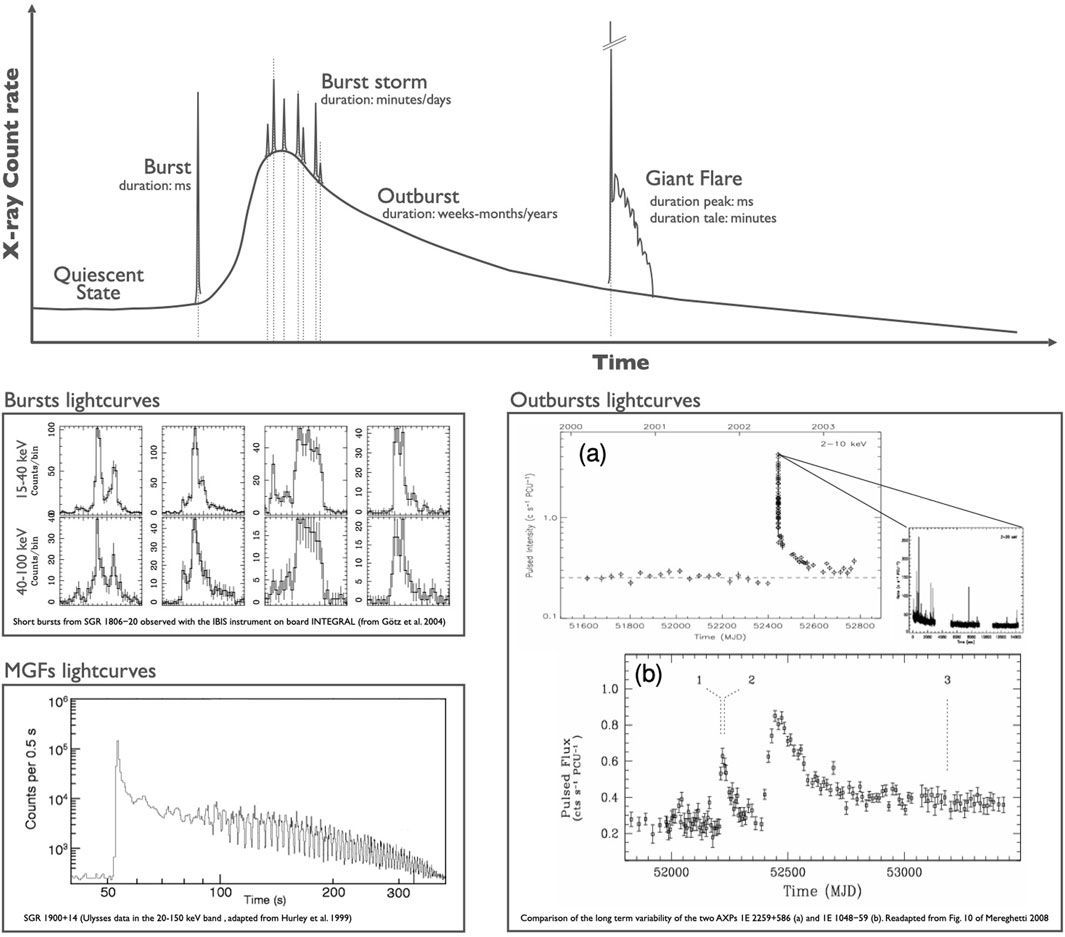
Figure 3. Illustration of the topology of transient events from magnetars. The top panel summarizes the different transient activities of magnetars. The panel “Bursts lightcurves” shows examples of short bursts from SGR 1806-20 observed by INTEGRAL-IBIS in 2004 (Götz et al., 2004). The panel “MGFs lightcurves” shows the 1998 MGF from SGR 1900 + 14 as representative of this class of events (Hurley et al., 1999). The panel “Outbursts lightcurves” shows a comparison of the long-term variability of the two AXPs 1E 2259+586 (A) and 1E 1048−59 (B) (adapted from Figure 10 of Mereghetti et al., 2015).
Apart from the more prolonged outbursts, magnetars are also associated with short bursts of intense radiation, typically lasting only a fraction of a second. These short bursts, often observed in the hard X-ray spectrum, provide valuable insights into the extreme physical conditions prevailing in the vicinity of magnetars. The origins of these short bursts may be linked to the sudden release of magnetic energy or magneto-elastic energy from the crust. Short bursts are quasi-thermal, and broadband soft gamma-ray spectroscopy reveals that they are consistent with trapped fireballs within closed loops at low altitudes in the magnetosphere ( van der Horst et al., 2012; Younes et al., 2014).
Magnetars are known for their outbursts, during which the quiescent/persistent X-ray emission increases by as many as three orders of magnitude. Typically these events are characterized by a faster (hours–days) flux rise, followed by a slower (week- to year-long) decay to return eventually to quiescence. Such temporal characteristics enable follow-ups and monitoring by sensitive pointing telescopes, providing accurate flux estimates. Crustal shifts due to magnetic stress are believed to cause magnetar outbursts. Short bursts and flares have been observed during outbursts, as well as isolated in time. Burst storms have been observed to happen at the onset of outbursts.
Magnetar burst storms (or burst forests) refer to periods of heightened and sustained activity, during which a magnetar emits a series of tens to thousands of bursts over a relatively short time frame of minutes to days. These episodes of magnetar burst storms contribute significantly to our understanding of the magnetar’s dynamic behavior. Studying these storms helps decipher the underlying processes that govern the interplay between the decaying intense magnetic field, the internal and external structure of the magnetar, and the radiative processes occurring in high-B-field regime close to the surface of the magnetar.
Magnetar flares represent another facet of their transient activity, characterized by sudden and intense increases in radiation across multiple wavelengths. Such events are characterized by an ms-long bright spike, followed by a dimmer (but still bright) periodic tail decaying in time. These flares are among the most energetic events in the universe, releasing energy on the order of solar flares, but with magnitudes far surpassing those of solar flares Hurley et al. (1999, 2005); Israel et al. (2008). Typically classified in intermediates flares (with
High-energy monitors, spectrometers, and fast-repointing instruments have enabled the observation of magnetars’ dynamic transient activity since the 1980s. Major contributors including ROSAT (Truemper, 1982), CGRO (Gehrels et al., 1994), RXTE (Swank, 1999), and BeppoSAX (Boella et al., 1997) have been used earlier. Table 1 lists the major high-energy instruments that are currently contributing to monitoring and detection of magnetars’ transient activity. High-energy instruments like the GBM on board Fermi, Konus on board WIND, BAT on board Swift, and the ACS on board INTEGRAL offer broad coverage of the soft gamma-ray band, making them valuable for detecting a wide range of transient events, including those from magnetars. Instruments like Chandra, XMM-Newton, NuSTAR, and NICER provide high-angular resolution and are capable of discovering the precise locations of transient events, aiding in follow-up studies and multiwavelength observations; however, except for Swift with minute-scale reaction, the repointing time limits follow-ups to magnetar outbursts and burst storms. Figure 4 is a visual illustration of the available energy, timing, and sky coverage provided by the instruments listed in Table 1.

Table 1. Major high-energy instruments currently contributing to magnetar observations. Missions’ figures of merit can be found on the NASA’s High-Energy Astrophysics Science Archive Research Center (HEASARC). For the time property of INTEGRAL anti-coincidence shield (ACS), we referred to Savchenko et al. (2012).
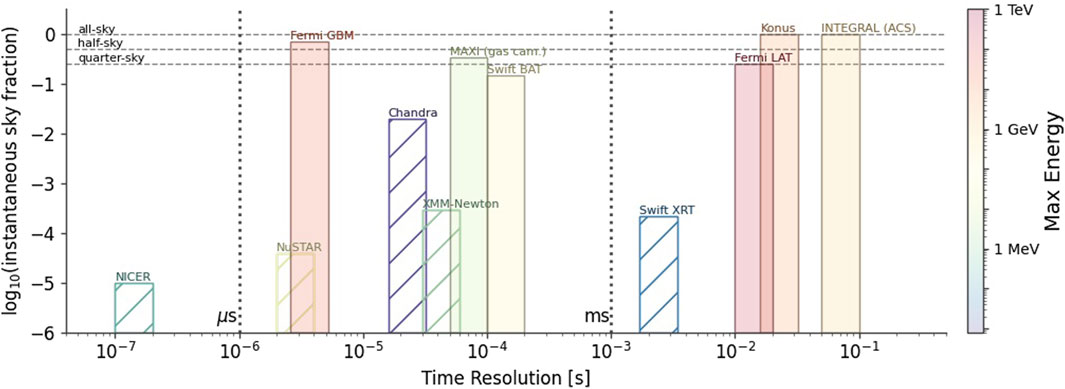
Figure 4. Active high-energy missions available for magnetar transient activity observations. On the y-axis, we show the sky coverage, monitors are marked with filled rectangles, while pointing telescopes are marked with hatched rectangles. On the x-axis, we report the time resolution of the different instruments. The colors mark the upper end of the energy range covered by the instruments.
3.1 Outbursts
Most magnetars display periods of elevated X-ray emissions above their historical minimum level, sometimes by as many as three orders of magnitude in luminosity (Coti Zelati et al., 2018), i.e., magnetar outbursts. These epochs, which are typically observed concurrently to the onset of bursting activity (see below), are defined by extreme spectral–temporal variability to the soft and hard X-ray emissions in the form of harder spectra, pulse profile and fraction variation, timing noise, and glitches ( Gavriil et al., 2004; Woods et al., 2007; Rea et al., 2009; Dib and Kaspi, 2014; Hu et al., 2020; Younes et al., 2022). At radio wavelengths, six confirmed magnetars have shown transient radio pulsed emission, appearing around outburst epochs (Camilo et al. (2006); Lower et al. (2020b), or, in a few occasions, disappearing (Lower et al., 2023). For a few magnetars, the infrared to optical emissions have also been observed to vary (Tam et al., 2004). These outburst epochs last from months to years during which the multiwavelength properties usually return back to their pre-outburst states (Coti Zelati et al. (2018).
Magnetar outbursts are generally attributed to crustal shifts (e.g., due to stresses on the surface from internal B-field restructuring and perhaps decay), imparting a twist onto an external magnetic field loop [see (Turolla et al., 2015) and references therein]. The surface heating arises due to either energy deposition in the crust, e.g., from Hall wave avalanches (Thompson and Duncan, 1996; Beloborodov and Li, 2016), or bombardment of the surface by accelerated particles in a twisted external B-field (Beloborodov, 2009). Both models predict the formation of surface hotspots, which could explain the altered pulse shape and amplitude during magnetar outbursts as well as the harder spectra and increased X-ray power. Although in both cases the outburst is initiated by an elastic failure of the crust (Dehman et al., 2020), their evolution is dictated by different regions of the NS. For the external model, as the twisted fields “unwind,” magnetic energy is released in the form of radiation, typically leading to the shrinkage and cooling of the hotspot (Beloborodov, 2009), whereas if the heating is purely internal, the outburst decay is determined by crustal cooling scenarios heavily dependent on the micro- (e.g., crust impurity) and macro-physics [depth and total energy deposited in the crust (Brown and Cumming, 2009; Pons et al., 2009)].
Hence, given the abovementioned, multiwavelength follow-up studies of magnetar outbursts have distinctly revealed their highly dynamic nature; physics of plastic deformation of the crust, characteristics of the twisted B-field loops (twist magnitude, loop locale, and total volume), pair-production and particle acceleration required for the coherent radio emission, and the interconnection between all of these elements.
The high-energy properties of magnetar outbursts have been extensively studied with RXTE, XMM-Newton, Chandra, Swift/XRT, NuSTAR, and most recently NICER. Yet the most consequential results have come from the long-term monitoring previously afforded by RXTE (Dib and Kaspi, 2014) and currently conducted with XRT ( Archibald et al., 2013; 2020) and NICER (Lower et al., 2020a; Younes et al., 2020b). Apart from the obvious benefit of such observational campaigns, i.e., the measurement of the period and period-derivative, and hence of the fundamental properties of the sources (magnetic dipole field strength, spin-down age, and spin-down power), continuous long-term monitoring of several bright magnetars from 1998 to 2012 revealed the common detection of some timing anomalies, mainly in the form of large spin-up (or on one occasion spin-down) glitches, at the onset of outbursts likely implying an internal trigger mechanism to these events (Archibald et al., 2013; Dib and Kaspi, 2014). Moreover, these monitoring campaigns revealed the delayed, erratic variability in the spin-down torque of these sources months to years after outburst onset, providing clues to the dynamics of the untwisting magnetospheric B-field lines (Woods et al., 2007; Younes et al., 2017; Archibald et al., 2020). Most recently, NICER (with the added benefit of the large effective area, relatively low background, and ease of repointing), through almost daily observations of the magnetar SGR 1830
Long-term monitoring of magnetars in X-rays (in tandem with radio and infrared campaigns) is unquestionably fruitful. In this regard, continued operation of Swift and, especially, NICER is essential, and similarly, the operation of a satellite with a similar type of capabilities, such as Strobe-X, in the future (Ray et al., 2019).
3.2 Short bursts and burst storms
Short bursts are one of the most unique and defining properties of the magnetar population. These sub-second, bright hard X-ray flashes, capable of reaching luminosities of about
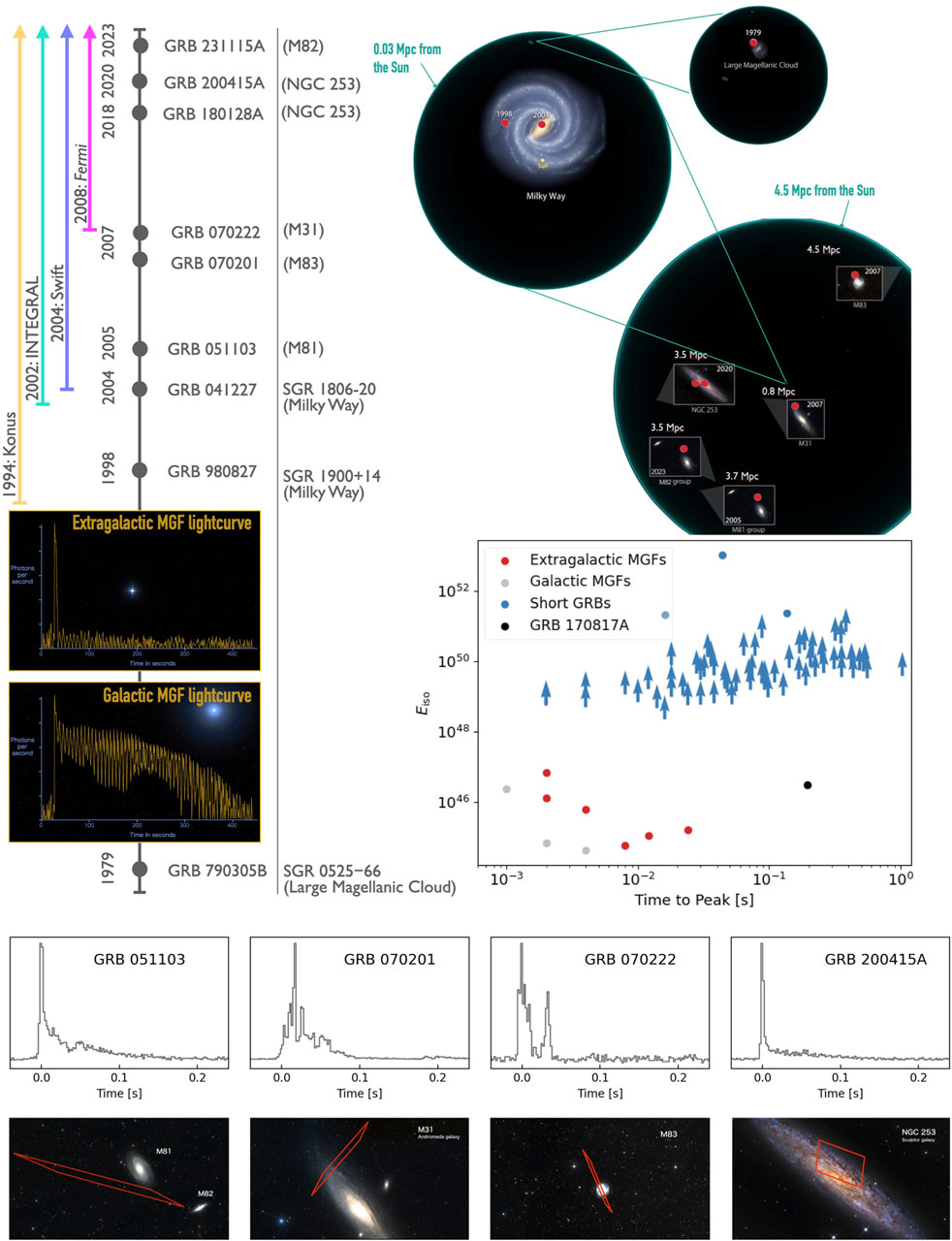
Figure 5. Illustration summarizing the current known population of MGFs and MGF candidates. The plot of the intrinsic energetic as a function of the rise time is the updated version of the plot presented in Ref. Negro and Burns (2023) with the addition of two more recent extragalactic identified events (see the text for more details). We also report the light curves and the IPN localizations for four of the MGF candidates identified in Burns et al. (2021). (Credit images: adapted from NASA Goddard).
Due to the dimness of most magnetars during their quiescent state, the large absorbing column in their direction (being at low galactic latitudes), and the lack of adequate large field-of-view X-ray instruments1, magnetars are rarely discovered through their persistent X-ray emission. This is plainly demonstrated through the discovery space of new magnetars in the last 20 years, which is fully dominated by the detection of short bursts, primarily with the Swift Burst Alert Telescope (BAT). The BAT is sensitive to short magnetar bursts and able to localize them to within few arcminutes. The rapid follow-up with the Swift X-ray telescope (XRT) confirms the activity through the detection of the (at the time) bright X-ray counterpart and provides arcsecond localization. Follow-up X-ray observations with the adequate time-resolution (which currently happens primarily with NICER) detects the pulse period of the source and its derivative, thus confirming the magnetar nature of the source (see, e.g., Ray et al., 2019, among numerous ATels of this kind). In summary, during its 20-year operation, the Swift telescope has enabled the discovery of more than double of the confirmed magnetar population in the galaxy and identified numerous new outbursts from the already known ones ( Kaspi and Beloborodov, 2017; Esposito et al., 2021). The most significant among those discoveries is the identification of other classes of NSs as capable of showing magnetar-like activity, most noticeably high-B radio-pulsar (Archibald et al., 2016; Göğüş et al., 2016), CCOs Rea et al. (2016), and low-field magnetar Rea et al. (2010), as well as the discovery of a canonical magnetar with a bright X-ray wind nebula (Younes et al., 2016), a property typically attributable to rotation-powered pulsars (Kargaltsev et al., 2015). These discoveries have enabled a more comprehensive understanding of what constitutes a magnetar, observationally, and theoretically, the latter through magneto-thermal evolutionary studies of poloidal and toroidal/crustal fields in NSs (Pons et al., 2009; Viganò et al., 2013; Gourgouliatos et al., 2016; De Grandis et al., 2020; Igoshev et al., 2021; Dehman et al., 2023b; a).
Magnetar short bursts are also crucial for understanding the enigmatic FRBs ( Section 4.3). Following the detection of a short X-ray burst coincident with an FRB-like radio emission from the magnetar SGR 1935 + 2154 (Bochenek et al., 2020; CHIME/FRB Collaboration et al., 2020; Mereghetti et al., 2020; Tavani et al., 2021; Li et al., 2021; Ridnaia et al., 2021), studies on the comparison of the spectral and temporal properties of the FRB-associated X-ray short burst to those without an FRB counterpart (which constitutes the overwhelming majority of short X-ray bursts) have shed light on the unusually hard spectrum of the X-ray burst that accompanies the FRB (Mereghetti et al., 2020; Younes et al., 2021). This likely pointed to an active region in the vicinity of the open-field line zone which permits the release of bright radio waves away from the presumably dense environment of the closed magnetosphere (Younes et al., 2021). Moreover, population-wide comparison of extragalactic FRBs and magnetar short bursts, such as duration, rate, and waiting time distribution, have shed some light on the origin of extragalactic FRBs (Cruces et al., 2021; Wei et al., 2021). Yet these have not been able to confirm what fraction of magnetar short bursts is indeed magnetars. This is partly due to our poor knowledge of the magnetar population in the Galaxy, and their activity cycle. Moreover, the detection of FRB 20200120E from a globular cluster in the nearby galaxy M 81 Bhardwaj et al. (2021) challenges the notion that most, if not all, FRBs have a magnetar central engine, unless these magnetars were formed through unconventional channels, e.g., accretion-induced collapse or the merger of two white dwarfs. X-ray observations of this FRB 20200120E with current X-ray instruments ruled out coincident short bursts that are at the high end of the burst fluence distribution (
Several advances in the magnetar field could be achieved with modest effort and investment. For instance, we currently lack a comprehensive, preferentially live, catalog of magnetar short bursts; an essential first step to understanding the activity rate and cycle of the population as a function of, e.g., spin-down age and magnetic field strengths. This could inform population studies of FRBs and comparison to the magnetar population. Ensuring the continued operation of Swift (or a new Swift-like instrument) is crucial for continued discovery of new magnetars and other exotic sources that exhibit magnetar-like activity. For instance, the low-magnetic field magnetar, SGR 0418 + 5729, bears a striking resemblance to XDINs during quiescence (Haberl, 2007). None of the latter sources (known as the magnificent seven) have shown magnetar-like activity, yet this could be due to their larger ages, implying a lower rate of activity than that of canonical magnetars. If XDINs are confirmed to be magnetars, this would have significant consequences on the number density of magnetars in the Milky Way and their formation rate, providing clues for the birth process of magnetars (Beniamini et al., 2019). New large FOV hard X-ray monitors that are capable of providing arcminute localization, preferentially equipped with sensitive follow-up X-ray instruments, e.g., NICER-like effective area, are key for continued scientific success in our understanding of the magnetar bursting and outburst phenomena. Additionally, next-generation X-ray instruments, such as HEX-P, AXIS, or Strobe-X, should be able to reach weaker short bursts in the nearby universe, further constraining the magnetar nature of nearby FRBs, including FRB 20200120E (Alford et al., 2024).
3.3 Magnetar giant flare spikes
In the 1970s, the debate on the origin of gamma-ray bursts (GRBs) was an outstanding question in astrophysics. Key pieces of information were that GRBs were not associated to known sources, none had been shown to repeat, and that their light curves had spiky but random behavior. The arrival of GRB 790305B was the first GRB localized to a known position (a supernova remnant in the Large Magellanic Cloud), was followed by a weaker GRB from the same position, and an incredibly bright spike was observed, followed by a periodic, exponentially decaying tail (Mazets et al., 1979). The tail period is approximately 8 s, complemented by a weaker interpulse occurring at a phase of 0.5 (Mazets et al., 1979; Cline et al., 1980). The rapid rise time of less than 0.25 ms was the fastest ever seen (Cline et al., 1980). This was the first Magnetar Giant Flare (MGF) seen and the first signal from a magnetar identified. Since then, two more flares have been identified from magnetars in the Milky Way (Hurley et al., 1999; Palmer et al., 2005). All three show similar characteristics, with tails lasting for hundreds of seconds. Due to their extreme luminosities, the spikes of these three giant flares saturated all viewing detectors.
MGFs are the most luminous transients created by magnetars. The crust of the magnetar may store significant elastic energy, which is released when the crust, stressed and powered by the internal magnetic field energy density, deeply and widely fractures (Lander et al., 2015). Magnetic reconnection may occur in the magnetosphere, releasing a bright spike where the plasma blows off on open field lines, followed by a periodic tail caused by the emission form a plasma fireball magnetically trapped on the rotating surface of the magnetar (Duncan and Thompson, 1992; Paczynski, 1992).
By building and characterizing a larger population of MGFs, it will be possible to place better constraints on their intrinsic rates, energetics distribution, and maximal energy release. The rates are of key importance to understand the possibility of detection via GWs during future observing runs (Abbott et al., 2019; Macquet et al., 2021) and the possibility that intermediate or giant flares may produce cosmological FRBs (Popov et al., 2018; Bochenek et al., 2020). The rates are key to understanding the formation channels and the fraction of magnetars that emit giant flares, allowing us to understand the processes which produce the most powerful magnets in the cosmos. The rates and energetics distribution will determine if the giant flares are the extreme events of the same underlying population which produces SGR short bursts, or if they are fundamentally distinct. The maximal energy release can be related to the maximal surface magnetic field of magnetars.
Furthermore, a sample of events allows for testing of theories on the physical mechanisms that power the prompt spikes. However, galactic events saturate any reasonable GRB monitor, precluding spectral and temporal properties of the spikes at the brightest intervals. This saturation has prevented the study of whether giant flares only occur with single pulses or if they show the same internal pulse variability observed in typical and intermediate SGR short bursts.
Galactic events likely only occur every few decades. In order to substantially increase the sample size during our lifetimes, we must recover and study extragalactic events. These are also key events to study the spectral and temporal properties as they are often sufficiently far to avoid significant saturation effects on GRB monitors. Given the exceptionally high peak luminosities of their initial spikes, instruments with high sensitivity, such as the Fermi Gamma-ray Burst Monitor (Meegan et al., 2009) or the Swift Burst Alert Telescope [BAT: Barthelmy et al., 2005)], can detect MGF emissions from magnetars located in galaxies possibly up to distances of
Thus, identification of extragalactic giant flares requires reasonably precise localizations and comparison with nearby galaxy catalogs. Six candidate events at differing degree of significance events have now been found: GRB 070201 from M31, GRB 051103 and 231115A from M82, GRB 070222 from M83, and GRB 180128A and GRB 200415A from NGC 253 (Frederiks et al., 2007; Ofek, 2007; Mazets et al., 2008; Ofek et al., 2008; Hurley et al., 2010; Burns et al., 2021; Roberts et al., 2021; Svinkin et al., 2021; Trigg et al., 2023). This spatial alignment method and expectation of extragalactic MGFs masquerading as cosmological short GRBs date back decades (Hurley et al., 2005). Only GRB 051103 and GRB 070201 were identified prior to 2020. Population analyses considering localizations of all short GRBs by Swift and the InterPlanetary Network (IPN) against galaxy catalogs failed to identify additional candidates. The discovery of GRB 200415A led to the development of an improved search method, weighting possible host galaxies by star formation rate and distance based on the brightness of the GRB, which identified GRB 070222 in archival data (Burns et al., 2021). Additionally applying selections to short GRBs including the rise time and duration, both preferentially shorter for MGFs, identified GRB 180128A (Trigg et al., 2023). Recently, INTEGRAL detected, localized to few arc minutes—which is orders of magnitude better than the second best-localized MGF—enabling rapid follow-up observations, and promptly identified GRB 231115A as an MGF (Mereghetti et al., 2023; Yin et al., 2023), which is the first giant flare with rapid follow-up observations. Further analysis of this event is ongoing. It is important to notice how, in this case, even in the absence of a pulsating tail, it was possible to unambiguously identify the origin of the event as an MGF, thanks to the precise localization. A well-constrained association to a nearby galaxy, in fact, allows for accurate estimation of distances and hence intrinsic energetics of the burst, effectively excluding other typically more energetic progenitors.
Constructing a population of MGFs is key for several reasons. Study of galactic and extragalactic MGFs allows for more precise measures on rates and intrinsic energetic functions (Burns et al., 2021), which indicate if these giant flares are the extreme end of the SGR short burst distribution or fully distinct. These measures are also key to understanding if MGFs can power FRBs. The study of individual events provides precise temporal and spatial information for deep multimessenger searches. Recovery of the MGF signal, individually or stochastically (Macquet et al., 2021; Kouvatsos et al., 2022), allows measure of the f-mode frequency, giving an insight into the structure of NSs and their equation of state (Kunjipurayil et al., 2022). The study of extragalactic MGFs allows for careful (unsaturated) study of their temporal and spectral evolution, providing insights into their physical origin (Trigg et al., 2023). Lastly, identifying extragalactic MGFs is the easiest, possibly only way to study magnetars beyond the Magellanic Clouds.
All of these scientific results support the need for continuous, sensitive, all-sky monitoring of the gamma-ray sky. Reasonable localization accuracy is necessary to enable follow-up searches across and beyond the electromagnetic spectrum. The possible harder spectrum of brighter bursts may be key to driving sensitivity at higher energies than typical GRB monitors. Coverage of gamma-rays above the MeV regime is needed to search for more GeV flares, similar to the one found after GRB 200415A (Ajello et al., 2021), which may inform or reject the bow-shock origin proposed in Ajello et al. (2021).
3.4 Pulsating MGF tail from extragalactic magnetars
The initial spike of the three confirmed MGFs was closely followed by a bright (
These tails are thought to be generated due to the magnetosphere of the NS trapping a fraction of the energy released by the initial burst (likely when magnetic pressure overcomes the radiation pressure as emission from the initial spike abates). This trapped fireball of photon-pair plasma is optically thick and slowly releases energy from its surface as it cools and shrinks in size (essentially evaporating Thompson and Duncan, 1996). Observationally, the tail spectra in the 1–100 keV range are dominated by a thermal component with observed temperatures on the order of tens of keV, which decreases with time. A non-thermal component is also present, most prominently at early times and dominating the emission at higher energies (
The spectra of the time-integrated tails of the three MGF tails were compatible with a dominant blackbody component (
To this end, we simulate the possible detection of MGF tails with currently operating X-ray satellites, scaled to the extragalactic distance of 3.5 Mpc (e.g., the distance of the star-forming galaxies M82 and NGC 253). We assume an event like the 1998 MGF from SGR 1900

Figure 6. Right: Expected number of counts for time-integrated observation of an MGF tail as it would appear at a distance of 3.5 Mpc (e.g., NGC 243) as a function of repointing time after the initial MGF spike. We assume an MGF tail similar to the one observed in 1998 from SGR 1900 + 14 Feroci et al. (2001), scaled to 3.5 Mpc. Left: effective areas of different instruments considered are shown for comparison.
3.5 Polarization of magnetars’ bursts and flares
X-ray polarization of magnetars traces the magnetic field geometry as well as the shape, dimension, and physical state of the surface emitting region and exotic effects of quantum electrodynamics (QED) that are expected to take place in the presence of extreme magnetic fields like those of magnetars. Despite the significant recent observational advancements made with the NASA’s IXPE mission (Weisskopf et al., 2022), the highly degenerate parameters space prevents from definitive conclusions on QED effects ( Taverna et al., 2022; Zane et al., 2023). IXPE results, which focus primarily on persistent emission, highlight the need for further theoretical effort and advancements in numerical simulations to build more accurate models. Furthermore, the impossibility in decoupling QED effects on polarization from geometrical polarization expected when the emitting region is a small patch on the magnetar’s surface suggests the need for extending the range of measured polarization below 1 keV. Probing the polarization from the cooler X-ray radiation emitted from a wider portion of the surface is expected to be a better probe of QED effects. In this context, the further advancement of technologies like the ones developed for the Rocket Experiment Demonstration of a Soft X-ray Polarimeter (REDSoX) (Marshall et al., 2023), recently approved by the NASA, will be critical in this endeavor.
Extant models of magnetar burst polarizations are sparse (Taverna and Turolla, 2017) and are currently in development Wadiasingh et al. (2023). The combination of different outgoing photon angles sampled by the observer on a magnetic loop, however, is expected to reduce the time-averaged polarization of the bursts to approximately
In the context of MGFs, polarization observations would provide key information about the structure of the magnetar magnetosphere. Taverna and Turolla (2017) modeled the spectral and polarization properties of the 1–100 keV radiation emitted during the MGF tails, invoking a simplified “trapped-fireball” model, in which the electron–positron pair plasma is injected into the magnetosphere and remains trapped within the closed lines of the strong magnetic field. The linear polarization predicted by this model is very high (greater than 80% between 1 and 100 keV). Taverna and Turolla (2017) adopted a similar model to predict the linear polarization from MGF tails, assuming a more realistic temperature distribution in the fireball, but integrating over wider energy ranges, finding a lower polarization degree, as high as 30% (1–30 keV) and 10% (30–100 keV) depending on the viewing angle with respect to the magnetic axis of the magnetar.
Such discrepancy in different predictions highlights how polarization measurements of MGF tails could help constrain the trapped-fireball model and potentially drive new theories to explain magnetar flares. Such observations are not possible in the soft X-ray band as IXPE could not repoint fast enough to catch the emission, while at higher energies, at which the future missions COSI and POLAR 2 will operate, theoretical predictions are lacking. COSI—the COmpton Spectrometer and Imager (Tomsick et al., 2023)— scheduled to launch in 2027, will be sensitive to soft gamma rays between 200 keV and 5 MeV and will have polarization capabilities for assessing galactic MGF tails. A dedicated study on the ability of the COSI to detect extragalactic MGFs is needed.
4 Magnetars in multimessenger astronomy
4.1 Gravitational waves from magnetar bursts and flares
Gravitational waves (GWs) from magnetars can be generated through various astrophysical processes that involve rapid changes in the mass distribution or extreme deformations of these highly magnetized NSs. The intense magnetic fields associated with magnetars significantly influence their dynamics and can give rise to GW emissions. This happens when the intense magnetic fields of magnetars undergo instabilities, causing dramatic reconfigurations. The associated GW waveforms depend on the specifics of the starquake, and the characteristic frequencies are unknown. MGFs excite two different types of oscillations, the fundamental (of f-mode), which radiate GWs, and the shear modes or torsional modes, that manifest themselves with observable QPOs. The f-mode is thought to be excited when the magnetar’s internal magnetic field rearranges itself, while QPOs are other oscillation modes most likely excited due to seismic vibrations and are longer-lived than the f-mode. QPOs have been detected in the tail emission of all three nearby MGFs (Israel et al., 2005; Strohmayer and Watts, 2005; Strohmayer and Watts, 2006; Watts and Strohmayer, 2006), and, interestingly, QPOs in short repeated bursts from SGR J1550-5418 were also reported in 2014 by Huppenkothen et al. (2014). In general, however, the frequencies detected are disparate and the vibration modes are difficult to identify, given the numerous stellar parameters involved (magnetic field, mass, radius, composition, etc...) and the rarity of these events.
While GWs are generally anticipated to accompany energetic bursts, this expectation is especially pronounced and accessible in the case of MGFs, representing the most intense starquakes in magnetars. This expectation is predicated upon the assumption that mass redistribution can yield a GW luminosity that is a sizable fraction of the total radiative luminosity of
GWs are also likely produced during the birth of the magnetar. Section 3.3 described the relevance of observing a second MGF from the same magnetar, in terms of being the first source of repeating GRBs. However, another implication of repeating MGFs, as pointed out by Stella et al. (2005), is the requirement of a magnetic field above
Models predicting gravitational wave signals from magnetars (see Ciolfi and Rezzolla, 2012; Dall’Osso and Stella, 2022, and references therein) face considerable uncertainty due to our limited understanding of their internal magnetic field configurations and matter equations of state. This uncertainty spans from optimistic to pessimistic expectations. Further investigation into magnetars’ transient activity holds promise in elucidating the underlying physics, potentially improving prediction reliability.
4.2 Neutrinos from magnetars
During the initial phases of a magnetar flare or burst, the intense release of energy can heat the NS’s crust and interior. Subsequent cooling processes, involving neutrino emission, become prominent. Neutrinos, being weakly interacting particles, can escape the dense magnetar environment and carry away significant amounts of energy. We can distinguish between high-energy neutrinos, of GeV–TeV energy, detectable by instruments like the IceCube Observatory (IceCube Collaboration et al., 2006), and MeV neutrinos, like the ones produced in stellar processes and supernovae explosions, detectable by instruments like Super-Kamiokande (Walter, 2008). Both classes of neutrinos, when detected in coincidence with the electromagnetic counterpart, are a crucial aspect of multimessenger astronomy—which, in a sense, can be dated back to the detection of MeV neutrinos from SN 1987A (Blanco et al., 1987). In the context of magnetar bursts and flares, models have been developed to predict the emission of high-energy neutrinos, the detection of which would provide important information about the flaring mechanism, as well as the crustal composition. In general, the production of neutrinos requires the presence of hadronic or photo-hadronic interactions. In MGFs, the neutrino fluxes depend on the baryon load, which is not well-constrained, due to uncertainties on the relative importance of thermal and non-thermal components (Ioka et al., 2005). Hence, detection of neutrinos from magnetars would be extremely insightful to understand their composition.
One can build the expectation of the high-energy neutrino yield knowing the expected photon flux of the outflow. This was done in Guépin and Kotera (2017), where they computed the minimum photon flux necessary for neutrino detection by IceCube, as well as the maximum neutrino energy expected, for a number of different sources of outflows (including magnetar bursts and flares). The study is generalized in terms of the intrinsic bolometric luminosity, the Lorentz factor, and the time variability of the emission. Figure 7 highlights the results for magnetars’ transient activity. This study shows how neutrino detection is limited to only very nearby bright events, i.e., MGFs with a maximum luminosity distance of
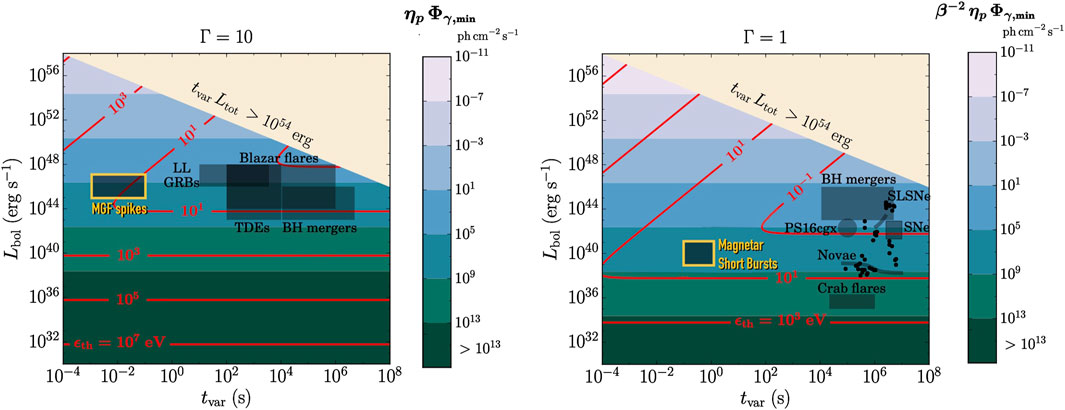
Figure 7. Adapted from Guépin and Kotera (2017) (Figure 1). The two plots illustrate the minimum photon flux needed to detect neutrinos in IceCube detectors for different Lorentz factors. Highlighted with yellow boxes are the magnetars’ transients considered, short bursts, and MGF spikes.
Ghadimi and Santander (2023) searched for high-energy neutrinos from galactic magnetars, performing a time-integrated search over 14 years of data collected by the IceCube Observatory (Aartsen et al., 2017). The results point out that a next-generation upgrade of the neutrino detector with improved sensitivity is in order, as the current IceCube capabilities are
4.3 Link to fast radio bursts
FRBs are extragalactic flashes of radio emission of millisecond duration of isotropic-equivalent energies
Magnetars were initially proposed as the engines of the 2001 Lorimer burst among many models, although in the form of giant flares producing FRBs (Popov and Postnov, 2010; 2013). Yet various non-magnetar and exotic models were also proposed Platts et al. (2019). As the first repeating FRB was discovered (Spitler et al., 2016), giant flares from “hyperactive” magnetars became a popular model ( Beloborodov, 2017; Metzger et al., 2019) over cataclysmic events. However, statistics of waiting times and power-law distributions of fluence in repeating FRBs suggested much more similarity with magnetar short bursts (Wadiasingh and Timokhin, 2019). Yet, as of 2019, no FRBs were seen from many thousands of short bursts recorded from known magnetars in our local universe. Moreover, radio limits on the SGR 1806-20 giant flare in 2004 ruled out any contemporaneous bright radio flashes (Tendulkar et al., 2016); thus, it appears that giant flares do not necessarily produce FRBs. As suggested by Wadiasingh and Timokhin (2019); Wadiasingh et al. (2020), special conditions (e.g., charge starvation and pair cascades in the magnetosphere) must be satisfied such that not all short bursts produce radio emission (yet all FRBs would be associated with short bursts, as the FRB occurs in the beginning “clean” stage of the fireball created in short bursts). As FRBs result from coherent emission processes, and short bursts are incoherent, the energy contained in FRBs is generally expected to be a small fraction of the total energy observed in the quasi-thermal short bursts. The same conditions thought to be conducive to the production of FRBs (i.e., explosive pair production demanded by large coherent electric fields) likely are also suitable for proton acceleration and the production of high-energy neutrinos at low altitudes in the magnetar magnetosphere ( Herpay et al., 2008).
The situation was clarified dramatically in April 2020, when SGR 1935 + 2154 underwent a burst storm, emitting thousands of short bursts in the hard X-rays (Younes et al., 2020a; Palmer, 2020). In the waning hours of this storm, CHIME/FRB (CHIME/FRB Collaboration et al., 2020) and STARE2 (Bochenek et al., 2020) observed a bright radio flash consistent with an FRB from SGR 1935 + 2154. The radio burst was bright enough (energy
Radio activity in SGR 1935 + 2154 is also connected with torque and potentially interior dynamics of the magnetar. In October 2020, SGR 1935 + 2154 became radio-active again, exhibiting bright radio bursts (Kirsten et al., 2021) as well as a prolonged episode of pulsar-like pulsed radio emission (Zhu et al., 2023). This is suggestive of conditions which are conducive to both phenomena and a magnetospheric origin of FRBs. For this episode, X-ray timing revealed a jump in the period of the magnetar Younes et al. (2023) i.e., a spin-down glitch, consistent with a baryon loaded wind extracting angular momentum from the star. More recently, Hu et al. (2024) have reported X-ray timing revealing two spin-up glitches separated by
There are many open questions concerning FRBs and the putative magnetar connection: Why do only a small fraction of magnetar short bursts result in an FRB-like emission? Why are some extragalactic FRB sources much more prolific FRB producers than galactic magnetars? What is the origin of long-timescale periodic activity windows in extragalactic FRBs ( Rajwade et al., 2020; Chime/Frb Collaboration et al., 2020), and is this related to the recently reported galactic long-period magnetar candidates (Caleb et al., 2022; Hurley-Walker et al., 2022; 2023; Beniamini et al., 2023)? Can magnetars involved in NS mergers produce radio bursts (Cooper et al., 2023)? To answer these questions, further study of local magnetars and extragalactic magnetar signals correlated in time and sky location in multiple messengers will likely be crucial.
5 Summary and conclusion
We conclude by underscoring the critical role of continuous monitoring and real-time detection and alert capabilities in advancing our understanding of magnetars, as well as other transient events in the high-energy astrophysical landscape.
Long-term monitoring campaigns of magnetar outbursts, particularly in X-rays alongside radio and infrared observations, have yielded invaluable insights into the behavior of magnetars. Swift and NICER have played pivotal roles in this regard, with their continued operation being paramount for future discoveries. Sensitive, continuous monitoring of the high-energy sky plays a crucial role in detecting bursts and flares from magnetars, both alone and in concert with FRB monitoring, and possibly future GW and neutrino observations. Increased sensitivity of all-sky monitors could reveal MGF tail emission of extragalactic events, providing the unambiguous signature for a magnetar origin. At the same time, improved localizations could unambiguously exclude a cosmological origin of the detected gamma-ray burst (Mereghetti et al., 2023). Precise localizations may also allow for determination of repeat giant flares from individual magnetars in other galaxies, a question which has not been resolved directly in 50 years of monitoring the Milky Way. Capturing orphan MGF tail detection, where the spike emission is directed away from the observer, also requires ultra-fast repointing instruments or large field-of-view X-ray instruments equipped with sensitive optics. High-energy polarimetry offers a unique window into the physical processes driving magnetar transients, shedding light on magnetic field configurations, emission mechanisms, and the nature of the emitting sources. The recent non-selection of LEAP—A LargE Area burst Polarimeter—by NASA represents a missed opportunity to gather new insights from fast-transient polarization in the 50–500 keV energy range. In general, a wide-field polarimeter with sensitivity down to tens of keV would greatly contribute to enhancing our understanding of magnetar dynamics through the observations of nearby extragalactic MGFs and galactic intermediate flares.
The aging status of current instruments, including Konus, Swift, and Fermi, coupled with the decommissioning of AGILE and the impending decommissioning of INTEGRAL, underscores the urgency of advancements in technology and development of new missions to ensure uninterrupted coverage and enhanced capabilities for detecting fast transients. As technology evolves, there is optimism for improved sensitivity, localization, and monitoring capabilities, paving the way for further discoveries in the dynamic field of high-energy astrophysics.
Author contributions
MN: conceptualization, project administration, writing–original draft, and writing–review and editing. GY: writing–original draft and writing–review and editing. ZW: writing–original draft and writing–review and editing. EB: writing–original draft and writing–review and editing. AT: writing–original draft and writing–review and editing. MB: writing–original draft and writing–review and editing.
Funding
The author(s) declare that no financial support was received for the research, authorship, and/or publication of this article.
Acknowledgments
GY and ZW’s contributions are based upon work supported by NASA under award number 80GSFC21M0002. This work has made use of the NASA Astrophysics Data System.
Conflict of interest
The authors declare that the research was conducted in the absence of any commercial or financial relationships that could be construed as a potential conflict of interest.
Publisher’s note
All claims expressed in this article are solely those of the authors and do not necessarily represent those of their affiliated organizations, or those of the publisher, the editors, and the reviewers. Any product that may be evaluated in this article, or claim that may be made by its manufacturer, is not guaranteed or endorsed by the publisher.
Footnotes
1eROSITA might detect few magnetars at the end of its full-sky survey, yet these will likely be marked as candidates as many might not be bright enough for pulsation detection.
2Although possibly much earlier by Linscott and Erkes (1980).
References
Aartsen, M. G., Ackermann, M., Adams, J., Aguilar, J. A., Ahlers, M., Ahrens, M., et al. (2017). The IceCube Neutrino Observatory: instrumentation and online systems. J. Instrum. 12, P03012. doi:10.1088/1748-0221/12/03/P03012
Abbott, B., Abbott, R., Adhikari, R., Agresti, J., Ajith, P., Allen, B., et al. (2007). Search for gravitational wave radiation associated with the pulsating tail of the sgr 1806- 20 hyperflare of 27 december 2004 using ligo. Phys. Rev. D. 76, 062003.
Abbott, B. P., Abbott, R., Abbott, T. D., Acernese, F., Ackley, K., Adams, C., et al. (2017). GW170817: observation of gravitational waves from a binary neutron star inspiral. 119, 161101. doi:10.1103/PhysRevLett.119.161101
Abbott, B. P., et al. (2019). Search for transient gravitational-wave signals associated with magnetar bursts during advanced LIGO’s second observing run. Astrophys. J. 874, 163. doi:10.3847/1538-4357/ab0e15
Ajello, M., Atwood, W. B., Axelsson, M., Baldini, L., Barbiellini, G., Baring, M. G., et al. (2021). High-energy emission from a magnetar giant flare in the Sculptor galaxy. Nat. Astron. 5, 385–391. doi:10.1038/s41550-020-01287-8
Alford, J. A. J., Younes, G. A., Wadiasingh, Z., Abdelmaguid, M., An, H., Bachetti, M., et al. (2024). The high energy X-ray probe (HEX-P): magnetars and other isolated neutron stars. Front. Astronomy Space Sci. 10, 1294449. doi:10.3389/fspas.2023.1294449
Archibald, R. F., Kaspi, V. M., Ng, C. Y., Gourgouliatos, K. N., Tsang, D., Scholz, P., et al. (2013). An anti-glitch in a magnetar. 497, 591–593. doi:10.1038/nature12159
Archibald, R. F., Kaspi, V. M., Tendulkar, S. P., and Scholz, P. (2016). A magnetar-like outburst from a high-B radio pulsar. 829, L21. doi:10.3847/2041-8205/829/1/L21
Archibald, R. F., Scholz, P., Kaspi, V. M., Tendulkar, S. P., and Beardmore, A. P. (2020). Two new outbursts and transient hard X-rays from 1E 1048.1-5937. 889, 160. doi:10.3847/1538-4357/ab660c
Atteia, J. L., Boer, M., Hurley, K., Niel, M., Vedrenne, G., Fenimore, E. E., et al. (1987). Localization, time histories, and energy spectra of a new type of recurrent high-energy transient source. 320, L105. doi:10.1086/184984
Barrère, P., Guilet, J., Reboul-Salze, A., Raynaud, R., and Janka, H. T. (2022). A new scenario for magnetar formation: tayler-Spruit dynamo in a proto-neutron star spun up by fallback. 668, A79. doi:10.1051/0004-6361/202244172
Barthelmy, S. D., Barbier, L. M., Cummings, J. R., Fenimore, E. E., Gehrels, N., Hullinger, D., et al. (2005). The burst alert telescope (BAT) on the SWIFT midex mission. 120, 143–164. doi:10.1007/s11214-005-5096-3
Beloborodov, A. M. (2009). Untwisting magnetospheres of neutron stars. 703, 1044–1060. doi:10.1088/0004-637X/703/1/1044
Beniamini, P., Hotokezaka, K., van der Horst, A., and Kouveliotou, C. (2019). Formation rates and evolution histories of magnetars. 487, 1426–1438. doi:10.1093/mnras/stz1391
Beniamini, P., Wadiasingh, Z., Hare, J., Rajwade, K. M., Younes, G., and van der Horst, A. J. (2023). Evidence for an abundant old population of Galactic ultra-long period magnetars and implications for fast radio bursts. 520, 1872–1894. doi:10.1093/mnras/stad208
Beniamini, P., Wadiasingh, Z., and Metzger, B. D. (2020). Periodicity in recurrent fast radio bursts and the origin of ultralong period magnetars. 496, 3390–3401. doi:10.1093/mnras/staa1783
Bhardwaj, M., Gaensler, B. M., Kaspi, V. M., Landecker, T. L., Mckinven, R., Michilli, D., et al. (2021). A nearby repeating fast radio burst in the direction of M81. 910, L18. doi:10.3847/2041-8213/abeaa6
Blanco, W. M., Gregory, B., Hamuy, M., Heathcote, S. R., Phillips, M. M., Phillips, N. B., et al. (1987). Supernova 1987A in the large magellanic Cloud: initial observations at cerro tololo. 320, 589. doi:10.1086/165577
Bochenek, C. D., Ravi, V., Belov, K. V., Hallinan, G., Kocz, J., Kulkarni, S. R., et al. (2020). A fast radio burst associated with a Galactic magnetar. 587, 59–62. doi:10.1038/s41586-020-2872-x
Boella, G., Butler, R. C., Perola, G. C., Piro, L., Scarsi, L., and Bleeker, J. A. M. (1997). BeppoSAX, the wide band mission for X-ray astronomy. 122, 299–307. doi:10.1051/aas:1997136
Boggs, S. E., Zoglauer, A., Bellm, E., Hurley, K., Lin, R. P., Smith, D.-M., et al. (2007). The giant flare of 2004 december 27 from SGR 1806-20. Astrophys. J. 661, 458–467. doi:10.1086/516732
Brandenburg, A. (2020). Hall cascade with fractional magnetic helicity in neutron star crusts. 901, 18. doi:10.3847/1538-4357/abad92
Brown, E. F., and Cumming, A. (2009). Mapping crustal heating with the cooling light curves of quasi-persistent transients. 698, 1020–1032. doi:10.1088/0004-637X/698/2/1020
Burns, E., Coughlin, M., Ackley, K., Andreoni, I., Bizouard, M.-A., Broekgaarden, F., et al. (2023) “Gamma-ray transient network science analysis group report,”. arXiv e-prints. arXiv:2308.04485doi. doi:10.48550/arXiv.2308.04485
Burns, E., Svinkin, D., Hurley, K., Wadiasingh, Z., Negro, M., Younes, G., et al. (2021). Identification of a local sample of gamma-ray bursts consistent with a magnetar giant flare origin. Astrophysical J. Lett. 907, L28. doi:10.3847/2041-8213/abd8c8
Caleb, M., Heywood, I., Rajwade, K., Malenta, M., Stappers, B. W., Barr, E., et al. (2022). Discovery of a radio-emitting neutron star with an ultra-long spin period of 76 s. Nat. Astron. 6, 828–836. doi:10.1038/s41550-022-01688-x
Caleb, M., and Keane, E. (2021). A decade and a half of fast radio burst observations. Universe 7, 453. doi:10.3390/universe7110453
Camilo, F., Ransom, S. M., Halpern, J. P., Reynolds, J., Helfand, D. J., Zimmerman, N., et al. (2006). Transient pulsed radio emission from a magnetar. 442, 892–895. doi:10.1038/nature04986
Cheng, B., Epstein, R. I., Guyer, R. A., and Young, A. C. (1996). Earthquake-like behaviour of soft γ-ray repeaters. 382, 518–520. doi:10.1038/382518a0
CHIME/FRB Collaboration Andersen, B. C., Bandura, K. M., Bhardwaj, M., Bij, A., Boyce, M. M., et al. (2020b). A bright millisecond-duration radio burst from a Galactic magnetar. 587, 54–58. doi:10.1038/s41586-020-2863-y
Chime/Frb Collaboration Amiri, M., Andersen, B. C., Bandura, K. M., Bhardwaj, M., Boyle, P. J., et al. (2020a). Periodic activity from a fast radio burst source. 582, 351–355. doi:10.1038/s41586-020-2398-2
Ciolfi, R., and Rezzolla, L. (2012). Poloidal-field instability in magnetized relativistic stars. 760, 1. doi:10.1088/0004-637X/760/1/1
Cline, T., Desai, U., Pizzichini, G., Teegarden, B., Evans, W., Klebesadel, R., et al. (1980). Detection of a fast, intense and unusual gamma-ray transient. Astrophysical J. 237, L1–L5. doi:10.1086/183766
Cline, T. L., Desai, U. D., Teegarden, B. J., Evans, W. D., Klebesadel, R. W., Laros, J. G., et al. (1982). Precise source location of the anomalous 1979 March 5 gamma-ray transient. Tech. Rep. doi:10.1086/183766
Collazzi, A. C., Kouveliotou, C., van der Horst, A. J., Younes, G. A., Kaneko, Y., Göğüş, E., et al. (2015). The five year fermi/GBM magnetar burst catalog. 218, 11. doi:10.1088/0067-0049/218/1/11
Cooper, A. J., Gupta, O., Wadiasingh, Z., Wijers, R. A. M. J., Boersma, O. M., Andreoni, I., et al. (2023). Pulsar revival in neutron star mergers: multimessenger prospects for the discovery of pre-merger coherent radio emission. 519, 3923–3946. doi:10.1093/mnras/stac3580
Coti Zelati, F., Rea, N., Pons, J. A., Campana, S., and Esposito, P. (2018). Systematic study of magnetar outbursts. 474, 961–1017. doi:10.1093/mnras/stx2679
Cruces, M., Spitler, L. G., Scholz, P., Lynch, R., Seymour, A., Hessels, J. W. T., et al. (2021). Repeating behaviour of FRB 121102: periodicity, waiting times, and energy distribution. 500, 448–463. doi:10.1093/mnras/staa3223
Dall’Osso, S., and Stella, L. (2022). “Millisecond magnetars,” in Astrophysics and space science library. Editors S. Bhattacharyya, A. Papitto, and D. Bhattacharya, 465, 245–280. doi:10.1007/978-3-030-85198-9_8
De Grandis, D., Turolla, R., Wood, T. S., Zane, S., Taverna, R., and Gourgouliatos, K. N. (2020). Three-dimensional modeling of the magnetothermal evolution of neutron stars: method and test cases. 903, 40. doi:10.3847/1538-4357/abb6f9
Dehman, C., Viganò, D., Ascenzi, S., Pons, J. A., and Rea, N. (2023a). 3D evolution of neutron star magnetic fields from a realistic core-collapse turbulent topology. 523, 5198–5206. doi:10.1093/mnras/stad1773
Dehman, C., Viganò, D., Pons, J. A., and Rea, N. (2023b). 3D code for MAgneto-Thermal evolution in Isolated Neutron Stars, MATINS: the magnetic field formalism. 518, 1222–1242. doi:10.1093/mnras/stac2761
Dehman, C., Viganò, D., Rea, N., Pons, J. A., Perna, R., and Garcia-Garcia, A. (2020). On the rate of crustal failures in young magnetars. 902, L32. doi:10.3847/2041-8213/abbda9
Dib, R., and Kaspi, V. M. (2014). 16 yr of RXTE monitoring of five anomalous X-ray pulsars. 784, 37. doi:10.1088/0004-637X/784/1/37
Dong, F. A.Chime/Frb Collaboration (2022). CHIME/FRB detection of a bright radio burst from SGR 1935+2154. The Astronomer’s Telegram, 1.
Duncan, R. C. (1998). Global seismic oscillations in soft gamma repeaters. Astrophysical J. 498, L45. doi:10.1086/311303
Duncan, R. C., and Thompson, C. (1992). Formation of very strongly magnetized neutron stars-implications for gamma-ray bursts. Astrophysical J. 392, L9–L13. doi:10.1086/186413
Esposito, P., Rea, N., Borghese, A., Coti Zelati, F., Viganò, D., Israel, G. L., et al. (2020). A very young radio-loud magnetar. 896, L30. doi:10.3847/2041-8213/ab9742
Esposito, P., Rea, N., and Israel, G. L. (2021). “Magnetars: a short review and some sparse considerations,” in Timing neutron stars: pulsations, oscillations and explosions. Editors T. M. Belloni, M. Méndez, and C. Zhang (Berlin, Heidelberg: Springer Berlin Heidelberg), 461, 97–142. doi:10.1007/978-3-662-62110-3_3
Feroci, M., Hurley, K., Duncan, R. C., and Thompson, C. (2001). The giant flare of 1998 august 27 from SGR 1900+14. I. An interpretive study of BeppoSAX and ulysses observations. 549, 1021–1038. doi:10.1086/319441
Frederiks, D. D., Palshin, V. D., Aptekar, R. L., Golenetskii, S. V., Cline, T. L., and Mazets, E. P. (2007). On the possibility of identifying the short hard burst GRB 051103 with a giant flare from a soft gamma repeater in the M81 group of galaxies. Astron. Lett. 33, 19–24. doi:10.1134/S1063773707010021
Gavriil, F. P., Kaspi, V. M., and Woods, P. M. (2004). A comprehensive study of the X-ray bursts from the magnetar candidate 1E 2259+586. 607, 959–969. doi:10.1086/383564
Ge, M. Y., Liu, C. Z., Zhang, S. N., Lu, F. J., Zhang, Z., Chang, Z., et al. (2023). Reanalysis of the X-ray-burst-associated FRB 200428 with insight-HXMT observations. 953, 67. doi:10.3847/1538-4357/acda1d
Ge, M.-Y., Yang, Y.-P., Lu, F.-J., Zhou, S.-Q., Ji, L., Zhang, S.-N., et al. (2024). Spin evolution of the magnetar SGR J1935+2154. Res. Astronomy Astrophysics 24, 015016. doi:10.1088/1674-4527/ad0f0c
Gehrels, N., Chipman, E., and Kniffen, D. (1994). The compton gamma ray observatory. 92, 351. doi:10.1086/191978
Ghadimi, A., and Santander, M. (2023). Search for high-energy neutrinos from magnetars with IceCube. arXiv e-prints , arXiv:2307.15375doi. doi:10.48550/arXiv.2307.15375
Giri, U., Andersen, B. C., Chawla, P., Curtin, A. P., Fonseca, E., Kaspi, V. M., et al. (2023). Comprehensive Bayesian analysis of FRB-like bursts from SGR 1935+2154 observed by CHIME/FRB. arXiv e-prints , arXiv:2310.16932. doi:10.48550/arXiv.2310.16932
Göğüş, E., Lin, L., Kaneko, Y., Kouveliotou, C., Watts, A. L., Chakraborty, M., et al. (2016). Magnetar-like X-ray bursts from a rotation-powered pulsar. PSR J1119-6127 829, L25. doi:10.3847/2041-8205/829/2/L25
Götz, D., Mereghetti, S., Mirabel, I. F., and Hurley, K. (2004). Spectral evolution of weak bursts from SGR 1806-20 observed with INTEGRAL. 417, L45–L48. doi:10.1051/0004-6361:20040080
Gourgouliatos, K. N., Wood, T. S., and Hollerbach, R. (2016). Magnetic field evolution in magnetar crusts through three-dimensional simulations. Proc. Natl. Acad. Sci. 113, 3944–3949. doi:10.1073/pnas.1522363113
Guépin, C., and Kotera, K. (2017). Can we observe neutrino flares in coincidence with explosive transients? 603, A76. doi:10.1051/0004-6361/201630326
Haberl, F. (2007). The magnificent seven: magnetic fields and surface temperature distributions. 308, 181–190. doi:10.1007/s10509-007-9342-x
Herpay, T., Razzaque, S., Patkós, A., and Mészáros, P. (2008). High energy neutrinos and photons from curvature pions in magnetars. 2008, 025. doi:10.1088/1475-7516/2008/08/025
Hu, C.-P., Begiçarslan, B., Güver, T., Enoto, T., Younes, G., Sakamoto, T., et al. (2020). NICER observation of the temporal and spectral evolution of Swift j1818.0-1607: a missing link between magnetars and rotation-powered pulsars. 902, 1. doi:10.3847/1538-4357/abb3c9
Hu, C.-P., Narita, T., Enoto, T., Younes, G., Wadiasingh, Z., Baring, M. G., et al. (2024). Rapid spin changes around a magnetar fast radio burst. 626, 500–504. doi:10.1038/s41586-023-07012-5
Huppenkothen, D., D’Angelo, C., Watts, A. L., Heil, L., van der Klis, M., van der Horst, A. J., et al. (2014). Quasi-periodic oscillations in short recurring bursts of the soft gamma repeater j1550-5418. 787, 128. doi:10.1088/0004-637X/787/2/128
Hurley, K., Boggs, S., Smith, D., Duncan, R., Lin, R., Zoglauer, A., et al. (2005). An exceptionally bright flare from sgr 1806–20 and the origins of short-duration γ-ray bursts. Nature 434, 1098–1103. doi:10.1038/nature03519
Hurley, K., Boggs, S. E., Smith, D. M., Duncan, R. C., Lin, R., Zoglauer, A., et al. (2005). An exceptionally bright flare from SGR 1806-20 and the origins of short-duration γ-ray bursts. 434, 1098–1103. doi:10.1038/nature03519
Hurley, K., Cline, T., Mazets, E., Barthelmy, S., Butterworth, P., Marshall, F., et al. (1999). A giant periodic flare from the soft γ-ray repeater sgr1900+ 14. Nature 397, 41–43. doi:10.1038/16199
Hurley, K., Rowlinson, A., Bellm, E., Perley, D., Mitrofanov, I. G., Golovin, D. V., et al. (2010). A new analysis of the short-duration, hard-spectrum grb 051103, a possible extragalactic soft gamma repeater giant flare. Mon. Notices R. Astronomical Soc. 403, 342–352. doi:10.1111/j.1365-2966.2009.16118.x
Hurley-Walker, N., Rea, N., McSweeney, S. J., Meyers, B. W., Lenc, E., Heywood, I., et al. (2023). A long-period radio transient active for three decades. 619, 487–490. doi:10.1038/s41586-023-06202-5
Hurley-Walker, N., Zhang, X., Bahramian, A., McSweeney, S. J., O’Doherty, T. N., Hancock, P. J., et al. (2022). A radio transient with unusually slow periodic emission. 601, 526–530. doi:10.1038/s41586-021-04272-x
IceCube Collaboration Achterberg, A., Ackermann, M., Adams, J., Ahrens, J., Andeen, K., et al. (2006). First year performance of the IceCube neutrino telescope. Astropart. Phys. 26, 155–173. doi:10.1016/j.astropartphys.2006.06.007
Igoshev, A. P., Hollerbach, R., Wood, T., and Gourgouliatos, K. N. (2021). Strong toroidal magnetic fields required by quiescent X-ray emission of magnetars. Nat. Astron. 5, 145–149. doi:10.1038/s41550-020-01220-z
Ioka, K., Razzaque, S., Kobayashi, S., and Mészáros, P. (2005). TeV-PeV neutrinos from giant flares of magnetars and the case of SGR 1806-20. 633, 1013–1017. doi:10.1086/466514
Israel, G. L., Belloni, T., Stella, L., Rephaeli, Y., Gruber, D. E., Casella, P., et al. (2005). The discovery of rapid X-ray oscillations in the tail of the SGR 1806-20 hyperflare. 628, L53–L56. doi:10.1086/432615
Israel, G. L., Romano, P., Mangano, V., Dall’Osso, S., Chincarini, G., Stella, L., et al. (2008). A Swift gaze into the 2006 march 29 burst forest of SGR 1900+14. Astrophysical J. 685, 1114–1128. doi:10.1086/590486
Kargaltsev, O., Cerutti, B., Lyubarsky, Y., and Striani, E. (2015). Pulsar-wind nebulae. Recent Prog. Observations Theory 191, 391–439. doi:10.1007/s11214-015-0171-x
Kaspi, V. M., and Beloborodov, A. M. (2017). Magnetars 55, 261–301. doi:10.1146/annurev-astro-081915-023329
Kaspi, V. M., Gavriil, F. P., Woods, P. M., Jensen, J. B., Roberts, M. S. E., and Chakrabarty, D. (2003). A major soft gamma repeater-like outburst and rotation glitch in the No-longer-so-anomalous X-ray pulsar 1E 2259+586. 588, L93–L96. doi:10.1086/375683
Kirsten, F., Snelders, M. P., Jenkins, M., Nimmo, K., van den Eijnden, J., Hessels, J. W. T., et al. (2021). Detection of two bright radio bursts from magnetar SGR 1935 + 2154. Nat. Astron. 5, 414–422. doi:10.1038/s41550-020-01246-3
Kouvatsos, N., Lasky, P. D., Quitzow-James, R., and Sakellariadou, M. (2022). Detectability of the gravitational-wave background produced by magnetar giant flares. Phys. Rev. D. 106, 063007. doi:10.1103/PhysRevD.106.063007
Kouveliotou, C., Norris, J. P., Cline, T. L., Dennis, B. R., Desai, U. D., Orwig, L. E., et al. (1987). SMM hard X-ray observations of the soft gamma-ray repeater 1806-20. 322, L21. doi:10.1086/185029
Kunjipurayil, A., Zhao, T., Kumar, B., Agrawal, B. K., and Prakash, M. (2022). Impact of the equation of state on f-and p-mode oscillations of neutron stars. Phys. Rev. D. 106, 063005. doi:10.1103/PhysRevD.106.063005
Lamb, R. C., Fox, D. W., Macomb, D. J., and Prince, T. A. (2002). Discovery of a possible anomalous X-ray pulsar in the small magellanic Cloud. 574, L29–L32. doi:10.1086/342352
Lander, S. K., Andersson, N., Antonopoulou, D., and Watts, A. L. (2015). Magnetically driven crustquakes in neutron stars. 449, 2047–2058. doi:10.1093/mnras/stv432
Lander, S. K., and Jones, D. I. (2020). Magnetar birth: rotation rates and gravitational-wave emission. 494, 4838–4847. doi:10.1093/mnras/staa966
Laros, J. G., Fenimore, E. E., Klebesadel, R. W., Atteia, J. L., Boer, M., Hurley, K., et al. (1987). A new type of repetitive behavior in a high-energy transient. 320, L111. doi:10.1086/184985
Levin, L., Bailes, M., Bates, S., Bhat, N. D. R., Burgay, M., Burke-Spolaor, S., et al. (2010). A radio-loud magnetar in X-ray quiescence. 721, L33–L37. doi:10.1088/2041-8205/721/1/L33
Li, C. K., Lin, L., Xiong, S. L., Ge, M. Y., Li, X. B., Li, T. P., et al. (2021). HXMT identification of a non-thermal X-ray burst from SGR J1935+2154 and with FRB 200428. Nat. Astron. 5, 378–384. doi:10.1038/s41550-021-01302-6
Li, X., Ge, M., Lin, L., Zhang, S.-N., Song, L., Cao, X., et al. (2022). Quasi-periodic oscillations of the X-ray burst from the magnetar SGR j1935-2154 and associated with the fast radio burst FRB 200428. 931, 56. doi:10.3847/1538-4357/ac6587
Li, Z.-X., Gao, H., Ding, X.-H., Wang, G.-J., and Zhang, B. (2018). Strongly lensed repeating fast radio bursts as precision probes of the universe. Nat. Commun. 9, 3833. doi:10.1038/s41467-018-06303-0
Linscott, I. R., and Erkes, J. W. (1980). Discovery of millisecond radio bursts from M 87. 236, L109–L113. doi:10.1086/183209
Lorimer, D. R., Bailes, M., McLaughlin, M. A., Narkevic, D. J., and Crawford, F. (2007). A bright millisecond radio burst of extragalactic origin. Science 318, 777–780. doi:10.1126/science.1147532
Lower, M. E., Bailes, M., Shannon, R. M., Johnston, S., Flynn, C., Osłowski, S., et al. (2020a). The UTMOST pulsar timing programme - II. Timing noise across pulsar Popul. 494, 228–245. doi:10.1093/mnras/staa615
Lower, M. E., Shannon, R. M., Johnston, S., and Bailes, M. (2020b). Spectropolarimetric properties of Swift j1818.0-1607. A 1.4 s Radio Magnetar 896, L37. doi:10.3847/2041-8213/ab9898
Lower, M. E., Younes, G., Scholz, P., Camilo, F., Dunn, L., Johnston, S., et al. (2023). The 2022 high-energy outburst and radio disappearing act of the magnetar 1E 1547.0-5408. 945, 153. doi:10.3847/1538-4357/acbc7c
Maan, Y., Leeuwen, J. v., Straal, S., and Pastor-Marazuela, I. (2022). GBT detection of bright 5 GHz radio bursts from SGR 1935+2154, coincident with X-ray and 600 MHz bursts. Astronomer’s Telegr. 15697, 1.
Macquart, J. P., Prochaska, J. X., McQuinn, M., Bannister, K. W., Bhandari, S., Day, C. K., et al. (2020). A census of baryons in the Universe from localized fast radio bursts. 581, 391–395. doi:10.1038/s41586-020-2300-2
Macquet, A., Bizouard, M.-A., Burns, E., Christensen, N., Coughlin, M., Wadiasingh, Z., et al. (2021). Search for long-duration gravitational-wave signals associated with magnetar giant flares. Astrophys. J. 918, 80. doi:10.3847/1538-4357/ac0efd
Manchester, R. N., Hobbs, G. B., Teoh, A., and Hobbs, M. (2005). The Australia telescope national facility pulsar catalogue. 129, 1993–2006. doi:10.1086/428488
Marshall, H., Heine, S., Garner, A., Bongiorno, S., Guenther, H. M., Heilmann, R., et al. (2023). “The Rocket experiment demonstration of a soft X-ray polarimeter,” in AAS/High energy astrophysics division (Bulletin of the American Astronomical Society), 55, 67.
Mazets, E., Aptekar, R., Cline, T., Frederiks, D., Goldsten, J., Golenetskii, S., et al. (2008). A giant flare from a soft gamma repeater in the andromeda galaxy (m31). Astrophysical J. 680, 545. doi:10.1086/587955
Mazets, E., Golenetskii, S., Il’Inskii, V., Aptekar’, R., and Guryan, Y. A. (1979). Observations of a flaring x-ray pulsar in dorado. Nature 282, 587–589.
Meegan, C., Lichti, G., Bhat, P., Bissaldi, E., Briggs, M. S., Connaughton, V., et al. (2009). The fermi gamma-ray burst monitor. Astrophysical J. 702, 791. doi:10.1088/0004-637X/702/1/791
Mereghetti, S. (2008). The strongest cosmic magnets: soft gamma-ray repeaters and anomalous X-ray pulsars. 15, 225–287. doi:10.1007/s00159-008-0011-z
Mereghetti, S., Pons, J. A., and Melatos, A. (2015). Magnetars: properties, origin and. Evolution 191, 315–338. doi:10.1007/s11214-015-0146-y
Mereghetti, S., Rigoselli, M., Salvaterra, R., Pacholski, D. P., Rodi, J. C., Gotz, D., et al. (2023). A magnetar giant flare in the nearby starburst galaxy m82. arXiv preprint arXiv:2312.14645.
Mereghetti, S., Savchenko, V., Ferrigno, C., Götz, D., Rigoselli, M., Tiengo, A., et al. (2020). INTEGRAL discovery of a burst with associated radio emission from the magnetar SGR 1935+2154. 898, L29. doi:10.3847/2041-8213/aba2cf
Metzger, B. D., Margalit, B., and Sironi, L. (2019). Fast radio bursts as synchrotron maser emission from decelerating relativistic blast waves. 485, 4091–4106. doi:10.1093/mnras/stz700
Miller, M. C., Lamb, F. K., Dittmann, A. J., Bogdanov, S., Arzoumanian, Z., Gendreau, K. C., et al. (2019). PSR J0030+0451 mass and radius from NICER data and implications for the properties of neutron star matter. 887, L24. doi:10.3847/2041-8213/ab50c5
Negro, M., and Burns, E. (2023). Identification of a local sample of gamma-ray bursts consistent with a magnetar giant flare origin. IAU Symp. 363, 284–287. doi:10.1017/S1743921322001107
Negro, M., Di Lalla, N., Omodei, N., Veres, P., Silvestri, S., Manfreda, A., et al. (2023). The ixpe view of grb 221009a. Astrophysical J. Lett. 946, L21. doi:10.1017/S1743921322001107
Ofek, E. O. (2007). Soft gamma-ray repeaters in nearby galaxies: rate, luminosity function, and fraction among short gamma-ray bursts. Astrophysical J. 659, 339. doi:10.1086/511147
Ofek, E. O., Muno, M., Quimby, R., Kulkarni, S. R., Stiele, H., Pietsch, W., et al. (2008). GRB 070201: a possible soft gamma-ray repeater in M31. 681, 1464–1469. doi:10.1086/587686
Olausen, S. A., and Kaspi, V. M. (2014). McGill Magnetar Catalog 212, 6. doi:10.1088/0067-0049/212/1/6
Palmer, D. M., Barthelmy, S., Gehrels, N., Kippen, R., Cayton, T., Kouveliotou, C., et al. (2005). A giant γ-ray flare from the magnetar sgr 1806–20. Nature 434, 1107–1109.
Pearlman, A. B., Scholz, P., Bethapudi, S., Hessels, J. W. T., Kaspi, V. M., Kirsten, F., et al. (2023). Multiwavelength constraints on the origin of a nearby repeating fast radio burst source in a globular cluster. arXiv e-prints , arXiv:2308.10930. doi:10.48550/arXiv.2308.10930
Perna, R., and Pons, J. A. (2011). A unified model of the magnetar and radio pulsar bursting phenomenology. 727, L51. doi:10.1088/2041-8205/727/2/L51
Platts, E., Weltman, A., Walters, A., Tendulkar, S. P., Gordin, J. E. B., and Kandhai, S. (2019). A living theory catalogue for fast radio bursts. 821, 1–27. doi:10.1016/j.physrep.2019.06.003
Pons, J. A., Miralles, J. A., and Geppert, U. (2009). Magneto-thermal evolution of neutron stars. 496, 207–216. doi:10.1051/0004-6361:200811229
Popov, S. B., and Postnov, K. A. (2010). “Hyperflares of SGRs as an engine for millisecond extragalactic radio bursts,” in Evolution of cosmic objects through their physical activity. Editors H. A. Harutyunian, A. M. Mickaelian, and Y. Terzian, 129–132. doi:10.48550/arXiv.0710.2006
Popov, S. B., and Postnov, K. A. (2013). Millisecond extragalactic radio bursts as magnetar flares. arXiv e-prints , arXiv:1307.4924.
Popov, S. B., Postnov, K. A., and Pshirkov, M. S. (2018). Fast radio bursts. Physics-Uspekhi 61, 965. doi:10.3367/UFNe.2018.03.038313
Predehl, P., Andritschke, R., Arefiev, V., Babyshkin, V., Batanov, O., Becker, W., et al. (2021). The eROSITA X-ray telescope on SRG. 647, A1. doi:10.1051/0004-6361/202039313
Rajwade, K. M., Mickaliger, M. B., Stappers, B. W., Morello, V., Agarwal, D., Bassa, C. G., et al. (2020). Possible periodic activity in the repeating FRB 121102. 495, 3551–3558. doi:10.1093/mnras/staa1237
Ray, P. S., Arzoumanian, Z., Ballantyne, D., Bozzo, E., Brandt, S., Brenneman, L., et al. (2019). STROBE-X: X-ray timing and spectroscopy on dynamical timescales from microseconds to years. arXiv e-prints.
Rea, N., Borghese, A., Esposito, P., Coti Zelati, F., Bachetti, M., Israel, G. L., et al. (2016). Magnetar-like activity from the central compact object in the SNR RCW103. 828, L13. doi:10.3847/2041-8205/828/1/L13
Rea, N., Coti Zelati, F., Dehman, C., Hurley-Walker, N., de Martino, D., Bahramian, A., et al. (2022). Constraining the nature of the 18 min periodic radio transient GLEAM-X J162759. 5-523504.3 via Multiwavelength Observations Magneto-thermal Simulations 940, 72. doi:10.3847/1538-4357/ac97ea
Rea, N., Esposito, P., Turolla, R., Israel, G. L., Zane, S., Stella, L., et al. (2010). A low-magnetic-field soft gamma repeater. Science 330, 944. doi:10.1126/science.1196088
Rea, N., Hurley-Walker, N., Pardo-Araujo, C., Ronchi, M., Graber, V., Coti Zelati, F., et al. (2024). Long-period radio pulsars: population study in the neutron star and white dwarf rotating dipole scenarios. 961, 214. doi:10.3847/1538-4357/ad165d
Rea, N., Israel, G. L., Turolla, R., Esposito, P., Mereghetti, S., Götz, D., et al. (2009). The first outburst of the new magnetar candidate SGR0501+4516. 396, 2419–2432. doi:10.1111/j.1365-2966.2009.14920.x
Ridnaia, A., Svinkin, D., Frederiks, D., Bykov, A., Popov, S., Aptekar, R., et al. (2021). A peculiar hard X-ray counterpart of a Galactic fast radio burst. Nat. Astron. 5, 372–377. doi:10.1038/s41550-020-01265-0
Riley, T. E., Watts, A. L., Bogdanov, S., Ray, P. S., Ludlam, R. M., Guillot, S., et al. (2019). A NICER view of PSR J0030+0451: millisecond pulsar parameter estimation. 887, L21. doi:10.3847/2041-8213/ab481c
Roberts, O. J., Veres, P., Baring, M. G., Briggs, M. S., Kouveliotou, C., Bissaldi, E., et al. (2021). Rapid spectral variability of a giant flare from a magnetar in NGC 253. 589, 207–210. doi:10.1038/s41586-020-03077-8
Savchenko, V., Neronov, A., and Courvoisier, T. J. L. (2012). Timing properties of gamma-ray bursts detected by SPI-ACS detector onboard INTEGRAL. 541, A122. doi:10.1051/0004-6361/201218877
Schneider, F. R. N., Ohlmann, S. T., Podsiadlowski, P., Röpke, F. K., Balbus, S. A., Pakmor, R., et al. (2019). Stellar mergers as the origin of magnetic massive stars. 574, 211–214. doi:10.1038/s41586-019-1621-5
Spitler, L. G., Cordes, J. M., Hessels, J. W. T., Lorimer, D. R., McLaughlin, M. A., Chatterjee, S., et al. (2014). Fast radio burst discovered in the arecibo pulsar ALFA. Survey 790, 101. doi:10.1088/0004-637X/790/2/101
Spitler, L. G., Scholz, P., Hessels, J. W. T., Bogdanov, S., Brazier, A., Camilo, F., et al. (2016). A repeating fast radio burst. 531, 202–205. doi:10.1038/nature17168
Stella, L., Dall’Osso, S., Israel, G. L., and Vecchio, A. (2005). Gravitational radiation from newborn magnetars in the Virgo cluster. 634, L165–L168. doi:10.1086/498685
Strohmayer, T. E., and Watts, A. L. (2005). Discovery of fast X-ray oscillations during the 1998 giant flare from SGR 1900+14. 632, L111–L114. doi:10.1086/497911
Strohmayer, T. E., and Watts, A. L. (2006). The 2004 hyperflare from SGR 1806-20: further evidence for global torsional vibrations. 653, 593–601. doi:10.1086/508703
Svinkin, D., Frederiks, D., Hurley, K., Aptekar, R., Golenetskii, S., Lysenko, A., et al. (2021). A bright γ-ray flare interpreted as a giant magnetar flare in ngc 253. Nature 589, 211–213. doi:10.1038/s41586-020-03076-9
Swank, J. H. (1999). The rossi X-ray timing explorer. Nucl. Phys. B Proc. Suppl. 69, 12–19. doi:10.1016/S0920-5632(98)00175-3
Tam, C. R., Kaspi, V. M., van Kerkwijk, M. H., and Durant, M. (2004). Correlated infrared and X-ray flux changes following the 2002 june outburst of the anomalous X-ray pulsar 1E 2259+586. 617, L53–L56. doi:10.1086/426963
Tavani, M., Casentini, C., Ursi, A., Verrecchia, F., Addis, A., Antonelli, L. A., et al. (2021). An X-ray burst from a magnetar enlightening the mechanism of fast radio bursts. Nat. Astron. 5, 401–407. doi:10.1038/s41550-020-01276-x
Taverna, R., and Turolla, R. (2017). On the spectrum and polarization of magnetar flare emission. 469, 3610–3628. doi:10.1093/mnras/stx1086
Taverna, R., Turolla, R., Muleri, F., Heyl, J., Zane, S., Baldini, L., et al. (2022). Polarized x-rays from a magnetar. Science 378, 646–650. doi:10.1126/science.add0080
Tendulkar, S. P., Kaspi, V. M., and Patel, C. (2016). Radio nondetection of the SGR 1806-20 giant flare and implications for fast radio bursts. 827, 59. doi:10.3847/0004-637X/827/1/59
The LIGO Scientific Collaboration, the Virgo Collaboration, the KAGRA Collaboration Abbott, R., Abe, H., Acernese, F., et al. (2022). Search for gravitational-wave transients associated with magnetar bursts in Advanced LIGO and Advanced Virgo data from the third observing run. arXiv e-prints , arXiv:2210.10931. doi:10.48550/arXiv.2210.10931
Thompson, C., and Duncan, R. C. (1993). Neutron star dynamos and the origins of pulsar magnetism. 408, 194. doi:10.1086/172580
Thompson, C., and Duncan, R. C. (1996). The soft gamma repeaters as very strongly magnetized neutron stars. II. Quiescent Neutrino, X-Ray, Alfven Wave Emiss. 473, 322. doi:10.1086/178147
Tomsick, J. A., Boggs, S. E., Zoglauer, A., Hartmann, D., Ajello, M., Burns, E., et al. (2023). The compton spectrometer and imager. arXiv e-prints , arXiv:2308.12362. doi:10.48550/arXiv.2308.12362
Totani, T., and Tsuzuki, Y. (2023). Fast radio bursts trigger aftershocks resembling earthquakes, but not solar flares. 526, 2795–2811. doi:10.1093/mnras/stad2532
Trigg, A. C., Burns, E., Roberts, O. J., Negro, M., Svinkin, D. S., Baring, M. G., et al. (2023). Grb 180128a: a second magnetar giant flare candidate from the sculptor galaxy. arXiv preprint arXiv:2311.09362.
Truemper, J. (1982). The ROSAT mission. Adv. Space Res. 2, 241–249. doi:10.1016/0273-1177(82)90070-9
Tsuzuki, Y., Totani, T., Hu, C.-P., and Enoto, T. (2024). Similarity to earthquakes again: periodic radio pulses of the magnetar SGR 1935+2154 are accompanied by aftershocks like fast radio bursts. arXiv e-prints , arXiv:2401.16758.
Turolla, R., Zane, S., and Watts, A. L. (2015). Magnetars: the physics behind observations. A review. Rep. Prog. Phys. 78, 116901. doi:10.1088/0034-4885/78/11/116901
van der Horst, A. J., Kouveliotou, C., Gorgone, N. M., Kaneko, Y., Baring, M. G., Guiriec, S., et al. (2012). SGR j1550-5418 bursts detected with the fermi gamma-ray burst monitor during its most prolific activity. 749, 122. doi:10.1088/0004-637X/749/2/122
van Putten, T., Watts, A. L., Baring, M. G., and Wijers, R. A. M. J. (2016). Radiative transfer simulations of magnetar flare beaming. 461, 877–891. doi:10.1093/mnras/stw1279
Viganò, D., Rea, N., Pons, J. A., Perna, R., Aguilera, D. N., and Miralles, J. A. (2013). Unifying the observational diversity of isolated neutron stars via magneto-thermal evolution models. 434, 123–141. doi:10.1093/mnras/stt1008
Wadiasingh, Z., Beniamini, P., Timokhin, A., Baring, M. G., van der Horst, A. J., Harding, A. K., et al. (2020). The fast radio burst luminosity function and death line in the low-twist. Magnetar Model. 891, 82. doi:10.3847/1538-4357/ab6d69
Wadiasingh, Z., and Chirenti, C. (2020). Fast radio burst trains from magnetar oscillations. 903, L38. doi:10.3847/2041-8213/abc562
Wadiasingh, Z., Kalapotharakos, C., Baring, M., Hu, K., Younes, G., Harding, A., et al. (2023). “Strong lensing in magnetar burst fireballs: transfer functions,” in AAS/High energy astrophysics division (The Astrophysical Journal Letters), 903 (2), 49.
Wadiasingh, Z., and Timokhin, A. (2019). Repeating fast radio bursts from magnetars with low magnetospheric twist. 879, 4. doi:10.3847/1538-4357/ab2240
Walter, C. W. (2008). “The super-kamiokande experiment,” in Neutrino oscillations: present status and future plans. Editors A. THOMAS JENNIFER, and L. VAHLE PATRICIA (Published by World Scientific Publishing Co. Pte. Ltd.), 19–43. doi:10.1142/9789812771971_0002
Watts, A. L., and Strohmayer, T. E. (2006). Detection with RHESSI of high-frequency X-ray oscillations in the tailof the 2004 hyperflare from SGR 1806-20. 637, L117–L120. doi:10.1086/500735
Wei, J.-J., Wu, X.-F., Dai, Z.-G., Wang, F.-Y., Wang, P., Li, D., et al. (2021). Similar scale-invariant behaviors between soft gamma-ray repeaters and an extreme epoch from FRB 121102. 920, 153. doi:10.3847/1538-4357/ac2604
Weisskopf, M. C., Soffitta, P., Baldini, L., Ramsey, B. D., O’Dell, S. L., Romani, R. W., et al. (2022). The imaging X-ray polarimetry explorer (IXPE): pre-launch. J. Astronomical Telesc. Instrum. Syst. 8, 026002. doi:10.1117/1.JATIS.8.2.026002
Woods, P. M., Kouveliotou, C., Finger, M. H., Göǧüş, E., Wilson, C. A., Patel, S. K., et al. (2007). The prelude to and aftermath of the giant flare of 2004 december 27: persistent and pulsed X-ray properties of SGR 1806-20 from 1993 to 2005. 654, 470–486. doi:10.1086/507459
Yin, Y.-H. I., Zhang, Z. J., Yang, J., Chen, R.-C., Rehman, U., Zhang, B.-B., et al. (2023). A comptonized fireball bubble fits the second extragalactic magnetar giant flare GRB 231115A. arXiv e-prints , arXiv:2312.14833. doi:10.48550/arXiv.2312.14833
Younes, G., Baring, M. G., Harding, A. K., Enoto, T., Wadiasingh, Z., Pearlman, A. B., et al. (2023). Magnetar spin-down glitch clearing the way for FRB-like bursts and a pulsed radio episode. Nat. Astron. 7, 339–350. doi:10.1038/s41550-022-01865-y
Younes, G., Baring, M. G., Kouveliotou, C., Arzoumanian, Z., Enoto, T., Doty, J., et al. (2021). Broadband X-ray burst spectroscopy of the fast-radio-burst-emitting Galactic magnetar. Nat. Astron. 5, 408–413. doi:10.1038/s41550-020-01292-x
Younes, G., Baring, M. G., Kouveliotou, C., Harding, A., Donovan, S., Göğüş, E., et al. (2017). The sleeping monster: NuSTAR observations of SGR 1806-20, 11 Years after the giant flare. 851, 17. doi:10.3847/1538-4357/aa96fd
Younes, G., Güver, T., Kouveliotou, C., Baring, M. G., Hu, C.-P., Wadiasingh, Z., et al. (2020a). NICER view of the 2020 burst storm and persistent emission of SGR 1935+2154. 904, L21. doi:10.3847/2041-8213/abc94c
Younes, G., Kouveliotou, C., Kargaltsev, O., Gill, R., Granot, J., Watts, A. L., et al. (2016). The wind nebula around magnetar Swift j1834.9-0846. 824, 138. doi:10.3847/0004-637X/824/2/138
Younes, G., Kouveliotou, C., van der Horst, A. J., Baring, M. G., Granot, J., Watts, A. L., et al. (2014). Time resolved spectroscopy of SGR j1550-5418 bursts detected with fermi/gamma-ray burst monitor. 785, 52. doi:10.1088/0004-637X/785/1/52
Younes, G., Lander, S. K., Baring, M. G., Enoto, T., Kouveliotou, C., Wadiasingh, Z., et al. (2022). Pulse peak migration during the outburst decay of the magnetar SGR 1830-0645: crustal motion and magnetospheric untwisting. 924, L27. doi:10.3847/2041-8213/ac4700
Younes, G., Ray, P. S., Baring, M. G., Kouveliotou, C., Fletcher, C., Wadiasingh, Z., et al. (2020b). A radiatively quiet glitch and anti-glitch in the magnetar 1E 2259+586. 896, L42. doi:10.3847/2041-8213/ab9a48
Yuan, W., Zhang, C., Chen, Y., and Ling, Z. (2022) “The Einstein probe mission,” in Handbook of X-ray and gamma-ray astrophysics, 86. doi:10.1007/978-981-16-4544-0_151-1
Zane, S., Taverna, R., González-Caniulef, D., Muleri, F., Turolla, R., Heyl, J., et al. (2023). A strong X-ray polarization signal from the magnetar 1RXS j170849.0-400910. 944, L27. doi:10.3847/2041-8213/acb703
Zhou, B., Li, X., Wang, T., Fan, Y.-Z., and Wei, D.-M. (2014). Fast radio bursts as a cosmic probe? 89, 107303. doi:10.1103/PhysRevD.89.107303
Keywords: magnetars, TDAMM, time-domain, multimessanger, neutron star (NS)
Citation: Negro M, Younes G, Wadiasingh Z, Burns E, Trigg A and Baring M (2024) The role of magnetar transient activity in time-domain and multimessenger astronomy. Front. Astron. Space Sci. 11:1388953. doi: 10.3389/fspas.2024.1388953
Received: 20 February 2024; Accepted: 10 June 2024;
Published: 09 July 2024.
Edited by:
Sayantan Choudhury, Shree Guru Gobind Singh Tricentenary (SGT) University, IndiaReviewed by:
Paolo Esposito, University Institute of Higher Studies in Pavia, ItalySandro Mereghetti, Istituto di Astrofisica Spaziale e Fisica Cosmica di Milano (INAF), Italy
Clara Dehman, University of Alicante, Spain
Copyright © 2024 Negro, Younes, Wadiasingh, Burns, Trigg and Baring. This is an open-access article distributed under the terms of the Creative Commons Attribution License (CC BY). The use, distribution or reproduction in other forums is permitted, provided the original author(s) and the copyright owner(s) are credited and that the original publication in this journal is cited, in accordance with accepted academic practice. No use, distribution or reproduction is permitted which does not comply with these terms.
*Correspondence: Michela Negro, bWljaGVsYW5lZ3JvQGxzdS5lZHU=