 Enaam Youssef
 Soumaya Abdellatif
 Amal Mohamed Nabil Badr
- Department of Sociology, Ajman University, Ajman, United Arab Emirates
This research seeks to examine how media messages influence the public’s acceptance of sustainable development goals in the United Arab Emirates. Drawing on the Diffusion of Innovation theory, 532 structured surveys are used to collect data, which is further scrutinized using structural equation modeling. Results showed an overall effective role of media messages in shaping public opinion regarding sustainable development. Respondents agreed that media messages regularly provide information about sustainable development that is accurate and based on diverse topics, affecting their perceptions and views regarding sustainable development goals. Results showed a wider agreement that these media messages affect public behavior on both individual and collective levels to accept sustainable development. The effectiveness of these media messages is further shown as the audience considers these messages as well-organized, well-represented, having symbolic meaning, and having stronger relevance. These messages are compatible as they are comprehensive and understandable, providing reliable information that is relevant to the audience’s needs both on collective and individual levels. Finally, the credibility of these messages is also indicated by the respondents agreeing that the sources can be trusted as it is unbiased and aimed at overall national development. Thus, this study underlines the significant role of media messages in fostering sustainable development agendas in the UAE. It highlights how the media actively encourages and contributes to attaining sustainable development goals. As the UAE aims for a sustainable future, the positive influence of media has the potential to encourage informed public opinion and contribute to collective efforts for a more sustainable and resilient society.
1 Introduction
Sustainable development is widely recognized as a crucial element of extensive public policy relevant to both developed and developing nations (Diprose et al., 2018). Multiple studies have witnessed and highlighted the importance of sustainability from the socio-economic perspective (Fiala et al., 2021). Notably, sustainable development involves long-term socio-economic progress characterized by constant and significant growth acquired through the efficient use of natural resources while protecting the ecological environment. It also involves economic development that handles the present societal needs without exhausting resources or imposing damaging environmental impacts on future generations (Kang and Park, 2018). As a result, there is an increasing focus on investigating sustainability efforts from the public perspective (ElHaffar et al., 2020). From an individual perspective, shaping public perceptions and attitudes toward accepting sustainable developed initiatives. These sustainable development initiatives are aimed at shaping public behavior from conventional practices by prioritizing long-term advantages for humanity and the environment over immediate personal needs satisfaction. In this regard, the role of mass media-based communication is crucial (Milne et al., 2009). The role of mass media in this context is that of a gatekeeper, actively choosing and sharing information to improve public awareness of specific issues (Carvalho, 2020). Mass media plays a key role in shaping opinions and comprehending related to sustainable development. Also, it acts as a communication medium for scientists, professionals, and businesses striving to educate the general public about the importance of sustainable development (Diprose et al., 2018).
Thus, mass media not only helps to increase public awareness and consciousness but also encourages a shared understanding of sustainable development for both the public and government (Summ, 2018). It can ingrain a sense of individual accountability for making sustainable options (Lee et al., 2019). Jones et al. (2017) further added the role and effect of media, arguing that the media messages work as a major channel for providing information to the general public, delivering news, analysis, and commentary across a spectrum of subjects that contribute to shaping public awareness and understanding. Media messages are based on delivering precise and objective reporting, assuring that the public remains well-informed. Also, media platforms play a critical role in creating spaces for public discussion. They allow the sharing of ideas, thoughts, and perspectives on social, political, and cultural concerns. By providing platforms for myriad viewpoints, media platforms can stimulate public engagement, strengthen marginalized voices, and support democratic procedures (Holt and Barkemeyer, 2012). Given the critical role of media messages in affecting individual attitudes toward sustainable development, examining public opinion about the effectiveness of media messages and content on accepting sustainable development is of principal interest to policymakers and the UAE government. For the local government, a deeper understanding of public perceptions of sustainable development plans and strategies can inform the development of comparatively stronger communication strategies and the improvement of existing ones (Reilly and Larya, 2018). Also, policymakers can further leverage media trends to shape public opinion and formulate sustainable development policies that align more closely with sustainable development goals. This study aims to investigate the effect of media messages on public acceptance of sustainable development goals. First, it will examine the perceived effectiveness of these media messages in sharing information on sustainable development. Also, the study aims to examine the beliefs and attitudes of the public concerning sustainable development, analyzing the role that media messages plays in shaping these viewpoints. Another critical aspect to be investigated is how individuals perceive the compatibility of media messages with their existing values, opinions, and needs in the context of sustainable development. Also, the study assesses the perceived credibility of media as a source of information on sustainable development, exploring the trustworthiness and reliability of these messages. Further, the aim is to understand the diffusion process of sustainable development concepts among the people through media messages, considering elements, i.e., innovation characteristics and communication channels. Thus, by providing evidence-based insights, this study strives to inform decision-making processes for policymakers, suggesting practical recommendations to improve communication strategies and contributing to a more informed and dynamic public on sustainable development goals. Notably, this study contributes to the literature by analyzing the effect of media messages on public acceptance of sustainable development goals in the UAE. It incorporates innovation characteristics to measure the effectiveness, credibility, perceived compatibility, and influence of media messages on public beliefs and attitudes. This study provides practical insights for policymakers to enhance communication strategies, improve public engagement with sustainability initiatives, and support the achievement of national and global development goals by providing empirical evidence from the UAE context.
2 Literature review
2.1 UAE’S sustainable development agenda
The Sustainable Development Goals (SDGs), also known as Global Goals, comprise 17 interrelated objectives established by the United Nations to enhance the quality of life for all individuals. These include eradicating poverty (Goal 1), ensuring quality education (Goal 4), achieving gender equality (Goal 5), promoting affordable and clean energy (Goal 7), and fostering climate action (Goal 13) (Daher-Nashif and Bawadi, 2020). Evolving from the Millennium Development Goals (Krzymowski, 2020), the SDGs form the cornerstone of the 2030 Agenda for Sustainable Development. The UAE has actively supported this global agenda, contributing to key areas such as education, energy, women’s empowerment, and sustainable economic growth (Umar et al., 2020).
Examples of UAE’s media messages related to sustainability include social media campaigns by the UAE government promoting clean energy adoption and energy efficiency initiatives (e.g., #CleanEnergyUAE, Dubai Electricity and Water Authority campaigns), television programs and documentaries highlighting water conservation, waste reduction, and recycling initiatives, news articles and online media coverage of Masdar City and other renewable energy projects, influencer-led campaigns on Instagram and YouTube raising awareness about SDG-related topics such as gender equality, climate action, and sustainable lifestyles, and radio segments and podcasts discussing sustainable transportation, green building practices, and eco-friendly community initiatives (Government of UAE, 2024). Similarly, the UAE’s Green Agenda 2030 and sustainability initiatives include national strategies for renewable energy, energy efficiency, and carbon footprint reduction, the National Committee on SDGs monitoring and reporting progress, government-led projects such as Masdar City and the UAE Energy Strategy 2050, public awareness campaigns about SDG targets including clean water (SDG 6), affordable and clean energy (SDG 7), and climate action (SDG 13), and partnerships with international organizations to implement sustainable development projects in education, women’s empowerment, and health (Mazouz et al., 2017). Through the National Committee on SDGs, chaired by the Minister of State for International Cooperation and supported by the Federal Competitiveness and Statistics Center, the UAE monitors progress and aligns national initiatives with global sustainability priorities (Daher-Nashif and Bawadi, 2020). These initiatives reflect the government’s commitment to achieving agile and efficient governance that prioritizes citizen wellbeing and innovation (Ayish, 2021).
Importantly, the success of these efforts depends not only on policy implementation but also on effective communication with the public. The media in the UAE plays a crucial role in sharing information about sustainability, shaping perceptions, and fostering public engagement with national and global development goals (Richter and Kozman, 2021; Ayish, 2021). Benefiting from the nation’s economic growth, cultural diversity, and rapid technological advancement, UAE media platforms act as key channels for promoting awareness and acceptance of the SDGs. These links highlight the critical role of media in influencing how citizens understand and embrace sustainable development initiatives. This interrelationship between media communication and public acceptance of sustainability goals provides the conceptual foundation for the present study.
2.2 Diffusion of innovation theory and sustainable development
The Diffusion of Innovations Theory plays a crucial role in apprehending the dynamics of sustainable development acceptance within the media message influence. This theory highlights how new ideas or innovations spread through a social system. Sustainable development, with its focus on ecological equilibrium, economic progress, and social equity, aligns with the theory’s principles of innovation dissemination (Korneeva et al., 2023). Applied to sustainable development acceptance in the current study, it is assumed to explain how media messages serve as sources for the diffusion process. Notably, the media acts as a preceding channel for communicating sustainable development goals, affecting the adoption of these ideas among the public. The theory’s innovation characteristics, i.e., relative advantage and complexity, are reflected in how media messages frame sustainability, influencing public perceptions of the advantages and feasibility of embracing sustainable practices (Holt and Barkemeyer, 2012). Through timely reporting and educational content, media platforms help the public respond effectively to environmental, social, and economic issues, reinforcing the adoption of sustainable practices (Youssef et al., 2024).
As the relevant theory highlights the importance of communication channels (Rogers et al., 2012), it proposes that media is a potent channel to shape the spread of sustainable development ideas. The importance of sustainability coverage and communication messages on diverse media outlets can affect the public agenda, contriving understanding and acceptance. According to Kelly et al. (2023), media acts as a pivotal source for the diffusion process. Through different platforms, including television, radio, print, and digital media, information about sustainable practices and initiatives is shared with a broad audience. Media serves as a bridge between innovators and early adopters, distributing awareness about environmentally friendly technologies, preservation techniques, and socially accountable practices. Accordingly, mass media also plays a role in shaping social norms and values linked to sustainable development. Media also play a key role in crisis management by providing timely information, addressing misunderstandings, and guiding the public during environmental, social, or economic challenges, thereby reinforcing the adoption of sustainable practices (Farhi et al., 2021, 2023). This transition in societal values contributes to the acceptance and integration of sustainable prices into mainstream culture (Tkáčová et al., 2021). Thus, based on the role and perceived effect of mass media messages on sustainable development acceptance among the Emirati public, this research adopts innovation characteristics to measure their effect. Notably, these characteristics are further divided into four sub-constructs, including the effectiveness of media messages, public beliefs, perceived compatibility, and source credibility. Figure 1 graphically illustrates the explanatory framework of current research. Figure 1 illustrates the explanatory framework of current research.

Figure 1. Explanatory framework.
2.3 Media messages and public beliefs
Public beliefs in the current research are operationalized as the collaborative attitudes, sentiments, and perceptions held by the public in the United Arab Emirates concerning sustainable development initiatives. These beliefs mirror the public’s understanding, acceptance, and support for sustainability-related objectives and practices as affected by the media messages (Tiozzo et al., 2019). The relevant term encompasses the shared beliefs and attitudes of the public in the UAE in response to the information, messages, and narratives shared through different media channels concerning sustainable development. Sustainable development messages transmitted through media channels are aligned with current beliefs and values to achieve acceptance. The messages perceived as compatible with enduring beliefs are more likely to be embraced, highlighting the significance of media messages in framing sustainability in a way that resonates with the public (Lewis, 2000). Dhiman (2023) also agreed with the role and effect of mass media in facilitating the acceptance of sustainable development among the public. As noted, achieving sustainable development implies a modification in both individual and collective values, along with an increased awareness of interconnectedness. The mass media, being a powerful means of communication, holds considerable possibility in spreading information, affecting public perspectives, and encouraging constructive changes in behavior. The integration of meditation practices can further strengthen mindfulness and help decision-making based on values by making useful contributions to sustainable development. Based on the relevant role of media, it is hypothesized that.
H1: Media messages significantly affect the public beliefs concerning sustainable development in the UAE.
2.4 Effectiveness of media messages
Media message effectiveness is defined as the degree to which messages communicated through different media channels successfully shape public attitudes, opinions, and behaviors related to sustainable development. Shaping the public attitudes, opinions, and behaviors relies on the clarity, effectiveness, and relevance of media messages and their influence on creating awareness, promoting positive attitudes, and affecting behavioral changes aligned with sustainable practices among the target audience in the UAE. Notably, the effectiveness of media messages as an innovation feature aligns with the theory’s emphasis on relative advantage and communication channels. Representing the benefits of sustainable practices, media affects public perceptions, promoting the adoption of these innovations. The theory suggests that the more effective and advantageous the message, the more likely it is to be adopted by the public (García-Avilés, 2021). For instance, a study by Nelson and Namtira (2017) evaluated the effectiveness of media campaigns in raising awareness about the Ebola Virus Disease (EVD) in Lagos State. Collected by a sample size of 400 participants from two local government areas, namely Surulere and Ikeja, indicated that 71.2% of the respondents had adequate knowledge about EVD. Also, a significant majority of respondents adopted anti-Ebola health practices, affected by the positive influence of media campaigns aimed at fostering awareness of Ebola Virus Disease (EVD). Thus, this research proposes that.
H2: Media Messages are significantly effective in spreading information about sustainable development in the UAE.
2.5 Media messages and perceived compatibility
Perceived compatibility, as another characteristic of innovation, further highlights the role of media in shaping public attitudes (Zahid and Haji Din, 2019). The relevant concept indicates that the more individuals consider media messages on sustainable development as consistent with their values, the greater the probability of adoption. This emphasizes the critical role of media in presenting sustainable practices in a way that harmonizes with the public’s existing belief systems (Sarkar et al., 2022). Their study Brenner and Hartl (2021) examined how different stakeholders perceive the relationship between digital media and ecological, economic, and social sustainability in Austria. Using a multi-method technique, the researchers conducted media analysis with two experimental studies to examine how different actors represent the link between digitalization and sustainability in media messages. Based on the results, it was found that the extent of social media significantly influences perceptions of ecological, social, and economic sustainability. These findings indicate a strong influence of communication resources on sustainability behaviors and acceptance among the public. Zafar et al. (2021) further investigated the influence of mass media on attitudes toward sustainable purchasing, analyzing the underlying mechanisms and specifying the boundary constraints. Data gathered from 693 respondents showed a significant positive correlation between mass media and sustainable purchasing, with the purpose of environmental sustainability partially mediating this relationship. Besides, trust in social media and perceived environmental effectiveness play an influential moderating role in the connections related to mass media and environmental sustainability motives. Thus, it is hypothesized that.
H3: Media messages significantly affect the perceived compatibility concerning sustainable development in the UAE.
2.6 Media messages and source credibility
According to the existing literature (See Schmidt et al., 2016; Spence et al., 2013; Wu et al., 2016), the perceived level of knowledge, expertise, and competence attributed to the media sources providing messages on sustainable development is source credibility. It includes concerns about the educational background, professional knowledge, and capabilities of the individuals or organizations giving the information. A study by Lee and Cho (2020) investigated how the audiences’ exposure to media and their attention to corporate sustainability communications impact their preferences toward environmental protection behavior and green purchasing behavior. The study also examined how audiences’ perceptions of media credibility moderate these impacts. Through an online survey involving 503 participants, the findings showed distinct impacts of media exposure and attention on audiences’ pro-environmental behavior intentions. Also, it revealed that the perceived credibility of media supported the relationship between media exposure and intentions for environmental conservation behavior. Another study by Kumar et al. (2022) analyzed the importance of source credibility concerning the purchasing of environmentally friendly products in India, using Ajzen’s (2020) theory of planned behavior as the supporting framework. Data collected from 334 respondents supported the source credibility as an important factor in the original theory of planned behavior. Also, the study determined that consumer attitude served as a mediator in the relationship between corporations’ credibility and purchase intention. Further, the research highlighted the significance of attitude and perceived behavioral control as preceding predictors affecting consumers’ intentions to purchase environmentally friendly products. Considering the cited literature, it is hypothesized that.
H4: Media messages significantly affect the source credibility concerning sustainable development in the UAE.
3 Research methodology
Data for this study were gathered through an online survey distributed using You Gov, a well-known online research survey forum in the United Arab Emirates that provides research sampling and data collection services. YouGov is broadly recognized and collaborates with different research organizations in the Middle Eastern region, expanding its data-gathering services across myriad industries (YouGov, 2022). The platform sustains a national sampling pool with members from different geographic and occupational environments. To ensure participant authenticity, You Gov verifies individuals through mobile numbers and email accounts. It is important to note that the sampling pool consists of individuals with agreed to participate in the survey proceedings, indicating transparent and ethical participation. Given the close relationship between sustainable development with media responsibilities, online surveys targeting media audiences are considered appropriate for understanding the importance and role of sustainable agenda in the UAE. The survey employed questionnaire items acquired from existing literature (refer to Table 1). The questionnaire was designed by adapting validated items from prior studies to ensure reliability and content validity. Items were organized under five constructs, Media Messages, Public Beliefs, Effectiveness, Perceived Compatibility, and Source Credibility, and phrased to reflect the UAE context. A pilot test with 30 respondents was conducted to refine wording, improve clarity, and confirm the relevance of the items before full-scale data collection.

Table 1. Provides details of study questionnaire.
Respondents were randomly recruited from the YouGov sampling pool until the sufficient number of completed questionnaires was reached. Notably, the data were gathered from November 2023 to January 2024. A total of 532 questionnaires were collected, with invalid cases excluded, resulting in a final sample of 521 respondents residing in the UAE, representing all seven Emirates.
3.1 Data analysis
The data analysis involved using the Statistical Package for Social Sciences (SPSS) and Partial Least square-structural Equation Modeling (PLS-SEM). First, descriptive statistics were used to analyze the frequency and percentages of respondents’ demographics, along with evaluating data normality. Later, structural equation modeling was used to assess the reliability and validity of the measurement tool, evaluate the effect of the independent construct, and, eventually, test the proposed hypotheses.
3.2 Normality testing
As this study adopted a quantitative design with an emphasis on using parametric tests and techniques, an estimation of data normality is conducted to determine the suitability of these techniques (Khatun, 2021). Kolmogorov–Smirnov and Shapiro–Wilk normality tests are used for this purpose, and the results are presented in Table 2. The results demonstrate that the p-values for each variable overreach the threshold of 0.7, implying a deviation from the normal distribution in the current dataset. Thus, it is inferred that parametric methods are appropriate for this study.

Table 2. Data normality testing.
3.3 Respondents’ demographics
Calculation of respondents’ demographics indicated that most of the respondents (51.8%) were males and 48.2% were females (M 1.51, SD 0.500). Concerning the age. 48.2% of respondents indicated that they were 41 years old or above, 38.0% of respondents were between 18 and 30 years old, 10.65 were 31–40 years old, and 3.3% of respondents were below 18 years of age (M 3.03, SD 0.996). Finally, according to 37.6% of respondents, they are from Sharjah, 24.4% were from Dubai, 11.8% were from Abu Dhabi, 10.4% were from Ras Al Khaimah, 6.9% were from Umm Al Quwain, 6.0% were from Fujairah, and 3.1% of respondents were from Ajman (M 3.58, SD 5.82).
3.4 Data analysis and findings
This research uses Partial Least Square-Structural Equation Modeling (PLS-SEM) for data analysis, which consists of two sequential stages: the evaluation of the measurement model and the assessment of the outer model. The analysis of the inner model includes Confirmatory Factor Analysis (CFA) to examine loading values and Average Variance Extracted (AVE) values. The testing of construct reliability (Kiliç et al., 2020). The results of the Confirmatory Factor Analysis (C.F.A.) are presented in Table 3, revealing that the majority of item loads exceed the 0.5 threshold. Also, AVE values for Media Messages (0.785), Public Beliefs (0.529), Effectiveness (0.584), Perceived Compatibility (0.530), and Source Credibility (0.573) also exceed the 0.5 thresholds (Hoyle, 2000).

Table 3. Confirmatory Factor Analysis (CFA).
Similarly, in terms of construct reliability, the Cronbach Alpha values exceed the 0.7 thresholds for Media Messages (0.715), Public Beliefs (0.847), Effectiveness (0.827), Perceived Compatibility (0.788), and Source Credibility (0.798) also exceed the 0.5 thresholds. Moreover, the Composite Reliability value for each construct surpasses the 0.7 thresholds, with values for Media Messages (0.713), Public Beliefs (0.845), Effectiveness (0.821), Perceived Compatibility (0.793), and Source Credibility (0.778) also exceeding the 0.5 thresholds. Table 3 represents the detailed of CFA in this study.
After determining certain item loadings below the 0.5 thresholds, model fit analysis was conducted to ensure the sufficiency of the measurement model for following structural model analysis after their removal. According to Cangur and Ercan (2015), a model fit estimate measures the degree to which observed values align with expected values. In the present study, the evaluation of model fit showed a Standardized Root Mean Square (SRMR) value of 0.092 (below 0.850), Non-Fit Index (NFI) value of 0.745 (within the range of 0–1), Tucker and Lewis Index (TLI) value of 0.964 (exceeding 0.900), and a Chi-square value of 1.420 (<3.0). Thus, the model fit for the current study is deemed satisfactory. The precise outcomes of the model fit assessment are presented in Table 4.

Table 4. Goodness of fit.
Discriminant validity is further assessed using a two-step approach, which involves the Fornel-Larcker Criterion and the Heterotrait Monotrait Ratio (HTMT). First, the squares of all Average Variance Extracted (AVE) values were calculated, as shown in Table 5 (Shiu et al., 2011). These calculations indicated no correlation with the following table values. Also, the Heterotrait Monotrait Ratio was calculated (see Table 6), which remained below (0.617) the minimum threshold of 0.85 (Mello and Collins, 2001). Therefore, the results affirm the existence of discriminant validity in the study.
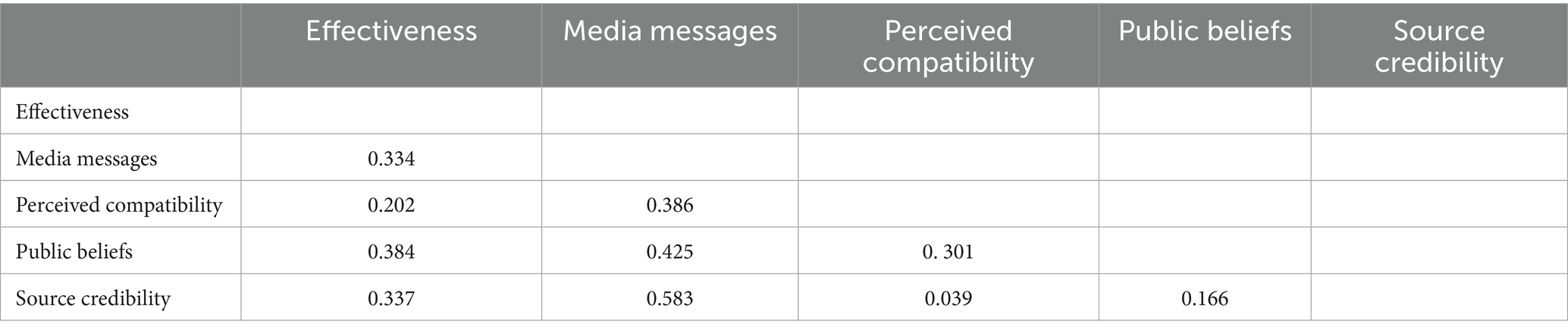
Table 5. Fornel Larcker criterion.

Table 6. Coefficient of determination and f2.
Similarly, this study assessed the predictive power and effect size of the predictor variable (Media Messages) on its relationships with dependent variables (Public Beliefs, Effectiveness, Perceived Compatibility, and Source Credibility). The analysis of predictive power used Coefficients of Determination R2, as suggested by Samartha and Kodikal (2018). The acquired values show robust predictive power, with the R-square value for Public Beliefs at 0.681 and the R-square Adjusted value at 0.681. For Effectiveness, the R-square value is 0.539, with a corresponding R-square Adjusted value of 0.538. For Perceived Compatibility, the R-square value is 0.4471, with an R-square Adjusted value of 0.470. Finally, the R-square value for Source Credibility is 0340, and the R-square Adjust value is 0.338.
Likewise, the study analyzed the effect size (f2) of Media Messages on (Public Beliefs, Effectiveness, Perceived Compatibility, and Source Credibility). As shown in Table 7, values equal to or below 0.02 are considered low, 0.15 is moderate, and 0.35 is large (Figueiredo Filho et al., 2011). Thus, the effect size of Media Messages on Public Beliefs is 2.136, categorizing it as large. For Effectiveness, the effect size is 1.168, Perceived Compatibility is 0.889, and for Source Credibility, it is 0.519, indicating large effect sizes. This highlights the strong effect of Media Messages on the variables under consideration and holds substantial implications for media practitioners (see Table 7).

Table 7. Hypotheses testing.
Finally, path analysis is used to examine the relationships between Media Messages and Public Beliefs, Effectiveness, Perceived Compatibility, and Source Credibility in the UAE. As highlighted by Valenzuela and Bachmann (2017), path analysis is a crucial part of Structural Equation Modeling (SEM), allowing researchers to analyze complex relationships among variables. By highlighting the suggested paths and relationships, the study seeks to precisely explain how different factors interact and mutually affect one another. The results presented in Table 7 show the results of the path analysis conducted in the current research.
First, the effect of Media Messages on Public Beliefs in the UAE is scrutinized. The results show a significant effect, witnessed by a beta coefficient (β) value of 0.825 and a significance value (p) of 0.000 (p < 0.000), confirming the support for Hypothesis 1 (H1). Proceeding to the second hypothesis (H2), significant a notable result of Media Messages on Effectiveness; path analysis supports this hypothesis with a beta coefficient value (β) of 0.734 and a significance value of p < 0.000. Regarding the third hypothesis, the effect of Media Messages on Perceived Compatibility is analyzed, showing a beta coefficient value (β) of 0.686 and a significance value of p < 0.000. Finally, the first hypothesis (H4), positing a significant effect of Media Messages on Source Credibility, is also affirmed with a beta coefficient value (β) of 0.583 and a significance value of p < 0.000. Table 7 represents the results of the path analysis.
Notably, the path between Media Messages and Public Beliefs emerges as the most powerful, with a path value of 0.825. Following closely is the path between Media Messages and Effectiveness, with a path value of 0.734. In contrast, the path between Media Messages and Perceived Compatibility is the third strongest among all (9.686), while the path between Media Messages and Source Credibility is 0.583, which remained the weakest among all. These results provide useful insights into the complex nature of the relationships under study, highlighting the varying strengths of effect between Media Messages and the sustainable development agenda considered in the UAE.
4 Discussion on results
This study examined how media messages affect public acceptance of sustainable development goals in the United Arab Emirates. It investigated how people perceive the effectiveness of these messages in disseminating information about sustainable development. The research also scrutinized public beliefs and the perceptions of media messages concerning the compatibility of media messages with their values and opinions. The study further assessed the credibility of media as a source of information on sustainable development, examining the trustworthiness and reliability of these messages. Also, it highlighted how sustainable development concepts spread among people through media messages concerning innovation characteristics and communication channels. Using the diffusion of innovation theory, the research employed a quantitative design with structured questionnaires to gather data. The collected data is then tested using Partial Least Square-Structural Equation Modeling (PLS-SEM). The results supported all hypotheses, offering evidence-based insights. Notably, each hypothesis is individually tested and represented for transparent and better understanding.
However, while the results are generally supportive of the hypothesized relationships, it is crucial to acknowledge possible limitations in interpreting these findings. For example, the dependence on self-reported data may introduce social desirability bias, where respondents exaggerate their engagement with sustainability messages. Also, the cross-sectional design prevents establishing causal relationships, restricting the ability to determine whether media messages directly cause changes in public beliefs or behaviors.
It is not worthwhile to note that the government of UAE is dedicated to gaining a more sustainable future by 2030 through the Sustainable Development Goals (SDGs). Their focus is on using abilities and expertise to introduce innovative solutions to persistent development challenges within the UAE. This mission has achieved increased significance, especially after the pandemic, which has rebounded hard-earned development progress worldwide (United Nations in United Arab Emirates, 2020). Efforts are strengthened to address challenges such as climate change, conflict, flux, and unstable economic growth. Acknowledging the rapid social and economic development in the UAE (Ayish, 2021), the government acknowledges that sustainability initiatives are most impactful when complemented by the active involvement of communication channels. The key to progress lies in open communication about priorities and challenges, along with offering timely support for these initiatives. This approach is critical for ensuring continuous progress in sustainable development (United Nations in United Arab Emirates, 2020).
Critically, while the media seems effective in disseminating sustainability information, the study does not capture differences in how different demographic groups perceive these messages. Factors such as age, education, and urban–rural location could moderate the influence of media, and analyzing these interactions might provide a deeper understanding of public acceptance patterns. Additionally, the study focuses on reported perceptions rather than observable behavioral change, which limits conclusions about the real-world impact of media messaging on sustainable development practices.
Talking specifically about the current research, the results highlighted the effectiveness of media messages in supporting positive perceptions regarding sustainable development in the UAE. Table 7 shows the description of the gathered data. Overall, the study respondents indicated that the media regularly provides information on the UAE’s sustainable development agenda, and they consider that this information is accurately delivered to them. According to the respondents, this information is based on diverse topics that positively affect their perceptions and views regarding sustainable development goals. These findings are consistent with the argumentation by McComas (2017). While interpersonal communication has irreplaceable significance, media like radio, television, and mobile phones present an effective alternative for accessing extensive audiences, even in far-flung areas. The growing use of media in sustainable development highlights their power to evolve beyond one-way information flow. It shows their ability to integrate and address local knowledge and experiences, encouraging dialogue among the public and developers of messages.
Similarly, a more critical interpretation suggests that the quality and framing of media messages could lead to differential effects. For example, excessively technical or generic messaging might fail to engage audiences meaningfully, while highly localized or emotionally resonant content could be more persuasive. Future research should examine how content framing, message frequency, and source diversity influence public acceptance.
Similarly, the first hypothesis (H1) of current research proposed a significant effect of media messages on public beliefs concerning sustainable development in the UAE. According to the study respondents, media messages affect public behavior concerning sustainable development acceptance. Also, the respondents indicated that these messages individually affect their attitude as they are well-equipped to inspire the audience’s attitude toward accepting the sustainable development agenda in the UAE. Respondents further agreed that messages conveyed by celebrities inspire their perceptions toward sustainable development as these messages effectively alter public opinions. Examples cited include televised interviews with sustainability experts, social media posts by UAE government accounts, and coverage of national green initiatives such as the ‘Clean UAE’ campaign. These findings are consistent with the existing literature witnessing media messages as effective in supporting sustainable development in different regions (ElAlfy et al., 2020; Koinig and Diehl, 2021; Kotsalas et al., 2018).
However, the dependence on celebrity messaging raises questions about the sustainability of these effects. While celebrities can grab attention and shift attitudes temporarily, it is unclear whether these changes translate into long-term behavioral adoption or a deeper understanding of sustainable development principles. Future studies should consider longitudinal designs to evaluate the persistence of such media influences.
Their study Voci (2022) examined the extent to which Austrian media companies adopt their role as critical communicators in the public sphere. The researchers specifically analyzed how these entities shape the discussion on sustainability through their content. The results indicated that most of the media content related to sustainability focuses on issues related to food, followed by concerns about resources and climate conditions. This focus contributed to advancing specific Sustainable Development Goals (SDGs), including SDG#2 (zero hunger), #6 (clean water and sanitation), #13 (climate action), #14 (life below water), and #15 (life on land). Highlighting these issues predominantly depends on logical appeals, engaging the audience’s reason (logos, 76%), with moral appeals (ethos, 22%) and emotional appeals (pathos, 2%) being less prevailing. Critically, this heavy reliance on logical appeals may limit engagement with audiences who respond more strongly to emotional or ethical messaging, suggesting that the impact of sustainability communication could vary depending on audience characteristics and message framing.
The second research hypothesis (H2) proposed that media messages are effective in spreading information about sustainable development in the UAE. Regarding the relevant hypothesis, the study respondents indicated that media messages about sustainable development are well-organized and well-represented. According to the respondents, these media messages contain symbolic messages that have strong relevance and sophistication for the audience. For instance, respondents mentioned campaigns on clean energy, recycling initiatives, and water conservation programs, as well as social media content from government and influencer channels promoting SDG-related activities. The respondents indicated that the overall media representation of the sustainable development agenda is effective. Considering these findings, it is evident that existing studies on media effectiveness for sustainable development in different regions also witnessed similar findings (Abbas et al., 2019; Grover et al., 2019; Laurie et al., 2016; Waisbord, 2020). However, while the messages are perceived as effective, the study does not critically examine potential oversaturation or audience fatigue, which could diminish the long-term effectiveness of repeated media campaigns.
For instance, Wielki (2020) examined the role, impact, and significance of social media influencers in facilitating the promotion of green sustainability products and services related to sustainable development goals in Poland. Data collected from structured surveys suggested significant prospects in activities involving social media influencers. This prospect remained especially associated with their effective communication of information about products or services, their impact on increasing brand awareness, and their impact on the sales performance of products and services offered by companies. A critical consideration is that the reliance on social media influencers may introduce bias or commercial motivations that could compromise the objectivity of sustainability messages, potentially affecting public trust over time.
The third hypothesis is that “Media messages significantly affect the perceived compatibility concerning sustainable development in the UAE.” The study respondents revealed that the information concerning sustainable development through media messages is reliable as it is relevant to their personal and overall societal needs. Study respondents further revealed that the relevant information concerning sustainable development by media is comprehensive and understandable to them. Similar findings are found in the studies (Zikargae, 2018) in Ethiopia, Malaysia (Buytaert et al., 2014), and other different regions (Bain et al., 2019). Nonetheless, perceived compatibility does not guarantee behavioral change, and the study does not measure whether these perceptions lead to concrete sustainable actions among the public.
Finally, the fourth hypothesis proposed a significant effect of source credibility concerning sustainable development in the UAE. Study respondents agreed that media messages are qualified and can be trusted to provide information regarding sustainable development agendas. According to the respondents, these media messages provide unbiased information and are concerned about educating the audience about sustainable development. Respondents also indicated their agreement that media messages gain public trust by educating them about sustainable development for national development as they are focused on the welfare of the common man. As noted by Dhiman (2023). Therefore, results also supported the idea that media has credible position and plays an effective role in encouraging the values of sustainable development by impacting public opinion, raising awareness, and shaping individual and collective behaviors (Parguel et al., 2011). Media messages are instrumental in effectively sharing essential messages, engaging audiences, and promoting changes in behavior that align with sustainable development objectives. The media’s significant role expands to fostering values and mindfulness facilitative to sustainable development (Bain et al., 2019; Diaconeasa and Popescu, 2022). Critically, while credibility is affirmed by respondents, this may reflect perceived trust rather than measured accuracy or impartiality, and differences in credibility perception across media platforms could influence the generalizability of the findings.
Through its capacity to inform, educate, affect, and motivate, the media possesses the possibility to mold public opinion, raise awareness, and initiate positive behavioral changes by integrating sustainable development values and mindfulness practices into media strategies; the collective power of media and meditation to foster a more sustainable and compassionate world is of greater importance (Ruiz-Benítez et al., 2018). Thus, the media’s capability to inform and enlighten the public about sustainability challenges, environmental problems, social injustices, and economic inequalities is critical in cultivating an in-depth understanding of the significance of sustainable development values. Besides, the media can shape public perceptions and attitudes toward sustainable development by articulating issues and forming the agenda for public discussion (Carvalho, 2007; Schmidt et al., 2016; Thomas et al., 2019). However, it is important to recognize that media influence is not uniform; audience interpretation, selective exposure, and cultural context can moderate the impact of these messages, which may limit the extent to which media alone can drive sustainable development behaviors.
5 Study implications
This research provides some theoretical implications concerning the diffusion of innovation theory. First, the study’s investigation of the perceived effectiveness of media messages in disseminating information on sustainable development is consistent with the Diffusion of Innovation Theory’s focus on the significance of communication channels in creating awareness. The results elucidated the aspects of media content effectively catch public attention and contribute to the initial stages of the diffusion process. Furthermore, regarding the opinions of the public concerning sustainable development and the role of media messages in shaping these perspectives, the research highlighted the power of opinion leaders and communication resources in the diffusion process. Apprehending how media messages interact with current beliefs helps in identifying factors that encourage the acceptance of sustainable development objectives.
Similarly, investigating how individuals consider the compatibility of media messages with their values, beliefs, and needs harmonizes with the Diffusion of Innovation Theory’s concept of compatibility. Discernment into this aspect indicates that Emirati media’s content aligns with the existing mindset of the audience, accelerating the diffusion of sustainable development concepts. Besides, evaluating the perceived credibility of media as a basis of information on sustainable development conforms to the theory’s dimension of perceived credibility. Understanding the trustworthiness and reliability linked to media messages shows crucial factors affecting the evaluation and acceptance of sustainable development conceptions by the public. Finally, examining the diffusion process of sustainable development notions through media messages, considering factors such as innovation characteristics and communication channels aligns with the theory’s focus on the innovation’s characteristics and the channels through which it disseminates. This study provides in-depth insights into the dynamics of information flow and its influence on the diffusion of sustainable development objectives within the UAE context.
6 Study limitations and future research
This research has some primary limitations that future studies can overcome. First, this research is based on the United Arab Emirates, which questions the generalizability of results. Future researchers can replicate this research and conduct it in different regions to delimit this scope. The second limitation involves using a single-method approach for data gathering. Future studies can apply a mixed-method approach to gain comprehensive insights. Finally, the focus remained on overall sustainable development, while there are diverse types of sustainable development goals, i.e., green sustainability, economic sustainability, etc. Future researchers are suggested to focus on a particular type of sustainable development to gain particular insights.
7 Conclusion
This research highlighted the key role of media messages in shaping the narrative and promoting acceptance of sustainable development agendas among the public in the UAE. The study has provided extensive insights into the effectiveness of media messages in sharing information on sustainable development, highlighting their impact on public attitudes and beliefs. The results of this research highlight the importance of media messages as a potent tool for increasing awareness and garnering support for sustainable development objectives within the UAE. By studying the perceived compatibility of media messages with the existing values, beliefs, and needs of the public, the study emphasized the possibility of media aligning with the attitude of the audience, thereby encouraging the acceptance of sustainable development initiatives. Also, the research suggests that media in the UAE plays a critical role in promoting sustainable development goals effectively. The evidence presented shows that the local media landscape is actively contributing to the diffusion of positive information, promoting a favorable environment for the endorsement of sustainable development initiatives. The media’s role as a conceivable source of information on sustainable development is highlighted, with the study indicating a perceived trustworthiness and reliability linked with media messages in the relevant context. The positive opinions and attitudes observed among the public regarding sustainable development initiatives in the UAE, as impacted by media messages, confirm the media’s role as an effective agent in shaping public perception. The research indicates that individuals are obtaining positive information through media channels, contributing to a constructive perspective on sustainable development and its usefulness for current and future generations. Thus, this study not only highlights the importance of media messages in emphasizing sustainable development agendas in the UAE but also represents the effective role of media in actively encouraging and contributing to the realization of sustainable development goals. As the UAE aims toward a sustainable future, the positive impact of media emerges as a robust catalyst, encouraging informed public opinion and contributing to joint efforts for a more sustainable and resilient society.
Data availability statement
The original contributions presented in the study are included in the article/supplementary material, further inquiries can be directed to the corresponding authors.
Ethics statement
The studies involving humans were approved by Research Ethics Committee, Ajman University, United Arab Emirates. The studies were conducted in accordance with the local legislation and institutional requirements. The participants provided their written informed consent to participate in this study.
Author contributions
EY: Data curation, Formal analysis, Writing – original draft, Writing – review & editing. SA: Conceptualization, Software, Supervision, Validation, Writing – original draft, Writing – review & editing. AB: Formal analysis, Project administration, Validation, Writing – original draft. SM: Funding acquisition, Methodology, Resources, Supervision, Writing – original draft, Writing – review & editing.
Funding
The author(s) declared that financial support was received for this work and/or its publication. This article is funded by Ajman University Internal Grant Number (DRG Ref no. AP/P505208/3). The findings represented in this research are solely the responsibility of the author.
Conflict of interest
The author(s) declared that this work was conducted in the absence of any commercial or financial relationships that could be construed as a potential conflict of interest.
Generative AI statement
The author(s) declared that Generative AI was not used in the creation of this manuscript.
Any alternative text (alt text) provided alongside figures in this article has been generated by Frontiers with the support of artificial intelligence and reasonable efforts have been made to ensure accuracy, including review by the authors wherever possible. If you identify any issues, please contact us.
Publisher’s note
All claims expressed in this article are solely those of the authors and do not necessarily represent those of their affiliated organizations, or those of the publisher, the editors and the reviewers. Any product that may be evaluated in this article, or claim that may be made by its manufacturer, is not guaranteed or endorsed by the publisher.
References
Abbas, J., Aman, J., Nurunnabi, M., and Bano, S. (2019). The impact of social media on learning behavior for sustainable education: evidence of students from selected universities in Pakistan. Sustainability 11:1683. doi: 10.3390/su11061683
Ajzen, I. (2020). The theory of planned behavior: Frequently asked questions. Human behavior and emerging technologies, 2, 314–324.
Ayish, M. (2021). “United Arab Emirates: media for sustainable development” in Arab media systems. Londan: Routledge.
Bain, P. G., Kroonenberg, P. M., Johansson, L.-O., Milfont, T. L., Crimston, C. R., Kurz, T., et al. (2019). Public views of the sustainable development goals across countries. Nat. Sustain. 2, 45–62. doi: 10.1038/s41893-019-0365-4
Brenner, B., and Hartl, B. (2021). The perceived relationship between digitalization and ecological, economic, and social sustainability. J. Clean. Prod. 315:128128. doi: 10.1016/j.jclepro.2021.128128
Buytaert, W., Zulkafli, Z., Grainger, S., Acosta, L., Alemie, T. C., Bastiaensen, J., et al. (2014). Citizen science in hydrology and water resources: opportunities for knowledge generation, ecosystem service management, and sustainable development. Front. Earth Sci. 2:26. doi: 10.3389/feart.2014.00026
Cangur, S., and Ercan, I. (2015). Comparison of model fit indices used in structural equation modeling under multivariate normality. J. Mod. Appl. Stat. Methods 14, 33–41. doi: 10.22237/jmasm/1430453580
Carvalho, A. (2007). Ideological cultures and media discourses on scientific knowledge: re-reading news on climate change. Public Understand. Sci. 15, 223–243.
Carvalho, J. V. (2020). European strategy and legislation for cybersecurity: implications for Portugal. Cluster Comput. 23, 1845–1854. doi: 10.1007/978-3-030-12345-6
Daher-Nashif, S., and Bawadi, H. (2020). Women’s health and well-being in the United Nations sustainable development goals: a narrative review of achievements and gaps in the Gulf states. Int. J. Environ. Res. Public Health 17:1059. doi: 10.3390/ijerph17031059,
Dhiman, B. (2023). Media role in promoting values & meditation for sustainable development: an overview. Available online at: https://papers.ssrn.com/sol3/papers.cfm?abstract_id=4478221
Diaconeasa, M.-C., and Popescu, G. (2022). Media discourse on sustainable consumption in Europe. Environ. Commun. 16, 352–370. doi: 10.1080/17524032.2021.1999295
Diprose, K., Fern, R., Vanderbeck, R. M., Chen, L., Valentine, G., Liu, C., et al. (2018). Corporations, consumerism and culpability: sustainability in the British press. Environ. Commun. 12, 672–685. doi: 10.1080/17524032.2017.1400455
ElAlfy, A., Darwish, K. M., and Weber, O. (2020). Corporations and sustainable development goals communication on social media: corporate social responsibility or just another buzzword? Sustain. Dev. 28, 1418–1430. doi: 10.1002/sd.2095
ElHaffar, G., Durif, F., and Dubé, L. (2020). Towards closing the attitude-intention-behavior gap in green consumption: a narrative review of the literature and an overview of future research directions. J. Clean. Prod. 275:122556. doi: 10.1016/j.jclepro.2020.122556
Farhi, F., Jeljeli, R., Slamene, R., Mohammed, M., and Zamoum, K. (2023). Towards communication in achieving sustainable economic development goals: the role of communication in UAE media institutions. Sustainability 15:7933. doi: 10.3390/su15107933
Farhi, F., Saidani, S., and Jeljeli, R. (2021). Determinants of dependence on social media for accessing news a study on a sample of journalists in the newsroom. Psychol. Educ. 58, 3531–3543. doi: 10.1016/j.jbusres.2021.04.012
Fiala, V., Freyer, B., and Bingen, J. (2021). Environmentally sound agriculture between transformation and conformation: the changing portrayal of the growing organic farming movement in Austria’s newspaper coverage. Environ. Commun. 15, 495–513. doi: 10.1080/17524032.2020.1866636
Figueiredo Filho, D. B., Silva Júnior, J. A., and Rocha, E. C. (2011). What is R2 all about? Leviathan (São Paulo) 3:60. doi: 10.11606/issn.2237-4485.lev.2011.132282
García-Avilés, J. A. (2021). Journalism as usual? Managing disruption in virtual newsrooms during the COVID-19 crisis. Digit. Journal. 9, 1239–1260. doi: 10.1080/21670811.2021.1942112
Government of UAE (2024). The UAE’s Green Agenda—2030 | The Official Platform of the UAE Government. Available online at: https://u.ae/en/about-the-uae/strategies-initiatives-and-awards/strategies-plans-and-visions/environment-and-energy/the-uaes-green-agenda-2030
Grover, P., Kar, A. K., and Janssen, M. (2019). Diffusion of blockchain technology: insights from academic literature and social media analytics. J. Enterp. Inf. Manag. 32, 735–757. doi: 10.1108/JEIM-06-2018-0132
Holt, D., and Barkemeyer, R. (2012). Media coverage of sustainable development issues – attention cycles or punctuated equilibrium? Sustain. Dev. 20, 1–17. doi: 10.1002/sd.460
Hoyle, R. H. (2000). “16—confirmatory factor analysis” in Handbook of applied multivariate statistics and mathematical modeling. eds. H. E. A. Tinsley and S. D. Brown (Thousand Oaks, CA: Academic Press), 465–497.
Jones, P., Wynn, M., Hillier, D., and Comfort, D. (2017). The sustainable development goals and information and communication technologies. Indones. J. Sustain. Account. Manag. 1:1. doi: 10.28992/ijsam.v1i1.22
Kanchanatanee, K., Suwanno, N., and Jarernvongrayab, A. (2014). Effects of attitude toward using, perceived usefulness, perceived ease of use and perceived compatibility on intention to use E-marketing. J. Manag. Res. 6:3. doi: 10.5296/jmr.v6i3.5573
Kang, M. Y., and Park, B. (2018). Sustainable corporate social media marketing based on message structural features: firm size plays a significant role as a moderator. Sustainability 10:4. doi: 10.3390/su10041167
Kelly, S., Kaye, S.-A., and Oviedo-Trespalacios, O. (2023). What factors contribute to the acceptance of artificial intelligence? A systematic review. Telemat. Inform. 77:101925. doi: 10.1016/j.tele.2022.101925
Kemp, D. G. (2007). Source credibility and public information campaigns: The effect of audience evaluations of organizational sponsors on message acceptance [University of South Florida]. Available online at: https://digitalcommons.usf.edu/cgi/viewcontent.cgi?article=3240&context=etd
Khatun, N. (2021). Applications of normality test in statistical analysis. Open J. Stat. 11, 113–122. doi: 10.4236/ojs.2021.111006
Kiliç, A., Uysal, İ., and Atar, B. (2020). Comparison of confirmatory factor analysis estimation methods on binary data. Int. J. Assess. Tools Educ. 7, 451–487. doi: 10.21449/ijate.660353
Koinig, I., and Diehl, S. (2021). “Health communication (campaigns) for sustainable development—can social media be a remedy?” in The sustainability communication reader: a reflective compendium. eds. F. Weder, L. Krainer, and M. Karmasin (Wiesbaden, Germany: Springer Fachmedien), 437–460.
Korneeva, E., Salge, T. O., Teubner, T., and Antons, D. (2023). Tracing the legitimacy of artificial intelligence: a longitudinal analysis of media discourse. Technol. Forecast. Soc. Change 192:122467. doi: 10.1016/j.techfore.2023.122467
Kotsalas, I. P., Antoniou, A., and Scoullos, M. (2018). Decoding mass media techniques and education for sustainable development. J. Educ. Sustain. Dev. 11, 102–122. doi: 10.1177/0973408218761229
Krzymowski, A. (2020). Sustainable development goals in Arab region – United Arab Emirates’ case study. Probl. Ekorozwoju 15, 101–118. doi: 10.35784/pe.2020.1.22
Kumar, R., Kaushal, S. K., and Kumar, K. (2022). Does source credibility matter in promoting sustainable consumption? Developing an integrated model. Soc. Responsib. J. 19, 1320–1347. doi: 10.1108/SRJ-07-2021-0257
Laurie, R., Nonoyama-Tarumi, Y., Mckeown, R., and Hopkins, C. (2016). Contributions of education for sustainable development (ESD) to quality education: a synthesis of research. J. Educ. Sustain. Dev. 10, 226–242. doi: 10.1177/0973408216661442
Lee, J., and Cho, M. (2020). The effects of consumers’ media exposure, attention, and credibility on pro-environmental behaviors. J. Promot. Manag. 26, 434–455. doi: 10.1080/10496491.2019.1699629
Lee, Y., Park, S.-A., Lee, H., Willis, E., and Cameron, G. T. (2019). Resources aren’t everything, but they do help: assessing local TV health news to deliver substantive and useful health information. J. Commun. Healthc. 12, 13–22. doi: 10.1080/17538068.2018.1556959
Lewis, T. L. (2000). Media representations of “sustainable development”: sustaining the status quo? Sci. Commun. 21, 244–273. doi: 10.1177/1075547000021003003
Mazouz, A., Alnaji, L., Jeljeli, R., and Al-Shdaifat, F. (2017). Innovation indicators and growth in the United Arab Emirates. AAU J. Bus. Law 1, 1–12. doi: 10.51958/AAUJBL2017V1I1P2
McComas, C. Y. K. (2017). “Media’s role in enhancing sustainable development in Zambia” in Climate and sustainability communication (New York, NY: Routledge).
Mello, S. C. B. D., and Collins, M. (2001). Convergent and discriminant validity of the perceived risk scale in business-to-business context using the multitrait-multimethod approach. Rev. Adm. Contemp. 5, 167–186. doi: 10.1590/S1415-65552001000300009
Milne, M. J., Tregidga, H., and Walton, S. (2009). Words not actions! The ideological role of sustainable development reporting. Account. Audit. Account. J. 22, 1211–1257. doi: 10.1108/09513570910999292
Nelson, O., and Namtira, B.-J. (2017). Measuring media campaigns effectiveness for environmental health for sustainable development: a study of Ebola outbreak in Lagos state, Nigeria. J. Health Manag. 19, 553–562. doi: 10.1177/0972063417727619
Otondo, R. F., Van Scotter, J. R., Allen, D. G., and Palvia, P. (2008). The complexity of richness: media, message, and communication outcomes. Inf. Manag. 45, 21–30. doi: 10.1016/j.im.2007.09.003
Parguel, B., Benoît-Moreau, F., and Larceneux, F. (2011). How sustainability ratings might deter ‘greenwashing’: a closer look at ethical corporate communication. J. Bus. Ethics 102, 15–28. doi: 10.1007/s10551-011-0901-2
Reilly, A. H., and Larya, N. (2018). External communication about sustainability: corporate social responsibility reports and social media activity. Environ. Commun. 12, 621–637. doi: 10.1080/17524032.2018.1424009
Rogers, M., Chapman, C., and Giotsas, V. (2012). Measuring the diffusion of marketing messages across a social network. J. Direct Data Digit. Mark. Pract. 14, 97–130. doi: 10.1057/dddmp.2012.25
Ruiz-Benítez, R., López, C., and Real, J. C. (2018). The lean and resilient management of the supply chain and its impact on performance. Int. J. Prod. Econ. 203, 190–202. doi: 10.1016/j.ijpe.2018.06.009
Samartha, V., and Kodikal, R. (2018). Measuring the effect size of coefficient of determination and predictive relevance of exogenous latent variables on endogenous latent variables through PLS-SEM. Int. J. Pure Appl. Math. 119, 512–517. doi: 10.1109/ICACCI.2018.8554879
Sarkar, J. G., Sarkar, A., and Sreejesh, S. (2022). Developing responsible consumption behaviours through social media platforms: sustainable brand practices as message cues. Inf. Technol. People 36, 532–563. doi: 10.1108/ITP-01-2021-0044
Schmidt, A. M., Ranney, L. M., Pepper, J. K., and Goldstein, A. O. (2016). Source credibility in tobacco control messaging. Tob. Regul. Sci. 2, 31–37. doi: 10.18001/TRS.2.1.3,
Shiu, E., Pervan, S. J., Bove, L. L., and Beatty, S. E. (2011). Reflections on discriminant validity: reexamining the Bove et al. (2009) findings. J. Bus. Res. 64, 497–500. doi: 10.1016/j.jbusres.2010.04.004
Spence, P. R., Lachlan, K. A., Westerman, D., and Spates, S. A. (2013). Where the gates matter less: ethnicity and perceived source credibility in social media health messages. Howard J. Commun. 24, 1–16. doi: 10.1080/10646175.2013.748593
Summ, A. (2018). What’s science? Where’s science? Science journalism in German print media. Public Understand. Sci. 25, 775–790. doi: 10.1177/0963662515583419
Thomas, R. J., Masthoff, J., and Oren, N. (2019). Can I influence you? Development of a scale to measure perceived persuasiveness and two studies showing the use of the scale. Front. Artif. Intell. 2:24. doi: 10.3389/frai.2019.00024,
Tiozzo, B., Pinto, A., Neresini, F., Sbalchiero, S., Parise, N., Ruzza, M., et al. (2019). Food risk communication: analysis of the media coverage of food risk on Italian online daily newspapers. Qual. Quant. 53, 2843–2866. doi: 10.1007/s11135-019-00897-3
Tkáčová, H., Pavlíková, M., and Jenisová, Z. (2021). Social media and students’ wellbeing: an empirical analysis during the Covid-19 pandemic. Sustainability 13:10442. doi: 10.3390/su131810442
Umar, T., Egbu, C., Ofori, G., Honnurvali, M. S., Saidani, M., Shibani, A., et al. (2020). UAE’s commitment towards UN Sustainable Development Goals. Proceedings of the Institution of Civil Engineers - Engineering Sustainability, 173, 325–343. doi: 10.1680/jensu.19.00036
United Nations in United Arab Emirates (2020). Sustainable Development Goals [Online post]. Available online at: https://unitedarabemirates.un.org/en/sdgs
Valenzuela, S., and Bachmann, I. (2017). “Path analysis” in The international encyclopedia of communication research methods. New York: Oxford University Press.
Voci, D. (2022). Logos, ethos, pathos, sustainabilitos? About the role of media companies in reaching sustainable development. Sustainability 14:2591. doi: 10.3390/su14052591
Waisbord, S. (2020). “Family tree of theories, methodologies, and strategies in development communication” in Handbook of communication for development and social change. ed. J. Servaes (Cambridge, UK: Springer), 93–132.
Wielki, J. (2020). Analysis of the role of digital influencers and their impact on the functioning of the contemporary on-line promotional system and its sustainable development. Sustainability 12:7138. doi: 10.3390/su12177138
Wu, M., Huang, Y., Li, R., Bortree, D. S., Yang, F., Xiao, A., et al. (2016). A tale of two sources in native advertising: examining the effects of source credibility and priming on content, organizations, and media evaluations. Am. Behav. Sci. 60, 1492–1509. doi: 10.1177/0002764216660139
YouGov (2022). UAE National Omnibus. Available online at: https://business.yougov.com/product/realtime/uae-national-omnibus
Youssef, E., Medhat, M., and Alserkal, M. (2024). Investigating the effect of social media on dependency and communication practices in Emirati society. Soc. Sci. 13:1. doi: 10.3390/socsci13010069
Zafar, A. U., Shen, J., Ashfaq, M., and Shahzad, M. (2021). Social media and sustainable purchasing attitude: role of trust in social media and environmental effectiveness. J. Retail. Consum. Serv. 63:102751. doi: 10.1016/j.jretconser.2021.102751
Zahid, H., and Haji Din, B. (2019). Determinants of intention to adopt E-government services in Pakistan: an imperative for sustainable development. Resources 8:3. doi: 10.3390/resources8030128
Keywords: media messages, sustainable development, United Arab Emirates, diffusion of innovation, quantitative analysis
Citation: Youssef E, Abdellatif S, Badr AMN and Mohamed Nasef SA (2026) Investigating the effect of media messages on sustainable development agenda acceptance among public in the United Arab Emirates. Front. Commun. 10:1670329. doi: 10.3389/fcomm.2025.1670329
Edited by:
Zoran Govedar, University of Banja Luka, Bosnia and HerzegovinaReviewed by:
Michalis Tastsoglou, National and Kapodistrian University of Athens, GreeceKhaled Zamoum, University of Sharjah, United Arab Emirates
Copyright © 2026 Youssef, Abdellatif, Badr and Mohamed Nasef. This is an open-access article distributed under the terms of the Creative Commons Attribution License (CC BY). The use, distribution or reproduction in other forums is permitted, provided the original author(s) and the copyright owner(s) are credited and that the original publication in this journal is cited, in accordance with accepted academic practice. No use, distribution or reproduction is permitted which does not comply with these terms.
*Correspondence: Enaam Youssef, ZS55b3Vzc2VmQGFqbWFuLmFjLmFl; Soumaya Abdellatif, cy5hYmRlbGxhdGlmQGFqbWFuLmFjLmFl