 Noemí Caballero-Sánchez
 Nathan Winn
 Jose Cesar Rosa Neto
 Laszlo Nagy
- 1Doctoral School of Molecular Cell and Immunobiology, Faculty of Medicine, University of Debrecen, Debrecen, Hungary
- 2Department of Biochemistry and Molecular Biology, Faculty of Medicine, University of Debrecen, Debrecen, Hungary
- 3Department of Molecular Physiology and Biophysics, Vanderbilt University School of Medicine, Nashville, TN, United States
- 4Immunometabolism Research Group, Department of Cell and Developmental Biology, University of São Paulo, São Paulo, Brazil
- 5Department of Medicine, Johns Hopkins University School of Medicine, and Institute for Fundamental Biomedical Research, Johns Hopkins All Children’s Hospital, St Petersburg, FL, United States
- 6Department of Biological Chemistry, Johns Hopkins University School of Medicine, and Institute for Fundamental Biomedical Research, Johns Hopkins All Children’s Hospital, St Petersburg, FL, United States
A Corrigendum on
Editorial: Cross-talk between heterogeneous cell types in skeletal muscle: implications for glucose metabolism
by Caballero-Sánchez N, Winn N, Neto JCR and Nagy L (2023). Front. Endocrinol. 14:1185725. doi: 10.3389/fendo.2023.1185725
In the published article, Figure 1 and the respective citations were omitted. The corrected Figure 1 and its caption appear below.
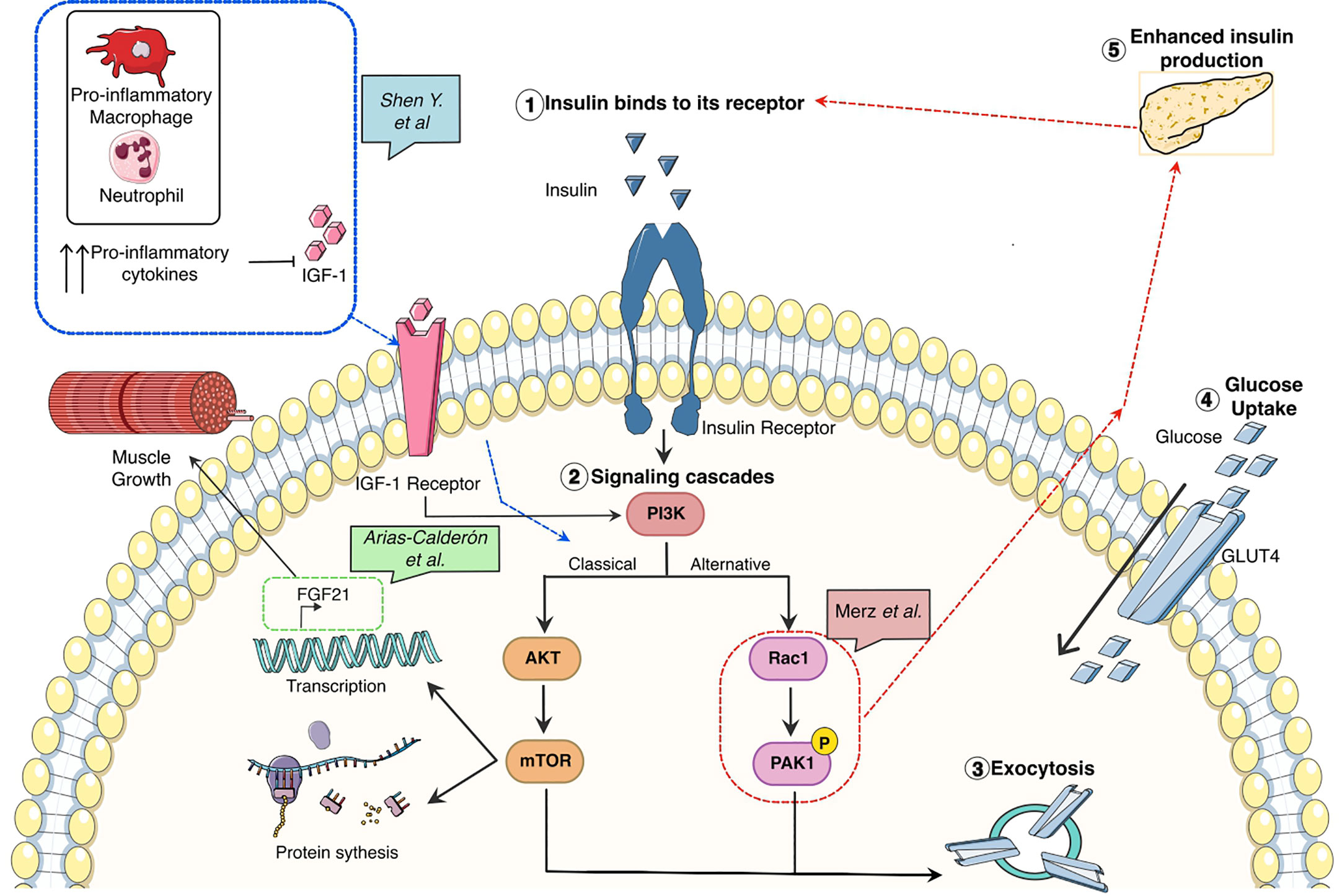
Figure 1 Glucose metabolism associated pathways and its correlation with growth, inflammation, and tissue repair in skeletal muscle.
The citations for Figure 1 have now been inserted in paragraphs 3 and 4 and should read:
“In a recently published paper, Merz et al. link the relevance of PAK1 to type II diabetes pathogenesis by the use of knockout and overexpression of PAK1 mouse models (Figure 1).”
“Nonetheless, the interconnection between insulin release, resistance, and glucose metabolism in skeletal muscle is much more complex and it also has an immunological cofactor as reviewed by Shen et al. linking the systematic pro-inflammatory response detected by several studies by the increased levels of TNFa or IL-6 in serum (8) and intramuscular (9) with muscle degeneration (Figure 1).”
“In this issue, Arias-Calderoín et al. have been able to identify that FGF21 an important hormone for muscle repair, can be secreted intra-muscularly via PI3K/AKT/mTOR signaling pathway (Figure 1).”
The authors apologize for this error and state that this does not change the scientific conclusions of the article in any way. The original article has been updated.
Publisher’s note
All claims expressed in this article are solely those of the authors and do not necessarily represent those of their affiliated organizations, or those of the publisher, the editors and the reviewers. Any product that may be evaluated in this article, or claim that may be made by its manufacturer, is not guaranteed or endorsed by the publisher.
Keywords: skeletal muscle, glucose metabolism, tissue cross talk, inflammation, FGF21
Citation: Caballero-Sánchez N, Winn N, Rosa Neto JC and Nagy L (2023) Corrigendum: Editorial: Cross-talk between heterogeneous cell types in skeletal muscle: implications for glucose metabolism. Front. Endocrinol. 14:1219036. doi: 10.3389/fendo.2023.1219036
Received: 08 May 2023; Accepted: 08 June 2023;
Published: 26 June 2023.
Approved by:
Frontiers Editorial Office, Frontiers Media SA, SwitzerlandCopyright © 2023 Caballero-Sánchez, Winn, Rosa Neto and Nagy. This is an open-access article distributed under the terms of the Creative Commons Attribution License (CC BY). The use, distribution or reproduction in other forums is permitted, provided the original author(s) and the copyright owner(s) are credited and that the original publication in this journal is cited, in accordance with accepted academic practice. No use, distribution or reproduction is permitted which does not comply with these terms.
*Correspondence: Laszlo Nagy, bG5hZ3lAamhtaS5lZHU=