 Wonjin Kim1
 Mi-Kyoung Seo2
 Yong Joon Kim3Soo Hyun Choi3
 Cheol Ryong Ku4
 Sangwoo Kim5†
 Eun Jig Lee4*
 Jin Sook Yoon3*
- 1Division of Endocrinology and Metabolism, Department of Internal Medicine, CHA Gangnam Medical Center, CHA University School of Medicine, Seoul, Republic of Korea
- 2Channing Division of Network Medicine, Brigham and Women’s Hospital, Harvard Medical School, Boston, MA, United States
- 3Institute of Vision Research, Department of Ophthalmology, Yonsei University College of Medicine, Seoul, Republic of Korea
- 4Division of Endocrinology and Metabolism, Department of Internal Medicine, Yonsei University College of Medicine, Seoul, Republic of Korea
- 5Department of Biochemical Systems Informatics, Brain Korea 21 PLUS Project for Medical Science, Yonsei University College of Medicine, Seoul, Republic of Korea
A Correction on
Role of the suppressor of cytokine signaling-3 in the pathogenesis of Graves’ orbitopathy
By Kim W, Seo M-K, Kim YJ, Choi SH, Ku CR, Kim S, Lee EJ and Yoon JS (2025) Front. Endocrinol. 16:1527275. doi: 10.3389/fendo.2025.1527275
There was a mistake in Figure 4 as published. Figures 3, 4 appear to be identical.
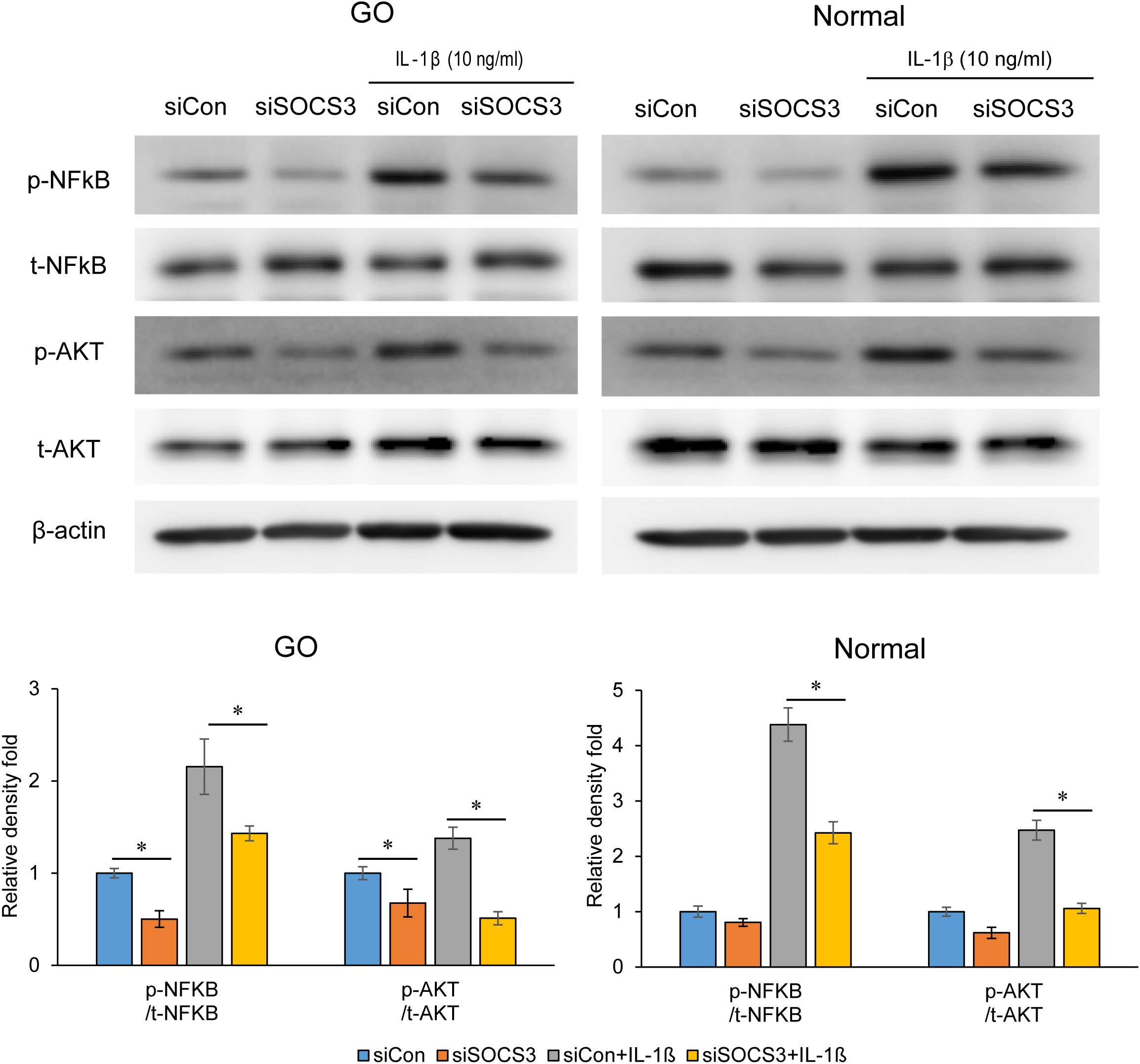
Figure 4. Effects of SOCS3 suppression on the activation of NF-κB and AKT signaling proteins following IL-1β treatment. Orbital fibroblasts derived from patients with GO (n = 3) and healthy individuals (n = 3) were transfected with 20 nM si-SOCS3 or si-con and cultured for 48 h, followed by IL-1β treatment (10 ng/mL) for 1 h, which resulted in an increase in the level of phosphorylated forms of NF-κB and AKT. Protein levels determined using densitometry were normalized to the β-actin levels in the same sample. Results are presented as the mean relative density ± SD for three individual samples and graphs are representative of three independent experiments (*p < 0.05 between si-con and si-SOCS3; si-con + IL-1β and si-SOCS3 + IL-1β). AKT, protein kinase B; GO, Graves’ orbitopathy; IL-1β, interleukine-1 beta; ICAM-1, intercellular adhesion molecule 1; NF-κB, nuclear factor kappa-light-chain-enhancer of activated B cells; SOCS3, suppressor of cytokine signaling-3.
The corrected Figure 4 appears below.
The original version of this article has been updated.
Publisher’s note
All claims expressed in this article are solely those of the authors and do not necessarily represent those of their affiliated organizations, or those of the publisher, the editors and the reviewers. Any product that may be evaluated in this article, or claim that may be made by its manufacturer, is not guaranteed or endorsed by the publisher.
Keywords: Graves’ orbitopathy, orbital fibroblast, SOCS3, suppressor of cytokine signaling 3, inflammation, adipogenesis
Citation: Kim W, Seo M-K, Kim YJ, Choi SH, Ku CR, Kim S, Lee EJ and Yoon JS (2025) Correction: Role of the suppressor of cytokine signaling-3 in the pathogenesis of Graves’ orbitopathy. Front. Endocrinol. 16:1709476. doi: 10.3389/fendo.2025.1709476
Received: 20 September 2025; Accepted: 07 November 2025; Revised: 06 October 2025;
Published: 17 November 2025.
Edited and reviewed by:
Sijie Fang, Shanghai Jiao Tong University, ChinaCopyright © 2025 Kim, Seo, Kim, Choi, Ku, Kim, Lee and Yoon. This is an open-access article distributed under the terms of the Creative Commons Attribution License (CC BY). The use, distribution or reproduction in other forums is permitted, provided the original author(s) and the copyright owner(s) are credited and that the original publication in this journal is cited, in accordance with accepted academic practice. No use, distribution or reproduction is permitted which does not comply with these terms.
*Correspondence: Eun Jig Lee, ZWpsZWVAeXVocy5hYw==; Jin Sook Yoon, eW9vbmpzQHl1aHMuYWM=
†ORCID: Sangwoo Kim, orcid.org/0000-0001-5356-0827