 Feifei Qiu
 Huazhen Liu
 Chun-Ling Liang
 Golay D. Nie2
 Zhenhua Dai
- 1Section of Immunology, Guangdong Provincial Academy of Chinese Medical Sciences, Guangdong Provincial Hospital of Chinese Medicine, Guangzhou, China
- 2School of Medicine, University of Texas Medical Branch, Galveston, TX, United States
A Corrigendum on
A New Immunosuppressive Molecule Emodin Induces both CD4+FoxP3+ and CD8+CD122+ Regulatory T Cells and Suppresses Murine Allograft Rejection
by Qiu, F., Liu, H., Liang, C-L., Nie, G. D., and Dai, Z. (2017). Front. Immunol. 8:1519. doi: 10.3389/fimmu.2017.01519
In the original article, there were errors in Figure 3A and Figure 5 as published. As such, minor adjustments were made with “n = 4-5 mice” now, which is reflected in the legends below. In addition, there were irregular clusters of dots between the two adjacent groups of LN in Figure 3A and Spleen in Figure 5. We decided to abandon this set of inaccurate data while using two additional sets of the raw data that do not have any problem. We therefore provided the representing dot plots from one of the two sets of the correct raw data for the corrections and also updated the column graphs accordingly. The corrected figures and legends appear below.
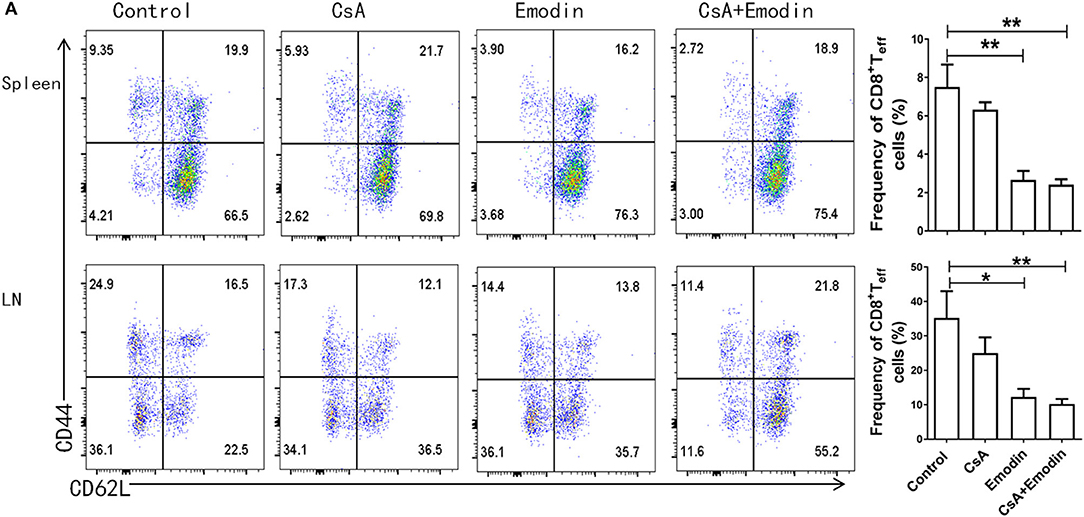
Figure 3A. Emodin suppresses the expansion of effector CD8+ T cells. (A) Draining lymph node (LN) and spleen cells from emodin- and CsA-treated B6 mice transplanted with BALB/c skin were isolated 10 days after transplantation and analyzed via FACS analysis. Column graphs show the percentages of CD8+CD44highCD62Llow effector T cells (Teff) from LNs and spleens. Data are presented as means ± SD from two separate experiments (*P < 0.05, **P < 0.01, n = 4 mice/group).
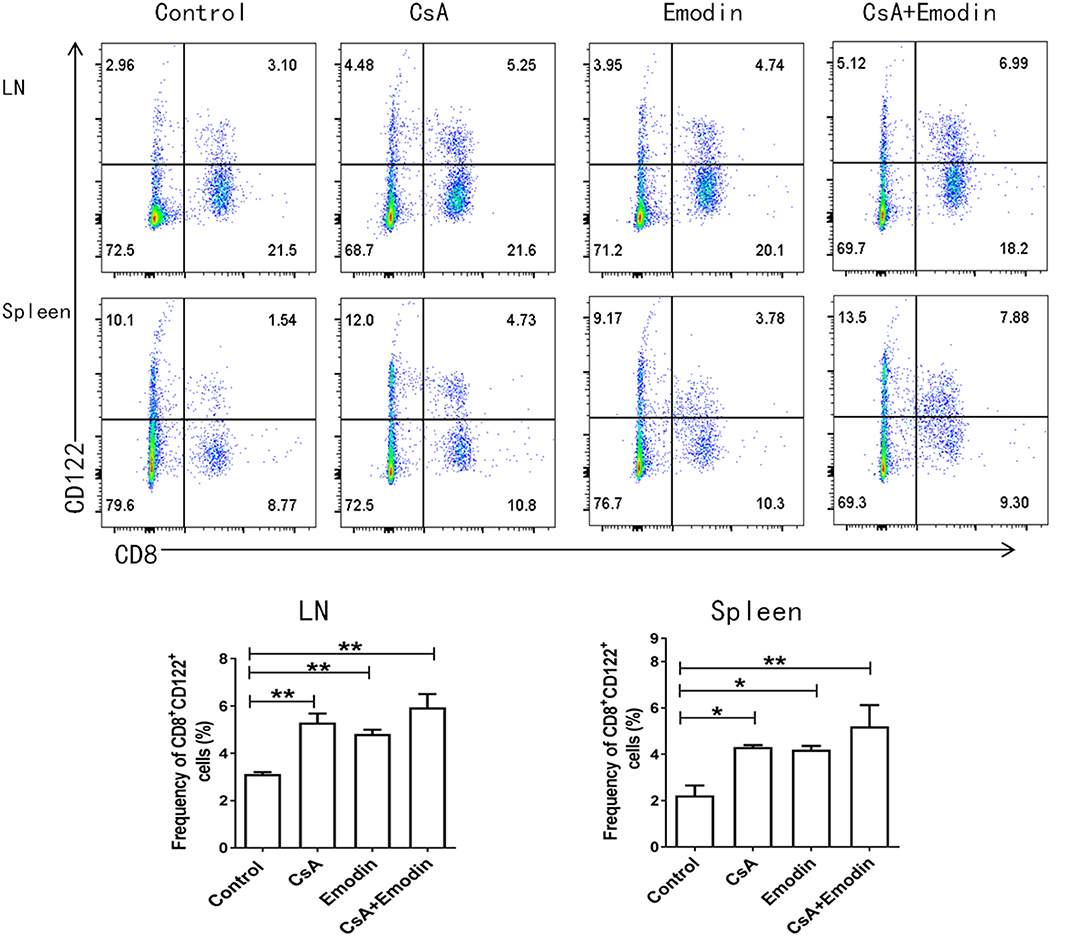
Figure 5. Emodin also augments the percentages of CD8+CD122+ Tregs. Draining LN and spleen cells from emodin- or CsA-treated B6 mice transplanted with BALB/c skin were isolated 10 days after transplantation. The percentages of CD8+CD122+ Tregs from LNs and spleens of recipient mice were measured via a flow cytometer. Data are shown as means ± SD from two separate experiments (*P < 0.05 and **P < 0.01, n = 4–5 mice/group).
The authors apologize for this error and state that this does not change the scientific conclusions of the article in any way. The original article has been updated.
Keywords: transplant immunology, regulatory T cell, T cell, immunosuppression, allograft rejection
Citation: Qiu F, Liu H, Liang C-L, Nie GD and Dai Z (2020) Corrigendum: A New Immunosuppressive Molecule Emodin Induces both CD4+FoxP3+ and CD8+CD122+ Regulatory T Cells and Suppresses Murine Allograft Rejection. Front. Immunol. 11:1381. doi: 10.3389/fimmu.2020.01381
Received: 27 May 2020; Accepted: 29 May 2020;
Published: 16 July 2020.
Edited and reviewed by: Aurore Saudemont, GlaxoSmithKline, United Kingdom
Copyright © 2020 Qiu, Liu, Liang, Nie and Dai. This is an open-access article distributed under the terms of the Creative Commons Attribution License (CC BY). The use, distribution or reproduction in other forums is permitted, provided the original author(s) and the copyright owner(s) are credited and that the original publication in this journal is cited, in accordance with accepted academic practice. No use, distribution or reproduction is permitted which does not comply with these terms.
*Correspondence: Zhenhua Dai, emRhaTIwMDlAaG90bWFpbC5jb20=