 Jihao Xue
 Qijia Yin2,3†‡
 Ming Wang
 Yanling Li
- 1Department of Neurosurgery, the Affiliated Hospital, Southwest Medical University, Luzhou, Sichuan, China
- 2Department of Urology or Nursing, Dazhou First People’s Hospital, Dazhou, Sichuan, China
- 3College of Nursing, Chongqing Medical University, Chongqing, China
- 4Department of Rehabilitation or Nursing, the Affiliated Hospital of Southwest Medical University, Luzhou, Sichuan, China
By Peng Z, Wang J, Tong S, Wu Y, Yi D and Xiang W (2023) Front. Immunol. 14:1128151. doi:
Phosducin-like 3 is a novel prognostic and onco-immunological biomarker in glioma: a multi-omics analysis with experimental verification
We read with great interest the recently reported work by Peng et al., entitled “Phosducin-like 3 is a novel prognostic and onco-immunological biomarker in glioma: A multi-omics analysis with experimental verification” (1). In this study, the authors conducted univariate and multivariate Cox regression analyses in combination with common clinicopathological characteristics and ultimately determined that PDCL3 acted as a potential prognostic biomarker of glioma. They subsequently established a nomogram in the TCGA cohort and confirmed that the nomogram had satisfactory prognostic efficiency for glioma. While we fully recognize the important contributions made by this study, we would like to highlight a few crucial aspects for further scrutiny and analysis. Firstly, it is essential to underscore that the application of Cox regression models necessitates the adherence to the proportional hazards (PH) assumption for the independent variables (2). This means that the hazard ratio associated with each independent variable must remain constant over time (p > 0.05). Violation of this assumption can lead to inaccuracies and biases in the statistical inferences drawn from the model (3). In addition, to ensure that the Cox regression model complies with the PH assumption, it is important to conduct a GLOBAL test. A p-value greater than 0.05 in this test serves as a strong indicator that the model satisfies the PH assumption, thereby validating its appropriateness for statistical analysis (4).
Similarly, we performed univariate and multivariate Cox regression analyses (Figure 1A) on the relevant clinical parameters the same as those used by Peng et al. (1) from glioma patients in the TCGA cohort, and tested the PH assumption of multivariate Cox regression (Table 1). Subsequently, we constructed a nomogram (Figure 1B) based on multivariate Cox regression, and also plotted calibration curves (Figure 1C) and ROC curves (Figure 1D). The results showed that Age, WHO grade, IDH status, PDCL3 expression levels and GLOBAL did not fulfill the PH hypothesis (Table 1), which may affect the credibility and accuracy of the predictive model proposed by Peng et al. (1) from a statistical perspective.
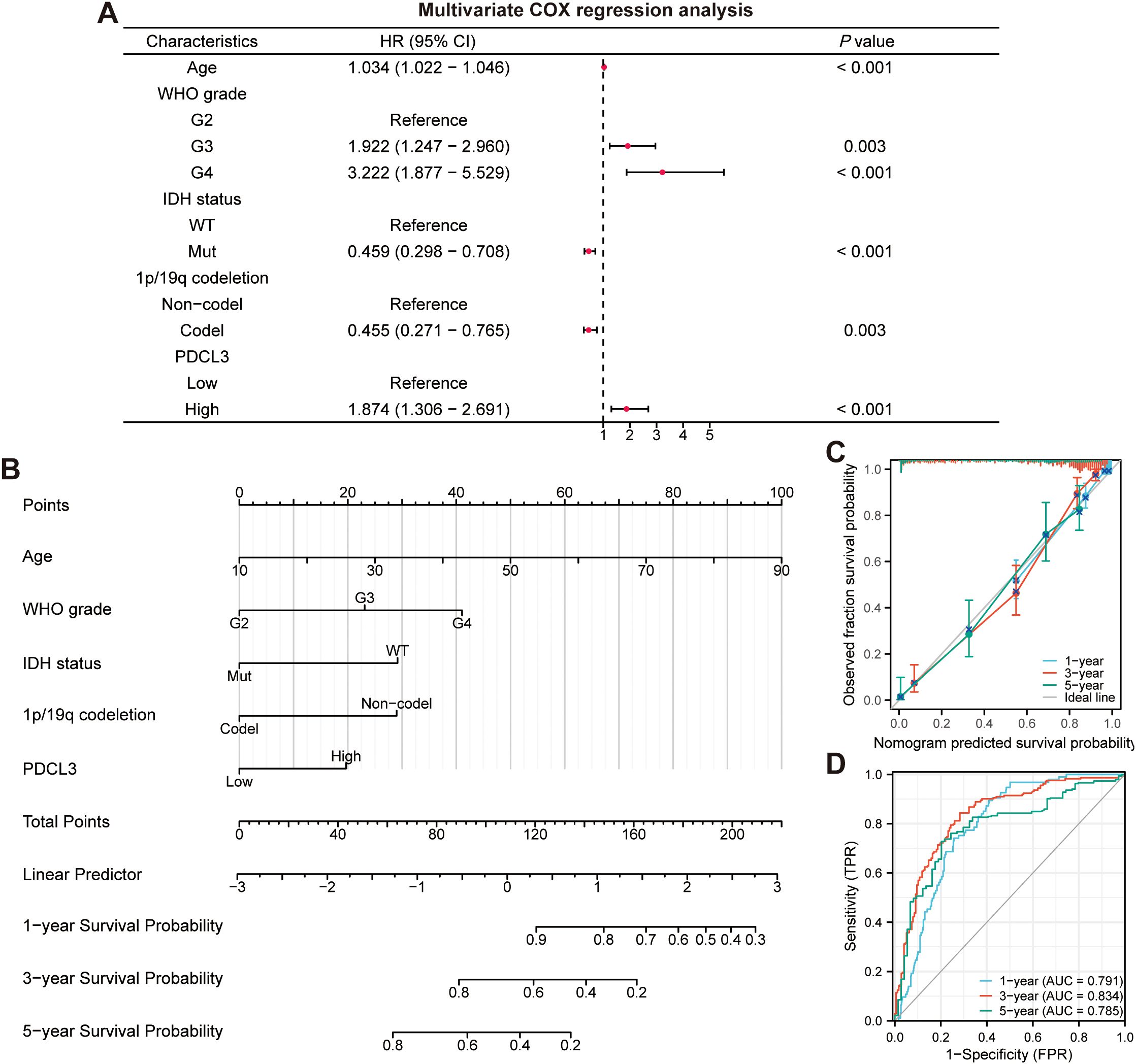
Figure 1. Construction and evaluation of the nomogram. (A) Multivariate Cox regression analyses in the TCGA cohort. (B) Nomogram based on age, WHO grade, IDH status, 1p/19q codeletion and PDCL3 expression. (C) Calibration curves showed the concordance between predicted and observed 1-, 3-, and 5-year OS. (D) ROC curve analyses of the nomogram in predicting 1-, 3-, and 5-year OS.
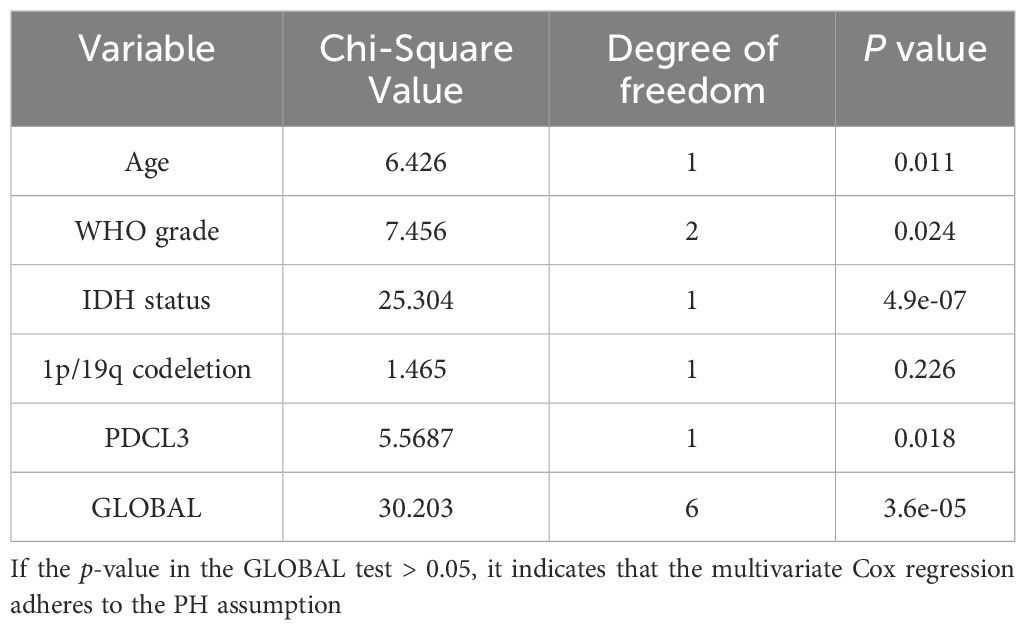
Table 1. PH assumption test to multivariate Cox regression.
In light of the aforementioned considerations, it is imperative to adopt a more rigorous approach to evaluating the predictive capabilities of the model. Firstly, to ensure the robustness and validity of the Cox regression analysis, we propose the inclusion of interaction terms between covariates and time. This refinement enables the model to capture the potential time-varying effects of covariates on the hazard function, thereby addressing the potential violation of the PH assumption (5). Secondly, to further scrutinize the stability of the predictive outcomes, we suggest stratifying the dataset based on the covariates that fail to meet the PH criterion. Within each stratum, separate Cox regression analyses can be conducted, allowing for a more nuanced understanding of the covariate effects within specific subgroups (6). Lastly, we also advocate for the consideration of alternative survival analysis methodologies, particularly accelerated failure time model (7).
Despite our efforts to remind researchers of the prerequisites for using multi-factor Cox regression and constructing nomograms, there are still many papers published that have overlooked the PH assumption in their research. This situation indicates that the rigorous validation of models remains a neglected but crucial aspect in scientific research.
Author contributions
JX: Writing – review & editing, Writing – original draft. QY: Writing – original draft, Writing – review & editing. MW: Writing – review & editing. YL: Writing – review & editing.
Funding
The author(s) declare financial support was received for the research, authorship, and/or publication of this article. This work was supported by the Natural Science Foundation of Southwest Medical University, Grant (No. 2023QN008 and 2023QN103).
Conflict of interest
The authors declare that the research was in the absence of any commercial or financial relationships that could be construed as a potential conflict of interest.
Publisher’s note
All claims expressed in this article are solely those of the authors and do not necessarily represent those of their affiliated organizations, or those of the publisher, the editors and the reviewers. Any product that may be evaluated in this article, or claim that may be made by its manufacturer, is not guaranteed or endorsed by the publisher.
References
1. Peng Z, Wang J, Tong S, Wu Y, Yi D, Xiang W. Phosducin-like 3 is a novel prognostic and onco-immunological biomarker in glioma: A multi-omics analysis with experimental verification. Front Immunol. (2023) 14:1128151. doi: 10.3389/fimmu.2023.1128151
2. Stensrud MJ, Hernán MA. Why test for proportional hazards? Jama. (2020) 323:1401–2. doi: 10.1001/jama.2020.1267
3. Concato J, Feinstein AR, Holford TR. The risk of determining risk with multivariable models. Ann Intern Med. (1993) 118:201–10. doi: 10.7326/0003-4819-118-3-199302010-00009
4. Fisher LD, Lin DY. Time-dependent covariates in the cox proportional-hazards regression model. Annu Rev Public Health. (1999) 20:145–57. doi: 10.1146/annurev.publhealth.20.1.145
5. Leon LF, Day BM, Hu XS. If the ratio of hazards R(T)=Λe(T)/Λc(T) does not depend on time T then the proportional hazards assumption holds. J Thorac Oncol. (2013) 8:e116. doi: 10.1097/JTO.0b013e3182a4081f
6. McLernon DJ, Giardiello D, Van Calster B, Wynants L, van Geloven N, van Smeden M, et al. Assessing performance and clinical usefulness in prediction models with survival outcomes: practical guidance for cox proportional hazards models. Ann Intern Med. (2023) 176:105–14. doi: 10.7326/m22-0844
7. Sayehmiri K, Eshraghian MR, Mohammad K, Alimoghaddam K, Foroushani AR, Zeraati H, et al. Prognostic factors of survival time after hematopoietic stem cell transplant in acute lymphoblastic leukemia patients: cox proportional hazard versus accelerated failure time models. J Exp Clin Cancer Res. (2008) 27:74. doi: 10.1186/1756-9966-27-74
Keywords: proportional hazards (PH) assumption, cox regression, global test, glioma, nomogram
Citation: Xue J, Yin Q, Wang M and Li Y (2024) Commentary: Phosducin-like 3 is a novel prognostic and onco-immunological biomarker in glioma: a multi-omics analysis with experimental verification. Front. Immunol. 15:1499286. doi: 10.3389/fimmu.2024.1499286
Received: 20 September 2024; Accepted: 04 December 2024;
Published: 18 December 2024.
Edited by:
Abdulqadir J. Nashwan, Hamad Medical Corporation, QatarReviewed by:
Xiangming Mao, Southern Medical University, ChinaCopyright © 2024 Xue, Yin, Wang and Li. This is an open-access article distributed under the terms of the Creative Commons Attribution License (CC BY). The use, distribution or reproduction in other forums is permitted, provided the original author(s) and the copyright owner(s) are credited and that the original publication in this journal is cited, in accordance with accepted academic practice. No use, distribution or reproduction is permitted which does not comply with these terms.
*Correspondence: Yanling Li, bGl5YW5saW5nMjdAc3dtdS5lZHUuY24=
†These authors have contributed equally to this work and share first authorship
†ORCID: Nadia Sabbah, orcid.org/0009-0008-9380-6535