

A commentary on
Neuroscience: going with the wean.
by Arellano, J. I., and Rakic, P. (2011). Nature 478, 333–334.
An article by Sanai et al. (2011) published in Nature set the disappearance of the rostral migratory stream (RMS) in humans around the 18th month after birth. In their comment on this article, Arellano and Rakic (2011) underline the limits of adult neurogenesis and put the attention on a branch of this stream reaching the ventro-medial prefrontal cortex, defined as “a feature that has not been described in any non-human mammal after birth” (Arellano and Rakic, 2011).
We previously published three papers showing chains of neuroblasts reaching the frontal cortex of postpuberal rabbits (6–12 months) from the RMS (Luzzati et al., 2003, 2006; Ponti et al., 2006). We called these streams “parenchymal chains” since they migrate through the corpus callosum to enter the cortical gray matter (Figure 1). In their comment entitled “Going with the wean,” dealing with an article published in the megahit journal Nature, Arellano and Rakic quote a famous blockbuster movie. In comparison, our “missing chain” somehow tastes of “going with…a B-movie” (if the low impact factor, yet prestigious J. Comp. Neurol. can be defined as such).
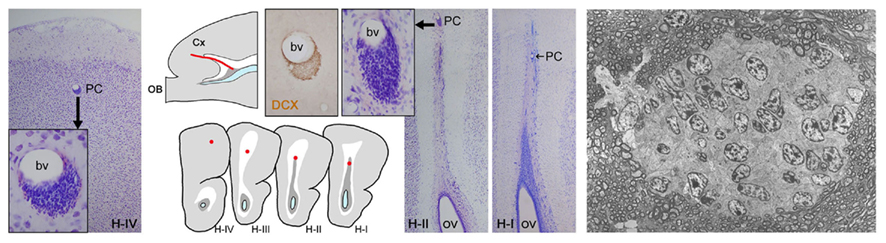
Figure 1. A parenchymal chain of neuroblasts (PC) in a 6-month-old rabbit. After reconstruction, the chain is followed along a blood vessel (bv) through the white matter of the corpus callosum and in the frontal cortex (Cx). On the right another parenchymal chain viewed with electron microscopy within the corpus callosum. ov, Olfactory ventricle; DCX, doublecortin (from Ponti et al., 2006).
Apart from quotations, which cannot be exhaustive, we utterly agree with Dr. Rakic that too much emphasis has been put in adult mammalian neurogenesis as a possible source for brain repair. Yet, we feel that in order to gather a better knowledge on this biological process more B-movies on comparative neurogenesis should be shot. As a matter of fact, comparative studies on adult neurogenesis represent a very low percentage (Bonfanti et al., 2011). In other words, although the limits of de novo neurogenesis are emerging in mammals (Bonfanti and Peretto, 2011), the issue of its adaptive significance is not solved. Thus, before viewing the RMS as a Sunset boulevard, Universal studies aimed at a global understanding of structural plasticity are of Paramount importance in solving the mystery of lack for repair in the mammalian CNS.
References
Bonfanti, L., and Peretto, P. (2011). Adult neurogenesis in mammals – a theme with many variations. Eur. J. Neurosci. 34, 930–950.
Bonfanti, L., Rossi, F., and Zupanc, G. K. (2011). Towards a comparative under standing of adult neurogenesis. Eur. J. Neurosci. 34, 845–846.
Luzzati, F., Peretto, P., Aimar, P., Ponti, G., Fasolo, A., and Bonfanti, L. (2003). Glia-independent chains of neuroblasts through the subcortical parenchyma of the adult rabbit brain. Proc. Natl. Acad. Sci. U.S.A. 100, 13036–13041.
Luzzati, F., De Marchis, S., Fasolo, A., and Peretto, P. (2006). Neurogenesis in the caudate nucleus of the adult rabbit. J. Neurosci. 26, 609–621.
Ponti, G., Aimar, P., and Bonfanti, L. (2006). Cellular composition and cytoarchitecture of the rabbit subventricular zone and its extensions in the forebrain. J. Comp. Neurol. 498, 491–507.
Citation: Bonfanti L and Peretto P (2012) The missing chain. Front. Neurosci. 6:5. doi: 10.3389/fnins.2012.00005
Received: 09 January 2012;
Accepted: 11 January 2012;
Published online: 26 January 2012.
Copyright: © 2012 Bonfanti and Peretto. This is an open-access article distributed under the terms of the Creative Commons Attribution Non Commercial License, which permits non-commercial use, distribution, and reproduction in other forums, provided the original authors and source are credited.
*Correspondence:bHVjYS5ib25mYW50aUB1bml0by5pdA==;cGFvbG8ucGVyZXR0b0B1bml0by5pdA==