 Guo Ying-ying1
 Wang Yan-fang1Deng Yan1Zhang Su-ying2Liu Dong3,4Luo Bin3,4Wang Xue5Deng Miao5Ma Rui-lin1Liu Xiao-hui6Jiao Yu-pei7Sun Ai-jun*
- 1Department of Obstetrics and Gynecology, Peking Union Medical College Hospital, Chinese Academy of Medical Sciences and Peking Union Medical College, Beijing, China
- 2Department of Obstetrics and Gynecology, The Second Affiliated Hospital of Hunan University of Chinese Medicine, Changsha, China
- 3Key Laboratory of Birth Defects and Related Diseases of Women and Children, West China Second Hospital, Sichuan University, Chengdu, China
- 4Ministry of Education, Sichuan University, Chengdu, China
- 5Department of Obstetrics and Gynecology, Hangzhou Women’s Hospital (Hangzhou Maternity and Child Healthcare Hospital), Hangzhou, China
- 6School of Life Sciences, Tsinghua University, Beijing, China
- 7National Protein Science Technology Center, Tsinghua University, Beijing, China
Objective: To explore the pharmacological basis and mechanism of Buxue Yimu pills (BYP) in the treatment of anaemia in women from the perspective of metabolomics and network analysis.
Materials and Methods: Forty-six women of reproductive age with haemoglobin 70–110 g/L were recruited. Blood samples were collected before and after 4 weeks of oral BYP treatment to assess the changes in haemoglobin, coagulation function, and iron metabolism indices. An integrated analysis of metabolomics (liquid chromatography mass spectrometry) and network analysis was performed to identify the potential pharmacodynamic mechanisms of BYP.
Results: After BYP treatment, the haemoglobin level of patients significantly increased from 93.67 ± 9.77 g/L to 109.28 ± 12.62 g/L (p < 0.01), while no significant changes were found in iron metabolism and coagulation-related indicators. A total of 22 differential metabolites were identified after metabolomics analysis, which were mainly related to the inhibition of inflammation and oxidative stress. Integrating pharmacodynamics and metabolomics, a network of drug-active components-targets-metabolic pathways-metabolomics was established. Acetylcholinesterase, phospholipase A2 group IIA, and phospholipase A2 group IVA may be the most promising therapeutic targets.
Conclusion: BYP can inhibit inflammation and oxidative stress as well as promote haematopoiesis, potentially improving anaemia.
1 Introduction
Anaemia is thought to affect 29% and 38% of non-pregnant and pregnant women, respectively (Benson et al., 2021). Its high prevalence and recurrent nature have significantly affected the work and life of women of childbearing age. Gynaecological disorders often include recurrent menorrhagia, chronic postoperative and postpartum bleeding, and abnormal uterine bleeding caused by adenomyosis, fibroids, and endometrial hyperplasia (Breymann and Auerbach, 2017). Iron deficiency anaemia is often considered to be the most common single cause of anaemia, with multi-country meta-analyses worldwide showing that it accounts for 34%–50% of cases, mainly due to a lack of iron supply, inadequate bioavailability, or blood loss. Other causes include nutritional anaemia such as vitamin/folic acid deficiency and drug-related anaemia.
The goal of the World Health Organization is to halve the prevalence of anaemia in women of reproductive age between 2010 and 2025 (Young, 2018). Anaemia treatment decisions are based on a combination of factors, such as the patient age, sex, cause, severity, symptoms, and time available for treatment. Available treatment modalities include iron, other nutritional drugs such as vitamin B12/folic acid, erythropoietin (EPO), or surgical control supplemented by blood transfusions if the patient is haemodynamically unstable and severely anaemic (Sato and Yanagita, 2013). Oral iron is convenient, inexpensive, and effective but is prone to cause gastrointestinal discomfort, muscle pain, and urticaria. Compliance and tolerability are common factors that limit its efficacy (Pavord et al., 2020). Regardless of readiness, nearly 20% of women discontinue oral iron therapy (Ortiz et al., 2011). Intravenous iron is often administered when oral therapy is ineffective or inhibits absorption and can bypass the hepcidin block, which limits oral iron absorption (Weiss et al., 2019). However, the incidence of adverse reactions is also 1%–5% (Breymann and Auerbach, 2017), which commonly include nausea, headache, hypertension, flushing, and injection site reactions. Alternatively, other parenteral alternatives to oral iron, such as iron polymermaltose, gluconate iron, and low molecular weight iron, are available, but further research is needed to validate evidence-based medicine in large samples. Despite the benefits of iron supplementation, the long-term biological effects of iron, including oxygen radical production, will lead to an increased incidence of infectious diseases.
As a result, western medicine alone often has various limitations, while traditional Chinese medicine (TCM) prescriptions often have the distinct advantage of fewer side effects in the treatment of multifactorial diseases because of their natural multi-active ingredient composition, multi-pathway targets, and holistic treatment bias (Wang et al., 2016). TCM is considered as a complementary and alternative form of medicine in the Chinese healthcare system (Feng et al., 2021). It is often used together with western medicine to reduce side effects or toxicity or to obtain additional pharmacological effects, but attention should also be paid to the presence of herbal drug interactions due to the inhibition or induction of cytochrome enzymes (Wang, 2015).
Based on the syndrome differentiation and treatment theory of TCM, qi and blood deficiency are the causes of angiogenesis disorders and blood flow disturbance. Qi-reinforced, blood-activating, and blood-stasis-removing drugs have huge treatment potential (Zhang et al., 2022). Numerous herbal formulations and extracts have been shown to promote angiogenesis, improve blood circulation, and clear blood stasis (Bu et al., 2020; Ni et al., 2021). Buxue Yimu pills (BYP) have attracted attention for replenishing qi and blood and for dispelling blood stasis. According to the 2015 edition of Chinese Pharmacopeia, it is mainly composed of five ingredients namely, Angelicae Sinensis Radix [ASR, the dried root of Angelica sinensis (Oliv.) Diels], Astragali Radix (AR, the dried root of Astragalus mongholicus Bunge), Asini Corii Colla (ACC, a product of the hide of Equus asinus L.), Leonurus cardiaca L. (LC), Citri Reticulatae Pericarpium (CRP, dried citrus peel from Citrus × aurantium L.), in which the bioactive substance has been analysed (Zhang et al., 2020). It is widely used for the treatment of gynaecological diseases, postpartum or abortion complications, and postpartum abdominal pain. Modern pharmacological evidence suggests that it can effectively increase haemoglobin levels, promote endometrial repair, and improve metabolic disorders. However, the specific effects and molecular mechanisms of its pharmacological effects in improving anaemia are not clear.
Metabolomics is a well-established histological technique in the post-genomic era and has long been used in TCM, focusing on identifying endogenous low-molecular metabolites in response to internal and external features and providing clues about its molecular basis and mechanisms of action. It can play an active role in disease control rate assessment and elucidation of the mechanisms of action of TCM (Yang and Lao, 2019). On the other hand, network analysis, a new tool based on data mining and network construction, has been used to thoroughly investigate the active ingredients, potential targets, and underlying theoretical mechanisms of TCM. Therefore, in our study, we explored the mechanism of BYP in anaemia by integrating metabolomics and network pharmacological approaches.
2 Materials and methods
2.1 Clinical sample design
Forty-six women of reproductive age caused by deficiency of Qi and Blood, combined with blood stasis syndrome, were investigated in this study, which is similar to that of chronic anemia and hemorrhagic anemia in Western medicine. In terms of clinical parameters, patients with a haemoglobin of 70–110 g/L and defined gynecological cause for polyps, fibroids and so on were included. Patients with uncontrolled bleeding, abnormal liver and kidney functions, malignancy, psychiatric disorders, or pregnancy were excluded. All patients signed an informed consent form. The study was approved by the PUMCH Ethics Committee (No. ZS-1254) and registered with the National Institutes of Health (registration No. NCT03232554, www.clinicaltrials.gov). This study was conducted in accordance with the Declaration of Helsinki of the World Medical Association.
2.2 Intervention assessment
Participants received BYP (24 g, twice a day) through oral administration for 4 weeks. BYP (Zhuzhou Qianjin Pharmaceutical Co., Ltd., Hunan, China, CFDA approval number: Z20090602, batch number: 20170403) were stored in bags (12 g/bag) and consisted of five ingredients (See Table 1 for details of composition). According to the high-performance liquid chromatography (HPLC) method, the content of ferulic acid (C10H10O4) was ensured to be not less than 1 mg for each bag (Pharmacopoeia Commission, 2005).
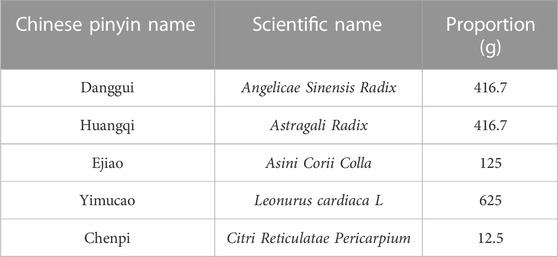
TABLE 1. Standard formulation of Buxue Yimu Pills (1000g).
Venous blood samples were collected before and after treatment, and whole blood cell count, coagulation function, liver and kidney function, and iron metabolism-related indices, including the serum iron, serum ferritin, and total iron binding capacity, were assessed according to routine laboratory methods. Side-effects and adverse events were monitored.
2.3 Metabolomics research
2.3.1 Metabolite extraction
Blood samples of 10 patients were collected for metabolomics analysis by liquid chromatography mass spectrometry/mass spectrometry (LC-MS/MS) at the Facility Center of Metabolomics and Lipidomics at the Technology Center for Protein Sciences of Tsinghua University. Briefly, 50 μL serum sample thawed at room temperature was mixed with a 450 μL methanol: acetonitrile (1:1) preparation (containing internal standard propranolol 50 ng/mL), which was then vortexed for 30 s and centrifuged at 13,000 r/min for 15 min. Afterward, an aliquot of 5 μL supernatant was taken and directly injected for analysis.
Furthermore, quality control (QC) samples were prepared by mixing equal volumes of extraction of all samples. The volume of each QC was the same as that of the sample. Since QC samples contained the data of every sample, they were applied to the stability verification of the LC-MS/MS system.
2.3.2 LC-MS/MS analysis
LC-MS was performed on an Ultimate 3000-VelosPro system equipped with a binary solvent delivery manager and a sample manager, coupled with a QE Orbitrap Mass Spectrometer equipped with an electrospray interface (Thermo Fisher Scientific, United States).
First, an ACQUITY BEH C18 column (2.1 mm × 50 mm, 1.7 μm) was applied for the analytes, whose temperature was maintained at 30°C, with a flow rate of 0.25 mL/min. The analysis was performed with gradient elution using water/0.1% formic acid/2 mmoL/L ammonium formate (solvent A) and acetonitrile (solvent B), which were programmed as follows: 95% A from 0 to 1 min; 95%–40% A from 1 to 5 min; 40%–0% A from 5 to 8 min; 0% A from 8 to 11 min; 0%–40% A from 11 to 14 min; 40%–95% A from 14 to 15 min; 95% A from 15 to 18 min.
Next, data were collected in electrospray ionization (ESI) positive and negative ion modes, and the ESI voltage was set to 3.0 kV. The instrument settings were first an MS scan with 70,000 resolution, and then MS/MS scans of the top 10 most intense precursors with 17,500 resolutions. Data were acquired in the positive-ion mode in the mass range 70–1,050 m/z and in the negative-ion mode in the mass range 80–1,200 m/z.
2.3.3 Metabolite identification
Metabolites were identified using Tracerfinder 3.2 (Thermo Fisher Scientific; California, United States) based on an internal MS/MS library, which was established using chemical standards or biological samples. Two levels of metabolite identification were achieved: one was confirmed by MS/MS and the other by mass matching of precursors. Metabolite candidates were selected from those identified by MS/MS with an LS score higher than 30 and those not confirmed by MS/MS. Our in-house software “MetaInt” was used for high-throughput data analysis.
2.4 Statistical analysis
2.4.1 Clinical indicators analysis
SPSS 26.0 (IBM; Chicago, Illinois, United States) was used for statistical analysis. Normally distributed data are expressed as mean ± standard deviation, and the paired t-test was used to compare the differences before and after treatment. Non-normal distribution data are represented by the median +25–75 interquartile range, and the differences were evaluated using the Wilcoxon paired signed rank test. Statistical significance was defined as p < 0.05. Variable correlation analysis was performed using the Pearson correlation analysis or Spearman rank correlation.
2.4.2 Metabolic profiling and pathway analysis
Data were normalized by a log10 transformation before statistical analysis. Multivariate statistics and pathway analysis were performed using MetaboAnalyst 3.0 (www.Metaboanalyst.ca), including principal component analysis (PCA), partial least squares discriminant analysis (PLSDA), and orthogonal partial least squares discriminant analysis (OPLSDA). The differential metabolites were selected according to variable importance (VIP) > 1 and p-value (t-test) < 0.05 out of Kyoto Encyclopedia of Genes and Genomes (KEGG) Pathway for enrichment analysis.
2.4.3 Network construction
To further explain the changes in the metabolic spectrum and clarify the molecular mechanisms of BYP in the treatment of anaemia, we comprehensively applied network analysis. First, we obtained potential treatment targets of BYP bioactive compounds (oral bioavailability ≥30% and drug-likeness ≥ 0.18) by searching the TCMSP platform (http://lsp.nwu.edu.cn/tcmsp.php), which subsequently converted to target genes using Uniprot Knowledgebase (http://www.uniprot.org/). Second, anaemia targets were retrieved from the Online Mendelian Inheritance in Man (OMIM) database (https://www.omim.org/) and GeneCard Database (https://www.genecards.org/) without duplication using “gynecological anemia” as the keyword. Third, using the KEGG of the above differential metabolite enrichment analysis results, the related gene list was obtained from the KEGG2 webpage (http://www.genome.jp/kegg/kegg2.html). Finally, the drug-active components-targets-metabolic pathways-metabolomics network was established and visualised by Cytoscape software (http://cytoscape.org/).
3 Results
3.1 Baseline characteristics and pharmacodynamic results
All 46 subjects aged 24–52 years old (median age: 41 years) completed 4 weeks treatment. The median BMI was 23.1 kg/m2; 73% had a pregnancy history. The main causes of gynaecological anaemia were ovulation disorders (53.3%), surgical blood loss (17.8%), fibroids (11.1%), adenomyosis (8.9%), and polyps (8.9%).
As shown in Table 2, after 4 weeks of BYP treatment, the haemoglobin level of the patients increased significantly from 93.67 ± 9.77 g/L to 109.28 ± 12.62 g/L, red blood cell count from 3.790.53 × 1,012 g/L to 4.450.42 × 1,012 g/L, and haematocrit from 29.82 ± 2.81% to 34.52 ± 3.21% (p < 0.01).There were no significant changes in other blood cell counts, iron level, and coagulation indices (Table 2). Liver and renal function were also not significantly changed (p > 0.05). No adverse effects were recorded throughout the study.
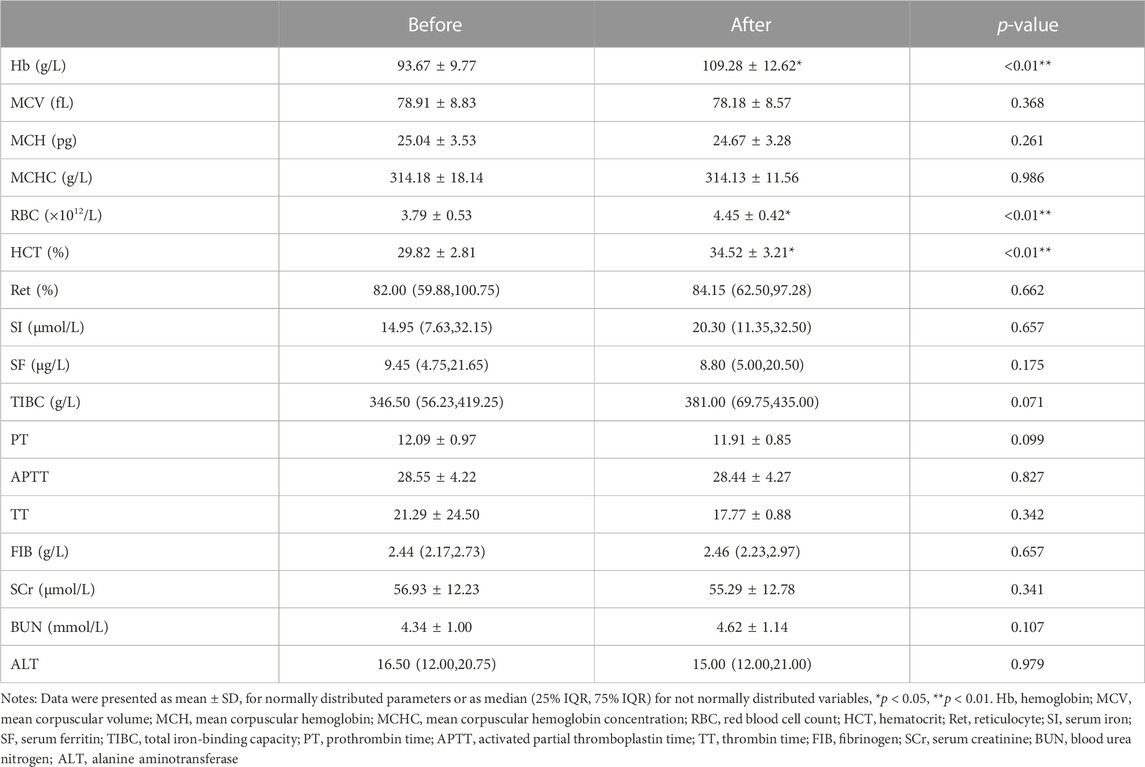
TABLE 2. Comparison of serological indicators before and after BYP treatment in 46 patients.
3.2 Metabolomics results
3.2.1 Metabolomics analysis
Metabolomic data showed that 205 and 328 metabolites were identified and quantified in cationic and anionic modes, respectively. Two-dimensional PCA and OPLS-DA showed the separation and distribution of the metabolites before and after treatment (Figure 1). Model verification from 100 permutation tests showed the variance (R2Y = 0.987), predictivity (Q2 = 0.833), and p-values <0.01.
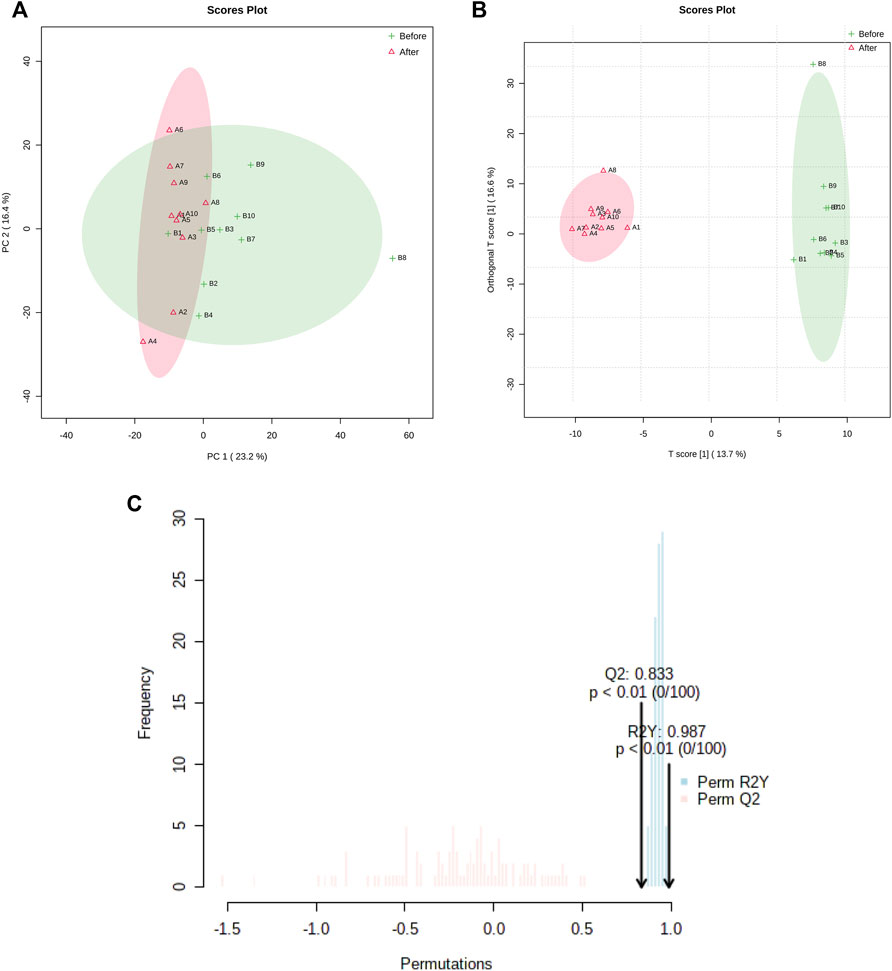
FIGURE 1. Metabolic profiling before and after treatment. (A): PCA score plot. (B): OPLSDA score plot. (C): Validation of the model obtained from 100 permutation tests (R2Y = 0.987; Q2 = 0.833, p < 0.01).
3.2.2 Identification of differential metabolites and related metabolic pathways
According to the above metabolic data analysis methods, we identified 22 differential metabolites (13 in positive mode, 10 in negative mode, and one in both modes; Figure 2; Table 3). Supplementary Material contains the secondary mass spectrogram of each metabolite. After the BYP treatment, the concentrations of most differential metabolites increased, including chenodeoxycholic acid (fold change: 15.47, VIP: 4.7877, p < 0.01).
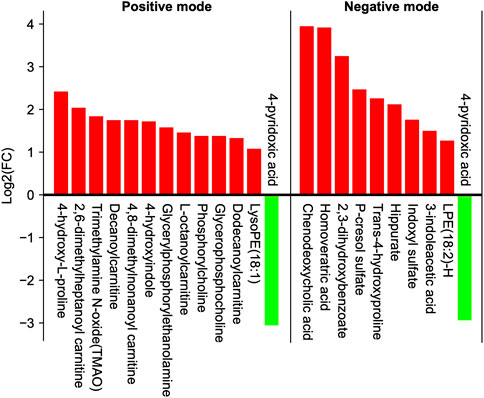
FIGURE 2. Changes in metabolome profile. Log 2(FC): log2 fold change, represents the values of differential metabolites fold change (after-/before-treatment) were transformed into log2-ratio. Green color indicates decreased concentration levels of metabolites, red color increased metabolite levels. Please refer to the Supplementary Table S1 for details.
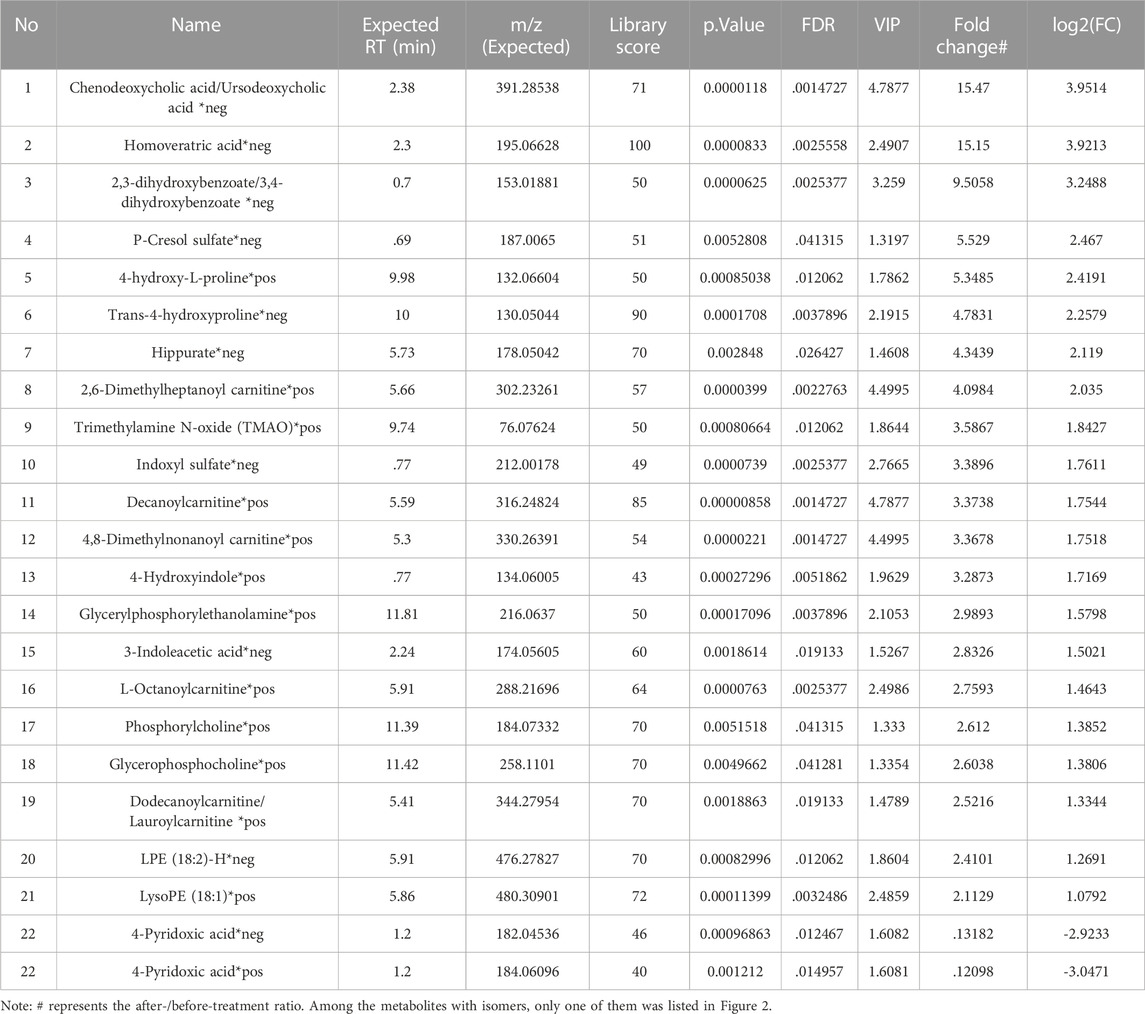
TABLE 3. Differential metabolites obtained from LC-MS metabolomics.
In both models, only the level of 4-pyridoxinic acid decreased significantly (negative model, fold change: 0.13182, VIP: 1.6082, p < 0.01; positive model, fold change: 0.12098, VIP: 1.6081, p < 0.01). KEGG enrichment analysis revealed 10 pathways of enrichment, among which glycerophospholipid metabolism (hsa00564, p = 0.0005) and ether lipid metabolism (hsa00565, p = 0.0192) were significantly enriched (Table 4).
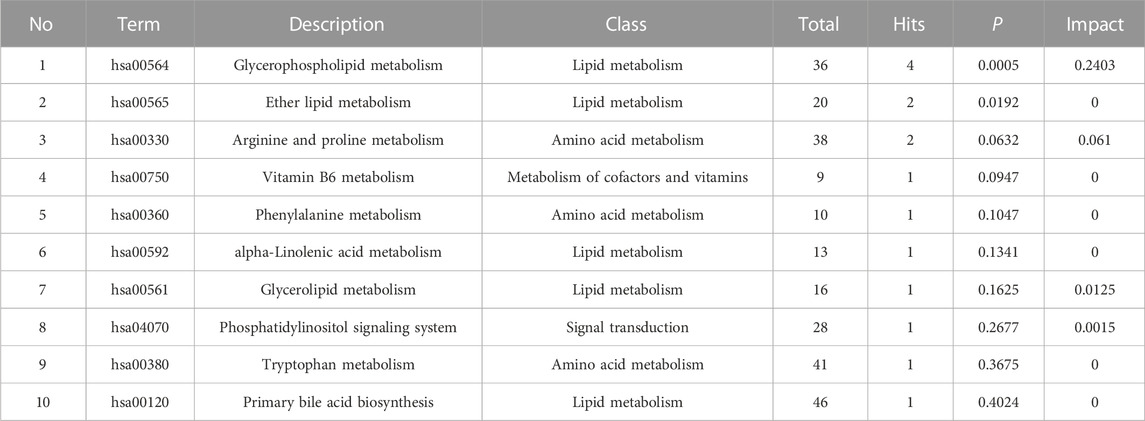
TABLE 4. Results of pathway analysis using MetaboAnalyst database.
3.3 Construction of target-metabolic pathway network
Thirty-two active components that met the screening criteria were extracted from the four main components of BYP by data mining (Table 5). We identified 270 BYP targets (drug targets), 6623 anaemia targets (disease targets), and 339 KEGG genes involved in the above 10 KEGG metabolic pathways. As presented in the Venn diagram (Figure 3A), BYP has 206 potential targets for anemia, of which 19 appear in the KEGG pathways (See Table 6 for details). To further demonstrate the relationship between the active components and affected metabolites and to reveal the anti-anaemia mechanism of BYP, an active components-targets-metabolic pathways-metabolomics network was constructed, which included six pathways and six metabolites (Figures 3B, C). Two significant enrichment pathways of glycerophospholipid metabolism and ether lipid metabolism were connected to the drug-target network through three targets: acetylcholinesterase (AchE), phospholipase A2 (PLA2) group IIA, and PLA2 group IVA.
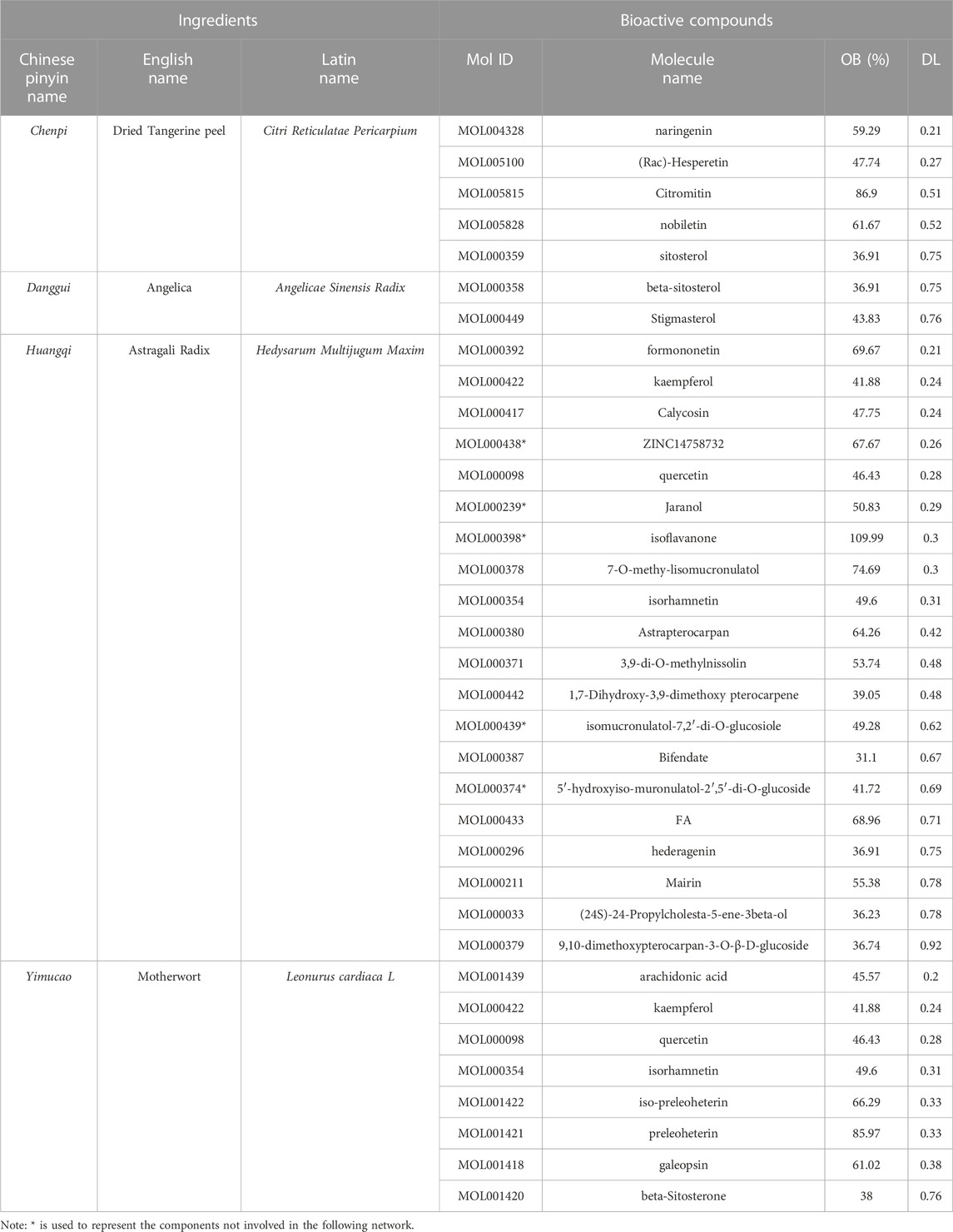
TABLE 5. Main ingredients of Buxue Yimu Pills and their bioactive compounds.
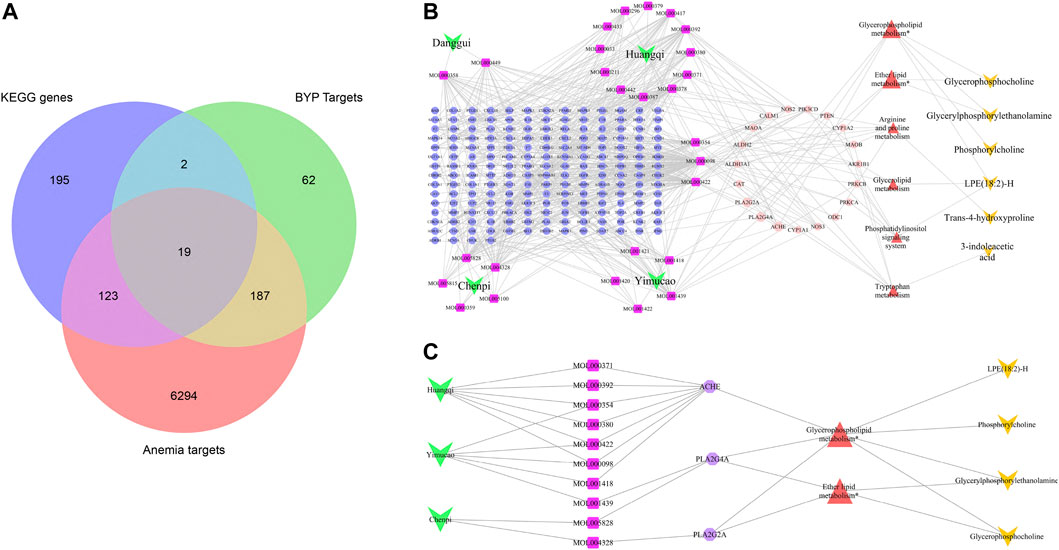
FIGURE 3. (A) Venn diagram of BYP targets, anemia targets and KEGG genes. (B) Active component–target–pathway interaction network (248 nodes, 602 edges). (C) Active component–corresponding target–significantly enriched metabolic pathway–potential biomarker interaction network (22 nodes, 34 edges). Green inverted triangle nodes represent the ingredients of BYP; pink square nodes represent the active molecules; round nodes represent potential targets (blue: targets not involved in pathways; orange: targets involved in pathways); red triangle nodes represent the metabolic pathways; orange circular nodes represent the targets of the metabolic pathways; yellow inverted triangle nodes represent the potential metabolites.

TABLE 6. Details of 19 potential candidate targets.
4 Discussion
4.1 Efficacy of BYP in anaemia and its possible influencing factors
After statistical analysis of the baseline characteristics and serological data of the patients in this study, it was found that the haemoglobin (r = –0.435, p = 0.003), haematocrit (r = –0.404, p = 0.007), and blood urea nitrogen levels (r = 0.454, p = 0.002), as well as patient age (r = 0.297, p = 0.045) and body mass index (r = 0.301, p = 0.042) before BYP treatment, were significantly correlated with the degree of anaemia improvement, with the first three parameters being moderately correlated and the last two being weakly correlated. Before and after BYP treatment, there were significant increases in haemoglobin, haematocrit, and red blood cells levels. Approximately 69.8% of patients who fully met the diagnosis of iron deficiency anaemia, that is, both iron deficiency (ferritin concentration threshold of 15 mg/L) and anaemia (haemoglobin concentration threshold of 120 g/L), showed no significant difference in the treatment outcome compared to those with non-iron deficiency anaemia.
4.2 Analysis of the effects of each component of BYP
In a study of 7682 anaemic Chinese herbal users and non-users, AR and ASR were found to be in the top 10 of the formula mono-herbs (Chen et al., 2018). According to Lipinski’s five principles, the active components of BYP were obtained (Shi et al., 2019). The main components of AR, such as polysaccharides, flavonoids, and AS-IV, have been studied and confirmed to promote erythrocyte differentiation, and increase γ-globin mRNA expression and foetal haemoglobin synthesis (Shi et al., 2019). It has unique haematopoietic function, anti-inflammatory activity, and immune properties. The main components of ASR are stigmasterol, ferulic acid, volatile oil, and other phthalate esters containing phthalic acid mother nuclei (Wei et al., 2016). In animal models of iron deficiency anaemia, ASR has been observed to significantly inhibit the expression of ferritin by blocking the JAK-STAT, BMP-Smad, and ERK pathways (Zhang et al., 2014). LC has been used for more than 1,800 years to improve menstrual blood stasis and delivery disorders, including dysmenorrhoea, amenorrhoea, and postpartum haemorrhage (Miao et al., 2019). Its total alkaloid extract and major components, including stachydrine, have been shown to significantly reduce interleukin-1β-induced NO, PGE2, interleukin-6, and tumour necrosis factor (TNF)-α production by inhibiting the activation of the PI3K/Akt/NF-κB signalling pathway (Chen, 2021). CRP is also used in several well-known TCM prescriptions for the treatment of blood stasis syndrome (Yu et al., 2018). Previous studies on the overall pharmacodynamics of TCM have demonstrated that BYP components can partially support its therapeutic potential for angiogenic defects and haemodynamic disorders (Zhang et al., 2022).
According to our network pharmacological identification, kaempferol (MOL000422, the only given ID from TCMSP), quercetin (MOL000098), and isorhamnetin (MOL000354) are three components commonly found in AR and LC. After network analysis using Cytoscape, quercetin (MOL000098) was identified as the most important compound, which may reduce oxidative stress, improve iron status, and protect red blood cells, thus improving inflammation and chemotherapy-related anaemia.
4.3 Metabolic pathway analysis
To elucidate the mechanism of TCM in the treatment of anaemia, previous studies have focused on animal experiments. In this experiment, in women of childbearing age, a combination of metabolomics and network analysis was used to obtain significantly enriched metabolic pathways, with glycerophospholipid, and ether lipid metabolism as the top two pathways associated with anaemia and BYP efficacy. Glycerophospholipid metabolism plays a role in maintaining normal cellular function and enhancing lipid metabolism, thereby stabilising cell membranes. Ether lipid metabolism is less frequently reported to be directly related to correcting anemia, but it has been considered to have an important role in platelet function (Chignard et al., 1985) and reducing cholestasis (Chen et al., 2016), and therefore may contribute to improvement of anemia indirectly. Previously, systematic studies on Danggui Buxue decoction, which is composed of ASR and AR, proposed three metabolic disorder pathways involving iron ion binding, haematopoiesis, reactive oxygen species production, inflammation, and apoptosis (Liu et al., 2021).
In our study, a human metabolic profile was set where the major differential metabolites were lipid derivatives, and half of the metabolic pathways (5/10) were categorised as lipid metabolism. These significantly altered metabolites were also found to have several therapeutic properties, including the inhibition of inflammation and oxidative stress. Chenodeoxycholic acid was the most significantly increased metabolite and thought to have many beneficial functions, including alleviation of cholestasis, antiinflammatory effects, and modulation of immune function (Chappell et al., 2018). Lang et al. found that cholestasis accelerates reduction of circulating red blood cells, leading to anaemia (Lang et al., 2016). 4-pyridoxycholic acid was the only differential metabolite with reduced concentrations, which may be related to the fact that it is a catabolic product of vitamin B6, a cofactor of many important enzymes involved in a range of biochemical reactions, including haemoglobin synthesis. Reinken and Kurz demonstrated that as haeme synthesis improved, the requirement for pyridoxal phosphate increased, and the vitamin B6 body pool decreased (Reinken and Kurz, 1978), which are consistent with our findings.
4.4 Target prediction
Using a combination of network analysis and metabolomics, we identified 19 candidate targets, of which the most potential therapeutic targets were AchE, PLA2 group IIA, and PLA2 group IVA. The enzymatic activity of erythrocyte membrane AchE has been found to be a biomarker of membrane integrity (normal), senescence (low), inflammation (high), and neurotoxicity (high) (Saldanha, 2017). Xu et al. experimentally found that EPO-induced transcription and expression of α- and β-bead proteins can only be significantly enhanced when AchE is overexpressed. AchE may regulate the responsiveness of erythroid-like cells to EPO, and one hypothesis is that AchE assists in stabilising EPO receptors via RACK1 in lipid rafts, resulting in better sensitisation signals with important implications for erythropoiesis and adult erythroid maturation (Xu et al., 2019). In addition, BYP may also act by inhibiting the activity of important isoforms of PLA2 IIA and IVA. The PLA2 family catalyses the release of arachidonic acid and others from membrane phospholipids, which are then metabolised by COX and LOX to produce eicosanoids that trigger inflammatory responses and play a central role in cellular lipid metabolism and signal transduction (Tan and Goh, 2017; Mouchlis and Dennis, 2019). Group IIA sPLA2 often acts as an amplifier of pathological inflammation (Scott et al., 2021). Group IVA cPLA2 gene is located in the 1q25 region of the human chromosome and causes an upstream of several proinflammatory mediators (Yarla et al., 2016). These two proteins can activate each other through MAPK cascade reactions; thus, BYP may potentially improve anaemia by regulating intracellular signalling pathways, inhibiting IIA-dependent production of second messengers such as PGE2, reducing Ca2+ channel activation, inhibiting inflammatory responses and platelet activation, stabilising metabolism, avoiding coagulation problems such as excessive thrombosis, and reducing microcirculatory disorders. However, we must not overlook the fact that moderate platelet activation may play a role in enhancing haemostasis, which involves complex platelet activation signalling pathways that need to be further studied. It has also been found that ferritin has a strong pro-oxidant effect and is considered a potentiometric modulator of plasma LP-PLA2 activity and a good inducer of elevated TNF-α (Ragab et al., 2015). Oral iron supplementation often leads to the elevation of ferritin, which may promote a series of responses mediated by inflammatory factors such as PLA2 or TNF-α. Otherwise, BYP, owing to unaltered iron metabolism, may avoid the above, improving anaemia.
BYP has unique advantages over other forms of anaemia treatments. First, it does not affect iron metabolism but rather affects iron distribution. Haematopoiesis increases, and iron from the non-haematopoietic system (blood circulation and iron storage cells) can be transported more efficiently to the haematopoietic system (red lineage precursors), thus optimising the redistribution of iron. Second, after one course of BYP treatment, there was no significant change in haematocrit and reticulocyte count, nor was there any sign of elevated arterial blood pressure, probably because BYP promotes haematopoiesis but does not trigger adverse erythropoietic and haemodynamic effects; however, further studies are needed to confirm this result. Third, inflammatory processes can interfere with ideal iron regulation, increasing circulating hepcidin and limiting iron transport to red blood cells, thereby causing or exacerbating anemia (Benson et al., 2021). Chronic inflammation can lead to imbalances in the production of haematopoietic stem cells in the blood and cause an impairment in the self-renewal of haematopoietic stem cells and red blood cell production. In contrast, BYP inhibits inflammation and apoptosis, activates repair, and may reduce serum hepcidin levels, improve anaemia, and have adjuvant effects in improving oxidative stress and its related diseases.
5 Conclusion
BYP can improve anaemia without altering the iron metabolism. Since BYP is a mixed prescription of TCM, it is hypothesised that its therapeutic effect may be a combination of multiple components and targets. After treatment, 22 differential metabolites were identified, which were mainly related to the inhibition of inflammation and oxidative stress. Combined network analysis and metabolomics revealed that AchE and PLA2 groups IIA and IVA might be the most promising therapeutic targets for promoting haematopoiesis. The combination of network analysis and metabolomics complements each other and provides a three-dimensional approach to TCM research.
Data availability statement
The raw data supporting the conclusions of this article will be made available by the authors, without undue reservation.
Ethics statement
The studies involving human participants were reviewed and approved by the PUMCH Ethics Committee (No. ZS-1254). The patients/participants provided their written informed consent to participate in this study.
Author contributions
GY-Y, WY-F, ZS-Y, and SA-J implemented the research plan and were responsible for data curation, data mining, analysis, conceptualization and writing of the manuscript. SA-J, DY, MR-L provided a critical contribution to the organization and cooperation of this research and some useful suggestions. LD, LB, WX, and DM participated in the enrolment of the patients and data collection. LX-H and JY-P were involved in performing the metabolomics analysis. All authors read and approved the final manuscript.
Funding
This work was supported by National Clinical Research Center for Obstetric and Gynecologic Diseases, Department of Obstetrics and Gynecology, Peking Union Medical College Hospital, Chinese Academy of Medical Sciences and Peking Union Medical College.
Acknowledgments
The authors thank Zhuzhou Qianjin Pharmaceutical Co., Ltd. for providing medications to support this study.
Conflict of Interest
The authors declare that the research was conducted in the absence of any commercial or financial relationships that could be construed as a potential conflict of interest.
Publisher’s note
All claims expressed in this article are solely those of the authors and do not necessarily represent those of their affiliated organizations, or those of the publisher, the editors and the reviewers. Any product that may be evaluated in this article, or claim that may be made by its manufacturer, is not guaranteed or endorsed by the publisher.
Supplementary material
The Supplementary Material for this article can be found online at: https://www.frontiersin.org/articles/10.3389/fphar.2022.962850/full#supplementary-material
Abbreviations
ACC, Asini Corii Colla; AchE, acetylcholinesterase; AR, Astragali Radix; ASR, Angelicae Sinensis Radix; BYP, Buxue Yimu pills; CRP, Citri Reticulatae Pericarpium; EPO, erythropoietin; KEGG, Kyoto Encyclopedia of Genes and Genomes; LC, Leonurus cardiaca L.; LC-MS, liquid chromatography mass spectrometry; MS, mass spectrometry; OPLSDA, orthogonal partial least squares discriminant analysis; PLA2, phospholipase A2; PCA, principal component analysis; PLSDA, partial least squares discriminant analysis; TCM, traditional Chinese medicine; TNF, tumour necrosis factor; VIP, variable importance.
References
Benson, C. S., Shah, A., Stanworth, S. J., Frise, C. J., Spiby, H., Lax, S. J., et al. (2021). The effect of iron deficiency and anaemia on women's health. Anaesthesia 76 (4), 84–95. doi:10.1111/anae.15405
Breymann, C., and Auerbach, M. (2017). Iron deficiency in gynecology and obstetrics: Clinical implications and management. Hematol. Am. Soc. Hematol. Educ. Program 2017 (1), 152–159. doi:10.1182/asheducation-2017.1.152
Bu, L., Dai, O., Zhou, F., Liu, F., Chen, J. F., Peng, C., et al. (2020). Traditional Chinese medicine formulas, extracts, and compounds promote angiogenesis. Biomed. Pharmacother. 132, 110855. doi:10.1016/j.biopha.2020.110855
Chappell, L. C., Chambers, J., Thornton, J. G., and Williamson, C. (2018). Does ursodeoxycholic acid improve perinatal outcomes in women with intrahepatic cholestasis of pregnancy? Bmj 360, k104. doi:10.1136/bmj.k104
Chen, T. T. (2021). Research of quality control and study on the medical-induced incomplete abortion rats based on serum metabolomics of Buxue Yimu Preparation. MA thesis. Dali, Yunnan, China: DaliUniversity. doi:10.27811/d.cnki.gdixy.2021.000064
Chen, W. D., Huang, H. S., Su, Y. C., Chou, S. C., Ho, W. C., Kao, M. C., et al. (2018). The characteristics and prescription patterns of Chinese herbal medicine in clinical practice for the treatment of anemia. Taiwan J. Obstet. Gynecol. 57 (4), 570–577. doi:10.1016/j.tjog.2018.06.030
Chen, Y., and Guillemin, G. J. (2009). Kynurenine pathway metabolites in humans: Disease and healthy States. Int. J. Tryptophan Res. 2, 1–19. doi:10.4137/ijtr.s2097
Chen, Z., Zhu, Y., Zhao, Y., Ma, X., Niu, M., Wang, J., et al. (2016). Serum metabolomic profiling in a rat model reveals protective function of paeoniflorin against ANIT induced cholestasis. Phytother. Res. 30, 654–662. doi:10.1002/ptr.5575
Chignard, M., Coëffier, E., and Benveniste, J. (1985). Role of paf-acether and related ether-lipid metabolism in platelets. Adv. Exp. Med. Biol. 192, 309–326. doi:10.1007/978-1-4615-9442-0_22
Feng, Z., Hu, X., Qu, W., Zhu, X., Lu, J., Huang, Z., et al. (2021). Metabolomics-based clinical efficacy of compound shenlu granule, a Chinese patent medicine, in the supportive management of aplastic anemia patients: A randomized controlled pilot trial. Evid. Based Complement. Altern. Med. 2021, 6655848. doi:10.1155/2021/6655848
Fernstrom, J. D., and Fernstrom, M. H. (2007). Tyrosine, phenylalanine, and catecholamine synthesis and function in the brain. J. Nutr. 137 (6), 1539S-1547S; discussion 1548S–1547S. doi:10.1093/jn/137.6.1539S
Lang, E., Pozdeev, V. I., Gatidis, S., Qadri, S. M., Häussinger, D., Kubitz, R., et al. (2016). Bile acid-induced suicidal erythrocyte death. Cell Physiol. Biochem. 38 (4), 1500–1509. doi:10.1159/000443091
Liu, Y., Ju, Y., and Qin, X. (2021). Studies on the compatibility mechanism and material basis of Danggui Buxue Decoction against anemia mice using metabonomics and network pharmacology. J. Pharm. Pharmacol. 73 (6), 767–777. doi:10.1093/jpp/rgab016
Marchini, J. S., Cortiella, J., Hiramatsu, T., Castillo, L., Chapman, T. E., and Young, V. R. (1994). Phenylalanine and tyrosine kinetics for different patterns and indispensable amino acid intakes in adult humans. Am. J. Clin. Nutr. 60 (1), 79–86. doi:10.1093/ajcn/60.1.79
Miao, L. L., Zhou, Q. M., Peng, C., Liu, Z. H., and Xiong, L. (2019). Leonurus japonicus (Chinese motherwort), an excellent traditional medicine for obstetrical and gynecological diseases: A comprehensive overview. Biomed. Pharmacother. 117, 109060. doi:10.1016/j.biopha.2019.109060
Mouchlis, V. D., and Dennis, E. A. (2019). Phospholipase A(2) catalysis and lipid mediator lipidomics. Biochim. Biophys. Acta Mol. Cell Biol. Lipids 1864 (6), 766–771. doi:10.1016/j.bbalip.2018.08.010
Ni, H., Liu, J., Dai, O., Feng, R., Liu, F., Cao, X. Y., et al. (2021). Chemical composition and uterine smooth muscle relaxant activity of essential oils from 10 kinds of blood-activating and stasis-resolving Chinese medicinal herbs. J. Ethnopharmacol. 269, 113713. doi:10.1016/j.jep.2020.113713
Ortiz, R., Toblli, J. E., Romero, J. D., Monterrosa, B., Frer, C., Macagno, E., et al. (2011). Efficacy and safety of oral iron(III) polymaltose complex versus ferrous sulfate in pregnant women with iron-deficiency anemia: A multicenter, randomized, controlled study. J. Matern. Fetal Neonatal Med. 24 (11), 1347–1352. doi:10.3109/14767058.2011.599080
Pang, H. Q., Yue, S. J., Tang, Y. P., Chen, Y. Y., Tan, Y. J., Cao, Y. J., et al. (2018). Integrated metabolomics and network pharmacology approach to explain possible action mechanisms of xin-sheng-hua granule for treating anemia. Front. Pharmacol. 9, 165. doi:10.3389/fphar.2018.00165
Pavord, S., Daru, J., Prasannan, N., Robinson, S., Stanworth, S., Girling, J., et al. (2020). UK guidelines on the management of iron deficiency in pregnancy. Br. J. Haematol. 188 (6), 819–830. doi:10.1111/bjh.16221
Ragab, S. M., Safan, M. A., Obeid, O. M., and Sherief, A. S. (2015). Lipoprotein-associated phospholipase A2 (Lp-PLA2) and tumor necrosis factor-alpha (TNF-α) and their relation to premature atherosclerosis in β-thalassemia children. Hematology 20 (4), 228–238. doi:10.1179/1607845414y.0000000180
Reinken, L., and Kurz, R. (1978). The treatment of anemia due to iron-deficiency with iron combined with vitamins (author's transl). Klin. Padiatr 190 (2), 163–167.
Saldanha, C. (2017). Human erythrocyte acetylcholinesterase in health and disease. Molecules 22 (9), 1499. doi:10.3390/molecules22091499
Sato, Y., and Yanagita, M. (2013). Renal anemia: From incurable to curable. Am. J. Physiol. Ren. Physiol. 305 (9), F1239–F1248. doi:10.1152/ajprenal.00233.2013
Scott, K. F., Mann, T. J., Fatima, S., Sajinovic, M., Razdan, A., Kim, R. R., et al. (2021). Human group IIA phospholipase A(2)-three decades on from its discovery. Molecules 26 (23), 7267. doi:10.3390/molecules26237267
Shi, X. Q., Yue, S. J., Tang, Y. P., Chen, Y. Y., Zhou, G. S., Zhang, J., et al. (2019). A network pharmacology approach to investigate the blood enriching mechanism of Danggui buxue Decoction. J. Ethnopharmacol. 235, 227–242. doi:10.1016/j.jep.2019.01.027
Tan, T. L., and Goh, Y. Y. (2017). The role of group IIA secretory phospholipase A2 (sPLA2-IIA) as a biomarker for the diagnosis of sepsis and bacterial infection in adults-A systematic review. PLoS One 12 (7), e0180554. doi:10.1371/journal.pone.0180554
Wang, X. L. (2015). Potential herb-drug interaction in the prevention of cardiovascular diseases during integrated traditional and Western medicine treatment. Chin. J. Integr. Med. 21 (1), 3–9. doi:10.1007/s11655-014-1892-5
Wang, X., Zhang, A., Zhou, X., Liu, Q., Nan, Y., Guan, Y., et al. (2016). An integrated chinmedomics strategy for discovery of effective constituents from traditional herbal medicine. Sci. Rep. 6, 18997. doi:10.1038/srep18997
Wang, Y. F., Deng, Y., Zhang, S. Y., Liu, D., Luo, B., Wang, X., et al. (2021). Efficacy and mechanism of buxue Yimu pills on gynecological anemia: A combination of clinical and network pharmacology study. Chin. J. Integr. Med. 28, 1072–1080. doi:10.1007/s11655-021-3296-7
Wei, W. L., Zeng, R., Gu, C. M., Qu, Y., and Huang, L. F. (2016). Angelica sinensis in China-A review of botanical profile, ethnopharmacology, phytochemistry and chemical analysis. J. Ethnopharmacol. 190, 116–141. doi:10.1016/j.jep.2016.05.023
Weiss, G., Ganz, T., and Goodnough, L. T. (2019). Anemia of inflammation. Blood 133 (1), 40–50. doi:10.1182/blood-2018-06-856500
Xu, M. L., Luk, W. K. W., Liu, E. Y. L., Kong, X. P., Wu, Q. Y., Xia, Y. J., et al. (2019). Differentiation of erythroblast requires the dimeric form of acetylcholinesterase: Interference with erythropoietin receptor. Chem. Biol. Interact. 308, 317–322. doi:10.1016/j.cbi.2019.06.006
Yang, M., and Lao, L. (2019). Emerging applications of metabolomics in traditional Chinese medicine treating hypertension: Biomarkers, pathways and more. Front. Pharmacol. 10, 158. doi:10.3389/fphar.2019.00158
Yarla, N. S., Bishayee, A., Vadlakonda, L., Chintala, R., Duddukuri, G. R., Reddanna, P., et al. (2016). Phospholipase A2 isoforms as novel targets for prevention and treatment of inflammatory and oncologic diseases. Curr. Drug Targets 17 (16), 1940–1962. doi:10.2174/1389450116666150727122501
Young, M. F. (2018). Maternal anaemia and risk of mortality: A call for action. Lancet Glob. Health 6 (5), e479–e480. doi:10.1016/s2214-109x(18)30185-2
Yu, X., Sun, S., Guo, Y., Liu, Y., Yang, D., Li, G., et al. (2018). Citri Reticulatae Pericarpium (Chenpi): Botany, ethnopharmacology, phytochemistry, and pharmacology of a frequently used traditional Chinese medicine. J. Ethnopharmacol. 220, 265–282. doi:10.1016/j.jep.2018.03.031
Zhang, L. L., Sheng, F., He, Y., Yang, Y., Hu, Y. F., Li, W., et al. (2022). Buxue Yimu Pills improve angiogenesis and blood flow in experimental zebrafish and rat models. J. Ethnopharmacol. 289, 115002. doi:10.1016/j.jep.2022.115002
Zhang, Y., Cheng, Y., Wang, N., Zhang, Q., and Wang, K. (2014). The action of JAK, SMAD and ERK signal pathways on hepcidin suppression by polysaccharides from Angelica sinensis in rats with iron deficiency anemia. Food Funct. 5 (7), 1381–1388. doi:10.1039/c4fo00006d
Zhang, Y., Li, W., Chen, T. T., Yang, Y., Wu, M. Y., Luo, J. Y., et al. (2020). Chemical fingerprint analysis and ultra-performance liquid chromatography quadrupole time-of-flight mass spectrometry-based metabolomics study of the protective effect of buxue Yimu granule in medical-induced incomplete abortion rats. Front. Pharmacol. 11, 578217. doi:10.3389/fphar.2020.578217
Keywords: metabolomic, pharmacodynamic, anaemia, Buxue Yimu pills, iron stasis
Citation: Ying-ying G, Yan-fang W, Yan D, Su-ying Z, Dong L, Bin L, Xue W, Miao D, Rui-lin M, Xiao-hui L, Yu-pei J and Ai-jun S (2023) Metabolomic mechanism and pharmacodynamic material basis of Buxue Yimu pills in the treatment of anaemia in women of reproductive age. Front. Pharmacol. 13:962850. doi: 10.3389/fphar.2022.962850
Received: 06 June 2022; Accepted: 20 December 2022;
Published: 10 January 2023.
Edited by:
Luca Rastrelli, University of Salerno, ItalyReviewed by:
Ronghua Dai, Shenyang Pharmaceutical University, ChinaImma Pagano, University of Salerno, Italy
Xinhui Liu, Shenzhen Traditional Chinese Medicine Hospital, China
Copyright © 2023 Ying-ying, Yan-fang, Yan, Su-ying, Dong, Bin, Xue, Miao, Rui-lin, Xiao-hui, Yu-pei and Ai-jun. This is an open-access article distributed under the terms of the Creative Commons Attribution License (CC BY). The use, distribution or reproduction in other forums is permitted, provided the original author(s) and the copyright owner(s) are credited and that the original publication in this journal is cited, in accordance with accepted academic practice. No use, distribution or reproduction is permitted which does not comply with these terms.
*Correspondence: Sun Ai-jun, c2FqX3B1bWNoQHNpbmEuY29t