 Marco Goczol1,2*
- 1Department of Forensic Medicine, Medical Faculty, Leipzig University, Leipzig, Germany
- 2Department of National Security, Faculty of Information Sciences, University of Library Studies and Information Technologies, Sofia, Bulgaria
A Correction on
Sexually aggressive behavior triggered by parasitic infection – how parasites can influence our personality
By Goczol M (2025). Front. Psychiatry 16:1555024. doi: 10.3389/fpsyt.2025.1555024
There was a mistake in the caption of Figure 1 as published. The numbers in the caption were erroneously linked to the reference list instead of indicating points in the figure. Furthermore, the original source of the figure was not acknowledged. The corrected caption of Figure 1 appears below:
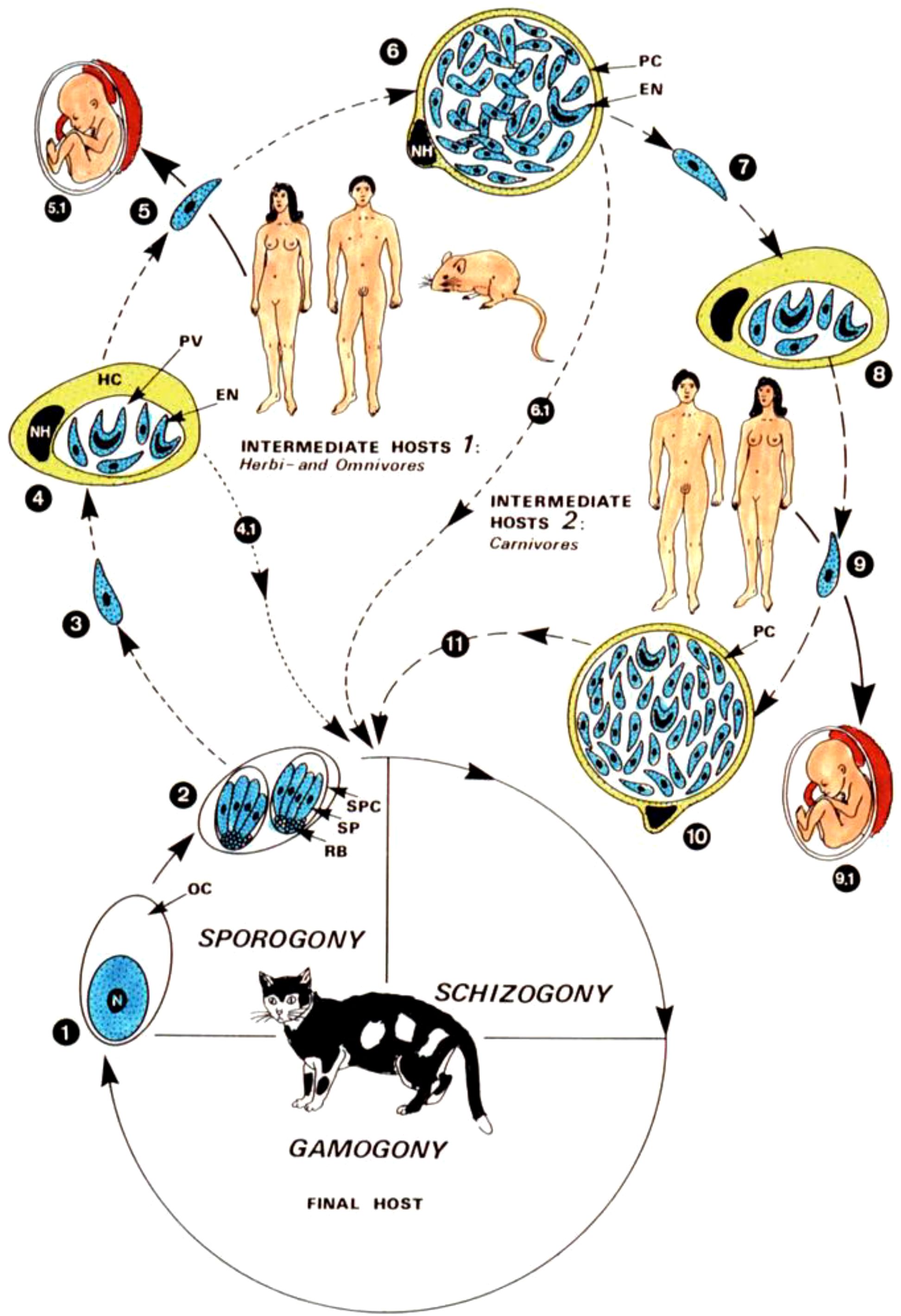
Figure 1. Development cycle and transmission routes of Toxoplasma gondii. The typical coccidial cycle takes place in the intestinal epithelium of felids, which become infected through oocysts (2), “pseudocysts” (8) and tissue cysts (6, 11). 1–11. Routes of infection in intermediate hosts. Source: Mehlhorn (28), Reproduced with permission from Springer Nature. © Springer-Verlag GmbH.
“Development cycle and transmission routes of Toxoplasma gondii. The typical coccidial cycle takes place in the intestinal epithelium of felids, which become infected through oocysts (2), “pseudocysts” (8) and tissue cysts (6, 11). 1–11. Routes of infection in intermediate hosts. Source: Mehlhorn (28), Reproduced with permission from Springer Nature. © Springer-Verlag GmbH”.
Refernece 8 was erroneously written as “Flegr J. How and why toxoplasma gondii influences human behavior. Zoonoses Public Health. (2013) 60:116–20. doi: 10.1016/j.pt.2013.01.007”. It should be “Flegr J. How and why Toxoplasma makes us crazy. Trends in parasitology. (2013) 29(4):156–63. doi: 10.1016/j.pt.2013.01.007”.
Reference 28 was erroneously written as “Mehlhorn H. Die Parasiten des Menschen. Erkrankungen erkennen, bekämpfen und vorbeugen. Auflage. (2022) 8:82”. It should be “Mehlhorn H. Die Parasiten des Menschen. Erkrankungen erkennen, bekämpfen und vorbeugen. 8th ed. Berlin, Heidelberg: Springer Spektrum. (2022). p. 82, doi:10.1007/978-3-662-65315-9”.
The original version of this article has been updated.
Publisher’s note
All claims expressed in this article are solely those of the authors and do not necessarily represent those of their affiliated organizations, or those of the publisher, the editors and the reviewers. Any product that may be evaluated in this article, or claim that may be made by its manufacturer, is not guaranteed or endorsed by the publisher.
Keywords: personality change, parasitic infection, sexual aggression, Toxoplasma gondii, neuropsychiatric, psychological behavior
Citation: Goczol M (2025) Correction: Sexually aggressive behavior triggered by parasitic infection – how parasites can influence our personality. Front. Psychiatry 16:1639610. doi: 10.3389/fpsyt.2025.1639610
Received: 02 June 2025; Accepted: 27 June 2025;
Published: 16 July 2025.
Approved by:
Frontiers Editorial Office, Frontiers Media SA, SwitzerlandCopyright © 2025 Goczol. This is an open-access article distributed under the terms of the Creative Commons Attribution License (CC BY). The use, distribution or reproduction in other forums is permitted, provided the original author(s) and the copyright owner(s) are credited and that the original publication in this journal is cited, in accordance with accepted academic practice. No use, distribution or reproduction is permitted which does not comply with these terms.
*Correspondence: Marco Goczol, bWFyY29nb2N6b2xfbWVkaWNhbHJlc2VhcmNoQHdlYi5kZQ==