Abstract
Since the Rio Summit, sustainability has been enshrined in the official claims of mega-events, and scholars' sustainability concerns over mega-events persist. This research is one of the few contextualising the debates in China where mega-events have become prevalent and contributed to metropolitan boosterism since the 1990s. It argues that the ill-defined, ambiguous meaning of sustainability leaves room for host cities to discursively strike a balance between environment protection, social equity and economic growth, but unavoidably leads to paradoxes of sustainability in actual practises. The argument is supported by a longitudinal study on 12 major mega-events held or to be held in Chinese metropolises. Narratively, Chinese government's articulation of sustainability declared by international organisations of top mega-events has evolved technocratic and inclusive. Practically, amongst the three variants of sustainability, economic sustainability, and environmental sustainability appear to work better than social sustainability. Findings of this research call for clarified narratives and concrete measures to guide mega-event practises.
Introduction
Mega-events are “large-scale, high profile and short life span urban events normally on a one-time basis, which play an influential and catalytic role in urban development and spatial restructuring” (Roche, 2017). These events have a long history in the global north but only became prevalent in the 1970s when space competitiveness and economic growth became the central theme in the urban agenda under neoliberal urbanism (Ribeiro and Santos, 2017). For policymakers, hosting a mega-event has been considered “one of the most fundamentally political acts of the modern age” (Horne and Whannel, 2012). These spectacular events tremendously amplified the trends of neoliberalisation already underway and disrupted the urban order beneficial to business interests (Boykoff, 2016). The switch occurred in the early 1990s after the Rio Summit when sustainability traversed the globe and became enshrined in the official claims of mega-events.
Sustainability issues of mega-events have sparked wide scholarly debates in developed countries, especially in large metropolises (Smith and Fox, 2007; Hall, 2012; Raco, 2014; Müller, 2015a; Chirieleison and Scrucca, 2017). Researchers and commentators have openly doubted the practical realisation of the claimed sustainability benefits for host cities (Coakley and Souza, 2013; Gaffney, 2013; Mirzayeva et al., 2020; Mair et al., 2021; Weaver et al., 2021). The first line of inquiry is about the global-national organisational synergy of mega-event sustainability over time (Kromidha et al., 2019; Weaver et al., 2021), often discursively embodied in event themes and bid books (Smith and Fox, 2007; Gaffney, 2013; Xu, 2015). The second line of inquiry is about the paradox under the triple bottom lines of environment, social and economic sustainability in practises of host cities, often contested, negotiated and reconciled by local stakeholders (Fleischer et al., 2013; Taha and Allan, 2019; Gulak-Lipka and Jagielski, 2020; Mirzayeva et al., 2020; Mair et al., 2021). With the global prevalence of mega-events, research echoing these two lines of inquiries is more crucial for developing countries, where civic engagement is less common, than for developed ones.
This research aims to enrich global north-based debates on mega-event sustainability with a longitudinal perspective on how sustainability has been narrated and practised in Chinese host cities. Although vagueness exists in terms of what constitutes a mega-event, scholars acknowledged that an event that attracts international visitors/participants, obtains wide mediated reach, secures costs and holds transformative impact can be viewed as a mega-event (Müller, 2015c), and specific classifications may vary according to a nation's own definition, e.g., the definition of types of events from the New Zealand government1. This research endorses the view and treats events beyond the national reach of China as mega-events. Since 1990s, Chinese cities have been enthusiastic about mega-events and have been coping with their unprecedented urban transformation (Shin, 2014; Chan and Li, 2017). As a powerful political instrument to reshape urban agendas, mega-events in China are a type of spatial fix touching off multiscale spatial restructuring for capital accumulation. The Olympic–Expo combo, as a significant component of China's rapid rise to prominence at the turn of the century, recalls to mind what regional rival Japan accomplished several decades ago during the boom of its economy (Wilson, 2012). Although the nation aims to impress the world with back-to-back mega-events and imprint a fresh image of a modern country, the event-led transformation for rapid wealth creation offers the locality a chance to take advantage. The emerging mega-event phenomenon in Chinese cities has attracted the interest of urbanists (Zhang and Wu, 2008; Shin, 2014; Roche, 2017) and offers a good vehicle to disentangle how sustainability has been conceptualised and embodied in mega-event hosting.
Worldwide Mega-Events Sustainability Issues
Since the 1970s, neoliberalism has proliferated globally under the well-known recession-urged transition of metropolitan governance from the Fordist-Keynesian regime to the “flexible accumulation” regime (Swyngedouw, 1986; Schoenberger, 1988; Scott, 1988; Harvey, 1989; Eisenschitz and Gough, 1993). Unlike the preceding Fordist-Keynesian regime that centred on welfare provision, the neoliberalised form of flexible accumulation places competitiveness building and growth at the vertex of the urban development agenda (Jessop and Sum, 2000) for which mega-events have become vanguards and effective strategies catering to the growth in politics and appearing as a significant impetus to the reconstruction and repositioning of ascending economies (Ribeiro and Santos, 2017; Roche, 2017; Li, 2019). Mega-events have ushered in a new epoch of global reach rhetorically assimilated with the growth-first ideology (Makarychev and Yatsyk, 2015; Trubina, 2015). Global cities strive to compete for hosting the topmost mega-events, and small events are “mega-becoming” to sharpen the competitive edge of host cities (Koh, 2005; Poynter, 2009). Host cities have inter-refer policy knowledge to advance on- and off-site accumulations (McCann, 2008). A mega-event and its development usually imply considerable funds and resources concentrated in a certain location, which forms a new spatial order in a short span. Hosting a mega-event normally requires supporting urban development policies aligned with the future development of the whole city. Mega-events function as a spatio-temporal fix to remake the host city for capital accumulation (Harvey, 2001; Sánchez and Broudehoux, 2013; Ribeiro and Santos, 2017). What distinguishes a mega-event from other types of affair is its massive, global and short-term nature. The sizeability of event venues not only (re)produces the in-site built environment but also incurs off-site spatial reconfiguration that recomposes broader social, economic, and cultural structures (Shin, 2014; Trubina, 2014). As a short-term event, its timeframe has often been incorporated strategically into the city's temporary systems that depend upon and transmogrify the long-term urban agenda (Grabher and Thiel, 2015). Mega-events also differ from low-profile, ordinary occasions because they attract global attention.
All these characteristics raise concerns for the sustainability of mega-events. Being prominent in the 1980s and globally prevalent in the 1990s, sustainability, initially, had unequivocal environmentalist underpinnings that embraced biodiversity and ecosystem integrity (Pow and Neo, 2013). Under the influence of neoliberalism, sustainability is gradually shouldered with uncompromising responsibility to ease the tensions between the mounting pressure on governments to protect the environment and promoting growth (Dryzek, 1997; Liu and Diamond, 2005). This evolution is well-exemplified in its pro-growth variant-economic sustainability, referring to sustained accumulation, development, and productivity that embrace market allocation of resources and believes in the “trickle-down” of economic growth to the poor (Khan, 1995). Another well-known variant-sustainable development, as reported by the United Nations, also captures the pro-growth yet environment-sensitive ideology and proclaims that it “meets the needs of the present without compromising the ability of future generations to meet their own needs” (Commission, 1987). This grand narrative further incorporates the social dimension into sustainability and greatly expands what sustainability is and how sustainability can (or should) be achieved. The definition of social sustainability varies by context. In South Africa, with post-apartheid situation, it may refer to social inclusivity (Fleischer et al., 2013); but in China, where low-income urban citizens or rural migrants are innumerable, it means social equity and that the redistribution of wealth would be unbiased. The three variants of sustainability set the “triple-bottom line” of environmental, economic and social aspects of urban development and focused on efficiency and technological solutions to sustainability challenges (Hall, 2012).
Fundamentally, environment protection became a potent force, and sustainability has been a pursued mandate in mega-events after the Rio Earth Summit in the early 1990s (Gold and Gold, 2013). This sustainability, in turn, found resonance in the official documents of three of the topmost impactful mega-events, the Olympic Games, World Expositions and FIFA World Cup. As noted by their respective official organisations, sustainability is either interpreted partially as an undertaking serving long-run development or understood as an objective minimising possible adverse effects.
-
- International Olympic Committee (IOC): The IOC emphasises the promotion of sustainable development in sports. The Olympic Partner (TOP) program furthers the sustainability agenda of the IOC and the organisation creates conditions for partners to increase profits whilst advancing the economy and generating investment, jobs and innovations in host cities (IOC, 2011, 2012);
-
- Bureau International des Expositions (BIE): The BIE takes the post-use intentions into account, particularly in today's political environment in which “sustainability” is no longer just a fashionable phrase but a mandate, and the community's goals for generating tourism and economic progress (BIE, 2008);
-
- Fédération Internationale de Football Association (FIFA): FIFA has dedicated corporate social responsibility (CSR) directives to address sustainability in its stated goal of minimising the negative effects of the World Cup (FIFA, 2012).
These narrated sustainable visions, however, lack specific rules and measures on the utilisation and exploitation of natural resources. The ill-defined and vague meanings of “sustainability” or “sustainable development” have complicated defining mega-event sustainability (Satterthwaite, 1997; Haughton, 1999; Klauer, 1999). Scholars also identified mega-event syndromes that result in the unsustainability in urban development (Müller, 2015b). For instance, underestimating costs but overlooking the potential risks in event finance. Since 1960s, the average overrun for the Olympic Games is nearly 180%. The 2010 Commonwealth Games in New Delhi (India) initially had a budget of 50 million USD but eventually cost over 4 billion USD. The event hijacking urban development or leaving redundant constructions in its wake is another unfavourable consequence for host cities. An example is Rio de Janeiro, where the 2007 Pan American Games, 2014 Football World Cup and 2016 Olympic Games were held. Its mayor admitted that these mega-events were prioritised over the city's own development and overwhelmed Rio's plan. The unlimited liability of the government to offer event facilities and infrastructure burdens host cities whilst profits accrue to international event organisers and contractors. For instance, the 2014 Russia Winter Games in Sochi built roads and rail lines to connect the venues, but the operational cost was overly high to afford even after the event ended. Moreover, the social sustainability of mega-events cares about gentrification resulting from event-led spatial restructuring given that mega-events often entail massive relocation. Some examples are what transpired in Atlanta, Sydney, London and so on.
These sustainability challenges are universal in mega-events, and how these challenges are treated and addressed in the Chinese context deserve further research, which must employ caution in three aspects. Firstly, the empirical research shall note the potential mismatches between the normative goals and the reality in mega-events (Miller, 2013). Secondly, it should pay attention to omnipresent conflicts between economic growth and environmental protection due to the ill-defined constraints or vaguely applicable guidelines for the practises of host cities (Gaffney, 2013). Thirdly, it shall be sensitive to possible tensions between the government and society that result from aggrandised social segregation or failure of public trust building in the events (Fleischer et al., 2013; Raco, 2014).
Methodology
This research adopts a mixed, comprehensive review on the narratives and practises about the sustainability debates in mega-events, in the context of Chinese metropolises. Firstly, the pre-research about the topic: mega-event and sustainability, followed by a systematic literature search via free combination of keyword identified in the pre-research: “mega-event,” “event (prefix and suffix),” “sustainability/sustainable,” “Olympic (prefix),” “Expo” and so on. A total of 110 articles from the mainstream academic database were included in the initial round, and 43 articles were located to offer the general background for mega-event sustainability and to build the framework for this study. The inclusion criteria are that the article's main content shall be on mega-event sustainability based on the abstract review. Book reviews, short comments and contents that are not directly pertinent to mega-event sustainability were excluded.
Then, given that China has started mega-event application and hosting since the 1990s, 12 major influential events held in eight Chinese metropolises were selected for a longitudinal study. A longitudinal study represents a research design that involves repeated observations of the same variables (e.g., events) over certain periods of time, usually conducted as a type of observational study (Cook et al., 2002). First-hand data sources mainly rest upon four field trips to venues, design and management bodies, re-settlement sites in Shanghai, Shenzhen and Guangzhou in August 2010, July 2012, August 2016 and March 2018. Semi-structured interviews with local planners, government officials, event organisers (e.g., Expo Coordination Bureau), residents and scholars and unstructured interviews with visitors and taxi drivers were conducted to understand their roles in the event process and their views, comments and recognitions. Over 20 stakeholders were involved in the interviews, but their identities were concealed. Site visits to venues of Olympic Games in Beijing, Expo in Shanghai and of Universiade in Shenzhen were made for participatory observation on how the built environment and overall spatial structure are reshaped by mega-events. Photos and event brochures were collected during the visits. Coding and in-depth reflections were conducted after daily interviews or observations, realigning the obtained data with the proposed framework, and readjusting it accordingly. Supplementary learning was timely added for knowledge blind spots during the field trips.
Secondary data sources were accessed through the respondents and broad online and archive search was carried out throughout the entire process to help clarify the interview question, complement the background information and deepen the reflections on the interview. This is particularly important to host cities where the author did not attend in person. The data include bid books, evaluation reports, event websites, official audit reports, historical archives, online news, statistical yearbooks and event policies and planning documents. With the data pool, a narrative synthesis approach (Popay et al., 2006) was applied to identify how the words and texts reflect the stances and standpoints of multi-stakeholders toward sustainability in these mega-events.
Mega-Event Sustainability In Chinese Metropolises
Thinking Global: Technocratic and Expanded Discourses as Political Imperatives
In the bid stage, official claims, bid books and event themes capture how the organisers envisage event sustainability. These materials suggest that China's articulation to sustainability declared by international organisations of top mega-events has evolved technocratic and expanded, mainly in two directions. Firstly, the emphasis on sustainability has shifted from pure environmental clearance and passive solutions to environmental problems throughout the 1990s, as indicated in the 1990 Beijing Asian Games and the 1999 Kunming Horticultural Expo, to smart sustainable urbanism embracing green technology (Wathne and Haarstad, 2020) and low-carbon concept stressing emission control (While et al., 2010) since the late 2000s, e.g., the 2008 Beijing Olympics, 2010, Shanghai Expo and Guangzhou Asian Games, 2011, Shenzhen Universiade, 2014, Nanjing Youth Olympics, 2019, Beijing Horticultural Expo and 2022 Hangzhou Asian Games and so on (Table 1). This is also accompanied with a transition of sustainability approaches from setting a standard or applying a physical chemistry method to address pollution and environmental degradation to using high technology and new energy to facilitate a low energy consumption and cleaner environment. A year after the Tiananmen Square protests, the 1990 Beijing Asian Games was the first mega-event in China with overriding political significance to establish a national identity and facilitate a peaceful international environment for socialist modernisation. Held before the Rio Summit, the Beijing Asian Games had not made discursive commitments to sustainability neither to the Olympic Council of Asia (OCA) nor to the National Olympic Committees (NOCs) with small amount of GDP. The 1999 Kunming Horticultural Expo was the first one to exhibit “nature” explicitly on the theme and invested substantially to address environmental problems with GDP embark to rise quickly. It also contributed to implanting the sustainability idea, which was not as common as it is now to the public. The later world-renowned Beijing Olympics and Shanghai Expo had proactively embraced sustainability to gain favourable impression internationally under the country's economic boom. Facing criticism over environmental problems, the Beijing Olympic Committee (BOC) highlighted the “Green Olympics” to deliver its promise to the environmental concerns of the IOC, whilst the Shanghai Expo Organisation Committee (SEOC) proposed “Better City, Better Life” and “Green Expo” as the theme to respond to the sustainability vision from the BIE and to the urgency in improving urban liveability. Moreover, in both events, the organisers claimed to adopt technologies for energy saving and carbon control to project an eco-friendly image to the domestic public and international community. The two vanguards established the rhetoric model to articulate sustainability for later events in which the “green” prefix has never been absent. Such a rhetoric model is often combined with “technology” to reconcile environmental conflicts.
Table 1
| Host city | Type of mega-events | Dates | Themes | Sustainability discourse from the host city | Economic gains in mega-events | Unsustainability results from tensions in actually existing practises of mega-events |
|---|---|---|---|---|---|---|
| Beijing | Asian Games | September–October 1990 | Unity, friendship and progress | Improve the international environment for China's sustainable development. Environmental protection for Qinhuangdao where water race took place. | Economic optimization by promoting tertiary industries of commercial catering, residential services and international tourism. Most venues were newly constructed. | Environmental issues are not prominent and succeed to economic development. |
| Universiade | August–September 2001 | Youth, Friendship and Peace | Political significance overwhelmed the others. Improve environment governance to support Olympic Bidding. | Proportion of output value in education, art broadcasting and the film industry rose significantly. Industries related to S&T also significantly increased. | Athlete Village and other facilities involve some demolition. | |
| Olympic Games | August 2008 | One World. One Dream | Highlight Green Olympics echoing Olympic Movement's Agenda 21, adopted in Brazil by the IOC in October1999: Making environmental protection a prerequisite, applying eco-friendly and energy saving technologies and Raising public awareness of environmental protection and eco-friendly consumption | Continued rise of FDI, A large number of job posts in the construction business, Newly built and renewed venues spread across the city. | Worsen air pollution. A large number of residents in Beijing are displaced. The costs were borne by socio-economically marginalised groups. | |
| Horticultural Expo | April–October 2019 | Live green, live better | Articulate green Beijing, embrace green ecology and low carbon environment protection. | Promoted ecological civilisation, green industrial system, green merits, and harmonious symbiosis of human and nature, improved the ecological and investment environment. | Locate in once landfill but now a green ecological belt of Yongding river, involve relocation of pollution industries and residents. | |
| Winter Olympic Games | February 2022 | Joyful Rendezvous Upon Pure Ice and Snow | Stick to Green Olympic in “Olympic Agenda 2020,” improve eco-environment, regional and urban sustainable development; protect eco-system and biodiversity; operate under ISO 20121 (mega-event sustainability management system) and ISO 14001 (environment management system). | Prioritise tourism development in Zhangjiakou and Yanqing. Reuse industrial heritage and venues left in 2008 Olympic to sustain growth in Beijing. Renewal of Shougang old industrial area. | Reliable snowfall is uncertain. Environmental impact is questionable as some venues will be adjacent to Beijing Songshan National Natural Reserve. Renewal of shantytowns with monetary compensation. | |
| Shanghai | World Expo | May–October 2010 | Better City, Better Life | Embrace green Expo, take sustainable development as the main theme, and stress responsibilities of cities in environmental change. | Boosted the economic transition of Shanghai. Fosters high technology industry. Venues were renewal of industrial buildings in Puxi and newly built in Pudong. | Intense bargaining during the relocation of 18,000 households and 272 industrial enterprises. |
| Guangzhou | Asian Games | November 2010 | Thrilling Games Harmonious Asia | Commitment to Green Asian Games. Create bluer sky, cleaner water, smoother road and more beautiful city. Build an ecological, energy saving Asian Game Town. | Promote service economy which accounts 61.2% after the Game, infrastructure construction and urban (re)development. | Nine urban villages are redeveloped and a much higher number of migrant tenants were to be affected by the demolition. Shut down polluting companies. |
| Shenzhen | Universiade | August 2011 | Start here. Make a difference | Advocate green, low carbon concept, stick to green Universiade. | Cultural and high-tech industry increased the most, and tourism income also increased. | Hundreds of buildings were demolished. Water environment pollution treatment. |
| Nanjing | Youth Olympic Games | August 2014 | Share the Games, Share our dreams | Explore a hosting approach that is green, environment-friendly, economical and sustainable through innovations in concept, management and technology. | Energy consumption industry declined alongside the increase of new service industries, thereby optimising the industrial structure. | Massive relocation of more than 20 land parcels and 1.3 million shanty houses were demolished. Post-event air quality control. |
| Kunming | Horticultural Expo | May–October 1999 | Man and Nature, marching into the twenty first century | Follow nature. Addressed environmental problems and displayed achievements and solutions necessary to ensure coordinated development. | The service industry progressed and business tourism prospered. Post-utilisation of venues promote tourism development. | Environmental governance in area with over 70% forest coverage and 500 species of trees. |
| Hangzhou | Asian Games | September 2022 | Green, frugal, intelligent, civilised | In line with master plan and sustainable goal of Hangzhou. Advancing green, low-carbon, energy-saving, environmental protection and sustainable use in the design and construction of venues. | Economic development is infused with city beautification and high-tech development. The games also aim to promote urban renewal in Hangzhou. | Cost-benefit of the game is waited to be seen. Air quality control. More than 50 urban villages were displaced. |
| Harbin | Winter Universiade | February 2009 | Youth, Future, Ice and Snow | A green festival to promote ice industries and green development of Harbin. | Domestic tourism increased. Exhibition industry rose 25%. Yabuli Ski Resort became well-known as a tourist attraction. | Ski facility is detrimental to forest ecology and tourists bring pressure on the environment. |
Sustainability discourse, economic gains, and sustainability challenges of mega-events in Chinese metropolises (1992–2022).
Source: author compiled from various sources.
Secondly, the scope of sustainability narratives about these mega-events has amplified from environment/eco-friendly responsibilities to sustained development incorporating local development-directed ideas to mediate ecological and economic imperatives for competitiveness building. Since 2008, when the nation's GDP ratio in tertiary sectors was about to surpass the secondary industrial sectors, major Chinese cities, such as Beijing, Shanghai, Guangzhou and Shenzhen experienced an intense competition to host mega-events (Figure 1), which catalysed local urban development. In the 2008 Beijing Olympic Games, commitments to sustainability were integrated intentionally into new infrastructure construction and industrial restructuring justified to improve transportation systems, upgrade wastewater treatment, enhance sewage network capacity and relocate or retrofit major polluting industries for better water and air quality. Similarly, in the Shanghai Expo, Guangzhou Asian Games and Shenzhen Universiade, sustainability discourses were merged into the renewal of old urban areas or the expansion of suburban new towns for sustained accumulation. The discursive means to balance environment protection and development is reflected eminently in the mixed, interchangeable use of the term, “sustainability” and “sustainable development” in bid books prepared by the organisation committee of host cities. For instance, in the official summary report of the Beijing 2008 Olympic Games in which “sustainable” was reiterated in all three volumes, most were linked to “development” to demonstrate how the Games has sustained economic growth. In the upcoming 2022 Winter Olympic Games, discourse analysis reveals that although “sustainable” and “sustainability” are high-frequency words, which appear 108 times in total, “development” is overwhelmingly the most discernible term used up to 181 times in the text. A similar word frequency was also detected in the IOC reports.
Figure 1
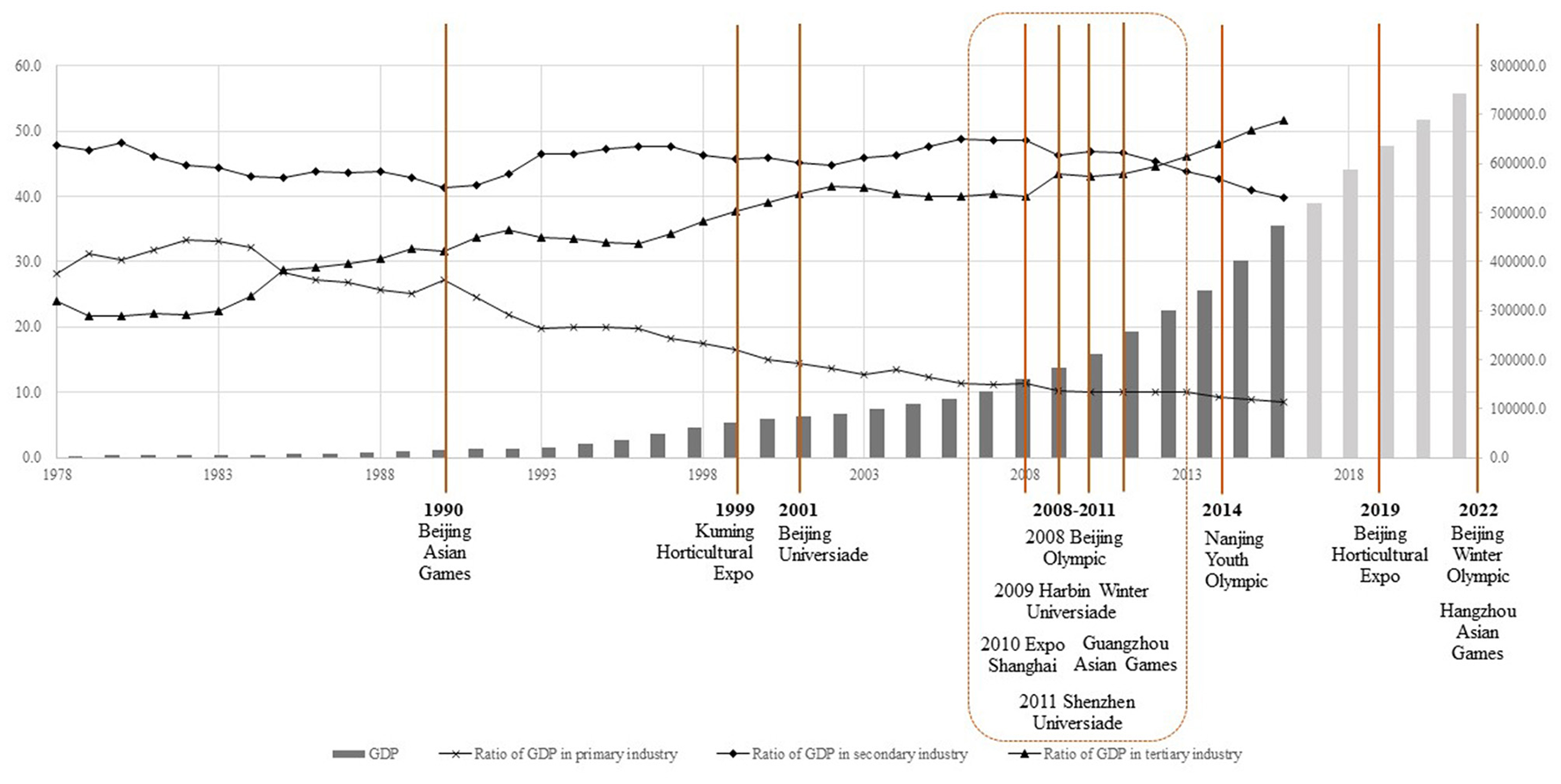
Mega-events, accumulation, GDP growth, and structure in China (1978–2022). Source: National Statistical Bureau.
The transition to a smart and inclusive sustainability narrative in the bid stage captures the global policy trend of “modernising” and “broadening” the treatment of environmental issues (Beal, 2015). Rather than being an opponent of neoliberalism, sustainability has deepened the neoliberalisation process by the technocratic selection of environmental issues and by the amplification of the meaning of sustainability from being a constraint on resource consumption to encouraging green growth, balancing environmental, social and economic goals.
Acting Local: State-Dominated Practises Guided by Growth Needs
These narratives, regardless of how glorious and promising they are portrayed, are overly general to offer specific rules and guidelines and arbitrary to confront the sophisticated sustainability challenges. Different from the West where public-private partnerships are widespread, in China, the mega-event process is generally state dominated, characterised by omnipotent government intervention, absent grassroots participation and omnipresent elite politics. Mega-events in China are normally viewed as an opportunity and platform to showcase national soft power, thus often entail economic pressure to host cities. For them, whether the short-term large investments can be recouped in the long-run development in post-events has always been a great challenge. The 2008 Beijing Olympics was widely acknowledged as a successful game in terms of its economic return, yet according to the audit report, the 20.5 billion RMB income generated by the game barely surpassed the 19.5 billion RMB investment. The audit report of the Shanghai Expo indicated that the operational cost was 11.96 billion RMB, covered by the 13.01 billion RMB operational income but excluded the 19.74 billion RMB investment on the construction of Expo Park. Whether the investment can be reimbursed remains uncertain, depending on the economic situation and income from land leasing. The audit report of the 2011 Shenzhen Universiade revealed that the total investment of 14.0 billion RMB was far from being recovered by the 1.2 billion RMB income. Nevertheless, the cost-benefit issue is often offset by a magnificent plan. For instance, the accumulation targets are usually achieved through a strategic site selection of event venues alongside integrated plans subject to the development stage of host cities. Urban planners in Chinese cities excel at aligning mega-events with the city master plan, taking advantage of mega-events as a catalyst for urban development. They are clear about the development objectives of the host cities and plan to integrate event infrastructure preparation and the urban development schedule to avoid construction redundancy. Examples include the sites for Beijing Olympics, Guangzhou Asian Games and Shanghai Expo, which worked for the restructuring of urban space and completion of key projects in comprehensive strategic plans to create room for accumulation in future development2. Their event venues are spatially delineated for space (re)production nurturing new industrial or life activities. For less-developed areas, mega-events are highlighted as a tourism industrial development strategy to promote the local economy. Examples include the 1999 Kunming Horticultural Expo, which aimed to advertise Kunming as a “vegetation kingdom” and the upcoming 2022 Beijing Winter Olympic Games, which aimed to advance the snow tourism industry in Yanqing3. Spatially spreading out these venues in different places may relieve the pressure of peak days management in mega-events and facilitate economic development in a broader geographical area driven by mega-events. In 2022 Winter Games, venues were spread over three cities: Beijing, Yanqing and Zhang Jiakou; this mega-event had been strategically integrated into the coordinated development of Beijing-Tianjin-Hebei (BTH) region to promote regional development4.
The environmental dimension is the original underpinning to propose sustainability that host cities are duty bound to address. China's determination to address environmental challenges remains unwavering, not only to catch up with the nation's environmental protection policy orientation but also to impress the world with a pleasant, clean environment. The two leading cities in China have spared no effort to sort out the dirty, smoggy, drought-ridden and congested environment. Preparing the Olympic Games, the Chinese government invested a great proportion of the 8 million USD budget made in the bid to enhance the transportation infrastructure and Beijing's environment, including building more parks, and green areas5. Environmental measures were unanimous with the international standards from the United Nations. A frugal approach to holding the Olympic Games turns out to be a new global fashion. Exempting from wasteful or redundant construction by mega-events favours environmental protection. This is well-exemplified in the 2022 Beijing Winter Olympic Games for which most venues are off the shelf. Moreover, Beijing took the opportunity of the Winter Games to reuse its industrial heritage whereby the obsolete, unused factories could be renewed to undertake new functions. The Shougang West Ten project was designed and completed to provide office space for the Winter Olympics Organising Committee staff6 Moreover, science and technology have almost been adopted in every mega-event, which successfully improve the construction standards and energy use efficiency of venues since 2000. Green technologies help educate the public about ecological modernisation and to reassure doubts on environmental impacts entailed by the gigantic construction. For instance, Shanghai Expo has practised eco-low-carbon idea, which encouraged intelligent green technology to facilitate Shanghai's sustainable future. In Expo Park, new energy automobile (include hybrid, pure electric and fuel cell vehicles) realised the “zero-emission” of transportation. Moreover, Shanghai Mobile used the TD-LTE technology to complete the coverage of the 4G communication test network and transportation bureau applied the RFID technology to improve the passenger flow efficiency. In UBPA, the “Shanghai Eco-Home” saved over 60% energy and reduced 140 tonnes of annual carbon dioxide emissions. Planners also built temporary, removable venues for flexible after-use whereby land resources are best utilised7. However, for mega-events held in non-urbanised areas, challenges for environmental sustainability do not decrease. The upcoming 2022 Winter Olympic Games is a case that induces wide controversies about its negative effect on natural habitats of wild species. As contested by biologists and environmentalists, the alpine skiing route at Yanqing, one of the three Winter Olympics competition zones, falls within the Songshan National Nature Reserve, which retains some rare species8. Using technology alone to solve the potential damage to biodiversity is difficult, so are the environmental sustainability and the consequent questioning from local and international society.
The social sustainability is also tough in contemporary China. Mega-events held in urbanised areas are likely to result in massive relocation of on-site residents and businesses firms, incurring social conflicts and injustice that contradict with social sustainability. These occur universally in post-2008 mega-events by which China embarked on the profound urban restructuring for high-quality and efficient growth. According to the field trip and interviews by the author, the mega-event movements significantly affected the citizens of host cities: up to 15,000 people were moved for hosting 2008 Beijing Olympic Games; almost 18,000 households and over 270 enterprises were relocated to make room for the 2010 Shanghai Expo; more than 16,000 village households and numerous migrants were affected by the demolition prioritised by the 2010 Guangzhou Asian Games; over 410,000 m2 residential and 1,000,000 m2 industrial built-up areas accomplished relocation within 15 days in the preparation of 2011 Shenzhen Universiade; around 1,550,000 m2 area of urban villages completed relocation before the 2014 Nanjing Youth Olympics; in 2022 Hangzhou Asian Games, preparation for the Dragon Boat Sports Base alone involved the displacement of roughly 1,200 households. The unprecedented scale of resettlements implemented in these mega-events was conflict ridden, given that negative experiences of displacement often ignited social complaints on unemployment or social alienation. Moreover, although Chinese governments endeavoured to compensate more than the usual to foreground the resistance from the event-led relocation, many relocates that were not so vital to the fulfilment of mega-events barely received benefits. They were groups of people indirectly influenced by the event and were marginalised in the mega movement, which were likely to be the source of social unrest. Mega-events held in the non-urbanised area would threaten the wild species and ignite social criticism as exemplified in the Alpine skiing construction for the 2022 Beijing Winter Olympic Games, where the environmental threats to biodiversity were widely denounced by environmental protection enthusiasts. However, the struggle between state and society was not limited to the concern over biodiversity, people are sceptical of the non-transparent procedures beneath the decision making on the readjustment of the natural reserve that aims to outline the overlapped area of the Alpine construction and the reserve. They questioned whether the procedural legitimacy of this adjustment announced by the Yanqing government accorded with the “National Nature Reserve Adjustment Management Regulations”9. Consequently, social disharmony has been magnified, and tensions have surfaced between government and society of unsustainability.
Discussion and Conclusion
This study enquires how the sustainability of mega-events is discursively committed and practised in China. It contributes to a contextualised understanding toward global north-originated debates over mega-event sustainability, with a longitudinal study on 12 mega-events that are held or to be held in 8 Chinese metropolises since 1990s. The study demonstrates that sustainable principles in mega-events are far from clear to guide host cities (Hall, 2012; Gaffney, 2013). At the global/national level, the narratives of the Chinese government to articulate sustainability mandated from international organisations have become technocratic and broad, implying an attempt to secure development opportunities given the ill-defined, ambiguous meaning of sustainability, as any other candidate does (Makarychev and Yatsyk, 2015; Trubina, 2015; Ribeiro and Santos, 2017; Roche, 2017). The developmental and expanded commitments to sustainability have resulted in widespread concerns on sustainability at the local level due to the absence of clear guidelines (Gold and Gold, 2013). At the host city level, the state-dominated practises of mega-events to advance urban growth agenda are facing divergent challenges beyond the sustainability declaration. Although Chinese governments have strived to minimise the potential unsustainable issues in mega-events, the mega-scale, vague discourse and concomitant disputable practises of the event can hardly fix the intrinsic fallacies of mega-event sustainability. This is particularly true in social sustainability, which works less well than economic sustainability and environmental sustainability (Fleischer et al., 2013).
This research also adds on new understanding toward the on-going discussions of sustainability against the backdrop of China's ascension to the status of being the second-largest economy via the lens of mega-events, a mega amplifier urban phenomenon. Similar to those held in the developed countries, the past and upcoming mega-events in China, in favour of the elites, are interscalar strategies by the Chinese government to articulate local politics and mobile capital and reinforce city–region status (Li, 2019). Moreover, they function as engines for economic growth and address potential social and environmental injustice simultaneously. However, different as they are from western countries, China's mega-events are mostly state led. With an authoritarian political-economic context, the Chinese government and its affiliated agents play a key role in coupling ephemeral mega-events with enduring economic transition, the transition from industrialisation to post-industrialisation, manufacturing to service investment attraction to capital expansion, of a host city (Chan and Li, 2017). Uncertainties due to the growth-oriented ideology can be addressed by pre-setup plans. In recent years, the private sector and social forces increase as indicated in the 2022 Olympic Winter Games4, complementing sustainable development of mega-events in China. Experiences of China's mega-events introduced in this article reveal the technocratic, meaning-expanded evolution of sustainability as an entrepreneurial strategy to strike a balance between environment protection, social equity and economic growth, and how the expanded, ambiguous meaning of sustainability has unavoidably led to paradoxes in economic, social and environmental dimensions of sustainability in actual practises. Clear guidelines for working objectives, standards, principles and specific measures toward sustainability in mega-events may help enhance the development for host cities.
Funding
This research was supported by National Natural Science Foundation of China (51808391) and Shanghai Foundation for Science and Technology (19692114504).
Publisher's Note
All claims expressed in this article are solely those of the authors and do not necessarily represent those of their affiliated organizations, or those of the publisher, the editors and the reviewers. Any product that may be evaluated in this article, or claim that may be made by its manufacturer, is not guaranteed or endorsed by the publisher.
Statements
Data availability statement
The raw data supporting the conclusions of this article will be made available by the authors, without undue reservation.
Author contributions
LL contributed to conception and design of the study, wrote the first draught of the manuscript and revision, read, and approved the submitted version.
Conflict of interest
The author declares that the research was conducted in the absence of any commercial or financial relationships that could be construed as a potential conflict of interest.
Footnotes
1.^ See https://www.majorevents.govt.nz/.
2.^ Beijing, Guangzhou and Shanghai master plans.
3.^ Official website of Kunming Horticultural Expo and Beijing 2022.
4.^ The bid books for 2022 Beijing Winter Olympic Games.
5.^ The bid books for 2008 Beijing Olympic Games and audit report.
6.^ The official website of Beijing 2022. https://www.beijing2022.cn/.
7.^ Former official website of Shanghai Expo 2010.
8.^ Information gathered from weibo, accessed in September, 2016.
9.^ Information gathered from weibo, accessed in September, 2016.
References
1
Beal V. (2015). Selective public policies: sustainability and neoliberal urban restructuring. Environ. Urbaniz.27, 303–316. 10.1177/0956247814549153
2
BIE . (2008). The Expo Book: A Guide to the Planning, Organization, Design and Operation of World Expositions. Retrieved from: Gordon Linden.
3
Boykoff J. (2016). Power Games: A Political History of the Olympics. New York, NY: Verso.
4
Chan R. C. K. Li L. (2017). Entrepreneurial city and the restructuring of urban space in Shanghai Expo. Urban Geogr.38, 666–686. 10.1080/02723638.2016.1139909
5
Chirieleison C. Scrucca L. (2017). Event sustainability and transportation policy: a model-based cluster analysis for a cross-comparison of hallmark events. Tourism Manage. Perspect.24, 72–85. 10.1016/j.tmp.2017.07.020
6
Coakley J. Souza D. L. (2013). Sport mega-events: can legacies and development be equitable and sustainable?Motriz Revista De Educ. Física19, 580–589. 10.1590/S1980-65742013000300008
7
Commission B. (1987). Report of the World Commission on Environment and Development: OUr Common Future. New York, NY: United Nations. 10.3828/twpr.9.3.x4k73r2p72w22402
8
Cook T. D. Campbell D. T. Shadish W. (2002). Experiments and Generalized Causal lnference. Boston, MA: Houghton Mifflin.
9
Dryzek J. S. (1997). The Politics of the Earth: Environmental Discourses. Oxford: Oxford University Press.
10
Eisenschitz A. Gough J. (1993). The Politics of Local Economic Policy: The Problems and Possibilities of Local Initiative. Basingstoke: MacMillan. 10.1007/978-1-349-22839-3
11
FIFA . (2012). FIFA 2014 World Cup Sustainability Strategy-Concept. Retrieved from: Zurich, Switzerland:
12
Fleischer M. Fuhrmann M. Haferburg C. Krüger F. (2013). “Festivalisation” of Urban Governance in South African cities: framing the urban social sustainability of mega-event driven development from below. Sustainability5, 5225–5248. 10.3390/su5125225
13
Gaffney C. (2013). Between discourse and reality: the un-sustainability of mega-event planning. Sustainability5, 3926–3940. 10.3390/su5093926
14
Gold J. R. Gold M. M. (2013). “Bring It under the Legacy Umbrella”: olympic host cities and the changing fortunes of the sustainability Agenda. Sustainability5, 3526–3542. 10.3390/su5083526
15
Grabher G. Thiel J. (2015). Projects, people, professions: trajectories of learning through a mega-event (the London 2012 case). Geoforum65, 328–337. 10.1016/j.geoforum.2015.02.006
16
Gulak-Lipka P. Jagielski M. (2020). Incorporating sustainability into mega-event management as means of providing economic, social and environmental legacy: a comparative analysis. J. Phys. Educ. Sport20, 2859–2866. 10.7752/jpes.2020.5388
17
Hall C. M. (2012). Sustainable mega-events: beyond the myth of balanced approaches to mega-event sustainability. Event Manage.16, 119–131. 10.3727/152599512X13343565268294
18
Harvey D. (1989). From managerialism to entrepreneurialism: the transformation in urban governance in late capitalism. Geografiska Annaler. Series B. Human Geogr.71, 3–17. 10.1080/04353684.1989.11879583
19
Harvey D. (2001). Globalization and the Spatial Fix. Article.
20
Haughton G. (1999). Environmental justice and the sustainable city. J. Planning Educ. Res.18, 233–243. 10.1177/0739456X9901800305
21
Horne J. Whannel G. (2012). Understanding the Olympics. London: Routledge. 10.4324/9780203867723
22
IOC (2011). Olympic Charter. Retrieved from: Lausanne, Switzerland:
23
IOC (2012). Sustainability Through Sport: Implementing the Olympic Movement's Agenda 21. Retrieved from: Lausanne, Switzerland:
24
Jessop B. Sum N.-L. (2000). An entrepreneurial city in action: Hong Kong's emerging strategies in and for (Inter) urban competition. Urban Stud.37, 2287–2313. 10.1080/00420980020002814
25
Khan M. A. (1995). “Concepts, definitions, and key issues in sustainable development: the outlook for the future,” in Paper presented at the Proceedings of the 1995 International Sustainable Development Research Conference, Manchester, England.
26
Klauer B. (1999). Defining and achieving sustainable development. Int. J. Sustain. Dev. World Ecol.6, 114–121. 10.1080/13504509909470000
27
Koh E. (2005). South Korea and the Asian games: the first step to the world. Sport Soc.8, 468–478. 10.1080/17430430500260511
28
Kromidha E. Spence L. J. Anastasiadis S. Dore D. (2019). A longitudinal perspective on sustainability and innovation governmentality: the case of the Olympic Games as a mega-event. J. Manag. Inquiry28, 77–93. 10.1177/1056492617711585
29
Li L. (2019). A mega-event approach to glurbanization: insights from Expo 2010, Shanghai. J. Geogr. Res.2, 1–12. 10.30564/jgr.v2i1.188
30
Liu J. Diamond J. (2005). China's environment in a globalizing world. Nature435, 1179–1186. 10.1038/4351179a
31
Mair J. Chien M. Kelly S. J. Derrington S. (2021). Social impacts of mega-events: a systematic narrative review and research agenda. J. Sustain. Tourism1–22. 10.1080/09669582.2020.1870989
32
Makarychev A. Yatsyk A. (2015). Brands, cities and (post-)politics: a comparative analysis of urban strategies for the Universiade 2013 and the World Football Cup 2018 in Russia. Eur. Urban Reg. Stud.22, 143–160. 10.1177/0969776414548523
33
McCann E. (2008). Expertise, truth, and urban policy mobilities: global circuits of knowledge in the development of vancouver, canada's 'four pillar' drug strategy. Environ. Plann. A40, 885–904. 10.1068/a38456
34
Miller T. (2013). Imaginaries of Sustainability: The Technopolitics of Smart Cities and the Shaping of Our Urban Future.
35
Mirzayeva G. Turkay O. Akbulaev N. Ahmadov F. (2020). The impact of mega-events on urban sustainable development. Entrepreneur. Sustain.7, 1653–1666. 10.9770/jesi.2020.7.3(15)
36
Müller M. (2015a). (Im-)Mobile policies: Why sustainability went wrong in the 2014 Olympics in Sochi. Eur. Urban Reg. Stud.22, 191–209. 10.1177/0969776414523801
37
Müller M. (2015b). The mega-event syndrome: why so much goes wrong in mega-event planning and what to do about it. J. Am. Plann. Assoc.81, 6–17. 10.1080/01944363.2015.1038292
38
Müller M. (2015c). What makes an event a mega-event? Definitions and sizes. Leisure Stud.34, 627–642. 10.1080/02614367.2014.993333
39
Popay J. Roberts H. Sowden A. Petticrew M. Arai L. Rodgers M. et al . (2006). Guidance on the Conduct of Narrative Synthesis in Systematic Reviews. A product from the ESRC methods programme Version 1:b92.
40
Pow C. P. Neo H. (2013). Seeing red over green: contesting urban sustainabilities in China. Urban Stud.50, 2256–2274. 10.1177/0042098013478239
41
Poynter G. (2009). “The 2010 olympic games and the reshaping of east London,” in Regenerating London: Governance, Sustainability and Community in a Global City, eds R. Imrie, L. Lees, and M. Raco, editors. Milton Park, Abingdon, Oxon; New York, NY: Routledge.
42
Raco M. (2014). Sustainable city-building and the new politics of the possible: reflections on the governance of the London Olympics 2012. Area47, 124–131. 10.1111/area.12080
43
Ribeiro L. C. Santos A. D. (2017). Neoliberalization and mega-events: the transition of Rio de Janeiro's hybrid urban order. J. Urban Affairs39, 909–923. 10.1080/07352166.2017.1328976
44
Roche M. (ed.). (2017). “Mega-events, globalisation and urban legacy: events in China in the early twenty-first century,” in Mega-Events and Social Change (Manchester: Manchester University Press), 223–245. 10.7228/manchester/9781526117083.003.0008
45
Sánchez F. Broudehoux A.-M. (2013). Mega-events and urban regeneration in Rio de Janeiro: planning in a state of emergency. Int. J. Urban Sustain. Dev.5, 132–153. 10.1080/19463138.2013.839450
46
Satterthwaite D. (1997). Sustainable cities or cities that contribute to sustainable development. Urban Stud.34, 1667–1691. 10.1080/0042098975394
47
Schoenberger E. (1988). From Fordism to flexible accumulation: technology, competitive strategies, and international location. Environ. Plann.6, 245–262. 10.1068/d060245
48
Scott A. J. (1988). New Industrial Spaces: Flexible Production Organization and Regional Development in North America and Western Europe. London: Pion Ltd.
49
Shin H. B. (2014). Urban spatial restructuring, event-led development and scalar politics. Urban Stud.51, 2961–2978. 10.1177/0042098013515031
50
Smith A. Fox T. (2007). From ‘Event-led’ to ‘Event-themed’ Regeneration: the 2002 Commonwealth Games Legacy Programme. Urban Stud.44, 1125–1143. 10.1080/00420980701256039
51
Swyngedouw E. (1986). The Socio-Spatial Implications of Innovations in Industrial Organisation. Working Paper, Johns Hopkins European Center for Regional Planning and Research.
52
Taha B Allan A . (2019) “Hosting a mega event, a drive towards sustainable development: Dubai's Expo 2020,” in Computational Urban Planning and Management for Smart Cities. CUPUM 2019, eds S. Geertman, Q. Zhan, A. Allan, C. Pettit, Lecture Notes in Geoinformation Cartography. (Switzerland: Springer, Cham). 10.1007/978-3-030-19424-6_13
53
Trubina E. (2014). Mega-events in the context of capitalist modernity: the case of 2014 Sochi Winter Olympics. Eurasian Geogra. Econom.55, 610–627. 10.1080/15387216.2015.1037780
54
Trubina E. (2015). Manipulating neoliberal rhetoric: Clientelism in the run-up to international summits in Russia. Eur. Urban Regional Stud.22, 128–142. 10.1177/0969776413512139
55
Wathne M. W. Haarstad H. (2020). The smart city as mobile policy: Insights on contemporary urbanism. Geoforum108, 130–138. 10.1016/j.geoforum.2019.12.003
56
Weaver D. Moyle B. D. McLennan C. L. (2021). A core/periphery perspective on mega-event sustainability: dystopic and utopic scenarios. Tourism Manage.86:104340. 10.1016/j.tourman.2021.104340
57
While A. Jonas A. E. Gibbs D. (2010). From sustainable development to carbon control: eco-state restructuring and the politics of urban and regional development. Transact. Institute Br. Geogr.35, 76–93. 10.1111/j.1475-5661.2009.00362.x
58
Wilson S. (2012). Exhibiting a new Japan: the Tokyo Olympics of 1964 and Expo '70 in Osaka *. Historical Res.85, 159–178. 10.1111/j.1468-2281.2010.00568.x
59
Xu J. (2015). Environmental discourses in China's urban planning system: a scaled discourse-analytical perspective. Urban Studies53, 978–999. 10.1177/0042098015571054
60
Zhang J. Wu F. (2008). Mega-event marketing and urban growth coalitions: a case study of nanjing olympic new town. Town Plann. Rev.79, 209–226. 10.3828/tpr.79.2-3.4
Summary
Keywords
urban sustainability, mega-event planning, neoliberalism, Chinese metropolises, sustainability challenges
Citation
Li L (2021) Contesting Sustainability of Mega-Events in Chinese Metropolises: A Narrative and Practise Review. Front. Sustain. Cities 3:687315. doi: 10.3389/frsc.2021.687315
Received
29 March 2021
Accepted
09 November 2021
Published
10 December 2021
Volume
3 - 2021
Edited by
Lukasz Damurski, Wrocław University of Science and Technology, Poland
Reviewed by
Miguel Valdez, The Open University, United Kingdom; Tom Bason, Coventry University, United Kingdom
Updates
Copyright
© 2021 Li.
This is an open-access article distributed under the terms of the Creative Commons Attribution License (CC BY). The use, distribution or reproduction in other forums is permitted, provided the original author(s) and the copyright owner(s) are credited and that the original publication in this journal is cited, in accordance with accepted academic practice. No use, distribution or reproduction is permitted which does not comply with these terms.
*Correspondence: Lingyue Li lilingyue929@gmail.com
This article was submitted to Governance and Cities, a section of the journal Frontiers in Sustainable Cities
Disclaimer
All claims expressed in this article are solely those of the authors and do not necessarily represent those of their affiliated organizations, or those of the publisher, the editors and the reviewers. Any product that may be evaluated in this article or claim that may be made by its manufacturer is not guaranteed or endorsed by the publisher.