Abstract
Consumption of raw materials, energy, manufactured goods, and services is increasingly concentrated in cities, as urbanization accelerates globally. Such consumption is influenced by complex interactions arising between the various socio-technical and natural systems that make up cities. To improve understanding of the interlinked factors that can perpetuate—or “lock-in”—unsustainable consumption, we build an explanatory framework that conceptually joins the literature on socio-technical systems and on urban consumption. Two questions guide our study: (1) What are the principal socio-technical systems in cities that influence consumption behavior? (2) How do these systems interact to lock urban dwellers into unsustainable consumption behavior? The resulting framework incorporates theories of socio-technical lock-in with factors relating to both “structure” and “agency” in consumption literature. Specifically, it describes the influence and interactions of physical, non-physical, and human systems on two interlinked scales: macro-scale (structure and collectively shared conditions) and micro-scale (agency and individually shaped conditions). To demonstrate the practical value of this framework, we apply it to a case study on mobility in Bangkok, Thailand. This allows us to systematically identify the interlinked mechanisms contributing to the growing dependence on and lock-in to individually owned passenger vehicles. Our study thus provides a comprehensive understanding of the multiplex drivers of consumption behavior, taking into account both structure and agency. The framework also provides a tool for other scholars to empirically identify lock-in mechanisms that hamper the adoption of more sustainable consumption behavior in other sectors and geographies.
Introduction
The intertwined relationship between cities and consumption is widely recognized (Hodson and Marvin, 2010; McMeekin and Southerton, 2012; Mylan et al., 2016; Vergragt et al., 2016). Urbanization trends are accelerating globally as humans migrate from rural areas, drawn by the rising cultural and economic attractiveness of cities. As a result, economic and social activities in urban areas have become the core drivers of environmental deterioration and climate change around the globe (Fuchs and Lorek, 2005; Schor, 2005; EEA, 2012; Lorek and Spangenberg, 2014).
These impacts arise from two dimensions. Cities, by virtue of their concentrated wealth and population, import and consume vast volumes of raw materials, manufactured goods and services. Studies (Mckinsey, 2016; C40, 2018) predicted that from 2015 to 2030, 81% of global consumption will occur in urban areas. The other dimension is that this consumption and these economic activities then discharge tremendous volumes of waste and pollution into the atmosphere, soil, and aquatic environment, with local, regional, and global effects (Grimm et al., 2008). Consumption-based emissions are also strongly linked to global climate change. Indeed, studies show (C40, 2018; C40 Arup, 2019) that more than 70% of global greenhouse gases (GHG) are emitted by the consumption activities of cities. Although developed nations are overall responsible for most of these impacts, the contribution of developing nations is rising fast, driven by rapid urbanization over the past half century (Mckinsey, 2012, 2016).
In trying to explain the drivers of urban consumption, researchers (Zauberman, 2003; Foxon, 2011) have predominantly examined them from two perspectives: macro and micro. Macro focuses on collectively provided conditions (Miles and Paddison, 1998; Jackson and Papathanasopoulou, 2008; Seto et al., 2014) that include rising levels of wealth and of quality of life (Jayne, 2005; Lorek and Spangenberg, 2014), government development policies (Cohen, 2005; Schor, 2005; UNEP, 2018b), urban infrastructure, the availability of technologies, and the influence of biophysical conditions (Orum and Dunleavy, 2019). At the micro scale, individually owned or shaped conditions are commonly articulated, including psychological aspects such as individual preferences and values; income; privately owned assets such as housing, vehicles, and household appliances; and demographic features such as marital status and family size.
Urban consumption behaviors also result from complex interactions between all these factors, at both macro and micro scales (Sudmant et al., 2018). The influence of these forces in driving consumption can be constant, long-lasting, and self-reinforcing (Barnes et al., 2004; Jackson and Papathanasopoulou, 2008; Cecere et al., 2014; Seto et al., 2016). Furthermore, urban dwellers can be “locked-in” to unsustainable practices and consumption habits through the cumulative effect of collectively shaped structural conditions and individually shaped circumstances (Boucher, 2016). It is therefore important to consider the intertwined and multi-dimensional nature of various influencing factors if we are to understand what prevents people in cities from adopting more sustainable living patterns and technologies (Miles and Paddison, 1998; Sanne, 2002).
In light of this, the existing literature on unsustainable urban consumption behavior has at least two limitations. First, its focus on individual factors from a micro perspective (e.g., psychological factors such as preferences or willingness to adopt new technologies or behaviors) (Pereira Heath and Chatzidakis, 2012; de Koning et al., 2016) means that the influence of broader structural conditions has received less attention. Second, its focus on developed countries has meant less focus on developing countries. Although the drivers of rising demand for goods and services are commonly discussed, there have been limited studies on the factors that perpetuate unsustainable consumption behaviors in developing countries. Our knowledge on the conditions necessary to achieve global sustainable consumption—inclusive of the developing world—is thus incomplete (Gasper et al., 2019).
The transitions literature on socio-technical systems offers insights that can help urban-consumption researchers to understand the diverse mechanisms affecting consumer behavior. Cities are well suited to being viewed as socio-technical systems (Hodson and Marvin, 2010). The many systems making up urban areas—including infrastructure, technologies, formal and informal institutions, and people—are highly compatible with conceptions of the basic components that constitute socio-technical systems. Seeing cities as socio-technical systems in this way also reinforces the need to consider the multi-directional and multi-dimensional links that arise between these systems, since interactions across human, technological, and social systems are heavily stressed in transitions scholarship (Geels, 2004; Cohen, 2012; Patorniti et al., 2017, 2018; Trencher et al., 2020).
This socio-technical perspective of cities also requires that we understand the concept of “lock-in”. This phenomenon, which features heavily in scholarship on socio-technical systems (Unruh, 2000; Foxon, 2002; Erickson et al., 2015; Seto et al., 2016), occurs due to the tendency for policies, technologies, cognitive frames, infrastructure, and social systems to co-evolve and reach a state of stability and self-perpetuation. Lock-in occurs when links or feedbacks between these factors combine to lock a system or set of actors to a particular pathway or behaviors, thereby hampering the adoption of environmentally superior alternatives (Maréchal, 2010; Foxon, 2011; Seto et al., 2016; Wesseling and Van der Vooren, 2017).
In this context, this study aims to conceptually marry the two fields of socio-technical systems and urban consumption, in order to deepen understanding of the drivers of unsustainable consumption behaviors in urban areas. To achieve this, we create an analytical framework guided by two research questions: (1) What are the principal socio-technical systems in cities that influence consumption behavior? (2) How do these systems interact to lock urban dwellers into unsustainable consumption behavior? To show the practical value of our theoretical framework, we apply it to a case study on Bangkok, Thailand, using this to identify the interlinked lock-in mechanisms driving unsustainable mobility behavior.
Reflecting our methodological approach, our paper is structured as follows. The following Section Analytical Framework of Urban Consumption Lock-in consists of two parts. In the first, we draw on scholarship to propose an analytical framework that conceptualizes the key socio-technical systems that affect urban consumption. In the latter half, we propose how lock-in to unsustainable consumption can arise from interactions across these systems. In Section Case Study: Lock-in to Private Passenger Vehicle Usage in Bangkok City, we apply the framework to the case of mobility behavior in Bangkok to identify how lock-in to unsustainable behavior can occur in a developing country context. We identify the relevant lock-in mechanisms through a process of causal loop tracing (Wesseling and Van der Vooren, 2017), which draws on evidence collected from secondary documents.
Our contribution to literature is four-fold. First, we address the need for a comprehensive framework in urban consumption literature that can account for both structure and agency in understanding the drivers of consumption behavior (Kirchberg, 2007; Pekkanen, 2020). Second, we increase the relevance and scope of scholarship on socio-technical systems and sustainability transitions, where most studies focus on innovation and technology (Unruh, 2000; Erickson et al., 2015; Seto et al., 2016; Geels, 2018). We do so by extending the application of lock-in theories to a social dimension, and specifically to demand-side behavior. Third, by interpreting the complex socio-technical structures in cities as an interwoven web of collective and individual-level systems, our study explicitly incorporates geographical scale and place-based conditions. These have lacked emphasis in transitions research (Chandrashekeran, 2016). Fourth, and finally, our framework could provide a tool to help other scholars to empirically identify lock-in mechanisms that hamper the adoption of more sustainable consumption patterns in other sectors and geographies.
Analytical Framework of Urban Consumption Lock-In
Systems Influencing Urban Consumption
In this section, we introduce our novel framework to elucidate the concept of socio-technical lock-in in urban consumption (see Table 1). Specifically, a lens of socio-technical systems is applied in order to understand the diverse drivers of urban consumption, due to its suitability for capturing the multiple and complexly interwoven sub-systems that make up cities. The framework is based on insights from literature describing the basic components of socio-technical systems (Geels, 2004; Seto et al., 2016; Markolf et al., 2018; Trencher et al., 2020). It consists of three broad categories: (1) physical systems of infrastructure, technology, and biogeographic conditions; (2) non-physical systems, comprising formal institutions, non-formal institutions, economics, and knowledge and competencies; and (3) human systems, consisting of demographic features. To understand how each system may lock-in unsustainable consumption behaviors, we visualize the framework in two dimensions: horizontal and vertical.
Table 1
| Macro level (shared structural conditions) | Micro level (individually shaped conditions) | Key literature | |
|---|---|---|---|
| Physical systems | |||
| Biogeographic conditions | Naturally occurring or human-shaped conditions at the city scale: | Natural environments shaped by buildings and infrastructure: | Werner, 2011; Jim, 2016; Seto et al., 2016; Diehl et al., 2020; Trencher et al., 2020 |
| -Climate patterns (temperature, humidity, wind, urban heat island) | -Ambient conditions and micro-climates (light, wind, temperature, shade) | ||
| -Topography and natural features (hills, land, water availability) | -Vegetation or green spaces (private gardens, ponds) | ||
| -Vegetation or green space (parks, waterways, forest) | -Indoor air quality | ||
| -Environmental quality (air, water, land, noise) | |||
| Infrastructure and built environment | Shared human-made environmental and infrastructural conditions: | Privately owned or rented infrastructure and built-environment features: | Seto et al., 2014, 2016; Besagni and Borgarello, 2018; Davis et al., 2019; Ding et al., 2019; Pekkanen, 2020 |
| -Transportation infrastructure and networks (roads, bridges, airports, railways, buses, public parking lots) | -Physical properties of houses and buildings (age, design, material, thermal comfort) | ||
| -Energy infrastructures (electricity or gas grids, gasoline stations) | -Availability of parking space, rooftops | ||
| -Telecommunications infrastructure (IT networks, television broadcasting) | -Connections with shared infrastructure (electricity and gas grids, water supply, Internet) | ||
| -Built environment (town squares, shopping districts) | |||
| Availability of technology, goods, and services | The availability and properties of technologies, consumer goods, and services in the market: | The availability of privately owned assets and consumables: | Foxon, 2002; Sanne, 2002; Cachinho, 2014; Besagni and Borgarello, 2018; Haque et al., 2019; Merfeld et al., 2019 |
| -Technology (passenger vehicles, motorcycles, EVs, smartphones, household appliances, solar panels) | -Household or office technologies and appliances (refrigerators, air-conditioners, dishwashers, televisions, vehicles) | ||
| -Access to particular foods and drinks in stores (organic or local vegetables, meat, fish, alcohol) | -Availability of consumables such as food and drinks in households and offices (availability in refrigerators) | ||
| -Services (repair and maintenance, home delivery, entertainment) | |||
| Non-physical systems | |||
| Formal institutions | Formalized national or city-level policies and regulations: | Formalized rules and procedures created by individual agents or organizations: | Niinimäki, 2010; Schulte, 2015; Hult and Larsson, 2016; Seto et al., 2016; Dawkins et al., 2019; Weatherall et al., 2020 |
| -Visions and policies for economic growth, city planning, sustainable consumption, sharing economy, climate change, smart cities | -Legal agreements, such as house renting contracts | ||
| -Regulations, laws, incentives and standards (subsidies for industry and consumers, environmental regulations and standards, transport pricing) | Workplace rules on procurement standards, dress code, traveling and telecommuting or working from home | ||
| Informal institutions | Collectively produced and widely shared societal views, beliefs, values, culture, trends, norms, and religions: | Shared worldviews, preferences, routines, or lifestyles of individuals or small groups: | Sanne, 2002; Shove and Walker, 2010; Seto et al., 2016; Pekkanen, 2020; Sovacool and Griffiths, 2020; Trencher et al., 2020; Duygan et al., 2021 |
| -Shared cultural norms around fashion, personal appearance, diets, and leisure (emphasis on private motor-vehicle transport and meat eating) | -Routines, preferences, and lifestyles shared by household members, organizations, or social networks (leisure activities, dietary patterns) | ||
| -Cultural identification or norms around modes of transport (automobiles, bicycles) | -Workplace norms (working hours, air-conditioning settings) | ||
| Economic forces | Collectively produced economic conditions: | Economic circumstances of individuals or organizations: | Sanne, 2002; Jayne, 2005; Biswas and Roy, 2015; Sudmant et al., 2018; UNEP, 2019; Trencher et al., 2020; Wiedmann et al., 2020 |
| -Economic vitality measured by GDP, average salaries, and employment | -Salaries, savings, disposable income and procurement budgets | ||
| -Marketing campaigns and business strategies | -Possession of personal or business credit (credit cards, loans) | ||
| -Cost of goods and services | |||
| -Availability of financial and credit institutions | |||
| Knowledge and competencies | The intellectual and technical capacity of governments, industry, and educational organizations: | Intellectual resources and cognitive levels of individual agents, households, or organizations: | Fuchs and Lorek, 2005; Ueno et al., 2005; Hult and Larsson, 2016; Lazzarini et al., 2018; Lo et al., 2018; Sudmant et al., 2018; Dawkins et al., 2019; Trencher et al., 2020 |
| -Knowledge about the sources and impacts of environmental problems and technological or managerial capacities to formulate countermeasures | -Knowledge or awareness of environmental pollution and causes, availability of green technologies or products, and sustainable living behaviors (saving energy, reducing meat consumption, separating waste) | ||
| -Availability of environmental information on markets (eco-labeling, CO2 emissions, energy-efficiency certification) | -Know-how and skills (ability to repair appliances and vehicles, grow or cook food, install energy-saving technologies) | ||
| -Knowledge and educational resources for a green workforce (technological development, training, specialized educational institutions) | |||
| -Availability of specialized human resources (sustainable transport or smart-city planners, green architects) | |||
| Human systems | |||
| Demographic features | The structural features of urban population: | Size and attributes of households and organizations: | Jayne, 2005; Mckinsey, 2012, 2016; Meng et al., 2018; Soltani et al., 2018; Sudmant et al., 2018; Yao and Wang, 2018 |
| -Population size, density, age, geographic distribution, growth | -Size, age, and composition of households and other features (marital status, employment status, number of children) | ||
| -Working population, average household size | -Density of households and workplaces | ||
| -Health and life expectancy | |||
Framework of lock-in factors affecting individual urban consumption*.
Bullet lists and parenthetical lists in this table are examples only and are not intended to be exhaustive.
To conceive the horizontal dimension, we examined literature on socio-technical systems and systemic causes of lock-in to extract explanations of the core urban systems that influence consumption behavior (Unruh, 2000; Foxon, 2002; Seto et al., 2016; Markolf et al., 2018; Trencher et al., 2020). Previous lock-in literature has focused on interactions and self-reinforcing relationships between institutional and technological factors, often in large-scale socio-technical systems such as energy or transport (Unruh, 2000; Foxon, 2002). Recently, Seto et al. (2016) and Ürge-Vorsatz et al. (2018) extended the scope of relevant lock-in causes by integrating behavioral factors. Their framework, however, does not explicitly discuss broader contextual factors such as geographic or economic conditions. Markolf et al. (2018) later address this deficiency, incorporating ecological context in addition to social and technological dimensions. A similar conception of socio-technical lock-in is carried out by Trencher et al. (2020). Their framework, which also discusses energy systems, integrates the influence of exogenous context, rooting this in conceptions of a “landscape” from sustainability transitions literature (Geels, 2004; Geels and Schot, 2007; Edmondson et al., 2019), alongside other material, non-material, and human factors. Thus, although these recent studies consider the importance of broader contextual factors such as economic forces, natural conditions, and culture, their discussion on socio-technical lock-in is overwhelmingly placed in the context of understanding the self-perpetuating nature of fossil-fuel-based technologies or infrastructures. However, the field of sustainable consumption requires putting human agents as the focal point, situating these within the structural conditions and barriers posed by urban environments, technologies and social factors (Bengtsson et al., 2018).
To conceive the vertical dimension, we explicitly reflect the influence of both structure and agency on urban consumption behaviors. By depicting the two interlinked and interacting geographical scales of macro and micro, our framework is congruent with descriptions of multi-scalar dimensions in socio-technical systems (Giddens, 1984; Vergragt et al., 2016; Elbasha and Wright, 2017) and lock-in literature (Seto et al., 2016). The macro scale reflects the collectively provided or shared conditions that may be climatic, economic, technological, infrastructural, institutional and cultural in nature. These conditions are typically long-lasting and difficult for individuals to change, so they exert a powerful force on urban dwellers' consumption behavior (Jackson and Papathanasopoulou, 2008). In contrast, the micro scale depicts smaller-scale conditions, assets, and institutions—typically owned, accessed, or shaped by individual agents. Relevant actors at this scale include individuals, households, social networks and specific organizations, such as workplaces (Oliveira et al., 2020). At the micro scale, these actors often have more power than at the macro scale to decide or control consumption behaviors in relation to their own material possessions, environment, and non-material conditions (Jørgensen, 2012; Tao et al., 2021).
In proposing this framework comprised of two scales, macro and micro, we do not explicitly include a third scale—the so-called meso scale—that is sometimes evoked in consumption literature (Kirchberg, 2007; Maréchal, 2010; Poças Ribeiro et al., 2019). These studies explicitly describe the meso scale as situated between the macro and the micro, arising from interactions between the structural and individual conditions that shape urban environments. Yet conceiving the meso scale can be problematic, since literature concedes that its boundaries with other scales are blurry (Vergragt et al., 2016; Pekkanen, 2020). Thus, to avoid conceptual ambiguities and simply but clearly distinguish between structural and individual conditions, we incorporate in our framework only two scales: macro and micro.
The following sections describe each urban system captured by the analytical framework in more detail. We provide examples from a broad range of literature on urban consumption, climate governance, and energy transitions to describe how each can influence consumption behaviors and lock-in unsustainable living patterns. Two points deserve prior emphasis. First, we discuss these systems and scales separately for the sake of conceptual clarity. However, because of their interconnectedness and interdependence, we expect a certain overlap or conceptual blurriness when looking at the messy empirical world of living cities. Second, we do not assume that a particular consumption behavior would experience interactions and influences equally from all systems and scales. Rather, each system's relevance and influence would vary with particular consumption acts by micro-scale actors.
Biogeographic Conditions
Biogeographic conditions are in the nature-in-city realm (Jim, 2016), which is either pre-existing or newly formed to accommodate human activity (Werner, 2011; Frank, 2017; Trencher et al., 2020). This system includes long-lived natural conditions (Seto et al., 2016), such as topography, vegetation, land and water availability, air quality, and climate. At the macro scale, such conditions can negatively impact consumption behaviors. For example, climate (e.g., heat, cold, humidity, rain, wind), natural lightings, and environmental stresses, such as air and pollen pollution, can force households to adapt. This might entail using heating, cooling, or air-filtration systems to make interior living spaces more comfortable (Lariviere and Lafrance, 1999; Fell et al., 2014; Singh et al., 2017), or using private passenger vehicles, which offer more comfort than walking, cycling, or public transport (Burge et al., 2007; Tao et al., 2018; Böcker et al., 2019; Lipson et al., 2019; Nissen and Becker, 2020). The causal relationship between such energy-intensive consumption behavior and biogeographic conditions may create a vicious circle. Specifically, not only do such behaviors contribute to air pollution and climate change through increased energy use1, they can also exacerbate uncomfortable conditions and thus reinforce the need for adaptation measures (Eom et al., 2020). The urban heat island effect2 is one such example (Souza et al., 2009).
At the micro scale, outdoor natural environments are also shaped by individually owned buildings. These too strongly influence consumption. For example, a lack of space for home gardens can deny households the opportunity to produce their own food. This makes them dependent on buying vegetables and fruits produced by industrial agricultural and food-production systems, typically located far from cities (Diehl et al., 2020). It also creates reliance on municipal waste treatment systems, since organic household waste cannot be treated at the source (i.e., converted to compost) (Eades et al., 2020).
Infrastructure and Built Environment
Infrastructure and built-environment systems include human-made surroundings that support or provide the physical setting for human activity (Kaklauskas and Gudauskas, 2016). At the macro scale, these systems typically consist of long-lived, collectively provided, and shared buildings, structures, and infrastructure such as those supporting transportation (e.g., roads, subways, bike lanes, pedestrian networks), supply chains, telecommunications, energy provision networks, leisure (e.g., parks, public spaces), commerce (e.g., shopping centers), and industry (e.g., technology parks) (Davis et al., 2019; Pekkanen, 2020). Accounts of such macro-scale conditions impacting consumption behavior are widespread in literature—mobility behavior being no exception. For example, residents can be initially attracted to using private motor vehicles or taxi alternatives when supportive or optimized urban infrastructures are in place, such as roads, bridges, and expressways (Burge et al., 2007), or when there is a lack of infrastructures that encourage alternative mobility behaviors, such as public transport, cycling, and walking (McIntosh et al., 2014; Hagen et al., 2016; Nguyen et al., 2019). Urban dwellers may become locked-in to lifestyles dependent on private vehicle use, as cultural norms are established, and as expansionist city planning reinforces the need to own private motor vehicles because of urban sprawl (Seto et al., 2014, 2016).
At the micro scale, infrastructure and built environment may include individually owned or rented buildings and external connections to telecommunications or energy infrastructure (Sanne, 2002; Seto et al., 2016). Literature also describes how unsustainable behaviors can be perpetuated at the micro scale. For example, the fixed architecture and limited roofing space of apartment or office buildings can pose a barrier to installing solar panels, prolonging dependence on grid-based electricity (Mah et al., 2018; Roberts et al., 2019; Reindl and Palm, 2021). Large dwelling sizes or poorly insulated buildings also tend to lock-in households to high energy consumption (Guan et al., 2014; Jones et al., 2015; Sakah et al., 2019). Meanwhile, physical limitations in high-rise apartment buildings may prevent urban dwellers from installing charging infrastructure for electric vehicles, perpetuating dependence on gasoline vehicles (Ou et al., 2018).
Availability of Technologies, Goods, and Services
The availability and characteristics of technologies, goods, and services is a core consumption enabler (Foxon, 2002; Sanne, 2002; Lorek and Fuchs, 2013). At the macro scale, the sustainability of consumption behavior is structurally influenced by the general availability of technological artifacts (e.g., passenger vehicles, smartphones, household appliances), goods (e.g., foods, clothes, eco-bags), and services (e.g., sharing bike, Internet, and cellphone networks; repair services; restaurants) (McKinsey, 2020), and by their properties: size, energy efficiency, embodied emissions, environmental footprint, and so on. The influence of availability in the consumption patterns of people who migrate from rural to urban areas has been observed in some countries undergoing rapid urbanization, since consumption tends to increase because of more opportunities to buy and use technologies, goods, and services (Kurniawan et al., 2020). Availability can also structurally restrain consumers' choices, when green goods such as electric vehicles or organic foods are lacking (De Rubens et al., 2018; Vermeir et al., 2020) or when platforms for sharing bicycles or vehicles, for example, are underdeveloped (Sun et al., 2018; Meelen et al., 2019; Merfeld et al., 2019).
At the micro scale, the availability of technologies, goods, and services under possession or control will also dictate consumption behavior. For example, the distance and frequency of motorized travel tends to increase when individuals or households acquire their own vehicle (Yang et al., 2017; Haque et al., 2019). Likewise, the availability of items such as foods, drinks, services, and appliances in households or offices (e.g., free bottled water, dishwashers, central heating) will also stimulate consumption and usage (Cohen and Murphy, 2001; Sanne, 2002; Lorek and Fuchs, 2013) and, in some cases, lock-in individuals to unsustainable practices.
Formal Institutions
As part of non-physical systems, formal institutions are the formalized and shared rules, commitments and principles that govern behavior at the level of society or individual organizations (Foxon, 2011; Spangenberg, 2014; Trencher et al., 2020). At the macro scale, national or city-level institutions may include policies, rules, laws, roadmaps, master plans, and regulations (Clammer, 1997; Sanne, 2002; Jayne, 2005; Dawkins et al., 2019). These can heavily influence and lock-in consumption patterns (Hult and Larsson, 2016; Seto et al., 2016), in their absence as much as their presence. For example, motorists can be discouraged from driving in downtown areas if regulations such as road tolls or car-free zones are in place (Sareen et al., 2021; Trencher et al., 2021). In the absence of such progressive policies, motorists can be encouraged to use private vehicles instead of public transport. The absence of strict energy-efficiency regulations for housing or electronic goods can increase energy consumption among consumers (Zhu and Li, 2015). The absence of policies to reduce plastic packaging around the world is exacerbating the problem of consumer waste (UNEP, 2018a).
At the micro scale, relevant formal institutions may include contracts, organizational rules, and procedures that influence the behavior of individuals or groups (Schulte, 2015). For example, building rental or leasing contracts often prevent energy-saving measures. Some contracts can restrict or economically discourage renters from modifying a building's design or material to enhance its energy efficiency (Weatherall et al., 2020). In the workplace, dress codes such as those mandating a suit and tie (Niinimäki, 2010) have been associated with necessitating greater use of air-conditioning and thus higher energy consumption.
Informal Institutions
Informal institutions are the social regularities or standards, informally generated and maintained, that regulate human consumption behaviors (Coşgel, 1997). Widely described as a cause of socio-technical lock-in (Geels, 2004; Trencher et al., 2020; Duygan et al., 2021), at the macro scale this system includes collectively produced and widely shared political or societal views, beliefs, values, culture, trends, norms, and religions (Fuchs and Lorek, 2005; Biswas and Roy, 2015; Pekkanen, 2020). For example, the highly contagious fashion culture and emphasis on appearance in developed cities induces high levels of purchasing goods such as clothes, shoes, accessories, and makeup (Rudd, 1997; Rajagopal, 2011). Shared preferences and culture affect dietary behavior, such as fast food or meat-eating (Wirtz, 2019), which has varying impacts on sustainability (Riordan and Stoll-kleemann, 2015). Societal norms such as the use of hot water for bathing, or cultural identification with automobiles, has increased the consumption of fossil fuels (Seto et al., 2016; Sovacool and Martiskainen, 2020).
Viewed from the micro scale, informal institutions such as the worldviews, preferences, routines, or experiences of individuals or small groups can also perpetuate socio-technical lock-in (Sanne, 2002; Shove and Walker, 2010; Schulte, 2015). For example, people's fashion, dietary, transport, or lifestyle routines are strongly influenced by interpersonal relations with family, peers, and workplace or social networks (Algesheimer et al., 2005; Niu, 2013).
Economic Forces
Collectively produced economic conditions are primary drivers of the production, marketing, supply, and consumption of technologies, goods, and services (Goodwin et al., 2018). At the macro scale, these may include economic vitality and growth, employment opportunities, salary conditions, and access to finance, which are the collective result of individual economic agents and organizations (Sanne, 2002; Jayne, 2005; Mckinsey, 2012; Sudmant et al., 2018). Economic conditions can also arise from business models, marketing strategies, and the costs or prices of goods and services (Foxon, 2011; Biswas and Roy, 2015; UNEP, 2019). Studies show how declines in the cost of goods such as air-conditioners (Sovacool, 2016) and cars (Tang, 2009), driven by mass production and technological learning, have sharply increased their consumption. Another powerful economic mechanism that drives consumption behavior is the ideology embedded into marketing campaigns about constantly “upgrading” to the latest model—of smartphones and computers, for example (Seto et al., 2016).
At the micro scale, economic conditions shaped by individuals or organizations also influence consumption practices. These conditions include disposable household income and financial resources (Sudmant et al., 2018; Trencher et al., 2020). An extreme example is the tremendous individual and organizational wealth possessed by the so-called “1%”, which enables them to enjoy lavish but unsustainable lifestyles (Robeyns, 2019; Wiedmann et al., 2020). This may encompass the ownership and use of multiple residences, vehicles, boats, and jets. As a more mundane but widespread example, increased wealth at the household level has been shown to stimulate more consumption of meat and processed food in some developing countries (Delgado, 2003; Bereznicka and Pawlonka, 2018).
Knowledge and Competencies
The nature of knowledge, skills, and intellectual capacities, whether collective or individual, also affects the sustainability of consumption behavior (Dawkins et al., 2019; Trencher et al., 2020). At the macro scale, the managerial and technical capacity of local governments, industry, and professional organizations is often reported to hamper the introduction of more sustainable policies and urban-planning practices (Cohen and Murphy, 2001; Lorek and Spangenberg, 2014; Hult and Larsson, 2016; Sudmant et al., 2018). For example, without the knowledge or skills to tackle environmental pollution and waste or to promote sustainable energy and infrastructure, city planners in both developing and developed countries may find themselves locked-in to maintaining and reproducing unsustainable policies and urban infrastructures (Zhu and Li, 2015; Verma et al., 2016; Trinh et al., 2021). Thus, escaping the shackling effect of existing cognitive capacities may require experts and best practices to be imported from elsewhere (Alizadeh, 2017).
At the micro scale, intellectual resources such as knowledge, awareness, and skills also influence the consumption behavior of individual agents and organizations (Ueno et al., 2005; Zhu and Li, 2015; Lazzarini et al., 2018). For example, even when green products are available in markets, a lack of environmental awareness or knowledge can hamper individuals' sustainable-consumption choices, because they may not understand, notice, or appreciate the explanatory labeling or value propositions (Biswas and Roy, 2015). Similarly, lack of awareness of the environmental consequences of unsustainable energy systems may hamper consumers from choosing to purchase renewable electricity (Chapman and Itaoka, 2018) or electric vehicles (Krishna, 2021).
Demographic Features
The demographic characteristics of human populations in urban areas are another important consumption driver that can contribute to the lock-in of unsustainable behavior. Viewed from the macro scale, relevant features include population size, growth, age, density, and geographic distribution (Mckinsey, 2012, 2016). With many cities attracting increasing numbers of residents, particularly from rural areas, urban locations are frequently locked-in to increasing needs for energy, manufactured goods, and natural resources (Meng et al., 2018). Conversely, however, low population density can encourage larger flooring space in offices and households, increasing per capita energy consumption (Sudmant et al., 2018; UNEP, 2018b).
At the micro scale, factors such as the size and attributes of households and organizations (e.g., age, education, gender, health, marital status) influence choices around energy and material consumption (Soltani et al., 2019). For example, households with young dependents tend to consume more electricity, because of more time spent at home and more sensitivity toward the indoor environment (Su, 2019). This then affects transport behavior, since cars are often used for children's schooling (Yang et al., 2018) or for household tasks such as shopping and running errands (Yao and Wang, 2018). Older people have been found to be less likely than younger people to upgrade household appliances such as refrigerators and air-conditioners (Yagita and Iwafune, 2021). This perpetuates energy-intensive living patterns, because of the lower energy efficiency of older appliances.
Conceptual Interaction on Urban Consumption Lock-In
In studying urban consumption behavior, we identified that structural lock-in can wed agents to current and unsustainable practices as well as prevent agents from adopting sustainable alternatives. This draws on three fundamental principles from previous literature. First, lock-in arises from the persistent and multidirectional interactions that occur in multiple and interconnected urban systems, at differing scales (Seto et al., 2016). Second, feedback loops between these systems may emerge—by design or consequence. This occurs when one system influences another, which then reciprocally influences the first, reinforcing the collective impact (Wesseling and Van der Vooren, 2017; Markolf et al., 2018). Third, one factor might be more important than another, and thus may become a precondition for others or exert cascading effects on others.
Thus, behavioral lock-in, like technological lock-in, is created by persistent interactions and feedbacks occurring across the various physical, non-physical, and human systems that make up cities and urban areas. These systems are collectively provided or shaped at the macro scale or individually owned or shaped at the micro scale. The ability of individual agents to break free from these hampering conditions can be determined by the extent of their dependence on the collectively provided structural conditions at the macro scale, and by their ability to overcome various restraining factors originating from the micro scale.
To systematically capture these dynamic forces affecting urban consumption behavior, this study follows the distinction between structure and agency in structuration theory (Whittington, 2015). As shown in Figure 1, we apply two perspectives to visualize the origin and direction of these shapers of consumption behavior: (1) top-down, describing forces originating from the macro scale (i.e., from structural conditions), and (2) bottom-up, describing forces originating at the micro scale (i.e., from conditions under the control of individual agents and organizations).
Figure 1
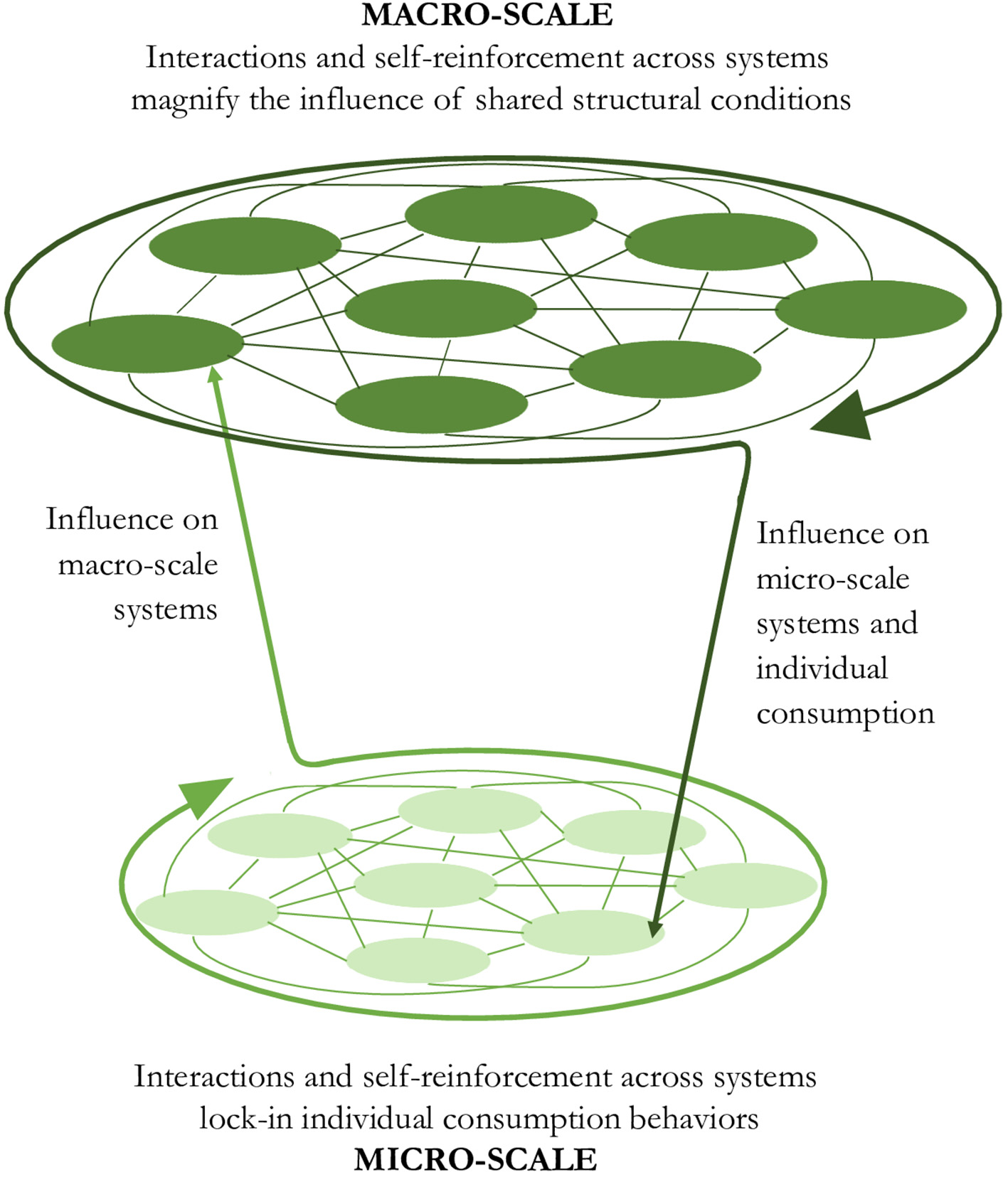
Mechanisms contributing to the lock-in of urban consumption (Source: Authors).
In conceiving the top-down perspective, we make two proposals about the nature of consumption drivers and lock-in forces that originate from the macro scale. The first is that various systems at the macro scale will interact and self-reinforce, magnifying the cumulative influence of collectively provided structural conditions in urban areas (Bettencourt, 2013). Road transport, if viewed as a socio-technical system comprising several interlinked, self-reinforcing components (Geels, 2004), is an illustrative example. Here, a nexus of co-evolving, interlocked, and self-perpetuating factors at the macro scale may arise from policies that support passenger vehicle use through the provision of infrastructure like roads and bridges, the rise of a middle-income class, increasing production or availability of passenger vehicles in the market, and cultural identification with the car as a symbol of desire or a transportation norm (Cohen, 2012; Seto et al., 2016; Sovacool, 2017; Canitez, 2019).
The second proposal is that individual conditions at the micro scale are directly influenced and perpetrated by the collectively provided structural conditions at the macro scale (Janssen and Jager, 1999). For instance, increasing GDP at the macro scale often manifests as higher incomes for individuals and households, providing more opportunities for the consumption of resources, goods, and services (Spangenberg, 2014; Zaharia et al., 2019). This relationship has also been noted when the urban population size directly influences the density of the workplace or dwelling sizes due to less land availability (Aranda-Mena et al., 2018). Also commonly discussed, shared social norms or values can pose constraints or pressures on an agent's beliefs and preferences (Foxon, 2011; Biswas and Roy, 2015; Pekkanen, 2020). These can influence the practices of individuals, households, and organizations in diverse living activities such as bathing habits (Sovacool and Griffiths, 2020), dietary preferences (Einhorn, 2020), and choice of transport mode (Belgiawan et al., 2017).
The bottom-up perspective is inspired by the idea of dynamic agency (Elbasha and Wright, 2017). This encompasses two views. Conditions under the control or influence of individual agents may interact and self-reinforce to perpetuate unsustainable consumption behavior at the micro scale. Individual agents, organizations, or communities may also exercise their agency to contribute to continuing or reproducing larger structural factors originating from the macro scale (Phipps, 2001; Whittington, 2015). In addition, though it is beyond the scope of this paper, certain individual agents may succeed in transforming structural conditions (Corman, 2008).
Two postulations emerge from here. In the first, multiple systems at the micro scale can interact, reinforcing each other's influence to perpetuate the conditions that drive unsustainable consumption. For example, higher levels of disposable income or access to credit can incite the purchase of larger households or business premises, resulting in greater demand for energy, furniture, and household appliances due to the increased flooring area (Li et al., 2018; Sakah et al., 2019).
In the second postulation, individual factors at the micro scale can exert an upward influence on collective conditions at the macro scale, even stimulating change. Some have argued that agents have little control over structural forces (Jackson and Papathanasopoulou, 2008). But examples do exist where individual behavior has succeeded in influencing structural conditions at the macro scale (Spangenberg, 2014; Pekkanen, 2020). For example, the intellectual resources of individuals agents or organizations, when widely shared, can enrich the collective knowledge base of society (Kanger and Schot, 2016). And, though it is an atypical example, the individual beliefs and travel behavior of Greta Thunberg have circulated globally, arguably influencing collective norms and knowledge on climate change in many countries (Martiskainen et al., 2020).
Our attempt to conceptually integrate concepts of socio-technical lock-in with discussions of unsustainable consumption behavior draws inspiration from others. Notably, Kim and Kim (2020) highlighted that lock-in mechanisms can explain the loyalty of some consumers to certain consumption behaviors. Meanwhile Jackson and Papathanasopoulou (2008) explain that lock-in to unsustainable consumption patterns is exacerbated by the general inability of consumers to control the broader structural conditions shaping their surrounding urban environment.
Yet by adopting theories of lock-in and socio-technical systems in the domain of urban consumption, we acknowledge several challenges that arise. For example, though human agents can play a crucial role in triggering or inhibiting change in socio-technical systems (Borrás and Edler, 2014), the sustainability transitions literature on socio-technical systems and lock-in has been criticized for overemphasizing the influence of structural conditions and paying inadequate attention to individuals and agency (Duygan et al., 2021). However, by applying insights about socio-technical systems and lock-in while heeding the limitations of scholarship on urban consumption and sustainability transitions, an opportunity arises for a novel research perspective with a more comprehensive view of urban consumption. Importantly, this perspective can account for structural and individual factors, as well as interactions and lock-in that arise from the socio-technical systems that comprise cities.
Case Study: Lock-In to Private Passenger Vehicle Usage in Bangkok City
This section applies the above framework to a case study on Bangkok, to show how the various systems comprising urban environments can structurally lock-in consumption behavior to unsustainable practices and restrain the adoption of sustainable alternatives. We focus on urban mobility because individual transportation choices have a significant impact on the sustainability of cities (C40, 2018). Bangkok is an ideal case study to illustrate this. Private passenger vehicles have surpassed 6 million units to become the dominant means of urban transport (OTP, 2018). Applying the framework of lock-in factors affecting individual urban consumption shows that the deepening dependence on passenger vehicles can be largely explained by a suite of interactions and feedbacks occurring across multiple systems.
The case study first provides background information on car production and usage in Thailand. We then apply the lock-in framework to explore the interactions among various urban systems at macro and micro scales, showing how these structurally lock-in individual mobility behavior to relying on privately owned passenger vehicles. We focus on two consumption stages: vehicle purchasing and vehicle use. The core aim of this case study is to show how the interactions theorized in this paper can arise in the real world and perpetuate unsustainable mobility behavior. A full-fledged empirical analysis is beyond the scope of this study, but evidence is sourced from a wide range of documents, including policy documents, gray literature, and academic studies. To ensure a comprehensive understanding of the transport situation in Bangkok, literature was selected to ensure coverage of factors affecting a wide range of transport choices, such as passenger cars, walking, and public transport (including trains, buses, and bus rapid transit).
Background of Bangkok's Mobility
This case examines mobility behavior in Bangkok City (henceforth referred to as Bangkok). Surrounded by five vicinities, Bangkok lies at the heart of the broader Bangkok Metropolitan Region. The whole region comprises a diversity of density and land uses, ranging from dense downtown areas, semi-urban and industrial areas, over a vast area of 7,762 km2. National level policies are also examined when they affect urban development in Bangkok.
Triggered by its accelerating development and population growth, Bangkok's traffic situation is worsening, provoking the environmental and social consequences of a steep surge in privately owned passenger vehicles. The city's population increased from 6.4 million in 2000 to 10.7 million in 2021, a rate of 2.6% per year. It currently accommodates more than 13% of Thailand's total population and is home to some 6 million on-road passenger vehicles. The ratio of 0.6 vehicles per resident is twice as high as Tokyo's and three times higher than Beijing's.3
This explosion in the use of private passenger vehicles (see Figure 2) has occurred in a series of waves, one from 2011 to 2013 and another from 2018 to 2019. Despite the availability of diverse transport modes, such as buses and rapid rail transit, privately owned passenger vehicles have become the dominant mode of travel in Bangkok, making up around of 40% of journeys, followed by motorcycles with nearly 24% (OTP, 2018). The rapidly expanding fleet of motor vehicles has worsened the city's traffic conditions and air quality and has raised the urban temperature by contributing to the heat island effect (Attavanich, 2017; Khamchiangta and Dhakal, 2019). Motor vehicles thus damage public health, human welfare, and the economy (Uttamang et al., 2017). Indeed, the impacts of air pollution on health and life satisfaction have been estimated to cost around $6.17 billion annually during the first wave of car purchasing (Attavanich, 2017). Bangkok is often also alerted with days of harmful air pollution, its annual average for PM2.5 levels being more than four times the World Health Organization's target (IQAir, 2019). The dominant sources coming from traffic activities, PM2.5, PM10, O3, and SO3, are observed to be heavily contributing to non-accidental mortality, cardiopulmonary diseases, and lung cancer in the city (Chuersuwan et al., 2008; Guo et al., 2014; Fold et al., 2020).
Figure 2
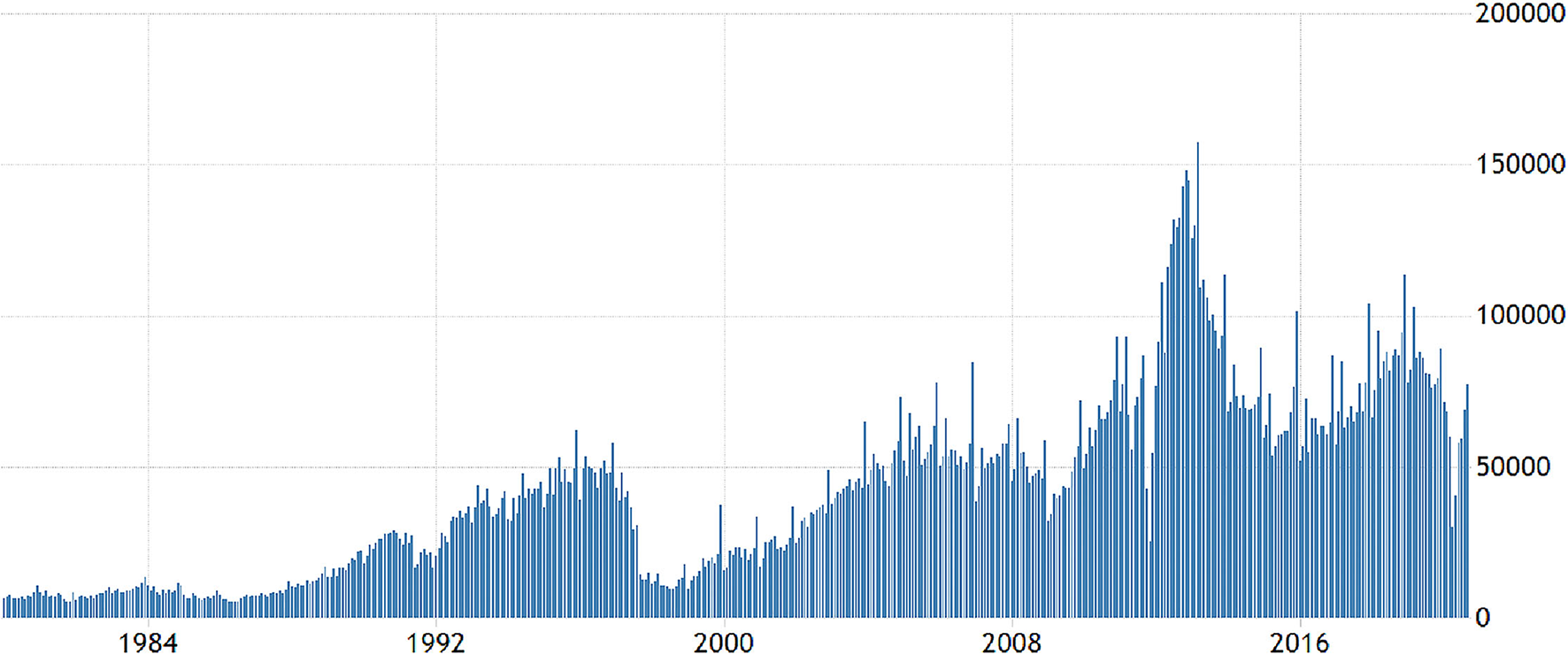
Thailand total vehicle sales 1980–2020 data (Trading Economics, 2021).
As we now demonstrate, the lock-in of unsustainable mobility behavior in Bangkok is the result of long-term interactions among multiple urban systems, at both macro and micro scales, which promote the purchase and use of privately owned passenger vehicles. The lock-in mechanism is summarized in Figure 3.
Figure 3
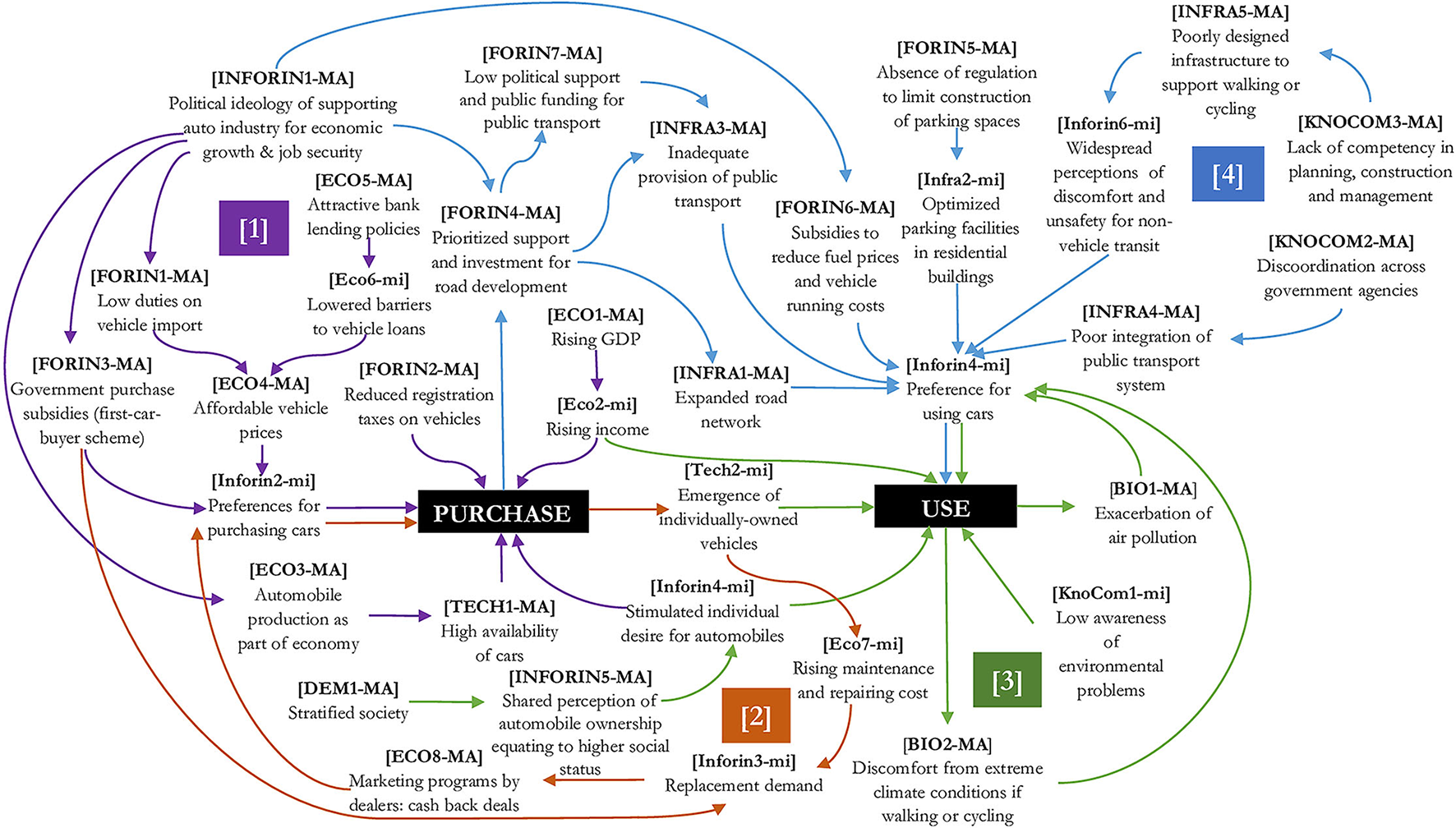
Visualization of mechanisms contributing to the lock-in of mobility based on individual passenger vehicles in Bangkok (Source: Authors).
Influence of Lock-In Factors on Vehicle Purchasing
We begin with vehicle purchases, both new and used. We focus first on two clusters of lock-in mechanisms, shown as [1] and [2] in Figure 3. The first cluster shows how informal institutions, formal institutions, economic forces, and technology availability at the macro scale intertwine to exert a downward impact on informal institutions at the micro scale. The second cluster starts with informal institutions at the micro scale, showing how these exert an upward influence on economic forces at the macro scale. To illustrate the persistence of the lock-in situation over time, while also addressing the changing relevance of various factors, we focus explicitly on different time periods when describing each cluster. When referring to the different systems of the lock-in framework, we use codes in the text and in Figure 3. For example, [ECO-MA] in upper case refers to economic forces at the macro scale, while [eco-mi] in lower case refers to economic forces at the micro scale.
The description of cluster [1] is strongly based on the first wave of car buying, between 2011 and 2013. Beginning with economic forces at the macro scale [ECO1-MA], rising GDP has boosted households' income and expenditure levels [eco2-mi].
In 2010, with the economy rebounding, Thailand's GDP per capita regained positive growth of 7.2% compared to 2009 (Pasuk and Pornthep, 2012). Bangkok's average monthly income per household continued to be ranked the highest in Thailand, hitting a peak of 49,000 THB (Thai baht) in 2011–2013 (NSO, 2019). The driving effect of this rising income on car ownership is stressed in multiple studies (Pongthanaisawan and Sorapipatana, 2010). For example, Taylor and Yue (2011) predicted that car ownership surpasses motorcycle ownership when household income exceeds around 50,000 THB per month. Thus, the increasing income triggered by economic growth gave many Bangkok residents the opportunity to purchase their first passenger vehicle.
Thailand has been by far the largest automobile producer [ECO3-MA] among ASEAN countries for the last 20 years (Figure 4). The high availability of automobiles for the domestic market [TECH1-MA] provides Thais with wide opportunities for purchasing. Indeed, Thailand has been called the “Detroit of Asia” (Wad, 2009; Wonglimpiyarat, 2016) owing to its success at attracting foreign automobile brands, mainly Japanese, to build factories on the outskirts of Bangkok (Warr and Kohpaiboon, 2017). Thus, compared to the populations of other ASEAN countries, Thai people benefit from low purchase costs for new vehicles, since locally produced vehicles are exempted from import tariffs.
Figure 4
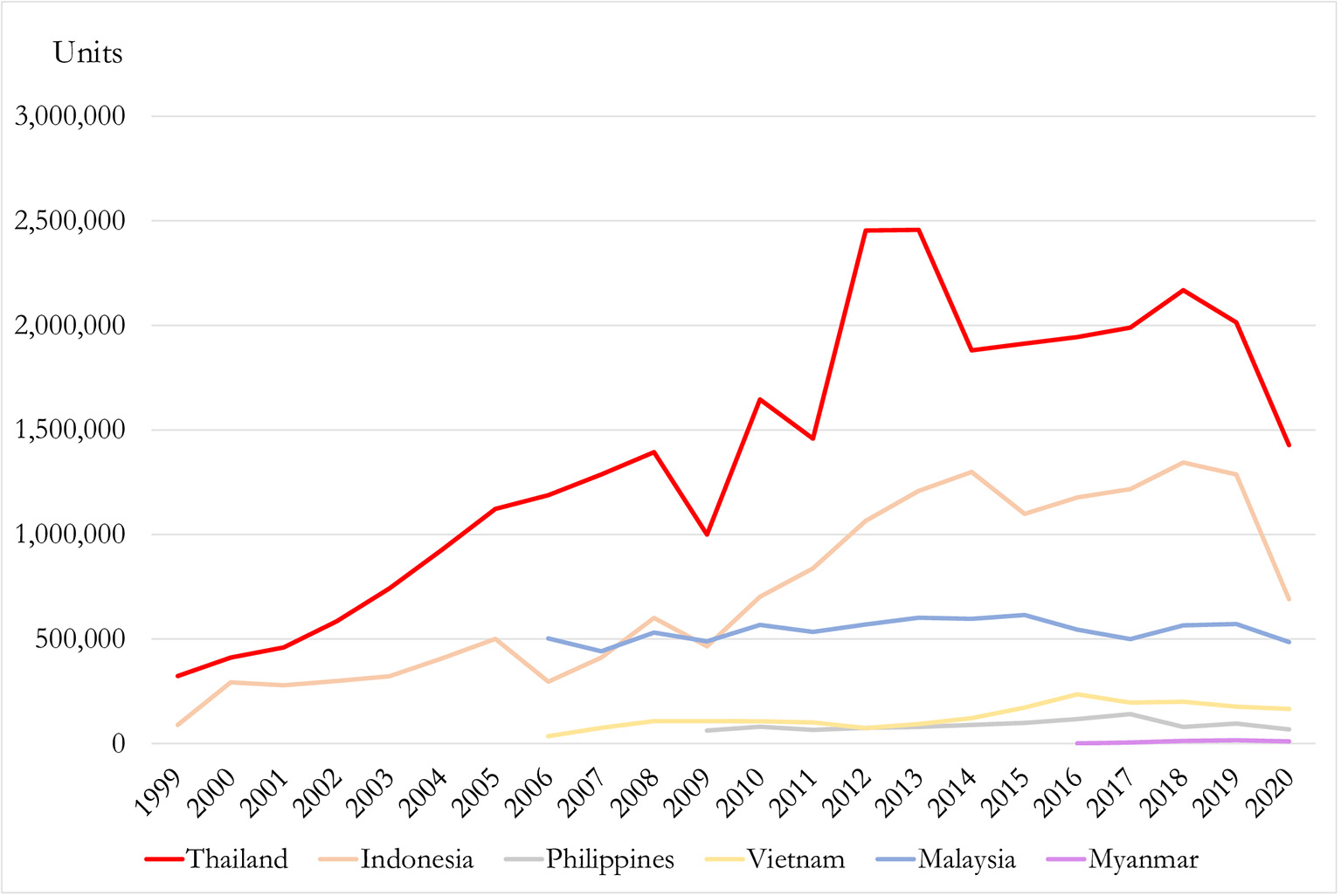
Yearly automobile production in ASEAN countries (Retrieved from AAF and OICA on July 15, 2021).
Informal institutions at the macro scale [INFORIN1-MA] also contributed to increased purchasing of private automobiles. National government policy propagated a political ideology around the automotive industry's important position in ensuring economic growth, stressing its creation of employment (Thailand Board of Investment, 2017) and its contribution of 12% to average annual GDP since 2012 (Pollio, 2012). Policies favorable to the automobile market were implemented as a result, aimed at shortening the gap between customers' income and purchase prices. For example, since the early development of the automotive industry in the 1990s, low import duties [FORIN1-MA] have persistently provided attractive market conditions, by ensuring affordable price choices of new vehicles [ECO4-MA] (Wu and Pojani, 2016). The used-vehicle market was also targeted by policies at the macro scale: the rate of annual registration taxes [FORIN2-MA] was lowered to make automobiles more affordable for lower-income households (Techakanont and Leelahanon, 2015).
Other informal institutions have also propelled vehicle purchases. After experiencing severe consequences from the Asian economic crisis of 1997 (Kittiprapas, 2000) and the recession during post-Thaksin's regime (2001–2006), the new government of Yingluck Shinawatra in 2011 continued the populist development strategy from their predecessor. This notably included establishing preferential policies to support the outputs of the domestic vehicle production sector (Chambers, 2013; Pollio and Rubini, 2021). In the second half of 2011, the government's first-time car-buyer tax rebates scheme [FORIN3-MA] was introduced to stimulate automobile purchasing over motorcycles, which were historically Thais' preferred choice for urban mobility. The scheme offered a tax rebate up to 100,000 THB (Muthitacharoen et al., 2019), equivalent to the average yearly income of low-income households. At the same time, banks' lending policies [ECO5-MA] acted as a supporting economic force, providing more opportunities for the rising urban middle class to obtain personal credit [eco6-mi]. The additional car purchases were even boosted in this period by competition across the banking industry, as many introduced subprime loans (Muthitacharoen et al., 2019). With loans authorized for many low-income applicants, and the above-mentioned subsidy accepted as a down payment, this interconnected web of economic forces and formal institutions at the macro scale shrank the gap between income and affordability. It thus shifted the purchase preferences of many first-time buyers [inforin2-mi] from motorcycles to automobiles. As a consequence of these driving forces originating from the macro scale, national sales reached 1.44 million in 2012, up 80% from 2011. This momentum was sustained, with 1.33 million purchases in 2013 (Krungsri Research, 2020). Demonstrating the shift, in Bangkok the number of registered automobiles exceeded, for the first time ever, the number of registered motorcycles in 2012 and 2013 (Figure 5).
Figure 5
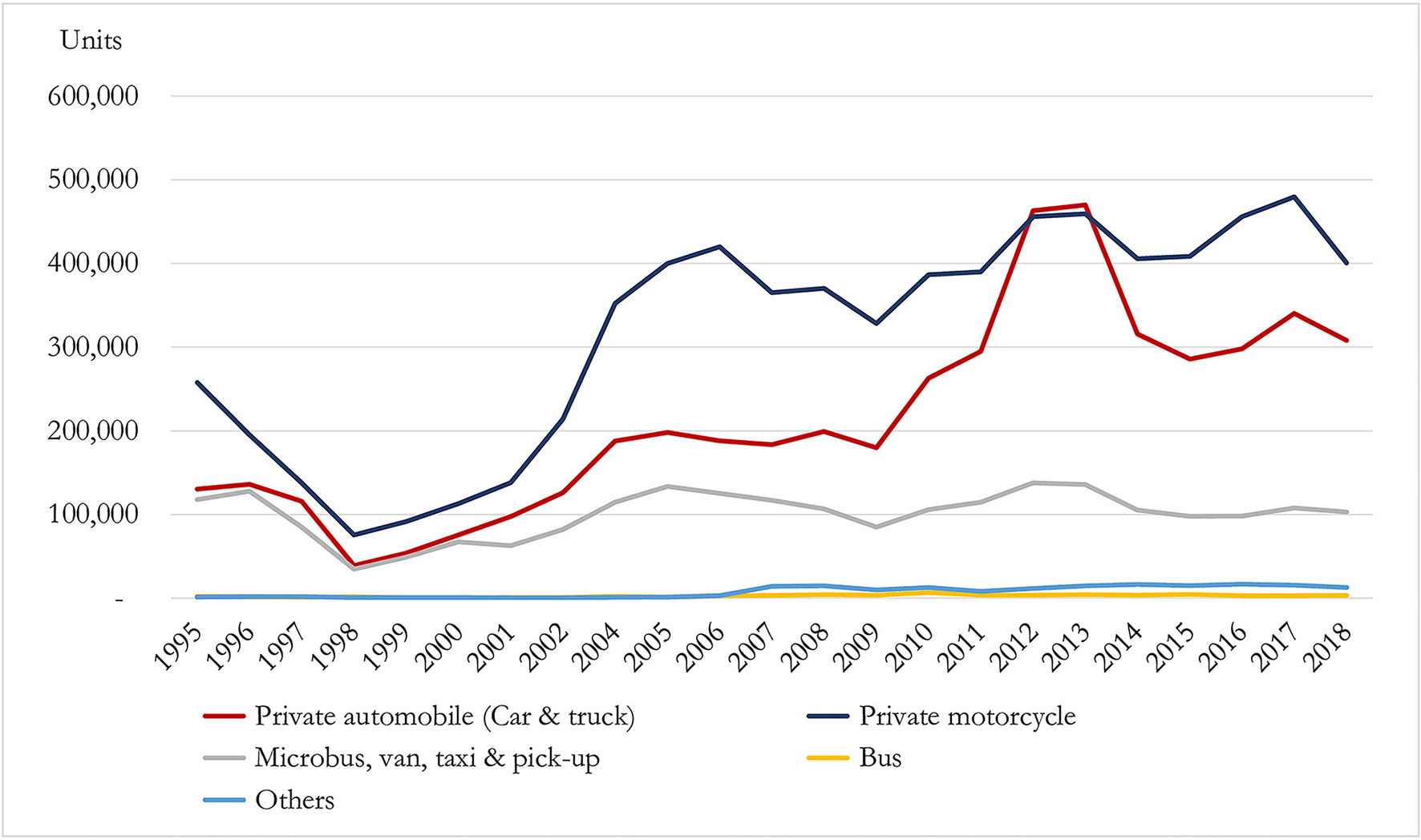
Number of newly registered vehicles in Bangkok (1995–2018) (Department of Land Transport, 2021).
Cluster [2] is linked to the second wave of car buying, from 2018 to 2019. Although car sales dropped dramatically after the first wave, the accumulated car ownership at the micro scale [tech2-mi] triggered a series of economic repercussions at the macro scale. The vast number of cars purchased during the first car buyer scheme (2011–2013) [FORIN3-MA] led to demand for replacement [inforin3-mi] as households became accustomed to the convenience of private automobile use. This occurred after around five years of ownership, largely during 2018 and 2019, as owners finished loan repayments and opted for replacement after considering the increasing repair costs for vehicles exiting the warranty period [eco7-mi] (Krungsri Research, 2020).
Macro-scale conditions reacted to this new market opportunity. Car dealers adopted aggressive marketing activities [ECO8-MA], such as cash-back deals for owners trading in vehicles early. Vehicle upgrading then reinforced many Bangkok residents' preference for private automobiles [inforin2-mi]. This created a stock of affordable used vehicles, lowering the financial barrier for lower-income households to acquire their first automobile. At the same time, Thailand's per capita GDP [ECO1-MA] recovered after a slight drop due to the influence of political uncertainty on the economy (BOT, 2014), reaching ~10% growth in 2017 (KNOEMA, 2021). The stimulated economic activity at the macro scale raised household incomes further [eco2-mi] (NSO, 2019).
Though the second wave was less pronounced than the first, dependence on private automobiles in Bangkok deepened once again, as a result of these interactions across multiple sub-systems, pushing annual car sales to pass 1 million in the following 2 years in 2018 and 2019 (Figure 2).
Influence of Lock-In Factors on Vehicle Use
We now examine how various urban systems have collectively fostered and locked-in urban mobility behavior that depends on private car use. We focus on two clusters of intertwined factors, marked as [3] and [4] in Figure 3. Cluster [3] illustrates an upward trajectory: how technology availability, informal institutions, and knowledge at the micro scale collectively influence biogeographic conditions at the macro scale. Cluster [4] illustrates a downward trajectory: how formal institutions along with knowledge and competencies at the macro scale collectively influence informal institutions at the micro scale. In contrast with the previous section, where we focused on two temporal events of vehicle purchasing, here we draw on different time periods and pieces of evidence to show how a temporally accumulated array of factors is perpetuating dependence on automobile use.
In cluster [3], mobility behavior is closely correlated with the availability of privately owned automobiles in households [tech2-mi]. Such ownership leads to more driving, and decreases the likelihood of owners walking, cycling, or using public transport (Pongprasert and Kubota, 2017; Witchayaphong et al., 2020). This causal trend is also stimulated by economic forces at the micro scale because, as more households enjoy higher incomes [eco2-mi], they become less sensitive to travel costs (Witchayaphong et al., 2020).
Moreover, for high-income Thais, the persistence of informal institutions at the micro scale, such as personal preference for car usage [inforins4-mi], can be explained not only by the relative levels of convenience, comfort, and safety—just as importantly, vehicle ownership gives them a desirable symbol of economic success and social status (Dissanayake and Morikawa, 2010; Pongthanaisawan and Sorapipatana, 2010; Matsuyuki et al., 2020). The correlation between private automobile ownership and social status has been described as a way for Bangkok's wealthy to save face and avoid the embarrassment of using public transport. These individual perceptions are influenced by widely circulated norms and societal values at the macro scale [INFORIN5-MA], with Thai society rooted in traditional class divisions separating the wealthy from the working class [DEM1-MA].
The literature also describes a self-reinforcing loop of exhaust fumes from the growing fleet of on-road vehicles and higher vehicle usage rates. Among all road transportation, passenger cars are the major contributor to worsening air quality in Bangkok [BIO1-MA] (Chuersuwan et al., 2008; Pongthanaisawan and Sorapipatana, 2010; Cheewaphongphan et al., 2017). Interestingly, the deterioration of air quality is exacerbated by low levels of environmental awareness [knocom1-mi], because many of Bangkok's citizens accept environmental problems such as air pollution as part of urban living. Furthermore, the extreme climate conditions [BIO2-MA] posed by high temperatures are worsened by the combined influence of climate change and the heat island effect. Bangkok's average surface temperatures have increased by more than 6°C from 1991 to 2016 (Khamchiangta and Dhakal, 2020); the use of automobiles, though it is not the major cause, has contributed to this anthropogenic heat flux (Khamchiangta and Dhakal, 2019). Alongside concerns about residents' physical and mental health on account of heat stress (Arifwidodo and Chandrasiri, 2020), the high relative humidity all year in Thailand (Taweekun and Tantiwichien, 2013) causes perspiration and body odor when walking to public transport stations. The air-conditioned comfort of private automobiles thus offers an attractive mobility option for many Bangkok residents [inforin4-mi].
In cluster [4], we highlight a further web of interactions and self-reinforcing loops that collectively contribute to locking-in reliance on private automobiles. In particular, we draw attention to the aggregated impacts of formal and informal institutions, infrastructure development, and the deficiency of knowledge and competences around integrated, sustainable transport planning. The first set of relations occurs between formal institutions and the expansion of road infrastructure. Thailand's road policies [FORIN4-MA] aim to meet the increasing demand for road space that has ensued from the surge in private vehicle purchases and the increase of freight traffic serving the automotive industry (Charoentrakulpeeti et al., 2006).
Specifically, the construction of vehicle-production factories on the outskirts of Bangkok has necessitated the investment of road infrastructure [INFRA1-MA] to attract foreign development investment and enable supply-chain development (Lecler, 2002; Chalermpong and Ratanawaraha, 2015). Japanese investments in particular have powered this trend. Indeed, 41% of foreign direct investment flows to Thailand for automobile and other industries between 2010 and 2017 have come from Japanese companies and government agencies (OECD, 2021). In parallel, after the first and second waves of car buying, successive infrastructure-development policies have sought to increase the convenience of car ownership by easing traffic congestion (Peungnumsai et al., 2020; Witchayaphong et al., 2020). This has resulted in a disproportionate allocation of public spending toward increasing Bangkok's road networks over other transport infrastructure, such as rail. Government data shows that road development has accounted for about 80% of the total annual investment budget for infrastructure development since 2009 (Ministry of Transport, 2020).
In particular, from 2016 to 2020, national highway development was the only category of transport infrastructure to receive increasing investment from government budgets and loans, rising around 10% compared to 2011–2015 (Ongkittikul, 2014). This directed public spending was underpinned by the government's goal to add 6,612 km of roadways across the country as part of its Intercity Motorway Development Master Plan. Formal commitments to expanding Thailand's road network continue. Setting a 20-year development plan for 2017–2036, the government is currently working to add more than 390,000 km of roads. These public investment policies have widened the gap between the development of road infrastructure and of alternative transport modes (OECD, 2020). And the resulting superior road network has increased people's preferences for using cars [inforin4-mi] (Wu and Pojani, 2016).
Use of private automobiles is also stimulated by other macro-scale formal institutions, such as government policies on buildings, fuel taxes, and tollway fees. The Thai Building Control Regulation [FORIN4-MA] has been criticized for failing to limit how much parking space can be installed around residential and office buildings (Chalermpong and Wibowo, 2007; Pongprasert and Kubota, 2018). This has led to a marked increase of parking spaces [infra2-mi] in private-sector-led real estate development, boosting the convenience of park-and-ride behavior for car users. Government policies—e.g., subsidies and tax breaks for consumers and the oil and gas industry—also incite vehicle use by reducing the burden of fuel costs [FORIN6-MA] (ADB, 2015). Meanwhile, tollway prices are subsidized to encourage road use (Charoentrakulpeeti et al., 2006).
With regard to the underdevelopment of public transportation, this is largely explained by the prioritization of road development in formal institutions [FORIN4-MA]. This has manifested as frequent political debates on the need for the state to invest in public transport. The development of public bus and rail networks has received inconsistent and less support [FORIN7-MA] than road development in terms of public funds, private investments, and development plans (Charoentrakulpeeti et al., 2006; Hossain, 2006) despite the its overloaded capacity (Peungnumsai et al., 2020). For example, a lack of political support has delayed the development and expansion of Bangkok's bus rapid transit system (BRT). The BRT—originally planned for 12 routes covering 185 km, as proposed in 2004—was delayed several times due to change in government and complicated institutional structures and bidding procedures. It finally opened in 2010, with coverage confined to a single 15 km route with low ridership capacity (Wu and Pojani, 2016). The BRT's limited coverage and capacity [INFRA3-MA] (Munira et al., 2013; Sanko et al., 2014; Pongprasert and Kubota, 2017) pose physical barriers to Bangkok residents able to access or ride public transport. These structural conditions at the macro scale thus reinforce preferences at the micro scale for using privately owned automobiles [inforins4-mi] (Witchayaphong et al., 2020).
Development of the public transportation network is also hampered by the impact of knowledge and competencies on infrastructure development. This occurs in two sequences of lock-in causes. The first starts from the low degree of coordination between the different government departments and agencies involved in Bangkok's transportation system [KNOCOM2-MA]. Though several national and city departments oversee urban transport planning, operation, regulation, monitoring, and so on, there is no agency that leads this effort or oversees collaboration among the relevant bodies. This has led to fragmented transport planning and inter-agency conflict (Hossain, 2006; Marks, 2020); it has also ultimately prevented the formation of an authoritative multi-modal transport master plan (Wu and Pojani, 2016).
The lack of coordinated competencies and planning to guide the sustainable development of Bangkok's transportation system has also hampered the emergence of efforts to integrate the different modes of transport (BRT, Metropolitan Rapid Transit, skyrail, etc.) [INFRA4-MA] (Ongkittikul, 2014). For example, Bangkok transport planners have missed an important opportunity to link and streamline fare collection for Metropolitan Rapid Transit and skyrail, which currently use separate systems (Chalermpong and Ratanawaraha, 2015). Most of BRT, meanwhile, lacks any integration with rail stations (Wu and Pojani, 2016). Inconveniences posed by the absence of an integrated ridership experience reduce accessibility to public transport, again increasing the probability of Bangkok residents using privately owned automobiles to fulfill their mobility needs.
The second sequence of lock-in causes relates to government agencies' limited competences in the design of safe and user-friendly infrastructures to promote the use of public transport [KNOCOM3-MA]. Understaffing and a lack of qualified technical consultants in public transportation agencies has resulted in poorly designed interconnectivity infrastructure [INFRA5-MA] around stations (Wu and Pojani, 2016). This occurs with the design of walkways in stations themselves (Prasertsubpakij and Nitivattananon, 2012) as much as the footpaths, pedestrian bridges, and shading devices (e.g., roofing or trees) around stations in the urban environment. The few Bangkok residents who choose to walk or cycle around thus feel uncomfortable and unsafe [inforin5-mi] (Prasertsubpakij and Nitivattananon, 2012; Munira et al., 2013). These structural conditions discourage residents from accessing stations on foot and push them further away from public transport, perpetuating demand for motorized travel, even for trips of just a few hundred meters.
Conclusion and Contributions to Literature
Unraveling the diverse factors that influence urban consumption is crucial for tracing the causes of unsustainable behaviors, and for understanding the interlinked processes that contribute to their persistence, reproduction, and self-reinforcement. Much literature has explored the drivers and barriers of urban consumption. Until now, however, limited attention has been paid to the interdependences and interactions among them. This is especially so for factors that cross the traditional division between “structure” and “agency” in consumption literature. Furthermore, the influence of broader structural conditions on consumption behavior has received less attention, because many studies have focused on individually shaped circumstances, such as psychological factors and willingness to adopt new technologies, services, or practices.
To fill this gap in scholarship, this study married theoretical insights from the field of urban consumption with conceptions of socio-technical lock-in from sustainability and energy transition studies. Combining these into a comprehensive framework, we developed a theoretical tool for understanding the interlinked and self-reinforcing drivers of consumption behavior from two perspectives: macro scale (shared structural factors) and micro scale (individually shaped factors). This framework accounts for the power of both structure and agency, and allows scholars to understand the complex and intertwined causal relations that can lock urban dwellers into unsustainable consumption patterns, stopping them adopting new and more sustainable behavior.
As well as contributing to consumption literature, our study helps to overcome some of the limitations of scholarship on socio-technical lock-in to date. By interpreting cities as a socio-technical system with biophysical and human features, our framework contains an explicitly geographical dimension that accounts for place-specific characteristics. This connection to place has largely lacked in the existent literature. Our study also focused on social aspects and the consumption behavior of urban dwellers. This helps to overcome the tendency for literature on socio-technical transitions and lock-in to overemphasize structural dimensions and to underemphasize the importance of agency and micro-scale factors.
To illustrate the explanatory power of this framework, we applied it to a case study of Bangkok to identify the numerous and varied causes of lock-in to automobile-based mobility. Our analysis revealed that a complex web of influencing factors and bidirectional relations has contributed to this lock-in. At the macro scale, important factors included informal institutions such as political ideologies about the economic importance of local automotive industry. These drive the formation of formal institutions that encourage the purchase of vehicles and the expansion of supporting infrastructure, such as roads. At the micro scale, important factors included the intertwined effect of economic forces (e.g., rising household income) and informal institutions (e.g., perceptions of increased social status from owning vehicles) on increasing tendencies to purchase and use vehicles. We noted several feedbacks occurring across these factors. One involved the increase in individually owned vehicles, where the need to replace these spurred vigorous marketing strategies from car dealers. New car purchases led to more vehicles in the second-hand market being affordable for low-income households. Another self-reinforcing loop occurs as vehicle numbers grow, causing a demand for greater road capacity, which is subsequently met through government policy. The expanded road network increases the convenience of driving, which reinforces preferences for and lock-in to mobility based on individually owned automobiles.
The case study provides several important insights for policies to rupture the dynamics that perpetuate lock-in to unsustainable passenger mobility in the vast urban areas within and around Bangkok. Overall, development policies should avoid creating additional structural conditions that lock residents further into environmentally polluting mobility systems based on conventional automobiles. First and foremost, urban planning policies and greater public investments are needed to provide a diversity of alternatives to car-based travel and to realize the full potential of Bangkok's inefficient and poorly linked public transport network. Second, this study determined multiple situations where economic policies are fundamental drivers of individual consumption—in this case, the purchase of new vehicles. Therefore, policy changes should aim to shift consumer preferences toward sustainable vehicle choices, balancing development with environmental protection goals. For example, while gradually abolishing incentives for the purchase of gasoline engines along with fuel subsidies, new policies should be introduced to spur the purchase of compact-sized electric or hybrid vehicles. This would also necessitate public investments in charging infrastructure. Furthermore, government authorities should consider taking early actions on the eventual need to curb automaker investments in the production of vehicles with internal combustion engines. Governmental policies in many nations are increasingly restricting the production of this technology while setting target years for a complete phase-out. Authorities in Bangkok and Thailand may therefore be in the process of supporting the development of an industry with limited prospects for export. The state could look to other Asian neighbors such as China for lessons on how to steer the automobile industry toward a sustainable growth trajectory, focusing on electric, automated, and connected vehicles.
Future research could address the limitations of this study. Scholars could apply the framework empirically to other types of consumption behavior beyond mobility, such as food, fashion, housing, and energy. This study was unable to systematically determine the relative importance of influencing factors. Future studies could tackle this, perhaps by including quantitative methods such as cross-impact analyses that use survey data from consumers or experts, for example. By inviting respondents to rank the importance of particular factors, such approaches could sketch causal relationships and hierarchical structures more systematically and objectively. This could boost the practical value of the framework, by identifying both known and unknown sources. The results could then be used to identify strategies for disrupting the most important drivers of lock-in to unsustainable consumption behavior in specific cities.
Funding
The research was supported by Kaken Funds (Grant Numbers 19K20501 and 21H03666) from the Japan Society for the Promotion of Science.
Publisher's Note
All claims expressed in this article are solely those of the authors and do not necessarily represent those of their affiliated organizations, or those of the publisher, the editors and the reviewers. Any product that may be evaluated in this article, or claim that may be made by its manufacturer, is not guaranteed or endorsed by the publisher.
Statements
Data availability statement
The original contributions presented in the study are included in the article/supplementary material, further inquiries can be directed to the corresponding author.
Author contributions
NT, GT, and KM designed the study and edited the final version. NT collected and analyzed data. NT and GT wrote the original draft. All authors provided input into the draft and final manuscript.
Conflict of interest
The authors declare that the research was conducted in the absence of any commercial or financial relationships that could be construed as a potential conflict of interest.
Footnotes
1.^ Globally, the 2.3% increase in energy consumption is responsible for an energy-related CO2 emissions rise to 33.1 Gt CO2, up 1.7% in 2018 (IEA, 2019).
2.^ The urban heat island phenomenon occurs when urban areas experience a higher temperature at day or night than outlying areas. This typically results from land transformation after the reduction of forest or vegetation cover, the increase of artificial surfaces such as concrete, bitumen and buildings, and exhaust heat from vehicles, air-conditioners, and industrial activities.
3.^ The total number of automobiles registered in Tokyo in 2019 was nearly 4 million, equivalent to around 0.3 per resident (Automobile Inspection and Registration Information Association, 2019). In Beijing in 2017 the ratio was around 0.2 per resident (Gao et al., 2020).
References
1
ADB. (2015). Fossil Fuel Subsidies in Thailand: Trends, Impacts, and Reforms. Available online at: www.adb.org (accessed August 15, 2020).
2
Algesheimer R. Dholakia U. M. Herrmann A. (2005). The social influence of brand community: evidence from European car clubs. J. Mark.69, 19–34. 10.1509/jmkg.69.3.19.66363
3
Alizadeh T (2017). An investigation of IBM's smarter cites challenge: what do participating cities want?Cities63, 70–80. 10.1016/j.cities.2016.12.009
4
Aranda-Mena G. Dahl Lund J. Dahl C. (2018). “Learning from dense cities: Hong Kong spatial constructs as narratives,” in 52nd International Conference of the Architectural Science Association, December, 753–759. Available online at: https://www.researchgate.net/publication/330823624 (accessed August 15, 2020).
5
Arifwidodo S. D. Chandrasiri O. (2020). Urban heat stress and human health in Bangkok, Thailand. Environ. Res.185:109398. 10.1016/j.envres.2020.109398
6
Attavanich W (2017). “Impact of the first-time car buyer program on the environmental cost of air pollution in Bangkok,” in Kuala Lumpur Seminar Series, 83170.
7
Automobile Inspection Registration Information Association. (2019). Number of Vehicles Owned by Prefecture/Vehicle Type. Available online at: https://www.airia.or.jp/publish/statistics/number.html (accessed November 10, 2020).
8
Barnes W. Gartland M. Stack M. (2004). Old habits die hard: path dependency and behavioral lock-in. J. Econ. Issues38, 371–377. 10.1080/00213624.2004.11506696
9
Belgiawan P. F. Schmöcker J. D. Abou-Zeid M. Walker J. Fujii S. (2017). Modelling social norms: Case study of students' car purchase intentions. Travel Behav. Soc.7, 12–25. 10.1016/j.tbs.2016.11.003
10
Bengtsson M. Alfredsson E. Cohen M. Lorek S. Schroeder P. (2018). Transforming systems of consumption and production for achieving the sustainable development goals: moving beyond efficiency. Sustain. Sci.13, 1533–1547. 10.1007/s11625-018-0582-1
11
Bereznicka J. Pawlonka T. (2018). Meat consumption as an indicator of economic well-being—case study of a developed and developing economy. Acta Sci. Polon. Oecon.17, 17–26. 10.22630/aspe.2018.17.2.17
12
Besagni G. Borgarello M. (2018). The determinants of residential energy expenditure in Italy. Energy.165, 369–386. 10.1016/j.energy.2018.09.108
13
Bettencourt L. M. A (2013). The origins of scaling in cities. Science.340, 1438–1441. 10.1126/science.1235823
14
Biswas A. Roy M. (2015). Leveraging factors for sustained green consumption behavior based on consumption value perceptions: testing the structural model. J. Clean. Prod.95, 332–340. 10.1016/j.jclepro.2015.02.042
15
Böcker L. Priya T. Liu C. Dijst M. (2019). Weather and daily mobility in international perspective : a cross-comparison of Dutch, Norwegian and Swedish city regions. Transport. Res. Part D77, 491–505. 10.1016/j.trd.2019.07.012
16
Borrás S. Edler J. (2014). The governance of change in socio-technical and innovation systems: three pillars for a conceptual framework. Govern. Socio-Tech. Syst. Exp. Change2018, 23–48. 10.4337/9781784710194.00011
17
BOT. (2014). Thailand's Economic Conditions in 2014. Available online at: https://www.bot.or.th/English/MonetaryPolicy/EconomicConditions/AnnualReport/AnnualReport/Annual_eng_2014.pdf (accessed on February 5, 2021).
18
Boucher J. L (2016). Culture, carbon, and climate change: a class analysis of climate change belief, lifestyle lock-in, and personal carbon footprint. Soc. Ecol. J. Environ. Thought Sociol. Res.25, 53–80. 10.17234/SocEkol.25.1.3
19
Burge P. Fox J. Kouwenhoven M. Rohr C. Wigan M. R. (2007). Modeling of motorcycle ownership and commuter usage: a UK study. Transp. Res. Rec.2031, 59–68. 10.3141/2031-08
20
C40 Arup. (2019). The Future of Urban Consumption in a 1.5°C World. Available online at: https://www.c40.org/consumption (accessed January 8, 2020).
21
C40. (2018). Consumption-based GHG emissions of C40 cities (Issue March). Available online at: https://c40-production-images.s3.amazonaws.com/researches/images/68_C40_CBE_Report_FINAL.original.pdf?1520350162 (accessed January 8, 2020).
22
Cachinho H (2014). Consumerscapes and the resilience assessment of urban retail systems. Cities36, 131–144. 10.1016/j.cities.2012.10.005
23
Canitez F (2019). Pathways to sustainable urban mobility in developing megacities: a socio-technical transition perspective. Technol. Forecast. Social Change141, 319–329. 10.1016/j.techfore.2019.01.008
24
Cecere G. Corrocher N. Gossart C. Ozman M. (2014). Lock-in and path dependence: an evolutionary approach to eco-innovations. J. Evol. Econ.24, 1037–1065. 10.1007/s00191-014-0381-5
25
Chalermpong S. Ratanawaraha A. (2015). How land use affects station access behaviors of bus rapid transit passengers in Bangkok, Thailand. Transp. Res. Rec.2533, 50–59. 10.3141/2533-06
26
Chalermpong S. Wibowo S. S. (2007). Transit station access trips and factors affecting propensity to walk to transit stations in Bangkok, Thailand. J. Eastern Asia Soc. Transp. Stud.7, 1806–1819. 10.11175/eastpro.200
27
Chambers P (2013). Economic guidance and contestation: an analysis of Thailand's evolving trajectory of development. J. Curr. Southeast Asian Aff.32, 81–109. 10.1177/186810341303200104
28
Chandrashekeran S (2016). Multidimensionality and the multilevel perspective: territory, scale, and networks in a failed demand-side energy transition in Australia. Environ. Plan. A48, 1636–1656. 10.1177/0308518X16643728
29
Chapman A. Itaoka K. (2018). Curiosity, economic and environmental reasoning: public perceptions of liberalization and renewable energy transition in Japan. Energy Res. Social Sci.37, 102–110. 10.1016/j.erss.2017.09.026
30
Charoentrakulpeeti W. Sajor E. Zimmermann W. (2006). Middle-class yravel patterns, predispositions and attitudes, and present-day transport policy in Bangkok, Thailand. Transp. Rev.26, 693–712. 10.1080/01441640600746927
31
Cheewaphongphan P. Junpen A. Garivait S. Chatani S. (2017). Emission inventory of on-road transport in bangkok metropolitan region (BMR) development during 2007 to 2015 using the GAINS model. Atmosphere.8:167. 10.3390/atmos8090167
32
Chuersuwan N. Nimrat S. Lekphet S. Kerdkumrai T. (2008). Levels and major sources of PM2.5 and PM10 in Bangkok Metropolitan Region. Environ. Int.34, 671–677. 10.1016/j.envint.2007.12.018
33
Clammer J (1997). Contemporary Urban Japan—A Sociology of Consumption. Hoboken, NJ: Blackwell.
34
Cohen M (2012). The future of automobile society: a socio-technical transitions perspective. Technol. Anal. Strat. Manag.24, 377–390. 10.1080/09537325.2012.663962
35
Cohen M. Murphy J. (2001). Exploring Sustainable Consumption: Environmental Policy and the Social Sciences. Newark, NJ: New Jersey Institute of Technology.
36
Cohen M. J (2005). Sustainable consumption in national context: an introduction to the special issue. Sustain. Sci. Pract. Policy1, 22–28. 10.1080/15487733.2005.11907962
37
Corman S. R (2008). Structuration Theory. International Encyclopedia of Communication. Oxford, UK: Oxford University Press. 10.1002/9781405186407.wbiecs111
38
Coşgel M. M (1997). Consumption institutions. Rev. Soc. Econ.55, 153–171. 10.1080/00346769700000031
39
Davis D. R. Dingel J. I. Monras J. Morales E. (2019). How segregated is urban consumption?Joan Monras. J. Polit. Econ.127, 1684–1738. 10.1086/701680
40
Dawkins E. Andr,é K. Axelsson K. Benoist L. Swartling Å. G. Persson Å. (2019). Advancing sustainable consumption at the local government level: a literature review. J. Clean. Prod.231, 1450–1462. 10.1016/j.jclepro.2019.05.176
41
de Koning J. I. J. C. Ta T. H. Crul M. R. M. Wever R. Brezet J. C. (2016). GetGreen Vietnam: towards more sustainable behaviour among the urban middle class. J. Clean. Prod. 10.1016/j.jclepro.2016.01.063
42
De Rubens G. Z. Noel L. Sovacool B. K. (2018). Dismissive and deceptive car dealerships create barriers to electric vehicle adoption at the point of sale. Nat. Energy3, 501–507. 10.1038/s41560-018-0152-x
43
Delgado C. L (2003). Rising consumption of meat and milk in developing countries has created a new food revolution. J. Nutr.133, 3907–3910. 10.1093/jn/133.11.3907s
44
Department of Land Transport. (2021). Statistics on the Number of Newly Registered Vehicles in Bangkok, From 1995 to 2018. Available online at: http://apps.dlt.go.th/statistics_web/statistics.html (accessed May 7, 2021).
45
Diehl J. A. Sweeney E. Wong B. Sia C. S. Yao H. Prabhudesai M. (2020). Feeding cities: Singapore's approach to land use planning for urban agriculture. Glob. Food Sec. 26, 100377. 10.1016/j.gfs.2020.100377
46
Ding C. Cao X. Liu C. (2019). How does the station-area built environment influence Metrorail ridership? Using gradient boosting decision trees to identify non-linear thresholds. J. Transp. Geogr.77, 70–78. 10.1016/j.jtrangeo.2019.04.011
47
Dissanayake D. Morikawa T. (2010). Investigating household vehicle ownership, mode choice and trip sharing decisions using a combined revealed preference/stated preference Nested Logit model: case study in Bangkok Metropolitan Region. J. Transp. Geogr.18, 402–410. 10.1016/j.jtrangeo.2009.07.003
48
Duygan M. Kachi A. Oliveira T. D. Rinscheid A. (2021). Introducing the Endowment-Practice-Institutions (EPI) framework for studying agency in the institutional contestation of socio-technical regimes. J. Clean. Prod.296:126396. 10.1016/j.jclepro.2021.126396
49
Eades P. Kusch-Brandt S. Heaven S. Banks C. J. (2020). Estimating the generation of gardenwaste in England and the differences between rural and urban areas. Resources9, 1–23. 10.3390/resources9010008
50
Edmondson D. L. Kern F. Rogge K. S. (2019). The co-evolution of policy mixes and socio-technical systems: towards a conceptual framework of policy mix feedback in sustainability transitions. Res. Policy48:103555. 10.1016/j.respol.2018.03.010
51
EEA . (2012). Consumption and the Environment–2012 Update: The European Environment—State and Outlook 2010.Brussels: EEA.
52
Einhorn L (2020). Normative Social Influence on Meat Consumption Laura Einhorn MPIfG Discussion Paper. MPIfG Discussion Paper. Available online at: https://pure.mpg.de/rest/items/item_3196378/component/file_3204446/content (accessed March 5, 2021).
53
Elbasha T. Wright A. (2017). Reconciling structure and agency in strategy -as-practice research: Towards a strong- structuration theory approach. Management20, 107–128. 10.3917/mana.202.0107
54
Eom J. Hyun M. Lee J. Lee H. (2020). Increase in household energy consumption due to ambient air pollution. Nat. Energy5, 976–984. 10.1038/s41560-020-00698-1
55
Erickson P. Lazarus M. Tempest K. (2015). Carbon Lock-in from Fossil Fuel Supply Infrastructure. SEI Discussion Brief, 2015. Available online at: https://mediamanager.sei.org/documents/Publications/Climate/SEI-DB-2015-Carbon-lock-in-supply-side.pdf
56
Fell H. Li S. Paul A. (2014). A new look at residential electricity demand using household expenditure data. Int. J. Indus. Organ.33, 37–47. 10.1016/j.ijindorg.2014.02.001
57
Fold N. R. Allison M. R. Wood B. C. Thao P. T. B. Bonnet S. Garivait S. et al . (2020). An assessment of annual mortality attributable to ambient PM2.5 in Bangkok, Thailand. Int. J. Environ. Res. Public Health17, 1–14. 10.3390/ijerph17197298
58
Foxon T. J (2002). Technological and institutional ‘ lock-in ' as a barrier to sustainable innovation. Change, 1–9. Available online at: http://www.iccept.ic.ac.uk (accessed January 8, 2021).
59
Foxon T. J (2011). A coevolutionary framework for analysing a transition to a sustainable low carbon economy. Ecol. Econ.70, 2258–2267. 10.1016/j.ecolecon.2011.07.014
60
Frank B (2017). Urban systems: a socio-ecological system perspective. Sociol. Int. J.1, 1–8. 10.15406/sij.2017.01.00001
61
Fuchs D. A. Lorek S. (2005). Sustainable consumption governance: a history of promises and failures. J. Consumer Policy28, 261–288. 10.1007/s10603-005-8490-z
62
Gao Y. Newman P. Kenworthy J. (2020). The rise and decline of car use in Beijing and Shanghai. Sustain. Urban Plan. Des. 279–290. 10.5772/intechopen.90130
63
Gasper D. Shah A. Tankha S. (2019). The framing of sustainable consumption and production in SDG 12. Global Policy10, 83–95. 10.1111/1758-5899.12592
64
Geels F. W (2004). From sectoral systems of innovation to socio-technical systems: insights about dynamics and change from sociology and institutional. Res. Policy. 33, 897–920. 10.1016/j.respol.2004.01.015
65
Geels F. W (2018). Disruption and low-carbon system transformation: progress and new challenges in socio-technical transitions research and the Multi-Level Perspective. Energy Res. Social Sci37, 224–231. 10.1016/j.erss.2017.10.010
66
Geels F. W. Schot J. (2007). Typology of sociotechnical transition pathways. Res. Policy36, 399–417. 10.1016/j.respol.2007.01.003
67
Giddens A (1984). The Constitution of Society: Outline of the Theory of Structuration. California: University of California.
68
Goodwin N. Development G. Library S. S. Thinking F. Development S. Well-being H. et al . (2018). Macroeconomics in Context. London: Routledge.
69
Grimm N. B. Faeth S. H. Golubiewski N. E. Redman C. L. Wu J. Bai X. et al . (2008). Global change and the ecology of cities. Science.319, 756–760. 10.1126/science.1150195
70
Guan H. Soebarto V. Bennett J. Clay R. Andrew R. Guo Y. et al . (2014). Response of office building electricity consumption to urban weather in Adelaide, South Australia. Urban Climate10, 42–55.
71
Guo Y. Li S. Tawatsupa B. Punnasiri K. Jaakkola J. J. K. Williams G. (2014). The association between air pollution and mortality in Thailand. Sci. Rep.4, 1–8. 10.1038/srep05509
72
Hagen J. X. Pardo C. F. Valente J. B. (2016). Motivations for motorcycle use for Urban travel in Latin America: a qualitative study. Transport Policy49, 93–104. 10.1016/j.tranpol.2016.04.010
73
Haque M. B. Choudhury C. Hess S. Sourd R. C. . (2019). dit Modelling residential mobility decision and its impact on car ownership and travel mode. Travel Behav. Soc.17, 104–119. 10.1016/j.tbs.2019.07.005
74
Hodson M. Marvin S. (2010). Can cities shape socio-technical transitions and how would we know if they were?Res. Policy39, 477–485. 10.1016/j.respol.2010.01.020
75
Hossain M (2006). The issues and realities of BRT planning initiatives in developing Asian cities. J. Public Transp.9, 69–87. 10.5038/2375-0901.9.3.4
76
Hult A. Larsson J. (2016). Possibilities and problems with applying a consumption perspective in local climate strategies—the case of Gothenburg, Sweden. J. Clean. Prod.134, 434–442. 10.1016/j.jclepro.2015.10.033
77
IEA . (2019). Global Energy and CO2 Status Report: the Lastest Trends in Energy and Emissions in 2018. Paris: IEA
78
IQAir. (2019). World Air Quality Report. 2019 World Air Quality Report, August, 1–35. Available online at: https://www.iqair.com/world-most-polluted-cities/world-air-quality-report-2019-en.pdf
79
Jackson T. Papathanasopoulou E. (2008). Luxury or “lock-in”? An exploration of unsustainable consumption in the UK: 1968 to 2000. Ecol. Econ.68, 80–95. 10.1016/j.ecolecon.2008.01.026
80
Janssen M. Jager W. (1999). An integrated approach to simulating behavioural processes: a case study of the lock-in of consumption patterns. J. Artif. Soc. Social Simul.2, 21–35.
81
Jayne M (2005). Cities and Consumption. London: Routledge.
82
Jim C. Y (2016). Urban biogeography. International Encyclopedia of Geography: People, the Earth, Environment and Technology: People, the Earth, Environment and Technology.New York, NY: Wiley, 1–4.
83
Jones R. V. Fuertes A. Lomas K. J. (2015). The socio-economic, dwelling and appliance related factors affecting electricity consumption in domestic buildings. Renew. Sustain. Energy Rev.43, 901–917. 10.1016/j.rser.2014.11.084
84
Jørgensen U (2012). Mapping and navigating transitions - The multi-level perspective compared with arenas of development. Res. Policy41, 996–1010. 10.1016/j.respol.2012.03.001
85
Kaklauskas A. Gudauskas R. (2016). “Intelligent decision-support systems and the Internet of Things for the smart built environment,” in: Start-Up Creation: The Smart Eco-Efficient Built Environment. Amsterdam: Elsevier.
86
Kanger L. Schot J. (2016). User-made immobilities: a transitions perspective. Mobilities11, 598–613. 10.1080/17450101.2016.1211827
87
Khamchiangta D. Dhakal S. (2019). Physical and non-physical factors driving urban heat island: Case of Bangkok Metropolitan Administration, Thailand. J. Environ. Manag.248:109285. 10.1016/j.jenvman.2019.109285
88
Khamchiangta D. Dhakal S. (2020). Time series analysis of land use and land cover changes related to urban heat island intensity: case of Bangkok Metropolitan Area in Thailand. J. Urban Manag.9, 383–395. 10.1016/j.jum.2020.09.001
89
Kim B. Kim D. (2020). Attracted to or locked in? Explaining consumer loyalty toward airbnb. Sustainability12, 1–19. 10.3390/su12072814
90
Kirchberg V (2007). Cultural consumption analysis: Beyond structure and agency. Cult. Sociol.1, 115–135. 10.1177/1749975507073926
91
Kittiprapas S (2000). “Thailand: The Asian financial crisis and social changes,” in The Social Impact of the Asia Crisis. London: PalgraveMacmillan, 35–56.
92
KNOEMA. (2021). Thailand - Gross Domestic Product Per Capita in Current Prices. Available online at: https://knoema.com/atlas/Thailand/topics/Economy/National-Accounts-Gross-Domestic-Product/GDP-per-capita?action=exportandgadget=indicator-preview-host (accessed February 5, 2021).
93
Krishna G (2021). Understanding and identifying barriers to electric vehicle adoption through thematic analysis. Transp. Res. Interdiscip. Perspect.10:100364. 10.1016/j.trip.2021.100364
94
Krungsri Research (2020). Thailand Industry OUtlook 2020–2022: Automobile Industry. Krungsri Research
95
Kurniawan R. Trencher G. P. Edianto A. S. Setiawan I. E. Matsubae K. (2020). Understanding the multi-faceted drivers of increasing coal consumption in Indonesia. Energies13, 1–22. 10.3390/en13143660
96
Lariviere I. Lafrance G. (1999). Modelling the electricity consumption of cities: effect of urban density. Energy Econ.21, 53–66.
97
Lazzarini G. A. Visschers V. H. M. Siegrist M. (2018). How to improve consumers' environmental sustainability judgements of foods. J. Clean. Prod.198, 564–574. 10.1016/j.jclepro.2018.07.033
98
Lecler Y (2002). The cluster role in the development of the Thai car industry. Int. J. Urban Reg. Res.26, 799–814. 10.1111/1468-2427.00419
99
Li C. Song Y. Kaza N. (2018). Urban form and household electricity consumption: a multilevel study. Energy Build.158, 181–193. 10.1016/j.enbuild.2017.10.007
100
Lipson M. J. Thatcher M. Hart M. A. (2019). Climate change impact on energy demand in building-urban-atmosphere simulations through the 21st century. Environ. Res. Lett.14:125014. 10.1088/1748-9326/ab5aa5
101
Lo K. Mah D. N. Wang G. Leung M. K. H. Lo A. Y. Hills P. (2018). Barriers to adopting solar photovoltaic systems in Hong Kong. Energy Environ.29, 649–663. 10.1177/0958305X18757402
102
Lorek S. Fuchs D. (2013). Strong sustainable consumption governance—precondition for a degrowth path?J. Clean. Prod.38, 36–43. 10.1016/j.jclepro.2011.08.008
103
Lorek S. Spangenberg J. H. (2014). Sustainable consumption within a sustainable economy—beyond green growth and green economies. J. Clean. Prod.63, 33–44. 10.1016/j.jclepro.2013.08.045
104
Mah D. N. yin Wang G. Lo K. Leung M. K. H. Hills P. Lo A. Y. (2018). Barriers and policy enablers for solar photovoltaics (PV) in cities: perspectives of potential adopters in Hong Kong. Renew. Sustain. Energy Rev.92, 921–936. 10.1016/j.rser.2018.04.041
105
Maréchal K (2010). Not irrational but habitual: the importance of “behavioural lock-in” in energy consumption. Ecol. Econ.69, 1104–1114. 10.1016/j.ecolecon.2009.12.004
106
Markolf S. A. Chester M. V. Eisenberg D. A. Iwaniec D. M. Davidson C. I. Zimmerman R. et al . (2018). Interdependent Infrastructure as Linked Social, Ecological, and Technological Systems (SETSs) to Address Lock-in and Enhance Resilience. Earth's Future6, 1638–1659. 10.1029/2018EF000926
107
Marks D (2020). An urban political ecology of Bangkok's awful traffic congestion. Journal of Political Ecology27, 732–758. 10.2458/V27I1.23604
108
Martiskainen M. Axon S. Sovacool B. K. Sareen S. Furszyfer Del Rio D. Axon K. (2020). Contextualizing climate justice activism: knowledge, emotions, motivations, and actions among climate strikers in six cities. Global Environ. Change65, 102180. 10.1016/j.gloenvcha.2020.102180
109
Matsuyuki M. Aizu N. Nakamura F. Leeruttanawisut K. (2020). Impact of gentrification on travel behavior in transit-oriented development areas in Bangkok, Thailand. Case Stud. Transp. Policy8, 1341–1351. 10.1016/j.cstp.2020.09.005
110
McIntosh J. Trubka R. Kenworthy J. Newman P. (2014). The role of urban form and transit in city car dependence: analysis of 26 global cities from 1960 to 2000. Transp. Res. Part D: Transp. Environ.33, 95–110. 10.1016/j.trd.2014.08.013
111
Mckinsey . (2012). Urban World: Cities and the Rise of the Consuming Class.Washington, DC: McKinsey Global Institute.
112
Mckinsey. (2016). Urban World—the Global Consumers To Watch. McKinsey Global Insitute (Issue April). Available online at: https://www.mckinsey.com/~/media/McKinsey/FeaturedInsights/Urbanization/UrbanworldTheglobalconsumerstowatch/Urban-World-Global-Consumers-Full-Report.ashx (accessed July 8, 2020).
113
McKinsey . (2020). The Great Consumer Shift : Ten Charts That Show How US Shopping Behavior is Changing. Washington, DC: McKinsey Global Institute.
114
McMeekin A. Southerton D. (2012). Sustainability transitions and final consumption: Practices and socio-technical systems. Technol. Anal. Strat. Manag.24, 345–361. 10.1080/09537325.2012.663960
115
Meelen T. Frenken K. Hobrink S. (2019). Energy Research and Social Science Weak spots for car-sharing in The Netherlands? The geography of socio- technical regimes and the adoption of niche innovations. Energy Res. Social Sci.52, 132–143. 10.1016/j.erss.2019.01.023
116
Meng F. Liu G. Hu Y. Su M. Yang Z. (2018). From production to consumption: a multi-city comparative study of cross-regional carbon emissions. Energy Proc.152, 744–749. 10.1016/j.egypro.2018.09.239
117
Merfeld K. Wilhelms M. Henkel S. Kreutzer K. (2019). Technological Forecasting and Social Change Carsharing with shared autonomous vehicles : uncovering drivers, barriers and future developments—a four-stage Delphi study. Technol. Forecast. Soc. Change144, 66–81. 10.1016/j.techfore.2019.03.012
118
Miles S. Paddison R. (1998). Urban consumption: an historiographical note. Urban Stud.35, 815–823. 10.1080/0042098984565
119
Ministry of Transport . (2020). Transport Statistics 2018. Bangkok: Ministry of Transport.
120
Munira S. Sarm S. Santoso D. S. (2013). Perception of public van users in Bangkok. J. Eastern Asia Soc. Transp. Stud.10, 1501–1515. 10.11175/easts.12.2215
121
Muthitacharoen A. Samphantharak K. Chantarat S. (2019). Fiscal stimulus and debt burden: evidence from Thailand's first-car-buyer tax rebate program. Int. Tax Public Fin.26, 1383–1415. 10.1007/s10797-019-09549-6
122
Mylan J. Holmes H. Paddock J. (2016). Re-introducing consumption to the “circular economy”: A sociotechnical analysis of domestic food provisioning. Sustainability8:8080794. 10.3390/su8080794
123
Nguyen M. Q. Thanh T. Pham X. Thuy T. Phan H. (2019). Traffic Congestion—a prominent problem in vietnam current situation and solutions. Eur. J. Eng. Res. Sci.4, 112–116. 10.24018/ejers.2019.4.9.1524
124
Niinimäki K (2010). Eco-clothing, consumer identity and ideology. Sustain. Dev.18, 150–162. 10.1002/sd.455
125
Nissen K. M. Becker N. (2020). How does weather affect the use of public transport in Berlin? OPEN ACCESS How does weather affect the use of public transport in Berlin?
126
Niu H. J (2013). Cyber peers' influence for adolescent consumer in decision-making styles and online purchasing behavior. J. Appl. Soc. Psychol.43, 1228–1237. 10.1111/jasp.12085
127
NSO . (2019).
 2562
2562 .
.
128
OECD . (2020). The Overview of Economic Assessment of Thailand.Paris: OECD Publishing.
129
OECD . (2021). OECD Investment Policy Reviews: Thailand (OECD Inves). Paris: OECD Publishing.
130
Oliveira M. G. Vidal D. G. Ferraz M. P. (2020). Urban lifestyles and consumption patterns. Sustain. Cities Commun.2020, 851–860. 10.1007/978-3-319-95717-3_54
131
Ongkittikul S (2014). Chapter 9 Thailand Country Report, vol 15. Jakarta: ERIA. 351–396.
132
Orum A. M. Dunleavy P. (2019). Collective consumption. Wiley Blackwell Encycloped Urban Reg. Stud.2019, 1–8. 10.1002/9781118568446.eurs0052
133
OTP (2018). Travel Demand Freight Movement Survey For National Transport Planning.Beaverton, OR: OTP.
134
Ou S. Lin Z. He X. Przesmitzki S. (2018). Estimation of vehicle home parking availability in China and quantification of its potential impacts on plug-in electric vehicle ownership cost. Transp. Policy68, 107–117. 10.1016/j.tranpol.2018.04.014
135
Pasuk P. Pornthep B. (2012). Locked in the middle-income trap: Thailand ' s economy between resilience and future challenges. Friedrich Ebert Stiftung, March. Available online at: http://library.fes.de/pdf-files/bueros/thailand/09208.pdf (accessed February 5, 2020).
136
Patorniti N. P. Stevens N. J. Salmon P. M. (2017). A systems approach to city design: exploring the compatibility of sociotechnical systems. Habitat Int.66, 42–48. 10.1016/j.habitatint.2017.05.008
137
Patorniti N. P. Stevens N. J. Salmon P. M. (2018). A sociotechnical systems approach to understand complex urban systems: a global transdisciplinary perspective. Hum. Factors Ergon. Manuf.28, 281–296. 10.1002/hfm.20742
138
Pekkanen T. L (2020). Institutions and agency in the sustainability of day-to-day consumption practices: an institutional ethnographic study. J. Bus. Ethics. 168, 241–260. 10.1007/s10551-019-04419-x
139
Pereira Heath M. T. Chatzidakis A. (2012). “Blame it on marketing”: consumers' views on unsustainable consumption. Int. J. Consum. Stud.36, 656–667. 10.1111/j.1470-6431.2011.01043.x
140
Peungnumsai A. Miyazaki H. Witayangkurn A. Kim S. M. (2020). A grid-based spatial analysis for detecting supply—demand gaps of public transports: a case study of the bangkok metropolitan region. Sustainability12, 1–27. 10.3390/su122410382
141
Phipps A. G (2001). Empirical applications of structuration theory. Geogr. Ann. Ser. B Human Geogr.83, 189–204. 10.1111/j.0435-3684.2001.00106.x
142
Poças Ribeiro A. Harmsen R. Rosales Carreón J. Worrell E. (2019). What influences consumption? Consumers and beyond: purposes, contexts, agents and history. J. Clean. Prod.209, 200–215. 10.1016/j.jclepro.2018.10.103
143
Pollio C (2012). The Auto Industry in Thailand : Value Transfer, Technological Dependence and Relations Between Local and Foreign Capital (C. MET Working Paper, Issue Febuary 2012).
144
Pollio C. Rubini L. (2021). Who drives the automotive sector? Thailand selective policies. Int. J. Emerg. Markets16, 370–390. 10.1108/IJOEM-02-2018-0084
145
Pongprasert P. Kubota H. (2017). Why do TOD residents still use cars? Understanding the factors affecting the automobile ownership and use of residents living near transit stations of Bangkok. Urban Reg. Plan. Rev.4, 231–250. 10.1061/9780784481547.018
146
Pongprasert P. Kubota H. (2018). “The influences of built environment factors on mode switching of TOD residents from car use to transit dependence: case study of Bangkok, Thailand,” in International Conference on Transportation and Development 2018, 186–196. Available online at: http://www.asce-ictd.org/ (accessed April 20, 2020).
147
Pongthanaisawan J. Sorapipatana C. (2010). Relationship between level of economic development and motorcycle and car ownerships and their impacts on fuel consumption and greenhouse gas emission in Thailand. Renew. Sustain. Energy Rev.14, 2966–2975. 10.1016/j.rser.2010.07.034
148
Prasertsubpakij D. Nitivattananon V. (2012). Evaluating accessibility to Bangkok Metro Systems using multi-dimensional criteria across user groups. IATSS Research36, 56–65. 10.1016/j.iatssr.2012.02.003
149
Rajagopal R (2011). Consumer culture and purchase intentions toward fashion apparel in Mexico. Datab. Market. Customer Strat. Manag.18, 286–307. 10.1057/dbm.2011.33
150
Reindl K. Palm J. (2021). Installing PV: barriers and enablers experienced by non-residential property owners. Renew. Sustain. Energy Rev.141:110829. 10.1016/j.rser.2021.110829
151
Riordan T. O. Stoll-kleemann S. (2015). The challenges of changing dietary behavior toward more sustainable consumption. Environ. Sci. Policy Sustain. Dev.57, 4–13. 10.1080/00139157.2015.1069093
152
Roberts M. B. Bruce A. MacGill I. (2019). Opportunities and barriers for photovoltaics on multi-unit residential buildings: reviewing the Australian experience. Renew. Sustain. Energy Rev.104, 95–110. 10.1016/j.rser.2018.12.013
153
Robeyns I (2019). What, if anything, is wrong with extreme wealth?J. Human Dev. Capabil.20, 251–266. 10.1080/19452829.2019.1633734
154
Rudd N. A (1997). Cosmetics consumption and use among women: ritualized activities that construct and transform the self. J. Ritual Stud.1997, 59–77.
155
Sakah M. de la Rue du Can S. Diawuo F. A. Sedzro M. D. Kuhn C. (2019). A study of appliance ownership and electricity consumption determinants in urban Ghanaian households. Sustain. Cities Soc.44, 559–581. 10.1016/j.scs.2018.10.019
156
Sanko N. Dissanayake D. Kurauchi S. Maesoba H. Yamamoto T. Morikawa T. (2014). Household car and motorcycle ownership in Bangkok and Kuala Lumpur in comparison with Nagoya. Transp. A: Transp. Sci.10, 187–213. 10.1080/18128602.2012.726285
157
Sanne C (2002). Willing consumers—or locked-in? Policies for a sustainable consumption. Ecol. Econ.42, 273–287. 10.1016/S0921-8009(02)00086-1
158
Sareen S. Remme D. Wågsæther K. Haarstad H. (2021). Energy Research and Social Science A matter of time: explicating temporality in science and technology studies and Bergen ' s car-free zone development. Energy Res. Social Sci.78:102128. 10.1016/j.erss.2021.102128
159
Schor . (2005). Prices and quantities: Unsustainable consumption and the global economy. Ecol. Econ.55, 309–320. 10.1016/j.ecolecon.2005.07.030
160
Schulte B. K (2015). Staying the Consumption Course: Exploring the Individual Lock-In Process in Service Relationships.Berlin: Springer Gabler.
161
Seto K. C. Davis S. J. Mitchell R. B. Stokes E. C. Unruh G. Ürge-Vorsatz D. (2016). Carbon lock-in: types, causes, and policy implications. Annu. Rev. Environ. Resour.41, 425–452. 10.1146/annurev-environ-110615-085934
162
Seto K. C. Dhakal S. Bigio A. Blanco H. Delgado G. C. Dewar D. et al (2014). Human Settlements, Infrastructure, and Spatial Planning. Available online at: https://www.researchgate.net/publication/275035277_Human_Settlements_Infrastructure_and_Spatial_Planning (accessed May 20, 2020).
163
Shove E. Walker G. (2010). Governing transitions in the sustainability of everyday life. Res. Policy39, 471–476. 10.1016/j.respol.2010.01.019
164
Singh J. Mantha S. S. Phalle V. M. (2017). Characterizing domestic electricity consumption in the Indian urban household sector. Energy Build. J.170, 74–82. 10.1016/j.enbuild.2018.04.002
165
Soltani A. Pojani D. Askari S. Masoumi H. E. (2018). Socio-demographic and built environment determinants of car use among older adults in Iran. J. Transp. Geogr.68, 109–117. 10.1016/j.jtrangeo.2018.03.001
166
Soltani M. Rahmani O. Pour A. B. Ghaderpour Y. Ngah I. Misnan S. H. (2019). Determinants of variation in household energy choice and consumption: case from Mahabad City, Iran. Sustainability11:11174775. 10.3390/su11174775
167
Souza L. C. L. Postigo C. P. Oliveira A. P. Nakata C. M. (2009). Urban heat islands and electrical energy consumption. Int. J. Sustain. Energy28, 113–121. 10.1080/14786450802453249
168
Sovacool B. K (2016). How long will it take? Conceptualizing the temporal dynamics of energy transitions. Energy Res. Social Sci.13, 202–215. 10.1016/j.erss.2015.12.020
169
Sovacool B. K (2017). Experts, theories, and electric mobility transitions: Toward an integrated conceptual framework for the adoption of electric vehicles. Energy Res. Social Sci.27, 78–95. 10.1016/j.erss.2017.02.014
170
Sovacool B. K. Griffiths S. (2020). The cultural barriers to a low-carbon future: a review of six mobility and energy transitions across 28 countries. Renew. Sustain. Energy Rev.119:109569. 10.1016/j.rser.2019.109569
171
Sovacool B. K. Martiskainen M. (2020). Hot transformations: governing rapid and deep household heating transitions in China, Denmark, Finland and the United Kingdom. Energy Policy139:111330. 10.1016/j.enpol.2020.111330
172
Spangenberg J (2014). Institutional change for strong sustainable consumption: sustainable consumption and the degrowth economy. Sustain. Sci. Pract. Policy10, 62–77. 10.1080/15487733.2014.11908125
173
Su Y. W (2019). Residential electricity demand in Taiwan: consumption behavior and rebound effect. Energy Policy124, 36–45. 10.1016/j.enpol.2018.09.009
174
Sudmant A. Gouldson A. Millward-Hopkins J. Scott K. Barrett J. (2018). Producer cities and consumer cities: using production- and consumption-based carbon accounts to guide climate action in China, the UK, and the US. J. Clean. Prod.176, 654–662. 10.1016/j.jclepro.2017.12.139
175
Sun F. Chen P. Jiao J. (2018). Promoting public bike-sharing: a lesson from the unsuccessful Pronto system. Transp. Res. Part D63, 533–547. 10.1016/j.trd.2018.06.021
176
Tang R (2009). The Rise of China ' s Auto Industry and Its Impact on the U.S. Motor Vehicle Industry.Ithaca, NY: Cornell University
177
Tao S. Corcoran J. Rowe F. Hickman M. (2018). To travel or not to travel : ‘Weather' is the question. Modelling the effect of local weather conditions on bus ridership. 86, 147–167. 10.1016/j.trc.2017.11.005
178
Tao Y. Wang Q. Zou Y. (2021). Simulation and analysis of urban production–living–ecological space evolution based on a macro–micro joint decision model. Int. J. Environ. Res. Public Health18:9832. 10.3390/ijerph18189832
179
Taweekun J. Tantiwichien A.-U.-W. (2013). Thermal comfort zone for Thai people. Engineering05, 525–529. 10.4236/eng.2013.55062
180
Taylor M. A. P. Yue W. L. (2011). An investigation of vehicle ownership and the effects of income and vehicle expenses in mid-sized city of Thailand. J. Eastern Asia Soc. Transp. Stud.9, 437–451. 10.11175/easts.9.437
181
Techakanont K. Leelahanon S. (2015). “The impact of economic crises on the Thai automobile industry,” in Global Automobile Demand (pp. 159–184). Palgrave Macmillan, London.
182
Thailand Board of Investment (2017). Thailand's Automotive Industry The Next-Generation. Malaysia: TBI.
183
Trading Economics (2021). Thailand Total Vehicle Sales 1980–2020 Data. Available online at: https://tradingeconomics.com/thailand/total-vehicle-sales (accessed August 25, 2021).
184
Trencher G. Rinscheid A. Duygan M. Truong N. Asuka J. (2020). Revisiting carbon lock-in in energy systems: Explaining the perpetuation of coal power in Japan. Energy Res. Social Sci.69:101770. 10.1016/j.erss.2020.101770
185
Trencher G. Truong N. Temocin P. Duygan M. (2021). Energy Research and Social Science Top-down sustainability transitions in action: how do incumbent actors drive electric mobility diffusion in China, Japan, and California?Energy Res. Social Sci.79:102184. 10.1016/j.erss.2021.102184
186
Trinh L. T. K. Hu A. H. Pham Phu S. T. (2021). Situation, challenges, and solutions of policy implementation on municipal waste management in Vietnam toward sustainability. Sustainability13. 10.3390/su13063517
187
Ueno T. Inada R. Saeki O. Tsuji K. (2005). “Effectiveness of displaying energy consumption data in residential houses-Analysis on how the residents respond,” in Proceedings of European Council for an Energy-efficient Economy, Panel 6. (ECEEE), 1289-1299. Available online at: https://www.eceee.org/static/media/uploads/site-2/library/conference_proceedings/eceee_Summer_Studies/2005c/Panel_6/6100ueno/paper.pdf
188
UNEP. (2018a). Single-Use Plastics: A Roadmap for Sustainability. Available online at: http://hdl.handle.net/20.500.11822/25496 (accessed July 20, 2020).
189
UNEP . (2018b). The Weight of Cities Resource Requirements. Nairobi: UNEP.
190
UNEP. (2019). Emissions Gap Report 2019 Executive Summary. In Emissions Gap Report 2019. Available online at: https://wedocs.unep.org/bitstream/handle/20.500.11822/30798/EGR19ESEN.pdf?sequence=13 (accessed July 20, 2020).
191
Unruh G. C (2000). Understanding carbon lock-in. Energy Policy28, 817–830. 10.1016/S0301-4215(00)00070-7
192
Ürge-Vorsatz Di. Rosenzweig C. Dawson R. J. Sanchez Rodriguez R. Bai X. Barau A. S. et al . (2018). Locking in positive climate responses in cities. Nat. Clim. Chang.8, 174–177. 10.1038/s41558-018-0100-6
193
Uttamang P. Aneja V. Hanna A. (2017). Assessment of Air Pollution in Bangkok Metropolitan Region, Thailand. Atmos. Chem. Phys. Discuss. x, 1–28. 10.5194/acp-2017-1063
194
Vergragt P. J. Dendler L. de Jong M. Matus K. (2016). Transitions to sustainable consumption and production in cities. J. Clean. Prod.134, 1–12. 10.1016/j.jclepro.2016.05.050
195
Verma R. L. Borongan G. Memon M. (2016). Municipal solid waste management in Ho Chi Minh City, Viet Nam, current practices and future recommendation. Proc. Environ. Sci.35, 127–139. 10.1016/j.proenv.2016.07.059
196
Vermeir I. Weijters B. Houwer J. De Geuens M. Slabbinck H. Spruyt A. et al . (2020). Environmentally sustainable food consumption : a review and research agenda from a goal-directed perspective. Front. Psychol. 11(July). 10.3389/fpsyg.2020.01603
197
Wad P (2009). The automobile industry of Southeast Asia: Malaysia and Thailand. J. Asia Pac. Econ.14, 172–193. 10.1080/13547860902786029
198
Warr P. Kohpaiboon A. (2017). Thailand' s Automotive Manufacturing Corridor, ADB Economics Working Paper Series (Issue 519). Mandaluyong: Asian Development Bank.
199
Weatherall D. Mccarthy F. Bright S. (2020). Property law as a barrier to energy upgrades in multi-owned properties: insights from a study of England and Scotland. May2010, 1641–1655. 10.1007/s12053-017-9540-5
200
Werner P (2011). The ecology of urban areas and their functions for species diversity. Landsc. Ecol. Eng.7, 231–240. 10.1007/s11355-011-0153-4
201
Wesseling J. H. Van der Vooren A. (2017). Lock-in of mature innovation systems: the transformation toward clean concrete in the Netherlands. J. Clean. Prod.155, 114–124. 10.1016/j.jclepro.2016.08.115
202
Whittington R (2015). “Giddens, structuration theory and strategy as practice,” in Cambridge Handbook of Strategy as Practice, Second Edition, January (Cambridge: Cambridge University Press), 145–164.
203
Wiedmann T. Lenzen M. Keyßer L. T. Steinberger J. K. (2020). Scientists' warning on affluence. Nat. Commun.11, 1–10. 10.1038/s41467-020-16941-y
204
Wirtz J (2019). Jollibee Foods Corporation. Pasig: Jollibee Food Corporation.
205
Witchayaphong P. Pravinvongvuth S. Kanitpong K. Sano K. Horpibulsuk S. (2020). Influential factors affecting travelers' mode choice behavior on mass transit in Bangkok, Thailand. Sustainability12, 1–18. 10.3390/su12229522
206
Wonglimpiyarat J (2016). Towards the Detroit of Asia: empirical research insights of Thailand's OEM strategy. J. High Technol. Manag. Res.27, 78–87. 10.1016/j.hitech.2016.04.007
207
Wu I. Pojani D. (2016). Obstacles to the creation of successful bus rapid transit systems: the case of Bangkok. Res. Transp. Econ.60, 44–53. 10.1016/j.retrec.2016.05.001
208
Yagita Y. Iwafune Y. (2021). Residential energy use and energy-saving of older adults: a case from Japan, the fastest-aging country. Energy Res. Social Sci.75:102022. 10.1016/j.erss.2021.102022
209
Yang M. Wu J. Rasouli S. Cirillo C. Li D. (2017). Exploring the impact of residential relocation on modal shift in commute trips: Evidence from a quasi-longitudinal analysis. Transp. Policy59, 142–152. 10.1016/j.tranpol.2017.07.005
210
Yang Y. Wang C. Liu W. Zhou P. (2018). Understanding the determinants of travel mode choice of residents and its carbon mitigation potential. Energy Policy115, 486–493. 10.1016/j.enpol.2018.01.033
211
Yao M. Wang D. (2018). Mobility and travel behavior in urban China: The role of institutional factors. Transp. Policy69, 122–131. 10.1016/j.tranpol.2018.05.012
212
Zaharia A. Diaconeasa M. C. Brad L. Lădaru G. R. Ioanăs C. (2019). Factors influencing energy consumption in the context of sustainable development. Sustainability11, 1–28. 10.3390/su11154147
213
Zauberman G (2003). The intertemporal dynamics of consumer lock-in. J. Consum. Res.30, 405–419. 10.1086/378617
214
Zhu J. Li D. (2015). Current situation of energy consumption and energy saving analysis of large public building. Proc. Eng.121, 1208–1214. 10.1016/j.proeng.2015.09.140
Summary
Keywords
consumption, lock-in, mobility, socio-technical system, Thailand, urban
Citation
Truong N, Trencher G and Matsubae K (2022) How Does Socio-Technical Lock-In Cause Unsustainable Consumption in Cities? A Framework and Case Study on Mobility in Bangkok. Front. Sustain. Cities 4:770984. doi: 10.3389/frsc.2022.770984
Received
05 September 2021
Accepted
04 January 2022
Published
08 February 2022
Volume
4 - 2022
Edited by
James Evans, The University of Manchester, United Kingdom
Reviewed by
Thulisile Ncamsile Mphambukeli, University of the Free State, South Africa; Manjula Ranagalage, Rajarata University of Sri Lanka, Sri Lanka; Brian McGrath, The New School, United States
Updates
Copyright
© 2022 Truong, Trencher and Matsubae.
This is an open-access article distributed under the terms of the Creative Commons Attribution License (CC BY). The use, distribution or reproduction in other forums is permitted, provided the original author(s) and the copyright owner(s) are credited and that the original publication in this journal is cited, in accordance with accepted academic practice. No use, distribution or reproduction is permitted which does not comply with these terms.
*Correspondence: Nhi Truong truong.thi.ai.nhi.r2@dc.tohoku.ac.jp
This article was submitted to Governance and Cities, a section of the journal Frontiers in Sustainable Cities
Disclaimer
All claims expressed in this article are solely those of the authors and do not necessarily represent those of their affiliated organizations, or those of the publisher, the editors and the reviewers. Any product that may be evaluated in this article or claim that may be made by its manufacturer is not guaranteed or endorsed by the publisher.