Abstract
Leadership is a critical component in approaching infrastructure resilience. Leadership, the formal and informal governance within an organization, drives an infrastructure system's ability to respond to changing circumstances. Due to the instability of the Anthropocene, infrastructure managers (individuals who design, build, maintain, and decommission infrastructure) can no longer rely on assumptions of stationarity, but instead that shifts are occurring at a faster rate than institutions and infrastructure organizations are adapting. Leadership and organizational change literature provide considerable insights into the ability of organizations to navigate uncertainty and complexity, and infrastructure organizations may be able to learn from this knowledge to avoid obsolescence. Therefore, this article asks: what leadership capabilities do infrastructure organizations need to readily respond to stability and instability? An integrative leadership framework is proposed, exploring capabilities of collaboration, perception and exploration toward learning, and flexible informal and formal governance leveraged by leadership. These capabilities are driven by underlying tensions (e.g., climate change, emerging technologies) and managed through enabling leadership, a set of processes for pivoting between stability and instability. The framework is then applied to infrastructure organizations. Lack of market competition may make infrastructure organizations more open to collaboration and, therefore, learning. However, the need to provide specific services may cause risk adversity and an avoidance of failure, restricting flexibility and innovation. It is critical for infrastructure organizations to identify their strengths and weaknesses so they may develop an approach to change at pace with their external environments.
Introduction
Shifts in the environment driven by increasing complexity and uncertainty, are occurring at a faster rate than infrastructure systems are adapting (Folke et al., 2005; Uhl-Bien and Arena, 2017, 2018; Chester and Allenby, 2018; Helmrich and Chester, 2020). Leadership—comprised of formal and informal governance—and physical networks drive an infrastructure system's ability to respond to changing circumstances. The role of institutions is frequently overlooked in infrastructure practice and theory (Gim et al., 2019; Helmrich et al., 2021), but infrastructure organizations interpret the operating environments and establish how infrastructure function within them (Chester et al., 2020a). Neglecting infrastructure institutions and their organizations places infrastructure at risk of obsolescence in the Anthropocene. Institutions are defined here as knowledge, rules, and norms created by society that influence infrastructure systems, while organizations are structured collections of people working toward a common goal (e.g., accessible, potable water within the drinking water sector) (North, 1990; Chester et al., 2020a). At the dawn of the Anthropocene social, ecological, and technological conditions have seen rapid growth and subsequent massive disruptions to Earth systems, indicating a new era founded in increasing instability (Steffen et al., 2015). This is exhibited in the relationships between built infrastructure and changing climatic conditions, where built infrastructure are deteriorating, and even failing, sooner than expected (Burillo et al., 2017; Underwood et al., 2017; Ayyub, 2018; Bondank et al., 2018; Nasr et al., 2019).
In the Anthropocene, infrastructure managers (i.e., individuals who design, build, maintain, and decommission infrastructure) can no longer rely on relatively stationary conditions, i.e., the assumption that the past may predict the future, which has been the foundational model of modern infrastructure (Olsen, 2015; Chester and Allenby, 2018; Markolf et al., 2020). For instance, it is not unreasonable to expect gradual climate change to become increasingly significant, and if this transition were to happen rapidly, infrastructure institutions would need to respond within a reasonable timeframe and at a scale of uncertainty that is largely unfamiliar, marking a radical change in how they operate (Wilbanks and Fernandez, 2014; Chester et al., 2019, 2020a,b; Helmrich and Chester, 2020). Similar challenges have persisted beyond infrastructure management; the technology sector experiences a competitive environment with fast-paced technology evolution and demand changes that leads to frequent destabilization, highlighted by the stories of Xerox (Teece, 2007; Uhl-Bien and Marion, 2009) and Kodak (Courtney et al., 1997). The tensions between exploitation (i.e., efficiency within the status quo) and exploration (i.e., pursuing innovations and associated risks) of these technological organizations parallel tensions experienced by infrastructure managers navigating efficiency and adaptation for resilience (March, 1991; Papachroni et al., 2016). The consequences of designing infrastructure systems for efficiency are becoming increasingly evident with failures across a range of disturbances even beyond climate change (Chester et al., 2020b; Underwood et al., 2020), such as aging infrastructure and emerging technology (Arbesman, 2017; Chester and Allenby, 2018), terrorist attacks, cyber warfare (Ogie, 2017; Paté-Cornell et al., 2018), and pandemics (Carvalhaes et al., 2020).
Leadership within infrastructure organizations must be able to react quickly and effectively to changing environments to maintain longevity, making it imperative to study and question how infrastructure are governed today relative to disturbances. While infrastructure literature is in the nascent stages of studying governance in the context of resilience, leadership, and organizational change literature has developed considerable insights around governance in the context of uncertainty and complexity. Governance is a system of rules, values, and norms that balances the responsibility, authority, and power of management and individuals to establish a cooperative behavior (Mintzberg, 1979; Kooiman, 1993; Dubois and Fattore, 2009; Faguet, 2014; Chester et al., 2020a). Formal governance (i.e., rule-based) and informal governance (i.e., relation-based) provide opportunities and challenges toward institutional resilience. Commonly, formal governance is characterized by power granted through hierarchical mechanisms and/or formal rules that regulate the autonomy of individuals within an organization (Boesen, 2007; Uhl-Bien and Marion, 2009). Organizational structures and contractual agreements exemplify hierarchical mechanisms, and these governance tools create an expectation of an individual's role within the organization. Concurrently, whether in tension or congruence, informal governance manifests within organizations, where power is established through social relationships amongst individuals through mutual trust, appreciation, and respect (Boesen, 2007; Uhl-Bien and Marion, 2009). In terms of formal governance, many infrastructure organizations rely heavily on hierarchical bureaucracies, this vertical dispersion of power (e.g., direct oversight) has managed conditions of stability with some adaptive capacity; however, this organizational structure appears problematic moving forward, ultimately restricting flexibility by perpetuating standardization, reducing collaboration, and diminishing the value of exploration (Mintzberg, 1979; Adler, 2001; Zhou, 2013; Chaffin et al., 2014; Martela, 2019; Chester et al., 2020a) as explored in the following section.
Infrastructure organizations will need to better manage cooperative pursuits of efficiency and adaptation across periods of stability and instability. The ability of leaders to navigate the complexity between exploitation and exploration is referred to as “enabling leadership” (Uhl-Bien et al., 2007; Uhl-Bien and Arena, 2017, 2018), which may be embedded in existing governance systems through acknowledging and bridging conflict as well as promoting and connecting innovation within the existing processes (Uhl-Bien and Arena, 2018). In order to achieve this, infrastructure organizations must assess and modify their processes of leadership when reconciling disturbances (Chester et al., 2020a). It has been difficult to replicate resilient organizations because, oftentimes, organizations that display adaptive capacity are not fully aware of what behaviors enabled them to do so (Uhl-Bien and Arena, 2018). As such, this article addresses:
-
1) What are the leadership capabilities that organizations need to respond to rapidly changing conditions (i.e., shifts between stability and instability)?
-
2) How do the identified leadership capabilities translate to infrastructure systems?
The work is structured as follows. In Section Governance of Infrastructure Systems, infrastructure system governance is explored in relation to increasingly complex environments. In Section Leadership Capabilities for Navigating Stability and Instability, leadership and organizational change literature are synthesized into an integrative leadership framework. This framework is then applied in to Infrastructure Section Contextualization of Leadership Capabilities to infrastructure and public service organizations to describe the importance of these leadership capabilities in infrastructure practice. Section Discussion discusses the process of adjusting leadership so that organizations may respond at pace to emerging disturbances from a US-centric lens, and Section Conclusion concludes with a brief summary.
Governance of Infrastructure Systems
Infrastructure institutions were established when external conditions were more stable than experienced today (Chester et al., 2020a), and it is critical to evaluate the agility of infrastructure institutions, organizations, and governance, in order to maintain services in increasing instability (Little, 2004; Salet et al., 2013; Omer et al., 2014; Chester and Allenby, 2018; Sovacool et al., 2018). However, engineered infrastructure resilience literature tends to prioritize physical infrastructure (Omer et al., 2014; Gim et al., 2019; Chester et al., 2020a), undermining the importance of decision-making toward emphasizing technological reliability (La Porte and Consolini, 2001; Schulman and Roe, 2016). This is further problematic since infrastructure systems are sociotechnical systems, and thus both the social (e.g., governance) and technological components need to operate, adapt, and transform in conjunction—or at least in parallel—to navigate the enterprise in the face of change (Hughes, 1983; Sovacool et al., 2018; Gim et al., 2019; Chester et al., 2020a). Public infrastructure systems were organized as centralized structures because movements toward industrialization and urbanization during the nineteenth and twentieth century provided an opportunity to utilize economies of scale to meet increasing demand for services (Faguet, 2014; Ansell and Lindvall, 2021). A hierarchical and departmentalized organizational structure was established across infrastructure systems to simplify complicated problems by capitalizing on specialized expertise, while maintaining cost-effective coordination through a chain of command (Chandler, 1977; Friedlander, 1995a,b, 1996; La Porte, 1996; Zhou, 2013; Chester et al., 2020a). These organizations are expected to maintain services without failure as the environments in which they operate become increasingly complex—a dynamic explored in high reliability organizations (Roberts, 1990; Grabowski and Roberts, 2019). As infrastructure systems mature, they are encountering lock-in, an inability or resistance to change due to past decisions (Corvellec et al., 2013; Markolf et al., 2018; Chester and Allenby, 2019); lock-in partially occurs because infrastructure systems become highly specialized to their environments.
Formal governance influences an organization's ability (or inability) to adapt by creating rules that control roles, responsibilities, and relationships (re: informal governance) amongst employees. This structure determines who holds decision-making power and the process of workflow for an organization. While few studies have classified organizational structures of infrastructure systems, the divisionalized form (Figure 1) is seemingly prevalent (Friedlander, 1995a,b, 1996; Chester et al., 2020a). There are five components within this structure (Mintzberg, 1979):
Figure 1
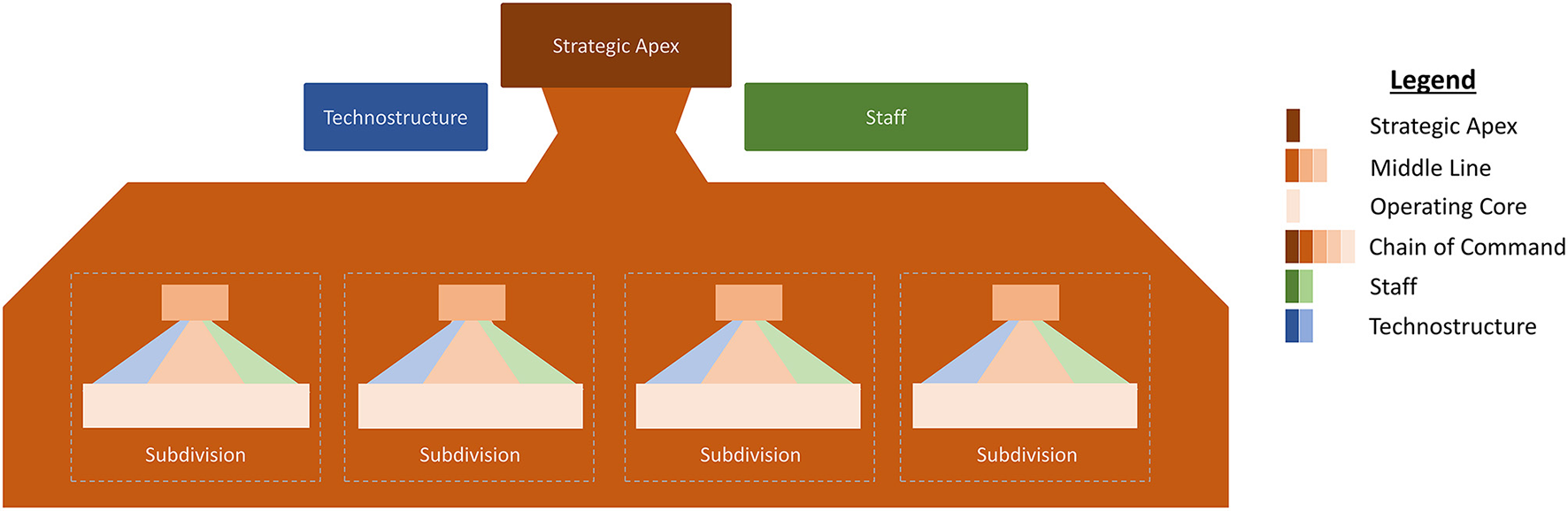
Conceptual representation of divisionalized form adapted from Mintzberg (1979).
-
Operating Core—employees performing the routine tasks.
-
Strategic Apex—employees aligning the organization toward a mission.
-
Middle Line—employees navigating communications between the operating core and strategic apex.
-
Technostructure—employees standardizing workflows.
-
Staff—employees providing indirect services.
The divisionalized form relies on quality control of standardized outputs rather than direct supervision to monitor the operating core (Mintzberg, 1979); in terms of infrastructure systems, the goal of a standardized output is providing individuals with the same access to reliable, high-quality services (e.g., potable water, reliable electricity, accessible, and safe travel) with socially-accepted controlled and uncontrolled failures (e.g., combined sewer overflows, rolling blackouts, traffic congestion during rush hours). A divisionalized organizational structure is most appropriate when organizations diversify, where the organization can manage additional products or address emerging needs through individual departments. This configuration permits some adaptive capacity since divisions can be added or subtracted within the organization as needed (Mintzberg, 1979; Zhou, 2013). However, departmentalization is not synonymous with governance decentralization, which is oftentimes promoted for infrastructure resilience (Helmrich et al., 2021). This is because the divisionalized form still maintains a vertical hierarchy—or chain of command—with little dispersal of decision-making power, since the divisions are closely managed by “headquarters.” If a division were unable to maintain services, the headquarters could intervene. Additional critiques of divisionalized form have surfaced, including the prominence of risk-adversity and uneven power dynamics that derail innovation and limit holistic thinking (Adler, 2001; Cleaver and Whaley, 2018; Martela, 2019; Chester et al., 2020a). Highlighting a failed example of such hierarchical oversight, Flint, Michigan had been experiencing an economic crisis that caused emergency managers (state-level employees, re: headquarters) to intervene. The appointed, unelected emergency managers were not familiar with local contexts but were tasked with autocratic decision-making across a wide array of city affairs to balance budgets (Pauli, 2019). To stabilize water expenditures and obtain partial authority of the resource, Flint's water supply would be shifted from the Detroit Water and Sewerage Department (DWSD) to Karegnondi Water Authority, both sourced from Lake Huron. DWSD announced they would be terminating service prior to the completion of the new pipeline project, and the Flint River was chosen as an interim water source despite concerns. Ultimately, financial constraints, political pressure, failure of bureaucracy, and environmental injustice led to a contamination of the city's drinking water (Butler et al., 2016; Masten et al., 2016; Pieper et al., 2017; Pauli, 2019). Ineffective leadership by the emergency managers restricted Flint's ability to respond to the emergent disturbance, accentuating how institutional lock-in limits adaptive capacity.
Institutional lock-in contributes to the slow pace of change seen within infrastructure systems. First, there are consistent processes of change within organizations that occur within formal and informal governance, but lack of support for explorative behaviors can make it difficult for ongoing change to establish itself (Tsoukas and Chia, 2002; Deslatte and Swann, 2019). The establishment of formal governance may perpetuate lock-in through legacy rules and regulations, performance measures, and norms if the processes are inflexible. An adherence to exploitative behaviors helps organizations avoid overextending resources by ignoring noise in the environment; therefore, organizations must balance stability through exploitative behaviors and responsiveness with explorative behaviors while pursing ongoing change. Second, financing is crucial, and infrastructure growth has been constrained in the past by federal financial decisions such as ending large grant programs, changing funding priorities, and managing increasing debt (Miller, 2000; Deslatte and Swann, 2019). However, the impacts of financial stress are not always predictable in the processes of change or subsequent outcomes (Deslatte and Swann, 2019; Garcia et al., 2019). Third, and intertwined with funding opportunities, infrastructure systems are beholden to political and public interests, which may prioritize different outcomes or processes (Miller, 2000; Marshall and Alexandra, 2016; Garcia et al., 2019). The factors presented here highlight a few examples of institutional lock-in an organization faces, which keep infrastructure on one path and restrict their ability to change at pace with their environments. Public service organizations are encountering increasing pressures to meet ambiguous objectives with high levels of risk aversion and unclear metrics of success (Deslatte and Swann, 2019).
Leadership Capabilities for Navigating Stability and Instability
Methods
Leadership practices rooted in the past are not compatible with emerging volatile environments (Marion and Uhl-Bien, 2001; Mäkinen, 2018). Concentrating on identifying leadership capabilities needed to rapidly adjust between periods of stability and instability, articles were identified through search queries within Google Scholar of “leadership” and “ambidexterity,” “dynamic capabilities,” “organizational change,” “complexity,” and “innovation” literature and snowballing. This ultimately resulted in a database of 48 articles. Aligning with findings from Uhl-Bien and Arena (2018) who have consolidated these concepts under Complexity Leadership Theory, these fields present considerable overlap. To identify the attributes of formal and informal governance that address leadership through stability and instability, a thematic analysis was performed. Themes were identified through a non-linear inductive coding process. An open coding process was used to identify meaningful material. Following this, the first axial coding iteration resulted in 87 codes. Through a recursive process to reduce redundancy, these codes were refined and categorized into 20 codes specific to formal and informal governance contexts. This reduction occurred through comparison and reflection of definitions and usages (e.g., intentions) of the codes throughout the literature database. Eventually, four themes and four sub-themes were selected for detailed discussion of leadership capabilities and the creation of an integrative leadership framework illustrated through a thematic map, as explored in the following sub-sections. The inductive coding approach utilized presents a few limitations, including reflexivity and the omission of edge cases.
Collaborating: Creating a Variety of Knowledge Through Formal and Informal Networking
Organizations operating in complexity must develop a variety of knowledge to respond to changes in the environment. Collaboration creates a space for a heterogeneous organizational culture, and opportunities for collaboration are increased when formal and informal relationship building (i.e., networking) are abundant (Teece, 2007; Havermans et al., 2015; Rosenhead et al., 2019). There are two main components of this leadership capability. The first is developing a variety in stakeholders, anyone with influence on the infrastructure system, within or beyond the organization. Variety can be demonstrated in a number of ways, including function, authority, experience, location, etc. For instance, veteran employees can often make decisions without close oversight but are also prone to responding in familiar ways, creating informal institutional lock-in (Carley and Lee, 1998; Grote, 2019). Conversely, while new employees may need more guidance (e.g., training and/or mentorship), they are more likely to think creatively as their knowledge is unlikely redundant to the organization's (March, 1991). One way to build diversity, and avoid groupthink, is to not only sponsor internal personnel, but also external personnel, recruited from organizations such as research institutions, consumers, competitors, industry partners (Hooijberg, 1997; Teece, 2007; Pitelis and Wagner, 2019). These acts of inclusive community building enhance leadership's ability to think holistically and avoid groupthink (Carley and Lee, 1998; Uhl-Bien and Arena, 2017; Rosenhead et al., 2019), assuming viable communication channels exist such as boundary spanning (Schneider, 2002; Taylor and Helfat, 2009). Notably, while organizational hierarchy is often considered the formal line of communication, informal relationships (e.g., trust, routine) are also significant, and formal and informal communication influence one another (Zhou, 2013).
Secondly, resilient organizations should encourage non-linear and interdependent relationships to promote transdisciplinary teamwork across all levels (Schneider, 2002; Lichtenstein and Ashmos Plowman, 2009; Omer et al., 2014). Non-linearity allows any person to assume the role of a leader when contextually relevant (i.e., horizontal decentralization), and the interdependence creates a pressure for action that may diverge from routine conformity (Uhl-Bien et al., 2007; Mäkinen, 2018; Rosenhead et al., 2019). A decentralized structure blurs the line between formal and informal communication and encourages co-current, overlapping—or even conflicting—endeavors, establishing “messy institutions” that are arguably more adept to address complexity (Mintzberg, 1979; Teece, 2007; Lichtenstein and Ashmos Plowman, 2009; Jansen et al., 2012; Daviter, 2017). However, higher interdependence does come at an increased coordination cost (e.g., scheduling more meetings, hiring brokering personnel), which is necessary to ensure information is shared widely across the organization; this highlights the benefit of centralized structures which have proven their ability to be highly efficient at decomposing complicated problems—a person can trust that following protocol will achieve the goal (Teece, 2007; Taylor and Helfat, 2009; Zhou, 2013; Daviter, 2017; Uhl-Bien and Arena, 2017; Mäkinen, 2018; Martela, 2019; Nederveen Pieterse et al., 2019). The takeaway from this leadership capability is that an organization must utilize their diversity by promoting multi-level collaboration which provides an opportunity for adaptive leadership to occur (Uhl-Bien et al., 2007; Mäkinen, 2018).
Learning: Perceiving and Exploring the Environment to Generate Innovation
Learning is “both a product of knowledge and [the knowledge] source,” where knowledge is not only shared but created and stored (Daviter, 2017; Serrat, 2017), and the ability to learn establishes a pathway for organizational change. Organizations learn from their experiences and those of their community; and they must store this information as to inform future decision-making (Serrat, 2017). Both personnel and organizations have the capacity to learn, and mutual learning promotes convergence; however, personnel must avoid conforming to formal governance or else adaptive capacity decreases (March, 1991; Uhl-Bien and Arena, 2017; Martela, 2019). To encourage learning, an organization and/or leaders should invest in individual and collective development (e.g., supporting ideas, sponsoring cross-training) and keep knowledge accessible (e.g., transparency) (Omer et al., 2014; Havermans et al., 2015; Serrat, 2017; Bäcklander, 2019). A key component of learning is reflection, where leaders are not simply reacting but dissecting the effectiveness of their actions to inform future actions (Serrat, 2017; Rosenhead et al., 2019). As organizations learn, they should act upon the information gathered by aligning or dealigning from existing formal and informal leadership strategies (e.g., structures, routines) to form a new, temporary equilibrium.
Leaders who are perceptive and explorative are in optimal positions to learn. Perceptive leaders are able to identify opportunities and challenges in advance of a disturbance and actively understand the implications and prepare a coordinated response (Teece, 2007; Jansen et al., 2012; Omer et al., 2014; Grote, 2019; Pitelis and Wagner, 2019). Leaders become increasingly valuable when they are able to recognize opportunities or threats outside of their expertise (Brown, 2004; Turner et al., 2013; Papachroni et al., 2016). In order to develop independence and perceptiveness within employees, an organization should create a strong organizational culture around resilience and motivate employees through supporting organizational values (e.g., transparency, safety, sustainability) and incentives for explorative behaviors rather than focus on production output (La Porte, 1996; Gibson and Birkinshaw, 2004; Omer et al., 2014; Uhl-Bien and Arena, 2017; Martela, 2019; Nederveen Pieterse et al., 2019; Pitelis and Wagner, 2019). While perception may be partially accredited to experience, it also relies on an organization's support of experimentation, providing a safe space to explore planned or spontaneous ideas (Gibson and Birkinshaw, 2004; Teece, 2007; Lichtenstein and Ashmos Plowman, 2009; Havermans et al., 2015; Arbesman, 2017; Serrat, 2017; Rosenhead et al., 2019). A safe space can be established through supportive relationships and systems that provide resources to assist creative and explorative ideas; allow mistakes; provide independence; support risk-taking rather than monitoring milestones, penalizing errors, or establishing routines (Rosing et al., 2011; Uhl-Bien and Arena, 2018). The cycle of creativity and experimentation allows an organization to continuously reinvent itself, not only through successes but failures (Lichtenstein and Ashmos Plowman, 2009; Rosenhead et al., 2019).
Innovation occurs when efforts of perception and exploration present an opportunity for a value-add to the organization, and if innovation is successful, allows an organization to evolve. The integration of an innovation into an organization is risky as the concept must be sponsored and adopted within the organization—institutionally, and possibly physically—before there is a return on investment (Galbraith, 1982; March, 1991; Rosing et al., 2011; Cantarello et al., 2012; Uhl-Bien and Arena, 2017, 2018; Mäkinen, 2018). There are two types of innovation an organization can pursue at either incremental or transformational scales: exploitative, seeking to increase efficiency, and explorative, focusing on new processes (March, 1991; Diesel and Scheepers, 2019). Explorative innovations are less frequently sponsored due to the emphasis on exploitative behaviors in established organizations and the long return on investment for explorative innovation (Galbraith, 1982; Teece, 2007; Rosing et al., 2011). Innovation increases organization longevity by allowing organizations to not only meet current, but future, demands (Cantarello et al., 2012). However, like collaboration, innovation is only one driver of an organization's adaptive capacity (Teece, 2007; Uhl-Bien and Arena, 2018).
Leadership: Enhancing Adaptive Capacity Through Flexible Formal and Informal Governance
The environments in which an organization operate are dynamic; therefore, leadership must be flexible to new ideas, responsive to shifts, and embrace uncertainty. Formal governance within organizations oftentimes seeks to routinize tasks for efficiency, but this creates a vulnerable position in the Anthropocene (March, 1991; Boisot and Mckelvey, 2011; Havermans et al., 2015; Daviter, 2017). If an organization overemphasizes exploitative behaviors, it will likely be unable to adjust therefore collapsing due to a lack of flexibility, innovation, and adaptive capacity (Lichtenstein and Ashmos Plowman, 2009; Papachroni et al., 2016; Sovacool et al., 2018; Martin, 2019). Exploitative behaviors have been able to persist at scale due to the relatively stable environment, but the increasing uncertainty faced today demands organizations to change more rapidly, requiring organizational repositioning (Siggelkow and Levinthal, 2003; Teece, 2007; Sovacool et al., 2018; Uhl-Bien and Arena, 2018; Martela, 2019; Pitelis and Wagner, 2019). Sovacool et al. (2018) characterizes repositioning as transformation, technological substitution, reconfiguration, dealignment and realignment. For example, one proposal of dealignment and realignment is to implement temporary decentralization, where an organization shifts to a decentralized form when it encounters a disturbance and reverts to a centralized form when a temporary equilibrium is found (Siggelkow and Levinthal, 2003). Temporary decentralization is already used within infrastructure systems during disaster recovery when immediate action is necessary to prevent cascading failures.
Leadership capabilities for complexity emphasize the capabilities to shift between exploitative and explorative behaviors (Hooijberg, 1997; Gibson and Birkinshaw, 2004; Havermans et al., 2015; Uhl-Bien and Arena, 2018), highlighting the importance of responsiveness and preparedness during uncertainty (Teece, 2007; Pitelis and Wagner, 2019). The organization should empower personnel (of varying levels of authority) to take initiative by providing them support (e.g., mentorship, motivation) and the necessary tools (e.g., resources, training) (Schneider, 2002; Cantarello et al., 2012; Bäcklander, 2019; Martela, 2019). When an opportunity or threat is perceived, leaders must decide whether or not they will act upon the information (March, 1991; Zahra and George, 2002; Teece, 2007; Uhl-Bien and Arena, 2017, 2018; Bäcklander, 2019; Pitelis and Wagner, 2019). If an organization is too beholden to exploitative behaviors, their bias may steer them toward inaction (Courtney et al., 1997; Teece, 2007; Pitelis and Wagner, 2019; Rosenhead et al., 2019). To safeguard organizational longevity, leaders should recognize, accept, and endorse external uncertainty and rapid change (Lichtenstein and Ashmos Plowman, 2009; Uhl-Bien and Arena, 2018; Tourish, 2019). This is a difficult demand of leaders who will then need to accept that they do not have control over the unpredictable system (Tsoukas and Chia, 2002; Rosenhead et al., 2019; Tourish, 2019).
Enabling Leadership: Navigating Conflict and Contestation of Drift and Crisis
Organizations can embrace the growing complexity and deep uncertainty of their external environments to leverage productive organizational change. An organization can embrace the potential of conflict, contestation, and controversy (i.e., tension) of complex systems to catalyze leadership capabilities including collaboration, learning, and flexibility toward creating enabling leadership (Lichtenstein and Ashmos Plowman, 2009; Uhl-Bien and Arena, 2018; Rosenhead et al., 2019; Tourish, 2019). Facilitating tension creates space for varying perspectives, constructive criticism, and innovation. In leadership and organizational change literature, the tension between exploitative and explorative behaviors is frequently discussed. This tension, however, should not always be viewed as a tradeoff where one must be disadvantaged to pursue the other. Instead, the tension can be seen as complementary, i.e., “continuous improvement,” or interrelated, i.e., “distinct but equally necessary” (Gibson and Birkinshaw, 2004; Papachroni et al., 2016). An organization cannot seek to eliminate tension—as seen with hierarchical structures—as these disruptions, and eventual reconciliations, are what drive organizations to be successful over time (Gibson and Birkinshaw, 2004; Cantarello et al., 2012; Uhl-Bien and Arena, 2017).
Given the emphasis on exploitative practices within organizations writ large, and particularly in hierarchical organizational structures, leadership should focus on integrating adaptive behaviors at multiple scales such as at the person, team, and organization (Gibson and Birkinshaw, 2004; Turner et al., 2013). Ambidexterity literature proposes structural separation (i.e., providing separate divisions for exploitation and exploration), parallel structures (i.e., switching to an alternative organizational structure to address exploitation or exploration), and temporal balancing (i.e., approaching either exploitation or exploration exclusively as needed) as methods to manage tension; however, management of tension in practice is not always well-defined (Gibson and Birkinshaw, 2004; Turner et al., 2013; Papachroni et al., 2016). Individuals have agency and make their own decisions, and bottom-up approaches have shown to inspire increased creativity and productivity within an organization (Marion and Uhl-Bien, 2001). Gibson and Birkinshaw (2004) proposed contextual ambidexterity as simultaneously pursuing exploitation and exploration. Similarly, Uhl-Bien and Arena (2018) define enabling leadership as an emergent leadership style that is “creating, engaging and protecting [the] “adaptive space” needed to nurture and sustain the adaptability process in organizations” and which actively injects tension to support innovation (Uhl-Bien et al., 2007).
Integrative Leadership Framework
The following integrative leadership framework (Figure 2) proposes capabilities that may prepare organizations to navigate periods of stability and instability. Tension is an underlying characteristic of complex systems and drives each of the presented capabilities. Tension can form from internal or external stress, where organizations may experience drift as they continue to operate in routines created for a different environment, or shocks, where an organization must act immediately to a crisis. Leadership must acknowledge tension as an opportunity of productivity rather than an obstacle. Enabling leadership emerges from tension and the identified leadership capabilities, but also provides a reinforcing feedback that continues to strengthen an organization's ability to respond to stability and instability across scales (e.g., operating core to the strategic apex, individuals to the organization) (Uhl-Bien and Arena, 2017). It is crucial to acknowledge that leaders cannot control the outcomes but can merely guide an organization through tension, and leadership's influences may not always be predictable (Marion and Uhl-Bien, 2001; Uhl-Bien and Marion, 2009; Rosenhead et al., 2019; Tourish, 2019).
Figure 2
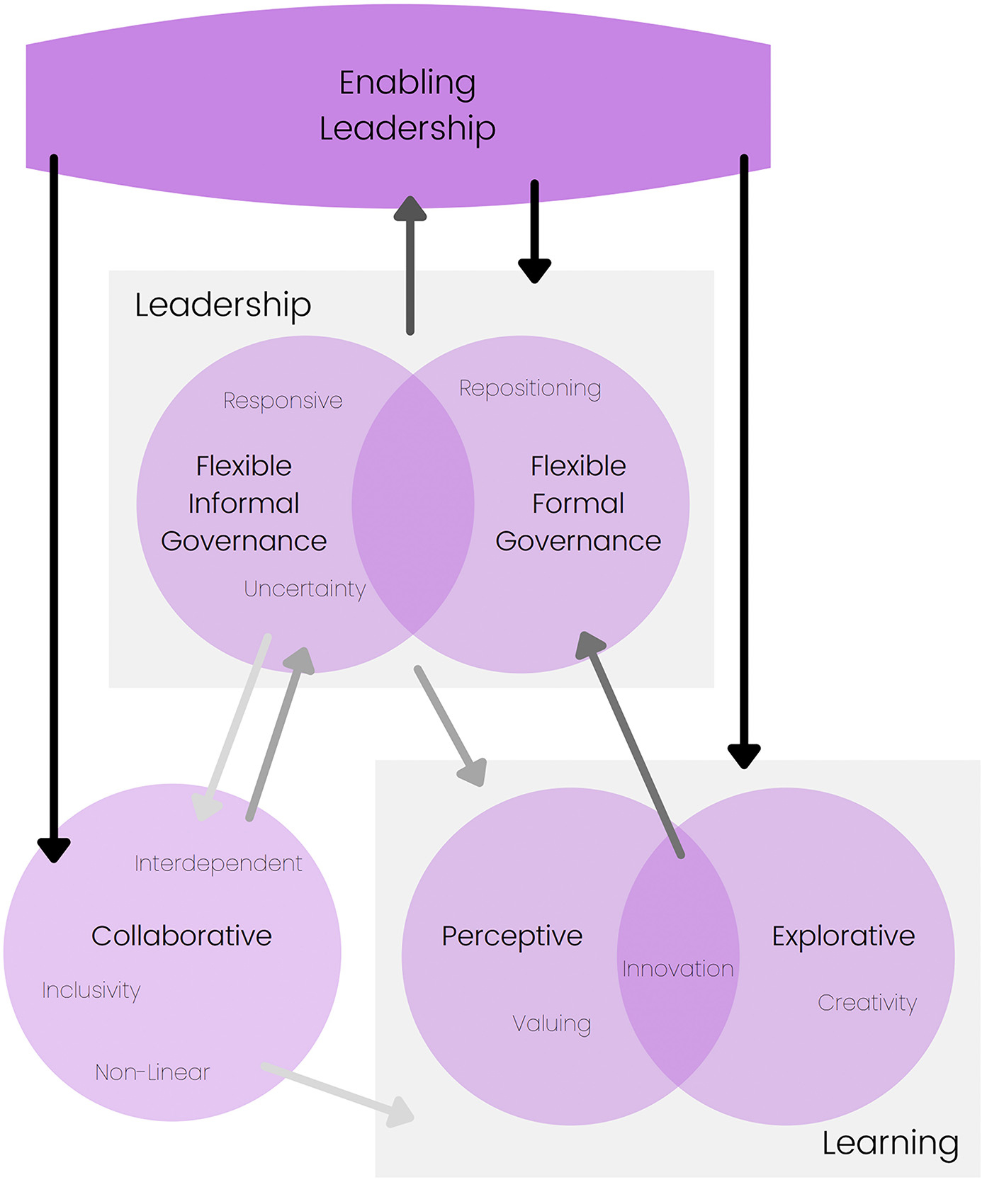
Integrative Leadership Framework: Organizations face tension from stresses and shocks and must be able to respond quickly and effectively to the changing dynamics (i.e., enabling leadership). The purple circles represent emerging capabilities in leadership and organizational change literature, with the fine print words indicating characteristics of the capability. The darkening arrows indicate growing momentum toward a virtuous cycle, where all arrows would eventually be saturated. Notably, it is the efforts of integrating all the themes that enables conflict navigation and, ultimately, resilience.
Enabling leadership may also be fostered through the identified capabilities, providing organizations a degree of permanence not found when enabling leadership is driven by tension. Starting with collaboration, this leadership capability identifies the individuals in the working environment and how they interact. The inclusion of diverse stakeholders within and beyond the organization increases the number of opportunities and threats an organization will be able to perceive. If relationships between these stakeholders are non-linear and interdependent, more individuals have the opportunity to become leaders (re: flexible informal governance), further enhancing the ability of an organization to learn. This bottom-up approach also demonstrates the interdependence of informal and formal governance. This interdependence has not always been recognized, but it is critical in developing an organization's leadership (Weber and Khademian, 2008; Uhl-Bien and Marion, 2009). The formal governance structure must be supportive of emergent leaders, including personnel not necessarily assigned a leadership role. Leadership should nurture a culture of learning—including perception and exploration capabilities—to enable innovation. Once an opportunity is identified, an innovation still has a tumultuous path toward implementation within the formal governance structures. Innovation provides impetus for organizations to adapt. As discussed, generally organizations are prone to follow a routine and repositioning is a difficult and costly endeavor (Galbraith, 1982; Teece, 2007). This pathway between innovation and flexible formal governance also shows the value in complementary exploitative behaviors, so that an organization may incorporate new ideas into operations (Zahra and George, 2002). The combination of these leadership capabilities provides the opportunity to foster enabling leadership and, in turn, resilient organizations.
Contextualization of Leadership Capabilities to Infrastructure
Infrastructure managers must reevaluate the assumptions of the operating environment, acknowledge the internal and external complexity of infrastructure systems, and actively navigate between tensions of efficiency and resilience; else, infrastructure systems may become obdurate and, potentially obsolete (Lemer, 1996; Chester and Allenby, 2018; Iwaniec et al., 2019). The study of ‘large technical systems' explores contestation, a state of non-concurrence within an organization where authority may be challenged (Sovacool et al., 2018). Contestation, oftentimes driven by drift and crisis, creates vulnerability through tension within an organization, leading to an opportunity to enhance adaptive capacity (Hughes, 1983; Summerton, 1994; Sovacool et al., 2018). A system operating in a falsely perceived environment of stability, rather than a complex one, experiences drift (Hacker et al., 2015). In drift, existing governance may undergo conversion, where leadership may be directly or indirectly challenged (e.g., strategic apex reevaluating organizational goals or operating core increasing precautions, respectively) in response to evolving conditions (Streeck and Thelen, 2005; Hacker et al., 2015; Sovacool et al., 2018). The divisionalized form prevalent in infrastructure organizational structures creates fragmented responses when addressing external complexity. Conversely, a system operating in a chaotic environment may encounter crisis, a rapid and/or publicized transition of network and/or leadership such as seen with extreme weather events. This transition may or may not be intentional (Sovacool et al., 2018; Iwaniec et al., 2019). These instances of instability—stresses driving drift or shocks initiating crisis—may lead to repositioning and survival (Geels and Schot, 2007; Sovacool et al., 2018) or decoupling and failure (Chester and Allenby, 2018; Chester et al., 2019). The integrative leadership framework proposed identifies three thrusts (collaboration, learning, and leadership) to address the tension of navigating through periods of stability and instability. The remainder of this section applies the framework to infrastructure systems in a broad context. Further contextualizing leadership capabilities to specific infrastructure organizations is a critical endeavor toward addressing resilience in infrastructure institutions, which will ideally lead to more resilient infrastructure networks.
Leadership and organizational change literature revealed capabilities that boost longevity of organizations. While infrastructure systems exist in dynamic environments, they do not face the same pressures as the private organizations examined (Rashman et al., 2009). Instead, infrastructure systems exist as public service organizations providing services that need to meet public expectations (Rashman et al., 2009), with approximately 85% of (non-military) infrastructure assets being managed at a state or local level (Miller, 2000; Edwards, 2017; Saha and Ibrahima, 2020). In other words, the goods and services that infrastructure provide are intended to be accessible to everyone, and most of the time, the government will oversee the development and management of the systems. Water and transportation sectors provide conventional examples, but even the power sector, while often privately-owned (e.g., renewable energy), must abide by regulations to ensure the organization keeps public interest (e.g., social inclusion, sustainability Osborne and Brown, 2005) at the forefront of their mission. Public service organizations face higher pressures from political environments than private organizations, making this a fundamental tension to their operation (Osborne and Brown, 2005). Infrastructure systems experience significantly less pressure to change due to their natural monopoly model (i.e., lack of competition), which partially results from governmental oversight, economies of scale, and the challenge of pricing the value of public services (Miller, 2000). This drift can make infrastructure systems more prone to indulge in exploitative behaviors. Further, the high pressure to maintain services combined with a lack of resources and/or ability to experiment (Miller, 2000; Osborne and Brown, 2005), suppresses explorative behaviors.
Collaboration, the first thrust in the integrative leadership framework, is a skill practiced by infrastructure organizations (e.g., co-production, benchmarking, private-public partnerships) and has been recognized as a critical tool for resilience in infrastructure and social-ecological systems (SES) literature (Folke et al., 2005; Biggs et al., 2012; Park et al., 2013; Chaffin et al., 2014; Deslatte and Swann, 2019; Gim et al., 2019). Infrastructure organizations collaborate with numerous diverse stakeholders, including other infrastructure managers within their sector, infrastructure managers of other sectors, state and federal agencies, private industries, academic institutions, non-profits (Rashman et al., 2009; Muñoz-Erickson, 2014; Gim et al., 2019). These stakeholders are identified based on their relevant knowledge and investment in the issue at hand, indicating that collaborators should change to address different disturbances (Weber and Khademian, 2008; Head and Alford, 2013). These relationships may be interconnected, dependent, or interdependent between individuals of varying authority or entire organizations (Weber and Khademian, 2008; Muñoz-Erickson, 2014). Resilience theories in SES encourage collaboration through polycentricity, or governance through decentralization of power (Folke et al., 2005; Biggs et al., 2012; Chaffin et al., 2014). Social-ecological systems theory is valuable in the framing of infrastructure resilience (Markolf et al., 2018; Helmrich et al., 2021). Further, relationships may be formal or informal. Informal relationships are widely prevalent in infrastructure projects, and they create mutual dependencies and trust amongst personnel (van Gestel et al., 2008; Rashman et al., 2009; Head and Alford, 2013). Collaboration, therefore, highlights the importance of teams and teamwork within organizations. Addressing instability requires teams that are collectively oriented through shared mental models and leadership, mutually supportive, monitoring performance, communicative and trusting, and adaptive (Baker et al., 2006). The more increasingly non-linear relationships become, the more complex the system. While complexity is in part synonymous with unpredictability, complex organizations are necessary to help navigate increasingly complex environments (Folke et al., 2005; Boisot and Mckelvey, 2011; Head and Alford, 2013). When there are numerous collaborators sharing (and creating) knowledge, learning becomes increasingly fruitful (Rashman et al., 2009; Park et al., 2013).
Learning, the second major thrust of the integrative leadership framework, requires infrastructure managers to gather new knowledge from theory and practice and integrate the knowledge into practice. Learning, within public service organizations, has been defined by Rashman et al. as “a process of individual and shared thought and action, involving cognitive, social, behavioral, and technical elements” (2009). They further identify four organizational learning processes: individual perspective, shared understanding, diffusion, and embedding in organization. Learning requires a level of risk-taking to identify opportunities and threats (i.e., perception) and motivate exploration and experimentation. Infrastructure managers must assess risk of potential developments. There are a number of decision-making methods available to infrastructure managers: conventional (e.g., cost-benefit analysis, cost effectiveness analysis, risk assessment), environmental (e.g., life cycle analysis, environmental impact assessment), social (e.g., social impact assessment), deep uncertainty (e.g., real option analysis, robust decision making, info-gap analysis, adaptation pathways) (Helmrich and Chester, 2020). Notably, most of these are not required for development. It is also important for infrastructure organizations to understand the institutional pressures that reinforce particular actions (e.g., vested interests, knowledge asymmetry, mental models, cultural perceptions). By learning of the forces influencing the system as well as who and who does not hold power over those forces, infrastructure managers may be able to identify trigger points where the cycle may be broken (Marshall and Alexandra, 2016). Ideally, this would allow infrastructure managers to encourage adaptation and transformation more frequently—rather than, primarily, after crisis events (Huitema and Meijerink, 2010; Marshall and Alexandra, 2016; Iwaniec et al., 2019). This highlights the need for “policy entrepreneurs”—individuals internal or external to the infrastructure system who develop new ideas, create a network of support, and identify windows of opportunity for implementation (Huitema and Meijerink, 2010). To further identify trigger points for change, or windows of opportunity, infrastructure managers should monitor evolving risks (embedded in both stresses and shocks, known and unknown) throughout the infrastructure life cycle (Park et al., 2013; Woods, 2015).
Another challenge of risk analysis is the integration of qualitative knowledge into decision-making processes, as infrastructure assessments tend to focus on quantitative metrics (Park et al., 2013). Leadership and organizational change literature acknowledges that unifying organizational mission and values (qualitative metrics) may guide leaders in their decision-making as well as establish motivation for learning (Little, 2004; Rashman et al., 2009; Taylor and Helfat, 2009; Uhl-Bien and Arena, 2017). In regards to infrastructure organizations, value is oftentimes placed on efficient use of public resources, transparency, and democratic legitimacy, but there are competing values of sustainability, economic development, and environmental quality (van Gestel et al., 2008; Rashman et al., 2009). Values can change, or have fluctuating priority, over the lifetime of infrastructure; they can also change based on political environments (van Gestel et al., 2008). This volatility highlights the importance of flexible leadership and a change-oriented organizational culture that embraces uncertainty (Folke et al., 2005; van Gestel et al., 2008; Rashman et al., 2009; Chester and Allenby, 2018). Risk analysis is an important tool that allows infrastructure managers to perceive opportunities and threats and contributes toward learning.
When learning reveals a potential value-add for an organization, the opportunity to innovate arises; however, infrastructure systems struggle to deviate from the status quo (i.e., lock-in) and experiment with new ideas (Head and Alford, 2013; Chester et al., 2019; Yu et al., 2020). Infrastructure managers can promote experimentation by investing in research and development, which requires an organizational culture shift and reallocation of resources (La Porte and Consolini, 1991; Chester et al., 2019, 2020a; Gilrein et al., 2019). Errors can be embraced as tools for learning and decision-making within infrastructure systems, as long as managers are communicative and transparent with stakeholders and the surrounding community about the experimentation (La Porte and Consolini, 1991; La Porte, 1996). Experimentation—typically defined as small and deliberate changes to infrastructure technologies—requires “learning-focused management approaches” and a degree of failure acceptance from infrastructure organizations, financers and insurers, and the public (Biggs et al., 2012; Chester et al., 2019; Deslatte and Swann, 2019; Yu et al., 2020). Safe-to-fail infrastructure provides an opportunity to embrace experimentation, with the approach accounting for various types of failure (social, ecological, technological) during the design process (Park et al., 2013; Kim et al., 2019; Yu et al., 2020). The risks are then prioritized to minimize harm, and stakeholders are educated on expected failure pathways and the potential of unexpected failures (Kim et al., 2019). Another approached proposed in SES literature is adaptive governance, where the interactions across multiple levels of power (individual to organization to institution) act collectively toward achieving a desired state (Folke et al., 2005; Chaffin et al., 2014). The choice of state can be revisited to ensure the system is responding to emerging conditions (Chaffin et al., 2014; Cleaver and Whaley, 2018). Working across social, ecological, and technological dimensions highlights the advantage of collaboration in experimentation (Garud et al., 2011; Head and Alford, 2013; Gilrein et al., 2019); the boundary spanning, presented in both of these approaches, challenges infrastructure organizations to invest in products and services that are tangentially related to their mission (e.g., a transportation department funding research on roadside photovoltaics Aupperlee, 2018; Clines, 2018; Gilrein et al., 2019). Ideally, learning leads to sustained innovation, where value-adds are continuously identified and incorporated into the organization's formal governance (Garud et al., 2011). Innovation challenges the formal governance (i.e., bureaucratic nature) of public service organizations (Newell et al., 2003; Osborne and Brown, 2005; Uhl-Bien and Arena, 2018).
Leadership, the final major thrust of the integrative leadership framework, is comprised of formal and informal governance, both of which hold valuable roles in agile infrastructure organizations. To reiterate, formal governance is defined as structured, explicit rules and regulations that require ample governance to circulate and enforce, but maintain low barriers to entry due to standardization (Boesen, 2007; Uhl-Bien and Arena, 2018). Meanwhile, informal governance consists of implicit norms based on relationships and trust; informal governance presents high entry barriers due to the contextualized nature (Boesen, 2007; Uhl-Bien and Arena, 2018). Infrastructure leadership is not currently established in a manner that is favorable toward advancing resilience within its organizations. Specifically, divisionalized form restricts the ability of personnel to collaborate and learn due to overemphasis on exploitative behaviors (Rashman et al., 2009; Zhou, 2013; Chester et al., 2021). Upon review of the five components of divisionalized form (operating core, strategic apex, middle line, technostructure, and staff), each component description exemplifies an exploitative behavior. No position is explicitly responsible for exploratory initiatives, and only the strategic apex holds explorative power with the ability to add and remove divisions (Mintzberg, 1979). Literature on public service and infrastructure organizations identifies organizational decentralization as a tool to promote collaboration, learning, and, importantly, adaptability for resilience (Finger and Brand, 1999; Rashman et al., 2009; Head and Alford, 2013; Zhou, 2013; Chester et al., 2020a).
Decentralized organizations are capable of meeting complexity with complexity because they encourage non-linear relationships which emerge unpredictable endeavors (Lichtenstein and Ashmos Plowman, 2009; Boisot and Mckelvey, 2011). Decentralized organizational structures emphasize the significance of informal relationships. It is crucial that personnel are included in the “process of change” (i.e., a bottom-up approach) as their commitment can increase the success of infrastructure repositioning (Perry and Ingraham, 1990; Osborne and Brown, 2005), highlighting another key point: infrastructure organizations will need to continuously reposition to adjust to changing environments (Siggelkow and Levinthal, 2003; Head and Alford, 2013). Yet, there is a tradeoff. Organizations must also eliminate noise from decision-making to avoid overextending resources. Recalling temporary decentralization, this approach to governance may provide guidance, particularly within increasingly distributed infrastructure networks which are characterized by networks with coupled producer and consumer relationships that lead to coordinated responses (Helmrich et al., 2021). This configuration has the potential to respond with more variety than centralized systems, while utilizing beneficial qualities of each. For instance, emergency response protocols will allow infrastructure managers to make more autonomous decisions during disasters. For example, a water treatment plant operator prevented a cyberattack where aggressors were attempting to tamper with sodium hydroxide concentrations (Chappell, 2021). This does, notably, add complexity to the governance system (La Porte and Consolini, 1991; Boisot and Mckelvey, 2011). Despite this, fluidity in organizational structure has been advocated as a tool within high reliability organizations, as well as resilient to meet demands in periods of stability and instability (Grabowski and Roberts, 2019).
Discussion
Infrastructure institutions within the United States are often considered too critical to fail; however, this framing is preventing organizations from adapting and transforming to meet the complexity and deep uncertainty of the Anthropocene. While the leadership and organizational change literature assessed largely focused on private organizations, the emergent leadership capabilities have shown applicability and alignment with infrastructure. The lack of market competition may make public service organizations more open to collaboration and, subsequently, collective learning (Hartley and Benington, 2006; Rashman et al., 2009); however, the need to provide specific services may cause risk adversity and an avoidance of failure, restricting flexibility and innovation (Newman and Chaharbaghi, 2000; Rashman et al., 2009). Infrastructure systems must change at pace with the environments in which they operate (Hollnagel et al., 2006). Unintentional and reductionistic approaches toward flexible leadership will not ensure reliable infrastructure services into the future (Lemer, 1996; Chester and Allenby, 2018; Iwaniec et al., 2019). Operational and strategic planning of resilient infrastructure must confront the influence of formal and informal governance, and they must be inclusive when considering stakeholders who hold power over infrastructure networks. For instance, referring back to distributed systems, this configuration has created space for external stakeholders to exert unregulated authority over infrastructure. Individuals are routed through transportation networks via navigation applications hosted by Google, Waze, Apple, etc. These rerouting options, while providing real-time alternatives (re: flexibility and agility), channel vehicles through roads that were potentially not designed for high levels of traffic (e.g., shortcuts through residential neighborhoods). Network distribution is leading to disjointed governance of infrastructure systems when authority is not explicitly considered in the design consequences or the stakeholders are not operating in coordination. The integrative leadership framework highlights opportunities and challenges within infrastructure organizations and related stakeholders for more intentional fostering of collaboration and explorative behaviors while providing insights to how an organization may invest in its formal and informal governance to produce enabling leaders and institutional resilience.
To increase capacity for explorative behaviors in infrastructure organizations, there needs to be a cultural shift from exploitative behaviors (Chester et al., 2020a). It is clear that organizations need to change, and there several capabilities that support longevity in instable environments. The challenge is identifying pathways to transition organizations between exploitative and explorative behaviors, as seen with enabling leadership. These pathways must be dynamic to navigate future uncertainty. Infrastructure managers must realize the “change” in organizational change will never be complete, meaning that all decisions and projects will be revisited. This acknowledgment is crucial to avoid inaction attributed to uncertainty, a topic readily explored in the field of deep uncertainty (Courtney et al., 1997; Walker et al., 2013). Instead, infrastructure managers, organizations, and institutions must learn to lead through the flux of instability. The proposed integrative leadership framework provides insight on leadership capabilities that organizations can invest in now to begin this transition (i.e., adaptation). Infrastructure organizations will also need to undergo transformational change to avoid path dependencies and reverting to a baseline of exploitative behavior. There are tools to help organizations address complexity and deep uncertainty such as horizon scanning and scenario planning. Infrastructure organizations may also find guidance from high reliability organizations, which promote strategies to minimize failures: learning, decentralization of power, incentivizing employee behavior, functional redundancy, and balancing tradeoffs of reliability and efficiency (Roberts, 1990; Roberts and Bea, 2001). Infrastructure organizations will need to educate and empower their personnel by creating environments in which their employees can partake in explorative behaviors. The environments in which infrastructure operate are changing rapidly. Technologies surrounding infrastructure are rapidly changing. Infrastructure organizations and institutions must also be able to respond rapidly change to advance infrastructure resilience.
Conclusion
The institutions that govern infrastructure—including their bureaucratic structures, leadership culture, administrative structure, rules, and norms—play a critical role in creating the capacities necessary to adapt and transform to known and unknown disturbances at pace with changing conditions (Hollnagel et al., 2006; Pelling et al., 2015; Woods, 2015). It is essential that infrastructure organizations are able to adjust at pace with the changes of the environments in which they operate (Hollnagel et al., 2006). The current institutional practices surrounding infrastructure (e.g., lack of competition, risk-adversity) do not place pressure on infrastructure systems to change, but organizations must adjust to avoid becoming obsolete. The integrative leadership framework presented demonstrates an immediately applicable deployment of leadership capabilities that emerge enabling leadership; however, in alignment with (Uhl-Bien and Marion, 2009), organizational and institutional transformations still need to occur to ensure longevity. In order to enhance resilience, organizations must acknowledge they are operating in complex—rather than complicated—environments so that they may properly assess the tradeoffs for transitioning their leadership structures. Therefore, the takeaway should not be that investment in leadership capabilities will independently create resilient infrastructure organizations, but that they may provide a pathway toward retooling institutions to operate effectively in flux between states of stability and instability.
Funding
This work was in part supported by two grants, the United States National Science Foundation SRN-1444755 and GCR-1934933.
Publisher's Note
All claims expressed in this article are solely those of the authors and do not necessarily represent those of their affiliated organizations, or those of the publisher, the editors and the reviewers. Any product that may be evaluated in this article, or claim that may be made by its manufacturer, is not guaranteed or endorsed by the publisher.
Statements
Data availability statement
The original contributions presented in the study are included in the article/supplementary material, further inquiries can be directed to the corresponding author/s.
Author contributions
All authors listed have made a substantial, direct, and intellectual contribution to the work and approved it for publication.
Acknowledgments
This work is based on a dissertation chapter in Alternative Design Approaches for Advancing Infrastructure Resilience by Helmrich (2021).
Conflict of interest
The authors declare that the research was conducted in the absence of any commercial or financial relationships that could be construed as a potential conflict of interest.
References
1
Adler P. S (2001). Market, hierarchy, and trust: the knowledge economy and the future of capitalism. Organ. Sci.12, 215–234. 10.1287/orsc.12.2.215.10117
2
Ansell B. Lindvall J. (2021). “The political origins of modern public services,” in Inward Conquest (University Printing House). Availabe online at: https://www.cambridge.org/core/product/identifier/9781108178440/type/book
3
Arbesman S (2017). Overcomplicated: Technology at the Limits of Comprehension. London: Portfolio.
4
Aupperlee A (2018). Pennsylvania to Build Test Track, Training Facility for Next-Gen Vehicles TribLIVE.com. Available online at: https://archive.triblive.com/news/pennsylvania/pennsylvania-to-build-test-track-training-facility-for-next-gen-vehicles/ (accessed August 18, 2021).
5
Ayyub B. M. (ed.) (2018). Climate-Resilient Infrastructure. Reston, VA: American Society of Civil Engineers. 10.1061/9780784415191
6
Bäcklander G (2019). Doing complexity leadership theory: how agile coaches at Spotify practise enabling leadership. Creat.Innov. Manage.28, 42–60. 10.1111/caim.12303
7
Baker D. Day R. Salas E. (2006). Teamwork as an essential component of high-reliability organizations. Health Serv. Res.41, 1576–1598. 10.1111/j.1475-6773.2006.00566.x
8
Biggs R. Schlüter M. Biggs D. Bohensky E. BurnSilver S. Cundill G. et al . (2012). Toward principles for enhancing the resilience of ecosystem services. Annu. Rev. Environ. Resour. 37, 421–448. 10.1146/annurev-environ-051211-123836
9
Boesen N (2007). “Governance and Accountability: how do the formal and informal interplay and change?,” in Informal Institutions: How Social Norms Help or Hinder Development, eds J. Jutting, D. Drechsler, S. Bartsch, and I. de Soysa (OECD Development Centre Studies).
10
Boisot M. Mckelvey B. (2011). “Complexity and organization–environment relations: revisiting ashby's law of requisite variety,” in The Sage Handbook of Complexity and Management, eds P. Allen, S. Maguire, and B. McKelvey (London: SAGE Publications Ltd.), 278–298.
11
Bondank E. N. Chester M.V Ruddell B. L. (2018). Water distribution system failure risks with increasing temperatures [Research-article]. Environ. Sci.Technol.52, 9605–9614. 10.1021/acs.est.7b01591
12
Brown J. S (2004). Minding and mining the periphery. Long Range Plann.37, 143–151. 10.1016/J.LRP.2004.01.001
13
Burillo D. Chester M. v. Ruddell B. Johnson N. (2017). Electricity demand planning forecasts should consider climate non-stationarity to maintain reserve margins during heat waves. Appl. Energy206, 267–277. 10.1016/j.apenergy.2017.08.141
14
Butler L. J. Scammell M. K. Benson E. B. (2016). Original articles the flint, michigan, water crisis: a case study in regulatory failure and environmental injustice. Environ. Just.9, 93–97. 10.1089/env.2016.0014
15
Cantarello S. Martini A. Nosella A. (2012). A multi-level model for organizational ambidexterity in the search phase of the innovation processc aim. Create Innov. Manage. 21, 28–48. 10.1111/j.1467-8691.2012.00624.x
16
Carley K. M. Lee J.-S. (1998). “Dynamic organizations: organizational adaptation in a changing environment in Advances in Strategic Management, Vol. 15, ed D. J. Collis (Greenwich, CT: Jai Press Inc.), 269–297.
17
Carvalhaes T. Markolf S. Helmrich A. Kim Y. Li R. Natarajan M. et al . (2020). COVID-19 as a harbinger of transforming infrastructure resilience. Front. Built Environ.6:148. 10.3389/fbuil.2020.00148
18
Chaffin B. Gosnell H. Cosens B. (2014). A decade of adaptive governance scholarship: synthesis and future directions. Ecol. Soc.19, 56. 10.5751/ES-06824-190356
19
Chandler A. D (1977). The Visible Hand : The Managerial Revolution in American Business.Cambridge, MA: Belknap Press.
20
Chappell B (2021). FBI Called In After Hacker Tries To Poison Tampa-Area City's Water with Lye. NPR. Available online at: https://www.npr.org/2021/02/09/965791252/fbi-called-in-after-hacker-tries-to-poison-tampa-area-citys-water-with-lye (accessed November 08, 2021).
21
Chester M. Allenby B. (2019). Infrastructure as a wicked complex process. Elem. Sci. Anth.7, 21. 10.1525/elementa.360
22
Chester M. Underwood B. S. Allenby B. Garcia M. Samaras C. Markolf S. et al . (2021). Infrastructure resilience to navigate increasingly uncertain and complex conditions in the Anthropocene. NPJ Urban Sustain.1, 1–6. 10.1038/s42949-021-00016-y
23
Chester M. V. Allenby B. (2018). Toward adaptive infrastructure: flexibility and agility in a non-stationarity age. Sustain. Resil. Infrastruct.4, 173–191. 10.1080/23789689.2017.1416846
24
Chester M. V. Markolf S. Allenby B. (2019). Infrastructure and the environment in the Anthropocene. J. Indust. Ecol.23, jiec.12848. 10.1111/jiec.12848
25
Chester M. V. Miller T. Muñoz-Erickson T. A. (2020a). Infrastructure governance for the Anthropocene. Elementa8, 78. 10.1525/elementa.2020.078
26
Chester M. V. Underwood B. S. Samaras C. (2020b). Keeping infrastructure reliable under climate uncertainty. Nat. Clim. Chang. 10, 488–490. 10.1038/s41558-020-0741-0
27
Cleaver F. Whaley L. (2018). Understanding process, power, and meaning in adaptive governance: a critical institutional reading. Ecol. Soc.23, 49. 10.5751/ES-10212-230249
28
Clines K (2018). “The Ray” is Ga.'s 18-Mile Proving Ground for Technology and Ideas on I-85 | Equipment World. Available online at: https://www.equipmentworld.com/better-roads/article/14969126/the-ray-is-gas-18-mile-proving-ground-for-technology-and-ideas-on-i-85 (accessed August 18, 2021).
29
Corvellec H. Campos M. J. Z. Zapata P. (2013). Infrastructures, lock-in, and sustainable urban development: the case of waste incineration in the Göteborg Metropolitan Area. J. Clean. Prod.50, 32–39. 10.1016/j.jclepro.2012.12.009
30
Courtney H. Kirkland J. Viguerie P. (1997). Strategy Under Uncertainty. Harvard Business Review. Available online at: https://hbr.org/1997/11/strategy-under-uncertainty (accessed December 14, 2018).
31
Daviter F (2017). Coping, taming or solving: alternative approaches to the governance of wicked problems. Policy Stud.38, 571–588. 10.1080/01442872.2017.1384543
32
Deslatte A. Swann W. (2019). Elucidating the linkages between entrepreneurial orientation and local government sustainability performance. Amer. Rev. Publ. Admin.50, 92–109. 10.1177/0275074019869376
33
Diesel R. Scheepers C. B. (2019). Innovation climate mediating complexity leadership and ambidexterity. Person. Rev.48, 1782–1808. 10.1108/PR-11-2018-0445
34
Dubois H. F. W. Fattore G. (2009). Definitions and typologies in public administration research: the case of decentralization. Int. J. Publ. Admin.32, 704–727. 10.1080/01900690902908760
35
Edwards C (2017). Who Owns U.S. Infrastructure? CATO Institute. Available online at: https://www.cato.org/tax-budget-bulletin/who-owns-us-infrastructure (accessed February 02, 2021).
36
Faguet J.-P (2014). Decentralization and governance. World D53, 2–13. 10.1016/j.worlddev.2013.01.002
37
Finger M. Brand S. B. (1999). “The concept of the learning organization applied to the transformation of the public sector: Conceptual contributions for theory development,” in Organizational Learning and the Learning Organization: Developments in Theory and Practice, eds M. Easterby-Smith, L. Araujo, and J. Burgoyne (Sage Publications).
38
Folke C. Hahn T. Olsson P. Norberg J. (2005). Adaptive governance of social-ecological systems. Annu. Rev. Environ. Resour. 30, 441–473. 10.1146/annurev.energy.30.050504.144511
39
Friedlander A (1995a). Emerging Infrastructure: The Growth of Railroads. In Infrastructure History Series. Corporation for National Research Initiatives.
40
Friedlander A (1995b). Natural Monopoly and Universal Service: Telephones and Telegraphs in the U.S.Corporation for National Research Initiatives.
41
Friedlander A (1996). Power and Light: Electricity in the U.S. Energy Infrastructure, 1870-1940. Infrastructure History Series.Corporation for National Research Initiatives.
42
Galbraith J. R (1982). Designing the innovating organization. Organ. Dyn.10, 5–25. 10.1016/0090-2616(82)90033-X
43
Garcia M. Koebele E. Deslatte A. Ernst K. Manago K. Treuer G. (2019). Towards urban water sustainability: analyzing management transitions in Miami, Las Vegas, and Los Angeles. Glob. Environ. Change58, 101967. 10.1016/j.gloenvcha.2019.101967
44
Garud R. Gehman J. Kumaraswamy A. (2011). Complexity arrangements for sustained innovation: Lessons from 3M corporation. Organ. Stud.32, 737–767. 10.1177/0170840611410810
45
Geels F. W. Schot J. (2007). Typology of sociotechnical transition pathways. Res. Policy36, 399–417. 10.1016/j.respol.2007.01.003
46
Gibson C. B. Birkinshaw J. (2004). The antecedents, consequences, and mediating role of organizational ambidexterity. Acad. Manage. J.47, 209–226. 10.2307/20159573
47
Gilrein E. J. Carvalhaes T. M. Markolf S. A. Chester M. V. Allenby B. R. Garcia M. (2019). Concepts and practices for transforming infrastructure from rigid to adaptable sustainable and resilient infrastructure. Sustain. Resilient Infrastruct.6, 213–234. 10.1080/23789689.2019.1599608
48
Gim C. Miller C. A. Hirt P. W. (2019). The resilience work of institutions. Environ. Sci. Policy97, 36–43. 10.1016/j.envsci.2019.03.004
49
Grabowski M. Roberts K. (2019). Reliability seeking virtual organizations: challenges for high reliability organizations and resilience engineering. Saf. Sci.117, 512–522. 10.1016/j.ssci.2016.02.016
50
Grote G (2019). “Leadership in resilient organizations,” in Exploring Resilience A Scientific Journey from Practice to Theory, eds S. Wiig and B. Fahlbruch (Springer).
51
Hacker J. Pierson P. Thelen K. (2015). “Drift and conversion: hidden faces of institutional change,” in Advances in Comparative-Historical Analysis, 180–208.
52
Hartley J. Benington J. (2006). Copy and paste, or graft and transplant: Knowledge sharing through inter-organizational networks. Public Money Manag.26, 101–108. 10.1111/J.1467-9302.2006.00508.X
53
Havermans L. A. den Hartog D. N. Keegan A. Uhl-Bien M. (2015). Exploring the role of leadership in enabling contextual ambidexterity. Hum. Resour. Manage.54, s179–s200. 10.1002/hrm.21764
54
Head B. W. Alford J. (2013). Wicked problems: Implications for public policy and management. Adm. Soc.47, 711–739. 10.1177/0095399713481601
55
Helmrich A (2021). Alternative Design Approaches for Advancing Infrastructure Resilience.Dissertation Thesis. Tempe, AZ: Arizona State University.
56
Helmrich A. Markolf S. Li R. Carvalhaes T. Kim Y. Bondank E. et al . (2021). Centralization and decentralization for resilient infrastructure and complexity. Environ. Res. Infrastruct. Sustain.1, 021001. 10.1088/2634-4505/AC0A4F
57
Helmrich A. M. Chester M. V. (2020). Reconciling complexity and deep uncertainty in infrastructure design for climate adaptation. Sustain. Resil. Infrastruct.2020, 1–17. 10.1080/23789689.2019.1708179
58
Hollnagel E. Woods D. D. Leveson N. (2006). Resilience Engineering: Concepts and Precepts. Aldershot: Ashgate Publications.
59
Hooijberg R (1997). Leadership complexity and development of the leaderplex model. J. Manage.23, 375–408. 10.1016/s0149-2063(97)90036-2
60
Hughes T. P (1983). Networks of Power: Electrification in Western Society, 1880–1930. Johns Hopkins University Press.
61
Huitema D. Meijerink S. (2010). Realizing water transitions: The role of policy entrepreneurs in water policy change. Ecol. Soc.15, 26. Available online at: http://www.ecologyandsociety.org/vol15/iss2/art26/
62
Iwaniec D. M. Cook E. M. Barbosa O. Grimm N. B. (2019). The framing of urban sustainability transformations. Sustainability11, 1–10. 10.3390/su11030573
63
Jansen J. J. P. Simsek Z. Cao Q. (2012). Ambidexterity and performance in multiunit contexts: cross-level moderating effects of structural and resource attributes. Strat. Manage. J. Strat. Mgmt. J33, 1286–1303. 10.1002/smj.1977
64
Kim Y. Chester M. V. Eisenberg D. A. Redman C. L. (2019). The infrastructure trolley problem: Positioning safe-to-fail infrastructure for climate change adaptation. Earths Future7, 2019:EF001208. 10.1029/2019EF001208
65
Kooiman J (1993). Modern Governance: New Government-Society Interactions. SAGE.
66
La Porte T (1996). High reliability organizations: unlikely, demanding and at risk. J. Conting. Crisis Manage.4, 60–71.
67
La Porte T. Consolini P. (2001). Working in practice but not in theory: theoretical challenges of “high-reliability organizations.”J. Publ. Admin. Res. Theory, 1, 19–48. 10.1093/oxfordjournals.jpart.a037070
68
La Porte T. R. Consolini P. M. (1991). Working in practice but not in theory: Theoretical challenges of high-reliability organizations. J. Public Adm. Res. Theory1, 19–48. Available online at: http://www.jstor.org/stable/1181764
69
Lemer A. C (1996). Infrastructure obsolescence and design service life. J. Infrastruct. Syst.2, 153–161. 10.1061/(asce)1076-0342(1996)2:4(153)
70
Lichtenstein B. Ashmos Plowman D. (2009). The leadership of emergence: a complex systems leadership theory of emergence at successive organizational levels. Leadersh. Q.20, 617–630. 10.1016/J.LEAQUA.2009.04.006
71
Little R. G (2004). The role of organizational culture and values in the performance of critical infrastructure systems. IEEE Int. Confer. Syst. Man Cybern.5, 4047–4052. 10.1109/ICSMC.2004.1401164
72
Mäkinen E. I (2018). Complexity leadership theory and the leaders of transdisciplinary science. Inform. Sci. Int. J. Emerg. Tran Discipl.21, 133–155. 10.28945/4009
73
March J. G (1991). Exploration and exploitation in organizational learning. Organ. Sci.2, 71–87.
74
Marion R. Uhl-Bien M. (2001). Leadership in complex organizations leadership in complex organizations part of the management sciences and quantitative methods commons leadership in complex organizations. Leadersh. Q.12, 389–418. 10.1016/S1048
75
Markolf S. A. Chester M. v. Eisenberg D. A. Iwaniec D. M. Davidson C. I. et al . (2018). Interdependent infrastructure as linked social, ecological, and technological systems (SETSs) to address lock-in and enhance resilience. Earth's Future6, 1638–1659. 10.1029/2018EF000926
76
Markolf S. A. Chester M. V. Helmrich A. M. Shannon K. (2020). Re-imagining design storm criteria for the challenges of the 21st century. Cities109, 102981. 10.1016/j.cities.2020.102981
77
Marshall G. Alexandra J. (2016). Institutional path dependence and environmental water recovery in Australia's murray-darling basin. Water Altern.9, 679–703. Available online at: https://www.water-alternatives.org/index.php/alldoc/articles/vol9/v9issue3/323-a9-3-16/file
78
Martela F (2019). What makes self-managing organizations novel? Comparing how Weberian bureaucracy, Mintzberg's adhocracy, and self-organizing solve six fundamental problems of organizing. J. Organ. Des.8, 1–23. 10.1186/s41469-019-0062-9
79
Martin R. L (2019). The high price of efficiency. Harvard Business Review. Available online at: https://hbr.org/2019/01/rethinking-efficiency (accessed August 05, 2021).
80
Masten S. J. Davies S. H. Mcelmurry S. P. (2016). Flint water crisis: what happened and why?Water Treat. Process.108, 22. 10.5942/jawwa.2016.108.0195
81
Miller J. B (2000). Principles of Public and Private Infrastructure Delivery. Boston, MA: Springer. 10.1007/978-1-4757-6278-5
82
Mintzberg H (1979). The Structuring of Organizations: A Synthesis of the Research. Prentice-Hall.
83
Muñoz-Erickson T. A (2014). Co-production of knowledge-action systems in urban sustainable governance: The KASA approach. Environ. Sci. Policy37, 182–191. 10.1016/j.envsci.2013.09.014
84
Nasr A. Björnsson I. Honfi D. Larsson Ivanov O. Johansson J. Kjellström E. (2019). A review of the potential impacts of climate change on the safety and performance of bridges. Sustain. Resil. Infrastruct.6, 192–212. 10.1080/23789689.2019.1593003
85
Nederveen Pieterse A. Hollenbeck J. R. van Knippenberg D. Spitzmüller M. Dimotakis N. Karam E. P. et al . (2019). Hierarchical leadership versus self-management in teams: goal orientation diversity as moderator of their relative effectiveness. Leadersh. Q.30, 101343. 10.1016/j.leaqua.2019.101343
86
Newell S. Edelman L. Scarbrough H. Swan J. Bresnen M. (2003). Best practice development and transfer in the NHS: The importance of process as well as product knowledge. Health Serv. Manage. Res.16, 1–12. 10.1258/095148403762539095
87
Newman V. Chaharbaghi K. (2000). The study and practice of leadership. J. Knowl. Manag.4, 64–74. 10.1108/13673270010315966
88
North D (1990). Institutions, Institutional Change and Economic Performance. Cambridge, UK: Cambridge University Press.
89
Ogie R. I (2017). Cyber security incidents on critical infrastructure and industrial networks. ACM Int. Confer. Proc. F1278, 254–258. 10.1145/3057039.3057076
90
Olsen J. R (2015). Adapting infrastructure and Civil Engineering Practice to a Changing Climate. Reston, VA: American Society of Civil Engineers. 10.1061/9780784479193
91
Omer M. Madni A. M. Mostashari A. Lindemann U. (2014). Resilience analysis of soft infrastructure systems. Proc. Comput. Sci.28, 565–574. 10.1016/j.procs.2014.03.104
92
Osborne S. P. Brown K. (2005). Managing Change and Innovation in Public Service Organizations. Routledge.
93
Papachroni A. Heracleous L. Paroutis S. (2016). In pursuit of ambidexterity: managerial reactions to innovation–efficiency tensions. Hum. Relat.69, 1791–1822. 10.1177/0018726715625343
94
Park J. Seager T. P. Rao P. S. C. Convertino M. Linkov I. (2013). Integrating risk and resilience approaches to catastrophe management in engineering systems. Risk Anal.33, 356-367. 10.1111/j.1539-6924.2012.01885.x
95
Paté-Cornell M.-E. Kuypers M. Smith M. Keller P. (2018). Cyber Risk management for critical infrastructure: a risk analysis model and three case studies. Risk Anal.38, 226–241. 10.1111/risa.12844
96
Pauli B. J (2019). Flint Fights Back.Cambridge: The MIT Press. 10.7551/mitpress/11363.001.0001
97
Pelling M. O'brien K. Matyas D. (2015). Adaptation and transformation. Clim. Change133, 113–127. 10.1007/s10584-014-1303-0
98
Perry J. L. Ingraham P. W. (1990). The motivational bases of public service. Public Adm. Rev.367–373. 10.1111/j.1540-6210.2005.00466.x
99
Pieper K. J. Tang M. Edwards M. A. (2017). Flint water crisis caused by interrupted corrosion control: investigating “ground zero” home. Environ. Sci. Technol.51, 2007–2014. 10.1021/acs.est.6b04034
100
Pitelis C. N. Wagner J. D. (2019). Strategic shared leadership and organizational dynamic capabilities. Leadersh. Q.30, 233–242. 10.1016/j.leaqua.2018.08.002
101
Rashman L. Withers E. Hartley J. (2009). Organizational learning and knowledge in public service organizations: A systematic review of the literature. Int. J. Manag. Rev.11, 463–494. 10.1111/j.1468-2370.2009.00257.x
102
Roberts K (1990). Managing high reliability organizations. Calif. Manage. Rev.32, 101–113. 10.2307/41166631
103
Roberts K. Bea R. (2001). Must accidents happen? Lessons from high-reliability organizations. Acad. Manage. Exec.15, 70–79. 10.5465/AME.2001.5229613
104
Rosenhead J. Franco L. A. Grint K. Friedland B. (2019). Complexity theory and leadership practice: a review, a critique, and some recommendations. Leadersh. Q.30, 101304. 10.1016/j.leaqua.2019.07.002
105
Rosing K. Frese M. Bausch A. (2011). Explaining the heterogeneity of the leadership-innovation relationship: ambidextrous leadership. Leadersh. Q.22, 956–974. 10.1016/j.leaqua.2011.07.014
106
Saha D. Ibrahima F. T. (2020). Who Finances Infrastructure, Really? Disentangling Public and Private Contributions. World Bank Blogs. Available online at: https://blogs.worldbank.org/ppps/who-finances-infrastructure-really-disentangling-public-and-private-contributions (accessed February 09, 2021).
107
Salet W. Bertolini L. Giezen M. (2013). Complexity and uncertainty: problem or asset in decision making of mega infrastructure projects?Int. J. Urban Reg. Res.37, 1984–2000. 10.1111/j.1468-2427.2012.01133.x
108
Schneider M (2002). A stakeholder model of organizational leadership. Organ. Sci.13, 209–220. 10.1287/orsc.13.2.209.531
109
Schulman P. Roe E. (2016). Reliability and Risk: The Challenge of Managing Interconnected Infrastructures. Stanford,CA: Stanford University Press.
110
Serrat O (2017). “Building a learning organization,” in Knowledge Solutions (Singapore: Springer), 57–67. 10.1007/978-981-10-0983-9_11
111
Siggelkow N. Levinthal D. A. (2003). Temporarily divide to conquer: centralized, decentralized, and reintegrated organizational approaches to exploration and adaptation. Organ. Sci.14, 650–669. 10.1287/orsc.14.6.650.24840
112
Sovacool B. K. Lovell K. Ting M. B. (2018). Reconfiguration, contestation, and decline: conceptualizing mature large technical systems. Technol. Hum. Values43, 1066–1097. 10.1177/0162243918768074
113
Steffen W. Broadgate W. Deutsch L. Gaffney O. Ludwig C. (2015). The trajectory of the anthropocene: the great acceleration. Anthrop. Rev.2, 81–98. 10.1177/2053019614564785
114
Streeck W. Thelen K. (2005). Beyond Continuity: Institutional Change in Advanced Political Economies. Oxford University Press.
115
Summerton J (1994). Changing Large Technical Systems. Boulder, CO: Westview Press.
116
Taylor A. Helfat C. E. (2009). Organizational linkages for surviving technological change: complementary assets, middle management, and ambidexterity. Organ. Sci.20, 685–834. 10.1287/orsc.1090.0429
117
Teece D. J (2007). Explicating dynamic capabilities: the nature and microfoundations of (sustainable) enterprise performance. Strat. Manage. J.28, 1319–1350. 10.1002/smj.640
118
Tourish D (2019). Is complexity leadership theory complex enough? A critical appraisal, some modifications and suggestions for further research. Organ. Stud.40, 219–238. 10.1177/0170840618789207
119
Tsoukas H. Chia R. (2002). On organizational becoming: rethinking organizational change. Organ. Sci.13, 567. 10.1287/orsc.13.5.567.7810
120
Turner N. Swart J. Maylor H. (2013). Mechanisms for managing ambidexterity: a review and research agenda. Int. J. Manag. Rev.15, 317–332. 10.1111/j.1468-2370.2012.00343.x
121
Uhl-Bien M. Arena M. (2017). Complexity leadership: enabling people and organizations for adaptability. Organ. Dyn.46, 9–20. 10.1016/j.orgdyn.2016.12.001
122
Uhl-Bien M. Arena M. (2018). Leadership for organizational adaptability: a theoretical synthesis and integrative framework. Leadersh. Q.29, 89–104. 10.1016/j.leaqua.2017.12.009
123
Uhl-Bien M. Marion R. (2009). Complexity leadership in bureaucratic forms of organizing: a meso model. Leadersh. Q.20, 631–650. 10.1016/j.leaqua.2009.04.007
124
Uhl-Bien M. Marion R. McKelvey B. (2007). Complexity leadership theory: shifting leadership from the industrial age to the knowledge era. Leadersh. Q.18, 298–318. 10.1016/j.leaqua.2007.04.002
125
Underwood B. S. Guido Z. Gudipudi P. Feinberg Y. (2017). Increased costs to US pavement infrastructure from future temperature rise. Nat. Clim. Chang.7, 704–707. 10.1038/nclimate3390
126
Underwood B. S. Mascaro G. Chester M. V. Fraser A. Lopez-Cantu T. Samaras C. (2020). Past and present design practices and uncertainty in climate projections are challenges for designing infrastructure to future conditions. J. Infrastruct. Syst. 26, 04020026. 10.1061/(ASCE)IS.1943-555X.0000567
127
van Gestel N. Koppenjan J. Schrijver I. van de Ven A. Veeneman W. (2008). Managing public values in public-private networks: A comparative study of innovative public infrastructure projects. Public Money Manag.28, 139–145. 10.1111/j.1467-9302.2008.00635.x
128
Walker W. E. Haasnoot M. Kwakkel J. H. (2013). Adapt or perish: A review of planning approaches for adaptation under deep uncertainty. Sustainability5, 955-979. 10.3390/su5030955
129
Weber E. P. Khademian A. M. (2008). Wicked problems, knowledge challenges, and collaborative capacity builders in network settings. Public Adm. Rev.68, 334–349. 10.1111/J.1540-6210.2007.00866.X
130
Wilbanks T. J. Fernandez S. (2014). “Framing climate change implications for infrastructures and urban systems,” in Climate Change and Infrastructure, Urban Systems, and Vulnerabilities, eds T. J. Wilbanks and S. Fernandez (Washington, DC: Island Press; Center for Resource Economics), 17–40. 10.5822/978-1-61091-556-4_3
131
Woods D. D (2015). Four concepts for resilience and the implications for the future of resilience engineering. Reliab. Eng. Syst. Saf.141, 5–9. 10.1016/j.ress.2015.03.018
132
Yu D. J. Schoon M. L. Hawes J. K. Lee S. Park J. Suresh Rao P. C. et al . (2020). Toward general principles for resilience engineering. Risk Anal.40, 1509–1537. 10.1111/risa.13494
133
Zahra S. A. George G. (2002). Absorptive capacity: a review, reconceptualization, and extension. Acad. Manage. Rev.27, 185. 10.2307/4134351
134
Zhou Y. M (2013). Designing for complexity: using divisions and hierarchy to manage complex tasks. Organ. Sci.24, 339–355. 10.1287/orsc.1120.0744
Summary
Keywords
governance, leadership, complexity, infrastructure, resilience
Citation
Helmrich A and Chester M (2022) Navigating Exploitative and Explorative Leadership in Support of Infrastructure Resilience. Front. Sustain. Cities 4:791474. doi: 10.3389/frsc.2022.791474
Received
08 October 2021
Accepted
24 January 2022
Published
17 February 2022
Volume
4 - 2022
Edited by
Jonatan A. Lassa, Charles Darwin University, Australia
Reviewed by
Jason Alexandra, RMIT University, Australia; Rob DeLeo, Bentley University, United States
Updates
Copyright
© 2022 Helmrich and Chester.
This is an open-access article distributed under the terms of the Creative Commons Attribution License (CC BY). The use, distribution or reproduction in other forums is permitted, provided the original author(s) and the copyright owner(s) are credited and that the original publication in this journal is cited, in accordance with accepted academic practice. No use, distribution or reproduction is permitted which does not comply with these terms.
*Correspondence: Alysha Helmrich ahelmric@asu.edu
This article was submitted to Governance and Cities, a section of the journal Frontiers in Sustainable Cities
Disclaimer
All claims expressed in this article are solely those of the authors and do not necessarily represent those of their affiliated organizations, or those of the publisher, the editors and the reviewers. Any product that may be evaluated in this article or claim that may be made by its manufacturer is not guaranteed or endorsed by the publisher.