Abstract
Urban studies in recent decades have acknowledged that the cities of the Global South are epistemically, methodologically, and empirically different. However, the theorizations of Southern cities continue to be considered outside mainstream urban theories. In addition, there remains discrepancies and imbalance in the production of scholarships in southern cities. In addition to Southern urbanism knowledge being predominantly produced in the geographical West, scholars based in the Global South experience growing marginalization as a result of access, affordances, and knowledge production politics. With increasing discussions around the politics of visibility and institutional affiliations, this study aims to systematically map and analyze the dynamics and geography of knowledge production in the field. First, a scientometric review of this study unpacks the plethora of urban theory and related publications that theorizes the Global South and places them according to where and by whom this was published. Second, this study traces the need for urban theory and the production of knowledge following the decolonization agenda to be produced by and for the south. Finally, it closes by addressing the ways forward to progress urban theory and empirics from the south through the production and coproduction of knowledge for and by the south.
Introduction
I begin this article with an attempt to question the “southernness” of southern urbanism echoing a distinct and growing group of feminist scholars in urban studies1(Bhan, 2019; Lawhon and Le Roux, 2019; Mohan, 2021). The rationale of this article is based on a clear and pertinent question that has been raised by Lawhon et al. (2020), in the wake of 40 years of the Urban Geography journal. The question put simply is, what is the “Southern lens” in urban studies? or how do we begin to unpack the southernness in “southern urbanism”? Furthermore, how and where our understanding of southern cities is being produced? And by whom? Very broadly, southern urbanism is described as the processes, realities, and commonalities observed, particularly in cities of the Global South (including cities in Asia, Africa, and Central and Latin America). To engage with this broad but increasingly discussed question, I offer to systematically map, present, and discuss the various theoretical, methodological, and conceptual attributes associated with southern cities.
Urban studies in recent decades have seen vibrant debates with questions related to urban change and how best to theorize the current trends in urbanization and what methods are best to understand the processes of change in the Global South. Further contestation in theorization has been witnessed in cases of southern cities through empirical descriptions, ethnographic studies, and the production of idiosyncratic knowledge, substantially shifting from the dominant theorizations of the northern cities, which marks a southern turn in urban theory. Several scholars have questioned the “colonized” notions and critically developed theories of incorporating cities beyond the West (Robinson, 2006). Prominent among these are “Southern cities” (McFarlane, 2011; Roy, 2011; Parnell and Oldfield, 2014; Bhan et al., 2018) or the more recent literature on contending mainstream “Northern” presumptions and suggesting “provincializing” the urban theory (Sheppard et al., 2013; Leitner and Sheppard, 2016). Similarly, the world-class city concept has been criticized as rather a “showbiz” which worsens the marginalization or the inequalities caused by neoliberal capitalist policies (Watson, 2014). Robinson (2011) argues that categorizing all cities as “ordinary cities” makes it easier to compare and sets them all at a “starting point” to minimize the debates of urban theoretical studies on the “western” cities and the other postcolonial or “third world cities”. While most of these theorizations question the generalizability of southern cities with their northern counterparts, there have also been recent debates to unify, compare, and contrast specificities, histories, and relationalities in urban theory globally (Randolph and Storper, 2023).
There have been previous studies reviewing theoretical, methodological, and empirical approaches in relation to southern urbanism (Parida and Agrawal, 2022) and the contemporary approaches to studying the Global South through a review of contemporary urban studies textbooks (Lawhon and Le Roux, 2019). While most of the studies acknowledge that the south is empirically different (Lawhon and Truelove, 2020), the implicit binaries of north–south in urban theories result in the othering of southern urbanism (Roy, 2020). In addition, there are substantial discrepancies in the knowledge production processes. However, despite these concerns, not only is knowledge primarily produced and published in the North, by scholars born or taught in northern or western cities (Lawhon, 2020; Lawhon et al., 2020), but southern scholars based in the Global South also face increasing marginalization due to politics of access, affordances, and ultimately production of knowledge. With increasing concerns of politics of visibility and institutional affiliations, reviewing processes, time, and fees, this study aims to unpack geographies, politics, and the dynamics of knowledge production particularly in the urban theories from and of the south.
This study uses reviewing and analyzing approaches described by scientometrics principles studying scientific journal articles over the last 25 years. This study aims to systematically review the conceptual, theoretical, methodological, and empirical usage of the “Southern urban theory” or “Southern urbanism” and to map the extent, impact, and geographical distribution of this theoretical knowledge production in the broad field of urban studies through peer-reviewed journal articles. This aim is achieved by answering the following questions:
-
(a) Who are the most influential authors and how their work has been cited over the years?
-
(b) Which institutes and countries are most influential in knowledge production, and whether there has been any notable shift/change over the study period in response to the calls above?
-
(c) Finally, while I acknowledge that, articles on urban studies are predominantly single-authored publications, I also question how the authors are connected through jointly authored and collaborative articles. What are the main themes of this field?
The following Section 2 details the research methods used in this study. Section 3 presents the results, which include the publications' structure, influential papers, influential authors, institutions, and countries of publication. First, through a systematic review, this section unpacks the plethora of urban theory and related publications that theorizes the Global South and places them according to where and by whom this was published. Second, this section traces the need for urban theory and the production of knowledge following the decolonization agenda to be produced by and for the south. Section 4 presents a graphical representation of the data using VOS viewer software. Finally, Section 5 discusses the results by summarizing the outputs. This section also draws on the concluding thoughts by addressing the ways forward to progress urban theory and empirics from the south through the production and coproduction of knowledge for and by the south.
Research methodology
I conducted a systematic review to identify, screen, and present relevant articles guided by the Preferred Reporting Items for Systematic review and Meta-Analysis approach (Moher et al., 2009). I used Scopus and Web of Science as databases to search for articles across urban studies disciplines. Urban studies being a multidisciplinary field, I intentionally did not specify any disciplines during my search. Three strings of search terms were used, namely “ <Urban Theory> AND <Global South>,” “ <Southern Urbanism> OR <Southern Urban Practice>,” and “ <Urban Theories> AND <Southern Cities>.” The search terms were intentionally kept broad to capture as many articles as possible and demonstrate the range and breadth of the field. I used an exclusion criterion by selecting only peer-reviewed journal articles. Figure 1 shows the step-by-step approach of the review and analysis.
Figure 1
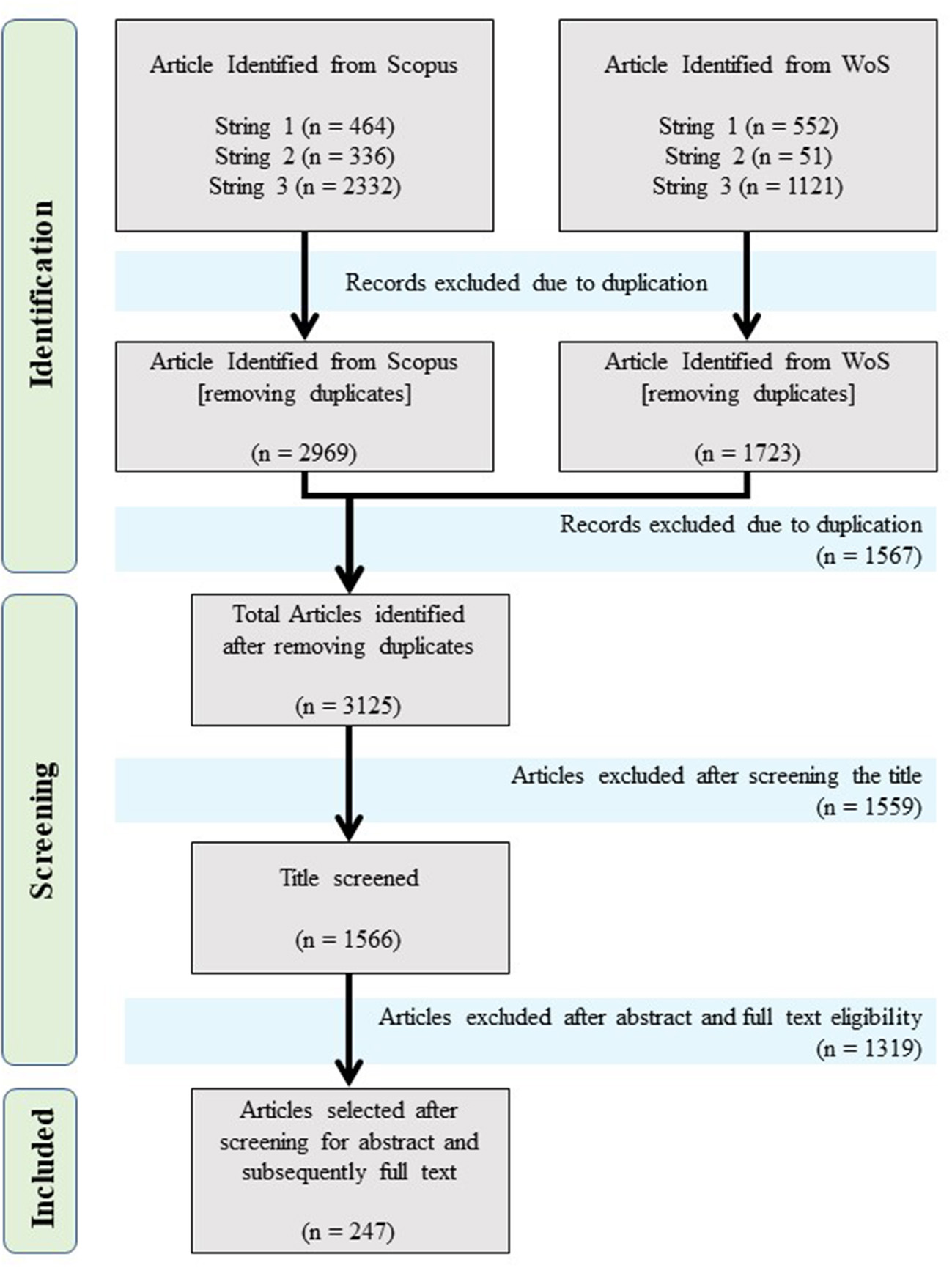
Flowchart of the systematic review protocol.
The start date of the search was 1997 to capture the published articles over the last 25 years. While I acknowledge that the previous reviews (Parida and Agrawal, 2022) have conducted reviews over 40 years since the first usage of the term Global South or Southern cities, the last 25 years, however, illustrate the growth of the field. Figure 2 shows the number of published articles against the timeline to demonstrate the same. The present searches were done on and up to December 2022 for peer-reviewed journal articles. The searches were based on the content of the title, abstract, and keywords. English was specified as the language of publication.
Figure 2
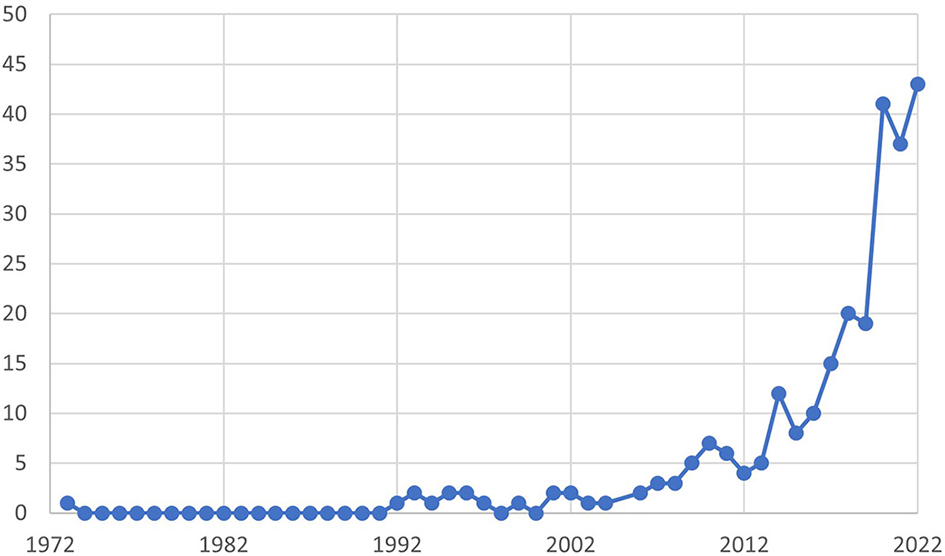
Publication trend by year.
In WoS, the total number of articles identified was 1,723 and in Scopus, the number was 2,969. The articles that overlapped in both searches were eliminated, and a total of 3,125 unique articles were selected. After reviewing the titles of these articles, 1,566 articles were shortlisted. These included all articles that contained the use of any of the search terms. Hence, after reviewing the abstracts and eliminating the articles, I retained 247 articles, which either theoretically, methodologically, or empirically contributed to the conceptual underpinning of Southern urbanism or Southern cities.
This review article primarily focuses on identifying and mapping published articles in the field of urban studies globally. Hence, a quantitative bibliometric analysis of the published articles based on authors, affiliations, country, journals, and citations was prioritized over a review of the contents of the articles. The categories of analysis, therefore, are the most influential articles (Section Influential articles) based on total citation count, leading authors (Section Leading authors), leading institutions and countries (Section Leading institutions and countries), and leading journals in the field (Section Leading journals). A mapping exercise to draw on collaborative networks in the field based on authorship and country-wise institutional affiliations was performed to demonstrate the need for co-producing knowledge in Section 4. Two separate word mapping exercises demonstrate the trends in the field.
Results
Figure 2 shows the number of articles published each year since 1972. There are a few other notable articles published before 1997 (Ginsburg et al., 1991; Sanders, 1992; Myers, 1994), but the number is low. It is visible from this figure that the terminologies gained more momentum since the late 2000s with the growing number of publications since 2017. Since 2017, approximately two-thirds of the articles (160) considered in this review article have been published, highlighting the critical mass and momentum the field has received in recent years. In the following subsections, I discuss the results in more detail.
Influential articles
This section depicts the top 20 influential articles in the field of interest since 1997. The influential articles are determined by the number of total citations (TCs). Table 1 presents the list of articles that have received the most citations during the period 1997 to 2022. It can be seen that the most cited article is titled “The 21st-Century Metropolis: New Geographies of Theory” (Roy, 2009). This article calls for renewed diverse theoretical understanding from experiences of the southern cities. Rooted strongly in calls for decolonization, this article has influenced continuing efforts in steering away from the Euro-American theorization of cities to developing more nuanced and empirically situated understandings of Southern cities. This article has received just <700 citations with an average of 51.8 citations per year.
Table 1
| Authors | Title | Key concept | Journal | TC | PY | |
|---|---|---|---|---|---|---|
| 1 | Roy, Ananya | The 21st-century metropolis: new geographies of theory (Roy, 2009) | Call for new epistemic and methodological insights from the global South | Regional Studies | 674 | 2009 |
| 2 | Roy, Ananya | Slumdog cities: rethinking subaltern urbanism (Roy, 2011) | Theorization of subaltern urbanism | International Journal of Urban and Regional Research | 598 | 2011 |
| 3 | Watson, Vanessa | Seeing from the South: refocusing urban planning on the globe's central urban issues (Watson, 2009) | Calls for moving away from Northern planning theories, practices, assumptions, and norms | Urban Studies | 406 | 2009 |
| 4 | Mcfarlane, Colin | The comparative city: knowledge, learning, urbanism (McFarlane, 2010) | Comparative analysis of Northern and Southern cities through a postcolonial lens | International Journal of Urban and Regional Research | 278 | 2010 |
| 5 | Yu, Xi Jun; Ng, Cho Nam | Spatial and temporal dynamics of urban sprawl along two urban-rural transects: a case study of Guangzhou, China (Yu and Ng, 2007) | Comparative analysis of differential orientations of urban and rural landscape. | Landscape and Urban Planning | 254 | 2007 |
| 6 | Caldeira, Teresa P. R. | Peripheral urbanization: autoconstruction, transversal logics, and politics in cities of the global south (Caldeira, 2017) | Spatial production in urban peripheries by residents as a phenomenon in Global South. | Environment and Planning D-Society & Space | 221 | 2017 |
| 7 | Lawhon, Mary; Ernstson, Henrik, et al. | Provincializing urban political ecology: toward a situated UPE through African urbanism (Lawhon et al., 2014) | Enhancing the understanding of urban political ecology through study of everyday practices, power, and agency. | Antipode | 213 | 2014 |
| 8 | Sheppard, Eric; Leitner, Helga, et al. | Urban pulse-provincializing global urbanism: a manifesto (Sheppard et al., 2013) | Identifying and empowering new urban forms, theories, and practices away from the mainstream global urbanism phenomenon of the North. | Urban Geography | 204 | 2013 |
| 9 | Yigitcanlar, Tan; Kamruzzaman, Md, et al. | Understanding “smart cities”: intertwining development drivers with desired outcomes in a multidimensional framework (Yigitcanlar et al., 2018) | Conceptualizes smart cities' drivers and aspirations | Cities | 198 | 2018 |
| 10 | Roy, Ananya | Who's afraid of postcolonial theory? (Roy, 2016) | Use of postcolonial theory to highlight drawbacks of Eurocentric urban theories. | International Journal of Urban and Regional Research | 196 | 2016 |
| 11 | Connell, Raewyn | Using southern theory: decolonizing social thought in theory, research and application (Connell, 2014) | Importance of the use of Southern and Postcolonial perspectives in social sciences and expanding knowledge boundaries. | Planning Theory | 180 | 2014 |
| 12 | Carmin, JoAnn; Anguelovski, Isabelle, et al. | Urban climate adaptation in the global South: planning in an emerging policy domain (Carmin et al., 2012) | Climate action, and adaptation practices in Global South. | Journal of Planning Education and Research | 172 | 2012 |
| 13 | Robinson, Jennifer; Roy, Ananya | Debate on global urbanisms and the nature of urban theory (Robinson and Roy, 2016) | Rethinking euro-American legacies of urban studies and considering relationality in global urbanism. | International Journal of Urban and Regional Research | 145 | 2016 |
| 14 | Lawhon, Mary; Nilsson, David, et al. | Thinking through heterogeneous infrastructure configurations (Lawhon et al., 2018) | Conceptualizing and acknowledging differential configurations of infrastructure and heterogeneity in Global South. | Urban Studies | 143 | 2018 |
| 15 | Dovey, Kim | Informal urbanism and complex adaptive assemblage (Dovey, 2012) | Conceptualizing urban informality through related assemblage theory and self-organization in complex adaptive systems. | International Development Planning Review | 125 | 2012 |
| 16 | Bhan, Gautam | Notes on a Southern urban practice (Bhan, 2019) | Furthering work on Southern theory and drawing on urban informality as practice. | Environment and Urbanization | 97 | 2019 |
| 17 | Ghertner, D. Asher | India's urban revolution: geographies of displacement beyond gentrification (Ghertner, 2014) | Analyzing socio-spatial changes in Indian cities to critique gentrification in Global South. | Environment and Planning A-Economy and Space | 94 | 2014 |
| 18 | Kudva, Neema | The everyday and the episodic: the spatial and political impacts of urban informality (Kudva, 2009) | Furthering understanding of urban informality and its impact through a Lefebvrian analysis. | Environment and Planning A-Economy and Space | 94 | 2009 |
| 19 | Phelps, Nicholas A.; Wood, Andrew M., et al. | A postsuburban world? An outline of a research agenda (Phelps et al., 2010) | Comparative analysis of urban growth and its implications. | Environment and Planning A-Economy and Space | 92 | 2010 |
| 20 | Shatkin, Gavin | Global cities of the South: emerging perspectives on growth and inequality (Shatkin, 2007) | Developing alternative analytical framework for global cities. | Cities | 88 | 2007 |
The 20 most cited articles in the field.
The second most influential article is also written by the same author, titled “Slumdog Cities: Rethinking Subaltern Urbanism” (Roy, 2011) and received almost 600 citations with an average of 54.4 citations per year. This article focused on subaltern urbanism theories and expands on ideas, such as subaltern spaces and subaltern classes, which are supported by reflections on marginalized slum dwellers' livelihoods and politics in Southern cities. The third most influential article on this list is “Seeing from the South: Refocusing Urban Planning on the Globe's Central Urban Issues” by Watson (2009), which received just over 400 citations with an average of 31.2 citations per year. This article argues against the assumptions, conventions, and normalizations in urban planning dominated by the Global North and how that affects analytical reference for Southern cities.
Thematically all three articles call for acknowledging epistemic and methodological nuances of cities of the Global South that lacks representation in the more widely understood and practiced planning perceptions of Northern cities. In fact, these articles have been crucial in the epistemic positioning of this systematic review. Out of the top 20, 15 articles add to the advancement of our understanding of the Global South, Southern cities, or socio-spatial, ethico-political phenomenon within them (see Table 1). For example, Connell (2014), Roy (2016), and McFarlane (2010) use postcolonial thinking to theorize Southern urbanism. Kudva (2009), Lawhon et al. (2014), Caldeira (2017), and Bhan (2019) call for understanding everyday practices, livelihoods, and needs of marginalized urban dwellers for urban planning and policy decision-making processes. Similar theorizations of urban informality, often marginalized in mainstream urban theories have been addressed and critically assessed by several articles (Dovey, 2012; Caldeira, 2017; Lawhon et al., 2018). A thematic review of debates and concepts in Southern urban theory have been carried out by Parida and Agrawal (2022).
Among the top 20 influential articles, 17 were cited at least 10 times a year on average. Only seven articles received more than 30 citations a year on average. Among those articles, four were published between 2016 and 2019. However, tabulating and ranking authors based on their citations only can be sometimes misleading and may not reflect the true impact and contribution to the knowledge of their scholarly publications in any field. Citation scores may be skewed due to a combination of factors such as publication access type, institutional affiliations, web accessibility, journal subscriptions, and budgetary constraints for the same. Some or all of which in turn may affect the visibility and access of published articles across diverse geographies.
Leading authors
Table 2 shows the top 15 contributing authors based on their total number of citations (TCs). I have considered authors with more than one article for this table. The table also shows other indices such as the total number of publications (TPs), citation per publication (TC/TP), and the citation threshold (more than 200, 100, and 50 citations).
Table 2
| Author | TC | TP | TC/TP | Affiliation | >200 | >100 | >50 | |
|---|---|---|---|---|---|---|---|---|
| 1 | Roy, Ananya | 1613 | 4 | 403.3 | University Calif Berkeley | 2 | 4 | 4 |
| 2 | Lawhon, Mary | 523 | 9 | 58.1 | University Oklahoma | 1 | 2 | 3 |
| 3 | Mcfarlane, Colin | 401 | 3 | 133.7 | University Durham | 1 | 1 | 1 |
| 4 | Ernstson, Henrik | 394 | 4 | 98.5 | KTH Royal Inst Technol | 1 | 2 | 2 |
| 5 | Silver, Jonathan | 382 | 4 | 95.5 | University Sheffield | 1 | 2 | 2 |
| 6 | Robinson, Jennifer | 302 | 5 | 60.4 | University College London | 0 | 1 | 3 |
| 7 | Leitner, Helga | 271 | 4 | 67.8 | University Calif Los Angeles | 1 | 1 | 2 |
| 8 | Sheppard, Eric | 271 | 4 | 67.8 | University Calif Los Angeles | 1 | 1 | 2 |
| 9 | Roberts, Debra | 186 | 2 | 93 | eThekwini Municipal | 0 | 1 | 1 |
| 10 | Lemanski, Charlotte | 172 | 5 | 34.4 | University Autonoma Barcelona | 0 | 0 | 2 |
| 11 | Lwasa, Shuaib | 147 | 2 | 73.5 | Makerere University | 0 | 1 | 1 |
| 12 | Nilsson, David | 143 | 2 | 71.5 | KTH Royal Inst Technol | 0 | 1 | 1 |
| 13 | Bhan, Gautam | 110 | 2 | 55 | Indian Inst Human Settlements | 0 | 0 | 1 |
| 14 | Ghertner, D. Asher | 101 | 2 | 50.5 | Rutgers State University | 0 | 0 | 1 |
| 15 | Shatkin, Gavin | 88 | 2 | 44 | Northeastern University | 0 | 0 | 1 |
Most influential and contributing authors (with more than one article).
Ananya Roy leads in the citation per article category with 403.25 TC/TP, followed by Colin Mcfarlane with 133.67. However, based on the number of articles, the leaders are Mary Lawhon (nine papers) and Jennifer Robinson and Charlotte Lemanski (both with five papers each). A total of 12 authors have more than two publications, among them six have more than 300 citations and five of them have more than 90 citations per paper.
There are a number of authors who have highly cited articles but are not included in the influential list because they have only one article within the limits of this review article. The top two articles of this type are written by Yu and Ng (2007) and Sheppard et al. (2013), but are not listed in Table 2.
However, the citation score does not cover the breadth and depth of the scholarship in the field of urban studies. While all the authors listed in Table 2, except Shuaib Lwasa (Lawhon et al., 2018; Nakyagaba et al., 2021) and Goutam Bhan (Bhan, 2019), are institutionally affiliated with Global North universities, it must be noted here that the increasing number of publications are now being produced in and from the Global South. Many notable scholarly articles and influential scholars have not been identified within this review due to the limitations of citation visibility. In addition, the search criteria automatically excluded a number of publications because the search terms were not present within the title, abstract, or keywords of those publications. For example, some influential scholars with a substantial number of publications in this field include Tim Bunnell and associated scholars (Bunnell and Das, 2010; Bunnell and Maringanti, 2010; Bunnell and Harris, 2012; Martinez et al., 2021), Swapna Banerjee-Guha (Banerjee-Guha, 2002, 2009), and Annapurna Shaw and associated scholars (Shaw, 1999, 2005; Shaw and Satish, 2007). Notably, the institutional affiliations of the said authors are geographically located in the Global South.
Leading institutions and countries
According to the total number of publications (TP), University College London (UCL) is the most productive and influential institute with 22 publications within this review period. The University of Cape Town is second on the list with 14 articles (Table 3). The next two universities ranked according to TPs are the University of California Los Angeles (UCLA, 12) and the University of Sheffield (11). Six European (four of which are from the UK), three North American, three African (specifically South Africa), two Australian, and one Latin American universities make the top 15 contributing universities according to the total number of publications. The top 30 universities comprise nine universities each from Europe and North America, four each from Australia and Africa, three from Asia, and only one from Latin America (Figure 3A).
Table 3
| According to TP | According to TC | According to TC/TP | ||||
|---|---|---|---|---|---|---|
| University | TP | University | TC | University | TC/TP | |
| 1 | University College London | 22 | The University of California Berkeley | 2986 | The University of California Berkeley | 497.7 |
| 2 | The University of Cape Town | 14 | The University of California Los Angeles | 1224 | Queensland University of Technology (QUT) | 198.0 |
| 3 | The University of California Los Angeles | 12 | The University of Cape Town | 948 | Daegu Gyeongbuk Institute of Science & Technology (DGIST) | 198.0 |
| 4 | The University of Sheffield | 11 | University College London | 698 | The University of Messina | 198.0 |
| 5 | The University of Manchester | 10 | Durham University | 636 | Universidade Federal de Santa Catarina (UFSC) | 198.0 |
| 6 | The University of Witwatersrand | 10 | The University of Oklahoma—Norman | 475 | Massachusetts Institute of Technology (MIT) | 172.0 |
| 7 | The University of Oklahoma - Norman | 10 | Queensland University of Technology (QUT) | 396 | Durham University | 127.2 |
| 8 | The University of Melbourne | 8 | The University of Hong Kong | 316 | The University of Pretoria | 125.5 |
| 9 | Cardiff University | 6 | The University of Manchester | 302 | Stanford University | 125.5 |
| 10 | Royal Institute of Technology | 6 | Monash University | 282 | The University of California Los Angeles | 102.0 |
| 11 | The University of California Berkeley | 6 | The University of Sheffield | 264 | Autonomous University of Barcelona | 92.0 |
| 12 | Durham University | 5 | The University of Pretoria | 251 | Oxford Brookes University | 92.0 |
| 13 | Monash University | 5 | Stanford University | 251 | The University of Kentucky | 92.0 |
| 14 | The University of Johannesburg | 5 | The University of Witwatersrand | 223 | The University of Sydney | 91.0 |
| 15 | Universidade de São Paulo | 5 | Daegu Gyeongbuk Institute of Science & Technology (DGIST) | 198 | The University of Hong Kong | 79.0 |
The most productive and influential institutions.
Figure 3
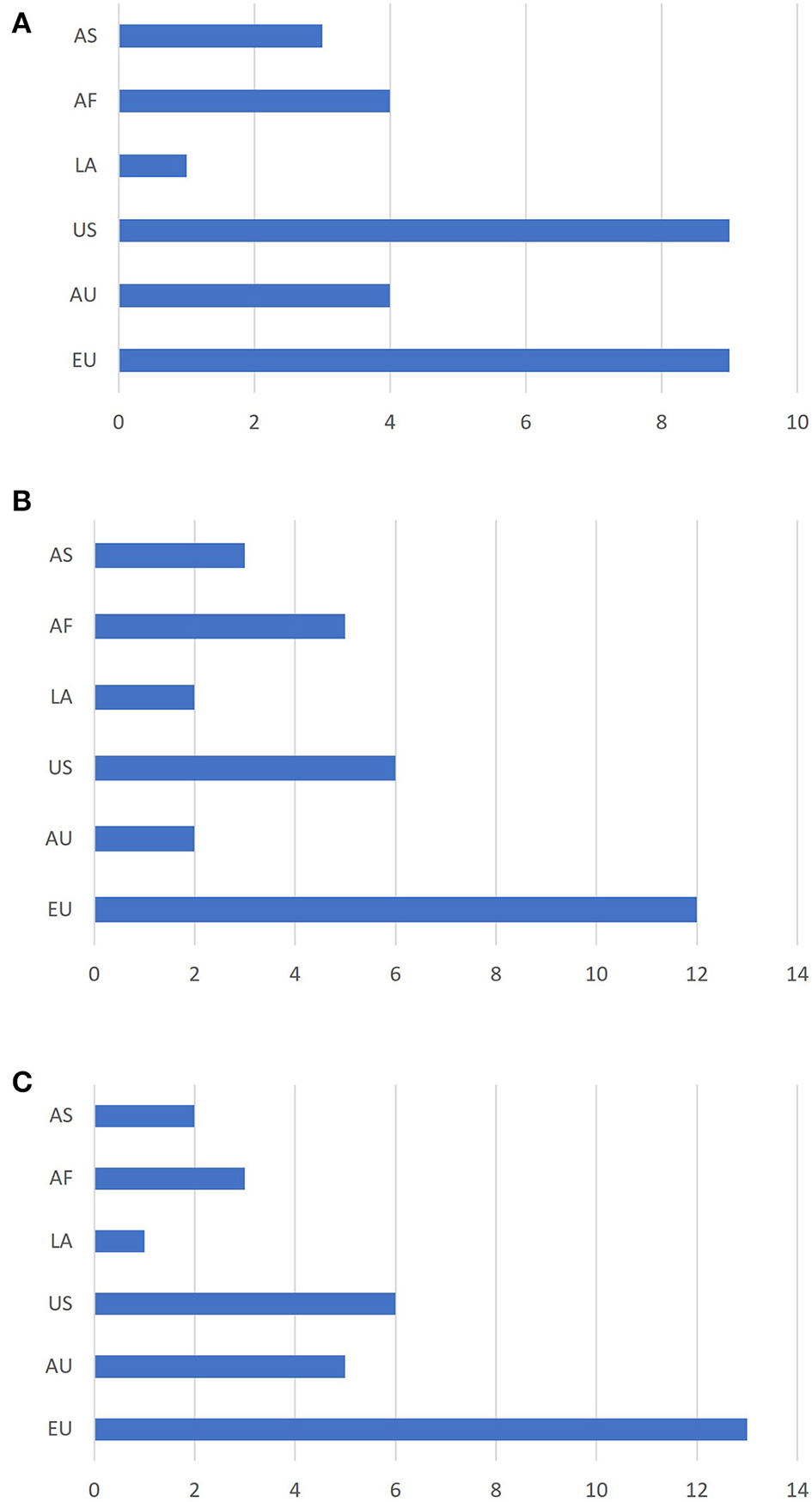
Continent-wise distribution of top 30 contributing universities—(A) According to total publications (TPs), (B) according to total citations (TCs), and (C) according to citations per publication (TC/TP).
The University of California Berkeley (UCB) leads the chart both by total citations (TCs) and citations per publication (TC/TP). UCB is the only institute to have more than 2,000 citations with six articles. The next three universities to follow UCB as per the TC are the University of California Los Angeles (UCLA, 1,224), the University of Cape Town (984), and the University College London (698). The top 15 universities as per TCs consist of four North American, four European (all UK), three African, and two each from Australian and Asian universities.
According to the citation per publication (TC/TP), UCB tops the list with a value of 497.7, followed by the Queensland University of Technology (QUT), the Daegu Gyeongbuk Institute of Science and Technology (DGIST), the University of Messina, and the Universidade Federal de Santa Catarina (UFSC) with 198.0. It must be noted that these universities have only one article in this review (Yigitcanlar et al., 2018). Thus, the second university with more than one article on the list is the Massachusetts Institute of Technology (MIT) with 172 TC/TP.
Based on TP, TC, and TC/TP indices, Figure 3 shows the distribution of universities across the continent that forms the top 30 universities of the respective lists. Figure 4 shows the consistency of publications across institutes over time which shows that UCL is showing a growing number of publications recently. All five universities, notably, two English and two American, in this figure have consistently produced highly cited articles over the last decade.
Figure 4
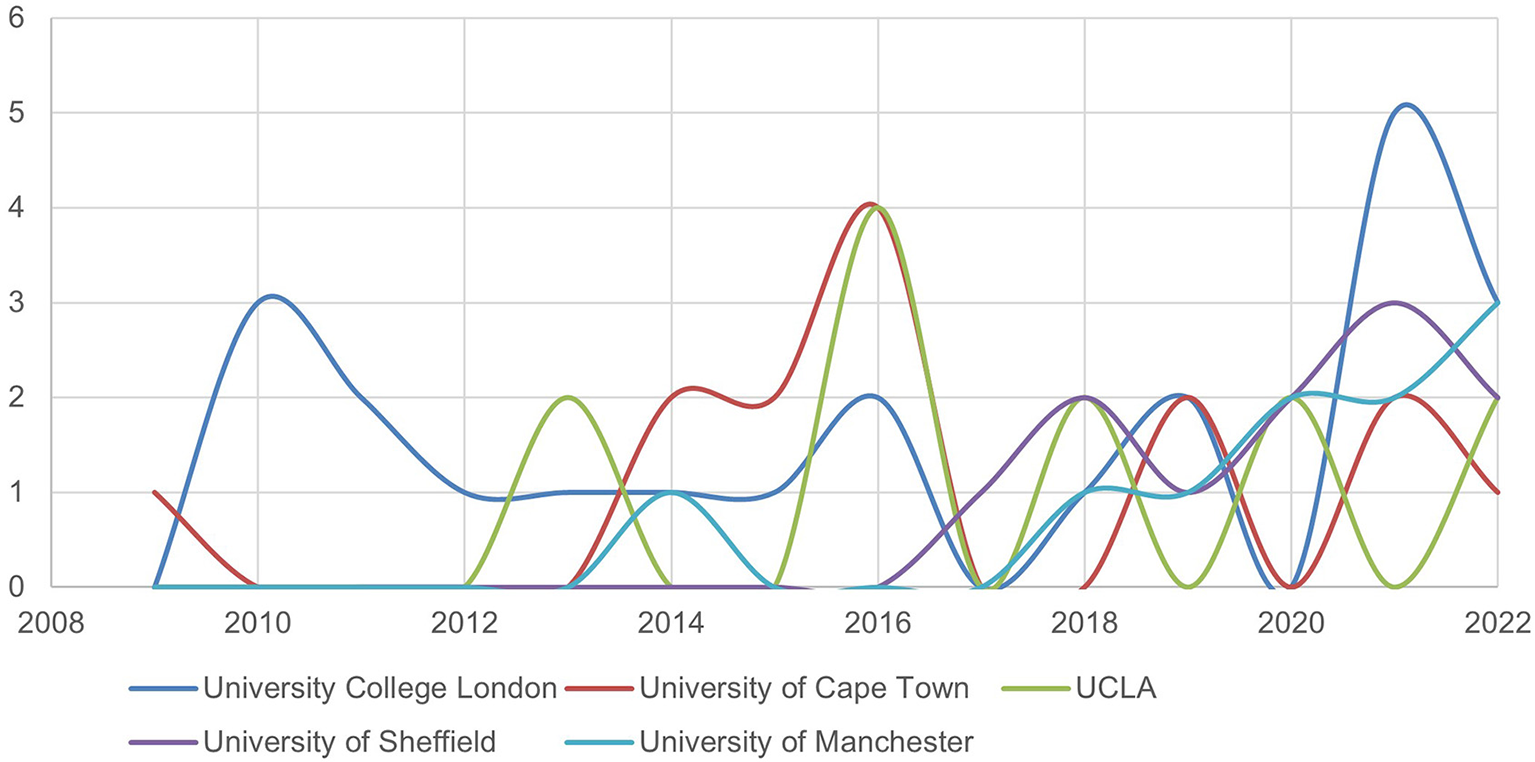
Top five institutes' year-wise publication trend.
A different perspective can be achieved by exploring the publications in a country-wise analysis (Table 4). Table 4 shows the top 15 influential countries with respect to TP, TC, and TC/TP. England is the most productive country with 76 publications, followed by the USA with 57 publications. It is to be noted that the UK universities are tabulated separately as England, Scotland, Wales, and Northern Ireland in this list. The next two most productive countries are South Africa (36) and Australia (21). Although the top four countries all are from different continents, the number of publications from Europe (142) and North America (75) is much higher than Asia (43), Africa (52), and Latin America (19) combined. It is worth noting, however, that some publications have authors working collaboratively across countries and continents, hence a few articles are calculated from more than one source.
Table 4
| According to TP | According to TC | According to TC/TP | ||||||||
|---|---|---|---|---|---|---|---|---|---|---|
| Rank | Country | TP | # | Country | TC | # | Country | TP | TC | TC/TP |
| 1 | England | 76 | 1 | England | 3,969 | 1 | South Korea | 3 | 222 | 74.0 |
| 2 | USA | 57 | 2 | USA | 3,565 | 2 | USA | 57 | 3,565 | 62.5 |
| 3 | South Africa | 36 | 3 | South Africa | 1,155 | 3 | England | 76 | 3,969 | 52.2 |
| 4 | Australia | 21 | 4 | Australia | 764 | 4 | Japan | 6 | 259 | 43.2 |
| 5 | Canada | 16 | 5 | China | 384 | 5 | France | 2 | 84 | 42.0 |
| 6 | Germany | 12 | 6 | Japan | 259 | 6 | Spain | 5 | 206 | 41.2 |
| 7 | Netherland | 11 | 7 | Brazil | 253 | 7 | Uganda | 4 | 161 | 40.3 |
| 8 | China | 10 | 8 | Canada | 249 | 8 | China | 10 | 384 | 38.4 |
| 9 | Brazil | 9 | 9 | South Korea | 222 | 9 | Australia | 21 | 764 | 36.4 |
| 10 | India | 8 | 10 | Spain | 206 | 10 | Sweden | 6 | 202 | 33.7 |
| 11 | Italy | 8 | 11 | Sweden | 202 | 11 | South Africa | 36 | 1,155 | 32.1 |
| 12 | Sweden | 6 | 12 | Uganda | 161 | 12 | Brazil | 9 | 253 | 28.1 |
| 13 | Japan | 6 | 13 | India | 154 | 13 | Wales | 2 | 54 | 27.0 |
| 14 | Spain | 5 | 14 | Netherland | 115 | 14 | India | 8 | 154 | 19.3 |
| 15 | Colombia | 5 | 15 | France | 84 | 15 | Canada | 16 | 249 | 15.6 |
The most productive and influential countries in the field.
According to the list of most cited countries, England again leads with 3,969 citations, followed by the USA (3,565), South Africa (1,155), and Australia (764) (Figure 5). An interesting finding can be noticed from the ranking as per the TC/TP index. South Korea is at the top of the list with 74.0 citations per publication, followed by the USA (62.5), England (52.1), and Japan (43.2). However, South Korea has only three publications in this review, while the USA and England have a much higher number of publications. Thus, it can be noted that although the number of publications from African, Asian, and Latin American universities is less compared to European and North American universities, they are well-cited. On the contrary, the European and North American universities with their high number of publications and citations produce skewed results in their favor when only these two factors are considered.
Figure 5
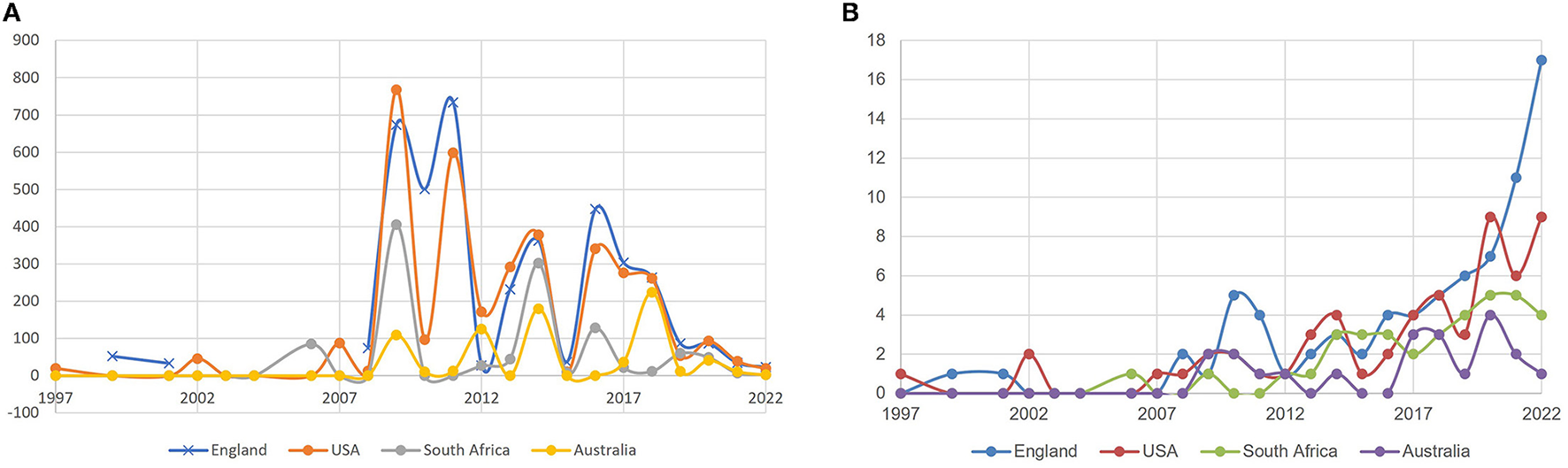
Country-wise distribution of publications—(A) according to total citations (TCs) and (B) according to total publications (TP).
An interesting trend is now visible if we review publications of the last 5 years in Table 5. England still leads the list for the indices TP (46) and TC (532), followed by the US (TP-32, TC-466) in both cases. However, the citations of publications from Asia, Africa, and Latin America have increased by a noticeable amount. The top three countries of the citations per publication list are South Korea (107.5), Uganda (50.3), and Japan (43.2). Interestingly, according to TC/TP, the top 10 list of countries consists of three Asian countries (South Korea, Japan, and India), two each from the EU (Sweden and Switzerland) and North America (USA and Canada), and one each from Africa (Uganda), Australia, and Latin America (Brazil). England is in the 11th position in this list with an average citation per publication of 11.6. Another historically influential country, South Africa, has also dropped to 16th place with a TC/TP value of 6.2.
Table 5
| According to TP | According to TC | According to TC/TP | ||||||
|---|---|---|---|---|---|---|---|---|
| Rank | Country | TP | # | Country | TC | # | Country | TC/TP |
| 1 | England | 46 | 1 | England | 532 | 1 | South Korea | 107.5 |
| 2 | USA | 32 | 2 | USA | 466 | 2 | Uganda | 50.3 |
| 3 | South Africa | 21 | 3 | Australia | 290 | 3 | Japan | 43.2 |
| 4 | Canada | 14 | 4 | Japan | 259 | 4 | Sweden | 38.5 |
| 5 | Australia | 11 | 5 | Brazil | 227 | 5 | Brazil | 32.4 |
| 6 | Germany | 11 | 6 | South Korea | 215 | 6 | Australia | 26.4 |
| 7 | Netherland | 9 | 7 | Canada | 166 | 7 | India | 20.1 |
| 8 | China | 7 | 8 | Sweden | 154 | 8 | Switzerland | 14.7 |
| 9 | Brazil | 7 | 9 | Uganda | 151 | 9 | USA | 14.6 |
| 10 | India | 7 | 10 | India | 141 | 10 | Canada | 11.9 |
Top 10 influential countries in the last 5 years.
Leading journals
Table 6 shows the top 10 influential journals according to the same three indices namely, TP, TC, and TC/TP. According to total publications (TP) and total citations (TC), the International Journal of Urban and Regional Research (IJURR) leads the list with 24 publications with 1,692 citations. Urban Studies and Sustainability are the two journals next on the list of TP with the number of articles being 16 and 10, respectively. Urban Studies journal also ranked second in the TC index with a number of citations of 880. The third on the list is the Regional Studies journal with 712 citations.
Table 6
| Rank | Journal name | TP | # | Journal name | TC | # | Journal name | TC/TP |
|---|---|---|---|---|---|---|---|---|
| 1 | IJURR | 24 | 1 | IJURR | 1,692 | 1 | Regional Studies | 356.0 |
| 2 | Urban Studies | 16 | 2 | Urban Studies | 880 | 2 | Environment and Planning D-Society & Space | 99.3 |
| 3 | Sustainability | 10 | 3 | Regional Studies | 712 | 3 | Landscape and Urban Planning | 96.7 |
| 4 | Environment and Planning A—Economy and Space | 9 | 4 | Environment and Planning A—Economy and Space | 446 | 4 | Journal of Planning Education and Research | 88.5 |
| 5 | Cities | 8 | 5 | Cities | 361 | 5 | IJURR | 70.5 |
| 6 | Habitat International | 8 | 6 | Environment and Planning D—Society & Space | 298 | 6 | Urban Geography | 59.4 |
| 7 | Antipode | 7 | 7 | Urban Geography | 297 | 7 | Planning Theory | 56.3 |
| 8 | Urban Geography | 5 | 8 | Antipode | 293 | 8 | Urban Studies | 55 |
| 9 | Environment and Urbanization | 5 | 9 | Landscape and Urban Planning | 290 | 9 | Progress in Human Geography | 52.7 |
| 10 | South African Geographical Journal | 4 | 10 | Planning Theory | 225 | 10 | Environment and Planning A—Economy and Space | 49.6 |
Top 10 influential journals.
However, based on the TC/TP index, Regional Studies is significantly ahead of others with 356 citations per publication which includes two articles only (Roy, 2009; Ernstson et al., 2014). One of these two articles is by Ananya Roy, who leads the citation list in Table 1. The next two journals with high citations per publication are Environment and Planning D—Society and Space (99.3) and Landscape and Urban Planning (96.7). Interestingly, IJURR also ranks fifth in terms of citations per article (70.5) and Urban Studies is ranked eighth with 55. For the ranking of journals, this article considered those journals only which has more than one article in the review data.
Mapping the publications with VOS viewer software
Based on the results of the analysis, I mapped the publications using different parameters to visually represent some of the data using the VOS viewer software (Van Eck and Waltman, 2010). It is important to note that the size of the nodes represents the number of occurrences in the respective map, and the curved lines are the representation of connections. Also, the different colors show different clusters and proximities.
By mapping the results of the country-wise collaborative articles, Figure 6 illustrates interesting clusters and connections. The US and England are unsurprisingly the biggest contributors, although South Africa, India, Australia, Canada, and China are showing connections. Another cluster shows a few European countries with many internal connections, but owing to their relatively smaller number of publications, the sizes of the nodes are compact.
Figure 6
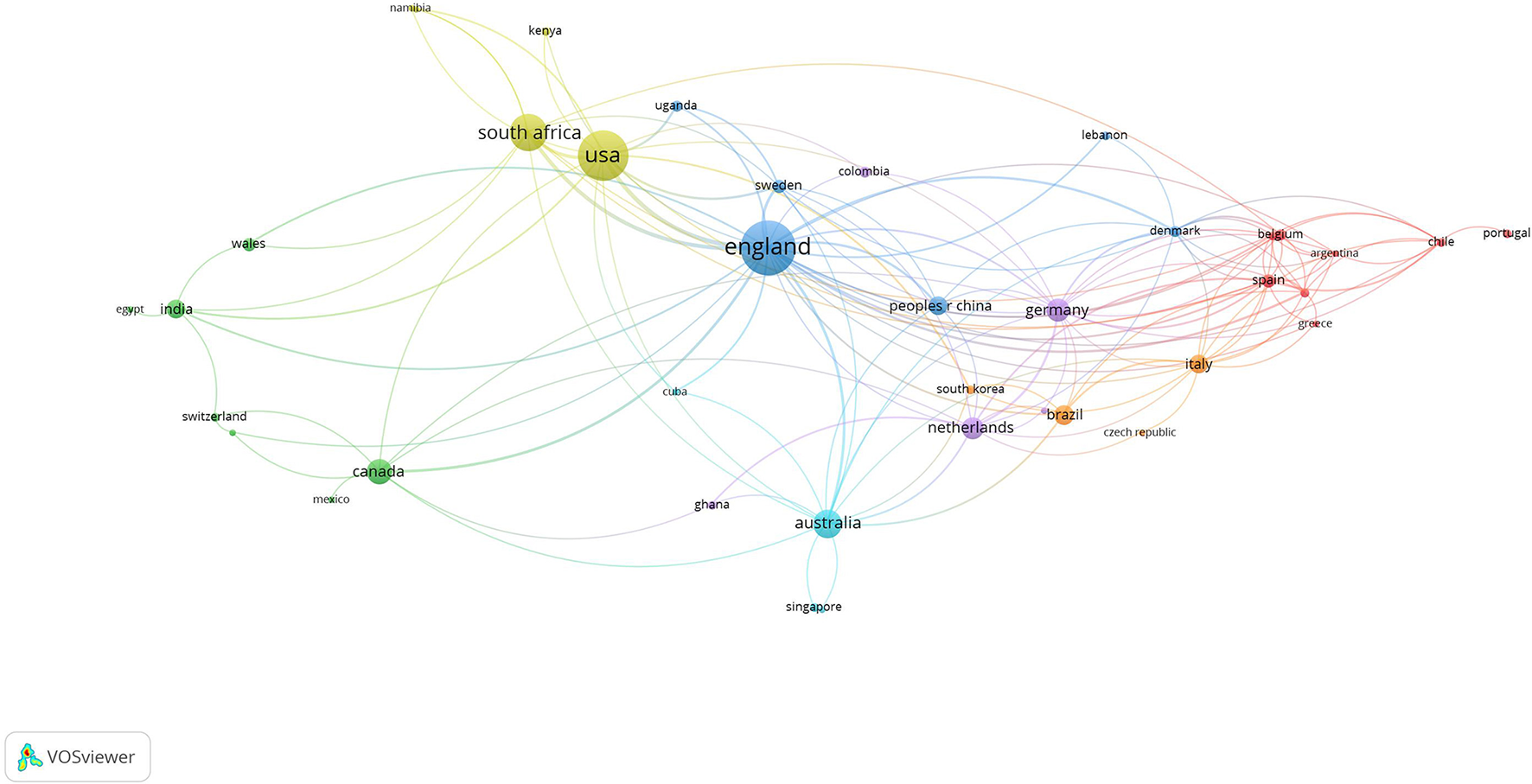
Collaborative networks across countries of affiliation of co-authors.
However, the collaborations become interesting when plotted with authors and their publications (Figure 7). It should be noted that there are almost no connections among the different clusters and nodes. The connections are few and far between, suggesting that despite calls for collaboration and support for early career scholars, concerns around the politics of visibility and diversity of voices for southern scholars (Lawhon et al., 2020), urban studies, and allied disciplines remain dominated by voices of Eurocentric and North Atlantic heavyweights (Roy, 2020).
Figure 7
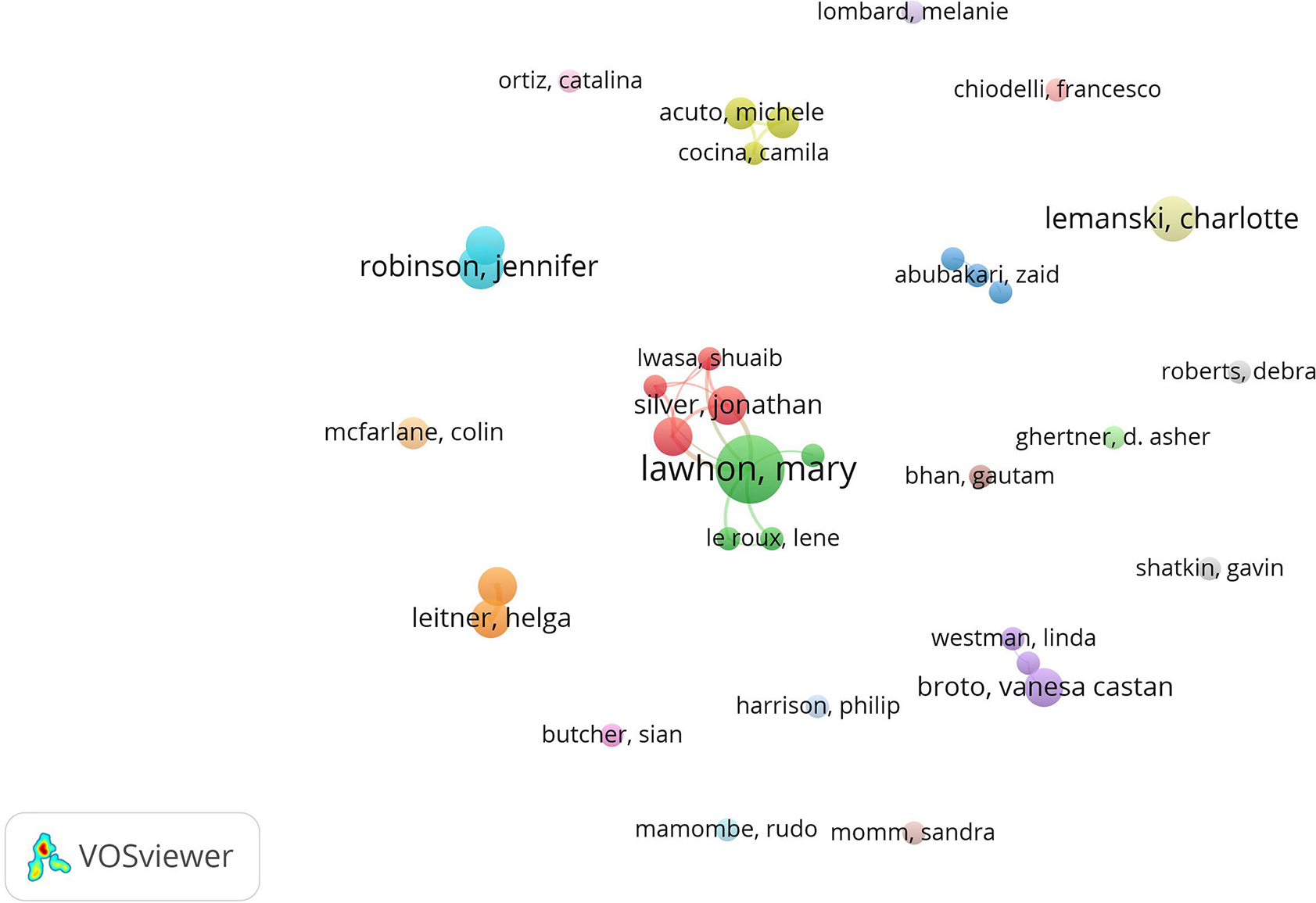
Collaborative networks of co-authors.
To analyze further, a thematic clustering based on the recurring words in the title and abstracts is represented in Figure 8. Here, four distinct clusters were identified, which are represented by four colors and show a close correlation among the clusters. The most prominent red cluster shows the urban scholarships in the Global South with strong implications in the conceptual and theoretical underpinnings. Moreover, the red cluster shows the words with a higher number of occurrences, and the cluster is most densely arranged and remains almost central to the map.
Figure 8
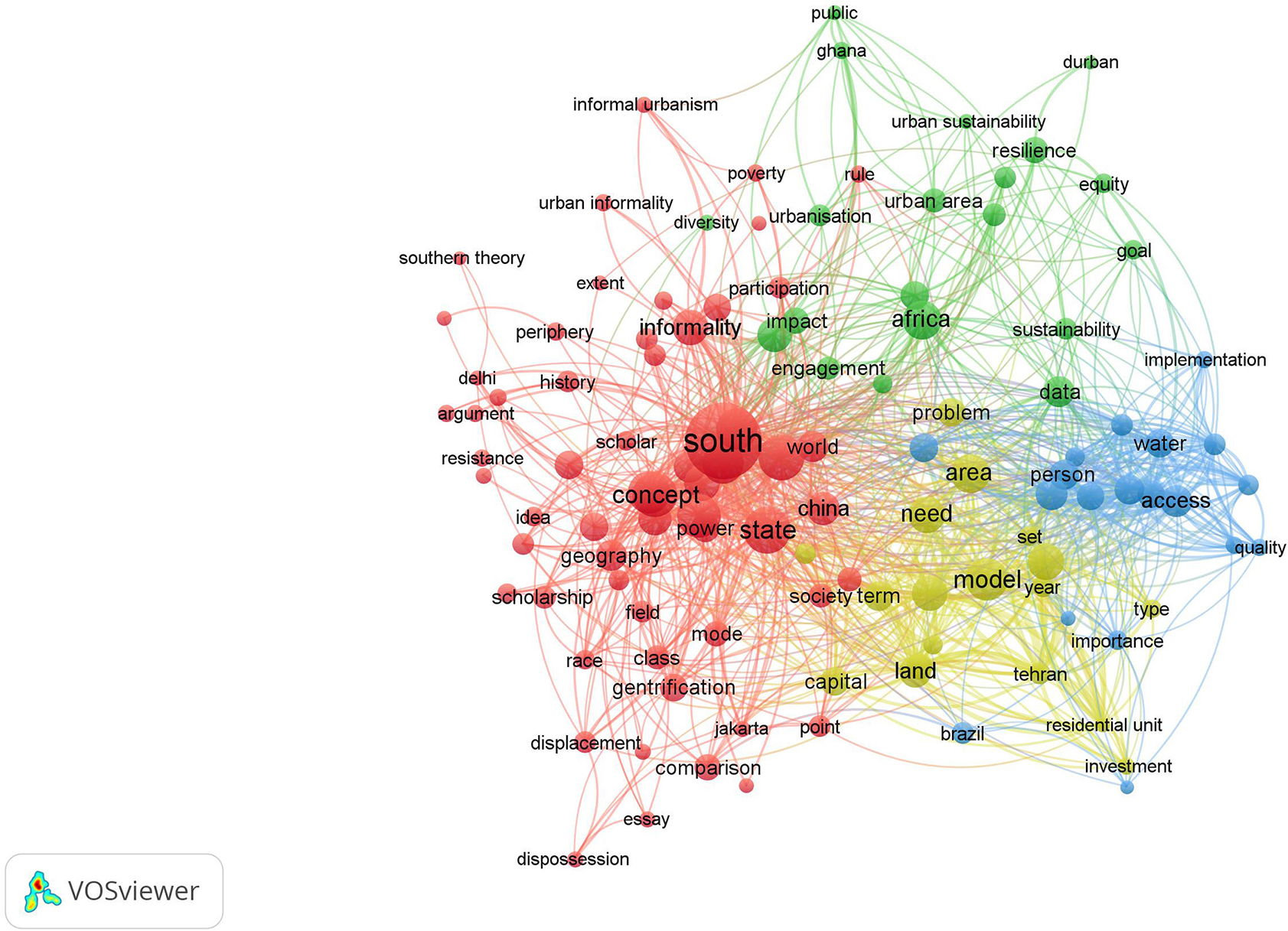
The thematic cluster of recurring words in the title of the publications.
Similarly, Figure 9 shows the thematic clustering of the recurring keywords from the same publications. As the figure is mapped based on the author's chosen keywords drawn from the publications, the clusters show more centrality where cities, politics, informality, Global South, policy, and urbanization are the most prominent. The clusters are highly correlated and distances between the nodes in the core are almost negligible.
Figure 9
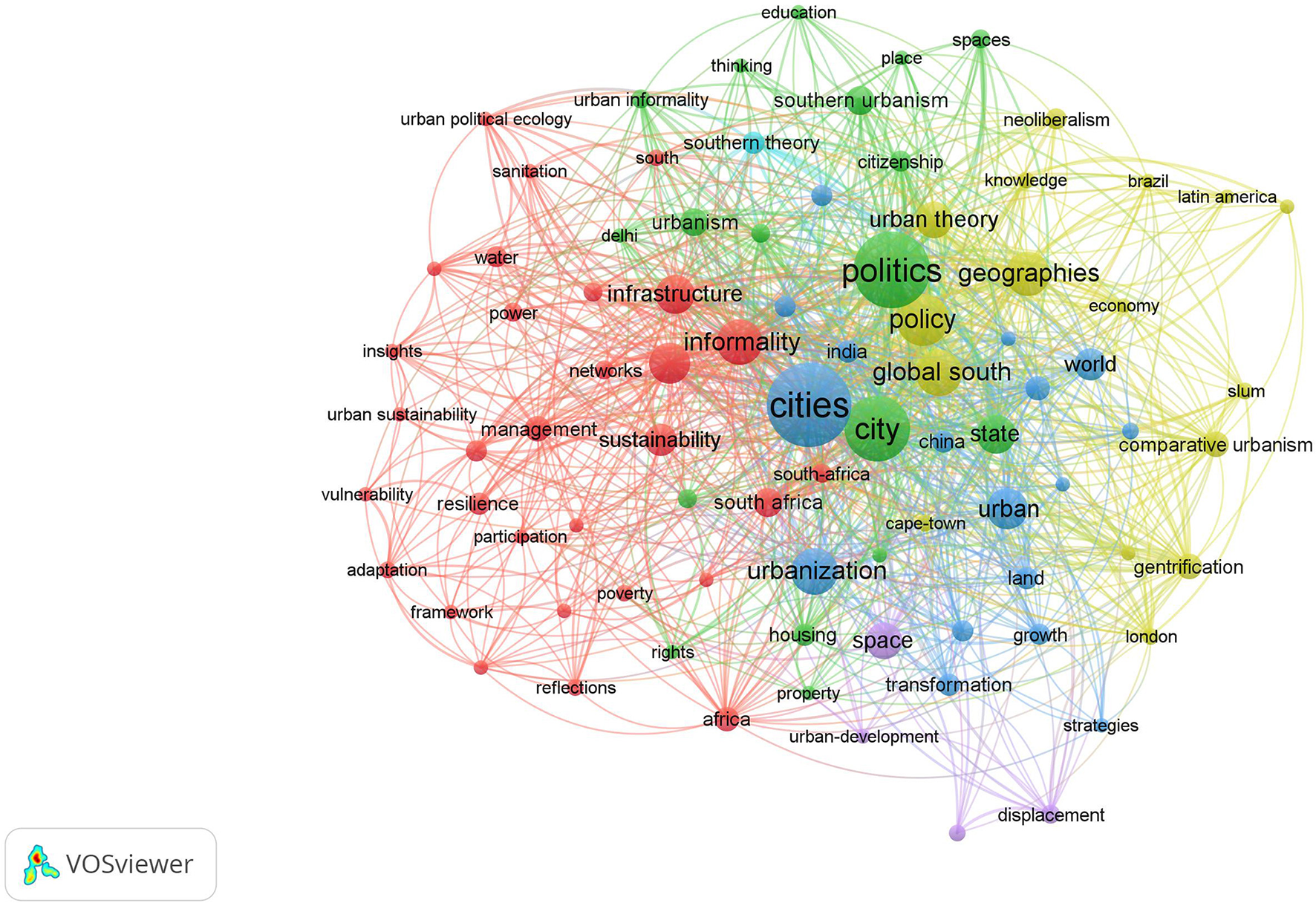
The thematic cluster of recurring words in the keywords of the publications.
Discussions and conclusion
The number of publications considered for this study was 247 journal articles published between 1997 and 2022. Compared to the overall number of publications in the field of urban studies, this number is small considering the ongoing calls to methodologically and epistemically contribute to the theorization of the Southern cities.
The analysis of results from 247 publications within this study agrees well with the ongoing discourse on the Eurocentric and North American dominance in urban studies (Lawhon and Le Roux, 2019). Furthermore, this study has illustrated the most cited, experienced authors, and the most influential universities in this field. These findings question the diversity and plurality of authorship in this field. Furthermore, the scholarship is skewed toward North American and European universities while most recently a small number of publications are originating from countries such as India, South Korea, Ghana, and Uganda. Notably, Australian and South African universities have a considerable scholarship in the field consistently, possibly owing to the selection criteria for publication being English.
Starting from the early 2000s, the field of urban studies has witnessed a steady growth of scholarship on particularly Southern cities challenging the assumptions of Western city-making. The last 5 years have seen a significant growth in the number of publications in this field and a considerable increase in the authorship originating in the South and collaborating with Southern scholars.
Another reason for the skewed representation of scholarship toward the European, North American, and Australian universities might be the lack of institutional support and funding landscape in Southern institutions. This shortcoming can be overcome by increasing institutional collaborations between Northern and Southern universities and support and mentorship of experienced scholars based in the north. This can be particularly achieved through institutional collaborations and exchange programs, allowing Southern scholars to spend visiting research positions at all career stages. Also, the financial barriers to attending scholarly events and exchange opportunities faced by Southern scholars can be eliminated by more affordable, accessible knowledge exchange activities. More efforts should be made for affordable and stipendiary opportunities for conferences, research visits, and funding and/or discounted fees for open-access publications.
From the mapping exercise, four or five distinct and growing thematic clusters can be identified which potentially leads to different conceptual underpinnings. The first cluster conceptualizes the politics, informality, and power relations in Southern cities. The second cluster problematizes land and tenureship models. The third, the more recent and growing cluster studies urban sustainability, community resilience, engagement, and impact activities. Finally, the other cluster discusses the politics of infrastructure and its access. This finding not only suggests the dynamics and ongoing transformation of Southern cities but also them being more than the significant other (Roy, 2020) to the Northern theorization. The findings of this study highlight that there is a need to widen and diversify the points of enquiry and geographies of knowledge production and contribute to urban theories from around the world.
In this article, I have systematically analyzed and mapped journal articles in urban studies contributing to shaping our understanding of cities of the Global South. The contribution of this review article is to highlight the knowledge production discrepancies and map the existing scholarship landscape. The main argument of this article is to facilitate collaborative dialogues and reduce barriers to access and affordability in the production of knowledge. By challenging the established power relations and institutional hegemonies, it might be possible to develop a diverse and plural representation of the scholarship in urban studies.
Statements
Data availability statement
The raw data supporting the conclusions of this article will be made available by the authors, without undue reservation.
Author contributions
The author confirms being the sole contributor of this work and has approved it for publication.
Funding
This work was supported by the Economic and Social Research Council (ESRC)—UKRI and The University of Manchester (Grant Number ES/W007649/1).
Conflict of interest
The author declares that the research was conducted in the absence of any commercial or financial relationships that could be construed as a potential conflict of interest.
Publisher’s note
All claims expressed in this article are solely those of the authors and do not necessarily represent those of their affiliated organizations, or those of the publisher, the editors and the reviewers. Any product that may be evaluated in this article, or claim that may be made by its manufacturer, is not guaranteed or endorsed by the publisher.
Footnotes
1.^ Urban studies refer to understanding cities and urban areas through multiple related disciplinary perspectives including urban planning, geography, architecture, anthropology, sociology, and economics and political sciences.
References
1
Banerjee-Guha S. (2002). Shifting cities: urban restructuring in Mumbai. Econ. Polit. Wkly.37, 121–128. Available online at: https://www.jstor.org/stable/4411593
2
Banerjee-Guha S. (2009). Neoliberalising the ‘urban': new geographies of power and injustice in Indian cities. Econ. Polit. Wkly.44, 95–107. Available online at: https://www.jstor.org/stable/40279062
3
Bhan G. (2019). Notes on a Southern urban practice. Environ. Urban.31, 639–654. 10.1177/0956247818815792
4
Bhan G. Srinivas S. Watson V. (2018). Introduction - The Routledge Companion to Planning in the Global South. London: Routledge. 10.4324/9781317392842
5
Bunnell T. Das D. (2010). Urban pulse—a geography of serial seduction: urban policy transfer from Kuala Lumpur to Hyderabad. Urban Geogr.31, 277–284. 10.2747/0272-3638.31.3.277
6
Bunnell T. Harris A. (2012). Re-viewing informality: perspectives from urban Asia. Int. Dev. Plann. Rev.34, 339. 10.3828/idpr.2012.21
7
Bunnell T. Maringanti A. (2010). Practising urban and regional research beyond metrocentricity. Int. J. Urban Reg. Res.34, 415–420. 10.1111/j.1468-2427.2010.00988.x
8
Caldeira T. P. (2017). Peripheral urbanization: autoconstruction, transversal logics, and politics in cities of the global south. Environ. Plann. D Soc. Space35, 3–20. 10.1177/0263775816658479
9
Carmin J. Anguelovski I. Roberts D. (2012). Urban climate adaptation in the global south: planning in an emerging policy domain. J. Plann. Educ. Res.32, 18–32. 10.1177/0739456X11430951
10
Connell R. (2014). Using southern theory: decolonizing social thought in theory, research and application. Plann. Theory13, 210–223. 10.1177/1473095213499216
11
Dovey K. (2012). Informal urbanism and complex adaptive assemblage. Int. Dev. Plann. Rev.34, 349–368. 10.3828/idpr.2012.23
12
Ernstson H. Lawhon M. Duminy J. (2014). Conceptual vectors of African urbanism: “Engaged theory-making” and “platforms of engagement”. Reg. Stud.48, 1563–1577. 10.1080/00343404.2014.892573
13
Ghertner D. A. (2014). India's urban revolution: geographies of displacement beyond gentrification. Environ. Plann. A Econ. Space46, 1554–1571. 10.1068/a46288
14
Ginsburg N. S. Koppel B. McGee T. G. (1991). The Extended Metropolis: Settlement Transition is Asia. Honolulu, HI: University of Hawaii Press.
15
Kudva N. (2009). The everyday and the episodic: the spatial and political impacts of urban informality. Environ. Plann. A41, 1614–1628. 10.1068/a41101
16
Lawhon M. (2020). Making Urban Theory: Learning and Unlearning Through Southern Cities. Abingdon; New York, NY: Routledge.
17
Lawhon M. Ernstson H. Silver J. (2014). Provincializing urban political ecology: towards a situated UPE through African urbanism. Antipode46, 497–516. 10.1111/anti.12051
18
Lawhon M. Le Roux L. (2019). Southern urbanism or a world of cities? Modes of enacting a more global urban geography in textbooks, teaching and research. Urban Geogr.40, 1251–1269. 10.1080/02723638.2019.1575153
19
Lawhon M. Le Roux L. Makina A. Nsangi G. Singh A. Sseviiri H. (2020). Beyond southern urbanism? Imagining an urban geography of a world of cities. Urban Geogr.41, 657–667. 10.1080/02723638.2020.1734346
20
Lawhon M. Nilsson D. Silver J. Ernstson H. Lwasa S. (2018). Thinking through heterogeneous infrastructure configurations. Urban Stud.55, 720–732. 10.1177/0042098017720149
21
Lawhon M. Truelove Y. (2020). Disambiguating the southern urban critique: propositions, pathways and possibilities for a more global urban studies. SAGE J. 57, 3–20. 10.1177/0042098019829412
22
Leitner H. Sheppard E. (2016). Provincializing critical urban theory: extending the ecosystem of possibilities. Int. J. Urban Reg. Res.40, 228–235. 10.1111/1468-2427.12277
23
Martinez R. Bunnell T. Acuto M. (2021). Productive tensions? The “city” across geographies of planetary urbanization and the urban age. Urban Geogr.42, 1011–1022. 10.1080/02723638.2020.1835128
24
McFarlane C. (2010). The comparative city: knowledge, learning, urbanism. Int. J. Urban Reg. Res.34, 725–742. 10.1111/j.1468-2427.2010.00917.x
25
McFarlane C. (2011). The city as a machine for learning. Transact. Inst. Br. Geogr.36, 360–376. 10.1111/j.1475-5661.2011.00430.x
26
Mohan A. K. (2021). “Introduction-exploring urban ‘southernness': praxes and theory (s),” in Theorising Urban Development From the Global South. p. 1–28.
27
Moher D. Liberati A. Tetzlaff J. Altman D. G. PRISMA Group* . (2009). Preferred reporting items for systematic reviews and meta-analyses: the PRISMA statement. Ann. Intern. Med.151, 264–269. 10.7326/0003-4819-151-4-200908180-00135
28
Myers G. A. (1994). Eurocentrism and African urbanization: the case of Zanzibar's Other Side. Antipode26, 195–215. 10.1111/j.1467-8330.1994.tb00248.x
29
Nakyagaba G. N. Lawhon M. Lwasa S. Silver J. Tumwine F. (2021). Power, politics and a poo pump: contestation over legitimacy, access and benefits of sanitation technology in Kampala. Singap. J. Trop. Geogr.42, 415–430. 10.1111/sjtg.12381
30
Parida D. Agrawal S. (2022). Southern urbanism: a systematic review of concepts, debates, and future directions. GeoJournal 1–22. 10.1007/s10708-022-10761-x
31
Parnell S. Oldfield S. (2014). The Routledge Handbook on Cities of the Global South. London: Routledge.
32
Phelps N. A. Wood A. M. Valler D. C. (2010). A postsuburban world? An outline of a research agenda. Environ. Plann. A42, 366–383. 10.1068/a427
33
Randolph G. F. Storper M. (2023). Is urbanisation in the Global South fundamentally different? Comparative global urban analysis for the 21st century. Urban Stud.60, 3–25. 10.1177/00420980211067926
34
Robinson J. (2006). Ordinary Cities: Between Modernity and Development, Vol. 4. London: Psychology Press.
35
Robinson J. (2011). Cities in a world of cities: the comparative gesture. Int. J. Urban Reg. Res.35, 1–23. 10.1111/j.1468-2427.2010.00982.x
36
Robinson J. Roy A. (2016). Debate on global urbanisms and the nature of urban theory. Int. J. Urban Reg. Res.40, 181–186. 10.1111/1468-2427.12272
37
Roy A. (2009). The 21st-century metropolis: new geographies of theory. Reg. Stud.43, 819–830. 10.1080/00343400701809665
38
Roy A. (2011). Slumdog cities: rethinking subaltern urbanism. Int. J. Urban Reg. Res.35, 223–238. 10.1111/j.1468-2427.2011.01051.x
39
Roy A. (2016). Who's afraid of postcolonial theory?Int. J. Urban Reg. Res.40, 200–209. 10.1111/1468-2427.12274
40
Roy A. (2020). ‘The shadow of her wings': respectability politics and the self-narration of geography. Dialog. Huma. Geogr.10, 19–22. 10.1177/2043820619898899
41
Sanders R. (1992). Eurocentric bias in the study of African urbanization: a provocation to debate. Antipode24, 203–213. 10.1111/j.1467-8330.1992.tb00441.x
42
Shatkin G. (2007). Global cities of the South: emerging perspectives on growth and inequality. Cities24, 1–15. 10.1016/j.cities.2006.10.002
43
Shaw A. (1999). Emerging patterns of urban growth in India. Econ. Polit. Wkly.34, 969–978.
44
Shaw A. (2005). Peri-urban interface of Indian cities: growth, governance and local initiatives. Econ. Polit. Wkly.40, 129–136. Available online at: https://www.jstor.org/stable/4416042
45
Shaw A. Satish M. (2007). Metropolitan restructuring in post-liberalized India: separating the global and the local. Cities24, 148–163. 10.1016/j.cities.2006.02.001
46
Sheppard E. Leitner H. Maringanti A. (2013). Provincializing global urbanism: a manifesto. Urban Geogr.34, 893–900. 10.1080/02723638.2013.807977
47
Van Eck N. Waltman L. (2010). Software survey: VOSviewer, a computer program for bibliometric mapping. Scientometrics84, 523–538. 10.1007/s11192-009-0146-3
48
Watson V. (2009). Seeing from the South: refocusing urban planning on the globe's central urban issues. Urban Stud.46, 2259–2275. 10.1177/0042098009342598
49
Watson V. (2014). African urban fantasies: dreams or nightmares?Environ. Urban.26, 215–231. 10.1177/0956247813513705
50
Yigitcanlar T. Kamruzzaman M. Buys L. Ioppolo G. Sabatini-Marques J. da Costa E. M. et al . (2018). Understanding ‘smart cities': intertwining development drivers with desired outcomes in a multidimensional framework. Cities81, 145–160. 10.1016/j.cities.2018.04.003
51
Yu X. J. Ng C. N. (2007). Spatial and temporal dynamics of urban sprawl along two urban–rural transects: a case study of Guangzhou, China. Landsc. Urban Plan.79, 96–109. 10.1016/j.landurbplan.2006.03.008
Summary
Keywords
urban theory, Global South, Southern urbanism, bibliometric analysis, Southern cities, systematic review
Citation
Chakrabarti D (2023) Urban theory of/from the Global South: a systematic review of issues, challenges, and pathways of decolonization. Front. Sustain. Cities 5:1163534. doi: 10.3389/frsc.2023.1163534
Received
10 February 2023
Accepted
10 April 2023
Published
05 May 2023
Volume
5 - 2023
Edited by
Swasti Vardhan Mishra, Rabindra Bharati University, India
Reviewed by
Diganta Das, Nanyang Technological University, Singapore; Lakshmi Sivaramakrishnan, Jadavpur University, India
Updates
Copyright
© 2023 Chakrabarti.
This is an open-access article distributed under the terms of the Creative Commons Attribution License (CC BY). The use, distribution or reproduction in other forums is permitted, provided the original author(s) and the copyright owner(s) are credited and that the original publication in this journal is cited, in accordance with accepted academic practice. No use, distribution or reproduction is permitted which does not comply with these terms.
*Correspondence: Debapriya Chakrabarti debapriya.chakrabarti@manchester.ac.uk
Disclaimer
All claims expressed in this article are solely those of the authors and do not necessarily represent those of their affiliated organizations, or those of the publisher, the editors and the reviewers. Any product that may be evaluated in this article or claim that may be made by its manufacturer is not guaranteed or endorsed by the publisher.