Abstract
Introduction:
With increasing urbanization, the frequency of extreme weather events, and the intensification of the urban heat island (UHI) phenomenon, there is a growing concern about outdoor thermal comfort (OTC) in urban and rural spaces. However, previous OTC studies have been dominated by empirical case studies of regional sample points and have lacked systematic large-scale exploration within a certain region.
Methods:
This study used the preferred reporting items for systematic reviews and meta-analyses (PRISMA) method and bibliometric tools to statisticians the sources, keywords, content and highly cited papers of OTC studies.
Results:
Based on the quantitative results, this study sorts and organizes OTC research from characterization, methods, and research trends, and summarizes the following results: (1) Universal thermal climate index (UTCI) is relatively suitable for large-scale OTC research; (2) The combination of subjectivity and objectivity with the application of Artificial Intelligence (AI) is the current cutting-edge research method of OTC; (3) Local climate zone (LCZ) classification system has a potential to be used in future large-scale OTC research has application potential.
Discussion:
Based on the collated results of previous studies, this study proposes a framework for large-scale OTC study to provide necessary theoretical support and practical guidance for future urban planning and construction, which will help optimize the urban environment and improve the thermal comfort and quality of life of residents.
1 Introduction
With the acceleration of urbanization, outdoor thermal comfort (OTC) has become a growing concern, particularly in response to extreme climate events and the urban heat island (UHI) effect (Li et al., 2022). OTC research is inherently interdisciplinary, an important part of the disciplines of oceanography, meteorology, atmospheric science, and sustainability science (Allen et al., 2017). Its significance is underscored by dedicated sessions in major academic conferences, including the International Conference on Urban Climate (ICUC) (Masson et al., 2018), the International Conference on Urban Heat Island Mitigation (IC2UHI) (Wong and Jusuf, 2016), the International Symposium on Heating, Ventilation and Air Conditioning (ISHVAC) (Li et al., 2014), and the International Symposium on Urban Climate and Urban Design (UCUD).
Previous OTC review studies have provided systematic research ideas in terms of index characteristics, research methods, urban planning considerations, human perception, and urban energy consumption. For instance, in terms of index characterization, Binarti et al. (2020) reviewed the evolution of OTC indices, comparing linear equation methods with adaptive thermal comfort models, and analyzed their advantages and limitations. In terms of research method, especially software computational simulation, Albdour and Baranyai (2019) evaluated the strengths and weaknesses of microclimate simulation tools. In urban planning, Jamei et al. (2016) highlighted the role of pedestrian-level greening and geometric shapes in shaping urban design outcomes. In terms of human perception, Li and Liu (2020) investigated thermal perception ranges, indices, and optimization strategies related to surface parameters in China. Lai et al. (2020b) reviewed thermal benchmarks, data collection methods, and models, identifying direct and indirect factors affecting OTC. Shooshtarian et al. (2020) emphasized the need for future research on geographic regions, races, and psychological adaptation in Australian OTC studies. In terms of urban energy consumption, Giridharan and Emmanuel (2018) examined the impact of urban heat islands (UHI) on building energy consumption, noting that the energy-UHI relationship is poorly understood in tropical regions.
Despite these advancements, challenges remain. Most studies rely on indices such as Predicted mean vote (PMV) and physiological equivalent temperature (PET), yet their accuracy varies across different climate zones and geographic regions (Budd, 2008). Furthermore, region-specific research often lacks comprehensive evaluations of diverse environments, including urban–rural transitions and cultural heritage sites (Dzyuban et al., 2022). These limitations hinder the broader applicability of OTC findings for large-scale policy development.
As climate change intensifies, OTC research is shifting toward more dynamic urban contexts, emphasizing meteorological influences, urban morphology, and architectural characteristics (Lai et al., 2019). Recent technological advances, particularly in remote sensing (RS) and artificial intelligence (AI), offer new opportunities for large-scale OTC assessment. This paper analyzes the relevant literature using the preferred reporting items for systematic reviews and meta-analyses (PRISMA) to sort out characterization, methods, and research trends of OTC studies (Figure 1), and to propose a research framework for large-scale OTC.
Figure 1
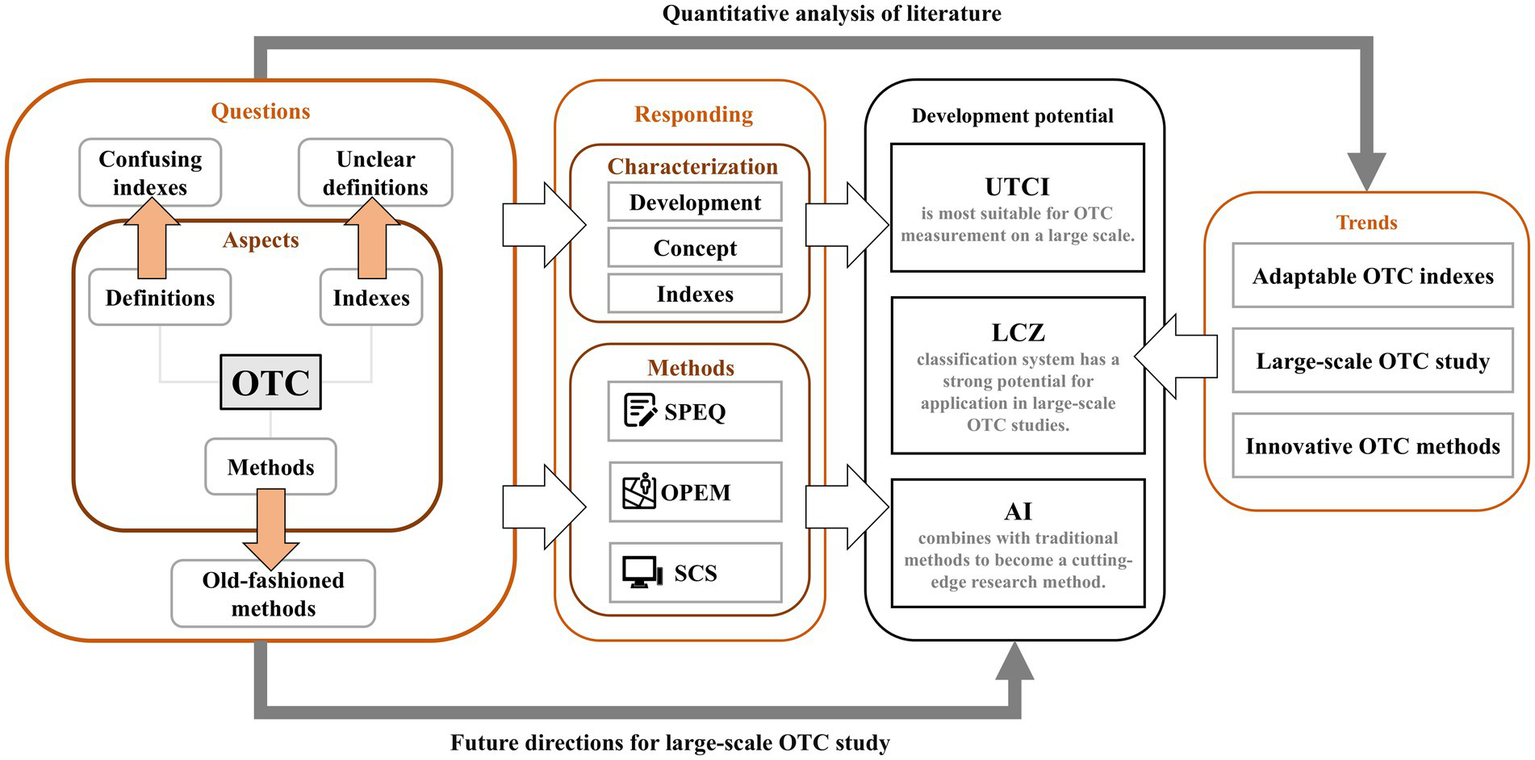
Research roadmap.
2 Quantitative analysis of literature
This paper searched the Web of Science (WOS) database using “Outdoor thermal comfort” as the subject word. A quantitative analysis of the number of publications revealed that between 1980 and 2010, the number of annual publications was low (less than 10), and from 2011 to the present, the number of annual publications has shown an increasing trend. This upward trajectory has been particularly pronounced since 2010, with a notable increase in the cumulative annual number of publications (Figure 2A). A linear fit analysis of the annual number of publications over the last ten years revealed a value of R2 of 0.63 at the 95% confidence band (Figure 2B). This indicates that OTC has retained a high level of international academic interest in recent years and reflects the growing importance of sustainable urban development and quality of life in the context of climate change.
Figure 2
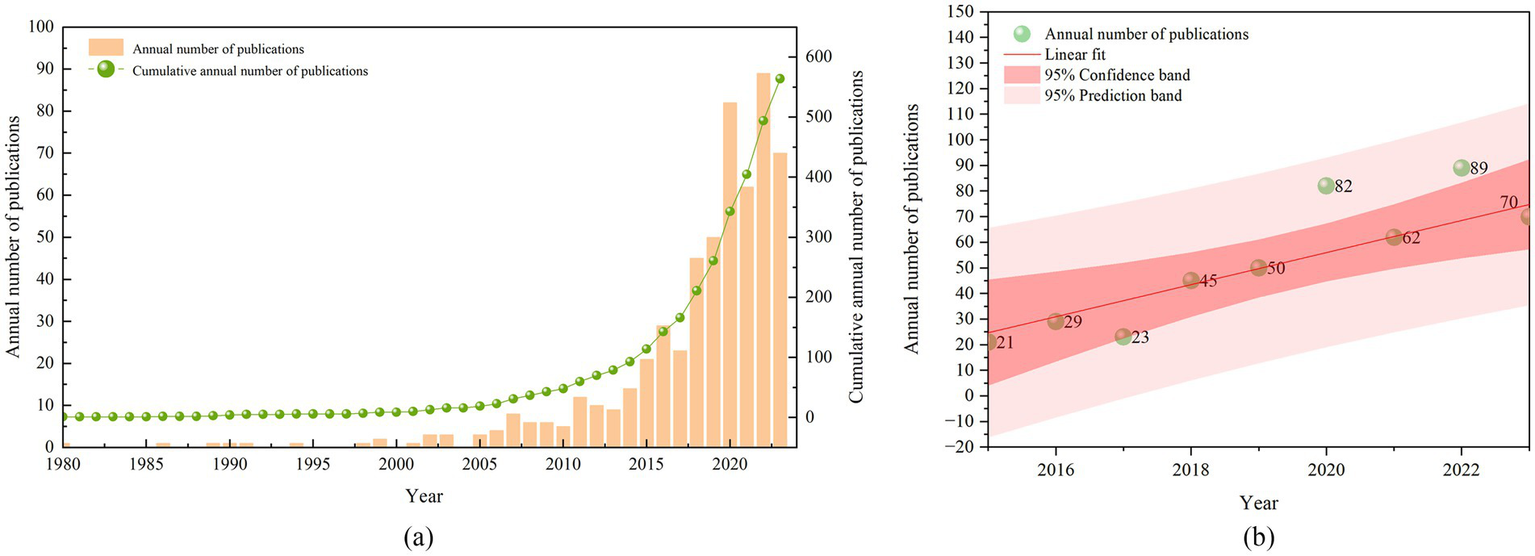
The trend of publication numbers in the WOS database. (a) Trends in the cumulative annual number of publications. (b) Linear fit analysis of the annual number of publications.
This paper systematically analyzes and screens OTC studies from the WOS database over the past decade using the PRISMA method (Moher et al., 2009) to identify literature for qualitative analysis. The screening process involved four stages (Figure 3): literature search, screening, selection, and inclusion. In the search stage, “outdoor thermal comfort” was used as the title search term in WOS, yielding 585 papers. This term ensured high relevance, focusing on outdoor thermal comfort and avoiding confusion with indoor or building thermal comfort. In the screening stage, 279 papers were retained based on title relevance, database, time range, and paper type. In the selection stage, 55 papers were chosen based on abstract content. In the inclusion stage, 47 papers were retained after detailed reading, excluding those without software-based computational simulations due to their limited quantitative analysis, lower reproducibility, and greater subjectivity in handling complex environmental conditions.
Figure 3
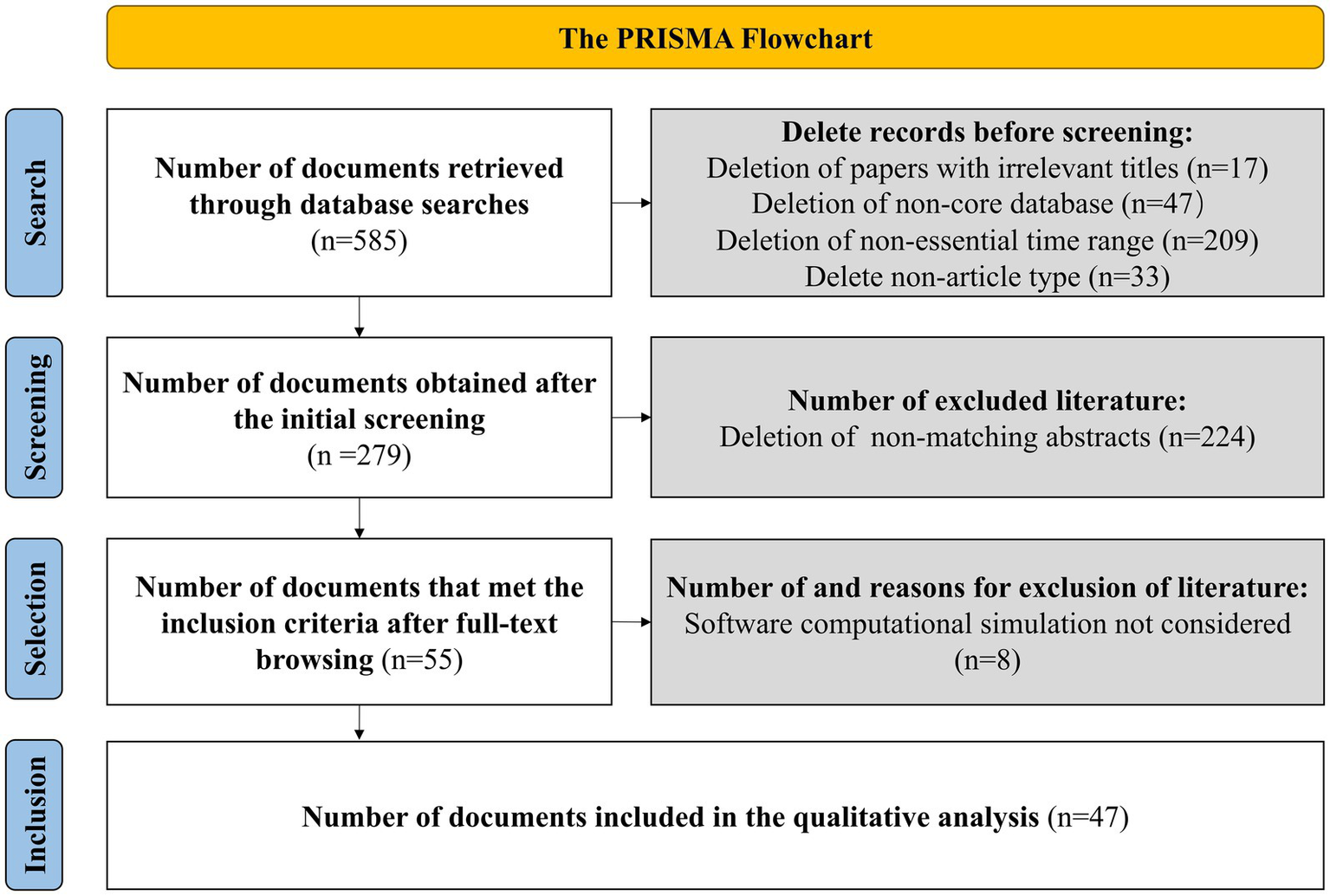
The PRISMA Flowchart.
On this basis, statistical analysis and literature visualization were conducted using VOSviewer software. This involved analyzing sources, keywords, content and highly cited literature. This was done to recognize the academic focus and research scope of the current research on the one hand and identify the hotspots and trends of the current research on the other hand.
2.1 Source analysis
This study conducted a statistical analysis of publication numbers by region and selected countries with high publication counts to highlight the status of OTC research. China led with 273 papers (46.67%), followed by the United States (54 papers, 9.23%) and the United Kingdom (51 papers, 8.72%). China’s dominance stems from rapid urbanization and the complex urban thermal environment issues driven by climate change, prompting significant research investment (Robinson et al., 2018). The U.S., with its diverse climate and advanced infrastructure, benefits from high-intensity urbanization, further fueling OTC research (Kumar and Sharma, 2020). The UK, with its strong academic tradition, international collaborations, and leadership in climate policy, also makes significant contributions to OTC research (Hebbert and Jankovic, 2013).
As global climate change intensifies, many countries, along with participants of the Smart Cities Challenge, have begun shifting their adaptation strategies and policies (Kamal-Chaoui and Robert, 2009). European cities are incorporating passive house technologies and renewable energy to improve energy efficiency and reduce emissions (Santamouris, 2016), while some Asian cities focus on increasing urban greenery and enhancing public transportation to mitigate the UHI effect and improve outdoor thermal comfort (Ruefenacht and Acero, 2017). The Smart Cities Challenge has also encouraged cities to adopt data monitoring, AI, and big data analytics to optimize urban heat environments (Ahmad et al., 2022), considering not only temperature control but also social, economic, and environmental factors to improve overall resilience.
However, despite the global attention to OTC, participation in research remains uneven (Table 1). It was found that among the countries with less than 10 articles, there are 50 countries, accounting for 20.69%, of which 32 countries with less than 3 articles, accounting for 7.52%. According to Köppen’s climate classification, the study found that temperate oceanic (Cfb), Mediterranean (Csa, Csb), and desert climates (BWh, BSh) are more common in the published research, while alpine (H), tropical highland (Cwb), and temperate continental (Dwb) climates are less frequently studied. The analysis of publication numbers also reveals a clear geographical imbalance: developed countries in temperate climate zones dominate OTC research, while tropical and desert regions, where many developing countries are located, are significantly under-researched. This suggests that increasing research in developing countries is crucial for broadening the diversity of OTC studies globally. Furthermore, research on more specialized climates, such as alpine (H), tropical highland (Cwb), and temperate continental (Dwb), is still limited, and further exploration in these areas would help increase the diversity of OTC research.
Table 1
| Rank | Climate types (Climate zone) |
Countries | Frequency |
|---|---|---|---|
| 1 | Temperate oceanic climate (Cfb) |
England, United Kingdom, Germany, Denmark, Netherlands, Ireland, New Zealand, Norway, Scotland, Austria, Brazil, Switzerland, Bosnia Herceg, Ecuador, Wales, Belgium, North Ireland | 17 |
| 2 | Mediterranean climate (Csa, Csb) |
Italy, Algeria, Spain, Turkiye, Greece, France, Portugal, Israel, Jordan, Lebanon, Morocco, Cyprus, San Marino, Tunisia, Chile | 15 |
| 3 | Desert climate (BWh, BSh) |
United States, Iran, Algeria, Egypt, Saudi Arabia, Pakistan, United Arab Emirates, Israel, Iraq, Morocco, Oman, Qatar, Chile | 13 |
| 4 | Temperate continental climate (Dfb) |
China, Germany, Sweden, Canada, Serbia, Switzerland, Hungary, Poland, Bosnia Herceg, Czech Republic, Austria, Russia | 12 |
| 5 | Tropical rainforest climate (Af) |
Singapore, India, Brazil, Malaysia, Indonesia, Bangladesh, Philippines, Colombia, Venezuela | 9 |
| 6 | Tropical monsoon climate (Am) |
China, India, Taiwan, Pakistan, Thailand, Bangladesh, Philippines, Sri Lanka | 8 |
| 7 | Subarctic climate (Dfc) |
United States, Canada, Sweden, Finland, Russia, Norway | 6 |
| 8 | Tropical climate (Af, Am, Aw) |
Australia, Brazil, Colombia, Ecuador, Venezuela, Argentina | 6 |
| 9 | Temperate climate (Cfa, Cfb) |
United States, Australia, Brazil, Argentina | 4 |
| 10 | Boreal climate (Dfc) |
Sweden, Norway, Finland, Russia | 4 |
| 11 | Alpine climate (H) |
China, Japan | 2 |
| 12 | Tropical highland climate (Cwb) |
Zimbabwe | 1 |
| 13 | Temperate continental climate (Dwb) |
Russia | 1 |
Statistics on the frequency of occurrence of climate zones in different countries.
2.2 Keywords analysis
The WOS database was searched using “outdoor thermal comfort” as the title word, and co-occurrence analysis of keywords was conducted with VOSviewer (Figure 4). “Outdoor thermal comfort” and “thermal comfort” had the highest link strength, closely associated with other keywords, forming the core of the research. The second tier included keywords such as “physiological equivalent temperature,” “microclimate,” “ENVI-met,” “UHI” and “urban microclimate,” reflecting the focus on human physiological responses to climate change, UHI, and detailed microclimate assessments. The third tier, including “UTCI,”"thermal sensation,”"outdoor thermal environment” and “thermal adaptation” highlights the growing interest in assessing human thermal perception and exploring environmental adaptation strategies. Overall, OTC research is expanding beyond microenvironments to include large-scale urban climates and heat islands, integrating human thermal perception and specific climates, reflecting the field’s trend toward a more comprehensive and detailed evaluation.
Figure 4
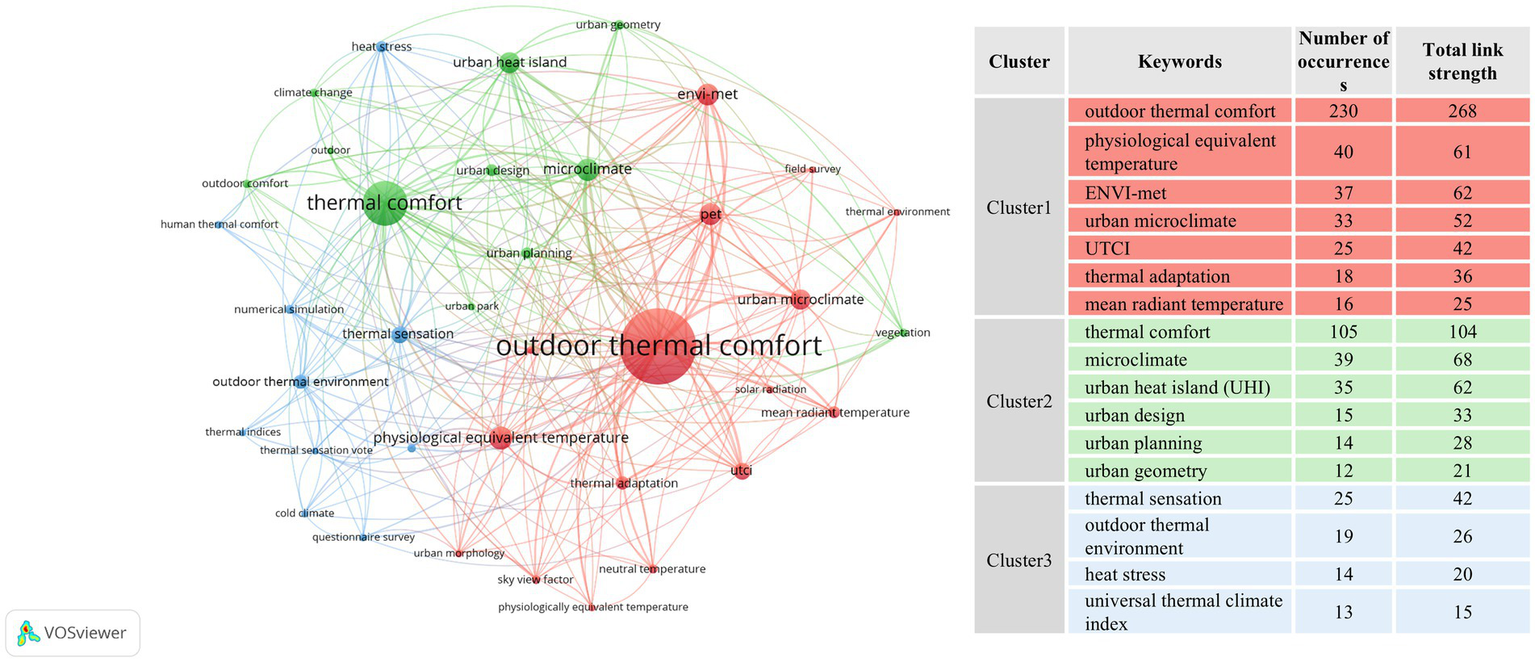
Keywords co-occurrence map.
2.3 Content and highly cited analysis
This paper organizes the content of the literature screened by PRISMA (Table 2) to identify the main issues and research trends in OTC research.
Table 2
| Author (Year) | Research content | Research sites | Regional climate | indexes | Research Methods | Simulation Tools | Emerging methods |
|---|---|---|---|---|---|---|---|
| Golasi et al. (2016) | Urban | Rome, Italy | Csa | MOCI | SPEQ OPEM |
||
| Yang et al. (2017) | Urban park | Umeå, Sweden | Dfb | PMV PET UTCI |
SPEQ OPEM |
||
| Karakounos et al. (2018) | Urban neighborhood | Serres, Greece | Csa | PMV | SCS | ENVI-met | |
| Lam and Lau (2018) | Urban | Melbourne, Australia | Cfb | UTCI | SPEQ OPEM |
||
| Hong Kong, China | Cwa | ||||||
| Liu et al. (2018) | Urban | Shenzhen, China | Cwa | PET OUT-SET* UTCI |
SPEQ OPEM SCS |
RayMan | LCZ |
| Lau et al. (2019) | Urban | Hong Kong, China | Cwa | PET | SPEQ OPEM |
LCZ | |
| Das et al. (2020) | Planning zone | West Bengal extending | Am | PET | SPEQ OPEM SCS |
LCZ | |
| Deng and Wong (2020) | Urban canyon | Nanjing, China | Cfa | PET | SCS | ENVI-met RayMan |
|
| He et al. (2020) | Urban | Sydney, Australia | Cfa | PET | OPEM SCS |
||
| Zhang et al. (2020) | Urban park | Chengdu, China | Cwa | UTCI PET |
SPEQ OPEM SCS |
RayMan | |
| Chen et al. (2020) | Urban | Harbin, China | BWk | SET* PET UTCI |
SPEQ OPEM |
||
| Vasilikou and Nikolopoulou (2020) | City square | London, United Kingdom | Cfb | SPEQ OPEM |
|||
| Rome, Italy | Csa | ||||||
| Lai et al. (2020a) | Urban park | Tianjin, China | Dwa | SPEQ OPEM |
|||
| Mijani et al. (2020) | Urban | Tehran, Iran | BSk | DI | SCS | RS | |
| Liu et al. (2020b) | Urban open spaces | Tianjin, China | Dwa | local skin temperatures | SPEQ OPEM |
ML | |
| Indiana, United States | Dfa | ||||||
| Lauwaet et al. (2020) | Urban | Ghent, Belgium | Cfb | WBGT | SPEQ | GIS | |
| Fabbri et al. (2020) | Archaeological sites | Rome, Italy | Csa | PET | OPEM SCS |
ENVI-met | |
| Aghamolaei et al. (2020) | Urban neighborhood | Tehran, Iran | BSk | UTCI | SCS | Rhino (Grasshopper) EnergyPlus |
Parameterization |
| Huang et al. (2021) | Urban park | Xian, China | at the boundary between BSk and Cwa | UTCI | SPEQ OPEM |
||
| Yin et al. (2021) | Urban | Harbin, China | BWk | PET | SPEQ OPEM |
||
| Zhang and Liu (2021) | Urban neighborhood | Beijing, China | Dwa | UTCI | OPEM SCS |
Rhino (Grasshopper) | Parameterization |
| An et al. (2021) | Urban park | Beijing, China | Dwa | UTCI | SPEQ OPEM |
RayMan | |
| Xian, China | at the boundary between BSk and Cwa | ||||||
| Harbin, China | BWk | ||||||
| Aghamohammadi et al. (2021) | Urban | Kuala Lumpur, Malaysia | Af | PET | SPEQ OPEM |
RayMan | |
| Ibrahim et al. (2021) | Urban geometry | Cairo, Egypt | BWh | UTCI | OPEM SCS |
Rhino (Grasshopper) | Parameterization |
| Fallahpour et al. (2022) | Urban canyon | Los Angeles, United States | Csa | PET | SCS | Rhino (Grasshopper) | CFD |
| Wei et al. (2022) | Urban park | Sichuan, China | Cfa | PET UTCI |
SPEQ OPEM |
RayMan | ML |
| Yao et al. (2022a) | Urban park | Lhasa, China | H | PET | SPEQ OPEM |
RayMan | |
| Rossi et al. (2022) | Outdoor open spaces | Perugia, Italy | Cfb | PET | SPEQ OPEM |
RayMan | |
| Zhang et al. (2022b) | Traditional settlements | Chengdu, China | Cwa | PET | SPEQ SCS |
ENVI-met | |
| Manavvi and Rajasekar (2022) | Outdoor open spaces | Chandigarh, India | Cwg | PET | SPEQ OPEM |
RayMan | |
| Shah et al. (2022) | Urban canyon | Gwalior, India | Aw | PET UTCI |
OPEM SCS |
ML | |
| Li et al. (2023) | Urban heritage environment | Xiamen, China | Cfa | UTCI | SPEQ OPEM |
Rhino (Grasshopper) | 3D real scene models |
| Lin et al. (2023) | Urban park | Fuzhou, China | Cfa | COMFA | SPEQ OPEM |
||
| Sun et al. (2023) | Outdoor open spaces | Tianjin, China | Dwa | UTCI | SCS | Rhino (Grasshopper) | Parameterization |
| Shanghai, China | Cfa | OpenFOAM | CFD | ||||
| Hado and Hassan (2023) | Residential areas | Baghdad, Iraq | BWh | PMV | SPEQ SCS |
ENVI-met | |
| Hashemi et al. (2023) | Urban neighborhood | Philadelphia, United States | Cfa | PMV | SCS | GIS ENVI-met Rhino (Grasshopper) |
LCZ |
| Mushore et al. (2023) | Urban | KwaZulu-Natal, South Africa | CWa | UTCI | SCS | GIS | RS LCZ ML |
| Guo et al. (2024) | Urban park | Xian, China | at the boundary between BSk and Cwa | PET UTCI |
SPEQ OPEM |
ML Python |
|
| Kotharkar and Dongarsane (2024) | Urban | Nagpur, India | Aw | PET UTCI |
SCS | ENVI-met Rhino (Grasshopper) |
LCZ |
| Sun et al. (2024) | Urban geometry | Tokyo, Japan | Cfa | UTCI | SCS | ||
| Yoo et al. (2024) | Urban canyon | Texas, United States | Cfa | COMFA | SCS | Autodesk Revit | BIM |
| Li et al. (2024) | Outdoor open spaces | Xian, China | at the boundary between BSk and Cwa | UTCI | SPEQ OPEM |
ML | |
| Zhang et al. (2024a) | Urban sunken square | Chongqing, China | Cfa | PET | OPEM SCS |
ENVI-met | ML |
| Behzad and Guilandoust (2024) | Urban square | Isfahan, Iran, | BWk | PET | SPEQ OPEM SCS |
ENVI-met |
Summary of literature content.
  Covered by the papers
 Covered by the papers   Not covered by the papers.
 Not covered by the papers.
Trend 1: Advancements in LCZ methods and emerging technologies. The development of Local Climate Zoning (LCZ) methods and the integration of technologies such as remote sensing (RS), Python, and AI are advancing OTC research, OTC studies are moving toward a more comprehensive and fine-grained approach. LCZ methods also offer good application prospects and development potential for large-scale OTC studies. For example, Das et al. (2020) used the LCZ classification system to assess OTCs in different environments in a tropical planning area from both subjective and objective perspectives.
Trend 2: Focus on urban areas and public spaces. Analysis of the top 10 highly cited papers (Table 3) reveals a strong focus on urban areas and public spaces, driven by high population density and complex urban morphology. These studies often emphasize pedestrian thermal comfort, especially in public spaces like parks and city squares, which are vital outdoor areas for residents. This trend underscores the growing importance of improving thermal comfort and walkability through urban planning to enhance residents’ quality of life and strengthen urban resilience.
Question 1: OTC definition is unclear. OTC is often understood and measured differently across studies due to variations in study areas, spatial types, climatic conditions, and target populations. Research priorities, such as urban form, microclimate, and pedestrian comfort, influence OTC definitions, leading to diverse evaluation systems (Nazarian et al., 2019). OTC is measured using various methods, including physiological models, subjective surveys, and composite indices, but their applicability varies, hindering uniform standards (Zhang et al., 2024b). Additionally, the applicability of OTC studies across climate zones and spatial scales remains unclear, making results difficult to compare or generalize (Fong et al., 2019). Therefore, OTC concepts and evaluation criteria need further standardization to improve comparability and applicability in cross-regional and cross-scale studies.
Question 2: Confusion over OTC indexes. At the level of OTC index selection, PET and UTCI are the most frequently used indexes, but there are still inconsistencies in the results of the optimal indexes of thermal comfort in the same area from different studies. For instance, in a cold region of China, Chen et al. (2020) found UTCI to be superior to SET* and PET for assessing outdoor thermal sensation, while Yin et al. (2021) confirmed the suitability of PET through meteorological measurements and subjective surveys.
Question 3: Outdated OTC Methods. Current OTC research relies on traditional methods, including subjective perception evaluation questionnaires (SPEQ), objective physical environment measurements (OPEM), and software simulations (SCS). However, these methods have not been sufficiently integrated with emerging technologies like AI, limiting the evolution of OTC research. Only one paper in Table 3 incorporated machine learning (ML) methods, and Wei et al. (2022) used ML to determine the relationship between heat sensation voting and meteorological factors, showing that human heat sensation receives the influence of different meteorological factors in other seasons, providing a new technical reference for OTC research.
Table 3
| No. | Title | Study scale/region | Case study area | Research methods | Total citations |
|---|---|---|---|---|---|
| 1. | Relationships among local-scale urban morphology, urban ventilation, urban heat island and outdoor thermal comfort under sea breeze influence | Urban district | The Greater Sydney Area, the state capital of the New South Wales, Australia | OPEM SCS |
139 |
| 2. | Impact of urban canyon geometries on outdoor thermal comfort in central business districts | Urban district | CBD (Xinjiekou), Nanjing, China | OPEM SCS |
77 |
| 3. | Outdoor thermal comfort in different settings of a tropical planning region: A study on Sriniketan-Santiniketan Planning Area (SSPA), Eastern India | Tropical planning zone | SSPA | LCZ SPEQ OPEM SCS |
67 |
| 4. | Variations in outdoor thermal comfort in an urban park in the hot-summer and cold-winter region of China | Urban park | People’s Park, Chengdu, Sichuan, China | SPEQ OPEM ML |
65 |
| 5. | Outdoor Thermal Comfort of Urban Park-A Case Study | Urban park | People’s Park, Chengdu, Sichuan, China | SPEQ OPEM SCS |
46 |
| 6. | Investigation of outdoor thermal sensation and comfort evaluation methods in severe cold area | Severe cold area | The Harbin Institute of Technology campus, China | SPEQ OPEM SCS |
45 |
| 7. | Outdoor thermal comfort for pedestrians in movement: thermal walks in complex urban morphology | Urban district | Seven Dials Junction to Covent Garden Square, passing through Neal and James Street. | SPEQ OPEM |
45 |
| Campo dei Fiori to Piazza Cairoli, passing through Via dei Giubbonari. | |||||
| 8. | Quantification of the influence of thermal comfort and life patterns on outdoor space activities | City Square | Fenghu Park in Tianjin, China | SPEQ OPEM SCS |
44 |
| 9. | Research on outdoor thermal comfort of high-density urban center in severe cold area | Severe cold area | The Qiulin commercial district, Harbin, China | SPEQ OPEM SCS |
41 |
| 10. | Outdoor thermal comfort during winter in China’s cold regions: A comparative study | Cold regions | Urban parks in Beijing, Xi’an, and Hami, China | SPEQ OPEM SCS |
40 |
Ranking of top 10 highly cited papers.
3 OTC characterization
3.1 OTC’s development
OTC research emerged from concerns about human living environments (Chen and Ng, 2012), particularly in the context of accelerated urbanization, rising population density, building height, and reduced green space, leading to increased demand for better environmental quality. As a research theme, “outdoor thermal comfort” (OTC) has evolved in three phases: germination, consolidation, and innovation.
In the germination period (before 2000), OTC was not yet an independent field, but foundational research paved the way. Gagge (1971) introduced the “two-node model” for thermodynamic energy exchange between the body and environment, followed by Givoni (1963) development of thermal stress indices. In the 1970s, Terjung’s urban energy balance study in Los Angeles indirectly contributed to understanding how outdoor thermal environments affect comfort (Terjung, 1970). Fanger (1972) created the PMV model for indoor thermal comfort, which influenced subsequent OTC research.
During the consolidation period (2000–2010), OTC emerged as a distinct research area independent of indoor thermal comfort. Interest in outdoor environments led to the application of indoor comfort indices to outdoor settings (Johansson et al., 2014). However, these models lacked empirical studies and often ignored outdoor complexities, individual differences, and socio-cultural factors (Spagnolo and De Dear, 2003; Johansson et al., 2014). In response to these challenges, Höppe (2002) suggested that outdoor exposure time variability affects human adaptive capacity, highlighting the need for non-stationary models. Spagnolo and De Dear (2003) further demonstrated that indoor models could not be directly applied to outdoor settings, particularly in the context of Sydney’s outdoor and semi-outdoor spaces. This realization solidified OTC as a unique research field, prompting the development of models and methods tailored to outdoor environments, addressing the impacts of urbanization and climate change. Concurrently, researchers like Nikolopoulou et al. (2001) and Matzarakis et al. (1999, 2007) made significant contributions, exploring factors like human thermal sensation in urban spaces and refining indices like UTCI and PET.
During the innovation period (2010-present), researchers have focused on understanding the factors influencing OTC, exploring more accurate assessment methods, and seeking practical solutions to address the challenges posed by urbanization and climate change. For example, Lin et al. (2010) applied meteorological data to predict long-term OTC over ten years using the RayMan model, thereby addressing the limitations of previous studies in accurately assessing annual thermal condition gaps. Taleghani et al. (2015) explored how urban form influences outdoor thermal comfort, showing that sunshine duration, shaped by urban geometry, plays a crucial role. In the past five years, the development and integration of emerging technologies such as AI, RS, and Python have further advanced OTC research. AI has enabled more precise data analysis and modeling, improving the accuracy of predictions and assessments in complex urban environments (Bibri et al., 2024). RS and Python have facilitated the collection and analysis of large-scale environmental data, allowing researchers to assess OTC over broader areas and in real-time (Lawhead, 2019). These technologies offer powerful tools for evaluating urban microclimates, optimizing urban planning, and enhancing the adaptability of cities to climate change, marking a significant leap forward in OTC research methodologies.
3.2 OTC’s concept
The diversity and complexity of previous OTC theories in practical applications have led to ambiguities in existing definitions of OTC. This paper clarifies the definition of OTC by conceptualizing OTC-related terms (Table 4). OTC is used to assess and quantify individuals’ thermal comfort in outdoor environments under various climatic conditions worldwide, integrating subjective and objective factors. OTC incorporates a range of objective environmental parameters, such as temperature, humidity, and solar radiation, while also considering individual physiological, psychological, and behavioral adaptability and other subjective feelings. By synthesizing these subjective and objective characteristics, OTC can effectively evaluate and compare thermal comfort across different environments. This comprehensive approach provides a scientific basis for urban planning and environmental design, enhancing the ability to create more comfortable and sustainable outdoor spaces.
Table 4
| Relevant concepts | Definitions |
|---|---|
| Outdoor thermal comfort | The comfort level people feel outdoors, influenced by factors like temperature, humidity, wind, and solar radiation (Höppe, 2002). |
| Outdoor thermal comfort level | Measurement of thermal comfort in outdoor environments, often through modeling, to assess sensations under various climatic conditions (Shooshtarian et al., 2020). |
| Outdoor thermal comfort index | An index quantifying thermal comfort in outdoor settings, combining climatic parameters to reflect human temperature perception (Coccolo et al., 2016). |
| Outdoor thermal comfort assessment | The process of analyzing and assessing outdoor thermal comfort, considering climate, individual differences, and environmental factors (Rupp et al., 2015). |
| Thermal sensation vote | People’s perception of outdoor thermal environments is measured through voting for quantitative analysis of comfort levels (Chen and Ng, 2012). |
| Outdoor thermal sensation | Subjective perception of outdoor temperature, categorized as cold, moderate, warm, etc. (Shooshtarian, 2019). |
| Outdoor thermal perception | Individuals’ subjective feelings of outdoor temperature reflect the immediate effect of ambient conditions on people (Antonini et al., 2020). |
| Outdoor thermal adaptation | The process of adapting to the outdoor thermal environment, including physiological, psychological, and behavioral adjustments to achieve comfort (Honjo, 2009). |
| Outdoor thermal satisfaction | Measuring satisfaction with outdoor temperature conditions compared to desired comfort levels (Johansson et al., 2014). |
| Outdoor thermal benchmark | Setting standards for assessing and comparing thermal comfort in different outdoor environments (Kumar and Sharma, 2020). |
Definition of related concepts to OTC.
3.3 OTC’s indexes
The characterization of OTC mainly relies on various assessment indexes to quantify human comfort under specific environmental conditions. Although thermal comfort indexes are widely used in both theory and practice, they still have shortcomings in outdoor scenarios: (1) Dynamically changing outdoor environments, such as solar radiation, wind speed changes, and humidity fluctuations, make some commonly used OTC indexes difficult for such indexes to accurately reflect the actual thermal comfort when applied (Zhao et al., 2021). Some commonly used OTC indexes, such as PMV and SET, which initially serve indoor environment design, assume that the environmental conditions are relatively stable and homogeneous indoor conditions. (2) Traditional OTC models tend to ignore individual differences (personal health status, clothing habits, personal adaptations, etc.), which leads to biased conclusions in studies (Yao et al., 2022b). (3) Existing OTC indices cannot be adapted to specific climatic regions adaptation (Mishra and Ramgopal, 2013).
Based on the above understanding, by combing the existing commonly used thermal comfort indexes (Table 5), it was found that the UTCI has applicability and flexibility due to its relatively well-established arithmetic mechanism and more comprehensive assessment range (Yang et al., 2022) and is more suitable for OTC more broadly measurement. In 2012, Bröde et al. (2012) confirmed that the UTCI has a reasonable response in both hot and cold regions, arguing that UTCI may generally apply to human biometeorological studies. In addition, the UTCI is more comprehensive than other indexes (Table 6) regarding the parameters considered, including seven parameters such as air temperature, relative humidity and wind speed. Provençal et al. (2016) compared the sensitivity and applicability of the UTCI with other thermal comfort indexes (e.g., PET) in different seasons and environments by comparing the UTCI with other indexes of thermal comfort in Quebec City, Canada, concluding that the UTCI outperforms the other indices like PET, confirming the applicability and flexibility of the UTCI.
Table 5
| Index | Abbr. | Birth time | Definition | Unit |
|---|---|---|---|---|
| Effective temperature | ET | 1923 | Measurement of thermal comfort in the environment based on physical parameters (Gagge et al., 1972). | — |
| Apparent temperature | AT | 1940s | Considering the combined effects of temperature, humidity and wind speed on human sensory temperature (Steadman, 1984). | °C |
| Wet bulb globe temperature | WBGT | 1950s | The index for measuring environmental thermal stress, especially for high-temperature environments (Budd, 2008). | °C |
| Discomfort index | DI | 1956 | Measuring and evaluating human discomfort based on temperature and relative humidity (Thom, 1959). | °C |
| Humidex | H | 1965 | The Canadian Meteorological Service developed an index to describe human-perceived temperatures in hot and humid environments (Rana et al., 2013). | — |
| Predicted mean vote | PMV | 1967 | The evaluation index characterizes the thermal response of the human body, representing the average hot and cold sensations of most people in the same environment (Orosa and Oliveira, 2011). | °C |
| Heat index | HI | 1970s | Combining air temperature and relative humidity to assess the degree of heat the human body feels (Rothfusz and Headquarters, 1990). | °C |
| Standard effective temperature | SET* | 1986 | Developed from equivalent temperatures based on the Gagge two-node human model (Ye et al., 2003). | °C |
| Comprehensive outdoor mean fluid apparent temperature | COMFA | 1986 | A combination of mean outdoor fluid body temperature (Kenny et al., 2009). | °C |
| Outdoor standard effective temperature | OUT_SET* | 1999 | To adapt SET* to the outdoor environment, the mean radiant temperature is added to describe the outdoor radiant environment (Pickup and de Dear, 2000). | °C |
| Physiological equivalent temperature | PET | 1999 | Considering the body’s heat balance and energy exchange (Höppe, 1999). | °C |
| Universal thermal climate index | UTCI | 2012 | An index developed by ISB using the equivalent temperature concept, based on the UTCI-fiala model, can be validated in various outdoor thermal environments, including extreme weather conditions (Bröde et al., 2012). | °C |
| Microclimate outdoor comfort index | MOCI | 2016 | Assessment of thermal comfort in Mediterranean outdoor climatic environments (Golasi et al., 2016). | — |
| Modified physiological equivalent temperature | mPET | 2017 | The index is an improved version of PET, which assesses thermal comfort more accurately (Chen and Matzarakis, 2018). | °C |
| Global outdoor comfort index | GOCI | 2018 | The index is based on regional differences and is used to assess outdoor thermal comfort on a global scale (Golasi et al., 2018). | — |
Outdoor thermal comfort characterization.
Table 6
| Index | Air Temperature | Relative humidity | Air velocity | Average radiation temperature | Skin Moisture | Neutral temperature | Clothing thermal resistance | Human metabolic rate |
|---|---|---|---|---|---|---|---|---|
| UTCI | √ | √ | √ | √ | √ | √ | √ | √ |
| WBGT | √ | √ | √ | √ | ||||
| PMV | √ | √ | √ | √ | √ | √ | ||
| ET | √ | √ | √ | |||||
| SET* | √ | √ | √ | √ | √ | √ | √ | |
| PET | √ | √ | √ | √ | √ | √ | √ | √ |
Comparison of standard index parameters (Liu et al., 2023; Tao et al., 2023).
4 OTC method
OTC Research method can be divided into SPEQ, OPEM, and SCS. SPEQ is the intuitive feedback for assessing thermal comfort, OPEM is the physical basis for quantification, and SCS is the prediction of the effects of different variables on thermal comfort. The subjective and objective combination of the three research methods constitutes a comprehensive assessment of the traditional OTC research methods, providing a solid foundation for OTC research.
4.1 Subjective perception evaluation questionnaire (SPEQ)
SPEQ is a crucial method for OTC research. The increased interest in OTC has facilitated the development of research questionnaire tools that allow researchers to collect and analyze public perceptions and responses to outdoor temperature environments more effectively. Initially, the questionnaire was more straightforward and focused on feelings about temperature. Later, as the study progressed, the questionnaire content became more refined, and most of the questionnaire designs could be divided into three sections containing questions on multiple variables related to thermal comfort. The first part of the questionnaire includes basic information such as time and place (Wei et al., 2022). The second part provides information such as gender, age, and height (Huang et al., 2021). The third part contains essential elements of the overall questionnaire, such as TSV, mean thermal sensation vote (MTSV), thermal comfort vote (TCV), thermal satisfaction vote (TSV), thermal preference vote (TPV), thermal acceptability vote (TAV), humidity preference vote (HPV), wind preference vote (WPV), overall comfort vote (OCV), and solar radiation preference vote (SPV), among others (Lin et al., 2023).
Among them, the scale and scoring system is an essential component of the third part of the questionnaire design. Most previous studies have expanded or narrowed the range of standard scales according to different climatic zones. The commonly used scoring scales are the ASHRAE (American Society of Heating, Refrigerating and Air-Conditioning Engineers) 55 standard 7-point heat sensation scale (−3 is very cold, −2 is cold, −1 is cool, 0 is neutral, 1 is warm, 2 is hot, 3 is very hot), the extended 11-point scale, or the streamlined 3-point scale, and the 5-point scale. To ensure the accuracy and validity of the analysis results, the collected data from the SPEQ had to go through ten steps of data cleaning, coding and entry, statistics, grouping, and comparison before they could be used to validate and optimize the simulation results of the OTC.
4.2 Objective physical environment measurement (OPEM)
OPEM is a key component of OTC research and is essential for verifying the validity of software simulations. At the beginning of the 20th century, OPEM relied on basic hand tools and instruments, such as mercury thermometers, anemometers, and hygrometers, which were inefficient in recording and analyzing data and limited in measurement range (Johansson et al., 2014). In the mid-20th century, traditional measurement tools were replaced by electronic sensors, allowing automatic data recording with improved accuracy and reliability. From the late 20th to early 21st century, with the rise of computers and Internet technology, OPEM underwent a digital transformation with systems like DAS and GIS, making environmental data collection, storage, and analysis more efficient and systematic.
Measured data from OPEM include key variables for assessing OTC, such as air temperature, relative humidity, wind speed, and solar radiation (Table 7). As technology evolves, data on key variables in OTC studies can be collected and analyzed more precisely. It is worth noting that the development of Internet of Things (IoT) technology has greatly facilitated the integration and networking of environmental sensors for real-time data collection and sharing. For example, Shahinmoghadam et al. (2021) developed an IoT prototype for measuring indoor surface temperatures based on the ASHRAE 55 standard, combining building information modeling (BIM), IoT, and virtual reality (VR), which not only provides 3D immersive visualization of BIM/IoT data, but also presents real-time PMV/PPD graphs. However, IoT’s limitations due to (Wi-Fi) network connectivity and the complexity and instability of outdoor thermal environments have led to the stagnation of the application of IoT technology in current OTC research.
Table 7
| Data types | Unit | Measurement equipment |
|---|---|---|
| Air temperature | °C °F |
Digital thermometer Temperature sensors |
| Relative humidity | % | Capacitive humidity sensors |
| Air velocity | m/s km/h |
Cup anemometer Wing wheel anemometer |
| Solar radiation | W/m2 | Absorption radiometers Thermopile radiometer |
| Sky radiant temperature | °C °F |
Infrared radiation thermometer |
| Ground temperature | °C °F |
Ground thermometer Infrared ground thermometer |
| Heat flux | W/m2 | Heat flux sensors |
| Wet bulb temperature | °C °F |
Wet bulb thermometer |
Types of data for OTC measurements.
4.3 Software computational simulation (SCS)
Traditional OTC studies primarily relied on combining SPEQ and OPEM (Kumar and Sharma, 2020). However, SPEQ is limited by time constraints, sample size, and individual perceptions, often resulting in incomplete data and inaccurate thermal comfort assessments. Similarly, OPEM struggles to fully capture OTC data due to environmental complexity and dynamic changes, as sensor measurements are often insufficient (Johansson et al., 2014). To overcome these limitations, scholars have increasingly turned to SCS techniques for environmental OTC simulation.
Commonly used computational simulation simulation software for OTC are ENVI-met, various types of software developed based on computational fluid dynamics (CFD) methods (ANSYS, OpenFOAM), Rayman, and Rhino & Grasshopper (Table 2). ENVI-met is widely applicable in OTC studies (Miao et al., 2022). For example, Miao et al. (2022) used ENVI-met to calculate OTC indices like apparent temperature (AT), PET, and UTCI to assess the human body’s energy balance and its interaction with the outdoor environment. However, ENVI-met has limitations. For example, Aleksandrowicz et al. (2023) compared monitored and simulated summer values at 60 sites, finding that ENVI-met, while improving MRT simulation accuracy, still underestimates MRT differences between sheltered and unsheltered conditions.
CFD-based software is known for accurately simulating complex fluid behavior (Blocken et al., 2012). For example, Fallahpour et al. (2022) proposed a new CFD, BES and OTC framework using ANSYS as a CFD simulation tool combined with a dynamic BES-CFD coupling method to achieve more accurate OTC assessment, while Sun et al. (2024) proposed and validated an hourly method for assessing the annual OTC using OpenFOAM as an FFD simulation tool. The method maintains high accuracy while also possessing relatively affordable computational costs. However, this software has notable drawbacks, requiring powerful hardware, high settings, and difficult-to-estimate computational time compared to other tools (Blocken, 2015).
RayMan software is the more commonly used computational simulation modeling software with easy-to-understand climatological and biometeorological methods and calculations compared to complex simulation software (Matzarakis et al., 2010). However, Rayman is prone to model and data limitations, such as significant computational errors when dealing with complex buildings or large-scale regional simulations (Liu et al., 2020a).
Rhino & Grasshopper has features such as highly customizable and flexible simulation environments with powerful data visualization and analysis tools (Ladybug and Honeybee) in OTC studies (Zhang and Liu, 2021). For example, Li et al. (2023) proposed a simulation model of OTC in a heritage environment (OTC-SM-HE) based on 3D real-world modeling techniques and UTCI by using Ladybug & Honeybee tools in Grasshopper to simulate OTC in a complex heritage environment.
Based on the comparative consideration of the above software (Table 8), this study infers that Rhino (Grasshopper) can achieve integration with AI to a certain extent due to their flexible visual programming features and that real-time environmental data collected through sensors can be directly applied to Grasshopper and dynamically adjusted based on real-time data. Compared to traditional control systems (which can only mechanically adjust various parameters) (Zhao et al., 2020), this method’s highly integrated approach can iteratively adapt to the application scenarios and application efficiencies in OTC research, and respond more intelligently to human needs for thermal comfort environments. On this basis, this operational procedure can be further optimized through empirical applications to accurately predict the effects of environmental data changes on the OTC, thus enhancing its accuracy in complex ecological simulations.
Table 8
| Software | Developer / Year | Characteristic | Author (Year) |
|---|---|---|---|
| ENVI-met | Bruse, 1999 | Broad applicability (Miao et al., 2022) | Miao et al. (2022) |
| Aleksandrowicz et al. (2023) | |||
| ANSYS | ANSYS Corporation,1970 | Higher accuracy (Blocken et al., 2012) | Fallahpour et al. (2022) |
| OpenFOAM | The OpenFOAM Foundation,2004 | Sun et al. (2024) | |
| RayMan | Matzarakis, 2007 | Simplicity and ease of use (Matzarakis et al., 2010) | Liu et al. (2020a) |
| Rhino (Grasshopper) |
— | Flexible visual programming (Zhang and Liu, 2021) | Li et al. (2023) |
Standard software for OTC research.
5 OTC research trends
5.1 Adaptable OTC indexes
Urban climate spans from micro-scale (buildings and streets) to mesoscale (city and neighborhood) to macro-scale (regional and global) (Brousse et al., 2016). However, traditional OTC index models developed for specific climate zones face geographical limitations when applied to larger-scale study. For example, PMV and PET, which were designed for temperate and boreal climates, are less accurate in tropical and arid regions, while the WBGT, developed for military heat stress, does not account for high humidity and low airflow conditions (Budd, 2008).
To solve the problem of geographical limitation of indexes, some scholars constructed or modified OTC index models based on geographical characteristics according to different climatic zones, special populations (e.g., older people, children), and utilization space. For example, oriented to various climate zones, Nguyen et al. (2012) proposed an extended PMV-PPD model for Southeast subtropical and high-humidity climates to better assess thermal sensation in those regions. Golasi et al. (2016) introduced the Mediterranean Outdoor Comfort Index (MOCI), which they found to be more suitable for Mediterranean climates than traditional indices. Oriented to special populations research, Yao et al. (2022a) studied the thermal comfort of elderly individuals in the Tibetan Plateau, identifying greater sensitivity to winter temperature changes and regional differences in thermal sensitivity. Oriented toward space research, Spagnolo and De Dear (2003) proposed the OUT_SET* index for outdoor and semi-outdoor environments in Sydney, which proved more adaptable than indoor SET* models. For broader applications, Golasi et al. (2018) proposed the Global Outdoor Comfort Index (GOCI), which integrates regional differences like latitude, mean annual temperature, and maximum temperature.
Compared with other indexes, UTCI is based on extensive experimental data and has the advantage of applying thermal comfort assessment in all climates, seasons, and scales (McGregor, 2012). It has been more widely recognized and used internationally, demonstrating its remarkable adaptability and flexibility. Some scholars have made the UTCI more suitable for addressing scale and geographical limitations by modifying the threshold criteria and coefficients. For example, Lam and Lau (2018) suggested defining different heat perception thresholds for the UTCI scale according to various climatic zones to better predict OTC in different urban populations by examining the heat perception of residents in two climatic zones over a similar range of UTCIs in summer. Wang and Yi (2021) proposed an adapted UTCI that can reasonably assess the outdoor thermal conditions in China and better reflect the severe cold region’s OTC.
5.2 Innovative OTC methods
Previous OTC methods were dominated by three types: SPEQ, OPEM and SCS. However, these methods have certain limitations in responding to the research needs of complex environments and multi-scale spaces, as well as for specific populations and multiple climate parameters. For example, when facing complex environments, achieving non-contact measurements or building realistic simulation models with traditional methods is difficult. When dealing with multi-scale spatial problems, traditional OTC methods are challenging to respond to the characteristics of the outdoor thermal environment and spatial and temporal differences in thermal comfort (Lai et al., 2019), and at the same time, they will consume a lot of labor, time and computational costs. When facing a specific group of people, traditional questionnaire methods are complex in reflecting individual differences and the specificity of their thermal comfort needs. When facing diverse climate parameters perception, traditional methods make it difficult to assess the impact of complex parameters on OTC.
To solve the above problems, some scholars improved and innovated OTC methods. For example, (1) oriented toward complex environments, Li et al. (2023) developed a novel OTC simulation model for heritage environments (OTC-SM-HE) using 3D real scene modeling and UTCI, enhancing the capture of environmental complexity and diversity. (2) Oriented toward multi-scale spatial requirements, Zhang et al. (2022a) assessed the relative importance of macro- and micro-climatic factors on OTC impacts for evaluation through an artificial neural network (ANN) model. (3) Oriented toward specific populations, Li et al. (2024) created a predictive model for children’s outdoor thermal sensation by integrating ML for facial expression analysis with meteorological data and questionnaires, thereby enhancing the accuracy of thermal comfort predictions for children. (4) Oriented toward diverse climate parameters, Wei et al. (2022) employed ML to explore the influence of climate parameters on outdoor heat perception, identifying the significance of different parameters. Guo et al. (2024) developed a high-accuracy ML model for OTC in cold regions using microclimate measurements and questionnaires optimized through Bayesian methods, which significantly improved prediction accuracy and supported urban space design.
In summary, the integration of AI techniques like ML and ANN into OTC research has led to methodological advancements, enhancing precision, broadening research scope, and improving computational efficiency. These innovations not only support the theoretical development of OTC but also provide practical tools for urban environmental sustainability and resident quality of life improvements.
5.3 Large-scale OTC study
As urbanization accelerates globally, urban areas face the growing issue of climate change, particularly the Urban Heat Island (UHI) phenomenon (Zhou and Chen, 2018). UHI studies explore how urbanization increases temperatures through changes in surface cover, building density, and heat source activities (Salata et al., 2017). These studies require a dense network of sensors to monitor urban temperatures over large areas, which poses time-consuming and costly challenges for large-scale research (Mirzaei and Haghighat, 2010). In this context, large-scale OTC study have become a current trend. However, earlier OTC studies were mostly focused on microclimate perception and assessment, making it difficult to compare results across regions.
Recent developments have seen scholars use the LCZ classification system for large-scale OTC study (Feng and Liu, 2022), exploring the relationships between temperature differences, urban spatial patterns, and urban climate (Lau et al., 2019). The LCZ system, introduced by Stewart and Oke (2012), divides cities and their surroundings into categories based on land cover, building density, vegetation, and surface materials. This classification provides a standardized framework for urban climate studies.
Based on this, Large-scale OTC study refer to a wide range of outdoor thermal environment and thermal comfort analyses at the urban or regional scale using different climatic and environmental data, particularly through the LCZ classification system and OTC assessment indexes. OTC studies combined with the LCZ classification system can more effectively reflect human thermal perceptions of different urban microclimates on a large scale, which is essential for the quality of life of urban residents and has long-term impacts on the sustainable development strategy. The detailed surface characteristics described in LCZ can help identify the key factors affecting the thermal environment, enabling more accurate OTC assessments. For example, Das et al. (2020) assessed OTC across different environments in a tropical planning area during the summer season, demonstrating differences in subjective perceptions of OTC across LCZs through questionnaires and field measurements.
When OTC index models are used in conjunction with LCZs, the detailed classification information of the LCZs can be used as an input parameter for the model, helping to adjust and optimize the output of the model, especially in complex urban environments, which can improve the accuracy of the software simulation in predicting OTC (Figure 5). Fan et al. (2022) mapped urban morphology using the LCZ system and demonstrated a stronger consistency between UTCI and LCZs in the Guangdong-Hong Kong-Macao Greater Bay Area. Similarly, Wu et al. (2022) analyzed UTCI using meteorological data from 11 LCZ types to explore spatial and temporal patterns of OTC, further refining the relationship between LCZs and UTCI.
Figure 5
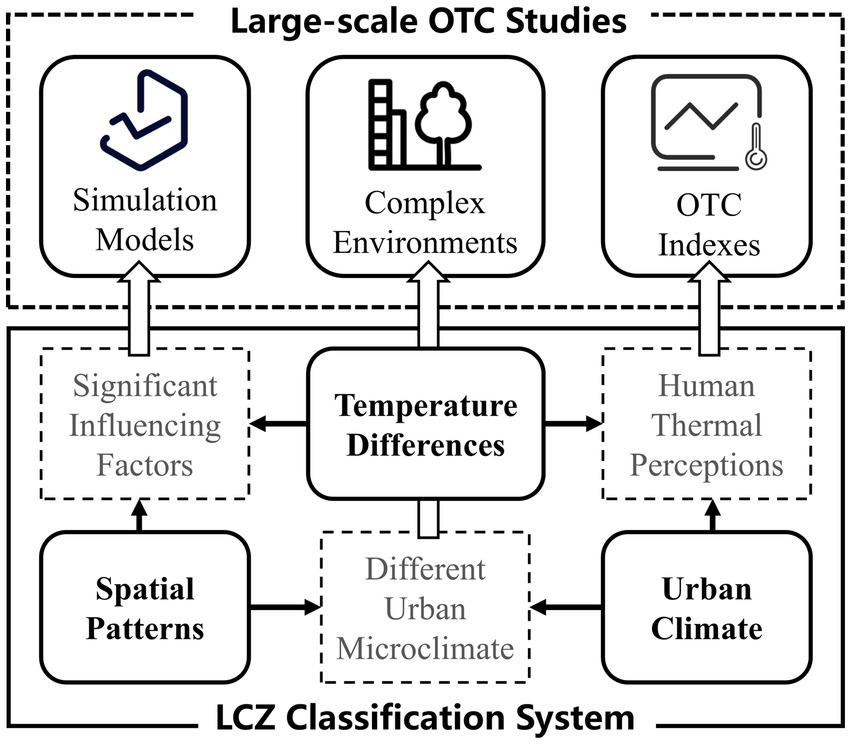
Application of the LCZ classification system to large-scale OTC studies.
In summary, in terms of the adaptive application of indexes of the above studies, UTCI is more adaptive and flexible in OTC research. In terms of the innovation of the methods in the above studies, combining OTC research methods with AI technology is the current optimal method. In terms of large-scale methods of the above studies, the LCZ classification system is the basis of large-scale OTC research. Combining these, the surface features and microclimate characteristics of the city and the surrounding area can be described as standardized, thus overcoming the problem of disjunction in studying the traditional method between different regions (exact location).
6 Discussion
6.1 Framework of large-scale OTC studies
Based on the above analysis, this paper proposes a large-scale OTC study technology framework (Figure 6). The study is divided into five steps: study area, field research, model simulation, data analysis, and research applications, which are carried out as follows: (1) Research object: using urban topography and land use data, draw LCZ classification maps to determine the climate type. (2) Field research: collect data through questionnaires and environmental measurements, analyzing TSV and meteorological data. (3) Model simulation: build spatial models using RS imagery and 3D real-scene data to simulate microclimates and UTCI values. (4) Data analysis: calibrate the urban thermal environment by combining simulated and measured results, analyzing thermal environment distribution and variations. (5) Research applications: propose climate-resilient design strategies based on thermal environment analysis and sample data, aiming to optimize urban environments, improve residents’ quality of life, mitigate UHI effects, and promote sustainable urban development.
Figure 6
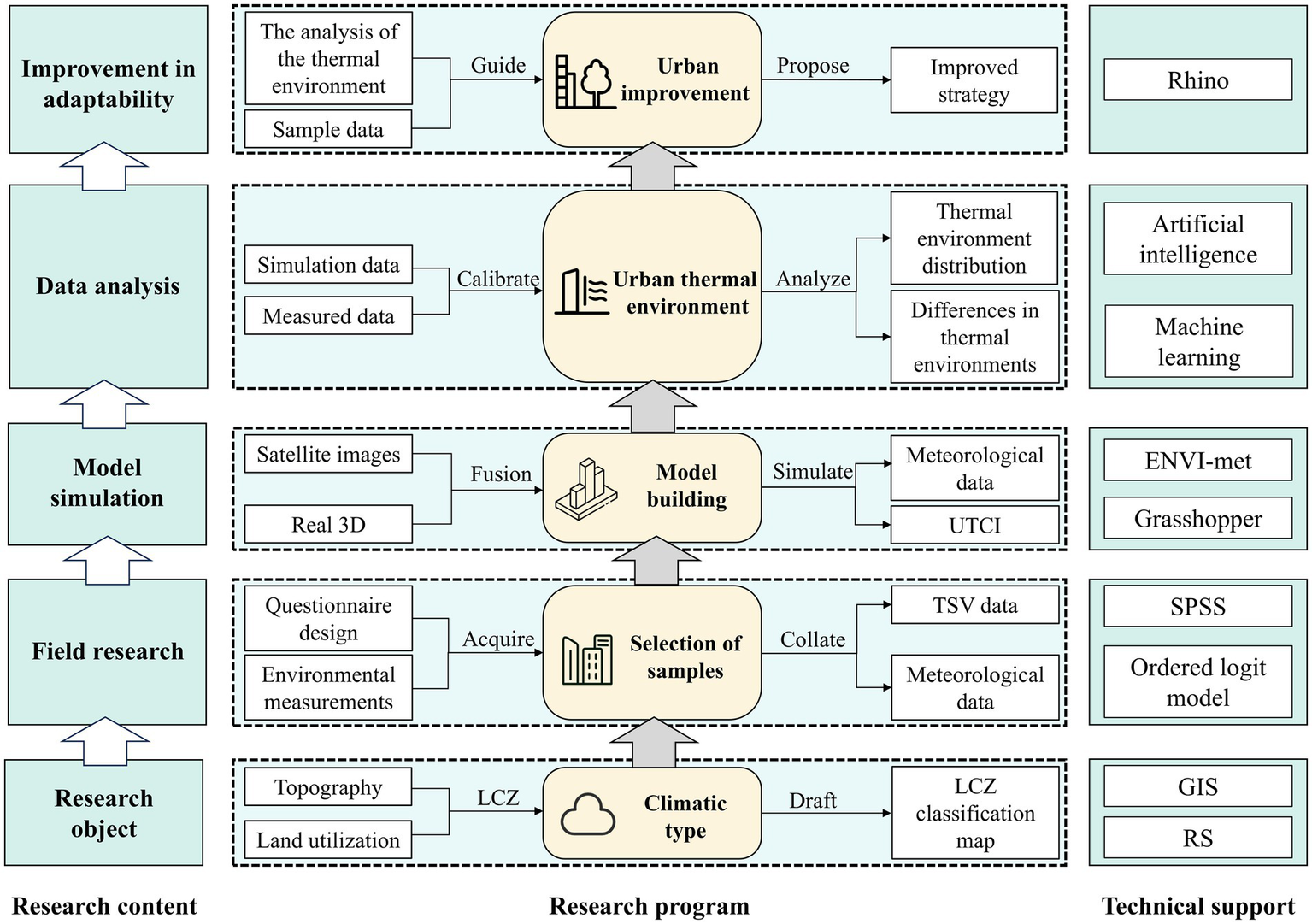
Framework for a large-scale OTC study.
To align large-scale OTC studies with thermal comfort and urban sustainability goals, urban strategies must integrate two key perspectives: (1) Subjective perception of thermal comfort: While objective metrics like temperature are essential, capturing subjective thermal comfort perceptions across demographic groups is equally critical. Factors such as age, activity levels, and cultural backgrounds influence individual experiences (Wang et al., 2018). Incorporating surveys and participatory methods ensures urban designs meet diverse user needs, fostering inclusivity and livability. (2) Integration of positive energy districts (PEDs): PEDs offer a transformative approach to urban energy transition, emphasizing renewable energy surplus and holistic environmental and socio-economic solutions (Gohari et al., 2024). Beyond energy efficiency, PEDs address UHI mitigation, microclimate optimization, and enhanced walkability (Natanian et al., 2024). Their design requires multi-stakeholder collaboration, integrating nature-based solutions, dynamic climate adaptation, and data-driven assessments. Embedding PED principles into OTC research supports resilient, climate-adaptive urban environments, aligning thermal comfort with broader sustainability goals, including the UN SDGs.
Thus, Combining subjective assessments with PED-based design strategies will create more livable, sustainable urban spaces that address UHI challenges and promote energy resilience, improving the quality of life for residents in urbanized environments.
6.2 Limitations
This study has certain limitations in data sources and analyses, primarily in two areas: (1) Data Source Constraints: The study relies solely on the WOS database, excluding other databases such as China National Knowledge Infrastructure (CNKI) and Scopus. As a result, the sample may not fully represent the entire field. Future research could incorporate data from additional databases or custom sources to enhance comprehensiveness. (2) Analysis Software Limitations: While VOSviewer is widely used for data analysis, advancements in digital technologies, particularly machine learning and digital programming, offer more intelligent and precise analytical capabilities. The current analysis methods may not fully leverage the data’s potential. Future studies should consider adopting more advanced software tools to optimize and improve analytical outcomes.
7 Conclusion
Based on PRISMA, this study reviewed the OTC-related paper in the past ten years. It was analyzed in terms of source, keywords, content and high citations. It was found that the current OTC research suffers from problems with unclear definitions, confusing indexes, and old-fashioned methods. In response to the above issues, this paper combed three aspects of OTC research, namely, definition, method and trend, and found that:
-
In terms of OTC characterization methods, the development of OTC has gone through three phases: germination, consolidation and innovation, with subjective and objective characteristics, and UTCI is most suitable for OTC measurement on a large scale.
-
In terms of OTC research method, the traditional OTC research method combines three subjective and objective methods, namely SPEQ, OPEM, and SCS, and further combines with new technologies such as AI, which has become a cutting-edge research method.
-
In terms of OTC research trends, based on combining the adaptive application of OTC indexes, research method innovation, and large-scale research, the adaptability and flexibility of UTCI and the advantages of new technologies such as AI are further corroborated. The potential for applying the LCZ classification system in large-scale OTC study is found.
On this basis, this paper proposes a large-scale OTC study technology framework. The framework can be used to achieve more accurate and comprehensive large-scale multi-scale OTC assessment in the future, and promote the optimization of urban planning and public health policies. In this paper, by combining the adaptability and flexibility of UTCI, the efficiency of AI technology, and the potential application of the LCZ classification system in large-scale study, the prediction accuracy and research efficiency of OTC studies are enhanced. It not only provides a scientific basis for the optimization of the urban environment in practice, but also promotes the sustainable development of cities and the improvement of residents’ quality of life.
Statements
Data availability statement
The original contributions presented in the study are included in the article/supplementary material, further inquiries can be directed to the corresponding author.
Author contributions
YL: Funding acquisition, Supervision, Writing – review & editing. WF: Data curation, Formal analysis, Investigation, Writing – original draft, Writing – review & editing. MY: Conceptualization, Methodology, Validation, Writing – original draft, Writing – review & editing. YiW: Visualization, Writing – review & editing. YD: Validation, Writing – review & editing. YaW: Investigation, Writing – review & editing.
Funding
The author(s) declare that financial support was received for the research, authorship, and/or publication of this article. This study was supported by grants from the National Natural Science Foundation of China (No. 42171219) and the Major Project Funding for Social Science Research Base in Fujian Province Social Science Planning.
Conflict of interest
The authors declare that the research was conducted in the absence of any commercial or financial relationships that could be construed as a potential conflict of interest.
Generative AI statement
The authors declare that no Gen AI was used in the creation of this manuscript.
Publisher’s note
All claims expressed in this article are solely those of the authors and do not necessarily represent those of their affiliated organizations, or those of the publisher, the editors and the reviewers. Any product that may be evaluated in this article, or claim that may be made by its manufacturer, is not guaranteed or endorsed by the publisher.
- UHI
Urban heat island
- OTC
Outdoor thermal comfort
- AI
Artificial Intelligence
- ICUC
International Conference on Urban Climate
- ISHVAC
International Symposium on Heating, Ventilation and Air Conditioning
- PMV
Predicted mean vote
- AT
Apparent temperature
- RS
Remote sensing
- SPEQ
Subjective perception evaluation questionnaire
- SCS
Software computational simulation
- PMV
Predictive mean vote
- MTSV
Mean thermal sensation vote
- TPV
Thermal preference vote
- HPV
Humidity preference vote
- OCV
Overall comfort vote
- IoT
Internet of Things
- VR
Virtual reality
- ANN
Artificial neural network
- PRISMA
Preferred reporting items for systematic reviews and meta-analyses Outdoor thermal comfort
- UTCI
Universal thermal climate index
- LCZ
Local climate zone
- IC2UHI
International Conference on Urban Heat Island
- UCUD
Urban Climate and Urban Design
- SET*
Standard effective temperature
- PET
Physiological equivalent temperature
- OPEM
Objective physical environment measurement
- ML
Machine learning
- TSV
Thermal sensation vote
- TCV
Thermal comfort vote
- TAV
Thermal acceptability vote
- WPV
Wind preference vote
- SPV
Solar radiation preference vote
- BIM
Building information modeling
- CFD
Computational fluid dynamics
- GOCI
Global outdoor comfort index
- MOCI
Mediterranean Outdoor Comfort Index
Glossary
References
1
Aghamohammadi N. Fong C. S. Idrus M. H. M. Ramakreshnan L. Haque U. (2021). Outdoor thermal comfort and somatic symptoms among students in a tropical city. Sustain. Cities Soc.72:103015:103015. doi: 10.1016/j.scs.2021.103015
2
Aghamolaei R. Azizi M. M. Aminzadeh B. Mirzaei P. A. (2020). A tempo-spatial modelling framework to assess outdoor thermal comfort of complex urban neighbourhoods. Urban Clim.33:100665. doi: 10.1016/j.uclim.2020.100665
3
Ahmad K. Maabreh M. Ghaly M. Khan K. Qadir J. Al-Fuqaha A. (2022). Developing future human-centered smart cities: critical analysis of smart city security, data management, and ethical challenges. Comput Sci Rev43:100452. doi: 10.1016/j.cosrev.2021.100452
4
Albdour M. S. Baranyai B. (2019). An overview of microclimate tools for predicting the thermal comfort, meteorological parameters and design strategies in outdoor spaces. Pollack Periodica14, 109–118. doi: 10.1556/606.2019.14.2.10
5
Aleksandrowicz O. Saroglou T. Pearlmutter D. (2023). Evaluation of summer mean radiant temperature simulation in ENVI-met in a hot Mediterranean climate. Build. Environ.245:110881. doi: 10.1016/j.buildenv.2023.110881
6
Allen M. J. Vanos J. Hondula D. M. Vecellio D. J. Knight D. Mehdipoor H. et al . (2017). Supporting sustainability initiatives through biometeorology education and training. Int. J. Biometeorol.61, 93–106. doi: 10.1007/s00484-017-1408-z
7
An L. Hong B. Cui X. Geng Y. Ma X. (2021). Outdoor thermal comfort during winter in China's cold regions: a comparative study. Sci. Total Environ.768:144464. doi: 10.1016/j.scitotenv.2020.144464
8
Antonini E. Vodola V. Gaspari J. De Giglio M. (2020). Outdoor wellbeing and quality of life: a scientific literature review on thermal comfort. Energies13:2016. doi: 10.3390/en13082079
9
Behzad Z. Guilandoust A. (2024). Enhancing outdoor thermal comfort in a historic site in a hot dry climate (case study: Naghsh-e-Jahan Square, Isfahan). Sustain. Cities Soc.102:105209. doi: 10.1016/j.scs.2024.105209
10
Bibri S. E. Huang J. Jagatheesaperumal S. K. Krogstie J. (2024). The synergistic interplay of artificial intelligence and digital twin in environmentally planning sustainable smart cities: a comprehensive systematic review. Environm. Sci. Ecotechnol.20:100433. doi: 10.1016/j.ese.2024.100433
11
Binarti F. Koerniawan M. D. Triyadi S. Utami S. S. Matzarakis A. (2020). A review of outdoor thermal comfort indices and neutral ranges for hot-humid regions. Urban Clim.31:100531. doi: 10.1016/j.uclim.2019.100531
12
Blocken B. (2015). Computational fluid dynamics for urban physics: importance, scales, possibilities, limitations and ten tips and tricks towards accurate and reliable simulations. Build. Environ.91, 219–245. doi: 10.1016/j.buildenv.2015.02.015
13
Blocken B. Janssen W. van Hooff T. (2012). CFD simulation for pedestrian wind comfort and wind safety in urban areas: general decision framework and case study for the Eindhoven university campus. Environ. Model Softw.30, 15–34. doi: 10.1016/j.envsoft.2011.11.009
14
Bröde P. Fiala D. Błażejczyk K. Holmér I. Jendritzky G. Kampmann B. et al . (2012). Deriving the operational procedure for the universal thermal climate index (UTCI). Int. J. Biometeorol.56, 481–494. doi: 10.1007/s00484-011-0454-1
15
Brousse O. Martilli A. Foley M. Mills G. Bechtel B. (2016). WUDAPT, an efficient land use producing data tool for mesoscale models? Integration of urban LCZ in WRF over Madrid. Urban Clim.17, 116–134. doi: 10.1016/j.uclim.2016.04.001
16
Budd G. M. (2008). Wet-bulb globe temperature (WBGT)—its history and its limitations. J. Sci. Med. Sport11, 20–32. doi: 10.1016/j.jsams.2007.07.003
17
Chen X. Gao L. Xue P. Du J. Liu J. (2020). Investigation of outdoor thermal sensation and comfort evaluation methods in severe cold area. Sci. Total Environ.749:141520. doi: 10.1016/j.scitotenv.2020.141520
18
Chen Y.-C. Matzarakis A. (2018). Modified physiologically equivalent temperature—basics and applications for western European climate. Theor. Appl. Climatol.132, 1275–1289. doi: 10.1007/s00704-017-2158-x
19
Chen L. Ng E. (2012). Outdoor thermal comfort and outdoor activities: a review of research in the past decade. Cities29, 118–125. doi: 10.1016/j.cities.2011.08.006
20
Coccolo S. Kämpf J. Scartezzini J.-L. Pearlmutter D. (2016). Outdoor human comfort and thermal stress: a comprehensive review on models and standards. Urban Clim.18, 33–57. doi: 10.1016/j.uclim.2016.08.004
21
Das M. Das A. Mandal S. (2020). Outdoor thermal comfort in different settings of a tropical planning region: a study on Sriniketan-Santiniketan planning area (SSPA), eastern India. Sustain. Cities Soc.63:102433. doi: 10.1016/j.scs.2020.102433
22
Deng J. Y. Wong N. H. (2020). Impact of urban canyon geometries on outdoor thermal comfort in central business districts. Sustain. Cities Soc.53:101966. doi: 10.1016/j.scs.2019.101966
23
Dzyuban Y. Ching G. N. Y. Yik S. K. Tan A. J. Banerjee S. Crank P. J. et al . (2022). Outdoor thermal comfort research in transient conditions: a narrative literature review. Landsc. Urban Plan.226:104496. doi: 10.1016/j.landurbplan.2022.104496
24
Fabbri K. Ugolini A. Iacovella A. Bianchi A. P. (2020). The effect of vegetation in outdoor thermal comfort in archaeological area in urban context. Build. Environ.175:106816. doi: 10.1016/j.buildenv.2020.106816
25
Fallahpour M. Aghamolaei R. Zhang R. Mirzaei P. A. (2022). Outdoor thermal comfort in urban neighbourhoods by coupling of building energy simulation and computational fluid dynamics. Build. Environ.225:109599. doi: 10.1016/j.buildenv.2022.109599
26
Fan P. Y. Chun K. P. Mijic A. Mah D. N.-Y. He Q. Choi B. et al . (2022). Spatially-heterogeneous impacts of surface characteristics on urban thermal environment, a case of the Guangdong-Hong Kong-Macau Greater Bay Area. Urban Clim.41:101034. doi: 10.1016/j.uclim.2021.101034
27
Fanger P.O. (1972). Thermal comfort. Analysis and applications in environmental engineering. Thermal Comfort Analysis & Applications in Environmental Engineering.
28
Feng W. Liu J. (2022). A literature survey of local climate zone classification: status, application, and Prospect. Buildings12:1693. doi: 10.3390/buildings12101693
29
Fong C. S. Aghamohammadi N. Ramakreshnan L. Sulaiman N. M. Mohammadi P. (2019). Holistic recommendations for future outdoor thermal comfort assessment in tropical Southeast Asia: a critical appraisal. Sustain. Cities Soc.46:101428. doi: 10.1016/j.scs.2019.101428
30
Gagge A. P. (1971). An effective temperature scale based on a simple model of human physiological regulatory response. ASHRAE Trans.77, 247–262.
31
Gagge A. P. Stolwijk J. A. Nishi Y. (1972). An effective temperature scale based on a simple model of human physiological regulatiry response. Memoirs Faculty Engineering, Hokkaido Univ13, 21–36.
32
Giridharan R. Emmanuel R. (2018). The impact of urban compactness, comfort strategies and energy consumption on tropical urban heat island intensity: a review. Sustain. Cities Soc.40, 677–687. doi: 10.1016/j.scs.2018.01.024
33
Givoni B. (1963). Estimation of the effect of climate on man: Development of a new thermal index. Jerusalem: Hebrew University.
34
Gohari S. Silvia S. C. Ashrafian T. Konstantinou T. Giancola E. Prebreza B. et al . (2024). Unraveling the implementation processes of PEDs: lesson learned from multiple urban contexts. Sustain. Cities Soc.106:105402. doi: 10.1016/j.scs.2024.105402
35
Golasi I. Salata F. de Lieto Vollaro E. Coppi M. (2018). Complying with the demand of standardization in outdoor thermal comfort: a first approach to the global outdoor comfort index (GOCI). Build. Environ.130, 104–119. doi: 10.1016/j.buildenv.2017.12.021
36
Golasi I. Salata F. de Lieto Vollaro E. Coppi M. de Lieto Vollaro A. (2016). Thermal perception in the mediterranean area: comparing the mediterranean outdoor comfort index (moci) to other outdoor thermal comfort indices. Energies9:550. doi: 10.3390/en9070550
37
Guo R. Yang B. Guo Y. Li H. Li Z. Zhou B. et al . (2024). Machine learning-based prediction of outdoor thermal comfort: combining Bayesian optimization and the SHAP model. Build. Environ.254:111301. doi: 10.1016/j.buildenv.2024.111301
38
Hado A. K. Hassan S. A. (2023). Iraq green buildings code effect on improving outdoor thermal comfort for residential complex. Asian J. Water Environ. Pollution20, 115–120. doi: 10.3233/AJW230015
39
Hashemi F. Poerschke U. Iulo L. D. Chi G. (2023). Urban microclimate, outdoor thermal comfort, and socio-economic mapping: a case study of Philadelphia, PA. Buildings13:1040. doi: 10.3390/buildings13041040
40
He B. J. Ding L. Prasad D. (2020). Relationships among local-scale urban morphology, urban ventilation, urban heat island and outdoor thermal comfort under sea breeze influence. Sustain. Cities Soc.60:102289. doi: 10.1016/j.scs.2020.102289
41
Hebbert M. Jankovic V. (2013). Cities and climate change: the precedents and why they matter. Urban Stud.50, 1332–1347. doi: 10.1177/0042098013480970
42
Honjo T. (2009). Thermal comfort in outdoor environment. Glob. Environ. Res.13, 43–47.
43
Höppe P. (1999). The physiological equivalent temperature–a universal index for the biometeorological assessment of the thermal environment. Int. J. Biometeorol.43, 71–75. doi: 10.1007/s004840050118
44
Höppe P. (2002). Different aspects of assessing indoor and outdoor thermal comfort. Energ. Buildings34, 661–665. doi: 10.1016/s0378-7788(02)00017-8
45
Huang B. Z. Hong B. Tian Y. Yuan T. T. Su M. F. (2021). Outdoor thermal benchmarks and thermal safety for children: a study in China's cold region. Sci. Total Environ.787:147603. doi: 10.1016/j.scitotenv.2021.147603
46
Ibrahim Y. Kershaw T. Shepherd P. Elwy I. (2021). A parametric optimisation study of urban geometry design to assess outdoor thermal comfort. Sustain. Cities Soc.75:103352. doi: 10.1016/j.scs.2021.103352
47
Jamei E. Rajagopalan P. Seyedmahmoudian M. Jamei Y. (2016). Review on the impact of urban geometry and pedestrian level greening on outdoor thermal comfort. Renew. Sustain. Energy Rev.54, 1002–1017. doi: 10.1016/j.rser.2015.10.104
48
Johansson E. Thorsson S. Emmanuel R. Krüger E. (2014). Instruments and methods in outdoor thermal comfort studies–the need for standardization. Urban Clim.10, 346–366. doi: 10.1016/j.uclim.2013.12.002
49
Kamal-Chaoui L. Robert A. (Eds.). (2009). Competitive Cities and Climate Change, OECD Regional Development Working Papers No. 2, Paris, Organization for Economic Cooperation and Development.
50
Karakounos I. Dimoudi A. Zoras S. (2018). The influence of bioclimatic urban redevelopment on outdoor thermal comfort. Energ. Buildings158, 1266–1274. doi: 10.1016/j.enbuild.2017.11.035
51
Kenny N. A. Warland J. S. Brown R. D. Gillespie T. G. (2009). Part a: assessing the performance of the COMFA outdoor thermal comfort model on subjects performing physical activity. Int. J. Biometeorol.53, 415–428. doi: 10.1007/s00484-009-0226-3
52
Kotharkar R. Dongarsane P. (2024). Investigating outdoor thermal comfort variations across local climate zones in Nagpur, India, using ENVI-met. Build. Environ.249:111122. doi: 10.1016/j.buildenv.2023.111122
53
Kumar P. Sharma A. (2020). Study on importance, procedure, and scope of outdoor thermal comfort -a review. Sustain. Cities Soc.61:102297. doi: 10.1016/j.scs.2020.102297
54
Lai D. Chen B. Liu K. (2020a). Quantification of the influence of thermal comfort and life patterns on outdoor space activities. Build Simul., 13, 113–125. doi: 10.1007/s12273-019-0565-x
55
Lai D. Lian Z. Liu W. Guo C. Liu W. Liu K. et al . (2020b). A comprehensive review of thermal comfort studies in urban open spaces. Sci. Total Environ.742:140092. doi: 10.1016/j.scitotenv.2020.140092
56
Lai D. Liu W. Gan T. Liu K. Chen Q. (2019). A review of mitigating strategies to improve the thermal environment and thermal comfort in urban outdoor spaces. Sci. Total Environ.661, 337–353. doi: 10.1016/j.scitotenv.2019.01.062
57
Lam C. K. C. Lau K. K. L. (2018). Effect of long-term acclimatization on summer thermal comfort in outdoor spaces: a comparative study between Melbourne and Hong Kong. Int. J. Biometeorol.62, 1311–1324. doi: 10.1007/s00484-018-1535-1
58
Lau K. K.-L. Chung S. C. Ren C. (2019). Outdoor thermal comfort in different urban settings of sub-tropical high-density cities: An approach of adopting local climate zone (LCZ) classification. Build. Environ.154, 227–238. doi: 10.1016/j.buildenv.2019.03.005
59
Lauwaet D. Maiheu B. De Ridder K. Boënne W. Hooyberghs H. Demuzere M. et al . (2020). A new method to assess fine-scale outdoor thermal comfort for urban agglomerations. Climate8:6. doi: 10.3390/cli8010006
60
Lawhead J. (2019). Learning geospatial analysis with Python: Understand GIS fundamentals and perform remote sensing data analysis using Python 3.7. Birmingham: Packt Publishing Ltd.
61
Li J. Liu N. (2020). The perception, optimization strategies and prospects of outdoor thermal comfort in China: a review. Build. Environ.170:106614. doi: 10.1016/j.buildenv.2019.106614
62
Li Y. Nian X. Gu C. Deng P. He S. Hong B. (2024). Assessing children's outdoor thermal comfort with facial expression recognition: An efficient approach using machine learning. Build. Environ.258:111556. doi: 10.1016/j.buildenv.2024.111556
63
Li X. Stringer L. C. Dallimer M. (2022). The impacts of urbanisation and climate change on the urban thermal environment in Africa. Climate10:164. doi: 10.3390/cli10110164
64
Li Y. Yang M. S. Bai H. X. Li R. Liang J. Q. Huang J. X. et al . (2023). A novel outdoor thermal comfort simulation model for heritage environments (OTC-SM-HE): Verify the effectiveness in Gulangyu, China. Building Environ.242:110568. doi: 10.1016/j.buildenv.2023.110568
65
Li A. Zhu Y. Li Y. (Eds.). (2014). Proceedings of the 8th International Symposium on Heating, Ventilation and Air Conditioning. Berlin: Springer. 551–561
66
Lin J. Chen S. Yang J. H. Li Z. Y. (2023). Research on summer outdoor thermal comfort based on COMFA model in an urban park of Fuzhou. China: Theoretical and Applied Climatology.
67
Lin T.-P. Matzarakis A. Hwang R.-L. (2010). Shading effect on long-term outdoor thermal comfort. Build. Environ.45, 213–221. doi: 10.1016/j.buildenv.2009.06.002
68
Liu D. Hu S. Liu J. (2020a). Contrasting the performance capabilities of urban radiation field between three microclimate simulation tools. Build. Environ.175:106789. doi: 10.1016/j.buildenv.2020.106789
69
Liu Z. M. Li J. Xi T. Y. (2023). A review of thermal comfort evaluation and improvement in urban outdoor spaces. Buildings13:3050. doi: 10.3390/buildings13123050
70
Liu L. Lin Y. Xiao Y. Xue P. Shi L. Chen X. et al . (2018). Quantitative effects of urban spatial characteristics on outdoor thermal comfort based on the LCZ scheme. Build. Environ.143, 443–460. doi: 10.1016/j.buildenv.2018.07.019
71
Liu K. Nie T. Liu W. Liu Y. Lai D. (2020b). A machine learning approach to predict outdoor thermal comfort using local skin temperatures. Sustain. Cities Soc.59:102216. doi: 10.1016/j.scs.2020.102216
72
Manavvi S. Rajasekar E. (2022). Evaluating outdoor thermal comfort in urban open spaces in a humid subtropical climate: Chandigarh, India. Building Environ209:108659. doi: 10.1016/j.buildenv.2021.108659
73
Masson V. Lemonsu A. Voogt J. (2018). The 9th international conference on urban climate, 23, 1–7. doi: 10.1016/j.uclim.2017.07.007
74
Matzarakis A. Mayer H. Iziomon M. G. (1999). Applications of a universal thermal index: physiological equivalent temperature. Int. J. Biometeorol.43, 76–84. doi: 10.1007/s004840050119
75
Matzarakis A. Rutz F. Mayer H. (2007). Modelling radiation fluxes in simple and complex environments—application of the ray man model. Int. J. Biometeorol.51, 323–334. doi: 10.1007/s00484-006-0061-8
76
Matzarakis A. Rutz F. Mayer H. (2010). Modelling radiation fluxes in simple and complex environments: basics of the ray man model. Int. J. Biometeorol.54, 131–139. doi: 10.1007/s00484-009-0261-0
77
McGregor G. R. (2012). Universal thermal comfort index (UTCI). Int. J. Biometeorol.56:419. doi: 10.1007/s00484-012-0546-6
78
Miao C. Chen W. Yu S. (2022). Assessing ozone distribution vertically and horizontally in urban street canyons based on field investigation and ENVI-met modelling. Buildings12:262. doi: 10.3390/buildings12030262
79
Mijani N. Alavipanah S. K. Firozjaei M. K. Arsanjani J. J. Hamzeh S. Weng Q. (2020). Modeling outdoor thermal comfort using satellite imagery: a principle component analysis-based approach. Ecol. Indic.117:106555. doi: 10.1016/j.ecolind.2020.106555
80
Mirzaei P. A. Haghighat F. (2010). Approaches to study urban heat island–abilities and limitations. Build. Environ.45, 2192–2201. doi: 10.1016/j.buildenv.2010.04.001
81
Mishra A. K. Ramgopal M. (2013). Field studies on human thermal comfort—an overview. Build. Environ.64, 94–106. doi: 10.1016/j.buildenv.2013.02.015
82
Moher D. Liberati A. Tetzlaff J. Altman D. G. Grp P. (2009). Preferred reporting items for systematic reviews and meta-analyses: the PRISMA statement. British Medical J.339:b2535. doi: 10.1136/bmj.b2535
83
Mushore T. D. Odindi J. Slotow R. Mutanga O. (2023). Remote sensing-based outdoor thermal comfort assessment in local climate zones in the rural–urban continuum of eThekwini municipality, South Africa. Remote Sens.15:5461. doi: 10.3390/rs15235461
84
Natanian J. Guarino F. Manapragada N. Magyari A. Naboni E. De Luca F. et al . (2024). Ten questions on tools and methods for positive energy districts. Build. environ, 111429.
85
Nazarian N. Acero J. A. Norford L. (2019). Outdoor thermal comfort autonomy: performance metrics for climate-conscious urban design. Build. Environ.155, 145–160. doi: 10.1016/j.buildenv.2019.03.028
86
Nguyen A. T. Singh M. K. Reiter S. (2012). An adaptive thermal comfort model for hot humid South-East Asia. Build. Environ.56, 291–300. doi: 10.1016/j.buildenv.2012.03.021
87
Nikolopoulou M. Baker N. Steemers K. (2001). Thermal comfort in outdoor urban spaces: understanding the human parameter. Sol. Energy70, 227–235. doi: 10.1016/S0038-092X(00)00093-1
88
Orosa J. A. Oliveira A. C. (2011). A new thermal comfort approach comparing adaptive and PMV models. Renew. Energy36, 951–956. doi: 10.1016/j.renene.2010.09.013
89
Pickup J. De Dear R. (2000). An Outdoor Thermal Comfort Index (OUT-SET*)-Part I—The Model and Its Assumptions. 5th International Congress of Biometeorology and International Conference on Urban Climatology, Macquarie University, Sydney, 279–283.
90
Provençal S. Bergeron O. Leduc R. Barrette N. (2016). Thermal comfort in Quebec City, Canada: sensitivity analysis of the UTCI and other popular thermal comfort indices in a mid-latitude continental city. Int. J. Biometeorol.60, 591–603. doi: 10.1007/s00484-015-1054-2
91
Rana R. Kusy B. Jurdak R. Wall J. Hu W. (2013). Feasibility analysis of using humidex as an indoor thermal comfort predictor. Energ. Buildings64, 17–25. doi: 10.1016/j.enbuild.2013.04.019
92
Robinson C. Yan D. Bouzarovski S. Zhang Y. (2018). Energy poverty and thermal comfort in northern urban China: a household-scale typology of infrastructural inequalities. Energ. Buildings177, 363–374. doi: 10.1016/j.enbuild.2018.07.047
93
Rossi F. Cardinali M. Di Giuseppe A. Castellani B. Nicolini A. (2022). Outdoor thermal comfort improvement with advanced solar awnings: subjective and objective survey. Build. Environ.215:108967. doi: 10.1016/j.buildenv.2022.108967
94
Rothfusz L. P. Headquarters N. S. R. (1990). The heat index equation (or, more than you ever wanted to know about heat index). Fort Worth Texas9023:640.
95
Ruefenacht L. Acero J.A. (2017). Strategies for cooling Singapore: A catalogue of 80+ measures to mitigate urban heat island and improve outdoor thermal comfort. Cooling Singapore (CS), Singapore. doi: 10.3929/ethz-b-000258216
96
Rupp R. F. Vásquez N. G. Lamberts R. (2015). A review of human thermal comfort in the built environment. Energ. Buildings105, 178–205. doi: 10.1016/j.enbuild.2015.07.047
97
Salata F. Golasi I. Petitti D. de Lieto Vollaro E. Coppi M. de Lieto Vollaro A. (2017). Relating microclimate, human thermal comfort and health during heat waves: An analysis of heat island mitigation strategies through a case study in an urban outdoor environment. Sustain. Cities Soc.30, 79–96. doi: 10.1016/j.scs.2017.01.006
98
Santamouris M. (2016). Innovating to zero the building sector in Europe: Minimising the energy consumption, eradication of the energy poverty and mitigating the local climate change. Sol. Energy128, 61–94. doi: 10.1016/j.solener.2016.01.021
99
Shah R. Pandit R. Gaur M. (2022). Urban physics and outdoor thermal comfort for sustainable street canyons using ANN models for composite climate. Alex. Eng. J.61, 10871–10896. doi: 10.1016/j.aej.2022.04.024
100
Shahinmoghadam M. Natephra W. Motamedi A. (2021). BIM-and IoT-based virtual reality tool for real-time thermal comfort assessment in building enclosures. Build. Environ.199:107905. doi: 10.1016/j.buildenv.2021.107905
101
Shooshtarian S. (2019). Theoretical dimension of outdoor thermal comfort research. Sustain. Cities Soc.47:101495. doi: 10.1016/j.scs.2019.101495
102
Shooshtarian S. Lam C. K. C. Kenawy I. (2020). Outdoor thermal comfort assessment: a review on thermal comfort research in Australia. Build. Environ.177:106917. doi: 10.1016/j.buildenv.2020.106917
103
Spagnolo J. De Dear R. (2003). A field study of thermal comfort in outdoor and semi-outdoor environments in subtropical Sydney Australia. Build. Environ.38, 721–738. doi: 10.1016/S0360-1323(02)00209-3
104
Steadman R. G. (1984). A universal scale of apparent temperature. J. Appl. Meteorol. Climatol.23, 1674–1687. doi: 10.1175/1520-0450(1984)023<1674:AUSOAT>2.0.CO;2
105
Stewart I. D. Oke T. R. (2012). Local climate zones for urban temperature studies. Bull. Am. Meteorol. Soc.93, 1879–1900. doi: 10.1175/BAMS-D-11-00019.1
106
Sun R. Lai D. Liu W. (2024). A computationally affordable and reasonably accurate approach for annual outdoor thermal comfort assessment on an hourly basis. Energ. Buildings316:114323. doi: 10.1016/j.enbuild.2024.114323
107
Sun R. Liu J. Lai D. Liu W. (2023). Building form and outdoor thermal comfort: inverse design the microclimate of outdoor space for a kindergarten. Energ. Buildings284:112824. doi: 10.1016/j.enbuild.2023.112824
108
Taleghani M. Kleerekoper L. Tenpierik M. Van Den Dobbelsteen A. (2015). Outdoor thermal comfort within five different urban forms in the Netherlands. Build. Environ.83, 65–78. doi: 10.1016/j.buildenv.2014.03.014
109
Tao Z. Zhu X. Xu G. Zou D. Li G. (2023). A comparative analysis of Outdoor Thermal Comfort indicators Applied in China and other Countries. Sustainability, 15, 16029. doi: 10.3390/su152216029
110
Terjung W. H. (1970). The energy balance climatology of a city-man system. Ann. Assoc. Am. Geogr.60, 466–492. doi: 10.1111/j.1467-8306.1970.tb00736.x
111
Thom E. C. (1959). The discomfort index. Weatherwise12, 57–61. doi: 10.1080/00431672.1959.9926960
112
Vasilikou C. Nikolopoulou M. (2020). Outdoor thermal comfort for pedestrians in movement: thermal walks in complex urban morphology. Int. J. Biometeorol.64, 277–291. doi: 10.1007/s00484-019-01782-2
113
Wang Z. de Dear R. Luo M. Lin B. He Y. Ghahramani A. et al . (2018). Individual difference in thermal comfort: a literature review. Build. Environ.138, 181–193. doi: 10.1016/j.buildenv.2018.04.040
114
Wang B. Yi Y. K. (2021). Developing an adapted UTCI (universal thermal climate index) for the elderly population in China’s severe cold climate region. Sustain. Cities Soc.69:102813. doi: 10.1016/j.scs.2021.102813
115
Wei D. Yang L. Bao Z. Lu Y. Yang H. (2022). Variations in outdoor thermal comfort in an urban park in the hot-summer and cold-winter region of China. Sustain. Cities Soc.77:103535. doi: 10.1016/j.scs.2021.103535
116
Wong N. H. Jusuf S. K. (2016). Special report on the fourth international conference on countermeasures to urban heat island (4th IC2UHI Conference) in Singapore. Front. Archit. Res., 508–510. doi: 10.1016/j.foar.2016.08.002
117
Wu J. Liu C. Wang H. (2022). Analysis of Spatio-temporal patterns and related factors of thermal comfort in subtropical coastal cities based on local climate zones. Build. Environ.207:108568. doi: 10.1016/j.buildenv.2021.108568
118
Yang X. Li S. Zhang Q. He S. (2022). Thermal comfort assessment of the Beijing historical town blocks: analysis of indices and applications. Sci. Program.2022, 1–18. doi: 10.1155/2022/2381584
119
Yang B. Olofsson T. Nair G. Kabanshi A. (2017). Outdoor thermal comfort under subarctic climate of North Sweden–a pilot study in Umeå. Sustain. Cities Soc.28, 387–397. doi: 10.1016/j.scs.2016.10.011
120
Yao F. Fang H. Han J. Zhang Y. (2022a). Study on the outdoor thermal comfort evaluation of the elderly in the Tibetan plateau. Sustain. Cities Soc.77:103582. doi: 10.1016/j.scs.2021.103582
121
Yao R. Zhang S. Du C. Schweiker M. Hodder S. Olesen B. W. et al . (2022b). Evolution and performance analysis of adaptive thermal comfort models–a comprehensive literature review. Build. Environ.217:109020:109020. doi: 10.1016/j.buildenv.2022.109020
122
Ye G. Yang C. Chen Y. Li Y. (2003). A new approach for measuring predicted mean vote (PMV) and standard effective temperature (SET∗). Build. Environ.38, 33–44. doi: 10.1016/S0360-1323(02)00027-6
123
Yin Q. Cao Y. Sun C. (2021). Research on outdoor thermal comfort of high-density urban center in severe cold area. Build. Environ.200:107938. doi: 10.1016/j.buildenv.2021.107938
124
Yoo W. Clayton M. J. Brown R. D. (2024). From BIM to thermal comfort: leveraging BIM for rapid outdoor comfort assessments. Energ. Buildings321:114664. doi: 10.1016/j.enbuild.2024.114664
125
Zhang H. Ao M. Ardabili N. G. Xu Z. Wang J. (2024a). Impact of urban sunken square design on summer outdoor thermal comfort using machine learning. Urban Clim.58:102214. doi: 10.1016/j.uclim.2024.102214
126
Zhang Y. Liu C. (2021). Digital simulation for buildings’ outdoor thermal comfort in urban neighborhoods. Buildings11:541. doi: 10.3390/buildings11110541
127
Zhang L. Liu H. Wei D. Liu F. Li Y. Li H. et al . (2022b). Impacts of spatial components on outdoor thermal comfort in traditional Linpan settlements. Int. J. Environ. Res. Public Health19:6421. doi: 10.3390/ijerph19116421
128
Zhang L. Wei D. Hou Y. Du J. Liu Z.a. Zhang G. et al . (2020). Outdoor thermal comfort of urban park—a case study. Sustain. For.12:1961. doi: 10.3390/su12051961
129
Zhang J. Zhang F. Gou Z. Liu J. (2022a). Assessment of macroclimate and microclimate effects on outdoor thermal comfort via artificial neural network models. Urban Clim.42:101134. doi: 10.1016/j.uclim.2022.101134
130
Zhang Y. Zheng Z. Zhang S. Fang Z. Lin Z. (2024b). Exploring thermal comfort and pleasure in outdoor shaded spaces: inspiration for improving thermal index models. Build. Environ.265:111933. doi: 10.1016/j.buildenv.2024.111933
131
Zhao Y. Genovese P. V. Li Z. (2020). Intelligent thermal comfort controlling system for buildings based on IoT and AI. Future Internet12:30. doi: 10.3390/fi12020030
132
Zhao Q. Lian Z. Lai D. (2021). Thermal comfort models and their developments: a review. Energy Built Environ.2, 21–33. doi: 10.1016/j.enbenv.2020.05.007
133
Zhou X. Chen H. (2018). Impact of urbanization-related land use land cover changes and urban morphology changes on the urban heat island phenomenon. Sci. Total Environ.635, 1467–1476. doi: 10.1016/j.scitotenv.2018.04.091
Summary
Keywords
outdoor thermal comfort, large-scale, universal thermal climate index, local climate zone, systematic reviews
Citation
Li Y, Fei W, Yang M, Wang Y, Du Y and Wang Y (2025) How to realize large-scale outdoor thermal comfort studies? A systematic review based on OTC characterization, methods and research trends. Front. Sustain. Cities 7:1552994. doi: 10.3389/frsc.2025.1552994
Received
19 January 2025
Accepted
03 March 2025
Published
21 March 2025
Volume
7 - 2025
Edited by
Xiangfei Kong, Hebei University of Technology, China
Reviewed by
Tong Yang, Middlesex University, United Kingdom
Jianlin Ren, Hebei University of Technology, China
Updates
Copyright
© 2025 Li, Fei, Yang, Wang, Du and Wang.
This is an open-access article distributed under the terms of the Creative Commons Attribution License (CC BY). The use, distribution or reproduction in other forums is permitted, provided the original author(s) and the copyright owner(s) are credited and that the original publication in this journal is cited, in accordance with accepted academic practice. No use, distribution or reproduction is permitted which does not comply with these terms.
*Correspondence: Mengsheng Yang, mention1992@stu.xmu.edu.cn
Disclaimer
All claims expressed in this article are solely those of the authors and do not necessarily represent those of their affiliated organizations, or those of the publisher, the editors and the reviewers. Any product that may be evaluated in this article or claim that may be made by its manufacturer is not guaranteed or endorsed by the publisher.