Abstract
As urban areas expand and the global focus on sustainability intensifies, integrating solar energy into urban systems has become a critical area of research and application. According to the United Nation Dept. of Economics and Social Affairs, in 2022, more than half of the world’s population already resided in urban areas, increasing the global electricity demand to approximately 30,000 terawatt-hours (TWh). At the same time, predictions indicate that by 2050, about 2/3-rd of the global population will live in urban areas, adding there around 2.5 billion people. In this light, providing a sustainable and reliable electric power supply is becoming a major challenge for city planning bodies, governments, and power utility companies. Utilization of architectural surfaces and components of urban infrastructure for renewable energy generation is becoming an often-considered potential solution. Furthermore, pairing PV systems with advanced energy storage solutions, including batteries, stabilizes supply–demand fluctuations, while digital tools such as Internet of Things (IoT), Artificial Intelligence (AI), and digital twins enhance system efficiency and grid management. These approaches are adding a variety of power generation systems, electrical control and energy storage components, and hardware, directly, to buildings and, on a broader scale, to urban districts. Community solar projects provide access to renewable energy in densely populated areas, particularly where rooftop space is limited. Additionally, integrating solar technologies with electric vehicle charging stations, green roofs, and urban agriculture systems demonstrates the multifunctionality of PV systems. This article explores strategies for urban solar expansion, emphasizing urban energy planning, advanced energy storage, digital tools, community solar projects, and integration with other urban systems. The potential of solar energy technologies in urban environments is discussed, from the perspective of supporting the transition to sustainable, energy-efficient cities while addressing technical, economic, and policy challenges.
1 Introduction
Global population projections indicate significant growth in the coming decades, with implications for urban density and energy demand. According to United Nations (2024) World Population Prospects, the global population is expected to increase from 8.2 billion in 2024 to approximately 10.3 billion by the mid-2080s (United Nations, 2024). In the United States, the population is projected to grow from 340 million in 2023 to approximately 375 million by 2050 (United States Census Bureau, 2023). Urbanization is expected to continue globally, with the urban population projected to increase from 4.2 billion in 2018 to 6.7 billion by 2050. In the U.S., urban areas are anticipated to experience continued growth, with urban population density expected to increase. One of the positive outcomes of this process is that this densification can lead to the reduced per capita energy consumption due to factors such as decreased reliance on personal vehicles and more efficient building energy use (University of Michigan, 2023). However, the overall energy demand in urban areas is expected to rise due to the increasing total urban population and economic activities (Güneralp et al., 2017).
With the current shifts in international demographics, balancing electricity supply and demand in power grids is becoming increasingly challenging. Increasing the share of renewable technologies in the international power supply landscape is beneficial. However, it is important to remember that the significant growth of solar power inputs also presents challenges (Allouhi et al., 2022; Choudhary and Kumar Srivastava, 2019; Kapilan et al., 2022; Shafiullah et al., 2022). According to Masson et al. (2022), over 600 GW of new PV systems were commissioned in 2024, resulting in the global cumulative PV capacity of over 2.2 TW at the end of 2024. This is a significant growth from the 1.6 TW value at the end of 2023. China contributed nearly 60% (357.3 GW) of this global capacity. Europe also demonstrated continual growth, installing about 71.4 GW, led by Germany (16.7 GW). The USA, Brazil, India also demonstrated significant PV installation growth of about 47.1 GW, 14.3 GW, and 31.9 GW of new PV installations, respectively. As depicted in Figure 1, there is a midday dip in net demand for grid electricity due to high solar generation, followed by a steep evening spike when solar power declines. When plotted as a curve, the shape resembles the silhouette of a duck thus the name “Duck Curve” (Al-Sunni et al., 2022). The Duck Curve was originally published by California ISO in 2013.1 It shows how solar energy can cause the net load on the power grid to fluctuate throughout the day. The curve explains the need for solutions. Solutions include deploying energy storage systems, demand response strategies, flexible power plants, and modernizing the grid to better integrate renewable energy.
Figure 1
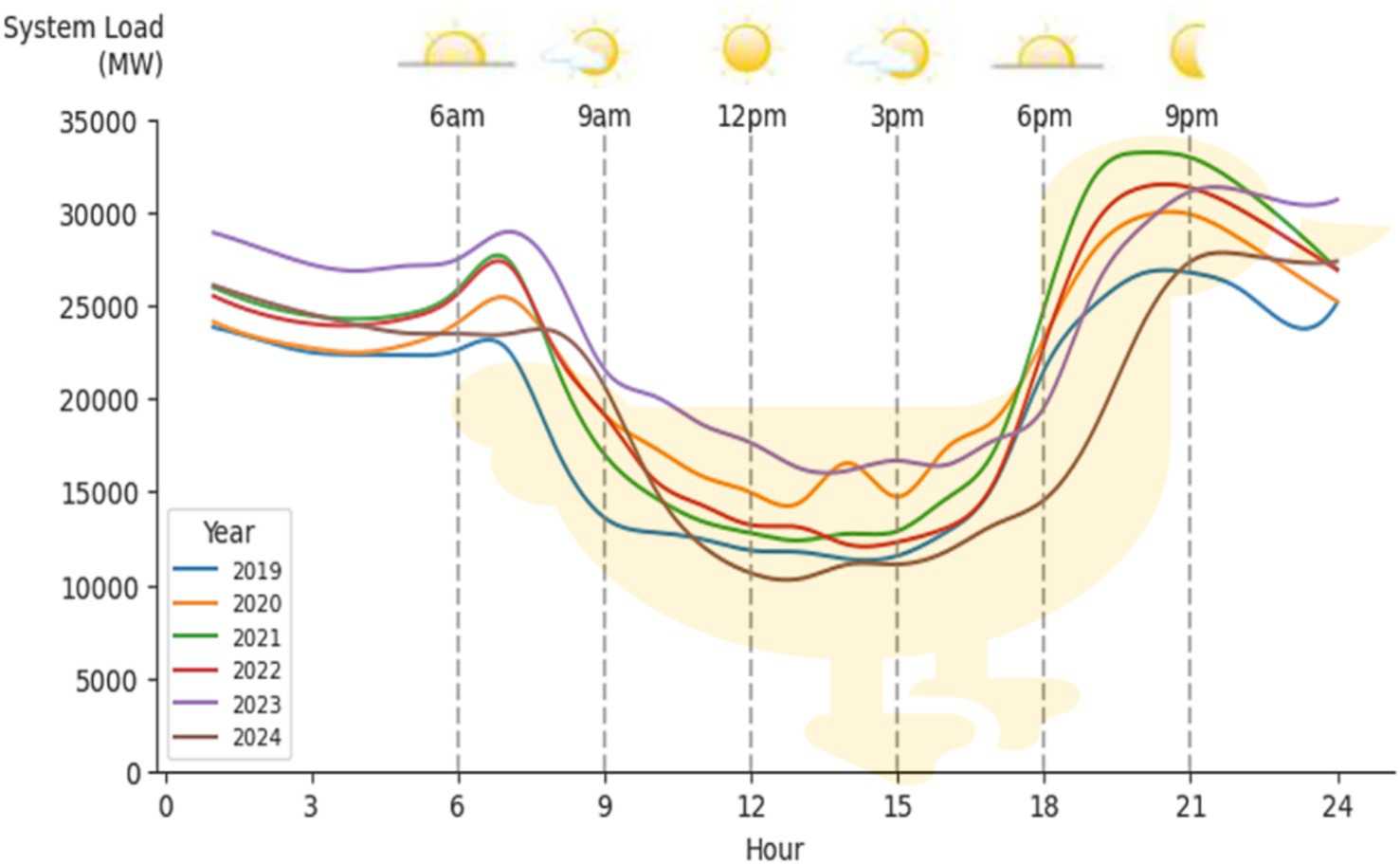
Duck curve based on U.S. Energy Information Administration data from California, March 31st 2019–2024 (EIA, 2025).
Solar energy will also need to fulfill new roles regarding water economy: sustainable cities integrate water collection, wastewater recovery, and even desalination into urban energy systems by utilizing the surplus solar energy during peak generation periods, addressing the duck curve, and reducing reliance on conventional power. The potential of solar energy to recovery water from humid air using desiccant materials was modeled by Mohamed et al. (2017) for different Egyptian weather and reported that a total of 3.02 L/ (day.m2) could be recovered in Alexendria during Spring. This technology has been practically demonstrated by Hamed et al. (2011) in Saudi Arabia, and their results show that about 1.0 L per m2 can be regenerated in the location of Tarif. Furthermore, it has been already demonstrated that solar-powered desalination and wastewater recovery enhance water security while lowering energy footprints (Garrido-Baserba et al., 2024). Solar energy can also be used in water heating systems to enhance building efficiency. Meena et al. (2022), reports that a clear glazing flat plate collector area of about 1.83 m × 1.22 m × 0.1 m with a 0.5 mm thick black copper collector which received an average irradiation of 700 W/m2, can supply about 60 L of water at temperatures from 15 to 45 degree Celsius for about 70 min. Coupling water treatment with energy storage supports decentralized urban solutions. Improving the lifecycle, sustainability and resource efficiency, these approaches contribute to a resilient and circular, urban energy approach.
2 Future PV technology developments for urban contexts
As the demand for sustainable energy solutions intensifies, the application of solar power and different PV technologies in urban landscapes such as in building integrated PVs are evolving. In the urban context there is a focus on land availability, efficiency, aesthetics, adaptability, and sustainability. Ground mounted PV and rooftop PVs installation are made up of either mono/polycrystalline silicon panels, or thin film technologies like Cadmium Telluride (CdTe). Solar PVs can also be either integrated or attached to buildings. The integration and utilization of PV modules into building structures as either Building-Integrated Photovoltaic (BIPV) systems or Building Applied Photovoltaics (BAPVs) are most common in urban areas (Zhao et al., 2023; Constantinou et al., 2024). They combine efficient energy generation with architectural designs. Differences between PV installation/integration approaches are presented in Figure 2.
Figure 2
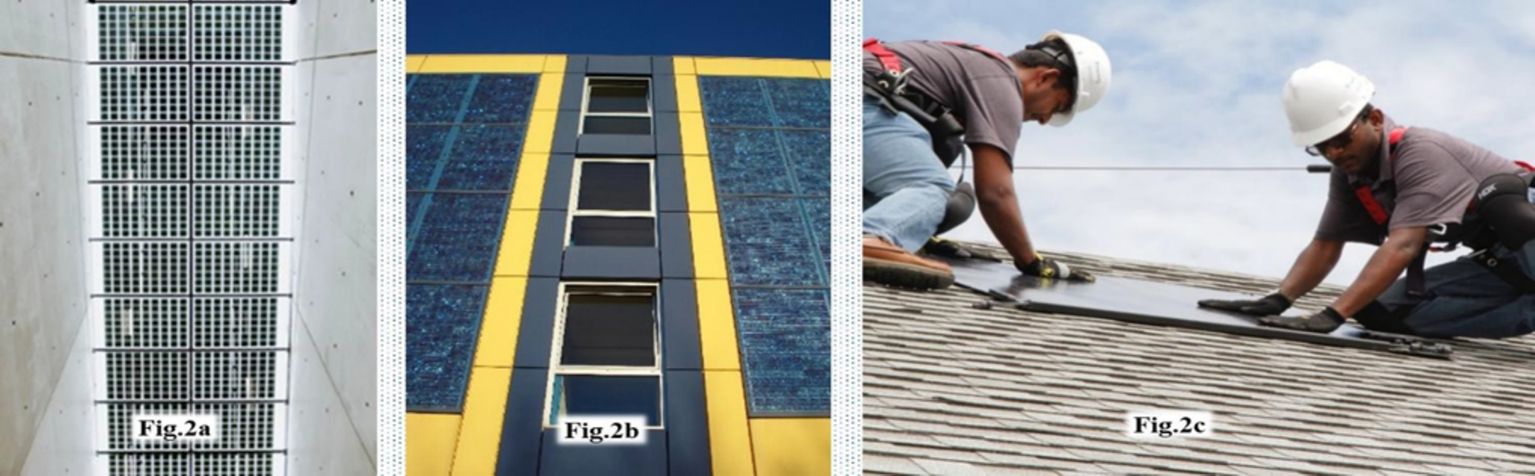
Examples of different PV installation techniques on window, wall, and slope roof. (a) BIPV: transparent PV modules that replace skylight windows. Source: Picture from https://www.freepik.com/. (b) Example of BAPV: PV modules that are applied to the façade of a building. Source: Image by Christiane M. from Pixabay. (c) Roof installation of lightweight adhered PV modules recorded during the final project demonstration of the Fraunhofer Plug-and-Play project. Source: Reproduced from Hoepfner (2016), with permission.
In BAPVs, photovoltaics are installed on building structures without substituting any existing component as in the case of BIPVs. Building-Integrated Photovoltaics (BIPVs) and Building-Applied Photovoltaics (BAPVs), based on PV technology, can be made from various solar cell types. Silicon-based options include monocrystalline and polycrystalline solar cells, commonly incorporated into facades (Biyik et al., 2017). Thin-film solar cells, such as Cadmium Telluride (CdTe) and Copper Indium Gallium Selenide (CIGS), offer flexible integration possibilities (KoŚny et al., 2012; Kumar et al., 2019; BiPVco, 2025). More recently, due to their ease of fabrication (Zhu et al., 2020) and their high-power conversion efficiency (Chan et al., 2019; Yavari et al., 2018), perovskites solar cells are considered as a promising technology for BIBVs and have been revolutionizing the field. Perovskite solar cells, particularly metal halides, stand out due to their semi-transparent properties, high efficiency, flexibility, and lightweight potential, making them ideal for portable devices and curved urban surfaces like glazing (Batmunkh et al., 2020; Bing et al., 2022). Organic solar cells provide new possibilities for BIPVs, thanks to their diverse color options, lightweight nature, mechanical flexibility, and customizable shapes (Landerer et al., 2019). Additionally, Dye-Sensitized Solar Cells (DSSCs) are particularly effective in low-light conditions, and can be easily integrated into building fenestrations (Mirabi et al., 2021), further expanding the potential applications of BIPVs in urban environments. Furthermore, photovoltaic blinds, overhangs and ownings are examples of architectural applications of solar BIPVs. Other urban PV technology includes bifacial mono crystalline PV technologies which capture solar radiation on both sides of the panel (Pisigan and Jiang, 2014). This technology is particularly suitable where solar radiation is reflected by urban surfaces like buildings (Huang et al., 2004). Transparent and semitransparent photovoltaic (PV) technologies enable direct integration with building envelopes and other urban infrastructures, enhancing their versatility and acceptance in urban planning. For example, transparent PVs are being utilized in windows and facades, allowing natural light transmission while simultaneously generating electricity, thus improving energy efficiency in buildings (Wu et al., 2024). Solar roof tiles and facades are another BIPV application replacing traditional roofing materials with aesthetically pleasing energy-generating tiles. Similarly, semitransparent BIPVs are attracting interest from several researchers, due to their combination of efficiencies and improved visual performance (Martellotta et al., 2017). Semitransparent PV facades enable energy generation without sacrificing the visual appeal of buildings, making them a key feature in sustainable urban development (Ferreira et al., 2018). Wall-mounted PVs, which is the installation of solar panels on walls have also been regarded as a promising option of PV installation in urban areas due to land constraints (Al-Rashidy et al., 2024). In wall-mounted PVs, solar panels, mostly crystalline and thin film solar panels, can be mounted on exterior walls, fences (Masna et al., 2023), or even within yards. Ruan et al. (2025) evaluated the potential of wall-mounted PV in high-latitudes such as in Sweden, through a PV power generation model and reported that the output of the PV installation was significantly greater in the snow periods from October to March, despite a lower power generation of about 5% in other seasons. Nagaoka et al. (2021) also reported higher power output during the winter periods, hence, positioning wall mounted PVs as viable options for offsetting building energy.
In addition to traditional flat applications, these PV technologies have enabled integration into a variety of architectural or urban infrastructure components, such as overhangs, awnings, and shading devices, enhancing their functionality while contributing to renewable energy generation. Rollable and bendable solar films expand their use on complex surfaces, such as curved roofs, vehicle exteriors, and uneven urban landscapes. These advancements allow PV systems to support architectural designs and improve their adoption in urban areas (Traverse et al., 2017).
Flexible PV materials are low-cost, high-performance, and easy to install (Dallaev et al., 2023). Flexible PV technologies reduce the cost through the elimination of high-energy manufacturing processes as compared to silicon based solar module technologies. Their high performance in low-light conditions, their lightweight and flexible nature allow low-cost and fast-to-install metal building applications and complex architectural facades, as well as the integration into non-traditional surfaces like for example infrastructure components, or roofs on different types of vehicles. These systems are advantageous for retrofitting older buildings (El Gindi et al., 2017), where traditional PV systems may not be feasible due to their weight, installation hardware requirements, and lack of flexibility.
Integrating photovoltaic (PV) technology into urban surfaces enables innovative solutions for sustainable energy generation. Applications include PV-integrated roads and parking lots. These surfaces harness solar energy by embedding durable solar panels capable of withstanding vehicle loads, thereby converting vast urban areas into decentralized power generators. For instance, solar roads replace traditional asphalt with specially designed solar panels, generating electricity from sunlight while supporting vehicle traffic (8MSolar, 2024). Several studies have evaluated the efficiency of solar roads, yielding mixed results. For instance, the Solar Road project in the Netherlands, which involved a 70-meter solar bike path, reported an energy yield of 78 kWh per square meter per year during its initial phase, measured in 2015 (Shekhar et al., 2018). Beyond roadways, PV integration extends to park benches, lighting poles, and noise barriers. Incorporating solar panels into these structures can power streetlights, signage, or provide charging stations for electronic devices, enhancing urban infrastructure’s functionality and sustainability (US DOE, 2024). Another significance of solar PV integration in urban areas lies within the context of Positive Energy Districts (PEDs). PEDs are designed to facilitate energy transition and advance climate neutrality by promoting energy efficiency and achieving a net zero energy balance. Lindholm et al. (2021) defined PEDs as energy efficient and energy-flexible urban areas or clusters of interconnected buildings that achieve net zero greenhouse gas emissions and actively manages an annual surplus of locally or regionally produced renewable energy. As outlined by Derkenbaeva et al. (2022), four defining elements of a PED include: a clearly defined geographical boundary; integration with the grid; a designated method of energy supply and a balancing period. PED emphasizes achieving Net-zero emissions through energy generation, hence, highlighting the critical role of integrating clean energy generating sources. Though not all renewable energy resources are applicable for PEDs due to high population density in urban areas, solar PV and batteries are more suitable for an urban environment and can be installed in all types of PEDs (Lindholm et al., 2021). Furthermore, solar PV’s synergy with energy storage like batteries can help in achieving an energy balance. Other benefits include decentralized energy production, optimized use of idle spaces, and the support of energy efficient technologies such as LED street lighting all contribute to the advancement of the PED concept (Table 1).
Table 1
| PV technologies | Types | Demonstrated efficiency (%) | References |
|---|---|---|---|
| Crystalline Si-based solar cells | Mono crystalline | 26.3 | Yoshikawa et al. (2017) |
| Poly crystalline | 20.4 | Green et al. (2020) | |
| Bifacial solar cells PERC | - Typical applications include power plants and BIPVs - Demonstrated Efficiency: 25% |
Dullweber et al. (2018) | |
| Thin film solar cells | Cadmium telluride (CdTe) | - Application in solar power plants, commercial and industrial rooftop installations - Demonstrated Efficiency: 21.5% |
Zhu et al. (2022) |
| Cupper Indium Gallium Selenide (CIGS) | - Application in BIPVs, metal buildings, architectural components, mobile applications, transportation infrastructure - Demonstrated Efficiency: 23.6% |
Keller et al., (2024) | |
| Third generation PV | Organic PV | - Applications in BIPVs, portable consumer electronics, IoT smart sensors, smart textiles, advertising signs, etc. - Demonstrated Efficiency: 18.7% |
Cui et al. (2021) |
| Perovskite solar | - Expected future applications in BIPV, mobile applications, transportation technologies - Demonstrated Efficiency 24.9% |
Ren et al. (2024) | |
| Dye sensitized solar cells | - Applications in smart windows (BIPVs), IoT smart sensors. - Demonstrated Efficiency: 12% |
Vodapally and Ali (2022) |
Efficiencies of the most common solar PV technologies.
In addition, hybrid systems combine PV cells with other types of solar technologies. For example, solar-thermal hybrid systems (PVT) merge photovoltaic cells with thermal collectors, simultaneously producing electricity and heat from the same surface area, thereby maximizing energy output. Integrating PV into green walls or roofs can improve building insulation, reduce urban heat island effects, and support biodiversity (Cheng et al., 2021).
3 Challenges with urban-scale expansion
To ensure the local energy production, and not only consumption by urban areas/cities, the early integration of solar energy consideration into urban design/planning is crucial (Akrofi and Okitasari, 2022). Urban solar implementation faces challenges that require innovative solutions. Space constraints are a primary issue (Kammen and Sunter, 2016), as densely populated areas often have limited roof space and competition for land with other urban needs such as housing, services, and green spaces. In a study by Mohajeri et al. (2016), they assessed the effects of various urban compactness indicators on solar potential for about 16 neighborhoods (11,418 buildings) in Geneva (Switzerland) for various PV installation technologies include BIPV, Solar thermal collectors (STC) and direct gain passive solar systems, and their results demonstrated that solar irradiance decreases with increase compactness. The BIPV potential on facades decreased from 20% in disperse neighborhood to 3% in compact neighborhood, the passive solar heating decreased from 21 to 4%, the STC potential decreased from 85 to 49%, the BIPV potential on roofs decreased from 94 to 79%, and finally the STC potential on roofs from 100 to 95%. Glare from reflective solar panels can impact nearby buildings, transportation infrastructure, and aesthetics (Etukudoh et al., 2024; Labib et al., 2016; Sreenath et al., 2021), while shadowing caused by high-rise buildings and trees can significantly reduce solar panel efficiency (Wang, 2025; Yang et al., 2019). Integrating solar systems into urban architecture presents aesthetic and design challenges, with public resistance often stemming from concerns about visual impacts. Additionally, urban grids may not be equipped to handle the distributed energy inputs from solar systems, necessitating upgrades and modernization, while energy storage solutions are needed to balance supply and demand, especially during nighttime (Etukudoh et al., 2024).
In PV applications only about 1/4 of energy is converted into electric power with similar amount transformed into heat (Prakash et al., 2023). The associated urban heat island effect, which raises ambient air temperatures, can further reduce solar panel efficiency (Adeh et al., 2019). Novel ventilation strategies and PV-Thermal applications may need to be considered in such situations. Maintenance and accessibility are also significant concerns, as urban solar installations on rooftops and facades often incur higher costs and logistical challenges (Shukla et al., 2018). Regulatory and policy barriers, such as inconsistent guidelines and lengthy permitting processes, complicated implementation, while high upfront costs and financing difficulties deter widespread adoption (Kammen and Sunter, 2016; Shukla et al., 2018).
Lifecycle and sustainability is another concern, particularly the recycling and disposal of solar panels at the end of their life (Ndalloka et al., 2024), alongside addressing their embodied carbon footprint. Finally, integrating solar systems with other urban infrastructures, such as EV charging stations and water management systems, can be challenging due to space and infrastructure limitations (Shafiullah et al., 2022). These issues highlight the need for comprehensive planning, innovative technologies, and supportive policies to effectively harness solar energy in urban environments. Figure 3 summarizes the challenges faced by solar PV integration in urban areas.
Figure 3
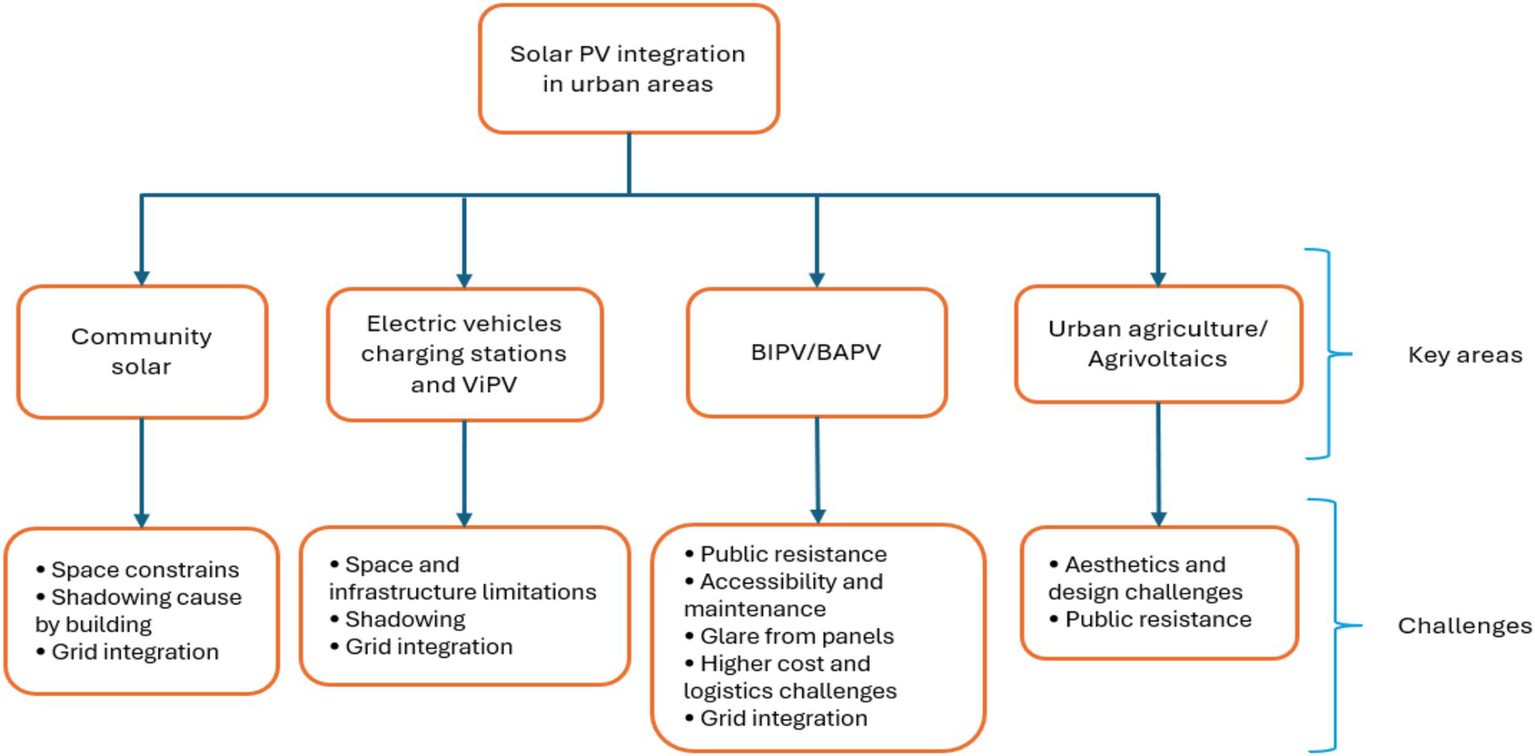
Challenges faced by solar PV integration in urban areas.
4 Cost and maintenance
Building-Integrated Photovoltaic (BIPV) systems offer the advantage of serving as both building materials and energy generators, contributing to sustainable architecture. However, there are often higher initial costs and maintenance challenges. While BIPV systems typically have a significant upfront investment compared to traditional building materials and standard photovoltaic installations, due to installation complexities (Shahverdian et al., 2025), their overall benefits including aesthetic, economic, environmental, societal, make them a cost-effective option (Gholami et al., 2020; Sorgato et al., 2018). To help in understanding potential economic advantages of BIPV systems and to illustrate a scale of cost reductions accomplished by the authors, the original experimental solar roof configuration, from their past project, is presented on Figure 2C (Hoepfner, 2016; Shukla et al., 2017). The Fraunhofer Center for Sustainable Energy Systems (CSE) developed a Plug and Play Photovoltaic (PV) system designed to simplify and reduce the costs of residential solar installations. The goal was to make solar installations as straightforward as setting up a home appliance, enabling homeowners to install the system themselves or with minimal assistance. In residential installations, PV modules, inverters, mounting hardware, and electrical components account for about 20% of the total cost. Soft costs (including design, permitting, and installation labor) constitute the remaining portion, The Plug and Play initiative aimed to lower the installed cost of residential solar systems to $1.50 per watt, a significant reduction from the average $3–$4 per watt in the U.S. at the time of the project’s inception in 2013. The additional benefit of the application of this technology was the great speed of installation. As shown on the shared video, it took less than 2 h to install, connect to the power grid, and commission the 3-kWh roof system—Fraunhofer Plug and Play PV Systems—System Installation and Commissioning November 2014—YouTube.
This is due to the integration of energy-generating components into building elements, which often require specialized materials and installation techniques. The increased complexity in design and construction contributes to these elevated costs (Zou et al., 2024). Maintenance of BIPV systems, especially in hard-to-reach locations, like high-rise buildings, have challenges. Accessing these systems for maintenance on high-rise buildings often necessitates specialized equipment and safety measures, leading to increased operational costs (Shi and Zhu, 2023). Advancements in materials and installation techniques are essential to make BIPV systems more economically viable and practical for widespread adoption in urban environments.
5 Strategies for urban expansion: enabling sustainable energy solutions
As urban populations grow, innovative strategies are required to integrate renewable energy systems into city planning, ensuring optimized resource use, and minimal environmental impact. The insufficiency of urban power grids is a major barrier to large-scale PV adoption, as many grids were designed for a given capacity and for one-directional power flow and cannot efficiently handle bidirectional energy inputs (Singh et al., 2015). Aging infrastructure, lack of smart inverters, and limited grid capacity lead to issues like voltage instability, solar curtailment, and power surges during peak solar generation. Dynamic load fluctuations complicate integration, as solar energy production is intermittent, requiring flexible storage and grid balancing mechanisms (Shafiullah et al., 2022). Smart grids, battery storage, and AI-driven energy management systems stabilize supply–demand mismatches (Kataray et al., 2023). The Advanced Energy Economy Institute reported the successful integration of renewable energy resources at penetration levels of 10–20%, and sometimes even up to 50% in two major states (Texas and Colorado) in the United States (Weiss et al., 2015). Some of their methods and technologies for grid integration include the use of large-scale storage, expansion of the transmission lines improved flexibility of fast ramping gas-fired generation resources and enhanced forecasting of renewable energy production.
Designating solar zones or districts in city planning is one approach. This involves large-scale installations on city-owned land or prioritizing solar development in underutilized spaces, like for example, industrial rooftops. Mandating PV integration in new developments ensures that solar energy generation is embedded into urban structures. Policies requiring solar-ready designs or PV systems on new buildings, as implemented in cities like San Francisco and Tokyo, have demonstrated the effectiveness of such mandates in achieving urban sustainability goals (Spector, 2017).
Advanced energy storage systems are necessary for stabilizing supply–demand fluctuations inherent in solar energy production. Pairing urban PV systems with batteries or other storage technologies, such as thermal, thermos-chemical, or flywheel storage, enables energy captured during the day to be used during peak demand periods, such as evenings (Barzegkar-Ntovom et al., 2020).
The integration of IoT, AI, and digital twins in urban energy systems have the potential to revolutionize urban energy distribution. IoT-enabled sensors monitor the performance of PV installations in real time, while AI algorithms optimize energy generation and consumption patterns based on weather forecasts and user behaviors. Digital twins—virtual replicas of physical assets—are increasingly used to model and optimize energy systems in urban environments and provide support in decision making. These tools enhance grid management by balancing distributed energy inputs and facilitating demand response programs, creating resilient and efficient energy systems (Zhao et al., 2016).
Community solar projects such as balcony mounted PV, addresses the challenge of limited roof space in densely populated urban areas by installing shared solar resources with energy sharing mechanisms (Yang et al., 2021). Residents and businesses in a community can purchase or lease a portion of the solar installation and receive credit for the electricity generated. These projects allow access to renewable energy, reduce energy costs, and enhance public buy-in for solar initiatives (Gai et al., 2021). To address the capital investment of distributed energy resources particularly faced by low to moderate income households, and enhance urban energy resilience and self-sufficiency (Abdelbary et al., 2024), proposed and energy sharing mechanism called Community Energy Cells (CECs). Controlled by a Cell Aggregator (CA) as a single controllable entity, CECs consist of a group of distributed energy resources that can operate autonomously during grid disruptions and can equally implement other value streams such as selling in the wholesale energy market. CECs can further benefit from tax incentives and play a vital role in enhancing energy justice in urban areas. Renewable energy communities can be encouraged through effective urban planning and provide a viable solution to reduce energy poverty in urban areas and advance the transition to carbon neutrality (Gerundo and Marra, 2022).
Integrating PV with other systems such as electric vehicle (EV) charging stations, for instance, supports the transition to sustainable transportation. Coupling PV with green roofs enhances building insulation while generating power and integrating PV with urban agriculture systems allows food production and renewable energy generation on the same land. These synergies optimize space use and contribute to urban resilience, aligning energy systems with broader sustainability goals (Bastida-Molina et al., 2021).
6 Conclusion
The integration of photovoltaic (PV) technology into urban landscapes is key to meeting rising energy demands while reducing environmental impacts. Innovations in high-efficiency solar cells, transparent PVs, flexible materials, and BIPV systems are enabling solar integration into city infrastructure. These advancements, including solar roof tiles, energy-generating facades, and hybrid PV-thermal systems, enhance urban energy resilience and promote decentralized clean energy generation.
However, urban-scale PV expansion, in addition to architectural design issues, faces significant challenges, including space constraints, grid limitations, and regulatory hurdles. Existing power grids lack the capacity for bidirectional energy flows, requiring upgrades like smart grids, battery storage, and AI-driven energy management to optimize PV performance. High upfront costs and maintenance challenges, especially for BIPV in high-rise structures, remain barriers. Emerging solutions such as remote monitoring, and improved PV technologies are helping lower long-term costs and increase adoption.
Strategic urban energy planning and supportive incentives and policies are crucial to overcoming these challenges. Mandatory PV integration, community solar initiatives, and digital energy management tools can enhance grid stability and increase access to solar power. Pairing PV with EV charging, green roofs, and urban agriculture creates multifunctional energy solutions.
By addressing grid capacity, costs, and space limitations, cities can leverage PV technology to become sustainable, energy-independent urban environments. With continued advancements and strategic planning, solar-powered cities can serve as global models of sustainability and resilience.
Statements
Data availability statement
The original contributions presented in the study are included in the article/supplementary material, further inquiries can be directed to the corresponding author.
Author contributions
CS: Conceptualization, Formal analysis, Methodology, Project administration, Writing – original draft, Writing – review & editing. ZN: Investigation, Writing – review & editing. JK: Conceptualization, Methodology, Resources, Writing – original draft, Writing – review & editing.
Funding
The author(s) declare that no financial support was received for the research and/or publication of this article.
Conflict of interest
The authors declare that the research was conducted in the absence of any commercial or financial relationships that could be construed as a potential conflict of interest.
The author(s) declared that they were an editorial board member of Frontiers, at the time of submission. This had no impact on the peer review process and the final decision.
Generative AI statement
The authors declare that no Gen AI was used in the creation of this manuscript.
Publisher’s note
All claims expressed in this article are solely those of the authors and do not necessarily represent those of their affiliated organizations, or those of the publisher, the editors and the reviewers. Any product that may be evaluated in this article, or claim that may be made by its manufacturer, is not guaranteed or endorsed by the publisher.
References
1
8MSolar . (2024). Solar roads - paving the future (2025). 8MSolar. Available online at: https://8msolar.com/solar-roads-paving-the-future/ (Accessed February 25, 2025).
2
Abdelbary A. M. Manglicmot L. Kanwhen O. Mohamed A. A. (2024). Community-centric distributed energy resources for energy justice and Decarbonization in dense urban regions. Energy Rep.11, 1742–1751. doi: 10.1016/j.egyr.2024.01.023
3
Adeh E. H. Good S. P. Calaf M. Higgins C. W. (2019). Solar PV power potential is greatest over croplands. Sci. Rep.9:11442. doi: 10.1038/s41598-019-47803-3
4
Akrofi M. M. Okitasari M. (2022). Integrating solar energy considerations into urban planning for low carbon cities: a systematic review of the state-of-the-art. Urban Governance2, 157–172. doi: 10.1016/j.ugj.2022.04.002
5
Allouhi A. Rehman S. Buker M. S. Said Z. (2022). Up-to-date literature review on solar PV systems: technology Progress, market status and R&D. J. Clean. Prod.362:132339. doi: 10.1016/j.jclepro.2022.132339
6
Al-Rashidy Abed W. O. Azooz A. A. (2024). Efficiency of vertically installed solar PV panels. Appl. Solar Energy60, 400–410. doi: 10.3103/S0003701X24600164
7
Al-Sunni M. F. Bin-Mohaya T. Alshehri K. Saleh H. Saif A. W. (2022). “On smoothing the duck curve: a control perspective” in 2022 19th IEEE international multi-conference on systems, signals and devices, SSD 2022 (Setif, Algeria: Institute of Electrical and Electronics Engineers Inc.), 1518–1522.
8
Barzegkar-Ntovom G. A. Chatzigeorgiou N. G. Nousdilis A. I. Vomva S. A. Kryonidis G. C. Kontis E. O. et al . (2020). Assessing the viability of battery energy storage systems coupled with photovoltaics under a pure self-consumption scheme. Renew. Energy152, 1302–1309. doi: 10.1016/j.renene.2020.01.061
9
Bastida-Molina P. Hurtado-Pérez E. Gómez M. C. M. Vargas-Salgado C. (2021). Multicriteria design and experimental verification of hybrid renewable energy systems. Appl. Electr. Veh. Charg. Stat.179, 737–755. doi: 10.1016/j.renene.2021.07.002
10
Batmunkh M. Zhong Y. L. Zhao H. (2020). Recent advances in perovskite-based building-integrated photovoltaics. Adv. Mater.32, 2000631. doi: 10.1002/adma.202000631
11
Bing J. Caro L. G. Talathi H. P. Chang N. L. Mckenzie D. R. Ho-Baillie A. W. Y. (2022). Perovskite solar cells for building integrated photovoltaics—glazing applications. Joule6, 1446–1474. doi: 10.1016/j.joule.2022.06.003
12
BiPVco . (2025). Technology - BiPVco -the building integrated photovoltaic company. Available online at: https://bipvco.com/technology/ (Accessed January 19, 2025).
13
Biyik E. Araz M. Hepbasli A. Shahrestani M. Yao R. Shao L. et al . (2017). A key review of building integrated photovoltaic (BIPV) systems. Eng. Sci. Technol. Int. J.20, 833–858. doi: 10.1016/j.jestch.2017.01.009
14
Chan S. H. Chang Y. H. Ming Chung W. (2019). High-performance perovskite solar cells based on low-temperature processed Electron extraction layer. Front. Mater.6:57. doi: 10.3389/fmats.2019.00057
15
Cheng X. Zou Z. Guoqing Y. Ma G. Ye H. Li Y. et al . (2021). Development and performance of roof-based building-integrated photovoltaic-thermal systems: a review. J. Solar Energy Eng. Tran. ASME143, 041009. doi: 10.1115/1.4049623
16
Choudhary P. Kumar Srivastava R. (2019). Sustainability perspectives-a review for solar photovoltaic trends and growth opportunities. J. Clean. Prod.227, 589–612. doi: 10.1016/j.jclepro.2019.04.107
17
Constantinou S. Al-naemi F. Alrashidi H. Mallick T. Issa W. (2024). A review on technological and urban sustainability perspectives of advanced building-integrated photovoltaics. Energy Sci. Eng.12, 1265–1293. doi: 10.1002/ese3.1639
18
Cui Y. Ye X. Yao H. Bi P. Hong L. Zhang J. et al . (2021). Single-junction organic photovoltaic cell with 19% efficiency. Adv. Mater.33, 2102420. doi: 10.1002/adma.202102420
19
Dallaev R. Pisarenko T. Papež N. Holcman V. (2023). Overview of the current state of flexible solar panels and photovoltaic materials. Materials16:5839. doi: 10.3390/ma16175839
20
Derkenbaeva E. Vega S. H. Hofstede G. J. van Leeuwen E. (2022). Positive energy districts: mainstreaming energy transition in urban areas. Renew. Sust. Energ. Rev.153:111782. doi: 10.1016/j.rser.2021.111782
21
Dullweber T. Schulte-Huxel H. Blankemeyer S. Hannebauer H. Schimanke S. Baumann U. et al . (2018). Present status and future perspectives of bifacial PERC+ solar cells and modules. Jpn. J. Appl. Phys.57, 08RA01.
22
EIA . (2025). Real-time operating grid - U.S. Energy Information Administration (EIA). Available online at: https://www.eia.gov/electricity/gridmonitor/dashboard/electric_overview/regional/REG-CAL (Accessed January, 2025)
23
El Gindi S. Abdin A. R. Hassan A. (2017). Building integrated photovoltaic retrofitting in office buildings. Energy Proc.115, 239–252. doi: 10.1016/j.egypro.2017.05.022
24
Etukudoh E. A. Nwokediegwu Z. Q. S. Umoh A. A. Ibekwe K. I. Ilojianya V. I. Adefemi A. (2024). Solar power integration in urban areas: a review of design innovations and efficiency enhancements. World J. Adv. Res. Rev.21, 1383–1394. doi: 10.30574/wjarr.2024.21.1.0168
25
Ferreira R. M Janse van Rensburg N. Nel A. L. (2018). A study into the efficiency of embedded solar photovoltaic cells in double Roman shaped roof tiles. In 5th International Conference on Renewable Energy: Generation and Applications (ICREGA): 25–28 February 2018, Al Ain: Institute of Electrical and Electronics Engineers.
26
Gai H. B. Dor E. S. Attanasio D. Weigelt C. LeBlanc S. Dehghanian P. et al . (2021). Examining community solar programs to understand accessibility and investment: evidence from the U.S. Energy Policy159:112600. doi: 10.1016/j.enpol.2021.112600
27
Garrido-Baserba M. Sedlak D. L. Molinos-Senante M. Barnosell I. Schraa O. Rosso D. et al . (2024). Using water and wastewater decentralization to enhance the resilience and sustainability of cities. Nat. Water.2, 953–974. doi: 10.1038/s44221-024-00303-9
28
Gerundo R. Marra A. (2022). A decision support methodology to Foster renewable energy communities in the municipal urban plan. Sustainability14, 16268. doi: 10.3390/su142316268
29
Gholami H. Røstvik H. N. Kumar N. M. Chopra S. S. (2020). Lifecycle cost analysis (LCCA) of tailor-made building integrated photovoltaics (BIPV) Façade: Solsmaragden case study in Norway. Sol. Energy211, 488–502. doi: 10.1016/j.solener.2020.09.087
30
Green M. A. Dunlop E. D. Hohl-Ebinger J. Yoshita M. Kopidakis N. Ho-Baillie A. W. Y. (2020). Solar cell efficiency tables (version 55). Prog. Photovolt. Res. Appl.28, 3–15. doi: 10.1002/pip.3228
31
Güneralp B. Zhou Y. Ürge-Vorsatz D. Gupta M. Sha Y. Patel P. L. et al . (2017). Global scenarios of urban density and its impacts on building energy use through 2050. Proc. Natl. Acad. Sci. USA114, 8945–8950. doi: 10.1073/pnas.1606035114
32
Hamed A. M. Aly A. A. Zeidan E.-S. B. (2011). Application of solar energy for recovery of water from atmospheric air in climatic zones of Saudi Arabia. Nat. Resour.2, 8–17. doi: 10.4236/nr.2011.21002
33
Hoepfner C . (2016). Plug and Play PV Systems for American Homes (No. DOE-Faunhofer-CSE-006035). Fraunhofer USA, Inc.,: Boston, MA, United States.
34
Huang M. J. Eames P. C. Norton B. (2004). Thermal regulation of building-integrated photovoltaics using phase change materials. Int. J. Heat Mass Transf.47, 2715–2733. doi: 10.1016/j.ijheatmasstransfer.2003.11.015
35
Kammen D. M. Sunter D. A. (2016). City-integrated renewable energy for urban sustainability. Science352, 922–928. doi: 10.1126/science.aad9302
36
Kapilan N. Nithin K. C. Chiranth K. N. (2022). Challenges and opportunities in solar photovoltaic system. Mater. Today62, 3538–3543. doi: 10.1016/j.matpr.2022.04.390
37
Kataray T. Nitesh B. Yarram B. Sinha S. Cuce E. Shaik S. et al . (2023). Integration of smart grid with renewable energy sources: opportunities and challenges – a comprehensive review. Sustain Energy Technol Assess58:103363. doi: 10.1016/j.seta.2023.103363
38
Keller J. Kiselman K. Donzel-Gargand O. Martin N. M. Babucci M. Lundberg O. et al . (2024). High-concentration silver alloying and steep Back-contact gallium grading enabling copper indium gallium selenide solar cell with 23.6% efficiency. Nat. Energy9, 467–478. doi: 10.1038/s41560-024-01472-3
39
KoŚny J. Biswas K. Miller W. Kriner S. (2012). Field thermal performance of naturally ventilated solar roof with PCM heat sink. Sol. Energy86, 2504–2514. doi: 10.1016/j.solener.2012.05.020
40
Kumar N. M. Sudhakar K. Samykano M. (2019). Performance comparison of BAPV and BIPV systems with C-Si, CIS and CdTe photovoltaic technologies under tropical weather conditions. Case Stud. Therm. Eng.13:100374. doi: 10.1016/j.csite.2018.100374
41
Labib R. Baltazar J. C. Baltazar J. C. (2016). UC Berkeley UC Berkeley previously published works title analysis and quantification of visual glare caused by photovoltaic panels installations in urban canyons analysis and quantification of visual glare caused by photovoltaic panels installations in urban canyons. 11th Conference on Advanced Building Skins: Bern, Switzerland, 652–659. doi: 10.13140/RG.2.2.32684.46724
42
Landerer D. Sprau C. Ebenhoch B. Colsmann A. (2019). “New directions for organic thin-film solar cells: stability and performance” in Advanced micro- and nanomaterials for photovoltaics (Amsterdam, Netherlands: Elsevier), 195–244.
43
Lindholm O. Rehman H. U. Reda F . (2021). “Positioning positive energy districts in European cities.” Buildings11:1–31. doi: 10.3390/buildings11010019
44
Martellotta F. Cannavale A. Ayr U. (2017). Comparing energy performance of different semi-transparent, building-integrated photovoltaic cells applied to ‘reference’ buildings. Energy Proc.126, 219–226. doi: 10.1016/j.egypro.2017.08.143
45
Masna S. Morse S. M. Hayibo K. S. Pearce J. M. (2023). The potential for fencing to be used as low-cost solar photovoltaic racking. Sol. Energy253, 30–46. doi: 10.1016/j.solener.2023.02.018
46
Masson G. Bosch E. Kaizuka I. Jäger-Waldau A. Donoso J. (2022). Snapshot of Global PV Markets 2022 Task 1 Strategic PV Analysis and Outreach PVPS. IEA PVPS: Paris, France. 44.
47
Meena C. S. Prajapati A. N. Kumar A. Kumar M. (2022). Utilization of solar energy for water heating application to improve building energy efficiency: an experimental study. Buildings12, 2166. doi: 10.3390/buildings12122166
48
Mirabi E. Abarghuie F. A. Arazi R. (2021). Integration of buildings with third-generation photovoltaic solar cells: a review. Clean. Energy5, 505–526. doi: 10.1093/ce/zkab031
49
Mohajeri N. Upadhyay G. Gudmundsson A. Assouline D. Kämpf J. Scartezzini J. L. (2016). Effects of urban compactness on solar energy potential. Renew. Energy93, 469–482. doi: 10.1016/j.renene.2016.02.053
50
Mohamed M. H. William G. E. Fatouh M. (2017). Solar energy utilization in water production from humid air. Sol. Energy148, 98–109. doi: 10.1016/j.solener.2017.03.066
51
Nagaoka A. Ota Y. Sakai K. Araki K. Matsuo H. Maeda K. et al . (2021). Performance evaluation and Spectrum-based analysis of a wall-mounted 1 photovoltaic system for zero-energy building. Renew Energy174, 147–156. doi: 10.1016/j.renene.2021.04.079
52
Ndalloka N. Zita H. V. Nair S. A. Schmid C. (2024). Solar photovoltaic recycling strategies. Sol. Energy270:112379. doi: 10.1016/j.solener.2024.112379
53
Pisigan C. Jiang F. (2014). Performance of Bi-facial PV modules in urban settlements in tropical regions. Adv. Mater. Res.853, 312–316.
54
Prakash K. B. Pasupathi M. K. Subramaniyan Chinnasamy S. Saravanakumar M. P. Alasiri A. Chandrasekaran M. (2023). Energy and exergy enhancement study on PV systems with phase change material. Sustainability15, 3627. doi: 10.3390/su15043627
55
Ren N. Tan L. Li M. Zhou J. Ye Y. Jiao B. et al . (2024). 25% - efficiency flexible perovskite solar cells via controllable growth of SnO2. IEnergy3, 39–45. doi: 10.23919/IEN.2024.0001
56
Ruan T. Wang W. Laumert B. (2025). Potential of wall-mounted solar PV panel in high-latitude areas-a case study in Swedish contexts #. In 16th International Conference on Applied Energy, ICAE 2024, Niigata, Japan, Sep 1 2024-Sep 5 2024. Scanditale AB. Energy Proceed. 51, 1–6.
57
Shafiullah M. Ahmed S. D. Al-Sulaiman F. A. (2022). Grid integration challenges and solution strategies for solar PV systems: a review. IEEE Access10, 52233–52257. doi: 10.1109/ACCESS.2022.3174555
58
Shahverdian M. H. Najaftomaraei M. Chimeh A. F. Yavarzadeh N. Sohani A. Javadijam R. et al . (2025). Towards zero-energy buildings: a comparative techno-economic and environmental analysis of rooftop PV and BIPV systems. Buildings15, 999. doi: 10.3390/buildings15070999
59
Shekhar A. Kumaravel V. K. Klerks S. De Wit S. Venugopal P. Narayan N. et al . (2018). Harvesting roadway solar energy-performance of the installed infrastructure integrated Pv bike path. IEEE J. Photovolt.8, 1066–1073. doi: 10.1109/JPHOTOV.2018.2820998
60
Shi S. Zhu N. (2023). Challenges and optimization of building-integrated photovoltaics (BIPV) windows: a review. Sustainability15, 15876. doi: 10.3390/su152215876
61
Shukla A. K. Sudhakar K. Baredar P. Mamat R. (2018). Solar PV and BIPV system: barrier, challenges and policy recommendation in India. Renew. Sust. Energ. Rev.82, 3314–3322. doi: 10.1016/j.rser.2017.10.013
62
Shukla N. Watts A. Honeker C. Kośny J. (2017). Hygrothermal impact of adhesive-applied rooftop photovoltaic system. ASTM Spec. Techn. Publ. STP1599, 69–82. doi: 10.1520/STP159920160108
63
Singh B. Roy P. Spiess T. Venkatesh B . (2015). Sustainable Integrated Urban & Energy Planning, the evolving electrical grid and urban energy transition. The Centre for Urban Energy. Ryerson University, 1–41.
64
Sorgato M. J. Schneider K. Rüther R. (2018). Technical and economic evaluation of thin-film CdTe building-integrated photovoltaics (BIPV) replacing Façade and rooftop materials in office buildings in a warm and sunny climate. Renew. Energy118, 84–98. doi: 10.1016/j.renene.2017.10.091
65
Spector J. (2017). “Mandatory solar on newly built roofs could be coming to all of CaliforniaGreentech Media. Available online at: https://www.greentechmedia.com/articles/read/mandatory-solar-new-roofs-california-san-francisco-wiener-developers (Accessed January, 2025).
66
Sreenath S. Sudhakar K. Yusop A. F. (2021). Solar PV in the airport environment: a review of Glare Assessment Approaches & Metrics. Sol. Energy216, 439–451. doi: 10.1016/j.solener.2021.01.023
67
Traverse C. J. Pandey R. Barr M. C. Lunt R. R. (2017). Emergence of highly transparent photovoltaics for distributed applications. Nat. Energy2, 849–860. doi: 10.1038/s41560-017-0016-9
68
United Nations . (2024). World population prospects 2024: summary of results, United Nations Department of Economic and Social Affairs, Population Division. Available online at: https://www.un.org/en/UN-projects-world-population-to-peak-within-this-century (Accessed January 10, 2025).
69
United States Census Bureau . (2023). 2023 national population projections tables: main series. Available online at: https://www.census.gov/data/tables/2023/demo/popproj/2023-summary-tables.html?utm (Accessed January 10, 2025).
70
University of Michigan . (2023). “U.S. cities factsheet | center for sustainable systems. Available online at: https://css.umich.edu/publications/factsheets/built-environment/us-cities-factsheet (Accessed January 10, 2025).
71
US DOE . (2024). Expanding solar energy opportunities: from rooftops to building integration. Department of Energy. Available online at: https://www.energy.gov/eere/solar/articles/expanding-solar-energy-opportunities-rooftops-building-integration? (Accessed January 10, 2025).
72
Vodapally S. N. Ali M. H. (2022). A comprehensive review of solar photovoltaic (PV) technologies, architecture, and its applications to improved efficiency. Energies16:319. doi: 10.3390/en16010319
73
Wang G. (2025). Performance evaluation and optimization of photovoltaic Systems in Urban Environments. Int. J. New Dev. Eng. Soc.9, 42–49. doi: 10.25236/IJNDES.2025.090106
74
Weiss J. Tsuchida B. Chang J. Chupka M . (2015). Integrating renewable energy into the electricity grid case studies showing how system operators are maintaining reliability PREPARED FOR advanced energy economy institute PREPARED BY acknowledgement: We acknowledge the valuable contributions of. Institute the Brattle Group Report. 1-39.
75
Wu Z. Shi B. Jiangsheng Y. Sha M. Sun J. Jiang D. et al . (2024). Human-friendly semitransparent organic solar cells achieving high performance. Energy Environ. Sci.17, 6013–6023. doi: 10.1039/d4ee01659a
76
Yang S. Chen W. Kim H. (2021). Building energy commons: three Mini-Pv installation cases in apartment complexes in Seoul. Energies14, 249. doi: 10.3390/en14010249
77
Yang L. Liu X. Qian F. (2019). Optimal configurations of high-rise buildings to maximize solar energy generation efficiency of building-integrated photovoltaic systems. Indoor Built Environ.28, 1104–1125. doi: 10.1177/1420326X19830755
78
Yavari M. Mazloum-Ardakani M. Gholipour S. Tavakoli M. M. Taghavinia N. Hagfeldt A. et al . (2018). Reducing surface recombination by a poly(4-Vinylpyridine) interlayer in perovskite solar cells with high open-circuit voltage and efficiency. ACS Omega3, 5038–5043. doi: 10.1021/acsomega.8b00555
79
Yoshikawa K. Kawasaki H. Yoshida W. Irie T. Konishi K. Nakano K. et al . (2017). Silicon heterojunction solar cell with interdigitated Back contacts for a Photoconversion efficiency over 26%. Nat. Energy2, 1–8. doi: 10.1038/nenergy.2017.32
80
Zhao P. Peffer T. Narayanamurthy R. Raftery P. Kaam S. Kim J . (2016). Getting into the zone: how the internet of things can improve energy efficiency and demand response in a commercial building. Proceedings of ACEE Summer Study, 1-13.
81
Zhao H. Yang R. J. Liu C. Sun C. (2023). Solar building envelope potential in urban environments: a state-of-the-art review of assessment methods and framework. Build. Environ.244:110831. doi: 10.1016/j.buildenv.2023.110831
82
Zhu T. Yang Y. Yao X. Huang Z. Liu L. Wenping H. et al . (2020). Solution-processed polymeric thin film as the transparent electrode for flexible perovskite solar cells. ACS Appl. Mater. Interfaces12, 15456–15463. doi: 10.1021/acsami.9b22891
83
Zhu Y. Zhou S. Tsai C. S. Guo X. Zhou H. (2022). “An analysis of cadmium telluride and amorphous silicon PV cells” in 2022 3rd International Conference on Clean and Green Energy Engineering, CGEE 2022 (Istanbul, Turkey: Institute of Electrical and Electronics Engineers Inc.), 1–7.
84
Zou W. Wang Y. Tian E. Wei J. Peng J. Mo J. (2024). A new dynamic and vertical photovoltaic integrated building envelope for high-rise glaze-facade buildings. Engineering39, 194–203. doi: 10.1016/j.eng.2024.01.014
Summary
Keywords
renewable energy integration, sustainable infrastructure, energy storage, photovoltaics, BIPV
Citation
Schmid CV, Ngagoum Ndalloka Z and Kośny J (2025) Transforming urban energy: developments and challenges in photovoltaic integration. Front. Sustain. Cities 7:1584917. doi: 10.3389/frsc.2025.1584917
Received
28 February 2025
Accepted
01 May 2025
Published
21 May 2025
Volume
7 - 2025
Edited by
Roberto Stasi, Politecnico di Bari, Italy
Reviewed by
Francesca Vecchi, Politecnico di Bari, Italy
Updates
Copyright
© 2025 Schmid, Ngagoum Ndalloka and Kośny.
This is an open-access article distributed under the terms of the Creative Commons Attribution License (CC BY). The use, distribution or reproduction in other forums is permitted, provided the original author(s) and the copyright owner(s) are credited and that the original publication in this journal is cited, in accordance with accepted academic practice. No use, distribution or reproduction is permitted which does not comply with these terms.
*Correspondence: Cordula V. Schmid, cordula_schmid@uml.edu
Disclaimer
All claims expressed in this article are solely those of the authors and do not necessarily represent those of their affiliated organizations, or those of the publisher, the editors and the reviewers. Any product that may be evaluated in this article or claim that may be made by its manufacturer is not guaranteed or endorsed by the publisher.