Introduction
Peri-urban areas represent a complex and contested interface between urban and rural space, where transitions in land use occur under socio-ecological tensions and governance challenges (Hutchings et al., 2022). As urban settlements expand and sprawl outward toward surrounding lands, managing transitional space is essential for achieving sustainability, resilience, and equity in development (Mulya et al., 2023). Despite increased attention in research and policy discussions, peri-urban land-use management remains a complex domain in both theory and practice (Kwadwo Anane and Cobbinah, 2022). The disconnect between theory and practice is a testament to the necessity for innovative, context-dependent strategies for managing peri-urban land use, for addressing unique problems and competing demands, and generating integrated, sustainable solutions (Buxton, 2022).
Peri-urban land-use management is not an urban or extended urban or rural plan but a unique domain requiring context-dependent and adapted frameworks for analysis and governance (Mortoja et al., 2020; Ahani and Dadashpoor, 2021). These transitional zones, characterized by their hybridity and rapid transformation, require strategies for managing it in recognition of unique socio-ecological dynamics, competing demands for land use, and multiple stakeholder relationships (Tacoli, 1997; Kwadwo Anane and Cobbinah, 2022). Managing these areas involves balancing urban encroachment, farm preservation, conservation, and infrastructure expansion while addressing fragmented governance structures (Hersperger et al., 2020; Salem et al., 2020).
The articles featured in this Research Topic contribute to key discourses, including:
-
Integrated strategies for delineating and analyzing peri-urban areas across different geographic and socio-economic contexts.
-
The role played by peri-urban landscapes in achieving sustainability and regenerative urban systems.
-
Interlinkages between resource efficiency, environmental sustainability, and urban expansion.
-
Adaptive governance frameworks for addressing unique problems in peri-urban areas, particularly in the Global South.
Contributions to the Research Topic
This Research Topic includes five papers presenting diverse perspectives on conceptualizing and engaging with peri-urban landscapes. Figure 1 provides an overview of peri-urban land use management challenges, illustrating the interconnections among the various themes explored in this Research Topic.
Figure 1
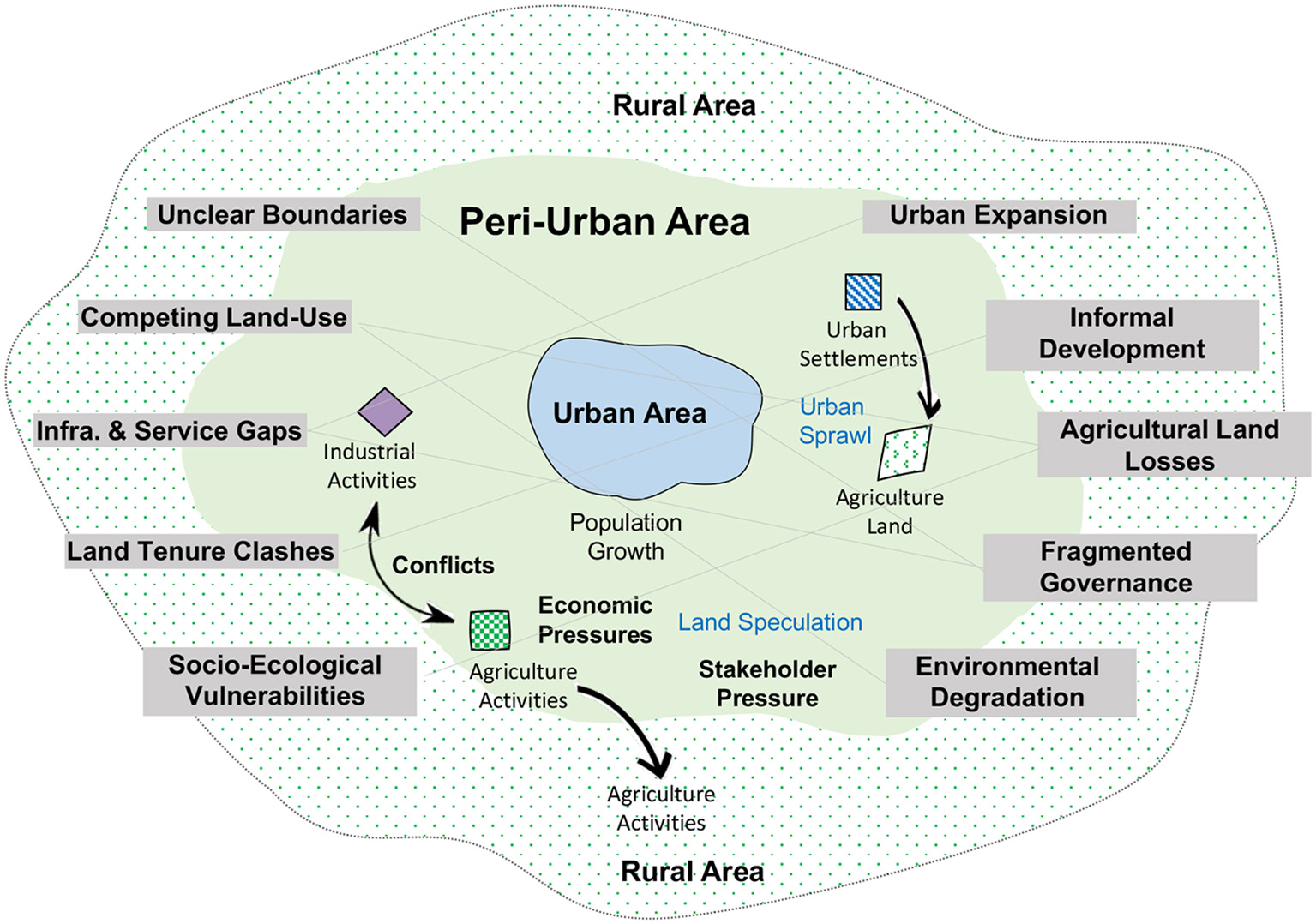
Overview of peri-urban land use management challenges.
Readers are encouraged to consult the full articles for detailed discussions. The key contributions are summarized as follows:
In “Where is the peri-urban? Mapping the areas ‘around, beyond and between,”' Ravetz and Sahana establish a methodological framework for research and policy in the peri-urban. The authors' research demonstrates an integrated solution to complex systems-based thinking, and a functional methodology for identifying peri-urban areas through population density and “functional urban area” data. Through analysis of 21 cities worldwide, the authors offer a scalable methodology as a precursor to systematic peri-urban classification and planning.
Referring to the literature on sustainability, Butt's article, “Sustainable, resilient, regenerative? The potential of Melbourne's peri-urban region”, discusses the possibility of peri-urban areas to increase socio-ecological resilience. Based on the case of Melbourne, the research condemns dominant policy paradigms and advocates a move toward regenerative urban systems that integrate community participation and multifunctional land use.
In “Rural homestead reform in China: unveiling urbanization dynamics and lessons for sustainable development”, Yahui et al. discuss a comparative policy analysis of peri-urban land-use policies. The study compares China's rural homestead reforms with cases from the United States and India, emphasizing the requirement for context-dependent policies that integrate urban development and rural sustainability. Their findings emphasize the application of market mechanisms, household decision-making, and capacity-building to support successful land-use transitions.
Ugalde-Monzalvo's paper, “Sustainable urban growth patterns based on environmental fitness”, offers an alternative method for analyzing urban growth on the basis of environmental suitability. By organizing urban growth patterns into six typologies of sustainability, the study offers insights on resolving urbanization forces and environmental conservation, exploring the efficiency of resources and infrastructural planning within peri-urban environments.
Finally, Woiwode et al.'s “Identifying entry points for adaptive governance in peri-urban Chennai (India): a multi-dimensional, multi-level, and multi-scalar approach”, provides a governance-oriented perspective. The study highlights the necessity of adaptive governance interventions in addressing peri-urbanization's socio-ecological uncertainties. In an examination of governance in Chennai, the authors demonstrate how interventions that address water management and agroecology can enhance climate resilience. Their multi-scalar perspective makes contributions to policymakers who seek to address governance fragmentation in rapidly evolving peri-urban areas.
Broader implications and future directions
Together, these contributions advance the understanding of peri-urban land-use management by integrating conceptual, methodological, and policy-oriented perspectives. The key takeaways from this Research Topic emphasize the following needs:
-
A clear methodology for defining and analyzing peri-urban areas.
-
Policies to recognize and utilize the multifunctionality of peri-urban landscapes.
-
A peri-urban land use management framework that incorporates land tenure dynamics, food-energy-water resource management, socio-economic mobility in peri-urban-rural linkages, and resilience to climate and economic change.
-
Implementation of urban growth strategies aligned with environmental adaptation and resource efficiency principles.
-
Adopting governance structures that are adaptive, participatory, and context-sensitive.
Looking ahead, future research should refine the classification of peri-urban typologies, investigate the relationship between governance and socio-ecological resilience, and create decision-support tools to improve land-use management. As peri-urbanization continues to transform urban regions worldwide, the insights from this Research Topic offer a strong foundation for advancing sustainable and flexible land-use strategies.
Statements
Author contributions
MS: Project administration, Writing – original draft, Writing – review & editing. JR: Conceptualization, Writing – original draft, Writing – review & editing. PD: Writing – review & editing. SR: Writing – review & editing. MS: Writing – review & editing.
Conflict of interest
The authors declare that the research was conducted in the absence of any commercial or financial relationships that could be construed as a potential conflict of interest.
The author(s) declared that they were an editorial board member of Frontiers, at the time of submission. This had no impact on the peer review process and the final decision.
Publisher’s note
All claims expressed in this article are solely those of the authors and do not necessarily represent those of their affiliated organizations, or those of the publisher, the editors and the reviewers. Any product that may be evaluated in this article, or claim that may be made by its manufacturer, is not guaranteed or endorsed by the publisher.
References
1
Ahani S. Dadashpoor H. (2021). Land conflict management measures in peri-urban areas: a meta-synthesis review. J. Environm. Plann. Managem.64, 1909–1939. 10.1080/09640568.2020.1852916
2
Buxton M. (2022). “Connecting peri-urban theory with policy: implications for practice,” in Mapping and Forecasting Land Use: The Present and Future of Planning (London: Elsevier), 55–94.
3
Hersperger A. M. Grădinaru S. R. Siedentop S. (2020). Towards a better understanding of land conversion at the urban-rural interface: planning intentions and the effectiveness of growth management. J. Land Use Sci.15, 644–651. 10.1080/1747423X.2020.1765426
4
Hutchings P. Willcock S. Lynch K. Bundhoo D. Brewer T. Cooper S. et al . (2022). Understanding rural–urban transitions in the Global South through peri-urban turbulence. Nat. Sustain.5, 924–930. 10.1038/s41893-022-00920-w
5
Kwadwo Anane G. Cobbinah P. B. (2022). Everyday politics of land use planning in peri-urbanisation. Habitat Int120:102497. 10.1016/j.habitatint.2021.102497
6
Mortoja M. G. Yigitcanlar T. Mayere S. (2020). What is the most suitable methodological approach to demarcate peri-urban areas? A systematic review of the literature. Land Use Policy95:104601. 10.1016/J.LANDUSEPOL.2020.104601
7
Mulya S. P. Putro H. P. H. Hudalah D. (2023). Review of peri-urban agriculture as a regional ecosystem service. Geograp. Sustainab.4, 244–254. 10.1016/j.geosus.2023.06.001
8
Salem M. Tsurusaki N. Divigalpitiya P. (2020). Land use/land cover change detection and urban sprawl in the peri-urban area of greater Cairo since the Egyptian revolution of 2011. J. Land Use Sci.15, 592–606. 10.1080/1747423X.2020.1765425
9
Tacoli C. (1997). Rural-urban interactions : a guide to the literature. Environ. Urban10, 147–166.
Summary
Keywords
land-use management, peri-urban areas, urban rural transition, urban sustainability, urban governance
Citation
Salem M, Ravetz J, Divigalpitiya P, Rajan SC and Sahana M (2025) Editorial: Land-use management in peri-urban areas. Front. Sustain. Cities 7:1586052. doi: 10.3389/frsc.2025.1586052
Received
01 March 2025
Accepted
17 March 2025
Published
28 March 2025
Volume
7 - 2025
Edited and reviewed by
Feni Agostinho, Paulista University, Brazil
Updates
Copyright
© 2025 Salem, Ravetz, Divigalpitiya, Rajan and Sahana.
This is an open-access article distributed under the terms of the Creative Commons Attribution License (CC BY). The use, distribution or reproduction in other forums is permitted, provided the original author(s) and the copyright owner(s) are credited and that the original publication in this journal is cited, in accordance with accepted academic practice. No use, distribution or reproduction is permitted which does not comply with these terms.
*Correspondence: Muhammad Salem m.salem@cu.edu.eg
Disclaimer
All claims expressed in this article are solely those of the authors and do not necessarily represent those of their affiliated organizations, or those of the publisher, the editors and the reviewers. Any product that may be evaluated in this article or claim that may be made by its manufacturer is not guaranteed or endorsed by the publisher.