Abstract
This study examines how local cultural logic are integrated into the economic practices of traditional markets in Makassar, Indonesia, and how these values sustain resilience in the face of modernization and globalization. Drawing on ethnographic fieldwork for 6 months, including participant observation in six traditional markets across Makassar, in-depth interviews with 12 participants, and document analysis, the research identifies eight core values that structure market life: siri’ (honor), pacce (solidarity), lempu’ (honesty), reso’ (perseverance), assitinajang (fairness), pappaseng (ancestral wisdom), pabbere’ (generosity), and ammacca’na (prudence). These values function simultaneously as moral obligations and strategic resources, embedding commerce within wider social and cultural frameworks. The findings challenge dominant modernization narratives that depict traditional markets as residual or destined for decline. Instead, traders demonstrate both adaptations, through selective use of digital technologies and flexible practices, and resistance, by rejecting impersonal or exploitative practices that undermine dignity and fairness. Theoretically, the study contributes to debates on embeddedness, cultural capital, and moral economy, highlighting that cultural repertoires can be converted into economic resilience. Practically, the study underscores that revitalization of traditional markets requires policies that strengthen, rather than erode, the moral economies that underpin community-based trade. While previous studies on traditional markets have emphasized economic efficiency, informality, or spatial planning, fewer have examined how culturally embedded moral values actively structure economic practice and resilience in contemporary urban markets. This study addresses this gap by offering an ethnographic analysis of how local cultural logics in Makassar’s traditional markets are mobilized as both moral frameworks and economic resources.
1 Introduction
The rapid expansion of modern retail in Indonesia’s urban centers reflects deeper integration into global markets and the diffusion of consumerist lifestyles associated with globalization (Nugroho and Wicaksono, 2020; Ravenholt, 2019). Hypermarkets, minimarkets, and digital platforms increasingly dominate urban retail landscapes, privileging efficiency, standardized pricing, and impersonal transactions (Sarie et al., 2025). Despite these shifts, traditional markets continue to persist and demonstrate socio-economic resilience (Geertz, 1963; Firman, 2020; Tsing, 2005). This persistence indicates that market sustainability cannot be explained solely through economic competitiveness or efficiency, but must also be understood through the cultural and moral foundations embedded in everyday economic practices (Munawaroh et al., 2025).
Existing scholarship on traditional retail in Indonesia has largely emphasized market competition, efficiency, spatial planning, and consumer behavior from formal economic perspectives (Tambunan, 2009; Suryadarma et al., 2010). While valuable, such approaches often overlook the cultural logics that structure daily market interactions. Conversely, studies on local wisdom tend to treat cultural values as symbolic heritage or static identity rather than as active resources shaping contemporary economic life (Geertz, 1963; Acciaioli, 1989). As a result, there remains limited ethnographic attention to how local cultural values are integrated into everyday business practices and mobilized as sources of resilience in urban contexts undergoing rapid modernization and digitalization (Sarie et al., 2025; Ferguson, 2009; Butler, 2004).
This gap is particularly evident in Indonesian urban traditional markets, where traders operate at the intersection of global economic pressures and deeply rooted moral systems. Although the concepts of moral economy and embeddedness have been widely discussed in economic anthropology (Scott, 1976; Polanyi, 2001; Granovetter, 1985; Gudeman, 2001), they have rarely been applied to contemporary Indonesian urban markets as lived economic arenas shaped by globalization, urban transformation, and digitalization (Tsing, 2005; Lindquist, 2015; Barker, 2019). Consequently, the mechanisms through which culture operates not merely as background context but as a practical economic resource remain underexplored.
Drawing on theories of embedded economies and moral economy, this study understands economic action as inseparable from social relations, cultural norms, and moral obligations (Polanyi, 2001; Granovetter, 1985; Scott, 1976; Gudeman, 2001; Hann and Hart, 2011; Hart et al., 2010). These perspectives foreground how trust, reciprocity, reputation, and obligation regulate market behavior beyond profit maximization, positioning traditional markets as culturally governed institutions rather than purely economic infrastructures (Aliyah et al., 2020; Carrier, 2012; Putnam, 2000; Grootaert and van Bastelaer, 2002; Bourdieu, 1986).
Traditional markets in Makassar exemplify this embeddedness as multidimensional socio-economic institutions that sustain livelihoods, mediate social relations, and reproduce cultural identities (Abdullah, 2006; Barker, 2019). Economic exchanges are shaped by local values such as siri’ (honor), pacce (solidarity), lempu’ (honesty), reso’ (perseverance), assitinajang (fairness), pappaseng (ancestral wisdom), pabbere’ (generosity), and ammacca’na (prudence), which regulate interactions between traders and customers and reinforce long-term trust. Practices such as informal credit, flexible pricing, reputational accountability, and selective adaptation to digital technologies illustrate how cultural values function simultaneously as moral obligations and economic resources (Geertz, 1962, 1963; Scott, 1976; Acciaioli, 1989; Errington, 1990; Alexander and Alexander, 2000; Appadurai, 1986; Appadurai, 1996; Carrier, 2018).
By conducting ethnographic fieldwork for 6 months, including participant observation in six traditional markets across Makassar, in-depth interviews with 12 participants, and document analysis, this study addresses the following research questions such as: how are local cultural values integrated into everyday economic practices in traditional markets in Makassar?; how do these values shape traders’ strategies of resilience amid modernization and digitalization?; how do cultural repertoires function simultaneously as moral obligations and economic resources in market interactions?
Despite growing scholarship on traditional markets and moral economy, existing studies tend to treat cultural values either as static heritage or as background context rather than as active resources mobilized in everyday economic practice. In the Indonesian urban context, particularly in Eastern Indonesia, there remains limited ethnographic analysis of how traders themselves interpret, enact, and strategically deploy local cultural values to sustain market resilience amid modernization and digitalization (Sarie et al., 2025). This lack of attention obscures the mechanisms through which culture operates as an economic resource rather than merely a symbolic attribute.
By adopting an ethnographic approach, this research contributes to debates on economic embeddedness, moral economy, and cultural capital by demonstrating how culturally grounded repertoires are mobilized as sources of economic resilience in urban Southeast Asia (Bourdieu, 1986; Miller, 2010; Rigg, 2019). Practically, the findings suggest that efforts to revitalize traditional markets should move beyond technocratic interventions and instead strengthen locally embedded moral economies that underpin community-based trade (Hendar and Kusnadi, 2018; Tjiptorahardjo, 2017; Folke, 2006).
2 Methods
This study employs a qualitative approach with an ethnographic design to examine how cultural values are enacted, negotiated, and contested within the everyday economic practices of traditional market actors in Makassar. Ethnography was selected not merely as a technique for data collection, but as an analytical strategy that enables close engagement with traders’ daily activities, moral reasoning, and relational practices as they unfold in situ (Atkinson, 2011; Hammersley and Atkinson, 2019). This approach allows the researcher to move beyond normative representations of cultural values and instead capture how values such as trust, reciprocity, honesty, and solidarity are mobilized pragmatically within contexts of economic uncertainty, competition, and survival.
Ethnographic fieldwork was conducted over a six-month period, from June 2025 to October 2025, across several traditional markets in Makassar, South Sulawesi, Indonesia. The research sites were deliberately selected to represent variation in scale, commodity types, and relational configurations. These included Pasar Terong, one of the city’s oldest and largest markets characterized by high commodity diversity and interethnic interactions; Pasar Karuwisi and Pasar Toddopuli, neighborhood-based markets sustained by dense kinship and long-term customer relations; Pasar Kalimbu and Pasar Daya, which serve peri-urban populations and function as distribution hubs for fresh produce and household goods; and Pasar Pa’baeng-baeng, widely recognized for its reliance on trust-based customer–vendor relations. Informants were drawn from multiple traditional markets (two persons per market) to capture variation in market scale, commodity circulation, and social interaction intensity. The distribution of informants across markets was not intended to be statistically proportional but analytically strategic, allowing comparative insight into how similar cultural values operate across different market settings. In addition, the diversity of these sites enabled comparative observation of how cultural values are enacted differently across market settings, while remaining embedded within a shared urban and cultural context.
Participant observation constituted the core of the ethnographic method. The researcher spent extended periods in the markets, primarily during peak trading hours from early morning to midday, observing and informally participating in everyday activities such as price negotiations, credit arrangements (utang piutang), distribution of goods, conflict mediation, and interactions between traders and customers. Observation focused particularly on moments where economic decisions intersected with moral considerations, including dilemmas related to pricing during scarcity, extending credit to financially vulnerable customers, balancing loyalty to regular buyers against opportunities for higher short-term profit, and navigating the selective adoption of digital payment technologies. Detailed fieldnotes were maintained to document these interactions, capturing gestures, language use, spatial arrangements, and situational contexts that reveal how cultural values are practically enacted rather than merely articulated (Spradley, 1980).
Data collection followed a triangulated strategy combining participant observation, semi-structured interviews, and document analysis. In-depth interviews were conducted with 12 participants, including traders, loyal customers, market officials, and community stakeholders. Semi-structured interview techniques allowed participants to narrate concrete experiences while ensuring comparability across cases (Bernard, 2017). Participants were selected using purposive sampling based on clear conceptual and empirical criteria aimed at identifying information-rich participants. The primary selection criteria included: (1) active and sustained involvement in traditional market activities for at least 5 years, (2) direct engagement in trust-based exchanges, informal credit relations, or reciprocal practices, and (3) social embeddedness within the market community, indicated by repeated interactions, reputational recognition, and relational visibility among traders and customers. These criteria ensured that informants possessed experiential depth and were directly relevant to the research objectives.
Each interview and observed interaction was documented with contextual information, including location, date, and mode of data collection (interview or observation), to enhance transparency and analytical rigor. Sampling followed a purposive strategy to identify traders with long-standing experience, reputational influence, and embeddedness within their communities, and was complemented by snowball sampling to expand access through existing social networks (Noy, 2008). Particular attention was given to gendered dynamics, especially the prominent role of women traders as key actors in sustaining trust, reciprocity, and social cohesion within market interactions (Elson, 1992; Porter, 2012). To situate everyday market practices within broader institutional and regulatory contexts, document analysis was conducted on policy documents, municipal reports, and archival materials related to market governance, revitalization programs, and urban development. This enabled the study to connect micro-level practices with macro-level structural dynamics shaping traditional retail in Makassar.
Data analysis followed a thematic strategy combining inductive and deductive approaches. Interview transcripts were transcribed verbatim and analyzed alongside detailed fieldnotes derived from participant observation. Inductive coding allowed recurring patterns, relational practices, and culturally significant themes to emerge organically from the data, while deductive coding was guided by analytical concepts drawn from studies on embedded economies, moral economy, and cultural capital (Granovetter, 1985; Gudeman, 2001; Scott, 1976; Polanyi, 2001; Bourdieu, 1986). Themes were refined through iterative cycles of comparison and synthesis, with particular attention to moments of tension where traders negotiated competing demands between economic survival and collective moral obligations. Triangulation across interviews, observations, and documentary sources was employed to enhance validity and reduce interpretive bias (Denzin, 1978).
The analytical process extended beyond identifying recurring practices to examining how local cultural knowledge functions as a strategic resource in economic decision-making. Rather than treating cultural values as static norms, the analysis foregrounded how they are selectively invoked, negotiated, and sometimes compromised in response to situational constraints. Insights derived from these observations informed the construction of a conceptual model that synthesizes the relationships between cultural values, everyday practices, and forms of economic resilience. This model links empirical findings with broader theoretical debates on embedded economies, moral economies, and business anthropology, while remaining grounded in observed practices rather than normative assumptions.
All participants provided informed consent prior to data collection, and pseudonyms are used to protect anonymity. Ethical approval for the study was obtained from Quality Assurance, Faculty of Social and Political Sciences, Hasanuddin University documented under approval number 875/UN4.8.6/KP.06.07/20, issued on June 20, 2025. Informants were assured of confidentiality and anonymity, and pseudonyms are used throughout the article. Ethical considerations were particularly important given the sensitivity of discussions related to trust, dishonor, indebtedness, and reputational consequences within close-knit market communities. The researcher maintained reflexive awareness regarding positionality and its influence on access, interpretation, and representation, in line with ethnographic research ethics (Atkinson, 2011; Hammersley and Atkinson, 2019). Care was taken to minimize disruption to market activities and existing social relations throughout the research process.
3 Results
The findings of this study reveal that the resilience of traditional markets in Makassar is deeply rooted in the integration of cultural values into everyday economic practices. Traders do not operate solely within the logic of profit maximization; rather, their activities are embedded in ethical frameworks that regulate interactions with customers, fellow traders, and the wider community. These frameworks are not peripheral but central to market survival, shaping how trust, reciprocity, and responsibility are enacted in daily exchanges. Fieldwork identified eight key values that emerged prominently across sites, each functioning simultaneously as a moral compass and a strategic resource for sustaining livelihoods. Together, these values form the cultural infrastructure of the market, enabling traders to navigate the uncertainties of urban retail while maintaining social cohesion (Figure 1).
Figure 1
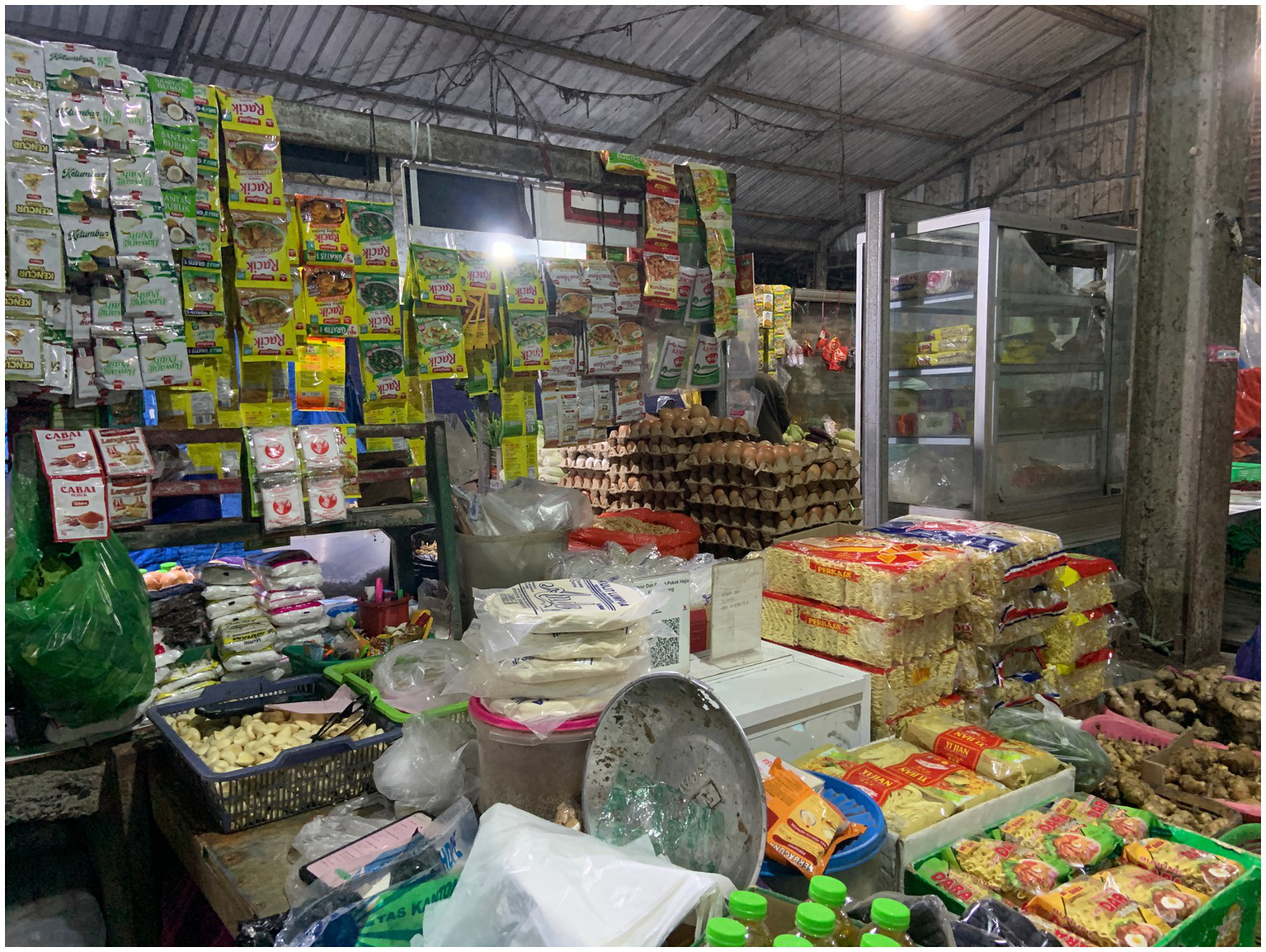
An example of a traditional stall in one of the local market in Makassar.
3.1 Siri’ as cultural values
At the heart of these interactions lies siri’, a Bugis-Makassar concept that embodies personal and collective honor. Within the traditional markets of Makassar, siri’ serves as an ethical anchor that regulates everyday business practices and defines the boundaries of acceptable conduct. Traders consistently emphasized that their dignity was inseparable from their honesty in weighing goods, transparency in pricing, and reliability in keeping promises. Violating these principles was described as mappakasiri’, or bringing shame upon oneself and one’s family, an act that jeopardizes not only individual reputation but also the sustainability of long-term trading relationships. In this sense, siri’ operates as a moral safeguard that enforces ethical conduct while simultaneously functioning as a practical mechanism for building and preserving economic trust. It demonstrates how cultural notions of honor are translated into everyday market strategies that sustain both personal credibility and community-level resilience.
One morning in Pasar Karuwisi, an incident involving a vegetable trader—here referred to as Ibu N—became a point of collective attention. Several customers complained that the scale used at her stall consistently showed less weight than promised. Initially, the discrepancy appeared minor and ambiguous, but repeated encounters triggered murmurs among neighboring traders and customers. Within days, the issue circulated through informal gossip networks (bicara-bicara pasar), a common mechanism through which reputation is negotiated and enforced in the market.
Rather than confronting Ibu N directly, customers began to avoid her stall. Fellow traders subtly distanced themselves: some stopped borrowing small change from her, others declined to watch her stall during breaks—an everyday practice usually grounded in mutual trust. When asked about the situation, one trader explained, “It is not only about cheating the scale. It is about siri’. If someone loses siri’, people become careful.”
The consequences were not immediate expulsion or formal sanction, but a gradual erosion of social and economic support. Ibu N reported a noticeable decline in daily sales and acknowledged feeling ashamed (mappakasiri’), particularly because the issue reflected not only on her but also on her family. She eventually replaced her scale and openly apologized to neighboring traders, explaining that the tool was faulty. Only after this public gesture of accountability did customers slowly return, and interactions with fellow traders normalize.
This episode illustrates how siri’ operates not as an abstract moral ideal but as a practical regulatory mechanism embedded in everyday market life. Honor is maintained through transparency and trust, while dishonor triggers social sanctions that directly affect economic survival. Gossip functions as a key conduit through which ethical breaches are communicated and corrected, demonstrating how moral accountability and livelihood are tightly interwoven. In this sense, siri’ mediates the tension between profit-seeking behavior and collective ethical standards, ensuring that economic practices remain socially legitimate.
This moral framework translates directly into economic behavior. Dishonest practices quickly circulate through gossip networks in the market, damaging a trader’s reputation and leading to loss of customers. Conversely, those who consistently uphold siri’ cultivate reputational capital that ensures long-term patronage. One informant in Pasar Karuwisi remarked:
“Kalau kita curangi timbangan, kita tidak hanya merugikan orang lain, tetapi juga mempermalukan diri sendiri. Orang-orang di sini pasti cepat tahu, dan kalau nama baik tercoreng, susah diperbaiki” (If we cheat the scales, we don’t just harm others, but we shame ourselves. People here find out quickly, and once your name is ruined, it is very hard to repair).
This illustrates how siri’ functions simultaneously as a moral safeguard and an economic strategy. By adhering to the value of siri’, traders not only protect their personal dignity but also secure their livelihoods through the cultivation of trust-based relationships with customers and fellow vendors. In this sense, honor is not abstract but materially consequential, shaping reputation, customer loyalty, and long-term business viability.
Beyond the individual, siri’ also carries a collective dimension. The dishonor of a trader is not confined to personal shame but reflects upon their kin group and, by extension, the integrity of the broader market community. Upholding siri’ therefore contributes to sustaining social cohesion, ensuring that the marketplace remains a legitimate and trusted arena of exchange. This collective ethic resonates with Scott’s (1976) notion of the moral economy, where fairness and obligation stabilize economic life, and with Granovetter’s (1985) theory of embeddedness, which emphasizes that economic behavior is always situated within webs of social relations. In Makassar’s traditional markets, siri’ demonstrates that economic sustainability is inseparable from cultural legitimacy. By embedding honor within the fabric of exchange, traders transform the market into a moral community in which dignity, trust, and livelihood are deeply interwoven.
This ethos was visible in everyday practices such as stall-sharing, where vendors unable to pay full rent were accommodated by others, and in the provision of temporary, interest-free loans among traders to bridge financial shortfalls. Equally significant was the flexibility extended to long-term customers, including reduced prices for those facing economic hardship and tolerance for delayed payments. These practices highlight that economic exchanges are reconfigured as social contracts, governed as much by empathy and reciprocity as by monetary value. In doing so, pacce aligns with anthropological perspectives on the moral economy (Scott, 1976), where fairness and obligation underpin survival strategies, and echoes Gudeman’s (2001) notion of the community economy, in which material livelihoods are sustained through shared cultural norms. By embedding solidarity within market exchanges, traders in Makassar demonstrate that resilience is achieved not through competition alone but through the reinforcement of cooperative ties that secure both individual livelihoods and collective well-being.
3.2 Solidarity through pesse
Solidarity, expressed through pesse or pacce, emerged as a defining principle of interaction in Makassar’s traditional markets. Rooted in the Bugis-Makassar moral universe, pesse extends beyond empathy to encompass a collective responsibility for sharing burdens and alleviating suffering. Traders consistently emphasized that their relationships with fellow vendors and loyal customers were not governed solely by the logic of profit but by an obligation to uphold communal welfare, particularly in times of vulnerability. In this sense, pesse transforms commerce into a social practice that reinforces belonging and mutual care within the market community.
Ethnographic encounters revealed how this ethos is enacted in practice. In Pasar Terong, solidarity rooted in pesse became visible during a period of crisis experienced by Pak R, a fish trader whose wife required urgent medical treatment. Faced with mounting expenses, Pak R struggled to maintain his daily stock and considered temporarily closing his stall. Instead, neighboring traders intervened. Over several days, three fellow vendors contributed small amounts of cash and allowed him to sell fish sourced through their supply networks, postponing repayment until his situation stabilized.
These actions were framed not as charity but as pesse—a moral obligation to share burdens within the market community. As one trader explained, “If one of us falls, the market feels it. We help so he can stand again.” At the same time, this solidarity was not unconditional. Traders emphasized that assistance was extended because Pak R was known as diligent (reso’), honest (lempu’), and fair (assitinajang). His moral reputation justified collective support.
The material impact of this solidarity was tangible. With continued access to goods, Pak R maintained his presence in the market, preserved his customer base, and avoided deeper debt. Several months later, once his family situation improved, he reciprocated by prioritizing these traders when surplus fish was available and by extending flexible credit when they faced shortages. As he put it, “What is given must return, not always in money, but in care.”
This vignette demonstrates that pesse is neither purely altruistic nor romantically detached from economic calculation. Rather, it constitutes a form of socially embedded rationality in which traders balance survival strategies with collective responsibility. Solidarity mitigates risk, stabilizes livelihoods, and reinforces long-term reciprocal relations. Through pesse, profit-oriented behavior and moral obligation are woven together in everyday practice, illustrating how embedded economies function through the simultaneous mobilization of economic and cultural logics.
Importantly, traders did not frame these acts as generosity but as moral obligations intrinsic to their identity as members of the market community. In this sense, pesse functions as an informal social safety net that mitigates the risks of precarity in environments where formal financial protections are limited. The collective dimension of pesse reinforces resilience at both the individual and community levels: for individuals, it cultivates loyalty and reputational standing; for the community, it ensures cooperation against the growing pressures of modern retail. As such, pesse illustrates how traditional markets are not merely transactional spaces but arenas of mutual care, where empathy is institutionalized as a cultural value that underpins economic resilience. This aligns with Scott’s (1976) notion of the moral economy, in which fairness and obligation stabilize economic life, and with Gudeman’s (2001) articulation of the community economy, where livelihoods are sustained through shared cultural norms.
3.3 The value of lempu’
Closely tied to siri’, the value of lempu’ (honesty) emerged as one of the most frequently invoked principles among traders. In the context of Makassar’s traditional markets, lempu’ refers to integrity and truthfulness in all aspects of commerce, from accurate weighing and measuring to transparent communication with customers. Traders consistently described lempu’ not merely as a pragmatic business strategy but as a moral obligation, a reflection of one’s inner character, and a key determinant of long-term economic survival. To cheat in weighing or mislead customers in pricing was regarded not only as a violation of market ethics but also as a corruption of personal identity, eroding the trust that sustains trading relationships across generations.
Ethnographic observations revealed that this principle was deeply woven into everyday practices. Several traders emphasized that honesty in transactions was “the main capital,” often outweighing financial capital in importance. For instance, a rice vendor in Pasar Daya explained that maintaining accurate measurements, even at the expense of small losses, was essential to retaining customers: “If I cheat the scale even once, people will not return.” Others highlighted that lempu’ extended beyond transactional honesty to the sincerity of interpersonal relations, including respectful communication, keeping promises, and maintaining fairness in price negotiations.
From an analytical perspective, lempu’ illustrates how economic rationality is intertwined with moral accountability. It echoes Polanyi’s (2001) argument that markets are embedded within social norms and Granovetter’s (1985) notion of trust as a constitutive element of economic exchange. At the same time, it resonates with Lambek’s (2010) discussion of ethics as lived practice, where moral commitments are continuously enacted in everyday life. By grounding commerce in lempu’, traders in Makassar ensure not only their individual reputations but also the credibility of the market as a trusted institution. In this way, honesty functions as both a moral safeguard and a strategic asset, stabilizing economic interactions while reinforcing the cultural legitimacy of traditional retail.
During interviews, many traders insisted that customers returned not only because of price but because they trusted the honesty of the seller. One vegetable vendor in Pasar Terong noted:
“Saya selalu jaga supaya harga yang ditawarkan jujur karena itu yang kasih percaya orang. Kalau satu kali saja kasih yang kurang dari yang dijanjikan, orang-orang tidak mau kembali” (I keep my scales honest because that’s what makes people trust me. If even once we give less than promised, people will not come back).
Such accounts demonstrate that lempu’ is simultaneously a cultural value and an economic asset. By consistently maintaining honesty, traders accumulate what Bourdieu (1986) describes as “symbolic capital,” the reputation, credibility, and trustworthiness that secure customer loyalty across generations. In this sense, lempu’ functions as a long-term investment in social relations, enabling traders to sustain livelihoods in highly competitive environments. Market actors differentiate themselves not only through product quality or price competitiveness but also through the moral integrity associated with their names, which becomes an enduring form of social recognition.
Importantly, lempu’ is also framed as a form of amanah (trustworthiness), carrying both spiritual and social implications. Several informants emphasized that deceiving customers was not only socially damaging but also considered sinful, invoking religious accountability as a reinforcement of cultural ethics. This convergence of spiritual morality and cultural obligation underscores honesty as a non-negotiable principle in market interactions. As one trader explained, “profit without honesty is haram,” highlighting how economic practices are embedded in ethical frameworks that transcend instrumental rationality. In this way, lempu’ exemplifies the fusion of cultural, religious, and economic domains, showing how moral commitments operate as both normative guides and practical strategies for ensuring the sustainability of traditional retail. The emphasis on lempu’ reflects Granovetter’s (1985) concept of embeddedness, where economic exchanges are anchored in social and moral expectations. In practice, lempu’ transforms what might otherwise be impersonal transactions into trust-based relationships. It ensures continuity of business, reinforces social cohesion, and positions honesty as both an ethical and practical foundation of market resilience.
3.4 The manifestation of reso’
Another central value identified in Makassar’s traditional markets is reso, which emphasizes diligence, perseverance, and the moral duty to work hard. For traders, reso is not merely about labor as an economic necessity but is embedded in a cultural ethic that equates effort with virtue and laziness with dishonor. In everyday practice, this value manifests in the discipline of arriving before dawn to secure fresh produce, enduring long hours in the heat of crowded stalls, and continuing to trade even during periods of economic uncertainty. Traders often explained that success in business was inseparable from kerja keras (hard work), with one vendor remarking, “without diligence, there is no livelihood.” The ethic of reso also embodies a collective dimension. Informants emphasized that diligence is not simply about individual achievement but about fulfilling obligations to family and community. A trader’s consistent labor sustains household needs, upholds kinship responsibilities, and reinforces their credibility within the market community. This resonates with Weber’s (2002) [1905] insights on the moral dimensions of work, while also aligning with Bugis-Makassar cultural logics that frame perseverance as a form of moral capital. From an anthropological perspective, reso illustrates how the moralization of labor contributes to market resilience, ensuring that traders remain committed even when confronted with competition from modern retail chains or the uncertainties of fluctuating prices. In this way, perseverance is transformed from an individual ethic into a cultural strategy for collective endurance.
Field observations revealed that traders frequently linked their economic survival to their willingness to “fight with work” (reso na temmangingi, or effort without hesitation). One fish vendor in Pasar Daya explained:
“Tanpa kerja keras, kita tidak bisa hidup. Kita harus datang subuh, bawa beban berat, dan terus bekerja meski capai. Itu kewajiban, bukan pilihan” (Without hard work, we cannot survive. We must come at dawn, carry heavy loads, and keep serving even when exhausted. That is a duty, not a choice).
This narrative demonstrates how reso functions both as an ethic of survival and as a cultural marker of identity. Traders frequently framed their perseverance as part of their responsibility to their families, linking personal effort to collective well-being. The ethic of reso thus reinforces intergenerational obligations, where the struggles of today are justified as investments in children’s education, household stability, and the continuity of family honor. In this sense, diligence is not an individual trait alone but part of a broader social economy of responsibility, where labor becomes a medium for sustaining kinship and ensuring the future of the next generation.
Beyond its practical significance, reso also carries profound symbolic weight. Traders who are visibly diligent, consistently present at their stalls, working long hours, and maintaining discipline, earn respect and admiration from peers and customers. Conversely, those perceived as neglecting their duties risk being judged as irresponsible or even dishonoring their kin group, as laziness is often equated with moral failure. This dual role of reso highlights how economic practice is inseparable from cultural judgment, where perseverance generates not only material survival but also symbolic capital in the form of social recognition (Bourdieu, 1986). Thus, reso not only sustains livelihoods but also shapes reputation and status, embedding work discipline within the moral and cultural frameworks that define community life in Makassar’s traditional markets.
From an analytical perspective, reso resonates with Gudeman’s (2001) concept of the people’s economy, where livelihood is anchored in moral and social obligations rather than abstract capitalist logic. In Makassar’s traditional markets, the ethic of hard work is not framed solely in terms of productivity or efficiency but as a form of moral discipline that defines a person’s worth and social standing. Diligence thus carries both material and symbolic weight, positioning perseverance as an index of moral character as much as economic capacity.
Ultimately, reso underscores that traditional markets are sustained not only by cultural values of trust and honesty but also by the embodied labor and perseverance of traders who see effort as both an economic strategy and a moral imperative. This ethic transforms the act of trading into a form of moral practice, where livelihood is tied to responsibility, endurance, and collective well-being. In this way, reso’ enriches the moral economy of Makassar’s markets by highlighting that resilience is achieved through the disciplined labor of individuals whose efforts are inseparable from the cultural frameworks that give meaning to their work.
3.5 The notion of assitinajang
The value of assitinajang, which can be translated as fairness, propriety, and appropriateness, emerged as a key principle governing transactions in Makassar’s traditional markets. Traders consistently described their role not simply as sellers but as custodians of just exchange. This entailed ensuring that goods were measured accurately, that prices were appropriate to the customer’s means, and that interactions were conducted with a sense of balance. Assitinajang thus embodies the notion that economic practices must be aligned with broader social expectations of justice and harmony, reinforcing the idea that commerce is not an isolated sphere of calculation but part of a moral order that regulates everyday life.
In practice, assitinajang often takes the form of small but significant gestures. Vendors regularly provide baji-baji (extra portions) when weighing vegetables, rice, or fish, a customary act that assures customers of fairness and generosity. Traders also refrain from inflating prices excessively, especially for staple goods, because overpricing is regarded as tena assitinajang, improper and exploitative. As one rice seller in Pasar Terong explained, “if the price is too high, people suffer; we also incur sin because it is not proper/fair.” This illustrates how fairness is framed not only in economic terms but also in moral and spiritual ones, linking justice in exchange to both community well-being and religious accountability.
Analytically, assitinajang resonates with Polanyi’s (2001) concept of embedded economies, in which economic activities are bound by social and moral obligations, and with Scott’s (1976) notion of the moral economy, where fairness is essential to legitimacy and survival. In Makassar’s markets, fairness is neither an optional virtue nor a mere business strategy; it is a cultural imperative that stabilizes trader–customer relationships and preserves social trust. By institutionalizing fairness through everyday practices, assitinajang transforms the market into a space of moral regulation, ensuring that economic sustainability is inseparable from social justice.
“Harus adil sama sama pelanggan. Kalau untung dikejar berlebihan, pelanggan pasti cepat pergi. Tapi kalau kita adil, orang akan terus kembali (we must be fair with customers. If we only seek excessive profit, customers will quickly disappear. But if we are fair, people keep coming back).
Such practices illustrate how assitinajang is both ethical and strategic: fairness ensures not only moral legitimacy but also long-term customer loyalty. Traders often emphasized that the goal of business is not to maximize short-term gain but to cultivate enduring relationships grounded in mutual respect. In this sense, assitinajang stabilizes the rhythm of economic life, ensuring that markets remain legitimate and trustworthy spaces of exchange even amid the uncertainties of fluctuating prices and shifting consumer demands.
The value also extends beyond customer relations to interactions among traders themselves. Vendors, for example, avoid undercutting each other’s prices in ways that could destabilize the community, reflecting a shared understanding of fairness that preserves harmony within the market. In some cases, traders collectively agree on price ranges for staple goods, ensuring that competition remains balanced rather than destructive. These practices demonstrate that assitinajang is not simply a matter of individual ethics but a collective principle that regulates market order and mitigates conflict.
Analytically, this dynamic aligns with Polanyi’s (2001) notion of embedded economies, where economic activities are governed by moral and social expectations, and resonates with Scott’s (1976) articulation of the moral economy, in which fairness is indispensable to community stability. In Makassar’s traditional markets, assitinajang illustrates how the pursuit of justice in exchange functions as both a cultural imperative and a practical strategy of resilience. By embedding fairness into economic practice, traders ensure that market sustainability is inseparable from the maintenance of social harmony. By ensuring proportionality, balance, and propriety, assitinajang acts as a cultural mechanism that restrains unbridled competition and prevents exploitation. In doing so, it secures the legitimacy of traditional markets as ethical spaces of exchange, reinforcing their resilience in the face of modern retail pressures.
3.6 The ancestral wisdom of pappaseng
The value of pappaseng, or ancestral wisdom, continues to guide economic behavior in Makassar’s traditional markets. Rooted in oral traditions and intergenerational teachings, pappaseng provides moral orientation for traders by linking present-day practices with the wisdom of the past. Unlike formal rules or state regulations, pappaseng carries legitimacy because it is perceived as the accumulated knowledge of elders, transmitted as advice, prohibitions, and guiding principles that remain socially binding. Traders often framed their decisions, such as avoiding exploitative practices, respecting customers, or maintaining diligence, as extensions of parental or ancestral instructions, which they described as warisan (inheritance).
Ethnographic accounts revealed that references to pappaseng frequently surfaced in moments of conflict or moral dilemma. For example, several traders explained that they refrained from overcharging customers during religious holidays, recalling their parents’ advice that “do not eat from dishonest gains, for they will not bring blessing.” Others invoked pappaseng to justify practices of generosity, noting that “if there is surplus, it must be shared so that fortune continues to flow.” Such invocations illustrate how ancestral wisdom provides not only moral legitimacy but also a cosmological rationale that ties economic practice to ideas of blessing (berkah) and continuity.
From an analytical perspective, pappaseng resonates with Bourdieu’s (1977) concept of habitus, where dispositions inherited through family and community become embodied guides for practice. It also connects with Sahlins’ (1976) idea of culture as a structure of the long durée, where past knowledge frames present economic strategies. In Makassar’s markets, pappaseng ensures that trade is embedded within a moral genealogy, reinforcing continuity between generations while offering a framework for negotiating contemporary challenges. By invoking ancestral wisdom, traders affirm that economic sustainability is not achieved solely through adaptation to market pressures but also through fidelity to cultural inheritance.
One widely cited example is the belief that refusing the first customer of the day is pamali (taboo). Traders explained that this teaching, passed down from parents and grandparents, shapes how they treat early transactions with care and generosity. A vegetable seller in Pasar Pa’baeng-baeng explained:
“Kalau ada pelanggan pertama, kita harus layani dengan baik. Orang tua kita dulu ajarkan kalau kita menolak, yang kita dapat hari itu mungkin akan sedikit” (When there is the first customer, we must serve them well. Our parents taught us that if we refuse, our fortune may be scarce for the rest of the day).
Such ancestral teachings influence not only individual behavior but also the broader rhythms of the market, reinforcing the sense that economic success is inseparable from moral correctness. Commonly cited pappaseng include advice to maintain harmony with customers, to avoid greed, and to ensure honesty as the foundation of trade. These instructions form the backbone of a moral economy, shaping traders’ decisions in ways that cannot be reduced to profit-seeking logic alone. In this way, ancestral wisdom provides a moral compass that regulates both the micro-level of individual transactions and the macro-level dynamics of collective exchange.
The persistence of pappaseng illustrates how tradition functions as a form of cultural capital (Bourdieu, 1986). Traders who embody and enact these inherited values accumulate reputational legitimacy, strengthening trust and loyalty within the community. By contrast, those who disregard or transgress ancestral teachings risk being perceived as untrustworthy, greedy, or culturally disconnected, labels that directly undermine their economic standing. Moreover, pappaseng resonates with what Sahlins (1976) describes as the continuity of cultural logics in economic practice, where ancestral voices and inherited norms continue to structure contemporary forms of exchange. In Makassar’s markets, pappaseng thus anchors economic resilience in cultural continuity, transforming tradition into a strategic resource for navigating modern pressures.
3.7 The reflection of pabbere
The value of pabbere, or sharing and generosity, plays a central role in shaping the ethics of exchange in Makassar’s traditional markets. Unlike commercial models that prioritize individual profit maximization, pabbere embeds trade within a redistributive ethic that recognizes the market as a site of social responsibility. Traders often described giving as a moral duty rather than a strategy, framing generosity as an inseparable part of what it means to conduct business properly. In this sense, pabbere reflects an ethic of abundance, where the circulation of goods is tied to the circulation of blessings (berkah) and social goodwill.
In everyday practice, pabbere is manifested in subtle but significant gestures. Vendors frequently add baji-baji (small extras) to customer purchases, an extra handful of rice, a chili, or a piece of fruit, particularly for loyal or struggling buyers. Allowing long-term customers to take goods on credit, sometimes over extended periods without written agreements, was also common, relying on interpersonal trust rather than legal contracts. These practices, though economically modest, carry symbolic weight, signaling care, reciprocity, and moral commitment. Traders emphasized that withholding generosity would risk not only losing customers but also diminishing their own moral standing in the eyes of the community.
Analytically, pabbere resonates with Mauss’s (1990) concept of the gift, where exchange is never purely economic but entails obligations of reciprocity and solidarity that sustain social ties. It also aligns with Scott’s (1976) notion of the moral economy, where redistributive practices function as mechanisms of social protection in contexts of vulnerability. In Makassar’s traditional markets, pabbere ensures that the act of selling is simultaneously an act of giving, embedding economic life in moral and relational logics that reinforce community resilience.
In practice, pabbere is visible in several ways. Many traders routinely add small extras (baji-baji) to purchases, an extra chili, a handful of rice, or a few pieces of fruit, especially for loyal or struggling customers. Others allow regular buyers to take goods on credit, sometimes over long periods, without formal agreements. A fish vendor in Pasar Kalimbu explained:
“Kalau pelanggan kesulitan, saya kasih barang dulu. Nanti dibayar kalau sudah punya uang. Apa yang didapat itu rezeki jadi harus dibagi” (If a customer is struggling, I let them take the goods first. They can pay later when they have money. What we earn is fortune, and it must be shared).
This ethic of sharing demonstrates that profit is not the sole measure of success. Instead, sustaining relationships and redistributing resources are viewed as equally important outcomes of commerce. Pabbere thus strengthens trust, secures customer loyalty, and contributes to the reputation of traders as reliable and compassionate figures in the community. For many vendors, these practices are framed not as strategies of market differentiation but as moral imperatives that ensure their businesses remain socially legitimate.
Ethnographic accounts from Pasar Kalimbu illustrate this vividly. A fish vendor explained that during periods when regular customers struggled to pay, such as after major household expenses or during religious festivals, he would allow them to take fish on credit, sometimes over several weeks, without asking for collateral or formal guarantees. He insisted that “livelihood returns to you if you give sincerely,” suggesting that generosity is perceived as both a moral act and a practical investment in long-term relational stability. Similarly, traders selling vegetables described routinely giving baji-baji (small extras) as gestures that “take care of the customer’s heart,” thereby ensuring goodwill and repeat patronage.
Anthropologically, pabbere reflects a form of moral economy (Scott, 1976), where generosity acts as a stabilizing force in times of scarcity, ensuring that markets operate as communal safety nets. It also resonates with Mauss’s (1990) classic concept of the gift, in which acts of giving and reciprocity create enduring social bonds. In Makassar, the small gifts and flexible credit systems associated with pabbere serve to embed economic exchange in webs of obligation, gratitude, and ongoing relationality. By reframing commerce as a space of sharing rather than mere accumulation, pabbere highlights how traditional markets embody a redistributive ethic that counters the impersonal rationality of capitalist retail systems.
3.8 Ammacca’na and decision-making
In practice, ammacca’na manifests in careful decision-making, where traders weigh not only financial outcomes but also the potential social consequences of their actions. For example, when determining credit arrangements, vendors often assess a customer’s trustworthiness not through formal contracts but through nuanced judgments of character, family background, and prior interactions. This discernment allows them to extend flexibility selectively, ensuring that trust is honored without exposing themselves to undue risk. Similarly, traders apply prudence in negotiating prices: while competitive pressures might encourage undercutting, many vendors deliberately avoid practices that could spark conflict or destabilize long-term relations within the market community.
Ammacca’na thus represents a culturally grounded form of rationality, one that integrates economic calculation with moral foresight. Rather than maximizing short-term profit, traders prioritize stability, reputation, and social cohesion, recognizing that these intangible assets are essential for business continuity. From an anthropological perspective, this value resonates with Polanyi’s (2001) notion of embedded economies, in which rationality is always mediated by social norms, and with Gudeman’s (2001) emphasis on the “base” of local knowledge as a reservoir of cultural reasoning in economic life. By embodying ammacca’na, traders enact a form of practical wisdom that anchors their livelihoods within both moral and relational worlds, ensuring that markets remain sustainable and socially legitimate arenas of exchange.
Field observations revealed that traders often practiced restraint in competition, preferring to maintain cooperative relationships rather than engage in destructive price wars. For instance, several vendors explained that if a neighboring stall was struggling to sell perishable goods, they would avoid lowering their own prices excessively, as this would “hurt the other’s fortune.” One trader in Pasar Toddopuli stated:
“Kita tidak boleh serakah dalam ambil untung atau merebut langganannya orang. Kalau kita bijak, ada-ada ji itu” (We should not be greedy in taking profit or seizing a neighbor’s customers. If we are wise, fortune will find its own way).
Such attitudes highlight how ammacca’na operates as a moral compass for decision-making. It encourages traders to consider the broader social consequences of their actions, weighing not only economic outcomes but also their impact on relationships, community trust, and collective dignity. This prudence often guides selective adaptation: for instance, some traders adopt digital payment systems like bank transfers or WhatsApp-based ordering when they enhance convenience, yet resist QRIS when delayed fund access threatens daily cash flow. Others strategically adjust prices in response to inflation but avoid excessive profiteering to preserve long-term customer loyalty (Riyanti et al., 2025; Sarie et al., 2025; Suryaningrum et al., 2020; Hart, 1973).
This principle resonates with Polanyi’s (2001) argument that economies are embedded within social norms, as well as Gudeman’s (2001) notion of the “base” of the economy, where community values shape material practices. In Makassar, ammacca’na allows traders to adapt flexibly to shifting conditions, such as fluctuating prices, new competitors, or emerging technologies, without undermining the ethical foundation of market life.
Ultimately, ammacca’na underscores that success in traditional markets is not measured solely by financial accumulation but by the capacity to act with balance, foresight, and responsibility. It ensures that economic activities contribute to both personal livelihood and community cohesion, embodying a culturally embedded form of rationality distinct from the impersonal logics of capitalist retail. In this way, ammacca’na illustrates how traders navigate the pressures of modernization with cultural discernment, embodying resistance not through outright opposition but through the careful preservation of ethical boundaries in everyday practice (Table 1).
Table 1
| No | Cultural value | Manifestation in everyday practice | Economic function | Observed consequences |
|---|---|---|---|---|
| 1 | siri’ (honor) | Honest weighing, maintaining reputation | Trust and market legitimacy | Social sanction if violated |
| 2 | pesse (solidarity) | Mutual aid during crisis | Risk sharing | Long-term loyalty |
| 3 | pabbere (generosity) | Small gifts, flexible pricing | Social bonding | Reciprocal support |
| 4 | lempu’ (honesty) | Transparent pricing | Transaction stability | Customer retention |
| 5 | assitinajang (fairness) | Reasonable profit margins | Conflict avoidance | Sustainable relations |
| 6 | reso (perseverance) | Long working hours, persistence | Income continuity | Economic survival |
| 7 | pappaseng (ancestral wisdom) | Moral reference in dilemmas | Ethical guidance | Intergenerational legitimacy |
| 8 | ammacca’na (prudence) | Selective adoption of technology, cautious credit decisions | Balancing risk and morality | Economic resilience |
Cultural values, practical manifestations, and economic functions in Makassar’s traditional markets.
4 Discussion
This study demonstrates that the resilience of traditional markets in Makassar cannot be understood solely through economic efficiency or infrastructural explanations. Instead, it is sustained by a moral and relational economy embedded in local cultural values such as siri’ (honor), pacce (solidarity), lempu’ (honesty), reso’ (perseverance), assitinajang (fairness), pappaseng (ancestral wisdom), pabbere’ (generosity), and ammacca’na (prudence). These values do not function merely as symbolic norms but operate as practical mechanisms that regulate economic behavior, shape social relations, and structure market participation.
Previous scholarship has long emphasized that traditional markets are socially embedded arenas in which economic action is regulated by moral norms and social relations rather than by price mechanisms alone (Geertz, 1963; Scott, 1976; Hyden, 1980; Polanyi, 2001; Gudeman, 2001). Studies across Southeast Asia have similarly highlighted the coexistence of competition and solidarity within market systems, demonstrating that economic survival is often sustained through relational and ethical arrangements (Alexander and Alexander, 2000; Carrier, 2018). The findings from Makassar confirm these foundational insights, while extending them by showing how specific Bugis–Makassar cultural values operate not only as moral ideals but as practical and calculative resources in traders’ everyday survival strategies.
4.1 Siri’ as moral regulation and economic consequence
Empirical findings reveal that siri’ operates as a powerful moral regulator with direct economic implications. The loss of siri’ is not confined to personal shame but translates into tangible consequences within market networks. The enactment of siri’ illustrates how moral sanctions are translated into concrete economic consequences. While prior studies have conceptualized honor as a symbolic or normative framework (Mattulada, 1985; Acciaioli, 1989), this study demonstrates how violations of siri’—such as dishonest weighing or broken promises—trigger reputational damage through gossip networks, resulting in reduced access to informal credit, weakened customer trust, and long-term loss of trading opportunities. In this sense, siri’ functions simultaneously as an ethical principle and a mechanism of market regulation, reinforcing Granovetter’s (1985) argument that trust and reputation are constitutive elements of economic exchange rather than external constraints.
A vignette illustrates this process. A trader (pseudonym: Ibu R), who regularly accessed informal credit from fellow traders, repeatedly delayed repayment while continuing visible non-essential expenditures. This behavior was interpreted by neighboring traders as a violation of siri’, triggering gossip that framed her actions as maloppo siri’na (lacking shame). As a consequence, access to informal loans was quietly withdrawn, suppliers required cash payments, and everyday interactions became distant. No formal punishment was imposed; instead, reputational degradation functioned as an informal sanction that reduced her economic capacity.
This case demonstrates how siri’ operates simultaneously as a moral value and an economic mechanism. Maintaining honor is a prerequisite for sustaining trust-based exchanges such as credit, cooperation, and mutual assistance. Traders therefore calculate not only profit and loss but also reputational risk, illustrating that economic rationality is inseparable from moral accountability. Analytically, this supports Polanyi’s (2001) argument that economic activities are embedded in social institutions, and Granovetter’s (1985) emphasis on how social relations condition economic action. Profit-oriented behavior does not disappear; rather, it is mediated through culturally grounded moral evaluations.
4.2 Pesse and solidarity as informal risk management
While siri’ functions as a mechanism of moral discipline, pesse operates as a logic of solidarity that sustains collective resilience. Empirical observations show that pesse is mobilized particularly in moments of misfortune, functioning as an informal safety net rather than routine charity. Similarly, pesse confirms Scott’s (1976) notion of the moral economy while revealing its contemporary urban articulation. Rather than operating as generalized altruism, solidarity in Makassar’s markets is selectively enacted through reciprocal assistance, interest-free loans, and price flexibility, particularly during moments of crisis. These practices demonstrate that traders continuously calculate risk and sustainability while remaining embedded in collective obligations. This dual logic reflects Polanyi’s (2001) conception of embedded economies, where market rationality is inseparable from social responsibility, and challenges modernization narratives that portray traditional markets as economically irrational or inefficient.
A vignette from the field illustrates this dynamic. A fish trader (pseudonym: Pakde) suffered significant losses due to a sudden power outage that spoiled his stock. Fellow traders contributed small amounts of money and shared ice supplies without immediate expectation of repayment. This assistance was framed as pesse—a response to shared suffering rather than calculated generosity. In the following weeks, Pakde reciprocated through preferential pricing and labor assistance, reaffirming reciprocal obligations within the market.
This practice shows that solidarity is not opposed to economic calculation. Instead, pesse functions as an informal insurance mechanism that mitigates risk in an unstable trading environment. Traders remain economic actors, yet their strategies incorporate long-term relational security rather than short-term profit maximization. This finding resonates with Scott’s (1976) concept of moral economy, while extending it into an urban market context where solidarity operates alongside competition. It also reinforces Granovetter’s (1985) insight that economic action is embedded in networks of social obligation.
4.3 Weaving moral values and economic rationality
The empirical material indicates that Makassar traders navigate a dual logic in everyday practice: pursuing income while adhering to moral expectations that structure market life. These logics are not alternated but enacted simultaneously. Decisions regarding pricing, credit, cooperation, and technology adoption are continuously evaluated through both economic and moral lenses.
The notion of “woven practices” captures this empirical reality. Cultural values such as siri’ and pesse are not abstract ideals but practical tools that discipline behavior, regulate access to resources, and sustain trust. This challenges modernization narratives that portray traditional markets as residual or inefficient institutions destined for decline (Tanjung et al., 2025; Harms, 2011). Instead, traders actively negotiate globalization by selectively adopting new technologies and practices when these align with cultural logics of fairness, transparency, and accountability, while resisting impersonal mechanisms that undermine dignity and trust. This finding complicates linear models of market modernization and underscores the adaptive capacity of culturally embedded economies.
The findings extend the concept of embeddedness by showing how cultural values are mobilized as strategic assets that generate reputational capital (Bourdieu, 1986), stabilize social relations, and enable resilience amid retail transformation and urban precarity (Rigg, 2019; Nugroho and Wicaksono, 2020). Rather than functioning as residual traditions, values such as siri’, pesse, and ammacca’na constitute an ethical infrastructure through which traders actively shape economic outcomes. This positions Makassar’s traditional markets not as sites of resistance alone, but as arenas of creative negotiation where moral commitments and economic calculation are continuously woven together in everyday practice.
The findings contribute to theoretical debates on embeddedness (Polanyi, 2001; Parry and Bloch, 1989; Granovetter, 1985), moral economy (Scott, 1976), and cultural capital (Bourdieu, 1986). Cultural values function as strategic resources that traders mobilize to maintain reputation, secure loyalty, and ensure continuity across generations. These values are not vestiges of a premodern order but dynamic forms of cultural capital that generate material and social returns. By foregrounding everyday practices, this study shows that traditional markets are neither static nor purely normative spaces. They are dynamic institutions where economic pragmatism and moral obligation converge, offering alternative models of economic sustainability rooted in cultural continuity and social responsibility.
This study has several limitations. First, the scope and duration of fieldwork limited the observation of long-term reputational recovery following moral breaches. Second, moments of overt conflict were relatively rare and often reconstructed through retrospective narratives. Third, the focus on selected traditional markets in Makassar limits the generalizability of findings to other regional or national contexts. Future research could address these limitations through longitudinal and comparative ethnographic studies.
4.4 Research agenda and future directions
Building on the empirical findings of this study, several directions for future research can be articulated. First, this research contributes to scholarship on embeddedness and moral economy by demonstrating how local cultural values are not merely normative ideals but are actively mobilized as practical strategies in everyday economic decision-making. By showing how traders simultaneously negotiate profit-oriented logics and moral obligations, this study extends classical theories of embeddedness (Polanyi, 2001; Granovetter, 1985) into contemporary urban market contexts in Southeast Asia. Future qualitative research could deepen this contribution through comparative ethnographic studies across different cities or regions in Indonesia and the Global South. Such studies could examine how similar moral repertoires are reconfigured under varying institutional pressures, degrees of digitalization, or market governance regimes. Longitudinal ethnographic approaches would also be valuable for tracing how moral economies evolve over time, particularly as younger generations of traders enter traditional markets with different educational backgrounds and technological competencies.
Second, the findings open avenues for quantitative and mixed-methods research. Survey-based studies could measure the extent to which moral values such as trust, honor, and solidarity influence customer loyalty, credit practices, and business sustainability in traditional markets. Combining ethnographic insights with network analysis or experimental designs could further illuminate how moral sanctions, reputation, and gossip function as informal regulatory mechanisms within market systems.
Third, future research could focus more explicitly on the role of digital technologies in reshaping moral economies. While this study shows selective and value-driven adoption of digital tools, further investigation is needed to assess how digital payment systems, online platforms, and algorithmic pricing interact with culturally embedded notions of fairness, transparency, and honor. Comparative studies between traders who adopt digital technologies and those who resist them could clarify whether digitalization transforms moral economies or becomes culturally domesticated within existing ethical frameworks.
Finally, from a policy-oriented perspective, future research should explore how development interventions and market revitalization programs can engage more meaningfully with local moral economies. Participatory and action-oriented research designs could assess whether policies that recognize and strengthen cultural values lead to more inclusive, resilient, and socially embedded forms of urban economic development. These research directions underscore that traditional markets remain fertile sites for advancing theoretical debates on moral economy, embeddedness, and resilience, while also offering practical insights for culturally grounded development strategies in an era of globalization.
Statements
Data availability statement
The raw data supporting the conclusions of this article will be made available by the authors, without undue reservation.
Ethics statement
The studies involving humans were approved by Quality Assurance, Faculty of Social and Political Sciences, Hasanuddin University. The studies were conducted in accordance with the local legislation and institutional requirements. The participants provided their written informed consent to participate in this study.
Author contributions
SS: Formal analysis, Conceptualization, Methodology, Writing – review & editing, Writing – original draft, Data curation. AA: Writing – original draft, Formal analysis, Methodology, Writing – review & editing, Conceptualization. HM: Supervision, Writing – review & editing, Project administration.
Funding
The author(s) declared that financial support was received for this work and/or its publication. This research received funding from the Lembaga Penelitian dan Pengabdian kepada Masyarakat (LP2M) (Community Research and Development Institute) Hasanuddin University via Thematic Research Group (TRG) Scheme Batch 4 (year 2025), contract number: 02124/UN4.22/PT.01.03/2025.
Acknowledgments
We thank to all the participants involved in our research. We also thank to the colleagues in Department of Anthropology, Hasanuddin University and to our friends in Antropos, a collective based in Makassar, Indonesia.
Conflict of interest
The author(s) declared that this work was conducted in the absence of any commercial or financial relationships that could be construed as a potential conflict of interest.
Generative AI statement
The author(s) declared that Generative AI was not used in the creation of this manuscript.
Any alternative text (alt text) provided alongside figures in this article has been generated by Frontiers with the support of artificial intelligence and reasonable efforts have been made to ensure accuracy, including review by the authors wherever possible. If you identify any issues, please contact us.
Publisher’s note
All claims expressed in this article are solely those of the authors and do not necessarily represent those of their affiliated organizations, or those of the publisher, the editors and the reviewers. Any product that may be evaluated in this article, or claim that may be made by its manufacturer, is not guaranteed or endorsed by the publisher.
References
1
Abdullah I. (2006). Konstruksi dan Reproduksi Kebudayaan. Yogyakarta: Pustaka Pelajar.
2
Acciaioli G. (1989). Searching for good fortune: The making of a Bugis shore community. Dordrecht: Foris Publications.
3
Alexander P. Alexander K. (2000). Markets and moral economies: competition and solidarity in south and Southeast Asia. Camb. J. Econ.24, 323–342. doi: 10.1093/cje/24.3.323
4
Aliyah I. Yudana G. Sugiarti R. (2020). Model of traditional market as cultural product outlet and tourism destination in the current era. J. Archit. Urban.44, 120–130. doi: 10.3846/jau.2020.12155
5
Appadurai A. (Ed.). (1986). The social life of things: Commodities in Cultural Perspective. Cambridge: Cambridge University Press.
6
Appadurai A. (1996). Modernity at large: Cultural dimensions of globalization. Minneapolis: University of Minnesota Press.
7
Atkinson P. (2011). Ethnography: Principles in practice (3rd ed.). Routledge.
8
Barker J. (2019). Local traditions and global forces in southeast Asian marketplaces. J. Southeast Asian Stud.50, 25–46. doi: 10.1017/S0022463418000560
9
Bernard H. R. (2017). Research methods in anthropology: Qualitative and quantitative approaches (6th ed.). Rowman & Littlefield.
10
Bourdieu P. (1977). Outline of a theory of practice. Cambridge University Press.(Original work published 1972).
11
Bourdieu P. (1986). “The forms of capital” in Handbook of theory and research for the sociology of education. ed. RichardsonJ. (Westport, CT: Greenwood), 241–258.
12
Butler J. (2004). Precarious life: The powers of mourning and violence. London: Verso.
13
Carrier J. (2012). A handbook of economic anthropology. Cheltenham, UK: Edward Elgar Publishing.
14
Carrier J. G. (2018). Moral economy: what’s in a name. Anthropol. Theory18, 18–35. doi: 10.1177/1463499617735259
15
Denzin N. K. (1978). The research act: A theoretical introduction to sociological methods (2nd ed.). McGraw-Hill.
16
Elson D. (1992). Male bias in macro-economics: The case of structural adjustment. In D. Elson (Ed.), Male bias in the development process (pp. 164–190). Manchester University Press.
17
Errington S. (1990). Recasting sex, gender, and power: A theoretical and regional overview. Stanford: Stanford University Press.
18
Ferguson J. (2009). The uses of neoliberalism. Antipode41, 166–184. doi: 10.1111/j.1467-8330.2009.00721.x
19
Firman T. (2020). The continuity and change of urban development in Indonesia: from centralized to decentralized governance. Cities107:102889. doi: 10.1016/j.cities.2020.102889
20
Folke C. (2006). Resilience: the emergence of a perspective for social–ecological systems analyses. Glob. Environ. Change16, 253–267. doi: 10.1016/j.gloenvcha.2006.04.002
21
Geertz C. (1962). The rotating credit association: A “middle rung” in development. Economic Development and Cultural Change, 10, 241–263.
22
Geertz C. (1963). Peddlers and princes: Social change and economic modernization in two Indonesian towns. Chicago: University of Chicago Press.
23
Granovetter M. (1985). Economic action and social structure: the problem of embeddedness. Am. J. Sociol.91, 481–510. doi: 10.1086/228311
24
Grootaert C. van Bastelaer T. (2002). The role of social capital in development. An empirical assessment. Cambridge, UK: Cambridge University Press.
25
Gudeman S. (2001). The anthropology of economy: Community, market, and culture. Oxford, UK: Blackwell.
26
Hammersley M. Atkinson P. (2019). Ethnography: Principles in practice (4th ed.). Routledge.
27
Hann C. Hart K. (2011). Economic anthropology: History, ethnography, critique. Cambridge: Polity Press.
28
Harms E. (2011). Saigon’s edge: On the margins of Ho Chi Minh City. Minneapolis: University of Minnesota Press.
29
Hart K. (1973). Informal income opportunities and urban employment in Ghana. J. Mod. Afr. Stud.11, 61–89. doi: 10.1017/S0022278X00008089
30
Hart K. Laville J.-L. Cattani A. D. (2010). The human economy: A citizen’s guide. Cambridge: Polity Press.
31
Hendar H. Kusnadi E. (2018). The existence of traditional markets in modern retail competition in Indonesia. Int. J. Bus. Soc.19, 669–684.
32
Hyden G. (1980). Beyond Ujamaa in Tanzania: Underdevelopment and an uncaptured peasantry. Berkeley, CA: University of California Press.
33
Lambek M. (2010). Ordinary ethics: Anthropology, language, and action. New York: Fordham University Press.
34
Lindquist J. (2015). Of Figures and Types: Brokering Knowledge and Migration in Indonesia and Beyond.Honolulu, HI: University of Hawai‘i Press.
35
Mattulada (1985). Latoa: Suatu Lukisan Analitis terhadap Antropologi Politik Orang Bugis. Ujung Pandang, Indonesia: Hasanuddin University Press.
36
Mauss M. (1990). The gift: The form and reason for exchange in archaic societies. London: Routledge.
37
Miller D. (2010). Stuff. Cambridge: Polity Press.
38
Munawaroh S. Maladi M. Boedi S. (2025). Exploring the role of social capital in traditional market survival amid urban retail transformation. Asian J. Econ. Bus. Account.25, 1–15. doi: 10.9734/ajeba/2025/v25i51784
39
Noy C. (2008). Sampling knowledge: The hermeneutics of snowball sampling in qualitative research. International Journal of Social Research Methodology. 11, 327–344. doi: 10.1080/13645570701401305
40
Nugroho H. Wicaksono A. (2020). Retail transformation and digital disruption in Indonesian urban economy. J. Southeast Asian Econ.37, 250–268. doi: 10.1355/ae37-2d
41
Parry J. Bloch M. (1989). Money and the morality of exchange. Cambridge, UK: Cambridge University Press.
42
Polanyi K. (2001). The great transformation: The political and economic origins of our time. Boston, MA: Beacon Press.
43
Porter G. (2012). Mobile phones, livelihoods and the poor in sub-Saharan Africa: Review and prospect. Geography Compass,6, 241–259. doi: 10.1111/j.1749-8198.2012.00484.x
44
Putnam R. (2000). Bowling alone: The collapse and revival of American community. New York: Simon & Schuster.
45
Ravenholt A. (2019). Consumer culture and the expansion of modern retail in Southeast Asia. J. Consum. Cult.19, 342–360. doi: 10.1177/1469540518792500
46
Rigg J. (2019). Resilience, livelihoods and the rural. Geoforum101, 111–122. doi: 10.1016/j.geoforum.2019.02.003
47
Riyanti D. Manik T. S. Prasetyo D. (2025). Market as a site of citizenship: how Yogyakarta’s traditional markets responded during the pandemic era. J. Citizenship Soc. Cult. Studi.3, 1–18. doi: 10.31980/journalcss.v8i1.1429
48
Sahlins M. (1976). Culture and practical reason. University of Chicago Press.
49
Sarie R. F. Iswoyo A. Aristyanto E. (2025). Sustainability challenge of traditional markets in the face of digital markets in East Java. WIGA: Jurnal Penelitian Ilmu Ekonomi15, 23–35.
50
Scott J. C. (1976). The moral economy of the peasant: Rebellion and subsistence in Southeast Asia. New Haven: Yale University Press.
51
Spradley J. P. (1980). Participant observation. Holt, Rinehart and Winston.
52
Suryadarma D. Akhmadi Suryahadi A. (2010). Traditional food traders in developing countries and competition from supermarkets. Food Policy35, 79–86. doi: 10.1016/j.foodpol.2009.11.006
53
Suryaningrum D. A. Rahmawati E. Hadi S. (2020). Economic behavior of traditional market traders in responding to the existence of modern markets and online markets. J. Econ. Entrepreneursh. Manag. Bus.1, 45–57. doi: 10.61255/jeemba.v1i3.168
54
Tambunan T. (2009). UMKM di Indonesia. Bogor: Ghalia Indonesia.
55
Tanjung R. R. Siregar M. Lubis A. (2025). Examination of traditional markets in sustaining social, cultural, and economic interactions amidst the digital era. Perspektif: Jurnal Ilmu Sosial dan Humaniora4, 55–68.
56
Tjiptorahardjo I. (2017). Revitalization of traditional markets in Indonesia: between local values and modernization. J. Reg. Dev. Stud.13, 45–61.
57
Tsing A. (2005). Friction: An ethnography of global connection. Princeton, New Jersey: Princeton University Press.
58
Weber M. (2002). The Protestant ethic and the “spirit” of capitalism (S. Kalberg, Trans.). Roxbury Publishing.(Original work published 1905).
Summary
Keywords
cultural capital, cultural values, economic resilience, embeddedness, Makassar, moral economy, traditional markets
Citation
Safriadi S, Al Isra AB and Munsi H (2026) Integration of cultural logic into traditional business practice in Makassar, Indonesia. Front. Sustain. Cities 8:1723013. doi: 10.3389/frsc.2026.1723013
Received
11 October 2025
Revised
06 January 2026
Accepted
07 January 2026
Published
26 January 2026
Volume
8 - 2026
Edited by
Philip Boland, Queen's University Belfast, United Kingdom
Reviewed by
Zul Fahmi, Padang State University, Indonesia
Amalinda Savirani, Gadjah Mada University, Indonesia
Updates
Copyright
© 2026 Safriadi, Al Isra and Munsi.
This is an open-access article distributed under the terms of the Creative Commons Attribution License (CC BY). The use, distribution or reproduction in other forums is permitted, provided the original author(s) and the copyright owner(s) are credited and that the original publication in this journal is cited, in accordance with accepted academic practice. No use, distribution or reproduction is permitted which does not comply with these terms.
*Correspondence: Safriadi Safriadi, safriadimuis@unhas.ac.id
Disclaimer
All claims expressed in this article are solely those of the authors and do not necessarily represent those of their affiliated organizations, or those of the publisher, the editors and the reviewers. Any product that may be evaluated in this article or claim that may be made by its manufacturer is not guaranteed or endorsed by the publisher.