 Frontiers Production Office
by Patyk, K. A., Fields, V. L., Beam, A. L., Branan, M. A., McGuigan, R. E., Green, A., Torchetti, M. K., Lantz, K., Freifeld, A., Marshall, K., and Delgado, A. H. (2023). Front. Vet. Sci. 10:1229071. doi: 10.3389/fvets.2023.1229071
Due to a production error, there was a mistake in Table 3 as published. “Visitor log used” and “Restroom facility available to crews visiting farm” should have been in different rows.
“Visitor log” should have had levels of “Always” and “Sometimes/never”.
“Restroom facility available to crews visiting farm” should have had levels “Always/sometimes”, “Never”, “Unknown (skipped question).”
The corrected Table 3 appears below.
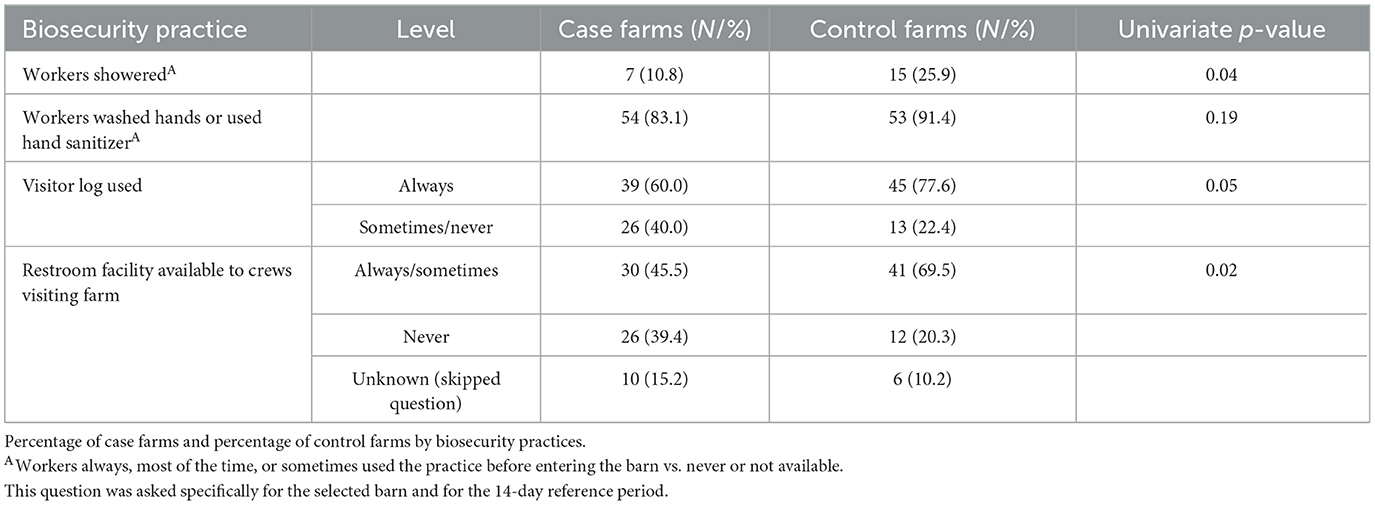
Table 3. Univariate analyses of factors (p ≤ 0.20) considered for entry into the multivariable model.
Due to a production error, the word “production” was misspelled as “productteion”.
A correction has been made to the section Conclusion, Paragraph Number: 1.
“This study compared management and biosecurity factors on case and control meat turkey farms in the U.S. during the HPAI H5N1 outbreak in 2022. Knowledge of risk factors for infection has become increasingly important as this outbreak continues into 2023 and as additional domestic poultry flocks, wild birds, and wildlife species are detected. Study results identified the following key risk factors: location of farms within an existing control zone, multiple stages of production on farm, toms as the sex market type on farm, waterfowl/shorebirds seen in the closest field, gaps in worker biosecurity measures such as lack of availability of a shower before entering the barn or a restroom facility for visiting crews, and the use of rendering for dead bird disposal. These risk factors were found to be associated with HPAI infection on farms and provide information that can be directly applied to support science-based updates to prevention and control recommendations to safeguard turkey farms in the United States.”
The publisher apologizes for these mistakes. The original article has been updated.
Keywords: avian influenza, biosecurity, case control, H5N1, highly pathogenic avian influenza, risk factors, turkey
Citation: Frontiers Production Office (2023) Erratum: Investigation of risk factors for introduction of highly pathogenic avian influenza H5N1 infection among commercial turkey operations in the United States, 2022: a case-control study. Front. Vet. Sci. 10:1336351. doi: 10.3389/fvets.2023.1336351
Received: 10 November 2023; Accepted: 10 November 2023;
Published: 23 November 2023.
Approved by:
Frontiers Editorial Office, Frontiers Media SA, SwitzerlandCopyright © 2023 Frontiers Production Office. This is an open-access article distributed under the terms of the Creative Commons Attribution License (CC BY). The use, distribution or reproduction in other forums is permitted, provided the original author(s) and the copyright owner(s) are credited and that the original publication in this journal is cited, in accordance with accepted academic practice. No use, distribution or reproduction is permitted which does not comply with these terms.
*Correspondence: Frontiers Production Office, cHJvZHVjdGlvbi5vZmZpY2VAZnJvbnRpZXJzaW4ub3Jn