 Adam Kerek1,2*
 Emese Szabó1Ábel Szabó1Márton Papp2,3Krisztián Bányai1,2,4
 Gábor Kardos2,5,6,7
 Eszter Kaszab2,5,8
 Krisztina Bali2,8
 Ákos Jerzsele1,2
- 1Department of Pharmacology and Toxicology, University of Veterinary Medicine, Budapest, Hungary
- 2National Laboratory of Infectious Animal Diseases, Antimicrobial Resistance, Veterinary Public Health and Food Chain Safety, University of Veterinary Medicine, Budapest, Hungary
- 3Centre for Bioinformatics, University of Veterinary Medicine, Budapest, Hungary
- 4Veterinary Medical Research Institute, Budapest, Hungary
- 5One Health Institute, Faculty of Health Sciences, University of Debrecen, Debrecen, Hungary
- 6National Public Health Center, Budapest, Hungary
- 7Department of Metagenomics, University of Debrecen, Debrecen, Hungary
- 8Department of Microbiology and Infectious Diseases, University of Veterinary Medicine, Budapest, Hungary
A Corrigendum on
Investigating antimicrobial resistance genes in probiotic products for companion animals
by Kerek, A., Szabó, E., Szabó, Á., Papp, M., Bányai, K., Kardos, G., Kaszab, E., Bali, K., and Jerzsele, Á. (2024). Front. Vet. Sci. 11:1464351. doi: 10.3389/fvets.2024.1464351
In the published article, there was an error in Table 2 as published. An incorrect letter was used in the first column of the table. In the fourth row of the first column, “A-product” was incorrectly indicated. The correct product is “B-product.” The corrected Table 2 and its caption appear below.
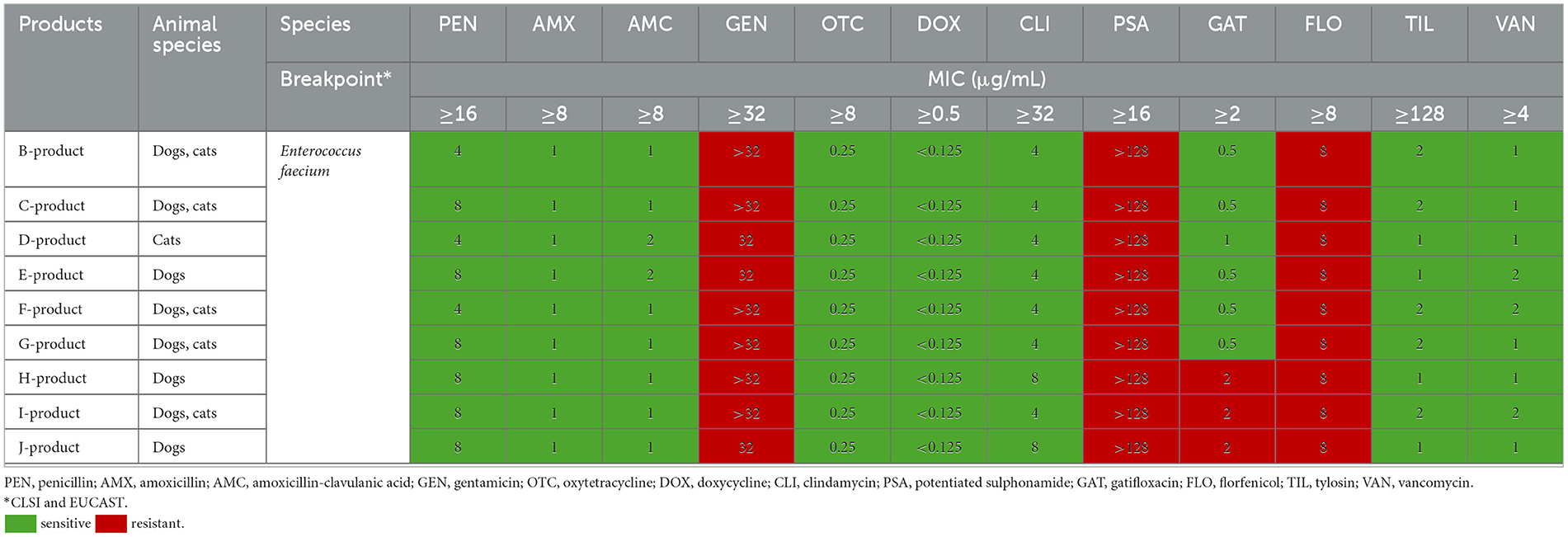
Table 2. Minimum inhibitory concentration (MIC) values of Enterococcus faecium strains isolated from the products for tested antibiotics.
The authors apologize for this error and state that this does not change the scientific conclusions of the article in any way. The original article has been updated.
Publisher's note
All claims expressed in this article are solely those of the authors and do not necessarily represent those of their affiliated organizations, or those of the publisher, the editors and the reviewers. Any product that may be evaluated in this article, or claim that may be made by its manufacturer, is not guaranteed or endorsed by the publisher.
Keywords: probiotics, ARG, NGS, companion animals, antimicrobial resistance
Citation: Kerek A, Szabó E, Szabó Á, Papp M, Bányai K, Kardos G, Kaszab E, Bali K and Jerzsele Á (2024) Corrigendum: Investigating antimicrobial resistance genes in probiotic products for companion animals. Front. Vet. Sci. 11:1531511. doi: 10.3389/fvets.2024.1531511
Received: 20 November 2024; Accepted: 29 November 2024;
Published: 17 December 2024.
Edited and reviewed by: Iram Liaqat, Government College University, Lahore, Pakistan
Copyright © 2024 Kerek, Szabó, Szabó, Papp, Bányai, Kardos, Kaszab, Bali and Jerzsele. This is an open-access article distributed under the terms of the Creative Commons Attribution License (CC BY). The use, distribution or reproduction in other forums is permitted, provided the original author(s) and the copyright owner(s) are credited and that the original publication in this journal is cited, in accordance with accepted academic practice. No use, distribution or reproduction is permitted which does not comply with these terms.
*Correspondence: Adam Kerek, a2VyZWsuYWRhbUB1bml2ZXQuaHU=