In the published article, there was an error in Figure 1, Table 1, Table 2, Table 3, and Table 6 as published. CD1c in the Figures and Tables should be CD1a. The authors discovered this error after publication of the article when the source of the antibody sent a notification stating that the antigen was not CD1c as originally indicated. The corrected Figure and Tables and their captions appear below.
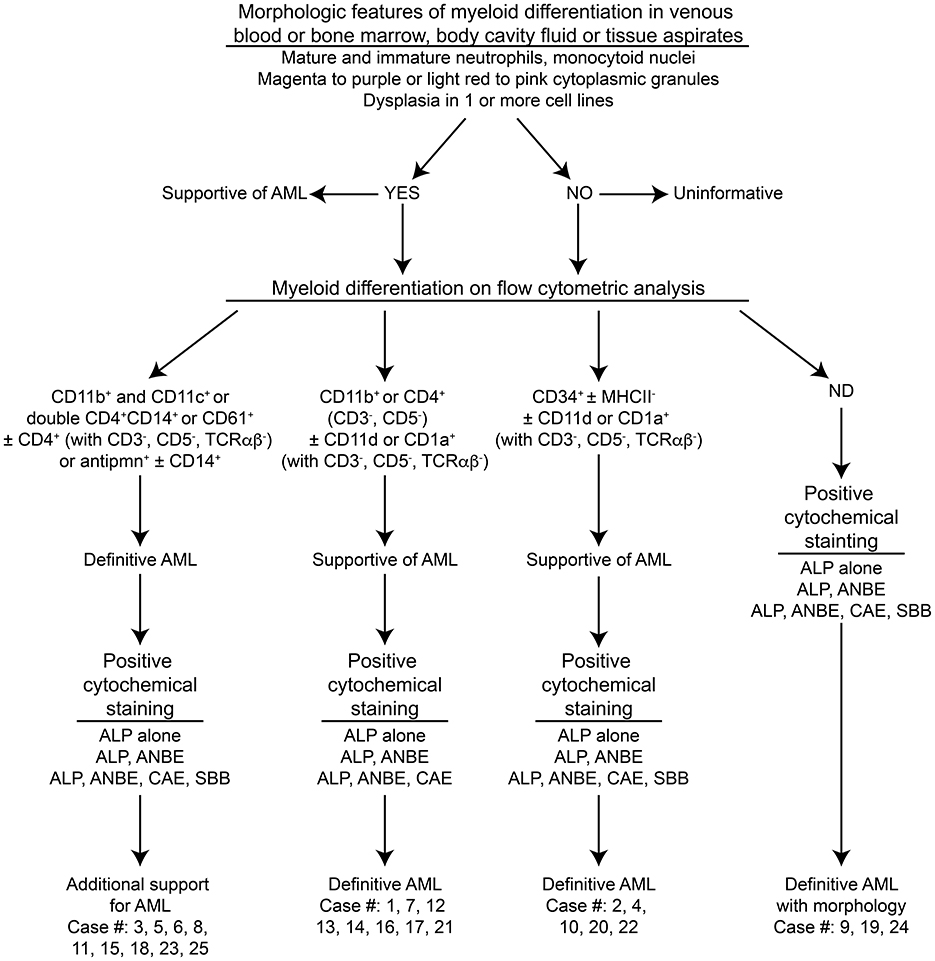
Figure 1

Algorithm used to diagnose acute myeloid leukemia (AML) in the 25 dogs of this study. This diagnostic algorithm was based on the order in which tests were generally performed in our laboratory, i.e., morphologic assessment of blood, bone marrow, or body cavity fluid or tissue aspirates, followed by flow cytometric analysis (performed routinely twice a week), followed by cytochemical staining (performed as needed). After completion of all the tests, the results were reevaluated, and a diagnosis of AML was based on the combined data. The path used to diagnose each case (#) is also shown. More details on the criteria are provided in Table 1.
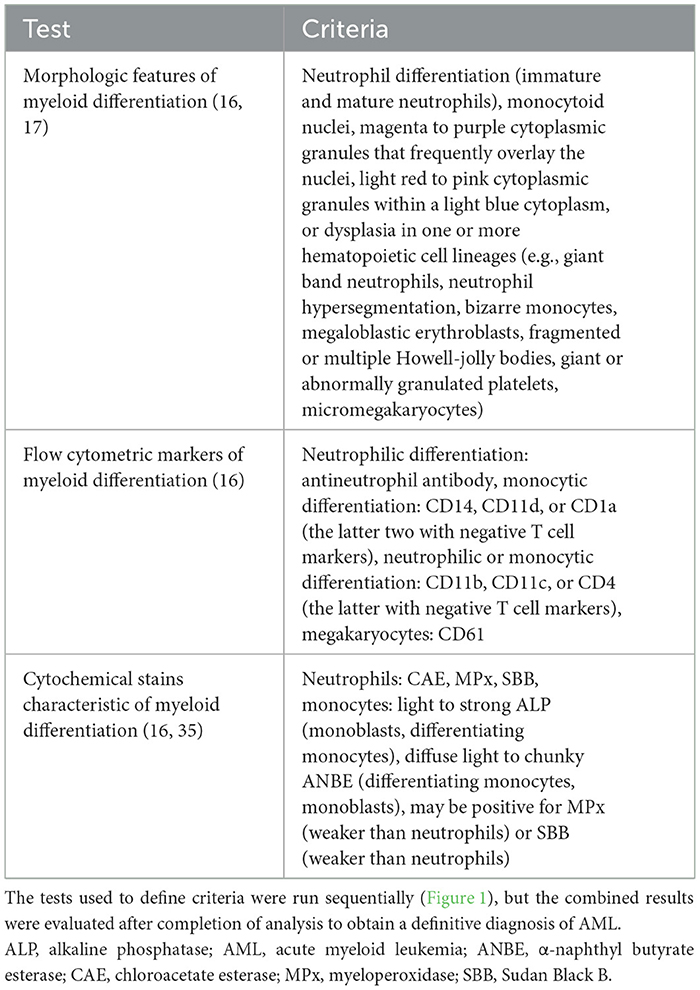
Table 1
| Test | Criteria |
|---|---|
| Morphologic features of myeloid differentiation (16, 17) | Neutrophil differentiation (immature and mature neutrophils), monocytoid nuclei, magenta to purple cytoplasmic granules that frequently overlay the nuclei, light red to pink cytoplasmic granules within a light blue cytoplasm, or dysplasia in one or more hematopoietic cell lineages (e.g., giant band neutrophils, neutrophil hypersegmentation, bizarre monocytes, megaloblastic erythroblasts, fragmented or multiple Howell-jolly bodies, giant or abnormally granulated platelets, micromegakaryocytes) |
| Flow cytometric markers of myeloid differentiation (16) | Neutrophilic differentiation: antineutrophil antibody, monocytic differentiation: CD14, CD11d, or CD1a (the latter two with negative T cell markers), neutrophilic or monocytic differentiation: CD11b, CD11c, or CD4 (the latter with negative T cell markers), megakaryocytes: CD61 |
| Cytochemical stains characteristic of myeloid differentiation (16, 35) | Neutrophils: CAE, MPx, SBB, monocytes: light to strong ALP (monoblasts, differentiating monocytes), diffuse light to chunky ANBE (differentiating monocytes, monoblasts), may be positive for MPx (weaker than neutrophils) or SBB (weaker than neutrophils) |
Criteria used to support myeloid lineage of leukemia in 25 dogs.
The tests used to define criteria were run sequentially (Figure 1), but the combined results were evaluated after completion of analysis to obtain a definitive diagnosis of AML.
ALP, alkaline phosphatase; AML, acute myeloid leukemia; ANBE, α-naphthyl butyrate esterase; CAE, chloroacetate esterase; MPx, myeloperoxidase; SBB, Sudan Black B.
Table 2
| Type of AML | Criteria |
|---|---|
| Acute myelomonocytic leukemia (M4) | ≥20% cells showing neutrophilic differentiation and ≥ 20% showing monocytic (including promonocytes) differentiation. Neutrophil differentiation was based on one or more of the following: • Morphologic features, i.e., mature an immature neutrophils comprised ≥20% cells in blood or bone marrow • Flow cytometry: expression of neutrophil-associated markers such as antineutrophil antibody • Cytochemical staining: Positive for chloroacetate esterase, myeloperoxidase, or Sudan Black B in ≥20% blasts |
| Monocytic differentiation was based on one or more of the following: • Morphologic features, i.e., mature and immature monocytes comprised ≥20% cells in blood or bone marrow • Flow cytometry: expression of monocyte-associated markers such as CD14 alone, CD4 and CD14 double positive, or CD11c or CD1a (with negative reactions for T cell markers with the latter) • Cytochemical staining: Positive for alkaline phosphatase (light to strong) or diffuse to light chunky α-naphthyl butyrate esterase |
|
| Acute monoblastic or monocytic leukemia (M5)a | >80% monocytic lineage (monoblasts, promonocytes, monocytes) based on the above features |
| Mixed lineage or phenotype | Combination of morphologic features and expression of markers of more than one myeloid lineage or concurrent expression of myeloid and lymphoid lineages on flow cytometry and cytochemical staining with no clear dominant pattern |
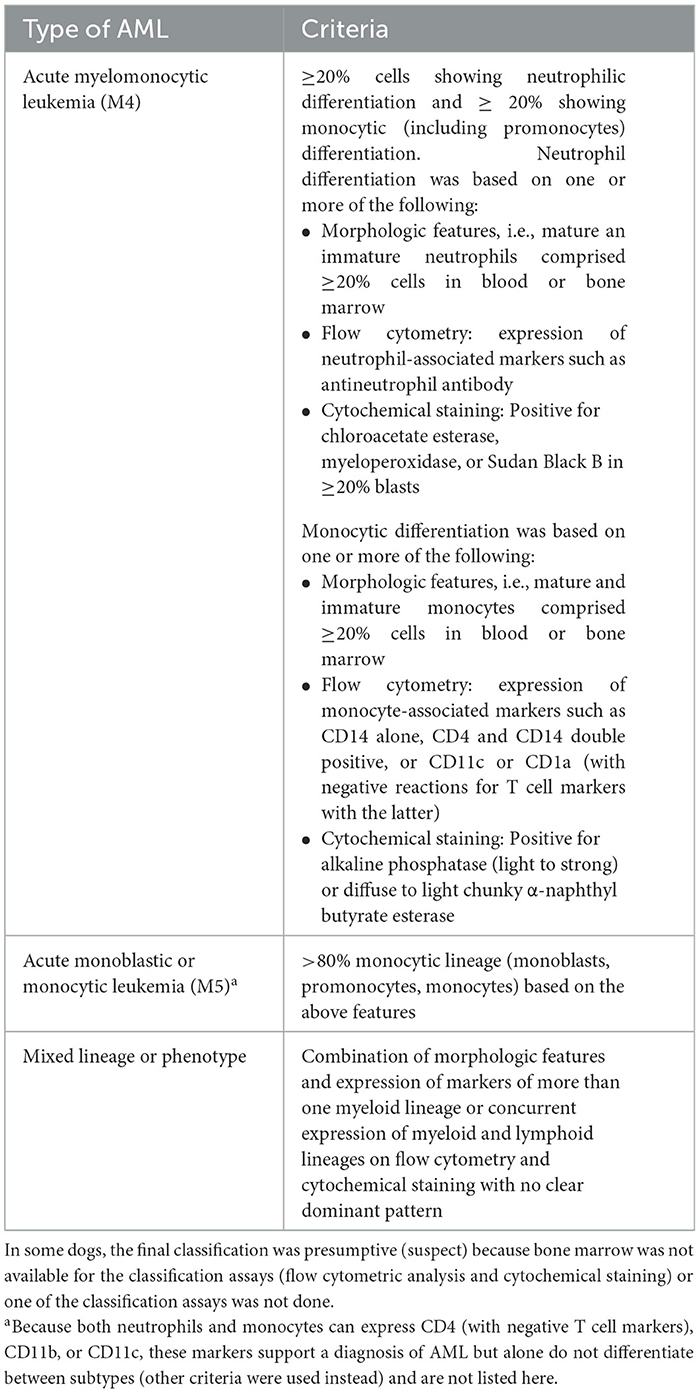
Criteria for classification of the subtype of acute myeloid leukemia (AML) based on the World Health Organization scheme – not otherwise specified (17, 18).
In some dogs, the final classification was presumptive (suspect) because bone marrow was not available for the classification assays (flow cytometric analysis and cytochemical staining) or one of the classification assays was not done.
aBecause both neutrophils and monocytes can express CD4 (with negative T cell markers), CD11b, or CD11c, these markers support a diagnosis of AML but alone do not differentiate between subtypes (other criteria were used instead) and are not listed here.
Table 3
| Antigen | Labeled cells | Clone | Conjugate | Sourcea |
|---|---|---|---|---|
| CD45 | Pan-leukocyte | YKIX716.13 | PE | AbD Serotec |
| CD18 | Pan-leukocyte | CA1.4E9 | AF647 | AbD Serotec |
| CD3 | T cells | CA17.2A12 | FITC | AbD Serotec |
| CD5 | T cells | YKIX322.2 | PE | AbD Serotec |
| CD4 | T helper/regulatory cells, neutrophils, activated monocytes | YKIX302.9 | FITC | AbD Serotec |
| CD8α | Cytotoxic T cell | YCATE55.9 | PE | AbD Serotec |
| CD28 | T cells | B58 | APC | eBioscience |
| TCRαβ | T cells | CA15.8G7 | None | UC-Davis |
| CD21 | B cells | B-ly4 | PE | BD Biosciences |
| CD22 | B cells | RFB4 | PE | Abcam |
| CD94 | Natural killer cell, cytotoxic T cell | HP-3D9 | APC | eBioscience |
| CD14 | Monocytes | Tük4 | PE | Dako |
| CD34 | Stem cell | 1H6 | PE | BD Biosciences |
| MHCII | Lymphocytes, monocytes | YKIX334.2 | FITC | AbD Serotec |
| CD80 | Monocytes, neutrophils | 16-10A1 | APC | eBioscience |
| CD11b | Neutrophils, monocytes | CA16.3E10 | None | AbD Serotec |
| CD11c | Monocytes, neutrophils, | CA11.6A1 | None | AbD Serotec |
| CD11d | T subset, some monocytes | CA11.8H2 | None | AbD Serotec |
| CD1a | T subset, B subset, monocytes | CA13.9H11 | None | UC-Davis |
| Anti-pmn | Neutrophil | CAD048A | None | VMRD |
| CD90 (Thy-1) | Lymphocytes, monocytes, stem cells, eosinophils | CA1.4G8 | None | UC-Davis |
| CD61 | Platelets | SZ21 | PE | Beckman-Coulter |
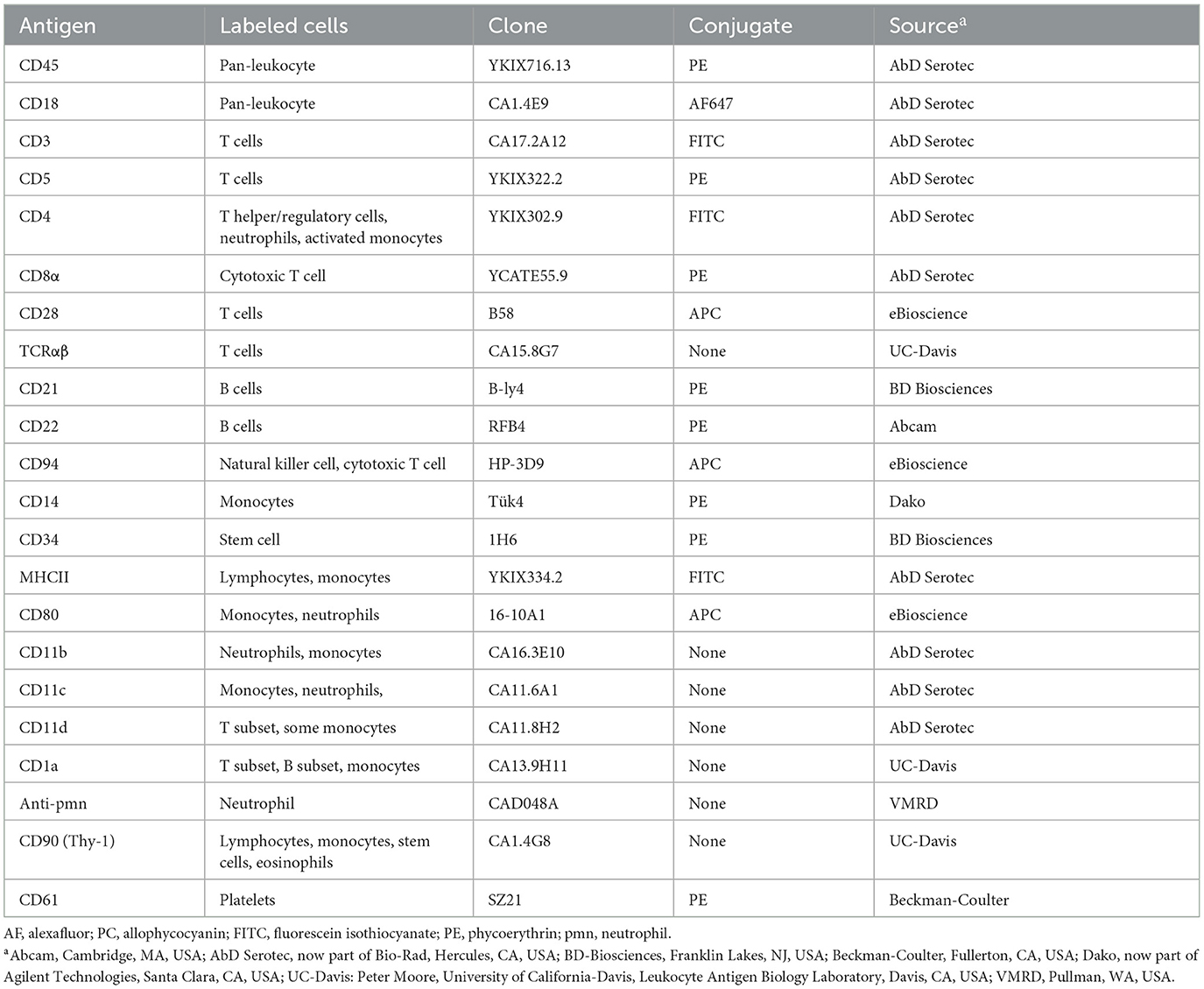
Antibodies used in flow cytometry at Cornell University to label antigens on tumor cells in liquid samples (blood or bone marrow, body cavity fluid, or tissue aspirates) from dogs with acute myeloid leukemia.
AF, alexafluor; PC, allophycocyanin; FITC, fluorescein isothiocyanate; PE, phycoerythrin; pmn, neutrophil.
aAbcam, Cambridge, MA, USA; AbD Serotec, now part of Bio-Rad, Hercules, CA, USA; BD-Biosciences, Franklin Lakes, NJ, USA; Beckman-Coulter, Fullerton, CA, USA; Dako, now part of Agilent Technologies, Santa Clara, CA, USA; UC-Davis: Peter Moore, University of California-Davis, Leukocyte Antigen Biology Laboratory, Davis, CA, USA; VMRD, Pullman, WA, USA.
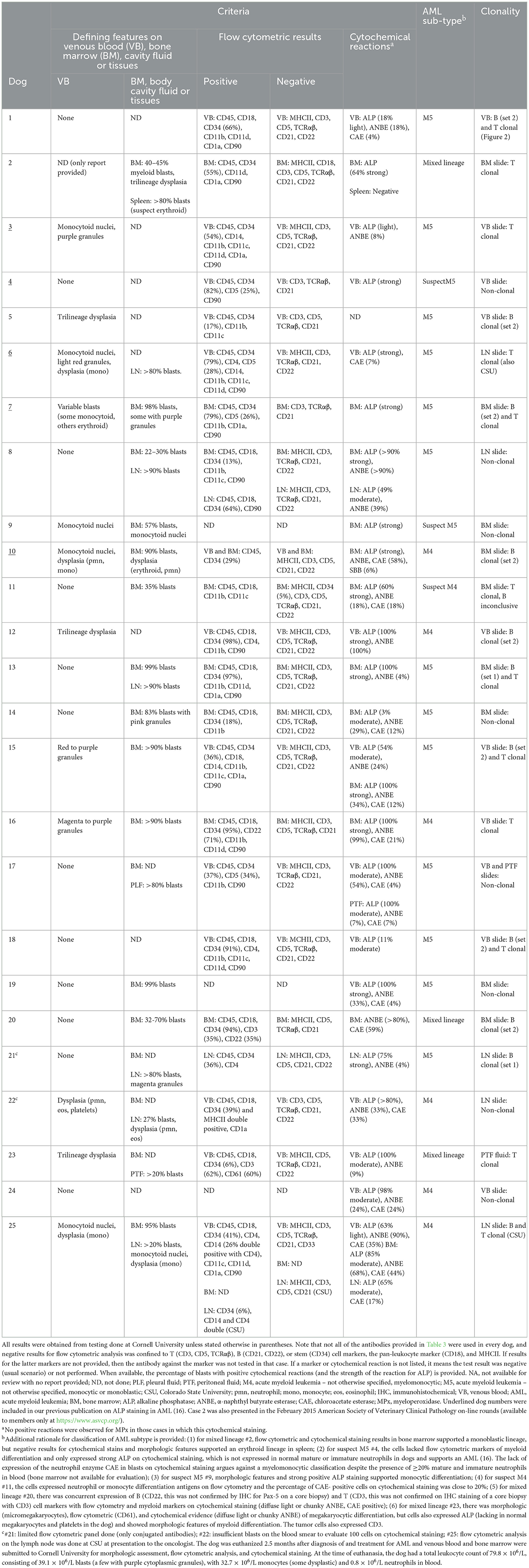
Table 6
| Criteria | AML sub-typeb | Clonality | |||||
|---|---|---|---|---|---|---|---|
| Defining features on venous blood (VB), bone marrow (BM), cavity fluid or tissues | Flow cytometric results | Cytochemical reactions a | |||||
| Dog | VB | BM, body cavity fluid or tissues | Positive | Negative | |||
| 1 | None | ND | VB: CD45, CD18, CD34 (66%), CD11b, CD11d, CD1a, CD90 | VB: MHCII, CD3, CD5, TCRαβ, CD21, CD22 | VB: ALP (18% light), ANBE (18%), CAE (4%) | M5 | VB: B (set 2) and T clonal (Figure 2) |
| 2 | ND (only report provided) | BM: 40–45% myeloid blasts, trilineage dysplasia Spleen: >80% blasts (suspect erythroid) | BM: CD45, CD34 (55%), CD11d, CD1a, CD90 | BM: MHCII, CD18, CD3, CD5, TCRαβ, CD21, CD22 | BM: ALP (64% strong) Spleen: Negative | Mixed lineage | BM slide: T clonal |
| 3 | Monocytoid nuclei, purple granules | ND | VB: CD45, CD34 (54%), CD14, CD11b, CD11c, CD11d, CD1a, CD90 | VB: MHCII, CD3, CD5, TCRαβ, CD21, CD22 | VB: ALP (light), ANBE (8%) | M5 | VB slide: T clonal |
| 4 | None | ND | VB: CD45, CD34 (82%), CD5 (25%), CD90 | VB: CD3, TCRαβ, CD21 | VB: ALP (strong) | SuspectM5 | VB slide: Non-clonal |
| 5 | Trilineage dysplasia | ND | VB: CD45, CD34 (17%), CD11b, CD11c | VB: CD3, CD5, TCRαβ, CD21 | ND | M5 | VB slide: B clonal (set 2) |
| 6 | Monocytoid nuclei, light red granules, dysplasia (mono) | ND LN: >80% blasts. | VB: CD45, CD34 (79%), CD4, CD5 (28%), CD14, CD11b, CD11c, CD11d, CD90 | VB: MHCII, CD3, TCRαβ, CD21, CD22 | VB: ALP (strong), CAE (7%) | M5 | LN slide: T clonal (also CSU) |
| 7 | Variable blasts (some monocytoid, others erythroid) | BM: 98% blasts, some with purple granules | BM: CD45, CD34 (79%), CD5 (26%), CD11b, CD1a, CD90 | BM: CD3, TCRαβ, CD21 | BM: ALP (strong) | M5 | BM slide: B (set 2) and T clonal |
| 8 | None | BM: 22–30% blasts LN: >90% blasts | BM: CD45, CD18, CD34 (13%), CD11b, CD11c, CD90 LN: CD45, CD18, CD34 (64%), CD90 | BM: MHCII, CD3, TCRαβ, CD21, CD22 LN: MHCII, CD3, TCRαβ, CD21, CD22 | BM: ALP (>90% strong), ANBE (>90%) LN: ALP (49% moderate), ANBE (39%) | M5 | LN slide: Non-clonal |
| 9 | Monocytoid nuclei | BM: 57% blasts, monocytoid nuclei | ND | ND | BM: ALP (strong) | Suspect M5 | BM slide: Non-clonal |
| 10 | Monocytoid nuclei, dysplasia (pmn, mono) | BM: 90% blasts, dysplasia (erythroid, pmn) | VB and BM: CD45, CD34 (29%) | VB and BM: MHCII, CD3, CD5, CD21, CD22 | BM: ALP (strong), ANBE, CAE (58%), SBB (6%) | M4 | BM slide: B clonal (set 2) |
| 11 | None | BM: 35% blasts | BM: CD45, CD18, CD11b, CD11c | BM: MHCII, CD34 (5%), CD3, CD5, TCRαβ, CD21, CD22 | BM: ALP (60% strong), ANBE (18%), CAE (18%) | Suspect M4 | BM slide: T clonal, B inconclusive |
| 12 | Trilineage dysplasia | ND | VB: CD45, CD18, CD34 (98%), CD4, CD11b, CD90 | VB: MHCII, CD3, CD5, TCRαβ, CD21, CD22 | VB: ALP (100% strong), ANBE (100%) | M4 | VB slide: B clonal (set 2) |
| 13 | None | BM: 99% blasts LN: >90% blasts | BM: CD45, CD18, CD34 (97%), CD11b, CD11d, CD1a, CD90 | BM: MHCII, CD3, CD5, TCRαβ, CD21, CD22 | BM: ALP (100% strong), ANBE (4%) | M5 | BM slide: B (set 1) and T clonal |
| 14 | None | BM: 83% blasts with pink granules | BM: CD45, CD18, CD34 (18%), CD11b | BM: MHCII, CD3, CD5, TCRαβ, CD21, CD22 | BM: ALP (3% moderate), ANBE (29%), CAE (12%) | M5 | BM slide: Non-clonal |
| 15 | Red to purple granules | BM: >90% blasts | VB: CD45, CD34 (36%), CD18, CD14, CD11b, CD11c, CD1a, CD90 | VB: MHCII, CD3, CD5, TCRαβ, CD21, CD22 | VB: ALP (54% moderate), ANBE (24%) BM: ALP (100% strong), ANBE (34%), CAE (12%) | M5 | VB slide: B (set 2) and T clonal |
| 16 | Magenta to purple granules | BM: >90% blasts | BM: CD45, CD18, CD34 (95%), CD22 (71%), CD11b, CD11d, CD90 | BM: MHCII, CD3, CD5, TCRαβ, CD21 | BM: ALP (100% strong), ANBE (99%), CAE (21%) | M4 | VB slide: T clonal |
| 17 | None | BM: ND PLF: >80% blasts | VB: CD45, CD34 (37%), CD5 (34%), CD11b, CD90 | VB: MHCII, CD3, TCRαβ, CD21, CD22 | VB: ALP (100% moderate), ANBE (54%), CAE (4%) PTF: ALP (100% moderate), ANBE (7%), CAE (7%) | M5 | VB and PTF slides: Non-clonal |
| 18 | None | ND | VB: CD45, CD18, CD34 (91%), CD4, CD11b, CD11c, CD11d, CD90 | VB: MCHII, CD3, CD5, TCRαβ, CD21, CD22 | VB: ALP (11% moderate) | M5 | VB slide: B (set 2) and T clonal |
| 19 | None | BM: 99% blasts | ND | ND | VB: ALP (100% strong), ANBE (33%), CAE (4%) | M5 | BM slide: Non-clonal |
| 20 | None | BM: 32-70% blasts | BM: CD45, CD18, CD34 (94%), CD3 (35%), CD22 (35%) | BM: MHCII, CD5, TCRαβ, CD21 | BM: ANBE (>80%), CAE (59%) | Mixed lineage | BM slide: B clonal (set 2) |
| 21c | None | BM: ND LN: >80% blasts, magenta granules | LN: CD45, CD34 (36%), CD4 | LN: MHCII, CD3, CD5, CD21, CD22 | LN: ALP (75% strong), ANBE (4%) | M5 | LN slide: B clonal (set 1) |
| 22c | Dysplasia (pmn, eos, platelets) | BM: ND LN: 27% blasts, dysplasia (pmn, eos) | VB: CD45, CD18, CD34 (39%) and MHCII double positive, CD1a | VB: CD3, CD5, TCRαβ, CD21, CD22 | VB: ALP (>80%), ANBE (33%), CAE (33%) | M4 | LN slide: Non-clonal |
| 23 | Trilineage dysplasia | BM: ND PTF: >20% blasts | VB: CD45, CD18, CD34 (6%), CD3 (62%), CD61 (60%) | VB: MHCII, CD5, TCRαβ, CD21, CD22 | VB: ALP (100% moderate), ANBE (9%) | Mixed lineage | PTF fluid: T clonal |
| 24 | None | ND | ND | ND | VB: ALP (98% moderate), ANBE (24%), CAE (24%) | M4 | VB slide: Non-clonal |
| 25 | Monocytoid nuclei, dysplasia (mono) | BM: 95% blasts LN: >20% blasts, monocytoid nuclei, dysplasia (mono) | VB: CD45, CD18, CD34 (41%), CD4, CD14 (26% double positive with CD4), CD11c, CD11d, CD1a, CD90 BM: ND LN: CD34 (6%), CD14 and CD4 double (CSU) | VB: MHCII, CD3, CD5, TCRαβ, CD21, CD33 BM: ND LN: MHCII, CD3, CD5, CD21 (CSU) | VB: ALP (63% light), ANBE (90%), CAE (35%) BM: ALP (85% moderate), ANBE (68%), CAE (44%) LN: ALP (65% moderate), CAE (17%) | M4 | LN slide: B and T clonal (CSU) |
Morphologic findings from blood or cytologic smears and results from flow cytometric labeling, cytochemical staining, and clonality testing in 25 dogs with AML.
All results were obtained from testing done at Cornell University unless stated otherwise in parentheses. Note that not all of the antibodies provided in Table 3 were used in every dog, and negative results for flow cytometric analysis was confined to T (CD3, CD5, TCRαβ), B (CD21, CD22), or stem (CD34) cell markers, the pan-leukocyte marker (CD18), and MHCII. If results for the latter markers are not provided, then the antibody against the marker was not tested in that case. If a marker or cytochemical reaction is not listed, it means the test result was negative (usual scenario) or not performed. When available, the percentage of blasts with positive cytochemical reactions (and the strength of the reaction for ALP) is provided. NA, not available for review with no report provided; ND, not done; PLF, pleural fluid; PTF, peritoneal fluid; M4, acute myeloid leukemia – not otherwise specified, myelomonocytic; M5, acute myeloid leukemia – not otherwise specified, monocytic or monoblastic; CSU, Colorado State University; pmn, neutrophil; mono, monocyte; eos, eosinophil; IHC, immunohistochemical; VB, venous blood; AML, acute myeloid leukemia; BM, bone marrow; ALP, alkaline phosphatase; ANBE, α-naphthyl butyrate esterase; CAE, chloroacetate esterase; MPx, myeloperoxidase. Underlined dog numbers were included in our previous publication on ALP staining in AML (16). Case 2 was also presented in the February 2015 American Society of Veterinary Clinical Pathology on-line rounds (available to members only at https://www.asvcp.org/).
aNo positive reactions were observed for MPx in those cases in which this cytochemical staining.
bAdditional rationale for classification of AML subtype is provided: (1) for mixed lineage #2, flow cytometric and cytochemical staining results in bone marrow supported a monoblastic lineage, but negative results for cytochemical stains and morphologic features supported an erythroid lineage in spleen; (2) for suspect M5 #4, the cells lacked flow cytometric markers of myeloid differentiation and only expressed strong ALP on cytochemical staining, which is not expressed in normal mature or immature neutrophils in dogs and supports an AML (16). The lack of expression of the neutrophil enzyme CAE in blasts on cytochemical staining argues against a myelomonocytic classification despite the presence of ≥20% mature and immature neutrophils in blood (bone marrow not available for evaluation); (3) for suspect M5 #9, morphologic features and strong positive ALP staining supported monocytic differentiation; (4) for suspect M4 #11, the cells expressed neutrophil or monocyte differentiation antigens on flow cytometry and the percentage of CAE- positive cells on cytochemical staining was close to 20%; (5) for mixed lineage #20, there was concurrent expression of B (CD22, this was not confirmed by IHC for Pax-5 on a core biopsy) and T (CD3, this was not confirmed on IHC staining of a core biopsy with CD3) cell markers with flow cytometry and myeloid markers on cytochemical staining (diffuse light or chunky ANBE, CAE positive); (6) for mixed lineage #23, there was morphologic (micromegakaryocytes), flow cytometric (CD61), and cytochemical evidence (diffuse light or chunky ANBE) of megakaryocytic differentiation, but cells also expressed ALP (lacking in normal megakaryocytes and platelets in the dog) and showed morphologic features of myeloid differentiation. The tumor cells also expressed CD3.
c#21: limited flow cytometric panel done (only conjugated antibodies); #22: insufficient blasts on the blood smear to evaluate 100 cells on cytochemical staining; #25: flow cytometric analysis on the lymph node was done at CSU at presentation to the oncologist. The dog was euthanized 2.5 months after diagnosis of and treatment for AML and venous blood and bone marrow were submitted to Cornell University for morphologic assessment, flow cytometric analysis, and cytochemical staining. At the time of euthanasia, the dog had a total leukocyte count of 79.8 × 10⁶/L, consisting of 39.1 × 10⁶/L blasts (a few with purple cytoplasmic granules), with 32.7 × 10⁶/L monocytes (some dysplastic) and 0.8 × 10⁶/L neutrophils in blood.
The authors apologize for this error and state that this does not change the scientific conclusions of the article in any way. The original article has been updated.
Statements
Publisher’s note
All claims expressed in this article are solely those of the authors and do not necessarily represent those of their affiliated organizations, or those of the publisher, the editors and the reviewers. Any product that may be evaluated in this article, or claim that may be made by its manufacturer, is not guaranteed or endorsed by the publisher.
Summary
Keywords
acute myelogenous leukemia, canine, polymerase testing for antigen receptor rearrangements, clonality testing, phenotyping, leukemia, flow cytometry, cytochemistry
Citation
Stokol T, Nickerson GA, Shuman M and Belcher N (2025) Corrigendum: Dogs with acute myeloid leukemia have clonal rearrangements in T and B cell receptors. Front. Vet. Sci. 11:1533729. doi: 10.3389/fvets.2024.1533729
Received
24 November 2024
Accepted
03 December 2024
Published
10 January 2025
Volume
11 - 2024
Edited and reviewed by
Stefano Comazzi, University of Milan, Italy
Updates
Copyright
© 2025 Stokol, Nickerson, Shuman and Belcher.
This is an open-access article distributed under the terms of the Creative Commons Attribution License (CC BY). The use, distribution or reproduction in other forums is permitted, provided the original author(s) and the copyright owner(s) are credited and that the original publication in this journal is cited, in accordance with accepted academic practice. No use, distribution or reproduction is permitted which does not comply with these terms.
*Correspondence: Tracy Stokol tracy.stokol@cornell.edu
Disclaimer
All claims expressed in this article are solely those of the authors and do not necessarily represent those of their affiliated organizations, or those of the publisher, the editors and the reviewers. Any product that may be evaluated in this article or claim that may be made by its manufacturer is not guaranteed or endorsed by the publisher.