TT
theodoros tokas
University Hospital of Heraklion
Heraklion, Greece
228
Total downloads
2,312
Total views and downloads
Submit your idea
Select the journal/section where you want your idea to be submitted:
Radical prostatectomy, the main treatment for prostate cancer, has undergone significant technological advancements since the introduction of the open nerve-sparing technique by Patrick Walsh. The development of the Montsouris technique marked a turn towards laparoscopic approaches, with subsequent innovations further reducing surgical invasiveness. Nevertheless, laparoscopic radical prostatectomy remained a highly skilled procedure with a steep learning curve.
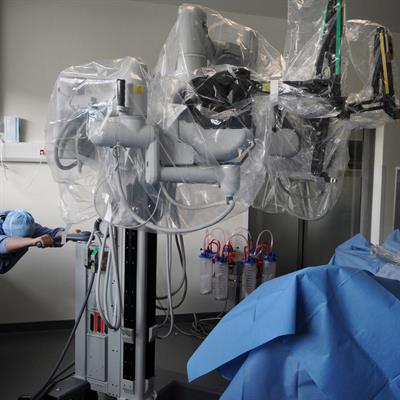
The advent of the da Vinci surgical robot transformed the landscape, addressing addressing many ergonomic issues of laparoscopy and achieving precision by offering a sitting position to the surgeon, a three-dimensional vision, and articulated instruments with six degrees of freedom. Later generations of the da Vinci surgical robot implemented numerous technical improvements, the most recent being the single-port surgery, which allows the surgeon to work in a limited space, minimizing invasiveness without compromising procedure outcomes. This technological revolution allowed surgeons to introduce new techniques to improve functional outcomes, like the Retzius-sparing and the transvesical robotic radical prostatectomy.
Recently, various manufacturers have produced many surgical robotic systems, each with advantages and limitations that are increasing the industry competition. At the same time, laparoscopy also evolved by introducing high-quality three-dimensional cameras and intelligent energy devices to optimize dissection. Economic limitations in many health systems worldwide are responsible for maintaining laparoscopic surgery in the armamentarium against prostate cancer, offering, however, quality surgery. Finally, utilizing additional tools intraoperatively, like fluorescent image guidance, confocal laser endomicroscopy, neurovascular structure-adjacent frozen section examination (NeuroSAFE), augmented reality, and artificial intelligence, have optimized intraoperative tumor staging and procedure planning.
This Research Topic aims to explore and evaluate the technological advancements and technique improvements in minimally invasive radical prostatectomy, particularly through laparoscopic and robotic methods. It seeks to investigate how these innovations contribute to optimizing oncological and functional outcomes, thereby enhancing patient quality of life. We welcome contributions that address the following areas but are not limited to:
o New technological developments in laparoscopic and robotically-assisted radical prostatectomy.
o Description and outcomes of new surgical techniques in laparoscopic and robotically-assisted radical prostatectomy
o The impact of different forms of artificial intelligence in the field
o Description of different tools to achieve or improve intraoperative staging and grading
o Economic considerations affecting the choice of surgical techniques
o Analysis of surgeon learning curves and their implications on procedural efficacy
Submissions are encouraged in various formats including original articles, systematic reviews, mini-reviews, comprehensive reviews, and opinion articles. We hope this Research Topic will provide urological surgeons with essential information about new developments in the field, ultimately enhancing surgical proficiency and patient care.
This Research Topic accepts the following article types, unless otherwise specified in the Research Topic description:
Articles that are accepted for publication by our external editors following rigorous peer review incur a publishing fee charged to Authors, institutions, or funders.
Keywords: Radical Prostatectomy, Robotic-Assisted Surgery, Laparoscopic Prostatectomy, Surgical Innovations, Oncological Outcomes, Artificial Intelligence in Surgery, Patient Quality of Life
Important note: All contributions to this Research Topic must be within the scope of the section and journal to which they are submitted, as defined in their mission statements. Frontiers reserves the right to guide an out-of-scope manuscript to a more suitable section or journal at any stage of peer review.

Manuscripts can be submitted to this Research Topic via the main journal or any other participating journal.
Submit your idea
Select the journal/section where you want your idea to be submitted: