CTC survival depends on several factors, including the ability to evade the immune system, resistance to apoptosis/anoikis, and resistance to shear forces and mechanical stress 1 . Cancer stem cells, a subset of cells thought to play a role in tumor initiation, progression, recurrence, and resistance to therapies 2,3 , may be the precursors of CTCs with stem-like phenotype and enhanced metastatic competence 4,5 . Quartieri et al. evidenced that exposure of osteosarcoma cells to hypoxia and radiation increased the population of cells with stem-like properties, with a more aggressive cell phenotype, determined by upregulation of CD133 and TrkB markers and enhanced resistance to anoikis, sphere formation, and sphere clustering capacity. Moreover, chronic hypoxia increases CD47 expression, a signal that helps CTCs evade the immune system.In relation to mechanical stress, Kurma & Alix-Panabières focused their review on the mechanobiology underlying the survival strategies and adaptations of CTCs in the microcirculation, highlighting the role of fluid shear stress and other mechanical cues on the nuclear envelope and cytoskeleton of CTCs, as well as on the signaling pathways and molecular players activated. It remains crucial to elucidate the involvement of fluid mechanics in the metastatic cascade to design anti-metastasis therapeutic strategies, as well as improve the detection of CTCs by liquid biopsy tests. Even more so in tumors such as breast cancer (BC), a disease in which the spread of cancer cells is an early event that can go unnoticed, and about 20% of patients will have a distant recurrence in the years following adjuvant therapy 6 . Targeting minimal residual disease, in the form of DTCs, represents a window for therapeutic intervention, but it requires a better understanding of the timing of tumor cell dissemination and the cell-intrinsic and extrinsic factors that drive tumor cell growth. Ring In conclusion, the articles included in this Research Topic provide a clear picture of the value that a 80 thorough understanding of the biology of the cells responsible for metastasis and their interaction with 81 stromal cells (i.e. CAFs) can have for the identification of new biomarkers of the metastatic process 82 and the development of new therapeutic strategies. We believe that directing our research efforts in 83 this direction will have a significant impact on how we manage cancer patients to limit the spread of 84 the disease.
Editorial27 February 2024
Editorial: Mechanisms of metastasis from circulating and disseminated tumor cells
Tumors not only consist of cancerous cells, but they also harbor several normal-like cell types and non-cellular components. Carcinoma-associated fibroblasts (CAFs) are one of these cellular components that are found predominantly in the tumor stroma. Autophagy is an intracellular degradation and quality control mechanism, and recent studies provided evidence that autophagy played a critical role in CAF formation, metabolic reprograming and tumor-stroma crosstalk.Therefore, shedding light on the autophagy and its role in CAF biology might help us better understand the roles of CAFs and the TME in cancer progression and may facilitate the exploitation of more efficient cancer diagnosis and treatment. Here, we provide an overview about the involvement of autophagy in CAF-related pathways, including transdifferentiation and activation of CAFs, and further discuss the implications of targeting tumor stroma as a treatment option.
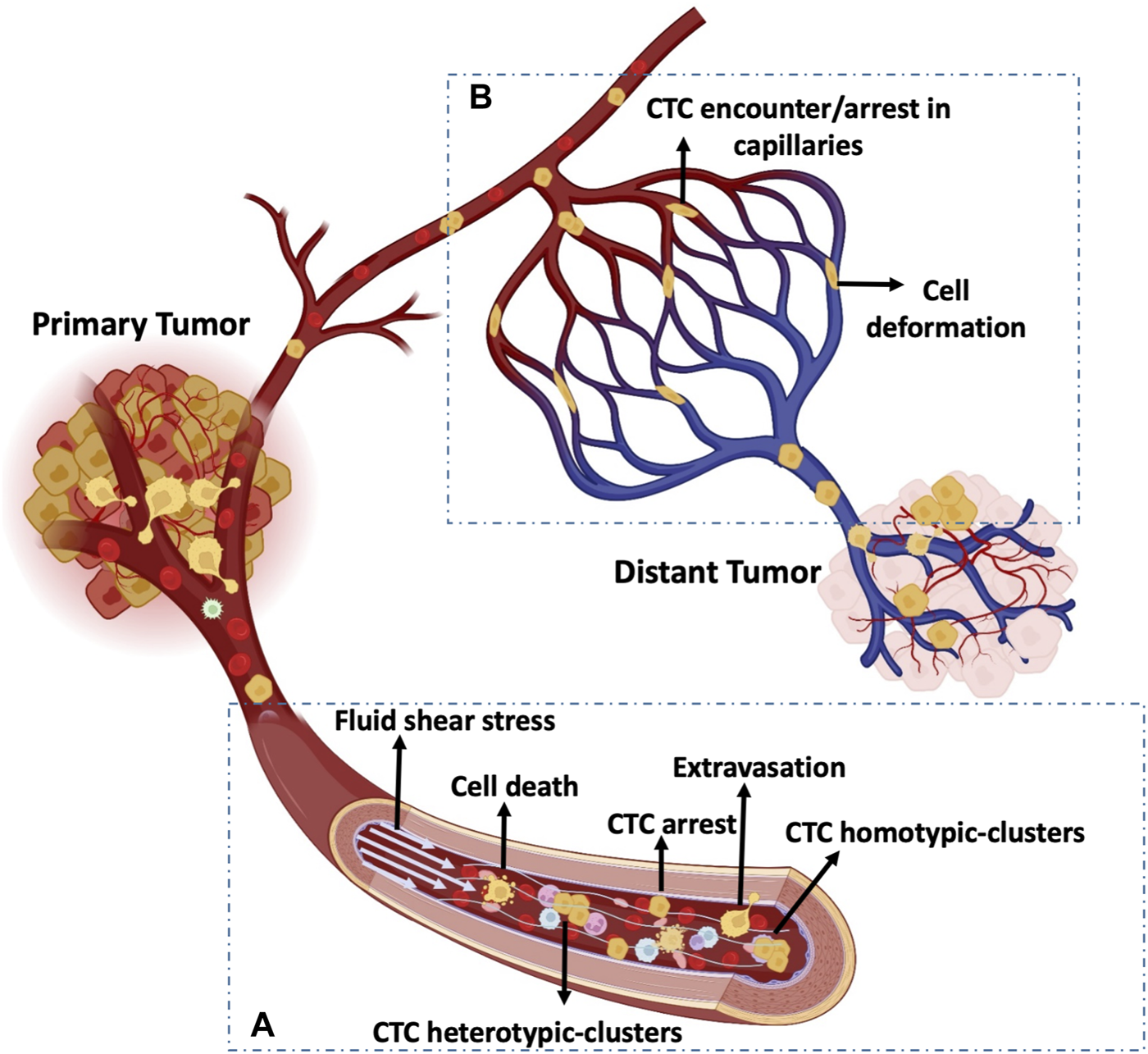
Metastatic progression is the deadliest feature of cancer. Cancer cell growth, invasion, intravasation, circulation, arrest/adhesion and extravasation require specific mechanical properties to allow cell survival and the completion of the metastatic cascade. Circulating tumor cells (CTCs) come into contact with the capillary bed during extravasation/intravasation at the beginning of the metastatic cascade. However, CTC mechanobiology and survival strategies in the bloodstream, and specifically in the microcirculation, are not well known. A fraction of CTCs can extravasate and colonize distant areas despite the biomechanical constriction forces that are exerted by the microcirculation and that strongly decrease tumor cell survival. Furthermore, accumulating evidence shows that several CTC adaptations, via molecular factors and interactions with blood components (e.g. immune cells and platelets inside capillaries), may promote metastasis formation. To better understand CTC journey in the microcirculation as part of the metastatic cascade, we reviewed how CTC mechanobiology and interaction with other cell types in the bloodstream help them to survive the harsh conditions in the circulatory system and to metastasize in distant organs.

Progress in detection and treatment have drastically improved survival for early breast cancer patients. However, distant recurrence causes high mortality and is typically considered incurable. Cancer dissemination occurs via circulating tumor cells (CTCs) and up to 75% of breast cancer patients could harbor micrometastatses at time of diagnosis, while metastatic recurrence often occurs years to decades after treatment. During clinical latency, disseminated tumor cells (DTCs) can enter a state of cell cycle arrest or dormancy at distant sites, and are likely shielded from immune detection and treatment. While this is a challenge, it can also be seen as an outstanding opportunity to target dormant DTCs on time, before their transformation into lethal macrometastatic lesions. Here, we review and discuss progress made in our understanding of DTC and dormancy biology in breast cancer. Strides in our mechanistic insights of these features has led to the identification of possible targeting strategies, yet, their integration into clinical trial design is still uncertain. Incorporating minimally invasive liquid biopsies and rationally designed adjuvant therapies, targeting both proliferating and dormant tumor cells, may help to address current challenges and improve precision cancer care.

REVIEW
1 March 2022
Menglu Dong, 2 more and Qi Zhang
4 Authors
- MD
Menglu Dong
Department of Thyroid and Breast Surgery, China
- QL
Quan Liu
Department of Thyroid and Breast Surgery, China
- YX
Yi Xu
Department of Plastic and Cosmetic Surgery, China
- QZ
Qi Zhang
Department of Plastic and Cosmetic Surgery, China
Triple-negative breast cancer (TNBC) is a heterogeneous subtype of breast cancer (BC) with diverse biological behavior, high aggressiveness, and poor prognosis. Extracellular vesicles (EVs) are nano-sized membrane-bound vesicles secreted by nearly all cells, and are involved in physiological and pathological processes. EVs deliver multiple functional cargos into the extracellular space, including proteins, lipids, mRNAs, non-coding RNAs (ncRNAs), and DNA fragments. Emerging evidence confirms that EVs enable pro-oncogenic secretome delivering and trafficking for long-distance cell-to-cell communication in shaping the tumor microenvironment (TME). The transferred tumor-derived EVs modify the capability of invasive behavior and organ-specific metastasis in recipient cells. In addition, TNBC cell-derived EVs have been extensively investigated due to their promising potential as valuable biomarkers for diagnosis, monitoring, and treatment evaluation. Here, the present review will discuss the recent progress of EVs in TNBC growth, metastasis, immune regulation, as well as the potential in TNBC diagnosis and treatment application, hoping to decipher the advantages and challenges of EVs for combating TNBC.