 Mégane Jassin1Alix Block1,2Laury Désiront1Louise Vrancken1,2Céline Grégoire2Frédéric Baron1,2Grégory Ehx1,3Thi Tham Nguyen1
 Jo Caers1,2*
- 1Laboratory of Hematology, Interdisciplinary Cluster for Applied Genoproteomics Institute (GIGA) Institute, University of Liege, Liege, Belgium
- 2Department of Hematology, University Hospital of Liege, Liege, Belgium
- 3Walloon Excellence in Life Sciences and Biotechnology (WELBIO) Department, Walloon Excellenxe in Life Research Institute, Wavre, Belgium
A Correction on
From spheroids to organoids: next-generation models for CAR-T cell therapy research in solid tumors
By Jassin M, Block A, Désiront L, Vrancken L, Grégoire C, Baron F, Ehx G, Nguyen TT and Caers J (2025) Front. Immunol. 16:1626369. doi: 10.3389/fimmu.2025.1626369
There was a mistake in the caption of Figure 6 as published. Figure uncomplete (missing words, empty square without “collagen matrix, tumor organoid, hydrogel matrix, biopsy derived cells”). The corrected caption of Figure 6 appears below.
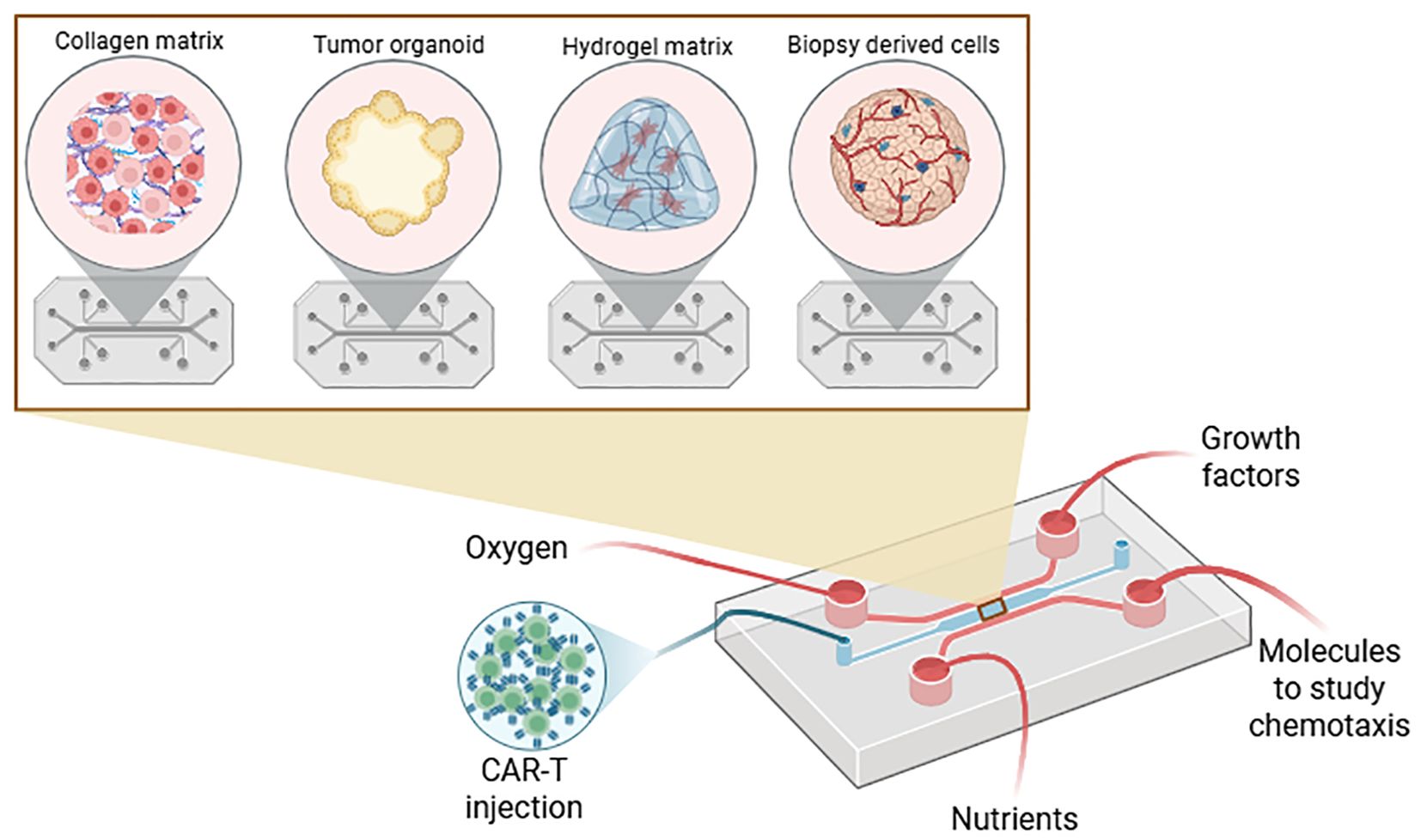
Figure 6. Schematic representation of using matrix coupled with microfluidic, organ-on-chip and bioprinting. Microfluidic device is composed of different channels, one to culture the spheroid or organoid with CAR-T cells while other channels can bring oxygen, nutrients, chemotaxis molecules or growth factors or can mimick blood vessels. Channels can be coupled with filters to remove debris and dead cells. This figure was generated on Biorender.
The original version of this article has been updated.
Publisher’s note
All claims expressed in this article are solely those of the authors and do not necessarily represent those of their affiliated organizations, or those of the publisher, the editors and the reviewers. Any product that may be evaluated in this article, or claim that may be made by its manufacturer, is not guaranteed or endorsed by the publisher.
Keywords: car-t, chimeric antigen receptor T cells, solid tumor, 3D culture, tumor microenvironment, spheroid, organoid, immunotherapy
Citation: Jassin M, Block A, Désiront L, Vrancken L, Grégoire C, Baron F, Ehx G, Nguyen TT and Caers J (2025) Correction: From spheroids to organoids: next-generation models for CAR-T cell therapy research in solid tumors. Front. Immunol. 16:1738434. doi: 10.3389/fimmu.2025.1738434
Received: 03 November 2025; Accepted: 14 November 2025; Revised: 04 November 2025;
Published: 02 December 2025.
Approved by:
Frontiers Editorial Office, Frontiers Media SA, SwitzerlandCopyright © 2025 Jassin, Block, Désiront, Vrancken, Grégoire, Baron, Ehx, Nguyen and Caers. This is an open-access article distributed under the terms of the Creative Commons Attribution License (CC BY). The use, distribution or reproduction in other forums is permitted, provided the original author(s) and the copyright owner(s) are credited and that the original publication in this journal is cited, in accordance with accepted academic practice. No use, distribution or reproduction is permitted which does not comply with these terms.
*Correspondence: Jo Caers, Sm8uQ2FlcnNAY2h1bGllZ2UuYmU=