In the original article, there was a mistake in Figure 3 as published. On Figure 3 panel F, an error was made when assembling the representative imagens on the board, and the same image was included twice for the SHR Control group and SHR Telm + PD group. The correct representative image for the SHR Control group was included and the corrected Figure 3 appears below.
FIGURE 3
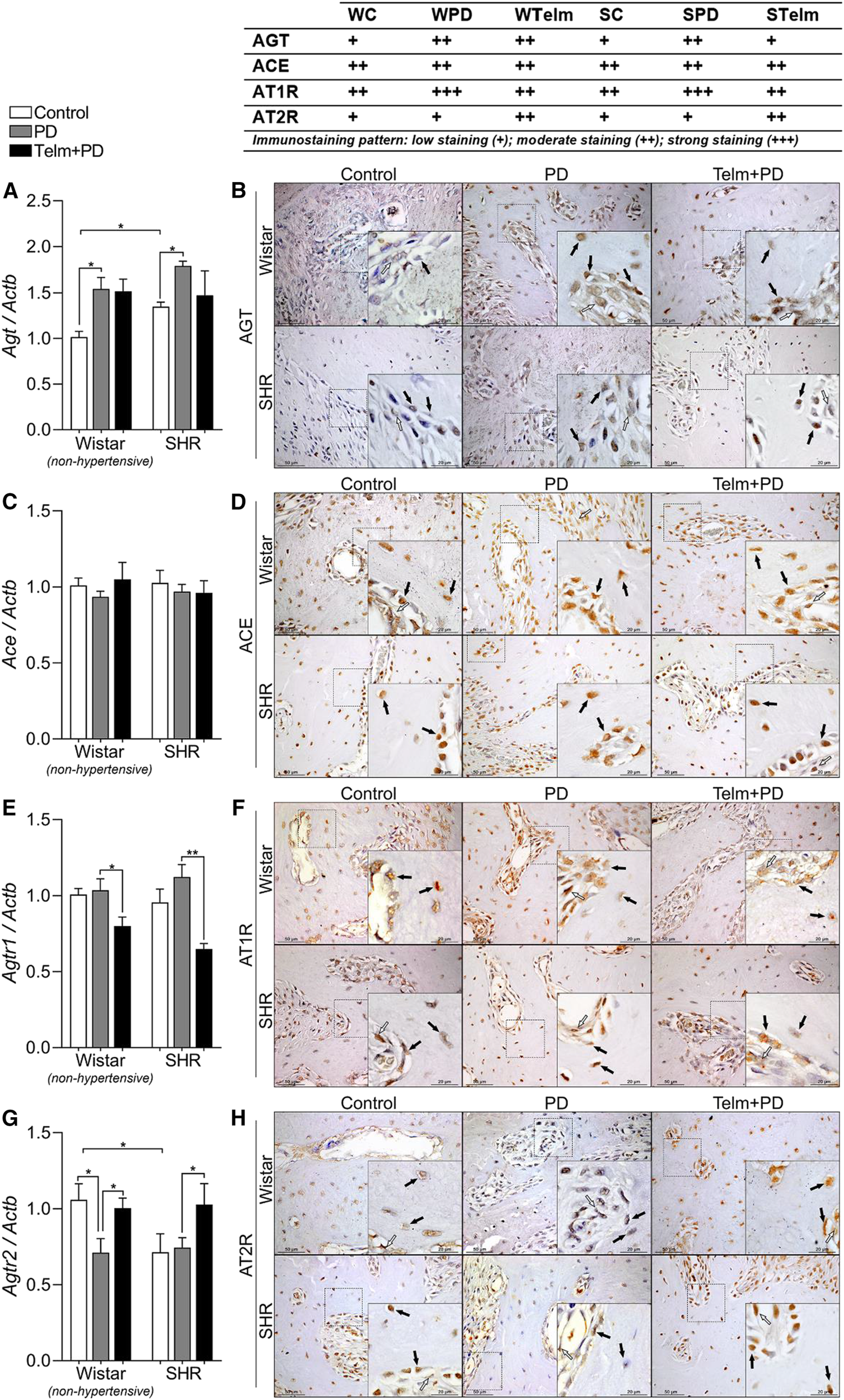
RAS components expression in mandibles of Wistar (non-hypertensive) and SHR with PD 15 days, treated with telmisartan. Respectively qRT-PCR and IHC for Agt (A,B), Ace (C,D), Agtr1 (E,F), and Agtr2 (G,H). Graphs show mean ± SEM (n = 6). Statistical difference are represented by brackets labeled by *p < 0.05, **p < 0.01, ***p < 0.001, and ****p < 0.0001, comparing Control vs. PD, PD vs. Telm + PD, and Wistar vs. SHR in the same experimental condition. Board shows representative images, and upper table presents the average immunostaining patter from each experimental group (n = 5). Black arrows point bone forming cells positive stained (osteoblasts and osteocytes), and white arrows indicate positive stained alveolar bone adjacent connective tissue.
The authors apologize for these errors and state that this does not change the scientific conclusions of the article in any way. The original article has been updated.
Summary
Keywords
telmisartan, AT1 blocker, bone metabolism, spontaneous hypertensive rats, periodontal disease, osteoblast, osteoclast, cytokines
Citation
Brito VGB, Patrocinio MS, Linjardi MC, Emanuelli Alves Barreto A, Frasnelli SCT, Lara V, Santos CF and Oliveira SHP (2021) Corrigendum: Telmisartan Prevents Alveolar Bone Loss by Decreasing the Expression of Osteoclasts Markers in Hypertensive Rats With Periodontal Disease. Front. Pharmacol. 11:635927. doi: 10.3389/fphar.2020.635927
Received
30 November 2020
Accepted
23 December 2020
Published
19 February 2021
Volume
11 - 2020
Edited and reviewed by
Ulrike Garscha, University of Greifswald, Germany
Updates
Copyright
© 2021 Brito, Patrocinio, Linjardi, Barreto, Frasnelli, Lara, Santos and Oliveira.
This is an open-access article distributed under the terms of the Creative Commons Attribution License (CC BY). The use, distribution or reproduction in other forums is permitted, provided the original author(s) and the copyright owner(s) are credited and that the original publication in this journal is cited, in accordance with accepted academic practice. No use, distribution or reproduction is permitted which does not comply with these terms.
*Correspondence: Sandra Helena Penha Oliveira, sandra.hp.oliveira@unesp.br
This article was submitted to Inflammation Pharmacology, a section of the journal Frontiers in Pharmacology
Disclaimer
All claims expressed in this article are solely those of the authors and do not necessarily represent those of their affiliated organizations, or those of the publisher, the editors and the reviewers. Any product that may be evaluated in this article or claim that may be made by its manufacturer is not guaranteed or endorsed by the publisher.