 Anelise Audibert
 Françoise Combes
 Santiago García-Burillo
 Philippe Salomé1
- 1Observatoire de Paris, LERMA, Centre National de la Recherche Scientifique, PSL University, Sorbonne University, UPMC, Paris, France
- 2College de France, Paris, France
- 3Observatorio Astronómico Nacional, Observatorio de Madrid, Madrid, Spain
Feeding and feedback in AGN play a very important role to gain a proper understanding of galaxy formation and evolution. The interaction between activity mechanisms in the nucleus and its influence in the host galaxy are related to the physical processes involved in feedback and the gas fueling of the black hole. The discovery of many massive molecular outflows in the last few years have been promoting the idea that winds may be major actors in sweeping the gas out of galaxies. Also, the widely observed winds from the central regions of AGN are promising candidates to explain the scaling relations (e.g., the black hole-bulge mass relation, BH accretion rate tracking the star formation history) under the AGN feedback scenario. Out goal is to probe these phenomena through the kinematic and morphology of the gas inside the central kpc in nearby AGN. This has recently been possible due to the unprecedented ALMA spatial resolution and sensitivity. We present results on NGC7213 and NGC1808, the latter is part of a new ALMA follow-up of the NuGa project, a previous high-resolution (0.5–1″) CO survey of low luminosity AGN performed with the IRAM PdBI.
1. Introduction
The fueling of SMBH at the center of galaxies and the subsequent feedback from its active nuclei, are among the key processes to understand the concerted growth of galaxies and BH. AGN feedback is invoked to explain the formation of massive galaxies when we compare the luminosity function of galaxies to theoretical simulations based on the cold dark matter models (Silk and Mamon, 2012). Winds and outflows produced by the AGN can eject or heat the gas, terminate the star formation and through the lack of fuel for accretion, quench the black hole activity. Recent discovery of many massive molecular outflows (e.g., Feruglio et al., 2010; Fischer et al., 2010; Alatalo et al., 2011; Sturm et al., 2011; Dasyra and Combes, 2012; Veilleux et al., 2013; Cicone et al., 2014; Dasyra et al., 2014; García-Burillo et al., 2014) have been promoting the idea that winds may be major actors in sweeping the gas out of galaxies, in agreement with theoretical predictions of AGN driven winds models (Faucher-Giguère and Quataert, 2012; Zubovas and King, 2012, 2014). However, it is still difficult to distinguish the origin of the outflows, whether they are AGN-driven or starburst-driven.
On the other hand, AGN are fueled by accretion of material onto the BH and the gas component can form stars on its way to the BH (García-Burillo and Combes, 2012; Combes et al., 2014). It is important to study the efficiency of angular momentum transport in galaxy disks in order to understand how the star formation and nuclear activity are fueled and what are the timescales involved, since both feeding process rely on a common cold gas supply, but in very different periods of time (~105 year for BH growth and ~107−9 year for star formation; García-Burillo, 2016). In addition to this scenario, one of the outstanding problems is to identify the mechanism that drives gas from the disk toward the nucleus, removing its large angular momentum and forming large non-axisymmetric perturbations, such as bars or spirals.
This work aims to better understand the galaxies chemical and thermal evolution by studying in detail the physical processes acting on the nucleus of a sample of nearby AGN. Probing AGN feeding and feedback phenomena through the kinematic and morphology of the gas inside the central kpc have recently been possible due to the unprecedented Atacama Millimeter/Submillimeter Array (ALMA) spatial resolution (≲0.5″) and sensitivity. Since there are only a few AGN observed with high spatial resolution, we investigate the nuclear molecular emission in a sample of nearby AGN making use of spectroscopic techniques.
2. Methodology
By applying the velocity channel maps on the dense molecular gas tracers, e.g., HCN, HCO+, CS, and mid transition of CO, we can access the gas kinematics. To detect possible inflows or outflows, we can compare the CO rotation curve with a rotational velocity model based on the Hα kinematics and then subtract the model to analyse the velocity residuals in order to search for blue and redshifted patterns. Another possibility is to explore the current models for the rotation curve, when previous Hα or H i are not available in the literature. One of this model is described by Bertola et al. (1991), assuming the gas is on circular orbits in a plane, , where for p = 1 the velocity curve is asymptotically flat and p = 3/2 the system has a finite total mass, therefore we expect 1 ≤ p ≤ 3/2. The observed radial velocity at a position (R, Ψ) on the plane of the sky can be described as:
where θ is the inclination of the disk (with θ = 0 for a face-on disk), Ψ0 is the position angle of the line of nodes, vsys is the systemic velocity and R is the radius and A, c, and p are parameters of the model. In the cases of NGC 7213 and NGC 1808, we have used the Bertola et al. (1991) model to search for non-circular motions in their observed velocity field.
3. Results
3.1. NGC 7213
We report ALMA Cycle 1 observations of CO(2-1) at 229.2 GHz of NGC 7213, an early-type SA(s)a galaxy harboring a Seyfert 1/LINER. Previous neutral and ionized gas observations suggest the presence of a warped gaseous disk that could be the result of a merger. It presents a giant Hα filament and two Hi tidal tails, confirming to be a highly disturbed interaction system (Hameed et al., 2001). Stellar kinematics is dominated by non-circular motions, along two spiral arms (Schnorr-Müller et al., 2014). In the central ~3 kpc, the CO map reveals a a widely distributed multiple-arm spiral structure, tracing the dusty spiral arms, as can be seen in the HST image (Figure 1). There is an offset peak located at 200 pc north from the center, meaning that the peak of the CO emission is not concentrated in the very center.
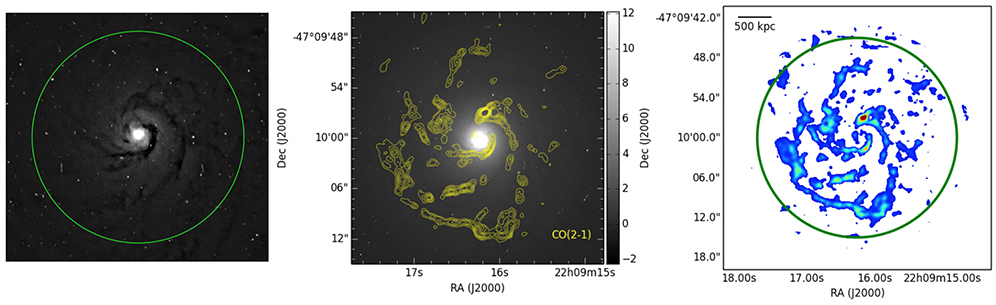
Figure 1. In the left and middle panels we show an unsharp-masked F606W HST image and the original image with CO(2-1) contours overlaid, respectively. Right: CO(2-1) intensity map of NGC 7213 clipped at >5σ. The green circle represents a 30″ diameter.
In general, the velocity field in the left panel of Figure 2 is well-described by rotation, presenting some slightly perturbations along the minor axis (at 10″) probably due to streaming motions from the spiral arms. By applying the Bertola et al. (1991) model to generate a 2-D velocity model that minimizes the residuals, we find that the position angle is −18° and the systemic velocity should be corrected in 30 km/s. The residuals do not indicate hints of a significant blue and/or red-shifted components and this result indicates that probably there is no molecular outflow in NGC 7213.
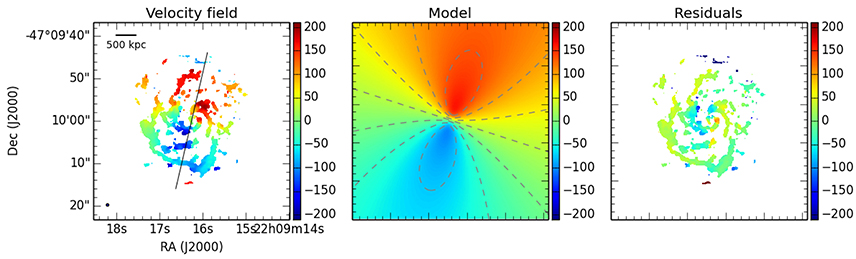
Figure 2. Left: Velocity map of NGC 7213 clipped at >5σ. In the middle panel the best fit model using the Bertola et al. (1991) function and the residuals, after subtracting the model from the data, are shown on the right.
3.2. NGC 1808
The “hot spot” galaxy NGC 1808 is remarkable for its very dusty appearance and especially for its well-known system of dark radial filaments. NGC 1808 is a Starburst/Seyfert 2 galaxy located at 9.1 Mpc and it is classified as a SAB(s)a. Accordingly to Reif et al. (1982), it has an inclination of 57°. Atomic gas traced with H i is concentrated in the galactic bar, disk, and a warped outer ring, indicating a tidal interaction in the past with the neighbor galaxy NGC 1792 (Koribalski et al., 1996). It presents prominent polar dust lanes and gas outflow emerging from the nucleus, as revealed in optical studies that indicate an outflow of dust and neutral and ionized gas (as seen in Hα, [N ii], Na i D, and H i by Koribalski et al., 1993; Phillips, 1993). In particular, Na i D is seen blueshifted in absorption and redshifted in emission and B-R images show that the dust plumes associated with the outflow reach ~3 kpc above the plane. Near-infrared integral-field spectroscopy with SINFONI by Busch et al. (2017) showed a large gas reservoir and a disturbed gas velocity field that shows signs of inflowing streaming motion in the central ~100 pc.
We report ALMA Cycle 3 observations of CO(3-2), CS(7-6), HCN(4-3), and HCO+(4-3) in band 7 with a resolution of 0.27″. Figure 3 shows that the CO emission follows the star-forming central 500 pc ring and the very center has a spiral trailing structure, that is also observed in CS, HCN, and HCO+.
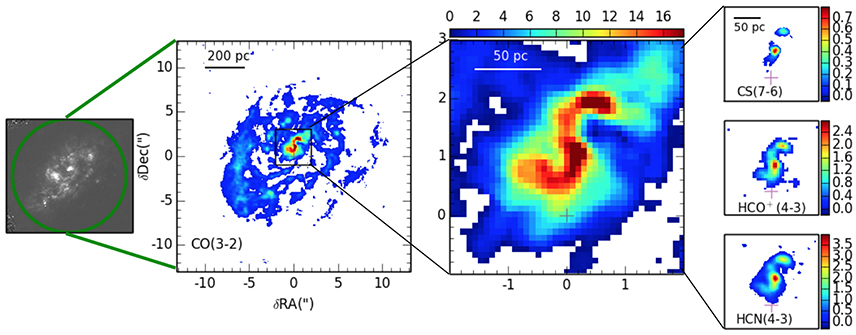
Figure 3. From the left to the right panels: a WFC/F658N HST image followed by the 26″ diameter imaged area of CO(3-2) observations with ALMA. The next panels shows a zoom of the spiral trailing structure observed, and the subsequent plots show the same detection as seen in CS(7-6), HCO+(4-3), and HCN(4-3). All the intensity maps were clipped at >5σ.
From the velocity map in Figure 4, the dominant velocity feature appears to be due to circular rotation in the disk. After subtracting a model for the velocity field by Bertola et al. (1991), we do not find significant patterns in the residuals and if there is a presence of an molecular outflow in the galaxy, it will be difficult to disentangle from the dominant circular motion in the 1st moment distribution. We need to explore in details the position-velocity diagrams along the dust lanes observed in the HST images. Additionally, Salak et al. (2016) presented evidence of a molecular gas outflow seen in CO(1-0) from the nuclear starburst region (r ≲ 250 pc) that could be only detected in the position-velocity diagram. The outflow has a maximum velocity of υout ~180 km/s and mass outflow rate between 1 and 10 M⊙/year, comparable to the total star formation rate in the starburst 500 pc region, that corresponds to SFR ~ 5M⊙/year in the “hot spots.” The kinematics of our CO(3-2) observations do not show strong outflows at this scale. Certainly, the outflow is more significant at larger scales. A further analysis of the molecular gas and the outflow in NGC 1808 will be present in a forthcoming paper (Audibert et al., in preparation).
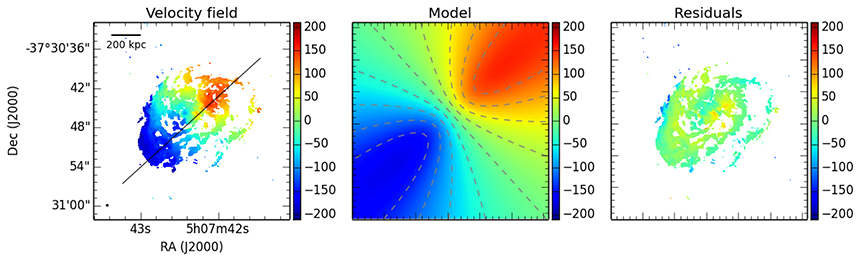
Figure 4. Left: Velocity map of NGC 1808 clipped at >5σ. In the middle panel the best fit model using the Bertola et al. (1991) function and the residuals, after subtracting the model from the data, are shown on the right.
4. Perspectives
We are going to apply the same methodology to search for outflows and inflows in a modest sample of nearby Seyfert/LINERs galaxies that are part of a new ALMA follow-up of the—NUclei of GAlaxies (NuGa) project, a previous CO survey of low luminosity AGN performed with the IRAM PdBI. The new ALMA observations have the remarkable spatial resolution of ~0.06–0.09″.
Author Contributions
AA has written the article; AA and FC have contributed to reduce the data; FC and SG-B have written the proposal; and all four authors have contributed to interpret the data and comment the paper.
Conflict of Interest Statement
The authors declare that the research was conducted in the absence of any commercial or financial relationships that could be construed as a potential conflict of interest.
Acknowledgments
AA thanks the organizers of the “Quasars at All Cosmic Epochs” conference for support and the referees for useful comments. AA would like to acknowledge the financial support from the Brazilian scholarship program Science Without Borders—CNPq (scholarship reference 234043/2014-8). This paper makes use of the following ALMA data: ADS/JAO.ALMA# 2012.1.00474.S (PI: N. Nagar) and ADS/JAO.ALMA# 2015.1.00404.S (PI: FC). ALMA is a partnership of ESO (representing its member states), NSF (USA), and NINS (Japan), together with NRC (Canada), NSC and ASIAA (Taiwan), and KASI (Republic of Korea), in cooperation with the Republic of Chile. The Joint ALMA Observatory is operated by ESO, AUI/NRAO, and NAOJ. We used observations made with the NASA/ESA Hubble Space Telescope, and obtained from the Hubble Legacy Archive, which is a collaboration between the Space Telescope Science Institute (STScI/NASA), the Space Telescope European Coordinating Facility (ST-ECF/ESA), and the Canadian Astronomy Data Center (CADC/NRC/CSA). This research has made use of the NASA/IPAC Extragalactic Database (NED) and of the HyperLeda database.
References
Alatalo, K., Blitz, L., Young, L. M., Davis, T. A., Bureau, M., Lopez, L. A., et al. (2011). Discovery of an active galactic nucleus driven molecular outflow in the local early-type Galaxy NGC 1266. Astrophys. J. 735:88. doi: 10.1088/0004-637X/735/2/88
Bertola, F., Bettoni, D., Danziger, J., Sadler, E., Sparke, L., and de Zeeuw, T. (1991). Testing the gravitational field in elliptical galaxies - NGC 5077. Astrophys. J. 373, 369–390.
Busch, G., Eckart, A., Valencia, S. M., Fazeli, N., Scharwächter, J., Combes, F., et al. (2017). Star formation and gas flows in the centre of the NUGA galaxy NGC 1808 observed with SINFONI. Astron. Astrophys. 598:A55. doi: 10.1051/0004-6361/201629440
Cicone, C., Maiolino, R., Sturm, E., Graciá-Carpio, J., Feruglio, C., Neri, R., et al. (2014). Massive molecular outflows and evidence for AGN feedback from CO observations. Astron. Astrophys. 562:A21. doi: 10.1051/0004-6361/201322464
Combes, F., García-Burillo, S., Casasola, V., Hunt, L. K., Krips, M., Baker, A. J., et al. (2014). ALMA reveals the feeding of the Seyfert 1 nucleus in NGC 1566. Astron. Astrophys. 565:A97. doi: 10.1051/0004-6361/201423433
Dasyra, K. M., and Combes, F. (2012). Cold and warm molecular gas in the outflow of 4C 12.50. Astron. Astrophys. 541:L7. doi: 10.1051/0004-6361/201219229
Dasyra, K. M., Combes, F., Novak, G. S., Bremer, M., Spinoglio, L., Pereira Santaella, M., et al. (2014). Heating of the molecular gas in the massive outflow of the local ultraluminous-infrared and radio-loud galaxy 4C12.50. Astron. Astrophys. 565:A46. doi: 10.1051/0004-6361/201323070
Faucher-Giguère, C.-A., and Quataert, E. (2012). The physics of galactic winds driven by active galactic nuclei. Mon. Not. R. Astron. Soc. 425, 605–622. doi: 10.1111/j.1365-2966.2012.21512.x
Feruglio, C., Maiolino, R., Piconcelli, E., Menci, N., Aussel, H., Lamastra, A., et al. (2010). Quasar feedback revealed by giant molecular outflows. Astron. Astrophys. 518:L155. doi: 10.1051/0004-6361/201015164
Fischer, J., Sturm, E., González-Alfonso, E., Graciá-Carpio, J., Hailey-Dunsheath, S., Poglitsch, A., et al. (2010). Herschel-PACS spectroscopic diagnostics of local ULIRGs: conditions and kinematics in Markarian 231. Astron. Astrophys. 518:L41. doi: 10.1051/0004-6361/201014676
García-Burillo, S. (2016). Gas flows in galactic nuclei: observational constraints on BH-galaxy coevolution. Proc. Int. Astron. Union 11, 207–214. doi: 10.1017/S1743921316007511
García-Burillo, S., and Combes, F. (2012). The feeding of activity in galaxies: a molecular line perspective. J. Phys. Conf. Ser. 372:012050. doi: 10.1088/1742-6596/372/1/012050
García-Burillo, S., Combes, F., Usero, A., Aalto, S., Krips, M., Viti, S., et al. (2014). Molecular line emission in NGC 1068 imaged with ALMA. I. An AGN-driven outflow in the dense molecular gas. Astron. Astrophys. 567:A125. doi: 10.1051/0004-6361/201423843
Hameed, S., Blank, D. L., Young, L. M., and Devereux, N. (2001). The discovery of a giant Hα filament in NGC 7213. Astrophys. J. Lett. 546, L97–L100. doi: 10.1086/318865
Koribalski, B., Dahlem, M., Mebold, U., and Brinks, E. (1993). A comprehensive study of the peculiar spiral galaxy NGC 1808. II - VLA H I line observations. Astron. Astrophys. 268, 14–24.
Koribalski, B., Dettmar, R.-J., Mebold, U., and Wielebinski, R. (1996). Gas streaming along the bar in NGC 1808. A combination of high-resolution Hα and HI data. Astron. Astrophys. 315, 71–76.
Reif, K., Mebold, U., Goss, W. M., van Woerden, H., and Siegman, B. (1982). An HI survey of southern galaxies. Astron. Astrophys. Suppl. Ser. 50, 451–479.
Salak, D., Nakai, N., Hatakeyama, T., and Miyamoto, Y. (2016). Gas dynamics and outflow in the barred starburst galaxy NGC 1808 revealed with ALMA. Astrophys. J. 823:68. doi: 10.3847/0004-637X/823/1/68
Schnorr-Müller, A., Storchi-Bergmann, T., Nagar, N. M., and Ferrari, F. (2014). Gas inflows towards the nucleus of the active galaxy NGC 7213. Mon. Not. R. Astron. Soc. 438, 3322–3331. doi: 10.1093/mnras/stt2440
Silk, J., and Mamon, G. A. (2012). The current status of galaxy formation. Res. Astron. Astrophys. 12, 917–946. doi: 10.1088/1674-4527/12/8/004
Sturm, E., González-Alfonso, E., Veilleux, S., Fischer, J., Graciá-Carpio, J., Hailey-Dunsheath, S., et al. (2011). Massive molecular outflows and negative feedback in ULIRGs observed by herschel-PACS. Astrophys. J. Lett. 733:L16. doi: 10.1088/2041-8205/733/1/L16
Veilleux, S., Meléndez, M., Sturm, E., Gracia-Carpio, J., Fischer, J., González-Alfonso, E., et al. (2013). Fast molecular outflows in luminous galaxy mergers: evidence for quasar feedback from herschel. Astrophys. J. 776:27. doi: 10.1088/0004-637X/776/1/27
Zubovas, K., and King, A. (2012). Clearing out a galaxy. Astrophys. J. Lett. 745:L34. doi: 10.1088/2041-8205/745/2/L34
Keywords: active galactic nuclei, extragalactic astronomy, evolution of galaxies, galaxies, spectroscopy
Citation: Audibert A, Combes F, García-Burillo S and Salomé P (2017) Probing the Gas Fueling and Outflows in Nearby AGN with ALMA. Front. Astron. Space Sci. 4:58. doi: 10.3389/fspas.2017.00058
Received: 30 September 2017; Accepted: 27 November 2017;
Published: 12 December 2017.
Edited by:
Mauro D'Onofrio, Università degli Studi di Padova, ItalyReviewed by:
Daniela Bettoni, Osservatorio Astronomico di Padova (INAF), ItalyAnna Lia Longinotti, National Institute of Astrophysics, Optics and Electronics, Mexico
Copyright © 2017 Audibert, Combes, García-Burillo and Salomé. This is an open-access article distributed under the terms of the Creative Commons Attribution License (CC BY). The use, distribution or reproduction in other forums is permitted, provided the original author(s) or licensor are credited and that the original publication in this journal is cited, in accordance with accepted academic practice. No use, distribution or reproduction is permitted which does not comply with these terms.
*Correspondence: Anelise Audibert, YW5lbGlzZS5hdWRpYmVydEBvYnNwbS5mcg==