 L. Matteini1,2,3*
 L. Franci4,3
 O. Alexandrova2
 C. Lacombe2
 S. Landi5,3
 P. Hellinger6
 E. Papini5,3A. Verdini5,3
- 1Department of Physics, Imperial College London, London, United Kingdom
- 2LESIA, Observatoire de Paris, Université PSL, CNRS, Sorbonne Université, Univ. Paris Diderot, Sorbonne Paris Cité, Paris, France
- 3INAF, Osservatorio Astrofisico di Arcetri, Firenze, Italy
- 4School of Physics and Astronomy, Queen Mary University of London, London, United Kingdom
- 5Dipartimento di Fisica e Astronomia, Universitá di Firenze, Florence, Italy
- 6Astronomical Institute, CAS, Prague, Czech Republic
We investigate the transition of the solar wind turbulent cascade from MHD to sub‐ion range by means of a detailed comparison between in situ observations and hybrid numerical simulations. In particular, we focus on the properties of the magnetic field and its component anisotropy in Cluster measurements and hybrid 2D simulations. First, we address the angular distribution of wave vector in the kinetic range between ion and electron scales by studying the variance anisotropy of the magnetic field components. When taking into account a single-direction sampling, like that performed by spacecraft in the solar wind, the main properties of the fluctuations observed in situ are also recovered in our numerical description. This result confirms that solar wind turbulence in the sub‐ion range is characterized by a quasi-2D gyrotropic distribution of k-vectors around the mean field. We then consider the magnetic compressibility associated with the turbulent cascade and its evolution from large-MHD to sub‐ion scales. The ratio of field aligned to perpendicular fluctuations, typically low in the MHD inertial range, increases significantly when crossing ion scales and its value in the sub‐ion range is a function of the total plasma beta only, as expected from theoretical predictions, with higher magnetic compressibility for higher beta. Moreover, we observe that this increase has a gradual trend from low to high beta values in the in situ data; this behavior is well captured by the numerical simulations. The level of magnetic field compressibility that is observed in situ and in the simulations is in fairly good agreement with theoretical predictions, especially at high beta, suggesting that, in the kinetic range explored, the turbulence is supported by low-frequency and highly oblique fluctuations in pressure balance, like kinetic Alfvén waves or other slowly evolving coherent structures. The resulting scaling properties as a function of the plasma beta and the main differences between numerical and theoretical expectations and in situ observations are also discussed.
1. Introduction
The solar wind constitutes a unique laboratory for plasma turbulence (Bruno and Carbone, 2013). In the last decade, increasing interest has been raised toward the small-scale behavior of the turbulent cascade, i.e., beyond the breakdown of the fluid/MHD description that takes place at ion scales. Spacecraft observations of solar wind and near-Earth plasmas provide unique measurements of the turbulent fluctuations at scales comparable and smaller than the typical particle scales, the Larmor radius ρ (see Appendix for definition of physical quantities used), and the inertial length d (e.g., Alexandrova et al., 2009; Sahraoui et al., 2010; Alexandrova et al., 2012; Chen et al., 2013a). However, the physical processes governing the energy cascade at kinetic scales and those responsible for its final dissipation are not well understood yet.
What is well established is that, in the transition from MHD to the kinetic regime, plasma turbulence modifies its characteristics. Observational and numerical studies over the last few years have highlighted the main differences between large and small-scale properties of solar wind fluctuations (e.g., Chen, 2016; Cerri et al., 2019). The magnetic field spectrum typically steepens when approaching ion scales, leading at sub‐ion scales (between ion and electron typical scales) to a power law with spectral index close to
The change in the magnetic field spectrum is accompanied by a rapid decrease in the power of ion velocity fluctuations (Šafránková et al., 2013; Stawarz et al., 2016) and the onset of the nonideal terms in Ohm’s law which governs the electric field associated with the turbulent fluctuations (Stawarz et al., 2020); as a consequence, the electric field spectrum becomes shallower at sub‐ion scales (Franci et al., 2015a; Matteini et al., 2017). In this framework, the electric current (mostly carried by electrons) plays a major role, coupling directly with the magnetic field in the cascade and likely affecting the energy cascade rate via the Hall term (Hellinger et al., 2018; Papini et al., 2019; Bandyopadhyay et al., 2020). All these properties depend further on the plasma beta (
One of the most significant differences with respect to the turbulent regime observed at large scales however is the role of compressive effects. While in the inertial range fluctuations show a low level of both plasma and magnetic field compressibility and hence can be reasonably well described by incompressible MHD, at sub‐ion scales density and magnetic field intensity fluctuations become significant and comparable to transverse ones (Alexandrova et al., 2008; Sahraoui et al., 2010; Chen et al., 2012b; Salem et al., 2012; Kiyani et al., 2013; Perrone et al., 2017), in agreement with simulations (Franci et al., 2015b; Parashar et al., 2016; Cerri et al., 2017). It is believed that this is related to a change in the properties of the turbulent fluctuations, which become intrinsically compressive at small scales. It is then by studying in detail their properties that it is possible to shed light on the nature of the fluctuations which support the cascade at kinetic scales (Chen et al., 2013b; Grošelj et al., 2019; Pitňa et al., 2019; Alexandrova et al., 2020).
Another important aspect of solar wind turbulence is its spectral anisotropy (Horbury et al., 2008; Chen et al., 2010; Wicks et al., 2010; Roberts et al., 2017b). Studies about the shape of turbulent eddies, both at MHD (Chen et al., 2012a; Verdini et al., 2018, 2019) and at kinetic scales (Wang et al., 2020), reveal the presence of a 3D anisotropy in the structures when described in terms of a local frame. On the other hand, when the analysis is made in a global frame (without tracking the local orientation of the structures), the 3D anisotropy is not captured, and the k-vectors of the fluctuations show a statistical quasi-2D distribution around the magnetic field (Matthaeus et al., 1990; Dasso et al., 2005; Osman and Horbury, 2006). In this work, we address this latter aspect and we investigate the distribution of the k-vectors with respect to the ambient magnetic field at kinetic scales by using the magnetic field variance anisotropy (i.e., the ratio of magnetic field fluctuations in different components). Bieber et al. (1996) and Saur and Bieber (1999) have shown that, also in single spacecraft observations, it is possible to characterize the 3D k-vector distribution by using variance anisotropy. When the sampling occurs only along a preferential direction, like in typical solar wind observations, their model predicts various possible kinds of variance anisotropy as a function of the underlying k-spectrum. In particular, assuming a quasi-2D gyrotropic distribution of k-vectors (axisymmetric with respect to the magnetic field), the ratio of the power in the two perpendicular magnetic field components is directly related to the local slope of the spectrum, which is assumed to have the same form for all components and a slope independent of the scale within a given regime. Since both quantities, spectral slope and perpendicular power ratio, can be easily measured in situ, the Saur and Bieber model constitutes a useful and simple tool to investigate underlying spectral anisotropies. Despite the model was originally developed for MHD scale fluctuations, it basically corresponds to a geometrical description built on the divergence-less condition for
The aim of this work is then to focus on the spectral anisotropy properties and magnetic compressibility at small scales, by exploiting the detailed comparison of in situ observations and high-resolution kinetic numerical simulations. The paper is organized as follows: In Section 2, we introduce the spacecraft and numerical dataset used, and in Section 3, we describe their spectral properties. In Section 4, we discuss the spectral anisotropy at sub‐ion scales and test, for the first time, the Saur and Bieber model in numerical kinetic simulations; in Section 5, we address properties of the magnetic compressibility and its dependence on the plasma beta. Finally, in Section 6, we discuss our conclusions and the implications of our findings for the interpretation of solar wind observations and simulations.
2. Data and Simulations
In this study, we compare the properties of magnetic fluctuations measured in situ by the Cluster spacecraft with numerical results obtained by means of 2D hybrid particle-in-cell (PIC) simulations.
2.1. Cluster STAFF Spectra
For our analysis, we use the dataset discussed by Alexandrova et al. (2012), when Cluster was in the free solar wind, i.e., not magnetically connected to the Earth’s bow shock. Details have been described also in Lacombe et al. (2017) and we recall here the main aspects. Magnetic field fluctuations are measured by the STAFF (Spatiotemporal Analysis of Field Fluctuation) instrument, composed of a waveform unit (SC) and a Spectral Analyzer (SA). Power spectra are computed on board in a magnetic field-aligned system of coordinates (MFA), based on the 4 s magnetic field measured by the FGM (Fluxgate Magnetometer) experiment. A selection of 112 spectra has been performed, retaining in each spectrum only measurements above three times the noise level in every direction
The reference frame adopted (MFA) is such that
As a consequence, this procedure selects intervals in which Cluster observed highly oblique k-vectors and, to a good approximation, the component
2.2. Hybrid 2D Numerical Simulations
In situ observations are directly compared with numerical simulations performed with the hybrid-PIC code CAMELIA (Matthews, 1994; Franci et al., 2018a). Despite the fact that the hybrid model neglects the dynamics of electrons, it captures well the transition from fluid to kinetic regime around ion scales where electron effects do not play an important role. Hybrid simulations reproduce successfully many of the main properties of solar wind turbulence observed by spacecraft at sub‐ion scales (e.g., Perrone et al., 2013; Valentini et al., 2014; Franci et al., 2015a; Franci et al., 2015b; Franci et al., 2018b; Cerri et al., 2016; Cerri et al., 2017; Arzamasskiy et al., 2019). It is then a suitable tool to investigate the turbulent regime probed by STAFF/Cluster data. We use here 2D simulations—computationally more affordable than 3D—in order to explore the parameter space observed in situ; in particular, we focus on the effects associated with variations in the proton and electron plasma beta
In order to make a direct comparison with sub‐ion spectra measured by Cluster, we have adopted a similar approach in the computation of spectra in the simulations. This means that numerical spectra are computed along the x direction only, to mimic the radial sampling occurring in the solar wind. This is obtained by integrating along y the Fourier spectrum
Therefore, also in the simulation,
The numerical dataset used was originally presented in Franci et al. (2016) and is available online. It is constituted by a set of different
3. In Situ Data Analysis and Simulation Results
Figure 1 shows three examples of Cluster spectra (2003/02/18 04:45–04:55; 2004/02/22 05:40–05:50; 2004/01/22 04:40–04:50), where frequencies have been converted into k-vectors and normalized to
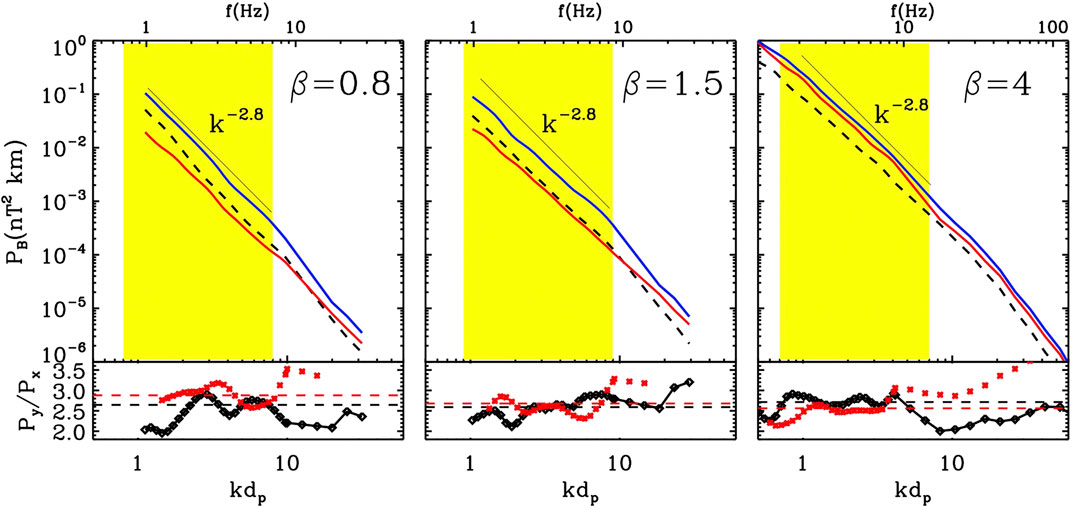
FIGURE 1. Cluster STAFF spectra for different intervals with
On the other hand, the power
Figure 2 shows an analogous selection from numerical simulations; note that, in the simulations,
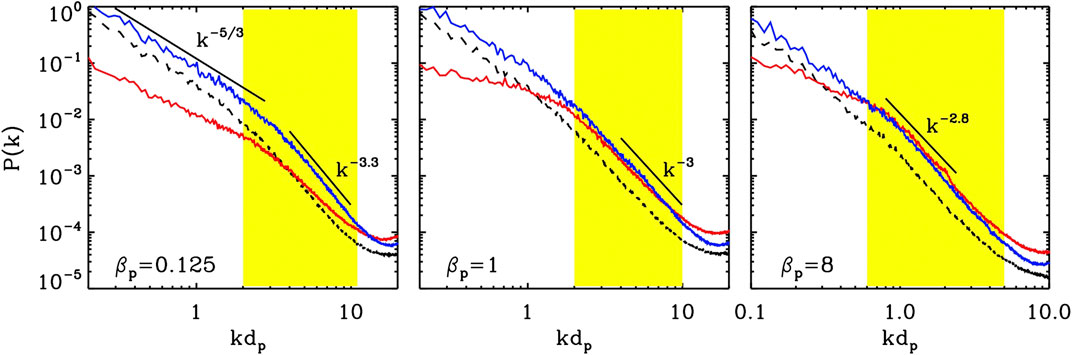
FIGURE 2. Magnetic field spectra from hybrid simulations for different beta regimes (
4. Spectral Anisotropy
4.1. Perpendicular Components Ratio
Bieber et al. (1996) and Saur and Bieber (1999) have investigated how different types of k-vectors distributions can generate a variable anisotropy in the observed magnetic field components, due to sampling effects. In the case of a gyrotropic 2D distribution of k-vectors, the ratio
To validate further this observational conclusion, we verify here the applicability of the Saur and Bieber model to sub‐ion scale turbulence. In the simulations, the spectrum is two-dimensional by construction and consistent with the axisymmetric initial conditions imposed in the x-y plane, it is also gyrotropic with respect to the out-of-plane magnetic field
First, it is instructive to discuss spectra shown in Figure 3. These are power spectra of the perpendicular components
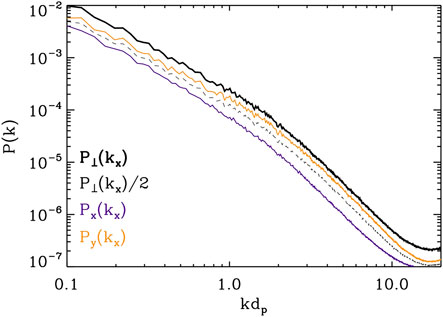
FIGURE 3. Reduced spectra of the fluctuations of the magnetic field components
Bearing this in mind, Figure 4 shows the ratio of the power in the perpendicular components for the three simulations shown in Figure 2. The
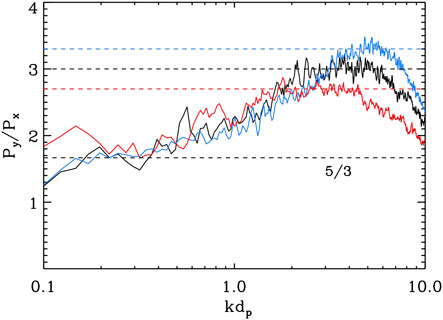
FIGURE 4. Hybrid simulations: spectra of the ratio of the perpendicular magnetic components
4.2. Beta Dependence
There is another interesting indication suggested by Figure 4, namely, the fact that the
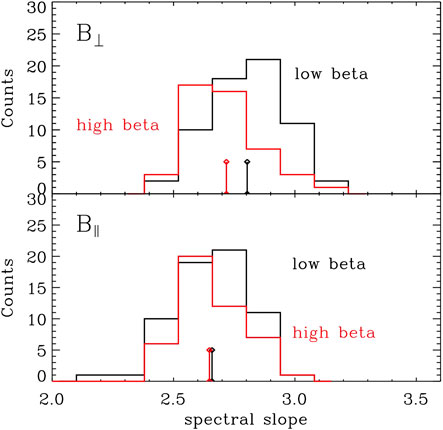
FIGURE 5. Spectral slope measured for different beta conditions in Cluster data; (black)
Moreover, a consequence of the behavior in Figure 5 is that while at high beta,
5. Magnetic Compressibility
We now investigate the role of the third magnetic field component
Figure 6 shows
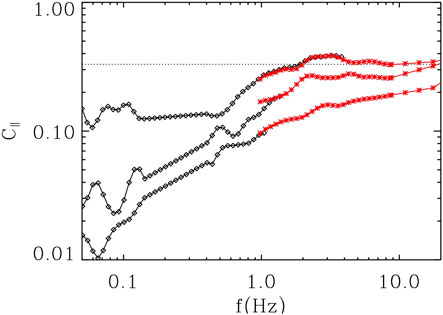
FIGURE 6. Examples of Cluster FGM (black) and STAFF (red) spectra of magnetic compressibility
To highlight further the β-dependence of the magnetic compressibility, Figure 7 shows
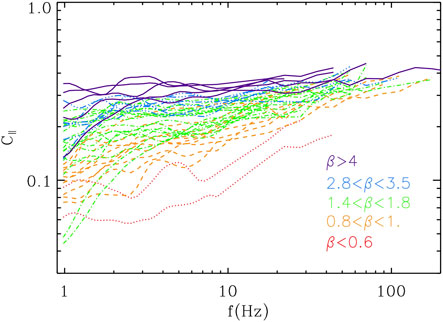
FIGURE 7. STAFF spectra of magnetic compressibility
5.1. Beta Dependence and Theoretical Predictions
First, it is useful to go again from frequency to k-vector spectra: in Figure 8, frequencies are converted into k-vectors and normalized with respect to the proton inertial length
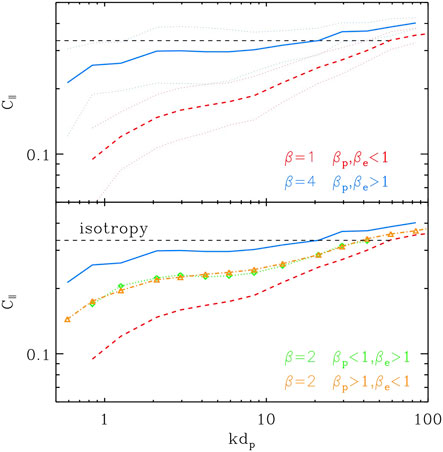
FIGURE 8. Cluster average spectra of magnetic compressibility for intervals with
We first identify two big categories such that both proton and electron betas are small, i.e.,
The remaining spectra are further separated in two other families: the first with
This observational finding is in very good agreement with the expectation from the following relation:
where
Eq. 2 can be derived (Schekochihin et al., 2009; Boldyrev et al., 2013) under the assumption of low-frequency magnetic structures in pressure balance at scales where the ion velocity becomes negligible compared to the electron one, or equivalently, the Hall term
5.2. Comparison with Simulations
To improve our analysis, we focus more in detail on the Cluster observations and compare them with numerical results. Note that, as in the simulations of Franci et al. (2016), it is only considered the case
The results of this comparison are shown in Figure 9, where scales are normalized to both
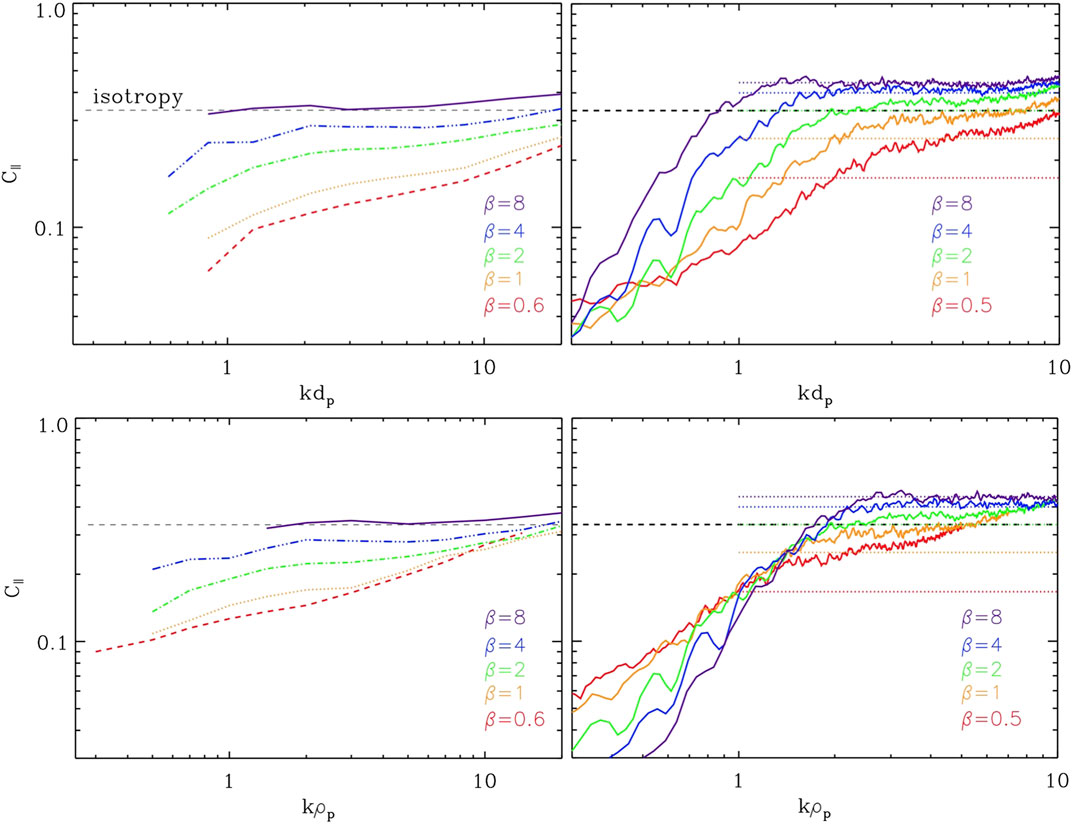
FIGURE 9. Top panels (left): Cluster spectra of magnetic compressibility for intervals binned on different β, encoded in different styles and colors. Only cases with
This seems to suggest a different behavior of the turbulent fluctuations populating the sub-ion cascade as a function of the beta. To investigate further this aspect, horizontal dotted lines in the right panels of Figure 9 show the theoretical prediction for the asymptotic level of
The situation is somewhat different when comparing predictions to the in situ data; in this case, there is a slight difference between the KAW level and the observed one, and this is persistent at all β. In particular, at high beta, it is apparent that while Eq. 2 predicts compressibility that goes beyond 1/3 (for
Interestingly, from Figure 9, it seems that neither
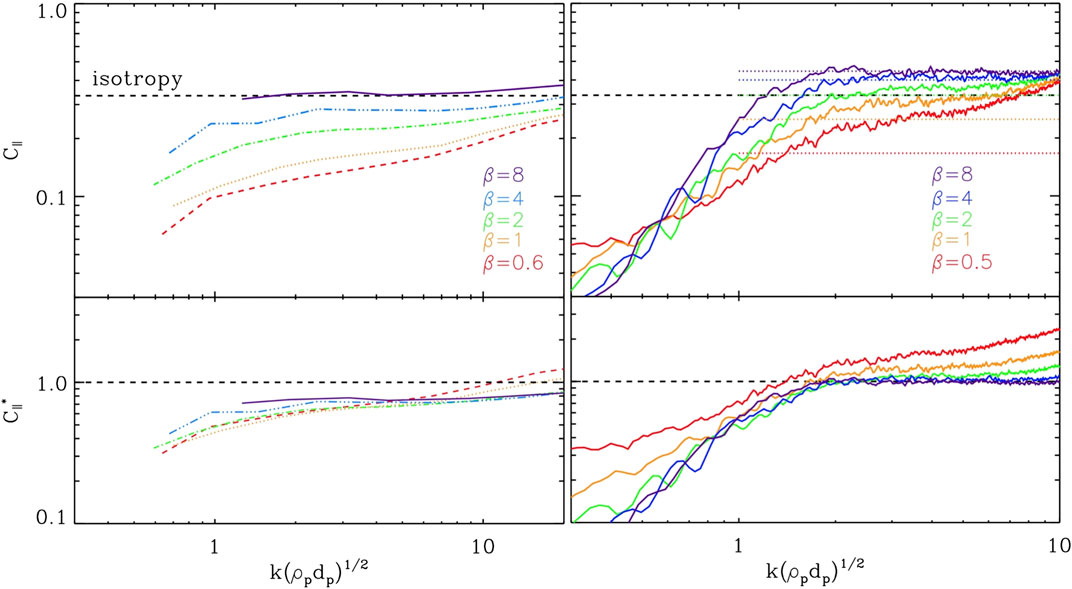
FIGURE 10. The same spectra as in Figure 9, but with k-vectors normalized to the mixed scale
It is then reasonable to use such a k-vector normalization to better evaluate the agreement with Eq. 2. In the bottom panels of the same figure
Finally, note that the increase in
6. Conclusion
In summary, we have discussed the properties of magnetic field spectra of turbulent fluctuations in the sub‐ion regime and their main dependence on the plasma beta. We have carried out a detailed comparison between in situ Cluster magnetic field observations in the frequency range f(Hz)
First, we investigated the spectral anisotropy of magnetic fluctuations at sub‐ion scales. Our simulations confirm that the model of Saur and Bieber (1999), originally developed for MHD range fluctuations, is valid also at kinetic scales; by applying the model to the numerical spectra obtained mimicking the sampling along a fixed direction made by spacecraft, we were able to successfully capture original spectral properties as well as their variation with β. This then reinforces the finding of Lacombe et al. (2017) who applied the Saur and Bieber model to kinetic-scale observations for the first time and concluded that fluctuations of the solar wind spectrum in the sub‐ion range are quasi-2D and gyrotropic. Moreover, we have shown that the component anisotropy measured in situ — leading to an apparent nongyrotropic spectrum from an original gyrotropic one (see also Turner et al., 2011) — is a direct consequence of the solenoidal condition of the magnetic field and the sampling procedure. This is not an effect related to the Doppler-shift of k-vectors swept through the spacecraft by the fast plasma flow and in fact, we were able to reproduce it in simulations just imposing a fixed sampling direction.
Note that our result about the global 2D-symmetry of the k-vectors around the magnetic field is not inconsistent with studies addressing the local shape of the eddies and suggesting the presence of a 3D anisotropy (e.g., Chen et al., 2012a; Verdini and Grappin, 2015; Verdini et al., 2018; Verdini et al., 2019; Wang et al., 2020). In our approach, we do not consider the specific orientation of the turbulent structures in the plane perpendicular to B, and it is reasonable to expect that the local 3D anisotropy is then lost. In other words, despite the 3D anisotropy of the turbulent eddies, their k-vectors can be oriented isotropically around B, leading then—in a frame like the one used here—to the 2D spectrum found in the Cluster observations. This does not exclude that some aspects of the 3D anisotropy could still be captured using a global approach; however, our study suggests that, in this case, one has to also carefully take into account the effects of the component anisotropy introduced by the sampling (Saur and Bieber, 1999, see also Figure 3 in this work).
For the magnetic compressibility
Our analysis also suggests that the increase in the compressibility at ion scales is controlled by an intermediate scale between the Larmor radius
Data Availability Statement
Publicly available datasets were analyzed in this study. This data can be found here: ESA Cluster archive: https://csa.esac.esa.int The numerical data are available at https://b2share.eudat.eu/records/a58135af9c9d429f92c15ce88bdfdd55.
Author Contributions
LM and LF performed the main analysis and produced figures. OA and CL identified Cluster intervals, provided the in situ dataset, and contributed to the observational spectral analysis. PH provided the hybrid code, LF performed the numerical simulations, and together with LM, SL, AV, and EP, they discussed the use and interpretation of numerical data. All authors contributed to the global interpretation of the results, as well as to their discussion and presentation in the manuscript. All authors revised the manuscript before submission.
Funding
This work was supported by the Programme National PNST of CNRS/INSU co-funded by CNES. It has also been funded by Fondazione Cassa di Risparmio di Firenze through the project HYPERCRHEL. LF was supported by Fondazione Cassa di Risparmio di Firenze, through the project Giovani Ricercatori Protagonisti, and by the United Kingdom Science and Technology Facilities Council (STFC) grants ST/P000622/1 and ST/T00018X/1. PH acknowledges grant 18-08861S of the Czech Science Foundation. OA and CL are supported by the French Centre National d’Etude Spatiales (CNES).
Conflict of Interest
The authors declare that the research was conducted in the absence of any commercial or financial relationships that could be construed as a potential conflict of interest.
The reviewer (SC) declared a past co-authorship with one of the authors (LF) to the handling Editor.
Acknowledgments
The authors acknowledge useful discussions with J. Stawarz, G. Howes, and A. Pitna. The authors acknowledge PRACE for awarding them access to resource Cartesius based in the Netherlands at SURFsara through the DECI-13 (Distributed European Computing Initiative) call (project HybTurb3D), and CINECA for the availability of high performance computing resources and support under the ISCRA initiative (grants HP10C877C4 and HP10BUUOJM) and the program Accordo Quadro INAF-CINECA 2017-2019 (grants C4A26 and C3A22a).
Appendix: Symbol Definitions and Normalized Units
The subscripts
References
Alexandrova, O., Krishna Jagarlamudi, V., Rossi, C., Maksimovic, M., Hellinger, P., Shprits, Y., et al. (2020). Kinetic turbulence in space plasmas observed in the near-Earth and near-Sun solar wind. arXiv e-prints arXiv: 2004.01102
Alexandrova, O., Lacombe, C., Mangeney, A., Grappin, R., and Maksimovic, M. (2012). Solar wind turbulent spectrum at plasma kinetic scales. Astrophys. J. 760, 121. doi:10.1088/0004-637X/760/2/121
Alexandrova, O., Lacombe, C., and Mangeney, A. (2008). Spectra and anisotropy of magnetic fluctuations in the Earth’s magnetosheath: Cluster observations. Ann. Geophys. 26, 3585–3596. doi:10.5194/angeo-26-3585-2008
Alexandrova, O., Saur, J., Lacombe, C., Mangeney, A., Mitchell, J., Schwartz, S. J., et al. (2009). Universality of solar-wind turbulent spectrum from MHD to electron scales. Phys. Rev. Lett. 103, 165003. doi:10.1103/PhysRevLett.103.165003
Arzamasskiy, L., Kunz, M. W., Chandran, B. D. G., and Quataert, E. (2019). Hybrid-kinetic simulations of ion heating in alfvénic turbulence. Astrophys. J. 879, 53. doi:10.3847/1538-4357/ab20cc
Bandyopadhyay, R., Sorriso-Valvo, L., Chasapis, A. r., Hellinger, P., Matthaeus, W. H., Verdini, A., et al. (2020). In Situ observation of hall magnetohydrodynamic cascade in space plasma. Phys. Rev. Lett. 124, 225101. doi:10.1103/PhysRevLett.124.225101
Bieber, J. W., Wanner, W., and Matthaeus, W. H. (1996). Dominant two-dimensional solar wind turbulence with implications for cosmic ray transport. J. Geophys. Res. 101, 2511–2522. doi:10.1029/95JA02588
Biskamp, D., Schwarz, E., and Drake, J. F. (1996). Two-dimensional electron magnetohydrodynamic turbulence. Phys. Rev. Lett. 76, 1264–1267. doi:10.1103/PhysRevLett.76.1264
Boldyrev, S., Horaites, K., Xia, Q., and Perez, J. C. (2013). Toward a theory of astrophysical plasma turbulence at subproton scales. Astrophys. J 777, 41. doi:10.1088/0004-637X/777/1/41
Boldyrev, S., and Perez, J. C. (2012). Spectrum of kinetic-alfvén turbulence. Astrophys. J. Lett. 758, L44. doi:10.1088/2041-8205/758/2/L44
Bruno, R., and Carbone, V. (2013). The solar wind as a turbulence laboratory. Living Rev. Sol. Phys. 10, 2. doi:10.12942/lrsp-2013-2
Cerri, S. S., Califano, F., Jenko, F., Told, D., and Rincon, F. (2016). Subproton-scale cascades in solar wind turbulence: driven hybrid-kinetic simulations. Astrophys. J. Lett. 822, L12. doi:10.3847/2041-8205/822/1/L12
Cerri, S. S., Grošelj, D., and Franci, L. (2019). Kinetic plasma turbulence: recent insights and open questions from 3D3V simulations. Front. Astron. Space Sci. 6, 64. doi:10.3389/fspas.2019.00064
Cerri, S. S., Kunz, M. W., and Califano, F. (2018). Dual phase-space cascades in 3D hybrid-vlasov-maxwell turbulence. Astrophys. J. Lett. 856, L13. doi:10.3847/2041-8213/aab557
Cerri, S. S., Servidio, S., and Califano, F. (2017). Kinetic cascade in solar-wind turbulence: 3D3V hybrid-kinetic simulations with electron inertia. Astrophys. J. Lett. 846, L18. doi:10.3847/2041-8213/aa87b0
Chen, C. H. K., Bale, S. D., Salem, C. S., and Maruca, B. A. (2013a). Residual energy spectrum of solar wind turbulence. Astrophys. J. 770, 125. doi:10.1088/0004-637X/770/2/125
Chen, C. H. K., and Boldyrev, S. (2017). Nature of kinetic scale turbulence in the Earth’s magnetosheath. Astrophys. J. 842, 122. doi:10.3847/1538-4357/aa74e0
Chen, C. H. K., Boldyrev, S., Xia, Q., and Perez, J. C. (2013b). Nature of subproton scale turbulence in the solar wind. Phys. Rev. Lett. 110, 225002. doi:10.1103/PhysRevLett.110.225002
Chen, C. H. K., Horbury, T. S., Schekochihin, A. A., Wicks, R. T., Alexandrova, O., and Mitchell, J. (2010). Anisotropy of solar wind turbulence between ion and electron scales. Phys. Rev. Lett. 104, 255002. doi:10.1103/PhysRevLett.104.255002
Chen, C. H. K., Leung, L., Boldyrev, S., Maruca, B. A., and Bale, S. D. (2014). Ion-scale spectral break of solar wind turbulence at high and low beta. Geophys. Res. Let. 41, 8081–8088. doi:10.1002/2014GL062009
Chen, C. H. K., Mallet, A., Schekochihin, A. A., Horbury, T. S., Wicks, R. T., and Bale, S. D. (2012a). Three-dimensional structure of solar wind turbulence. Astrophys. J. 758, 120. doi:10.1088/0004-637X/758/2/120
Chen, C. H. K., Salem, C. S., Bonnell, J. W., Mozer, F. S., and Bale, S. D. (2012b). Density fluctuation spectrum of solar wind turbulence between ion and electron scales. Phys. Rev. Lett. 109, 035001. doi:10.1103/PhysRevLett.109.035001
Chen, C. H. K. (2016). Recent progress in astrophysical plasma turbulence from solar wind observations. J. Plasma Phys. 82, 535820602. doi:10.1017/S0022377816001124
Dasso, S., Milano, L. J., Matthaeus, W. H., and Smith, C. W. (2005). Anisotropy in fast and slow solar wind fluctuations. Astrophys. J. 635, L181–L184. doi:10.1086/499559
Franci, L., Hellinger, P., Guarrasi, M., Chen, C. H. K., Papini, E., Verdini, A., et al. (2018a). Three-dimensional simulations of solar wind turbulence with the hybrid code CAMELIA. J. Phys. Conf. Ser. 1031, 012002. doi:10.1088/1742-6596/1031/1/012002
Franci, L., Landi, S., Verdini, A., Matteini, L., and Hellinger, P. (2018b). Solar wind turbulent cascade from MHD to sub-ion scales: large-size 3D hybrid particle-in-cell simulations. Astrophys. J. 853, 26. doi:10.3847/1538-4357/aaa3e8
Franci, L., Landi, S., Matteini, L., Verdini, A., and Hellinger, P. (2015a). High-resolution hybrid simulations of kinetic plasma turbulence at proton scales. Astrophys. J. 812, 21. doi:10.1088/0004-637X/812/1/21
Franci, L., Verdini, A., Matteini, L., Landi, S., and Hellinger, P. (2015b). Solar wind turbulence from MHD to sub-ion scales: high-resolution hybrid simulations. Astrophys. J. Lett. 804, L39. doi:10.1088/2041-8205/804/2/L39
Franci, L., Landi, S., Matteini, L., Verdini, A., and Hellinger, P. (2016). Plasma beta dependence of the ion-scale spectral break of solar wind turbulence: high-resolution 2D hybrid simulations. Astrophys. J. 833, 91. doi:10.3847/1538-4357/833/1/91
Grošelj, D., Cerri, S. S., Bañón Navarro, A., Willmott, C., Told, D., Loureiro, N. F., et al. (2017). Fully kinetic versus reduced-kinetic modeling of collisionless plasma turbulence. Astrophys. J. 847, 28. doi:10.3847/1538-4357/aa894d
Grošelj, D., Chen, C. H. K., Mallet, A., Samtaney, R., Schneider, K., and Jenko, F. (2019). Kinetic turbulence in astrophysical plasmas: waves and/or structures? Phys. Rev. X 9, 031037. doi:10.1103/PhysRevX.9.031037
Hamilton, K., Smith, C. W., Vasquez, B. J., and Leamon, R. J. (2008). Anisotropies and helicities in the solar wind inertial and dissipation ranges at 1 AU. J. Geophys. Res. Space Phys. 113, A01106. doi:10.1029/2007JA012559
Hellinger, P., Landi, S., Matteini, L., Verdini, A., and Franci, L. (2017). Mirror instability in the turbulent solar wind. Astrophys. J. 838, 158. doi:10.3847/1538-4357/aa67e0
Hellinger, P., Matteini, L., Landi, S., Verdini, A., Franci, L., and Travnicek, P. M. (2015). Plasma turbulence and kinetic instabilities at ion scales in the expanding solar wind. Astrophys. J. Lett. 811, L32
Hellinger, P., Verdini, A., Landi, S., Franci, L., and Matteini, L. (2018). von Kármán-Howarth equation for Hall magnetohydrodynamics: hybrid simulations. Astrophys. J. Lett. 857, L19. doi:10.3847/2041-8213/aabc06
Horbury, T. S., and Balogh, A. (2001). Evolution of magnetic field fluctuations in high-speed solar wind streams: ulysses and Helios observations. J. Geophys. Res. 106, 15929–15940. doi:10.1029/2000JA000108
Horbury, T. S., Forman, M., and Oughton, S. (2008). Anisotropic scaling of magnetohydrodynamic turbulence. Phys. Rev. Lett. 101, 175005. doi:10.1103/PhysRevLett.101.175005
Howes, G. G., Dorland, W., Cowley, S. C., Hammett, G. W., Quataert, E., Schekochihin, A. A., et al. (2008). Kinetic simulations of magnetized turbulence in astrophysical plasmas. Phys. Rev. Lett. 100, 065004. doi:10.1103/PhysRevLett.100.065004
Howes, G. G., Tenbarge, J. M., Dorland, W., Quataert, E., Schekochihin, A. A., Numata, R., et al. (2011). Gyrokinetic simulations of solar wind turbulence from ion to electron scales. Phys. Rev. Lett. 107, 035004. doi:10.1103/PhysRevLett.107.035004
Howes, G. G. (2015). The inherently three-dimensional nature of magnetized plasma turbulence. J. Plasma Phys. 81, 325810203. doi:10.1017/S0022377814001056
Jovanovic, D., Alexandrova, O., Maksimovic, M., and Belic, M. (2020). Fluid theory of coherent magnetic vortices in high-β space plasmas. Astrophys. J. 896 (1), 18. doi:10.3847/1538-4357/ab8a45
Kiyani, K. H., Chapman, S. C., Khotyaintsev, Y. V., Dunlop, M. W., and Sahraoui, F. (2009). Global scale-invariant dissipation in collisionless plasma turbulence. Phys. Rev. Lett. 103, 075006. doi:10.1103/PhysRevLett.103.075006
Kiyani, K. H., Chapman, S. C., Sahraoui, F., Hnat, B., Fauvarque, O., and Khotyaintsev, Y. V. (2013). Enhanced magnetic compressibility and isotropic scale invariance at sub-ion larmor scales in solar wind turbulence. Astrophys. J. 763, 10. doi:10.1088/0004-637X/763/1/10
Lacombe, C., Alexandrova, O., and Matteini, L. (2017). Anisotropies of the magnetic field fluctuations at kinetic scales in the solar wind: cluster observations. Astrophys. J. 848, 45. doi:10.3847/1538-4357/aa8c06
Landi, S., Franci, L., Papini, E., Verdini, A., Matteini, L., and Hellinger, P. (2019). Spectral anisotropies and intermittency of plasma turbulence at ion kinetic scales. arXiv eprint arXiv:1904.03903
Loureiro, N. F., and Boldyrev, S. (2017). Collisionless reconnection in magnetohydrodynamic and kinetic turbulence. Astrophys. J. 850, 182. doi:10.3847/1538-4357/aa9754
Mallet, A., Schekochihin, A. A., and Chandran, B. D. G. (2017). Disruption of sheet-like structures in Alfvénic turbulence by magnetic reconnection. Mon. Notices Royal Astron. Soc. 468, 4862–4871. doi:10.1093/mnras/stx670
Matteini, L., Alexandrova, O., Chen, C. H. K., and Lacombe, C. (2017). Electric and magnetic spectra from MHD to electron scales in the magnetosheath. Mon. Notices Royal Astron. Soc. 466, 945–951. doi:10.1093/mnras/stw3163
Matthaeus, W. H., Goldstein, M. L., and Roberts, D. A. (1990). Evidence for the presence of quasi-two-dimensional nearly incompressible fluctuations in the solar wind. J. Geophys. Res. 95, 20673–20683. doi:10.1029/JA095iA12p20673
Matthews, A. P. (1994). Current advance method and cyclic leapfrog for 2d multispecies hybrid plasma simulations. J. Comp. Phys. 112, 102–116. doi:10.1006/jcph.1994.1084
Osman, K. T., and Horbury, T. S. (2006). Multispacecraft measurement of anisotropic correlation functions in solar wind turbulence. Astrophys. J. 654, L103–L106. doi:10.1086/510906
Papini, E., Franci, L., Landi, S., Verdini, A., Matteini, L., and Hellinger, P. (2019). Can Hall magnetohydrodynamics explain plasma turbulence at sub-ion scales? Astrophys. J. 870, 52. doi:10.3847/1538-4357/aaf003
Parashar, T. N., Oughton, S., Matthaeus, W. H., and Wan, M. (2016). Variance anisotropy in kinetic plasmas. Astrophys. J. 824, 44. doi:10.3847/0004-637X/824/1/44
Passot, T., and Sulem, P. L. (2015). A model for the non-universal power law of the solar wind sub-ion-scale magnetic spectrum. Astrophys. J. Lett. 812, L37. doi:10.1088/2041-8205/812/2/L37
Passot, T., Sulem, P. L., and Tassi, E. (2017). Electron-scale reduced fluid models with gyroviscous effects. J. Plasma Phys. 83, 715830402. doi:10.1017/S0022377817000514
Perrone, D., Alexandrova, O., Roberts, O. W., Lion, S., Lacombe, C., Walsh, A., et al. (2017). Coherent structures at ion scales in fast solar wind: cluster observations. Astrophys. J. 849, 49. doi:10.3847/1538-4357/aa9022
Perrone, D., Valentini, F., Servidio, S., Dalena, S., and Veltri, P. (2013). Vlasov simulations of multi-ion plasma turbulence in the solar wind. Astrophys. J. 762, 99. doi:10.1088/0004-637X/762/2/99
Pitňa, A., Šafránková, J., Němeček, Z., Franci, L., Pi, G., and Montagud Camps, V. (2019). Characteristics of solar wind fluctuations at and below ion scales. Astrophys. J. 879, 82. doi:10.3847/1538-4357/ab22b8
Podesta, J. J., and TenBarge, J. M. (2012). Scale dependence of the variance anisotropy near the proton gyroradius scale: additional evidence for kinetic Alfvén waves in the solar wind at 1 AU. J. Geophys. Res. Space Phys.117, A10106. doi:10.1029/2012JA017724
Roberts, O. W., Alexandrova, O., Kajdič, P., Turc, L., Perrone, D., Escoubet, C. P., et al. (2017a). Variability of the magnetic field power spectrum in the solar wind at electron scales. Astrophys. J. 850, 120. doi:10.3847/1538-4357/aa93e5
Roberts, O. W., Narita, Y., and Escoubet, C. P. (2017b). Direct measurement of anisotropic and asymmetric wave vector spectrum in ion-scale solar wind turbulence. Astrophys. J. Lett. 851, L11. doi:10.3847/2041-8213/aa9bf3
Šafránková, J., Němeček, Z., Přech, L., and Zastenker, G. N. (2013). Ion kinetic scale in the solar wind observed. Phys. Rev. Lett. 110, 025004. doi:10.1103/PhysRevLett.110.025004
Sahraoui, F., Goldstein, M. L., Belmont, G., Canu, P., and Rezeau, L. (2010). Three dimensional anisotropic k spectra of turbulence at subproton scales in the solar wind. Phys. Rev. Lett. 105, 131101. doi:10.1103/PhysRevLett.105.131101
Sahraoui, F., Huang, S. Y., Belmont, G., Goldstein, M. L., Rétino, A., Robert, P., et al. (2013). Scaling of the electron dissipation range of solar wind turbulence. Astrophys. J. 777, 15. doi:10.1088/0004-637X/777/1/15
Salem, C. S., Howes, G. G., Sundkvist, D., Bale, S. D., Chaston, C. C., Chen, C. H. K., et al. (2012). Identification of kinetic Alfvén wave turbulence in the solar wind. Astrophys. J. Lett. 745, L9. doi:10.1088/2041-8205/745/1/L9
Saur, J., and Bieber, J. W. (1999). Geometry of low-frequency solar wind magnetic turbulence: evidence for radially aligned Alfénic fluctuations. J. Geophys. Res. 104, 9975–9988. doi:10.1029/1998JA900077
Schekochihin, A. A., Cowley, S. C., Dorland, W., Hammett, G. W., Howes, G. G., Quataert, E., et al. (2009). Astrophysical gyrokinetics: kinetic and fluid turbulent cascades in magnetized weakly collisional plasmas. Astrophys. J. Suppl. 182, 310–377. doi:10.1088/0067-0049/182/1/310
Schreiner, A., and Saur, J. (2017). A model for dissipation of solar wind magnetic turbulence by kinetic Alfvén waves at electron scales: comparison with observations. Astrophys. J. 835, 133. doi:10.3847/1538-4357/835/2/133
Smith, C. W., Vasquez, B. J., and Hamilton, K. (2006). Interplanetary magnetic fluctuation anisotropy in the inertial range. J. Geophys. Res. Space Phys. 111, A09111. doi:10.1029/2006JA011651
Stawarz, J. E., Eriksson, S., Wilder, F. D., Ergun, R. E., Schwartz, S. J., Pouquet, A., et al. (2016). Observations of turbulence in a kelvin-helmholtz event on 8 september 2015 by the magnetospheric multiscale mission. J. Geophys. Res. 121 (11), 11021–11034. doi:10.1002/2016JA023458. 2016JA023458
Stawarz, J. E., Matteini, L., Parashar, T. N., Franci, L., Eastwood, J. P., Gonzalez, C. A., et al. (2020). Generalized ohms law decomposition of the electric field in magnetosheath turbulence: magnetospheric multiscale observations. Earth and Space Science Open Archive. 31. doi:10.1002/essoar.10503618.1
Sulem, P. L., Passot, T., Laveder, D., and Borgogno, D. (2016). Influence of the nonlinearity parameter on the solar wind sub-ion magnetic energy spectrum: FLR-Landau fluid simulations. Astrophys. J. 818, 66. doi:10.3847/0004-637X/818/1/66
TenBarge, J. M., Podesta, J. J., Klein, K. G., and Howes, G. G. (2012). Interpreting magnetic variance anisotropy measurements in the solar wind. Astrophys. J. 753, 107. doi:10.1088/0004-637X/753/2/107
Turner, A. J., Gogoberidze, G., Chapman, S. C., Hnat, B., and Müller, W. C. (2011). Nonaxisymmetric anisotropy of solar wind turbulence. Phys. Rev. Lett. 107, 095002. doi:10.1103/PhysRevLett.107.095002
Valentini, F., Servidio, S., Perrone, D., Califano, F., Matthaeus, W. H., and Veltri, P. (2014). Hybrid Vlasov-Maxwell simulations of two-dimensional turbulence in plasmas. Phys. Plasmas. 21, 082307. doi:10.1063/1.4893301
Verdini, A., and Grappin, R. (2015). Imprints of expansion on the local anisotropy of solar wind turbulence. Astrophys. J. Lett. 808, L34. doi:10.1088/2041-8205/808/2/L34
Verdini, A., Grappin, R., Alexandrova, O., Franci, L., Landi, S., Matteini, L., et al. (2019). Three-dimensional local anisotropy of velocity fluctuations in the solar wind. Mon. Notices Royal Astron. Soc. 486, 3006–3018. doi:10.1093/mnras/stz1041
Verdini, A., Grappin, R., Alexandrova, O., and Lion, S. (2018). 3D anisotropy of solar wind turbulence, tubes, or ribbons? Astrophys. J. 853, 85. doi:10.3847/1538-4357/aaa433
Wang, T., He, J., Alexandrova, O., Dunlop, M., and Perrone, D. (2020). Observational quantification of three-dimensional anisotropies and scalings of space plasma turbulence at kinetic scales. Astrophys. J. 898, 91. doi:10.3847/1538-4357/ab99ca
Wang, X., Tu, C., He, J., and Wang, L. (2018). On the full-range β dependence of ion-scale spectral break in the solar wind turbulence. Astrophys. J. 857, 136. doi:10.3847/1538-4357/aab960
Wicks, R. T., Horbury, T. S., Chen, C. H. K., and Schekochihin, A. A. (2010). Power and spectral index anisotropy of the entire inertial range of turbulence in the fast solar wind. Mon. Notices Royal Astron. Soc. 407, L31–L35. doi:10.1111/j.1745-3933.2010.00898.x
Keywords: solar wind, plasma turbulence, kinetic physics, numerical simulations, in situ observation
Citation: Matteini L, Franci L, Alexandrova O, Lacombe C, Landi S, Hellinger P, Papini E and Verdini A (2020) Magnetic Field Turbulence in the Solar Wind at Sub‐ion Scales: In Situ Observations and Numerical Simulations. Front. Astron. Space Sci. 7:563075. doi: 10.3389/fspas.2020.563075
Received: 17 May 2020; Accepted: 23 September 2020;
Published: 08 December 2020.
Edited by:
Alexandros Chasapis, University of Delaware, United StatesReviewed by:
Silvio Sergio Cerri, Princeton University, United StatesKristopher G. Klein, University of Arizona, United States
Copyright © 2020 Matteini, Franci, Alexandrova, Lacombe, Landi, Hellinger, Papini and Verdini. This is an open-access article distributed under the terms of the Creative Commons Attribution License (CC BY). The use, distribution or reproduction in other forums is permitted, provided the original author(s) and the copyright owner(s) are credited and that the original publication in this journal is cited, in accordance with accepted academic practice. No use, distribution or reproduction is permitted which does not comply with these terms.
*Correspondence: L. Matteini, bC5tYXR0ZWluaUBpbXBlcmlhbC5hYy51aw==