 Pablo Villanueva-Domingo
 Olga Mena
 Sergio Palomares-Ruiz
- Instituto de Física Corpuscular (IFIC), CSIC-Universitat de València, Paterna, Spain
Primordial black holes (PBHs) represent a natural candidate for one of the components of the dark matter (DM) in the Universe. In this review, we shall discuss the basics of their formation, abundance and signatures. Some of their characteristic signals are examined, such as the emission of particles due to Hawking evaporation and the accretion of the surrounding matter, effects which could leave an impact in the evolution of the Universe and the formation of structures. The most relevant probes capable of constraining their masses and population are discussed.
1 Introduction
The hypothesis of the formation of black holes (BHs) in the early Universe was first suggested in 1967 by Zeldovich and Novikov (Zel’dovich and Novikov, 1967), and independently by Hawking in 1971 (Hawking, 1971). Soon after, the possibility that primordial black holes (PBHs) could account for at least part of the DM became obvious (Chapline, 1975; Meszaros, 1975). At that time, the DM question started to be outlined as one of the fundamental problems in cosmology [see, e.g., the reviews in Sanders (2010); Bertone and Hooper (2018)]. DM (partly) composed by PBHs constitutes an exciting possibility, presenting an enormous number of observable signatures which can constrain its parameter space, as shall be detailed in Sec. 6. The variety of phenomenological effects produced by PBHs allows placing stringent bounds on the abundance of PBHs, usually indicated by the energy fraction of DM as PBHs,
Shortly after the first detection of gravitational waves from a merger of
Unlike stellar BHs, formed from the collapse of a massive star, which can present masses only above
PBH formation is already present in standard cosmologies, although extremely unlikely. However, their production usually requires some exotic inflationary scenarios or physics beyond the Standard Model (BSM) in order to obtain a large enough abundance. The typically considered formation mechanism of PBHs arises from the direct collapse of primordial fluctuations, whose power is enhanced at small scales as a consequence of some inflationary potential, as we shall further comment on below. There are, however, other scenarios which naturally predict a population of PBHs as a result of phase transitions in the early Universe and by the collapse of topological defects (Hawking et al., 1982; Hawking, 1989; Polnarev and Zembowicz, 1991; Garriga et al., 2016; Deng et al., 2017; Deng and Vilenkin, 2017). Hence, the existence of PBHs would provide valuable hints about the still unknown physics of the very early Universe (see, e.g., Polnarev and Khlopov, 1985; Khlopov, 2010; Belotsky et al., 2014), and may allow to probe high-energy scales and supersymmetric theories (Ketov and Khlopov, 2019).
In this review, the most relevant aspects of PBHs as DM are briefly discussed, such as the mechanism of formation in Section 2, the initial abundance and mass distribution in Section 3, the process of accretion in Section 4 and other PBH features, which could leave imprints on different observables, in Section 5. Current observational constraints on their population are summarized in Section 6, and we conclude in Section 7.
2 Formation and Conditions of Collapse
The mass of a BH which collapsed in the early Universe depends on its formation time. A BH can be characterized by an extremely dense amount of matter in a very compact region, i.e., within the well-known Schwarzschild radius,
PBHs with masses of
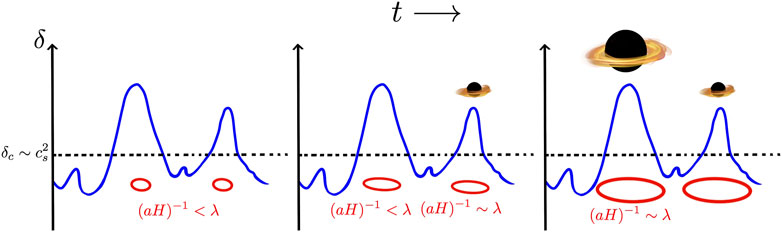
FIGURE 1. Sketch of the formation of PBHs from overdensities for three different successive moments. When fluctuations larger than a critical threshold
Since PBHs are formed when fluctuations cross the horizon by the time of formation,
Hence, probing a given scale k could constrain a PBH population of its corresponding mass. Furthermore, an enhancement in the power spectrum around that scale would result in a large number of PBHs of such masses. In this review, we shall only consider PBHs formed during the radiation era. Those produced before inflation ends would have been diluted due to their negligible density during the inflationary accelerated expansion. PBHs formed during the matter-dominated era, or in an early matter domination era previous to the radiation era, have also been considered in the literature, and may have different imprints, since the conditions of collapse are less restrictive, and could start from smaller inhomogeneities (see, e.g., Green and Kavanagh, 2021).
3 Abundance and Mass Function OF PBHS
It is possible to estimate the initial abundance of PBHs at the moment of formation, taking into account all overdensities above the threshold for collapse,
where in the last equality,
Nonetheless, although the initial fraction β is a very small quantity, since matter and radiation densities scale differently with redshift [
For initial fractions as low as
Depending on the specific mechanism of formation, a population of PBHs with different masses could be generated. The specific shape of the enhancement of fluctuations determines the mass distribution function. Sharp peaks in the power spectrum imply approximately monochromatic distributions. For instance, chaotic new inflation may give rise to relatively narrow peaks (Yokoyama, 1998; Saito et al., 2008). However, inflation models with an inflection point in a plateau of the potential (García-Bellido, 2017; García-Bellido and Ruiz Morales, 2017), or hybrid inflation (Clesse and García-Bellido, 2015), predict, instead, extended mass functions, which can span over a large range of PBHs masses. In this review, we focus on monochromatic distributions for simplicity, although it is possible to translate constraints to extended mass functions, which can be very stringent despite the fact of having more parameters to fit (Carr et al., 2017; Bellomo et al., 2018). Nonetheless, even if there are bounds that exclude
4 Accretion Onto PBHS
One of the consequences of the existence of PBHs with greater impact on different observables is the process of accretion. Infalling matter onto PBHs would release radiation, injecting energy into the surrounding medium, and strongly impacting its thermal state, leaving significant observable signatures. The physics of accretion is highly complex, but one can attempt a simplified approach considering the spherical non-relativistic limit, following the seminal work by Bondi (1952). In this framework, the BH is treated as a point mass surrounded by matter, embedded in a medium which tends to constant density far enough from the BH. The relevant scale is the so-called Bondi radius, defined by
where
where the parameter λ is the dimensionless accretion rate and depends on the equation of state, but it is order
On the other hand, real BHs spin and form an accreting disk. Thus, the spherical symmetric case may not be applicable. Even though PBH spins are expected to be small, an accretion disk would form if the angular momentum is large enough to keep matter orbiting at Keplerian orbits at distances much larger than the innermost stable orbits, which are roughy given by the Schwarzschild radius (Agol and Kamionkowski, 2002). Applying this criterion, the formation of accretion disks around PBHs has been suggested to occur if the condition
The matter falling onto BHs is greatly accelerated, which gives rise to radiative emission of high-energy photons by processes such as bremsstrahlung. The luminosity of accreting BHs is proportional to its accretion rate, and can be written as (Xie and Yuan, 2012)
where
If the accretion disk is optically thin, most of the energy released through viscous dissipation is radiated away, and the luminosities obtained can be close to the Eddington luminosity,
Finally, the energy emitted in the accretion processes is deposited through different channels into the medium. The energy deposition rate for each channel reads (Ali-Haïmoud and Kamionkowski, 2017; Poulin et al., 2017b)
where the subscript c denotes the channel in which energy is deposited, namely: ionization, heating, or atomic excitations (where the
5 Other Generic Features
A noteworthy phenomenon of BHs is that of evaporation. Due to quantum effects in curved spacetimes, BHs may emit particles at their event horizon, as was noticed in Hawking (1974). The emitted radiation would have a nearly thermal black body spectrum, with a temperature given by (Carr et al., 2010)
which is known as Hawking temperature. Due to this emission, BHs would slowly lose mass until completely evaporate. The lifetime of a PBH of initial mass M is (Lopresto, 2003)
Thus, the lower the PBH mass, the earlier it evaporates. Those with masses of 1015 g or below would have already evaporated by now, having lifetimes shorter than the age of the Universe (Page, 1976), so they cannot contribute to the current DM abundance. These evaporation products or the effects they produce in different observables can be search for in a variety of experiments, probing different mass ranges. Detailed computations of the emitted spectra can be performed by codes such as BlackHawk Arbey and Auffinger (2019).
Another important feature is that of clustering. If fluctuations are originally Gaussian distributed and around a relatively narrow peak, PBHs are not expected to be originated in clusters, being initially randomly distributed on small scales (Ali-Haïmoud, 2018; Desjacques and Riotto, 2018). However, either primordial non-gaussianities or a broad peak in the power spectrum could lead to a significant initial clustering (Ballesteros et al., 2018; Suyama and Yokoyama, 2019) [although broad spectra have also been argued not to produce appreciable clustering (Moradinezhad Dizgah et al., 2019)]. Anyway, PBHs could become bounded as the Universe evolves. A proper determination of their clustering properties at later times is of great importance, for instance, in order to estimate their merger rates (Desjacques and Riotto, 2018; De Luca et al., 2020a). Indeed, the formation of clusters could alleviate some constraints on the PBH abundance (Belotsky et al., 2019).
On another hand, since PBHs would be formed from the collapse of high density peaks relatively spherically symmetric, their torques and angular momentum are expected to be small (Chiba and Yokoyama, 2017; Mirbabayi et al., 2020). It is usually quantified with the dimensionless spin parameter,
Furthermore, due to the discrete nature of PBHs, a Poisson shot noise contribution to the matter power spectrum, constant in wavenumber,
6 Observational Constraints on PBHS as DM
PBHs can impact cosmology and astrophysics in a wide range of ways, leaving different observational effects which allow to constrain their properties. In this section, we review the most important bounds on the current fraction of PBHs as DM,
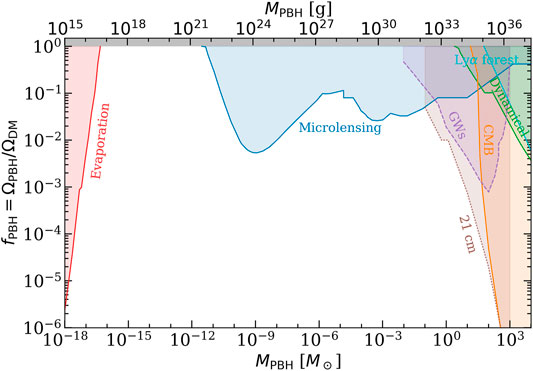
FIGURE 2. Compilation of constraints on the PBH fraction (with respect to DM) as a function of the PBH mass, assuming a monochromatic mass function. The different probes considered are: impact of PBH evaporation (red) on the extragalactic γ-ray background (Carr et al., 2010) and on the CMB spectrum (Clark et al., 2017); non-observation of microlensing events (blue) from the MACHO (Alcock et al., 2001), EROS (Tisserand et al., 2007), Kepler (Griest et al., 2014), Icarus (Oguri et al., 2018), OGLE (Niikura et al., 2019b) and Subaru-HSC (Croon et al., 2020) collaborations; PBH accretion signatures on the CMB (orange), assuming spherical accretion of PBHs within halos (Serpico et al., 2020); dynamical constraints, such as disruption of stellar systems by the presence of PBHs (green), on wide binaries (Monroy-Rodríguez and Allen, 2014) and on ultra-faint dwarf galaxies (Brandt, 2016); power spectrum from the Lyα forest (cyan) (Murgia et al., 2019); merger rates from gravitational waves (purple), either from individual mergers (Kavanagh et al., 2018; Abbott et al., 2019) or from searches of stochastic gravitational wave background (Chen and Huang, 2020). Gravitational waves limits are denoted by dashed lines, since they could be invalidated (Boehm et al., 2021). Dotted brown line corresponds to forecasts from the 21 cm power spectrum with SKA sensitivities (Mena et al., 2019) and from 21 cm forest prospects (Villanueva-Domingo and Ichiki, 2021). Figure created with the publicly available Python code PBHbounds (Kavanagh, 2019).
Evaporation
Since BHs emit energy due to Hawking radiation, those with a lifetime shorter than the age of the Universe must have disintegrated nowadays, a fact which excludes PBHs with
Microlensing
If a compact object crosses the line of sight of a star, it may produce a so-called microlensing effect, which implies a transient and achromatic amplification of its flux. The range of masses of the objects which can produce it span from
Gravitational Waves
The observation of BH mergers by LIGO and Virgo collaborations can be employed to constrain the allowed number of PBHs. Demanding that the predicted merger rates of PBH binaries cannot exceed the ones measured by gravitational waves, tight upper bounds of
Dynamical Constraints
Due to two-body interactions, kinetic energies of systems of different masses usually become balanced and match. If a stellar system also has an additional MACHO population, its stars would gain kinetic energy and, due to the virial theorem, the system would expand. Therefore, the presence of PBHs would dynamically heat star clusters, making them larger and with higher velocity dispersions, leading to an eventual dissolution into its host galaxy. Populations with high mass to luminosity ratios are more sensitive to this effect, as happens with ultra faint dwarf galaxies (UFDW), which would be disrupted by the presence of PBHs. Making use of these effects, tight bounds have been obtained at
CMB
Radiation emitted either by accretion or from Hawking evaporation may affect the CMB spectrum in two ways: producing spectral distortions and modifying temperature anisotropies. The energetic radiation can enhance the ionization rate, delay recombination and shift the peaks of the CMB anisotropy spectrum, as well as induce more diffusion damping. The polarization spectrum could also be modified, since the increase of the free electron fraction would increase the Thomson optical depth and enhance the reionization bump at large angular scales. Although early CMB analyses (Ricotti et al., 2008) found very stringent bounds on the allowed abundance of accreting PBHs, later works revisited these computations and found much milder constraints (Horowitz, 2016; Ali-Haïmoud and Kamionkowski, 2017). On another hand, while the former constraints rely on the assumption of spherical accretion, accreting disks have been argued to be more realistic for PBHs, resulting in tighter limits (Poulin et al., 2017b). Taking into account that PBHs could be immersed in DM halos with higher densities than the background, their accretion rates would be increased, also leading to more stringent constraints (Serpico et al., 2020). CMB limits from accretion are currently the most stringent ones for masses
On the other hand, the energy injection from PBHs evaporation would produce anisotropies and spectral distortions in the CMB spectrum, which would also limit the maximum abundance, leading to similar costraints to those obtained from the extra-galactic γ-ray background commented above (Clark et al., 2017; Poulin et al., 2017a; Acharya and Khatri, 2020). Besides energy injection from accretion of BH evaporation, spectral distortions can also be produced by other means, such as the diffusion of photons due to Silk damping at small scales. This allows the translation of constraints on spectral distortions from FIRAS to stringent upper bounds on the PBH abundance, for masses
Lyα Forest
The discrete nature of PBHs would lead to a shot-noize contribution to the matter power spectrum, enchancing small scale fluctuations. Observations of the Lyα forest, which traces matter distribution at small scales, have been employed to extract limits on the maximum allowed fraction of PBHs (Afshordi et al., 2003). The shot-noize contribution to the power spectrum depends on the joint product
21 cm Cosmology
The 21 cm line signal from the hyperfine structure of the hydrogen is highly sensitive to the thermal state of the IGM, and thus, energy injection from PBH accretion or evaporation may leave strong observable signatures. The first claimed measurement of a global absorption dip by the EDGES collaboration (Bowman et al., 2018) may lead to competitive bounds on the PBH abundance, either from accretion processes (Hektor et al., 2018) or from energy injection by evaporation (Clark et al., 2018; Halder and Banerjee, 2021; Halder and Pandey, 2021). It must be noted, however, that the EDGES signal has not been confirmed yet by other experiments, and it has been argued that it could be explained by alternative mechanisms (Hills et al., 2018; Bradley et al., 2019; Sims and Pober, 2020). On the other hand, although the cosmological 21 cm power spectrum has not been detected yet, forecasts with future experiments such as HERA and SKA have shown that 21 cm power spectrum data from these two radiotelescopes could potentially improve the bounds up to
7 Conclusion
The extremely rich physics involved in the formation, evolution and distribution of PBHs implies a large number of observable effects which allow probing them. A myriad of constraints are present for a large range of PBHs masses. In recent years some of these limits, as those from microlensing, femtolensing, CMB accretion or BH mergers, have been revisited. Some of these bounds have been significantly weakened or have even disappeared, opening windows in the parameter space where PBHs could still form a substantial part of the DM, if not all. On the other hand, future experiments with better sensitivities may be able to reach yet unexplored regions in the parameter space and tighten up current limits. New probes, such as the 21 cm line pursued in radio interferometers like SKA, will present a promising and powerful way to proof or refute the existence of PBHs formed in the early universe and their potential contribution to the DM in the Universe.
Author Contributions
PV-D is the main author of the text and the figures. OM and SP-R have substantially collaborated in the editing process.
Funding
PV and OM are supported by the Spanish grants FPA2017-85985-P and PROMETEO/2019/083. SP is supported by the Spanish FEDER/MCIU-AEI grant FPA2017-84543-P, and partially, by the Portuguese FCT (UID/FIS/00777/2019 and CERN/FIS-PAR/0004/2019). All authors acknowledge support from the European ITN project HIDDeN (H2020-MSCA-ITN-2019//860881-HIDDeN).
Conflict of Interest
The authors declare that the research was conducted in the absence of any commercial or financial relationships that could be construed as a potential conflict of interest.
References
Abbott, B. P., Abbott, R., Abbott, T., Abbott, D., Abernathy, M. R., Acernese, K., et al. (2016). Observation of Gravitational Waves from a Binary Black Hole Merger. Phys. Rev. Lett. 116, 061102. doi:10.1103/PhysRevLett.116.061102
Abbott, B. P., Abbott, R., Abbott, T. D., Abbott, S., Abraham, F., Acernese, K., et al. (2019). Search for Subsolar Mass Ultracompact Binaries in Advanced LIGO’s Second Observing Run. Phys. Rev. Lett. 123, 161102. doi:10.1103/PhysRevLett.123.161102
Abbott, R., Abbott, S., Abraham, F., Acernese, K., Ackley, C., Adams, R. X., et al. (2020). GW190521: a Binary Black Hole Merger with a Total Mass of 150 M⊙. Phys. Rev. Lett. 125, 101102. doi:10.1103/PhysRevLett.125.101102
Acharya, S. K., and Khatri, R. (2020). CMB Spectral Distortions Constraints on Primordial Black Holes, Cosmic Strings and Long Lived Unstable Particles Revisited. JCAP 02, 010. doi:10.1088/1475-7516/2020/02/010
Afshordi, N., McDonald, P., and Spergel, D. N. (2003). Primordial Black Holes as Dark Matter: the Power Spectrum and Evaporation of Early Structures. ApJ 594, L71–L74. doi:10.1086/378763
Agol, E., and Kamionkowski, M. (2002). X-rays from Isolated Black Holes in the Milky Way. Mon. Not. Roy. Astron. Soc. 334, 553. doi:10.1046/j.1365-8711.2002.05523.x
Alcock, C., Allsman, R. A., Alves, D. R., Axelrod, T. S., Becker, A. C., Bennett, D. P., et al. (2001). MACHO Project Limits on Black Hole Dark Matter in the 1-30 M Range. Astrophys. J. Lett. 550, L169. doi:10.1086/319636
Ali-Haïmoud, Y. (2018). Correlation Function of High-Threshold Regions and Application to the Initial Small-Scale Clustering of Primordial Black Holes. Phys. Rev. Lett. 121, 081304. doi:10.1103/PhysRevLett.121.081304
Ali-Haïmoud, Y., and Kamionkowski, M. (2017). Cosmic Microwave Background Limits on Accreting Primordial Black Holes. Phys. Rev. D95, 043534. doi:10.1103/PhysRevD.95.043534
Ali-Haïmoud, Y., Kovetz, E. D., and Kamionkowski, M. (2017). Merger Rate of Primordial Black-Hole Binaries. Phys. Rev. D 96, 123523. doi:10.1103/PhysRevD.96.123523
Arbey, A., and Auffinger, J. (2019). BlackHawk: a Public Code for Calculating the Hawking Evaporation Spectra of Any Black Hole Distribution. Eur. Phys. J. C 79, 693. doi:10.1140/epjc/s10052-019-7161-1
Ashoorioon, A., Rostami, A., and Firouzjaee, J. T. (2020). “Charting the Landscape in Our Neighborhood from the PBHs Mass Distribution and GWs,”.
Atal, V., and Germani, C. (2019). The Role of Non-gaussianities in Primordial Black Hole Formation. Phys. Dark Univ. 24, 100275. doi:10.1016/j.dark.2019.100275
Ballesteros, G., Coronado-Blázquez, J., and Gaggero, D. (2020). X-ray and Gamma-ray Limits on the Primordial Black Hole Abundance from Hawking Radiation. Phys. Lett. B 808, 135624. doi:10.1016/j.physletb.2020.135624
Ballesteros, G., Serpico, P. D., and Taoso, M. (2018). On the Merger Rate of Primordial Black Holes: Effects of Nearest Neighbours Distribution and Clustering. J. Cosmology Astropart. Phys. 2018, 043. doi:10.1088/1475-7516/2018/10/043
Barnacka, A., Glicenstein, J. F., and Moderski, R. (2012). New Constraints on Primordial Black Holes Abundance from Femtolensing of Gamma-ray Bursts. Phys. Rev. D 86, 043001. doi:10.1103/PhysRevD.86.043001
Bellomo, N., Bernal, J. L., Raccanelli, A., and Verde, L. (2018). Primordial Black Holes as Dark Matter: Converting Constraints from Monochromatic to Extended Mass Distributions. J. Cosmology Astropart. Phys. 2018, 004. doi:10.1088/1475-7516/2018/01/004
Belotsky, K. M., Dokuchaev, V. I., Eroshenko, Y. N., Esipova, E. A., Khlopov, M. Y., Khromykh, L. A., et al. (2019). Clusters of Primordial Black Holes. Eur. Phys. J. C 79, 246. doi:10.1140/epjc/s10052-019-6741-4
Belotsky, K. M., Dmitriev, A. D., Esipova, E. A., Gani, V. A., Grobov, A. V., et al. (2014). Signatures of Primordial Black Hole Dark Matter. Mod. Phys. Lett. A. 29, 1440005. doi:10.1142/S0217732314400057
Bertone, G., and Hooper, D. (2018). History of Dark Matter. Rev. Mod. Phys. 90, 045002. doi:10.1103/RevModPhys.90.045002
Bird, S., Cholis, I., Muñoz, J. B., Ali-Haïmoud, Y., Kamionkowski, M., et al. (2016). Did LIGO Detect Dark Matter? Phys. Rev. Lett. 116, 201301. doi:10.1103/PhysRevLett.116.201301
Boehm, C., Kobakhidze, A., O’hare, C. A. J., Picker, Z. S. C., and Sakellariadou, M. (2021). Eliminating the LIGO Bounds on Primordial Black Hole Dark Matter. JCAP 03, 078. doi:10.1088/1475-7516/2021/03/078
Bowman, J. D., Rogers, A. E. E., Monsalve, R. A., Mozdzen, T. J., and Mahesh, N. (2018). An Absorption Profile Centred at 78 Megahertz in the Sky-Averaged Spectrum. Nature 555, 67–70. doi:10.1038/nature25792
Bradley, R. F., Tauscher, K., Rapetti, D., and Burns, J. O. (2019). A Ground Plane Artifact that Induces an Absorption Profile in Averaged Spectra from Global 21 Cm Measurements, with Possible Application to EDGES. ApJ 874, 153. doi:10.3847/1538-4357/ab0d8b
Brandt, T. D. (2016). Constraints on MACHO Dark Matter from Compact Stellar Systems in Ultra-faint dwarf Galaxies. ApJ 824, L31. doi:10.3847/2041-8205/824/2/L31
Cai, R.-g., Pi, S., and Sasaki, M. (2019). Gravitational Waves Induced by Non-gaussian Scalar Perturbations. Phys. Rev. Lett. 122, 201101. doi:10.1103/PhysRevLett.122.201101
Carr, B. J., Kohri, K., Sendouda, Y., and Yokoyama, J. (2010). New Cosmological Constraints on Primordial Black Holes. Phys. Rev. D 81, 104019. doi:10.1103/PhysRevD.81.104019
Carr, B., Kohri, K., Sendouda, Y., and Yokoyama, J. (2020). “Constraints on Primordial Black Holes,”.
Carr, B., and Kühnel, F. (2020). Primordial Black Holes as Dark Matter: Recent Developments. Annu. Rev. Nucl. Part. Sci. 70, 355–394. doi:10.1146/annurev-nucl-050520-125911
Carr, B., Kühnel, F., and Sandstad, M. (2016). Primordial Black Holes as Dark Matter. Phys. Rev. D 94, 083504. doi:10.1103/PhysRevD.94.083504
Carr, B., Raidal, M., Tenkanen, T., Vaskonen, V., and Veermäe, H. (2017). Primordial Black Hole Constraints for Extended Mass Functions. Phys. Rev. D 96, 023514. doi:10.1103/PhysRevD.96.023514
Carr, B., and Silk, J. (2018). Primordial Black Holes as Generators of Cosmic Structures. MNRAS 478, 3756–3775. doi:10.1093/mnras/sty1204
Chapline, G. F. (1975). Cosmological Effects of Primordial Black Holes. Nat. J. C 253, 251–252. doi:10.1038/253251a0
Chen, Z.-C., and Huang, Q.-G. (2020). Distinguishing Primordial Black Holes from Astrophysical Black Holes by Einstein Telescope and Cosmic Explorer. J. Cosmology Astropart. Phys. 2020, 039. doi:10.1088/1475-7516/2020/08/039
Chiba, T., and Yokoyama, S. (2017). Spin Distribution of Primordial Black Holes. PTEP 2017, 083E01. doi:10.1093/ptep/ptx087
Chisholm, J. R. (2006). Clustering of Primordial Black Holes: Basic Results. Phys. Rev. D 73, 083504. doi:10.1103/PhysRevD.73.083504
Clark, S., Dutta, B., Gao, Y., Ma, Y.-Z., and Strigari, L. E. (2018). 21 Cm Limits on Decaying Dark Matter and Primordial Black Holes. Phys. Rev. D 98, 043006. doi:10.1103/PhysRevD.98.043006
Clark, S., Dutta, B., Gao, Y., Strigari, L. E., and Watson, S. (2017). Planck Constraint on Relic Primordial Black Holes. Phys. Rev. D 95, 083006. doi:10.1103/PhysRevD.95.083006
Clesse, S., and García-Bellido, J. (2015). Massive Primordial Black Holes from Hybrid Inflation as Dark Matter and the Seeds of Galaxies. Phys. Rev. D 92, 023524. doi:10.1103/PhysRevD.92.023524
Clesse, S., and García-Bellido, J. (2018). Seven Hints for Primordial Black Hole Dark Matter. Phys. Dark Universe 22, 137–146. doi:10.1016/j.dark.2018.08.004
Clesse, S., and García-Bellido, J. (2017). The Clustering of Massive Primordial Black Holes as Dark Matter: Measuring Their Mass Distribution with Advanced LIGO. Phys. Dark Univ. 15, 142–147. doi:10.1016/j.dark.2016.10.002
Coogan, A., Morrison, L., and Profumo, S. (2020). Direct Detection of Hawking Radiation from Asteroid-Mass Primordial Black Holes. Phys. Rev. Lett. 126, 171101. doi:10.1103/PhysRevLett.126.171101
Croon, D., McKeen, D., Raj, N., and Wang, Z. (2020). Subaru-HSC through a Different Lens: Microlensing by Extended Dark Matter Structures. Phys. Rev. D 102, 083021. doi:10.1103/PhysRevD.102.083021
Dasgupta, B., Laha, R., and Ray, A. (2020). Neutrino and Positron Constraints on Spinning Primordial Black Hole Dark Matter. Phys. Rev. Lett. 125, 101101. doi:10.1103/PhysRevLett.125.101101
De Luca, V., Desjacques, V., Franciolini, G., Malhotra, A., and Riotto, A. (2019a). The Initial Spin Probability Distribution of Primordial Black Holes. J. Cosmology Astropart. Phys. 2019, 018. doi:10.1088/1475-7516/2019/05/018
De Luca, V., Desjacques, V., Franciolini, G., and Riotto, A. (2020a). The Clustering Evolution of Primordial Black Holes. JCAP 11, 028. doi:10.1088/1475-7516/2020/11/028
De Luca, V., Franciolini, G., Kehagias, A., Peloso, M., Riotto, A., and Ünal, C. (2019b). The Ineludible Non-gaussianity of the Primordial Black Hole Abundance. J. Cosmology Astropart. Phys. 2019, 048. doi:10.1088/1475-7516/2019/07/048
De Luca, V., Franciolini, G., Pani, P., and Riotto, A. (2021). Bayesian Evidence for Both Astrophysical and Primordial Black Holes: Mapping the GWTC-2 Catalog to Third-Generation Detectors, J. Cosmology Astroparticle Phys., 2021, 003. doi:10.1088/1475-7516/2021/05/003
De Luca, V., Franciolini, G., Pani, P., and Riotto, A. (2020b). Primordial Black Holes Confront LIGO/Virgo Data: Current Situation. JCAP 06, 044. doi:10.1088/1475-7516/2020/06/044
De Luca, V., Franciolini, G., Pani, P., and Riotto, A. (2020c). The Evolution of Primordial Black Holes and Their Final Observable Spins. JCAP 04, 052. doi:10.1088/1475-7516/2020/04/052
Deng, H., Garriga, J., and Vilenkin, A. (2017). Primordial Black Hole and Wormhole Formation by Domain walls. J. Cosmology Astropart. Phys. 2017, 050. doi:10.1088/1475-7516/2017/04/050
Deng, H., and Vilenkin, A. (2017). Primordial Black Hole Formation by Vacuum Bubbles. J. Cosmology Astropart. Phys. 2017, 044. doi:10.1088/1475-7516/2017/12/044
DeRocco, W., and Graham, P. W. (2019). Constraining Primordial Black Hole Abundance with the Galactic 511 keV Line. Phys. Rev. Lett. 123, 251102. doi:10.1103/PhysRevLett.123.251102
Desjacques, V., and Riotto, A. (2018). Spatial Clustering of Primordial Black Holes. Phys. Rev. D 98, 123533. doi:10.1103/PhysRevD.98.123533
Dolgov, A. D., Kuranov, A. G., Mitichkin, N. A., Porey, S., Postnov, K. A., Sazhina, O. S., et al. (2020). On Mass Distribution of Coalescing Black Holes. JCAP 12, 017. doi:10.1088/1475-7516/2020/12/017
Escrivà, A., Germani, C., and Sheth, R. K. (2021). Analytical Thresholds for Black Hole Formation in General Cosmological Backgrounds. JCAP 01, 030. doi:10.1088/1475-7516/2021/01/030
Franciolini, G., Kehagias, A., Matarrese, S., and Riotto, A. (2018). Primordial Black Holes from Inflation and Non-gaussianity. J. Cosmology Astropart. Phys. 2018. 016 doi:10.1088/1475-7516/2018/03/016
García-Bellido, J. (2017). Massive Primordial Black Holes as Dark Matter and Their Detection with Gravitational Waves. J. Phys. Conf. Ser. 840, 012032. doi:10.1088/1742-6596/840/1/012032
Garcia-Bellido, J., Clesse, S., and Fleury, P. (2017). LIGO Lo(g)Normal MACHO: Primordial Black Holes Survive SN Lensing Constraints. Phys. Dark Univ. 20, 95–100. doi:10.1016/j.dark.2018.04.005
Garcia-Bellido, J., Nuño Siles, J. F., and Ruiz Morales, E. (2020). Bayesian Analysis of the Spin Distribution of LIGO/Virgo Black Holes. Phys. Dark Universe 31, 100791. doi:10.1016/j.dark.2021.100791
García-Bellido, J., and Ruiz Morales, E. (2017). Primordial Black Holes from Single Field Models of Inflation. Phys. Dark Universe 18, 47–54. doi:10.1016/j.dark.2017.09.007
Garriga, J., Vilenkin, A., and Zhang, J. (2016). Black Holes and the Multiverse. J. Cosmology Astropart. Phys. 2016, 064. doi:10.1088/1475-7516/2016/02/064
Germani, C., and Musco, I. (2019). Abundance of Primordial Black Holes Depends on the Shape of the Inflationary Power Spectrum. Phys. Rev. Lett. 122, 141302. doi:10.1103/PhysRevLett.122.141302
Germani, C., and Sheth, R. K. (2020). Nonlinear Statistics of Primordial Black Holes from Gaussian Curvature Perturbations. Phys. Rev. D 101, 063520. doi:10.1103/PhysRevD.101.063520
Gong, J.-O., and Kitajima, N. (2018). Distribution of Primordial Black Holes and 21cm Signature. JCAP 1811, 041. doi:10.1088/1475-7516/2018/11/041
Gong, J.-O., and Kitajima, N. (2017). Small-scale Structure and 21cm Fluctuations by Primordial Black Holes. JCAP 1708, 017. doi:10.1088/1475-7516/2017/08/017
Green, A. M., and Kavanagh, B. J. (2021). Primordial Black Holes as a Dark Matter Candidate. J. Phys. G 48, 4. doi:10.1088/1361-6471/abc534
Green, A. M., Liddle, A. R., Malik, K. A., and Sasaki, M. (2004). A New Calculation of the Mass Fraction of Primordial Black Holes. Phys. Rev. D 70, 041502. doi:10.1103/PhysRevD.70.041502
Green, A. M. (2014). Primordial Black Holes: Sirens of the Early Universe. Quan. Aspects Black Holes 178, 129–149. doi:10.1007/978-3-319-10852-0_5
Griest, K., Cieplak, A. M., and Lehner, M. J. (2014). Experimental Limits on Primordial Black Hole Dark Matter from the First 2 Yr of Kepler Data. Astrophys. J. 786, 158. doi:10.1088/0004-637X/786/2/158
Halder, A., and Banerjee, S. (2021). Bounds on Abundance of Primordial Black Hole and Dark Matter from EDGES 21-cm Signal. Phys. Rev. D 103, 063044. doi:10.1103/PhysRevD.103.063044
Halder, A., and Pandey, M. (2021). Investigating the Effect of PBH, Dark Matter – Baryon and Dark Matter – Dark Energy Interaction on EDGES in 21cm Signal
Hall, A., Gow, A. D., and Byrnes, C. T. (2020). Bayesian Analysis of LIGO-Virgo Mergers: Primordial vs. Astrophysical Black Hole Populations. Phys. Rev. D 102, 123524. doi:10.1103/PhysRevD.102.123524
Hawking, S. (1989). Black Holes from Cosmic Strings. Phys. Lett. B 231, 237–239. doi:10.1016/0370-2693(89)90206-2
Hawking, S. (1971). Gravitationally Collapsed Objects of Very Low Mass. MNRAS 152, 75. doi:10.1093/mnras/152.1.75
Hawking, S. W., Moss, I. G., and Stewart, J. M. (1982). Bubble Collisions in the Very Early Universe. Phys. Rev. D 26, 2681–2693. doi:10.1103/PhysRevD.26.2681
Hawkins, M. R. S. (2015). A New Look at Microlensing Limits on Dark Matter in the Galactic Halo. A&A 575, A107. doi:10.1051/0004-6361/201425400
Hektor, A., Hütsi, G., Marzola, L., Raidal, M., Vaskonen, V., and Veermäe, H. (2018). Constraining Primordial Black Holes with the EDGES 21-cm Absorption Signal. Phys. Rev. D 98, 023503. doi:10.1103/PhysRevD.98.023503
Hills, R., Kulkarni, G., Meerburg, P. D., and Puchwein, E. (2018). Concerns about Modelling of the EDGES Data. Nat. J. C 564, E32–E34. doi:10.1038/s41586-018-0796-5
Hütsi, G., Raidal, M., Vaskonen, V., and Veermäe, H. (2021). Two Populations of LIGO-Virgo Black Holes. JCAP 03, 068. doi:10.1088/1475-7516/2021/03/068
Ichimaru, S. (1977). Bimodal Behavior of Accretion Disks - Theory and Application to Cygnus X-1 Transitions. Astrophys. J. 214, 840–855. doi:10.1086/155314
Iguaz, J., Serpico, P. D., and Siegert, T. (2021). Isotropic X-ray Bound on Primordial Black Hole Dark Matter
Inman, D., and Ali-Haïmoud, Y. (2019). Early Structure Formation in Primordial Black Hole Cosmologies. Phys. Rev. D 100, 083528. doi:10.1103/PhysRevD.100.083528
Katz, A., Kopp, J., Sibiryakov, S., and Xue, W. (2018). Femtolensing by Dark Matter Revisited. J. Cosmology Astropart. Phys. 2018, 005. doi:10.1088/1475-7516/2018/12/005
Kavanagh, B. J., Gaggero, D., and Bertone, G. (2018). Merger Rate of a Subdominant Population of Primordial Black Holes. Phys. Rev. D 98, 023536. doi:10.1103/PhysRevD.98.023536
Ketov, S. V., and Khlopov, M. Y. (2019). Cosmological Probes of Supersymmetric Field Theory Models at Superhigh Energy Scales. Symmetry 11, 511. doi:10.3390/sym11040511
Khlopov, M. Y. (2010). Primordial Black Holes. Res. Astron. Astrophys. 10, 495–528. doi:10.1088/1674-4527/10/6/001
Laha, R., Muñoz, J. B., and Slatyer, T. R. (2020). INTEGRAL Constraints on Primordial Black Holes and Particle Dark Matter. Phys. Rev. D 101, 123514. doi:10.1103/PhysRevD.101.123514
Laha, R. (2019). Primordial Black Holes as a Dark Matter Candidate Are Severely Constrained by the Galactic center 511 keV γ -ray Line. Phys. Rev. Lett. 123, 251101. doi:10.1103/PhysRevLett.123.251101
Lehmann, B. V., Profumo, S., and Yant, J. (2018). The Maximal-Density Mass Function for Primordial Black Hole Dark Matter. JCAP 04, 007. doi:10.1088/1475-7516/2018/04/007
Lopresto, M. C. (2003). Some Simple Black Hole Thermodynamics. Phys. Teach. 41, 299–301. doi:10.1119/1.1571268
Mena, O., Palomares-Ruiz, S., Villanueva-Domingo, P., and Witte, S. J. (2019). Constraining the Primordial Black Hole Abundance with 21-cm Cosmology. Phys. Rev. D100, 043540. doi:10.1103/PhysRevD.100.043540
Mirbabayi, M., Gruzinov, A., and Noreña, J. (2020). Spin of Primordial Black Holes. JCAP 03, 017. doi:10.1088/1475-7516/2020/03/017
Monroy-Rodríguez, M. A., and Allen, C. (2014). The End of the MACHO Era Revisited: New Limits on MACHO Masses from Halo Wide Binaries. ApJ 790, 159. doi:10.1088/0004-637X/790/2/159
Moradinezhad Dizgah, A., Franciolini, G., and Riotto, A. (2019). Primordial Black Holes from Broad Spectra: Abundance and Clustering. J. Cosmology Astropart. Phys. 2019, 001. doi:10.1088/1475-7516/2019/11/001
Mróz, P., Udalski, A., Skowron, J., Poleski, R., Kozlowski, S., Szymanski, M. K., et al. (2017). No Large Population of Unbound or Wide-Orbit Jupiter-mass Planets. Nat. J. C 548, 183–186. doi:10.1038/nature23276
Murgia, R., Scelfo, G., Viel, M., and Raccanelli, A. (2019). Lyman-α forest Constraints on Primordial Black Holes as Dark Matter. Phys. Rev. Lett. 123, 071102. doi:10.1103/PhysRevLett.123.071102
Musco, I., De Luca, V., Franciolini, G., and Riotto, A. (2021). Threshold for Primordial Black Holes. II. A Simple Analytic Prescription. Phys. Rev. D 103, 063538. doi:10.1103/PhysRevD.103.063538
Musco, I., Miller, J. C., and Rezzolla, L. (2005). Computations of Primordial Black Hole Formation. Class. Quant. Grav. 22, 1405–1424. doi:10.1088/0264-9381/22/7/013
Nakama, T., Carr, B., and Silk, J. (2018). Limits on Primordial Black Holes from μ Distortions in Cosmic Microwave Background. Phys. Rev. D 97, 043525. doi:10.1103/PhysRevD.97.043525
Narayan, R., and Yi, I. (1995). Advection Dominated Accretion: Underfed Black Holes and Neutron Stars. Astrophys. J. 452, 710. doi:10.1086/176343
Narayan, R., and Yi, I. (1994). Advection-dominated Accretion: a Self-Similar Solution. ApJ 428, L13. doi:10.1086/187381
Niemeyer, J. C., and Jedamzik, K. (1999). Dynamics of Primordial Black Hole Formation. Phys. Rev. D 59, 124013. doi:10.1103/PhysRevD.59.124013
Niemeyer, J. C., and Jedamzik, K. (1998). Near-critical Gravitational Collapse and the Initial Mass Function of Primordial Black Holes. Phys. Rev. Lett. 80, 5481–5484. doi:10.1103/PhysRevLett.80.5481
Niikura, H., Takada, M., Yasuda, N., Lupton, R. H., Sumi, T., More, S., et al. (2019a). Microlensing Constraints on Primordial Black Holes with Subaru/HSC Andromeda Observations. Nat. Astron. 3, 524–534. doi:10.1038/s41550-019-0723-1
Niikura, H., Takada, M., Yokoyama, S., Sumi, T., and Masaki, S. (2019b). Constraints on Earth-Mass Primordial Black Holes from OGLE 5-year Microlensing Events. Phys. Rev. D 99, 083503. doi:10.1103/PhysRevD.99.083503
Oguri, M., Diego, J. M., Kaiser, N., Kelly, P. L., and Broadhurst, T. (2018). Understanding Caustic Crossings in Giant Arcs: Characteristic Scales, Event Rates, and Constraints on Compact Dark Matter. Phys. Rev. D 97, 023518. doi:10.1103/PhysRevD.97.023518
Oppenheimer, J. R., and Volkoff, G. M. (1939). On Massive Neutron Cores. Phys. Rev. 55, 374–381. doi:10.1103/PhysRev.55.374
Paczynski, B. (1986). Gravitational Microlensing by the Galactic Halo. ApJ 304, 1. doi:10.1086/164140
Page, D. N. (1976). Particle Emission Rates from a Black Hole. II. Massless Particles from a Rotating Hole. Phys. Rev. D 14, 3260–3273. doi:10.1103/PhysRevD.14.3260
Peacock, J. A. (1999). Cosmological Physics. Cambridge University Press. doi:10.1017/CBO9780511804533
Polnarev, A. G., and Khlopov, M. Y. (1985). Cosmology, Primordial Black Holes, and Supermassive Particles. Sov. Phys. Usp. 28, 213–232. doi:10.1070/PU1985v028n03ABEH003858
Polnarev, A., and Zembowicz, R. (1991). Formation of Primordial Black Holes by Cosmic Strings. Phys. Rev. D 43, 1106–1109. doi:10.1103/PhysRevD.43.1106
Poulin, V., Lesgourgues, J., and Serpico, P. D. (2017a). Cosmological Constraints on Exotic Injection of Electromagnetic Energy. JCAP 03, 043. doi:10.1088/1475-7516/2017/03/043
Poulin, V., Serpico, P. D., Calore, F., Clesse, S., and Kohri, K. (2017b). CMB Bounds on Disk-Accreting Massive Primordial Black Holes. Phys. Rev. D96, 083524. doi:10.1103/PhysRevD.96.083524
Rees, M. J., Phinney, E. S., Begelman, M. C., and Blandford, R. D. (1982). Ion Supported Tori and the Origin of Radio Jets. Nature 295, 17–21. doi:10.1038/295017a0
Ricotti, M., Ostriker, J. P., and Mack, K. J. (2008). Effect of Primordial Black Holes on the Cosmic Microwave Background and Cosmological Parameter Estimates. ApJ 680, 829–845. doi:10.1086/587831
Saito, R., Yokoyama, J., and Nagata, R. (2008). Single-field Inflation, Anomalous Enhancement of Superhorizon Fluctuations and Non-gaussianity in Primordial Black Hole Formation. J. Cosmology Astropart. Phys. 2008, 024. doi:10.1088/1475-7516/2008/06/024
Sanders, R. H. (2010). The Dark Matter Problem: A Historical Perspective. Cambridge University Press.
Sasaki, M., Suyama, T., Tanaka, T., and Yokoyama, S. (2016). Primordial Black Hole Scenario for the Gravitational-Wave Wvent GW150914. Phys. Rev. Lett. 117, 061101. doi:10.1103/PhysRevLett.117.061101
Sasaki, M., Suyama, T., Tanaka, T., and Yokoyama, S. (2018). Primordial Black Holes—Perspectives in Gravitational Wave Astronomy. Class. Quant. Grav. 35, 063001. doi:10.1088/1361-6382/aaa7b4
Serpico, P. D., Poulin, V., Inman, D., and Kohri, K. (2020). Cosmic Microwave Background Bounds on Primordial Black Holes Including Dark Matter Halo Accretion. Phys. Rev. Res. 2, 023204. doi:10.1103/PhysRevResearch.2.023204
Shakura, N. I., and Sunyaev, R. A. (1973). Black Holes in Binary Systems. Observational Appearance. Astron. Astrophys. 24, 337–355.
Sims, P. H., and Pober, J. C. (2020). Testing for Calibration Systematics in the EDGES Low-Band Data Using Bayesian Model Selection. MNRAS 492, 22–38. doi:10.1093/mnras/stz3388
Slatyer, T. R. (2016). Indirect Dark Matter Signatures in the Cosmic Dark Ages II. Ionization, Heating and Photon Production from Arbitrary Energy Injections. Phys. Rev. D93, 023521. doi:10.1103/PhysRevD.93.023521
Sureda, J., Magaña, J., Araya, I. J., and Padilla, N. D. (2020). Press-Schechter Primordial Black Hole Mass Functions and Their Observational Constraints
Suyama, T., and Yokoyama, S. (2019). Clustering of Primordial Black Holes with Non-gaussian Initial Fluctuations. Prog. Theor. Exp. Phys. 2019, 103E02. doi:10.1093/ptep/ptz105
Tisserand, P., Le Guillou, L., Afonso, C., Albert, J. N., Andersen, J., Ansari, E., et al. (2007). Limits on the MACHO Content of the Galactic Halo from the EROS-2 Survey of the Magellanic Clouds. Astron. Astrophys. 469, 387–404. doi:10.1051/0004-6361:20066017
Tolman, R. C. (1939). Static Solutions of Einstein’s Field Equations for Spheres of Fluid. Phys. Rev. 55, 364–373. doi:10.1103/PhysRev.55.364
Villanueva-Domingo, P., and Ichiki, K. (2021). 21 Cm forest Constraints on Primordial Black Holes (Preprint) Arxiv
Volonteri, M. (2010). Formation of Supermassive Black Holes. Astron. Astrophysics Rev. 18, 279–315. doi:10.1007/s00159-010-0029-x
Wong, K. W. K., Franciolini, G., De Luca, V., Baibhav, V., Berti, E., Pani, P., et al. (2021). Constraining the Primordial Black Hole Scenario with Bayesian Inference and Machine Learning: the GWTC-2 Gravitational Wave Catalog. Phys. Rev. D 103, 023026. doi:10.1103/PhysRevD.103.023026
Xie, F.-G., and Yuan, F. (2012). The Radiative Efficiency of Hot Accretion Flows. Mon. Not. Roy. Astron. Soc. 427, 1580. doi:10.1111/j.1365-2966.2012.22030.x
Yokoyama, J. (1998). Chaotic New Inflation and Formation of Primordial Black Holes. Phys. Rev. D 58, 083510. doi:10.1103/PhysRevD.58.083510
Yuan, F., and Narayan, R. (2014). Hot Accretion Flows Around Black Holes. Ann. Rev. Astron. Astrophys. 52, 529–588. doi:10.1146/annurev-astro-082812-141003
Zel’dovich, Y. B., and Novikov, I. D. (1967). The Hypothesis of Cores Retarded during Expansion and the Hot Cosmological Model. Soviet Ast 10, 602.
Keywords: primordial black holes, dark matter, cosmology, accretion, 21 cm cosmology, gravitational waves, cosmic microwave background, microlensing
Citation: Villanueva-Domingo P, Mena O and Palomares-Ruiz S (2021) A Brief Review on Primordial Black Holes as Dark Matter. Front. Astron. Space Sci. 8:681084. doi: 10.3389/fspas.2021.681084
Received: 15 March 2021; Accepted: 11 May 2021;
Published: 28 May 2021.
Edited by:
Fabrizio Nesti, University of L'Aquila, ItalyReviewed by:
Maxim Yurievich Khlopov, Southern Federal University, RussiaVyacheslav Ivanovich Dokuchaev, Institute for Nuclear Research (RAS), Russia
Copyright © 2021 Villanueva-Domingo, Mena and Palomares-Ruiz. This is an open-access article distributed under the terms of the Creative Commons Attribution License (CC BY). The use, distribution or reproduction in other forums is permitted, provided the original author(s) and the copyright owner(s) are credited and that the original publication in this journal is cited, in accordance with accepted academic practice. No use, distribution or reproduction is permitted which does not comply with these terms.
*Correspondence: Pablo Villanueva-Domingo, cGFibG8udmlsbGFudWV2YS5kb21pbmdvQGdtYWlsLmNvbQ==