 Yoritaka Iwata
 Shahariar Sarkar
- 1Faculty of Chemistry, Materials and Bioengineering, Kansai University, Osaka, Japan
- 2Indian Institute of Technology Ropar, Rupnagar, India
In the present work, the λ mechanism (left-right weak boson exchange) and the light neutrino-exchange mechanism of neutrinoless double beta decay is studied. In particular, much attention is paid to the calculation of nuclear matrix elements for one of the neutrinoless double beta decaying isotopes 82Se. The interacting shell model framework is used to calculate the nuclear matrix element. The widely used closure approximation is adopted. The higher-order effect of the pseudoscalar term of nucleon current is also included in some of the nuclear matrix elements that result in larger Gamow-Teller matrix elements for the λ mechanism. Bounds on Majorana neutrino mass and lepton number violating parameters are also derived using the calculated nuclear matrix elements.
1 Introduction
Neutrinoless double beta decay (0νββ) is a rare second-order weak nuclear process. In this process, neutrino comes as a virtual intermediate particle when two neutron pairs decay into two proton pairs inside some even-even nuclei. Thus, it violates the lepton number by two units. The 0νββ experiment is one of the possible ways to determine the effective neutrino mass (Schechter and Valle, 1982; Tomoda, 1991; Avignone et al., 2008; Rodejohann, 2011; Deppisch et al., 2012) and can help to solve many mysteries of neutrinos, such as whether neutrinos are their own anti-particle (Majorana neutrino) or not (Dirac neutrino) (Schechter and Valle, 1982; Rodejohann, 2011; Deppisch et al., 2012).
As lepton number conservation is not exact in most of the beyond the standard model (BSM) physics theories, many particle mechanisms of 0νββ have been proposed in different BSM theories such as light neutrino-exchange mechanism (Šimkovic et al., 1999; Rodin et al., 2006), heavy neutrino-exchange mechanism (Vergados et al., 2012), left-right symmetric mechanism (Mohapatra and Senjanović, 1980; Mohapatra and Vergados, 1981), and the supersymmetric particles exchange mechanism (Mohapatra, 1986; Vergados, 1987).
The decay rate for any particle mechanism of 0νββ is connected by nuclear matrix elements (NMEs) and absolute neutrino mass. These NMEs are calculated using theoretical nuclear many-body models (Engel and Menéndez, 2017). Popular nuclear models are quasiparticle random phase approximation (QRPA) (Vergados et al., 2012), the interacting shell-model (ISM) (Caurier et al., 2008; Horoi and Stoica, 2010; Sen’kov and Horoi, 2013; Brown et al., 2014; Iwata et al., 2016), the interacting boson model (IBM) (Barea and Iachello, 2009; Barea et al., 2012), the generator coordinate method (GCM) (Rodríguez and Martínez-Pinedo, 2010), the energy density functional (EDF) theory (Rodríguez and Martínez-Pinedo, 2010; Song et al., 2014), and the projected Hartree-Fock Bogolibov model (PHFB) (Rath et al., 2010). Other techniques includes, ab initio calculations for lower mass nuclei (A = 6–12) using variational Monte Carlo (VMC) method (Pastore et al., 2018; Cirigliano et al., 2019; Wang et al., 2019).
In the present work, we focus on the left-right weak boson (WL-WR) exchange λ mechanism along with the standard light neutrino-exchange mechanism (WL − WL exchange) of the 0νββ mediated by light neutrinos (Bhupal Dev et al., 2015; Horoi and Neacsu, 2016; Šimkovic et al., 2017). The λ mechanism has origin in the left-right symmetric mechanism with right-handed gauge boson at the TeV scale (Šimkovic et al., 2017). Thus, it will be interesting to study how the λ mechanism can compete with the standard light neutrino-exchange mechanism when both the mechanisms co-exist. Hence, in the present work, we are eager to study the λ and light neutrino-exchange mechanisms together.
In left-right symmetric model, there is another mass independent mechanism called η mechanism which occurs through WL − WR mixing. It will be interesting to study η mechanism along with λ mechanism of 0νββ. But, η mechanism is suppressed due to WL − WR mixing as compared to λ mechanism (Barry and Rodejohann, 2013). Hence, in the present work, we are interested to study the mass independent λ mechanism along with the mass dependent standard light neutrino-exchange mechanism. In future studies, we will extensively explore the η mechanism of 0νββ along with other mass independent and dependent mechanisms in left-right symmetric model.
One of the motivations of the present work is to include effects of some of the revisited formalism of Ref. (Štefánik et al., 2015) on light neutrino-exchange and λ mechanism of 0νββ. The revised formalism was exploited to include the effects of the pseudoscalar term of nucleon currents. Using the revised formalism of Ref. (Štefánik et al., 2015), the NMEs for λ, and light neutrino-exchange mechanisms of 0νββ are calculated using the QRPA model for several 0νββ decaying isotopes using closure approximation in Ref. (Šimkovic et al., 2017). Most of the NMEs relevant for λ and light neutrino-exchange mechanisms are also calculated using ISM in Ref. (Horoi and Neacsu, 2018) using the closure approximation for different 0νββ decaying isotopes (including 82Se). In this case, some of the NMEs are calculated without including the higher-order terms (for example, pseudoscalar and weak magnetism terms) of the nucleon currents. Recently, using the revised formalism of Ref. (Štefánik et al., 2015), we have also calculated the NMEs for 48Ca in Ref. (Sarkar et al., 2020a) using the non-closure approximation and found a significant change in some of the NMEs for including the pseudoscalar term. Thus, we have tried here to include the revised higher-order effect of the pseudoscalar term of nucleon current for the λ mechanism of 0νββ of 82Se using ISM. The 0νββ of 82Se is one of the experimental interests of CUPID (Dolinski et al., 2019; Pagnanini et al., 2019) and NEMO-3 (Arnold et al., 2020) experiments. Hence, it is important to study the nuclear structure aspects of 0νββ of 82Se theoretically. In recent years, one of the most important studies on light neutrino-exchange 0νββ of 82Se was performed in the ISM framework in Ref. (Sen’kov et al., 2014) using the non-closure approximation. Here we focus on the λ mechanism of 0νββ of 82Se in the closure approximation using the revised nucleon current term.
This paper is organized as follows. In Section 2, the expression for decay rate and the theoretical formalism to calculate NMEs for the λ and light neutrino-exchange mechanisms of 0νββ are presented. The results and discussion are presented in Section 3. A summary of the work is given in Section 4.
2 Theoretical Framework
2.1 Decay Rate for λ Mechanism of 0νββ
If both light neutrino-exchange (WL − WL exchange) and λ mechanisms (WL − WR exchange) of 0νββ co-exist, one can write the decay rate for 0νββ as (Štefánik et al., 2015; Šimkovic et al., 2017)
where the coupling constant λ is defined as (Šimkovic et al., 2017)
The
Here, mββ is the effective Majorana neutrino mass defined by the neutrino mass eigenvalues mj and the neutrino mixing matrix elements Uej (Horoi and Stoica, 2010):
The U, and T are the 3 × 3 block matrices in flavor space, which constitute a generalization of the Pontecorvo-Maki-Nakagawa-Sakata matrix, namely the 6 × 6 unitary neutrino mixing matrix (Štefánik et al., 2015; Šimkovic et al., 2017).
The amplitude of λ mechanism is given by (Bhupal Dev et al., 2015)
where λ is defined earlier, GF is the Fermi constant for weak interaction, and q is the virtual Majorana neutrino momentum.
The coefficients CI (I = mm, mλ and λλ) of Eq. 1 are linear combinations of products of nuclear matrix elements and phase-space factors (Šimkovic et al., 2017).
Calculated values of phase-space factors G0i (i = 1, 2, 3, 4, 10 and 11) for different 0νββ decaying nuclei are given in Ref. (Štefánik et al., 2015).
2.2 Nuclear Matrix Elements for λ Mechanism of 0νββ
Matrix elements required in the expression of CI are (Šimkovic et al., 2017).
The (MGT,ωGT,qGT) (MF,ωF,qF), and (MT,ωT,qT) matrix elements of the scalar two-body transition operator
where,
where,
There are two approximations for calculating the NME, one is non-closure approximation and another is the widely used closure approximation. In non-closure approximation, the radial neutrino potential Hα(r, Ek) has explicit dependence on energy of the intermediate state
where R is the radius of the parent nucleus, and the fα(q, r) factor (Appendix B) contains the form factors that incorporates the effects of finite nucleon size (FNS), and higher-order currents (HOC) of nucleons (Šimkovic et al., 1999), which is given in Appendix B of the manuscript. The Ei and Ef are the g.s. energy of the initial and final nucleus of the 0νββ decay, respectively. The non-closure approximation is computationally very challenging, because in this approximation, the NME has explicit dependence on the energy of large numbers of virtual intermediate state |k⟩ and calculating these states requires enormous computational power. Particularly, for higher mass region isotopes, some of the calculations are still beyond the reach of current generation’s high-performance computers. Fortunately, the most of the contributions on NME of 0νββ come from low lying energy states up to 10–12 MeV of the intermediate nucleus (Sen’kov and Horoi, 2013; Sarkar et al., 2020a). Thus, one can replace the effects of Ek with a suitable constant energy called closure energy
and the radial neutrino potential operator of Eq. 16 becomes
In closure approximation, the 0νββ decay operators defined in Eq. 15 become
The closure approximation is widely used in literature as it eliminates the complexity of calculating a large number of virtual intermediate states (Horoi and Stoica, 2010; Sen’kov and Horoi, 2013; Sarkar et al., 2020a). One can find suitable values of
In the calculation of the NME of 0νββ, it is also necessary to take into account the effects of short-range correlations (SRC). A standard method to include SRC is via a phenomenological Jastrow-like function (Vogel, 2012; Menéndez et al., 2009; Šimkovic et al., 2009). Including SRC effect in the Jastrow approach, one can write the NME of 0νββ defined in Eq. 14 as (Vogel, 2012)
where Jastrow-type SRC function is defined as
In literature, three different SRC prametrizationparameterization are used: Miller-Spencer, Charge-Dependent Bonn (CD-Bonn), and Argonne V18 (AV18) to parametrize a, b, and c (Horoi and Stoica, 2010). These parameters are chosen in such a way that the two-body wave function of two-body matrix elements (TBME) for 0νββ are still normalized. The parameters a, b, and c in different SRC parametrizations are given in Table 1.
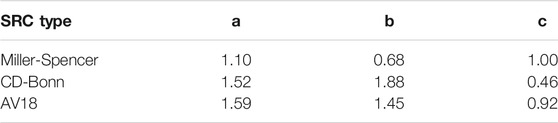
TABLE 1. Parameters for the short-range correlation (SRC) parametrization of Eq. 21. Values are taken from Ref. (Horoi and Stoica, 2010).
This approach of using a Jastrow-like function to include the effects of SRC is extensively used in Refs. (Menéndez et al., 2009; Horoi and Stoica, 2010; Neacsu et al., 2012).
2.3 The Closure Method of Nuclear Matrix Elements Calculation for 0νββ in ISM
The (MGT,ωGT,qGT) (MF,ωF,qF), and (MT,ωT,qT) matrix elements of the scalar two-body transition operator
where, α = (F, GT, T, ωF, ωGT, ωT, qF, qGT, qT), J is the coupled spin of two decaying neutrons or two final created protons, τ− is the isospin annihilation operator, A denotes that the two-body matrix elements (TBME) (Appendix A) are obtained using anti-symmetric two-nucleon wavefunctions, and k1 stands for the set of spherical quantum numbers (n1; l1; j1) (similar definition for k2, k1′, k2′). The |i⟩ is 0+ ground state (g.s.) of the parent nucleus, and |f⟩ is the 0+ g.s of the granddaughter nucleus.
The TBTD can be expressed as (Brown et al., 2014)
where,
and
are the two particle creation and annihilation operator of rank J, respectively. Most of the available public shell model code does not provide the option to calculate TBTD directly. One of the ways is to calculate TBTD in terms of a large number of two nucleon transfer amplitudes (TNA), assuming 0νββ decay occurs through (n − 2) channel (Brown et al., 2014). In (n − 2) channel of 0νββ, the TNA are calculated with a large set of intermediate states |m⟩ of the (n − 2) nucleons system, where n is the number of nucleons for the parent nucleus. In this approach, the TBTD in terms of TNA is expressed as (Brown et al., 2014)
where, TNA are given by
Here, Jm is the spin of the allowed states |m⟩ of intermediate nuclei. J0 is spin of |i⟩ and |f⟩. Jm = J when J0 = 0 (Brown et al., 2014).
3 Results and Discussion
We have used JUN45 effective shell model Hamiltonian (Honma et al., 2009) of fpg model space to calculate the relevant initial, intermediate, and final nuclear states for 0νββ of 82Se. In the fpg model space, valence nucleons can occupy the orbitals 0f5/2, 1p3/2, 1p1/2, and 0g9/2. For the 0νββ decay of 82Se through (n − 2) channel, the states of allowed spin-parity of 80Se acts as intermediate states for TNA calculations. The nuclear shell model code KSHELL (Shimizu et al., 2019) was used in the calculation. For comparing some of the TNA values, NushellX@MSU (Brown and Rae, 2014) code was also used. In the present calculation, we have included the first 100 states of different allowed spin-parity of 80Se in calculating the TNA. Earlier, it was found that considering around the first 50 states is enough to get the saturated value of NME, as the most dominating contributions come from the first few initial states (Brown et al., 2014; Sarkar et al., 2020b).
We have adopted the widely used closure approximation with the closure energy ⟨E⟩ = 0.5 MeV. Earlier studies of Refs. (Sarkar et al., 2020a; Sarkar et al., 2020b) suggested that ⟨E⟩ = 0.5 MeV is a suitable value that is close to optimal closure energy and, thus, gives NME near to the NME in the non-closure approximation. The non-closure method can give the exact value of NME, but the present study is beyond the scope of studying it. But, according to earlier results (Sarkar et al., 2020a; Sarkar et al., 2020b), with ⟨E⟩ = 0.5 MeV, one can get NME in the closure approximation close to the NME in non-closure approximation (within 1% difference).
Different types of NMEs for light neutrino-exchange and λ mechanism of 0νββ for 82Se is shown in Table 2. Here, NMEs are calculated in different SRC parameterization schemes. All standard effects of FNS + HOC are taken care of in all calculations. It is found that the Gamow-Teller matrix elements dominate over Fermi and tensor type matrix elements. Also, it is found that the MqGT type matrix element associated with the λ mechanism is relatively large as compared to standard light neutrino-exchange Gamow-Teller matrix element MGT. This leads to the large value of total NME M1+ for λ mechanism as compared to total NME Mν for light neutrino-exchange mechanism.
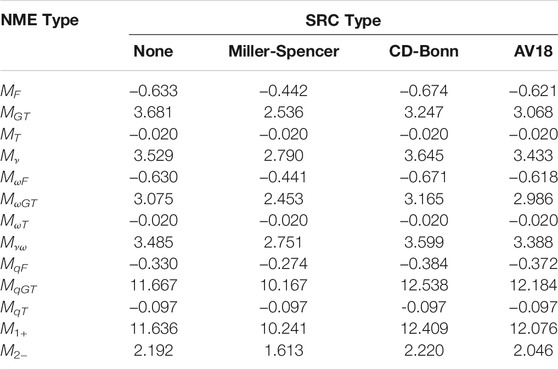
TABLE 2. NMEs for 0νββ (light neutrino-exchange and λ mechanism) of 82Se.
This increment of MqGT type of NME, which is obtained through the new revised expression of the nucleon currents of Ref. (Šimkovic et al., 2017), is surprisingly high. It is coming through the new revised expression of the nucleon currents of Ref. (Šimkovic et al., 2017) which includes the higher-order term (pseudoscalar) of the nucleon currents. In our calculation, Eq. 39 is used to calculate MqGT type NME using the revised formalism of nucleon currents of Refs. (Štefánik et al., 2015; Šimkovic et al., 2017).
An old equivalent expression of Eq. 39 is also found in Ref. (Horoi and Neacsu, 2018), which one can write using Eq. (A2c) and Eq. (A4b) of Ref. (Horoi and Neacsu, 2018) as
Using this old value of fqGT (q, r), the MqGT type NME will be significantly smaller, as reported earlier.
Here we include the higher-order current effect of pseudoscalar term in Eq. 39 as suggested in Ref. (Šimkovic et al., 2017) which is enhancing the MqGT type NME as compared to standard MGT type NME. A similar type of enhancement in MqGT type NME was also found in our earlier study for 48Ca (Sarkar et al., 2020a).
We have also decomposed the NME in terms of coupled spin-parity (Jπ) of two decaying neutrons and two created protons in the decay. Decomposed NME gives us a picture of the role of individual spin-parity on NME. The contribution of NMEs through different Jπ is shown in Figures 1–3 for different types of NME. Figure 1 examines the decomposition for MF,GT,T type matrix elements associated with light neutrino-exchange mechanism, where Figures 2, 3 examine the NME as function of Jπ for MωF,ωGT,ωT and MqF,qGT,qT type NMEs, respectively, for λ and interference mechanism. All results are presented for AV18 SRC parameterization.
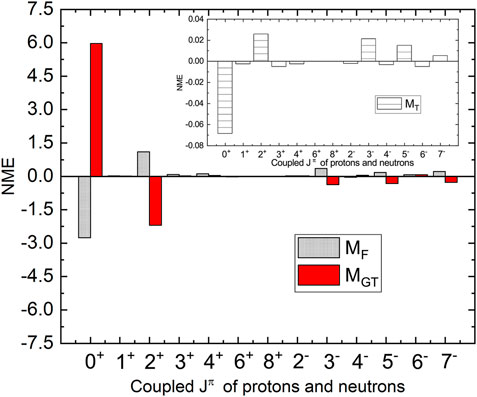
FIGURE 1. (Color online) Variation of MF, MGT, and MT type NMEs with Jπ of two initial neutron-neutron and final proton-proton pairs.
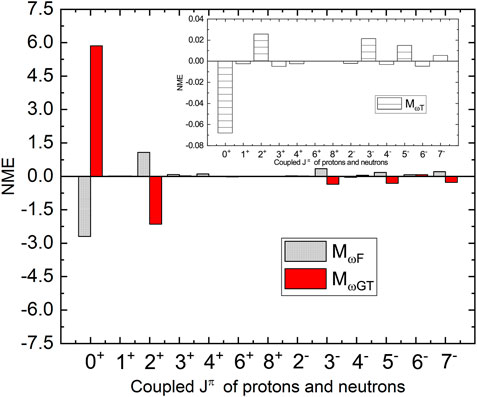
FIGURE 2. (Color online) Variation of MωF, MωGT, and MωT type NMEs with Jπ of two initial neutron-neutron and final proton-proton pairs.
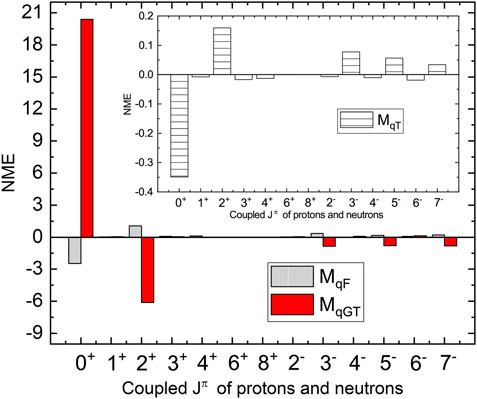
FIGURE 3. (Color online) Variation of MqF, MqGT, and MqT type NMEs with Jπ of two initial neutron-neutron and final proton-proton pairs.
For all types of NMEs, the most dominating contribution comes from 0+ states and 2+ states. The pairing effect is in play for dominating even-Jπ contributions (Brown et al., 2014). The NME from 0+ and 2+ states has opposite signs and, thus, cancel the effects of each other. Other non-negligible contributions come through 4+, 3−, 5−, and 7− states.
Now we will discuss how the calculated NMEs will help to determine the bounds on Majorana neutrino mass and various lepton number violating parameters, using the lower limit on the experimental half-life of the decay. The inverse of half-life for 0νββ is given in Eq. 1. It is found that the half-life is influenced by the term CI (I = mm, mλ, λλ), lepton number violating term ην and ηλ, which are unknown, and CP-violating phase ψ. The CI are defined in Eq 7 and (8), (9), which contains mainly phase space factors and relevant NMEs. To calculate CI, we have used the improved values of phase space factors calculated in Ref. (Štefánik et al., 2015), and for the NMEs, we have used the results of Table 2 using ISM.
The results for CI of light neutrino-exchange and λ mechanisms of 0νββ decay of 82Se and 48Ca are presented in Table 3. Here, the results for 48Ca are taken from our earlier work using the closure approximation on the λ mechanism (Sarkar et al., 2020a). It is found that values of Cmm (light neutrino-exchange) and Cλλ (λ mechanism) are similar in values, which shows the dominance of each of these mechanisms on 0νββ half-life. The interference term (Cmλ) of both the mechanisms are relatively smaller, which shows the less importance of the interference mechanism.

TABLE 3. Results for half-life and bounds on neutrino mass and lepton number violating parameters. The
We have also calculated the upper bound on unknown Majorana neutrino mass (mββ) and lepton number violating parameter: the right-handed current coupling strength ηλ, using the experimental constraint on
4 Summary
In summary, we have studied how the left-right weak boson exchange (λ) mechanism of 0νββ decay is competing with the standard light neutrino-exchange mechanism. Our interest of isotope was one of the prominent 0νββ decaying isotope 82Se. Particularly, we have calculated the NMEs for 0νββ of 82Se when both standard light neutrino-exchange and λ mechanisms co-exist. The revised formalism for nucleon currents to include the pseudoscalar term was taken care of. The nuclear shell model framework was used in the calculation, and the widely used closure approximation was adopted with suitable closure energy. Nuclear states of initial, final, and intermediate states are calculated for fpg model space with JUN45 effective shell model Hamiltonian using shell model code KSHELL. These nuclear states are used to calculate TNA, which comes in the expression of NME of 0νββ through (n − 2) decay channel. Using the calculated NMEs, we have also calculated the upper bounds on Majorana neutrino mass and lepton number violating parameters.
The results show that particularly MqGT type matrix element of λ mechanism is significantly enhanced as compared to standard MGT type NME for the inclusion of the higher-order effect of the pseudoscalar term in the nucleon current. A similar type of enhancement in MqGT type NME was also found in our earlier study for 48Ca (Sarkar et al., 2020a). The dominance of 0+ and 2+ states of neutron-neutron (proton-proton) pairs were also observed, just like earlier studies.
With the experimental lower limits on the half-life, we have used our calculated NMEs to set the upper bounds on Majorana neutrino mass (mββ). The upper limits of values of mββ are found to be 1.83 and 17.92 eV, respectively, for 82Se and 48Ca. With the new generation of experiments, the lower limit on half-life will be further improved, and thus we can expect a much more refined upper bound on mββ, which may be below 1 eV. Also, the difference for the value of mββ will be reduced.
The term CI (I = mm, mλ, λλ), which contains the phase space factors and NMEs, was also evaluated. The Cmm for light neutrino exchange and Cλλ for λ mechanism were found to be similar in values, that were larger than the term Cmλ for the interference of both the mechanisms. This shows the dominance of light neutrino exchange and the λ mechanisms over the interference mechanism. The overall dominant effect of light neutrino-exchange mechanism is observed over λ mechanism and interference of both the mechanisms for very small values of lepton number violating ηλ parameter.
In the future, it will be interesting to see the competing effect of the λ mechanism on the light neutrino-exchange mechanism and also how their contribution on 0νββ half-life will be evaluated in the current and future generation experiments.
Data Availability Statement
The raw data supporting the conclusion of this article will be made available by the authors, without undue reservation.
Author Contributions
The idea of the article was originated by YI. He has also contributed to calculating the nuclear states, interpretation of results, and manuscript writing. SS is responsible for the calculation of the TNA and TBME part of the NME. He has also actively participated in preparing the manuscript. Overall, both the authors have contributed enough in to various stages of preparing the final manuscript.
Funding
YI is grateful for the funding support from JSPS KAKENHI Grant No.17K05440.
Conflict of Interest
The authors declare that the research was conducted in the absence of any commercial or financial relationships that could be construed as a potential conflict of interest.
Publisher’s Note
All claims expressed in this article are solely those of the authors and do not necessarily represent those of their affiliated organizations, or those of the publisher, the editors, and the reviewers. Any product that may be evaluated in this article, or claim that may be made by its manufacturer, is not guaranteed or endorsed by the publisher.
Acknowledgments
Numerical computation in this work was carried out at the Yukawa Institute Computer Facility. YI acknowledges the Tokyo Institute of Technology for allowing to use of the high-performance computing facility to perform nuclear states calculation using KSHELL. YI is also grateful to Prof. Noritaka Shimizu, CNS, the University of Tokyo, for providing the 2020 version of shell model code KSHELL.
References
Arnold, R., Augier, C., Baker, J., Barabash, A., Broudin, G., Brudanin, V., et al. (2005). First Results of the Search for Neutrinoless Double-Beta Decay with the NEMO 3 Detector. Phys. Rev. Lett. 95, 182302. doi:10.1103/PhysRevLett.95.182302
Arnold, R., Augier, C., Bakalyarov, A. M., and Baker, J. D. (2016). Measurement of the Double-Beta Decay Half-Life and Search for the Neutrinoless Double-Beta Decay of 48Ca with the NEMO-3 Detector. Phys. Rev. D 93, 112008. doi:10.1103/PhysRevD.93.112008
Arnold, R., Augier, C., Barabash, A. S., Basharina-Freshville, A., Blondel, S., Blot, S., et al. (2020). Search for the Double-Beta Decay of 82se to the Excited States of 82kr with Nemo-3. Nucl. Phys. A 996, 121701. doi:10.1016/j.nuclphysa.2020.121701
Avignone, F. T., Elliott, S. R., and Engel, J. (2008). Double Beta Decay, Majorana Neutrinos, and Neutrino Mass. Rev. Mod. Phys. 80, 481–516. doi:10.1103/RevModPhys.80.481
Barea, J., and Iachello, F. (2009). Neutrinoless Double-Βdecay in the Microscopic Interacting Boson Model. Phys. Rev. C 79, 044301. doi:10.1103/PhysRevC.79.044301
Barea, J., Kotila, J., and Iachello, F. (2012). Limits on Neutrino Masses from Neutrinoless Double-β Decay. Phys. Rev. Lett. 109, 042501. doi:10.1103/PhysRevLett.109.042501
Barry, J., and Rodejohann, W. (2013). Lepton Number and Flavour Violation in Tev-Scale Left-Right Symmetric Theories with Large Left-Right Mixing. J. High Energ. Phys. 2013, 1–45. doi:10.1007/jhep09(2013)153
Bhupal Dev, P. S., Goswami, S., and Mitra, M. (2015). Tev-scale Left-Right Symmetry and Large Mixing Effects in Neutrinoless Double Beta Decay. Phys. Rev. D 91, 113004. doi:10.1103/PhysRevD.91.113004
Brown, B. A., Horoi, M., and Sen’kov, R. A. (2014). Nuclear Structure Aspects of Neutrinoless Double-β Decay. Phys. Rev. Lett. 113, 262501. doi:10.1103/PhysRevLett.113.262501
Brown, B. A., and Rae, W. D. M. (2014). The Shell-Model Code NuShellX@MSU. Nucl. Data Sheets 120, 115–118. doi:10.1016/j.nds.2014.07.022
Caurier, E., Menéndez, J., Nowacki, F., and Poves, A. (2008). Influence of Pairing on the Nuclear Matrix Elements of the Neutrinoless Betabeta Decays. Phys. Rev. Lett. 100, 052503. doi:10.1103/PhysRevLett.100.052503
Cirigliano, V., Dekens, W., de Vries, J., Graesser, M. L., Mereghetti, E., Pastore, S., et al. (2019). Renormalized Approach to Neutrinoless Double-β Decay. Phys. Rev. C 100, 055504. doi:10.1103/physrevc.100.055504
Deppisch, F. F., Hirsch, M., and Päs, H. (2012). Neutrinoless Double-Beta Decay and Physics beyond the Standard Model. J. Phys. G: Nucl. Part. Phys. 39, 124007. doi:10.1088/0954-3899/39/12/124007
Dolinski, M. J., Poon, A. W. P., and Rodejohann, W. (2019). Neutrinoless Double-Beta Decay: Status and Prospects. Annu. Rev. Nucl. Part. Sci. 69, 219–251. doi:10.1146/annurev-nucl-101918-023407
Engel, J., and Menéndez, J. (2017). Status and Future of Nuclear Matrix Elements for Neutrinoless Double-Beta Decay: a Review. Rep. Prog. Phys. 80, 046301. doi:10.1088/1361-6633/aa5bc5
Honma, M., Otsuka, T., Mizusaki, T., and Hjorth-Jensen, M. (2009). New Effective Interaction Forf5pg9-Shell Nuclei. Phys. Rev. C 80. doi:10.1103/physrevc.80.064323
Horoi, M., and Neacsu, A. (2016). Analysis of Mechanisms that Could Contribute to Neutrinoless Double-Beta Decay. Phys. Rev. D 93, 113014. doi:10.1103/PhysRevD.93.113014
Horoi, M., and Neacsu, A. (2018). Shell Model Study of Using an Effective Field Theory for Disentangling Several Contributions to Neutrinoless Double-β Decay. Phys. Rev. C 98, 035502. doi:10.1103/PhysRevC.98.035502
Horoi, M., and Stoica, S. (2010). Shell Model Analysis of the Neutrinoless Double-β Decay of 48Ca. Phys. Rev. C 81, 024321. doi:10.1103/PhysRevC.81.024321
Iwata, Y., Shimizu, N., Otsuka, T., Utsuno, Y., Menéndez, J., Honma, M., et al. (2016). Large-Scale Shell-Model Analysis of the Neutrinoless ββ Decay of 48Ca. Phys. Rev. Lett. 116, 112502. doi:10.1103/PhysRevLett.116.112502
Menéndez, J., Poves, A., Caurier, E., and Nowacki, F. (2009). Disassembling the Nuclear Matrix Elements of the Neutrinoless ββ Decay. Nucl. Phys. A 818, 139–151. doi:10.1016/j.nuclphysa.2008.12.005
Mohapatra, R. N. (1986). New Contributions to Neutrinoless Double-Beta Decay in Supersymmetric Theories. Phys. Rev. D 34, 3457–3461. doi:10.1103/PhysRevD.34.3457
Mohapatra, R. N., and Senjanović, G. (1980). Neutrino Mass and Spontaneous Parity Nonconservation. Phys. Rev. Lett. 44, 912–915. doi:10.1103/PhysRevLett.44.912
Mohapatra, R. N., and Vergados, J. D. (1981). New Contribution to Neutrinoless Double Beta Decay in Gauge Models. Phys. Rev. Lett. 47, 1713–1716. doi:10.1103/PhysRevLett.47.1713
Neacsu, A., Stoica, S., and Horoi, M. (2012). Fast, Efficient Calculations of the Two-Body Matrix Elements of the Transition Operators for Neutrinoless Double-β Decay. Phys. Rev. C 86, 067304. doi:10.1103/physrevc.86.067304
Pagnanini, L., Azzolini, O., Beeman, J., Bellini, F., Beretta, M., Biassoni, M., et al. (2019). “Results on Double Beta Decay of 82se with CUPID-0 Phase I,” in AIP Conference Proceedings (AIP Publishing LLC), 020019. doi:10.1063/1.5130980
Pastore, S., Carlson, J., Cirigliano, V., Dekens, W., Mereghetti, E., and Wiringa, R. B. (2018). Neutrinoless Double-β Decay Matrix Elements in Light Nuclei. Phys. Rev. C 97, 014606. doi:10.1103/PhysRevC.97.014606
Rath, P. K., Chandra, R., Chaturvedi, K., Raina, P. K., and Hirsch, J. G. (2010). Uncertainties in Nuclear Transition Matrix Elements for Neutrinoless ββ Decay within the Projected-Hartree-Fock-Bogoliubov Model. Phys. Rev. C 82, 064310. doi:10.1103/PhysRevC.82.064310
Rodejohann, W. (2011). Neutrino-less Double Beta Decay and Particle Physics. Int. J. Mod. Phys. E 20, 1833–1930. doi:10.1142/s0218301311020186
Rodin, V. A., Faessler, A., Šimkovic, F., and Vogel, P. (2006). Assessment of Uncertainties in QRPA 0ν ββ-decay Nuclear Matrix Elements. Nucl. Phys. A 766, 107–131. doi:10.1016/j.nuclphysa.2005.12.004
Rodríguez, T. R., and Martínez-Pinedo, G. (2010). Energy Density Functional Study of Nuclear Matrix Elements for Neutrinoless ββ Decay. Phys. Rev. Lett. 105, 252503. doi:10.1103/physrevlett.105.252503
Sarkar, S., Iwata, Y., and Raina, P. K. (2020). Nuclear Matrix Elements for the λ Mechanism of 0ν ββ Decay of 48Ca in the Nuclear Shell-Model: Closure versus Nonclosure Approach. Phys. Rev. C 102, 034317. doi:10.1103/PhysRevC.102.034317
Sarkar, S., Kumar, P., Jha, K., and Raina, P. K. (2020). Sensitivity of Nuclear Matrix Elements of 0νββ of 48Ca to Different Components of the Two-Nucleon Interaction. Phys. Rev. C 101, 014307. doi:10.1103/PhysRevC.101.014307
Schechter, J., and Valle, J. W. F. (1982). Neutrinoless Double-Βdecay in SU(2)×U(1) Theories. Phys. Rev. D 25, 2951–2954. doi:10.1103/physrevd.25.2951
Sen'kov, R. A., and Horoi, M. (2013). Neutrinoless Double-β Decay of 48Ca in the Shell Model: Closure versus Nonclosure Approximation. Phys. Rev. C 88, 064312. doi:10.1103/PhysRevC.88.064312
Sen’kov, R. A., Horoi, M., and Brown, B. A. (2014). Neutrinoless Double-β Decay of 82Se in the Shell Model: Beyond the Closure Approximation. Phys. Rev. C 89, 054304. doi:10.1103/PhysRevC.89.054304
Shimizu, N., Mizusaki, T., Utsuno, Y., and Tsunoda, Y. (2019). Thick-restart Block Lanczos Method for Large-Scale Shell-Model Calculations. Comp. Phys. Commun. 244, 372–384. doi:10.1016/j.cpc.2019.06.011
Šimkovic, F., Faessler, A., Müther, H., Rodin, V., and Stauf, M. (2009). 0νββ-decay Nuclear Matrix Elements with Self-Consistent Short-Range Correlation. Phys. Rev. C 79, 055501. doi:10.1103/PhysRevC.79.055501
Šimkovic, F., Pantis, G., Vergados, J. D., and Faessler, A. (1999). Additional Nucleon Current Contributions to Neutrinoless Double β Decay. Phys. Rev. C 60, 055502. doi:10.1103/PhysRevC.60.055502
Šimkovic, F., Štefánik, D., and Dvornickỳ, R. (2017). The λ Mechanism of the 0νββ-Decay. Front. Phys. 5, 57. doi:10.3389/fphy.2017.00057
Song, L. S., Yao, J. M., Ring, P., and Meng, J. (2014). Relativistic Description of Nuclear Matrix Elements in Neutrinoless Double-β Decay. Phys. Rev. C 90, 054309. doi:10.1103/PhysRevC.90.054309
Štefánik, D., Dvornickỳ, R., Šimkovic, F., and Vogel, P. (2015). Reexamining the Light Neutrino Exchange Mechanism of the 0νββ Decay with Left-And Right-Handed Leptonic and Hadronic Currents. Phys. Rev. C 92, 055502. doi:10.1103/PhysRevC.92.055502
Vergados, J. D., Ejiri, H., and Šimkovic, F. (2012). Theory of Neutrinoless Double-Beta Decay. Rep. Prog. Phys. 75, 106301. doi:10.1088/0034-4885/75/10/106301
Vergados, J. D. (1987). Neutrinoless Double β-decay without Majorana Neutrinos in Supersymmetric Theories. Phys. Lett. B 184, 55–62. doi:10.1016/0370-2693(87)90487-4
Vogel, P. (2012). Nuclear Structure and Double Beta Decay. J. Phys. G: Nucl. Part. Phys. 39, 124002. doi:10.1088/0954-3899/39/12/124002
Wang, X. B., Hayes, A. C., Carlson, J., Dong, G. X., Mereghetti, E., Pastore, S., et al. (2019). Comparison between Variational Monte Carlo and Shell Model Calculations of Neutrinoless Double Beta Decay Matrix Elements in Light Nuclei. Phys. Lett. B 798, 134974. doi:10.1016/j.physletb.2019.134974
Appendix A
One can write anti-symmetric two-body matrix elements for transition operator
where,
One can write in terms of 9j symbol
In terms of 6j symbol one can write
Appendix B
The fα(q, r) factor of Eq. 16 can be written in terms of radial dependence, spherical Bessel function jp (qr) (p = 0, 1, 2 and 3), and FNS + HOC coupling form factors in closure approximation as (Šimkovic et al., 2017).
where one can write in dipole approximation (Šimkovic et al., 1999).
μp − μn = 4.7, MV = 850 MeV, MA = 1,086 MeV mp and mπ are the mass of protons and pions (Sen’kov and Horoi, 2013). In the present calculation, vector constant gV = 1.0 and bare axial-vector constant gA = 1.27 (Sarkar et al., 2020b) are used. Both the pseudo scalar and weak magnetism terms of the nucleon currents are included in fGT,T,ωGT,ωT (q, r) factors whereas pseudo scalar term is included in fqGT,qT (q, r) factors (Šimkovic et al., 2017).
Keywords: neutrinoless double beta decay, λ mechanism, nuclear shell model, nuclear matrix element, right-handed weak boson
Citation: Iwata Y and Sarkar S (2021) Interacting Shell Model Calculations for Neutrinoless Double Beta Decay of 82Se With Left-Right Weak Boson Exchange. Front. Astron. Space Sci. 8:727880. doi: 10.3389/fspas.2021.727880
Received: 20 June 2021; Accepted: 30 August 2021;
Published: 19 November 2021.
Edited by:
Hiroyasu Ejiri, Research Center for Nuclear Physics, Osaka University, JapanReviewed by:
Bhupal Dev, Washington University in St. Louis, United StatesJ.D. Vergados, University of Ioannina, Greece
Javier Menendez, University of Barcelona, Spain
Copyright © 2021 Iwata and Sarkar. This is an open-access article distributed under the terms of the Creative Commons Attribution License (CC BY). The use, distribution or reproduction in other forums is permitted, provided the original author(s) and the copyright owner(s) are credited and that the original publication in this journal is cited, in accordance with accepted academic practice. No use, distribution or reproduction is permitted which does not comply with these terms.
*Correspondence: Yoritaka Iwata, aXdhdGFfcGh5c0AwOC5hbHVtbmkudS10b2t5by5hYy5qcA==