 Jose Luis Blázquez-Salcedo
 Luis Manuel González-Romero
 Fech Scen Khoo
 Jutta Kunz
 Vincent Preut
- 1Departamento de Física Teórica and IPARCOS, Facultad de Ciencias Físicas, Universidad Complutense de Madrid, Madrid, Spain
- 2Institute of Physics, University of Oldenburg, Oldenburg, Germany
Scalar–tensor theories allow for a rich spectrum of quasinormal modes of neutron stars. The presence of the scalar field allows for polar monopole and dipole radiation, as well as for additional higher multipole modes led by the scalar field. Herein, we present one family of the modes which are dominated by the scalar fields, the scalar-led ϕ-modes computed numerically with a shooting method, for the lowest multipoles, that is, l = 0, 1, and 2 for a massless scalar–tensor theory of the Brans–Dicke type, motivated by the
1 Introduction
Currently, astrophysical observations are being well described by Einstein’s general relativity not only in the Solar System but also in the realm of strong gravity, where neutron stars and black holes reside (Will, 2018). Still, the quest for a more fundamental theory of gravity compatible with quantum mechanics and the enigmatic presence of the dark sector in cosmology are motivating studies of alternative theories of gravity (Saridakis et al., 2021). Compact objects such as black holes and neutron stars then constitute excellent astrophysical laboratories to provide constraints on such alternative theories of gravity (Faraoni and Capozziello, 2010; Berti et al., 2015; Saridakis et al., 2021; Arun et al., 2022).
With the advent of gravitational wave observations, here, a new window to the Universe was opened (Abbott, 2016; Abbott, 2017; Abbott et al., 2017; Abbott et al., 2020; Abbott, 2021). In particular, in connection with multi-messenger astronomy, new insights into the properties of neutron stars have been gained. Like the collision of black holes, the collision of neutron stars is governed by three phases: inspiral, merger, and ringdown. The gravitational radiation emitted during the ringdown is associated with the quasinormal modes of the newly created compact object (Andersson and Kokkotas, 1996; Andersson and Kokkotas, 1998; Kokkotas and Schmidt, 1999). Therefore, investigation of the spectrum of quasinormal modes of black holes and neutron stars represents an important step for our understanding.
For neutron stars, a crucial open question is the composition of their inner core. Herein, numerous equations of state have been put forward since experiments on Earth cannot reach the extreme conditions of matter present in the interior of these stars (Lattimer, 2021). Although observations of high-mass pulsars have put strong constraints on the maximum mass of a neutron star obtained by a given equation of state (Demorest et al., 2010; Antoniadis et al., 2013; Cromartie, 2019), additional constraints are due to the observation and analysis of merger events (Abbott et al., 2017).
Although current gravitational wave observations do not yet constrain the quasinormal modes of neutron stars, future gravitational wave observatories should be sufficiently sensitive to do so in combination with further observations of neutron star properties (Berti et al., 2015). However, another all-important property of neutron stars will be introduced here, namely, their universal relations (Yagi and Yunes, 2017; Doneva and Pappas, 2018). Such universal relations represent relations between properly scaled neutron star properties that show a large degree of independence of the equation of state. They exist not only for intrinsic neutron star properties like their moment of inertia, quadrupole moment, or Love number but also for their quasinormal modes, where they were noticed early on (Andersson and Kokkotas, 1996; Andersson and Kokkotas, 1998; Benhar et al., 1999). By now, many studies of universal relations of quasinormal modes of the neutron stars in general relativity have been carried out (Andersson and Kokkotas, 1996; Andersson and Kokkotas, 1998; Benhar et al., 1999; Benhar et al., 2004; Tsui and Leung, 2005; Lau et al., 2010; Blazquez-Salcedo et al., 2013; Blázquez-Salcedo et al., 2014; Chirenti et al., 2015; Lioutas et al., 2021; Sotani, 2021; Sotani and Kumar, 2021; Zhao and Lattimer, 2022).
The universal relations for quasinormal modes of neutron stars are not only of relevance with respect to our current lack of knowledge of the proper equation of state but are also valuable to learn about alternative theories of gravity whenever these relations differ distinctly from those of general relativity (Berti et al., 2015; Doneva and Pappas, 2018). Axial quasinormal modes and their universal relations have already been considered for a variety of alternative theories of gravity (Blázquez-Salcedo et al., 2016; Altaha Motahar et al., 2018; Blázquez-Salcedo and Eickhoff, 2018; Blázquez-Salcedo et al., 2018; Altaha Motahar et al., 2019; Blázquez-Salcedo et al., 2019). Axial modes do not involve perturbations of the neutron star fluid and neither of the scalar field when, for instance, scalar–tensor theories of gravity are considered (Brans and Dicke, 1961; Damour and Esposito-Farese, 1992; Fujii and Maeda, 2007). They are pure gravitational modes.
Polar quasinormal modes, on the other hand, involve besides the metric also the fluid and the scalar field, when present. Therefore, early studies of polar modes in such alternative gravity theories have used the Cowling approximation, where only fluid perturbations are taken into account (Sotani and Kokkotas, 2004; Staykov et al., 2015). However, by now also the full set of perturbations has been considered when determining polar quasinormal modes of several alternative theories of gravity with a scalar degree of freedom (Sotani, 2014; Mendes and Ortiz, 2018; Blázquez-Salcedo et al., 2020; Blázquez-Salcedo et al., 2021; Dima et al., 2021; Krüger and Doneva, 2021; Blázquez-Salcedo et al., 2022a; Blázquez-Salcedo et al., 2022b).
Recently, we have determined polar modes for a family of quadratic gravity theories where the Einstein–Hilbert action is supplemented by an
Although we have previously determined polar quasinormal modes of neutron stars for this family of alternative gravity theories with finite values of the scalar mass (Blázquez-Salcedo et al., 2020; Blázquez-Salcedo et al., 2021; Blázquez-Salcedo et al., 2022a; Blázquez-Salcedo et al., 2022b), we here focus on these two limiting cases and construct their scalar-led modes, that is, their ϕ-modes. ϕ-modes are present in the radial (l = 0) and dipole (l = 1) cases besides the previously studied fluid F- and pressure Hn-modes. They also arise in the quadrupole (l = 2) case (as well as for l > 2), where the fundamental fluid f mode has previously been investigated. We then determine the universal relations for these ϕ-modes and compare them to general relativity. In contrast to our previous work, the scalar field is massless in this study, and universal relations for the ϕ-modes of neutron stars are investigated for the first time ever.
The article is structured as follows: in Section 2, we present the theoretical setting, the massless Brans–Dicke-type scalar–tensor theory, the equations for the background neutron star solution, and the metric, fluid, and scalar perturbations. Subsequently, we present our results on the ϕ-modes and their universal relations and the quadrupole modes in Section 3, the dipole modes in Section 4, and the radial modes in Section 5. We conclude in Section 6. In the appendices (Supplementary material), we present tables for the universal relations.
2 Theoretical setting
2.1 Massless Brans–Dicke-type scalar–tensor theory
We here consider neutron stars that are governed in the Einstein frame by the action (G = c = 1):
where
in the matter action LM. This action is obtained in the massless limit of the
The presently considered massless theory and general relativity represent limiting cases for this type of theory. To realize the relation between
with a positive constant a controlling the deviation from GR, which can be re-written into
with potential
and scalar field
The Jordan and Einstein frame fields are related by the following:
where
Variation of the action (Eq. 1) leads to the following Einstein equations:
with the Einstein tensor
and stress–energy tensor for the neutron star matter
with pressure p and density ρ defined in terms of the physical pressure
and with the equation of state
2.2 Neutron star properties
For the background metric of the neutron star, we used a static and spherically symmetric line element.
Accordingly, the scalar field and the pressure and the energy density of the fluid are parameterized by
while the fluid four-velocity is given by
The superscript (0) and subscript (0) will always be used to indicate the background quantities.
Insertion of the ansatz into the set of field equations leads to the following set of background equations inside the star:
where A0 = A(ϕ0).
In order to obtain the moment of inertia in the first-order perturbation theory for slow rotation, we now introduce the angular velocity of the star Ω, which enters the line element via the inertial dragging ω(r) = Ω − w(r) (Hartle, 1967; Sotani, 2012),
The fluid four-velocity changes to
while the pressure and the energy density do not change to the lowest order. The resulting equation for w is then
From the asymptotic behavior of the metric functions, the mass M and the angular momentum J of the star are obtained as follows:
and the moment of inertia is given by I = J/Ω. The massless scalar field is long ranged
We require the star to be regular at the center, and thus, it possesses the following finite central values of the pressure, the density, and the scalar field:
The boundary of the star r = R is determined by the condition of vanishing pressure
2.3 Polar perturbations
Dominated by the scalar field, the ϕ-modes are polar perturbations. To study such ϕ-modes, we therefore briefly recall the polar perturbations for neutron stars in scalar–tensor theories. (For further details on the derivation, see Regge and Wheeler, 1957; Thorne and Campolattaro, 1967; Price and Thorne, 1969; Thorne, 1969; Campolattoro and Thorne, 1970; Zerilli, 1970; Thorne, 1980; Detweiler and Lindblom, 1985; Chandrasekhar and Ferrari, 1991a; Chandrasekhar et al., 1991; Chandrasekhar and Ferrari, 1991b; Ipser and Price, 1991; Kojima, 1992).
The static and spherically symmetric solutions constitute the zeroth-order background functions. We now introduce the perturbation parameter ϵ ≪ 1, in order to keep track of the order of the perturbations, when we perturb the background metric, the neutron star fluid, and the scalar field. The general set of perturbations reads
Focusing now on polar perturbations, the metric perturbations are specified as
with the spherical harmonics Ylm, where l and m denote the multipolar indices (and m will be set to zero in accordance with the spherically symmetric background). The fluid perturbations read
and the perturbation of the scalar field is given by
The perturbations have been decomposed not only with respect to the scalar, vector, and tensor spherical harmonics but also with respect to the complex frequency ω = ωR + iωI. Herein, the real part ωR corresponds to the characteristic frequency of the quasinormal modes, and the imaginary part ωI represents their decay rate. Outside the star, the perturbations simplify substantially since the fluid is confined to the star, that is, Π1 = E1 = 0.
Substitution of this ansatz into the general set of field equations leads to a set of ordinary differential equations to be solved subject to adequate boundary conditions (Blázquez-Salcedo et al., 2020; Blázquez-Salcedo et al., 2021; Blázquez-Salcedo et al., 2022a). In particular, to obtain the quasinormal modes, we follow the same procedure as before (Blázquez-Salcedo et al., 2020; Blázquez-Salcedo et al., 2021; Blázquez-Salcedo et al., 2022a). For r → ∞, we impose outgoing wave conditions, and for the center r = 0 and the surface r = R of the star, we assume that the perturbation functions are regular. These physically motivated conditions then yield the necessary set of boundary conditions for the perturbation functions that are implemented in the numerical procedure (see (Blázquez-Salcedo et al., 2019), for more details on the used numerical method).
In the following, we will discuss the results of our calculations and analysis of the l = 0 (radial or monopole) ϕ-modes, the l = 1 (dipole) ϕ-modes, and the l = 2 (quadrupole) ϕ-modes for a set of six realistic equations of state describing
• plain nuclear matter: SLy (Douchin and Haensel, 2001) and APR4 (Akmal et al., 1998),
• a nucleon–hyperon fluid: GNH3 (Glendenning, 1985) and H4 (Lackey et al., 2006), and
• hybrid nuclear–quark matter: ALF2 (Alford et al., 2005) and WSPHS3 (Weissenborn et al., 2011).
As the matter in the star is not completely known, we consider the previous competing equations of state with different proposals of matter compositions that all satisfy the current observational constraints. Expressions for the fits of the equations of state can be obtained from the study by Read et al. (2009).
3 Quadrupole ϕ-modes
3.1 Spectrum
Figure 1 presents the quadrupole ϕ-modes for the six selected equations of state. On the left, the frequency ωR is shown in kHz versus the neutron star mass M in M⊙, and on the right, the damping time is shown in milliseconds versus M in M⊙. In each subfigure, the left panels show the modes for the nuclear matter equations of state, APR4 and SLy, the middle panels for the nucleon–hyperon fluids, H4 and GNH3, and the right panels for the hybrid nuclear–quark matter, ALF2 and WSPHS3. The red curves exhibit the modes for the massless Brans–Dicke-type scalar–tensor theory, while the black curves represent the modes for general relativity with a minimally coupled massless scalar field.
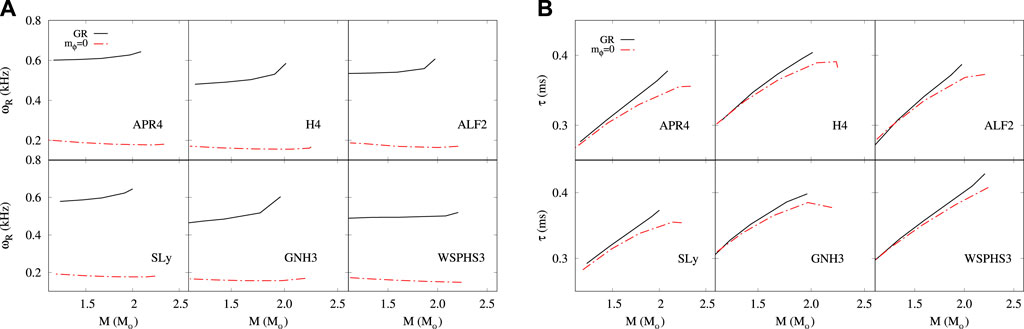
FIGURE 1. Frequency ωR in kHz (A) and damping time τ in milliseconds (B) versus the neutron star mass M in M⊙ for the quadrupole ϕ-mode. The six panels represent six equations of state, and the color red indicates the massless case, with the general relativistic case in black.
In this massless scalar–tensor theory, the frequency is always around 200 Hz or slightly below, whereas in the general relativistic case, the frequency is typically much larger, often by up to a factor of three. Also, the frequency increases toward the maximum mass in general relativity, while it mostly decreases in the scalar–tensor case. The damping time is very close in both theories for small neutron star masses, with deviations getting larger toward the maximum neutron star mass. However, the damping time rises with increasing mass for both theories, and this increase becomes slower in the scalar–tensor case. Overall, the damping time is mostly in the range of 0.3–0.4 ms for both theories. It should be noted that these are not the only ϕ-modes in the spectrum of quadrupolar perturbations; many other modes can be found, but these are the ones for which the damping times are larger.
3.2 Universal relations for the quadrupole ϕ-modes
We now turn to the universal relations for these quadrupole ϕ-modes. To this end, we consider dimensionless quantities (in geometric units) that are formed from the frequency ωR and the damping time τ. In the simplest case, these dimensionless quantities are formed with the mass of the star M or the radius of the star R, but they can also involve the radius of gyration
We exhibit in Figure 2 a simple set of universal relations for the frequency ωR of the modes. The upper panel of the left figure exhibits the dimensionless frequency MωR/c versus the compactness C = M/R of the star. The symbols identify the respective equation of state, while the colors green and black show the results for the massless scalar–tensor theory and general relativity, respectively. For both theories, rather linear universal relations for the frequency are obtained that lie far apart and thus are quite distinct. The lower panel of the figure shows the deviations from the best fit for all of the modes. As already clear from the upper figure, these universal relations are very good, exhibiting a mean error of 0.1% for general relativity and 0.5% for the massless scalar–tensor theory.
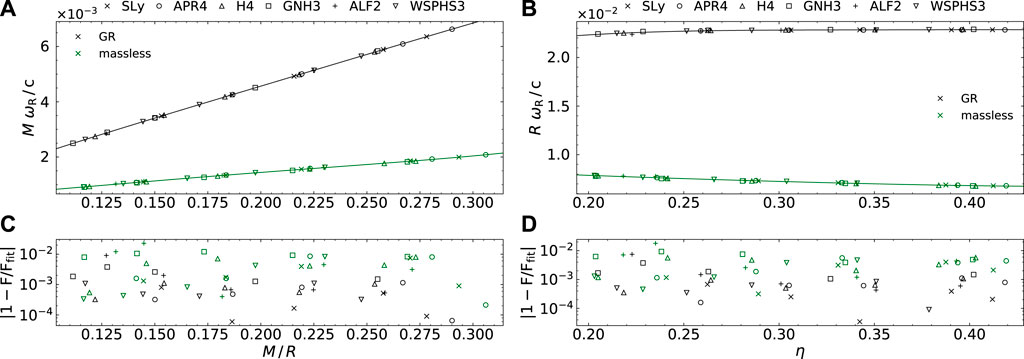
FIGURE 2. Quadrupole ϕ-mode universal relations: dimensionless frequency MωR/c versus compactness C = M/R (A) and fit errors (C); dimensionless frequency RωR/c versus generalized compactness η (B) and fit errors (D). The symbols indicate the respective equation of state. The massless scalar–tensor case is shown in green, and the general relativistic case is shown in black.
The right figure in Figure 2 uses the radius R instead of the mass for the scaling of the frequency. Thus, it shows in the upper panel the dimensionless frequency RωR/c but now versus generalized compactness η, which yields slightly better universal relations (with mean errors of 0.1% and 0.4% for general relativity and massless scalar–tensor theory, respectively) than the ordinary compactness C (with respective mean errors of 0.1% and 0.5%). Again, the relations are almost linear, well separated, and very good.
Figure 3 shows the corresponding results for the damping time. Thus, the left figure exhibits the universal relations for the dimensionless inverse damping time M/(cτ) versus the compactness C = M/R, while the right figure presents the universal relations for the dimensionless inverse damping time R/(cτ) versus the generalized compactness η. We note that these universal relations for the damping time are not as good as those for the frequency, as seen in the lower panels, where again the deviations from the best fits are shown. Interestingly, they are now better for the massless scalar–tensor case than for general relativity. However, both theories lead to rather close relations at least in certain ranges of the (effective) compactness, thus making these relations less useful to distinguish between the theories.
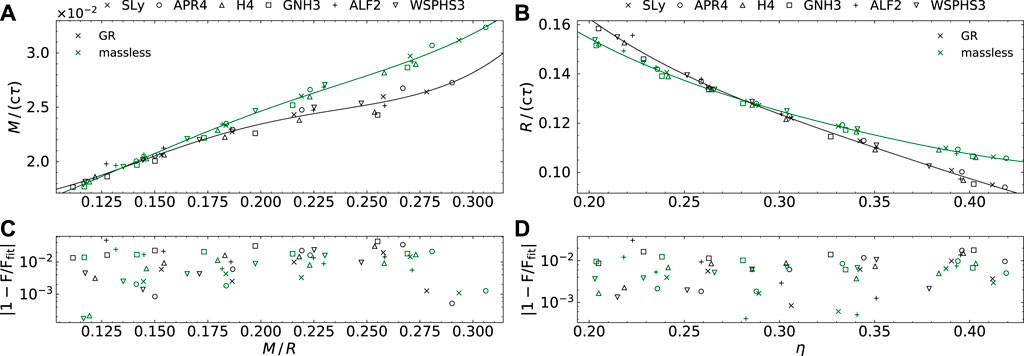
FIGURE 3. Quadrupole ϕ-mode universal relations: dimensionless inverse damping time M/(cτ) versus compactness C = M/R (A) and fit errors (C); dimensionless inverse damping time R/(cτ) versus generalized compactness η (B) and fit errors (D). The symbols indicate the respective equation of state. The massless scalar–tensor case is shown in green, and the general relativistic case is shown in black.
Among the numerous combinations of scaled frequencies and damping times tested, with mean errors displayed in the tables in the Appendix A in the Supplementary material, we here show another set of very good relations that are found. Figure 4 exhibits on the left the universal relations for the dimensionless frequency ωR/ωo versus the compactness C = M/R with mean errors of 0.1% and 0.6% for general relativity and the massless scalar–tensor theory, respectively. Herein, both relations display a monotonic decrease with increasing C, and they differ by a factor of 2–3, thus leading to good discernability of the theories. For the dimensionless scaled damping time τωo shown in the right figure versus the generalized compactness η, on the other hand, both relations are mostly very close for general relativity and the massless scalar–tensor theory. Thus, although very good (with mean errors of 0.5% for both), they are not useful to distinguish between the theories. Up until this point, the use of solely the dimensionless frequency in the relations is able to discriminate between theories better than that of solely the dimensionless damping time in the relations.
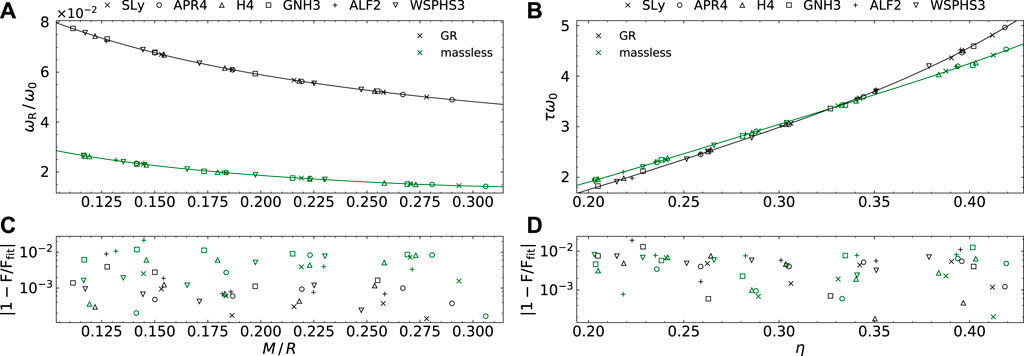
FIGURE 4. Quadrupole ϕ-mode universal relations: dimensionless frequency ωR/ωo versus compactness C = M/R (A) and fit errors (C); dimensionless damping time τωo versus generalized compactness η (B) and fit errors (D). The symbols indicate the respective equation of state. The massless scalar–tensor case is shown in green, and the general relativistic case is shown in black.
The last set of universal relations selected here concerns relations involving both the frequency and damping time. We thus show in Figure 5 on the left the dimensionless inverse damping time M/(cτ) versus the dimensionless frequency MωR/c and on the right, the dimensionless product ωRτ of the frequency and the damping time versus the generalized compactness η. As seen in the figures, the universal relations for general relativity and massless scalar–tensor theory differ considerably as desired, while their mean errors range from very good for the massless scalar–tensor theory (0.6% mean error in the left figure and 0.3% right figure) to average for general relativity (1.6% left and 1.0% right).
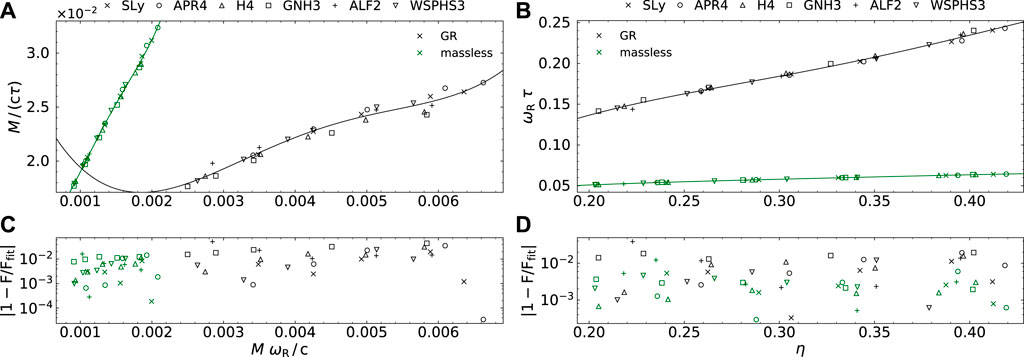
FIGURE 5. Quadrupole ϕ-mode universal relations: dimensionless inverse damping time M/(cτ) versus dimensionless frequency MωR/c (A) and fit errors (C); dimensionless product ωRτ of frequency and damping time versus generalized compactness η (B) and fit errors (D). The symbols indicate the respective equation of state. The massless scalar–tensor case is shown in green, and the general relativistic case is shown in black.
4 Dipole ϕ-modes
4.1 Spectrum
We now turn to the dipole ϕ-modes of the neutron stars. We exhibit these ϕ-modes for the chosen set of equations of state in Figure 6, with frequency ωR in kHz versus the neutron star mass in M⊙ on the left and the damping time in milliseconds on the right. The black curves present the results for general relativity with a minimally coupled massless scalar field, and the red curves show the results for the massless scalar–tensor theory. The frequency of the dipole ϕ-modes is always below 300 Hz, which is significantly lower than that for the dipole F-modes obtained previously (Blázquez-Salcedo et al., 2022a). For the dipole ϕ-modes, general relativity leads to larger frequencies than the massless scalar–tensor theory. In general, the frequency tends to increase for configurations close to the maximum mass. The damping time τ is typically less than 2 milliseconds for the general relativistic case, and the introduction of the massless scalar–tensor theory has the overall effect of increasing the damping time of the ϕ-mode. In general, the damping time tends to decrease for configurations close to the maximum mass.
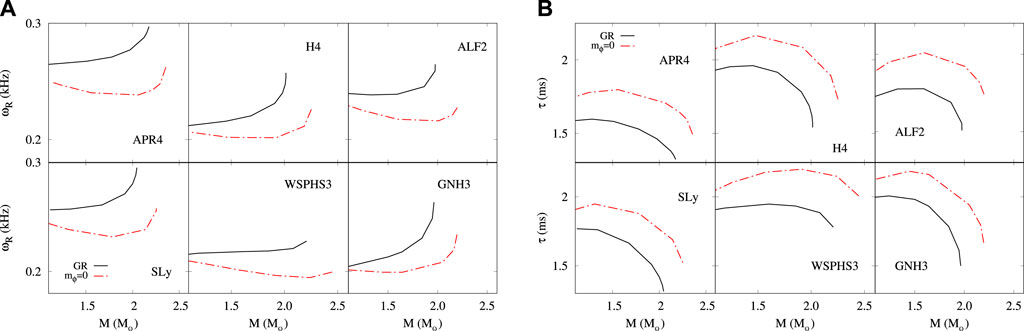
FIGURE 6. Frequency ωR in kHz (A) and damping time τ in milliseconds (B) versus neutron star mass M in M⊙ for the dipole ϕ-mode. The six panels represent six equations of state, and the color red indicates the massless case, with the general relativistic case in black.
4.2 Universal relations for the dipole ϕ-modes
We now address the universal relations for the dipole ϕ-modes for the two considered theories, the massless scalar–tensor theory and general relativity with a minimally coupled scalar field. We proceed as for the quadrupole ϕ-mode discussed in the previous section.
In Figure 7, we show the dimensionless frequency MωR/c scaled with the neutron star mass M versus the compactness C on the left and MωR/c versus the generalized compactness η on the right. The color green indicates the massless theory, and the results for general relativity are shown in black. The lower panels contain the associated fit errors as before. This simple scaling with the mass works very well for the dimensionless frequency MωR/c − compactness C relations, with low mean errors of 0.4% and 0.3% for general relativity and the massless theories, respectively. These relations are far better than the relations involving generalized compactness with respective mean errors of 1.8% and 1.6%. Moreover, in the case of generalized compactness, the curves for the massless theory and general relativity are very close.
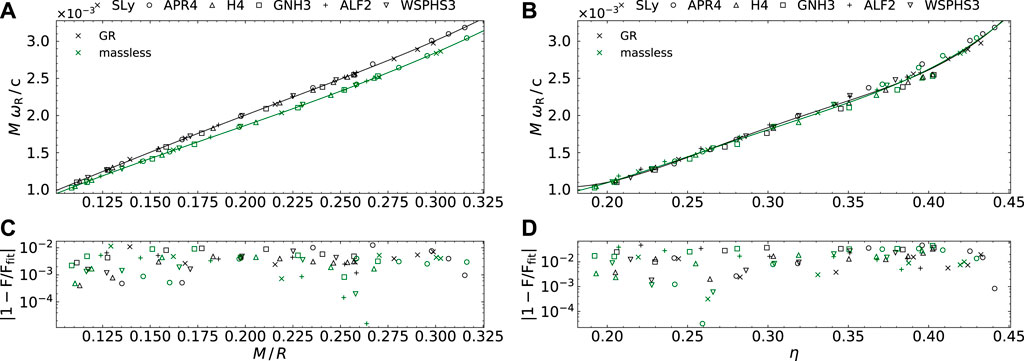
FIGURE 7. Dipole ϕ-mode universal relations: dimensionless frequency MωR/c (A,B) and fit errors (C,D) versus compactness C = M/R (A, C) and versus generalized compactness η (B,D). The symbols indicate the respective equation of state, and the color green indicates the massless case, with the general relativistic case in black.
Figure 8 represents the corresponding figure for the damping time τ, that is, the dimensionless inverse damping time M/cτ is shown versus the compactness C (left) and generalized compactness η (right). The fit reveals that the errors are larger for the damping time than for the frequency, with mean errors of 1.0% and 1.1% in the case of compactness and 1.8% and 1.6% in the case of generalized compactness.
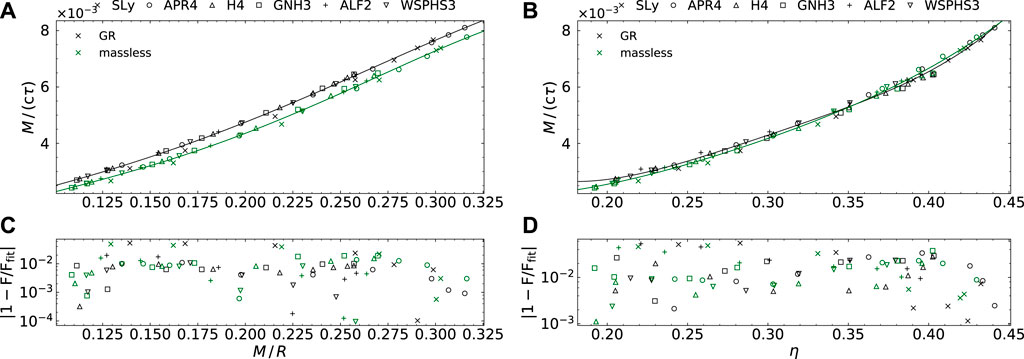
FIGURE 8. Dipole ϕ-mode universal relations: dimensionless inverse damping time M/(cτ) (A,B) and fit errors (C,D) versus compactness C = M/R (A,C) and versus generalized compactness η (B,D). The symbols indicate the respective equation of state, and the color green indicates the massless case, with the general relativistic case in black.
Figures 9A, C show the universal relations for the dimensionless frequency ωR/ωo versus the compactness C. These relations are very good and also distinct, showing mean errors of 0.4% for GR and 0.3% for the massless theory. Another set of very good universal relations for the frequency ωR is shown in Figures 9B, D, where the dimensionless RωR/c is considered as a function of the compactness C. Again, the mean errors are very small with 0.4% and 0.3% for general relativity and the massless scalar-tensor theory, respectively.
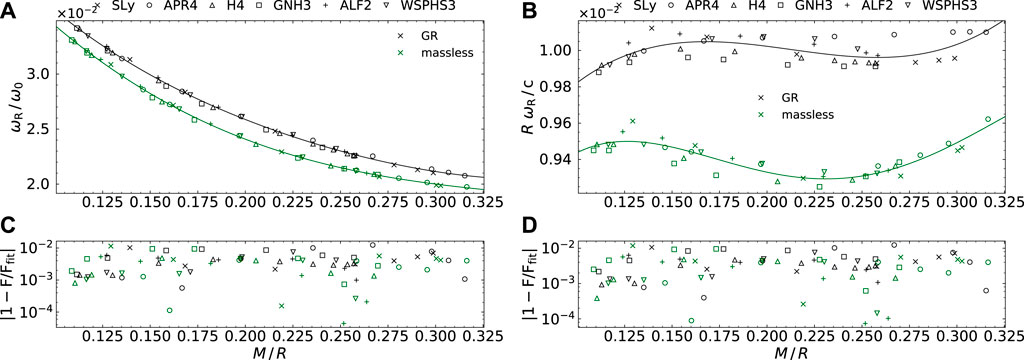
FIGURE 9. Dipole ϕ-mode universal relations: dimensionless frequencies ωR/ωo (A) and RωR/c (B) and their fit errors (C,D) versus compactness C = M/R. The symbols indicate the respective equation of state, and the color green indicates the massless case, with the general relativistic case in black.
When considering the damping time τ, the quality of the universal relations decreases again. We exhibit in Figures 10A, C the dimensionless damping time τωo versus the compactness C. Scaling with
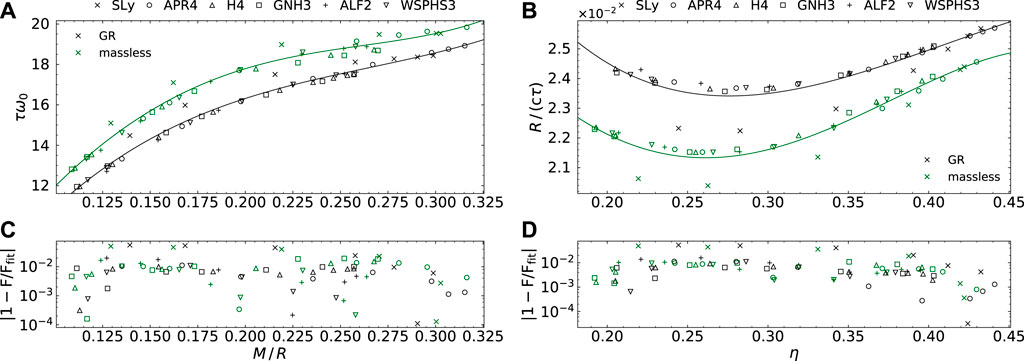
FIGURE 10. Dipole ϕ-mode universal relations: dimensionless damping time τωo versus compactness C = M/R (A) and fit errors (C) and dimensionless inverse damping time R/(cτ) versus generalized compactness η (B) and fit errors (D). The symbols indicate the respective equation of state, and the color green indicates the massless case, with the general relativistic case in black.
Further dimensionless quantities that have been tested are R/(cCτ), R/(cC3τ), RωR/(cC), RωR/(cC3), and ωRτ versus the compactness and the generalized compactness. Those versus compactness always lead to improvement. Relations for the dimensionless damping time M/(cτ) versus the dimensionless frequency MωR/c have also been tested. In addition, we have also examined the relations for
5 Radial ϕ-modes
5.1 Spectrum
We exhibit the sets of radial ϕ-modes for general relativity and the massless scalar–tensor theory in Figure 11. The frequency ωR of the modes is shown in the left figure and is located mostly in the range of 100–200 Hz. The damping time τ of the modes is on the order of 0.2–0.3 milliseconds, as seen in the right figure. Although these are not the only scalar-led modes in the spectrum of spherical perturbations, these are the modes with the highest damping time and best numerical precision in the shooting method we use.
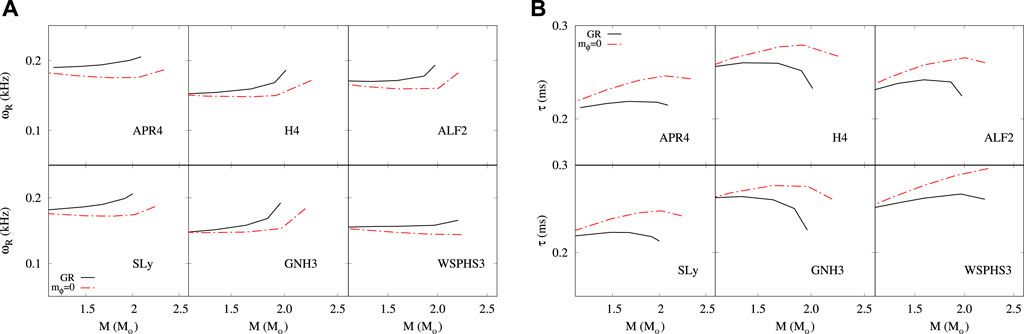
FIGURE 11. Frequency ωR in kHz (A) and damping time τ in milliseconds (B) versus the neutron star mass M in M⊙ for the radial ϕ-mode. The six panels represent six equations of state, and the color red indicates the massless case, with the general relativistic case in black.
For the less-massive neutron stars, the frequency and the damping time are very similar for both theories but deviate sizably toward the maximum mass of the stars, with the general relativistic frequency being larger and the damping time being smaller than their counterparts in the massless scalar–tensor theory.
In Figure 12A we show the scaled frequency RωR/c and the scaled inverse damping time R/(cτ) versus the compactness C for the massless scalar–tensor theory. The figure highlights that the scaled quantities are very close to each other for the different equations of state, except in a region close to the respective maximum mass. At the maximum mass, the instability sets in, found in the l = 0 sector of the theory, in the fundamental fluid F-mode (Blázquez-Salcedo et al., 2020). This results in an increased sensitivity of the l = 0 ϕ-modes with respect to the properties of the equations of state and, thus, a splitting of the associated curves close to the maximum mass.
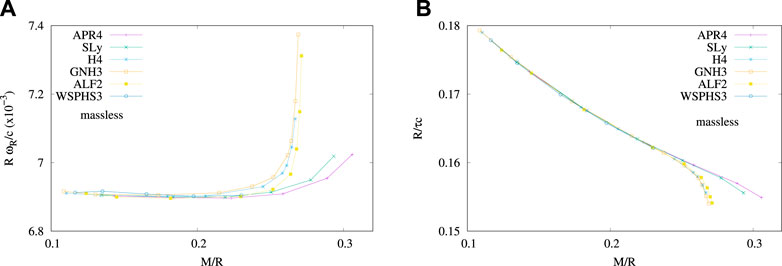
FIGURE 12. Scaled radial ϕ-modes for the massless scalar–tensor theory: dimensionless frequency RωR/c versus compactness C = M/R (A) and dimensionless inverse damping time R/(cτ) versus compactness C (B). The colors indicate the different equations of state.
Although the differences with respect to the mean values are small, this splitting becomes clearly recognizable on the scales of the figure. When evaluating the universal relations for these cases, this splitting together with the decreased density of points in this region leads to rather wiggly universal relations. To avoid giving this region too much weight, we have, therefore, decided to fit the universal relations only in the interval where there is a good agreement between the curves, as well as a high density of points, that is, before the splitting of the curves arises (around M/R = 0.24), as highlighted in the figure. Meanwhile, for the general relativistic case, we fitted the data over the entire range.
5.2 Universal relations for the radial ϕ-modes
Analogously to the higher l-modes, we now address the universal relations for the radial ϕ-modes. Figure 13 shows on the left the universal relations for the dimensionless frequency MωR/c versus the compactness C = M/R and on the right the dimensionless frequency RωR/c versus the compactness C = M/R. In both cases, the universal relations for general relativity are excellent, yielding mean errors of only 0.04%. The corresponding universal relations for the massless scalar–tensor theory are by far not as good. Scaling with the mass yields a mean error of 0.9%, and scaling with the radius yields a mean error of 0.7% when we fit over the entire range. A fit up to the compactness of C = 0.24 yields a mean error of 0.03%, which is comparable to the GR case.
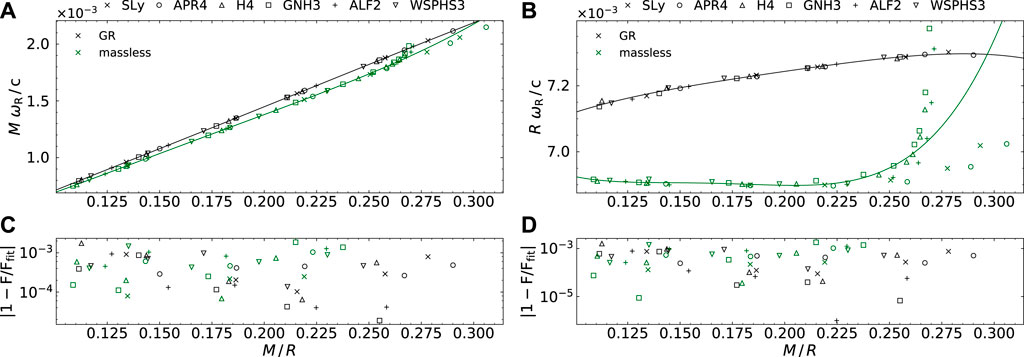
FIGURE 13. Radial ϕ-mode universal relations: dimensionless frequency MωR/c versus compactness C = M/R (A) and fit errors (C); dimensionless frequency RωR/c versus compactness C (B) and fit errors (D). The symbols indicate the respective equation of state. The massless scalar–tensor case is shown in green, and the general relativistic case is shown in black.
Similar universal relations for the damping time τ are shown in Figure 14. Again, general relativity yields excellent relations with mean errors of 0.02%. But here, the relations of the massless scalar–tensor theory produce mean errors of 0.4%. Here as well, a fit up to M/R = 0.24 improves the universal relations of the massless case. The mean errors become 0.01%, which is of the order of the errors in GR.
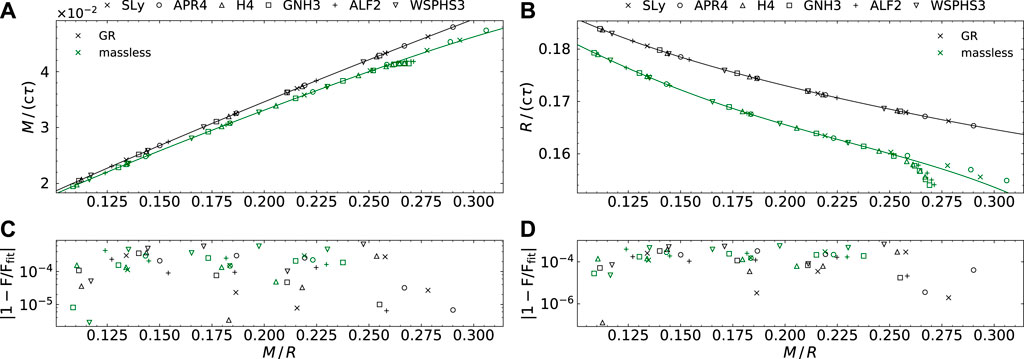
FIGURE 14. Radial ϕ-mode universal relations: dimensionless inverse damping time M/(cτ) versus compactness C = M/R (A) and fit errors (C); dimensionless inverse damping time R/(cτ) versus compactness C (B) and fit errors (D). The symbols indicate the respective equation of state. The massless scalar–tensor case is shown in green, and the general relativistic case is shown in black.
Figure 15 exhibits the dimensionless frequency ωR/ωo versus the compactness C = M/R on the left and the dimensionless damping time τωo versus the compactness C on the right. As before, general relativity gives excellent universal relations. Similarly, a fit for the massless case in the lower compactness range provides excellent universal relations, but the discernability of the theories is not too good. When considering the dimensionless inverse damping time M/(cτ) versus the dimensionless frequency MωR/c, the universal relations for both theories are almost identical except for the larger masses of the stars, as seen in Figures 16A, C. This also holds for the dimensionless product ωRτ of the frequency and the damping time versus the compactness C, shown in Figures 16B, D. As observed in all these cases, the universal relations for general relativity are excellent, whereas the universal relations for the massless scalar–tensor theory are less good, in particular for the larger neutron star masses.
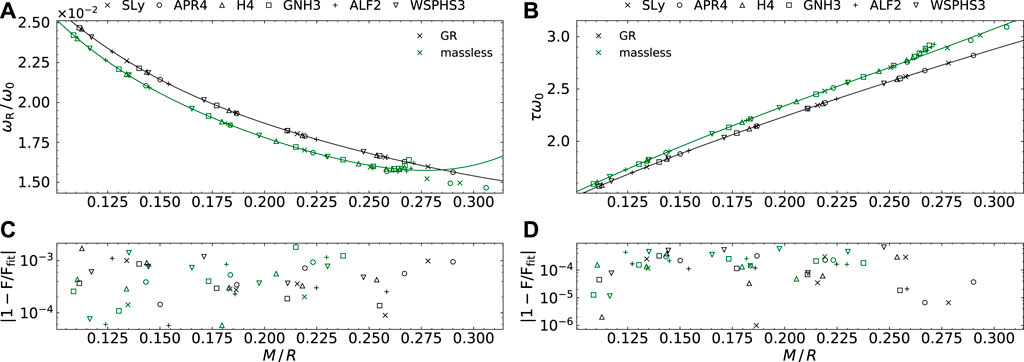
FIGURE 15. Radial ϕ-mode universal relations: dimensionless frequency ωR/ωo versus compactness C = M/R (A) and fit errors (C); dimensionless damping time τωo versus compactness C (B) and fit errors (D). The symbols indicate the respective equation of state. The massless scalar–tensor case is shown in green, and the general relativistic case is shown in black.
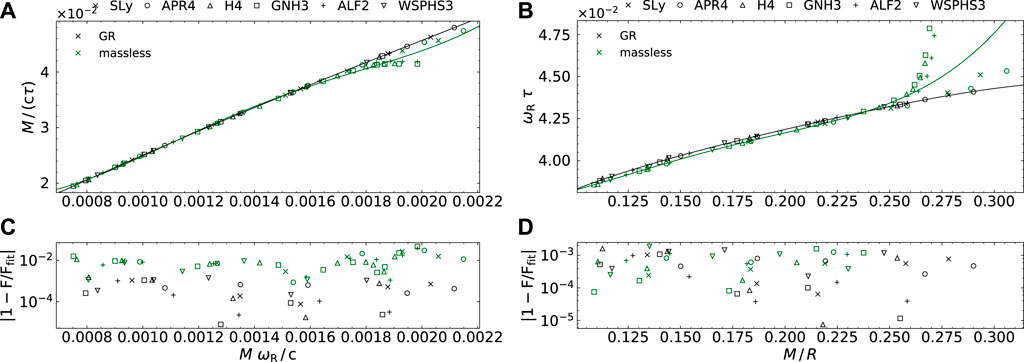
FIGURE 16. Radial ϕ-mode universal relations: dimensionless inverse damping time M/(cτ) versus dimensionless frequency MωR/c (A) and fit errors (C); dimensionless product ωRτ of frequency and damping time versus compactness C (B) and fit errors (D). The symbols indicate the respective equation of state. The massless scalar–tensor case is shown in green, and the general relativistic case is shown in black.
Thus, the quality of the universal relations in the massless theory is comparable to the GR case only in the lower range of compactness.
6 Conclusion
The universal relations of neutron stars represent valuable tools to test the viability of alternative gravity theories, as well as in the future, to put bounds on them with high precision gravitational wave observatories. Herein, we have studied a particular set of such universal relations that arise in a Brans–Dicke-type massless scalar–tensor theory and compared them with their counterparts in general relativity. This type of theory is obtained as a particular limit of an
The presence of a scalar degree of freedom leads to a rich spectrum of neutron stars. The scalar field allows for the emission of monopole and dipole radiation of the stars, which would be prohibited otherwise. Moreover, the now propagating fluid monopole and dipole modes but also all higher multipole modes are supplemented with a new set of quasinormal modes that are dominated by the scalar field, dubbed ϕ-modes. It is these ϕ-modes on which we have focused the present study, highlighting their presence in the spectra and calculating their properties that may find application in future observations of gravitational waves.
In order to be able to extract universal relations for the modes and thus demonstrate (almost) independence of the equation of state used, we have considered a set of six realistic equations of state, covering different possible star compositions, namely, plain nuclear matter, nucleon–hyperon fluids, and hybrid nuclear–quark matter. We have then tested a large variety of ways of scaling the frequency ωR and the damping time τ to obtain dimensionless quantities (in geometric units) and considering these as functions of other dimensionless variables such as the compactness or the generalized compactness. A best fit to all the resulting points has then yielded the sought-after respective universal relations, provided the error is sufficiently small.
We have presented sets of universal relations for the quadrupole ϕ-modes, the dipole ϕ-modes, and the radial ϕ-modes, both in the massless scalar–tensor theory and in general relativity with a minimally coupled scalar field. In all cases, we have found very good universal relations with only small deviations from the best fits, but we have also obtained a number of rather unconvincing relations with large errors. Interestingly, the simple scaling with the mass works quite well for these ϕ-modes, when they are considered versus the compactness. For the potential use of such universal relations besides the required smallness of the errors, it is, however, also relevant that the universal relations for different theories differ sufficiently as to discern them.
Having now provided the ϕ-modes and their universal relations for the limiting theories of general relativity and the massless scalar–tensor theory, we should, as our next step, calculate the ϕ-modes for finite values of the scalar field mass and extract the corresponding universal relations, as previously carried out for the fluid modes (Blázquez-Salcedo et al., 2020; Blázquez-Salcedo et al., 2021; Blázquez-Salcedo et al., 2022a; Blázquez-Salcedo et al., 2022b), and the current investigations could serve as a guide in this endeavor. Moreover, the study of the polar modes of neutron stars and their universal relations in alternative theories of gravity has just begun, and numerous interesting alternative gravities are waiting to be explored.
Data availability statement
The datasets generated and analyzed can be obtained from the authors upon request.
Author contributions
All authors listed have made a substantial, direct, and intellectual contribution to the work and approved it for publication.
Acknowledgments
The authors would like to gratefully acknowledge the support of the DFG Research Training Group 1620 Models of Gravity, DFG project Ku612/18-1, FCT project PTDC/FIS-AST/3041/2020, and the COST Actions CA15117 and CA16104. FSK thanks the Department of Theoretical Physics and IPARCOS of the Complutense University of Madrid for their hospitality.
Conflict of interest
The authors declare that the research was conducted in the absence of any commercial or financial relationships that could be construed as a potential conflict of interest.
Publisher’s note
All claims expressed in this article are solely those of the authors and do not necessarily represent those of their affiliated organizations, or those of the publisher, the editors, and the reviewers. Any product that may be evaluated in this article, or claim that may be made by its manufacturer, is not guaranteed or endorsed by the publisher.
Supplementary material
The Supplementary Material for this article can be found online at: https://www.frontiersin.org/articles/10.3389/fspas.2022.1005108/full#supplementary-material
References
Abbott, B. P., Abbott, R., Abbott, T. D., Abraham, S., Acernese, F., AcKley, K., et al. (2020). Prospects for observing and localizing gravitational-wave transients with Advanced LIGO, Advanced Virgo and KAGRA. Living Rev. Relativ. 892, L3. doi:10.1007/s41114-020-00026-9
Abbott, B. P., Abbott, R., Abbott, T. D., Acernese, F., Ackley, K., Adams, C., et al. (2017). Multi-messenger observations of a binary neutron star merger. Astrophys. J. 848, L12. doi:10.3847/2041-8213/aa91c9
Abbott, B. P., et al. (LIGO Scientific Collaboration and Virgo Collaboration) (2016). Observation of gravitational waves from a binary black hole merger. Phys. Rev. Lett. 116, 061102. doi:10.1103/PhysRevLett.116.061102
Abbott, B. P., et al. (LIGO Scientific Collaboration and Virgo Collaboration) (2017). Observation of gravitational waves from a binary neutron star inspiral. Phys. Rev. Lett. 119, 161101. doi:10.1103/PhysRevLett.119.161101
Abbott, B. P., et al. (LIGO Scientific and KAGRA and VIRGO Collaborations) (2021). Observation of Gravitational Waves from Two Neutron Star–Black Hole Coalescences. Astrophys. J. Lett. 915, L5. doi:10.3847/2041-8213/ac082e
Akmal, A., Pandharipande, V. R., and Ravenhall, D. G. (1998). Equation of state of nucleon matter and neutron star structure. Phys. Rev. C 58, 1804–1828. doi:10.1103/physrevc.58.1804
Alford, M., Braby, M., Paris, M. W., and Reddy, S. (2005). Hybrid stars that masquerade as neutron stars. Astrophys. J. 629, 969–978. doi:10.1086/430902
Altaha Motahar, Z., Blázquez-Salcedo, J. L., Doneva, D. D., Kunz, J., and Yazadjiev, S. S. (2019). Axial quasinormal modes of scalarized neutron stars with massive self-interacting scalar field. Phys. Rev. D. 99, 104006. doi:10.1103/physrevd.99.104006
Altaha Motahar, Z., Blázquez-Salcedo, J. L., Kleihaus, B., and Kunz, J. (2018). Axial quasinormal modes of scalarized neutron stars with realistic equations of state. Phys. Rev. D. 98, 044032. doi:10.1103/physrevd.98.044032
Andersson, N., and Kokkotas, K. D. (1996). Gravitational waves and pulsating stars: What can we learn from future observations?. Phys. Rev. Lett. 77, 4134–4137. doi:10.1103/physrevlett.77.4134
Andersson, N., and Kokkotas, K. D. (1998). Towards gravitational wave asteroseismology. Mon. Not. R. Astron. Soc. 299, 1059–1068. doi:10.1046/j.1365-8711.1998.01840.x
Antoniadis, J., Freire, P. C. C., Wex, N., Tauris, T. M., Lynch, R. S., van Kerkwijk, M. H., et al. (2013). A massive pulsar in a compact relativistic binary. Science 340, 448–1233232. doi:10.1126/science.1233232
Arun, K. G., Enis, B., Robert, B., Laura, B., Emanuele, B., Gianfranco, B., et al. (2022). New horizons for fundamental Physics with LISA. Living Rev. Relativ. 25. [arXiv:2205.01597 [gr-qc]]. doi:10.1007/s41114-022-00036-9
Benhar, O., Berti, E., and Ferrari, V. (1999). The imprint of the equation of state on the axial w-modes of oscillating neutron stars. Mon. Not. R. Astron. Soc. 310, 797–803. doi:10.1046/j.1365-8711.1999.02983.x
Benhar, O., Ferrari, V., and Gualtieri, L. (2004). Gravitational wave asteroseismology reexamined. Phys. Rev. D. 70, 124015. doi:10.1103/physrevd.70.124015
Berti, E., Barausse, E., Cardoso, V., Gualtieri, L., Pani, P., Sperhake, U., et al. (2015). Testing general relativity with present and future astrophysical observations. Cl. Quant. Grav. 32, 243001. doi:10.1088/0264-9381/32/24/243001
Blázquez-Salcedo, J. L., Altaha Motahar, Z., Doneva, D. D., Khoo, F. S., Kunz, J., Mojica, S., et al. (2019). Quasinormal modes of compact objects in alternative theories of gravity. Eur. Phys. J. Plus 134, 46. doi:10.1140/epjp/i2019-12392-9
Blázquez-Salcedo, J. L., Doneva, D. D., Kunz, J., Staykov, K. V., and Yazadjiev, S. S. (2018). Radial perturbations of the scalarized Einstein-Gauss-Bonnet black holes. Phys. Rev. D. 98, 084011. doi:10.1103/physrevd.98.084011
Blázquez-Salcedo, J. L., and Eickhoff, K. (2018). Axial quasinormal modes of static neutron stars in the nonminimal derivative coupling sector of Horndeski gravity: Spectrum and universal relations for realistic equations of state. Phys. Rev. D. 97, 104002. doi:10.1103/physrevd.97.104002
Blázquez-Salcedo, J. L., González-Romero, L. M., Khoo, F. S., Kunz, J., and Preut, V. (2022). Universal relations for quasinormal modes of neutron stars in R2 gravity. Phys. Rev. D. 106, 044007. [arXiv:2205.03283 [gr-qc]]. doi:10.1103/PhysRevD.106.044007
Blázquez-Salcedo, J. L., González-Romero, L. M., Kunz, J., Mojica, S., and Navarro-Lérida, F. (2016). Axial quasinormal modes of Einstein-Gauss-Bonnet-dilaton neutron stars. Phys. Rev. D. 93, 024052. doi:10.1103/physrevd.93.024052
Blazquez-Salcedo, J. L., Gonzalez-Romero, L. M., and Navarro-Lerida, F. (2013). Phenomenological relations for axial quasinormal modes of neutron stars with realistic equations of state. Phys. Rev. D. 87, 104042. doi:10.1103/physrevd.87.104042
Blázquez-Salcedo, J. L., González-Romero, L. M., and Navarro-Lérida, F. (2014). Properties of rotating Einstein-Maxwell-dilaton black holes in odd dimensions. Phys. Rev. D. 89, 024038. doi:10.1103/physrevd.89.024038
Blázquez-Salcedo, J. L., Khoo, F. S., and Kunz, J. (2020). Ultra-long-lived quasi-normal modes of neutron stars in massive scalar-tensor gravity. EPL 130, 50002. doi:10.1209/0295-5075/130/50002
Blázquez-Salcedo, J. L., Khoo, F. S., Kunz, J., and Preut, V. (2021). Polar quasinormal modes of neutron stars in massive scalar-tensor theories. Front. Phys. 9, 741427. doi:10.3389/fphy.2021.741427
Blázquez-Salcedo, J. L., Kleihaus, B., and Kunz, J. (2022). Compact objects in alternative gravities. Universe 8, 153. doi:10.3390/universe8030153
Brans, C., and Dicke, R. H. (1961). Mach's principle and a relativistic theory of gravitation. Phys. Rev. 124, 925–935. doi:10.1103/physrev.124.925
Campolattoro, A., and Thorne, K. S. (1970). Nonradial pulsation of general-relativistic stellar models. V. analytic analysis for L = 1. Astrophys. J. 159, 159. doi:10.1086/150362
Capozziello, S., and De Laurentis, M. (2011). Extended theories of gravity. Phys. Rep. 509, 167–321. doi:10.1016/j.physrep.2011.09.003
Chandrasekhar, S., and Ferrari, V. (1991a). On the non-radial oscillations of a star. Proc. Roy. Soc. Lond. A 432, 247. doi:10.1098/rspa.1991.0016
Chandrasekhar, S., Ferrari, V., and Winston, R. (1991). On the non-radial oscillations of a star II. Further amplifications. Proc. Roy. Soc. Lond. A 434, 635. doi:10.1098/rspa.1991.0117
Chandrasekhar, S., and Ferrari, V. (1991b). On the non-radial oscillations of a star III. A reconsideration of the axial modes. Proc. Roy. Soc. Lond. A 434, 449. doi:10.1098/rspa.1991.0104
Chirenti, C., de Souza, G. H., and Kastaun, W. (2015). Fundamental oscillation modes of neutron stars: Validity of universal relations. Phys. Rev. D. 91, 044034. doi:10.1103/physrevd.91.044034
Cromartie, H. T., et al. (2019). Relativistic Shapiro delay measurements of an extremely massive millisecond pulsar. Nat. Astron 4, 72. doi:10.1038/s41550-019-0880-2
Damour, T., and Esposito-Farese, G. (1992). General relativity and experiment: A brief review. Cl. Quantum Gravity 9, S55–S59. doi:10.1088/0264-9381/9/s/017
De Felice, A., and Tsujikawa, S. (2010). f(R) Theories. Living Rev. Relativ. 13, 3. doi:10.12942/lrr-2010-3
Demorest, P., Pennucci, T., Ransom, S., Roberts, M., and Hessels, J. (2010). A two-solar-mass neutron star measured using Shapiro delay. Nature 467, 1081–1083. doi:10.1038/nature09466
Detweiler, S. L., and Lindblom, L. (1985). On the nonradial pulsations of general relativistic stellar models. Astrophys. J. 292, 12. doi:10.1086/163127
Dima, A., Bezares, M., and Barausse, E. (2021). Dynamical chameleon neutron stars: Stability, radial oscillations, and scalar radiation in spherical symmetry. Phys. Rev. D. 104, 084017. doi:10.1103/physrevd.104.084017
Doneva, D. D., and Pappas, G. (2018). Universal relations and alternative gravity theories. Astrophys. Space Sci. Libr. 457, 737. doi:10.1007/978-3-319-97616-7_13
Douchin, F., and Haensel, P. (2001). A unified equation of state of dense matter and neutron star structure. Astron. Astrophys. 380, 151–167. doi:10.1051/0004-6361:20011402
Faraoni, V., and Capozziello, S. (2010). Beyond Einstein gravity : A survey of gravitational theories for cosmology and astrophysics. Fundam. Theor. Phys. 170. doi:10.1007/978-94-007-0165-6
Fujii, Y., and Maeda, K. (2007). The scalar-tensor theory of gravitation. Cambridge: Cambridge University Press. doi:10.1017/CBO9780511535093
Glendenning, N. K. (1985). Neutron stars are giant hypernuclei?. Astrophys. J. 293, 470–493. doi:10.1086/163253
Hartle, J. B. (1967). Slowly rotating relativistic stars. I. Equations of structure. Astrophys. J. 150, 1005. doi:10.1086/149400
Ipser, J. R., and Price, R. H. (1991). Nonradial pulsations of stellar models in general relativity. Phys. Rev. D. 43, 1768–1773. doi:10.1103/physrevd.43.1768
Kojima, Y. (1992). Equations governing the nonradial oscillations of a slowly rotating relativistic star. Phys. Rev. D. 46, 4289–4303. doi:10.1103/physrevd.46.4289
Kokkotas, K. D., and Schmidt, B. G. (1999). Quasi-Normal modes of stars and black holes. Living Rev. Relativ. 2, 2. doi:10.12942/lrr-1999-2
Krüger, C. J., and Doneva, D. D. (2021). Oscillation dynamics of scalarized neutron stars. Phys. Rev. D. 103, 124034. doi:10.1103/physrevd.103.124034
Lackey, B. D., Nayyar, M., and Owen, B. J. (2006). Observational constraints on hyperons in neutron stars. Phys. Rev. D. 73, 024021. doi:10.1103/physrevd.73.024021
Lattimer, J. M. (2021). Neutron stars and the nuclear matter equation of state. Annu. Rev. Nucl. Part. Sci. 71, 433–464. doi:10.1146/annurev-nucl-102419-124827
Lau, H. K., Leung, P. T., and Lin, L. M. (2010). INFERRING PHYSICAL PARAMETERS OF COMPACT STARS FROM THEIRf-MODE GRAVITATIONAL WAVE SIGNALS. Astrophys. J. 714, 1234–1238. doi:10.1088/0004-637x/714/2/1234
Lioutas, G., Bauswein, A., and Stergioulas, N. (2021). Frequency deviations in universal relations of isolated neutron stars and postmerger remnants. Phys. Rev. D. 104, 043011. doi:10.1103/physrevd.104.043011
Mendes, R. F. P., and Ortiz, N. (2018). New class of quasinormal modes of neutron stars in scalar-tensor gravity. Phys. Rev. Lett. 120, 201104. doi:10.1103/physrevlett.120.201104
Price, R., and Thorne, K. S. (1969). Non-radial pulsation of general-relativistic stellar models. II. Properties of the gravitational waves. Astrophys. J. 155, 163. doi:10.1086/149857
Read, J. S., Lackey, B. D., Owen, B. J., and Friedman, J. L. (2009). Constraints on a phenomenologically parametrized neutron-star equation of state. Phys. Rev. D. 79, 124032. doi:10.1103/physrevd.79.124032
Regge, T., and Wheeler, J. A. (1957). Stability of a schwarzschild singularity. Phys. Rev. 108, 1063–1069. doi:10.1103/physrev.108.1063
Saridakis, E. N., Lazkoz, R., Salzano, V., Vargas Moniz, P., Capozziello, S., Beltrán Jiménez, J., et al. (2021). Modified gravity and cosmology. Cham: Springer Nature Switzerland AG.
Sotani, H., and Kokkotas, K. D. (2004). Probing strong-field scalar-tensor gravity with gravitational wave asteroseismology. Phys. Rev. D. 70, 084026. doi:10.1103/physrevd.70.084026
Sotani, H., and Kumar, B. (2021). Universal relations between the quasinormal modes of neutron star and tidal deformability. Phys. Rev. D. 104, 123002. doi:10.1103/physrevd.104.123002
Sotani, H. (2021). Neutron star asteroseismology and nuclear saturation parameter. Phys. Rev. D. 103, 123015. doi:10.1103/physrevd.103.123015
Sotani, H. (2012). Slowly rotating relativistic stars in scalar-tensor gravity. Phys. Rev. D. 86, 124036. doi:10.1103/physrevd.86.124036
Sotani, H. (2014). Stellar oscillations in eddington-inspired born-infeld gravity. Phys. Rev. D. 89, 124037. doi:10.1103/physrevd.89.124037
Sotiriou, T. P., and Faraoni, V. (2010). f(R)theories of gravity. Rev. Mod. Phys. 82, 451–497. doi:10.1103/revmodphys.82.451
Staykov, K. V., Doneva, D. D., Yazadjiev, S. S., and Kokkotas, K. D. (2015). Gravitational wave asteroseismology of neutron and strange stars inR2gravity. Phys. Rev. D. 92, 043009. doi:10.1103/physrevd.92.043009
Staykov, K. V., Doneva, D. D., Yazadjiev, S. S., and Kokkotas, K. D. (2014). Slowly rotating neutron and strange stars inR2gravity. J. Cosmol. Astropart. Phys. 10, 006. doi:10.1088/1475-7516/2014/10/006
Thorne, K. S., and Campolattaro, A. (1967). Erratum: Non-Radial pulsation of general-relativistivc stellar models. I. Analytic analysis for L ≥ 2. Astrophys. J. 149152, 591673. Erratum: [Astrophys. J]. doi:10.1086/149586
Thorne, K. S. (1980). Multipole expansions of gravitational radiation. Rev. Mod. Phys. 52, 299–339. doi:10.1103/revmodphys.52.299
Thorne, K. S. (1969). Nonradial pulsation of general-relativistic stellar models.IV. The weakfield limit. Astrophys. J. 158, 997. doi:10.1086/150259
Tsui, L. K., and Leung, P. T. (2005). Universality in quasi-normal modes of neutron stars. Mon. Not. R. Astron. Soc. 357, 1029–1037. doi:10.1111/j.1365-2966.2005.08710.x
Weissenborn, S., Sagert, I., Pagliara, G., Hempel, M., and Schaffner-Bielich, J. (2011). Astrophys. J. 740, L14. doi:10.1088/2041-8205/740/1/l14
Will, C. M. (2018). Theory and experiment in gravitational Physics. Cambridge: Cambridge University Press. doi:10.1017/9781316338612
Yagi, K., and Yunes, N. (2017). Approximate universal relations for neutron stars and quark stars. Phys. Rep. 681, 1–72. doi:10.1016/j.physrep.2017.03.002
Yazadjiev, S. S., Doneva, D. D., Kokkotas, K. D., and Staykov, K. V. (2014). Non-perturbative and self-consistent models of neutron stars inR-squared gravity. J. Cosmol. Astropart. Phys. 06, 003. doi:10.1088/1475-7516/2014/06/003
Zerilli, F. J. (1970). Effective potential for even-parity regge-wheeler gravitational perturbation equations. Phys. Rev. Lett. 24, 737–738. doi:10.1103/physrevlett.24.737
Keywords: neutron stars, gravitational waves, quasinormal modes, scalar–tensor theory, equation of state, universal relations
Citation: Blázquez-Salcedo JL, González-Romero LM, Khoo FS, Kunz J and Preut V (2022) ϕ-modes of neutron stars in a massless scalar–tensor theory. Front. Astron. Space Sci. 9:1005108. doi: 10.3389/fspas.2022.1005108
Received: 27 July 2022; Accepted: 21 September 2022;
Published: 25 October 2022.
Edited by:
Amare Abebe, North-West University, South AfricaReviewed by:
Joseph Ntahompagaze, University of Rwanda, RwandaKazuharu Bamba, Fukushima University, Japan
Copyright © 2022 Blázquez-Salcedo, González-Romero, Khoo, Kunz and Preut. This is an open-access article distributed under the terms of the Creative Commons Attribution License (CC BY). The use, distribution or reproduction in other forums is permitted, provided the original author(s) and the copyright owner(s) are credited and that the original publication in this journal is cited, in accordance with accepted academic practice. No use, distribution or reproduction is permitted which does not comply with these terms.
*Correspondence: Fech Scen Khoo, ZmVjaC5zY2VuLmtob29AdW5pLW9sZGVuYnVyZy5kZQ==