 B. J. Carr
- Queen Mary University of London, London, United Kingdom
Black holes play an important role in linking microphysics with macrophysics, with those of the Planck mass (MP ∼ 10−5 g) featuring in any theory of quantum gravity. In particular, the Compton-Schwarzschild correspondence posits a smooth transition between the Compton wavelength (RC ∝ 1/M) below the Planck mass and the Schwarzschild radius (RS ∝ M) above it. The duality between RC and RS implies a form of the Generalized Uncertainty Principle (GUP) and suggests that elementary particles may be sub-Planckian black holes. The simplest possibility is that the ADM mass has the form
1 Introduction
Whatever final theory amalgamates relativity theory and quantum mechanics, it is likely to involve two features: 1) what is termed the Black Hole Uncertainty Principle (BHUP) correspondence; and 2) the existence of extra dimensions on sufficiently small scales. Both features are expected to become important at the Planck length, RP ∼ 10−33 cm, and possibly on much larger scales. It is striking that black holes are involved in both these features and indeed there are many other ways in which these objects provide a link between macrophysics and microphysics (Carr, 2018).
As regards feature (1), the duality under the transformation
As regards feature (2), if there are n extra spatial dimensions compactified on some scale RE, then RS scales as R1/(1+n) for R < RE, leading to the possibility of TeV quantum gravity and black hole production at accelerators if RC scales as M−1 for R < RE. However, the higher-dimensional Compton wavelength depends on the form of the (3 + n)-dimensional wavefunction and in some circumstances one might expect RC ∝ M−1/(1+n) for R < RE. This preserves the duality between RC and RS but TeV quantum gravity is precluded. Nevertheless, the extra dimensions could still have consequences for the detectability of black hole evaporations and the enhancement of pair-production at accelerators on scales below RE.
The plan of this paper is as follows. Section 2 discusses the BHUP correspondence in general terms. Section 3 applies the correspondence to black holes in Loop Quantum Gravity (LQG), this being the first historical study of this kind. Section 4 then considers the simplest application of the BHUP correspondence: the‘M + 1/M’ Schwarzschild model and its extension to charged and rotating black holes. Higher-dimensional black holes are discussed in Section 5 and some concluding remarks about the connection between particles and black holes are made in Section 6.
2 The Black Hole Uncertainty Principle correspondence
A key feature of the microscopic domain is the (reduced) Compton wavelength for a particle of rest mass M, with the region R < RC in the (M, R) diagram of Figure 1 being regarded as the “quantum domain”. A key feature of the macroscopic domain is the Schwarzschild radius for a body of mass M, with the region R < RS being regarded as the “relativistic domain”. The Compton and Schwarzschild lines intersect at around the Planck scales,
and divide the (M, R) diagram into three regimes, which we label quantum, relativistic and classical. There are several other interesting lines in the figure. The vertical line M = MP marks the division between elementary particles (M < MP) and black holes (M > MP), since the size of a black hole is usually required to be larger than the Compton wavelength associated with its mass. The horizontal line R = RP is significant because quantum fluctuations in the metric should become important below this (Wheeler, 1955). Quantum gravity effects should also be important whenever the density exceeds the Planck value, ρP = c5/(G2ℏ) ∼ 1094 g cm−3, corresponding to the sorts of curvature singularities associated with the big bang or the centres of black holes. This implies
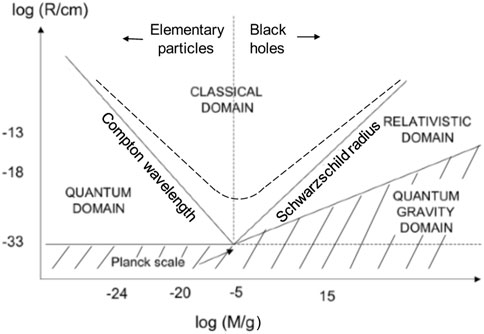
FIGURE 1. Division of (M, R) diagram into classical, quantum, relativistic and quantum gravity domains. The boundaries are specified by the Planck density, Compton wavelength and Schwarzschild radius. From Carr (2018).
The Compton and Schwarzschild lines transform into one another under the transformation
One way of smoothing the transition between the Compton and Schwarzschild lines is to invoke some form of unified expression which asymptotes to the Compton wavelength and Schwarzschild radius in the appropriate regimes (Carr, 2015). The simplest such expression would be
where β is a dimensionless constant. In the super-Planckian regime, this becomes
with the second term corresponding to a small correction to the usual Schwarzschild expression. In the sub-Planckian regime, it becomes
with the second term corresponding to a small correction to the usual expression for the Compton wavelength. More generally, one might consider any unified expression
An expression of the form (3) arises in the quantum N-portrait model of Dvali et al. (Dvali et al., 2011), which regards a black hole as a weakly-coupled Bose-Einstein condensate of gravitons. From holographic considerations, the number of gravitons in the black hole is
which is equivalent to Eq. 3. An expression of the form (4) also arises in the context of the Generalized Uncertainty Principle (GUP). This is because it can be argued that the Uncertainty Principle should be modified to the form (Adler, 2010)
where α is a dimensionless constant. The first term represents the uncertainty in the position due to the momentum of the probing photon and leads to the usual expression for the Compton wavelength if one substitutes Δx → R and Δp → cM. The second term represents the gravitational effect of the probing photon and is much smaller than the first term for Δp ≪ cMP. Variants of Eq. 6 are also motivated by string theory (Veneziano, 1986; Witten, 1996), non-commutative quantum mechanics (Gross and Mende, 1988; Amati et al., 1989; Yoneya, 1989; Konishi et al., 1990; Scardigli, 1999), general minimum length considerations (Maggiore, 1993a; Maggiore, 1993b; Maggiore, 1994), polymer corrections in the structure of spacetime in LQG (Ashtekar et al., 2003a; Hossain et al., 2010) and some approaches to quantum decoherence (Kay, 1998).
The GUP is usually restricted to the sub-Planckian domain (M < MP). However, if we rewrite Eq. 6 using Δx → R and Δp → cM even in the super-Planckian regime, we obtain a revised Compton wavelength which applies for all M:
This resembles Eq. 2 except that the constant is associated with the second term. This suggests that there is a different kind of positional uncertainty for an object larger than the Planck mass, related to the size of a black hole. This is not unreasonable since the usual Compton wavelength is below the Planck length here and also an outside observer cannot localize an object on a scale smaller than its Schwarzschild radius. This is termed the Black Hole Uncertainty Principle (BHUP) correspondence (Carr, 2015) or the Compton-Schwarzschild correspondence when discussing an interpretation in terms of extended de Broglie relations (Lake and Carr, 2015).
Strictly speaking, Eqs 2, 7 are consistent only if α = 2 and β = 1 but that would leave no free parameter at all. Therefore an interesting issue is whether one should associate the free constant in RCS with the 1/M term, as in Eq. 2, or the M term, as in Eq. 7. Here we adopt the former approach, on the grounds that the expression for the Schwarschild radius is exact, whereas there is some ambiguity in the meaning of the Compton scale. However, for comparison with the GUP literature, we still need to identify an effective value of α and a simple rescaling of the relationship between Δx and R suggests α = 2/β. Another approach is to identify Δp with 1/M rather than M for M > MP and Eq. 6 then equates α and β directly. One might even argue that Δp has the form (M + 1/M)−1, in which case Δx ∼ 1/M and Δp ∼ M in the particle case (M < MP) and Δx ∼ M and Δp ∼ 1/M in the black hole case (M > MP). This would be consistent with the extended de Broglie relations (Hawking, 1974; Lake and Carr, 2015).
In the standard picture, one can calculate the black hole temperature from the Uncertainty Principle by identifying it with a multiple η of Δp. This gives (Hawking, 1974)
which is precisely the Hawking temperature if we take η = 1/(4π). If one adopts the GUP but assumes the usual black hole size, one obtains the Adler form (Chen and Adler, 2003)
The negative sign gives a small perturbation to the standard Hawking temperature
at large M. However, the solution becomes complex when M falls below
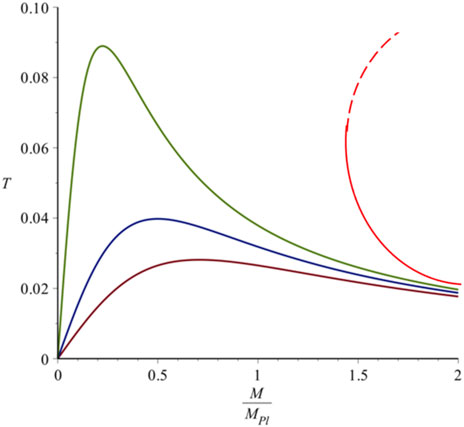
FIGURE 2. Hawking temperature (in Planck units) from Eq. 3 and surface gravity argument as a function of M/MP for β = 1 (bottom), β = 0.5 (middle) and β = 0.1 (top). Also shown on the right is the Adler prediction. From Carr et al. (2016).
Eq. 9 is inconsistent with the BHUP correspondence since this also modifies the relationship between the black hole radius Δx and M. If we adopt Eq. 3 instead, then the surface gravity argument gives a temperature
This is plotted in Figure 2 and is very different from the Adler form. As M decreases, the temperature reaches a maximum of around TP and then goes to zero as M → 0.
An important caveat is that Eq. 6 assumes that the two uncertainties add linearly. On the other hand, since they are independent, it might be more natural to assume that they add quadratically (Carr et al., 2011):
We refer to Eqs 6, 12 as the linear and quadratic forms of the GEP, respectively. The latter corresponds to a unified expression
where we have we have again introduced β. This leads to the approximations
and
These might be compared to the exact expressions in the linear case, given by Eqs 3, 4. As we now show, a model inspired by LQG permits the existence of a black hole whose horizon size has precisely the form (13).
3 Loop black holes
Loop Quantum Gravity is based on a canonical quantization of the Einstein equations, written in terms of the Ashtekar variables. One feature of this is that area is quantized, with its smallest possible value being
where γ is the Immirzi parameter and of order 1. The quantity ao ≡ Amin/8π, together with the dimensionless polymeric parameter δ, determines the deviation from classical theory.
One version of LQG, using the mini-superspace approximation, gives rise to cosmological solutions which resolve the initial singularity problem (Bojowald, 2001; Ashtekar et al., 2003b; Bojowald, 2005). Another version gives the loop black hole (LBH) solution (Modesto, 2010) and this replaces the singularity in the Schwarzschild solution with another asymptotically flat region. The metric depends only on the combined dimensionless parameter ɛ ≡ δγ, which must be small, and can be expressed as
with
Here r+ = 2GM/c2 and r− = 2GMP2/c2 are the outer and inner horizons, respectively, and
is called the polymeric function. In the limit r → ∞ one has
where
Here R is the physical radial coordinate, in the sense that the circumference function is 2πR. As r decreases from infinity to zero, R first decreases from infinity to a minimum value of
This corresponds to Eq. 13 if β = aoc2/G. The important physical implication of Eq. 21 is that central singularity of the Schwarzschild solution is replaced with another asymptotic region, so the collapsing matter bounces and the black hole becomes part of a wormhole. The fact that a purely geometrical condition in LQG implies the quadratic version of the GUP suggests some deep connection between general relativity and quantum theory. The duality between the two asympotic spaces also suggests a link between elementary particles with M ≪ MP and black holes with M ≫ MP (Modesto and Premont-Schwarz, 2009), which is clearly relevant to the theme of this paper.
The temperature implied by the black hole’s surface gravity is
However, if one calculates the temperature using the GUP expression for Δp, one obtains
This is similar to Eq. 11 but inconsistent with Eq. 23 in the sub-Planckian regime. The source of the discrepancy is that there are two asymptotic spaces—one on each side of the wormhole throat—and the temperature is different in these. Observer only detect radiation from the horizon on their side of the throat, so the inner horizon with respect to r = ∞ corresponds to the outer horizon with respect to r = 0 (Carr et al., 2011). For
4 Carr-Mureika-Nicolini approach
This section describes a particular interpretation of the linear version of the BHUP correspondence, described in my work with Mureika and Nicolini (Carr et al., 2016), in which the Arnowitt-Deser-Misner (ADM) mass is taken to be
This is equivalent to Eq. 3 and we noted a possible connection with the energy-dependent metric in the “gravity’s rainbow” proposal (Magueijo and Smolin, 2004) and with the QFT renormalization of mass in the presence of stochastic metric fluctuations (Camacho, 2003). Putting ℏ = c = 1, the Schwarzschild radius for the modified metric is
and the temperature is
The black hole luminosity in this model is
It is interesting to consider observational constraints on the parameter β and these are discussed in Carr et al. (2022). Within the GUP context, these only arise in the microscopic domain and a variety of mechanical oscillator experiments imply α < 4 × 10⁴ (Pikovski et al., 2012; Bushev et al., 2019). A similar bound arises from the AURIGA gravitational bar detector (Marin et al., 2014). Since β = 2/α, both bounds corresponding to a lower limit β > 10–4. Within the context of the BHUP correspondence, there are also constraints in the macroscopic domain from measuring the gravitational force between 100 mg masses with mm separation (Westphal et al., 2021) and these imply β < 106. Clearly these limits still allow a wide range of values for β. One might also constrain β by observations on astrophysical scales but in this domain the effects of the Extended Uncertainty Principle, in which Δx Δp ∼ 1 + (δx)2 rather than 1 + (δp)2, becomes more relevant (Mureika, 2019).
Recently we have extended this work, together with Heather Mentzer, to charged and rotating black holes (Carr et al., 2020), since this is clearly relevant to elementary particles. The standard Reissner-Nordström (RN) already exhibits features of the GUP-modified Schwarzschild solution. This is because the RN metric has an outer (+) and inner (-) horizon at
where ne is the black hole charge, γ ≡ αen2/4 with αe ≈ 1/137 being the electric fine structure constant, and the last expression applies for a black hole which is far from extremal
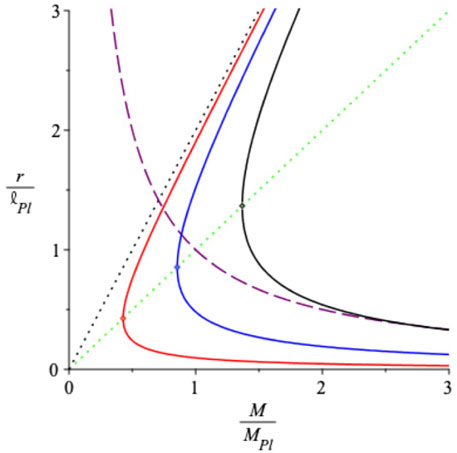
FIGURE 3. The solid curves show the outer and inner horizons for a standard RN black hole with n = 5, 11, 16 (left to right). For each n, the horizons meet at the extremal mass on the line
For each n, the two horizons merge on the line r = GM (lower dotted curve) at the minimum value of M. This corresponds to a sequence of “extremal” solutions (shown by the dots in Figure 3) with a spectrum of masses
The (standard) Compton line intersects the outer black hole horizon, as required if one wants a smooth connection between particles and black holes, at the mass
(This is also termed the self-completeness condition (Isi et al., 2013).) For n = 0, the intersect is
One can extend this model to the GUP-modified RN solutions by replacing M with MADM given by Eq. 25. Providing
This is indicated by the curves on the left of Figure 4. In principle, the particle-like black holes can have arbitrarily low mass in this case. However, it is unclear that these solutions are candidates for stable particles since none of them are extremal, this possibility arising only in the limit
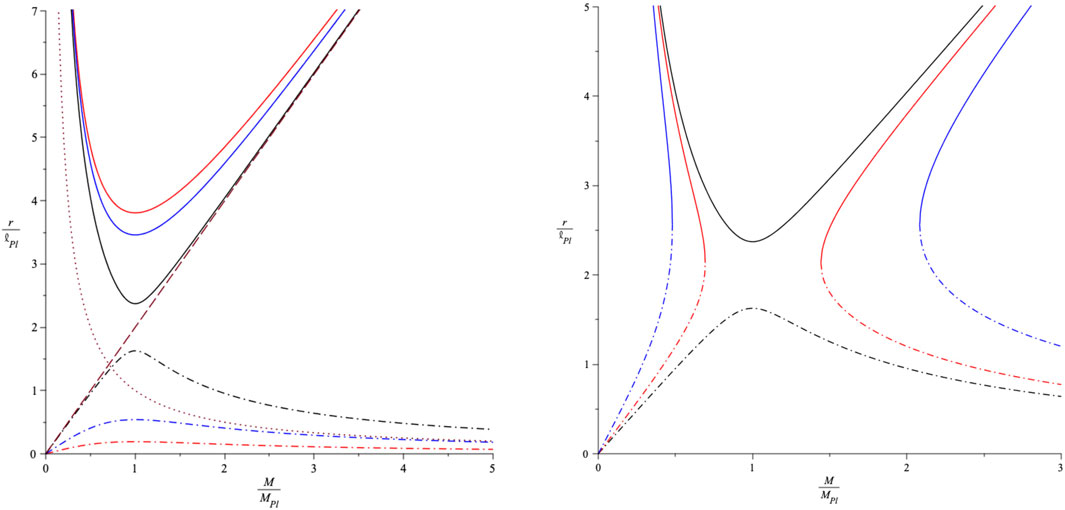
FIGURE 4. Outer (solid) and inner (dash-dot) horizon size for GUP-RN black hole with β = 2. Left: Outer (top) and inner (bottom) horizons for n = 10 (red), n = 16 (blue) and n = 23 (black). The dashed/dotted lines show the usual Schwarzschild/Compton scales. The inner horizon is nearly asymptotic to the Compton wavelength at large M for n = 16. There is a discontinuity when n reaches 23, this being close to an extremal solution. Right: Outer (top) and inner (bottom) horizons for n = 23 (black), n = 25 (blue) and n = 30 (black). The horizons in this case have a maximum value of M on the left and a minimum value on the right. There are no black holes between these values. From Carr et al. (2020).
The Kerr metric exhibits similar behaviour but there is a critical spin (nℏ) rather than a critical charge. The extremal case corresponds to the spectrum of masses
This allows all values of n, whereas n could not exceed
5 Higher-dimensional black holes
The black hole boundary in Figure 1 assumes there are three spatial dimensions but many theories suggest that the dimensionality could increase on small scales. Although the extra dimensions are often assumed to be compactified on the Planck length, there are also models in which they are much larger. For example, the model of Arkani-Hamed et al. (1998) has n extra spatial dimensions, all compactified on the same scale RE. If we assume that the standard expression for the Compton wavelength (RC ∝ M−1) still applies, then the masses with Compton and Schwarzschild scales RE are
For R < RE, the gravitational potential generated by a mass M is
where GD is the higher-dimensional gravitational constant and D = 4 + n is the total number of spacetime dimensions. For R > RE, one recovers the usual form, Vgrav = GM/R with
Eq. 32 implies that the usual expression for the Schwarzschild radius no longer applies for masses below
Therefore the slope of the black hole boundary in Figure 1 becomes shallower for
so
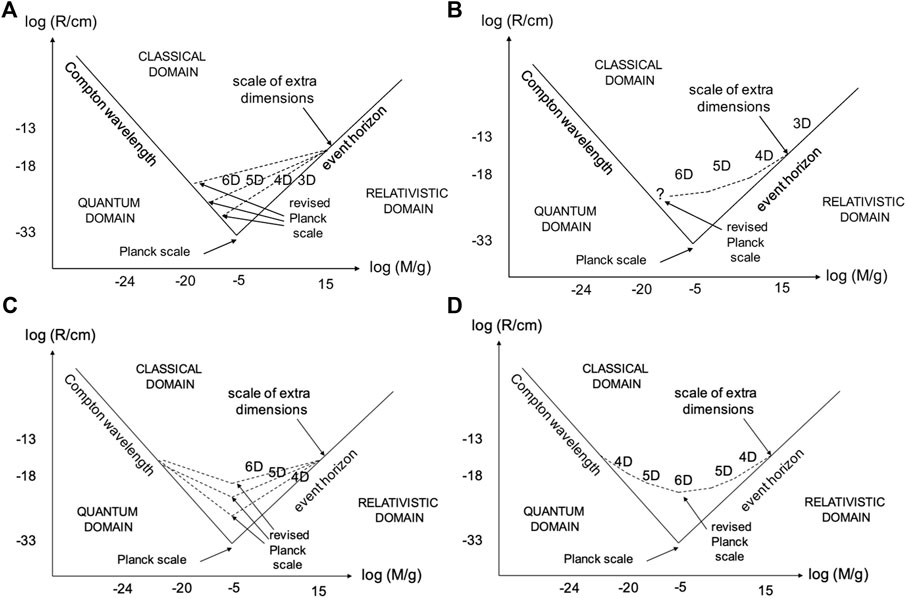
FIGURE 5. Modification of the Schwarzschild line and Planck scales in the (M, R) diagram for extra compact dimensions associated with (A) a single length scale or (B) a hierarchy of length scales (B) if the Compton scale preserves its usual form. (C) and (D) are the corresponding diagrams if the duality between the Compton and Schwarzschild expressions is preservd. From Lake and Carr (2019).
In principle, the lowering of the Planck mass could permit the possibility of TeV quantum gravity and the production of small black holes at the Large Hadron Collider (LHC), with their evaporation leaving a distinctive signature (Dimopoulos and Landsberg, 2001; Anchordoqui et al., 2002; Giddings and Thomas, 2002). If the accessible energy is Emax ≈ 10 TeV, then the extra dimensions can be probed for
Clearly, n = 1 is excluded on empirical grounds but n = 2 is possible. One expects n = 7 in M-theory, so it is interesting that RE must be of order a Fermi in this case. One could also consider a scenario with a hierarchy of compactification scales, Ri = αi RP with α1 ≥ α2 ≥…. ≥ αn ≥ 1, such that the dimensionality progressively increases as one goes to smaller scales (Carr, 2013). This situation is represented in Figure 5B. There is still no evidence for the extra dimensions (ATLAS collaboration, 2016), which suggests that either they do not exist or they have a compactification scale RE which is so small that
Another possible reason for the non-detection of accelerator black holes is that the M dependence of RC is also affected by the extra dimensions. Lake and myself have argued that the effective Compton wavelength depends on the form of the (3 + n)-dimensional wavefunction (Lake and Carr, 2019). If this is spherically symmetric in all the dimensions, then one has RC ∝ M−1 (as usually assumed). However, if the wave function is pancaked in the extra dimensions and maximally asymmetric, then we find RC ∝ M−1/(1+n). This implies that the duality between the Compton wavelength and the Schwarzschild radius persists in the higher dimensional case but that there is no accelerator production of black holes. Thus the constraint on RE given by Eq. 35 no longer applies. This scenario is illustrated in Figure 5C for extra dimensions compactified on a single length scale RE and in Figure 5D for a hierarchy of length scales, when the extra dimensions help to smooth the minimum. The latter case resembles the smooth minimum in Figure 1, which suggests that higher dimensions might themselves underlie the BHUP correspondence.
The above discussion of higher-dimensional black holes has assumed that the simple power-law forms for RS and RC apply all the way to their intersect at the (modified) Planck scale. However, the BHUP correspondence suggests that they should be unified in some way, which would smooth the minima in Figure 5. This raises the issue of the form of the GUP and BHUP correspondence in the higher-dimensional case. If the Compton wavelength preserves its 3-dimensional form, one might expect the generalized Compton wavelength to become
so that
However, the literature on this gives different results (Koppel et al., 2017; Knipfer et al., 2019).
Finally, if we interpret the Compton wavelength as marking the boundary in the (M, R) diagram below which pair-production rates becomes significant, we might expect the presence of compact extra dimensions to affect pair-production rates at high energies. Specifically, pair-production above the energy scale MEc2 ≡ ℏc/RE, should be enhanced relative to the 3-dimensional case. Indeed, there is tentative evidence that this is a generic feature of higher-dimensional theories (He, 1999; Eboli et al., 2000).
6 Linking black holes and elementary particles
The suggestion that there could be a fundamental link between elementary particles and black holes goes back to the 1970s, when it was motivated in the context of strong gravity theories (Sivaram and Sinha, 1977). Various arguments supported this suggestion: 1) both hadrons and Kerr-Newman black holes are characterised by three parameters (M,J,Q); 2) both have a magnetic dipole moment and a gyromagnetic ratio of two but no electric dipole moment; 3) Regge trajectories and extreme Kerr solutions have the same relationship between angular momentum and mass (J ∼ M2); 4) when classical black holes interact, their surface area can never decrease, which is analogous to the increase in cross-sections found in hadron collisions.
Of course, elementary particles cannot be black holes with normal gravity, since their Compton wavelength is much larger than their Schwarschild radius, as illustrated in Figure 1. The early models therefore assumed that gravity becomes stronger by a factor of
The current proposal—explored in more detail in work with Mureika and Nicolini (Carr et al., 2022)—is prompted by the Generalized Uncertainty Principle and the duality between the Compton and Schwarzschild expressions under the transformation
Extending the BHUP correspondence to charged black holes adds important insights. Although the Reissner-Nordstrom itself has a nearly Planckian mass and therefore cannot represent an elementary particle, adding a GUP term introduces sub-Planckian solutions. This explains why the charge cannot exceed
These considerations must be modified if there are extra dimensions on small scales. Although there is some uncertainty in the modifications to the GUP in this case, Figure 5 shows that the extra dimensions themselves smooth the Compton-Schwarzschild transition. Furthermore, the black hole mass may be shifted down towards the hadron scale, the effective strength of gravity being increased by the extra dimensions. However, the higher-dimensional analysis has not yet been extended to the charged and rotating black holes. Extra dimensions may also play an important role in amalgamating general relativity and quantum theory, with higher-dimensional relativity permitting a classical-type interpretation of some quantum anomalies.
Data availability statement
The original contributions presented in the study are included in the article/supplementary material, further inquiries can be directed to the corresponding author.
Author contributions
This paper is the work of the author BC but also includes some review of earlier work done in collaboration with other authors.
Acknowledgments
I thank my collaborators in the work reported here: Matthew Lake, Heather Mentzner, Leonardo Modesto, Jonas Mureika, Piero Nicolini and Isabeau Prémont-Schwarz.
Conflict of interest
The author declares that the research was conducted in the absence of any commercial or financial relationships that could be construed as a potential conflict of interest.
Publisher’s note
All claims expressed in this article are solely those of the authors and do not necessarily represent those of their affiliated organizations, or those of the publisher, the editors and the reviewers. Any product that may be evaluated in this article, or claim that may be made by its manufacturer, is not guaranteed or endorsed by the publisher.
References
Adler, R. J. (2010). Six easy roads to the Planck scale. Am. J. Phys. 78, 925–932. doi:10.1119/1.3439650
Amati, D., Ciafaloni, M., and Veneziano, G. (1989). Phys. Lett. B 216, 41–47. doi:10.1016/0370-2693(89)91366-x
Anchordoqui, L. A., Feng, J. L., Goldberg, H., and Shapere, A. D. (2002). Black holes from cosmic rays: Probes of extra dimensions and new limits on TeV-scale gravity. Phys. Rev. D. 65, 124027. doi:10.1103/physrevd.65.124027
Arkani-Hamed, N., Dimopoulos, S., and Dvali, G. (1998). The hierarchy problem and new dimensions at a millimeter. Phys. Lett. B 428, 263.
Ashtekar, A., Bojowald, M., and Lewandowski, J. (2003). Mathematical structure of loop quantum cosmology. Adv. Theor. Math. Phys. 7, 233–268. doi:10.4310/atmp.2003.v7.n2.a2
Ashtekar, A., and Lewandowski, J. (2004). Background independent quantum gravity: A status report. Cl. Quantum Gravity 21, R53–R152. doi:10.1088/0264-9381/21/15/r01
Atlas collaboration (2016). Search for new phenomena in different-flavour high-mass dilepton final states in pp collisions at 13 TeV with the ATLAS detector. Eur. Phys. J. C 76, 541.
Bojowald, M. (2001). Absence of a singularity in loop quantum cosmology. Phys. Rev. Lett. 86, 5227–5230. doi:10.1103/physrevlett.86.5227
Bushev, P. A., Bourhill, J., Goryachev, M., Kukharchyk, N., Ivanov, E., Galliou, S., et al. (2019). Testing the generalized uncertainty principle with macroscopic mechanical oscillators and pendulums. Phys. Rev. D. 100, 066020. doi:10.1103/physrevd.100.066020
Camacho, A. (2003). Decoherence and bare mass induced by nonconformal metric fluctuations. Gen. Relativ. Gravit. 35, 319–325. doi:10.1023/a:1022349328278
Carr, B. (2013). Black holes, the generalized uncertainty principle and higher dimensions. Mod. Phys. Lett. A 28, 1340011. doi:10.1142/s0217732313400117
Carr, B. (2015). “The black hole uncertainty principle correspondence,” in 1st Karl Schwarzschild meeting on gravitational physics. Editors P. Nicolini, M. Kaminski, J. Mureika, and M. Bleicher (Berlin, Germany: Springer), 159–167. arXiv:1402:1427.
Carr, B. (2018). “Quantum black holes as the link between microphysics and macrophysics,” in 2nd Karl Schwarzschild meeting on gravitational physics. Editors P. Nicolini, M. Kaminski, J. Mureika, and M. Bleicher (Berlin, Germany: Springer), 159–167. arXiv:1703.08655.
Carr, B., Mentzer, H., Mureika, J., and Nicolini, P. (2020). Self-complete and GUP-modified charged and spinning black holes. Eur. Phys. J. C 80, 1166. doi:10.1140/epjc/s10052-020-08706-0
Carr, B., Modesto, L., and Premont-Schwarz, I. (2011). Generalized Uncertainty Principle and Self-dual Black Holes. arXiv: 1107.0708 [gr-qc].
Carr, B., Mureika, J., and Nicolini, P. (2016). Sub-Planckian black holes and the generalized uncertainty principle. JHEP 07, 052.
Chen, P., and Adler, R. J. (2003). Black hole remnants and dark matter. Nucl. Phys. B - Proc. Suppl. 124, 103–106. doi:10.1016/s0920-5632(03)02088-7
Dimopoulos, S., and Landsberg, G. (2001). Black holes at the large hadron collider. Phys. Rev. Lett. 87, 161602. doi:10.1103/physrevlett.87.161602
Dvali, G., Folkerts, S., and Germani, C. (2011). Physics of trans-Planckian gravity. arXiv:1006.0984.
Eboli, O. J. P., Han, T., Magro, M. B., and Mercadante, P. G. (2000). Diphoton signals for large extra dimensions at the Fermilab Tevatron and CERN LHC. Phys. Rev. D. D61, 094007. doi:10.1103/physrevd.61.094007
Frassino, A. M., Koppel, S., and Nicolini, P. (2016). Geometric model of black hole quantum N-portrait, extradimensions and thermodynamics. Entropy 18, 181. doi:10.3390/e18050181
Giddings, S., and Thomas, S. (2002). High energy colliders as black hole factories: The end of short distance physics. Phys. Rev. D. 65, 056010. doi:10.1103/physrevd.65.056010
Gross, D. J., and Mende, P. F. (1988). String theory beyond the Planck scale. Nucl. Phys. B B303, 407–454. doi:10.1016/0550-3213(88)90390-2
Hossain, G. M., Husain, V., and Seahra, S. S. (2010). Nonsingular inflationary universe from polymer matter. Phys. Rev. D. 81, 024005. doi:10.1103/physrevd.81.024005
Isi, M., Mureika, J., and Nicolini, P. (2013). Self-completeness and the generalized uncertainty principle. J. High. Energy Phys. 1311, 139. doi:10.1007/jhep11(2013)139
Kanti, P. (2016). Black holes in theories with large extra dimensions: a review. Int. J. Mod. Phys. A 19, 4899–4951. doi:10.1142/s0217751x04018324
Kay, B. S. (1998). Decoherence of macroscopic closed systems within Newtonian quantum gravity. Cl. Quantum Gravity 15, L89–L98. doi:10.1088/0264-9381/15/12/003
Knipfer, M., Koppel, S., Mureika, J., and Nicolini, P. (2019). Generalized uncertainty principle and black holes in higher dimensional self-complete gravity. J. Cosmol. Astropart. Phys. 1908, 008. doi:10.1088/1475-7516/2019/08/008
Konishi, K., Paffuti, G., and Proverpo, P. (1990). Minimum physical length and the generalized uncertainty principle in string theory. Phys. Lett. B 234, 276.
Koppel, S., Knipfer, M., Isi, M., Mureika, J., and Nicolini, P. (2017). “2nd Karl Schwarzschild meeting on gravitational physics,” in Springer proceedings in Physics. Editors P. Nicolini, M. Kaminski, J. Mureika, and M. Bleicher (Berlin, Germany: Springer). arXiv:1703.05222.
Lake, M. J., and Carr, B. (2015). The Compton-Schwarzschild correspondence from extended de Broglie relations. JHEP 1511, 105.
Lake, M. J., and Carr, B. J. (2019). The Compton-Schwarzschild correspondence in higher dimensions. Int. J. Mod. Phys. D. 28, 1930001. doi:10.1142/s0218271819300015
Maggiore, M. (1993). A generalized uncertainty principle in quantum gravity. Phys. Lett. B 304, 65–69. doi:10.1016/0370-2693(93)91401-8
Maggiore, M. (1994). Quantum groups, gravity, and the generalized uncertainty principle. Phys. Rev. D. 49, 5182–5187. doi:10.1103/physrevd.49.5182
Maggiore, M. (1993). The algebraic structure of the generalized uncertainty principle. Phys. Lett. B 319, 83–86. doi:10.1016/0370-2693(93)90785-g
Magueijo, J., and Smolin, L. (2004). Gravity's rainbow. Cl. Quantum Gravity 21, 1725–1736. doi:10.1088/0264-9381/21/7/001
Marin, F., Marino, F., Bonaldi, M., Cerdonio, M., Conti, L., Falferi, P., et al. (2014). Investigation on Planck scale physics by the AURIGA gravitational bar detector. New J. Phys. 16, 085012. doi:10.1088/1367-2630/16/8/085012
Modesto, L., and Premont-Schwarz, I. (2009). Self-dual black holes in loop quantum gravity: Theory and phenomenology. Phys. Rev. D. 80, 064041. doi:10.1103/physrevd.80.064041
Modesto, L. (2010). Semiclassical loop quantum black hole. Int. J. Theor. Phys. 49, 1649–1683. doi:10.1007/s10773-010-0346-x
Mureika, J. R. (2019). Extended uncertainty principle black holes. Phys. Lett. B 789, 88–92. doi:10.1016/j.physletb.2018.12.009
Pikovski, I., Vanner, M. R., Aspelmeyer, M., Kim, M. S., and Brukner, C. (2012). Probing Planck-scale physics with quantum optics. Nat. Phys. 8, 393–397. doi:10.1038/nphys2262
Scardigli, F. (1999). Generalized uncertainty principle in quantum gravity from micro-black hole gedanken experiment. Phys. Lett. B B452, 39–44. doi:10.1016/s0370-2693(99)00167-7
Schwinger, J. (1951). On gauge invariance and vacuum polarization. Phys. Rev. 32, 664–679. doi:10.1103/physrev.82.664
Sivaram, C., and Sinha, K. P. (1977). Strong gravity, black holes, and hadrons. Phys. Rev. D. 16, 1975–1978. doi:10.1103/physrevd.16.1975
Veneziano, G. (1986). A stringy nature needs just two constants. Europhys. Lett. 2, 199–204. doi:10.1209/0295-5075/2/3/006
Westphal, J. P. T., Hepach, H., and Aspelmeyer, M. (2021). Measurement of gravitational coupling between millimetre-sized masses. Nature 591, 225–228. doi:10.1038/s41586-021-03250-7
Yoneya, T. (1989). On the interpretation of minimal lengths in string theory. Mod. Phys. Lett. A 4, 1587–1595. doi:10.1142/s0217732389001817
Keywords: Generalized Uncertainty Principle, Compton-Schwarzschild correspondence, black holes, higher dimensions, elementary particles
Citation: Carr BJ (2022) The Generalized Uncertainty Principle and higher dimensions: Linking black holes and elementary particles. Front. Astron. Space Sci. 9:1008221. doi: 10.3389/fspas.2022.1008221
Received: 31 July 2022; Accepted: 22 September 2022;
Published: 17 October 2022.
Edited by:
Matthew J. Lake, National Astronomical Research Institute of Thailand, ThailandReviewed by:
Kimet Jusufi, State University of Tetovo, North MacedoniaAli Övgün, Eastern Mediterranean University, Turkey
Euro Spallucci, Universities and Research, Italy
Copyright © 2022 Carr. This is an open-access article distributed under the terms of the Creative Commons Attribution License (CC BY). The use, distribution or reproduction in other forums is permitted, provided the original author(s) and the copyright owner(s) are credited and that the original publication in this journal is cited, in accordance with accepted academic practice. No use, distribution or reproduction is permitted which does not comply with these terms.
*Correspondence: B. J. Carr, Qi5KLkNhcnJAcW11bC5hYy51aw==