 R. P. Sharma1
 Nidhi Gaur
- 1Centre for Energy Studies, Indian Institute of Technology Delhi, New Delhi, India
- 2School of Basic and Applied Sciences, K. R. Mangalam University, Gurugram, Haryana, India
- 3Department of Physics, University of Rajasthan, Jaipur, India
Various space missions and observations over the past decades have provided unexampled details about the nature of solar wind, the acceleration mechanism, and different nonlinear phenomena responsible for energy transfer and turbulence in the interplanetary space. This review focuses on the role of Alfvénic fluctuations—both kinetic Alfvén wave (KAW) and dispersive Alfvén wave (DAW)—in driving solar wind turbulence and magnetic reconnection at 1 AU. The process of filamentation has been studied through a nonlinear coupling system of KAW/IAW (ion acoustic wave) and relatively high-frequency pump KAW (HKAW, i.e., frequency less than ion cyclotron frequency) in the presence of LKAW (low-frequency KAW, i.e., frequency very much less then ion cyclotron frequency) perturbation by formulating their dynamical equations in the presence of ponderomotive force and using the numerical results for the same. A simplified model is presented to have a deeper insight into the evolution pattern using the results of simulation. The formation of coherent structures and current sheets using a numerical and semi-analytical approach is elaborated near the magnetic reconnection sites. In addition to this, the relevance of the generated turbulence is also depicted through the energy spectrum by examining the spectral index which is noticeable in determining the energy cascade down to smaller scales.
Introduction
Solar wind predominantly permeates the whole heliosphere, providing an indispensable medium to study collisionless plasma. It develops a strong turbulent character on expansion, and for decades, intensive efforts have been directed to understand solar wind and its turbulent nature through various space missions like SOHO (Solar Heliospheric Observatory), Ulysses, Voyager, Helios, Yohkoh, FREJA, POLAR, FAST, Cluster, and TRACE (Transition Region and Coronal Explorer). Emanating from the solar corona and expanding outward into space (Parker, 1958), solar wind acts as a natural laboratory (Bruno and Carbone, 2013) for in situ spacecraft measurements to investigate solar wind turbulence. To understand the turbulent system and perform multipoint measurements, the NASA MIDEX mission HelioSwarm is in a Phase-A study (Klein, 2019; Spence, 2019; Hautaluoma and Fox, 2020). The latest NASA mission, the Parker Solar Probe, is designed to probe the mechanisms leading to acceleration of solar wind. At the closest approach to the Sun, the Parker Solar Probe has progressed one step toward reaching the Sun to explore the mysteries of the evolution of the Sun and provide deeper insights into the flow of energy from the solar corona to the accelerating solar wind. The evolution of astrophysical environments is significantly affected by the turbulent cascade of energy and, so to identify with the dynamics of energy dissipation, is therefore of cardinal importance to the astrophysics communities.
In a turbulent medium like solar wind, the magnetic field lines constantly break and reconnect at some scales (Franci et al., 2017; Mallet et al., 2017; Vech et al., 2018), making magnetic reconnection an inherent part of a turbulent cascade. This process is associated with the release of large amount of energy and is responsible for the transfer of energy between different length scales, thereby leading to the acceleration of particles in solar wind (Lazarian et al., 2020). This review presents an outline of the solar wind plasma portraying the influence of the nonlinear wave–wave interactions (Kraichnan, 1965; Howes & Nielson, 2013; Iroshnikov P.S., 1964; Pezzi et al., 2017a, 2017b; Roberts et al., 2017; Narita, 2018; Roberts et al., 2022) and their role in understanding the nature of turbulence through the transfer of energy from large scales to smaller scales. The understanding of mechanisms which play a decisive part in creation of astrophysical environments through the dissipation of turbulent energy to heat has always been an issue of debate. Different schools of thought have structured this debate. In the first, Alfvénic turbulence is considered one of the processes responsible for the transfer of energy (Coleman, 1968; Isenberg and Hollweg, 1982; Tu et al., 1984; Hu et al., 2000; Isenberg, 2004). Being low-frequency magnetohydrodynamic (MHD) modes and difficult to dissipate, they are able to permeate the whole solar atmosphere and are ubiquitously present in the solar wind. An illustrative characteristic of magnetized turbulence is the propensity to form sheets of current density that are liable to magnetic reconnection (Matthaeus & Lamkin, 1986; Biskamp & Welter, 1989; Dmitruk & Matthaeus, 2006; Retinò et al., 2007; Servidio et al., 2009; Comisso and Sironi, 2019). These reconnecting current sheets are typical sites of particle acceleration and magnetic energy dissipation (Dmitruk et al., 2004). Concurrently, it has long been known that particles can gain energy through random scattering by turbulence fluctuations (Kulsrud & Ferrari, 1971). Therefore, turbulence fluctuations and magnetic reconnection work in alliance, and for a comprehensive understanding of the physics in a turbulent surrounding we need to have a detailed examination of their interplay.
The solar wind is inhabited by Alfvénic fluctuations spanning from fraction of a second to several hours. Their presence in the astrophysical plasma is endorsed by various observational evidences (Belcher and Davis, 1971; Cirtain et al., 2007; He et al., 2009; Okamoto et al., 2007). The restoring force and inertia for the Alfvén wave are provided by the magnetic tension and the ion mass, respectively. Ideal MHD equations administer the propagation of this non-dispersive Alfvén wave which is now called the shear Alfvén wave. The Alfvénic wave disturbance moves with no attenuation with distance along the background magnetic field, and this remarkable property has important ramifications for the transport of energy in plasma fluids. The nonlinear phenomena are of prominent interest to properly assess the acceleration and transportation of the particles in the solar wind. Alfven waves may come across instabilities and may convert into other dispersive modes which may provide a pathway to carry large amounts of energy and then dissipate it as heat (Bogdan et al., 2003).
When the Alfven waves attain wavelengths comparable to the ion gyroradius in the direction perpendicular to the background magnetic field, they are known as kinetic Alfvén waves (KAWs) (Podesta, 2013; Narita et al., 2020). KAWs are believed to play an indispensable role in particle heating and acceleration mechanisms (Wu, 2003; Wu and Chao, 2004). The transfer of energy from MHD scales to kinetic scales is also possible through the interaction of KAWs with large-scale MHD waves (Zhao et al, 2011). The in situ measurements in the solar wind back up the idea of an Alfvén wave turbulent cascade in the perpendicular direction at the ion or electron scales producing the KAWs (Howes et al., 2008a, Howes et al., 2008b, Howes et al., 2011; Alexandrova et al., 2013; Sahraoui et al., 2009; Zhao et al., 2013). KAWs are also dominating at proton kinetic scales (He et al., 2009; Roberts et al., 2017) and also shorter scales (Chen et al., 2010a). In addition, they can also couple with high-frequency modes (Zhao et al., 2013). The shear and kinetic Alfvén waves account for various nonlinear effects like parametric processes such as three-wave decay interactions, modulational instability, and the background plasma number density being modified by the ponderomotive force of the Alfvén wave. The nonlinear interaction of the KAW and shear Alfvén wave has been intensively studied by many authors and energy transfer processes so as to interpret the observations to have a deeper insight into the turbulent cascade of energy (Zhao et al., 2013). With the finite frequency correction, i.e., when the frequency of the Alfven wave becomes comparable to but less than the ion cyclotron frequency, we get circularly polarized dispersive Alfven waves (DAWs). This dispersion of the wave also occurs when the wavelength is around the ion inertial length, which many authors (Meyrand & Galtier, 2012; Ghosh, et al., 1996) consider the Hall term, and this Hall term contributes significantly to the transfer of energy over and across the small scales as well as has an important role in the increased reconnection rate (Shay et al., 2001; Smith et al., 2004). The interaction of these dispersive Alfvén waves undergoing filamentation with the pre-existing chain of magnetic islands may also contribute toward the turbulent cascade of energy in the solar wind.
Nonlinear processes being dominant in the transfer of energy from long wavelength magnetic fluctuations to shorter wavelengths, the study of the frequency spectrum is of utmost importance to unravel the nature of turbulent plasma. The energy spectrum depicting the turbulence scaling comprises the energy injection scales followed by the energy-containing scale, known as the forcing range or injective range, marking the energy source. Next, the “inertial range,” also called the intermediate range, marks the energy transfer process to smaller scales. This range is often described as the “dissipation range,” “dispersion range,” or the “scattering range.” In this range, the fluctuations are converted to thermal energy, thereby causing the heating of particles. For magnetic fluctuations at very large scales (i.e. f ≤ 10–4 Hz), the power spectra go as k −1. This range is the energy reservoir feeding the turbulent cascade and so called the 1/f range (Matthaeus and Goldstein 1986; Chandran 2018; Matteini et al., 2018). Various measurements account for the Kolmogorov k−5/3 spectrum in the inertial range (10−3 Hz ≤ f ≤ 10−1Hz) followed by steepening at ion kinetic scales. A spectral break appears around kρs >1 (where ρs is the ion gyroradius), and the spectral index lies between -2 and -5 (Bale et al., 2005; Shaikh and Shukla, 2009; Sahraoui et al., 2009). Between the ion scales and the electron scales, a small scale turbulent cascade is established (Alexandrova 2009). As the turbulent cascade crosses the ion scales and before reaching the electron scales (i.e. 3 ≤ f ≤ 30 Hz), the magnetic spectra follow ∼ k−2.8 (Alexandrova et al., 2009; Chen et al., 2010a; Sahraoui et al., 2010). The spectral index is conspicuous of the energy transfer phenomena. Many pioneering works have been carried out to understand the dynamics and the different nonlinear processes responsible for this steepening (Leamon et al., 2000; Sahraoui et al. 2010; Rudakov et al., 2011).
The prime candidates contributing to the spectral properties and the steepening of the spectra are the various nonlinear processes like transverse collapse or filamentation due to KAW, its interaction with other wave modes, and/or the formation of coherent (magnetic) structures resulting from the current sheets. In the literature, the analysis of the field fluctuations from the proton to the electron scales shows the presence of current sheets or possible coherent structures of sub-proton scales which are possible sites of magnetic reconnection and energy dissipation (Perri et al., 2012). The current sheets may be formed self-consistently from the Alfven wave-driven turbulence as discussed by Tanbarge & Howes, (2013). These coherent structures play an important role in driving the nonlinear transfer of energy to the smaller scales as they make some additional self-consistent energy injection available (Ma et al., 1995; Sturrock et al., 1999) and thus support the continuation of the turbulence over the smaller scales (Cerri & Califano, 2017). Therefore, it is required to further examine if this turbulent energy transfer across and below the ion scales takes place as a result of instabilities or some other mechanism such as magnetic reconnection that causes the formation of coherent/localized structures or if it is both. A plethora of studies show that instabilities such as those driven by the temperature anisotropy (Gary and Lee, 1994; Verscharen et al., 2014), stream-shear-driven instabilities (Roberts et al., 1992), and parametric instabilities (Longtin and Sonnerup, 1986; Brodin and Stenflo, 1988; Viñas and Goldstein, 1991; Stenflo and Shukla, 2007; Primavera et al., 2019) such as filamentation, all may possibly lead to the dissipation of solar wind turbulence. At the same time, observations also show that reconnection can typically cause turbulence in the solar wind (Vörös et al., 2014). The spectral scaling of these fluctuations driven by the reconnection flow (obtained using the WIND spacecraft data) bears resemblance with the observations in the inertial and dispersive regime of the solar wind. Thus, these two processes, that is, turbulence and magnetic reconnection, work in alliance, and an associative study is required to be carried out.
Here, we revisit the nonlinear effects caused by dispersive Alfvén waves and KAWs to comprehend the dynamics of solar wind turbulence. Part A discusses the nonlinear effects and the turbulence due to the KAW presenting the effect of initial conditions on the spectra and the detailed explanation governing the evolution pattern through a simplified model. In part B, we study the nonlinear evolution of dispersive Alfvén waves in the vicinity of pre-existing chains of magnetic islands. The wave becomes dispersive due to the wave frequency which is finite but less than the ion cyclotron frequency.
A. Turbulence due to the Kinetic Alfvén Wave
Many simulations backed up with observations have led to a deeper understanding of turbulence at 1 AU (Howes and Quataert, 2010; Sahraoui et al., 2010; Narita et al., 2020) unwinding the energy transfer processes. This section predominantly focuses on the role of KAWs in understanding the dissipation of energy through different nonlinear processes. One of the processes leading to energy transfer is filamentation or transverse collapse which has been widely investigated. The sensitivity of the nonlinear coupling of KAWs/IAWs resulting in the transverse collapse on different initial conditions is addressed. Considering the wave propagation in the x–z plane and background field
The localized structures of KAWs with the magnetic field
Here, the initial amplitude of the main KAW is
Figures 1A–3A,C present the simulation results indicating the splitting of pump KAW at different instances of time with periodic, Gaussian, and random perturbation forms, respectively, in real space alongside contour plots in the Fourier space, i.e., Figures 1B–3B,D. The figures demonstrate that there is no regularity in the filament formation with the formation of the most intense structures at the early time and an increase in complexity at later times. The contour plot shows the dependence of
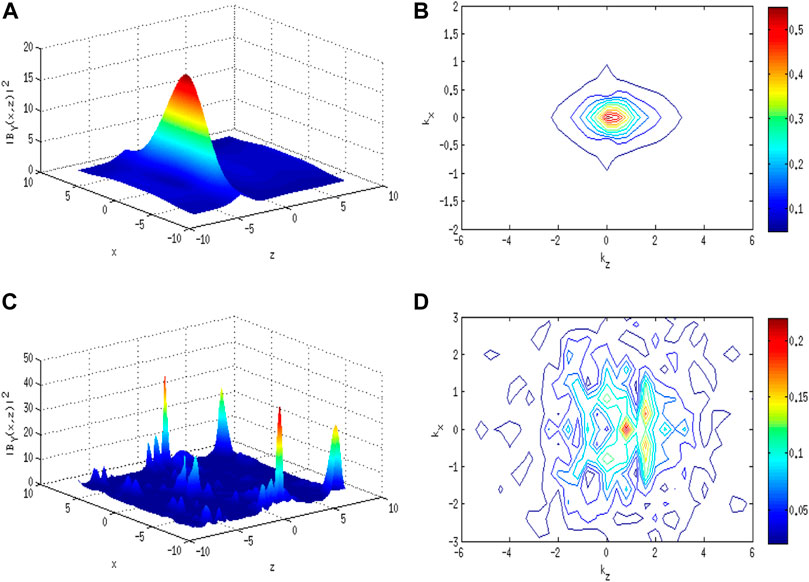
FIGURE 1. With IC-1. (A) Normalized intensity profile of the KAW magnetic field (
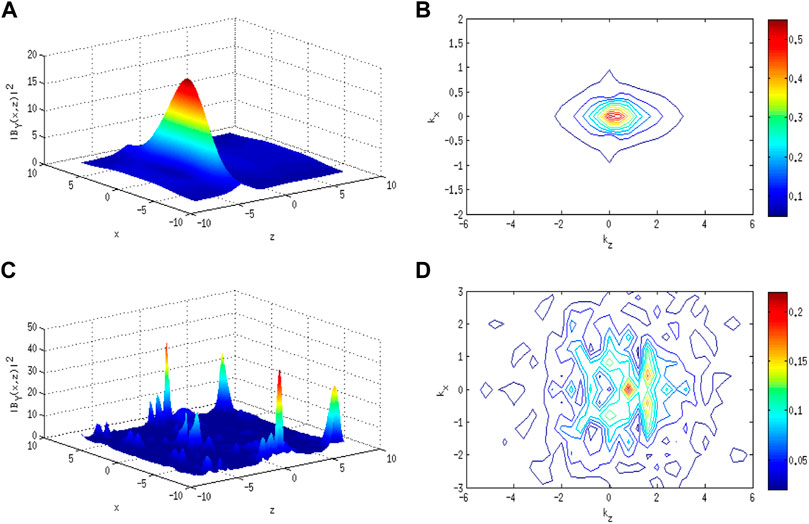
FIGURE 2. With IC-2. (A) Normalized intensity profile of the KAW magnetic field
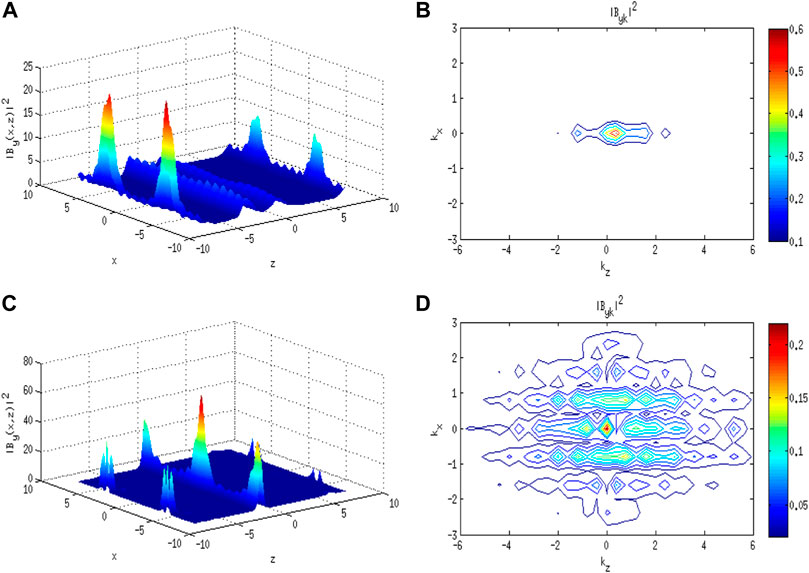
FIGURE 3. With IC-3. (A) Normalized intensity profile of the KAW magnetic field
Figure 4 illustrates the effect of formation of localized structures on the wave number spectrum. In the power spectra obtained by plotting
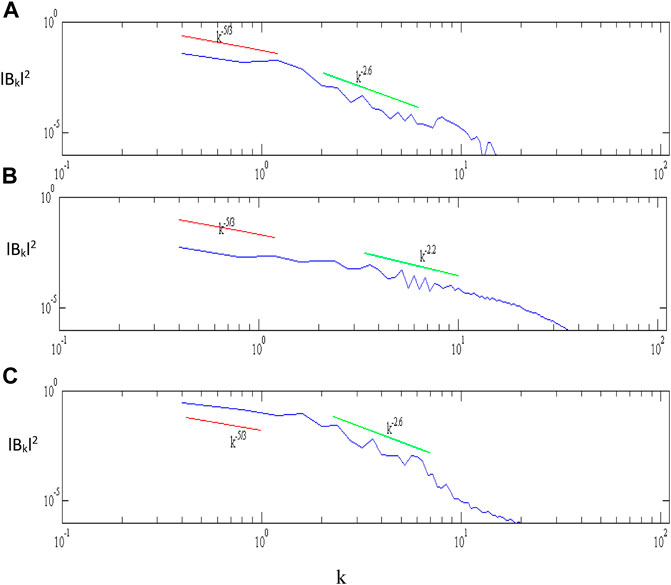
FIGURE 4. Power spectrum of normalized magnetic field fluctuations
A Simplified Model: A Deeper Insight Into the Evolution Pattern of Kinetic Alfvén Wave
Implementing the conditions
In the RHS of the aforementioned equation, the finite transverse size of the KAW accounted by the first term causes diffraction, and the nonlinearity is marked by the last three terms. The equation represents the interplay of diffraction, and nonlinear terms indicate the divergence less travel of the wave when these terms balance each other. The equation for
The Equations for
Here,
As illustrated in Figure 5. The wave intensity becomes high when the parameter
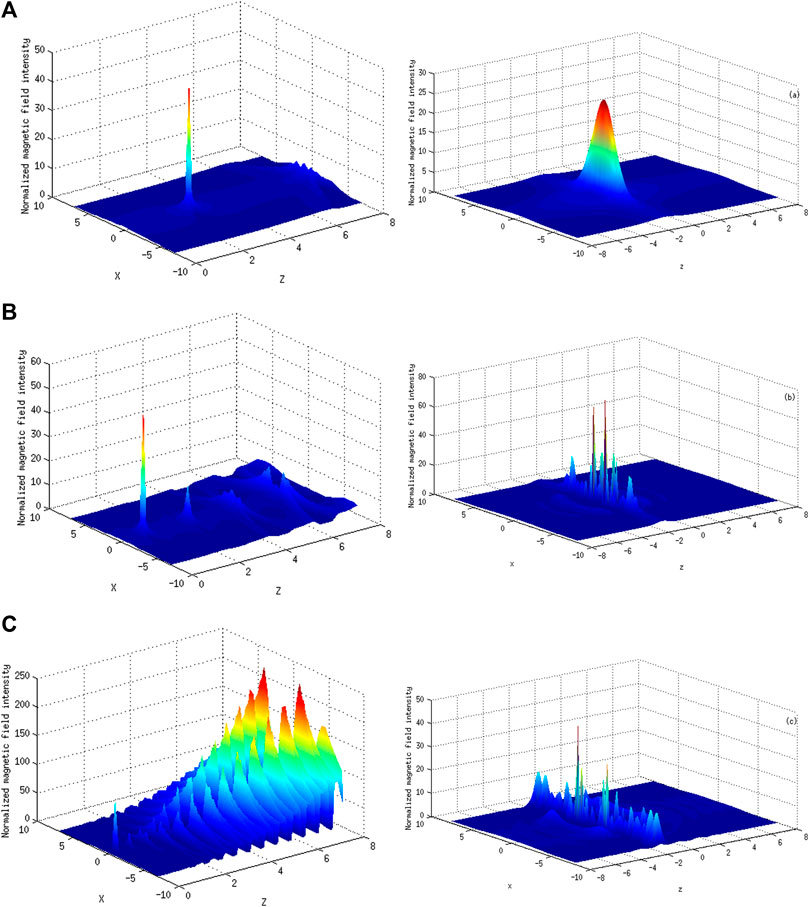
FIGURE 5. Normalized magnetic field intensity distribution
Nonlinear Effects due to KAW
Various wave modes interact with KAW to comprehend the turbulence in the space plasma. Other wave modes are excited by the ponderomotive force of KAW which leads to modification in density resulting in the nonlinear dynamics of KAW. Low-frequency KAW (LKAW) is also one of the wave modes present in the plasma, and its excitation by the ponderomotive force of relatively high-frequency, high-power pump KAW is analyzed to study its effect on the solar wind turbulence. With cold plasma assumption and two fluid models (separate ion and electron motions) in the solar wind regime, the dynamical equations are formulated and solved numerically to study the KAW evolution and the power spectra at 1 AU [ Gaur, N and R.P Sharma, 2014]:
This system of equations is solved under the following initial conditions (ICs) for the magnetic field and density perturbation:
The initial amplitude of the pump wave is
The filamentation process giving rise to strong magnetic filaments parallel to the ambient field is demonstrated under three initial conditions. The effect of the perturbation wave number is shown in the Figures 6–8 under different initial conditions. It exemplifies the dependence of nonlinear evolution patterns on the values of
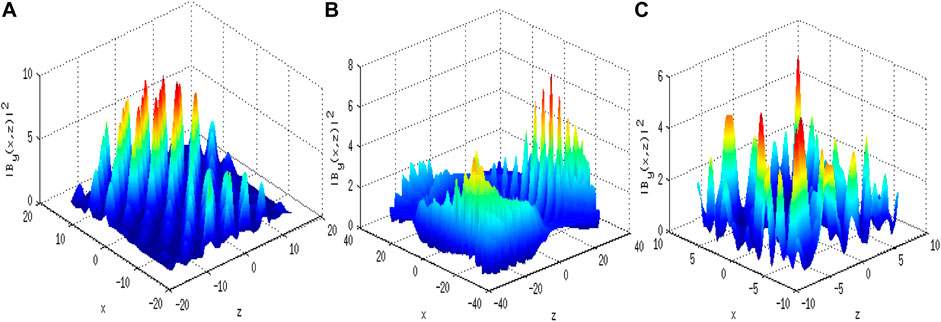
FIGURE 6. Normalized magnetic field intensity of wave
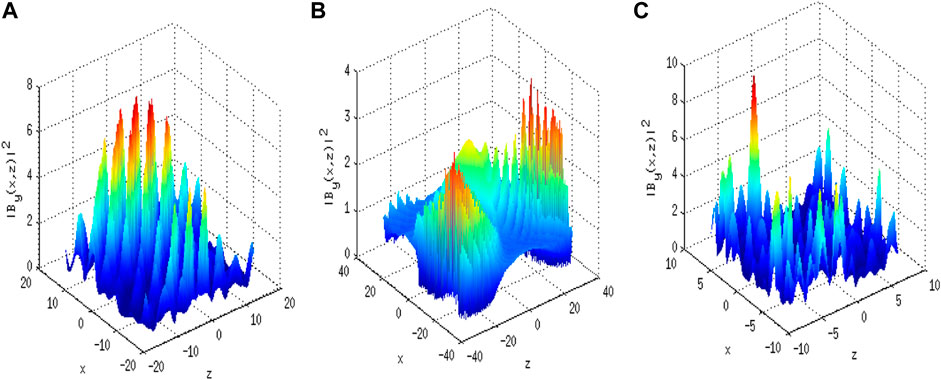
FIGURE 7. Normalized magnetic field intensity of wave
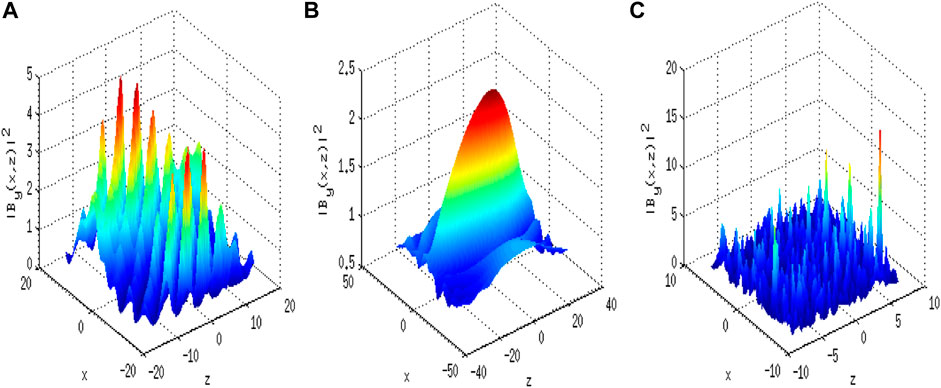
FIGURE 8. Normalized magnetic field intensity of wave
The energy distribution is further illustrated in the contour plots of
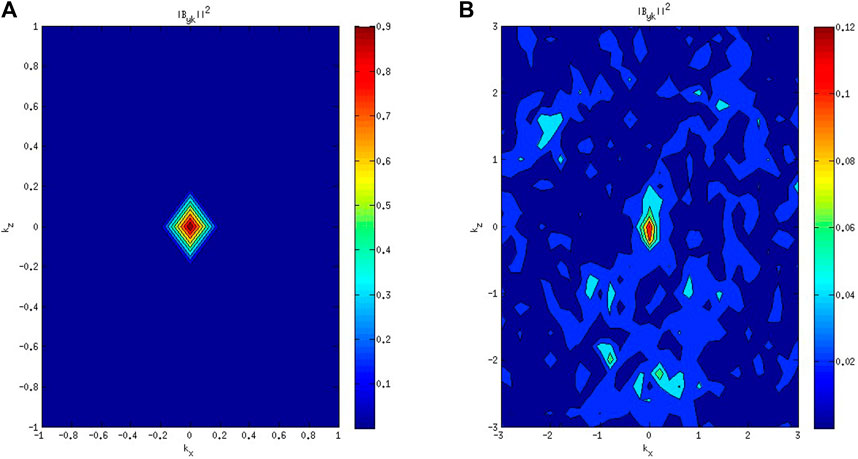
FIGURE 9. Contours of normalized
Finally, the averaged power spectra for all the three initial conditions are also shown to analyze the energy transfer through the localization process in Figure 10A with IC-1 and Figure 10B with IC-2 and IC-3. For
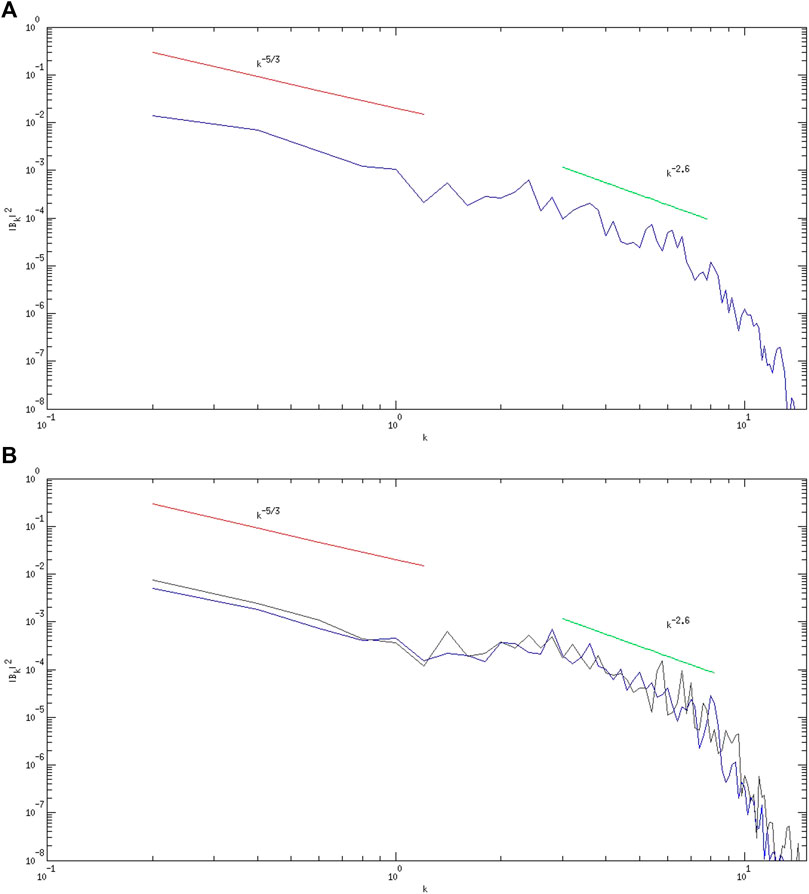
FIGURE 10. (A) Ensemble averaged normalized wave number spectrum of pump KAW
The role of kinetic Alfvén turbulence in collisionless high beta-plasmas is well documented, and the present model may be a step further to understand the turbulence in the solar wind (Boldyrev and Perez, 2012; Howes et al., 2008b).
B. Magnetic Island-Based Dispersive Alfvén Wave Model
Since turbulence and magnetic reconnection work in alliance, therefore for a comprehensive study, it is important to examine their interplay. For this, we consider the existence of a fully developed pre-existing chain of magnetic islands in the background of the parallel propagating dispersive Alfvén wave. The dispersion in the wave is considered due to the wave frequency which is finite but less than the ion cyclotron frequency. For the study, a uniform background magnetic field (
In the aforementioned equation,
For typical solar wind parameters,
The numerical value of the wave parameters is calculated as
The results depict that the fluctuations in the field occurring due to the existence of the chain of magnetic islands may induce localization, and the amplitude of these localized structures increases with z as shown in Figure 11. As clearly visible from the contour plot in Figure 11, the symmetry in the patterns is maintained only at the early stages, and as we evolve along z, this symmetry is broken, and highly irregular structures are obtained. The characteristic scale size of these coherent/localized structures is of the order of ion inertial length scales. For DAW propagating under the influence of both the factors, that is, density fluctuations as well as magnetic islands, these localized structures seem to be more intense and well evolved (Figure 12) compared to the case when DAW was propagating under the influence of magnetic islands only. Thus, these results clearly depict that nonlinearity supports the formation of localized structures, thereby aiding the generation of turbulence.
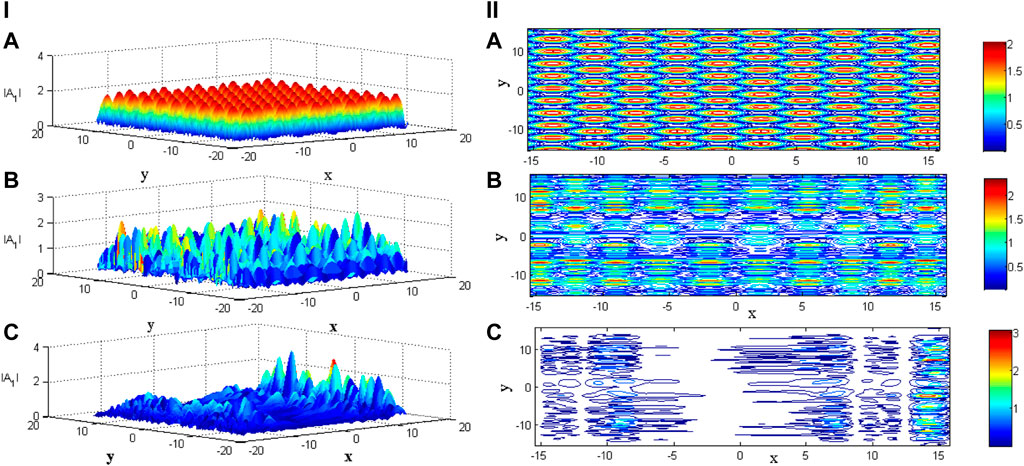
FIGURE 11. (I) DAW localization (normalized magnetic vector potential
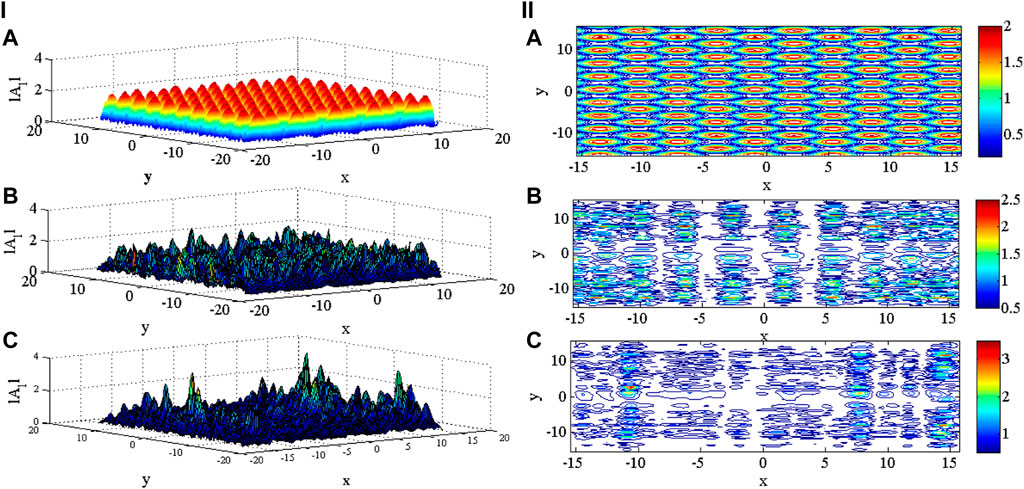
FIGURE 12. (I) DAW localization (normalized magnetic vector potential
The localized structures unveil the turbulent behavior that may further result in the development of current sheets. The current density plot of DAW as shown in Figure 13 explains that in the beginning, there is a symmetrical distribution of current in the x–y plane, but for larger z, it grows into several asymmetric and irregular structures. The size of these current sheets is found to be of the order of sub-ion scale length.
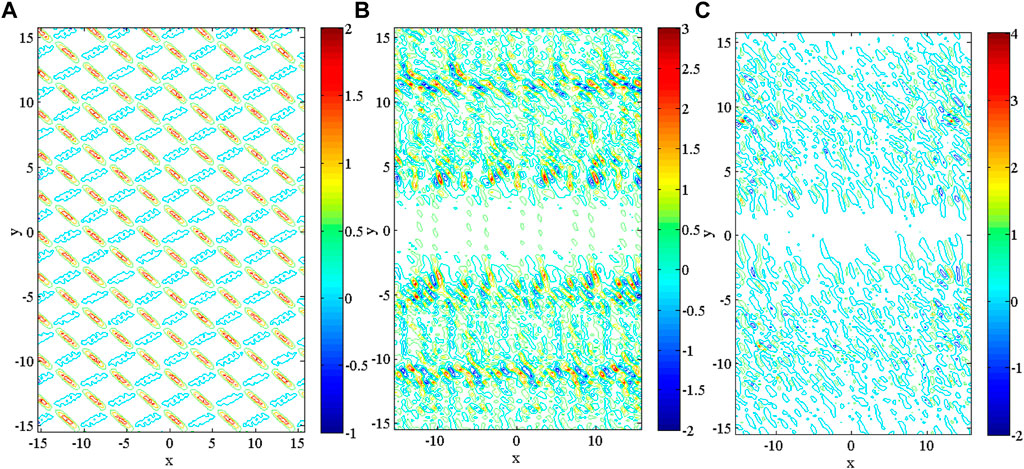
FIGURE 13. DAW-normalized current density for different z, (A) z = 0, (B) z = 2, and (C) z = 5 when the magnetic islands and perturbation in the background density are present. “Reproduced from [(Sharma et al., 2020), Physics of Plasmas, 27, https://doi.org/10.1063/1.5142893], with the permission of AIP Publishing.”
The power spectrum of DAW (Figure 14) shows that the energy distribution takes place from larger length scales to smaller length scales. For
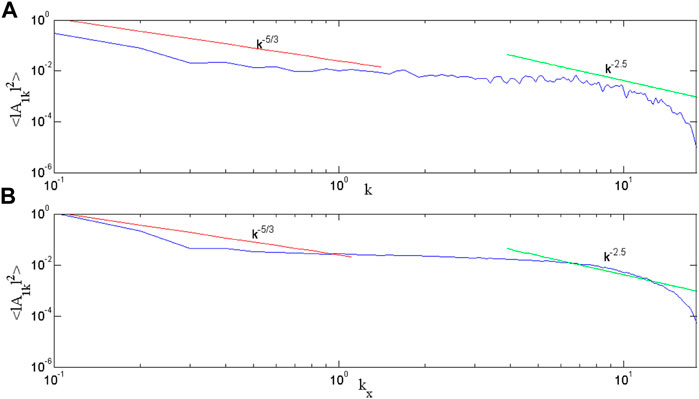
FIGURE 14. Normalized saturated average wave number spectrum of DAW showing the distribution of energy over length scales when magnetic islands and background density perturbations are existing. In the figure, we plot (A)
Semi-Analytical Method
For a better insight into the development of coherent structures and to determine their scale size, a semi-analytical approach is adopted for the aforementioned model equation as discussed by Sharma et al., 2020. Within the paraxial limit
where
On the right-hand side of the aforementioned equations, the opposite sign between the first and last two terms indicates that they behave contrary. The first term is the diffraction due to DAW, and the last two terms show convergence due to nonlinearity and magnetic islands. A competition between them goes on until the converging effects dominate the divergence leading to the localization of DAW. The result in Figure 15 shows that the localization of the wave occurs in both the planes, but the distribution of these structures is uneven due to different rates of diffraction and nonlinearity.
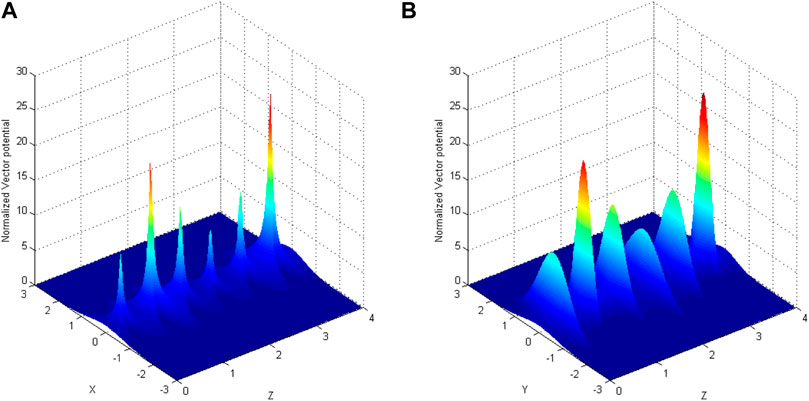
FIGURE 15. DAW normalized vector potential in the presence of magnetic islands as well as perturbation in the density in the (A) x–z plane (fixed y) and (B)y–z plane (fixed x) obtained using a semi-analytical model. “Reproduced from [(Sharma et al., 2020), Physics of Plasmas, 27, https://doi.org/10.1063/1.5142893], with the permission of AIP Publishing.”
To calculate the critical scale size, we equate the diffraction and convergence term and when only magnetic islands are present, it is found to be:
Summary and Conclusion
In this review, we have discussed the role of kinetic Alfvén waves and dispersive Alfvén waves interacting with the surrounding, nonlinearities, other low-frequency modes, and pre-existing chain of magnetic islands in the evolution of solar wind turbulence. Amongst the different validated processes for explaining the small-scale physics, emphasis is given on the en route generated coherent or localized structures which lead to the turbulent behavior and transfer of energy along and across the ion scales. The background vicinity and initial conditions affect the evolution of these structures, but the energy transfer continues to occur from larger length scales to smaller length scales. Although some variation in the spectral index is observed due to these effects, it lies within the observed spectral range of the solar wind turbulence, that is, ∼1.41.7 for large scales and ∼2.62.8 for small scales. As indicated by the observations, a reconnection flow can also generate turbulence in the solar wind, and the magnetic reconnection (magnetic island sites) may customize the plasma conditions such that several dissipation mechanisms may contribute to the evolution of the solar wind (Voros et al., 2014). Thus, solar wind turbulence is a result of various nonlinear processes like transverse collapse or localization due to KAW, its interaction with other wave modes, and/or the formation of coherent (magnetic) structures resulting from the current sheets, and all these processes gives solar wind turbulence the structure it is found in.
Author Contributions
All authors listed have made a substantial, direct, and intellectual contribution to the work and approved it for publication.
Funding
This work is supported by the Rashtriya Uchchatar Shiksha Abhiyan (RUSA 2.0), India, under Grant No. F. 35-532/PP/2021/1244. The work is partially supported by Indian Space Research organization (ISRO), Department of Science and Technology (DST) and Council of Scientific and Industrial Research (CSIR) India.
Conflict of Interest
The authors declare that the research was conducted in the absence of any commercial or financial relationships that could be construed as a potential conflict of interest.
Publisher’s Note
All claims expressed in this article are solely those of the authors and do not necessarily represent those of their affiliated organizations, or those of the publisher, the editors, and the reviewers. Any product that may be evaluated in this article, or claim that may be made by its manufacturer, is not guaranteed or endorsed by the publisher.
Acknowledgments
Authors thank Melvyn Goldstein from the NASA Goddard Space Flight Centre for useful discussions during the course of original publications from where material for the present review has been taken.
References
Akhmanov, S. A., Sukhorukov, A. P., and Khokhlov, R. V. (1967). Self-focusing and Diffraction of Light in a Nonlinear Medium. Usp. Fiz. Nauk. 93 (9), 19–70. doi:10.3367/ufnr.0093.196709c.0019
Alexandrova, O., Carbone, V., Veltri, P., and Sorriso Valvo, L. (2008). Small Scale Energy Cascade of the Solar Wind Turbulence. Astrophysical J. 674 (2), 1153–1157. doi:10.1086/524056
Alexandrova, O., Chen, C. H. K., Bale, S. D., Sorriso-Valvo, L., and Horbury, T. S. (2013). Solar Wind Turbulence and the Role of Ion Instabilities. Space Sci. Rev. 178, 101–139. doi:10.1007/s11214-013-0004-8
Alexandrova, O., Saur, J., Lacombe, C., Mangeney, A., Mitchell, J., Schwartz, S. J., et al. (2009). Universality of Solar-Wind Turbulent Spectrum from MHD to Electron Scales. Phys. Rev. Lett. 103, 165003. doi:10.1103/PhysRevLett.103.165003
Bale, S. D., Kellogg, P. J., Mozer, F. S., Horbury, T. S., and Reme, H. (2005). Measurement of the Electric Fluctuation Spectrum of Magnetohydrodynamic Turbulence. Phys. Rev. Lett. 94, 215002. doi:10.1103/PhysRevLett.94.215002
Belcher, J. W., and Davis, L. (1971). Large-amplitude Alfvén Waves in the Interplanetary Medium, 2. J. Geophys. Res. 76 (16), 3534–3563. doi:10.1029/JA076i016p03534
Biskamp, D., and Welter, H. (1989). Dynamics of Decaying Two Dimensional Magnetohydrodynamic Turbulence. Phys. Fluids B Plasma Phys. 1 (10), 1964–1979. doi:10.1063/1.859060
Bogdan, T. J., Hansteen, M. C. V., McMurry, A., Rosenthal, C. S., Johnson, M., Petty Powell, S., et al. (2003). Waves in the Magnetized Solar Atmosphere. II. Waves from Localized Sources in Magnetic Flux Concentrations. ApJ 599, 626–660. doi:10.1086/378512
Brodin, G., and Stenflo, L. (1988). Parametric Instabilities of Finite Amplitude Alfvén Waves. Phys. Scr. 37, 89–92. doi:10.1088/0031-8949/37/1/013
Bruno, R., and Carbone, V. (2013). The Solar Wind as a Turbulence Laboratory. Living Rev. Sol. Phys. 10, 2. doi:10.12942/lrsp-2013-2
Cerri, S. S., and Califano, F. (2017). Reconnection and Small-Scale Fields in 2D-3V Hybrid-Kinetic Driven Turbulence Simulations. New J. Phys. 19 (2), 025007. doi:10.1088/1367-2630/aa5c4a
Chandran, B. D. G. (2018). Parametric Instability, Inverse Cascade and the Range of Solar-Wind Turbulence. J. Plasma Phys.f range solar-wind Turbul. 84, 905840106. doi:10.1017/s0022377818000016
Chen, C. H. K., Horbury, T. S., Schekochihin, A. A., Wicks, R. T., Alexandrova, O., and Mitchell, J. (2010a). Anisotropy of Solar Wind Turbulence between Ion and Electron Scales. Phys. Rev. Lett. 104, 255002. doi:10.1103/PhysRevLett.104.255002
Chmyrev, V. M., Bilichenko, S. V., Pokhotelov, O. A., Marchenko, V. A., Lazarev, V. I., Streltsov, A. V., et al. (1988). Alfvén Vortices and Related Phenomena in the Ionosphere and the Magnetosphere. Phys. Scr. 38, 841–854. doi:10.1088/0031-8949/38/6/016
Cirtain, J. W., Golub, L., Lundquist, L., Van Ballegooijen, A., Savcheva, A., Shimojo, M., et al. (2007). Evidence for Alfven Waves in Solar X-Ray Jets. Science 318 (5856), 1580–1582. doi:10.1126/science.1147050
Coleman, P. J. J. (1968). Turbulence, Viscosity, and Dissipation in the Solar-Wind Plasma. ApJ 153, 371. doi:10.1086/14967
Comisso, L., and Sironi, L. (2019). The Interplay of Magnetically Dominated Turbulence and Magnetic Reconnection in Producing Nonthermal Particles. ApJ 886 (2), 122. doi:10.3847/1538-4357/ab4c33
Dmitruk, P., Matthaeus, W. H., and Seenu, N. (2004). Test Particle Energization by Current Sheets and Nonuniform Fields in Magnetohydrodynamic Turbulence. ApJ 617 (1), 667–679. doi:10.1086/425301
Dmitruk, P., and Matthaeus, W. H. (2006). Structure of the Electromagnetic Field in Three-Dimensional Hall Magnetohydrodynamic Turbulence. Phys. Plasmas 13 (4), 042307. doi:10.1063/1.2192757
Franci, L., Cerri, S. S., Califano, F., Landi, S., Papini, E., Verdini, A., et al. (2017). Magnetic Reconnection as a Driver for a Sub-ion-scale Cascade in Plasma Turbulence. ApJ 850 (1), L16. doi:10.3847/2041-8213/aa93fb
Gary, S. P., and Lee, M. A. (1994). The Ion Cyclotron Anisotropy Instability and the Inverse Correlation between Proton Anisotropy and Proton Beta. J. Geophys. Res. 99, 11297. doi:10.1029/94ja00253
Gaur, N., and Sharma, R. P. (2015). Nonlinear Effects Associated with Kinetic Alfvén Wave. J. Geophys. Res. Space Phys. 120, 2397–2408. doi:10.1002/2014JA020771
Gaur, N., and Sharma, R. P. (2014). Nonlinear Evolution of Kinetic Alfvén Wave and Turbulent Spectra: Effect of Initial Conditions. Astrophys. Space Sci. 350, 573–578. doi:10.1007/s10509-013-1770-1
Ghosh, S., Siregar, E., Roberts, D. A., and Goldstein, M. L. (1996). Simulation of High-Frequency Solar Wind Power Spectra Using Hall Magnetohydrodynamics. J. Geophys. Res. 101 (A2), 2493–2504. doi:10.1029/95ja03201
Hautaluoma, G., and Fox, K. (2020). NASA Space Weather Release, 20–083.Available from: https://www.nasa.gov/press-release/nasa-selects-proposalsfor- new-space-environment-missions.
He, J. S., TuMarsch, C. Y. E., Guo, L.-J., Yao, S., and Tian, H. (2009). Upward Propagating High Frequency Alfvén Waves as Identified from Dynamic Wave like Spicules Observed by SOT on Hinode. Astron. Astrophys. 497, 525. doi:10.1051/0004-6361/200810777
Howes, G. G., Cowley, S. C., Dorland, W., Hammett, G. W., Quataert, E., and Schekochihin, A. A. (2008a). A Model of Turbulence in Magnetized Plasmas: Implications for the Dissipation Range in the Solar Wind. J. Geophys. Res. 113, A05103. doi:10.1029/2007JA012665
Howes, G. G., Dorland, W., Cowley, S. C., Hammett, G. W., Quataert, E. A., Schekochihin, A. A., et al. (2008b). Kinetic Simulations of Magnetized Turbulence in Astrophysical Plasmas. Phys. Rev. Lett. 100, 065004. doi:10.1103/PhysRevLett.100.065004
Howes, G. G., and Nielson, K. D. (2013). Alfvén Wave Collisions, the Fundamental Building Block of Plasma Turbulence. Asymptotic Solution. Phys. Plasmas 20 (7), 072302. doi:10.1063/1.4812805
Howes, G. G., and Quataert, E. (2010). On the Interpretation of Magnetic Helicity Signatures in the Dissipation Range of Solar Wind Turbulence. ApJ 709, L49–L52. doi:10.1088/2041-8205/709/1/L49
Howes, G. G., Tenbarge, J. M., and Dorland, W. (2011). A Weakened Cascade Model for Turbulence in Astrophysical Plasmas. Phys. Plasmas 18, 102305. doi:10.1063/1.3646400
Hu, Y. Q., Esser, R., and Habbal, S. R. (2000). A Four-Fluid Turbulence-Driven Solar Wind Model for Preferential Acceleration and Heating of Heavy Ions. J. Geophys. Res. 105, 5093–5111. doi:10.1029/1999JA900430
Isenberg, P. A. (2004). Correction to "The Kinetic Shell Model of Coronal Heating and Acceleration by Ion Cyclotron Waves: 3. The Proton Halo and Dispersive Waves". J. Geophys. Res. 109, 3101. doi:10.1029/2004JA010524
Isenberg, P. A., and Hollweg, J. V. (1982). Finite Amplitude Alfvén Waves in a Multi-Ion Plasma: Propagation, Acceleration, and Heating. J. Geophys. Res. 87, 5023–5029. doi:10.1029/JA087iA07p05023
Klein, K. G. (2019). Multipoint Measurements of the Solar Wind : A Proposed Advance for Studying Magnetized Turbulence. Plasma 2020 Decadal. Available at: https://arxiv.org/abs/1903.05740v2.
Kraichnan, R. H. (1965). Inertial-range Spectrum of Hydromagnetic Turbulence. Phys. Fluids 8 (7), 1385–1387. doi:10.1063/1.1761412
Kulsrud, R. M., and Ferrari, A. (1971). The Relativistic Quasilinear Theory of Particle Acceleration by Hydromagnetic Turbulence. Astrophys. Space Sci. 12 (2), 302–318. doi:10.1007/BF00651420
Lazarian, A., Eyink, G. L., Jafari, A., Kowal, G., Li, H., Xu, S., et al. (2020). 3D Turbulent Reconnection: Theory, Tests, and Astrophysical Implications. Phys. Plasmas 27 (1), 012305–012394. doi:10.1063/1.5110603
Leamon, R. J., Matthaeus, W. H., Smith, C. W., Zank, G. P., Mullan, D. J., and Oughton, S. Mhd-driven Kinetic Dissipation in the Solar Wind and Corona. Astrophys. J. 537, 1054. doi:10.1086/309059
Longtin, M., and Sonnerup, B. U. Ö. (1986). Modulation Instability of Circularly Polarized Alfvén Waves. J. Geophys. Res. 91, 6816. doi:10.1029/ja091ia06p06816
Ma, Z. W., Lee, L. C., and Otto, A. (1995). Generation of Field Aligned Currents and Alfvén Waves by 3D Magnetic Reconnection. Geophys. Res. Lett. 22 (13), 1737–1740. doi:10.1029/95GL01430
Mallet, A., Schekochihin, A. A., and Chandran, B. D. G. (2017). Disruption of Alfvénic Turbulence by Magnetic Reconnection in a Collisionless Plasma. J. Plasma Phys. 83 (6). doi:10.1017/S0022377817000812
Matsumoto, Y., Amano, T., Kato, T. N., and Hoshino, M. (2015). Stochastic Electron Acceleration during Spontaneous Turbulent Reconnection in a Strong Shock Wave. Science 347 (6225), 974–978. doi:10.1126/science.1260168
Matteini, L., Stansby, D., Horbury, T. S., and Chen, C. H. K. (2018). On the 1/f Spectrum in the Solar Wind and its Connection with Magnetic Compressibility. Astrophysical J. Lett. 869 (6pp), L32. doi:10.3847/2041-8213/aaf573
Matthaeus, W. H., and Goldstein, M. L. (1986). Low-Frequency1fNoise in the Interplanetary Magnetic Field. Phys. Rev. Lett. 57, 495–498. doi:10.1103/physrevlett.57.495
Matthaeus, W. H., and Lamkin, S. L. (1986). Turbulent Magnetic Reconnection. Phys. Fluids 29 (8), 2513. doi:10.1063/1.866004
Meyrand, R., and Galtier, S. (2012). Spontaneous Chiral Symmetry Breaking of Hall Magnetohydrodynamic Turbulence. Phys. Rev. Lett. 109 (19), 9–13. doi:10.1103/PhysRevLett.109.194501
Narita, Y., Roberts, O. W., Vörös, Z., and Hoshino, M. (2020). Transport Ratios of the Kinetic Alfvén Mode in Space Plasmas. Front. Phys. 8, 166. doi:10.3389/fphy.2020.00166
Narita, Y. (2018), Space-time Structure and Wavevector Anisotropy in Space Plasma Turbulence, Living Rev. Sol. Phys. 15. doi:10.1007/s41116-017-0010-0
Okamoto, T. J., Tsuneta, S., Berger, T. E., Ichimoto, K., Katsukawa, Y., Lites, B. W., et al. (2007). Coronal Transverse Magnetohydrodynamic Waves in a Solar Prominence. Science 318, 1577–1580. doi:10.1126/science.1145447
Parker, E. N. (1958). Dynamics of the Interplanetary Gas and Magnetic Fields. ApJ 128, 664. doi:10.1086/146579
Perez, J. C., Mason, J., Boldyrev, S., and Cattaneo, F. (2012). On the Energy Spectrum of Strong Magnetohydrodynamic Turbulence. Phys. Rev. X 2, 041005. doi:10.1103/PhysRevX.2.041005
Perri, S., Goldstein, M. L., Dorelli, J. C., and Sahraoui, F. (2012). Detection of Small-Scale Structures in the Dissipation Regime of Solar-Wind Turbulence. Phys. Rev. Lett. 109 (19), 1–5. doi:10.1103/PhysRevLett.109.191101
Pezzi, O., Parashar, T. N., Servidio, S., Valentini, F., Vásconez, C. L., Yang, Y., et al. (2017a). Colliding Alfvénic Wave Packets in Magnetohydrodynamics, Hall and Kinetic Simulations. J. Plasma Phys. 83 (1). doi:10.1017/S0022377817000113
Pezzi, O., Parashar, T. N., Servidio, S., Valentini, F., Vásconez, C. L., Yang, Y., et al. (2017b). Revisiting a Classic: the Parker-moffatt Problem. ApJ 834 (2), 166. doi:10.3847/1538-4357/834/2/166
Podesta, J. J. (2013). Evidence of Kinetic Alfvén Waves in the Solar Wind at 1 AU. Sol. Phys. 286 (2), 529–548. doi:10.1007/s11207-013-0258-z
Primavera, L., Malara, F., Servidio, S., Nigro, G., and Veltri, P. (2019). Parametric Instability in Two-Dimensional Alfvénic Turbulence. ApJ 880 (2), 156. doi:10.3847/1538-4357/ab29f5
Retinò, A., Sundkvist, D., Vaivads, A., Mozer, F., André, M., and Owen, C. J. (2007). In Situ evidence of Magnetic Reconnection in Turbulent Plasma. Nat. Phys. 3 (4), 235–238. doi:10.1038/nphys574
Roberts, D. A., Goldstein, M. L., Matthaeus, W. H., and Ghosh, S. (1992). Velocity Shear Generation of Solar Wind Turbulence. J. Geophys. Res. 97, 17115. doi:10.1029/92ja01144
Roberts, O. W., Narita, Y., Nakamura, R., Vörös, Z., and Verscharen, D. (2022). The Kinetic Alfvén-like Nature of Turbulent Fluctuations in the Earth's Magnetosheath: MMS Measurement of the Electron Alfvén Ratio. Phys. Plasmas 29, 012308. doi:10.1063/5.0068828
Roberts, O. W., Narita, Y., Li, X., and Laakso, H. (2017). Multipoint Analysis of Compressive Fluctuations in the Fast and Slow Solar Wind. J. Geophys. Res. Space Phys. 122, 6940–6963. doi:10.1002/2016JA023552
Rudakov, L., Mithaiwala, M., Ganguli, G., and Crabtree, C. (2011). Linear and Nonlinear Landau Resonance of Kinetic Alfvén Waves: Consequences for Electron Distribution and Wave Spectrum in the Solar Wind. Phys. Plasmas 18, 012307. doi:10.1063/1.3532819
Sahraoui, F., Belmont, G., and Goldstein, M. L. (2012). New Insight into Short-Wavelength Solar Wind Fluctuations from Vlasov Theory. ApJ 748, 100. doi:10.1088/0004-637X/748/2/100
Sahraoui, F., Goldstein, M. L., Belmont, G., Canu, P., and Rezeau, L. (2010). Three Dimensional AnisotropickSpectra of Turbulence at Subproton Scales in the Solar Wind. Phys. Rev. Lett. 105, 131101. doi:10.1103/PhysRevLett.105.131101
Sahraoui, F., Goldstein, M. L., Robert, P., and Khotyaintsev, Y. V. (2009). Evidence of a Cascade and Dissipation of Solar-Wind Turbulence at the Electron Gyroscale. Phys. Rev. Lett. 102, 231102. doi:10.1103/physrevlett.102.231102
Servidio, S., Matthaeus, W. H., Shay, M. A., Cassak, P. A., and Dmitruk, P. (2009). Magnetic Reconnection in Two-Dimensional Magnetohydrodynamic Turbulence. Phys. Rev. Lett. 102 (11), 1–4. doi:10.1103/PhysRevLett.102.115003
Shaikh, D., and Shukla, P. K. (2009). 3D Simulations of Fluctuation Spectra in the Hall-MHD Plasma. Phys. Rev. Lett. 102, 045004. doi:10.1103/PhysRevLett.102.045004
Sharma, R. P., and Gaur, N. (2014). Nonlinear Simplified Model to Study Localization of Kinetic Alfvén Wave. Phys. Plasmas 21, 042302. doi:10.1063/1.4870500
Sharma, R. P., Kumar, S., Sharma, N., Singh, H. D., and Kumar, S. (2011a). Numerical Simulations to Study Solar Wind Turbulence. Phys. Plasmas 18, 022904. doi:10.1063/1.3556676
Sharma, R. P., Stubbe, P., and Verga, A. D. (1996). Numerical Simulation of a Zakharov-Boussinesq System of Equations to Study Langmuir Turbulence in the Ionosphere. J. Geophys. Res. 101, 10995–11003. doi:10.1029/96JA00043
Sharma, S., Sharma, R. P., Mishra, M. K., and Uma, R. (2020). Nonlinear Evolution of Dispersive Alfvén Waves and the Effect of Magnetic Islands in the Solar Wind Plasmas. Phys. Plasmas 27 (July 2020), 072903–072910. doi:10.1063/1.5142893
Shay, M. A., Drake, J. F., Rogers, B. N., and Denton, R. E. (2001). Alfvénic Collisionless Magnetic Reconnection and the Hall Term. J. Geophys. Res. 106, 3759–3772. doi:10.1029/1999ja001007
Smith, D., Ghosh, S., Dmitruk, P., and Matthaeus, W. H. (2004). Hall and Turbulence Effects on Magnetic Reconnection. Geophys. Res. Lett. 31 (2), 3–6. doi:10.1029/2003GL018689
Spence, H. E. (2019). “HelioSwarm: Unlocking the Multiscale Mysteries of Weakly Collisional Magnetized Plasma Turbulence and Ion Heating,” in Fall Meeting of the American Geophysical Union. Abstract SH11B-04.
Stenflo, L., and Shukla, P. K. (2007). “Nonlinear Processes in Space Plasmas,” in Handbook of the Solar- Terrestrial Environment. Editors Y. Kamide, and A. C. L. Chian.
Sturrock, P. A., Roald, C. B., and Wolfson, R. (1999). Chromospheric Magnetic Reconnection and its Implication for Coronal Heating. Astrophysical J. 524 (1), L75–L78. doi:10.1086/312301
Tenbarge, J. M., and Howes, G. G. (2013). Current Sheets and Collisionless Damping in Kinetic Plasma Turbulence. ApJ 771 (2), L27–7. doi:10.1088/2041-8205/771/2/L27
Vech, D., Mallet, A., Klein, K. G., and Kasper, J. C. (2018). Magnetic Reconnection May Control the Ion-Scale Spectral Break of Solar Wind Turbulence. ApJ 855 (2), L27. doi:10.3847/2041-8213/aab351
Verscharen, D., Bourouaine, S., and Chandran, B. D. G. (2014). Instabilities Driven by the Drift and Temperature Anisotropy of Alpha Particles in the Solar Wind. Astrophys. J. 773, 163.
Viñas, A. F., and Goldstein, M. L. (1991). Parametric Instabilities of Circularly Polarized Large-Amplitude Dispersive Alfvén Waves: Excitation of Obliquely-Propagating Daughter and Side-Band Waves. J. Plasma Phys. 46, 129–152. doi:10.1017/s0022377800015993
Vörös, Z., Sasunov, Y. L., Semenov, V. S., Zaqarashvili, T. V., Bruno, R., and Khodachenko, M. (2014). Reconnection Outflow Generated Turbulence in the Solar Wind. ApJ 797 (1), L10–L15. doi:10.1088/2041-8205/797/1/L10
Wilson III, L. B., Stevens, M. L., Kasper, J. C., Klein, K. G., Maruca, B. A., Bale, S. D., et al. (2018). The Statistical Properties of Solar Wind Temperature Parameters Near 1 au. ApJS 236 (2), 41. doi:10.3847/1538-4365/aab71c
Wu, D. J., and Chao, J. K. (2004). Recent Progress in Nonlinear Kinetic Alfvén Waves. Nonlin. Process. Geophys. 11 (5–6), 631–645. doi:10.5194/npg-11-631-2004
Keywords: turbulence, magnetic islands, energy spectrum, solar wind, Alfven waves
Citation: Sharma RP, Gaur N, Sharma S and Mishra MK (2022) Solar Wind Turbulence Outlined Through Magnetic Islands and Nonlinear Waves. Front. Astron. Space Sci. 9:896671. doi: 10.3389/fspas.2022.896671
Received: 15 March 2022; Accepted: 27 April 2022;
Published: 16 June 2022.
Edited by:
Oreste Pezzi, Institute for Plasma Science and Technology (ISTP/CNR), ItalyReviewed by:
Francesco Malara, University of Calabria, ItalyOwen Wyn Roberts, Austrian Academy of Sciences, Austria
Copyright © 2022 Sharma, Gaur, Sharma and Mishra. This is an open-access article distributed under the terms of the Creative Commons Attribution License (CC BY). The use, distribution or reproduction in other forums is permitted, provided the original author(s) and the copyright owner(s) are credited and that the original publication in this journal is cited, in accordance with accepted academic practice. No use, distribution or reproduction is permitted which does not comply with these terms.
*Correspondence: Nidhi Gaur, bmlkaGlwaHlzaWNzQGdtYWlsLmNvbQ==