 G. C. Ho
 G. M. Mason1
 R. C. Allen
- 1Johns Hopkins Applied Physics Laboratory, Laurel, MD, United States
- 2Institue für Experimentelle und Angewandte Physik Christian-Albrechts-Universität zu Kiel, Kiel, Germany
- 3Universidad de Alcalá, Space Research Group, Alcalá de Henares, Spain
Solar Orbiter, a joint ESA/NASA mission, is studying the Sun and inner heliosphere in greater detail than ever before. Launched in February 2020, Solar Orbiter has already completed its first three orbits, reaching perihelia of 0.5 au from the Sun in June 2020, February and August 2021. During the first 2 years in orbit, Solar Orbiter observed multiple 3He-rich Solar Energetic Particle (SEP) events inside 1 au. Even though these events were small, their spectral forms, 3He content, and association with energetic electrons and type III bursts convincingly identifies them as 3He-rich SEP events with properties similar to those previously observed at 1 au, and promising new insights as Solar Orbiter moves much closer to the Sun in 2022. In May 2021, we observed six 3He-rich SEP events in close succession within 48 h when Solar Orbiter was at 0.95 au. These events were likely released from the same active region at the Sun, and the particles arrived at Solar Orbiter in two batches with various abundances and intensities, showing strong anisotropies throughout. Multiple ion flux dropouts were also observed with these six 3He-rich SEP events. The fact that we observed so many ion injections in such a short period of time indicates the 3He enrichment and acceleration mechanism can produce SEP from the same region very efficiently and with varying enrichment levels and intensities. In addition, we report for the first-time dropout features that spanned multiple ion events simultaneously. This implies the field line random walk that we observe at 1 au still maintains magnetic connections to a small region back at the Sun up to the entire duration of these events (∼48 h).
Introduction
In one class of solar energetic particle (SEP) events, the 3He isotope is substantially enriched relative to the more abundant 4He, representing an intriguing isotopic enrichment phenomenon. The average solar wind plasma 3He/4He ratios are 5 × 10⁻⁴ (Gloeckler and Geiss, 1998) and on rare occasion can be as high as 7 × 10⁻³ (Ho et al., 2000). However, in some SEP events, the 3He/4He ratio in energetic and suprathermal ions can be three to four orders of magnitude higher than the solar wind value (Mason et al., 1986). The exact mechanism by which the 3He isotope is enhanced is still unknown. Most proposed theories involve some form of resonant wave-particle interaction that preferentially enhances the 3He but not 4He (e.g., Fisk 1978; Temerin and Roth 1992; Roth and Temerin 1997; Petrosian et al., 2009); in some models, a second stage mechanism (e.g., stochastic acceleration) provides the bulk of particle energization that accelerates the ions into the keV-MeV range (Kahler et al., 1985). Investigating the helium fluence in these 3He-rich SEP events, Ho et al. (2005) found that while the 4He fluences can vary by 5-6 orders of magnitude, the variations of the 3He fluences in the same SEP events are limited to only 2 orders of magnitude. This apparent limit of the 3He fluence variability and its distribution has been suggested as an indicator of the small size of the acceleration region (Reames 1999; Ho et al., 2005), and the underlying isotope enhancement mechanism (Petrosian et al., 2009).
These 3He-rich SEP events are often found to be accompanied by energetic electrons (10s–100s of keV), type III radio emission, and enhancements of heavy ions. Some events also appear to be associated with solar jets (reviews by Reames 2021; Bučík, 2020). But no correlation has been found between the enrichment of 3He with other accompanying observations. In fact, the only conclusive result from previous studies is that the occurrence of 3He-rich SEP events is associated with scatter-free nonrelativistic electron beams (Reames et al., 1994), but with no relation to the 3He/4He ratio itself (Ho et al., 2001).
Most of these 3He-rich SEP events are typically of short duration (i.e., impulsive) with dispersive onsets showing direct magnetic connection to the solar source. If the ions are accompanied by energetic electrons, a solar release time can be extrapolated reliably because of the fast transit times of the nonrelativistic electrons. Another interesting feature of these 3He-rich SEPs is the observation of “dropouts” (Mazur et al., 2000) in some events. Mazur et al. (2000) found in certain impulsive events, the ion flux will exhibit dispersionless “dropouts” lasting up to several hours and followed by reappearance of intensities from the same event. Mazur et al. (2000) and Chollet and Giacalone, 2008 attributed these dropouts to the spacecraft encountering magnetic flux tubes that are filled or not filled with particles, depending on the magnetic connection to the solar source. Analysis from Giacalone et al. (2000) further suggested that when SEPs are released from a small acceleration region on the Sun, the effect of field-line random walk because of supergranulation network in the solar photosphere could lead to observation of repeated dropouts in ion intensities out in the interplanetary medium. All of the dropout events identified in Chollet and Giacalone, 2008 are isolated and excluded those that had multiple impulsive injections at the same time. In an alternate explanation of dropouts by Ruffolo et al., 2003, the field line separation of filled and empty flux tubes takes place in interplanetary space due to random walk in the interplanetary medium (see also Chibber et al., 2021 and references therein).
In this paper we report six 3He-rich events, observed by Solar Orbiter in May 2021, that contained multiple dropouts. These events occurred in less than 48 h and arrived at the spacecraft location (∼0.95 au) in two batches, with particles from multiple events arriving simultaneously. During the time period there was only one active region (AR 12824) at the Sun. All the events have varying 3He/4He ratios and energy spectra, but have the same dropout signatures. This has implications for the sources of these enhanced 3He-rich SEP events and their propagation from the Sun through interplanetary space.
Observations
Event Overview
The 3He-rich events described in this paper were observed by the Solar Orbiter Energetic Particle Detector (EPD)/Suprathermal Ion Spectrograph (SIS). The SIS instrument is a high-resolution ion mass spectrometer that measures elemental and isotopic ion composition from 50 keV/nucleon to 10 MeV/nucleon (Rodríguez-Pacheco et al., 2020). SIS is based on the same design principle as the ULEIS instrument currently on ACE (Mason et al., 1998), but with modern electronics and the addition of another telescope to allow pitch-angle distribution measurements of suprathermal ions in the inner heliosphere for the first time.
Solar Orbiter was launched from Cape Canaveral in February 2020, and EPD was commissioned in April the same year. Since commissioning, EPD/SIS has measured the energetic and suprathermal ion composition in both large and small SEP events (Mason et al., 2021a; Mason et al., 2021b; Bučík et al., 2021); and Corotating Interaction Regions (Allen et al., 2021). The excellent sensitivity of the sensor allows us to measure elemental and isotopic composition in suprathermal particles with high precision. Hence, we are able to continue a similar study of 3He-rich events as reported by ACE ULEIS (e.g., Ho et al., 2005).
Figure 1 (left) shows spacecraft locations during this sudy, and (right) shows a 193Å image from the Solar Dynamics Observator (SDO) Atmospheric Imaging Assembly (AIA), with a blue circle marking the Solar Orbiter subsolar point. We used the Solar Orbiter magnetic connection tool (Rouillard et al., 2020) to locate the connection points during the period, assuming a 300 km/s solar wind speed, which was close to speed measured by the Solar Orbiter Solar Wind sensor. The calculated connections (shown by overlapping blue crosses on the figure and in the zoom in insert) use the Air Force Data Assimilative Photospheric flux Transport (ADAPT) model with synoptic magnetograms captured during 22 May 2021, and show the magnetic connection at Active Region 12824 throughout the study period. AR 12824 was the single active region on the visible disk, exhibiting multiple jets and accompanied by many type III radio bursts observed by STEREO-A WAVES. Thus this region exhibited the critical observational markers for sources of impulsive SEP events that show large enrichments of 3He, along with heavy ion enhancements and electrons in the 10 s of keV range. (e.g., Wang et al., 2006; Nitta et al., 2008; Gómez-Herraro et al., 2021).
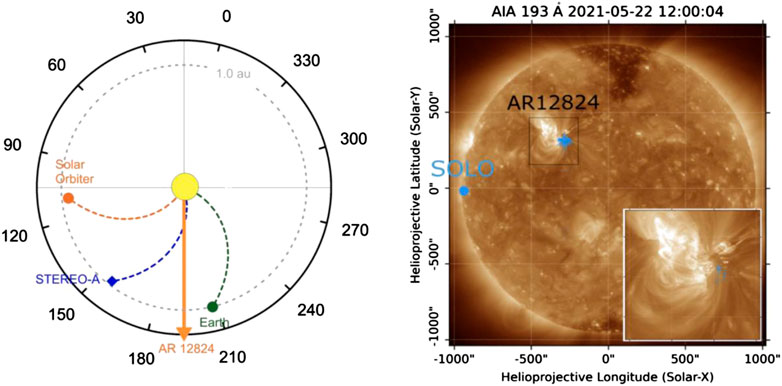
FIGURE 1. Left: spacecraft constellation on 22 May 2021, showing location of AR 12824 and nominal magnetic connections for a 400 km/s solar wind. Right: SDO-AIA EUV image: circle at left is Solar Orbiter subsolar point; blue crosses near AR mark connection locations throughout the study period with the insert showing a zoom in view of the region (see text for details).
Figure 2 shows Solar Orbiter particle and field observations during May 21-25, 2021. Ions (mostly protons) of 10 keV–100 MeV from the EPD/STEP, EPD/EPT and EPD/HET sensors are shown in the first two panels, while the ion composition measurements from SIS are shown in the third and fourth panel. All energetic particle panels use data from the sunward-pointing EPD sensors (STEP, sunward EPT, sunward HET, and SIS-A) which aim roughly along the interplanetary magnetic field (IMF) direction (Rodríguez-Pacheco et al., 2020). The bottom panel shows the IMF in RTN coordinates from the Solar Orbiter magnetometer (MAG; Horbury et al., 2020). The six ion events on May 22-23 labeled 1-6 in Figure 2 are all impulsive and 3He-rich as shown by the measured helium ion masses from SIS (panel 4), and had dispersive onsets shown on the inverse velocity plots (panels 2, 3). The sunward facing- and anti-sunward facing SIS telescopes showed extremely strong anisotropies during these events, with the sunward-facing: anti-sunward facing intensity ratios >10 throughout, and reaching values of several hundred during the peak intensity periods (not shown).
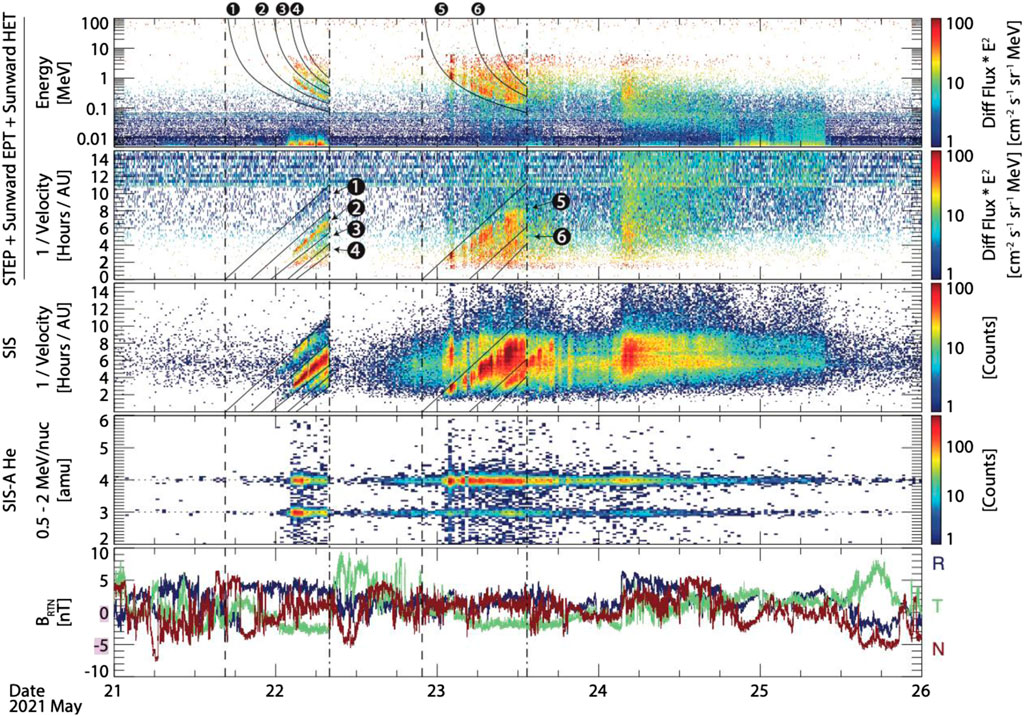
FIGURE 2. Overview of the Solar Orbiter observations from May 21-25, 2021. The top panel shows the total ion energy measurement; second panel shows the total ion inverse velocity; third panel shows the SIS inverse velocity measurement of heavy ions (C-Fe); the fourth panel shows the SIS mass spectrogram for helium isotopes; and the last panel shows the interplanetary magnetic field (IMF) in RTN coordinates. The six 3He-rich events are labeled 1-6.
During the period Solar Orbiter was 98° east of the Earth-Sun line at ∼0.95 au, and at a heliographic latitude of −0.74 to −0.78°. Table 1 lists additional details of the 6 events. Line 1 shows the injection times at the Sun estimated from extrapolating the leading edge of the heavy ion 1/v plots (Figure 2 panel 3). Line 2 shows the Carrington Longitude (CL) of Solar Orbiter, and line 3 shows the separation from the subsolar points to AR 12824. Even though the nominal separation changed by 21°during the period, the connection tool shows the spacecraft still connected to AR 12824 (at CL 194-5°), due spreading of the Potential Field Source Surface lines above the active region. The observation of events from a single AR by spacecraft separated by sizable longitudinal distances has been seen for other impulsive events, and shows that such regions can be magnetically connected to a broad range of longitudes (Wiedenbeck et al., 2013; Klassen et al., 2015; Nitta et al.,. 2015).
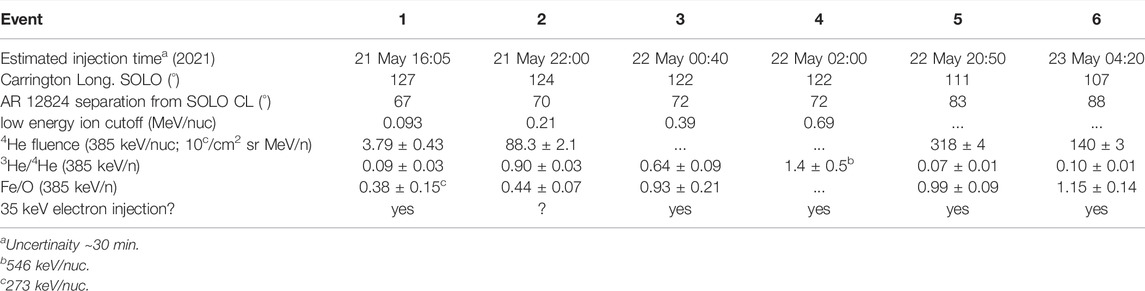
TABLE 1. 3He-Rich Solar Energetic Particle Event Properties.
Observations
Figures 3, 4 show events #1-4 and #5-6 in greater detail. These are in the same format as Figure 2 but with an expanded time scale to focus on the two batches of events; additionally, we added the 5 keV–350 keV electron data from the EPD/STEP, EPT, and HET sensors. There are five electron events (a, b, c, d, and e) with dispersive onsets clearly seen in Figure 3, and three (a, b, c) of those were closely associated with the extrapolated ion solar release time in the inverse velocity plots. We estimated the ion release time by fitting the first arriving particles (i.e., not the peak flux) that was based on Ho et al. (2003). Two dropout periods can be identified in the ion measurements, the first is highlighted with the vertical dashed lines, the second by the dash-dotted line. One occurred shortly before 22 May 0500 UT and can be seen as an abrupt drop in both ion and electron intensities for events #1-3, but particle intensities came back about 18 min later. A second one happened before 22 May 0800 UT that cut off the ion intensities entirely for events #1-4. In this case the ion intensities never recovered, but there was minimal effect on an on-going electron event (e). Line 4 of Table 1 lists the average energies below which the specta of events 1-4 were cut off by the second dropout, with progressively higher energy cutoffs for events with later injection times.
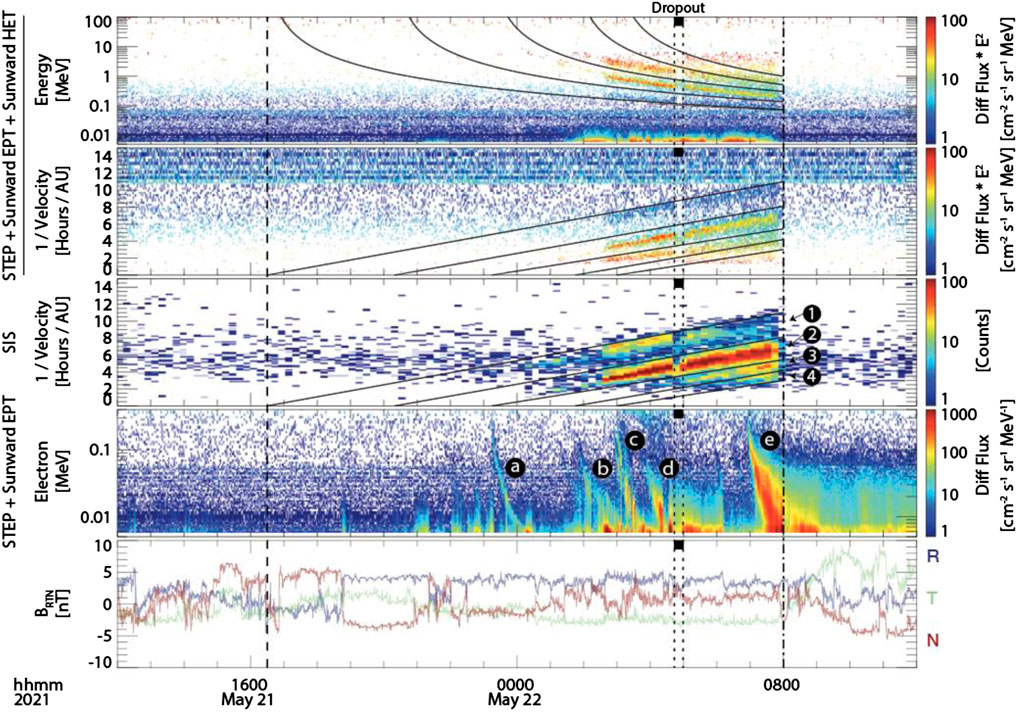
FIGURE 3. Detailed EPD observations during the first four 3He-rich events. The format is similar to Figure 2 but with the SIS mass spectrogram panel replaced by the EPD electrons in panel 4. The dropout periods are identified by dashed lines and label.
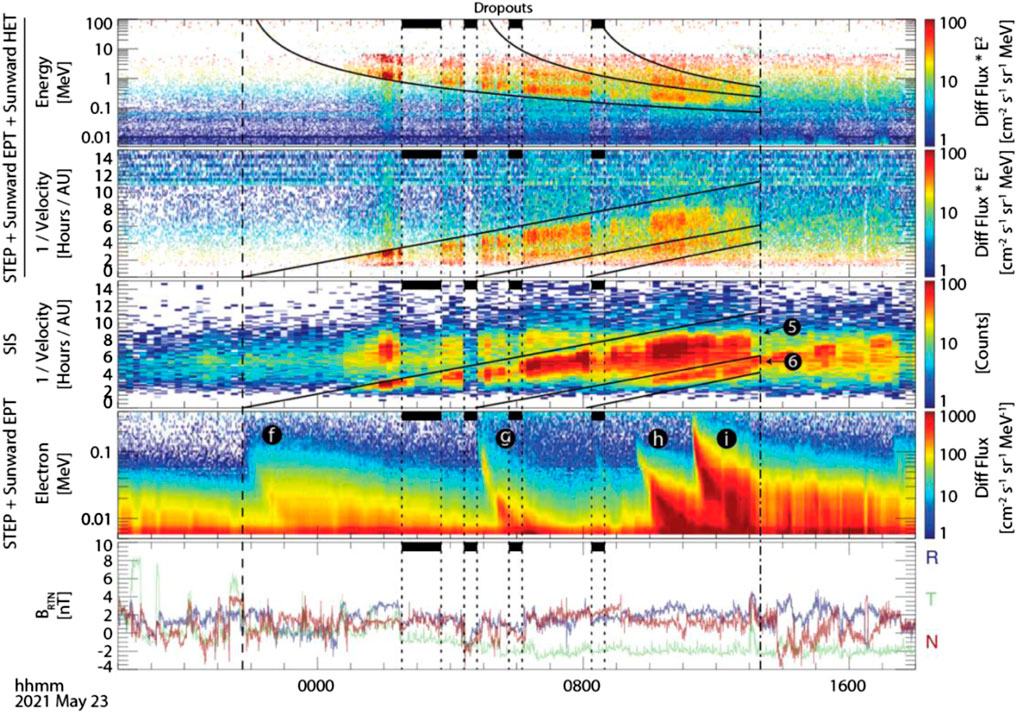
Vertical pairs of dashed lines and black rectangles in Figure 4 show four ion dropouts during the time period for events #5 and #6. The second dropout between 0400-0500 UT is very similar to the dropout on previous day at 0500 UT when the ion intensities went from high values [∼100/(cm2 s sr MeV)] to minimum. But other dropouts only slightly affected the ion intensities and none of these ion dropout signatures could be identified in the electron data. Four distinct electron events (f, g, h, and i) can be identified during this time period, but only two (f and g) of these could be associated with the ion events (5 and 6) based on the timing.
Differential fluence spectra for oxygen in all six events are shown in Figure 5 (left). Because there are multiple ion events overlapping at Solar Orbiter at the same time, we used a separate dispersive box (Mason et al., 2000) for each event in order to calculate the contributions from different events separately. The spectra are generally similar, showing range of a factor of ∼10 for oxygen, while the range for 4He is larger (Table 1 line 5). As shown earlier in Figure 2, all of these events are rich in 3He, and line 6 of Table 1 shows the 3He/4He for each event. The ratios are typical for impulsive events. Figure 5 (right) shows Fe/O ratios for each of the events, except #4 whose cutoff precluded a measurement. At 385 keV/nuc all events show Fe/O comparable to or larger than values typical of large SEP events (0.404±0.047; Desai et al., 2006), while at lower energies Fe/O increases further still in events 5 and 6.
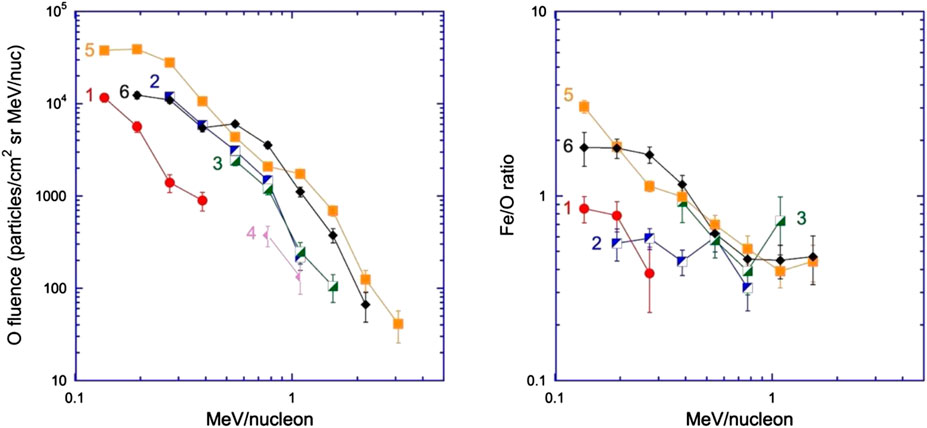
FIGURE 5. Left: oxygen energy spectra of the six 3He-rich events listed in Table 1; the energy ranges covered are affected by the dropout cutoff (see text) in events 1-4. Right: Fe/O ratio in each event (except 4) showing wide variation at low energies.
Discussion
It is remarkable that we observed these six 3He-rich events in such short period of time. They were all associated with a single, isolated active region (AR 12824) on the Sun and it therefore appears very likely that all six 3He-rich events originated from this single active region. The events have different energy spectra and abundances which means that the underlying mechanism for enhancing 3He-rich events from a single small region may tap into different sources of particles and/or have varying efficiency in producing different intensities and abundances in a short period of time. Equally remarkable is that we observed dropouts simultaneously in all these events, with the same individual dropouts occurring for multiple injections.
Ion dropouts in impulsive SEP events were first reported by Mazur et al. (2000) on ACE at 1 au. Giacalone et al. (2000) suggested that if particles are released from the Sun in a small region, the meandering of IMF lines could quantitively reproduce the ACE observations. Chollet and Giacalone, 2008 later examined two spacecraft measurements of these dropouts and found the dropout features are almost identical if the spacecraft are within the correlation length of the IMF turbulence, consistent with particle motion along random walking magnetic field lines. Both Giacalone et al. (2000) and Chollet and Giacalone, 2008 assumed that the energetic particles originated from a small region (field coherence or supergranulation scale) on the solar surface, and random motion of the solar supergranules led to separation of the IMF flux tubes because the footprints of the IMF are embedded in the photospheric plasma.
Ruffolo et al., 2003 proposed an alternate model, where the field line meandering does not take place on the solar surface, but rather in the turbulent solar wind itself by means of field line random walk (Jokipii 1966; Jokipii and Parker 1969). In such a model, dropouts are the results of particles being temporarily trapped within small-scale topological structures in statistically homogenous magnetic turbulence that has not diffused away yet (e.g., see Figure 3 in Ruffolo et al., 2003).
The above models share two common assumptions: 1) the particles originate in a small area near the solar surface; and 2) field line meandering causes the ion dropouts either through IMF footpoint motion (e.g. Giacalone et al., 2000) or solar wind turbulence (Ruffolo et al., 2003). The dropout events that have been reported so far are individual events or closely following one another (Chollet and Giacalone, 2008). Some had energetic electron and/or in-situ plasma signatures that coincided with the dropout (Gosling et al., 2004). The dropout events that we report in this paper are similar to prior studies with respect to the correlated concurrent in-situ plasma signatures. The events that we show here are separate ion injections that were released at separate times back at the Sun and arrived at Solar Orbiter with clear velocity dispersion. However, it is the first time we observed multiple ion injections that have the same dropouts across separate ion events.
During these 3He-rich events, the Sun had only one active region (AR 12824) on the visible solar disk as seen from Earth. If we assume particles from these 3He-rich events all originated from a single small region (i.e., AR 12824) at the Sun and were released separately, this implies that the IMF lines connected to Solar Orbiter with the source when they were released close to the Sun. However subsequent dropouts across multiple events at all energies implies that the field lines were connected/disconnected to the source multiple times and field line meandering happened even in shorter time intervals during the 2-day periods. Our observations showed within a 2-day period, a minimum of six 3He-rich events could be produced by the same AR and the footpoint of the IMF out at 0.95 au cannot be far removed from this region. In the Giacalone et al. (2000) model, the assumption is that the source region has to be small (∼coherence scale), so stimulation of a larger source region (several coherence scales) showed that the dropouts are nearly absent. One possibility is that the Solar Orbiter was connected to the source of this AR for up to 48 h with a bundle of flux tubes, some were filled with particles while others not (we note that the Sun will rotate by ∼25 degrees in these 48 h which is much larger than the active region). Hence, as these flux tubes passed Solar Orbiter at 0.95 au, the in-situ observations could detect all six of these 3He-rich events and showed multiple dropouts simultaneously. For the multiple events that we have shown here, they provide a constraint on time (up to 48 h) for which field lines at 0.95 au maintain their connectivity back at the Sun up to small region (∼coherence scale).
We note that Ruffolo et al., 2003 argued in their model that topological structures that develop in the solar wind turbulence could also explain the similar time-intensity profiles for many SEP events while at opposite side of the heliosphere (McKibben et al., 2001), which they attributed to rapid lateral diffusion of particles throughout the inner heliosphere. They argued that because 3He-rich events have rather narrow longitudinal distribution, they are limited within small-scale topological structures. However the larger SEP event “in a few days” could undergo broad lateral motion during their transport from the Sun to Earth, and they do not exhibit any dropouts. In the 2-day period that we observed these six 3He-rich events at 0.95 au, we found multiple ion dropouts but do not find any evidence of such rapid lateral diffusion within the duration of these events. We do not see how the present observations can distinguish between field line separation due to super-granule random walk on the solar surface, versus random walk in interplanetary space between the Sun and ∼0.95 au. However, when Solar Orbiter explores the inner heliosphere much closer to the Sun later in its mission, we expect new observations of similar dropouts may give us new data to reveal their exact cause and mechanism (e.g., Wang et al., 2014).
Conclusion
We observed six 3He-rich SEP events on Solar Orbiter while at 0.95 au in May 2021. These six events all showed dispersion onsets and half of these had associated energetic electrons during the extrapolated released time. All the events were measured by Solar Orbiter within 48 h and arrived in two batches, with ions from different events arriving at Solar Orbiter at the same time but at different energies. They were all likely to be associated with the same AR at the Sun. Interestingly, multiple dropouts were also observed with these six ion events with concurrent dropouts across all ion (and some electron) energies. Assuming all these ions were released from the same source at the Sun, this implies that the 3He enrichment and subsequent acceleration mechanism is able to generate this type of event in quick succession (∼several hours) with varying abundancees and intensities. The dropout features that we observed with these events are consistent with those reported by prior studies that reported the connectivity could be severed and reconnected at timescales of less than an hour. In addition, the multiple dropouts that we observed throughout these ion events indicate that field line random walk could allow magnetic connections to small region back at the Sun over 0.95 au radial distance during a time span of more than 48 h. All of these have implications on the source and enrichment mechanism of 3He-rich SEP events, and how SEPs propagate from the Sun into and through the interplanetary medium.
Data Availability Statement
The datasets presented in this study can be found in online repositories. The names of the repository/repositories and accession number(s) can be found below: https://soar.esac.esa.int/soar/.
Author Contributions
GM: contributed to the detailed analysis of the 3He-rich events RA: contributed to the EPD particle analysis and provided figures RF-S: Provided the EPD/STEP, EPT, HET data JR-P: EPD overall PI, provided all the EPD data processing RG-H: Provided the electron analysis to identify the possible source of the ion events.
Funding
Solar Orbiter post-launch work at JHU/APL is supported by NASA contract 80MSFC19F0002, and we thank NASA headquarters and the NASA/GSFC Solar Orbiter project office for their continuing support. JR-P and RG-H acknowledge the financial support by the Spanish Ministerio de Ciencia, Innovación y Universidades FEDER/MCIU/AEI Projects ESP 2017-88436-R and PID 2019- 104863RB-I00/AEI/10.13039/501100011033. RFWS thanks ESA for supporting the build of SIS under contract number SOL.ASTR.CON.00004; the German Federal Ministry for Economic Affairs and Energy and the German Space Agency [Deutsches Zentrum für Luft-und Raumfahrt, e.V., (DLR)] for their unwavering support under grant numbers 50OT0901, 50OT1202, 50OT1702, and 50OT 2002; and the University of Kiel and the Land Schleswig-Holstein for their support of SIS.
Conflict of Interest
The authors declare that the research was conducted in the absence of any commercial or financial relationships that could be construed as a potential conflict of interest.
Publisher’s Note
All claims expressed in this article are solely those of the authors and do not necessarily represent those of their affiliated organizations, or those of the publisher, the editors and the reviewers. Any product that may be evaluated in this article, or claim that may be made by its manufacturer, is not guaranteed or endorsed by the publisher.
References
Allen, R. C., Mason, G. M., and Ho, G. C. (2021). Solar Orbiter’s First Venus Flyby. Astronomy Astrophysics 656, L2. doi:10.1051/0004-6361/202140910
Bučík, R. (2020). 3He-Rich Solar Energetic Particles: Solar Sources. Space Sci. Rev. 215, 25. doi:10.1007/s11214-020-00650-5
Bučík, R., Mason, G. M., and Gómez-Herrero, R. (2021). First Near-Relativistic Solar Electron Events Observed by EPD Onboard Solar Orbiter. Astronomy Astrophysics 656, L11. doi:10.1051/0004-6361/202039883
Chibber, R., Ruffolo, D., and Matthaeus, W. H. (2021). Random Walk and Trapping of Interplanetary Magnetic Field Lines: Global Simulation, Magnetic Connectivity, and Implications for Solar Energetic Particles. Astrophysical J. 908, 174. doi:10.3847/1538-4357/abd7f0
Chollet, E. E., and Giacalone, J. (2008). Multispacecraft Analysis of Energetic Ion Flux Dropouts. Astrophysical J. 688, 1368–1373. doi:10.1086/592378
Desai, M. I., Mason, G. M., Gold, R. E., Krimigis, S. M., Cohen, C. M. S., Mewaldt, R. A., et al. (2006). Heavy-Ion Elemental Abundances in Large Solar Energetic Particle Events and Their Implications for the Seed Population. Astrophysical J. 649, 470–489. doi:10.1086/505649
Fisk, L. A. (1978). He-3-rich Flares - A Possible Explanation. Astrophysical J. 224, 1048. doi:10.1086/156456
Giacalone, J., Jokipii, J. R., and Mazur, J. E. (2000). Small-scale Gradients and Large-Scale Diffusion of Charged Particles in the Heliospheric Magnetic Field. Astrophysical J. 532, L75–L78. doi:10.1086/312564
Gómez-Herrero, R., Pacheco, D., Kollhoff, A., Dresing, N., Lario, D., Balmaaceda, L., et al. (2021). First Near-Relativistic Solar Electron Events Observed by EPD Onboard Solar Orbiter. Astronomy Astrophysics 656, L3. doi:10.1051/0004-6361/202039883
Gloeckler, G., and Geiss, J. (1998). Interstellar and Inner Source Pickup Ions Observed with SWICS on ULYSSES. Space Sci. Rev. 86, 541. doi:10.1023/a:1005019628054
Ho, G. C., Hamilton, D. C., Gloeckler, G., and Bochsler, P. (2000). Enhanced Solar Wind ³He2+ Associated with Coronal Mass Ejections. Geophys. Res. Lett. 27, 309–312. doi:10.1029/1999gl003660
Ho, G. C., Roelof, E. C., Hawkins III, S. E., Gold, R. E., Mason, G. M., Dwyer, J. R., et al. (2001). Energetic Electrons in 3He-Enhanced Solar Energetic Particle Events. Astrophysical J. 552, 863–870. doi:10.1086/320576
Ho, G. C., Roelof, E. C., Mason, G. M., Lario, D., and Mazur, J. E. (2003). Onset Study of Impulsive Solar Energetic Particleevents. Adv. Space Res. 32 (12), 2679–2684. doi:10.1016/s0273-1177(03)00930-x
Ho, G. C., Roelof, E. C., and Mason, G. M. (2005). The Upper Limit on 3 He Fluence in Solar Energetic Particle Events. Astrophysical J. 621, L141–L144. doi:10.1086/429251
Horbury, T. S., O’Brien, H., Blazquez, I. C., and Dresing, N. (2020). The First Widespread Solar Energetic Particle Event Observed by Solar Orbiter on 2020 November 29. Astronomy Astrophysics 642. doi:10.1051/0004-6361/202140937
Jokipii, J. R. (1966). Cosmic-Ray Propagation. I. Charged Particles in a Random Magnetic Field. Astrophysical J. 146, 480. doi:10.1086/148912
Jokipii, J. R., and Parker, E. N. (1969). Stochastic Aspects of Magnetic Lines of Force with Application to Cosmic-Ray Propagation. Astrophysical J. 155, 777. doi:10.1086/149909
Kahler, S., Reames, D. V., Sheeley, N. R. J., Howard, R. A., Michels, D. J., and Koomen, M. J. (1985). A Comparison of Solar Helium-3-Rich Events with Type II Bursts and Coronal Mass Ejections. Astrophysical J. 290, 742. doi:10.1086/163032
Klassen, A., Dresing, N., Gómez-Herrero, R., and Heber, B. (2015). First Simultaneous Observations of a Near-Relativistic Electron Spike Event by Both STEREO Spacecraft. Astronomy Astrophysics 580, A115. doi:10.1051/0004-6361/201525700
Mason, G. M., Dwyer, J. R., and Mazur, J. E. (2000). New Properties of [TSUP]3[/TSUP]H[CLC]e[/CLC]-Rich Solar Flares Deduced from Low-Energy Particle Spectra. Astrophysical J. 545, L157–L160. doi:10.1086/317886
Mason, G. M., Gold, R. E., Krimigis, S. M., Mazur, J. E., Andrews, G. B., Daley, K. A., et al. (1998). The Ultra-Low-Energy Isotope Spectrometer (ULEIS) for the ACE Spacecraft. Space Sci. Rev. 86, 409–448. doi:10.1023/a:1005079930780
Mason, G. M., Cohen, C. M., Ho, G. C., Mitchell, D. C., Allen, R. C., Hill, M. E., et al. (2021a). Solar Energetic Particle Heavy Ion Properties in the Widespread Event of 2020 November 29. Astrophys. 656, L12. doi:10.1051/0004-6361/202141310
Mason, G. M., Ho, G. C., Allen, R. C., Rodríguez-Pacheco, J., Wimmer-Schweingruber, R. F., Bučík,, R. C., Allen, R. C., et al. (2021b). 3He-Rich Solar Energetic Particle Events Observed on the First Perihelion Pass of Solar Orbiter. Astron. Astrophys 656, L1. doi:10.1051/0004-6361/202039752
Mason, G. M., Reames, D. V., von Rosenvinge, T. T., Klecker, B., and Hovestadt, D. (1986). The Heavy-Ion Compositional Signature in He-3-Rich Solar Particle Events. Astrophysical J. 303, 849. doi:10.1086/164133
Mazur, J. E., Mason, G. M., Dwyer, J. R., Giacalone, J., Jokipii, J. R., and Stone, E. C. (2000). Interplanetary Magnetic Field Line Mixing Deduced from Impulsive Solar Flare Particles. Astrophysical J. 532, L79–L82. doi:10.1086/312561
McKibben, R. B., Lopate, C., and Zhang, M. (2001). Simultaneous Observations of Solar Energetic Particle Events by Imp 8 and the Ulysses Cospin High Energy Telescope at High Solar Latitudes. Space Sci. Rev. 97, 257–262. doi:10.1023/a:1011816715390
Nitta, N. V., Mason, G. M., Wang, L., Cohen, C. M. S., and Wiedenbeck, M. E. (2015). SOLAR SOURCES OF3He-RICH SOLAR ENERGETIC PARTICLE EVENTS IN SOLAR CYCLE 24. Astrophysical J. 806, 235. doi:10.1088/0004-637x/806/2/235
Nitta, N. V., Mason, G. M., Wiedenbeck, M. E., Cohen, C. M. S., Krucker, S., Hannah, I. G., et al. (2008). Coronal Jet Observed by Hinode as the Source of a 3 He-Rich Solar Energetic Particle Event. Astrophysical J. 675, L125–L128. doi:10.1086/533438
Petrosian, V., Jiang, Y. W., Liu, S., Ho, G. C., and Mason, G. M. (2009). Relative Distributions of Fluences of 3He and 4He in Solar Energetic Particles. Astrophysical J. 701, 1–7. doi:10.1088/0004-637x/701/1/1
Reames, D. V., Meyer, J. P., and von Rosenvinge, T. T. (1994). Energetic-Particle Abundances in Impulsive Solar Flare Events. Astrophys. J. 90, 649. doi:10.1086/191887
Reames, D. V. (1999). Particle Acceleration at the Sun and in the Heliosphere. Space Sci. Rev. 90, 413–491. doi:10.1023/a:1005105831781
Reames, D. V. (2021). Sixty Years of Element Abundance Measurements in Solar Energetic Particles. Space Sci. Rev. 217, 72. doi:10.1007/s11214-021-00845-4
Rodríguez-Pacheco, J., Wimmer-Schweingruber, R. F., and Mason, G. M. (2020). The Energetic Particle Detector. Energetic Particle Instrument Suite for the Solar Orbiter Mission. Astron Astrophys. 642, A7. doi:10.1051/0004-6361/201935287
Roth, I., and Temerin, M. (1997). Enrichment of3He and Heavy Ions in Impulsive Solar Flares. Astrophysical J. 477, 940–957. doi:10.1086/303731
Rouillard, A. P., Pinto, R. F., and Vourlidas, A. (2020). The Solar Orbiter Science Activity Plan-Translating Solar and Heliospheric Physics Questions into Action. Astron Astrophys. 642, A2. doi:10.1051/0004-6361/202038445
Ruffolo, D., Matthaeus, W. H., and Chuychai, P. (2003). Trapping of Solar Energetic Particles by the Small-Scale Topology of Solar Wind Turbulence. Astrophysical J. 597, L169–L172. doi:10.1086/379847
Temerin, M., and Roth, I. (1992). The Production of 3He and Heavy Ion Enrichments in 3He-Rich Flares by Electromagnetic Hydrogen Cyclotron Waves. Astrophysical J. 391, 105. doi:10.1086/186408
Wang, Y. M., Pick, M., and Mason, G. M. (2006). Coronal Holes, Jets, and the Origin of 3He-Rich Particle Events. Astrophysical J. 639, 495–509. doi:10.1086/499355
Wang, Y., Qin, G., Zhang, M., and Dalla, S. (2014). A Numerical Simulation of Solar Energetic Particle Dropouts during Impulsive Events. Astrophysical J. 789, 157. doi:10.1088/0004-637x/789/2/157
Keywords: energetic particle, 3He-rich events, Solar Orbiter mission, particle acceleration, active region, Sun
Citation: Ho GC, Mason GM, Allen RC, Wimmer-Schweingruber RF, Rodríguez-Pacheco J and Gómez-Herrero R (2022) Interplanetary Ion Flux Dropouts Across Multiple 3He-Rich Events. Front. Astron. Space Sci. 9:939799. doi: 10.3389/fspas.2022.939799
Received: 09 May 2022; Accepted: 23 June 2022;
Published: 14 July 2022.
Edited by:
Linghua Wang, Peking University, ChinaReviewed by:
Maher Dayeh, Southwest Research Institute (SwRI), United StatesGang Qin, Harbin Institute of Technology, China
Copyright © 2022 Ho, Mason, Allen, Wimmer-Schweingruber, Rodríguez-Pacheco and Gómez-Herrero. This is an open-access article distributed under the terms of the Creative Commons Attribution License (CC BY). The use, distribution or reproduction in other forums is permitted, provided the original author(s) and the copyright owner(s) are credited and that the original publication in this journal is cited, in accordance with accepted academic practice. No use, distribution or reproduction is permitted which does not comply with these terms.
*Correspondence: G. C. Ho, R2VvcmdlLkhvQGpodWFwbC5lZHU=