 Rishi Kumar Tiwari1†
 Alnadhief H. A. Alfedeel2†*
 Değer Sofuoğlu3†
 Amare Abebe4,5†
 Eltegani I. Hassan2†B. K. Shukla1†
- 1Department of Mathematics, Govt. Model Science College Rewa, Rewa, Madhya Pradesh, India
- 2Department of Mathematics and Statistics, Imam Mohammad Ibn Saud Islamic University (IMSIU), Riyadh, Saudi Arabia
- 3Department of Physics, Istanbul University, Instanbul, Turkey
- 4Center for Space Research, North-West University, Mahikeng, South Africa
- 5National Institute for Theoretical and Computational Sciences (NITheCS), Cape Town, South Africa
In this paper, we investigate Bianchi type − V cosmological models with bulk viscous fluid and time varying cosmological Λ and Newtonian G parameters. The Einstein’s field equations have been transformed into a coupling non-linear, first-order differential equations, and the fourth-order Runge-Kutta method of numerical integration has been used to integrate the differential equations with appropriate initial conditions consistent with current cosmological observations. We show that the model describes a universe that starts off with a negative cosmological term, as well as a matter-dominated and decelerated early epoch that, eventually becomes Λ-dominated and expanding with acceleration, in concordance with current observations.
1 Introduction
Bianchi cosmological models are homogeneous and anisotropic models that can be viewed as a generalization of the homogeneous and isotropic Friedman-Lemaître-Robertson-Walker (FLRW) space-times on which the concordance cosmology is based. These models are interesting because, although the universe is almost isotropic on the largest possible scales, small-scale anisotropies are a feature of the observed universe. Current cosmological observations (Perlmutter et al., 1997; Perlmutter et al., 1998; Riess et al., 1998; Perlmutter et al., 1999) point out that the universe is expand with acceleration that was previously thought to be decelerating. Dark energy (DE), which in the standard Λ-Cold Dark Matter (ΛCDM) paradigm is represented by the cosmological constant in Einstein Field Equations (EFEs) of general relativity (GR), is thought to be responsible for the late-time accelerated expansion. Whereas DE is estimated to account for about 70% of the total matter-energy budget of the universe, the significant other proportion of 25% is thought to exist in the form of dark matter (DM), a non-luminous, and yet-to-be discovered, form of matter whose presence can only be detected through its gravitational effects.
Several proposals have been put forward to address the issues of DE and DM, such as additions of exotic matter forms (such as Λ, the Chaplygin gas, scalar fields, etc.), or modifications of GR itself [in the form of f(R), f(T), f(R, T), f(Q), etc. (Nojiri and Odintsov, 2004; Bergliaffa, 2006; Bertolami et al., 2007; Bertolami and Sequeira, 2009; Sotiriou and Faraoni, 2010; Liu and Reboucas, 2012; Atazadeh, Darabi; Wang and Liao, 2012; Sharif and Ikram, 2016; Bamba et al., 2017; Moraes et al., 2019; Mandal et al., 2020; Arora et al., 2021)] or the non-relativistic limit of Newtonian theory (MOND) in the case of DM. Another consideration in the literature has been one based on Dirac’s hypothesis on the evolution of the fundamental “constants”. P. Dirac hypothesized that Λ must be a time-dependent function (Dirac, 1937) because the theoretical prediction from quantum field theory (QFT) differs significantly from observations in the value of Λ (Chen and Wu, 1990; Sahni and Starobinsky, 2000). Since then, various scientists have indicated an interest in investigating cosmological models in the context of GR with time-dependent cosmological constant Λ. Many authors have investigated different forms of Λ with standard and non-standard cosmological models based on the same assumption (Vishwakarma and Abdussattar, 1996a; Vishwakarma and Abdussattar, 1996b; Vishwakarma et al., 1999; Vishwakarma, 2000; Vishwakarma, 2001; Vishwakarma, 2005; Bali et al., 2012; Alfedeel et al., 2018; Alfedeel and Abebe, 2020). Bulk viscosity is important in cosmology because it plays a role in the universe’s accelerated expansion, also known as the inflationary phase. Over the course of the universe’s history, bulk viscosity could manifest in a variety of ways (Ellis, 1971). It is believed that viscosity emerges when neutrinos disengage from the cosmic fluid (Misner, 1968), at the time of galaxies formation and particle synthesis at the early stages of our cosmos (Hu et al., 1983). For all these reasons, there have been many attempts to study non-standard cosmological models involving viscous fluids. Several researchers have recently studied various Bianchi-type cosmological models with varying cosmological constant (Λ) and bulk viscous fluid, including (Huang, 1990; Arbab, 1997; Arbab, 1998; Bali and Pradhan, 2007; Bali and Kumawat, 2008; Tiwari et al., 2016; Tiwari et al., 2017a; Tiwari et al., 2017b; Tiwari et al., 2018a; Tiwari et al., 2018b). For example, the influence of bulk viscosity on cosmic evolution has been studied in (Huang, 1990; Bali and Pradhan, 2007; Bali and Kumawat, 2008). Singh et al. (Singh et al., 2016) investigated the Bianchi type − V cosmological models for a viscous fluid, assuming that the Hubble parameter H is a linear hyperbolic function of cosmic time t. They discovered that using the proposed functional form for the Hubble parameter results in cosmological models that are compatible with current observations. Bali et al. (Bali et al., 2012) studied the Bianchi type − V cosmological model for viscous fluid distribution with variable cosmological term Λ. They analyzed a cosmic scenario after assuming the rule of variation for the Hubble parameter H, i.e., H = a(R−n + 1), where a, n are constants and R is the average scale factor. They discovered that the model isotropizes asymptotically, and that the existence of shear viscosity speeds up the isotropization. Singh and Baghel (Singh and Baghel, 2010) have investigated Bianchi type − V cosmological models in the presence of bulk viscosity. They derived an accurate solution for the EFEs by assuming that the shear scalar σ is proportional to the volume expansion θ, and that the coefficient of bulk viscosity is a power function of energy density ρ or volume expansion θ. They discovered that Λ should be negative, and the models derived are expanding, shearing, and non-rotating, with no approach to isotropy at late periods. The same authors analyzed spatially homogenous and anisotropic Bianchi type − V space-times with a bulk viscous fluid source and a time-dependent cosmological term (Singh and Baghel, 2009). They arrived to cosmological models by assuming a law of variation for the Hubble parameter, which results in a constant deceleration parameter q = m − 1, where m is a constant. They came to the conclusion that the model reflected the universe’s accelerating phase for particular values of m. Padmanabhan and Chitre (Padmanabhan and Chitre, 1987) looked at the influence of bulk viscosity on the development of the cosmos as a whole. They demonstrate that the bulk viscosity can result in inflation-like solutions.
Motivated by the above discussion, in this paper we will investigate the Bianchi type − V cosmological model for bulk viscous universe with time-dependent cosmological parameter Λ and Newtonian gravitational parameter G, which is inspired by previous works as mentioned above. We will not assume any coupling relation between the metric variables in this study when solving the gravitational field equations for model physical parameters or imposing any extra constraints, as others do. Instead, we will recast the geovering equations for the Bianchi type − V model as adimension less, non-linear, first order, coupling differential equation for cosmological observations h(z), Ωm(z), ΩΛ, Ωχ, and Ωσ, then integrate them in parallel to estimate the other model characterized parameters. The following is how the rest of this paper is organized: Section 2 introduces the Bianchi type − V metric and the field equations that go with it. The solution to the field equation is presented in Section 3. Section 4 will offer several cosmological models based on the selection of time-varying shear and bulk viscosity. Finally, we bring the article to a close with our conclusion in Section 5.
2 Metric and field equations
The Bianchi type − V line-element in orthogonal space and time coordinates is represented by the following formula:
where A = A(t), B = B(t) and C = C(t) are the metric potential and m is constant. We assume that the universe is filled by a viscous fluid whose distribution in space is represented by the following energy-momentum tensor:
where ρ is matter energy density, p is the isotropic pressure, η and ξ are coefficient of shear and bulk viscosity respectively, vi = (v1, v2, v3, v4) = (0, 0, 0, 1) is 4-velocity vector of the cosmic fluid and it is time-like quantity that satisfying vivi = −1, σij is the shear and
Note that the bulk and shear viscosities, ξ and η, are both positive, i.e., η > 0, ξ > 0. We will assume them as either constant or function of time or energy, such as η ∼ H and ξ ∼ ρn and n is a numerical constant. Here, the cosmic fluid is assumed to satisfy a linear equation of state
where w is the equation of state parameter (EoS) which relates p to the energy density. The shear tensor is given by
where hij = gij + vivj is the projection tensor. The Einstein field equations (EFEs) of the gravitation with time-varying cosmological constant (Λ) in geometrical units where c = 1 are given by
Here κ ≡ 8π and Rij is Ricci tensor, R is Ricci scalar and gij is the symmetric second-rank metric tensor. Using Eqs 1–4, the EFEs in Eq. 5 for a viscous fluid distribution reduce to the following set of partial differential Eq. 1:
Generally, one can consider that the covariant derivative of the energy-momentum tensor Tij is proportional to the time variation of the cosmological “constant” and the gravitational “constant”, thus:
Using
According to Eq. 13, G turns out to be constant for non-zero energy density ρ when Λ is constant or Λ = 0. Note that we have used
where σ0 is a constant that is related to the universe anisotropy. The spatial volume V for Bianchi type − V space-time given by
where (a) is the average scale factor of universe. In addition to that, the generalized Hubble parameter H, and the deceleration parameter q are defined as
where Hx, Hy and Hz are the directional Hubble parameters along x, y and z directions respectively. The components of the shear tensor σij for the metric in Eq. 1 are calculated as
and the shear scalar σ now gives
The average anisotropy parameter Ap is defined as
Subtracting the field Eqs 7, 8 gives
which can be integrated to give
Similarly, the rest of the field Eqs 6–10 can also be solved to give a coupled first order differential equation for the metric variables A, B and C as
Integrating Eq. 22 and absorbing the constant of integration into A or B yields
Thus, plugging Eq. 24 into Eqs 21, 23 produces
Integrating these equations one more time gives an expression for the metric function B and C as
where k1, k2, d1 and d2 are constants of integration. Eqs 6–10 can be written in terms of H, σ and q as
Eq. 29 and Eq. 30 are the generalized Friedmann equations for Bianchi type-V spacetimes endowed with the viscous-fluid model under consideration. The generalized Raychaudhuri equation reads:
This equation cannot be solved as it stands because of the unknown variables η, ξ, a, G, Λ, p and ρ. In order to facilitate the solution process by providing extra information in the form of initial conditions and a constraint, we divide the re-arranged form of the Friedmann Eq. 30 by 3H2 and write
such that
The present-day values of the above dimensionless quantities are given by
In terms of the dimensionless parameters defined here, Eqs. 12, 13 can be rewritten as:
These evolution equations together with the constraint (Eq. 32) need one extra equation to solve for the different Ωi’s. Thus we give the following additional evolution equations for the fractional energy density of the:
Our next step is to numerically integrate these equations and see if/how the results compare with those of the ΛCDM model.
3 Numerical integration
We observe that a viscous fluid Bianchi type-V model with time varying G and Λ is characterized by A, B, C, h. q, Ωm, ΩΛ and G, but the system of equations Eqs 6–10, 12, 13 only provides five differential equations. To complete the solutions processes an extra equation or assumption is required. According to the Dirac (Dirac, 1937) ansatz, the gravitational constant must decrease with time, and based on this we assume that
where δ = −1/60 is a constant obtained from observational constraints (Williams et al., 2009). In order to transform the governing Bianchi type-V evolution equations in redshift space, we use
for any time-dependent quantity Q, and with the dimensionless parameters
Here α and β are dimensionless constants and
Eqs 41–45 are first-order coupled differential equations that describe the evolution of h, Ωm and ΩΛ with respect to the redshift z. The deceleration parameter q, the metric variables A, B and the volume expansion V are given by:
where d3 = d1d2 and κ3 = κ1 + κ2 are numerical constants.
4 Results and discussion
The model governing system of Eqs 41–43 is numerically solved for h(z), Ωm and ΩΛ along with the normalized initial conditions h(0) = 1, Ωm(0) ≡Ωm0 = 0.321, ΩΛ(0) ≡ΩΛ0 = 0.679, Ωχ0 = −0.056 and Ωσ0 = 1 − Ωm0 − ΩΛ0 − Ωχ0 using the fourth-order Runge-Kutta method. The numerical results were obtained for several values of the constant n in the range 0 ≤ n ≤ 1 and α = β = κG0 = 1. The behaviors of Ωm, ΩΛ, h, q, ξ and Ap are graphically represented in Figures 1–3.
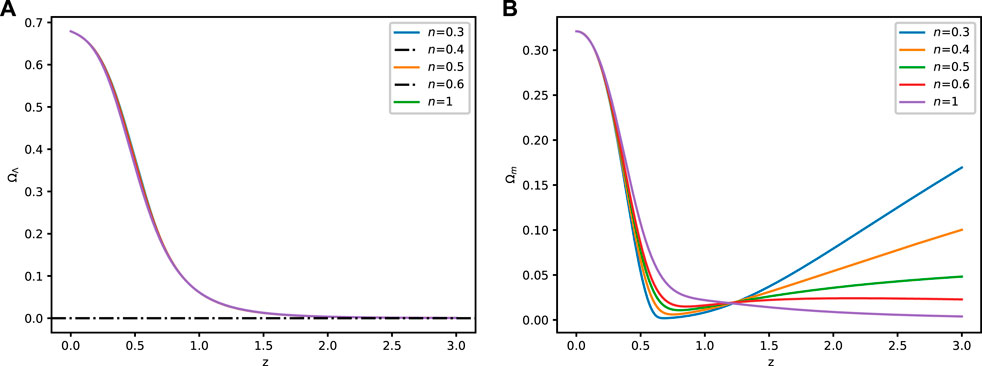
FIGURE 1. The variation of the fractional energy densities of dark energy ΩΛ and matter Ωm with redshift. The current values from (Aghanim et al., 2020) h(0) = 1, Ωm(0) ≡Ωm0 = 0.321, ΩΛ(01) ≡ΩΛ0 = 0.679, Ωχ0 = −0.056 and Ωσ0 = 1 − Ωm0 − ΩΛ0 − Ωχ0 are used as initial conditions along with the fourth-order Runge-Kutta method to integrate the system numerically.
From Figure 1 we see that Ωm starts evolving with redshift from having large value at an earlier stage of cosmic evolution gradually decreasing to its minimum value around z ∼ 1, then reaching its current value of Ωm0 at z = 0, whereas ΩΛ grew from a small value at the early times to its current positive value at z = 0. This result is in agreement with results from the ΛCDM model.
As seen in Figures 2, 3, the normalized Hubble parameter h, the bulk viscosity ξ and the anisotropy parameter Ap have become smaller today compared to their values at larger redshifts, for all vales of n considered. It appears from our analysis, however, that the anisotropy term at about z ∼ 1 (when the fractional energy density was at its minimum) reaches a maximum value before it decreases to its minimum value today.
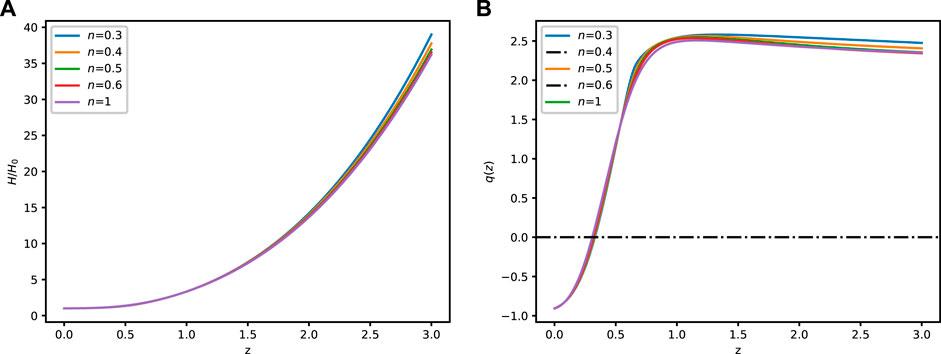
FIGURE 2. The variations of the normalized expansion rate h and the deceleration parameter q with redshift. The current values from (Aghanim et al., 2020) h(0) = 1, Ωm(0) ≡Ωm0 = 0.321, ΩΛ(0) ≡ΩΛ0 = 0.679, Ωχ0 = −0.056 and Ωσ0 = 1 − Ωm0 − ΩΛ0 − Ωχ0 are used as initial conditions along with the fourth-order Runge-Kutta method to integrate the system numerically.
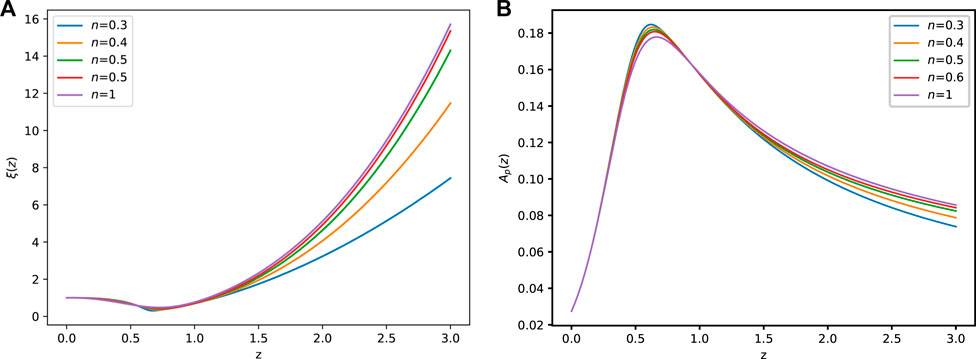
FIGURE 3. The variation of the bulk viscosityξ and anisotropy Ap parameters with redshift. The current values from (Aghanim et al., 2020) h(0) = 1, Ωm(0) ≡Ωm0 = 0.321, ΩΛ(0) ≡ΩΛ0 = 0.679, Ωχ0 = −0.056 and Ωσ0 = 1 − Ωm0 − ΩΛ0 − Ωχ0 are used as initial conditions along with the fourth-order Runge-Kutta method to integrate the system numerically.
The right panel of Figure 2 shows demonstrates that the deceleration parameter changes sign at small redshift values, from negative q > 0 at the early times to q < 0 at the present time for all different values of n considered. The change in q indicates that the universe expansion in this model has gone through a phase transition from slowing (decelerating) early epoch on to a speeding up (accelerating) universe now, with the transition from deceleration to acceleration happening at z ∼ 0.5, as predicted by observations as well.
5 Conclusion
The major goal of this paper was to investigate the homogeneous and anisotropic Bianchi type − V cosmological model in the presence of shear η and bulk ξ viscosities in the cosmic fluids for time-varying gravitational G and cosmological Λ parameters. The governing background EFEs were simplified to second-order differential equations for the metric variables A, B and C, as well as generalized Friedman equations. In this research we have transformed the basic governing equations into non-linear first-order differential equations for h, Ωm, ΩΛ, Ωσ, Ωχ in the redshift space, which may solved by numerically integrating in parallel using the fourth-order Runge-Kutta method. Unlike previous studies that required a relationship between the model’s characteristic parameter to describe the model in time domain, the current method of integration is significant because it allows us to determine the behaviour of the model directly from redshift-dependent measurable quantities and to compare it to current and future data. Our results showed that the model describes a universe that starts off with a negative cosmological term, dominated by non-relativistic matter and decelerated, that eventually becomes dark energy-dominated and hence expanding with acceleration, in concordance with current observations. Our future endeavour in this direction will involve a more rigorous data analysis to observationally constrain the different assumed parameters of the model.
Data availability statement
The original contributions presented in the study are included in the article/Supplementary Material, further inquiries can be directed to the corresponding author.
Author contributions
All authors listed have made a substantial, direct, and intellectual contribution to the work and approved it for publication.
Funding
The authors extend their appreciation to the Deanship of Scientific Research at Imam Mohammad Ibn Saud Islamic University for funding this work through Research Group no. RG-21-09-18
Conflict of interest
The authors declare that the research was conducted in the absence of any commercial or financial relationships that could be construed as a potential conflict of interest.
Publisher’s note
All claims expressed in this article are solely those of the authors and do not necessarily represent those of their affiliated organizations, or those of the publisher, the editors and the reviewers. Any product that may be evaluated in this article, or claim that may be made by its manufacturer, is not guaranteed or endorsed by the publisher.
Footnotes
1Overdots represent partial differentiation with respect to cosmic time t.
References
Aghanim, N., Akrami, Y., Ashdown, M., Aumont, J., Baccigalupi, C., Ballardini, M., et al. (2020). Planck 2018 results-VI. Cosmological parameters. Astronomy Astrophysics, 641, A6.
Alfedeel, A. H., and Abebe, A. (2020). Bianchi type − V solutions with varying G and Λ: The general case. Int. J. Geom. Methods Mod. Phys. 17, 2050076. doi:10.1142/s0219887820500760
Alfedeel, A. H., Abebe, A., and Gubara, H. M. (2018). A generalized solution of Bianchi type − V models with time-dependent G and Λ.
Arbab, A. I. (1998). Bianchi type − I viscous universe with variable G and Λ. General Relativ. Gravit. 30, 1401–1405. doi:10.1023/a:1018856625508
Arbab, A. I. (1997). Cosmological models with variable cosmological and gravitational constants and bulk viscous models. General Relativ. Gravit. 29, 61–74. doi:10.1023/a:1010252130608
Arora, S., Santos, J. R. L., and Sahoo, P. K. (2021). Constraining f(Q, T) gravity from energy conditions. Phys. Dark Universe 31, 100790. doi:10.1016/j.dark.2021.100790
Atazadeh, K., and Darabi, F. (2014). Energy conditions in f(R, G) gravity. Gen. Relativ. Gravit. 46 (2), 1664. doi:10.1007/s10714-014-1664-8
Bali, R., and Kumawat, P. (2008). Bulk viscous LRS Bianchi type − V tilted stiff fluid cosmological model in general relativity. Phys. Lett. B 665 (5), 332–337. doi:10.1016/j.physletb.2008.06.051
Bali, R., and Pradhan, A. (2007). Bianchi type − III string cosmological models with time dependent bulk viscosity. Chin. Phys. Lett. 24 (2), 585–588. doi:10.1088/0256-307x/24/2/079
Bali, R., Singh, P., and Singh, J. P. (2012). Bianchi type − V viscous fluid cosmological models in presence of decaying vacuum energy. Astrophys. Space Sci. 341 (2), 701–706. doi:10.1007/s10509-012-1134-2
Bamba, K., Ilyas, M., Bhatti, M. Z., and Yousaf, Z. (2017). Energy conditions in modified f(G) gravity. Gen. Relativ. Gravit. 49 (8), 112. doi:10.1007/s10714-017-2276-x
Bergliaffa, S. P. (2006). Constraining f(R) theories with the energy conditions. Phys. Lett. B 642 (4), 311–314.
Bertolami, O., Boehmer, C. G., Harko, T., and Lobo, F. S. (2007). Extra force in f(R) modified theories of gravity. Phys. Rev. D. 75 (10), 104016. doi:10.1103/physrevd.75.104016
Bertolami, O., and Sequeira, M. C. (2009). Energy conditions and stability in f(R) theories of gravity with nonminimal coupling to matter. Phys. Rev. D. 79 (10), 104010. doi:10.1103/physrevd.79.104010
Chen, W., and Wu, Y. S. (1990). Implications of a cosmological constant varying as R−2. Phys. Rev. D. 41 (2), 695–698. doi:10.1103/physrevd.41.695
Ellis, G. F. R. (1971). “Relativistic cosmology,” in Enrico fermi course. Editor R. K. Sachs (New York: Academic Press), 47, 104.
Hu, B. L. (1983). “Advances in astrophysics,” in World scientific. Editors L. J. Fang,, and R. Ruffini (Singapore. Return to ref 1983 in article.
Huang, W. H. (1990). Anisotropic cosmological models with energy density dependent bulk viscosity. J. Math. Phys. 31 (6), 1456–1462. doi:10.1063/1.528736
Liu, D., and Reboucas, M. J. (2012). Energy conditions bounds on f(T) gravity. Phys. Rev. D. 86 (8), 083515. doi:10.1103/physrevd.86.083515
Mandal, S., Sahoo, P. K., and Santos, J. R. L. (2020). Energy conditions in f(Q) gravity. Phys. Rev. D. 102 (2), 024057. doi:10.1103/physrevd.102.024057
Misner, C. W. (1968). The isotropy of the universe. Astrophys. J. 151, 431. Return to ref 1968 in article. doi:10.1086/149448
Moraes, P. H. R. S., Sahoo, P. K., Ribeiro, G., and Correa, R. A. C. (2019). A cosmological scenario from the Starobinsky model within the formalism. Adv. Astronomy 2019.
Nojiri, S. I., and Odintsov, S. D. (2004). Modified gravity with ln R terms and cosmic acceleration. General Relativ. Gravit. 36 (8), 1765–1780. doi:10.1023/b:gerg.0000035950.40718.48
Padmanabhan, T., and Chitre, S. M. (1987). Viscous universes. Phys. Lett. A 120 (9), 433–436. doi:10.1016/0375-9601(87)90104-6
Perlmutter, S., Aldering, G., Della Valle, M., Deustua, S., Ellis, R. S., Fabbro, S., et al. (1998). Discovery of a supernova explosion at half the age of the Universe. Nature 391 (6662), 51–54. doi:10.1038/34124
Perlmutter, S., Aldering, G., Goldhaber, G., Knop, R. A., Nugent, P., Castro, P. G., et al. (1999). Measurements of Ω and Λ from 42 high-redshift supernovae. Astrophys. J. 517 (2), 565–586. doi:10.1086/307221
Perlmutter, S., Gabi, S., Goldhaber, G., Goobar, A., Groom, D. E., Hook, I. M., et al. (1997). Measurements of the cosmological parameters Ω and Λ from the first seven supernovae at z ≥ 0.35. Astrophys. J. 483 (2), 565–581. doi:10.1086/304265
Riess, A. G., Filippenko, A. V., Challis, P., Clocchiatti, A., Diercks, A., Garnavich, P. M., et al. (1998). Observational evidence from supernovae for an accelerating universe and a cosmological constant. Astronomical J. 116 (3), 1009–1038. doi:10.1086/300499
Sahni, V., and Starobinsky, A. (2000). The case for a positive cosmological Λ-term. Int. J. Mod. Phys. D. 9 (04), 373–443. doi:10.1142/s0218271800000542
Sharif, M., and Ikram, A. (2016). Energy conditions in f(G, T) gravity, Eup. Eur. Phys. J. C 76, 640. doi:10.1140/epjc/s10052-016-4502-1
Singh, J. P., and Baghel, P. S. (2009). Bianchi type − V bulk viscous cosmological models with time dependent Λ-term. Electron. J. Theor. Phys. 6 (22), 85–96.
Singh, J. P., and Baghel, P. S. (2010). Bulk viscous bianchi Type − V cosmological models with decaying cosmological term Λ. Int. J. Theor. Phys. (Dordr). 49 (11), 2734–2744. doi:10.1007/s10773-010-0466-3
Singh, J. P., Baghel, P. S., and Singh, A. (2016). Viscous fluid bianchi type − V cosmological models with late time acceleration. Electron. J. Theor. Phys. 13 (36).
Tiwari, R. K., Beesham, A., and Shukla, B. K. (2016). Behaviour of the cosmological model with variable deceleration parameter. Eur. Phys. J. Plus 131, 447. doi:10.1140/epjp/i2016-16447-1
Tiwari, R. K., Beesham, A., and Shukla, B. K. (2018). Cosmological model with variable deceleration parameter in f(R,T) modified gravity. Int. J. Geometric Methods Mod. Phys. 15, 1850115. doi:10.1142/S0219887818501153
Tiwari, R. K., Beesham, A., and Shukla, B. K. (2017). Cosmological models with viscous fluid and variable deceleration parameter. Eur. Phys. J. Plus 132, 20. doi:10.1140/epjp/i2017-11289-y
Tiwari, R. K., Beesham, A., and Shukla, B. K. (2017). Scenario of a two-fluid FRW cosmological model with dark energy. Eur. Phys. J. Plus 132, 126. doi:10.1140/epjp/i2017-11409-9
Tiwari, R. K., Beesham, A., and Shukla, B. K. (2018). Scenario of two fluid dark energy models in Bianchi type − III universe.
Vishwakarma, R. G. (2005). A model to explain varying Λ, G and σ2 simultaneously. Gen. Relativ. Gravit. 37, 1305–1311. doi:10.1007/s10714-005-0113-0
Vishwakarma, R. G. (2000). A study of angular size-redshift relation for models in which Λ decays as the energy density. Cl. Quantum Gravity 17, 3833–3842. doi:10.1088/0264-9381/17/18/317
Vishwakarma, R. G. (2001). Consequences on variable Λ-models from distant type Ia supernovae and compact radio sources. Cl. Quantum Gravity 18, 1159–1172. doi:10.1088/0264-9381/18/7/301
Vishwakarma, R. G., and Dussattar, A. B. (1996a). A model of the universe with decaying vacuum energy. Pramana -. J. Phys. 47, 41–55. doi:10.1007/bf02847165
Vishwakarma, R. G., Abdussattar,, , and Beesham, A. (1999). LRS Bianchi type − I models with a time-dependent cosmological constant. Phys. Rev. D. 60, 063507. doi:10.1103/physrevd.60.063507
Vishwakarma, R. G., and Abdussattar, (1996b). Dissipative cosmology with decaying vacuum energy. Indian J. Phys. B 70 (4), 321.
Wang, J., and Liao, K. (2012). Energy conditions in f(R, Lm) gravity. Cl. Quantum Gravity 29 (21), 215016. doi:10.1088/0264-9381/29/21/215016
Keywords: time dependent G and ∧, bianchi metric, viscous fluid, anisotropy, cosmological parameter
Citation: Tiwari RK, Alfedeel AHA, Sofuoğlu D, Abebe A, Hassan EI and Shukla BK (2022) A cosmological model with time dependent Λ, G and viscous fluid in general relativity. Front. Astron. Space Sci. 9:965652. doi: 10.3389/fspas.2022.965652
Received: 10 June 2022; Accepted: 05 July 2022;
Published: 05 August 2022.
Edited by:
Chunshan Lin, Jagiellonian University, PolandReviewed by:
Leihua Liu, Jishou University, ChinaShahram Jalalzadeh, Federal University of Pernambuco, Brazil
Copyright © 2022 Tiwari, Alfedeel, Sofuoğlu, Abebe, Hassan and Shukla. This is an open-access article distributed under the terms of the Creative Commons Attribution License (CC BY). The use, distribution or reproduction in other forums is permitted, provided the original author(s) and the copyright owner(s) are credited and that the original publication in this journal is cited, in accordance with accepted academic practice. No use, distribution or reproduction is permitted which does not comply with these terms.
*Correspondence: Alnadhief H. A. Alfedeel, YWFhbG5hZGhpZWZAaW1hbXUuZWR1LnNh
†These authors have contributed equally to this work