 Faisal Javed
 Abdul Basit
 Aylin Caliskan
 Ertan Güdekli
- 1Department of Physics, Zhejiang Normal University, Jinhua, China
- 2Graduate School of Engineering and Science, Istanbul University, Istanbul, Turkey
- 3Department of Physics, Istanbul University, Istanbul, Turkey
This study examines the thermodynamics of charged anti-de Sitter (AdS) black holes (BHs) with nonlinear electrodynamics (NED) using quasinormal modes (QNMs) and thermal fluctuations. For this purpose, we calculate the Hawking temperature and discuss the stable configuration of the considered black hole using heat capacity. First, we study the interesting aspects of the emission of energy. Then, we explore the effects of thermal corrections on thermodynamic quantities and their corrected energies. We study the phase transitions of the system in the background of thermal fluctuations. It is concluded that the presence of a coupling constant enhances the thermodynamically stable configuration of uncharged and charged AdS BH geometries. We highlight that our results are in good agreement with the thermodynamics of the previous black hole solutions and assumptions presented in the literature.
1 Introduction
Black holes (BHs) are considered one of the most distinctive attributes of strong gravitational fields in the present arena of research. Classically, nothing can get away (either particles or radiations) from the event horizon of a BH due to strong gravitational influence. However, it swallows everything found in the surroundings. These thermodynamic entities not only characterize some remarkable classical insights but also come up with a better perception of their quantum gravitational features. The well-known BH configurations, including Schwarzschild, Reissner–Nordstrom (RN)
One of the primary issues with the classical Maxwell theory is the appearance of an infinite self-energy for a point-like charge at the charge position. In quantum electrodynamics, this divergence can be eliminated, but it still presents a challenge in classical electrodynamics. To resolve this issue, Born and Infeld developed a novel Lagrangian (Born and Infeld, 1934). Other nonlinear electrodynamic fields, such as the logarithmic, exponential, and power law Maxwell fields, have drawn greater attention than Born–Infeld nonlinear electrodynamics (NED) (Hendi et al., 2015; Dehghani, 2016; Dayyani et al., 2017; Dehghani and Hamidi, 2017). These theories, which can be reduced to linear Maxwell theory, are more complex than linear electrodynamics. In the existence of nonlinear electrodynamic impacts, Balart and Vagenas (2014) gave the exact solutions of a variety of regularly charged BHs and showed that the behavior of some BHs coincides asymptotically with that of RN BH. Studying the thermal properties of four regular BHs, Tharanath et al. (2015) discovered a second-order phase transition. Inferring the leading-order corrections to thermodynamic quantities of RN, Kerr, and charged anti-de-sitter (AdS) BHs, Faizal and Khalil (2015) concluded that these BHs produce remanence in all three cases. In an attempt to better understand the local thermal stability and logarithmic entropy adjustments of charged accelerating BHs, Pradhan (2019) detected second-order phase transitions in these BHs. According to the investigation of Sharif and Akhtar (2020)into the impact of thermal fluctuations on the thermodynamics of charged BHs with Weyl corrections, tiny BHs are unstable when logarithmic corrections are included. The stability and thermodynamics of asymptotically flat RN BH were examined by Sinha (2021). Additionally, he noted that BH displays a phase transition that is distinct from that of the Schwarzschild BH. Javed et al. (2023) studied thin-shell wormholes and gravastars in the background of different BH geometries.
The impact of logarithmic corrections on the thermodynamic variables such as heat capacity, Hawking temperature, and entropy of the modified Hayward BH was discussed by Pourhassan et al. (2016). In the presence of the cosmological constant, Jawad and Shahzad (2017) examined thermodynamic stability and the impact of thermal fluctuations on the non-minimal regular BHs. They concluded that normal BHs exhibit stable behavior for increasing cosmological constant values. The thermodynamic characteristics of the Hayward and the asymptotically AdS BHs under equilibrium conditions were investigated by Haldar and Biswas (2018) to an impact of thermal disturbances. Saleh et al. (2018) observed that the presence of the magnetic charge and quintessence produces the phase transition in regular BH after analyzing the behavior of thermal quantities such as heat capacity and temperature of Bardeen BH surrounded by quintessence. Javed et al. (2018) studied the thermodynamic characteristics and phase transition of regular charged BHs. They discovered that for charged BH with exponential distribution of variables, the phase transition curves diverge around critical points. Sharif and Nawaz (2020) explored the thermodynamic features of rotating regular BHs and their AdS versions and concluded that considered BHs are thermodynamically more stable and less hot than ordinary Kerr and Kerr-AdS BHs. Sharif and Ama-Tul-Mughani (2021) discussed the phase transition of the Kerr-Sen-AdS BH and concluded that BH attains the same phase transition as that of liquid–gas van der Waals fluid. They also analyzed how thermal fluctuations impact the stability of the considered BH. Sharif and Khan (2022a) studied how thermodynamic properties, thermal stability, and logarithmic correction impact on thermodynamic quantities and phase transitions of regular de Sitter BH. They demonstrated that the phase of Hawking’s temperature varies from positive to negative, whereas the phase of heat capacity varies from negative to positive for greater values of the de Sitter parameter.
The generalization of thermodynamic analogy between the van der Waals system and AdS BH is the Joule–Thomson expansion process. According to classical thermodynamics, the Joule–Thomson expansion describes how a fluid moves from an area with high pressure into a low-pressure area through a porous plug while maintaining a constant enthalpy. Ökcü and Aydýner (2017) examined the charged RN AdS BH’s Joule–Thomson expansion in the extended phase space. They discovered the inversion/isenthalpic curves and the cheating/cooling regions. This groundbreaking research has since been applied to a variety of different BHs, including the quintessence-charged AdS BH (Ghaffarnejad et al., 2018), the Kerr-AdS BH (Ökcü and Aydýner, 2018), the d-dimensional charged AdS BH (Mo et al., 2018), the holographic superfluid (D’Almeida and Yogendran, 2018), the charged AdS BH in f(R) gravity (Chabab et al., 2018), the charged AdS BH with a global monopole (Rizwan et al., 2018), the charged AdS BH in Lovelock gravity (Mo and Li, 2018), and the charged Gauss–Bonnet BH (Lan, 2018). Pacilio and Brito (2018) examined the QNMs of weakly charged Einstein–Maxwell dilaton BHs and found that gravitational modes are only weakly affected by coupling with the dilaton. The QNMs and quantization were studied for the analytical solutions in a cosmic string Born–Infeld dilaton BH geometry in Sakalli et al. (2018). Greybody factors of modified BH geometry in the background of NEDs were studied in Kanzi et al. (2020). QNMs, photon spheres, and shadows of regular BH with string cloud parameters were discussed in Singh et al. (2022). Nomura and Yoshida (2022) investigated the QNMs of charged BHs with corrections from NEDs and found that the isospectrality of QNMs under parity is generally violated due to NEDs.
Thermal stability with emission energy and Joule–Thomson expansion of regular BTZ-like BH are studied in Ditta et al. (2022) and tunneling analysis of null aether BH in Ali et al. (2022). The thermodynamics of accelerating BHs in ADS spacetime were discussed in Anabalon et al. (2018). The effects of NED on the BH shadow, deflection angle, quasinormal modes (QNMs), and graybody factors are calculated in Kuang et al. (2018) and Okyay and Övgün (2022). QNMs are observed for hairy BHs in (Yang et al., 2022a), QNMs of f(Q) BH are examined in Gogoi et al. (2023), and Kerr-like black bounce spacetime is calculated in Yang et al., (2022b); Övgün et al., (2021). The deflection angle of the photon, QNMs, the greybody factor, and shadows were discussed in Övgün (2018), Övgün and Jusufi (2018), Javed et al. (2019), and Pantig et al. (2022). Guo et al. (2020) examined the Joule–Thomson expansion for the regular AdS BH and determined the inversion temperature for Bardeen-AdS BH in the extended phase space. They analyzed the inversion and isenthalpic curves for the BH under consideration and found that their intersection points are the inversion points discriminating the cooling from the heating process. Gracia et al. (2021) studied this expansion for uncharged noncommutative BHs characterized by a parameter (present in the horizon function) and found that the uncharged BH in a noncommutative scenario acts as a charged commutative BH.
In this study, we explore the thermodynamic features and QNMs of charged ADS BH with NED. This study is devoted to exploring the effects of NED on thermodynamic quantities of charged ADS BH geometry. It is outlined as follows: Section 2 presents the charged ADS BH structure with NED and discusses the thermodynamic quantities and thermal stability through heat capacity, Section 3 discusses the rate of emission energy of the considered BH geometry, and Section 4 explains the relationship between the QNMs and Davies’s point. The consequences of thermal fluctuations on uncorrected thermodynamic physical quantities are examined in Section 5. In the last section, we present some concluding remarks.
2 Thermodynamics of charged ADS black hole with nonlinear electrodynamics
The following action is described as the minimal interaction between NED and gravity (Yu and Gao, 2020):
where
where R is the Ricci scalar, Aγ denotes the Maxwell field, and Y[ψ] is a function of ψ. By varying the aforementioned action, the corresponding field equations result in Yu and Gao (2020):
where
The parameterizations of the spherically symmetric static spacetime are
Here, the metric function is denoted as
Now, we consider a specific expression of
where Λ, Q, and m are the cosmological constant, charge, and mass of BH geometry, respectively. Here, we consider the following choices of physical parameters Q and β, and the respective manifolds become as follows:
• If β = 0 = Q, then Schwarzschild-ADS BH is recovered.
• If β = 0 and Q ≠ 0, then RN-ADS BH is recovered.
• If β ≠ 0 and Q ≠ 0, then it shows the charged ADS BH with NED (D’Ambrosio et al., 2022).
It is interesting to mention that the BH event horizon is located at a radial position for which the metric function becomes 0. In Figures 1–3, we discuss the behavior of the metric function for suitable values of physical parameters. It is noted that the position of the event horizon (dashed line
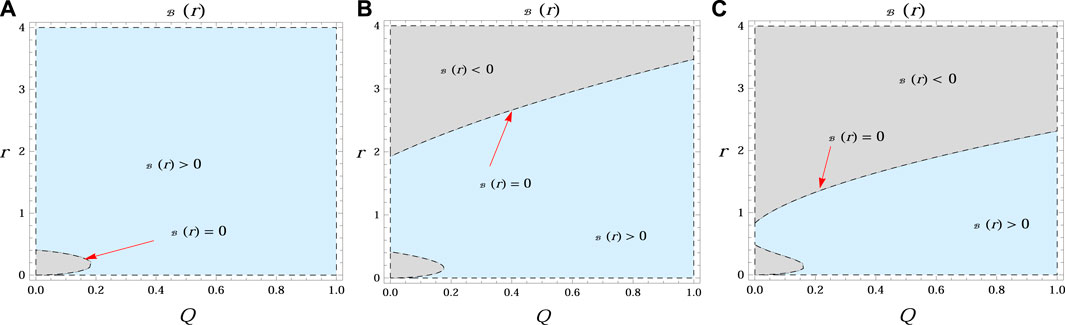
FIGURE 1. Region plots of the metric function charged with NED versus r and Q for different values of β[β = 0.4 (A), β = 0.8 (B), β = 1.5 (C)] with M = 0.2, Λ = 0. The central black dashed line
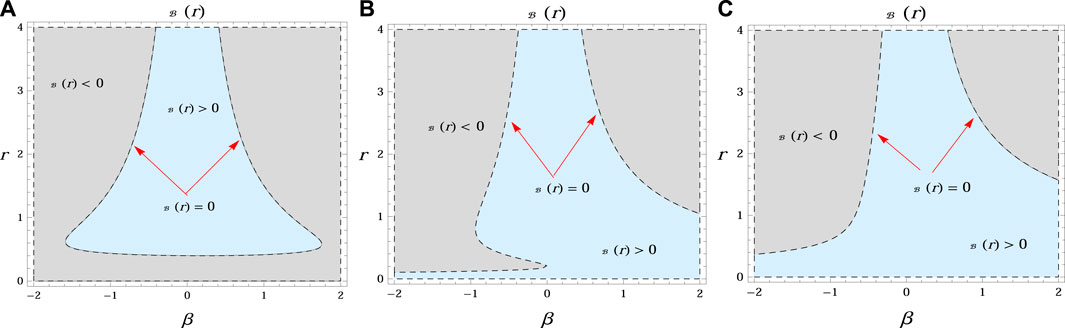
FIGURE 2. Region plots of the metric function charged with NED versus r and βfor different values of charge [Q = 0.1 (A), Q = 0.3 (B), Q = 0.6 (C)] with M = 0.2, Λ = 0.
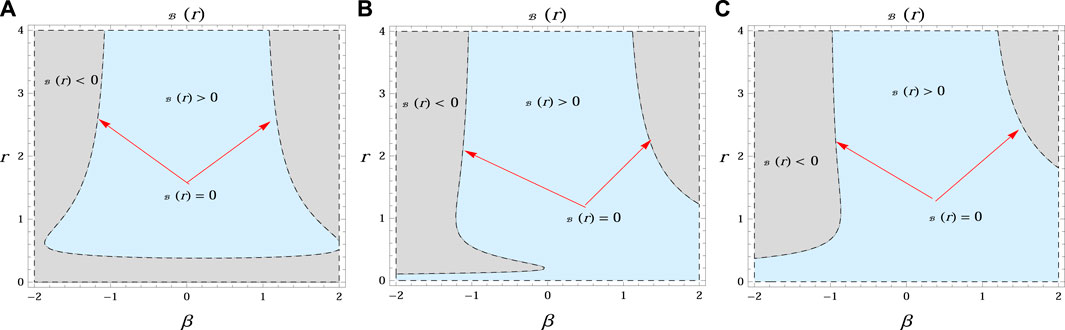
FIGURE 3. Region plots of the metric function of charged ADS with NED BH versus r and βfor different values of charge [Q = 0.1 (A), Q = 0.3 (B), Q = 0.6 (C)] with M = 0.2, Λ = −1.
Here, we are interested in evaluating the Hawking temperature heat capacity of the considered BH spacetime. Such thermodynamic entities play a crucial role in exploring the thermodynamically stable characteristics of BH. The respective mass of BH in terms of the event horizon is given as
The surface gravity
Consequently, we get the Hawking temperature
Figure 4 analyzes the behavior of the Hawking temperature in terms of the entropy of BH geometry. The left plot shows that the temperature of the system greatly depends on the mass of the geometry. It is noted that temperature increases initially and then decreases as the entropy of the system increases. In the background of the cosmological constant, the Hawking temperature enhances compared to the charged BH with NED in Figure 5.
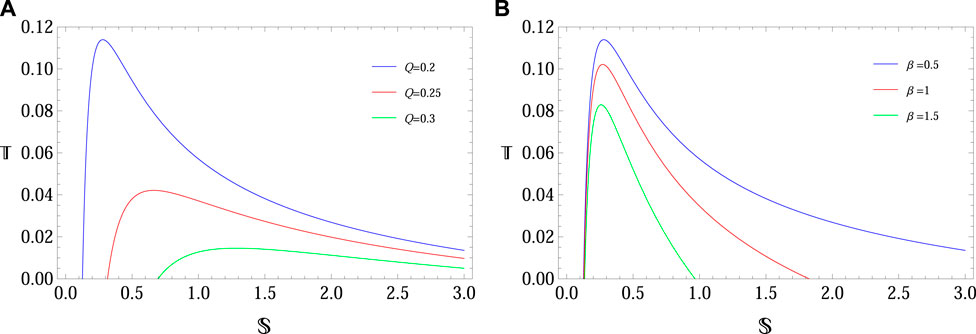
FIGURE 4. Plots of Hawking temperature of charged BH with NED BH versus entropy of the BH with different values of Q with β = 0.5 (A) and βwith Q = 0.2 (B) with M = 0.2, Λ = 0.
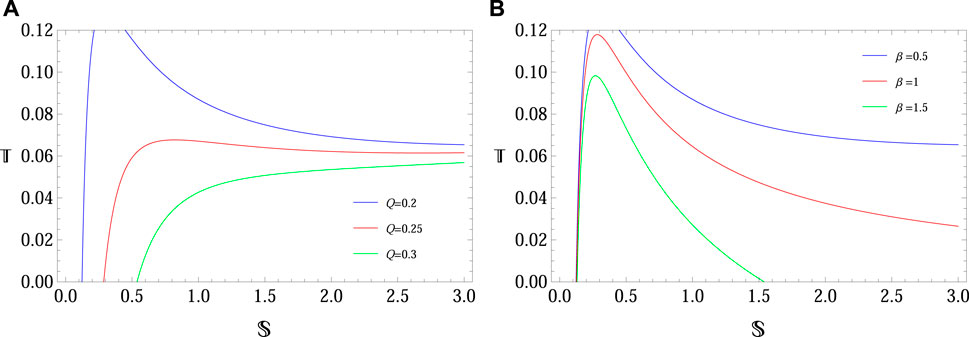
FIGURE 5. Plots of Hawking temperature of charged ADS BH with NED BH versus entropy of the BH with different values of Q with β = 0.5 (A) and βwith Q = 0.2 (B) with M = 0.2, Λ = −1.
By considering the Bekenstein area entropy relationship, the entropy of the system is given as (Das et al., 2002)
The heat capacity
The divergence point of the heat capacity is referred to as Davies’s point, which plays an important role in discussing the thermodynamic stability of the BH structure. Davies’s point is also known as the phase change point from negative to positive or positive to negative. It is noted that the positive region before the Davies point shows a stable region, and the negative region after the Davies point represents an unstable region (Das et al., 2002; Sharif and Khan, 2022b). Hence, the radial position of BH at which it changes the phase is given where rDP is represented by the position of Davies point.
Figure 6 is used to discuss stable and unstable configurations using the Davies point of heat capacity of BH. In the absence of β and Q (as Schwarzschild-ADS BH), the BH structure shows an unstable configuration, while for non-zero values of β and Q, the system shows a stable configuration for smaller BHs. It is also noted that the stable configuration is increased for higher values of β. Hence, the presence of NED-charged BH shows a stable configuration for smaller ADS BHs, while larger ADS BH shows unstable behavior.
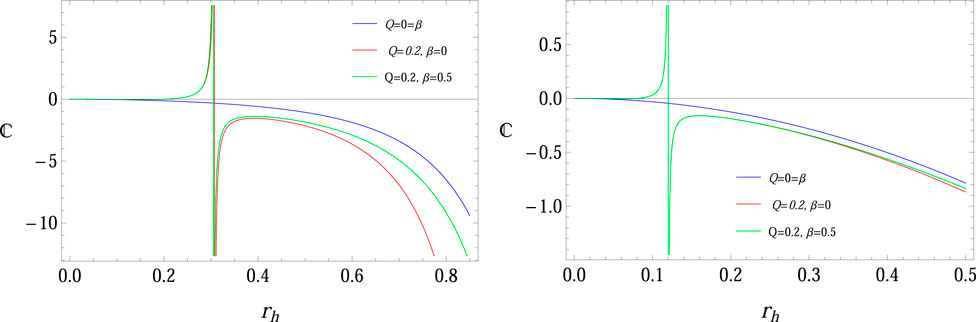
FIGURE 6. Plot of heat capacity versus BH horizon radius with M = 0.2, Λ = −1.
3 Emission energy
The formation and destruction of an excessive number of particles very close to the horizon are known as emission energy, and quantum fluctuations in the interior of BHs are the source of this energy. The main reason for the BH evaporation within a certain period is due to the positive-energy particles that tunnel out of the BH in the core area where Hawking radiation occurs. Here, we are interested in exploring the energy emission rate associated with the considered BH geometry with NED. At very high energy, the absorption cross-section often oscillates around a limiting constant value σlim. The limiting value of σlim is related to the radius of the event horizon (Wei and Liu, 2013; Papnoi et al., 2014; Eslam Panah et al., 2020):
The respective expression of the rate of BH energy emission becomes (Wei and Liu, 2013; Papnoi et al., 2014; Eslam Panah et al., 2020)
and by considering the Hawking temperature
Figure 7 shows the behavior of the rate of emission energy along the frequency with suitable values of physical parameters. It is found that the energy rate increases as frequency gradually increases initially, approaches its peak value, and then decreases. It is concluded that the rate of emission energy decreases for higher values of charge and NED parameter.
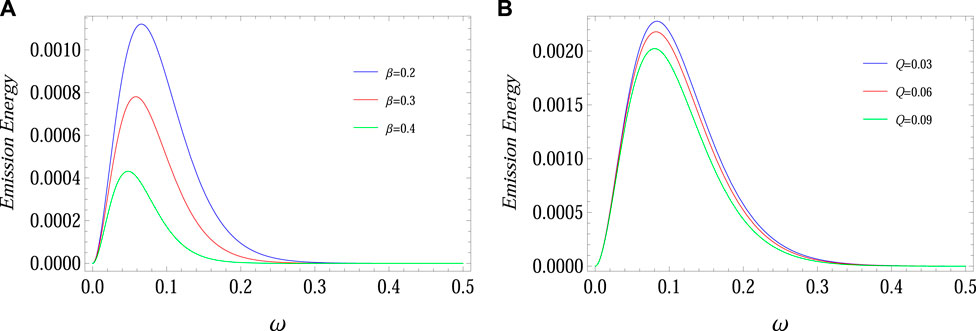
FIGURE 7. Graphical analysis of the rate of emission energy versus frequency for uncharged ADS (A) and charged ADS BHs (B) with M = 0.2, Λ = −1.
4 Null geodesics and quasinormal modes
Here, we are interested in calculating the null geodesics and radius of the photon sphere of charged ADS BH with NEW. Then, we determine the photon angular velocity and Lyapunov exponent using photon radius.
4.1 Null geodesics
The Lagrangian at the equatorial plane
where ϕ is referred to as an angular coordinate. The generalized momenta components
where
Hence, the Hamiltonian becomes the photon:
which yields
where the respective potential function yields
It is noted that positive values of
The photon sphere for the four-dimensional spherically symmetric geometry is determined using the following constraints:
Now, we consider the second condition to calculate the photon radius
By using the metric function of BH, we get
The respective radius of the photon sphere yields
We plot this function for suitable physical parameters, and the root of this function represents the position photon radius, as shown in Figure 8. This function also represents the stability of the photon motion around the BH at the event horizon. It is interesting to mention that the case of the Schwarzschild-ADS BH system shows an unstable structure, and the position of photon radius is decreased for higher values of β and Q. It is found that the system shows a stable configuration for RN and charged ADS BH with NED.
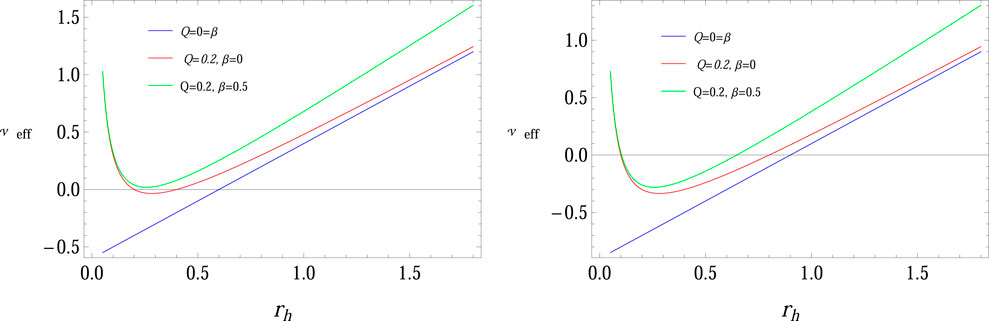
FIGURE 8. Plot of Veff to determine the position of photon sphere for M = 0.2. It is noted that the roots of Veff are denoted by the position of the photon’s spherical radius.
4.2 Quasinormal modes
The QNMs are determined through the property of the photon sphere in the eikonal limit (l ≫ 1) as follows (Das et al., 2002; Sharif and Khan, 2022b):
where n represents the number of overturns of the perturbations. The Lyapunov exponent λ and angular velocity Ω are two major physical quantities of the photon sphere. Both are associated with QNMs as
which yields
and
Now, we explore the effects of physical parameters on the angular velocity and Lyapunov exponent. For this purpose, we plot the mathematical expressions of both angular velocity and Lyapunov exponent versus rps as shown in Figure 9. Initially, both physical quantities decrease for higher values of horizon radius.
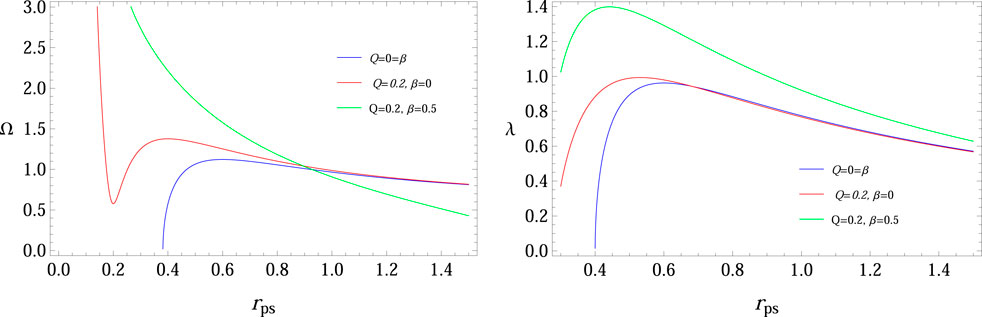
FIGURE 9. Plots angular velocity and Lyapunov exponent versus rps for M = 0.2, Λ = −1.
5 Thermal fluctuations
Here, we discuss the effects of thermal fluctuation on the charged ADS BH with NED. For this purpose, we find the mathematical expression of the corrected entropy of the system using the partition function defined as follows (Pourhassan et al., 2018; Pradhan, 2019; Sharif and Khan, 2022b):
where the density state is denoted with ρ(E) and the average energy is E. The density state is evaluated using the inverse Laplace transformation of the previously defined function given as
where the exact corrected expression of entropy is
The equilibrium entropy S satisfies the relations
Furthermore, it yields (Pourhassan et al., 2018; Pradhan, 2019; Sharif and Khan, 2022b)
which becomes
We may use a broader parameter χ without losing generality, except for the factor
By considering alternative correction parameter values γ and η, we obtain
• Uncorrected entropy (UCE) ⇒ if η, γ → 0.
• Simple logarithmic corrections (SLCs) ⇒ if η → 0, γ → 1.
• Second-order correction terms (SOCs) ⇒ if η → 1, γ → 0.
• Higher-order correction terms (HOCs) ⇒ if η, γ → 1.
The respective expression of perturbed entropy is evaluated by considering Eqs 8, 9 in Eq. 29 asFigure 10 shows the graph of corrected entropy through four different cases as UCE, SLCs, SOCs, and HOCs for Schwarzschild-ADS (first plot), RN-ADS (second plot), and charged ADS BH with NED (third and fourth plots). It is noted that for all cases, system entropy is monotonically increasing throughout the considered domain for larger BHs. It is noted that the graph of usual entropy is increasing smoothly (left plot blue curve), but the corrected expression fluctuates for smaller BHs, increasing smoothly for larger ones. Thus, these correction terms are more effective for small BHs. The corrected entropy shows the larger behavior for the case of HOCs.
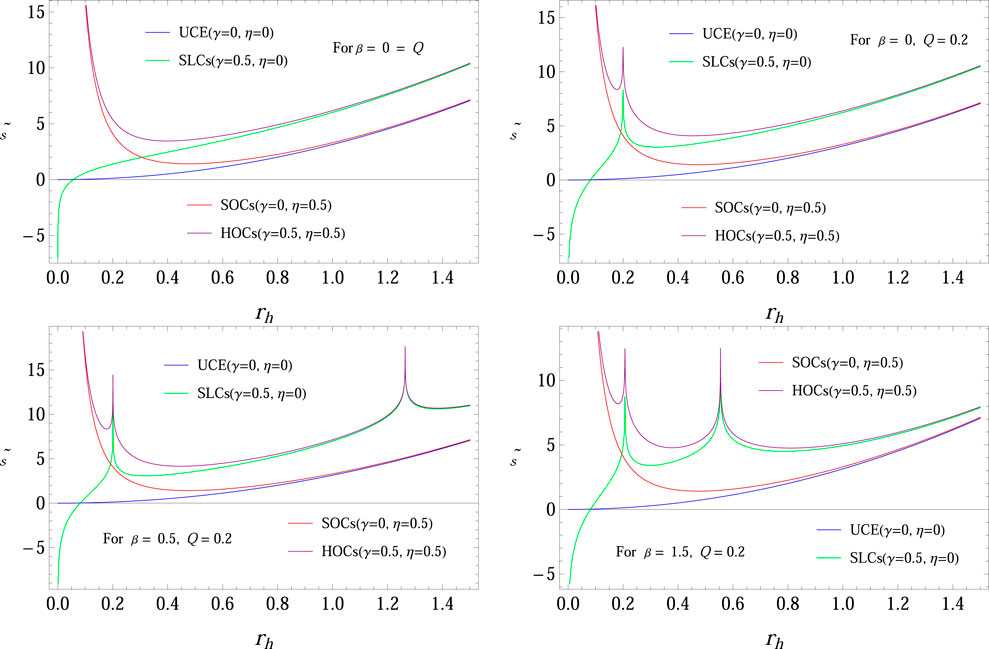
FIGURE 10. Plots of corrected entropy versus rh for different values of χ and η with M = 0.2, Λ = −1.
Now, we consider the expression of corrected entropy to explore the corrected energies of the considered BH solution. Under thermal fluctuations, the modified first rule of BH thermodynamics may be expressed as follows (Jawad and Shahzad, 2017; Sharif and Khan, 2022b):
where
which turns out to be
When the foregoing expressions are substituted in Eq. 31, the modified first law of BH is verified, suggesting that the existence of thermal fluctuations enhances the reliability of the first law of BH thermodynamics.
5.1 Corrected energies of black hole
The Helmholtz free energy can be determined in this context by applying the following relation (Jawad and Shahzad, 2017; Sharif and Khan, 2022b):
which yields
The identity that can be used to evaluate the internal energy of the system under consideration is given as
The BH’s volume can be expressed as (Pourhassan and Faizal, 2015; Sharif and Khan, 2022b)
The relationship that can be used to determine the pressure of the BH is as follows:
and hence,
The enthalpy of considered BH is determined using
The Gibbs free energy
The graphical analysis of corrected energies of the considered BHs can be expressed as follows:
• Thermal fluctuation affects the physical quantities of BH geometry. It is noted that for the small values of radii, the graph of Helmholtz free energy gradually decreases and then increases for higher BHs (first-panel plot of Figure 11). It shows larger behavior in the presence of β and Q for larger BHs. The Helmholtz free energy is maximum for larger BHs for non-zero values of β and Q.
• The corrected internal energy of Schwarzschild-ADS BH represents the gradually increasing behavior for higher values of BH event horizons (left plot of the second panel of Figure 11). It fluctuates in the presence of NED for higher BHs (right plot of the second panel of Figure 11). The internal energy of charged ADS BH with NED fluctuates, while for RN-ADS, it increases gradually.
• The enthalpy and Gibbs free energy of RN-ADS BH increase gradually while fluctuating for charged ADS BH with NED for SLCs and HOCs (third and fourth panels of Figure 11).
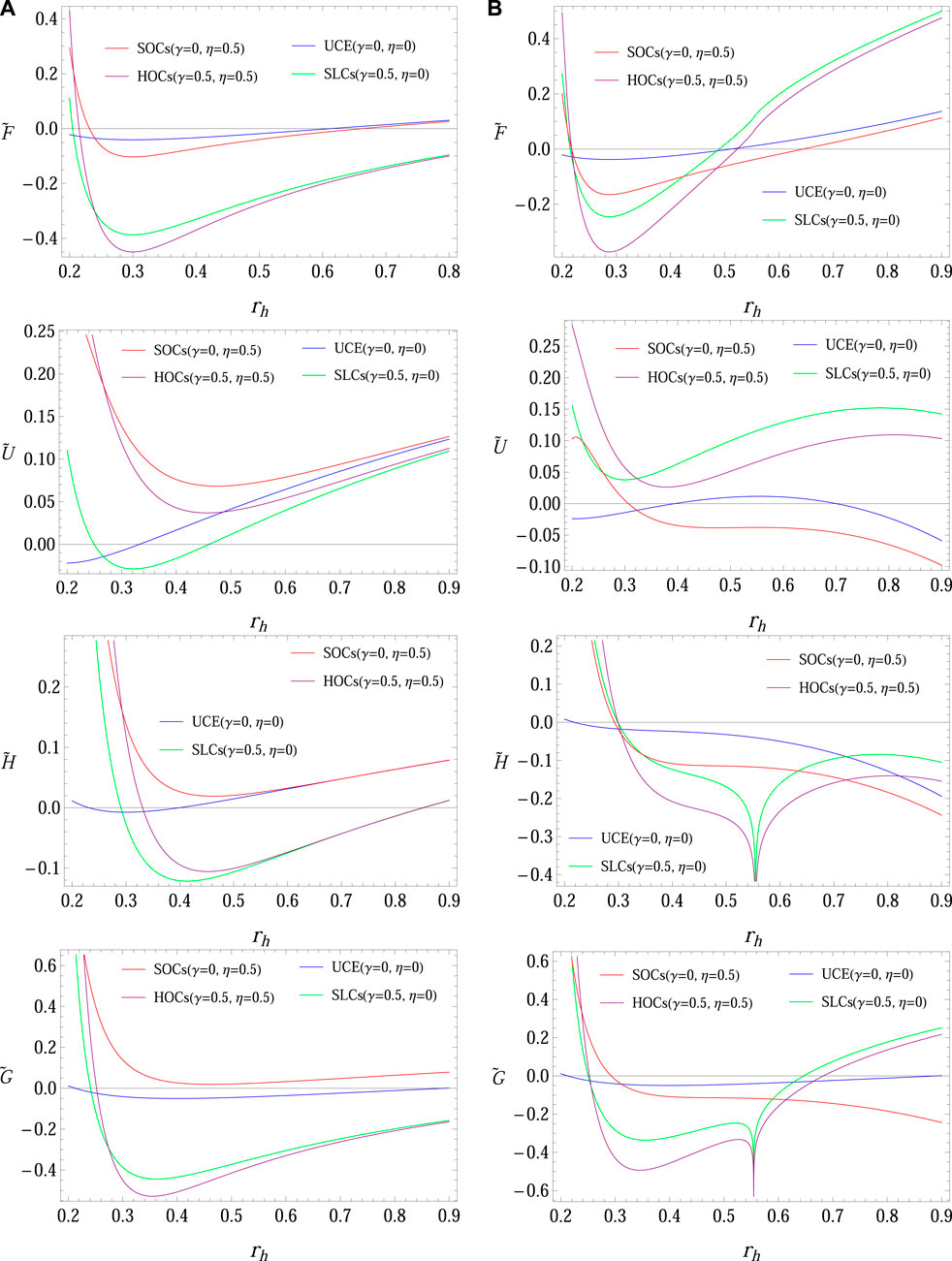
FIGURE 11. Plots of corrected energies of the BH versus horizon radius for RN BH (Q = 0.2, β = 0) (A) and charged BH with NED (Q = 0.2, β = 1.5) (B) with M = 0.2, Λ = −1.
5.2 Phase transition
Another method for locally determining the BH’s thermodynamic stability is to study the sign of the specific heat
Now, we discuss the thermodynamic stability of the system through the graphical behavior of specific heat with four different cases of thermodynamic fluctuations as UCE, SLCs, SOCs, and HOCs (Figure 12). It shows the behavior-specific heat of RN-ADS BH using UCE, SLCs, SOCs, and HOCs with M = 0.2. It is interesting to mention that specific heat expresses a stable structure for smaller BHs and an unstable configuration for larger BHs. Hence, the second- and higher-order correction provides the possibility of a more stable structure of BHs.
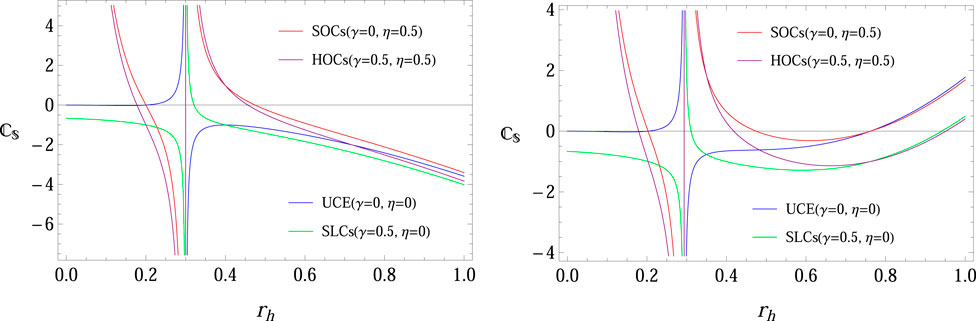
FIGURE 12. Plots of specific heat versus rh using four different cases of thermodynamic fluctuations as UCE, SLCs, SOCs, and HOCs for RN BH Q = 0.2, β = 0, and charged BH with nonlinear electrodynamics Q = 0.2, β = 1 with M = 0.2, Λ = −1.
6 Concluding remarks
This study is devoted to exploring the thermodynamics of charged ADS BH with NED through QNMs and thermal fluctuations. We explore the effects of NED parameter β on the thermodynamic quantities of charged ADS BH. Some important features of the present study are itemized as follows:
• The graphical behavior of the lapse function under the effect of involved model parameters is provided in Figures 1, 2. The position of the event horizon depends on the charge and the coupling constant β.
• We observed the behavior of temperature versus entropy of the system in Figure 4. It is noted that temperature initially increases and then decreases as the entropy of the system increases.
• The Davies point and heat capacity are presented in Figure 6 to check the stable and unstable regions for the BH configuration. In the absence of β and Q (as Schwarzschild-ADS BH), the BH structure shows unstable configuration, while non-zero values of β and Q systems show stable configurations for smaller BHs. Hence, the presence of NED-charged ADS BH shows the stable configuration for smaller BHs, while larger BH shows unstable behavior.
• Figure 7 shows that the rate of emission energy decreases for higher values of charge and NED parameter.
• We calculated the null geodesics and radius of the photon sphere of BH geometry in the background charged ADS BH with NED. It is interesting to mention that the case of the Schwarzschild-ADS BH system shows an unstable structure, and the position of photon radius is decreased for higher values of β and Q (Figure 8). It is found that the system shows a stable configuration for RN-ADS and charged BH with NED.
• The angular velocity and Lyapunov exponent versus rps, as shown in Figure 9, and both physical quantities initially decrease for higher values of the horizon radius.
• The behavior of thermal fluctuations (UCE, SLCs, SOCs, and HOCs) on the entropy of the system is provided graphically in Figure 10. It is noted that for all cases, the system entropy is monotonically increasing throughout the considered domain for larger BHs.
• The corrected, uncorrected Helmholtz free energy and internal energy for the BH versus rh are presented graphically in Figure 11. Helmholtz free energy shows larger behavior in the presence of β and Q for larger BHs. The internal energy of charged ADS BH with NED fluctuates, while for RN-ADS, it increases gradually. The enthalpy and Gibbs free energy of RN-ADS BH gradually increases while fluctuating for charged ADS BH with NED for SLCs and HOCs.
• It is interesting to mention that specific heat expresses a stable structure for smaller BHs and an unstable configuration for larger BHs. Hence, the second- and higher-order correction provides the possibility of a more stable structure of BHs (Figure 12).
Hence, to sum up, it is determined that the cosmological constant and NED greatly affect the thermodynamic properties of charged ADS BHs.
Data availability statement
The original contributions presented in the study are included in the article/Supplementary Material. Further inquiries can be directed to the corresponding authors.
Author contributions
FJ conceived the presented idea. FJ and AB developed the theory while FJ performed the computations. FJ, AB, and AC verified the analytical methods. All authors discussed the results and contributed to the final manuscript. All authors listed have made a substantial, direct, and intellectual contribution to the work and approved it for publication.
Funding
AB was supported by startup funding from Zhejiang Normal University through Grant no. ZC304021948 and from Zhejiang Provincial Postdoctoral Science Foundation through Grant no. ZC304022995. FJ is very thankful to Prof. Lin Ji from the Department of Physics, Zhejiang Normal University, for his kind support and help during this research. Also, FJ acknowledges Grant No. YS304023917 to support his Postdoctoral Fellowship at Zhejiang Normal University.
Conflict of interest
The authors declare that the research was conducted in the absence of any commercial or financial relationships that could be construed as a potential conflict of interest.
Publisher’s note
All claims expressed in this article are solely those of the authors and do not necessarily represent those of their affiliated organizations or those of the publisher, the editors, and the reviewers. Any product that may be evaluated in this article, or claim that may be made by its manufacturer, is not guaranteed or endorsed by the publisher.
References
Ali, R., Babar, R., Asgher, M., and Mustafa, G. (2022). Tunneling analysis of null aether black hole theory in the background of Newman–Janis algorithm. Int. J. Mod. Phys. A 37, 2250134. doi:10.1142/S0217751X22501342
Anabalon, A., Appels, M., Gregory, R., Kubizňák, D., Mann, R. B., and Övgün, A. Holographic thermodynamics of accelerating black holes doi:10.1103/PhysRevD.98.104038Phys. Rev. D. 98(2018)104038. doi:10.1103/PhysRevD.98.104038
Balart, L., and Vagenas, E. C. (2014). Regular black holes with a nonlinear electrodynamics source. Phys. Rev. D. 90, 124045. doi:10.1103/physrevd.90.124045
Born, M., and Infeld, L. (1934). Foundations of the new field theory. Proc. R. Soc. Lond. A 144, 425.
Cardoso, V., Miranda, A. S., Berti, E., Witek, H., and Zanchin, V. T. (2009). Geodesic stability, Lyapunov exponents and quasinormal modes. Phys. Rev. D. 79, 064016. doi:10.1103/PhysRevD.79.064016
Chabab, M., Moumni, H. E., Iraoui, S., Masmar, K., and Zhizeh, S. (2018). Joule-thomson expansion of reissner-nordstrom AdS black holes in f(R) gravity. arXiv:1804.10042.
D’Almeida, R., and Yogendran, K. P. (2018). Thermodynamic properties of holographic superfluids. arXiv: 1802.05116.
D’Ambrosio, F., Fell, S. D. B., Heisenberg, L., and Kuhn, S. (2022). Black holes in f(Q) gravity. Phys. Rev. D. 105, 024042. doi:10.1103/physrevd.105.024042
Das, S., Majumdar, P., and Bhaduri, R. K. (2002). General logarithmic corrections to black hole entropy. Cl. Quantum Grav. 19, 2355. doi:10.1088/0264-9381/19/9/302
Dayyani, Z., Sheykhi, A., and Dehghani, M. H. (2017). Counterterm method in Einstein dilaton gravity and the critical behavior of dilaton black holes with a power-Maxwell field. Phys. Rev. D. 95, 084004. doi:10.1103/PhysRevD.95.084004
Dehghani, M. (2016). Dimensional charged black holes with power-law Maxwell field. Phys. Rev. D. 94, 104071.
Dehghani, M., and Hamidi, S. F. (2017). Thermal stability analysis of nonlinearly charged asymptotic AdS black hole solutions. Phys. Rev. D. 96, 044025. doi:10.1103/PhysRevD.96.044025
Ditta, A., Tiecheng, X., Mustafa, G., Muhammad, Y., and Atamurotov, F. (2022). Thermal stability with emission energy and Joule–Thomson expansion of regular BTZ-like black hole. Eur. Phys. J. C 82, 756. doi:10.1140/epjc/s10052-022-10708-z
Eslam Panah, B., Jafarzade, K., and Hendi, S. H. (2020). Charged 4D Einstein-Gauss-Bonnet-AdS black holes: Shadow, energy emission, deflection angle and heat engine. Nucl. Phys. B 961, 115269. doi:10.1016/j.nuclphysb.2020.115269
Faizal, M., and Khalil, M. M. (2015). GUP-corrected thermodynamics for all black objects and the existence of remnants. Int. J. Mod. Phys. A 30, 1550144. doi:10.1142/s0217751x15501444
Ghaffarnejad, H., Yaraie, E., and Farsam, M. (2018). Quintessence reissner nordström anti de Sitter black holes and Joule thomson effect. Int. J. Theo. Phys. 57, 1671–1682. doi:10.1007/s10773-018-3693-7
Gogoi, D. J., Övgün, A., and Koussour, M. (2023). Quasinormal Modes of Black holes in f(Q) gravity. arXiv:2303.07424.
Gracia, J. P. M., Capossoli, E. F., and Boschi-Filho, H. (2021). Joule-Thomson expansion for noncommutative uncharged black holes. Europhys. Lett. 135, 41002. doi:10.1209/0295-5075/ac24c1
Guo, S., Pu, J., Jiang, Q. Q., and Zu, X. T. (2020). Joule-Thomson expansion of the regular(Bardeen)-AdS black hole *. Chin. Phys. C 44, 035102. doi:10.1088/1674-1137/44/3/035102
Haldar, A., and Biswas, R. (2018). Thermodynamic studies of different black holes with modifications of entropy. Astrophys. Space Sci. 363, 27. doi:10.1007/s10509-017-3238-1
Hawking, S. W. (1975). Particle creation by black holes. Commun. Math. Phys. 43, 199–206. doi:10.1007/BF02345020
Hendi, S. H., Panahiyan, S., and Panah, B. E. (2015). Geometrical method for thermal instability of nonlinearly charged BTZ black holes. Adv. High. Energy Phys. 2015, 743086. doi:10.1155/2015/743086
Javed, F., Fatima, G., Mustafa, G., and Övgün, A. (2023). Effects of variable equations of state on the stability of nonlinear electrodynamics thin-shell wormholes. Int. J.Geo. M. Mod. Phys. 20, 2350010. doi:10.1142/S021988782350010X
Javed, W., Abbas, J., and Övgün, A. (2019). Deflection angle of photon from magnetized black hole and effect of nonlinear electrodynamics. Eur. Phys. J. C 79, 694. doi:10.1140/epjc/s10052-019-7208-3
Javed, W., Yousaf, Z., and Akhtar, Z. (2018). Thermodynamics and glassy phase transition of regular black holes. Mod. Phys. Lett. A 33, 1850089. doi:10.1142/s021773231850089x
Jawad, A., and Shahzad, M. U. (2017). Effects of thermal fluctuations on non-minimal regular magnetic black hole. Eur. Phys. J. C 77, 349. doi:10.1140/epjc/s10052-017-4914-6
Kanzi, S., Mazharimousavi, S. H., and Sakalli, I. (2020). Greybody factors of black holes in dRGT massive gravity coupled with nonlinear electrodynamics. Ann. Phys. 422, 168301. doi:10.1016/j.aop.2020.168301
Kuang, X. M., Liu, B., and Övgün, A. (2018). Nonlinear electrodynamics AdS black hole and related phenomena in the extended thermodynamics. Eur. Phys. J. C 78, 840. doi:10.1140/epjc/s10052-018-6320-0
Lan, S. Q. (2018). Black-hole spectroscopy by making full use of gravitational-Wave Modeling. Phys. Rev. D. 98, 084014. doi:10.1103/PhysRevD.98.084038
Mo, J. X., and Li, G. Q. (2018). Effects of Lovelock gravity on the joule-thomson expansion. arXiv: 1805.04327.
Mo, J. X., Li, G. Q., Lan, S. Q., and Xu, X. B. (2018). Joule-Thomson expansion of d-dimensional charged AdS black holes. Phys. Rev. D. 98, 124032. doi:10.1103/physrevd.98.124032
More, S. S. (2005). Back reaction, the Hawking emission spectrum from the charged black hole. Cl. Quantum Grav. 22, 4129.
Nomura, K., and Yoshida, D. (2022). Quasinormal modes of charged black holes with corrections from nonlinear electrodynamics. Phys. Rev. D. 105, 044006. doi:10.1103/physrevd.105.044006
Ökcü, O., and Aydýner, E. (2017). Joule-thomson expansion of charged AdS black holes. Eur. Phys. J. C 77, 24. doi:10.1140/epjc/s10052-017-4598-y
Ökcü, O., and Aydýner, E. (2018). Measurement of quarkonium production in proton–lead and proton–proton collisions at 5.02 TeV with the ATLAS detector. Eur. Phys. J. C 78, 123.
Okyay, M., and Övgün, A. (2022). Nonlinear electrodynamics effects on the black hole shadow, deflection angle, quasinormal modes and greybody factors. J. Cosm. Astro. Phys. 01, 009. doi:10.1088/1475-7516/2022/01/009
Övgün, A. (2018). P-V criticality of a specific black hole in f(R) gravity coupled with yang-mills field. Adv. High. Energy Phys. 2018, 8153721. doi:10.1155/2018/8153721
Övgün, A., and Jusufi, K. (2018). Quasinormal modes and greybody factors of f(R) gravity minimally coupled to a cloud of strings in 2+1 dimensions. Ann. Phys. 395, 138. doi:10.1016/j.aop.2018.05.013
Övgün, A., Sakalli, I., and Mutuk, H. (2021). Quasinormal modes of dS and AdS black holes: Feedforward neural network method. Int. J. Geometric Methods Mod. Phys. 18, 2150154. doi:10.1142/S0219887821501541
Pacilio, C., and Brito, R. (2018). Quasinormal modes of weakly charged Einstein-Maxwell-dilaton black holes. Phys. Rev. D. 98, 104042. doi:10.1103/physrevd.98.104042
Pantig, R. C., Mastrototaro, L., Lambiase, G., and Övgün, A. (2022). Shadow, lensing, quasinormal modes, greybody bounds and neutrino propagation by dyonic ModMax black holes. Eur. Phys. J. C 82, 1155. doi:10.1155/2018/8153721
Papnoi, U., Atamurotov, F., Ghosh, S. G., and Ahmedov, B. (2014). Shadow of five-dimensional rotating Myers-Perry black hole. Phys. Rev. D. 90, 024073. doi:10.1103/physrevd.90.024073
Pourhassan, B., Faizal, M., and Debnath, U. (2016). Effects of thermal fluctuations on the thermodynamics of modified Hayward black hole. Eur. Phys. J. C 76, 145. doi:10.1140/epjc/s10052-016-3998-8
Pourhassan, B., Kokabi, K., and Sabery, Z. (2018). Higher order corrected thermodynamics and statistics of Kerr–Newman–Gödel black hole. Ann. Phys. 399, 181–192. doi:10.1016/j.aop.2018.10.011
Pourhassan, B., and Upadhyay, S. (2021). Perturbed thermodynamics of charged black hole solution in Rastall theory. Eur. Phys. J. Plus 136, 311. doi:10.1140/epjp/s13360-021-01271-9
Pourhassan, M., and Faizal, M. (2015). Thermal fluctuations in a charged AdS black hole. Eur. Phys. Lett. 111, 40006. doi:10.1209/0295-5075/111/40006
Pradhan, P. (2019). Horizon areas and logarithmic correction to the charged accelerating black hole entropy. Universe 5, 57. doi:10.3390/universe5020057
Rizwan, C. L. A., Kumara, A. N., Vaid, D., and Ajith, K. M. (2018). Joule–Thomson expansion in AdS black hole with a global monopole. Int. J. Mod. Phys. A 33, 1850210. doi:10.1142/s0217751x1850210x
Sakalli, I., Jusufi, K., and Övgün, A. (2018). Analytical solutions in a cosmic string born–infeld-dilaton black hole geometry: Quasinormal modes and quantization. Gen. Relativ. Gravit. 50, 125. doi:10.1007/s10714-018-2455-4
Saleh, M., Thomas, B. B., and Kofane, T. C. (2018). Thermodynamics and phase transition from regular bardeen black hole surrounded by quintessence. Int. J. Theor. Phys. 57, 2640–2647. doi:10.1007/s10773-018-3784-5
Sharif, M., and Akhtar, Z. (2020). Quasi-normal modes and thermal fluctuations of charged black hole with Weyl corrections. Phys. Dark Universe 29, 100589. doi:10.1016/j.dark.2020.100589
Sharif, M., and Ama-Tul-Mughani, Q. (2021). Gravitational decoupled solutions of axial string cosmology. Eur. Phys. J. Plus 136, 20500911. doi:10.1142/S0217732320500911
Sharif, M., and Khan, A. (2022b). Effects of non-linear electrodynamics on thermodynamics of charged black hole. Chin. J. Phys. 77, 1130–1144. doi:10.1016/j.cjph.2021.08.026
Sharif, M., and Khan, A. (2022a). Thermodynamics of regular black hole with de Sitter core. Mod. Phys. Lett. A 37, 2250049. doi:10.1142/S0217732322500493
Sharif, M., and Nawaz, H. S. (2020). Thermodynamics of rotating regular black holes. Chin. J. Phys. 67, 193. doi:10.1016/j.cjph.2020.06.021
Singh, D. V., Shukla, A., and Upadhyay, S. (2022). Quasinormal modes, shadow and thermodynamics of black holes coupled with nonlinear electrodynamics and cloud of strings. Ann. Phys. 447, 169157. doi:10.1016/j.aop.2022.169157
Sinha, A. K. (2021). Thermodynamics of asymptotically flat Reissner–Nordstrom black hole. Mod. Phys. Lett. A 36, 2150071. doi:10.1142/s0217732321500711
Tharanath, R., Suresh, J., and Kuriakose, V. C. (2015). Phase transitions and Geometrothermodynamics of Regular black holes. Gen. Relativ. Gravit. 46, 47. doi:10.1007/s10714-015-1884-6
Wei, S.-W., and Liu, Y.-X. (2013). Observing the shadow of Einstein-Maxwell-Dilaton-Axion black hole. J. Cosmol. A. P. 2013, 063. doi:10.1088/1475-7516/2013/11/063
Yang, Y., Liu, D., Övgün, A., Long, Z. W., and Xu, Z. (2022a). Probing hairy black holes caused by gravitational decoupling using quasinormal modes, and greybody bounds. arXiv:2203.11551.
Yang, Y., Liu, D., Övgün, A., Long, Z. W., and Xu, Z. (2022b). Quasinormal modes of Kerr-like black bounce spacetime. arXiv:2205.07530.
Keywords: nonlinear electrodynamics, thermodynamics, null geodesics, quasinormal modes, thermal fluctuations, phase transitions
Citation: Javed F, Basit A, Caliskan A and Güdekli E (2023) Thermal fluctuations, QNMs, and emission energy of charged ADS black hole with nonlinear electrodynamics. Front. Astron. Space Sci. 10:1174029. doi: 10.3389/fspas.2023.1174029
Received: 25 February 2023; Accepted: 25 May 2023;
Published: 07 November 2023.
Edited by:
Ibrar Hussain, National University of Sciences and Technology (NUST), PakistanReviewed by:
Ali Övgün, Eastern Mediterranean University, TürkiyeIzzet Sakalli, Eastern Mediterranean University, Türkiye
Copyright © 2023 Javed, Basit, Caliskan and Güdekli. This is an open-access article distributed under the terms of the Creative Commons Attribution License (CC BY). The use, distribution or reproduction in other forums is permitted, provided the original author(s) and the copyright owner(s) are credited and that the original publication in this journal is cited, in accordance with accepted academic practice. No use, distribution or reproduction is permitted which does not comply with these terms.
*Correspondence: Abdul Basit, YmFzaXRfcGh5QHpqbnUuZWR1LmNu
†These authors have contributed equally to this work