 M. Cécere
 A. Costa
 H. Cremades
 G. Stenborg
- 1Instituto de Astronomía Teórica y Experimental, Consejo Nacional de Investigaciones Científicas y Técnicas—Universidad Nacional de Córdoba (CONICET-UNC), Córdoba, Argentina
- 2Observatorio Astronómico de Córdoba, Universidad Nacional de Córdoba, Córdoba, Argentina
- 3Grupo de Estudios en Heliofísica de Mendoza, Consejo Nacional de Investigaciones Científicas y Técnicas, Universidad de Mendoza, Mendoza, Argentina
- 4Johns Hopkins University, Applied Physics Laboratory, Laurel, MD, United States
It has been shown that the magnetic structures surrounding coronal mass ejection (CME) events play a crucial role in their development and evolution along the first few solar radii. In particular, active regions, coronal holes, pseudostreamers, and helmet streamers are among the main coronal structures involved in the deviation of the trajectory of CMEs from their radial direction. Therefore, comprehensive observational studies along with their theoretical interpretation, aided by numerical simulations of the early evolution of CMEs, are the key ingredients to help determine their 3D trajectory in the interplanetary medium to narrow down the error in the estimation of the time of arrival of geoeffective events. In this mini-review, we compile the last decade of theoretical, numerical, and observational research that has shed light on the causes influencing the early deflection of CMEs away from their otherwise radial trajectory.
1 Introduction
Coronal and interplanetary dynamics are significantly influenced by coronal mass ejections (CMEs), which play a pivotal role in injecting substantial amounts of mass and magnetic flux into the heliosphere. Extensive research has been conducted on various aspects of CMEs since their discovery in the 1970s, namely, on their morphology (e.g., angular width, shape evolution), kinematics (e.g., velocity, expansion rate), dynamics (e.g., mass, energy), and occurrence rate. Furthermore, the propagation of CMEs has also been a subject of significant inquiry, the potential deflection, interaction, and/or rotation of the CME feature being crucial factors that impact the forecasting of space weather. Several years after the first white-light observation of a coronal transient (Hansen et al., 1971) a systematic deflection of CMEs towards the equator by
When considering more local magnetic structures, studies have suggested that the magnetic structures surrounding the eruption region may be associated with the deflection of CMEs that takes place during the first few solar radii. For instance, it is widely known that CMEs propagate non-radially away from coronal holes (CHs). Studies have shown that the total area of nearby CHs has a significant impact on CME deflection at low coronal heights (Cremades et al., 2006). Moreover, Gopalswamy et al. (2009) also suggested that the CH magnetic field intensity influences the deflection of CMEs. The CHs act as magnetic walls that constrain CME propagation.
Before being able to numerically describe the deflection of CMEs, it was necessary to construct numerical models of the CME triggering mechanisms. One of the first such efforts was that of Forbes (1990), who solved numerically the equations of magnetohydrodynamics (MHD) to study the possible eruption of a flux rope (FR), caused by loss of magnetic equilibrium or magnetic instability. Any modification of the instability-related factor in the magnetic field, such as the degree of magnetic twist, would immediately initiate the eruption. From another perspective, Mikic and Linker (1994) studied through MHD simulations, the initiation of CMEs by applying shearing photospheric motion to the base of coronal arcades. Gibson and Low (1998) proposed self-similar MHD equations to construct a 3D erupting twisted FRs. Another alternative is offered by the “magnetic breakout model,” which proposes that magnetic reconnection processes in complex magnetic configurations trigger the eruption (Antiochos et al., 1999). Titov and Démoulin (1999) proposed a purely magnetic model of a twisted structure, which set the foundation for many subsequent models [e.g., Regnault et al., 2023]. In Amari et al. (2000), the authors present a mechanism where a photospheric shearing and opposite-polarity emergence are necessary for the eruption of the CMEs. On the other hand, Török and Kliem (2005) studied the helical kink instability of a FR as a model for solar eruptions. These are just some of the most prominent MHD-based models used to simulate CME deflections.
Technological advances in the recent years have widened the possibilities to observe and simulate deflections of CMEs, enabling the investigation of this aspect of early CME trajectories with improved precision, resulting in a large number of studies on this topic, which will be briefly mentioned in the next sections.
2 Studies based on observations
Observational studies on CME deflections aim at shedding light on the features responsible for such deflections. Two types of studies can be discerned: those that address observations of specific case studies, and statistical ones. Results from those investigations agree in the finding of two families of neighbouring structures: repulsors and attractors. The former involve CHs and active regions (ARs), while the latter HCSs, pseudostreamers (PSs), and helmet streamers (HSs).
Several case studies have revealed that CMEs can be deflected by intense magnetic fields produced by ARs in the neighbourhood of the CME source. By studying a particular event, Möstl et al. (2015) showed that the CME deviated from the radial projection of its source location due to both the strong AR magnetic field topology and the area of open flux above the nearby CH, hence following the direction of least resistance. In an analysis of the same event, Wang et al. (2015) mapped the magnetic energy density distribution based on a potential field source surface (PFSS) magnetic field reconstruction (e.g., Schrijver and De Rosa, 2003) and found that the magnetic pressure from the sunspot forced the CME to deflect. More recent studies speculate that, in general, the ejecta escape non-radially from underneath the extended sunspot fields (Yurchyshyn et al., 2022).
Liewer et al. (2015) found that the AR magnetic field lines seem to guide the CME trajectory through the region of low magnetic field strength surrounding the HCS, based on the analysis of another five events with PFSS extrapolations of the magnetic field. Along these lines, Kay et al. (2017) conducted a study on 7 CME deflections and concluded that the large-scale deflections towards the HCS are a consequence of a coherent force acting on the entire CME, whereas smaller deviations from the radial direction are attributed to AR magnetic gradients on a smaller scale.
Coronal holes represent another structure associated with non-radial propagation, as they influence the CME trajectory away from the source region. Several case studies have concluded that the presence of the open magnetic field lines of a CH is correlated with the CME deflection away from this structure (Gopalswamy et al., 2018; Cécere et al., 2020; Majumdar et al., 2020), where the CME motion is guided towards regions of weaker magnetic fields (typically below 4R⊙). Various explanations have been proposed to uncover the mechanisms by which this specific coronal structure induces deflection. For instance, Panasenco et al. (2013) suggested that the presence of a CH leads to asymmetric global forces acting on the CME, resulting in an eruption propagating non-radially. On the other hand, Sarkar et al. (2019) suggested that the open field lines of a CH channelled the trajectory of the CME towards the HCS. However, there are certain cases displaying an atypical behaviour, i.e., the CME first approaches to the CH to later deviate away from it (Jiang et al., 2007; Sahade et al., 2021).
Furthermore, it is well established that CMEs propagate directly towards areas with lower magnetic energy, such as those associated with HCSs, HSs and PSs. For instance, by analysing a particular event, Shen et al. (2011) showed through the analysis of magnetic energy spatial distribution that the CME was deflected to the surroundings of the HCS and then propagated almost adjacent to it. Gui et al. (2011) extended this work to more events, analysing latitudinal and longitudinal deflections in relation with the gradient of magnetic energy density and found a positive correlation. Liewer et al. (2015) pointed out that the CME path towards the HCS is not necessary the shortest since the trajectory would depend on the local and global gradients of the magnetic pressure.
The effects of HSs as a plausible factor in the deflection of CMEs have also been studied. Yang et al. (2012) suggested that the streamer arcade acts as a guide for an erupting filament (Jiang et al., 2009). Moreover, Yang et al. (2018) noted that the Y-type null point of a HS can act as a potential well for the CME.
PSs are also considered attractors of CMEs (Cécere et al., 2020). Bi et al. (2013) proposed the hypothesis that interchange reconnection taking place at the null point of PS (Yang et al., 2015) results in a rapid deflection of the filament due to a magnetic pressure imbalance.
From another perspective, several statistical observational analyses have been also performed. For instance, through the analysis of 51 observed events, Bosman et al. (2012) found that most CMEs (82%) were deflected to lower latitudes, as expected. Moreover, Wang et al. (2020) found that most of the analysed deflections agree with previous studies, in that 87% of them were deflected towards HCS and PSs structures. Another example is provided by Xie et al. (2009). Via detailed analysis of 27 events, they observed that slow CMEs have a tendency to deflect towards and propagate along the streamer belts, because of the strong polar magnetic fields of coronal holes. However, they noted that some faster CMEs exhibit opposite deflections, moving away from the streamer belts. They attributed this unusual behaviour to the complex magnetic structure inside or near the AR, encompassing large low-latitude CHs. Later, Wang et al. (2011) exhaustively analysed 329 CMEs. Considering deflections larger than 10°, they found that 62% of these CMEs were deflected towards the equator while 5% manifested unexpected behaviours, a large deflection towards the poles was observed. They argued that these atypical poleward deflections occurred to narrow and slow CMEs. Moreover, they found some equatorward deflections across the equatorial line. For these cases they noted that the CMEs were associated with wide and fast CMEs. Similar conclusions were found by Sieyra et al. (2020). From a comprehensive analysis of 13 large CME deflections they found that most events follow the typical trends. However, they found 4 cases with anomalous behaviour, as a CME approaching to an AR or CH and CME trajectory overshooting the HCS (see panel A of Figure 1).
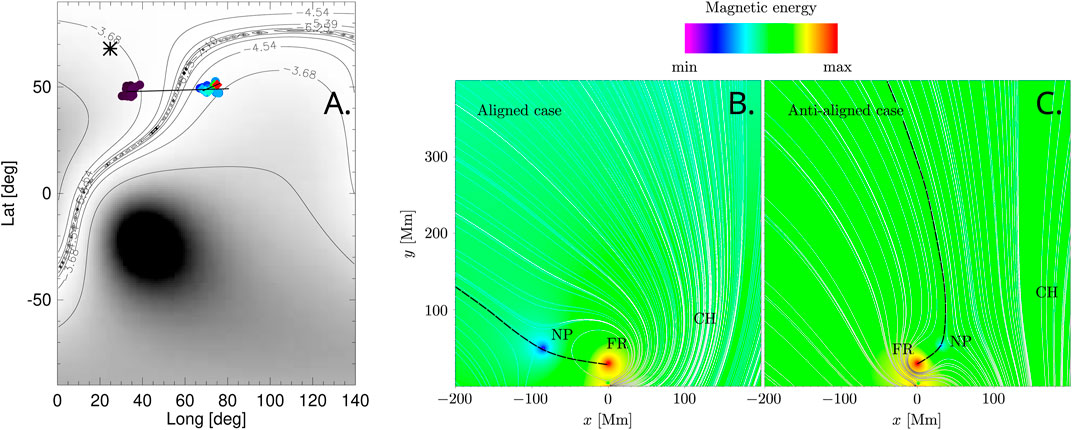
FIGURE 1. (A) Anomalous behaviour of a CME flux rope that is overshooting the HCS (figure extracted from Sieyra et al., 2020). Figure reproduced with the permission of the Solar Physics journal. The black lines are contours of magnetic energy density, with the thick line representing the HCS location. The colored circles represent the location of filament (purple, at lower heights) and CME (other colors, larger heights) (figure adapted from Sahade et al., 2020) figure adapted from figure 8 Sahade et al., 2020 © AAS. Reproduced with permission. (B) Typical behaviour of CME deflection moving away from a CH. (C) Atypical deflection showing the approach of the CME flux rope to the CH and later moving away (figure adapted from Sahade et al., 2021). Figure adapted from figure 4 of Sahade et al., 2021 reproduced with permission © ESO.
Other specific and significant studies consider more complex configurations as, e.g., the collision between CMEs, which has been studied by Colaninno and Vourlidas (2015), and Lugaz et al. (2012) or the interaction between various structures, which has been analysed by Pick et al. (2016).
As noted above, two families of structures can be recognised in the search for phenomenological causes of CME deflections. The repulsors are associated with open magnetic field line structures like CHs and strong magnetic field structures like ARs, while the attractors include HCSs, PSs, and HSs whose structures contain regions of low magnetic energy. Still, atypical behaviours are repeatedly identified in particular events. It appears that the explanations based on repulsors and attractors, while providing a useful approximation to describe general behaviours, are oversimplified when it comes to understanding the underlying causes of the deviations. The complexities of the phenomena involved require taking into account various factors and mechanisms contributing to the deflections.
3 Modelling and simulations studies
Articles that simulate the ejection of specific events to address CME deflection abound in the literature. These studies exploit numerical modelling to explain the factors responsible for deflecting observed CMEs.
One of the fundamental aspects that have been studied is the role of magnetic forces. For instance, Lugaz et al. (2011) found that these forces are the main responsible for the deviation of a CME when the ejection occurs inside an AR. In particular, the magnetic pressure forces found in numerical simulations having low magnetic energy regions of PS and HS explained the deflection of two successive eruptions (Zuccarello et al., 2012; Bemporad et al., 2012). In this line of analysis, and accounting for a more dynamic description of the process, Lynch and Edmondson (2013) showed that the breakout current sheet (initiated by the PS null-point distortion) acts as a path of least resistance due to an imbalance in the magnetic energy density of the surrounding region. This results in a non-radial deflection of the CME at an early stage of sympathetic eruptions. Jin et al. (2017) argued that magnetic pressure gradient and magnetic tension effects could cause the CME deviation away from a nearby CH shown by their simulation. On the other hand, Wyper et al. (2021) found that the deflection occurs as a result of the erupting structure propagating along the HS magnetic field lines, rather than being solely influenced by magnetic pressure gradients.
Another group of models aim, through parametric studies, to describe scenarios in which a CME interacts with another magnetic structure in order to describe deviations from the radial trajectory using few magnetic parameters. Kay et al. (2013, 2015) developed and improved the ForeCAT (Forecasting a CME’s Altered Trajectory) model to study the CME deflection all the way from the Sun to 1AU. The model takes into account the background magnetic field (including the solar wind) and the properties of the CME, as mass, speed, size and magnetic field to calculate the magnetic forces. In the space of these parameters, various combinations yield a range of deflections. There is, however, a trend for slow and wide CMEs with low mass to experience the largest deflections. With regard to the neighbouring magnetic structures they found that the strong magnetic gradients around the ARs are responsible for the CME deflection, as well as streamer belts can act like potential wells that attract the bulk of the CMEs. In a study by Sahade et al. (2020) they performed 2.5D MHD numerical simulations using the FLASH code (Fryxell et al., 2000) to analyse the influence of CH parameters on CME deflection. In agreement with observational studies, the numerical analysis showed that intense magnetic fields in CHs, as well as wider and closer CHs, result in a greater deflection during CME initiation. These findings are associated with the proximity of the magnetic null point to the source region. The combined magnetic field of the FR configuration and CH creates a region of low magnetic energy that extends beyond the FR and CH structures when their polarities are parallel (see panel B of Figure 1). As a result, the CME consistently moves away from the CH. Conversely, in cases where the polarities are opposite, as studied in the work by Sahade et al. (2021), the location of the null point region lies between the CH and the FR. The CME initially deviates towards the CH but is subsequently redirected away from it by the global magnetic structure (see panel C of the figure). This explanation aligns with some atypical events where a CME experiences a double deflection. The authors attributed the deflection of the CME primarily to the location of the null point region. In this line, Sahade et al. (2022) focused on investigating the influence of a PS null point on the trajectory of a CME. They found a second null point region due to the FR. The research showed that the closer null point is responsible for the initial deflection, after which the CME follows a path towards the position of the further null point.
By modelling specific cases through simulations, it is possible to explore different scenarios and conditions, modify parameters, and observe how the system behaves in each case. This allows for studying its dynamics, identifying patterns, predicting results, and making informed decisions based on the obtained outcomes. As evidenced in the literature, numerical simulations play a crucial role in elucidating the factors that contribute to CME deflection, particularly in controversial cases. A notable example is the effect of the change in relative magnetic polarity between a CH and a CME, which provides a plausible explanation for both the approach and retreat of a CME with respect to a CH.
4 Conclusion and future perspective
The current state of knowledge on the subject has been reached through a combination of observations, theoretical analyses, and simulations. These are some of the factors that have contributed to the progressive understanding of the phenomenon.
Systematic observational studies, such as those by Xie et al. (2009); Wang et al. (2011); Bosman et al. (2012); Panasenco et al. (2013); Wang et al. (2020); Sieyra et al. (2020), demonstrate the challenge of fitting the rich phenomenology into well-established regularities. There are always cases that defy any attempt at classification.
Computational simulations have played a crucial role in advancing our knowledge of CMEs. Using complex mathematical models, simulations have been conducted to replicate the conditions and dynamics that govern their behaviour. Some numerical efforts to model deflections have been made to replicate specific observed cases. Also, parametric numerical studies have allowed us to understand the relative importance of characteristic physical parameters such as, magnetic field intensity, proximity, and area or size of the surrounding structures. Other numerical studies have shed light on certain puzzling aspects of this phenomenology by explaining them in terms of a few key physical parameters. These parameters include the location of the magnetic energy minima in the surroundings, the relative magnetic polarity between the CME source and the neighbouring magnetic structure (such as CH and PS), and the subsequent collimation of the CME by the ambient magnetic field.
A synthesis that becomes evident from this mini-review is that, when considering low coronal heights, the dynamics of CMEs are primarily governed by magnetic forces. In this context, as proposed by Sahade et al. (2020); Sahade et al. (2021); Sahade et al. (2022), regions with low magnetic energy act as attractors for the motion of CMEs. As observed, the location of these regions can determine whether the CME would always move away (with a certain polarity), but simply changing the relative polarity with respect to the neighbouring structure, can alter the position of the minimum, leading to an unexpected behaviour of the CME. Consequently, the concept of repulsors is not applicable in this case, as the repulsion is solely determined by the position of the minimum.
However, it is important to note that these considerations do not account for all the possible factors that can contribute to the deflection of a CME trajectory. Observational studies have revealed that in a dynamically and magnetically complex coronal environment, other factors also come into play. These factors include magnetic reconnections that alter the magnetic topology, the inertia of an energised CME, the twist within the CME flux rope, and various other dynamic effects. Therefore, to fully understand and explain the deflection of CME trajectories, these and probably other additional factors need to be taken into consideration to achieve more precise and realistic representations of CME deflections. Multi-viewpoint observations at various wavelengths, with suitable spatial and temporal coverage, hold the key to identifying and better characterising the factors involved, their interplay and importance.
Observations and simulations together, have contributed to improving our understanding of CMEs and have led to the current state of knowledge on this phenomenon. However, due to the complexity of the subject, the study of CMEs remains an active research field, and further advances are expected in the future.
Author contributions
MC: Conceptualization, Investigation, Software, Supervision, Writing–original draft, Writing–review and editing. AC: Conceptualization, Investigation, Methodology, Supervision, Writing–review and editing. HC: Conceptualization, Data curation, Investigation, Methodology, Supervision, Writing–review and editing. GS: Validation, Visualization, Writing–review and editing.
Funding
The authors declare financial support was received for the research, authorship, and/or publication of this article. MC, AC, and HC are members of the Carrera del Investigador Científico (CONICET). MC and AC acknowledge support PIP-CONICET under grant number No. 11220200103150CO. HC and MC are supported by project PICT-2021-GRF-TI-00803 (ANPCyT), while HC is supported by projects PIP11220200102710CO (CONICET) and MSTCAME0008181TC (UTN). GS was supported by NASA Grant 80NSSC-22K0970.
Conflict of interest
The authors declare that the research was conducted in the absence of any commercial or financial relationships that could be construed as a potential conflict of interest.
Publisher’s note
All claims expressed in this article are solely those of the authors and do not necessarily represent those of their affiliated organizations, or those of the publisher, the editors and the reviewers. Any product that may be evaluated in this article, or claim that may be made by its manufacturer, is not guaranteed or endorsed by the publisher.
References
Amari, T., Luciani, J. F., Mikic, Z., and Linker, J. (2000). A twisted flux rope model for coronal mass ejections and two-ribbon flares. ApJL 529, L49–L52. doi:10.1086/312444
Antiochos, S. K., DeVore, C. R., and Klimchuk, J. A. (1999). A model for solar coronal mass ejections. ApJ 510, 485–493. doi:10.1086/306563
Bemporad, A., Zuccarello, F. P., Jacobs, C., Mierla, M., and Poedts, S. (2012). Study of multiple coronal mass ejections at solar minimum conditions. Sol. Phys. 281, 223–236. doi:10.1007/s11207-012-9999-3
Bi, Y., Jiang, Y., Yang, J., Zheng, R., Hong, J., Li, H., et al. (2013). Analysis of the simultaneous rotation and non-radial propagation of an eruptive filament. ApJ 773, 162. doi:10.1088/0004-637X/773/2/162
Bosman, E., Bothmer, V., Nisticò, G., Vourlidas, A., Howard, R. A., and Davies, J. A. (2012). Three-Dimensional properties of coronal mass ejections from STEREO/SECCHI observations. Sol. Phys. 281, 167–185. doi:10.1007/s11207-012-0123-5
Cécere, M., Sieyra, M. V., Cremades, H., Mierla, M., Sahade, A., Stenborg, G., et al. (2020). Large non-radial propagation of a coronal mass ejection on 2011 January 24. Adv. Space Res. 65, 1654–1662. doi:10.1016/j.asr.2019.08.043
Colaninno, R. C., and Vourlidas, A. (2015). Using multiple-viewpoint observations to determine the interaction of three coronal mass ejections observed on 2012 march 5. ApJ 815, 70. doi:10.1088/0004-637X/815/1/70
Cremades, H., and Bothmer, V. (2004). On the three-dimensional configuration of coronal mass ejections. A&A 422, 307–322. doi:10.1051/0004-6361:20035776
Cremades, H., Bothmer, V., and Tripathi, D. (2006). Properties of structured coronal mass ejections in solar cycle 23. Adv. Space Res. 38, 461–465. doi:10.1016/j.asr.2005.01.095
Forbes, T. G. (1990). Numerical simulation of a catastrophe model for coronal mass ejections. JGR 95, 11919–11931. doi:10.1029/JA095iA08p11919
Fryxell, B., Olson, K., Ricker, P., Timmes, F. X., Zingale, M., Lamb, D. Q., et al. (2000). Flash: an adaptive mesh hydrodynamics code for modeling astrophysical thermonuclear flashes. Astrophysical J. Suppl. Ser. 131, 273–334. doi:10.1086/317361
Gibson, S. E., and Low, B. C. (1998). A time-dependent three-dimensional magnetohydrodynamic model of the coronal mass ejection. ApJ 493, 460–473. doi:10.1086/305107
Gopalswamy, N., Mäkelä, P., Akiyama, S., Yashiro, S., Xie, H., and Thakur, N. (2018). Sun-to-earth propagation of the 2015 June 21 coronal mass ejection revealed by optical, EUV, and radio observations. J. Atmos. Solar-Terrestrial Phys. 179, 225–238. doi:10.1016/j.jastp.2018.07.013
Gopalswamy, N., Mäkelä, P., Xie, H., Akiyama, S., and Yashiro, S. (2009). CME interactions with coronal holes and their interplanetary consequences. J. Geophys. Res. (Space Phys. 114, A00A22. doi:10.1029/2008JA013686
Gui, B., Shen, C., Wang, Y., Ye, P., Liu, J., Wang, S., et al. (2011). Quantitative analysis of CME deflections in the corona. Sol. Phys. 271, 111–139. doi:10.1007/s11207-011-9791-9
Hansen, R. T., Garcia, C. J., Grognard, R. J. M., and Sheridan, K. V. (1971). A coronal disturbance observed simultaneously with a white-light corona-meter and the 80 MHz Culgoora radioheliograph. Proc. Astronomical Soc. Aust. 2, 57–60. doi:10.1017/S1323358000012856
Jiang, Y., Yang, J., Zheng, R., Bi, Y., and Yang, X. (2009). A narrow streamer-puff coronal mass ejection from the nonradial eruption of an active-region filament. ApJ 693, 1851–1858. doi:10.1088/0004-637X/693/2/1851
Jiang, Y., Yang, L., Li, K., and Shen, Y. (2007). Magnetic interaction: an erupting filament and a remote coronal hole. ApJL 667, L105–L108. doi:10.1086/521949
Jin, M., Manchester, W. B., van der Holst, B., Sokolov, I., Tóth, G., Vourlidas, A., et al. (2017). Chromosphere to 1 au simulation of the 2011 march 7th event: A comprehensive study of coronal mass ejection propagation. ApJ 834, 172. doi:10.3847/1538-4357/834/2/172
Kay, C., Gopalswamy, N., Xie, H., and Yashiro, S. (2017). Deflection and rotation of CMEs from active region 11158. Sol. Phys. 292, 78. doi:10.1007/s11207-017-1098-z
Kay, C., Opher, M., and Evans, R. M. (2013). Forecasting a coronal mass ejection’s altered trajectory: foreCAT. ApJ 775, 5. doi:10.1088/0004-637X/775/1/5
Kay, C., Opher, M., and Evans, R. M. (2015). Global trends of CME deflections based on CME and solar parameters. ApJ 805, 168. doi:10.1088/0004-637X/805/2/168
Liewer, P., Panasenco, O., Vourlidas, A., and Colaninno, R. (2015). Observations and analysis of the non-radial propagation of coronal mass ejections near the Sun. Sol. Phys. 290, 3343–3364. doi:10.1007/s11207-015-0794-9
Lugaz, N., Downs, C., Shibata, K., Roussev, I. I., Asai, A., and Gombosi, T. I. (2011). Numerical investigation of a coronal mass ejection from an anemone active region: reconnection and deflection of the 2005 august 22 eruption. ApJ 738, 127. doi:10.1088/0004-637X/738/2/127
Lugaz, N., Farrugia, C. J., Davies, J. A., Möstl, C., Davis, C. J., Roussev, I. I., et al. (2012). The deflection of the two interacting coronal mass ejections of 2010 may 23-24 as revealed by combined in situ measurements and heliospheric imaging. ApJ 759, 68. doi:10.1088/0004-637X/759/1/68
Lynch, B. J., and Edmondson, J. K. (2013). Sympathetic magnetic breakout coronal mass ejections from pseudostreamers. ApJ 764, 87. doi:10.1088/0004-637X/764/1/87
MacQueen, R. M., Hundhausen, A. J., and Conover, C. W. (1986). The propagation of coronal mass ejection transients. JGR 91, 31–38. doi:10.1029/JA091iA01p00031
Majumdar, S., Pant, V., Patel, R., and Banerjee, D. (2020). Connecting 3D evolution of coronal mass ejections to their source regions. ApJ 899, 6. doi:10.3847/1538-4357/aba1f2
Mikic, Z., and Linker, J. A. (1994). Disruption of coronal magnetic field arcades. ApJ 430, 898. doi:10.1086/174460
Möstl, C., Rollett, T., Frahm, R. A., Liu, Y. D., Long, D. M., Colaninno, R. C., et al. (2015). Strong coronal channelling and interplanetary evolution of a solar storm up to Earth and Mars. Nat. Commun. 6, 7135. doi:10.1038/ncomms8135
Panasenco, O., Martin, S. F., Velli, M., and Vourlidas, A. (2013). Origins of rolling, twisting, and non-radial propagation of eruptive solar events. Sol. Phys. 287, 391–413. doi:10.1007/s11207-012-0194-3
Pick, M., Stenborg, G., Démoulin, P., Zucca, P., and Lecacheux, A. (2016). Homologous solar events on 2011 january 27: build-up and propagation in a complex coronal environment. ApJ 823, 5. doi:10.3847/0004-637X/823/1/5
Regnault, F., Strugarek, A., Janvier, M., Auchère, F., Lugaz, N., and Al-Haddad, N. (2023). Eruption and propagation of twisted flux ropes from the base of the solar corona to 1 au. A&A 670, A14. doi:10.1051/0004-6361/202244483
Sahade, A., Cécere, M., Costa, A., and Cremades, H. (2021). Polarity relevance in flux-rope trajectory deflections triggered by coronal holes. A&A 652, A111. doi:10.1051/0004-6361/202141085
Sahade, A., Cécere, M., and Krause, G. (2020). Influence of coronal holes on CME deflections: numerical study. ApJ 896, 53. doi:10.3847/1538-4357/ab8f25
Sahade, A., Cécere, M., Sieyra, M. V., Krause, G., Cremades, H., and Costa, A. (2022). Pseudostreamer influence on flux rope evolution. A&A 662, A113. doi:10.1051/0004-6361/202243618
Sarkar, R., Srivastava, N., Mierla, M., West, M. J., and D’Huys, E. (2019). Evolution of the coronal cavity from the quiescent to eruptive phase associated with coronal mass ejection. ApJ 875, 101. doi:10.3847/1538-4357/ab11c5
Schrijver, C. J., and De Rosa, M. L. (2003). Photospheric and heliospheric magnetic fields. Sol. Phys. 212, 165–200. doi:10.1023/A:1022908504100
Shen, C., Wang, Y., Gui, B., Ye, P., and Wang, S. (2011). Kinematic evolution of a slow CME in corona viewed by STEREO-B on 8 october 2007. Sol. Phys. 269, 389–400. doi:10.1007/s11207-011-9715-8
Sieyra, M. V., Cécere, M., Cremades, H., Iglesias, F. A., Sahade, A., Mierla, M., et al. (2020). Analysis of large deflections of prominence-CME events during the rising phase of solar cycle 24. Sol. Phys. 295, 126. doi:10.1007/s11207-020-01694-0
Titov, V. S., and Démoulin, P. (1999). Basic topology of twisted magnetic configurations in solar flares. A&A 351, 707–720.
Török, T., and Kliem, B. (2005). Confined and ejective eruptions of kink-unstable flux ropes. ApJL 630, L97–L100. doi:10.1086/462412
Wang, J., Hoeksema, J. T., and Liu, S. (2020). The deflection of coronal mass ejections by the ambient coronal magnetic field configuration. J. Geophys. Res. (Space Phys. 125, e27530. doi:10.1029/2019JA027530
Wang, R., Liu, Y. D., Dai, X., Yang, Z., Huang, C., and Hu, H. (2015). The role of active region coronal magnetic field in determining coronal mass ejection propagation direction. ApJ 814, 80. doi:10.1088/0004-637X/814/1/80
Wang, Y., Chen, C., Gui, B., Shen, C., Ye, P., and Wang, S. (2011). Statistical study of coronal mass ejection source locations: understanding CMEs viewed in coronagraphs. J. Geophys. Res. (Space Phys. 116, A04104. doi:10.1029/2010JA016101
Wyper, P. F., Antiochos, S. K., DeVore, C. R., Lynch, B. J., Karpen, J. T., and Kumar, P. (2021). A model for the coupled eruption of a pseudostreamer and helmet streamer. ApJ 909, 54. doi:10.3847/1538-4357/abd9ca
Xie, H., Cyr, St.O. C., Gopalswamy, N., Yashiro, S., Krall, J., Kramar, M., et al. (2009). On the origin, 3D structure and dynamic evolution of CMEs near solar minimum. Sol. Phys. 259, 143–161. doi:10.1007/s11207-009-9422-x
Yang, J., Dai, J., Chen, H., Li, H., and Jiang, Y. (2018). Filament eruption with a deflection of nearly 90 degrees. ApJ 862, 86. doi:10.3847/1538-4357/aaccfd
Yang, J., Jiang, Y., Bi, Y., Li, H., Hong, J., Yang, D., et al. (2012). An over-and-out halo coronal mass ejection driven by the full eruption of a kinked filament. ApJ 749, 12. doi:10.1088/0004-637X/749/1/12
Yang, J., Jiang, Y., Xu, Z., Bi, Y., and Hong, J. (2015). Interchange reconnection forced by the filament eruption inside a pseudo-streamer. ApJ 803, 68. doi:10.1088/0004-637X/803/2/68
Yurchyshyn, V., Yang, X., Nita, G., Fleishman, G., Abramenko, V., Inoue, S., et al. (2022). Magnetic field Re-configuration associated with a slow rise eruptive X1.2 flare in NOAA active region 11944. Front. Astronomy Space Sci. 9, 816523. doi:10.3389/fspas.2022.816523
Keywords: sun: coronal mass ejections (CMEs), CMEs: initiation and propagation, CMEs: low coronal signatures, magnetic fields: corona, methods: numerical and observational
Citation: Cécere M, Costa A, Cremades H and Stenborg G (2023) Recent insights on CME deflections at low heights. Front. Astron. Space Sci. 10:1260432. doi: 10.3389/fspas.2023.1260432
Received: 17 July 2023; Accepted: 04 September 2023;
Published: 27 September 2023.
Edited by:
Maria Ann Weber, Delta State University, United StatesReviewed by:
Emilia Kilpua, University of Helsinki, FinlandCopyright © 2023 Cécere, Costa, Cremades and Stenborg. This is an open-access article distributed under the terms of the Creative Commons Attribution License (CC BY). The use, distribution or reproduction in other forums is permitted, provided the original author(s) and the copyright owner(s) are credited and that the original publication in this journal is cited, in accordance with accepted academic practice. No use, distribution or reproduction is permitted which does not comply with these terms.
*Correspondence: A. Costa, YWNvc3RhQHVuYy5lZHUuYXI=